Regulation of VoIP Services:
Access to the Emergency Services
Statement and publication of a statutory notification
under section 48(1) of the Communications Act 2003
modifying General Condition 4
Statement
Contents
Section
Page
1
Executive Summary
1
2
Introduction
7
3
Background
8
4
Policy decision
18
5
Mandating access to the Emergency Services
47
6
Summary of the Impact Assessment 66
7
Modifying General Condition 4: Emergency Call Numbers 72
8
Next Steps 75
Annex
Page
1
Modification to General Condition 4 79
2
Modification to General Condition 4 of the General Conditions of
Entitlement 80
3
Responses Received
82
Section 1
1
Executive Summary
Introduction
1.1 Ofcom is the independent regulator of television, radio, telecommunications and wireless communications services in the UK. This Statement sets out our approach to regulating access to the emergency services from Voice over Internet Protocol services (VoIP services). It follows the July 2007 Consultation Regulation of VoIP Services: Access to the Emergency Services.
1.2 In that Consultation, Ofcom identified a high level of consumer and citizen confusion about access to the emergency services from VoIP services. That confusion means there is a risk of someone trying to make an emergency call from a service that does not provide access. Although most users can reach for another phone to make emergency calls, a delay of seconds can result in increased harm. Given this risk, and the recent rapid growth in the use of VoIP services, we consider it’s time to act.
1.3 Ofcom has therefore decided to require certain categories of VoIP service to provide access to the emergency services, broadly in accordance with the proposals set out in the Consultation. Our decision aims to avoid the risk of delays in contacting the emergency services by regulating VoIP services that consumers and citizens may try to use to call the emergency services.
1.4 The new requirement will enter into force on 8 September 2008.
1.5 This Statement sets out a summary of significant responses to the Consultation, Ofcom’s view of those responses, and Ofcom’s regulatory decision.
1.6 This Statement is primarily aimed at providers of VoIP services that allow users to call normal fixed or mobile phone numbers; consumers of VoIP services and other citizens; the emergency services and Government departments concerned with public safety, crime prevention and detection.
1.7 This Statement is also relevant to access to the emergency services over Next Generation Access (NGA) networks because they are likely to replace PSTN voice call services with VoIP. Ofcom published a consultation on Future broadband - Policy approach to next generation access on 26 October 2007 and proposed to carry out a specific consultation on NGA in new build developments around the end of 20071.
VoIP voice call services
1.8 Traditional phone services have existed for over 100 years. Voice services using VoIP are changing the way voice services are delivered. These services normally use VoIP technology to provide voice calls using fixed or wireless broadband connected to PC with a handset or headset, a Personal Digital Assistant (PDA, a handheld computer), a mobile phone handset or a fixed phone handset with an analogue telephone adapter (ATA) or router. VoIP services can benefit customers by reducing the cost of existing services, providing new services and increasing
competition in telephony and broadband. Ofcom aims to ensure that, as voice call services evolve, consumers and citizens are protected.
1
Calling the emergency services
1.9 One of the most important features of traditional phone services is that they enable users to call the emergency services. The UK’s 999 emergency call service from fixed phones, the first of its kind in the world, was launched in 1937 and extended to all major towns and cities by 1948. The 999 service was introduced for mobile phone users in 1986. In 1991, the European Union established a single emergency call number, 112, which can be used anywhere in the European Union to call the emergency services (so in the UK the emergency services can be reached on 999 and 112)2. BT currently handles around 30 million emergency calls a year from fixed and mobile phones.
The regulatory and policy background
3
1.10 General Condition 4 requires PATS providers to ensure that any end-user can access the emergency services by calling 999 and 112 at no charge and, to the extent technically feasible, make caller location information available to the emergency organisations handling those calls.
1.11 All fixed and mobile PSTN services allow users to access the emergency services. Some VoIP services allow users to do so but others do not. VoIP has introduced one-way services that allow users to make calls to traditional fixed or mobile phones but not to receive calls (called type 2 VoIP services); they aren’t caught by the definition of PATS or General Condition 4. Regarding VoIP services that allow users to make calls to and receive calls from traditional fixed or mobile phones (called type 4 services), the Universal Service Directive 2002/22/EC provided a definition of PATS that included “access to the emergency services”, creating circularity; PATS services must allow access to the emergency services, but allowing access to the emergency services is part of the PATS definition.
1.12 Ofcom is concerned that consumers and citizens are confused about whether they can call 999 / 112 from VoIP services. That could cause delays in contacting the emergency services, which could result in increased harm.
1.13 Ofcom has run three consultations on regulating VoIP services: New Voice Services: a Consultation and Interim Guidance, 6 October 20044 (the 2004 Consultation); Regulation of VoIP Services, 22 February 20065 (the 2006 Consultation), followed by a Statement on the Regulation of VoIP Services, 29 March 20076 (the March 2007
2
Council Decision of 29 July 1991 (91/396/EEC) and Directive 2002/22/EC (Universal Services Directive) of 7 March 2002. EU member states are required to ensure all end-users of publicly available telephony services (PATS, see footnote 11) and public pay phones are able to call the emergency services free of charge using 112, in addition to any national emergency call numbers. 3
In summary, PATS are defined as (i) a service available to the public (i.e. a PECS) (ii) for making and receiving national and international calls and (iii) accessing emergency services (iv) through a national or international phone number on a numbering plan. Those four points are known as the “gating criteria” for the PATS definition. For the full definition, see Article 2(c) of the Universal Services Directive (2002/20/EC) and Ofcom General Conditions (Schedule to the Notification under Section 48(1) of the Communications Act 2003) Part 1 para.1 and GC 18.
4
http://www.ofcom.org.uk/consult/condocs/new_voice/anew_voice/ 5
http://www.ofcom.org.uk/consult/condocs/voipregulation/ 6
Statement on the Regulation of VoIP Services, Ofcom, 29 March 2007
Statement); and Regulation of VoIP Services: Access to Emergency Services, 26 July 2007 (the July 2007 Consultation)7, followed by this Statement.
1.14 Regarding the ability to call 999 / 112 from VoIP services, in the 2004 Consultation Ofcom set out the policy aim of ensuring consumers are properly informed and protected about 999 / 112 access. In the 2006 Consultation, Ofcom added the objective of ensuring the maximum availability of high quality 999 / 112 access as voice call services and technology change.
8
1.15 To meet those aims, Ofcom mandated compliance with a Code of Practice drafted by an industry-Ofcom working group requiring VoIP providers to give their domestic and small business customers information about differences between VoIP services and traditional fixed and mobile phone services. VoIP providers also had to provide labels on-screen or for equipment and an automated message indicating if users could not call 999 / 112.
9
1.16 Additionally, Ofcom provided Guidelines to help VoIP providers to comply with requirements about the reliability of calls to 999 / 112 and providing caller location information for use by the emergency services.
10
1.17 Finally, Ofcom clarified a requirement that defines the types of voice call provider that are entitled to number portability, which enables consumers to keep their phone number when they change provider. We noted the clarification might act as an incentive for providers to offer 999 / 112 access, in order to secure the benefits of number portability, but might not lead to all providers offering 999 / 112 access.
The policy challenge
1.18 In its March 2007 Statement, Ofcom decided to review its approach to ensuring maximum availability of 999 / 112 access. That was because:
• since the 2006 consultation, there had been a rapid increase in the use of VoIP services: an estimated 10% of UK households used VoIP in the last quarter of 2006, compared to 5% in the last quarter of 200511;
• significant developments in VoIP services and technology meant they were more likely to “look and feel” like traditional fixed and mobile phone services and to replace those services for the mass market in the future;
• there was under provision of VoIP services that allowed 999 / 112 calls: in a survey of VoIP users conducted for Ofcom in October 2006 (the October 2006 research) 64% were with a provider that did not offer 999 or 112 access12; • a significant proportion of VoIP users were confused about whether they could
call the emergency services from their service or not: in October 2006 research,
7
http://www.ofcom.org.uk/consult/condocs/voip/voip.pdf 8
Code on the provision by Service Providers of consumer information to Domestic and Small Business Customers for the provision of Services, which entered into force on 29 May 2007. 9
Guidelines on the application of PATS obligations to VoIP service providers, which entered into force on 29 March 2007.
10
General Condition 18. 11
Source: Ofcom communications tracking survey Q.4 2006. 12
More information about the results of the quarterly Ofcom communications tracking survey for Q.4 2006 and the October 2006 research are available in the Ofcom Research Report: Voice over Internet Protocol (VoIP), www.ofcom.org.uk.
78% of UK households surveyed were not with a VoIP service that provided emergency services access but thought that they could access it or didn’t know; • responses to the 2006 Consultation from the emergency services, Government,
the Royal National Institute of Blind People (RNIB) and the Royal National Institute for Deaf People (RNID) expressed similar concerns to Ofcom.
1.19 Therefore, Ofcom undertook to consult further in summer 2007 on 999 / 112 access over VoIP and in particular on whether, and if so how, certain VoIP services should be required to offer 999 / 112 access. The July 2007 Consultation met that
commitment. In assessing the need to require 999 / 112 access, Ofcom said it would carefully consider the possible impact on competition and on market entry and innovation by VoIP providers.
The July 2007 Consultation: policy objectives and options
1.20 The key policy objective of the July 2007 Consultation was to ensure a high level of access to the 999 / 112 emergency call service. We considered two policy options: • Option 1: do not require VoIP services to allow 999 / 112 calls; and
• Option 2: require all VoIP services that allow users to make calls to traditional fixed or mobile phones (type 2 VoIP services), or to make calls to and receive calls from traditional fixed or mobile phones (type 4 services), to allow users to call 999 / 112. Ofcom considered the users of those services were likely to expect to be able to call 999 / 112.
1.21 To implement Option 2, Ofcom proposed extending the scope of General Condition 4 from PATS to all PECS13 that allow users to make calls to traditional fixed and mobile phones using national and international numbers. That would cover type 2 and type 4 VoIP services.
1.22 In the Consultation, Ofcom recommended implementing Option 2. In addition to the reasons set out in the March 2007 Statement, research suggested that customer information was unlikely to be enough to tackle under provision or consumer and citizen confusion; Ofcom’s Impact Assessment of the potential costs and benefits of Option 2 estimated there would be significant benefits for consumers and citizens, which would exceed the costs of compliance for the VoIP providers concerned and competition and innovation would not be significantly affected.
This Statement
1.23 In this Statement, Ofcom summarises significant responses to the July 2007 Consultation, provides its views on those responses and sets out its decision to adopt policy Option 2.
1.24 We have refined the drafting of the modification to General Condition 4 implementing Option 2 since the July 2007 Consultation to more accurately reflect the policy intention behind the requirement.
13
Public Electronic Communications Service: a service that uses a network and any associated apparatus, software or stored data to transmit signals, excluding content services, and that is available to the public. Section 32 Communications Act 2003 and Art. 2 Framework Directive 2002/21/EC.
1.25 Firstly, we have excluded “Click to Call” services. They are a form of VoIP service that may be selected on a web-site or other application by a user and connect the user only to a number or a limited set of numbers pre-selected by the provider or a user.
1.26 Secondly, the requirement now relates to services that allow calls to national
numbers (and not national and international numbers). That means it covers services that allow calls to national or to national and international numbers, to ensure that services that allow calls to national numbers only are caught by the requirement and to exclude services that allow calls to international numbers only.
1.27 We have excluded “Click to Call” and international-only services because we
consider consumers and citizens are not at material risk of confusion about whether they provide 999 / 112 access.
1.28 The modification to General Condition 4 will enter into force on 8 September 2008, meaning that there is a 9-month period in which to comply.
Complying with the requirement to provide 999 / 112 access
1.29 Under the modification to GC 4, all type 2 and type 4 VoIP services, except “Click to Call” services, that allow users to make calls to national numbers, must provide 999 / 112 access at no charge14.
1.30 By 8 September 2008, affected providers that do not currently provide 999 / 112 access must do so and meet requirements on providing caller location information to the emergency organisations handling the calls.
1.31 Providers should take into account the Guidelines explaining how VoIP providers should provide caller location information and how they should take steps to maintain a reliable service. This Statement provides further information on following the
Guidelines in Section 5.
1.32 Additionally, providers should comply with the Code of Practice on how VoIP providers should inform domestic and small business customers about their 999 / 112 service and any limitations. We will update the Code of Practice to coincide with the deadline for providing 999 / 112 access.
1.33 Type 4 providers are likely to meet the definition of PATS as a result of providing 999 / 112 access. They must also comply with other obligations on network integrity; emergency planning; operator access and directories; publishing prices, tariffs and terms and conditions; billing accuracy; itemised billing; non-payment of bills; special measures for end-users with disabilities.
1.34 Ofcom will enforce and review its policy to ensure VoIP providers are compliant and to see if its regulations need to be adapted.
Structure of this Statement
1.35 In this Statement, a summary of the significant responses to the July 2007
Consultation and Ofcom’s views on those are included within the relevant sections.
14
1.36 Section 3 provides an overview of VoIP services and the growth of VoIP service provision and take-up. It also sets out the regulatory framework and policy
background to this Statement. Section 4 summarises Ofcom’s policy objectives, sets out the two policy options for meeting those objectives considered in the July 2007 Consultation and explains Ofcom’s reasoning for refining and adopting one of those Options. Section 5 considers some of the practicalities for VoIP providers when complying with the new policy, including information on following the Guidelines and the Code of Practice. Section 6 provides a summary of Ofcom’s Impact Assessment, which estimated the costs and benefits of Ofcom’s policy proposals. Section 7 and Annex 1 describe the modification that Ofcom has made to its requirements in order to implement policy Option 2. Section 8 describes the next steps after this Statement, including the deadline for compliance and Ofcom’s planned approach to monitoring, review and enforcement. There is a Glossary in Annex 3.
Section 2
2
Introduction
2.1 The 26 July 2007 Consultation Regulation of VoIP Services: Access to the
Emergency Services (the July 2007 Consultation) identified a risk that citizens and consumers are confused about 999 / 112 access over VoIP, which may cause delays in contacting the emergency services and increased harm or loss of life. All traditional fixed and mobile services provide access to the emergency services. Some VoIP services do; others do not.
2.2 The July 2007 Consultation contained two proposals for regulating access to the emergency services over VoIP:
15
• Option 1: do not require VoIP services to allow 999 / 112 calls; and
• Option 2: require all VoIP services that allow users to make calls out to traditional fixed phones or mobile phones (called type 2 VoIP services), or to and from traditional fixed phones or mobile phones (called type 4 VoIP services), to allow users to call 999 / 112.
2.3 This Statement sets out a summary of significant responses to the July 2007 Consultation, Ofcom’s view of those responses, and Ofcom’s regulatory decision to implement Option 2, with modifications made in light of its evaluation of the
responses.
2.4 Our decision to adopt a modified version of Option 2 is consistent with our principal duty16 to further the interests of citizens and consumers because it is likely to reduce the risk of confusion about 999 / 112 access over VoIP and delays in contacting the emergency services. The Impact Assessment in the July 2007 Consultation
estimated that the benefits of Option 2 for citizens and consumers would significantly outweigh compliance costs for industry, and competition and innovation would not be significantly affected. The modification will enter into force on 8 September 2008.
2.5 This Statement is primarily aimed at providers of VoIP services that allow users to call normal fixed or mobile phone numbers; consumers of VoIP services and other citizens; the emergency services and Government departments concerned with public safety, crime prevention and detection.
2.6 It is also relevant to access to the emergency services over Next Generation Access (NGA) networks because they are likely to replace PSTN voice call services with VoIP. Ofcom published a consultation on Future broadband - Policy approach to next generation access on 26 October 2007 and proposed to carry out a specific
consultation on NGA in new build developments around the end of 200717.
15
112 is the single European emergency call number established by Council Decision of 29 July 1991 (91/396/EEC) and Directive 2002/22/EC (Universal Services Directive) of 7 March 2002. EU member states are required to ensure all end-users of PATS and public pay phones are able to call the emergency services free of charge using 112, in addition to any national emergency call numbers. 16
Communications Act 2003, Chapter 21, Part 1, Art. 3. 17
Section 3
3
Background
Introduction
3.1 This section provides an overview of VoIP services and the growth of VoIP service provision and take-up. It also sets out the regulatory framework and policy
background to the consultation Regulation of VoIP Services: Access to the
Emergency Services, 26 July 200718, including New Voice Services: a Consultation and Interim Guidance, 6 October 200419 (the 2004 Consultation) and Regulation of VoIP Services, 22 February 200620 (the 2006 Consultation) followed by a regulatory Statement on the Regulation of VoIP Services, 29 March 200721 (the March 2007 Statement).
3.2 In line with Ofcom’s policy objective of ensuring a high level of access to the emergency services (999 / 112 access22), the March 2007 Statement included a commitment to consult in summer 2007 on whether we should require certain VoIP services to provide 999 / 112 access. In assessing the need for that requirement, we undertook to carefully consider the possible impact on competition and on market entry and innovation by VoIP providers. The July 2007 Consultation met that commitment.
3.3 This Statement summarises significant responses to the July 2007 Consultation, sets out Ofcom’s view of those responses and explains its regulatory decision to
implement Option 2, with modifications made in light of its evaluation of the responses.
What are VoIP Services?
3.4 VoIP services enable voice, data and multimedia services to be provided over a broadband Internet connection. The July 2007 Consultation and this Statement focus on the provision of voice call services, which is the feature common to all types of VoIP services.
3.5 The July 2007 Consultation referred to four main types of VoIP voice call service, as broadly defined by the European Regulators’ Group (ERG):
3.5.1 Type 1: peer-to-peer services to make and receive voice calls over the Internet only, usually within the same application community;
3.5.2 Type 2: VoIP Out services to make voice calls over the Internet to the PSTN (Public Switched Telephony Network, the standard public phone network), but not to receive calls from the PSTN;
18
http://www.ofcom.org.uk/consult/condocs/voip/ 19
http://www.ofcom.org.uk/consult/condocs/new_voice/anew_voice/ 20
http://www.ofcom.org.uk/consult/condocs/voipregulation/ 21
Statement on the Regulation of VoIP Services, Ofcom, 29 March 2007
http://www.ofcom.org.uk/consult/condocs/voipregulation/voipstatement/voipstatement.pdf 22
3.5.3 Type 3: VoIP In services to receive voice calls over the Internet from the PSTN, but not to make calls to the PSTN. Customers can be allocated an ordinary geographic number or a VoIP number (056); and
3.5.4 Type 4: VoIP In and Out services to receive voice calls over the Internet from the PSTN and to make voice calls over the Internet to the PSTN. Customers can be allocated an ordinary geographic number or a VoIP number (056).
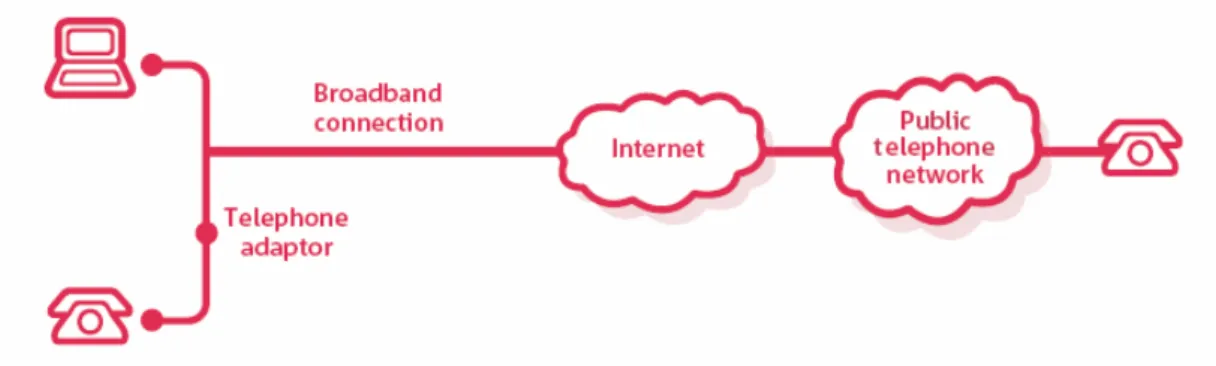
3.6 A VoIP service can be fixed, i.e. for use at a single fixed location like the home. Or it can be for use at different fixed locations, e.g. at home, at the office and at a hotel, which is known as a nomadic service. In these cases, the broadband is connected to a personal computer (PC) that has VoIP software and a headset or an IP phone handset or to an adapter or “VoIP router” and a traditional phone handset. For the purposes of illustration, Figure 1 shows how VoIP services work from a PC or a standard phone handset out to and/or in from the PSTN.
Figure 1: VoIP service from a PC or standard fixed phone out to and/or in from the PSTN.
Also, a VoIP service can be for use on the move using wireless broadband (WiMAX or Wi-Fi). VoIP can, therefore, be a mobile service, sometimes known as Voice over Wireless (VoWLAN). The broadband is connected to a wireless laptop PC, PDA, a 3G mobile phone or a dedicated VoWLAN phone, which has VoIP software.
3.7 Generally, where the broadband connection is connected to a PC (desktop, laptop or PDA) the service is known as PC-based VoIP. Where the broadband is connected to a phone handset (fixed or mobile) the service is known as phone-based VoIP.
Growth of VoIP service provision
3.8 Over the last five years, VoIP services have had an increasing impact on the UK communications market. They can deliver significant consumer benefits: offering new and innovative services like video calling, conference calling and computer file
transfer, in addition to traditional services like call waiting, voice mail, call forwarding and call barring or fax; reducing network costs and user prices and introducing new pricing structures; enhancing competition in broadband and telephony.
3.9 Often, type 1 VoIP services are marketed as PC-to-PC services because they allow calls from one PC to another, e.g. Skype and Google Talk; types 2 and 3 are
marketed as providing a secondary phone line, e.g. Skype In/ Skype Out and Tesco; type 4 is also marketed as providing a secondary phone line, e.g. BT Broadband Talk, or as a replacement for making calls over the PSTN, e.g. Vonage. VoIP is
marketed as a stand-alone service (Internet-based VoIP) or bundled with Internet access (on-net VoIP).
3.10 To date, no single combination of business model, functions or equipment has emerged to lead the market. Ofcom expects this diversity to remain for some time, although recent UK and international trends indicate that providers that seek to serve the mass market in the future are likely to offer type 4 phone-based PSTN
replacement services.23
3.11 As the type and number of VoIP providers and service or equipment propositions has grown so has consumer awareness and take-up.
3.12 According to Ofcom’s quarterly communications tracking survey, in Q4 2006, 60% of UK adults were aware of VoIP services, up from 49% in the same period of the previous year. As would be expected, awareness of VoIP in Q4 2006 was significantly higher among those who had Internet (74%) or broadband (77%) at home.
3.13 In an Ofcom survey of VoIP users in October 2006 (the October 2006 research), respondents most commonly claimed they had a type 1 service to call users with the same provider (86%); 40% claimed they had type 4; 25% claimed they had type 2; 3% claimed they had type 3. Almost a quarter (23%) said they used more than one provider; the figures suggest consumers were using different types of VoIP in combination.
3.14 In the October 2006 research, seven out of ten users said they used VoIP at least once a week and 14% claimed to use it daily. According to the communications tracking survey, in Q4 2006 an estimated 10% of UK households (2.4 million) used VoIP products, a significant increase from 5% of UK households in Q4 2005.
3.15 More information about the results of the communications tracking survey for Q.4 2006 and the October 2006 research are available in the Ofcom Research Report: Voice over Internet Protocol (VoIP)24.
3.16 Ofcom considers that, to benefit industry, consumers and citizens, regulation should not prevent VoIP service innovation or development and should enable competition with older services to occur on a level playing field and ensure that consumer protection measures keep pace with technology.
Regulatory Framework and Policy Background: Overview
3.17 In 1998, telecommunications were liberalised in principle in all Member States of the European Union (EU). In response to the convergence of telecommunications, information technology and the media and the growth of the Internet, in 2002 the European Parliament and the Council of Ministers adopted five Directives (the EC Communications Directives)25, which set out a common regulatory framework for
23
For example, see US Broadband Telephony Forecast, 2007 to 2012: Cable MSOs assert their dominance in the VoIP market, JupiterResearch, 2007.
24
The report draws on three pieces of quantitative research among UK consumers commissioned by Ofcom: Ofcom's communications tracking survey of c.2,200 UK adults per quarter; a face-to-face survey of UK adults conducted in May 2006 to gain a better view of VoIP take-up; an online survey of 500 VoIP users in October 2006 to gain a better understanding of consumer usage. See
www.ofcom.org.uk 25
Directive on a common regulatory framework (2002/21/EC); Directive on access and
Electronic Communications Networks (ECN),Electronic Communications Services (ECS)and associated facilities in the EU. The common framework is intended to encourage competition, improve the functioning of the internal market and guarantee the availability of a basic set of ECS that might not be guaranteed by market forces (universal service). The Communications Act 2003 (the Act) implemented a
significant proportion of the EC Communications Directives in the UK26. The Directives entered into force on 24 April 2004.
3.18 In summary, the Directives and the Act define an ECN as a network used to transmit signals and any associated apparatus, software or stored data27 and an ECS as a service that uses an ECN to send signals, excluding content services (e.g. the provision of information or entertainment)28. They set out sub-categories of ECS: Public Electronic Communications Services (PECS), which are ECS that are available to members of the public29 and, in turn, a sub-category of PECS: Publicly Available Telephone Services (PATS). PATS are defined as (i) a service available to the public (i.e. a PECS) (ii) for making and receiving national and international calls and (iii) accessing emergency services (iv) through a national or international phone number on a national or international numbering plan30. Those four points are known as the “gating criteria” for the PATS definition.
3.19 Depending on their individual characteristics, Ofcom considers type 1 VoIP services are unlikely to constitute an ECS. Type 2 and type 3 VoIP services are likely to be regarded as PECS31. Type 4 VoIP services are likely to be PECS or, if they meet the PATS gating criteria, PATS.
3.20 The common regulatory framework abolished the requirement for those intending to provide an ECN, ECS or associated facilities to obtain permission or a licence from the National Regulatory Authority before entering the market. Today, persons are automatically entitled (or generally authorised) to provide them. As a result, in the UK the licensing regime under the Telecommunications Act 1984 was replaced with a General Authorisation Regime. Under general authorisation, VoIP and other telephony providers that enter the market must comply with certain regulatory conditions (known as conditions of entitlement or general conditions [GCs])32 set by Ofcom. Some GCs apply to all ECS providers; others apply to a sub-category only, e.g. PATS providers.
3.21 Importantly, it is the provider’s responsibility to determine if it must comply with a particular GC. Ofcom does not send individual notifications that certain conditions apply. Failure to comply is subject to enforcement by Ofcom under procedures established in the Act.
and services (2002/20/EC); Directive on universal service and users’ rights (2002/20/EC); Directive on Privacy and Electronic Communications (2002/58/EC).
26
The remainder is implemented by secondary legislation or administrative action. 27
See Section 32(1) of the Act and Article 2(a) of the Framework Directive (2002/21/EC). 28
See Section 32(2) of the Act and Article 2(c) of the Framework Directive (2002/21/EC). 29
See Section 151 of the Act. 30
For the full definition, see Article 2(c) of the Universal Services Directive (2002/20/EC) and Ofcom General Conditions (Schedule to the Notification under Section 48(1) of the Communications Act 2003) Part 1 para.1 and GC 18.
31
Under section 32(4)(b) of the Act, a VoIP service is likely to be regarded as an ECS if it employs or engages a third party to provide an ECS (or ECN) and the provision of the ECS is under the VoIP provider’s “direction or control”.
32
Imposed on 25 July 2003 under Section 45 of the Act, and since revised. For more information, see
Regulatory Framework and Policy Background: VoIP and Access to the
Emergency Services
33
3.22 General Condition 4 requires PATS providers to ensure that any end-user can access the emergency services by calling 999 and 112 at no charge and, to the extent technically feasible, make caller location information available to the emergency organisations handling those calls.
3.23 All fixed and mobile PSTN services allow users to access the emergency services. Some VoIP services allow users to do so but others do not. VoIP has introduced one-way services that allow users to make calls the PSTN only (type 2); they aren’t caught by the definition of PATS or General Condition 4. Regarding type 4 services, the Universal Service Directive 2002/22/EC provided a definition of PATS that included “access to the emergency services”, creating circularity; PATS services must allow access to the emergency services, but allowing access to the emergency services is part of the PATS definition.
3.24 Ofcom has run three consultations on VoIP regulation.
3.25 The 2004 Consultation was launched in response to early developments in new voice services (NVS), including VoIP. Ofcom acknowledged the opportunities provided by NVS and the challenge of potentially lower consumer protection. We considered some services might “look and feel” like a traditional telephone service but might not be able to deliver, in the same way or to the same extent, the features consumers expect. In particular, some might not offer 999 / 112 access or might not offer 999 / 112 access to the same standard as traditional PSTN services. Unlike PSTN fixed phone services, except DECT phones, VoIP depends on the availability of a power supply. It also depends on a broadband connection and sometimes a software application. When on, a broadband connection can be less reliable than a PSTN fixed phone line, meaning that a voice call might be distorted or cut off.
3.26 In line with its principal statutory duty to promote the interests of citizens and consumers, Ofcom identified its aims as: (i) helping to create an environment in which new technologies can be developed and deployed successfully in the market so that consumers can benefit from a wider and more innovative range of services; (ii) ensuring consumers are properly informed and protected, e.g. regarding 999 / 112 access; and (iii) in doing so, being aware of the importance of technology neutrality and minimising distortions in the type of services offered to and used by consumers, without creating artificial incentives. Ofcom also asked some specific questions to inform its policy going forward, including what its policy on 999 / 112 access should be.
3.27 Ofcom favoured an approach that allowed new services to enter the market and enabled consumers to make informed choices when taking advantage of them. Ofcom also recognised that there was a clear public interest in ensuring that
widespread, reliable 999 / 112 access was maintained in the UK as VoIP use grew.
33
In summary, PATS are defined as (i) a service available to the public (i.e. a PECS) (ii) for making and receiving national and international calls and (iii) accessing emergency services (iv) through a national or international phone number on a numbering plan. Those four points are known as the “gating criteria” for the PATS definition. For the full definition, see Article 2(c) of the Universal Services Directive (2002/20/EC) and Ofcom General Conditions (Schedule to the Notification under Section 48(1) of the Communications Act 2003) Part 1 para.1 and GC 18.
3.28 At this stage, because they had strong expectations that all voice call services would offer 999 / 112 access and seemed to value that highly, Ofcom considered it was likely consumers would exercise a strong preference for VoIP services with 999 / 112 access, provided they were properly informed. Because the cost of providing 999 / 112 access was low, Ofcom also considered it likely that consumers would be
prepared to pay the additional cost for a service with basic 999 / 112 access, and that they would retain at least one service in the home with high quality access.
Moreover, existing and potential providers had indicated to Ofcom that most providers would choose to offer 999 / 112 access so that they could compete with other voice call providers and to avoid the possibility of a life being lost because a user was unable to access 999 / 112 from their service. Ofcom concluded, therefore, that it was not necessary or appropriate to require all voice call services to provide 999 / 112 access at that time, but undertook to keep that position under review as the voice call market developed. If it became apparent that the availability of 999 / 112 access was, or was likely to be, significantly reduced and that was likely to cause detriment to consumers and citizens, Ofcom would consider requiring certain VoIP services to offer 999 / 112 access, among other measures. An industry-Ofcom working group34 was set up to draft a Code of Practice on consumer information, including about 999 / 112 access.
3.29 Ofcom understood that the European Commission considered a VoIP provider could choose if they were providing a PATS even if they met all of the PATS gating
criteria35. Ofcom sought clarification from the European Commission. In the interim, Ofcom adopted a policy to allow VoIP providers to enter the market and meet the PATS gating criteria, in particular offering 999 / 112 access, without becoming PATS and having to comply with all of the associated GCs like network integrity and
reliability for 999 / 112 access under GC 3 (i.e. Ofcom would forbear from enforcing the PATS GCs). That allowed providers that could not provide the same level of 999 / 112 access as fixed PSTN providers to offer some (potentially less reliable) access, rather than none at all. That policy was known as the “interim forbearance policy”.
3.30 Under the interim forbearance policy, Ofcom provided that only subscribers to PATS services that met all of the associated GCs had a right to number portability36. That meant that VoIP services that provided 999 / 112 access that did not meet the standard of reliability set by GC 3 did not have the right to offer new customers the possibility of retaining their previous telephone number. Ofcom hoped that would provide an incentive for services that met the PATS gating criteria to comply with the PATS-related GCs.
3.31 Ofcom also enabled VoIP providers to allocate their customers standard phone numbers (geographic number ranges) or a new 056 number range so that consumers could use familiar numbers with VoIP services.
3.32 In its 2006 Consultation, launched in response to market, technology and regulatory developments since 2004, Ofcom set out three main policy objectives, which built on its 2004 policy aims: (i) enabling innovation in a technologically neutral way; (ii) ensuring consumers are well-informed, particularly about 999 / 112 access; (iii)
34
The New Voice Services (NVS) Working Group was convened at the end of 2004 and involved BT, Centrica, Communications Management Association, Easynet, Gossiptel, ISPA, ITSPA, Kingston Communications, Level 3, Magrathea, Ntl, Ofcom, Telewest, Thus, Vonage, Wanadoo and Xconnect. 35
European Commission, Information and consultation paper on the regulatory treatment of Voice over Internet Protocol (VoIP) under the EU regulatory framework, 14 June 2004.
36
“Number Portability” enables subscribers to take their standard telephone number with them when they change provider.
ensuring maximum availability of high quality 999 / 112 access as voice call services and technology change.
3.33 In light of clarification from the European Commission, Ofcom understood that, if the PATS gating criteria are met, a service automatically constitutes a PATS and must comply with the PATS obligations37. Therefore Ofcom discontinued its interim forbearance policy. But that created the risk that VoIP providers would decide not to provide 999 / 112 access to avoid becoming a PATS and subject to the relevant PATS GCs.
3.34 As set out in its March 2007 Statement on the 2006 Consultation, Ofcom modified the drafting of GC 18 on number portability to make clear that number portability rights would only apply to services that provided 999 / 112 access (with an exception for receive-only services like type 3 VoIP services) (March 2007 Statement, from paragraph 5.8, and Annex 4). The modification to GC 18 entered into force on 29 March 2007. We noted the clarification might act as an incentive for providers to offer 999 / 112 access, in order to secure the benefits of number portability, but might not lead to all providers offering 999 / 112 access.
3.35 Also, Ofcom implemented the Code on the provision by Service Providers of consumer information to Domestic and Small Business Customers for the provision of Services (the Code of Practice) developed by the industry-Ofcom working group following the 2004 Consultation. It requires VoIP providers to provide information about any feature or limitation that differs from a standard phone service provided over the PSTN, in particular the availability or standard of 999 / 112 access (March 2007 Statement, Section 6 and Annex 1). The Code is included in GC 14 and entered into force on 29 May 2007.
3.36 Following the March 2007 Statement, the GCs that were directly relevant to 999 / 112 access over VoIP voice call services can be summarised as:
• PATS providers must take all reasonably practicable steps, to the greatest extent possible: to maintain the availability of PATS at fixed locations38 in cases of catastrophic network breakdown or force majeure; to provide uninterrupted 999 / 112 access (GC 3 implementing USD Article 23);
• PATS providers must provide all end-users with 999 / 112 access at no charge and must make caller location information for all 999 / 112 calls available to the emergency organisations handling those calls, to the extent technically feasible (GC 4 implementing USD Article 26);
• PECS providers must ensure domestic and small business customers are provided with information about the features of their service. In particular, type 2, 3 and 4 VoIP providers must make clear whether their service offers 999 / 112 access and the extent to which it depends on the user's home power supply. If the customer chooses to take up a service that does not offer 999 / 112 access or that depends on an external power supply, the code requires providers to: secure the customer's positive acknowledgement of that at point of sale; provide a
37
As confirmed by the European Commission’s Expert Group on Emergency Access in a response dated 23 May 2006 to Ofcom’s 2006 consultation Regulation of VoIP Services.
38
For nomadic VoIP, “fixed locations” is understood as the contractually agreed fixed location. New Voice Services: a Consultation and Interim Guidance, Ofcom, 6 October 2004 and Statement on the Regulation of VoIP Services, Ofcom, 29 March 2007, Annex 5, Guidelines on the application of PATS obligations to VoIP service providers, from paragraph A5.53.
physical label for equipment on request or information on the computer screen stating there is no 999 / 112 access; play an announcement each time a 999 / 112 call is attempted reminding the caller that 999 / 112 access is unavailable (GC 14 implementing USD Article 34);
• ECS providers must provide, on request and on reasonable terms, number portability to subscribers of PECS that are for receiving national and international calls only through a standard national or international telephone number or to subscribers of PATS (GC 18 implementing USD Article 34).
3.37 PATS providers were also obliged to comply with: GC 5 on emergency planning; GC 8 on operator access, directory enquiries and directories; GC 10 on publishing prices, tariffs and terms and conditions; GC 11 on billing accuracy; GC 12 on itemised billing; GC 13 on non-payment of bills; GC 15 on special measures for end-users with disabilities.
39 3.38 On applying GC 3, Ofcom withdrew the Essential Requirements Guidelines
because they were suited to traditional PSTN providers only; they implied that the provider had ownership or direct control over the end-to-end network used to provide the call (March 2007 Statement, from paragraph 4.16).
3.39 Ofcom also issued Guidelines on the application of PATS obligations to VoIP service providers (the Guidelines), which explain how Ofcom would investigate potential contraventions of GCs 3 and 4 on network reliability and 999 / 112 calls to aid transparency and understanding of the requirements and increase the incentive for VoIP providers to offer 999 / 112 access (March 2007 Statement, Annex 5)40. Ofcom specified that VoIP providers should take all possible steps to ensure network
integrity and service reliability and should do so to the greatest extent possible, but only for the aspects of the network that they control.
3.40 Lastly, Ofcom undertook to encourage and enforce maximum compliance with
relevant GCs by VoIP providers and to monitor market and technology developments to ensure regulation can be quickly adapted to meet consumer and citizen needs, especially the need to maintain the widespread availability of 999 / 112 access (March 2007 Statement, Section 5).
3.41 In that regard, in the 2006 Consultation and March 2007 Statement, Ofcom signalled that market forces combined with information provision might not lead to an optimum provision of 999 / 112 access for society: it may be inherently difficult for consumers to properly evaluate the potential costs and benefits of taking a service without 999 / 112 access; without any requirement to offer 999 / 112 access there was the risk that service operators and/or subscribers would be able to “free ride” by offering a low cost service with no or limited 999 / 112 access and rely on customers of other networks to allow them to make emergency calls, or to make emergency calls on their behalf.
3.42 Ofcom noted in the March 2007 Statement that a number of respondents to the 2006 Consultation considered the new measures were insufficient to combat the risk of consumer and citizen confusion about 999 / 112 access over VoIP. That could cause delays in accessing 999 or 112, possibly leading to increased harm.
39
Guidelines on the essential requirements for network security and integrity, Oftel, 9 October 2002
http://www.ofcom.org.uk/static/archive/oftel/publications/ind_guidelines/guid1002.htm 40
3.43 Ofcom undertook, therefore, to consult in summer 2007 on whether it should require certain VoIP providers to provide 999 / 112 access and, in assessing the need for that requirement, it undertook to carefully consider the possible impact on
competition and on market entry and innovation by VoIP providers. The July 2007 Consultation met that commitment by proposing a modification to GC 4 to require 999 / 112 access from all PECS that enable users to call normal national or international numbers.
3.44 This Statement summarises and evaluates the significant responses to that Consultation and explains Ofcom’s conclusions.
International context
3.45 In June 2007, we polled other European regulators on their approach to regulating VoIP and in particular VoIP and emergency services access. Their responses are summarised in Figure 2.
Figure 2: Ofcom poll of VoIP and emergency services access in Europe, June 2007
Emergency services access from type 2 VoIP services?
Emergency services access from type 4 VoIP services? Broadband
penetration / population
Denmark 31.9% Y Y
Netherlands 31.8% N Y
Switzerland 28.5% Y Y
Norway 27.7% N Y
Finland 27.2% Y Y
Sweden 26.0% N Y
Belgium 22.5% No response
United Kingdom 21.6% N N
Luxembourg 20.4% N Y
France 20.3% Y Y
Austria 17.3% Y Y
Estonia 17.2% N Y
Germany 17.1% No response Y
EU 15.7%
Spain 15.3% N Y
Italy 14.8% No response
Portugal 13.8% No response
Slovenia 12.6% No response Y
Ireland 12.5% Best endeavours Y
Hungary 11.9% N Y
Czech Republic 10.6% N Y
Latvia 9.3% Y Y
Poland 6.9% N Y
Source: OECD broadband statistics to December 2006; Ofcom poll of ERG regulators June 2007
3.46 Regarding emergency services access over VoIP in other countries with high-broadband penetration, the USA and Australia require type 4 VoIP services to offer emergency services access. Australia has recently decided to consult with industry on the implications of also requiring emergency services access from type 2 VoIP services41. Hong Kong requires type 2 and type 4 VoIP services to offer emergency
41
See http://www.acma.gov.au/WEB/STANDARD/pc=PC_310364 and
services access. Canada requires type 2, type 3 and type 4 VoIP services to offer emergency services access42.
European Regulatory Developments
3.47 The European Commission launched the first review of the principles and
implementation of the common framework in 2006, including a public consultation43. The review is intended to improve spectrum management, streamline market
reviews, consolidate the single market, strengthen consumer and user rights, improve security, and remove outdated provisions. A Communication reporting on the consultation and the draft Proposals for European Parliament and Council Directives modifying the regulatory framework for electronic communications and services were published on 13 November 2007. Of particular relevance to this Statement, the Proposals remove the gating criterion of providing access to the emergency services from the PATS definition, require Member States to ensure customers of ECS providers are informed about whether a service has emergency services access and require ECS providers to inform customers about a lack of emergency services access before they enter into a contract and regularly thereafter. It is important to stress that these are draft proposals that must still go through the EU legislative process. Also, the draft provision on customer information, if adopted, would be a minimum harmonisation requirement; Member States would remain free to require greater emergency services provision.
3.48 The European Regulators Group (ERG) has established a VoIP Harmonization Task Force with the intention of reaching a common position on VoIP regulation later this year. It published a public consultation on a Common Position on VoIP (draft) of the ERG High Level Policy Task Force on VoIP on 24 October 200744. Ofcom considers the ERG’s draft common position on emergency services access over VoIP is consistent with the decision it adopts in this Statement.
86000846F1/$file/TelecomEmergencyCallServiceAmDet2007No1.pdf, page 3. The July 2007 Consultation said that Australia required type 2 and type 4 VoIP services to provide emergency services access.
42
See http://www.crtc.gc.ca/archive/ENG/decisions/2005/dt2005-21.htm 43
See the European Commission DG Information Society website for more information:
http://ec.europa.eu/information_society/policy/ecomm/tomorrow/index_en.htm 44
Common Position on VoIP (draft) of the ERG High Level Policy Task Force on VoIP, 24 October 2007 http://erg.eu.int/documents/cons/index_en.htm
Section 4
4
Policy decision
Introduction
4.1 This section summarises Ofcom’s policy objectives and sets out the two policy options for meeting those objectives that it consulted on in the July 2007 Consultation. It also summarises and evaluates the significant consultation responses and explains Ofcom’s reasoning for adopting one of the options, with modifications in light of the responses.
Policy objectives
4.2 The key objective of the 2006 and July 2007 Consultations was to ensure there is a high level of 999 / 112 access. Consumers and citizens in the UK traditionally enjoy high levels of 999 / 112 access. VoIP services are the only public voice call services that do not consistently allow 999 / 112 access in the UK; all PSTN fixed services allow 999 / 112 access and all mobile PSTN services provide 999 / 112 access where there is coverage. This level of access is highly valued by consumers and citizens and helps the emergency services to provide high quality services.
Accordingly, Ofcom regards it as important that these benefits are not lost as a result of changes in services or technology.
4.3 In meeting that objective, we aimed to take account of the desirability of regulating in a way that did not favour one technology over another or one means of providing technology over another45.
Ofcom’s approach before the July 2007 Consultation
4.4 As highlighted in Section 3 of this Consultation, in the 2006 Consultation, Ofcom discontinued its interim forbearance policy, which meant that type 4 VoIP services that met the PATS gating criteria had to comply with the PATS GCs. We withdrew the Essential Requirements Guidelines, which had been written with traditional PSTN services in mind, and proposed Guidelines on the application of PATS obligations to VoIP service providers, which entered into force on 29 March 2007 (the Guidelines), and a Code on the provision by Service Providers of consumer information to
Domestic and Small Business Customers for the provision of Services, which
entered into force on 29 May 2007 (the Code of Practice). We also clarified GC 18 on number portability.
4.5 Ofcom considered that this approach, combined with strong consumer preference for services with emergency services access and the fact that most VoIP services were being used as secondary lines (which meant that existing services with emergency services access were not being substituted), would ensure good continued provision of 999 / 112 access.
45
Section 4(6) of the Act provides:
The fourth Community requirement is a requirement to take account of the desirability of Ofcom’s carrying out their functions in a manner which, so far as practicable, does not favour—
(a) one form of electronic communications network, electronic communications service or associated facility; or
Challenges in meeting the policy aims
4.6 In its March 2007 Statement, Ofcom decided to review the question of how to ensure maximum availability of 999 / 112 access. A number of developments led Ofcom to consider the issue should be reconsidered, including:
• since the 2006 Consultation, there had been a rapid increase in the growth of VoIP services, increasing the potential for consumer detriment;
• generally, VoIP service providers did not seem to be offering emergency services access46, despite Ofcom’s original intention behind its interim forbearance policy and the incentives to provide emergency services access set out in the previous consultations; and
• there appeared to remain a large degree of confusion about the availability of 999 / 112 access from VoIP services, which could lead to delays in users successfully contacting the emergency services. The October 2006 research indicated that about three in four users of VoIP services that did not offer 999 / 112 access thought that the service provided 999 / 112 access or did not know;
• various 2006 Consultation respondents supported those concerns.
4.7 Ofcom considered ensuring access to emergency services could be a crucial issue moving forwards. Ofcom undertook to consult further in summer 2007 on 999 / 112 access over VoIP and in particular on whether, and if so how, certain VoIP services should be required to offer 999 / 112 access. In assessing the need for that
requirement, Ofcom said it would carefully consider the possible impact on
competition and on market entry and innovation by VoIP providers. The July 2007 Consultation met that commitment.
Policy Options
4.8 In the July 2007 Consultation, Ofcom weighed up two policy options for responding to the question of 999 / 112 access over VoIP. Ofcom considered those options
reflected its bias against regulatory intervention to encourage innovation and the need to regulate to protect citizens and consumers. The options were:
Option 1: Do not mandate 999 / 112 access for VoIP services
Option 2: Mandate 999 / 112 access for type 2 and type 4 VoIP services
4.9 Ofcom then asked respondents if they considered it should consider any other policy options.
Q.1 Do you consider Ofcom should consider any other policy options? Please describe your proposed option(s) and explain what you consider would be the advantages and any disadvantages.
Respondents’ Views on Q.1
4.10 Around a quarter of respondents to the July 2007 Consultation, mainly from industry, considered Ofcom should consider some other policy options.
46
4.11 Two industry respondents and an industry alliance considered Ofcom should refrain from imposing 999 / 112 requirements until the ongoing review of the EC
Communications Directives (see from paragraph 3.47) is complete. The alliance considered that, otherwise, Ofcom might impose inconsistent obligations, fragmenting the EU communications market. One industry respondent said the Commission proposes to amend Art. 20, Directive 2002/22/EC by inserting “Member States shall ensure … subscribers are clearly informed whether or not access to emergency services is provided. Providers of ECS shall ensure that customers are clearly informed of the lack of access to emergency services in advance of the conclusion of a contract and regularly thereafter”. It considered that wording is consistent with Option 1.
4.12 They also suggested Ofcom should give the current regulations (the Guidelines and Code of Practice) 12, 18 or 24 months to work before evaluating their impact and proposing a change in regulation, if necessary. The alliance considered Ofcom should use that time to update data on VoIP services and technology and access to 999 / 112, e.g. means of improving customer warnings and use of IP in public safety networks and transitioning to survivable communications systems.
4.13 One industry respondent considered Ofcom should introduce additional policy objectives like quality increases, presence awareness, access to third party software applications and high privacy protection and should take measures to support the development and adoption of VoIP like supporting naked DSL, ensuring network neutrality on fixed or mobile networks, facilitating consumer switching between ISPs, and e-mail portability.
4.14 One industry respondent commented that any policy option should be consistent with a free market and open standards to ensure UK consumers receive the most
effective 999 / 112 capabilities promptly, while permitting their continued evolution and innovation.
4.15 If Ofcom did require 999 / 112 access over VoIP, an industry respondent considered it should reintroduce the interim forbearance policy that had applied up to the 2006 Consultation (see from paragraph 3.30). It considered withdrawing that policy had led providers to withdraw 999 / 112 access because the PATS GCs are onerous and providers receive no obvious benefits. It commented that the Cost-Benefit Analysis (CBA) in the July 2007 Consultation was a UK-wide analysis and that the cost-benefit ratio for a given operator might be very different. That might lead providers to look for another way to avoid qualifying as a PATS provider, e.g. not allowing outgoing international calls, to the detriment of consumers. A Government respondent
understood VoIP providers are concerned that complying with PATS GCs will hinder development of VoIP services and 999 / 112 access. It said it would welcome an option that decoupled 999 / 112 access from the PATS GCs.
4.16 As a variant of the Options Ofcom set out, three industry respondents and an industry alliance considered Ofcom should also consider an option to require 999 / 112 access from type 4 VoIP services that replace traditional PATS services but not type 2 VoIP services that supplement traditional PATS services; that would stifle innovation; the justification given for not considering them separately wasn’t sufficient; users might expect 999 / 112 access from “replacement” services. A Government respondent and an industry respondent suggested Ofcom adopt a graduated approach to requiring 999 / 112 access by addressing type 4 services first as those likely to cause greatest user confusion.
4.17 An industry respondent considered Ofcom should reconsider its type 2 and type 4 classifications; VoIP is a continuum of services from simple, substitute services to complex, pure integrated peer-to-peer applications. Considering Option 2, a trade association and an industry respondent suggested Ofcom review the different range of services that fall under the category of type 2 VoIP services (and therefore Option 2). It drew Ofcom’s attention to ”Click to Call” services, which can be selected on a website or other application to connect to a number or a limited set of numbers pre-selected by the provider or a user; corporate VoIP products where 999 / 112 access is provided through the PSTN on the host’s existing telecoms equipment, e.g. the PBX.
4.18 Another respondent considered Ofcom should consider a policy where nomadic type 2 and type 4 VoIP services are only required to provide 999 / 112 access in the customer’s country of residence. It considered it would be impractical and
unreasonable to require access to multiple international emergency services. Also, although providers should encourage users to update their location, it considered most wouldn’t.
4.19 Another quarter of respondents responded to say they agreed that the range of policy options was suitable.
4.20 A trade association said it may be more appropriate to require type 4 providers only to provide 999 / 112 access but thought the European Commission is likely to place the obligation on all services that allow calls out to the PSTN.
4.21 A Government respondent and an industry respondent considered the decision to preclude type 1 and type 3 services should be kept under review to maintain public safety. The industry respondent commented that users receive calls from PSTN numbers on type 3 services and several softphones for type 1 and type 3 services look like traditional fixed or mobile handsets and it’s not possible to see which VoIP service is available.
4.22 Another industry respondent considered in the future, Ofcom should reconsider its definitions of voice service types because the roll out of next generation networks (NGN), on-net VoIP, IP interconnection and next generation access (NGA) are making the demarcation between VoIP and “traditional telephony” meaningless.
Ofcom’s Views on Responses to Q.1
4.23 Regarding the review of the EC Communications Directives, the Commission issued draft proposals on 13 November 2007. To become law, the Commission’s proposals must go through the EU legislative process. We consider it’s necessary to act sooner to protect consumers and citizens from delay in contacting the emergency services over VoIP. Ofcom will ensure regulation is consistent with the new Directives. Because the Universal Service Directive is a minimum harmonisation Directive, Option 2 would be consistent with the current proposals. In any case, the proposals may change following consideration by the European Parliament and the Council. Option 2 is also consistent with the draft ERG common position on emergency services access over VoIP and regulation in various European and other countries with high broadband penetration.
4.24 As regards the suggested option of waiting to evaluate the impact of the measures adopted in the March 2007 Statement, Ofcom said in that Statement that because of the increase in VoIP take-up, under provision of 999 / 112 access and consumer confusion, 999 / 112 access over VoIP required further consideration beyond the
measures adopted in the Statement, and undertook to consult this summer on requiring 999 / 112 access from certain VoIP services.
4.25 The July 2007 Consultation acknowledged that it was too early to measure the impact of mandating the Code of Practice, but noted that, at a time when customer information was provided voluntarily, 64% of VoIP users surveyed in the October 2006 research were with a provider that did not provide 999 / 112 access. 78% of those thought that they were or didn’t know. A total of 76% of all users surveyed were confused about whether they had access. 50% of all users were at particular risk because they were with a provider that didn’t give 999 / 112 access but they thought that it did47. We noted that 999 / 112 access has some characteristics of a public good, which the market will not provide optimally.
4.26 We cannot ignore the risk that, even when they are given full information, it may be inherently difficult for new customers to recognise the importance of 999 / 112 access (and information about it) because they have other more immediate priorities like price and daily functionality; 999 / 112 access is something they might need in the distant future, if at all. Other citizens might only realise they can’t access 999 / 112 from a VoIP service when they try to call 999 / 112 (see July 2007 Consultation from paragraph 4.30).
4.27 Going forward, we will keep developments in VoIP services and technology and user behaviour under review to see if our regulations need to be adapted. The Code of Practice will continue in force during the compliance period for providing 999 / 112 access, and will be reviewed and updated to coincide with the deadline.
4.28 Ofcom considers the additional policy objectives suggested in paragraph 4.13 fall outside the scope of the July 2007 Consultation.
4.29 For information, regarding network neutrality, Ofcom said in the March 07 Statement (from paragraph 8.19):
Ofcom considers that network neutrality is not as significant an issue in Europe as it has been in the US. While this debate is important and is likely to continue, the existing market structure, the level of competition in service provision and the regulatory policy in Europe, combined with powers to address such issues under the existing regulatory framework will be sufficient to address issues that arise in relation to network neutrality now and in the future, e.g. the ability to impose an end-to-end connectivity obligation under Art. 5 of the Access Directive.
We introduced regulation to facilitate consumer switching between ISPs in December 2006 and we’re monitoring the results48.
4.30 Regarding the comment that any policy option should be consistent with a free market and open standards, our October 2006 research showed that sufficient 999 / 112 access hasn’t been provided without a regulatory requirement.
4.31 As regards the suggestion that Ofcom should reinstate the interim forbearance policy, if the PATS gating criteria are met, a service is automatically PATS and must
47
In the October 2006 research, we compared respondents’ statements on whether they could access 999 / 112 from their VoIP service with our information about the provider they were with. 48
See Broadband Migrations – Enabling Consumer Choice (Regulatory Statement), 13 December 2006 http://www.ofcom.org.uk/consult/condocs/migration/statement/statement.pdf
comply with the PATS obligations, as confirmed by the European Commission’s Expert Group on Emergency Access in a response dated 23 May 2006 to our 2006 Consultation.
4.32 The ERG VoIP Harmonisation Task Force suggested emergency services access should be removed from the PATS gating criteria in Common Position on VoIP (draft) of the ERG High Level Policy Task Force on VoIP, 24 October 2007. At present, the review of the EC Communications Directives proposes to do so. If adopted, all services that meet the remaining gating criteria would be PATS and have to provide emergency services access, i.e. all services (i) available to the public (PECS) (ii) for originating and receiving national and international calls services (iii) through a number or numbers in a national or international telephone numbering plan.
4.33 In the meantime, our Impact Assessment shows that the benefits of Option 2 for consumers and citizens would significantly outweigh the compliance costs for industry, including the cost of complying with the PATS GCs, and would not significantly affect innovation. Therefore we don’t agree that complying with the PATS GCs will significantly hinder the development of VoIP services generally or 999 / 112 access in particular.
4.34 Regarding the response that the CBA in the July 2007 Consultation was a UK-wide analysis, Ofcom doesn’t conduct CBAs for individual providers; it has to consider the costs and benefits of its proposals for the UK as a whole.
4.35 Having considered the consultation responses, we consider we were justified to propose requiring 999 / 112 access for type 4 and type 2 services together. Our policy objective is to ensure a high level of 999 / 112 access to protect consumers and citizens from delay in accessing 999 / 112. We consider there’s a material risk of user confusion for all services that allow users to make calls out to the PSTN. That functionality is key, not whether the service is intended to supplement or replace PSTN services. That’s because it creates the risk that, in a stressful emergency situation, a user may go for the “wrong” phone and lose valuable time in reaching the emergency services. The fact that type 4 services also allow users to receive calls is less relevant; we don’t propose to require 999 / 112 access for type 3 VoIP services. In the October 2006 research, all the VoIP users surveyed said they had access to a landline or a mobile phone49 but, for public safety, both types of service provide 999 / 112 access. Also, as stated in the July 2007 Consultation, Ofcom considers any current difference in service features, technology or risk of consumer confusion between type 2 and type 4 VoIP services is likely to become negligible or disappear: traditional telephone handsets are increasingly capable of supporting type 2 or type 4 VoIP services and, for VoIP phones that plug into a PC, some new phones don’t require the PC to be switched on in order to function (July 2007 Consultation, paragraph 4.57). Our Impact Assessment suggests that the benefits of Option 2 for consumers and citizens would significantly outweigh the costs of compliance for industry.
4.36 On the use of “type 2” and “type 4” categories, we note they have been adopted by the ERG. We recognise that, in implementing Option 2, it’s necessary to ensure we don’t capture services that we consider don’t create a material user expectation or risk of confusion about 999 / 112 access (see paragraph 4.181).
49