This PDF is a selection from an out-of-print volume from the National Bureau of Economic Research
Volume Title: History and Policies of the Home Owners' Loan Corporation Volume Author/Editor: C. Lowell Harriss
Volume Publisher: NBER Volume ISBN: 0-870-14142-2
Volume URL: http://www.nber.org/books/harr51-1 Publication Date: 1951
Chapter Title: Front matter, History and Policies of the Home Owners' Loan Corporation
Chapter Author: C. Lowell Harriss
Chapter URL: http://www.nber.org/chapters/c3204 Chapter pages in book: (p. -24 - 0)
History and Policies ofthe
Home Owners' Loan Corporation
C. LOWELL HARRISS
Columbia UniversityFINANCIAL RESEARCH PROGRAM
STUDIES IN URBAN MORTGAGE FINANCING
National Bureau of Economic Research
Copyright, 1951, by National Bureau of Economic Research, Inc.
1819 Broadway, New York 23, N. Y. All Rights Reserved
Manufactured in the United States of America by the H. Wolff Book Manufacturing Co., Inc.
History and Policies of the
Home Owners' Loan Corporation
NATIONAL BUREAU OF RESEARCH OFFICERS (1951)
Boris Shishkin, Chairman
Harry Scherman, President
C. C. Balderston, Vice-President
George B. Roberts, Treasurer W. J. Carson, Executive Director
Martha Anderson, Editor DIRECTORS AT LARGE
Donald R. Beicher, American Telephone and Telegraph Company
Oswald W. Knauth, Beau fort, South Carolina
Simon Kuznets, University of Pennsylvania
H. W. Laidler, Executive Director, League for Industrial Democracy
Shepard Morgan, New York City C. Reinold Noyes, Princeton, New Jersey George B. Roberts, Vice-President, National City Bank
Beardsley Rumi, New York City
Harry Scherman, Chairman, Book-of-the-Month Club George Soule, Bennington College
N. I. Stone, Consulting Economist
J. Raymond Walsh, New York City
Leo Wolman, Columbia University
T. 0. Yntema; Vice President-Finance, Ford Motor Company DIRECTORS BY UNIVERSITY APPOINTMENT
E. Wight Bakke, Yale
C. C. Balderston, Pennsylvania
Arthur F. Burns, Columbia G. A. Elliott, Toronto
Frank W. Fetter, Northwestern
Theodore W. Schultz, Chicago
DIRECTORS APPOINTED BY OTHER ORGANIZATIONS Percival F. Brundage, American Institute of Accountants
Thomas C. Cochran, Economic History Association Frederick C. Mills, American Statistical Association
Stanley H. Ruttenberg, Congress of Industrial Organizations
Murray Shields, American Management Association
Boris Shishkin, American Federation of Labor
Donald H. Wallace, American Economic Association Frederick V. Waugh, American Farm Economic Association
RESEARCH STAFF
Moses Abramovitz F. F. Hill
Harold Barger . Thor Hultgren
Morris A. Copeland Simon Kuznets
Daniel Creamer Clarence D. Long
David Durand Ruth P. Mack
Solomon Fabricant Frederick C. Mills
Milton Friedman Raymond J. Saulnier Millard Hastay Lawrence H. Seltzer
W. Braddock Hickman George J. Stigler
H. M. Groves, Wisconsin
Gottfried Haberler, Harvard Clarence Heer, North Carolina R. L. Kozelka, Minnesota Paul M. O'Leary, Cornell
Arthur F. Burns, Director of Research
G. H. Moore, Associate Director of Research
Relation of the Directors to the Work and Publications of the
National Bureau of Economic Research
I. The object of the National Bureau of Economic Research is to ascertain and to present to the public important economic facts and their interpretation in a scientific and impartial manner. The Board of Directors is charged with the responsibility of ensuring that the work of the National Bureau is carried on in strict conformity with
this object.
2. To this end the Board of Directors shall appoint one or more Directors of
Research.
3. The Director or Directors of Research shall submit to the members of the Board,
or to its Executive Committee, for their formal, adoption, all specific proposals
con-cerning researches to be instituted.
4. No report shall be published until the Director or Directors of Research shall have submitted to the Board a summary drawing attention to the character of the
data and their utilization in the report, the nature and treatment of the problems
involved, the main conclusions and such other information as in their opinion would serve to determine the suitability of the report for publication in accordance with
the principles of the National Bureau.
5. A copy of any manuscript proposed for publication shall also be submitted to
each member of the Board. For each manuscript to be so submitted a special
commit-tee shall be appointed by the President, or at his designation by the Executive Direc-tor, consisting of three Directors selected as nearly as may be one from each general division of the Board. The names of the special manuscript committee shall be stated to each Director when the summary and report described in paragraph (4) are sent
to him. It shall be the duty of each member of the committee to read the
manu-script. If each member of the special committee signifies his approval within thirty days, the manuscript may be published. If each member of the special committee has not signified his approval within thirty days of the transmittal of the report and manuscript, the Director of Research shall then notify each member of the Board, requesting approval or disapproval of publication, and thirty additional days shall be granted for this purpose. The thanuscript shall then not be published unless at least a majority of the entire Board and a two-thirds majority of those members of the Board who shall have voted on the proposal within the time fixed for the receipt of
votes on the publication proposed shall have approved.
6. No manuscript may be published, though approved by each member of the
special committee, until forty.five days have elapsed from the transmittal of the
sum-mary and report. The interval is allowed for the receipt of any memorandum of dis-sent or reservation, together with a brief statement of his reasons, that any member may 'wish to express; and such memorandum of dissent or reservation shall be pub-lished with the manuscript if he so desires. Publication does not, however, imply that each member of the Board has read the manuscript, or that either members of the Board in general, or of the special committee, have passed upon its validity in every
detail.
7. A copy of this resolution shall, unless otherwise determined by the Board, be.
printed in each copy of every National Bureau book.
(Resolution adopted October 25, 1926, and revised February 6, 1933, and February 24, 1941).
Committee on Research in Finance
In the planning and conduct of its studies in finance the National Bureau benefits from
the advice and guidance of its Committee on Research in Finance. The members of
the Commitee are:
RALPH A. YOUNG, Chairman—Director, Division of Research and Statistics, Board of
Governors of the Federal Reserve System
RAYMOND J. SAULNIER, Secretary—Barnard College, Columbia University; Director,
Fi-nancial Research Program, National Bureau of Economic Research
BENJAMIN HAcGOrr BEcKHART—Columbia University; Economic Consultant, The Chase
National Bank
ARTHUR F. BuRNs—Columbia University; Director of Research, National Bureau of Economic Research
WILLIAM J. CARSON—University of Pennsylvania; Executive Director, National Bureau of Economic Research
GEORGE W. CoLEMAN—Economist, Mercantile Trust Company
EDISON H. Division of Research and Statistics, Federal Deposit
Insur-ance Corporation
ERNEST M. FIsHER—Columbia University E. A. GOLDENWEISER
F. CYRIL JAMES—Principal and Vice-Chancellor, McGill University WALTER LICHTENSTEIN
WALTER MITCHELL, JR.—Managing Director, Controllers Institute of America SHEPARD MORGAN
WILLIAM I. College of Agriculture, Cornell University
JAMES J. O'LF.11Ry—Director of Investment Research, Life Insurance Association of America
GEORGE BASSETT RoBERTs—Vice-President, The National City Bank; Treasurer, Na-tional Bureau of Economic Research
HAROLD V. R0ELsE—Vice-President, Federal Reserve Bank of New' York
CAsIMIR A. SIENKIEwICz—President, Central-Penn National Bank of Philadelphia
THOMAS—Economic Adviser, Board of Governors of the Federal Reserve
System
DONALD S. THoMPsoN—Vice-President, Federal Reserve Bank of Cleveland
JoHN H. WILLIAMS—Graduate School of Public Administration, Harvard University; Economic Adviser, Federal Reserve Bank of New York
JOHN H. WmLs—Second Vice-President, Northern Trust Company
LEO W0LMAN—Columbia University; Research Staff, National Bureau of Economic Research
DONALD B. W000wARD—Second Vice-President, Mutual Life insurance Company of
Preface
This account of the origination, development, and liquidation of the Home Owners' Loan Corporation was completed• under the Urban Real Estate Finance Project of the Financial Research Pro-gram of the National Bureau of Economic Research. Three other studies under this project have already been published: The Impact
of Government on Real Estate Finance in the United States, by
Miles L. Colean; Urban Real Estate Markets: Characteristics and Financing., by Ernest M. Fisher; and Urban Mortgage Lending by Life Insurance Companies, by R. J. Saulnier. Two other studies will deal with the urban mortgage lending policies and practices of com-mercial banks and savings and loan associations; a third will present a comparative analysis of the markets served and the investment experience of various institutional lenders; finally, a fourth will
discuss
the relation of urban mortgage lending to economic
fluctuations.
All of the investigations in the Urban Real Estate Finance Project were made with the support of funds from the Banking
Research Fund of the Association of Reserve City Bankers, the Life Insurance Investment Research Committee, acting for the American Life Convention and the Life Insurance Association of America, and the Rockefeller Foundation. Grateful acknowledgment is made of these generous research grants.
R. J. Saulnier
Director, Financial Research Program
Author's Acknowledgments
This volume tells the story of the Home Owners' Loan Corporation. Tome it is an interesting story. It is certainly unique. We all hope that there will neVer again be need for such an organization. Yet, even if our hopes are realized and no future need arises for a broad salvage operation of this general type, some of the HOLC's
experi-ences may be useful in improving one vitally important part of
American life—the financing of home purchases. I hope this volume will make some contribution toward that end.
Part of the story, however—the HOLC as a study in political economy—has not seemed appropriate for inclusion here, except indirectly and by implication. The history of the HOLC may be no less significant as a study in political economy or public administra-tion than as a study of real estate financing. The HOLC got off to a very bad start with some extremely poor appointments and with organization, staff, and leadership entirely incapable of doing its mammoth job creditably. Yet within a few years it had gained an enviable reputation for admirable accomplishment as a humane relief agency and for both honesty and economy. And it had this reputation just when it was foreclosing mortgages on American homes at the rate of thousands a month. The biggest single cause of the transformation, in my judgment—and I find general agreement —was the appointment of the late Mr. John H. Fahey as Chairman of the Federal Home Loan Bank Board.
By avoiding discussion of personalities in the text of this volume, I have necessarily failed to convey adequately my impression of the role Mr. Fahey played in the HOLC. A few lines in the Acknowl-edgments will not offset such a deficiency. Yet I wish to record here my firm conviction that Mr. Fahey's leadership determined to a
x AUTHOR'S ACKNOWLEDGMENTS considerable degree—favorably I believe—the outcome of this unique
episode in political economy. It was largely due to Mr. Fahey's efforts that "politics" were removed from HOLC operations so that within a short time even severe critics of the New Deal found little to disparage in HOLC actions. Mr. Fahey personally initiated recruit-ing and personnel policies that built a very effective staff and then gradually reduced it without demoralizing it; he insisted on economy and resisted pressures for policies that seemed likely to add to even-tual costs to the taxpayer; yet he keyed loan servicing to the basic original objective of granting relief; he took great pains to keep on good relations with Congress, not by granting special concessions to constituents but by presenting facts and convincing congressmen that the HOLC was fair and reasonable even when taking away homes by foreclosure; he consistently worked to liquidate the HOLC rather than to perpetuate or expand its power. In short, HOLC's history emphasizes the importance of leadership in political insti-tutions.
I have a personal debt to Mr. Fahey for his cooperation, first in his official capacity and later personally, in the preparation of this study. Other present or former officials of the HOLC have helped materially, especially the late Mr. Charles F. Cotter, and Mr. J. S. Baughmann, Mr. Francis M. Cockrell, and Mr. E. E. Wendell; Mr. Michael J. McLoughlin. was most helpful in assisting in statistical check-up, Mr. Bernard McDermott in making file material acces-sible, and Mr. Harold V,. Schunke in supervising many tabulations. Grateful acknowledgment is also made to Donald S. Thompson, who guided the early planning of the study, to Ernest M. Fisher and
E. Morton, who counseled with me on it at many points. Statistical work was ably performed by Catherine Martin and her staff and transcriptions were completed by David Fand, Martin H. Kaplinsky, Isaac H. Friedman, David Sarfaty, and Herbert C. Dixon. The type-script was prepared under the supervision of Mildred Courtney and the manuscript was edited and seen through the press by E. Jeannette Casseday. My greatest debt, however, is to Dr. R. J. Saulnier, on one level for his tolerance of my delays, which resulted from personal developments after II undertook the assignment, and on another level for his thorough and excellent review and criticism of the manu-script; his improvements have been both numerous and substantial.
Preface
Table of Contents
Author's Acknowledgments
Summary
1. Background of Home Owners' Loan Corporation
Legislation
vi'
ix 1
7
2. Original Lending Activities APPLICATiONS RECEIVED APPLICATIONS REJECTED
ACCEPTABILITY OF BONDS BY MORTGAGEES VOLUME OF ORIGINAL LENDING ACTIVITIES
Refinancing Loans
Handling of Second Mortgages and Other Junior
Claims
Wholesale Operations
Cash Loans
COST. OF CLOSING LOANS
3. Appraisal Policies
THE VALUATION STANDARD APPRAISAL ORGANIZATION APPRAISAL METHODS 14 16 23 25 29 29 35 37 39 xi 41 41 42 45
Xii TABLE OF CONThNTS 4. Characteristics of HOLC Borrowers, Properties, and
Loans 49
CHARACTERISTICS OF HOLC BORROWERS 50
CHARACTERISTICS OF PROPERTIES FINANCED BY THE HOLC 53
VALUES OF PROPERTIES FINANCED BY THE HOLC 58
CHARACTERISTICS OF THE HOLC LOANS 61
5. Loan Servicing 64
LOAN-SERVICING PROCEDURES 65
SERVICING DELINQUENT ACCOUNTS 66
EXTENSIONS 69
6. Foreclosures 71
TIMING OF FORECLOSURES 72
GEOGRAPHICAL DISTRIBUTION OF FORECLOSURES 74
REASONS FOR FORECLOSURE AND NUMBER OF MONTHS
DELINQUENT 76
THE FORECLOSURE PROCESS 81
Special Procedures for Obtaining Early Possession 82
Average Costs of Foreclosure 83
Deficiency Judgments 86
FACTORS AFFECTING HOLC FORECLOSURE EXPERIENCE 86
Borrower Characteristics 87
Type and Condition of the Property
Securing the Mortgage Loan 90
A mount of Loan and Financial Burden of Mortgage 94
7. Management and Sale of Foreclosed Properties 101 POLICIES AND METHODS OF PROPERTY MANAGEMENT 103
Initial Management Actions 104
Rental Record 105
Reconditioning and Maintenance 107
Insurance 111
TABLE OF 3d!j
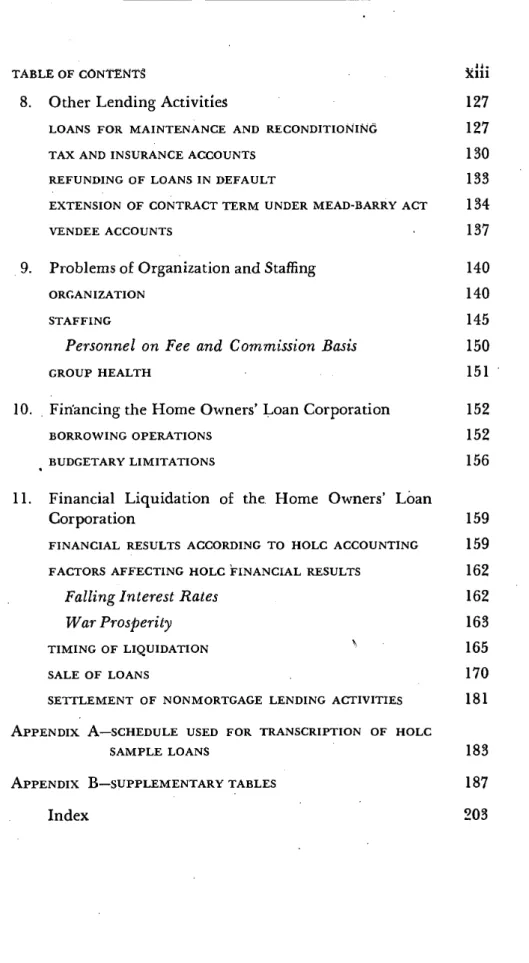
8. Other Lending Activities 127
LOANS FOR MAINTENANCE AND 127
TAX AND INSURANCE ACCOUNTS 130
REFUNDING OF LOANS IN DEFAULT 133
EXTENSION OF CONTRACT TERM UNDER MEAD-BARRY ACT 134
VENDEE ACCOUNTS 137
9. Problems of Organization and Staffing 140
ORGANIZATION 140
STAFFING 145
Personnel on Fee and Commission Basis 150
GROUP HEALTH 151
10. Financing the Home Owners' Loan Corporation 152
BORROWING OPERATIONS 152
BUDGETARY LIMITATIONS 156
11. Financial Liquidation of the, Home Owners' Loan
Corporation 159
FINANCIAL RESULTS ACCORDING TO HOLC ACCOUNTING 159
FACTORS AFFECTING HOLC 1'INANCIAL RESULTS 162
Falling Interest Rates 162
War Prosperity 163
TIMING OF LIQUIDATION 165
SALE OF LOANS 170
SEITLEMENT OF NONMORTGAGE LENDING ACTIVITIES 181
APPENDIX A—SCHEDULE USED FOR TRANSCRIPTION OF HOLC
SAMPLE LOANS , 183
APPENDIX B—SUPPLEMENTARY TABLES 187
List of Tables
1. Applications Received by the HOLC, by Month, June 13,
1933—June 27, 1935 17
2. Applications Received by the HOLC, by State, June 13,
1933—June 27, 1935 21
3. Withdrawals and Rejections to May 16, 1935, of Applica-tions Received, by Reason for Rejection 24 4. Loans Closed by the HOLC, by Month, August 20, 1933—
June 12, 1936 30
5. Loans Closed by the HOLC, by State, August 20, 1933—
June 12, 1936 32
6. Loans Closed by the HOLC, by Original Loan Amount,
August 20, 1933—June 12, 1936 34
7. Average Cost to the HOLC of Closing Loans and
Han-dling Rejected Applications, by State, June 13, 1933—
June 12, 1936 40
8. Percentage Distribution of a Sample of ITIOLC Loans
Made in the New York Region, by Monthly Family
Income 51
9. Percentage Distribution of a Sample of HOLC Loans Made, and of All Nonfarm, Owner-Occupied
Dwell-• ings, in the New York Region, by Age of Owner and
Number of Dependents 52
10. Percentage Distribution of a Sample of HOLC Loans
Made in the New York Region, by Number of Rooms
and Type of Property 53
LIST OF TABLES XV
11. Percentage Distribution of a Sample of HOLC Loans Made, and of All Nonfarm, Owner-Occupied Dwell-ings, in the New York Region, by Age of Dwelling and
Year of Purchase 55
12. Percentage Distribution of a Sample of HOLC Loans
Made in the New York Region, by Heating and
Bath-ing Facilities 56
13. Percentage Distribution of a Sample of HOLC Loans Made in the New York Region, by Type of Property and "Normal" Monthly Rental Value 56
14. Percentage Distribution of a Sample of I-IOLC Loans Made, and of All Nonfarm, Owner-Occupied Dwell-ings, in the New York Region, by Size of Community
and Nature of District 57
15. Percentage Distribution of a Sample of HOLC Loans Made, and of All Nonfarm, Owner-Occupied Dwell-ings, in the New York Region, by Value of Property 58.
16. Percentage Distribution of a Sample of HOLC Loans
Made in the New York Region, by the Ratio of HOLC Appraisal to Borrower's Investment in Property 59
17. Percentage Distribution of a Sample of HOLC Loans
Made in the New York Region, by Extent of Deprecia-tion of Structure and Ratio of Land Value to
Repro-duction Cost 60
18. Percentage Distribution of a Sample of HOLC Loans
Made in the New York Region, by Original Loan
Amount, Loan-to-Value Ratio, and Ratio of Borrower's
Equity to Original Loan Amount 62
19. Foreclosure Rates on All Original Loans Made by the HOLC, by Census Region and State, as of March 31,
1951 75
20. Percentage Distribution of HOLC Foreclosures, by Rea-son for Foreclosure and Number of Months
XV! LIST OF TABLES
21. Percentage Distribution of HOLC Foreclosures in
In-dicated Census Regions by Reason for Foreclosure,
as of June 30, 1944 80
22. A.verage Cost of Acquiring Properties Through Fore-closure and Voluntary Transfer of Deed in Lieu of
Foreclosure, and Average Time Required to Complete Foreclosure on Original Loans Made by the HOLC,
by State, as of June 30, 1939 84
23. Foreclosure Rates for a Sample of HOLC Loans Made
in the. New York Region, by Monthly Family Income,
Original Loan Amount, "Normal" Monthly Rental
Value, and Number of Dependents 89
24.. Foreclosure Rates for a Sample of HOLC Loans Made in the New York Region, by Age of Borrower 90
25. Foreclosure Rates for a Sample of I-IOLC Loans Made
in the New York Region, by Type of Property, Final
HOLC Review Appraisal, Number of Rooms, and
Size of Community 91
26. Foreclosure Rates for a Sample of HOLC Loans Made in the New York Region, by Heating and Bathing
Facilities 92
27. Foreclosure Rates for a Sample of HOLC Loans Made
in the New York Region, by Ratio of Land Value to
Reproduction Cost 93
28. Foreclosure Rates for a Sample of HOLC Loans Made
in the New York Region, by Age of House, Size of Community, Nature of District, and Ratio of
Deprecia-tion to ReproducDeprecia-tion Cost 95
29. Foreclosure Rates for a Sample of HOLC Loans Made
in the New York Region, by Original Loan Amount,
Type of Property, and "Normal" Monthly Rental
Value 97
30. Foreclosure Rates for a Sample of HOLC Loans Made
LIST OF TABLES XVU
Loan-to-Value Ratio, and Ratio of Borrower's Equity
to Original Loan Amount 98
31. Percentage Distribution of HOLC Foreclosures in the New York Region, by Original Loan Amount and
Ratio of Amount Due at Foreclosure to Original Loan
Amount 99
32. Reconditioning and Maintenance Expense on All
Prop-erties Sold by the HOLC, by Census Region and State,
as of March 31, 1951 109
33. Ratio of Cash Payment to Total Sales Price in All Instal-ment Sales of Properties by the HOLC, by Census
Region and State, as of March 31, 1951 117 34. Summary Analysis of Investment in 198,200 Properties
Acquired and Sold by the HOLC, as of March 31, 1951 119
35. Amount of. Original Loan, Net HOLC Investment,
Sales Price, Net Operating Profit and Capital Loss per Property, and Related Ratios, by Census Region and
State, as of March 31, 1951 121
36. Advances by the HOLC to Original Borrowers, by Pur-pose of Advance, June 13, 1933—March 31, 1951 128 37. Number of Original Loans and Vendee Accounts
Ex-tended and Recast by the HOLC Under the Mead-Barry Act, by Amortization Period, October 1,
1939_June 30, 1942 . 137
38. Summary of 199,854 Vendee Accounts of the HOLC,
as of March 31, 1951 138
39. Estimated Distribution of HOLC Employees and Salary
Expenses, by Department, 1938 146
40. Distribution of HOLC Employees and Salary Expenses, by Department and Type of Office, 1941 147
41. Average Interest Rates Paid by the HOLC, 1934-49 156
42. Operating Results of the HOLC, as of June 30, 1940
Xviii LIST OF TABLES
43. Capitalization and Liquidation of Debtor and Property
Accounts of the HOLC, June 13, 1933—March 31, 1951 170
44. Operating Results of the HOLC, by Census Region and
State, June 13, 1933—March 31, 1951 171
45. Number and Principal Balance of Mortgages Assigned in HOLC Liquidation Program, by Type of Assignee and
State, as of March 31, 1951 179
B-i Number and Percentage Distribution of Loans Made
by the HOLC in the New York Region, of Loans
Sampled, and of Loans in Inflated Sample, by Loan Status and State, June 13, 1933—June 12, 1936 189
B:2 Percentage Distribution of HOLC Foreclosures, by
Reason for Foreclosure, Number of Months
Delin-quent, and Method of Property Acquisition, as of
June 30, 1944 190
B-3 Number of Properties Acquired by the HOLC, Sold and on Hand, Cumulative by Quarters, September
30, 1935—March 31, 1951 191
B-4
Number of Dwelling Units Rented by the HOLC,
Vacancy 'Ratio, and Average Rent per Unit, End of Quarter, June 30, 1936—June 30, 1948 193 B-5 Summary Analysis of Bonds Issued by the HOLC, June
13, 1933—March 31, 1951 195
B-6 Summary Analysis of Bonds Refunded and Retired by
the HOLC, June 13, 1933—March 31, 1951 196
B-7 Principal and Interest Collections
on Original and
Vendee Loans of the HOLC, Monthly, January 1936—
December 1949 198
B-8 Ratio of Instalment Payments to Accruals on Total
Debtor 'Accounts of the HOLC, Monthly Averages
per Quarter, June 1936—June 1950 200
B-9 Number of HOLC Accounts Paid on Schedule,
Delin-quent, and in Default. Fnd of Quarter, June 30, 193 6—
List of Charts
1. Number of Properties Acquired by the HOLC, Sold and on Hand, Cumulative by Quarters, September 30, 1935—
June 30, 1948 102
2. Number of Dwelling Units Rented by the HOLC, Vacancy
Ratio, and Average Rent per Unit, End of Quarter,
June 30, 1936—June 30, 1948 106
3. Principal and Interest Collections on Original and Vendee Accounts of the HOLC, Monthly, January
1936—De-cember 1949 166
'4. Ratio of linstalment Payments to Accruals on Total Debtor
Accounts of the HOLC, Monthly Averages per Quarter,
June 1936—June 1950 167
5. Number of HOLC Accounts Paid on Schedule, Delin-quent and in Default, End of Quarter, June 30, 1936—
June 30, 1948 168
-2,006,213
Harriss,ClementLowell,1912-Historynnd policies of the Home Olners' Loan
Corpora-tion. 1New York3 National Bureau of Economic Research
xix 204 p. dtagri. 24 cm. (iNadonal Bureau of Economic Re.
esarch1 Flnnnclal Program. Studies In urban mortgage flnanclng)
Bibliographicalfootnotes.
1. HomeOwners' Loan Corporation. (Series)
}1G3729.U5H32 832.818
MATERIAL BY
•1
,1...
I'—, ir ';, r.p?w%'.Q •
2006213
—
Harriss, Clement frwefl 1912-'
1History and policies of the Home Olners' Loan
Corpora-tion. 1New York3 National Bureau of Economic Reaearch
' '
xix, 204 p. dlagre. 24 cm. (1Natlonal Bureauof Economic R
search, Financial Research Program. Studies In wtaa mortgage
Ananclog)
Bibliographical footnots.
1.Home Owners' Loan Corporation. (Series)
11G3729.U51182 832.318 52—161
I