The Effects of Reporting Frequency on Analyst Coverage
Decisions
August 2019
ABSTRACT: Using hand-collected data on analyst coverage decisions, we study how changes in reporting frequency affect analyst coverage decisions for European firms along with the impact on their forecast performance. Following the enactment of the Transparency Directive, we find that analysts’ expertise, with respect to greater reporting frequency, significantly influences the coverage decision. Particularly, analysts, with higher levels of disclosure expertise, are 150% more likely to initiate new coverage for firms that increase their disclosure frequency. Moreover, we identify that this type of analyst primarily produces firm-specific information as their initiations lead to increased firm-specific volatility, which signals more information-laden stock prices. Subsequently, analysts also provide significantly more accurate forecast on firms with changes in their reporting frequency. Overall, our findings indicate that reporting frequency not only directly impacts the available information about a firm, but also indirectly, by affecting the strategic coverage decisions of information intermediaries.
Keywords: financial analysts, forecast accuracy, accounting regulation, information environment, coverage decision
1. Introduction
Despite sharp variation in financial reporting frequency across the world, there is only limited research on the implications of this variation for capital market participants (Butler, Kraft, & Weiss, 2007; Yee, 2004; Cuijpers & Peek, 2010). In this study, we examine whether financial reporting frequency affects information intermediaries and their decision-making. Our focus on information intermediaries aims to complement the recent research on the real effects of reporting frequency for managers and investors, which mostly suggests that more frequent reporting induces myopic behavior and investments decisions (Fu, Kraft, & Zhang, 2012; Ernstberger, Link, Stich, & Vogler, 2017; Gigler, Kanodia, Sapra, & Venugopalan, 2014). While these findings have been used in the recent policy debates against quarterly reporting legislation, extant research provides little insight into the consequences for analysts arising from reporting frequency changes and the related effect on companies’ information environments. We seek to fill this gap and aim to identify how reporting frequency changes affect analyst-specific information advantages and their impact on analysts’ coverage and termination decisions. More specifically, we investigate the coverage decision and forecasts accuracy of analysts around the introduction of the Transparency Directive (TD), a regulatory change imposed by the European Union (EU) between 2004 and 2007, which involved a reporting frequency increase for publicly listed companies in the EU. In our setting we exploit this exogenous shock and differentiate analysts, prior to the TD introduction, based on the composition of their coverage portfolio. This differentiation into “frequent” and “infrequent” analysts is based on the proportion of quarterly-reporting firms in analysts’ portfolios and aims to proxy for the Post-TD coverage incentives of analysts. Particularly, the analyst type indicates the analyst’s expertise with firms of the corresponding reporting frequency.
Ex ante, we expect the reporting frequency change, induced by the Transparency Directive, to affect the analyst types and their coverage decisions in different ways. On the one hand, the enhanced information environment should benefit analysts with respect to their coverage decisions and forecasting performance. Specifically, the relative expertise in environments with greater levels of public information should enable frequent analysts to obtain information in a more timely and cost-efficient manner relative to the other analysts (Lang, Lins, & Miller, 2003). Similarly, prior literature also suggests that these analysts are better able to identify and complement the current information mix (firm-, industry- and market-specific information) incorporated in the stock price of a firm due to their prior expertise with quarterly-reporting firms (Crawford, Roulstone, & So, 2012). On the other hand, frequent analysts could lose their relative information advantage with the introduction of the
Transparency Directive. Specifically, the regulatory change may influence their ability to gather value-relevant information, by inducting a general increase in disclosure informativeness. In other words, the lower information asymmetry may reduce analysts’ ability to differentiate themselves from other analysts. Lang and Lundholm (1996) support this prediction and indicate that greater and more frequent voluntary disclosure policies improve forecast performance of analysts. While forecast performance improvements provide benefits to the other capital market participants, the convergence in forecast dispersion and accuracy also indicates that fewer differentiation opportunities exist for analysts. This effect on differentiation can result from decreases in ability differences among analysts, reductions in information acquisition costs, or both.
Similar to the frequent analysts, the predictions for infrequent analysts are mixed. More specifically, prior studies suggest that greater information asymmetry increases the investment value of private (firm-specific) information, which suggests that infrequent analysts most likely differentiate themselves through the acquisition of firm-specific information (Liu, 2011). However, regulatory changes (i.e.; Transparency Directive, IFRS introduction and/or SOX) may influence the costliness of such information. As a consequence, the change in information acquisition costs may diminish the benefits for these analysts and consequently, the incentives to cover the respective firms. This prediction also follows Frankel & Li (2004), who show that financial statement informativeness limits the ability to profit from private information. The authors reason that the limitation mainly stems from the enhanced competition that follows such regulatory changes. Moreover, the prior experience of infrequent analysts, relative to frequent analysts, results in lower levels of disclosure frequency expertise to cope with the post-TD adaptation (Clement, 1999). As a result, infrequent analysts may incur higher costs (i.e., time and effort), to manage the change in reporting frequency, which can negatively affect coverage decisions and subsequent forecasting performance. Nonetheless, several studies provide evidence that a decrease in information asymmetry increases the likelihood of coverage (Derrien & Kecskés, 2013; Lang, Lins, & Miller, 2004). Specifically, the enhanced information environment could outweigh the lack of disclosure frequency expertise of infrequent analysts and as a consequence, increase coverage likelihood. By comparing frequent versus infrequent analysts, we intent to isolate the informational advantage effect of analysts that result from changes in the information environment, on their coverage (termination) decisions and forecasting performance.
Our setting exploits the staggered adoption of the TD by publicly-listed EU companies over the period 2003–2013. Importantly, prior to the TD, numerous firms already disclose
information on a quarterly basis. Most of these firms either disclose quarterly on a voluntary basis or due to the cross-listing requirement of the US. Respectively, these firms and the staggered timing of disclosure frequency changes provide us with a natural control group of companies to employ a difference-in-differences (DiD) analysis.
Using I/B/E/S and hand-collected data1 on firms’ reporting frequency, we find that greater analyst expertise with respect to quarterly reporting settings (i.e., frequent analysts) increases the likelihood that an analyst will initiate coverage on a firm that switches to quarterly reporting after the TD. Moreover, these analysts are also significantly less likely to terminate the coverage of firms that increase their reporting frequency following the TD. With respect to the infrequent analysts, we find that they are less (more) likely to initiate (terminate) coverage on firms that change their reporting frequency in response to the TD. To collaborate our results, we further condition our analysis on the existing level of coverage at the time of an initiation to provide insight into whether the analyst types have different incentives to gather firm- versus industry- and/or market information. More specifically, following Crawford, Roulstone and So (2012), the analysis focuses on two different kinds of coverage levels. One the one hand, an analyst that initiates coverage on a firm without prior coverage will most likely provide low-cost market and industry information, whereas subsequent analysts will primarily provide firm-specific information to distinguish themselves from existing analysts. The corresponding results confirm that frequent analyst primarily collect and incorporate firm-specific information for firms that change their reporting frequency. In particular, the analysis of the coverage decision, based on the existing coverage level (non-existent versus existing), shows that frequent analysts primarily engage in subsequent initiations (e.g.; prior analyst coverage) that increase the amount of firm-specific information in the stock price formation. Subsequently, we show that the frequent analysts also provide significantly more accurate forecast for reporting frequency changing firms. Specifically, the forecast error as well as the target price error is significantly lower for frequent analysts that cover firms that increase reporting frequency in response to the TD. Overall, this suggests that the reporting frequency change enables frequent analysts to strategically use their relative information advantage, with respect to the disclosure frequency, in their coverage decisions, which subsequently also affects their forecast performance. Hence, our study shows that disclosure frequency changes affect
1Missing reporting frequency data has been hand-collected via LexisNexis and financial statement information.
the information environment of treated firms and respectively, the analysts’ coverage decisions and forecast performance. While previous studies (Derrien & Kecskés, 2013; Gilson, Healy, Noe, & Palepu, 2001; Lang, Lins, & Miller, 2004) indicate a universal increase in coverage after information asymmetry decreases, we provide evidence that the relative information advantage of certain analysts, with respect to their reporting frequency expertise, significantly influences coverage decisions and forecast accuracy. We provide robustness tests to account for the deregulation of the TD in 2015.
We directly expand on the disclosure frequency literature by examining how reporting frequency changes affects coverage and termination decisions of analysts. Specifically, the findings provide additional input to the current regulatory debate in the US with respect to the abolishment of quarterly earnings reports. In particular, we show how disclosure frequency changes affect information intermediaries, which play an important role in capital markets. Not only do they provide additional information to other capital market participants, but they also create substantial firm value in various ways (e.g., Irani & Oesch, 2013; Li & You, 2015; Altınkılıç, Balashov, & Hansen, 2013; Bradley, Clarke, Lee, & Ornthanalai, 2014). As part of this study, we identify and measure attributes of the analyst-firm pairs, including disclosure frequency, our main dependent variable, as well as other determinants such as the analyst's industry specialization, portfolio compositions and brokerage characteristics. This focus allows us to capture variation in these traits both cross-sectionally and over time. As all of our measures are analysts-specific, we focus on the analysts’ perspective when investigating the coverage decision. Third, we synthesize prior studies and examine the potential incentive channels of coverage behavior in a multivariate setting, following an exogenous shock. Using this research design, we provide compelling evidence that analysts create value for the firms they cover and strategically initiate based on their informational advantage. Lastly, we provide new evidence that the strategic coverage choice also matches the subsequent forecasting performance of these analysts. Consistent with prior studies (e.g., Barron, Kim, Lim, & Stevens, 1998; Clement, 1999), we document better forecasting performance for analysts that initiate new coverage on firms with reporting frequency changes in the post-TD period.
The remaining parts of the paper are structured as follows. Section 2 reviews the literature and develops the hypotheses. Section 3 illustrates the data and sample selection procedures. Section 4 displays the empirical results of the various analyses. Section 5 follows up with the discussion of the results, and Section 6 concludes the study.
2. Theoretical Framework and Hypotheses Development 2.1. Disclosure differences across accounting standards
Undoubtedly, analysts face a trade-off situation when deciding to cover firms in different information environments. These differences result from the numerous accounting standards across the world and their dissimilarities with respect to disclosure policies and other regulations. In particular, analysts need to assess and evaluate their coverage choice when deciding between firms with differing disclosure frequency and quality. For instance, Lang, Lins, & Miller (2004) investigate the relationship between analyst following, investor protection, and valuation. They find that analysts are less likely to follow firms with potential incentives to withhold or manipulate information, including family firms and firms in low shareholder-protection countries. These findings imply that the regulatory environment and its influence on information asymmetry has a significant impact on analysts’ likelihood to cover a certain firm. Similarly, Tan, Wang, & Welker (2011) investigate whether the mandated adoption of International Financial Reporting Standards (IFRS) affects the coverage behavior of financial analysts. In particular, the authors find that mandatory IFRS adoption attracts foreign analysts, particularly those from countries that are simultaneously adopting IFRS along with the covered firm's country and those with prior IFRS experience. Moreover, they find that the respective coverage coincides with superior forecasting behavior. Overall, the findings suggest that disclosure improvements enable analysts to better allocate their resources and make more informed decisions. Similarly, several scholars also address disclosure changes associated with cross-listing on foreign exchanges. Commonly, the literature focuses on US exchanges due to the comprehensive accounting regulation and strong legal enforcement. For instance, Lang, Lins, & Miller (2003) investigate the relation between cross-listing in the US and the information environments of cross-listers (i.e., non-US firms). They hypothesize that cross-listed firms experience significant improvements in their information environment due to the difference in accounting standards. Their findings confirm this prediction and show that non-US firms benefit from greater analyst coverage and more accurate forecast performance, which improves market valuations. We build on this premise and apply the regulatory implications and effects on the information environment of analysts in a European setting. More specifically, we predict that frequent analysts, relative to infrequent analysts, attain an informational advantage with respect to covering quarterly-reporting firms. This advantage mainly derives from analysts’ experience in quarterly-reporting settings. Clemens (1999) supports this claim, by attempting to explain the differences in analysts’ earnings forecast accuracy. He finds that forecast accuracy is positively associated with analysts’ experience (a
proxy for analyst ability) and negatively associated with the existing analyst coverage (indicator for task complexity). Similarly, we predict that knowledge accumulation, with respect to reporting frequency, enables analyst to provide more accurate forecast for firms that experience increases in disclosure frequency. Overall, previous research suggests that regulatory disclosure changes have a significant effect on the information environment of capital markets and respectively, influence the decision-making of the respective participants. One particular group, financial analysts, have an important information dissemination role. The ability to perform this role greatly depends on several characteristics, including ability, information intensity and/or geographical proximity (Clement, 1999; Cuijpers & Peek, 2010; O'Brien & Tan, 2015).
2.2. Analysts’ Initiations and the Effect on the Information Environment of the Firm
Despite the voluminous literature on analyst behavior and performance (Clement, 1999; Derrien & Kecskés, 2013), the clear incentive behind analysts’ coverage decisions, terminations and subsequent market implications still remains unclear. Previous studies provide compelling evidence of market responses (e.g. positive and/or negative) after analyst initiations and terminations (Piotroski & Roulstone, 2004; Branson, Guffey, & Pagach, 1998). In particular, Crawford, Roulstone and So (2012) study how the coverage information produced by analysts contributes to the mix of firm-specific, industry-, and market-wide information impounded in the stock price of a firm. They hypothesize that the existence or absence of prior coverage levels indicate different information types required by the analyst. More specifically, analysts that initiate coverage on firm without any prior analyst following, will provide low cost market and industry information, whereas subsequent initiations will mostly require analysts to accumulate firm-specific information to differentiate their contribution from existing information. The authors find that new analyst coverage decisions are positively related to the amount of industry- and market-level information impounded into stock prices relative to the firm-specific information. In contrast, analysts that initiate subsequent coverage primarily emphasize the identification and production of firm-specific information. This relation with respect to market and industry information is consistent with the study of Piotroski & Roulstone (2004), where they propose that analysts’ ability to extract firm-specific information is more costly when compared to the ability of other market participants (i.e.; executives and institutions). As a result, analysts are generally more specialized in acquiring, interpreting and impounding common industry-wide information into stock prices. This notion is also supported by various studies that indicate the tendency of
analysts to engage in industry specialization (Gilson, Healy, Noe, & Palepu, 2001). The authors further indicate that this mainly results from the markets’ ability to better understand the implications of industry- and market-wide information and incorporate this information in a timely manner. In other words, if analysts primarily create new information that links firm fundamentals to market and industry prospects, then other stakeholders can more confidently interpret upward (downward) movements in the market and/or industry as a sign for future firm value improvements (reductions). Compared to numerous scholars (e.g., Piotroski & Roulstone, 2004; Chan & Hameed, 2006; Durnev, Morck, Yeung, & Zarowin, 2003), who positively associate analyst coverage with the amount of industry- and market-information impounded in the stock prices, Liu (2011) provides contradicting evidence and displays that analysts largely produce firm-specific information. Particularly, the author hypothesizes that the greater investment value of firm-specific information outweighs the value of more common market- and industry-information. To examine this hypothesis, he splits the stock returns, following an increase in analyst coverage, into firm-specific and industry-specific components. Specifically, he proxies analysts’ incentive to gather and produce firm-specific information with firm’s idiosyncratic volatility. Consequently, the investment value of firm-specific information increases with greater idiosyncratic volatility, which incentivizes the analyst to gather more information of this type. Similarly, higher (absolute) levels of industry betas and lower idiosyncratic volatility encourages analysts to produce more industry-specific information. Results show that the initiation-induced stock returns contain, on average, significantly greater firm-specific components, relative to the industry-specific components. These findings have important implications because these results imply that analysts strategically decided what information type to collect. Other studies argue that analysts assess what type and amount of information is already impounded in the stock price and adjust their coverage decision accordingly (e.g., Piotroski & Roulstone, 2004; Chan & Hameed, 2006; Durnev, Morck, Yeung, & Zarowin, 2003; Liu, 2011).
2.3. Analysts’ Information Advantage and their Coverage and Termination Choice
Irrespective of the initiation timing and respective information type, prior literature (i.e.; Clement, 1999; Cuijpers & Peek, 2010; O'Brien & Tan, 2015; Durnev, Morck, Yeung, & Zarowin, 2003; Liu, 2011) suggests that the infrequent analysts will most likely lose their informational advantage around the introduction of the TD. This mainly results from the TD’s objective to improve the information environments and disclosure quality of European firms. Further, the TD was expected to improve the transparency of capital markets and provide
greater stakeholder protection across all the different financial market environments (European Commission, 2004). Correspondingly, the disclosure quality of annually, semi-annually and quarterly reporting firms as well as the amount of public information should increase after the introduction of the TD. As a result, the regulatory change will reduce the coverage likelihood of infrequent analysts or even result in the coverage termination of the respective firms. In contrast, the TD should enable frequent analysts to use their information advantage in their coverage decision for switching firms (Clemens, 1999; Mikhail, Walther, & Willis, 1997).
More specifically, frequent analysts, due to their information advantage, strategically initiate new coverage on firms that recently changed to a more frequent reporting regime, following the TD introduction. Infrequent analysts’ informational advantage will deteriorate with the introduction of the TD, which reduces the incentive to initiate coverage for switching firms. In alternative form, our first hypothesis is:
H1: Frequent analysts, relative to infrequent analysts, are more likely to initiate coverage on firms that experience a reporting frequency change following the TD.
Our second hypothesis focuses on the termination behavior of analysts. Coverage terminations can have detrimental effects on firms due to the value-providing role of analysts. In particular, literature suggests that analysts add value through (1) improvements in firms fundamental performance by monitoring managers (e.g., Irani & Oesch, 2013; Li & You, 2015), (2) reductions in firms’ cost of capital via decreasing information asymmetry (e.g., Branson, Guffey, & Pagach, 1998; Altınkılıç, Balashov, & Hansen, 2013, Bradley, Clarke, Lee, & Ornthanalai, 2014), or (3) decreases in firms’ cost of capital through increasing investor recognition (Merton, 1987). Consequently, the termination of analysts significantly affects the valuation of the firm. An important factor in the termination decision-making process is the fit between the analysts’ experience and the information environment of the respective firm. For our sample analysts, the firms’ information environments increase with the TD introduction. Such changes in the information environment will also influence the analysts’ coverage incentives. In our study, frequent analysts most likely prefer these environments, to benefit from their expertise with respect to greater reporting frequency. As a consequence, disclosure frequency increases will likely expand the benefits of this expertise and respectively, reduce the likelihood of terminations for these firms. In contrast, the motivation for infrequent analysts is mixed. Following the TD, these analysts have to acquire (additional) reporting-frequency specific knowledge to cope with the changes in both the regulatory and information
environment. Knowledge acquisition can be both costly and time-intensive, which most certainly increases the likelihood to drop the coverage of the respective firms (Liu, 2011). However, infrequent analysts also invested substantial amounts of resources to initially obtain this knowledge. As a consequence, the coverage termination of the respective firms can be even more costly compared to the analysts’ alternatives. Moreover, analysts’ career outcomes are also based on coverage and forecast performance. As a result, these analysts might continue their coverage, due to the familiarity with these firms, to increase the likelihood of positive career outcomes (Wu & Zang, 2009). Respectively, we expect frequent analysts, following the gain of their respective disclosure type expertise, to not terminate their coverage of the switching firm in the Post-TD period. For infrequent analysts, we expect a similar behavior. Particularly, the additional knowledge acquisition costs will most certainly be high, however, the initial knowledge acquisition cost, potential negative career outcomes in the future and the non-existence of actual coverage alternatives (i.e., all firms will have to switch to this setting) will most likely prevail in the termination decision process. Conclusively, our second hypothesis is stated the following way:
H2: Frequent analysts, relative to infrequent analysts, are less likely to initiate terminations on firm, that experience a reporting frequency change following the TD.
2.4. Forecast Performance of Different Analyst Types
After investigating the relationship between disclosure frequency experience and coverage decision performance, we complement prior research findings by Clement (1999) and Jacob, Lys, & Neale (1999) regarding ability, general experience, and firm-specific experience and how they affect forecasting performance. Specifically, we predict that the strategic coverage choice corresponds with a superior forecasting performance, where analyst utilize their experience related to reporting frequency. Previous literature has shown variation in the quality of analysts’ forecasts. In particular, numerous analysts providing more accurate forecasts than others (Mikhail, Walther, & Willis, 1997; Hong & Kubik, 2003; Clement, 1999). Some of these studies have found that analyst experience is an important determinant in explaining this accuracy variation (i.e., more firm- and industry-specific experience improves accuracy), while other studies failed to establish this relation. For instance, Clement (1999) suggests that general experience, defined as the time interval between the first and latest earnings forecast announcement date of the analyst, is detrimental in explaining forecast accuracy. Moreover, he identifies the specificity with respect to analyst forecasts. In particular, firm-specific
experience, which describes the number of prior years, an analyst issues a forecast for a specific firm. We build on these studies and propose that the disclosure frequency-type specific experience influences the coverage decision and subsequently, enables analysts to provide more accurate forecasts.
H3: Frequent analysts, relative to infrequent analysts, provide significantly lower forecast errors for firms that experience a reporting frequency change following the TD.
3. Data
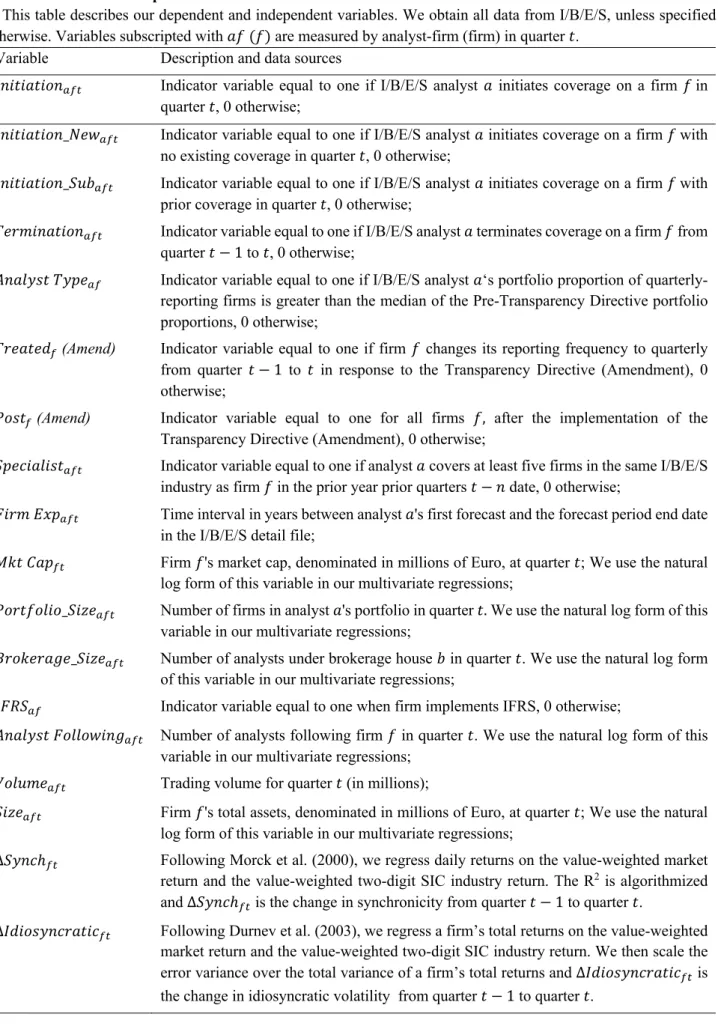
In this section we describe our data sources, sample selection criteria, and computation details of key variables. We also show summary descriptive statistics for the samples we use in our analyses. Table 1 summarizes our variables and data sources.
3.1. Sample Selection
For research setting, we use the staggered adoption differences in financial reporting frequency of EU companies, over the years 2003-2013. Prior to the TD implementation between 2004 and 2007, firms were only mandated to report on an annual basis. The first reporting frequency changes in the EU were experienced by cross-listed firms. Phrased differently, all newly listed firms (local or foreign firms) on the NYSE had to report quarterly financial reports since 1934 (SEC, 1934). The Securities Exchange Commission (SEC) further reinforced the quarterly reporting regime in 1969. As a result of these regulatory changes in the US, numerous EU firms, listed on American exchanges, were already reporting on a more frequent basis before 2004 and relative to their non-cross-listed counterparts in Europe. Consequently, the regulatory setting, before and around the TD, provides important conditions to test the impact of disclosure frequency changes on analysts’ coverage decisions. Notably, the sample period also aims to exclude potential factors of the Transparency Directive Amending Directive (TDAD), which was introduced in 2013. The regulatory introduction of the TDAD simplifies several of the requirements that were initially introduced by the EU. Respectively, we limit our sample to 2003 until 2013 to avoid the interference of this deregulation with our analysis. However, our subsequent robustness tests focus on the TDAD sample period from 2013 until 2018 and the respective implications of this deregulation. More importantly, our sample setting provides several key benefits. First, the mandatory (and voluntary) adoption of changing reporting frequencies occurs over time, which creates an ideal setting for a DiD design. Particularly, the cross-listing requirements of US exchanges leads to a substantial set of firms that already report
on a quarterly basis. This set of organizations serves as a natural group of control firms in our DiD design. Further, the mandatory requirement of more frequent reporting, following the TD, helps to reduce potential endogeneity concerns associated with a voluntary reporting frequency change of firms. Lastly, the choice for this specific time period stems from the substantial regulatory changes and the current debate in the US to abolish the quarterly reporting requirement. More specifically, a comparable analysis cannot be conducted in the US due to the constant quarterly-reporting requirement since 1934 by the SEC.
We start our sample selection by identifying 4,232 publicly listed European firms during 2003 – 2013 from the Compustat – Wharton Research Data Services. Within the databases, we obtain the reporting frequency and other firm-related characteristics. To match the firm sample to the I/B/E/S detail file, we use the respective CUSIP, and obtain all analyst forecasts within the sample period from January 2003 through November 2013. We lose 575 firms with no CUSIP match on I/B/E/S. Further, we delete 225 firms for which we cannot find reporting frequency information. Our final sample includes 3,462 publicly listed firms and 1,052 distinct analysts with a total of 19,160 initiations and 8,294 terminations for all sample firms. Lastly, we incorporate instances of coverage and non-coverage. By construction, research that studies coverage on a firm-by-firm basis excludes data from analysts who decide not to cover a given firm. However, this data is clearly important when one aims to model a coverage choice decision.
3.2. Model Equation and Multivariate Regression
In this section, we provide multivariate analyses of analysts' coverage decisions, namely, initiation and termination decisions of analysts. We study analysts' coverage decisions using a Probit model on the choice sample. In all multivariate models, we control for time, country and industry effects by including forecast end year, country and industry indicator variables. Further, we two-way cluster the standard errors at year level to control for cross-sectional and time-series dependence. Our regression model results in the following equation:
!"#$#%$#&"'() = +,+ +./"%012$3'()∗ 5&2$()∗ 367%$78() + ∑<<>,;<=&"$6&0'()< +
∑A ?@
@>. + ∑.D,EC>.DDFBC+ ∑IJK>LMN)O@'GH+ P'(), (1)
where the dependent variable is !"#$#%$#&"'() for the coverage likelihood analysis. For the subsequent analysis, we measure the level of existing analyst coverage for each of our
initiations. Specifically, we distinguish between initiations with no prior coverage (new initiations) and those with prior coverage (subsequent initiations). Initiations that occur at firms with (no) existing coverage are denoted by the indicator variable !"#$#%$#&"_R7S'() (!"#$#%$#&"_TUV'()) Subscript % stands for analyst, W for firm, $ for the forecast quarter, # for industry, X for year and = for country. We follow prior research and control for various firm, analyst, and brokerage characteristics, as defined in Table 1, that affect the analyst and her coverage decisions. The industry controls are constructed on 3-digit SIC codes. The main variable of interest, +., estimates the effect of an analysts’ frequent reporting expertise for treatment firms following the reporting frequency change around the Transparency Directive.
367%$78@ represents the indicator variable for a treatment firm (reporting frequency change
due to the Transparency Directive); 5&2$@,) represents an indicator variable that equals 1 for periods after the treatment year, and 0 for periods prior to the introduction year. Importantly, we visually establish the soundness of the parallel trend assumption.
3.3. Effects of frequency-type specific knowledge on forecast accuracy
We continue our empirical analyses with a model that includes the analyst type indicators, firm-specific and industry-specific knowledge, and other additional control variables. This model is shown below, in Eq. (2)
Z&67[%2$_5'() = +,+ +./"%012$3'() ∗ 5&2$() ∗ 367%$78()+ ∑<<>,;<=&"$6&0'()< +
∑A@>.?@+ ∑.D,EC>.DDFBC+ ∑IJK>LMN)O@'GH+ P'(), (2) where Z&67[%2$_5'() is the absolute forecast error (or directional forecast bias) for analyst a’s forecast of firm f’s earnings in t; the control variables are defined in Table 1.
367%$78@ represents the indicator variable for a treatment firm (reporting frequency change
due to the Transparency Directive); 5&2$@,) represents an indicator variable that equals 1 for periods after the treatment year, and 0 for periods prior to the treatment year.
3.3. Variables
Most research related to the determinants of analyst coverage links firm characteristics (e.g.; size, performance and the number of analysts that follow the firm) (Bae, Stulz, M., & Tan, 2008). Other studies incorporate a broader perspective and focus on brokerage- and analyst-specific elements, such as brokerage size and specialist status (Clarke, Khorana, Patel, & Rau,
2007). Due to the analyst-firm focus of our study, we aim to measure all variables in a pair setting, at each respective quarter. These variables comprise the reporting frequency, industry specialization and firm-specific experience between the analyst and the covered firm. For our main variables of interest, frequent analyst (infrequent analyst), equals one if an analyst’s portfolio proportion of frequent firms relative to all firms is greater (smaller) than the median portfolio proportion prior to the Transparency Directive. Notably, we compute the portfolio proportion based on the ratio of quarterly to all the other firms in an analyst’s portfolio. To account for industry- and firm-specific expertise, we apply the methodology used by Gilson et al. (2012) to classify an analyst as a specialist, if she/he covers at least five firms in the given firm's industry. Similar to the industry-specific classification, the firm-specific experience variable accounts for the difference between the forecast period end date and the first forecast by the analyst (McNichols & O'Brien, 1997). Lastly, for each analyst-pair at quarter t, we identify the number of analysts following the firm, as well as the size of the portfolio and brokerage house. We further describe the variables and data sources in Table 1.
3.4. Summary statistics, Univariate analysis and Correlation
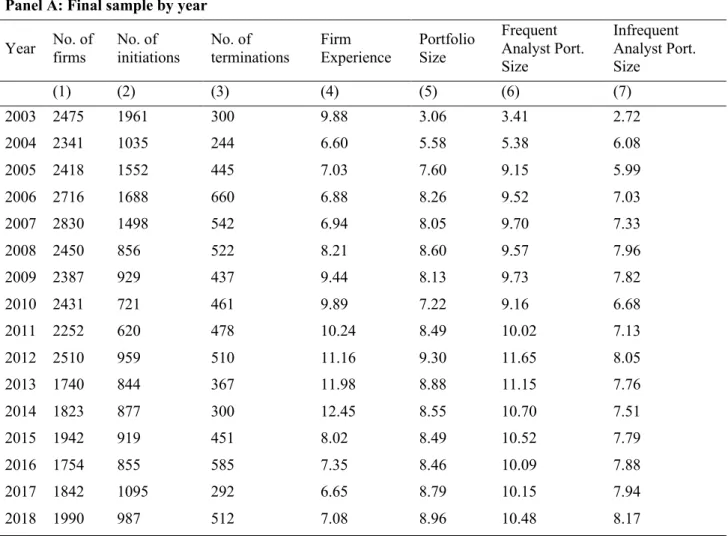
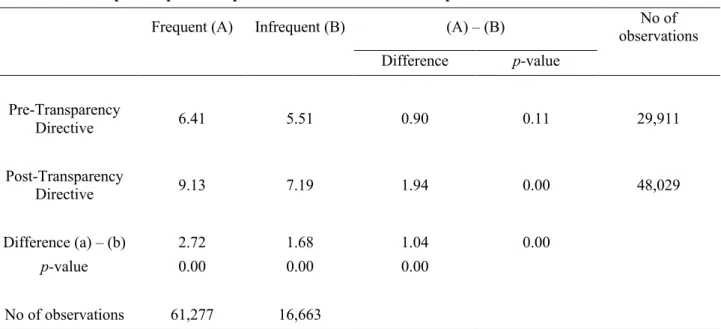
Panel A of Table 2 presents descriptive statistics by year for our sample firms. Our final sample incorporates 3,399 unique firms, of which 1,877 have analyst coverage over the sample period. We note the highest number of firms in the end of the TD implementation period in 2007 at 2,830, of which 1,672 are covered. The number of analyst’s peaks at the same time with 1,688 active analysts. The drops of firm and analyst numbers in 2011 onwards may reflect the European sovereign debt crisis2 starting in 2009 and slowly unfolds over the subsequent years. The number of initiations follows a similar pattern, increasing until 2007 and then remaining relatively stable over the following years. With respect to the averages, experience gradually increases over time. However, in the years 2015 and onwards, less-experienced (more experienced) analysts enter (leave) the market. Similarly, portfolio size increases over time, while remaining relatively constant after 2011. More specifically, frequent and infrequent analyst portfolios gradually increases over time, however, the portfolio size of frequent analyst is considerably larger than the portfolio of infrequent analyst. We further verify this with a
2 The European sovereign debt crisis is a multi-year debt crisis in the European Union that followed the global financial crisis in 2008. The collapse of banking systems across Europe has led to a loss of confidence in European businesses and economies. Respectively, capital market participants will increase risk aversive behavior or withdraw resources (Becker & Ivashina, 2017).
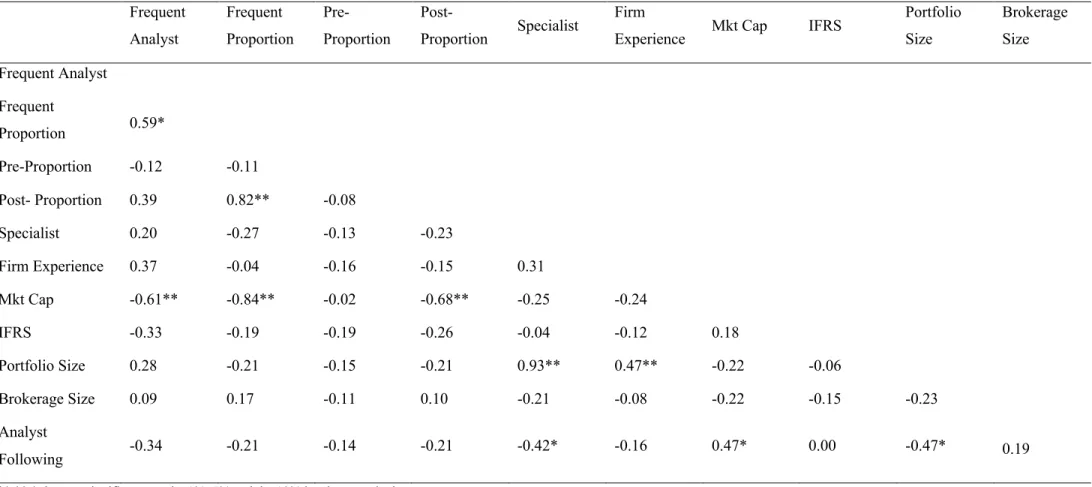
univariate analysis in Table 3. The result shows a significant difference in portfolio sizes between the two analyst types in both time periods. Particularly, the finding suggests that frequent analysts continuously add reporting frequency increasing firms to their portfolio after the Transparency Directive, while the portfolio of infrequent analysts remains relatively constant. We further include the descriptive statistics of our variables in Table 2 - Panel B. Notably, the portfolio proportions indicate the respective change following the Transparency Directive. Specifically, the overall proportion matches the Post-TD proportion due to the time period related to each variable. Furthermore, Table 4 also shows this correlation between the overall and post-TD proportion. With respect to our main variable Frequent Analyst, we employ the median of the pre-period proportion to isolate the effect of the regulatory change on analysts’ coverage decisions. This variable definition aims to capture the expertise in different reporting frequency levels and employs the pre-TD proportion as a benchmark. As displayed in Table 2, the mean and median were considerably lower before relative to the post-period, which follows the main objective of the Transparency Directive. Furthermore, the majority of our sample incorporates relatively experienced analysts. Lastly, the specialist
variable also indicates that approximately half of the analysts acquire industry expertise. This
specialist status positively correlates with the portfolio size of the analyst, which indicates that greater industry expertise incentives analysts to cover and follow more firms relative to non-specialist.
4. Analysis of disclosure frequency and analyst coverage decisions 4.1. Determinants of frequent analyst coverage likelihood
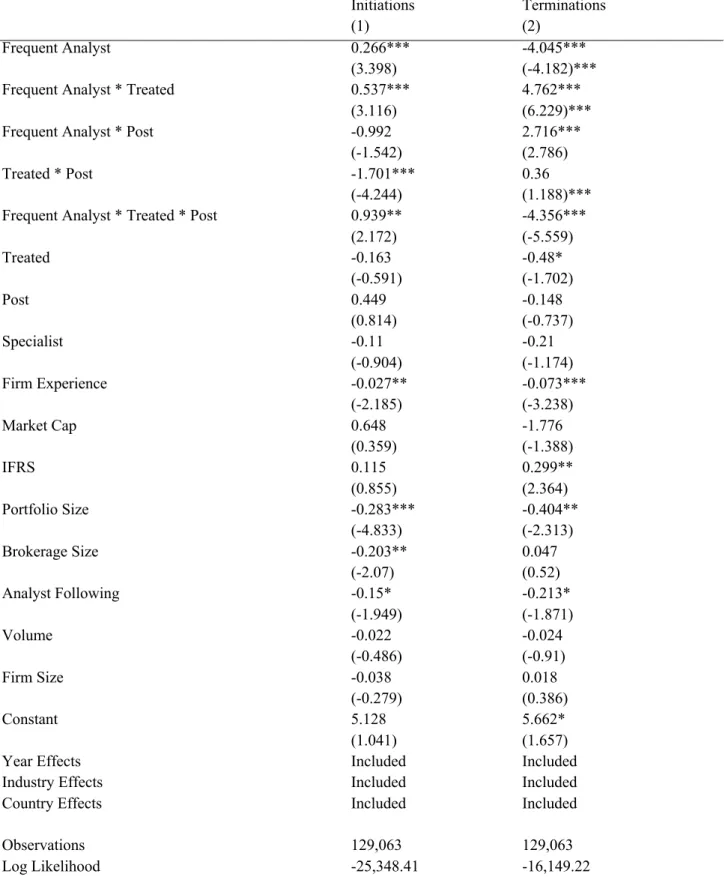
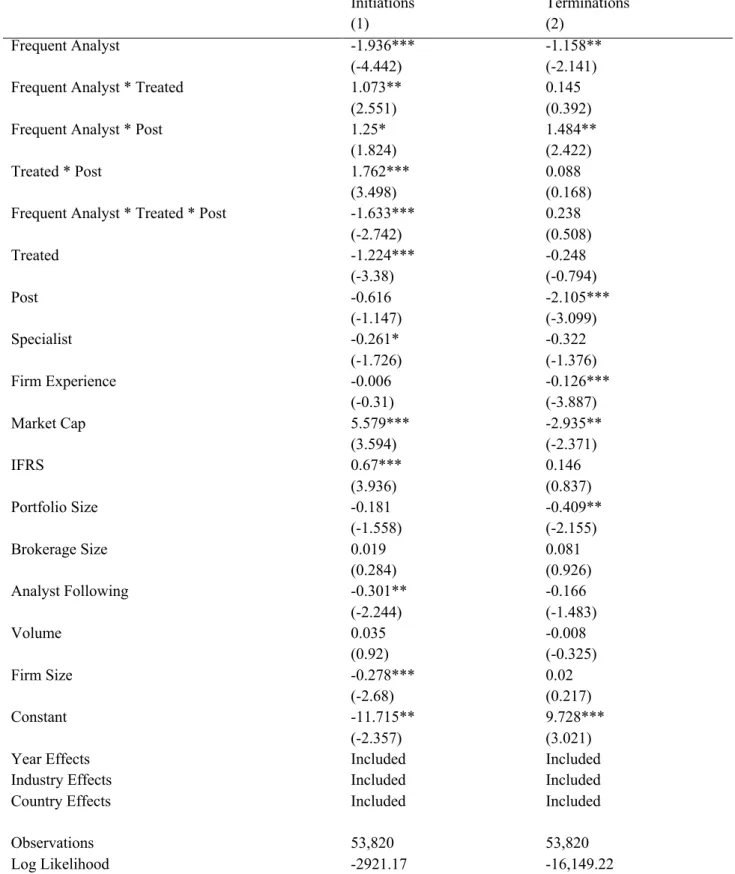
Table 5 illustrates our Probit regression results of the effect of reporting frequency on frequent analyst’s coverage likelihood of firms in our choice sample. As previously mentioned, we do not report the coefficients of year, industry and country effects, although we control for all three in all of our regressions. Table 4 further supports our premise that an analyst's expertise in disclosure frequency, increases the likelihood that she will cover a firm, controlling for other determinants of this decision. In all columns, we use the indicator Frequent Analyst to proxy for the expertise in disclosure frequency and find positive and significant coefficients for initiations. Furthermore, our main interaction variable of interest, Frequent Analyst * Treated * Post, providesconsistent and significant evidence for H1. In Column (1), the interaction term coefficient of 0.93 suggests an odd ratio of 2.53 (=exp(0.54)), meaning that frequent analysts are 150% more likely to initiate new coverage for a disclosure frequency changing firm after the Transparency Directive compared to infrequent analysts. This finding provides important
insights on how disclosure frequency and related informational advantages influence the coverage decision-making process of analysts. With respect to the other interaction terms,
Treated * Post shows a highly significant and negative coefficient. More specifically, the respective odd ratio indicates an 80% lower likelihood of new coverage for firms that increase reporting frequency after the Transparency Directive. This finding is in line with our premise and suggests that frequent analyst strategically select their coverage targets to fully utilize their informational advantage, while other analyst may not be able to seize this opportunity (Crawford, Roulstone, & So, 2012). However, opposing other studies, firm-specific
Experience seem to be less likely to initiate new coverage with an odd ratio of 0.02, indicating specialist are 5% less likely to initiate new coverage for firms (O'Brien & Tan, 2015). Potentially, these analysts prefer more established companies and their stature allows them more selectivity. Lastly, the analyses in Column (2) investigates the termination decision of analysts. The main focus variable provides significant and negative results, which indicates that the disclosure expertise of frequent analysts also has an effect on the termination decisions.
Consistent with the argumentation of H2, the result follows the general premise that the greater information environment Post-TD should not positively influence the termination behavior of frequent analysts for treated firms. In particular, frequent analysts prefer the greater reporting frequency and consequently, have more incentives to keep coverage for respective firms. On the contrary, the termination likelihood of infrequent analysts significantly increases for firms that switch reporting frequency in response to the TD. This could result from the overall increase in disclosure quality and the decrease in information asymmetry for these firms. Alternatively, infrequent analysts may start to restructure their portfolios and based on newly available information. Overall, our results support the conjecture that disclosure frequency significantly increases analyst coverage likelihood, controlling for specialist status, as well as other coverage determinants. In particular, the increase in likelihood for initiations suggests that frequent analysts possess the ability to gather and create information) in a more efficient manner following the Transparency Directive. Consistent with the previous literature on the determinants of the analyst coverage, Table 4 also shows that IFRS and Treated
positively influence the initiation behavior (Lang, Lins, & Miller, 2003; Crawford, Roulstone, & So, 2012; Branson, Guffey, & Pagach, 1998). These positive results follow the reduction in information asymmetry related to the three variables. For instance, IFRS and the associated regulatory changes aim to harmonize accounting standards and respectively reduce differing information environments across countries.
4.2. Analysts’ contribution to the existing information mix of the stock price
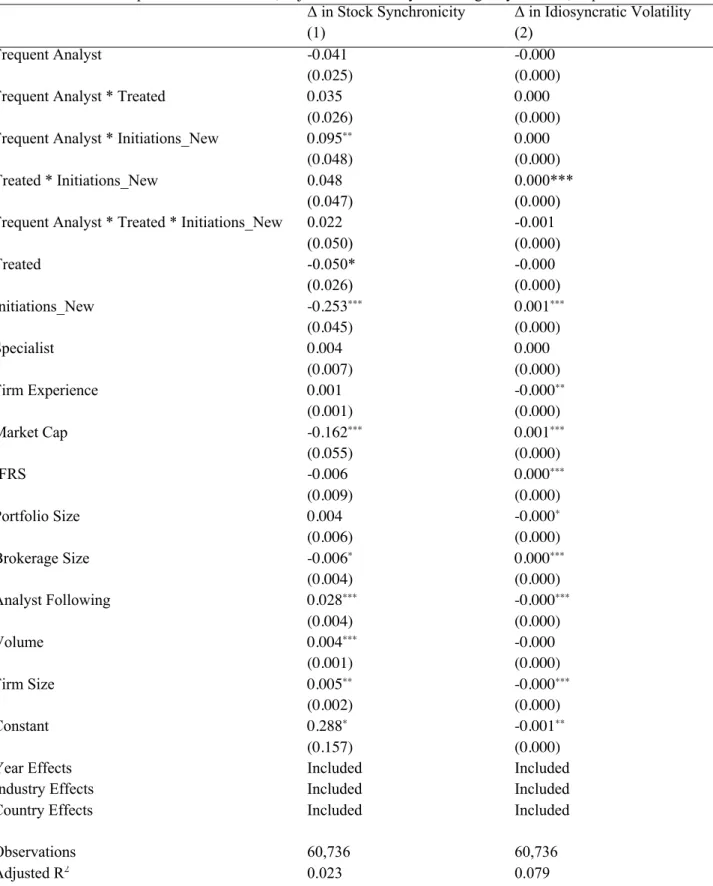
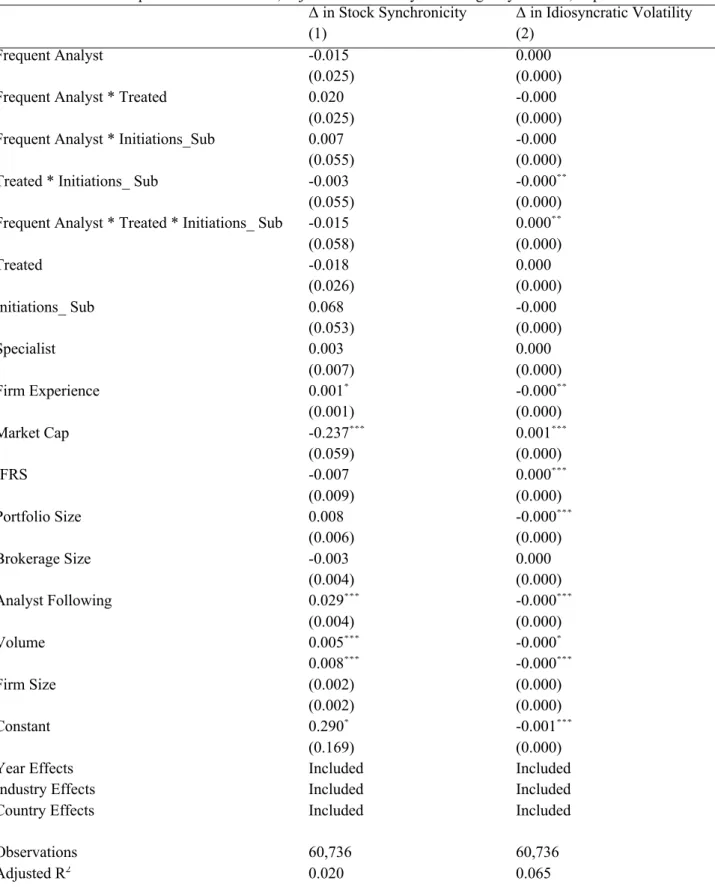
Table 6 displays our findings to determine whether the information effects of coverage initiations vary based on the level of existing coverage at the time of the initiation. Specifically, we aim to identify what type of information frequent (infrequent) analysts primarily produce in the coverage process of firms that increase their reporting frequency in response to the TD. We employ the methodology by Durnev, Morck, Yeung, & Zarowin (2003), who proxy firm-specific information and its impoundment into the price formation process via the change in idiosyncratic volatility. In contrast, we capture the respective change in industry and market-wide information by the change in stock return synchronicity. Several studies in the past have employed this measure to check for the relation between a firm’s stock returns and market and industry returns (Durnev et al, 2003; Crawford et al. , 2012). For instance, Roll (1988) found that stock return synchronicity is negatively associated with the amount of firm-specific information being impounded into individual stock prices. We explain the measures in more detail in Table 1. We interpret the results in Table 6 as indicating that, on average, frequent analysts (Frequent Analyst * Treated * Initiation_New) significantly reduce the amount of firm-specific information, when initiating coverage at firms with no prior coverage. Prior literature interprets this reduction as either an increase in industry and market-wide information or additional noise impounded in the stock price. While the former is consistent with analysts gathering information that is less costly to acquire, the alternative noise contribution may actually decrease the market efficiency (Crawford et al., 2012). However, as displayed in Table 7, frequent analysts that initiate coverage at firms with existing coverage (Frequent Analyst * Treated * Initiation_Sub) include significantly more firm-specific information into the covered firm’s stock price. Consistent with Durnev et al. (2003), these results indicate that frequent analysts only initiating coverage if they have the expertise and relevant firm-specific information to share with investors since industry- and market-related information has already been provided by other analysts. This analysis collaborates our initial argumentation that frequent analysts possess greater levels of reporting disclosure expertise and respectively, are more efficient in the firm-specific information collection for firms that change their reporting frequency in the TD period.
5. Forecasting implications of the Transparency Directive
In the previous section, we identify the impact of reporting disclosure frequency on analysts' coverage likelihood. Subsequently, we illustrate the implications of these coverage decisions on analyst’ forecast performance.
5.1. Forecast Performance of Frequent Analyst
In our first model specification, the primary variable of interest in this specification is the interaction term - /"%012$ 31\7 ∗ 5&2$ ∗ 367%$78'(). With this variable, we test the expertise of the specific analyst type on the forecast accuracy of frequency switching firms in the Post Transparency Directive period. Following the previous models, we expect a negative coefficient on this interaction term for frequent analysts. This result could be interpreted as the respective forecasting advantage related to the frequency type-specific knowledge, succeeding the strategic coverage choice of the analyst. On the contrary, we expect decreases in the forecasting performance for the infrequent analyst group, because of their informational advantage loss related to their disclosure frequency expertise and a subsequent adjustment phase to the new informational environment. With respect to the second specification, we do not specify a direction for the expected forecast bias. This mostly results from inconclusive evidence for both argumentations. The superior information of frequent analysts may enable them to gather and utilize information (i.e.; firm- and/or industry-specific information) in a timelier and more cost-efficient manner, however, the resulting earnings forecast can be either more optimistic or pessimistic. For the former direction, the superior expertise can enable frequent analysts to gather more crucial information and respective provide better and more positive forecasts. On the other hand, this better information gathering process could also unfold important information that makes earnings forecasts more negative for this analyst type (Hong & Kubik, 2003; Das, Levine, & Sivaramakrishnan, 1988).
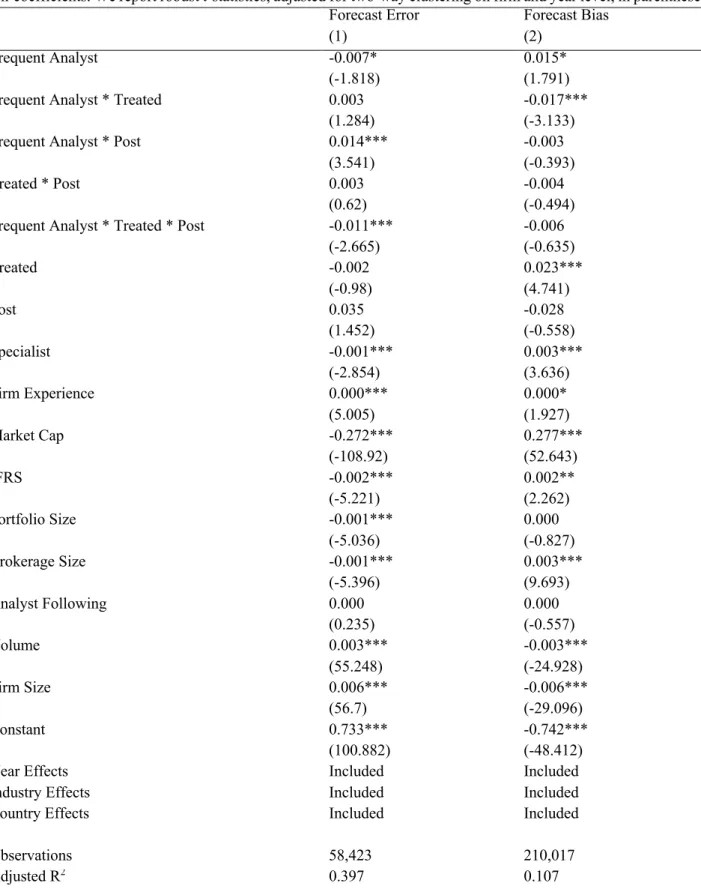
Turning to our primary regressions, we see in Table 8 - Columns (1) that the coefficients and significance levels of the interest variables confirm our predication. Most specifically, the variable Z67]U7"$ /"%012$ ∗ 5&2$ ∗ 367%$78 indicates that frequent analysts, following their previous coverage decision, provide superior earnings forecast for future periods, relative to infrequent analysts. This improved performance will mainly result for the reporting frequency specific expertise that this type of analyst incorporates in the forecasting process. However, on average, frequent analysts only provide superior forecasts for the treated firms in the Post-TD period. Potential explanations for this increase could relate to the greater information asymmetry prior to the TD implementation. Importantly, this should not be interpreted as a unsuccessful implementation of the Transparency Directive, because this regulatory change was aimed to reduce myopic behavior and inefficiencies in resource allocation (Fu, Kraft, & Zhang, 2012). Furthermore, the improvements for these firms could occur gradually, which
may result in an initial increase in analysts’ forecast errors. With respect to the control variables, we see that Specialist, Analyst Following, IFRS, Portfolio Size and Brokerage Size
negative influence the forecast error, which is consistent with prior literature (Mikhail, Walther, & Willis, 1997; Clement, 1999, Dowen, 1989). Lastly, the results further indicate that with Volume and Size, one can expect increases in the forecast error. The common factor in in these variables relates to complexity and uncertainty. For instance, greater trade or more complex global operations aggravate analyst’s ability to predict future performance of firms due to the limited resource to process all the necessary information (Clement, 1999). Column (2) provides the regression results for the forecast bias specification. As previously stated, we do not expect one direction to be more pronounced in our model. Respectively, the results indicate no significant relationship between the frequent analysts’ disclosure advantage for switching firms and forecast bias. A potential explanation may relate to a negating effect of optimistic and pessimistic analysts. This argumentation follows the direction of the remaining interaction terms. Noticeably, all analysts provide significantly more pessimistic forecast for treated firms in the Post-TD period. The control variables follow the expected direction that we outline in the previous section.
Overall, we find significant evidence for the superior forecasting performance of frequent analysts, after their strategic initiation choices of treated firms, relative to infrequent analysts. More specifically, frequent analysts provide more accurate future earnings forecasts for firms that were affected by the Transparency Directive implementation between 2004 and 2007.
6. Robustness tests
In the above sections, we show the relationship between reporting disclosure frequency increases, analyst type-specific experience and analysts' coverage likelihood. To check the robustness of our results, we employ alternative choice decisions and alternative proxies for our variables. We have identified some of these alternatives previously in footnotes and explain them in more detail below.
6.1. Effects of deregulations on analyst coverage likelihood
The period that follows our sample period also includes another important regulatory change that may influence analysts’ coverage. Other scholars have already investigated deregulation settings (i.e.; industry deregulations) and the respective effects on forecasting performance. For instance, Datta, Iskandar-Datta, & Sharma (2011) exploit industry deregulations, as their
research setting, to investigate the change in competition (market power) on analysts’ forecasts accuracy and bias. The authors find that analysts’ forecast accuracy declines significantly in the post-deregulation period, while analyst optimism increases significantly. Moreover, they find that deregulated industries are also able to attract a greater coverage level. This finding contradicts previous assumptions of analysts’ incentive to strategic select firms with more market power because they are easier to forecast. We aim to complement these findings, by investigating how analysts’ reporting frequency expertise affects the coverage decisions after a deregulatory change. Our deregulatory change relates to the abolishment of several key policies of the Transparency Directive. The Transparency Directive Amending Directive (TDAD), introduced in 2013, aims to correct several issues of the Transparency Directive. In particular, legislators removed the quarterly reporting and other administrative requirements as a response to myopic managerial behavior and real earnings management incidents in quarterly reporting settings. We aim to exploit this exogenous shock and the respective endogenous coverage choice to verify whether our specific analyst types decide to (not) cover specific firms in the Post-TDAD period.
We display the respective output for each analyst type in Table 9. However, before the discussion of the results, several changes to key independent variables were implemented. In particular, the Treated and Post variablechange to Treated Amend and Post Amend. Table 1 describes them in more detail; however, the change mainly relates to the respective regulatory change. Table 8 – Column (1) and (2) displays the coverage implications for frequent analysts. Our main focus lies on the respective analyst types and their coverage decisions for firms that switch to a less frequent reporting regime in the Post-TDAD period. Table 9 – Column (1) shows significant change in the coverage initiations of frequent analysts for firms that implement the regulatory requirements of the TDAD. In particular, frequent analysts are significantly less likely to initiate coverage for firms that decrease their reporting frequency in response to the TDAD. More specifically, the odd ratio of 0.19 (exp(-1,63)) indicates that frequent analysts are 80% less likely to coverage firms that reduce their reporting frequency after 2013. This follows our premise of the reporting expertise, possessed by frequent analysts, that significantly diminishes with the implementation of the TDAD. In other words, the introduction of greater information asymmetry, through the regulatory change, refrains frequent analysts to initiate coverage for treated firms. The control variables primarily indicate that industry- and firm-specific experience as well as existing analyst coverage reduces the initiations likelihood in the respective sample period. Column (2) illustrates the termination behavior of frequent analysts in the TDAD sample period. While the non-significance of the
three-way interaction indicates that frequent analysts do not terminate their coverage of reporting frequency decreasing firms in the post-TDAD period, the significantly positive coefficient of Frequent Analyst * Post Amend supports the aforementioned restructuring prediction. Particularly, frequent analysts seem to be more likely to terminate their coverage in the post-TDAD period. Conclusively, these findings suggest that the constant portfolio size of frequent analysts, in combination with the significant increase in both initiations and terminations likelihood by frequent analyst, indicates portfolio restructuring by this analyst group. All in all, deregulation provides consistent results that follow the aforementioned argumentation and further reveal potential restructuring activities of analysts, following the deregulatory changes.
6.2. Analyst Target Price Error
Earnings forecasts are an important channel through which information intermarries distribute information, nonetheless, target prices are another common measure of the type of information that analysts provide. We adapt Equation (2) for this analysis and replace the right-hand side with the Target Price forecast accuracy. We measure TP forecast accuracy by the magnitude of the TP error, TPE, which is the absolute difference between the target and the actual stock price at the end of the 12-month forecast horizon, scaled by the stock price at the TP issue date. The results in Table 10 provide similar results. Noticeably, the magnitude of the forecast error reduction is stronger. Moreover, the control variables follow similar pattern, as in Table 8. 7. Conclusion
Despite abundant evidence regarding the effect of analyst coverage on covered firms and on analysts' employers, we have an incomplete understanding of determinants that incentivize an individual analyst to initiate or terminate the coverage of a particular firm. Based on the idea that reporting frequency creates varying information environments, which improves the analyst's information about the firm, we examine reporting frequency as a determinant of the analyst's coverage decision. We divide the analyst in respective groups based on their portfolio composition to account for expertise in specific disclosure frequency types. We further control for industry specialization, firm-specific experience, and other common determinants of coverage in our study. After controlling for these factors, we identify that frequent analysts are 150% more likely to initiate new coverage for a disclosure frequency changing firm in the Post TD period, compared to infrequent analysts. The opposite holds for the infrequent analysts, this analyst type refrains from initiations in the Post-TD period. More specifically, they
regulatory change leads to the loss of their reporting frequency-specific informational advantage, which subsequently reduces the benefits of covering firms that are required to increase disclosure frequency. While several control variables are of great importance, the respective industry and firm-specific experience variables provide the most significant coefficients. To collaborate these findings, we further identify the primarily information type that frequent and infrequent analysts produce during their coverage decision. We show that frequent analysts primarily incorporate firm-specific information into the stock price formation process, which follows our argumentation of their greater expertise with respect to high reporting frequency. Moreover, the strategic coverage behavior of analysts also reflects in their subsequent forecasting performance. In particular, frequent analysts are able to provide more accurate forecast for the treated firms, following the Transparency Directive introduction. Lastly, we add another novel dimension to the study by exploiting the one-time events of deregulations to ascertain and verify the impact of reporting frequency changes on analysts’ coverage decisions. The exogenous shock (provides us with a clean natural experiment and a unique opportunity to study the disclosure frequency adjustments on analysts’ coverage behavior. We examine our choice sample and identify that frequent analysts avoid coverage decisions in the post-deregulation period, while terminations remain unaffected. This result may relate to the consecutive exposure and adjustment to a quarterly reporting setting. In other words, the frequent analysts avoid the increase in information asymmetry and refrain from new initiations. While prior scholars of coverage behavior examine the number of analysts that follow a firm in aggregate, we look at detailed characteristics of the specific analyst-firm pair. The exogenous regulatory change provides us with an ideal setting to examine this detailed coverage decision and allows us to isolate the behavioral differences between our two analyst groups. Although our conjecture about the information advantage of analyst types is based on prior research and logically could apply to any analyst-firm pair, we cannot be certain that our results generalize to other regulatory settings. In conclusion, we examine the impact of different reporting frequency expertise of analysts after a regulatory change and find that analysts benefit from information environments that closely match their type of expertise. These benefits include the strategic coverage of certain firms and subsequently, the superior forecast performance via more accurate forecasts. Lastly, we believe that the investigation of analyst’s decision-making processes remains a viable research area for the future. Analyst’s coverage decisions have important implications for a variety of stakeholders. For example, greater coverage enables better funding conditions for firms, more efficient resource allocation by shareholders and more informed capital markets benefit regulators and other stakeholders.
REFERENCES
Altınkılıç, O., Balashov, V. S., & Hansen, R. S. (2013). Are analysts' forecasts informative to the general public? Management Science, 59(11), 2550-2565.
Bae, K. H., Stulz, M., R., & Tan, H. (2008). Do local analysts know more? A cross-country study of the performance of local analysts and foreign analysts. Journal of Financial Economics, 88(3), 581-606.
Barron, O. E., Kim, O., Lim, S. C., & Stevens, D. E. (1998). Using analysts' forecasts to measure properties of analysts' information environment. Accounting Review, 421-433.
Barth, M. E., Landsman, W. R., Lang, M., & Williams, C. (2012). Barth, M. E., Landsman, W. R., Lang, M., & Williams, C. (2012). Are IFRS-based and US GAAP-based accounting amounts comparable? Journal of Accounting and Economics, 54(1), 68-93.
Becker, B., & Ivashina, V. (2017). Financial repression in the European sovereign debt crisis. Review of Finance, 22(1), 83-115.
Botosan, C. A., & Plumlee, M. A. (2002). A re‐examination of disclosure level and the expected cost of equity capital. Journal of accounting research, 40(1), 21-40.
Bradley, D., Clarke, J., Lee, S., & Ornthanalai, C. (2014). Are analysts’ recommendations informative? Intraday evidence on the impact of time stamp delays. The Journal of Finance, 69(2), 645-673. Branson, B. C., Guffey, D. M., & Pagach, D. P. (1998). Information conveyed in announcements of
analyst coverage. Contemporary Accounting Research, 15(2), 119-143.
Brown, S., Hillegeist, S. A., & Lo, K. (2004). Conference calls and information asymmetry. Journal of Accounting and Economics, 37(3), 343-366.
Butler, M., Kraft, A., & Weiss, I. S. (2007). he effect of reporting frequency on the timeliness of earnings: The cases of voluntary and mandatory interim reports. Journal of Accounting and Economics, 43(2-3), 181-217.
Byard, D., Li, Y., & Yu, Y. (2011). The effect of mandatory IFRS adoption on financial analysts’ information environment. Journal of accounting research, 49(1), 69-96.
Chan, K., & Hameed, A. (2006). Stock price synchronicity and analyst coverage in emerging markets.
Journal of Financial Economics, 80(1), 115-147.
Clarke, J., Khorana, A., Patel, A., & Rau, P. R. (2007). The impact of all-star analyst job changes on their coverage choices and investment banking deal flow. Journal of Financial Economics, 84(3), 713-737.
Clement, M. B. (1999). Analyst forecast accuracy: Do ability, resources, and portfolio complexity matter? Journal of Accounting and Economics, 27(3), 285-303.
Crawford, S. S., Roulstone, D. T., & So, E. C. (2012). Analyst initiations of coverage and stock return synchronicity. The Accounting Review, 87(5), 1527-1553.
Cuijpers, R., & Peek, E. (2010). Reporting frequency, information precision and private information acquisition. Journal of Business Finance & Accounting, 37(1‐2), 27-59.
Das, S., Levine, C. B., & Sivaramakrishnan, K. (1988). Earnings predictability and bias in analysts' earnings forecasts. Accounting Review, 277-294.
Datta, S., Iskandar-Datta, M., & Sharma, V. (2011). Product market pricing power, industry concentration and analysts’ earnings forecasts. Journal of Banking & Finance, 35(6), 1352-1366.
Derrien, F., & Kecskés, A. (2013). The real effects of financial shocks: Evidence from exogenous changes in analyst coverage. The Journal of Finance, 68(4), 1407-1440.
Dowen, R. J. (1989). The relation of firm size, security analyst bias, and neglect. Applied Economics, 21(1), 19-23.
Durnev, A., Morck, R., Yeung, B., & Zarowin, P. (2003). Does greater firm‐specific return variation mean more or less informed stock pricing? Journal of Accounting Research, 41(5), 797-836. Ellul, A., & Panayides, M. (2018). Do financial analysts restrain insiders’ informational advantage?
Journal of Financial and Quantitative Analysis, 53(1), 203-241.
Ernstberger, J., Link, B., Stich, M., & Vogler, O. (2017). he real effects of mandatory quarterly reporting. The Accounting Review, 92(5), 33-60.
European Commission. (2004). Directive 2004/109/EC of the European Parliament and of the Council.
Official Journal of the European Union, L 390, pp. 38–57.
Fernandes, N., & Ferreira, M. A. (2008). Does international cross-listing improve the information environment. Journal of Financial Economics, 88(2), 216-244.
Frankel, R., & Li, X. (2004). Characteristics of a firm's information environment and the information asymmetry between insiders and outsiders. Journal of Accounting and Economics, 37(2), 229-259.
Fu, R., Kraft, A., & Zhang, H. (2012). Financial reporting frequency, information asymmetry, and the cost of equity. Journal of Accounting and Economics, 54(2-3), 132-149.
Gigler, F., Kanodia, C., Sapra, H., & Venugopalan, R. (2014). How frequent financial reporting can cause managerial short‐termism: An analysis of the costs and benefits of increasing reporting frequency. Journal of Accounting Research, 52(2), 357-387.
Gilson, S. C., Healy, P. M., Noe, C. F., & Palepu, K. G. (2001). Analyst specialization and conglomerate stock breakups. Journal of Accounting Research, 39(3), 565-582.
Healy, P. M., & Palepu, K. G. (2001). How frequent financial reporting can cause managerial short-termism: An analysis of the costs and benefits of increasing reporting frequency. Journal of Accounting Research, 52(2), 357-387.
Hong, H., & Kubik, J. D. (2003). Analyzing the analysts: Career concerns and biased earnings forecasts. The Journal of Finance, 58(1), 313-351.
Horton, J., Serafeim, G., & Serafeim, I. (2013). Does mandatory IFRS adoption improve the information environment? Contemporary accounting research, 30(1), 388-423.
Irani, R. M., & Oesch, D. (2013). Monitoring and corporate disclosure: Evidence from a natural experiment. Journal of Financial Economics, 109(2), 398-418.
Jacob, J., Lys, T. Z., & Neale, M. A. (1999). Expertise in forecasting performance of security analysts.
Journal of Accounting and Economics, 28(1), 51-82.
Kim, J. B., & Shi, H. (2012). IFRS reporting, firm-specific information flows, and institutional environments: International evidence. Review of Accounting Studies , 17.3 (2012): 474-517. Kraft, A. G., Vashishtha, R., & Venkatachalam, M. (2017). Frequent financial reporting and
managerial myopia. The Accounting Review, 93(2), 249-275.
Lang, M. H., & Lundholm, R. (1996). Corporate Disclosure Policy and Analyst Behavior. The Accounting Review, 71(4), 467-492.
Lang, M. H., Lins, K. V., & Miller, D. P. (2003). ADRs, analysts, and accuracy: Does cross listing in the United States improve a firm's information environment and increase market value?
Journal of Accounting Research, 41(2), 317-345.
Lang, M. H., Lins, K. V., & Miller, D. P. (2004). Concentrated control, analyst following, and valuation: Do analysts matter most when investors are protected least? Journal of Accounting Research, 42(3), 589-623.
Li, K. K., & You, H. (2015). What is the value of sell-side analysts? Evidence from coverage initiations and terminations. Journal of Accounting and Economics, 60(2-3), 141-160.
Liu, M. H. (2011). Analysts’ incentives to produce industry-level versus firm-specific information.
Journal of Financial and Quantitative Analysis, 46(3), 757-784.
McNichols, M., & O'Brien, P. C. (1997). Self-selection and analyst coverage. Journal of Accounting Research, 35, 167-199.
Merkley, K., Michaely, R., & Pacelli, J. (2017). Does the scope of the sell‐side analyst industry matter? An examination of bias, accuracy, and information content of analyst reports. The Journal of Finance, 72(3), 1285-1334.
Merton, R. C. (1987). A simple model of capital market equilibrium with incomplete information. The Journal of Finance, 42(3), 483-510.
Mikhail, M. B., Walther, B. R., & Willis, R. H. (1997). Do security analysts improve their performance with experience? Journal of Accounting Research, 35, 131-157.
Mola, S., Rau, P. R., & Khorana, A. (2012). Is there life after the complete loss of analyst coverage?
The Accounting Review, 88(2), 667-705.
O'Brien, P. C., & Tan, H. (2015). Geographic proximity and analyst coverage decisions: Evidence from IPOs. Journal of Accounting and Economics, 59(1), 41-59.
Piotroski, J. D., & Roulstone, D. T. (2004). The influence of analysts, institutional investors, and insiders on the incorporation of market, industry, and firm-specific information into stock prices. The Accounting Review, 79(4), 1119-1151.
Tan, H., Wang, S., & Welker, M. (2011). Analyst following and forecast accuracy after mandated IFRS adoptions. Journal of accounting research, 49(5), 1307-1357.
Xu, N., Chan, K. C., Jiang, X., & Yi, Z. (2012). Do star analysts know more firm-specific information? Evidence from China. . Journal of Banking & Finance, 37(1), 89-102.
Yee, K. K. (2004). Interim reporting frequency and financial analysts' expenditures. Journal of Business Finance & Accounting, 31(1‐2), 167-198.