Page 1 of 6
APPROACHING A UNIVERSAL SAMPLE PREPARATION METHOD
FOR XRF ANALYSIS OF POWDER MATERIALS
John Anzelmo, Alexander Seyfarth, Larry Arias
Bruker AXS, Inc. Madison, Wisconsin
Abstract
It is well known that the preparation of metals and liquids for XRF analysis is fast, easy, and usually requires little strategy. The preparation of powder samples such as silicates, carbonates, slags, cements, ferro-alloys and other powdered materials however requires careful planning in the way of additives, lubricants, binders, dilution, backing and holders. The ratio of binder to sample must include forethought regarding the homogeneity of the briquette, the stability of the briquette, the cleaning and cleanliness of the grinding vessel, and the performance requirements of the analysis. The ideal situation would be to have one set of preparation materials, with only one sample to additive ratio suffice for all powder preparations. Various preparation materials and strategies are examined, and their usefulness toward achieving a universal preparation method considered.
Introduction
The word “approaching” was chosen very carefully when deciding on the title of this paper, because there is no universal preparation method for pressed powders. However, it is possible to greatly reduce the number of different methods in many laboratories. Many laboratories use widely varying techniques in their selection of preparation methods, when it may have been possible for that laboratory to use only one method.
The use of a grinding aid or lubricant is the one material that is not made use of in many laboratories. This material has many properties which make the consideration of other parameters in the preparation method unnecessary. The grinding aid Vertrel XFTM (1) was reported in a previous paper(2) to have these properties in the preparation of cement, clinker and related raw materials. This lubricant, which replaces previously used Freon TF, is a clear colorless liquid, which is not retained in the pressed pellet as shown by scans for fluorine in finished sample briquettes. Vertrel XF is the trade name for 2,3 Dihydroperfluoropentane, and the material Safety Data Sheet(1) (MSDS) for this product should be consulted for properties and characteristics of this material. It is not intended for this method to be selected as a universal method. But, rather, it is hoped that the concepts presented here will be applied, and more thought given to reducing the number of variables considered when preparing various materials.
Discussion
There are many variables (Table 1) to consider when designing a method for preparation of a material for XRF analysis. Many times, the container material chosen is W/C because of the need to eliminate iron contamination when using steel grinding media. A grinding aid acts as a lubricant, and minimizes if not eliminates, the iron contamination, so that a hardened steel container can be used. The binder to sample dilution is another area where multiple methods can
Copyright(c)JCPDS-International Centre for Diffraction Data 2001,Advances in X-ray Analysis,Vol.44 1 Copyright(c)JCPDS-International Centre for Diffraction Data 2001,Advances in X-ray Analysis,Vol.44Copyright(c)JCPDS-International Centre for Diffraction Data 2001,Advances in X-ray Analysis,Vol.44 367368
Conference (DXC) on Applications of X-ray Analysis.
Sponsored by the International Centre for Diffraction Data (ICDD).
This document is provided by ICDD in cooperation with
the authors and presenters of the DXC for the express
purpose of educating the scientific community.
All copyrights for the document are retained by ICDD.
Usage is restricted for the purposes of education and
scientific research.
DXC Website
–
www.dxcicdd.com
ICDD Website
-
www.icdd.com
Page 2 of 6
be reduced. Typical binders stick to the grinding vessel and components unless the proper ratio is determined, making many trial and error experiments necessary. The use of Vertrel XF along with a Whatman CF11 fibrous cellulose(3) minimizes the need to vary dilution ratios. The low ash content (typically ~ 50 ppm) of this binder, used in a dilution ratio of 20% insures that the most contamination possible from the binder is 10 ppm total. No expanding of briquettes has been observed when using the the formula listed in Table 2, even after years.
After grinding, the mixture exists as a slurry. A gentle draft for ~15 seconds will vaporize the liquid. The remaining powder can be brushed from the container and components very easily, almost dust free. The container and components need only a gentle wiping with clean,
disposable, paper towels to remove contamination for the next grind.
Table 1. Sample Preparation Variables
1. Grinder Type (manual, mixer, ring and puck disk mill) - Particle size distribution desired
- Grinding time allowed or desired
2. Container Material (Fe/Cr, W/C, ZrO, Si/N, Al2O3)
- Weight, brittleness, expense
3. Grinder cleanliness and container condition (rust outside inserts) 4. Workbench contamination
5. Sample volume
6. Container/Ring/Puck/Lid condition 7. Component dimensions and pitting
8. Binder type and dilution 9. Grinding Aid – Lubricant
10. Dust
11. Sample contamination 12. Ease of cleaning
Table 2. Proposed “General Method” for Sample Preparation Ø Disc Mill (ring and puck type)
Ø Hardened steel container and components Ø 10.00x grams of sample
Ø 2.50x grams Whatman CF11 cellulose as binder Ø 7 ml Dupont Vertral XF
Ø 90 second grinding time
Ø 15 second press at 40, 000 lbs. in 40mm die mold Ø Tapered Aluminum pellet cup
The elimination of contamination for subsequent sample preparations is of paramount
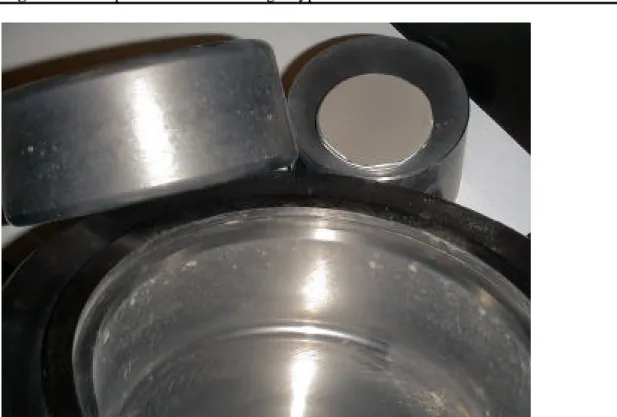
importance. Typical binders leave material stuck to the components that is difficult to remove, even after thorough wiping (Figure 1). Washing with water is then necessary, causing loss of time.
In some cases, such as when using Boric acid as a binder (Fig. 2), this effect is quite noticeable. The sample preparation method shown in Table 2 makes cleaning the grinding vessel and components easy, dustless, and contamination free, while making a homogenous, stable, sturdy
Copyright(c)JCPDS-International Centre for Diffraction Data 2001,Advances in X-ray Analysis,Vol.44 2 Copyright(c)JCPDS-International Centre for Diffraction Data 2001,Advances in X-ray Analysis,Vol.44Copyright(c)JCPDS-International Centre for Diffraction Data 2001,Advances in X-ray Analysis,Vol.44 368369
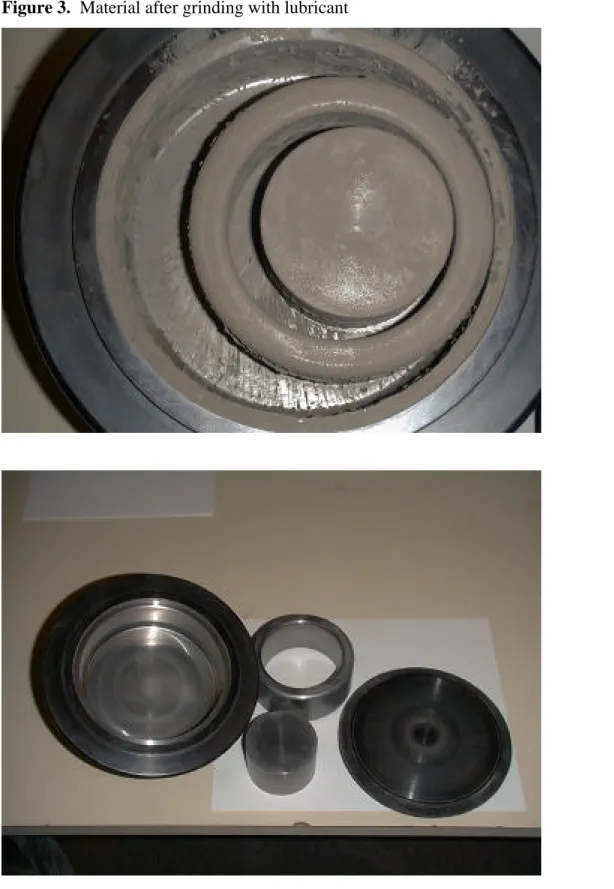
pellet. After the liquid has been removed from the freshly ground slurry, most materials appear evenly and smoothly distributed over the grinding media (Fig. 3). After the material is brushed out, and the vessel and components are wiped clean with a paper towel, the vessel appears spotless as shown in Figure 4. In many critical applications where tight precision and accuracy specifications must be met, the smallest amount of contamination from the vessel or previous samples will not allow the method to pass. Table 3 shows the accuracy and precision
requirements of such a method, ASTM C-114 Qualification(2).
Table 3. ASTM C-114 Qualification Specifications
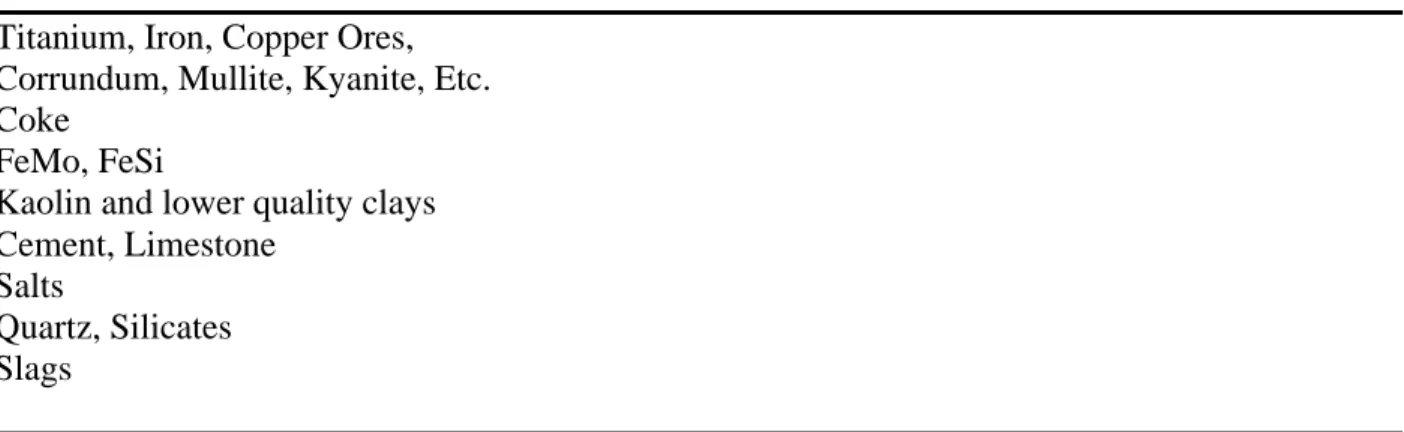
The instrumentation used to generate data for this study was the S4 Explorer (Figure 5). Many other materials (Table 4) were evaluated for preparation using the “General Method” proposed, and all had excellent results except gypsum, which is well know for its preparation problems unless pressed as is.
Table 4. Various materials types prepared successfully with proposed “General Method” Titanium, Iron, Copper Ores,
Corrundum, Mullite, Kyanite, Etc. Coke
FeMo, FeSi
Kaolin and lower quality clays Cement, Limestone Salts Quartz, Silicates Slags Component Max Difference between Duplicates on alternate days Max Difference of the Average of Duplicates from SRM Certificate SiO2 0.16 ±0.2 Al2O3 0.20 ±0.2 Fe2O3 0.10 ±0.10 CaO 0.20 ±0.3 MgO 0.16 ±0.2 SO3 0.10 ±0.1 Na2O 0.03 ±0.05 K2O 0.03 ±0.05 TiO2 0.02 ±0.03 P2O5 0.03 ±0.03 ZnO 0.03 ±0.03 Mn2O3 0.03 ±0.03
Page 4 of 6
Figure 1. Components after brushing – typical binder
Figure 2. Components after brushing – boric acid binder
Copyright(c)JCPDS-International Centre for Diffraction Data 2001,Advances in X-ray Analysis,Vol.44 4 Copyright(c)JCPDS-International Centre for Diffraction Data 2001,Advances in X-ray Analysis,Vol.44Copyright(c)JCPDS-International Centre for Diffraction Data 2001,Advances in X-ray Analysis,Vol.44 370371
Figure 3. Material after grinding with lubricant
Page 6 of 6
Figure 5. S4 Explorer XRF Spectrometer
Conclusion
The use of a grinding aid or lubricant, together with the proper binder and dilution, can eliminate most of the variations in sample preparation for widely varying materials. A lubricant utilized during the grinding process can eliminate wear and contamination, reduce dust, contribute to stable, homogenous briquettes, and reduce operator fatigue. The authors have no affiliation with the vendors mentioned in this article, and only mention specific names because these materials are known to produce the desired results.
References:
1. MSDS – VERTREL XF, Dupont Chemicals, Engineering and Product Safety, P.O. Box 80709, Chestnut Run, Wilmington, DE 19880-0709, December 29, 1998
2. Anzelmo, Seyfarth, Arias, XRF Analysis of Cement – ASTM C-114 Qualification, Presented at the Denver X-ray Conference, Steamboat Springs, CO, August 4, 1999 3. Whatman CF11 fibrous, cellulose powder, Whatman International Ltd., Springfield Mill,
James Whatman Way, Maidstone, Kent, ME142LE England
4. Uhlig, Mauser, Granacher, XRF Spectrometers For Multi-Element Analysis, World Cement, June, 1999
Copyright(c)JCPDS-International Centre for Diffraction Data 2001,Advances in X-ray Analysis,Vol.44 6 Copyright(c)JCPDS-International Centre for Diffraction Data 2001,Advances in X-ray Analysis,Vol.44Copyright(c)JCPDS-International Centre for Diffraction Data 2001,Advances in X-ray Analysis,Vol.44 372373