2009 Wiley Periodicals, Inc.
Published online in Wiley InterScience (www.interscience.wiley.com). DOI: 10.1002/hfm.20147
A Custom Collaboration Service System for Idea
Management of Mobile Phone Design
Wei-Feng Tung
Department of Information Management, Fu Jen Catholic University, Taiwan Soe-Tsyr Yuan
Department of MIS, National Chengchi University, Taiwan Je-Ren Tsai
EBO/Mask Data Integration Department, Taiwan Semiconductor Manufacturing Company, Ltd., Taiwan
ABSTRACT
Customized collaborative service (CCS) systems are defined as the e-services transforming a business process into a collaborative service model and aiming to facilitate interactions with customers and assist the providers in dealing with collaborative strategies and activities. The demand for such services has grown rapidly in a shift of people out of the manufacturing mindset into the service-dominant mindset. For example, the mobile-phone market now tends to customization rather than commoditization, and customer-driven design strategies increasingly substitute for technology-driven design strategies. This trend accordingly urges the mobile-phone companies to center on a customer-centric idea management process to assure customer idea originality but also sustain the process feasibility for realistic product design. However, a method to engineer such CCS systems has not been addressed. This article presents a prototype system namediMobileDesignto exemplify a CCS system. We present a new methodology to engineer this CCS system aiming to achieve semiautomated value coproduction with productivity and satisfaction. This method comprises two parts: simple service machine (SSM) and intelligent service machine (ISM). Usage of SSM and ISM would lead to the formation of analysis and design of the CCS system that joins the service provider efforts with their customers for ensuring a customer-centric idea management process. C2009 Wiley Periodicals, Inc. 1. INTRODUCTION
Customized collaborative service (CCS) systems are defined as the e-services transforming a business process into a collaborative service model and aiming to facilitate interactions with customers and assist the providers in dealing with collaborative strategies and activities. The importance of such systems has grown rapidly in recent years in light of the trend of products to services. For instance, the mobile-phone market tends to customization rather than commoditization. Customer-driven design strategies increasingly substitute for technology-driven design strategies. Namely, aiming for improving quality of daily life, product design has changed from being technology centered to being human centered to further achieve customization and satisfaction goals. However, two problems exist for Correspondence to: Wei-Feng Tung, Department of Information Management, Fu Jen Catholic University, No. 510, Chung Cheng Rd., Hsinchuang, Taipei County 24205, Taiwan. E-mail: [email protected]
product design of mobile-phone companies: (1) The company lacks intelligent monitoring to overcome probable uncertainties during business procedures of product design. (2) The real ideas of customers could be hard to grasp. This consequently urges the mobile-phone companies to center on a customer-centric idea management process to assure customer idea originality but also sustain the process feasibility for realistic product design. This article presents a prototype system named iMobileDesign to exemplify a CCS system.
iMobileDesign is used to address the aforementioned two problems, highlighting idea management improvement in mobile-phone design.
We present a new methodology to engineer this CCS system aiming to achieve semiau-tomated value coproduction with productivity and satisfaction. This method comprises two parts: (1) simple service machine (SSM) and (2) intelligent service machine (ISM). SSM defines the salient attributes of the personalized relationship service system and serves as the basis of system analysis (including goals, problem-solving strategy, solution require-ments, theory, tacit knowledge, and design method). ISM is a design-science–based artifact that models and automates the cognitive process and knowledge representation regarding collaborative service delivery according to SSM for value coproduction with productiv-ity and satisfaction. In other words,iMobileDesigncan be viewed as an exemplar case to demonstrate how the systematic collaborative experiences of idea management can be made by SSM and ISM. This service system introduces the mathematic models of cooperation and competition, which are derived from mutualism-based theory and the evolutionary al-gorithm. Four service modules (ideation module, competition module, mutation module, and monitoring module) are used to fulfill the three practical business procedures of prob-lem conceptualization, concept visualization, and design commercialization within the idea management process of mobile-phone design. In addition, idea management of product design includes three main criteria for determining chosen ideas: customization, originality, and feasibility.
The remainder of this article is organized as follows. Section 2 describes related studies. Section 3 then describes the new methodology of engineering CCS systems (SSM and ISM). Section 4 presents the prototype systemiMobileDesign. Section 5 is an evaluation. Implications and conclusions are presented in Section 6.
2. RESEARCH BACKGROUND AND RELATED LITERATURE
An increasing number of recent publications have explored how to systematic service innovation underpinned by Service Science, Management and Engineering (SSME) that can be analytical and synthetic artifact for innovative service system. IBM’s SSME aims at understanding and categorizing service systems and advancing the ability to design, improve, and scale service systems for practical business and societal purposes (Spohrer, Maglio, Bailey, & Gruhl, 2007), which analyze how to align people and technology effectively to generate value for both service providers and clients (Allen & Mugge, 2006). Spohrer et al. (2007) indicate that service system characteristics evolve over time as service systems attempt to improve productivity, quality, compliance, and innovation. SSME was developed to cocreate and share value through collaboration capability of business and government to improve service, evaluate information technology (IT) and tools, and investigate enterprise culture for employee encouragement and convergence as well as total service effectiveness (Zeithaml, Berry, & Parasuraman, 1993). Tien and Berg (2003) argued that service systems comprise service providers and clients working together to coproduce value in complex value chains or networks (Tien & Berg, 2003). A service system comprises people and
technology that adaptively adjust to a system’s changing value of knowledge (Spohrer et al., 2007). Service scientists consider addressing the problem of service system design for service innovation and productivity (Maglio, Srinivasan, Kreulen, & Spohrer, 2006).
The experienced economy transforms traditional service transactions into experience-based transactions (Pine & Gilmore, 1998). Service experiences derived from either explicit or implicit customer contact points to a service product and a service process (Field, Gregory, & Sinha, 2004). Prahalad and Ramaswamy (2004) suggest that managers attend to cocre-ation experience quality, not just firm’s product and process quality. Quality depends on interaction infrastructure between companies and consumers, oriented toward the capacity to create a variety of experiences. Carbone (2004) indicates that enterprise design experience innovation enhances customer preference and loyalty to create benefit. Firms must measure and manage service delivery to ensure quality of the entire experience (Rust & Miu, 2006). It has been argued, by Menon and Bansal (2006), that most experiences of power occurred in high contact services and that customer experiential value (i.e., efficiency, service excel-lence, playfulness, and aesthetics) positively affected customer behavioral intentions (Keng, Huang, Zheng, & Hsu, 2007). Nevertheless, cocreation experience for product design pro-cess as a research field has not yet been much explored. According to a way of thinking of the experience economy, this study proposes how the collaborative service experiences of idea management in mobile phone design service systems can be measured and systematized.
Schultz (1997) argues that integrated marketing involves customer benefit, customer cost, convenience, and communication, implying inevitable integration of production, oper-ations, marketing, distribution, finance, communication, and other forms of business activity (Schultz & Kitchen, 1997). Therefore, integrated marketing communication is helpful to per-form service, enabling relationship development with customers. Bitner and Brown (2006) also indicate that companies have increasingly developed collaborative relationships with other organizations to induce new thinking, creativity, and service innovation. However, mobile-phone design still lacks design procedures with collaborative relationships. This work intends to construct a CCS system that allows a service provider and its customers to collaboratively communicate on product design.
There have been several studies attempting to identify design features for the mobile phone. For example, Han, Kim, Yun, Hong, and Kim (2004) stated that they had a sys-tematic way of identifying design features of mobile phones critical to user satisfaction. It presented an approach to obtaining useful design information (design features critical to user satisfaction and their common properties) based on the relationship models. This approach was demonstrated through a case study in which the empirical models linking design features to the level of user satisfaction played a key role in identifying the crit-ical features. Yun, Han, Hong, and Kim (2003) indicated that the subjective evaluation of mobile-phone design is greatly influenced by human interface elements as well as the overall shapes of products. Evaluation uses statistical processes for selecting and screening the critical design variables closely related to the customer’s impression of a product. The modeling process consisted of two parts that employed analysis of variance and multiple linear regression modeling. Besides, another study investigated the relationship between user preference perception of mobile phones and their form design elements. The study used a semantic differential method to explore important design elements and design trends suitable for users’ preferences (Chuang, Chang, & Hsu, 2001). All of these works showed that there are differential methods for soliciting user preferences in mobile-phone design. These studies made an impact on the understanding of critical features, design variables, or design trends of mobile-phone design with the market data. In this article, we intend to use
design science to build an artifact (iMobileDesign) that applies CCS to facilitate the business process of idea management in mobile-phone design. Namely, this study attempts a differ-ent and significant transformation of a traditional business process into a new collaborative e-service for mobile-phone design.
Whereas these backgrounds (SSME, experience economy, integrated marketing, and mobile-phone design methodology) motivate this study, we aim to explore the systematic and quantitative service experiences for CCS on idea management of mobile-phone design. This study also focuses on how to systematically construct a CCS in which the service providers and customers work in collaboration andiMobileDesignserves as an example of CCS constructed by ISM and SSM in a systematic way.
3. CONSTRUCTING SERVICE MACHINES
ISM refers to a service system design underpinned by modeling and automating the cognitive process and knowledge representations featuring the embodied cognition of coproduction. SSM symbolizes that a service system is composed of the attribute elements featuring social–technical systems (STS).
3.1. SSM
The SSM concept is that a service system can be developed and underpinned by the attribute elements enabling the service experiences that can semiautomate value coproduction with productivity and satisfaction. In terms of developing information systems, a well-known theory, STS, refers to a service system composed of the joint interaction between these two systems (social and technical systems) (Bostrom & Heinen, 1977). The system designer should conceptualize a service work system as a set of complementary or interdependent information systems (Bitner & Brown, 2006) with the objective of jointly optimizing both social and technical systems. Bijker (1995) reports that causal technical and social elements shape the interactions of all relevant factors and actors and influence the trajectory of technological and social outcomes. These salient elements include goals, problem-solving strategies, solution requirements, theories, tacit knowledge, and design methods. Moreover, a technological frame comprises elements that influence interactions within relevant social groups and lead to the attribution to artifacts (i.e., system) (Bijker, 1995). A physical example is a hospital where people are organized into social systems (e.g., teams or departments) to perform tasks using technical systems (e.g., computers or x-ray machines).
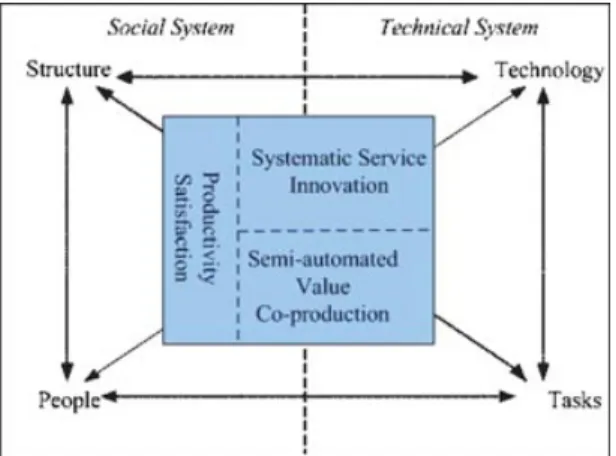
A machine, typically a physical mechanism, is composed of parts to operate for pro-ductivity, and distributed cognition is the manufacturing cognition that considers functional relationships of parts participating in the manufacturing process. Machine’s metaphor means the service system’s composite with productivity. In addition, an information system takes into account the elements such as social systems and technical systems for modeling and automating the information processes of independent subsystems, their interactions, and comprehensive processes. Therefore, a service system (as a machine) relatively includes elements (as parts) such as people, models, architectures, technologies for modeling and automating the individual processes, their interactions, and their comprehensive processes. Therefore, for the goals of SSME, all the elements that relate to systematic service inno-vation, semiautomated value coproduction, and service productivity and satisfaction can be viewed as the comprehensive schemes for service system engineering (Figure 1).
SSM includes attribute elements: First, goals are systematic service innovation as well as semi-automated value coproduction with service productivity and customer satisfaction.
Figure 1 Conceptual framework of SSM.
TABLE 1. Attribute Elements of SSM
Attribute Elements Tactic of SSM
Goal Systematic service innovation and semiautomated value coproduction with service productivity and customer satisfaction
Problem-solving strategy Facilitated/Mediated/Assisted collaborative technologies Solution requirement Maximum satisfaction or minimum cost
Theories Interdisciplinary theories or methodologies
Tacit knowledge Information, knowledge, and decision of people involved
Design method Design-science (creating synthesized IT artifact) (Havner et al., 2004)
Second, problem-solving strategies can be facilitated, mediated, or assisted collaborative technology. Third, solution requirements seek to either minimize cost or maximize satisfac-tion. Fourth, the adopted theory may originate from other disciplines such as natural or social theories and methodologies. Fifth, the service process involves tacit information knowledge and decisions. Sixth, design method is design-science to build a synthesized IT-artifact (e.g., service system) characterized by its measurable functions, goals, and adaptability in accordance with the service provider and customers (Table 1).
3.2. ISM
ISM refers to a method of systematic and quantitative service experiences, which aims at modeling and automating the cognitive process and knowledge representations that can be applied to design problems. A service system is composed of interactions between service providers and the customers who coproduce value. For this purpose, this work uses the concept of ISM to model and automate particular cognitive processes and knowledge representations (characterized by salient elements of embodied theories supporting the value cocreation process with underlying requirements objectives). The ISM design helps equip SSM to support service system engineering.
4. CASE OF CCS SYSTEMS: IDEA MANAGEMENT OF MOBILE-PHONE DESIGN (iMobileDesign)
In practice, most mobile-phone companies use brainstorming to develop ideas on their mobile-phone product design (that are often technology-driven ideas for design). For ful-filling the design of mobile phones (e.g., the appearance) that can satisfy customers’ needs, the strategy of customer-driven ideas for design is increasingly taking the place of the technology-driven approach. However, CCS can be used to facilitate the customer-driven design in which a mobile-phone company can focus on customer perspectives to retain customer idea originality but also sustain process feasibility for realistic product design.
iMobileDesigncan be viewed as an example of an ISM-facilitated service system mod-eling the ISM-facilitated service operations of idea management joining the efforts of the mobile-phone company and its customers. For instance, this system enables the mobile phone company and the customers to cooperate and determine the ideas of mobile phone appearance.
4.1. Determining SSM foriMobileDesign
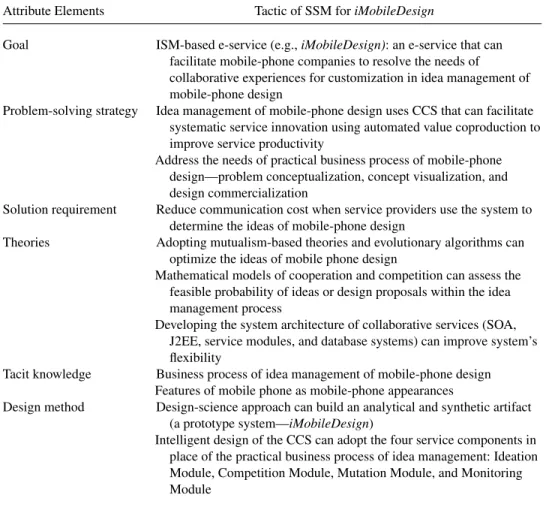
The six attribute elements of SSM are used to determine how to design and develop the innovative collaborative e-services that can be semiautomated value coproduction (Table 2). 4.1.1. Goals. As mobile-phone companies frequently face the problems of idea manage-ment of product design, ISM-based e-services can be a technique to model the collaborative service systems. Based on the principle of value coproduction, ISM-based e-services aim at a kind of service platform where service providers and customers effectively acquire the consensuses on product design. ISM-based e-services can facilitate to solve the following problems:
• Uncertainty in the product design process and design quality. Idea management tradi-tionally has some of the uncertain factors likely to influence the design process and quality.
• Lack of the more thoughts from customers to design a product. Almost all service providers adopt brainstorming to develop ideas. New collaborative systems contribute to how the designers exchange opinions with customers to enhance product design. 4.1.2. Problem-Solving Strategies. To achieve the goals of iMobileDesign, the problem-solving strategies adopt CCS that can facilitate the practical business process of idea management of mobile-phone design.
In the process of idea management of mobile-phone design, the company participants who work for product design need to work together through various negotiations. They first extract the important ideas from customers’ input. These ideas will be determined step by step through some mathematical models.iMobileDesign,an e-service that is a systematic idea for management of mobile-phone design, is helpful for supporting participants to make decisions and control quality. There are three main practical business procedures for idea management of mobile-phone design: (1) Conceptualizing a question: As most initial design concepts are unclear and unobservable, mobile-phone companies should be aware of important requirements from customers. (2) Visualizing a concept: Visualizing the results of concepts can provide more understanding of a product design. Service providers
TABLE 2. Attribute Elements of SSM
Attribute Elements Tactic of SSM foriMobileDesign
Goal ISM-based e-service (e.g.,iMobileDesign): an e-service that can facilitate mobile-phone companies to resolve the needs of collaborative experiences for customization in idea management of mobile-phone design
Problem-solving strategy Idea management of mobile-phone design uses CCS that can facilitate systematic service innovation using automated value coproduction to improve service productivity
Address the needs of practical business process of mobile-phone design—problem conceptualization, concept visualization, and design commercialization
Solution requirement Reduce communication cost when service providers use the system to determine the ideas of mobile-phone design
Theories Adopting mutualism-based theories and evolutionary algorithms can optimize the ideas of mobile phone design
Mathematical models of cooperation and competition can assess the feasible probability of ideas or design proposals within the idea management process
Developing the system architecture of collaborative services (SOA, J2EE, service modules, and database systems) can improve system’s flexibility
Tacit knowledge Business process of idea management of mobile-phone design Features of mobile phone as mobile-phone appearances
Design method Design-science approach can build an analytical and synthetic artifact (a prototype system—iMobileDesign)
Intelligent design of the CCS can adopt the four service components in place of the practical business process of idea management: Ideation Module, Competition Module, Mutation Module, and Monitoring Module
make proposals the include the customized design concepts resulting from these determined important ideas. (3) Commercializing design: This third procedure places idea feasibility assessment in the spotlight. After the previous two procedures, this procedure leads to higher feasibility for a well-designed proposal and design process with good performance.
From the perspective of business strategy and value activities of mobile-phone design, the idea-management process accordingly needs to embody the three aforementioned business procedures. However, Porter (1996) argues that a business strategy has five points: Opera-tional effectiveness is not strategy, strategy rests on unique activities, a sustainable strategic position requires trade-offs, fit drives both competitive advantage and sustainability, and re-discovering strategy is undermined by a misguided view of competition, by organizational failures, and, especially, by the desire to grow. To drive competitive advantage and sus-tainability, the business strategy accordingly is about combining activities, and operational effectiveness is about achieving excellence in individual activities.
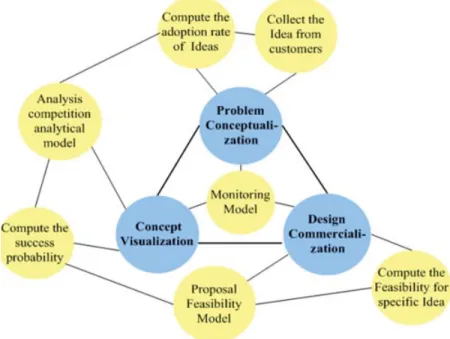
In aiming for systematic service innovation, the unique value activities of the business strategy behindiMobileDesigninclude the activities according to the defined SSM’s deter-minants. As shown in Figure 2, the strategy concerns the three core competencies (problem
Figure 2 Business strategy foriMobileDesign.
conceptualization, concept visualization, and design commercialization), and the value ac-tivities include three models and four tasks to support the three core competencies required. In other words, the seven activities manifested in Figure 2 represent the unique value ac-tivities behind the iMobileDesign’s business strategy, such as collecting customer ideas and computing the adoption rate, success probability, and feasibility of chosen ideas for the product’s marketing proposal. Meanwhile, Figure 3 depicts a layer relationship: The business strategy’s implementation is underpinned by SSM and ISM.
4.1.3. Solution Requirements. The main solution requirement rests on the reduction in communication costs. Compared with the traditional mobile-phone market investigation and design, the study mainly proposes a new ISM-basediMobileDesignsystem enabling systematic idea management of mobile-phone design based on value coproduction. The mutualism-based theory and evolutionary algorithms are used to implement the system and reduce the communication costs.
4.1.4. Theories. Service system design can use certain theories (e.g., psychology theory, management theory, or economic theory) as the basis for developing the implementation of the service system aiming for value coproduction.iMobileDesignadopts certain mutualism-based theories originating from biology research to imitate the evolutional process for optimization, enabling the mathematical models required for screening ideas. For example, the theories of the fly oviposition model and the larvae survival and competition model can imitate evolutional processes for cooperation and competition between the two symbiotic species (Laurence, Jean-Baptiste, & Bernard, 2002). These models are of the mathematical forms to determine the best offspring over cooperation and competition evolution. Adopting these interdisciplinary theories into the development of CCS for idea management of mobile-phone design is believed to obtain novel and different insights.
The imitated evolutional process can be explained briefed as follows: The fly oviposition model indicates that a female fly selects globeflowers and spawns. The probability of spawning would be decreased if the other flies have spawned the globeflower. Assessing the probability of spawning can then be analogous to assessing the probability of adopted ideas within idea management of mobile-phone design. Namely, different ideas liken to individual eggs, and the probability of spawning likens to the probability of adopting an idea. In biology, the flies could be classified according to the number of spawnings to observe the behavior of spawning; a similar line of reasoning can be used within idea management of mobile-phone design. In contrast, the larvae survival and competition model indicates that the number of living larvae would be decreased when there is a limited number of flowers. Similarly, the adopted idea proposals need to resolve the problems of competition given the limited resources with a mobile-phone company.
4.1.5. Tacit Knowledge. Tacit knowledge within idea management in mobile-phone designing can be, for example, mobile-phone practical design management, the business process, exchanging opinions, and decision making during the mobile-phone design pro-cess. A traditional company often brainstorms for product design; however, this study also presents a systematic business process as a semiautomating brainstorming. Thus, tacit knowledge is needed for automating a service system design. Besides the business process, the tacit knowledge also can include the features of the mobile phone as well (e.g., color or shape in appearance, quality of voice or messaging in basic functions, picturing added functions, 3G in advanced functions).
4.1.6. Design Methods. The design-science research method builds the artifacts (e.g.,
iMobleDesignprototype system) to meet the identified business needs. An ISM-based e-service system (iMobileDesign) that automates the decision-making process can serve as an analytical and synthetic artifact.iMobileDesignenables a systematic and quantitative collaborative service process and operations in which the stakeholders work jointly in different phases (i.e., the value activity chain) of the job (idea management).iMobileDesign
uses the mutualism-based theory plus the evolutionary algorithm and the mathematical models of cooperation and competition to attain four service components—Ideation Module, Competition Module, Mutation Module, and Monitoring Module—to realize the strategy and value activities of idea management of mobile-phone design. In addition, there are three criteria to evaluate the determined ideas (customization, originality, and feasibility).
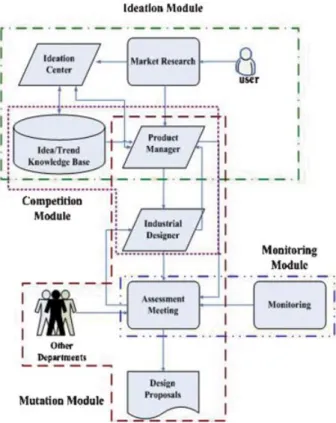
Figure 4 System framework ofiMobileDesign.
4.2. Systematic and Quantitative Service Innovation iniMobileDesign
ISM-based design is a capability that can allow systematic and quantitative service ex-periences.iMobileDesignmodels and automates the required business procedures of idea management of mobile-phone design by means of evolutionary algorithms, enabling CSS applied to idea management of mobile-phone design. Mobile-phone design encompasses a series of service activities performed as the intelligent system of idea management shown in Figure 4. Theories in prior SSM serve as interdisciplines, hence this study adopts the mutualism-based theory and evolutionary algorithm to propose the mathematical mod-els and construct system. The evolutionary algorithm is used to develop the four service components to accomplish interaction-based collaborative service interactions and service delivery as the CCS. Brief descriptions of the four modules (Tsai, Tung, & Yuan, 2006) are as follows:
4.2.1. Ideation Module. This module executes the first procedure–problem conceptu-alization of idea management of mobile-phone design. It extracts customers’ needs (e.g., mobile-phone preference) by marketing research, creating the ideas into an idea knowl-edge base, and adopting ideas into idea proposals (as depicted in Figure 5). This study uses four categories of ideas falling into twenty-seven dimensions (e.g., color or shape in appearance, quality of voice or messaging in basic functions, picturing added functions, 3G in advanced functions). For semiautomatically assisted decision-making processes in
Figure 5 Process of ideation module.
idea adoption, this module deals with the certain cognitive processes of idea management modeled by an ecological symbiosis equation to compute the adoption probabilityPi(t) as follows, pi(t)=(1−ei)× NF(t) k=1 (αkt( 1 k +(1− 1
k)×(1−ei)), where an ideaiin which
Pi(t) stands fortindicating thetth meeting (i.e., it usually takes a lot of meetings to decide which ideas could be involved in a project design), NF(t) denotes the number of ideas that could be referenced from the idea knowledge base,eirepresents the probability with which participants with ideas would reject a new idea encountered in the meeting (i.e., the participants in a meeting who may reject the new ideai), andαtkindicates the probability thatk ideas are discussed simultaneously in a meeting. A probability threshold is set by product manager to decide the set of ideas adopted.
The aforementioned symbiosis equation originates from a fly oviposition model (Laurence et al., 2002) that represents an evolutionary process for cooperation and competition be-tween the two symbiotic species. Our analogous reasoning is twofold: micro and macro. For micro, the fly eggs laid on a plant are like the ideas generated by human designers. Because the flower seeds are limited, the larvae incubated from the eggs must compete with each other, and this competition is similar to the selection of the design proposal generated by the designers within a company with limited resources such as manpower, financial capitals, and so forth. For macro, the mutualism between plants and seed-eaters is a long-term rela-tionship, and the continued offspring between the two sides could be viewed as the extended interactions of the two symbiotic species in the first place. This is analogous to building the tight interactions between a mobile-phone company and its customers for customer-centric product design. For the remaining modules, we omit the details of their quantitative models, but they can be found in the work of Tsai et al. (2006).
4.2.2. Competition Module. This module executes the second procedure, concept visu-alization, which involves a product manager conveying adopted idea proposals to industrial designers who visualize the ideas and concepts into design proposals, iteratively examined by the product manager and amended to better meet customer needs. The product manager obtains competitor information from the idea knowledge base for evaluating design propos-als using focus groups and trial products based on design propospropos-als. For example, a design proposal includes (1) a mobile phone with a white cover and without antenna and (2) a black mobile phone with an antenna and without cover. For a semiautomated decision-making process in design proposal, this module embodies a cognitive process modeled by a certain ecological symbiosis equation to compute adoption probabilities of design proposals. The product manager sets a probability threshold to decide the adopted design proposal set. 4.2.3. Mutation Module. This module executes the third procedure, design commer-cialization, which involves the product manager taking charge of feasibility meetings and
allocating required resources. The industrial designer justifies the adopted design propos-als, and other departments (e.g., research and development [R&D]) provide suggestions (e.g., the provision of technical consultancies and consideration of component cost) to the industrial designer for further refinement of feasible design proposals. For a semiauto-mated decision-making process in feasibility analysis of the adopted design proposals, the Mutation Module embodies a cognitive process modeled by a certain ecological symbiosis equation to compute the adopted design proposal feasibility.
4.2.4. Monitoring Module. This module is responsible for examining Mutation Module progress. Different feasibility meeting participants (e.g., from different backgrounds and/or from different departments) may increase design project uncertainty, resulting in time delay of products to the market. Monitoring the progress of meetings minimizes time delay; the Monitoring Module aims to examine and evaluate meeting performance. An assistant examines if feasibility probabilities of design proposals in a feasibility meeting are higher than those in the former feasibility meeting and a preset threshold. For semiautomated monitoring of feasibility meetings, this module embodies a cognitive process modeled by certain ecological symbiosis equations to assist the product manager in monitoring design proposal revisions among feasibility meetings.
5. THE EVIDENCE OFiMobileDesign
The Ideation Module uses an idea adoption rate to examine the determined ideas. The Com-petition Module decides the adopted design proposals via a design proposal probability and threshold. However, product diversity would be decreased if the threshold of adoption rate is high. Evidence shows thatiMobileDesignis better than traditional methods in mediating idea management of mobile-phone design. Estimating the performance of design proposals uses customer idea probability (CIP), which is defined as the average percentage of preferred customer ideas regarded in design proposals.iMobileDesignis also benchmarked against traditional idea management for mobile-phone design by calculating CIP at each service process checkpoint (Tsai et al., 2006).
This study uses simulation for testing experiments in idea management mediated by CCS-facilitated systems and traditional methods to provide evidence of preliminary suc-cess. CIP is integrated into a service system evaluation model to examine service quality during a whole service process ofiMobileDesignand the traditional way. Service system performance is estimated at each checkpoint by using the equation: IFPR=E( ¯R×L)= E( ¯R)×E(L)=eCIP/n×ex, where ¯R is the average performance at each service process phase (i.e., checkpoint), L and n would be the number of checkpoints, andαrepresents the weight. Thus, the negative difference between each two CIPs (i.e., CIP) would be performance loss (i.e., IFED) resulting from exchange costs. Interactive fitness (IF) is used to assess the performance of service. Service system holistic performance might be total incremental performance at each phase and possible performance loss—that is, (IFPR+IFED). There are 27 kinds of mobile-phone dimensions that can be chosen by the idea management service system. Simulation settings are shown in Table 3 (Tsai et al., 2006).
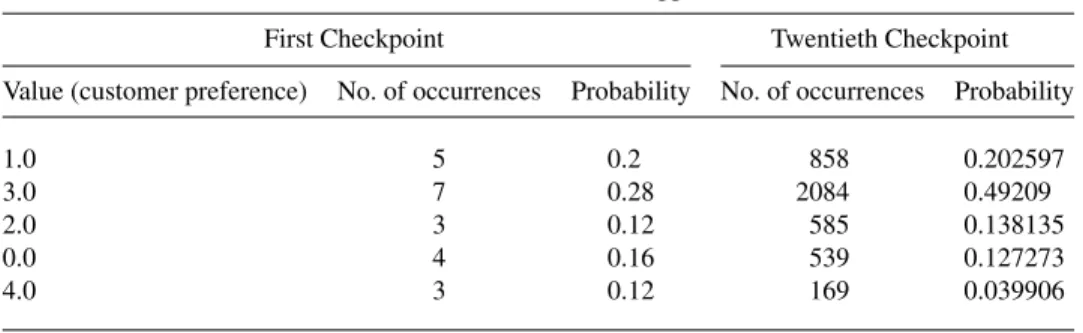
Table 4 shows the difference in the fourth dimension (mobile phone appearance) according to the results of simulating the first checkpoint and the twentieth checkpoint. Experimental results show that customer preference 3.0 is the majority preference for the mobile phone’s appearance (the first checkpoint), and it will be continuously emphasized in the subsequent
TABLE 3. Results of Parameters withiniMobileDesign
Parameters Value
The number of idea proposals considered for each dimension 3
The threshold used in the Ideation Module 0.2
The number of design proposals adopted from the Competition Module 5 The threshold of the adopted design proposals used in the Competition Module 0.2 The number of proposals via traditional ways 5 The rounds of running the four modules as required for a service checkpoint 5 The probability of an idea that would meet customer needs for mobile-phone design 0.3
TABLE 4. Results of CIP During a Design Process
Dimension of Mobile Phone’s Appearance
First Checkpoint Twentieth Checkpoint Value (customer preference) No. of occurrences Probability No. of occurrences Probability
1.0 5 0.2 858 0.202597
3.0 7 0.28 2084 0.49209
2.0 3 0.12 585 0.138135
0.0 4 0.16 539 0.127273
4.0 3 0.12 169 0.039906
e-mutualism learning process for attaining the design proposals (i.e., highest probability values of 0.28 and 0.49209, respectively).
The experiment computes every CIP from the first to the twentieth checkpoints over 100 simulations. CIP results derived fromiMobileDesignare much higher and more stable than those derived from the traditional method that are much lower and more fluctuant (Figure 6).
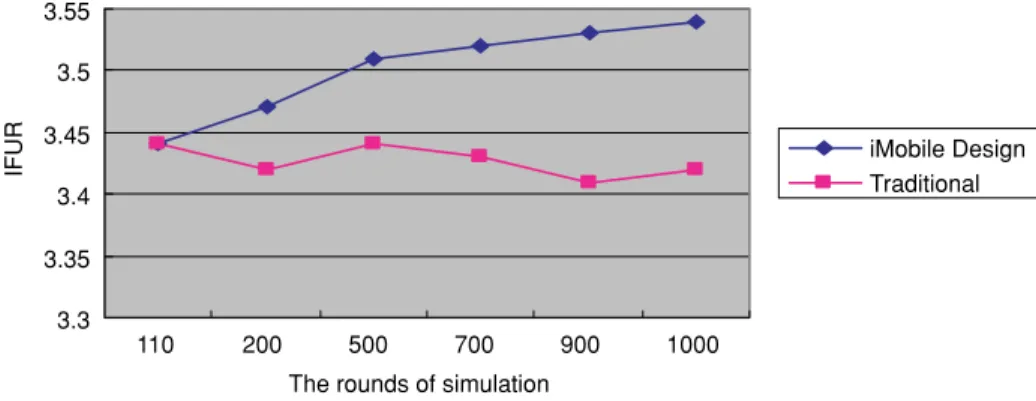
To evidence the effects of iMobileDesign, the CIP can be used to evaluate IFUR representing holistic service performance during a service process using E-QUAL (Tung &
0 0.1 0.2 0.3 0.4 0.5 1 3 5 7 9 11 13 15 17 19 The n-th checkpoint
CIP iMobile DesignTraditional
3.3 3.35 3.4 3.45 3.5 3.55 110 200 500 700 900 1000
The rounds of simulation
IFUR iMobile Design
Traditional
Figure 7 Results of IFURover simulations (110–1000).
Yuan, 2007). IFURimplies comprehensive service performance of a service delivery pro-cess assessed by simulation over rounds of 110, 200, 500, 700, 900, and 1,000 times of simulation, respectively. The results of IFURshow that iMobileDesignhas higher service performance than the traditional method dealing with business procedures of mobile-phone design (Figure 7).
6. CONCLUSION
In this article, we defined the notion of CCS and presented an example of CCS on idea management of mobile-phone design. Our article also provides a new service system design method (SSM and ISM) to develop CCS that can automate value coproduction for analyt-ical and synthetic artifacts with service productivity. SSM is used to analyze and design the elements of ISM based on STS. ISM models and automates the cognitive process and knowledge representations of the involved business process or service process. Namely, ISM-basediMobileDesigncontributes to the systematic and quantitative idea management of mobile-phone design based on SSM. In iMobileDesign, we use the interdisciplinary theories (e.g., mutualism-based theories) to support methodologies (e.g., evolutionary al-gorithms) to solve problems (e.g., idea management with value coproduction). The three service components ofiMobileDesign(i.e., idea modules, competition module, and mutation module) are semiautomated value coproduction for determining ideas and proposals used for mobile-phone design. Also, an experimental simulation evidenced thatiMobileDesign
can fulfill custom collaboration for determining ideas and design proposals according to practical business procedures.
6.1. Research and Practical Implications
From the aspect of research, innovative e-service design that can perform collaboration ser-vices needs information technologies or methods to achieve the goal of systematic service innovation and automated value coproduction. SSM serves as a blueprint that facilitates system developers to consider and design the scheme enabling systematic service innova-tion.iMobileDesigncan be viewed as an ISM-based e-service, which serves as the CCS-facilitated service system that has successfully transformed traditional business procedures. It aims to achieve automated value coproduction by facilitating interactions with customers and assisting providers in the provision of the service. From the aspect of practice, service
providers can realize what and how SSM and ISM analyze and design CCS-facilitated idea management of mobile-phone design. According to the evidence of preliminary success of
iMobileDesign, the impact of CCS-facilitated service systems would be beneficial to practi-cal idea management of the mobile-phone design process. Service providers can refer to the way systems are modeled with cost-effective value coproduction and experience innovation to support sustainable business strategies. IniMobileDesign, the ecology mutualism–based theory, evolutionary methodologies, and mathematical models of cooperation and competi-tion inspire the intelligent design. The system has the service modules—Ideacompeti-tion Module, Competition Module, Mutation Module, and Monitoring Modul—to fulfill the three business procedures of customization, originality, and feasibility in the mobile-phone design process. In short, ISM-based e-services impact on transforming the practical business process into the CCS systems.
6.2. Research Limitations and Future Work
The study envisioned that SSM and ISM are applicable to other types of collaborative services besides CCS. Although the demonstration ofiMobileDesignevidences the contri-butions of the service system design methodology (SSM and ISM), computer-aided support of the methodology is preferred for a general methodology’s adoption in its applications. However, the service modules ofiMobileDesignare still limited to the specific mobile-phone design process. In future work, the different interdisciplinary theories and methodologies can be used to develop and implement innovative CCS systems. In addition, surveys or interviews with many more users would be useful for refining innovative service systems.
REFERENCES
Allen, G. S., & Mugge, P. (2006). Services science to be taught at NC State. Research Technology Management, 49(6), 6–8.
Bijker, W. E. (1995). Of bicycles, bakelites, and bulbs: Toward a theory of sociotechnical change. Cambridge, MA: MIT Press.
Bitner, J. M., & Brown, W. S. (2006). The evolution and discovery of services science in business schools. Communications of the ACM, 49(7), 73–78.
Bostrom, R., & Heinen, J. S. (1977). MIS problems and failures: A socio-technical perspective. MIS Quarterly, 1(3), 17–30.
Carbone, L. P. (2004). Clued in: How to keep customers coming back again and again. Upper Saddle River, NJ: Prentice Hall.
Chuang, M. C., Chang, C. C., & Hsu, S. H. (2001). Perceptual factors underlying user preferences toward product form of mobile phones. International Journal of Industrial Ergonomics, 27, 247– 258.
Field, J. M., Gregory, R. H., & Sinha, K. K.(2004). Management quality in the e-service system: Development and application of a process model. Production & Operations Management Society (POMS), 13(4), 291–306.
Han, S. H., Kim, K. J., Yun, M. H., Hong, S. W., & Kim, J. (2004). Identifying mobile phone design features critical to user satisfaction. Human Factors and Ergonomics in Manufacturing, 14(1), 15–29.
Havner, A. R., March, S. T., Park, J., & Ram, S. (2004). Design science in information systems research. MIS Quarterly, 28(1), 75–105.
Keng, C. J., Huang, T. L., Zheng, L. J., & Hsu, M. K. (2007). Modeling service encounters and customer experiential value in retailing: An empirical investigation of shopping mall customers in Taiwan. International Journal of Service Industry Management, 18(4), 349–367.
Laurence, D., Jean-Baptiste, F., & Bernard, G. (2002). Evolution of mutualism between globeflowers and their pollinating flies. Journal of Theoretical Biology, 217(22), 219–234.
Maglio, P. P., Srinivasan, S. J., Kreulen, T., & Spohrer, J. (2006). Service systems, service scientists, SSME, and innovation. Communications of the ACM, 49(7), 81–85.
Menon, K., & Bansal, H. S. (2006). Exploring consumer experience of social power during service consumption. International Journal of Service Industry Management, 18(1), 89–104.
Pine, J. B., & Gilmore, J. H. (1998). Welcome to the experience economy. Harvard Business Review, July-August.
Porter, M. E. (1996). What is strategy?. Harvard Business Review, November-December. 62–78. Prahalad, C. K., & Ramaswamy, V. (2004). The future of competition: Co-creating unique value with
customers. Boston, MA: Harvard Business School Press.
Rust, R. T., & Miu, C. (2006). What academic research tells us about service. Communications of the ACM, 49(7), 49–54.
Schultz, D. E., & Kitchen, P. J. (1997). Integrated marketing communications in US advertising agencies: An exploratory study. Journal of Advertising Research, 37(5), 7–18.
Spohrer, J., Maglio, P. P., Bailey, J., & Gruhl, D. (2007). Steps toward a science of service systems. IEEE Computer, 40(1), 71–77.
Tien, J., & Berg, D. (2003). A case for service systems engineering. Journal of Systems Science and Systems Engineering, 12(1), 13–38.
Tsai, J. R., Tung, W. F., & Yuan, S. T. (2006). Mutualism-based idea management for mobile-phone design service. Proceedings of the International Conference of Information Management Research and Practice, Yunlin, Taiwan, December 9.
Tung, W. F., & Yuan, S. T. (2007). Optimization of collaborative service systems using an experience evaluation model. Proceedings of the IEEE International Conference on Services Computing (SCC 2007), Salt Lake City, Utah.
Yun, M. Y., Han, S. H., Hong, S. W., & Kim, J. (2003). Incorporating user satisfaction into the look-and-feel of mobile phone design. Ergonomics, 46(13/14), 1423–1440.
Zeithaml, V. A., Berry, A. L., & Parasuraman, A. (1993). The nature and determinants of customer expectations of service. Journal of the Academy of Marketing Science, 21(1), 1–12.