Distributed Reinforcement Learning
for Network Intrusion Response
KLEANTHIS
MALIALIS
Doctor of Philosophy
UNIVERSITY OF
YORK
COMPUTER
SCIENCE
Abstract
The increasing adoption of technologies and the exponential growth of networks has made the area of information technology an integral part of our lives, where network security plays a vital role. One of the most serious threats in the current Internet is posed by distributed denial of service (DDoS) attacks, which target the availability of the victim system. Such an attack is designed to exhaust a server’s resources or congest a network’s infrastructure, and therefore renders the victim incapable of providing services to its legitimate users or customers.
To tackle the distributed nature of these attacks, a distributed and coordinated defence mech-anism is necessary, where many defensive nodes, across different locations cooperate in order to stop or reduce the flood. This thesis investigates the applicability of distributed reinforce-ment learning to intrusion response, specifically, DDoS response. We propose a novel approach to respond to DDoS attacks called Multiagent Router Throttling. Multiagent Router Throttling provides an agent-based distributed response to the DDoS problem, where multiple reinforce-ment learning agents are installed on a set of routers and learn to rate-limit or throttle traffic towards a victim server. One of the novel characteristics of the proposed approach is that it has a decentralised architecture and provides a decentralised coordinated response to the DDoS problem, thus being resilient to the attacks themselves.
Scalability constitutes a critical aspect of a defence system since a non-scalable mechanism will never be considered, let alone adopted, for wide deployment by a company or organisation. We propose Coordinated Team Learning (CTL) which is a novel design to the original Multiagent Router Throttling approach based on the divide-and-conquer paradigm, that uses task decompos-ition and coordinated team rewards. To better scale-up CTL is combined with a form of reward shaping. The scalability of the proposed system is successfully demonstrated in experiments in-volving up to 1000 reinforcement learning agents. The significant improvements on scalability and learning speed lay the foundations for a potential real-world deployment.
Abstract . . . 3 Contents . . . 4 List of Tables . . . 7 List of Figures . . . 9 Acknowledgements . . . 10 Declaration . . . 11 1 Introduction 13 1.1 Motivation . . . 13
1.2 Scope and Hypothesis . . . 14
1.3 Thesis Overview . . . 15
2 Background and Literature Review 17 2.1 Reinforcement Learning . . . 17
2.1.1 Markov Decision Process . . . 19
2.1.2 Value Functions . . . 20
2.1.3 Temporal-Difference Learning . . . 22
2.1.4 Multiagent Reinforcement Learning . . . 23
2.1.4.1 Challenges . . . 23 2.1.4.2 Algorithms . . . 24 2.1.5 Scaling-Up . . . 26 2.1.5.1 Function Approximation . . . 26 2.1.5.2 Communication . . . 27 2.1.5.3 Exploration-Exploitation Trade-off . . . 28
2.1.5.4 Value Function Initialisation . . . 29
2.1.5.5 Reward Shaping . . . 29
2.2 Network Attacks and Defence . . . 30
2.2.1 Security Attacks . . . 31
2.2.2 Defence Against Network Attacks . . . 32
2.2.3 Intrusion Detection . . . 32
2.2.3.1 Data Collection . . . 33
2.2.3.2 Detection Types . . . 34
2.2.3.3 Architecture . . . 34
CONTENTS 5
2.2.4 Anomaly Detection Using Machine Learning . . . 36
2.2.5 Challenges and Guidelines on Using Machine Learning . . . 37
2.2.5.1 Challenges . . . 38
2.2.5.2 Guidelines . . . 40
2.2.6 Next Generation Intrusion Defence . . . 41
2.3 Distributed Denial of Service Attacks . . . 42
2.3.1 Architecture . . . 43
2.3.2 Taxonomy . . . 43
2.3.2.1 Source Address Validity . . . 44
2.3.2.2 Exploited Weakness . . . 45
2.3.2.3 Attack Rate Dynamics . . . 46
2.3.2.4 Persistence Agent Set . . . 47
2.3.2.5 Victim Type . . . 47 2.3.2.6 Victim Impact . . . 47 2.3.3 Defence Characteristics . . . 48 2.3.3.1 Challenges . . . 48 2.3.3.2 Deployment Location . . . 48 2.3.4 Defence Techniques . . . 50 2.3.4.1 Intrusion Prevention . . . 50 2.3.4.2 Intrusion Detection . . . 53 2.3.4.3 Intrusion Response . . . 54 2.3.5 Distributed Rate-limiting . . . 56 2.3.5.1 Pushback . . . 56 2.3.5.2 Router Throttling . . . 58 2.3.5.3 DefCOM . . . 62 2.4 Summary . . . 64
3 Multiagent Router Throttling 65 3.1 Network Model and Assumptions . . . 65
3.2 Multiagent Router Throttling . . . 66
3.2.1 Agent Selection . . . 67 3.2.2 State Space . . . 67 3.2.3 Action Space . . . 67 3.2.4 Global Reward . . . 68 3.2.5 Agent Learning . . . 68 3.3 Experimental Setup . . . 69 3.4 Simulation Experiments . . . 70
3.4.1 Attack Rate Dynamics . . . 71
3.4.1.1 Topology with 8 Nodes and 2 RLs . . . 72
3.4.1.2 Topology with 20 Nodes and 3 RLs . . . 75
3.4.2 Legitimate Traffic Distribution . . . 77
3.5 Emulation Experiments . . . 79
3.5.1 Emulator Versus Simulator . . . 79
4 Coordinated Team Learning for Scalability 83
4.1 Hierarchical Communication (Comm) . . . 84
4.2 Independent and Coordinated Team Learning (ITL & CTL) . . . 85
4.3 Experimental Setup . . . 87
4.4 Offline Learning Experiments . . . 88
4.4.1 Performance . . . 88
4.4.2 Scalability . . . 93
4.4.3 Aggregate Load Convergence . . . 94
4.5 Summary . . . 99
5 Incorporating Difference Rewards for Online Learning 100 5.1 Motivation for Online Learning . . . 101
5.2 Difference Rewards . . . 101
5.3 Incorporating Difference Rewards . . . 103
5.3.1 Basic Design (D MARL) . . . 103
5.3.2 Coordinated Team Learning (D CTL) . . . 104
5.4 Parameter Tuning . . . 106
5.4.1 Preliminary Results Without Parameter Tuning . . . 107
5.4.2 Reward Functions with a Gradient Throughout . . . 108
5.4.3 Default Action for Difference Rewards . . . 109
5.4.4 Effect of Hierarchical Communication . . . 110
5.4.5 Effect of Exploration Strategy . . . 111
5.5 Online Learning Experiments . . . 114
5.5.1 Scalability . . . 114
5.5.2 Performance . . . 119
5.5.3 Performance with Agent Failures . . . 121
5.5.4 Performance with Variable-rate Attack Dynamics . . . 123
5.5.5 Performance with Measurement Noise . . . 123
5.5.6 Performance with “Meek” Attackers . . . 127
5.5.7 Number of Teams . . . 128
5.5.8 Incremental Learning . . . 128
5.6 Computational Complexity and Communication Overhead . . . 131
5.7 Case Studies . . . 132
5.7.1 A Walkthrough Example on Calculating the Difference Rewards . . . 132
5.7.2 Comparison Between (D )CTL and AIMD throttles . . . 135
5.8 Summary . . . 140
6 Conclusion 142 6.1 Overview . . . 142
6.2 Summary of Contributions . . . 143
6.2.1 Contributions in Network Intrusion/DDoS Response . . . 143
6.2.2 Contributions in Multiagent Reinforcement Learning . . . 146
6.3 Limitations and Future Work . . . 147
6.3.1 Secure and Reliable Communication . . . 147
6.3.2 Enrichment of the State Space . . . 147
6.3.3 Theoretical Model . . . 148
6.3.4 Model-based Reinforcement Learning . . . 148
6.3.5 Human Intervention . . . 148
List of Tables
2.1 Throttle Fractionf for the Baseline Algorithm . . . 60
2.2 Throttle Ratersfor the AIMD Algorithm . . . 61
3.1 Examples of Network Instances . . . 71
5.1 Parameter Tuning for Linearly Decreasing-greedy . . . 114
5.2 Throttles Derived Using AIMD . . . 137
5.3 Rate Limits Learnt Using CTL . . . 138
5.4 Rate Limits Learnt Using D CTL . . . 139
2.1 The Agent-Environment Interaction in RL . . . 19
2.2 Instance of the Multi-armed Bandit Problem . . . 24
2.3 Example of Tile Coding with Overlapping Tiles . . . 27
2.4 IDS Architecture . . . 35
2.5 DDoS Architecture . . . 44
2.6 Abstract View of the Internet . . . 49
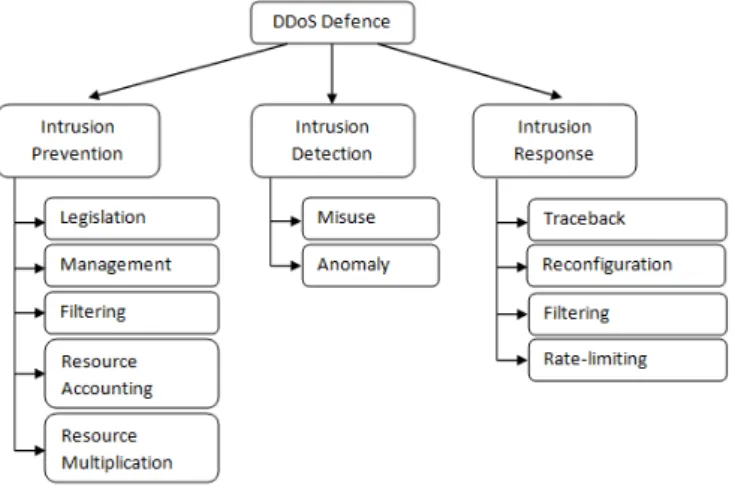
2.7 DDoS Defence Taxonomy . . . 50
2.8 Distributed Route-based Filtering . . . 51
2.9 Illustration of Pushback . . . 58
2.10 Illustration of Router Throttling . . . 59
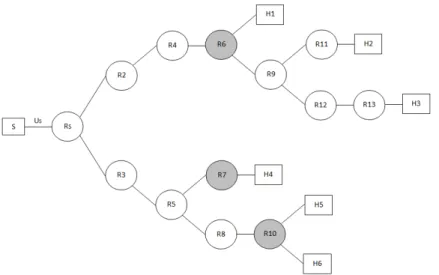
2.11 Illustration of DefCOM . . . 63
3.1 Network Topology Showing Defensive Routers . . . 66
3.2 Constant-rate Attack . . . 72
3.3 Variable-rate Attack Dynamics . . . 72
3.4 Network Topology with 8 Nodes and 2 RLs . . . 73
3.5 Training Results for 2 RLs . . . 74
3.6 Evaluation Results for 2 RLs . . . 74
3.7 Training Results for 3 RLs . . . 75
3.8 Evaluation Results for 3 RLs . . . 76
3.9 Evaluation Results Using the Pareto ON/OFF Model . . . 78
3.10 Training Results Using Emulation . . . 80
3.11 Evaluation Results Using Emulation . . . 81
4.1 Team Formation . . . 85
4.2 Team Structure . . . 85
4.3 Offline Learning for30RLs . . . 89
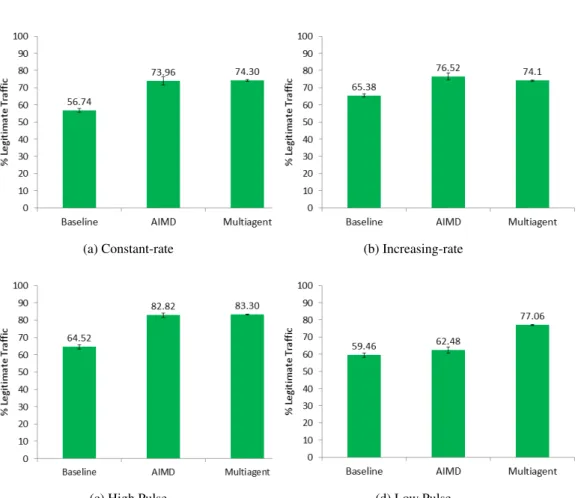
4.4 Performance for Constant-rate Attack . . . 90
4.5 Performance for Increasing-rate Attack . . . 91
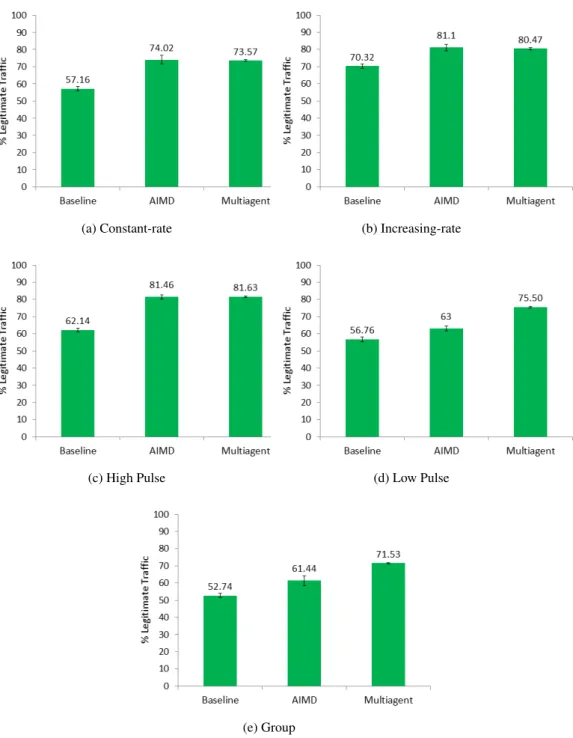
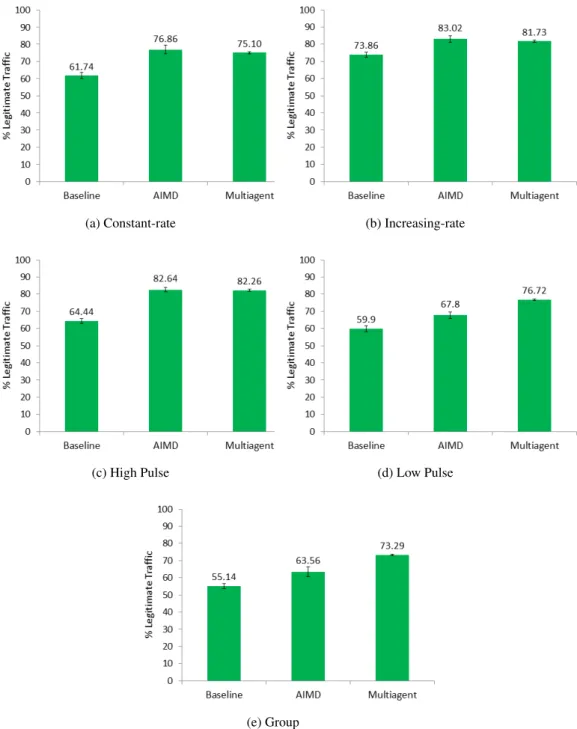
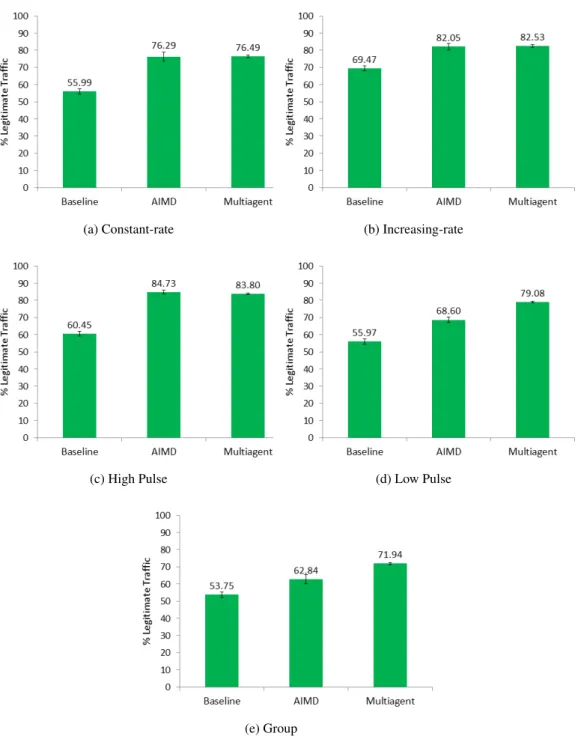
4.6 Performance for High Pulse Attack . . . 91
4.7 Performance for Low Pulse attack . . . 92
4.8 Performance for Group Attack . . . 92
LIST OF FIGURES 9
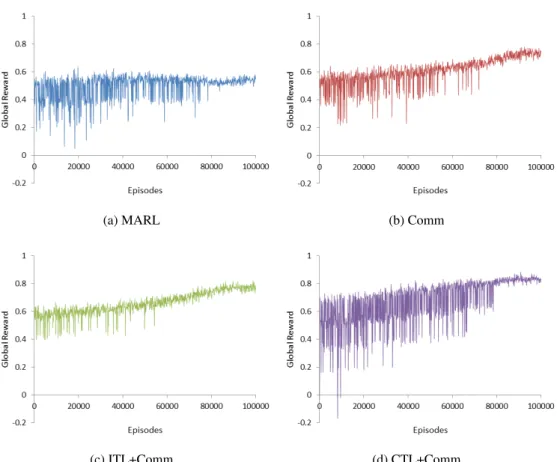
4.9 Scalability of MARL . . . 93
4.10 Scalability of Comm . . . 94
4.11 Scalability of ITL+Comm . . . 94
4.12 Scalability of CTL+Comm . . . 95
4.13 Load for Constant-rate Attack . . . 96
4.14 Load for Increasing-rate Attack . . . 97
4.15 Load for High Pulse Attack . . . 98
5.1 Team Formation . . . 105
5.2 Team Structure . . . 105
5.3 Preliminary Results Without Parameter Tuning . . . 108
5.4 Reward Functions with a Gradient Throughout . . . 109
5.5 Default Action for Difference Rewards . . . 110
5.6 Effect of Hierarchical Communication . . . 111
5.7 Linearly Decreasing-greedy for MARL . . . 112
5.8 Linearly Decreasing-greedy for CTL . . . 112
5.9 Linearly Decreasing-greedy for D MARL . . . 112
5.10 Exponentially Decreasing-greedy for D MARL . . . 113
5.11 Linearly VS Exponentially Decreasing-greedy (D MARL) . . . 113
5.12 Linearly Decreasing-greedy for D CTL . . . 113
5.13 Scalability of MARL . . . 115
5.14 Scalability of CTL . . . 115
5.15 Scalability of D MARL . . . 116
5.16 Scalability of D CTL . . . 116
5.17 Online Learning for 30 - 102 RLs . . . 117
5.18 Online Learning for 504 RLs . . . 118
5.19 Online Learning for 1002 RLs . . . 118
5.20 Performance for 102 RLs . . . 120
5.21 Agent Failures . . . 122
5.22 Pulse Attack . . . 124
5.23 Effect of Measurement Noise . . . 125
5.24 Measurement Noise . . . 126
5.25 Meek Attackers . . . 127
5.26 Number of Teams . . . 129
5.27 Offline Learning . . . 130
5.28 Incremental Learning . . . 131
A big thank you to my supervisor Dr. Daniel Kudenko for his guidance and support throughout these four years, and for all the freedom he has given to me. It was a privilege working with you. I wish to express my gratitude to my examiners Prof. John A. Clark and Dr. Michael Rovatsos for their invaluable feedback which has shaped and considerably improved my thesis.
Special thanks to Dr. Sam Devlin for the great collaboration, and to Logan Yliniemi and Prof. Kagan Tumer for their invaluable suggestions on Chapter 5. I am grateful to Gareth A. Lloyd for his great help; I learnt something new from you in every single conversation we have had. I would also like to thank Kyriakos Efthymiadis, Peter Scopes, Hanting Xie, Christos Evripidou, Simos Gerasimou and Yu Chan for all their help and the numerous fruitful discussions we have had. Last but not least, I would like to thank Dr. Paul Cairns for his help on statistics, Alex Cooper and David Hull for the technical support, and the Head of the Artificial Intelligence group, Dr. Alan M. Frisch, and the Department of Computer Science for the generous financial support.
I would like to thank my friends - you all know who you are - for all the good times. I am very grateful to Koulla for her love, support and encouragement through the ups and downs of this journey. Thank you for your understanding.
Above all, I would like to thank my family, Andreas, Evita and Iro for their endless love and support. Nothing would have ever been possible without you.
Declaration
This thesis has not previously been accepted in substance for any degree and is not being concur-rently submitted in candidature for any degree other than Doctor of Philosophy of the University of York. This thesis is the result of my own investigations, except where otherwise stated. Other sources are acknowledged by explicit references.
Some of the material contained in this thesis has appeared in the following published or awaiting publication papers:
Journal Articles
1. K. Malialis and D. Kudenko, Distributed Response To Network Intrusions Using Multia-gent Reinforcement Learning, InEngineering Applications of Artificial Intelligence. (In press)
2. K. Malialis, S. Devlin and D. Kudenko, Distributed Reinforcement Learning for Adaptive and Robust Network Intrusion Response, InConnection Science. (In press)
Conference Papers
1. K. Malialis, S. Devlin and D. Kudenko, Coordinated Team Learning and Difference Re-wards for Distributed Intrusion Response, InProceedings of the 21st European Conference on Artificial Intelligence (ECAI), Prague, Czech Republic, August 18-22, 2014, pp. 1063-1064.
2. K. Malialis and D. Kudenko, Multiagent Router Throttling: Decentralized Coordinated Response against DDoS Attacks, In Proceedings of the 25th Conference on Innovative
Applications of Artificial Intelligence (AAAI / IAAI), Bellevue, Washington, USA, July 14-18, 2013.
Workshop Papers
1. K. Malialis, S. Devlin and D. Kudenko, Intrusion Response Using Difference Rewards for Scalability and Online Learning, InProceedings of the AAMAS Workshop on Adaptive and Learning Agents (ALA), Paris, France, May 5-6, 2014.
2. K. Malialis and D. Kudenko, Large-Scale DDoS Response Using Cooperative Reinforce-ment Learning, In11th European Workshop on Multi-Agent Systems (EUMAS), Toulouse, France, December 12-13, 2013.
3. K. Malialis and D. Kudenko, Reinforcement Learning of Throttling for DDoS Attack Response, In Proceedings of the AAMAS Workshop on Adaptive and Learning Agents (ALA), Valencia, Spain, June 4-5, 2012, pp. 111-117.
CHAPTER
1
Introduction
This chapter introduces the topic of this thesis and describes the motivation of our research. It discusses the scope of the research and sets out the central research direction or hypothesis to be investigated. It then presents an overview of the thesis and discusses how the rest of the chapters are organised.
1.1
Motivation
The increasing adoption of technologies, the wide spread application of computers and the ex-ponential growth of networks has made the area of information technology an integral part of our lives. This gave birth to numerous applications such as social networking, online shopping, smart metering and cloud computing where computer and network security plays a vital role.
A rapidly evolving threat and one of the most serious in the current Internet is posed by distributed denial of service (DDoS) attacks, which target the availability of a system (Mirkovic & Reiher 2004; Douligeris & Mitrokotsa 2004). A DDoS attack is a highly coordinated attack where the attacker takes under his control a large number of hosts, called the botnet (network of bots), which start bombarding the target when they are instructed to do so. Such an attack is designed to exhaust a server’s resources or congest a network’s infrastructure, and therefore renders the victim incapable of providing services to its legitimate users or customers.
Numerous incidents have been reported over the years against some high profile companies such as Yahoo, eBay, Amazon, Twitter, Facebook, CNN, Visa, MasterCard and PayPal (Greene 2011). Specifically, the Arbor Network’s worldwide security survey (Anstee et al. 2013) conduc-ted among more than 290 companies and organisations reveals that 50% of the participants see
1-10 DDoS attacks per month, while 12% experience more than 100. Furthermore, the survey reveals that the 62% of the participants have seen increased demand for DDoS protection from their customers. Beyond the financial loss caused by DDoS attacks, victims also suffer loss to their reputation which results in customer dissatisfaction and loss of trust. Common motivations are political and ideological hacktivism, vandalism, rivalries and extortion (Anstee et al. 2013).
As a result of the Internet’s popularity and usefulness, there are many “interesting” targets and malicious (or simply ignorant) users that the DDoS threat is not going to disappear on its own (Keromytis et al. 2002). DDoS attacks grow in sophistication, frequency and size, and this demonstrates the need to adopt novel approaches to rapidly respond to DDoS attacks.
Machine learning (Mitchell 1997) is the study of how to construct computer agents that can improve their behaviour with experience. Machine learning is a multidisciplinary concept highly influenced by ideas from mathematics, psychology, biology, neuroscience and others.
As computing evolves, the overlapping connections, dependencies and interacting applica-tions increase (Horn 2001). The need of learning new behaviours emerges from the fact that the complexity of the environment may not allow good behaviours to be pre-designed. Furthemore, in dynamic environments where the environment changes frequently over time, even a good be-haviour may become inappropriate because it is static. Also, these complex applications require for administrative decision-making and responses faster than any human can deliver (Horn 2001). Machine learning distinguishes three different learning processes; these are, supervised learning, unsupervised learning and reinforcement leaning (RL) (Mitchell 1997).
Reinforcement learning is defined as the goal-directed learning from interaction between an active decision-making agent and its environment (Sutton & Barto 1998). The agent maps environmental input to local state information in discrete time steps. It then selects and executes an action. The environment presents the new state and also responds with a feedback, in the form of a positive or negative reward, evaluating the quality of the action performed. The agent finally updates its policy in such a way to optimise future rewards.
A multiagent system deals with the construction of a system involving multiple autonom-ous and interacting agents. Multiagent systems can offer many benefits including among others, better robustness to individual agent failures, better scalability, taking advantage of geographic distribution and sharing experiences for faster and better learning (Stone & Veloso 2000). Mul-tiagent systems often need to be very complex, and mulMul-tiagent reinforcement learning (MARL) is a promising candidate for dealing with this emerging complexity (Stone & Veloso 2000).
1.2
Scope and Hypothesis
The DDoS threat is challenging for many reasons, including the following (Mirkovic et al. 2003). Firstly, the traffic flows originate from host machines spread all over the Internet, which they all aggregate at the victim. Furthermore, the volume of the aggregated traffic is really large which is unlikely to be stopped by a single defence point near the victim. Also, the number of
com-Section 1.3 Thesis Overview 15
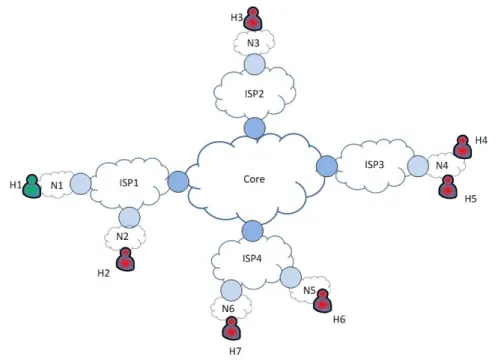
promised host machines is large, thus making an automated response a necessary requirement. Moreover, DDoS packets appear to be similar to legitimate ones, since the victim damage is caused by the total volume and not packet contents. A defence system cannot make an accurate decision based on a packet-by-packet basis. It requires the defender to keep some statistical data in order to correlate packets and detect anomalies, for example, “all traffic directed towards a specific destination address”. Lastly, it is very difficult to traceback, that is, to locate the botnet machines responsible for the attack, let alone discover the actual attackers who infected them.
It is evident that, to combat the distributed nature of these attacks, a distributed and coordin-ated defence mechanism is necessary where many defensive nodes across different locations cooperate in order to stop or reduce the flood.
There is an extensive literature regarding the application of machine learning to intrusion
detection, specifically anomaly detection where no action is performed beyond triggering an intrusion alarm when an anomalous event is detected.
This thesis investigates the applicability of multiagent systems and machine learning to intru-sionresponse. Specifically, the thesis investigates the applicability of multiagent reinforcement learning to respond to DDoS attacks. We focus on distributed rate-limiting and the research pursued in the thesis investigates the following hypothesis:
Distributed reinforcement learning will create an automated and adaptive response, thus producing dynamic and robust behaviours to effectively mitigate the impact of DDoS attacks and improve recovery rates over existing state-of-the-art rate-limiting approaches.
1.3
Thesis Overview
Chapter 2 provides the background and literature review necessary for the reader to understand the contributions made by this work. Chapters 3 to 5 present the contributions made in the thesis. Chapter 3 provides the basis of this work, and the rest of the contributing chapters build upon their previous one. Each contributing chapter contains its own experimental evaluation. The thesis concludes in Chapter 6. Specifically, the organisation of the thesis is as follows.
Chapter 2
This chapter provides the background and a comprehensive review of the research necessary to make later chapters accessible to the reader. It provides a technical introduction to reinforce-ment learning and emphasises multiagent reinforcereinforce-ment learning. It also covers network attacks emphasising the existing use of machine learning. Lastly, it covers DDoS attacks and reviews current DDoS defence techniques.
Chapter 3
Mul-tiagent Router Throttling. MulMul-tiagent Router Throttling provides an agent-based distributed re-sponse to DDoS attacks, where multiple individual reinforcement learning agents learn to rate-limit traffic towards a victim server. One of the novel characteristics of our proposed approach is that it has a decentralised architecture and provides a decentralised coordinated response to the DDoS problem, thus being more resilient to the attacks. This initial design forms the basis on which the next couple of chapters build upon.
Chapter 4
This chapter tackles the scalability challenge. Scalability is one of the most important aspects of a defence system since a non-scalable mechanism will never be considered, let alone adopted, for wide deployment by a company or organisation. The chapter proposes Coordinated Team Learn-ing (CTL) which is a novel design to the original Multiagent Router ThrottlLearn-ing approach based on the divide-and-conquer paradigm. The CTL approach proposes several mechanisms, namely, hierarchical team-based communication, task decomposition and coordinated team rewards and can successfully scale up to large network scenarios.
Chapter 5
Online learning is the focus of this chapter; the previous two chapters deal with offline learning. Unlike non-learning approaches, one of the core advantages of reinforcement learning is its cap-ability for online learning. To enable online learning we incorporate into CTL a form of reward shaping called difference rewards. The combination of CTL and difference rewards improves the scalability, learning speed and final performance. Specifically, the scalability of the proposed approach is demonstrated in experiments involving up to 1000 reinforcement learning agents. The significant improvements on scalability and learning speed lay the foundations for a poten-tial real-world deployment. The proposed approach provides an adaptive response and meets the real-world requirements of robustness to agent failures and measurement noise.
Chapter 6
The thesis concludes in this chapter summarising all the contributions made, the deployment issues of our proposed approach and provides directions for future work on how to resolve these issues and extend our approach.
CHAPTER
2
Background and Literature Review
This chapter provides the background and current state of research related to this thesis. Sec-tion 2.1 covers the fundamentals of reinforcement learning and emphasises multiagent reinforce-ment learning and approaches to scalability. Section 2.2 covers the background on network attacks, emphasises defence approaches and discusses existing research on the use of machine learning. Section 2.3 provides a technical description of distributed denial of service (DDoS) at-tacks, discusses the characteristics of DDoS defence and reviews the current defence techniques.
2.1
Reinforcement Learning
A computer agent or agent is any entity that perceives its environment through sensors and acts upon it through actuators (Russell & Norvig 2003). Artificial Intelligence is defined as “the study of the design of intelligent agents” (Poole et al. 1998). An intelligent or rational agent is the agent that acts in such a way as to achieve the best possible outcome. Russell & Norvig (2003) formally defines a rational agent as follows:
“For each possible percept sequence, a rational agent should select an action that is expected to maximise its performance measure, given the evidence provided by the percept sequence and whatever built-in prior knowledge the agents has.”
Wooldridge (2009) suggests that an intelligent agent should be reactive, that is, to respond in a timely fashion to environmental changes; proactive, that is, to exhibit goal-directed behaviour by taking the initiative; and finally to have social abilities, that is, to interact (cooperate, coordinate, negotiate) with other agents or even humans.
Other definitions of intelligence or rationality exist. According to Russell & Norvig (2003) a rational agent should be capable of information gathering, capable of learning and should be autonomous. Information gathering refers to the execution of actions provided by exploration in order to modify future percepts. A rational agent should be able to learn from its perceptions, that is, to modify or augment its configuration as it gains experience. The agent should also be autonomous. An autonomous agent is the one which does not rely solely on its designer’s prior knowledge. An autonomous agent should learn what it can to compensate in situations where partial or incorrect prior knowledge is provided.
Machine learning is the study of how to construct computer agents that can improve their behaviour with experience. Machine learning is a multidisciplinary concept highly influenced by ideas from philosophy, mathematics, psychology, biology, neuroscience and others. Mitchell (1997) formally defines Machine learning as follows:
“A computer is said to learn from experience E with respect to some class of tasks T and performance measure P, if its performance at tasks in T, as measured by P, improves with experience E.”
The questions that now arise are in which cases and why is machine learning preferred over pre-designed static behaviours? The answer is explained along four directions, namely, com-plexity, automation, adaptation and cost. As computing evolves, the overlapping connections, dependencies and interacting applications increase (Horn 2001). Therefore, the complexity of the environment may not allow good behaviours to be pre-designed. Also, these complex ap-plications require for administrative decision-making and responses faster than any human can deliver (Horn 2001). Moreover, in dynamic environments where the environment changes fre-quently over time, a static behaviour may become inappropriate. Finally, machine learning can be used in cases where manual processing of enormous amount of data is difficult and expensive. Machine learning distinguishes three different learning processes; these are, supervised learn-ing, unsupervised learning and reinforcement learning (RL) (Mitchell 1997). Supervised learning involves learning a function from labelled examples of inputs and outputs provided by a domain expert (the teacher or supervisor). The learnt function can be then applied to new situations with unseen input data in order to predict the output. Unsupervised learning involves learning patterns in the input data and clusters relevant data when no output values are provided.
In RL the agent learns by interacting with its environment, specifically, it learns from rein-forcement i.e. environmental feedback which indicates whether an action was right or wrong. This feedback is less informative than in supervised learning, but more informative than in unsu-pervised learning (Bus¸oniu et al. 2008).
According to Stone (2007) the premise of RL matches the agent paradigm exactly (although this is not say that classical learning is irrelevant to agents). As we will shortly explain, despite the elegant theory behind temporal difference algorithms, there have only been a limited number of
Section 2.1 Reinforcement Learning 19
Figure 2.1: The Agent-Environment Interaction in RL (Sutton & Barto 1998)
successful large-scale applications such as playing backgammon (Tesauro 1994), robotic soccer (Stone et al. 2005) and air traffic management (Tumer & Agogino 2007).
Reinforcement learning is defined as the goal-directed learning from interaction between an active decision-making agent and its environment (Sutton & Barto 1998). The agent maps environmental input to local state information in discrete time steps. It then selects and executes an action. The environment presents the new state and also responds with a feedback, in the form of a positive or negative reward, evaluating the quality of the action performed. The action selection mechanism is based on the maximisation of a specific quantity such as the cumulative reward or average reward per time step. The agent finally updates its policy in such a way to optimise future rewards. This agent-environment interaction is shown in Figure 2.1.
2.1.1
Markov Decision Process
A Markov Decision Process (MDP) provides a mathematical framework which is widely used for modelling the dynamics of an environment under different actions, and is useful for solving reinforcement learning problems. A state is said to be Markov or have the Markov property if its state signal includes a compact summary of all previous sensations, but in such a way that all essential information is kept (Sutton & Barto 1998). This enables the prediction of the next state and expected next reward according to the current state and action; that is, the Equation 2.1 holds.
P(st+1=s0, rt+1=r|st, at, rt, st−1, at−1, rt−1, ..., r1, s0, a0)
=P(st+1=s0, rt+1 =r|st, at) (2.1)
Therefore, a Markov state makes available to the agent all the necessary information in order to make an optimal decision. It should be noted that a state may not fully satisfy the Markov property, but it is often useful to assume that it does. A reinforcement learning problem is called an MDP if it satisfies the Markov property (Sutton & Barto 1998). An MDP is defined by a 4-tuple< S, A, R, P >where:
• Arepresents the set of all possible actions
• R:S×A×S→Ris the reward function which returns the expected reward received in
statest+1when actionais executed in statesas shown in Equation 2.2.
Rass0 =E{rt+1|st=s, at=a, st+1=s0} (2.2)
• P :S×A×S→[0,1]is the transition probability function which returns the probability of reaching statest+1when actionais executed in statesas shown in Equation 2.3.
Pssa0 =P r{st+1=s0|st=s, at=a} (2.3)
Ra
ss0andPssa0are called the environment’s dynamics. A finite MDP is the one with a finite set of states and actions. MDPs assume that each action requires the same length of time. A Semi-Markov Decision Process (SMDP) relaxes this assumption by allowing actions to have different durations. MDPs also assume that the agent can observe the whole environment accurately at all times. This assumption is relaxed by considering the Partially Observable Markov Decision Process (POMDPs). SMDPs and POMDPs are outside the scope of our work and the interested reader is directed towards (Puterman 1994) and (Kaelbling et al. 1998) respectively.
2.1.2
Value Functions
A policyπdefines a state-action mapping to the probability of selecting actionain states, that is,π:S×A→[0,1]. The notion of “how good” a particular state is, or “how good” would it be to perform an action in a particular state, is given by the value functions.
The state-value functionVπ(s)is the value of a state under a given policy (Sutton & Barto 1998). It is defined as the expected return when starting from statesand then following policyπ as shown in Equation 2.4. Vπ(s) = Eπ{Rt|st=s} = Eπ (∞ X k=0 γkrt+k+1|st=s ) (2.4)
Rtis also called the cumulative future discounted reward because future rewards are discoun-ted by a factor of0 ≤γ≤1. The discount factorγis introduced to deal with the problematic formulation for continuing tasks, because for the final time step (k=∞) the return could be in-finite. Ifγ <1the infinite sum has a finite value (as long as the reward is bounded). Ifγ= 0the agent is called “myopic” and is concerned only with maximising immediate rewards. A myopic agent could maximise the return by separately maximising each immediate reward, but typically, doing that reduces access to future rewards and therefore the return may actually be reduced. As
Section 2.1 Reinforcement Learning 21
γapproaches 1, the agent becomes more “farsighted”.
The action-value functionQπ(s, a)is the value of a state-action pair under a given policy (Sutton & Barto 1998). It is defined as the expected return when starting from states, performing actionaand then following policyπas shown in Equation 2.5.
Qπ(s, a) = Eπ{Rt|st=s, at=a} = Eπ (∞ X k=0 γkrt+k+1|st=s, at=a ) (2.5)
The value function satisfies a particular recursive relationship shown in Equation 2.6 which is known as the Bellman equation forVπ(s). It expresses a relationship between the state value and the values of its successor states i.e. the value of the start state must be equal to the discounted value of the expected next state, plus the expected future reward.
Vπ(s) = X
a
π(s, a)X
s0
Pssa0[Rass0+γVπ(s0)] (2.6)
The goal of a reinforcement learning agent is to find the optimal policyπ∗, that is, the policy
which maximises the expected discounted reward over time. There always exists one policy which is better or equal to the rest. The state-value function and action-value function under optimal policyπ∗, are called the optimal state-value functionV∗(s)and optimal action-value
functionQ∗(s, a)respectively. They are defined in Equations 2.7 and 2.8.
V∗(s) = max π V π(s) (2.7) Q∗(s, a) = max π Q π(s, a) (2.8)
The Bellman optimality equations forV∗(s)andQ∗(s, a)are shown in Equations 2.9 and 2.10 respectively. The Bellman optimality equation is essentially a system of equations, one for each state. When the environment’s dynamics (Ra
ss0 andPssa0) are known, dynamic programming (Sutton & Barto 1998) algorithms can be used to find the optimal value function and hence the optimal policy. However, in most real-world applications the environment’s dynamics are not known, therefore temporal-difference learning (Sutton & Barto 1998) algorithms are used.
V∗(s) = max a X s0 Pssa0[Rass0 +γV∗(s0)] (2.9) Q∗(s, a) = X s0 Pssa0[Rass0+γmax a0 Q ∗(s0, a0)] (2.10)
2.1.3
Temporal-Difference Learning
The assumption of perfect problem domain knowledge makes dynamic programming algorithms to be of limited practicality. Furthermore, these algorithms are computational intensive. Temporal-difference (TD) learning (Sutton & Barto 1998) is the most fundamental class of methods for solving the reinforcement learning problem. TD methods can learn directly from raw experience when the environment’s dynamicsRa
ss0 andPssa0are not known.
TD methods perform bootstrapping, that is, they update estimates based on other learnt es-timates. Model-based reinforcement learning refers to the algorithms that attempt to also learn the environmental model apart from the optimal policy. This involves the integration of planning and learning, and it is outside the scope of the thesis; the interested reader is directed towards (Sutton & Barto 1998). The focus of our work is on model-free or direct reinforcement learning. The two most widely used TD techniques are the SARSA and Q-learning algorithms which are described in this section.
In SARSA, the agent simply maintains a table to represent states and actions. This table is called the Q-table, and each entry is called a Q-value. Each Q-value represents the value of a state-action pair, that isQ(s, a)∈R. SARSA uses the rule 2.11 to update the Q-values (Sutton
& Barto 1998). Parameterα∈[0,1]represents the step-size or the learning rate of the algorithm. The learning rateαaffects how big the change in estimated Q-value is and the discount factor γaffects the agent’s preference over immediate rewards and future rewards. SARSA takes its name from the quintuple of events(st, at, rt+1, st+1, at+1).
Q(st, at)←Q(st, at) +α[rt+1+γQ(st+1, at+1)−Q(st, at)] (2.11) Q-learning is very similar to SARSA. Q-learning uses the rule 2.12 to update the Q-values (Sutton & Barto 1998). It is an off-policy TD algorithm since value function updates are made following an independent policy.
Q(st, at)←Q(st, at) +α h rt+1+γmax a Q(st+1, at+1)−Q(st, at) i (2.12)
SARSA and Q-learning have both strict convergence criteria. The conditions under whichQ converges toQ∗with a probability of one are presented below (Sutton & Barto 1998; Mitchell 1997). Even if not all the convergence criteria are met in practice, the algorithms can produce reasonably good results (Bertsekas & Tsitsiklis 1996).
1. The agents visit all state-action pairs infinitely often.
2. The environment’s states satisfy the Markov property.
3. The learning rate reduces to zero.
Section 2.1 Reinforcement Learning 23
5. The reward function produces values which have an upper bound.
2.1.4
Multiagent Reinforcement Learning
A multiagent system deals with the construction of a system involving multiple autonomous and interacting agents, which are situated in a common environment that can perceive through sensors, and act upon it through actuators (Bus¸oniu et al. 2008). There are many possible bene-fits for using multiagent systems including among others, better robustness to individual agent failures, better scalability, taking advantage of geographic distribution and sharing experiences for faster and better learning (Stone & Veloso 2000). Agents can be homogeneous or heterogen-eous. The latter occurs in cases where each agent has a different set of capabilities or in cases where agents are controlled by a different designer or owner. Agents can also have the same or conflicting interests, thus leading to cooperative or competitive systems (or both).
Multiagent systems often need to be very complex, and multiagent reinforcement learning (MARL) is a promising candidate for dealing with this emerging complexity (Stone & Veloso 2000). The two MARL goals that are typically found in the literature are stability of an agent’s learning, and adaptation to the dynamic behaviour of the other agents (Bus¸oniu et al. 2008). Convergence is often presented in the literature as a requirement for stability, and rationality as a requirement for adaptation. Learning in multiagent systems remains an open research area (Stone 2007). Despite the benefits of multiagent systems, new challenges arise that need to be tackled. The rest of this section discusses some of the challenges encountered in both single-agent and multiagent RL. We also discuss some of the well-known MARL algorithms.
2.1.4.1 Challenges
The curse of dimensionality (Sutton & Barto 1998) refers to the exponential growth of the search space, in terms of the number of states and actions. Table-based methods such as SARSA and Q-learning are most affected by this problem. In a MARL scenario the problem becomes more acute since complexity is now also exponential in the number of agents in the system (Bus¸oniu et al. 2008).
The problem of partial observability refers to situations where an agent does not perceive all of the information from a state as a result of data unavailability, sensor misinterpretation or hidden state information (Russell & Norvig 2003; Mitchell 1997). The problem becomes even harder in a MARL scenario where each agent cannot observe the entire environment, but has only knowledge about its local environment. Furthermore, in a MARL scenario the effects of an agent’s action on the environment, also depend on the other agents’ actions. Therefore, the Markov property does not hold if an agent cannot observe the joint action.
Typically in a multiagent system an agent is provided with a reward at the global level. How-ever, recall that the other agents also act in the environment, therefore an agent may be rewarded for taking a bad action, or punished for taking a good action.
Figure 2.2: Instance of the Multi-armed Bandit Problem
Consider an instance of the multi-armed bandit problem shown in Figure 2.2 with three slot machines A, B and C which provide a reward of -10, 0 and 10 respectively. The goal is to maximise the sum of rewards provided. There are 30 learning agents in the system; the star indicates a particular player P. At time stept1(upper part of Figure 2.2) each machine is chosen
by 10 agents and player P chooses machine B. The global reward given to each agent isr1= 0.
At time stept2(bottom part of Figure 2.2), machines A, B and C are chosen by 6, 9 and 15 agents
respectively. The global reward is nowr2= 90. Therefore, although player P has chosen a bad
action, he will still receive a reward of90.
This is known as the multiagent credit assignment problem (Stone & Veloso 2000) and re-search attempts to provide answers to questions like “which agent should receive the reward?” and “how much reward should each agent receive?”.
2.1.4.2 Algorithms
Applications of reinforcement learning to multiagent systems typically take one of two ap-proaches; multiple individual learners or joint action learners. We describe these approaches below and also present some popular alternatives.
Individual Learners (ILs)
ILs (Claus & Boutilier 1998) involves the deployment of multiple agents each using a single-agent reinforcement learning algorithm. Multiple ILs assume any other single-agents to be a part of the environment and so, as the others simultaneously learn, the environment appears to be dynamic as the probability of transition when taking actionain stateschanges over time.
If an IL agentiuses the SARSA or Q-learning algorithm, then it applies the following update rules respectively: Qi(s, a)←Qi(s, a) +α[r+γQi(s0, a0)−Qi(s, a)] (2.13) Qi(s, a)←Qi(s, a) +α h r+γmax a0 Qi(s 0, a0)−Q i(s, a) i (2.14)
Section 2.1 Reinforcement Learning 25
wheresands0are the states at timestandt+ 1respectively, andris the reward received at time t+ 1. Despite subsequent algorithm development ILs remains a popular solution.
Joint Action Learners (JALs)
JALs (Claus & Boutilier 1998) is a group of multiagent specific algorithms designed to consider the existence of other agents; in this setting an agent observes the actions of the other agents or each agent communicates its action to the others. To overcome the appearance of a dynamic environment, JALs were developed that extend their value function to consider for each state the value of each possible combination of actions by all agents.
For instance if a JAL agentiuses the SARSA algorithm, then it applies the following update rule: Qi(s, → a)←Qi(s, → a) +αhr+γQi(s0, →0 a)−Qi(s, → a)i (2.15)
where→a and→0a are the joint actions at timestandt+ 1respectively.
For Q-learning it becomes slightly more complicated. A JAL agenticounts the number of times a state-joint action pair of the other agents occur C(s,a→−i). The agent is then able to calculate its frequency using:
F(s,a→−i) =
C(s,a→−i)
n(s) (2.16)
A JAL agentithat uses the Q-learning algorithm, it then applies the following update rule:
Qi(s, → a)←Qi(s, → a) +α r+γmaxa0 i X →0 a−i F(s0,a→0−i)Qi(s0, a0i, →0 a−i)−Qi(s, → a) (2.17)
The consideration of the joint action causes an exponential increase in the number of val-ues that must be calculated with each additional agent added to the system. For this reason, the method suffers from scalability issues in large and complex domains.
Alternatives
Lauer & Riedmiller (2000) proposed an extension of ILs for deterministic, fully cooperative tasks called distributed Q-learning. The idea behind the approach is that Q-values are only updated if the update leads to an increase in the Q-value:
Qi(s, a) =max n
Q(s, a), r+γmax
a0 Qi(s
0, a0)o (2.18)
If an update leads to a decrease, the agent assumes that this is another agent’s fault. Therefore, distributed Q-learning agents never reduce a Q-value. In a deterministic and fully cooperative environment, if all agents use distributed Q-learning they will converge to the optimal policy. For fully cooperative but stochastic environments, Optimal Adaptive Learning has been proposed
which is guaranteed to converge to the optimal Nash equilibrium (Wang & Sandholm 2002). Hu & Wellman (2003) proposed an extension of JALs called Nash Q-learning. This approach assumes that agents will play a Nash equilibrium strategy. It further assumes that an agent not only can observe the other agents’ actions, but also their rewards. Each agent keeps a Q-table not only for itself, but for the other agents as well, and uses the following update rule:
Qi(s, → a)←Qi(s, → a) +αhr+γN ashi(s0, Q1, ..., Qn)−Qi(s, → a)i (2.19)
whereN ashi(s0, Q1, ..., Qn)is the expected payoff for agent i when all agents play a Nash equilibrium in states0. The approach has been shown to converge to a Nash equilibrium under strict conditions. A recent algorithm called Nash-DE weakens these conditions and has been shown to converge to a Nash equilibrium as well (Akchurina 2009).
Future Coordinating Q-learning (FCQ-learning) combines both ILs and JALs (De Hauwere et al. 2011). An agent starts as an individual learner and at each state it decides using statistical tests whether its state space would also include the joint action. As a consequence, only in some states the value function is extended to consider the joint action.
Another approach which provides a combination of ILs and JALs is Adaptive State Focus Q-learning (Busoniu et al. 2005). An agent starts as an individual learner, but if convergence is not reached, its state space is expanded to include the state of the other agents.
2.1.5
Scaling-Up
Reinforcement learning algorithms experience difficulties when scaling-up to real-world applic-ations (Bus¸oniu et al. 2008; Sutton & Barto 1998). Real-world applicapplic-ations involve complex domains with large and continuous state and action spaces. Therefore, learning becomes infeas-ible due to memory constraints and computational time. This section describes a non-exhaustive list of popular approaches to improve scalability and coordination; these are, function approxima-tion, communicaapproxima-tion, exploration-exploitation strategies, value function initialisation and reward shaping.
2.1.5.1 Function Approximation
It is perhaps the most common technique to deal with scalability issues. The idea of function ap-proximation techniques is to reduce the impact of scalability by reducing the agent’s exploration (Sutton & Barto 1998). With large and continuous state and action spaces, a tabular implementa-tion becomes very inefficient. Funcimplementa-tion approximaimplementa-tion techniques approximate the search space. Tile coding is one of the most common function approximation techniques (Sutton & Barto 1998). Tile coding partitions the state space into tilings, each tiling is further partitioned into tiles where state feature values are grouped into. For example, Figure 2.3 shows a two-dimensional space (i.e. with two state features) partitioned into two tilings, each consisting of 25 tiles. Each point in the two-dimensional state space activates one tile per tiling; this is shown by the point
Section 2.1 Reinforcement Learning 27
Figure 2.3: Example of Tile Coding with Overlapping Tiles (Sutton & Barto 1998)
“x” in the figure. In other words, activated tiles correspond to multiple states. Expected reward values are now stored per tile rather than state-action pair. Tile coding sensitivity can be adjusted by the addition or removal of tilings and tiles. The shape of the tiles indicates the degree of generalisation, and the number of tilings indicates the degree of resolution.
State feature selection is a manual process performed by the designer. Obviously, domain knowledge would benefit the process as the domain expert will include important features and remove irrelevant ones. With a reduced number of features the state-action space becomes smal-ler and agents learn faster.
Boyan & Moore (1995) state that the use of function approximation in a continuous search space does not guarantee convergence to the optimal policy as the requirement of visiting all state-action pairs infinitely often cannot be realised. However, tile coding has been successfully applied in many domains, including the large-scale and complex domain of robotic soccer (Stone et al. 2005). According to Sutton & Barto (1998), it has been empirically demonstrated that tile coding works better with the SARSA algorithm, rather than Q-learning. For other methods of function approximation the reader is directed towards (Sutton & Barto 1998).
2.1.5.2 Communication
Communication is considered to be the most common way of interaction between intelligent agents (Matari´c 1998). Any observable behaviour can also be interpreted as a form of commu-nication. For this reason we distinguish between the following two forms of communication (Matari´c 1998). Direct communication is defined as a purely communicative act in order to transmit information (e.g. a speech act, radio message transmission). Indirect communication is concerned with the observation of other agents’ behaviour and its effects on the environment. Cooperation is a form of interaction, usually based on communication. Cooperative behaviours may depend on direct or indirect communication. Communication is practised by many species in nature, and has also been demonstrated to be beneficial in multiagent systems.
Typically, an agent communicates or shares its local information with other agents in the system. Such information can include state sensations, actions, rewards or a combination of
the aforementioned. Communication tackles the partial observability problem, where distributed agents cannot sense all of the relevant information necessary to complete a cooperative task. This however does not come without challenges; communication messages can be costly, noisy, corrupted, dropped or received out of order. For these reasons and also because real-world ap-plications are typically already complex, communication should be minimal and simple.
Tan (1993) uses agent communication in the prey-hunter domain. The domain’s task is for one or more hunter RL agents to capture at least one randomly moving prey agent in a 10 by 10 grid world. A prey is captured if it occupies the same cell with a hunter. The author runs several experiments, some of which are discussed here. In the first experiment the domain consists of one hunter agent and one prey agent. The author introduces a randomly moving scout agent which at each time step shares its action and local state sensation with the hunter agent (it is assumed that the hunter agent is aware of the scout’s initial relative location). Results show that the hunter with a scout requires fewer steps to capture the prey than the one without. Results improve as the scout’s visual depth increase (with the expense of more communication).
In a variation of this experiment, there are two hunter RL agents and one prey agent. Tan (1993) extends the scout concept by having each hunter to act as a scout for the other. Sim-ilar results are obtained as the previous experiment. However, when the visual depth was small mutual-scouting hinders learning. As a conclusion, sensory information from other agents could be beneficial, but unnecessary or insufficient information can interfere with learning. Tan (1993) also considers the case of joint tasks, where a prey is now captured if it occupies the same cell with two hunter agents. Hunter agents cooperate by either passively observing each other or actively sharing (mutual-scouting) their location and state sensations. Results reveal that cooper-ative agents perform the joint task significantly better than the independent agents.
Servin & Kudenko (2008a,b) and Servin (2009) propose a distributed RL approach to semantic-less communication. Agents are organised in a hierarchy and a sender agent (lower hierarchical level) learns semantic-less communication signals which represent the “summary” of its local state observations. The recipient agent (higher hierarchical level) also needs to learn how to interpret these semantic-less signals. This approach improves the scalability of the multiagent system since the recipient’s state space is significantly reduced. It also reduces communication costs.
2.1.5.3 Exploration-Exploitation Trade-off
The exploration-exploitation trade-off constitutes a critical issue in the design of an RL agent. Recall that one of the convergence criteria is the need for all state-action pairs to be visited infinitely often, in a goal-directed efficient manner. Random search and other systematic search methods such as breadth-first search may visit all state-action pairs, but not in an efficient manner. The exploration-exploitation trade-off plays an important role in achieving the goal-directed efficient visit to the state-action pairs. An agent exploits its knowledge when it selects actions
Section 2.1 Reinforcement Learning 29
that will result to higher immediate rewards, and an agent is said to explore when it explores new states and actions. The exploration-exploitation trade-off aims to offer a balance between the exploitation of the agent’s knowledge and the exploration through which the agent’s knowledge is enriched. Too much exploitation is not desirable since it is more likely for an agent to stuck in a local maximum. Too much exploration is also not desirable since learning becomes very difficult. In scenarios where multiple agents co-exist, the agents may also need to explore in order to obtain information about the other agents.
We describe two of the most popular action selection mechanisms; these are the greedy and -greedy (Sutton & Barto 1998) mechanisms. An agent uses the -greedy action selection mechanism when it selects actions only by exploiting its knowledge. As previously stated, behaving greedily all the time can lead to a local maximum settlement. A variant of the greedy mechanism is called -greedy, where the agent behaves greedily most of the time but with a probabilityit selects an action randomly. -greedy methods can theoretically sample over time every action ensuring convergence toQ∗. The value ofplays an important role; a high value e.g. 0.9 allows more exploration while a low value e.g. 0.01 allows more exploitation. To get the best of both, it is advised to reduceover time (Sutton & Barto 1998). Therefore, exploration is encouraged by using a high value of , but as the agent becomes more and more experienced exploitation is encouraged by using a low value of.
We will later discuss about reward shaping, a more advanced way for effective exploration.
2.1.5.4 Value Function Initialisation
A value function is typically initialised pessimistically or optimistically. Pessimistic initialisation sets the Q-values i.e. state-action pairs to the minimum reward value, while optimistic initialisa-tion sets the Q-values to the maximum reward value. For example, if a reward funcinitialisa-tion generates rewards in the range[0,10], the former will initialise the values to0while the latter to10. Optim-istic initialisation allows all actions in all states to be tried out before convergence to the optimal policy occurs. On the contrary, with pessimistic initialisation an agent’s behaviour can only converge to the optimal policy if the exploration-exploitation strategy identifies it. A randomly initialised value function is often used to combine the advantages of each method.
2.1.5.5 Reward Shaping
Reward shaping refers to the process of training an agent using an artificial reward rather than the reward naturally received by the environment, in order to favour or bias learning towards specific behaviours (Mataric 1994). Reward shaping constitutes a common way to incorporate domain or expert knowledge.
An early approach for incorporating knowledge and facilitating the learning task is to initial-ise the Q-values (Wiewiora 2003). If such information is known this could benefit the agent a lot. However, the major difficulty of this approach is to interpret a certain desirable behaviour (the knowledge) into a set of Q-values.
Randlov & Alstrom (1998) consider an agent learning to ride a bicycle from a starting point to a target destination. The authors use reward shaping by providing an additional reward to encourage the RL agent to stay balanced. Results show that shaping accelerates the learning process immensely. However, reward shaping must be used with great care otherwise it can produce undesirable results. In one of the experiments regarding the bicycle domain, the RL agent learnt to ride in circles since it could benefit more for staying balanced rather than riding to the target destination.
To overcome such problems potential-based reward shaping (PBRS) has been proposed (Ng et al. 1999). The additional reward provided is the difference of a potential functionΦdefined over a sourcesand a destination states0as shown in Equation 2.20 below:
P BRS=r+γΦ(s0)−Φ(s) (2.20) whereris the original environmental reward andγis the same discount factor as used in Equa-tions 2.11 and 2.12.
Ng et al. (1999) have proved that the use of PBRS does not alter the optimal policy of a single agent, although as a heuristic it can increase or decrease the time of convergence. Wiewiora (2003) has proved that an agent learning with PBRS and no knowledge-based Q-table initialisa-tion, will behave identically to an agent not using PBRS but its Q-table is initialised with the same potential function. Devlin & Kudenko (2011, 2012) and Devlin et al. (2014) extend the concept of PBRS to the multiagent scenario. The authors have proved that PBRS in a multiagent system can alter the joint policy learnt but does not alter the Nash equilibria of the underlying system.
Difference rewards is a form of reward shaping that tackles the multiagent credit assignment problem, specifically designed for fully cooperative multiagent systems (Wolpert & Tumer 2000). The difference rewards mechanism rewards an agent based on its contribution to the system’s task by removing a large amount of the noise created by the actions of the other agents in the system. Difference rewards have been successfully applied in many real-world applications such as air traffic management (Tumer & Agogino 2007) and distributed sensor networks (HolmesParker et al. 2013; Colby & Tumer 2013). We will extensively describe difference rewards in chapter 5.
2.2
Network Attacks and Defence
The increasing adoption of technologies, the wide spread application of computers and the expo-nential growth of networks has made the area of information technology an integral part of our lives. This gave birth to numerous applications such as social networking, online shopping, smart metering and cloud computing where computer and network security plays a vital role. Security is defined as the protection provided to an automated information system in order to preserve the confidentiality, integrity and availability of its resources, commonly known as the CIA triad
Section 2.2 Network Attacks and Defence 31
(Stallings 2010). Confidentiality relates to two concepts, namely data confidentiality and privacy. The former ensures that confidential data is not exposed to unauthorised individuals. The latter ensures that individuals have the full control of all the information relating to them. Integrity relates to two concepts, namely data integrity and system integrity. Data integrity protects data from undergoing an unauthorised modification or destruction. System integrity deals with the authorised performance of a system’s intended functionality. Availability assures that a system’s service is provided in a timely and reliable manner to its legitimate users.
2.2.1
Security Attacks
Eavesdropping(Stallings 2010) refers to obtaining information from data being transmitted, for example, over a telephone conversation or an e-mail exchange. This kind of attack does not cause any alteration of the data. It is therefore very difficult to detect, and for this reason the focus is on prevention, typically by means of encryption. However, even if the data is encrypted, the attacker can performtraffic analysisand may still be able to extract information from observed patterns, for example, frequency or length of messages exchanged.
Amasquerade(Stallings 2010) attack occurs when the attacker pretends to be a different entity.Reconnaissance(Pfleeger & Pfleeger 2006) refers to the preparation done by the attacker prior to an attack. The attacker attempts to gather as much information as possible in order to identify potential victims that are easy targets, such as weak or vulnerable machines.
ATrojan(Hansman & Hunt 2005) is a computer program that serves a malicious purpose (e.g. capturing passwords) when run by a user. Avirusis a self-replicated computer program that serves a malicious purpose which when run by a user it attaches itself to other programs. Contrary to viruses, a wormis a self-replicated piece of code which spreads rapidly through network services or email.
The most rapidly-growing problem however is therootkit(Anderson 2008). Once installed, the rootkit allows the attacker to remotely control the infected machine. Typically, machines infected in this way become part of a botnet (network of bots). Interestingly, rootkits are also used by law enforcement agencies which turn suspects’ laptops into listening devices. Modern rootkits have stealth capabilities, that is, they try to hide from the operating system so that they cannot be detected and removed. Some rootkits even install antivirus software to prevent competing botnets from taking over the machine.
Distributed denial of service (DDoS) (Anderson 2008) attacks target the availability of a system. The attacker compromises a large number of host machines (the botnet) which start bombarding the victim with traffic. Such attacks do not allow the authorised or legitimate users to access resources in a timely and efficient manner, or even make the resources completely inaccessible to them. DDoS attacks are extensively discussed in a later section. Similarly to a DDoS attack,spam(Anderson 2008) refers to the flood of generally unwanted emails sent out mostly by botnet machines.
Finally,social engineering(Anderson 2008) attacks refer to the attacks which exploit psy-chology rather than technology. In other words, these attacks target people directly rather than their computer or network. The fastest-growing attack of this type isphishing, where victims receive an email instructing them to visit a website which appears to be legitimate (such as a bank’s website) but in fact it is not. The website is designed to steal sensitive information such as usernames, passwords and credit card details.
2.2.2
Defence Against Network Attacks
Anderson (2008) defines four lines of defence against network attacks. These are management, filtering, intrusion detection and encryption.
Management aims at minimising the occurrence of intrusions. Such mechanisms include ap-plying patches to fix known vulnerabilities, changing default settings (e.g. passwords), removing unnecessary services (e.g. mail servers) and training staff to avoid taking risky actions that may expose a system.
The second line of defence is filtering the harmful network traffic. The firewall is considered to be the most widely sold product. A firewall is a machine that lies between a local system and Internet, examines packets and performs filtering according to specific rules. There are three types of filters, the ones that operate at the IP packet level (network layer), at the TCP session level (transport layer) or the application level (application layer). An example of the latter is the spam filter. An ingress filter is responsible for examining incoming traffic, while an egress filter is responsible for the outgoing traffic.
Intrusion detection is the third line of defence. Preventive mechanisms are important and essential but they are not perfect. In addition, “it’s often cheaper to prevent some of the attacks and detect the rest than it is to try to prevent everything” (Anderson 2008). An intrusion detection system (IDS) monitors the logs and network traffic, and triggers an intrusion alarm if a malicious or suspicious behaviour is detected. IDSs are discussed in detail in the next section.
The last line of defence is the use of security protocols using encryption such as TLS and SSH. Encryption can be useful but similarly to the others, it does not entirely solve the problem. Encryption is outside the scope of our work.
2.2.3
Intrusion Detection
Although the focus of this thesis is on intrusion response, we provide the background material and review the research conducted for intrusion detection since the two areas are directly relevant. Furthermore, there is an extensive literature regarding the application of machine learning to in-trusion detection, specifically anomaly detection, where an alarm is triggered when an anomalous event is detected.
As already mentioned preventive mechanisms are not perfect. Furthermore, it is very expens-ive to try and prevent everything (Anderson 2008). Therefore, it is always safe to assume that
Section 2.2 Network Attacks and Defence 33
attacks will happen. The pioneering work of Anderson (1980) laid the foundations for automated intrusion detection. Anderson (1980) claimed that audit trails can reveal important information regarding the identification of misuse behaviour. Nowadays an intrusion detection system is defined as the one which monitors the logs and network traffic, and triggers an alarm if some-thing malicious or suspicious is detected (Anderson 2008). The key aspects of IDSs are presented below.
2.2.3.1 Data Collection
Depending on the data collection points, intrusion detection can be classified as host-based and network-based (Ghorbani et al. 2010). A host-based IDS analyses audit logs and system calls on the protected host. An audit log file contains sets of events created by the operating system such as running processes and consumed memory. System calls are sequences of operations a program requests from the operating system such as open, read, and close. A host-based IDS can also analyse the log files for specific applications and even the program code itself.
Our focus is on network-based IDSs. Data can be collected from network packets and flows (Ghorbani et al. 2010). The most commonly used open-source software to collect and analyse packets is the Tcpdump (TCPDUMP 2011). A flow is defined as
“A set of IP packets passing an observation point in the network during a certain time interval. All packets belonging to a particular flow have a set of common properties.” (Sperotto et al. 2010)
Traditionally, these properties are the IP source and destination addresses, the source and destination port numbers, and the transport layer’s protocol type. NetFlow (Cisco 2011) is the de facto industry standard protocol for flow capture and monitoring.
Inspecting the payload of packets requires high resource consumption, and due to today’s high speed networks it is infeasible to inspect each individual packet. Alternatively, inspecting flow information can be more efficient since they consist of aggregated information and do not carry any payload. However, flow-based inspection does not offer the precision of packet-based inspection, for example, pattern matching in payload content.
Each approach has its advantages and limitations and therefore they should complement each other. Indeed, that is exactly what is happening according to the Arbor Network’s worldwide security survey conducted by Anstee et al. (2013) among more than 290 companies and organ-isations. Specifically, NetFlow and deep packet inspection (DPI) tools (among others) are being used by 83% and 41% of the respondents. 70% of the respondents use the firewall logs for threat detection.
Finally, feature selection constitutes a critical design decision, since it highly affects the de-tection performance. Typically, these features include packet sizes, IP addresses, ports, timestamps, session size, session duration, session volume etc (Sommer & Paxson 2010). For a
comprehens-ive feature classification scheme the interested reader is directed towards (Onut & Ghorbani 2007), where the authors classify features according to 15 categories.
2.2.3.2 Detection Types
There are typically three intrusion detection types, namely, misuse, anomaly and specification-based detection (Ghorbani et al. 2010).
Misuse or signature-based detection aims at identifying already known attacks by monitoring the traffic for signatures, these are, known characteristics of attacks. The disadvantage of this approach is that it cannot uncover novel intrusions. Pattern matching approaches are commonly used for misuse detection. Snort (Roesch 1999) is a well-known defence system which uses misuse detection.
Anomaly detection aims at uncovering novel attacks by attempting to learn a notion of normal network activity; any activity which deviates from the normality profile is marked as potentially intrusive. The disadvantage of this approach is that it usually suffers from a high rate of false pos-itives and negatives. Anomaly detection typically makes use of advanced statistical techniques or machine learning.
Contrary to learning a normal profile of activity, specification-based detection defines al-lowed types of behaviours and marks any other behaviour that deviates from the specification as intrusive. The disadvantage of this approach is that it is very difficult to specify and validate the behaviour for systems with a large number of components and applications.
2.2.3.3 Architecture
IDSs can be collaborative or non-collaborative. Collaborative IDSs were proposed to detect more accurately coordinated attacks such as DDoS attacks and worm outbreaks (Zhou et al. 2010). A collaborative IDS can detect intrusions that occur at different places in the Internet by correlating decisions between other IDSs. A collaborative IDS has typically two components, a detection unit and a correlation unit. A detection unit consists of multiple sensors, where each sensor monitors a network component or host, and raises low-level intrusion alerts. A correlation unit receives and analyses all low-level alerts and generates a high-level intrusion alarm.
Depending on the place where data is collected and analysed a collaborative IDS can be classified as centralised, hierarchical (or semi-distributed) or fully distributed (Zhou et al. 2010). An example of a centralised IDS architecture is shown in Figure 2.4a. It depicts three detection units i.e. IDSs where low-level alerts are reported to a central correlation unit for further analysis. Figure 2.4b shows a three-level hierarchical IDS. First-level detection units report to a second-level correlation/detection unit which analyses information and reports to the third-second-level unit. The highest-level of the hierarchy further analyses the received information and decides whether or not an intrusion alarm should be triggered. In practice, a hierarchy can be determined by many factors such as the geography, network administration control and collection of similar software platforms.