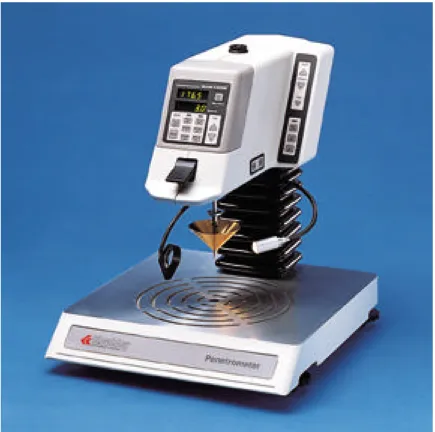
A Useful Tool for the Determination of Consistency in Semi-Solid Substances
By Wayne S. Goldenberg, Ph.D. and Raj Shah, Ph.D. Koehler Instrument Company, Inc., New York
Consistency (i.e., thickness or firmness) is the most important characteristic among the many physical properties of a semi-solid substance. The most commonly used test to measure consistency is the cone penetration test as per ASTM D217. Numerous international standards outline procedures for performing these tests on various substances such as petroleum products, food, cosmetics, and other semi-solid materials. The instrument used for determining the consistency and penetration properties of semi-solid substances is called a penetrometer.
Instrument Operation
The operating principle of the penetrometer is straightforward. The penetration measurement is the depths in tenths of millimeters to which a standard penetrant such as a cone or a needle sinks into a semi-solid substance under defined conditions of sample size, penetrant weight, geometry, and time. The softer the sample is then the deeper the penetrant will sink into the sample and thus the higher the penetration number will be. The microprocessor-based digital penetrometer from Koehler Instrument Company shown in Figure 1 is automated instrument and makes this an even easier test to perform. Operators can choose the time interval they want for the penetrant drop, where the standard time is 5 seconds. The penetration needle or cone is placed at the surface of the sample using either preset values or operator-defined values, and the test can be started with the press of a button. The sample can also be kept at a fixed temperature utilizing the penetrometer bath, which is also available from Koehler. The bath helps in performing tests at a wide range of temperatures. A cooling or temperature stabilization period can also be programmed in the penetrometer by the operator to delay the release of the penetrant into the sample. Once the pentrant is released, it falls into the sample under the influence of gravity.
The penetrometer finds application in a variety of different industries for measuring the consistency of a variety of different products. Each international test standard has been developed with specified penetrants, where each penetrant has a different shape and weight based on the product being tested. Table 1 lists the different penetrants, test standards, and products tested using the penetrometer. For instance, a hard asphalt or a cosmetic paste may
need a sharp needle with an additional weight to adequately penetrate the sample and give meaningful results. It is important to remember that the penetration measurement is the distance traveled by the penetrant inside the sample under the influence of gravity for a fixed period of time. If the results are too high or too low, then the time of penetration and the weight of the penetrant (1-250 g) can be modified. Typical results are from 50 to 600 penetration units, corresponding to 5 to 60 mm.
The penetrometer is also useful for quality control. For example, for a quality-controlled batch of biscuit dough, the test is performed with a penetrant chosen from Table 1 and the results are noted. Each subsequent batch can then be checked for consistency using the instrument. The test can be run in the laboratory or even on the plant floor, and provides a quick quality control check. The unit can be programmed with higher and lower limits, and then alert the user via audible alarms if the results fall outside the acceptable limits.
Purpose of measuring consistency
Because penetrometers have been in use in the grease industry for a number of years, grease is a good example to consider in explaining the reason for measuring consistency. Greases are available in consistencies ranging from almost fluid to semi-fluid to form block-type greases. Product consistency needs to be appropriate for the application. A grease that is too hard may not feed adequately into areas that need to be lubricated. On the other hand, if a grease is too soft, it may leak away from the area to be lubricated. The pumpablility of a grease is also a function of its consistency, with softer greases being pumped more easily.
Thus, it is important to determine the consistency of a product in order for it to be used properly in any given application. As shown above, the example for grease could transcend to other industries as well, such as with the food industry and the processing of the biscuit dough. The use of penetration to measure this property is practical and easy, and can be performed in the field (under battery power) or the laboratory.
Conclusion
This paper describes the versatility of the penetrometer and tests the wide array of products for which it can be used to measure consistency. The automated instrument is important for measuring the thickness or consistency of such products as lubricating greases, dough, chocolate, cosmetic pastes, fruit pulp, silicone, paints, and many other products.
Table 1 – Penetrants, Test Standards, and Products Tested Using the Penetrometer Petroleum Industry:
Material International Test Method Description of Penetrator
• Greases ASTM D217, ASTM D1403
IP 50, IP 310 ISO 2137 DIN 51804
FTM 791-311, FTM 791-313
Solid Cone
Standard Hollow Cone Quarter-Scale Cone Half-Scale Cone • Semi-Liquid Lubricating Greases IP 167 ISO 2137 Perforated Disk • Vaselines • Paraffins (over 150 penetration units) ASTM D217, ASTM D937 IP 50, IP 179 ISO 2137 DIN 51580
Standard Hollow Cone
• Petrolatum ASTM D937 IP 179 ISO 2137 DIN 51580 Solid Cone • Petroleum Waxes • Paraffins ASTM D1321 IP 376 DIN 51579 Tapered Needle • Bitumens • Asphalts ASTM D5 IP 49 DIN 52010 Standard Needle, 2.5 g
Food Industry:
Material International Test Method Description of Penetrator • Chocolate • Confectioneries • Yeast ASTM D5 IP 49 DIN 52010 Standard Needle, 2.5 g
• Bread American Institute of Baking,
Chicago
Test Ram
• Putty and Fruit • Viscous Pastes • Cheese Pin Needle • Chocolate • Yeast • Sausages • Meat Products ASTM D1321 DIN 51579 Tapered Needle • Edible Fats • Pudding • Jelly • Yogurt • Mayonnaise ASTM D217 IP 50, IP 179 ISO 2137 DIN 51580
Standard Hollow Cone
• Fats (small quantities) ASTM D1403 IP 310 DIN 51804 Part 2 Quarter-Scale Cone • Jam • Marmalade • Ketchup • Mustard • Fruit Preparations ASTM D217 IP 167 ISO 2137 Perforated Disk Solid Cone • Mayonnaise • Mustard
• Semi-Liquid Fats and Greases
Food Industry cont’d: • Semi-Liquid Fats • Honey
Hollow Penetration Rod
• Yogurt • Cream
Hollow Plexiglas Cone
• Puddings • Gelatin • Jam • Mustard
Perforated Disk with Cylindrical Holes • Edible Fats • Butter • Margarine • Confectioneries • Candy AOCS Cc 16-60 AACC 58-14 Aluminum Cone Cosmetics Industry:
Material International Test Method Description of Penetrator • Lipstick
• Compact Powder
DIN 52010 Standard Needle, 2.5 g
• Face and Skin Cream ASTM D217, ASTM D937 IP 50, IP 179
ISO 2137 DIN 51580
Standard Hollow Cone
• Solid or Semi-Liquid Cosmetic Cream
Miscellaneous Items:
Material International Test Method Description of Penetrator
• Soap Test Cutter
• Silicone • Rubber • Cement Penetration Rod • Pastes • Emulsions • Paints • Putty Fillers ASTM D217 IP 50, IP 179 ISO 2137 DIN 51580
Standard Hollow Cone
• Paints • Varnishes • Printing Inks ASTM D217 IP 167 ISO 2137 Solid Cone Perforated Disk
• Rubber Solutions Conical Perforated Disk
• Soft Pastes • Toothpaste • Printing Inks
Test Cylinder with Tip
• Paste Emulsions • Paints
• Varnishes
• Potting Compounds • Ceramic Pastes
Hollow Penetration Rod Plexiglas Penetration Rod
• Paints • Varnishes
Hollow Plexiglas Cone
• Viscous Substances • Paints
• Varnishes
Perforated Disk with Cylindrical Holes
• Solid Emulsions AOCS Cc 16-60 AACC 58-14
Aluminum Cone, 45 g
• Pastes USDA Aluminum Cone, 35 g