Working Paper No. 102
‘By a Silken Thread’: regional banking integration
and pathways to financial development in Japan’s
Great Recession
Mathias Hoffmann and Toshihiro Okubo
December 2012
University of Zurich
Department of Economics
Working Paper Series
ISSN 1664-7041 (print)
ISSN 1664-705X (online)
‘By a Silken Thread’: regional banking integration and
pathways to financial development in Japan’s Great
Recession
1Mathias Hoffmann, University of Zurich & CESifo2
Toshihiro Okubo, Keio University3
December 2012
1We are grateful for feedback from and discussions with Sascha Becker, Linda Goldberg, Pierre-Olivier
Gourinchas, Takeo Hoshi, Masaki Nakabayashi, Joe Peek, Bent Sorensen, Pascal Towbin, Frank Westermann and seminar participants at the University of Bonn, Hitotsubashi University, Keio University, RIETI, Uni-versity of Muenster, UniUni-versity of Osnabrück, UniUni-versity of Tübingen, the 3rd Bundesbank Workshop on Money, Finance and Banking in East Asia, the conference on “Financial globalization, financial crises and the (re)-regulation of banking” at the University of Zurich, the Austrian National Bank Workshop on “Financial Markets and Real Economic Activity” and the EEA-ESEM meetings 2012 in Malaga.
2University of Zurich, Dept. of Economics, Chair of International Trade and Finance,
Zurich-bergstrasse 14, CH-8032 Zurich / Switzerland. E-mail: [email protected] Web:
http://www.econ.uzh.ch/itf
Abstract
How do financial development and financial integration interact? We focus on Japan’s Great Reces-sion after 1990 to study this question. Regional differences in banking integration affected how the recession spread across the country: financing frictions for credit-dependent firms were more se-vere in less integrated prefectures, which saw larger decreases in lending by nationwide banks and lower GDP growth. We explain these cross-prefectural differences in banking integration by refer-ence to prefectures’ different historical pathways to financial development. After Japan’s opening to trade in the 19th century, silk reeling emerged as the main export industry. The silk reeling in-dustry depended heavily on credit for working capital but comprised many small firms that could not borrow directly from larger banks. Instead, silk merchants in Yokohama, the main export hub for silk, provided silk reelers with trade loans. Many regional banks in Japan were founded as local clearing houses for such loans, and regional banks continued to account for above-average shares in lending in the formerly silk-exporting prefectures long after the decline of the silk indus-try. Using the cross-prefectural variation in the number of silk filatures in 1895 as an instrument, we confirm that the post-1990 decline was worse in prefectures where credit constraints were tight-ened through low levels of banking integration. Our findings suggest that different pathways to
financial development can lead to long-term differences in de factofinancial integration, even if
there are no formal barriers to capital mobility between regions, as is the case in modern Japan.
JEL-CODES: F15, F30, F40, G01, N15, N25, O16
KEYWORDS: financial development; financial integration; Japan; Great Recession; Lost Decade; banking integration;
regional business cycles; transmission of financial shocks; misallocation of credit; trade credit; export finance; silk in-dustry
Introduction
How do financial development and financial integration interact? We focus on Japan’s Great Recession after 1990 to study this question. First, we show that differences in banking integra-tion between prefectures affected the regional spread of the crisis. Prefectures with many credit-dependent, small manufacturing firms grew much more slowly after 1990 if their banking sector was weakly integrated with the rest of the country. The financially least integrated and most credit-dependent prefectures also saw the largest declines in lending by nationwide banks. Hence, the regional segmentation of Japan’s banking market significantly influenced the way in which the recession affected different parts of the country. We then show that in Japan’s otherwise highly integrated national economy, these regional differences in banking integration have long-standing historical origins. Prefectures in which silk reeling emerged as the first main export industry in the late 19th century developed a particular system of trade credit and export finance in which regional, cooperative or mutual banks came to play a key role in local banking markets. In other regions, larger, nationwide banks eventually came to dominate the market. Therefore, the old silk
regions hadde factoweakly integrated banking markets at the onset of the Great Recession. Hence,
the extent to which a large, common, countrywide shock—the bursting of Japan’s asset price bub-ble in the early 1990s—was transmitted to different parts of the country literally hung ‘by a silken thread’ that was reeled 100 years earlier, during the days of Meiji-era Japan (1868–1912).
Our empirical approach follows a large body of literature initiated by Rajan and Zingales (1998). We identify cross-regional differences in credit dependence using the output or employ-ment share of small manufacturing firms in each prefecture. Our main measure of regional finan-cial integration is the prefecture-level market share of big banks that operate countrywide (termed ‘city banks’) as opposed to that of purely regional lenders (mainly small cooperative and mutual banks). We find that the effects of credit dependence were compounded by low levels of financial integration: over the period 1991–2005, some of the most credit-dependent prefectures may have grown by up to 0.7 percentage points per year less because of their low levels of financial inte-gration. Increasing our main measure of financial integration by one standard deviation would have increased post-1990 growth rates by around 0.4 percentage points per annum for the average
prefecture. We identify the lending behavior of the large, nationwide banks as the transmission channel from the financial shock to the real economy: these banks restricted their lending most severely in prefectures where they traditionally had the lowest market share (i.e. in the least finan-cially integrated prefectures).
The second part of our analysis then turns to the question: what determines variation in the degree of financial integration across prefectures? We turn to Japan’s economic history to argue that cross-prefectural differences in financial integration at the onset of the Great Recession can, to a large extent, be explained by the regions’ different historical pathways to financial develop-ment. After Japan’s opening to trade in the 19th century, silk thread emerged as Japan’s first export staple. The development of this industry had a huge impact on the development of the financial system. With the mechanization of the reeling process in the 1880s and 1890s, silk reeling became increasingly separated from the growing of cocoons. Therefore, silk reelers had to purchase co-coons, which accounted for more than 80 percent of their operating cost. This made the silk reeling business highly dependent on trade credit. However, small reelers—most of them located in the mountain regions of central Japan—were largely cut off from direct access to finance from the large city banks in Yokohama and other treaty ports. The silk reelers therefore often founded coopera-tive or mutual banks that provided operating loans against so-called ‘documentary bills’ drawn on reputed Yokohama silk export merchants, to whom the reelers would ship their produce after hav-ing reeled the cocoons. Hence, these regional banks essentially acted as clearhav-ing houses for loans that were ultimately provided by the Yokohama export merchants. As a result of their central role in this system of export finance for the silk reeling firms, regional cooperative or mutual banks became particularly important (compared with large, nationwide banks) in the silk-producing re-gions. As we show, these regional differences in banking structure persisted even after the silk industry had virtually vanished, which happened by the mid-20th century. Regional banks op-erating in Japan today often have their origins in these small-scale cooperative institutions that emerged in the late 19th century.
We show that the prefecture-level number of silk reeling mills (normalized by population) in the late 19th century is indeed a powerful predictor of the prefecture-level market share of these
local lenders (as opposed to that of city banks) 100 years later, at the onset of Japan’s Great Re-cession, and therefore of the degree of regional banking integration after 1990. We then use the prefecture-level variation in the number of silk filatures (reeling factories) in the late 19th century as an instrument for financial integration in the 1980s. We corroborate our previous results: the negative effect of credit constraints on output growth in the recession after 1990 was worse in less financially integrated areas.
Our results shed new light on the interdependency between financial development and finan-cial integration: different pathways to finanfinan-cial development had a century-long impact on the de-gree to which prefectures were effectively financially integrated when the Japanese bubble burst in the early 1990s. During Japan’s industrialization, large-scale bank finance was extremely im-portant in developing other industries—cotton reeling, railways, steel milling and coal mining— whereas the main silk reeling areas achieved economic growth through financial development based mainly on small, often cooperatively owned banks. While this model certainly served the needs of the silk industry very well, it eventually led to a long-lasting regional fragmentation of the banking system that persisted for over a century. As we argue, these regional differences in the level of financial integration, in turn, had a considerable impact on small firms’ access to finance during the crisis and on post-crisis growth differentials between prefectures.
Contribution to the literature
Our study incorporates and builds on several strands of literature. First, we contribute to the empirical literature on financial development and macroeconomic performance (King and Levine (1993), Rajan and Zingales (1998), Jayaratne and Strahan (1996) and Morgan, Rime and Strahan (2004)). While much of this literature has focused on the growth implications of financial de-velopment and on international comparisons, our focus is more on the implications for business cycles and medium-term growth, and on intranational (regional) differences in financial structure. Here, we have precursors in the work of Jayaratne and Strahan (1996), Morgan, Rime and Strahan (2004), Dehejia and Lleras-Muney (2007) and Rajan and Ramcharan (2011) for the United States and Guiso, Sapienza and Zingales (2004) for Italy. We add an important, novel aspect to this
lit-erature by illustrating how differences in financial integration can be the outcome of alternative
pathways of financial development. Each model of financial development—the system of small,
regional, cooperative banks for the silk-producing regions and the system of large, nationwide banks for other regions—seems to have served the specific financing needs of each region’s major industries at the time, and each seems to have been instrumental for regional economic develop-ment over the past century (see Miwa and Ramseyer (2006)). Today, the regions that form modern Japan at first sight appear to be highly financially integrated, and they share the same regulatory and legal framework. Despite this, the different historical pathways have created interesting
het-erogeneity in terms of regional differences in de facto financial integration. We argue that these
differences influenced the spread of a large, common shock across the country 100 years later (the Great Recession).
Our results shed new light on the debate about the interdependency of financial development and financial integration, and their roles in growth and the transmission of macroeconomic distur-bances. Studies in the spirit of Rajan and Zingales (1998) emphasize that financial development has a particularly strong impact on sectors that are especially dependent on external finance. This implicitly assumes that firms in these credit-constrained sectors cannot substitute local access to financial markets for finance from other countries or regions. An important question, therefore,
is whether financial development matters per se or because it often arises in conjunction with a
low degree of financial integration. Guiso, Sapienza and Zingales (2004) show that differences in local financial development can matter even in integrated financial markets. By contrast, Bekaert et al. (2007) argue that it is mainly financial integration—stock market and banking integration, in
particular—rather than local financial development per sethat removes financial constraints and
helps in aligning growth opportunities with actual growth rates.
Our empirical findings complement the results in these papers. Prima facie, we find that
dif-ferences in financial integration (rather than difdif-ferences in local financial development) mattered most directly for the macroeconomic transmission of the shocks associated with the Japanese crisis: credit-dependent prefectures performed significantly worse if their banking sectors were poorly integrated with the rest of the country, irrespective of how financially developed they were in
other respects. What we do find, however, is that a prefecture’s particular pathway to financial
development effectively determined its de facto level of financial integration with the rest of the
country, which, in turn, affected the regional spread of the crisis. We believe that this result is
in-teresting at a general level because it suggests thatde factodifferences in financial integration can
persist even in an environment in which formal barriers to interregional capital mobility are very
low, as is certainly the case in modern Japan.1
Our results also bear an interesting resemblance to the findings by Do and Levchenko (2008), who show that export structure may be an important determinant of financial development: coun-tries with a comparative advantage in induscoun-tries with high external finance dependence will ul-timately develop a financial sector that is suited to sustaining these industries, whereas countries specializing in industries with low external finance dependence will have lower financial develop-ment. Our findings here suggest that a prefecture’s comparative advantage in a key export indus-try (silk reeling) determined the development of financial institutions in that prefecture. However, our results do not allow us to conclude whether silk regions ultimately have higher or lower levels of financial development. For our argument it is, however, sufficient that the silk regions have developed financial institutions that are different from those in other regions, in such a way as to render the silk regions effectively less financially integrated with the rest of the country during the 1990s.
We use the bursting of Japan’s big property and stock market bubbles of the 1980s as an iden-tifying shock to banks’ lending behavior that tightened the financial constraints faced by credit-dependent households and firms. Besides being of interest in its own right, the Japanese expe-rience during the 1990s and 2000s is important for at least two reasons, as follows. First, the workings of the financial accelerator and the balance sheet channel (see Bernanke (1983), Gertler and Gilchrist (1994) and Bernanke and Gertler (1989)) are plausibly much stronger in a major crisis
1Relationship lending by banks (Berger and Udell (1995)) is one possible reason why regions are imperfectly
inte-grated. As we will argue, in the case of Japan such networks of banking relationships have long-standing historical roots that may have given regional banks an informational advantage with respect to local customers (in particular, small businesses). This may have prevented these businesses from obtaining credit from nationally integrated banks
in a downturn—leading to ade factosegmentation of markets even though there are no formal impediments to capital
flows. See Berger et al. (2005) for the role of small banks in relationship lending and Uchida, Udell and Watanabe (2008) for an analysis of Japanese banks in particular.
than in a “normal” downturn. Second, the Japanese crisis had very persistent effects on economic activity, leading to what is often referred to as the ‘Lost Decade’. This provides us with a long period of observation after the crisis, allowing us to study its longer-term impact. Our use of the Japanese crisis as an identifying shock follows Peek and Rosengren (2000), Amiti and Wein-stein (2011) and Imai and Takarabe (2011). Peek and Rosengren (2000) and Imai and Takarabe (2011) focus on common lender effects and on how integrated banking markets can accelerate the spread of a crisis. By contrast, our analysis emphasizes how a lack of regional banking integration can worsen a recession in particularly credit-dependent sectors and regions. Amiti and Weinstein (2011) use differences in the external finance dependence of exporting and nonexporting firms to identify the impact of bank-level loan supply shocks on real economic activity. In our analysis, we focus on differences between prefectures to identify the impact of financial constraints on real economic activity.
This focus on the regional dimension of Japan’s Great Recession is relatively novel in the
lit-erature.2 The Japanese experience has been studied in significant detail from a macroeconomic
perspective or based on bank- and firm-level data. However, there is significantly less evidence about the implications of the crisis (and about the importance of regional differences in financial integration) for regional business cycles and medium-term growth. We provide such evidence here.
The paper therefore also contributes a regional perspective to the literature on banking crises and financial integration (Dell’Ariccia, Detragiache and Rajan (2008) and Kroszner, Laeven and Klingebiel (2007)). These studies examine the aftermath of banking crises in a large cross-section of countries. Our focus here is on the regional implications of a common (countrywide) shock over time.
We also add a regional dimension to the literature on the role of international banking in the cross-country transmission of shocks (Cetorelli and Goldberg (forthcoming) and Peek and
Rosen-2The only recent paper we are aware of is by Imai and Takarabe (2011), who study the role of banking integration
in cross-prefecture differences in exposure to the house price shock. They conclude that house price shocks in the core areas had bigger (negative) spillovers in areas with high banking integration. We corroborate their results below as a test of the robustness of our main findings. Our analysis, however, focuses on how the lack of financial integration has exacerbated the financial frictions that were induced by the common shock. Furthermore, Imai and Takarabe (2011) do not offer a historical explanation for why there are cross-regional differences in financial integration, as we do here.
gren (2000, 1997)). Peek and Rosengren (2000) emphasize the common lender effect of the Japanese shock of the early 1990s on US banks. Peek and Rosengren (1997) show that Japanese banks that operated in international markets cut back on their foreign lending—markets that they often had only recently entered. One way to interpret these results is as evidence of relationship lending: banks withdraw from regions with which they have relatively weak ties. Our results are quite analogous: in fact, city banks reduced their lending in particular in prefectures in which they tra-ditionally had a low market share. We add to this by showing that this effect was stronger in areas with many small firms. Our results also relate to recent findings by Cetorelli and Goldberg (forth-coming), who show that the internal liquidity management of US banks operating internationally actually exacerbated the transmission of domestic (i.e. US) liquidity shocks to foreign economies, leading to a reduction in lending.
Recent important literature focusing on the Japanese experience after 1990 has emphasized that Japan’s bursting bubble cannot be characterized as a conventional credit crunch (Caballero, Hoshi and Kashyap (2008), Peek and Rosengren (2005)). Rather, banks seem to have engaged in ‘ev-ergreening’ insolvent borrowers in the hope that either these borrowers or the banks themselves would eventually be bailed out by the government. This seems to have led to the emergence of a class of ‘zombie’ firms, i.e. insolvent firms that starved other, productive firms of credit and hindered the creation and growth of new firms, and thus stifled growth in the aggregate economy (Caballero, Hoshi and Kashyap (2008). Evergreening may help explain our findings in this paper. First, Caballero, Hoshi and Kashyap (2008) show that manufacturing was one of the sectors that was least affected by evergreening. Our focus here is on small manufacturing firms—the ones that were therefore most likely to be deprived of the credit from which the (generally large) ‘zombies’
benefited. Furthermore, it seems that evergreening was particularly pervasive within Zaibatsu—
the tight industrial conglomerates that encompass industrial firms and banks—and that it was conducted in particular by large banks. One of our findings is that large banks withdrew from areas where they traditionally had a low market share and where there were many small manu-facturing firms. Clearly, this is consistent with the possibility that large banks withdrew credit in order to evergreen large customers in their core business regions.
A key innovation of our paper is that it explores the long-term historical origins of why Japan’s crisis of the 1990s spread across the country as it did. These historical aspects of our results build on literature showing that Japan’s opening to trade was indeed a natural experiment. Bernhofen and Brown (2005, 2004) demonstrate that this opening spurred the development of industries in which Japan had a comparative advantage, with the silk industry as a preeminent example. The role of special institutions involved in trade credit and export finance for the development of the silk industry has been explored by several scholars of Japanese economic history (e.g. Nakabayashi
(2001) and Miwa and Ramseyer (2006)).3 However, to our knowledge, we are the first to identify
the persistence of the role of these institutions, and that it led to a regional segmentation in banking markets that lasted for over a century. In explaining these differences in banking market structure, we also relate to recent literature that has emphasized the role that trade credit can play in at-tenuating informational asymmetries (Petersen and Rajan (1997)) and in overcoming barriers to growth in environments with low financial development (Fisman and Love (2003)). Most silk reel-ing firms were located in remote prefectures and were unable to borrow directly from the banks in the big port cities. Instead, the Yokohama silk merchants who sold the silk to the international market also effectively provided trade credit to the reelers. In the longer run, only mechanized reelers were able to provide the consistently high quality of silk required by international mar-kets (in particular the US). Therefore, only the prefectures in which there was a high concentration of reeling firms (and in which these firms switched to mechanized production quite early) could keep their competitive advantage, and these eventually became the main silk-exporting regions. Furthermore, with Yokohama as the export hub, eventually only regions that were able to export internationally enjoyed continued access to the particular form of nonbank credit provided by the
3The terms ‘trade credit’ and ‘trade finance’ are ambiguous in the literature. We follow Amiti and Weinstein (2011)
and use the term ‘trade credit’ to denote financing by suppliers (e.g. by allowing deferred payment of materials). By contrast, the term ‘trade finance’ refers to the financing of international trade. As we argue below, both concepts are relevant in understanding the development of the institutions financing the silk trade. To further facilitate the distinction between the two concepts, in the remainder of the paper we do not use the term ‘trade finance’ but instead refer to financing of international trade as ‘export finance’.
Yokohama silk merchants.4,5
There are a number of explanations of why the silk industry had such a long-lasting effect on Japan’s regional banking landscape. First, the specific type of regional bank that emerged in the silk regions served its purpose well: scholars of Japan’s economic and social history have noted that these institutions—many of them organized as cooperatives—successfully resolved the financing frictions faced by the fragmented silk industry, whereas big national banks tended to cater to the financing needs of large-scale, capital-intensive industries such as cotton reeling, rail-roads and heavy industry (see Miwa and Ramseyer (2006)). As the silk industry remained the foremost export industry until the onset of World War II, it is not surprising that its small-scale, regional institutions shaped Japan’s banking landscape well into the 20th century—in fact, until
after the war.6 Heavy regulation of Japanese banking in the post-WWII era—the ‘convoy system’
and separate legal frameworks for Shinkins (industrial and commercial cooperative banks) and
Sogo (mutual) banks—then consolidated thisde factoseparation of regional banking markets for at
least the next 40 years.
An important challenge faced by studies in the spirit of Rajan and Zingales (1998) (such as ours) is that access to finance may affect industrial structure in the long run: areas where access to finance is poor will have a comparative advantage in industries with low levels of external finance dependence (see Fisman and Love (2004) and Bekaert et al. (2007)). If this was the case, this could lead us to overestimate the importance of low levels of financial integration for economic activity in areas with high levels of credit dependence: areas with low levels of financial integration would then simply not be very dependent on credit in general. To show that our results are not affected by this objection, we also estimate specifications in which we allow for the possibility that the
4As we discuss in detail below, the institutional details of the silk trade resemble those of modern export finance
as described in Amiti and Weinstein (2011). In this system, the silk reelers played the role of the ‘exporting’ firm, the Yokohama-based silk merchants played the role of the ‘importer’ and regional banks acted as the exporters’ ‘advising’ bank. Large Yokohama banks essentially issued letters of credit on behalf of the Yokohama silk merchants, but they did not generally lend to the silk reelers directly. This is likely to have led to a long-term informational advantage for the regional banks with respect to their customer base of small businesses, thus contributing to banking market segmentation long after the eventual decline of the silk industry.
5To our knowledge, no prefecture-level data on silk exports exist, so this argument cannot be directly tested.
How-ever, our reasoning implies that early mechanization, if it is linked to export success, should also be linked to the persistence of the regional system of banks. In our empirical analysis below, we show that this is indeed the case.
6This is plausible because the regional distribution of economic activity remained remarkably stable after the war
pre-1990 prefecture-level output shares of small manufacturing firms—our main measure of credit dependence—may be endogenous, in the sense that they were influenced by the path to financial development taken by the prefecture since the late 19th century. We overcome the endogeneity by building on insights from the literature on agglomeration effects and knowledge spillovers (see Glaeser et al. (1992)), using a prefecture’s distance to the main silk regions as an exogenous measure of growth prospects in the manufacturing sector in the late 19th century. Using this measure as an additional instrument, we then treat both financial integration and financial dependence as endogenous in our regressions. Our previous results remain valid.
The remainder of this paper is structured as follows. Section 2 provides background on our identification strategy and presents details about small business finance and the regional segmen-tation of the banking sector in Japan. It also introduces the data. Section 3 presents our basic stylized facts: the fallout from the crisis was particularly strong in regions where banking markets were not very integrated with the rest of the country and where there were many credit-dependent, small manufacturing firms. Section 4 acknowledges the potential endogeneity of our banking in-tegration measures and introduces our instrument: we show that the importance of silk reeling in a prefecture in the late 19th century is a powerful predictor of the prefecture-level importance of regional banks in the late 20th century, and we proceed to demonstrate that these long-standing differences in financial integration significantly affected regional differences in macroeconomic transmission during the Great Recession of the 1990s. Section 5 discusses our results further and concludes.
Identification: small business finance and regional banking in Japan
To identify how cross-prefecture differences in financial integration affected the regional spread of the Great Recession, we adopt the approach of Rajan and Zingales (1998) in arguing that access to finance should matter more where dependence on credit is stronger. Hence, it should be the in-teraction between dependence on finance and access to finance that determines how severely the crisis hits a region. Our conjecture at the outset is that access to finance is worse in financially less integrated regions because there are barriers to the free flow of credit from outside the region inresponse to credit demand shocks.7 As argued by Rajan and Zingales (1998) and Guiso, Sapienza and Zingales (2004), focusing on such interactions strengthens the identification of the effects of the treatment (in their case, financial development; in our case, our measure of financial integra-tion) because unobserved confluent factors can easily be controlled for: if regional differences in financial integration are time invariant, or only evolving very slowly (as we would expect), then it is impossible to separate their effect from a fixed effect in a panel setting if the marginal impact of financial integration on the outcome (e.g. growth or volatility) is fixed. If, however, the marginal impact of financial integration on the observed outcome depends on other characteristics (such as the dependence on external finance of households or firms), then the interaction allows us to sepa-rate the effect of financial integration from any first-order confluent factor that would be captured by the fixed effect.
As our primary measures of a prefecture’s dependence on external finance, we use the share of small manufacturing firms in the prefecture’s output or employment. Our data are from Japan’s manufacturing census, and they provide a detailed account of value-added and employment ac-cording to firm size in the manufacturing sector.
Our main indicator of differences across prefectures in financial integration is the prefecture-level share in bank lending accounted for by banks that operate nationwide (and which therefore pool bank funds across prefectures) vs. those that operate only regionally (and therefore are more directly exposed to local economic conditions). To construct these shares, we obtain data on bank lending by prefecture and by bank type from the Bank of Japan. These data allow us to distinguish between lending by ‘city banks’ (i.e. nationwide and first-tier regional banks), second-tier regional mutual banks (Sogo banks), industrial credit associations (Shinkins), and agricultural, fishery and other credit cooperatives. Our data set also contains prefecture-level lending by the post office and byShoko Chukin, a government-sponsored bank lending to small businesses nationwide.
Until the onset of the Great Recession of the 1990s and the ensuing banking crisis, Japan’s banking system was clearly regionally tiered and segmented (Hoshi and Kashyap (2004); Kano
7In this respect, we differ from Rajan and Zingales (1998), who focus on the level of financial development more
generally. However, as we will argue and illustrate in more detail below, our result suggests that it is mainly the regional segmentation of the banking market (rather than differences in the local development of these markets) that seems to drive our results.
and Tsutsui (2003)). The big city banks are the foremost lenders overall and are the main banks that operate nationwide. There are also some large, previously regional banks (so-called first-tier regional banks) that operate nationwide or at least in most parts of the country. These two groups are combined in our measurements; for brevity, we refer to these large banks collectively as city banks. The post office and Shoko Chukin are also nationwide lenders but account for only a modest share of overall lending. The genuinely regional banks on which we have data fall into two main groups: mutual banks (Sogo banks, also often referred to as ‘second-tier’ regional banks)
and industrial credit associations (Shinkins).8
Many of the regional lenders are cooperative or mutual banks. Below we discuss in detail the origins of many of these banks in the development of cooperatives in the silk reeling sector in the late 19th century. From the outset, they were set up mainly to lend regionally, not nationally. Furthermore, constrained by regulation and statutes, they largely continued to operate regionally until the end of the 1980s. During the postwar era and well into the 1990s, government regulation under the convoy system restricted these regional banks from opening branch networks outside their prefecture of origin (see Hoshi and Kashyap (2000) and Hosono, Sakai and Tsuru (2007) for details). The situation was similar before World War II: while a national banking market had started to develop during the late 19th century, regional banking integration in the prewar era
remained limited.9
The group of industrial credit associations (Shinkins) allows us to illustrate the regional seg-mentation in Japan’s banking sector. Shinkins are cooperative banks that lend exclusively at a regional level and to their members, which are small businesses. Their historical roots are in the industrial and commercial cooperatives founded in the late 19th century—in particular, those in the silk industry. An industrial cooperative law governing the operation of such credit coopera-tives was enacted in 1900. The Shinkins’ operation today is governed by the Shinkin Bank Law of 1951, which stipulates that Shinkin banks can only lend to their members, i.e. small firms, and are
8Our data set also provides detail on lending by other nonagricultural cooperatives by prefecture, and we also
in-clude this item in our measure of regional bank lending.
9Grossman and Imai (2008) study the impact of banking integration on spreads between borrowing and lending rates
and on their cross-prefectural dispersion during that period. While they find that regional markets gradually became more integrated during the 1920s and 1930s, they conclude that significant regional fragmentation ultimately persisted. They ascribe this to the very anticompetitive banking regulations of the period.
confined in their lending to their prefecture of origin and only to firms below a certain equity (and employment) threshold. Hence, by virtue of the legal restriction faced by Shinkins, their lending is a) particularly likely to be directed at small businesses and b) very clearly restricted to their prefecture of origin. Hence, we expect the lending share of Shinkin banks to be a good measure of regional segmentation (see Kano and Tsutsui (2003) and the literature surveyed therein). The situation is similar for second-tier regional banks (Sogo banks), which also lend mainly locally but
are generally not quite as severely restricted by their governing statutes.10
Our two main measures of regional banking integration therefore are the share of regional banks (Sogo banks, Shinkins and other credit cooperatives) and the share of nationwide banks (‘zenkoku ginko’, i.e. city and first-tier regional banks) in prefecture-level lending. We refer to the former as the ‘regional bank’ share and to the latter as the ‘city bank’ share. By construction, the regional bank lending share is negatively related to financial integration, whereas the city bank lending share is positively related. As we have discussed, there is a host of smaller regional and nationwide (government-sponsored) banks, and so the joint share of Sogo banks and Shinkins in a prefecture’s total lending is not exactly equal to one minus the share of city banks. For robust-ness, we therefore generally report results for both measures, and sometimes also for the narrower
regional measure based on the Shinkin lending share alone.11
Clearly, the share of lending by regional vs. city banks could be a function of the local demand for credit. We note at the outset, however, that aggregate (countrywide) variation in the demand for credit (stimulated e.g. by variations in monetary policy or by an asset market boom as
hap-pened during the 1980s) should a prioriaffect banks of all types in a similar manner, leaving the
cross-regional pattern of their lending shares largely unaffected.12 Furthermore, in all our
regres-10The separating line between first- and tier banks started to blur in the late 1980s and 1990s. Many
second-tier (Sogo) banks were purchased by first-second-tier regional banks or city banks throughout the 1980s. In the Bank of Japan data set that we use, Sogo banks no longer appear as a separate item after 1990. Furthermore, since the mid-1980s, some of the Sogo banks have had access to the interbank market, whereas Shinkins have not.
11Our interpretation of these lending shares as measure of financial integration is further buttressed by their high
correlation with a widely used macroeconomic indicator of financial integration, that is, savings–investment correlations in the spirit of Feldstein and Horioka (1980). In panel regressions of prefecture-level investment rates on savings rates, we include an interaction term with our regional and city bank lending shares. The coefficient of the interaction terms is significant in both specifications, and is negatively signed for the city banks’ lending share and positively signed for the regional banks’ lending share.
sions, we use precrisis (i.e. pre-1990) lending shares as measures of financial integration. This
should alleviate the most direct feedbacks of the crisis on the lending shares of individual banks.13
Still, it could be the case that the lending share of regional banks is relatively high simply because there are many small businesses or because these businesses are doing particularly well. To the extent that Shinkins or other regional banks offer the best financing conditions for small firms, they would then be the first preference of these businesses. This would increase the share in total prefecture-level lending accounted for by the regional banks. Conversely, bias might exist in the opposite direction if nationwide banks withdraw from an area where growth prospects are poor, whereas regional lenders have no choice but to keep on lending locally. Our discussion of the his-torical roots of the cooperative banking sector will provide us with an instrument that allows us to address such issues of simultaneity. We now turn to our econometric implementation.
Econometric implementation
Our main results are based on two basic econometric specifications. The first are panel regressions of the form
∆gdpkt = αAggShockt×SMEk+µk+τt+ekt (1)
where ∆gdpkt is GDP growth in period t in prefecture k, SMEkis a measure of the precrisis (i.e.
before 1990) importance of small businesses (termed ‘small business/firm importance’) in prefec-turekandAggShocktis a measure of the aggregate shock that hit the economy in 1990. The terms
µkandτtare prefecture-fixed and time effects, respectively, andekt is the error term. We chose
AggShockt= Post1990t
wherePost1990tis a dummy that is zero until 1990 and one from 1991 onward. This specification
allows us to focus on the effects of the crisis on post-1990 growth rates.
Specification (1) allows the impact of the aggregate shock on prefecture-level GDP growth to vary as a function of small business importance in a given prefecture. As we have discussed, this is
13For example, some regional banks were hit strongly by the banking crisis of 1997/98. See e.g. Spiegel and Yamori
an indicator of the prefecture-level demand for, or dependence on, credit. Our conjecture—based on Rajan and Zingales (1998) —is that the link between credit dependence and aggregate GDP growth is negative: when the crisis dummy variable changes from zero to one, regions with more small businesses experience lower average growth rates.
Our main hypothesis is that the coefficientαdepends on credit supply and that financial
inte-gration plays an important role in improving local credit conditions after the aggregate shock: α
should be negative, but we would expect it to be more negative in regions with low levels of finan-cial integration. Our first method of testing this hypothesis is to split the sample into one group of prefectures with high financial integration and another group with low financial integration, and estimate the specification (1) separately for each group.
Our second, more formal way of testing the same hypothesis allowsαto depend linearly on our
continuous measures of financial integration so that, controlling for first-order effects, we obtain
∆gdpkt = AggShockt×
h
α0FIk×SMEk+α1FIk+α2SMEk+α03Xk i
+β0Ztk+µk+τt+ekt (2)
whereFIkis one of our measures of financial integration discussed above, and we have addedXk, a
vector of additional prefecture-level characteristics that also may affect the impact of the aggregate
shock on regional output growth. Zkt is a vector of additional controls that may vary by time and
prefecture, andβthe associated vector of coefficients. This is our second main specification. In this
specification, the marginal effect of credit dependence is a continuous linear function of financial integration so that
∂∆gdpkt ∂SMEk
=α0FIk+α2
and we would expect that—conditional on the number of credit-dependent firms in the prefecture—
growth should be higher if financial integration is high, so thatα0 >0.14
A couple of remarks are in order on this specification. Regression (2) is a differences-in-differences (DD) specification in which the interactions with the intervention (the aggregate shock)
vary only by prefecture (k) and not by time. This approach emphasizes the spirit of our analysis:
14Clearly, the specification using the split sample (1) can be interpreted as a nested version of (2) if we codeFIk
we do not claim that short-term, year-to-year fluctuations in financial integration or small business importance affect growth outcomes in the longer run. Rather, we argue that there are long-standing differences in the degree of financial integration or small business importance that have long-term
effects. We want to focus on those. 15 Bertrand, Duflo and Mullainathan (2004) strongly advocate
this approach, arguing that the use of longer-term averages (instead of characteristics that vary over time and cross-section) significantly improves the reliability of DD estimates.
After a description of our data, we discuss our baseline results that are based on the above spec-ifications. We then discuss the different historical origins of regional versus nationwide banks. This discussion will allow us to suggest an instrument with which to address the potential endogeneity
ofFIin the above regressions.
Data
Our data are at the prefectural level. There are 47 prefectures in Japan. We drop Okinawa prefec-ture, which had a special status as a US territory until the early 1970s and still remains economically separate from the mainland in many ways. Hence, there are 46 prefectures in our sample.
Nom-inal prefectural GDPs are taken from theAnnual Report on Prefectural Accounts(Cabinet Office of
Japan). We obtain per capita values using population data from the same source. We deflate using the countrywide consumer price index, obtained from the Ministry of Internal Affairs and Com-munications of Japan. The importance of small manufacturing firms in terms of employees and
value added at the prefectural level is taken from theManufacturing Census of Japanby the Ministry
of Economy, International Trade and Industry.16 We define small and medium manufacturing
en-terprises (SMEs) as having fewer than 300 employees.17 The lending data by bank type (City and
first-tier regional bank, Sogo banks, Shinkin, Shoko Chukin, etc.) at the prefecture level are taken
from theEconomic Statistics Annual by Prefecture(Bank of Japan). The prefecture-level breakdown
of these data by bank type only runs to 1996. GDP and SME data cover the period 1980–2005.
15In fact, as we discuss in detail below, we will use pre-1990 characteristics to eliminate short-term feedbacks of
growth on financial integration or the share of small businesses in the prefectural economy from our analysis.
16The number of manufacturing establishments in the years 1981, 1986, 1991 and 1996 was 873,000, 875,000, 857,000
and 772,000, respectively. This tells us that the number of Japanese firms remained unchanged during the 1980s and 1990s.
Prefectural borders in Japan have remained largely unchanged since the early 1890s. This will allow us to use late 19th century prefecture-level data as instruments in the second part of our analysis. Specially, data on the number of silk filatures in the late 19th century are taken from
Zenkoku Seishi Kojo Chosa (Survey of Silk-reeling Factories throughout Japan). Filatures are classified by whether they used mechanized-reeling or hand-reeling equipment and by total production per year (again: by machines, by hand and in total), all at the prefecture level. We use data from the earliest available year, which is 1895. The largest, most important silk prefectures by output are Nagano and Gifu, followed by Aichi, Kyoto and Yamanashi. Prefecture-level data on population
in 1895 are from theNihon Teikoku Minseki Kokouhyo(Registered Household Tables of Imperial Japan).
Results
A first look at the data
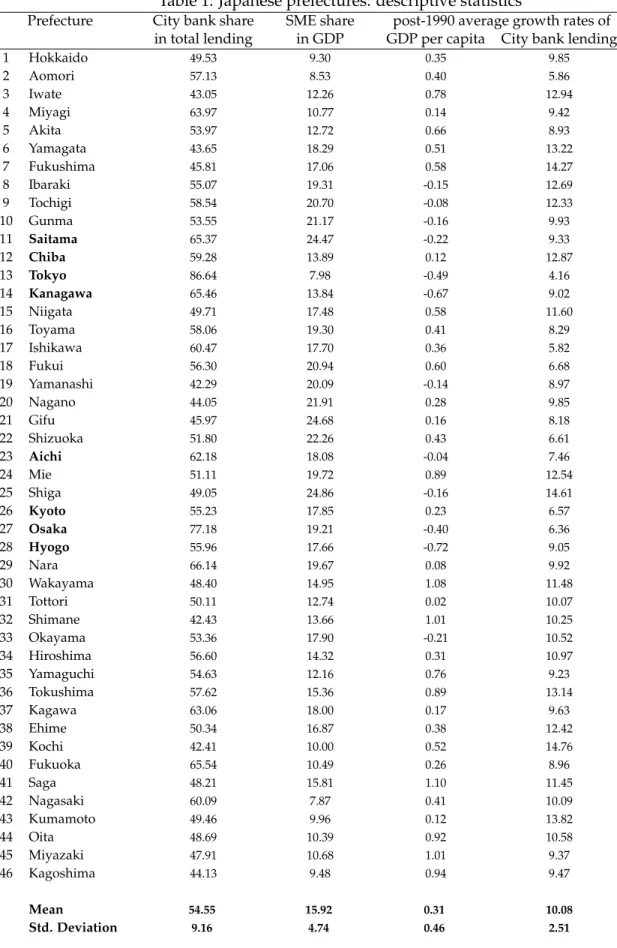
Table 1 provides a first look at the data. For each prefecture, the first two columns of the ta-ble present averages over the period 1980–1990 of city bank lending shares and of our measure of SME importance (by valued added). The last two columns report post-1990 (1991–2005) pre-fectural GDP growth rates and the growth rates of lending by city banks. We also highlight the core economic areas that may differ from the rest of the country: these include Greater Tokyo (Tokyo, Chiba, Saitama and Kanagawa—with Yokohama as the major city), the Kansai region (Os-aka, Hyogo—with Kobe as the major city—and Kyoto) and Aichi prefecture (with Nagoya as the major city). The cross-prefectural standard deviations show that for each of these characteristics, there is considerable variation around the mean. The average lending share of city banks is around 55 percent, ranging from just over 40 percent in prefectures such as Kochi, Kagoshima, Gifu and Nagano (the latter two of which are silk prefectures, as we will see later) to over 70 or even 80 percent in Greater Tokyo and other core prefectures. The GDP share of small manufacturing firms is around 16 percent, ranging from around 10 percent in remote prefectures such as Hokkaido (in the north) and Kagoshima (in the southwest) to almost 25 percent in Gifu, Shiga and Saitama.
core areas, which were particularly exposed to the bursting of the stock market and property bubbles. Prefectures such as Tochigi, Gunma and Yamanashi even had negative average growth rates. Maybe somewhat surprisingly, the highest average post-1990 growth rates (per capita) were achieved in some remote prefectures, such as Miyazaki and Saga in the west.
A visual impression of the regional distribution of pre-1990 characteristics (SME importance and banking integration) and post-1990 growth can be gleaned from the two maps in Figure 1. The map on the left shows the geographical dispersion of SME importance and financial integration (the city bank lending share). Clearly, the city bank share is highest in the core areas: the Greater Tokyo and Kansai regions. Conversely, financial integration is quite low not only in some remote regions but also in many manufacturing regions in central Japan and in the areas surrounding the big cities. As we will argue later, this is the silken thread: many of these regions were silk reeling regions and took a special pathway to financial development. Turning to post-1990 GDP growth (right map), we again see the fallout of the crisis in the core areas (white, low growth), but there is significant variation in GDP growth rates across prefectures, and again many areas in central Japan have relatively low growth rates. As we saw in the map on the left, many of these regions have no shading, i.e. they are regions with a low city bank lending share and, often, a high SME share in value added and/or employment. We now explore this link more formally and present our first regression results.
Baseline results
Table 2 presents our first set of results: Panel A for the measure of small business importance based on value added and Panel B for the employment-based measure. The first column estimates the baseline specification (1) based on all prefectures. Regions with a higher share of small manufac-turing businesses in either output or employment clearly were affected more severely by the crisis. The effect is large: increasing the share of small manufacturing firms in employment or output by just one percentage point lowers the average growth rate by between 0.07 and 0.08 percent. Even though this estimate is for all prefectures and is significant only at the 10 percent level, it is econom-ically quite sizable: the average SME share (based on valued added) is 16 percent, and the range is
from about 8 percent in prefectures such as Nagasaki and Tokyo to 25 percent in prefectures such as Saitama and Shiga. According to our regressions, these most SME-intensive prefectures have
seen a(25−16)∗0.08≈0.7 percent lower annual growth rate than the average prefecture over the
15 years following the bursting of the housing and stock market bubbles. The orders of magnitude for the employment-based measure of SME importance are similar.
Once we split the sample into two groups of 23 prefectures according to the levels of financial integration, based on our measure of the lending shares of regional and city banks, we find that the
previous estimate of 0.07−0.08 masks considerable heterogeneity across prefectures. In the group
with low financial integration (i.e. a high regional and low city bank share), post-1990 growth de-pends much more strongly on SME importance: the estimated coefficient is consistently between
−0.12 and−0.15 and is highly significant in all specifications. Increasing the prefecture-level share
of small manufacturing firms in value added by one standard deviation (around 0.05) lowers that
prefecture’s output growth rate by between 0.12×0.05=0.006 and 0.15×0.05=0.0075. This
sug-gests that in the least financially integrated parts of the country, some of the most credit-dependent prefectures may have experienced growth rates that were between 0.6 and 0.75 percentage points lower than that of a prefecture with an average level of credit dependence. Conversely, in re-gions whose banking sectors are highly integrated with the rest of the country, there appears to be no significant link between small business importance and the depth of the recession. Our first
main result is that the interaction between dependence on creditandlow banking integration
ag-gravated the recession as it spread across the country. Our interpretation of this finding is that credit-dependent small firms faced more severe credit constraints in regions where cross-regional
banking flows were limited.18
18To further illustrate the quantitative importance of this effect, consider two prefectures such as Yamanashi and
Fukushima, both of which have below-median levels of financial integration. According to Table 1, small manufacturing firms account for 20 percent of GDP in Yamanashi and 17 percent of GDP in Fukushima. According to our estimate,
the growth differential between the prefectures should be 0.12×(0.2−0.17) = 0.036 or 0.36 percent per year,ceteris
paribus. Compounded over the 15 years from 1991 to 2005, this amounts to a 5.5 percent difference in per capita income.
Conversely, consider two prefectures such as Nara and Fukuoka, both of which have very high levels of financial integration. Nara also has a rather high share of small businesses in GDP (around 18 percent), whereas Fukuoka has a rather low share (around 10 percent). According to our model, this difference in the incidence of small firms should
not matter for post-1990 growth,ceteris paribus, because both prefectures have high levels of financial integration. In
fact, according to the data, the growth differential between the financially integrated prefectures was much smaller: Fukuoka grew just 0.2 percent per year faster than Nara in the period after 1990. Conversely, with regard to the pair of financially less integrated prefectures, Fukushima grew 0.7 percent per year faster than Yamanashi over the period
In Table 3, we further explore this result. We start, in columns I and I I, with regressions of
prefecture-level GDP growth on interactions of the Post1990 dummy with our measures of
bank-ing integration andSMEimportance, respectively. Interestingly, regions with a high (low) lending
share of city (regional) banks grew more slowly overall after 1990, possibly a reflection of the fact that the city bank share is particularly high in the big centers that were hit most severely by the housing price declines. We will return to this point shortly. Also, as we established before,
prefec-tures with a highSMEshare had lower growth rates after 1990. Starting in columnI I I, we report
different versions of the regression specification (2) in which we now also include our main term of
interest—the interaction between banking integration andSMEimportance. Our previous results
are confirmed: the negative effect of credit dependence on post-1990 growth appears stronger in prefectures with low levels of banking integration.
We add additional controls in the subsequent columns. In the regressions in columnsV and
V I of Table 3, we add a measure of financial depth: total lending in a prefecture as a share of its
GDP. This is not significant. Finally, in columnsV I I andV I I I we add an indicator of whether a
prefecture is a core economic area (Tokyo, Osaka, Aichi, Kanagawa, Chiba, Saitama, Hyogo and Kyoto prefectures). This is highly significant, suggesting that the core areas were indeed hit more
severely by the crisis. The specifications in columnsV I IandV I I Ialso include an alternative
mea-sure of the aggregate shock—the land price change in the core areas—interacted with the local lending share of city banks. The rationale for doing so is to see if our main results hold once we control for alternative channels of cross-regional transmission. Specifically, Imai and Takarabe (2011) show very persuasively that areas that were more financially integrated with the rest of the country were more directly exposed to the decline in collateral values. This, in turn, had direct ef-fects on economic activity in these prefectures. We corroborate the Imai and Takarabe (2011) result: prefectures with higher lending shares of city (vs. regional) banks are considerably more exposed to fluctuations in the collateral value of land in the core areas. However, this channel coexists with the channel that is our focus here: vis-à-vis the earlier specifications, in the regressions in columns
V I IandV I I Iall coefficients of SME importance remain very stable and highly significant. Hence,
1991–2005. The difference-in-difference of growth rates between the two pairs, therefore, is 0.5 percent per year, of
which around 70 percent (100×0.036/0.05) is explained by the interaction between low financial integration and high
low levels of interregional banking integration lead to a deeper recession in areas with many small, finance-dependent firms.
We note that our results do not imply that less integrated prefectures necessarily grow more slowly overall. Indeed, our estimates suggest that more financial integration would, if anything, lead to lower growth rates if there were no regional differences in credit dependence: the coefficient
α1on the first-order term for financial integration is always significantly negative for the regional
bank lending share and positive for the city bank lending share. It is the interaction between credit dependence (small firm importance) and low levels of financial integration that is associated with lower post-1990 growth. To appreciate this effect quantitatively, consider the last specification in Table 3 (column 8) and an average prefecture. According to Table 1, the average share of small firms in GDP is 16 percent. Increasing financial integration by one standard deviation (according to Table 1, this is 9 percent in terms of city bank lending share) implies a predicted increase in the prefecture’s annual post-1990 growth rate of 0.45 percentage points. The numbers are similar for the specifications that use regional banks’ lending share: increasing the lending share of regional banks by 10 percentage points would lower the growth rate of the average prefecture by 0.35 percentage points. We believe these are quite sizable effects. As we noted before, the effects will be
even stronger for particularly credit-dependent prefectures. According to specificationV I I I, for a
prefecture with a small firm share of 20 percent in value added (roughly one standard deviation above average), the predicted effect of increasing the city bank lending share by 10 percentage points would be a growth rate gain of 0.8 percentage points per year.
Financial integration and local financial development
Our results so far may raise the question of whether it is really the segmentation of banking mar-kets that drives our results or whether we just pick up general differences in local financial de-velopment among the prefectures. We explore this point in Table 4, which reports the same basic regression as Table 3, but now we also include an interaction variable between credit dependence
(SME) and various measures of financial development (FD): in column I, our measure of FD
SME×FDare both insignificant, whereas the coefficient of financial integration (FI) remains es-sentially unchanged vis-à-vis the specifications in Table 3.
A popular indicator of financial development is lending relative to GDP. Once we choose this
indicator as our measure of FD (column II), we do indeed find significant coefficients with the
expected signs: higher pre-1990 levels of lending relative to GDP mitigated the impact of the credit
dependence of growth. However, the interaction between SME and FI remains significant, if
only at the 10 percent level. Note also that lending/GDP will be affected by the ability of the financial system to raise funds both locally and from outside the region. The latter, however, would correspond to our notion of financial integration. We therefore decompose
Total Lending GDP = CityBank Lending GDP | {z } FI
+ Regional Bank Lending
GDP
| {z }
Local component of FD (LFD) .
The first term is a proxy for the ability of the financial system to raise funds from outside the region. It can therefore be interpreted as just another indicator of banking integration. The second term proxies for the system’s ability to raise funds locally, and we therefore refer to it as the purely
localcomponent of financial development (LFD). ColumnIIIreports a regression in which lending
by city banks relative to GDP is our measure of financial integration and in whichFDis chosen to
be just the purely local component of financial development,LFD. The regression clearly suggests
that it is mainly the cross-sectional variation in the ability of the financial system to raise funds from outside the prefecture that accounts for the significance of lending/GDP in the regression
in columnII. In our last specification (columnIV), we let our baseline measure of integration (the
share of city banks in local lending) compete against the local component of financial development. The results, again, suggest that it is indeed primarily variation in the ability to raise funds from
outside—financial integration —that matters for our results.19
19Clearly we cannot rule out the possibility that the ability of a region to raise funds from outside could itself be
a hallmark of the level of sophistication of the region’s financial system. However, it would then still make sense to distinguish between the purely local and the common (i.e. integration-related) components of financial development: even when interpreted this way, our results suggest that there is regional segmentation in the banking market in the sense that funds raised by local banks cannot be intermediated with the same technology as can funds intermediated by nationally integrated banks.
Dynamic effects
Our results so far suggest that post-1990 growth was lower, ceteris paribus, in areas with low
fi-nancial integration and many credit-dependent firmson average. In Figure 2, we look at the role
of banking integration in the dynamicsof growth during the ‘Lost Decade’. We split prefectures
into four groups based on pre-1990 characteristics: above/below-median banking integration and above/below-median small business importance. Then, within each financial integration group, we look at the cumulative growth differential between the high-SME (i.e. high credit dependence) and the low-SME (low credit dependence) subgroups. The results in the figure show that, irre-spective of the degree of banking integration, prefectures with many small manufacturing firms generally grew less than did those with few small firms: both the blue (solid) and the red (dashed) lines are below zero. However, the within-group growth differential is particularly marked for the group with low financial integration, suggesting that low regional banking integration was indeed associated with particularly low growth in very credit-dependent areas. This effect is large: in the least financially integrated areas, the cumulative growth difference until 2005 between the high-and low-SME groups amounts to an almost 8 percent difference in per capita GDP; in the most financially integrated areas, the effect is only around three percent. Furthermore, for the least in-tegrated areas, the maximum cumulative growth differential between low- and high-SME groups was almost nine percent in 2001.
Transmission channels
To shed light on the transmission of the Great Recession to credit-dependent prefectures, Table
5 repeats the regressions from Table 3 but now with lending as the dependent variable.20 Our
interpretation of the previous results was that low financial integration would make small firms’ access to credit more difficult in the Great Recession. The results in Table 5 are consistent with this notion: the first five columns provide results for total lending, while in columns VI–X and XI–XV we distinguish between lending by city banks and lending by regional banks.
20Our prefecture lending data set ends in 1996. Note also that lending by Sogo banks after 1991 is no longer reported
as a separate item in our data set but is included in the definition of ‘zenkoku ginko’ (the nationwide or ’city’ banks). As Sogo banks account for a small share of total lending by ‘zenkoku ginko’, we continue to refer to this category as ‘city banks’ and to the remainder as ‘regional banks’.
In each panel, the first two columns show the results for small firm importance and financial integration, but without the interaction term: the results show that lending declined more strongly in areas with a high lending share of city banks. Furthermore, the first two columns in the next two panels (V and VI, and XI and XII) show that it is indeed city bank lending that declined most strongly in the areas that had high market penetration by city banks. This is essentially a version of the findings in Imai and Takarabe (2011), who report that lending declined most strongly in areas with many city banks because of a common lender effect: city banks were heavily affected by the land price decline in the core areas, and also cut back their lending in more provincial areas.
The last three columns of each panel report the results after adding the interaction term be-tween small firm importance and our financial integration measure. High financial integration does seem to lead to more lending in areas of high credit dependence. Conversely, lending growth
seems lower,ceteris paribus, in areas with many credit-dependent firms and low levels of financial
integration. The corresponding columns in the second and third panel show that, in particular, the lending by city banks declined in credit-dependent but financially less integrated regions. Con-versely, the countrywide decline in city bank lending because of the bursting of the asset bubble seems to have been considerably mitigated in areas where city banks traditionally had a high mar-ket share and where there are many small firms. Finally, the growth in lending by regional banks seems quite unaffected by the degree of financial integration or the importance of small firms.
On the one hand, these findings suggest that Japan’s financial crisis constituted a major credit supply shock and that this shock spread very unequally across prefectures. It strongly affected regions with many credit-dependent firms and low levels of financial integration—understood here as a locally low market share of banks that operate nationwide. On the other hand, we do
notthink that our results are best interpreted as a simple credit crunch: a priori, we would expect
a credit crunch to affect credit supply rather uniformly across different types of banks. We find that this is clearly not the case. Rather, the decline in lending in the least integrated and most credit-dependent prefectures is predominately explained by nationwide banks cutting back on their lending. Peek and Rosengren (2000, 1997) show that Japanese banks that operated interna-tionally predominantly cut back on lending in foreign markets following the crisis—markets that
they had often only recently entered. Our results are the first to document the relevance of this channel for intranational effects, i.e. the regional dimension of Japan’s Great Recession: regions in which nationwide banks had relatively weak standing experienced the largest declines in credit
and economic activity.21
Our results are related to an important strand of the recent literature that has emphasized the role of evergreening in banks’ credit decisions during Japan’s Great Recession (Peek and Rosengren (2005) and Caballero, Hoshi and Kashyap (2008)). These authors argue that big banks would often defer action on bad loans in the hope that the situation of borrowing firms might improve or that the government would take action to bail out the banks or their borrowers. Caballero, Hoshi and Kashyap (2008) show that this evergreening behavior led to the creation of ‘zombie’ firms that were effectively bankrupt but, due to their ongoing preferential access to finance, could keep more productive competitors out of the market or at least make it difficult for them to access credit. We emphasize that our results are actually very much consistent with this pattern. First, Caballero, Hoshi and Kashyap (2008) document their finding based on a set of publicly listed (and therefore rather large) firms. In fact, they argue that evergreening was particularly pervasive
withinZaibatsu, the tight-knit industrial conglomerates that encompass industrial firms and banks.
Second, Caballero, Hoshi and Kashyap (2008) show that manufacturing was one of the sectors that was least affected by evergreening. Our focus here is on small manufacturing firms—the ones that
were therefore most likely to be deprived of the credit from which the ‘zombies’ benefited.22
21One possible explanation of this pattern is relationship lending: banks withdraw first from markets in which they
have relatively few long-standing credit relationships in order to keep on lending to large, long-standing customers. Small banks also tend to lend to small businesses (see Berger et al. (2005) for the US and Uchida, Udell and Watanabe (2008) for Japan). The evidence we present in the second part of the paper is also consistent with the view that relation-ship lending matters here: we show that the market share of regional banks vs. nationwide banks at the prefecture level has deep historical roots and that regional banks are strongest in areas where silk reeling was important in the late 19th century and where silk reelers’ cooperatives were important in founding the first regional banks. It seems plausible that small firms in such areas are more likely to have long-standing relationships with their regional banks (if it is a cooperative, they may even be a member) rather than with a local branch of a nationwide bank.
22Peek and Rosengren (2005) discuss how the incentive to evergreen clearly depends on the importance of the
bor-rowers’ debt for the bank’s balance sheet. Clearly, banks will therefore tend to evergreen mainly large borrowers. The small firms that are our focus here, however, are likely to be small borrowers for city banks. They may still be relatively big borrowers from the perspective of a small regional bank, however, and our results do not preclude the possibil-ity that regional banks for their part also engaged in some evergreening. However, this does not affect the empirical relevance of the channel we are investigating here: if regional banks evergreen inefficient small firms, depriving more efficient competitors of credit, then we expect that better access for these competitors to credit from outside their region (i.e. big city banks) would certainly help alleviate the adverse aggregate effects of the evergreening by regional banks. Hence, evergreening by regional banks could actually help explain the pattern we see here by increasing the importance