ALMA MATER STUDIORUM — UNIVERSIT `
A DI BOLOGNA
DISI - Dipartimento di Informatica: Scienza e Ingegneria
PhD in Computer Science and Engineering
Ciclo XXXI
Settore Concorsuale: 09/H1
Settore Disciplinare: ING-INF/05
BIG DATA MINING AND MACHINE LEARNING
TECHNIQUES APPLIED TO REAL WORLD SCENARIOS
Candidato
Dott. Ing. ANDREA PAGLIARANI
Supervisore
Chiar.mo Prof. Ing. GIANLUCA MORO
Tutor
Chiar.mo Prof. Ing. CLAUDIO SARTORI
Coordinatore
Chiar.mo Prof. Ing. PAOLO CIACCIA
iii
Be modest and determined,
and do what you love to do,
always.
Acknowledgements
Most of the material that got integrated as a single work in this thesis has been
written in publications I co-authored. I am thankful to those great researchers
I have collaborated with, for their guidance, their suggestions and their help. I
would like to thank first Gianluca Moro, who carefully supervised me in the
past three years and whose deep expertise has been pivotal for my research.
Claudio Sartori, who co-supervised me, sharing lots of essential research ideas,
also deserves a special mention. I am grateful for the opportunity Claudio gave
me to contribute to TOREADOR, an European project that kickstarted me in
the world of research. I also desire to thank Giacomo Domeniconi and Roberto
Pasolini, who shared the APICe laboratory with me and tried to improve my
technical skills. A special thank to Elizabeth Daly, who supervised me during
my three-month research period at IBM Research - Ireland Lab. Finally, I want
to thank these other great researchers and professionals I have collaborated with:
Oznur Alkan, Adi Botea, Stefano Lodi, Beniamino Di Martino, Cesare Bandirali,
Salvatore D’Angelo, Antonio Esposito, Karin Pasini.
Contents
Abstract xi
1 About this thesis 1
1.1 Structure of this thesis . . . 2
1.2 List of publications . . . 3
I
Background and Motivation
5
2 The age of big data 7 2.1 What is big data? . . . 72.1.1 The features of big data . . . 9
2.1.2 The value of big data . . . 11
2.1.3 Open challenges . . . 11
2.2 Related technologies . . . 13
2.2.1 Cloud computing . . . 13
2.2.2 IoT . . . 14
2.2.3 Data mining and machine learning . . . 15
3 Sentiment analysis 17 3.1 Introduction . . . 17
3.2 Techniques . . . 19
3.2.1 Feature selection . . . 19
3.2.2 Sentiment classification . . . 21
3.2.3 Cross-domain and transfer learning . . . 26
4 Stock market analysis 29 4.1 Introduction . . . 29
4.2 Traditional approaches . . . 29
4.3 Methods based on text and news analysis . . . 31
4.4 Methods based on social media . . . 32
4.4.1 The predictive value of Twitter . . . 32
4.4.2 Twitter-based stock market prediction . . . 33
5 Recommender systems for job search 35 5.1 Recruitment systems . . . 36
5.2 Job recommendation systems . . . 37
6 Big Data Analytics 41
6.1 Introduction . . . 41
6.2 Platforms . . . 42
6.2.1 Horizontal scaling platforms . . . 42
6.2.2 Vertical scaling platforms . . . 44
6.3 Algorithms . . . 46
6.3.1 Local learning and model fusion for multiple information sources . . . 46
6.3.2 Mining from sparse, uncertain and incomplete data . . . 47
6.3.3 Mining complex and dynamic data . . . 47
II
Algorithms and Methods for Sentiment Analysis
49
7 Markov techniques for transfer learning and sentiment analysis 51 7.1 Markov chain . . . 517.1.1 Introduction . . . 51
7.1.2 Markov theory applications . . . 52
7.2 A Markov method for cross-domain sentiment classification . . . 53
7.2.1 Overview . . . 53 7.2.2 Text pre-processing . . . 54 7.2.3 Learning phase . . . 55 7.2.4 Classification phase . . . 58 7.2.5 Computational complexity . . . 59 7.2.6 Experimental setup . . . 60
7.2.7 Markov chain performance with different feature selection methods . . 60
7.2.8 Comparison with the state of the art . . . 62
7.3 Variants of the Markov chain method . . . 65
7.3.1 Document splitting into sentences . . . 66
7.3.2 Polarity-driven state transitions . . . 67
7.3.3 Analysis and results . . . 68
7.4 Final remarks . . . 71
8 Deep methods to enhance text understanding in big dataset analysis 73 8.1 Deep learning . . . 73
8.1.1 Overview . . . 73
8.1.2 The impact on sentiment classification . . . 75
8.2 Distributed text representation for transfer learning and cross-domain . . . 76
8.2.1 Methods . . . 77
8.2.2 Experimental setup . . . 80
8.2.3 In-domain analysis . . . 82
8.2.5 Multi-source training . . . 86
8.2.6 Final remarks . . . 87
8.3 Fine-tuning of memory-based deep neural networks for transfer learning . . . . 89
8.3.1 Gated recurrent unit . . . 89
8.3.2 In-domain analysis . . . 91
8.3.3 Cross-domain analysis . . . 91
8.3.4 Fine-tuning for transfer learning and cross-domain . . . 94
8.3.5 Final remarks . . . 97
8.4 Combining memory-based deep architectures and distributed text representations for sentiment classification . . . 97
8.4.1 Differentiable neural computer . . . 98
8.4.2 Global vectors . . . 100
8.4.3 The impact of labeled training data on memory-based networks . . . . 100
8.4.4 Fine-tuning for cross-domain sentiment classification . . . 101
8.4.5 Large-scale document sentiment classification . . . 104
8.4.6 Single-sentence sentiment classification . . . 107
8.4.7 Final remarks . . . 109
III
Text Mining Approaches for Stock Market Analysis
111
9 Methods for DJIA index prediction 113 9.1 Background . . . 1139.1.1 Noise detection . . . 113
9.2 Detecting and mining relevant tweets . . . 114
9.2.1 Benchmark text set . . . 115
9.2.2 Vector space model construction . . . 116
9.2.3 Detecting noisy tweets . . . 117
9.2.4 Experimental evaluation . . . 117
9.3 A trading protocol for DIJA . . . 119
9.3.1 Protocol . . . 119
9.3.2 Experiments . . . 122
9.4 Final remarks . . . 123
IV
Big Data Mining and Machine Learning Methods for Job Search 125
10 A skillset-based job recommender 127 10.1 Building a hierarchy of job positions . . . 12710.1.1 Methodology . . . 127
10.1.2 Experimental setup . . . 129
10.2 Job recommendation . . . 130
10.2.1 Methodology . . . 134
10.2.2 Results . . . 134
10.3 Final remarks . . . 138
11 Modeling job transitions and recommending career pathways 139 11.1 Modeling job transitions . . . 139
11.1.1 Clustering of similar jobs . . . 141
11.1.2 Building a job graph . . . 142
11.2 MDP-based career pathway recommendation . . . 143
11.2.1 Recommendation requirements . . . 143 11.2.2 MDP recommender . . . 144 11.3 Experimental evaluation . . . 146 11.3.1 Evaluation protocol . . . 147 11.3.2 Results . . . 148 11.4 Final remarks . . . 151
V
Accelerate the Development of Big Data Analytics
153
12 Towards vendor-agnostic implementation of big data analytics 155 12.1 Background . . . 15512.2 Parallel programming primitives . . . 156
12.2.1 Primitives definition . . . 157
12.3 Agnostic implementations of data mining algorithms based on parallel primitives 158 12.3.1 k-means . . . 159
12.3.2 C4.5 . . . 161
12.3.3 Apriori . . . 163
12.3.4 PageRank . . . 165
12.4 From vendor-agnostic implementation to vendor-specific platforms . . . 168
12.4.1 Compiling primitives into skeletons . . . 168
12.5 Spark implementation of k-means based on parallel primitives . . . 171
12.6 Experimental results . . . 173
12.6.1 Dataset description . . . 173
12.6.2 Performance check . . . 173
12.7 Final remarks . . . 174
VI
Conclusion
175
13 Results achieved and future work 177 13.1 Methods for sentiment analysis . . . 17713.2 Methods for stock market analysis . . . 179
13.3 Recommendation methods for job search . . . 180
13.4 Boosting the development of big data analytics . . . 181
13.5 Ongoing and future work . . . 181
13.5.1 Improvement of the Markov techniques for sentiment analysis . . . 181
13.5.2 Enhancing deep learning approaches for sentiment analysis . . . 182
13.5.3 Expanding the investigation on stock market analysis . . . 182
13.5.4 Improving the performance of job recommendation . . . 182
13.5.5 Enhancing the effectiveness of career pathway recommendation . . . . 183
13.5.6 Supporting the development of big data analytics . . . 183
Abstract
Data mining techniques allow the extraction of valuable information from heterogeneous and possibly very large data sources, which can be either structured or unstructured. Unstructured data, such as text files, social media, mobile data, are much more than structured data, and grow at a higher rate. Their high volume and the inherent ambiguity of natural language make unstructured data very hard to process and analyze. Appropriate text representations are therefore required in order to capture word semantics as well as to preserve statistical information, e.g. word counts. In Big Data scenarios, scalability is also a primary requirement. Data mining and machine learning approaches should take advantage of large-scale data, exploiting abundant information and avoiding the curse of dimensionality. The goal of this thesis is to enhance text understanding in the analysis of big data sets, introducing novel techniques that can be employed for the solution of real world problems. The presented Markov methods temporarily achieved the state-of-the-art on well-known Amazon reviews corpora for cross-domain sentiment analysis, before being outperformed by deep approaches in the analysis of large data sets. A noise detection method for the identification of relevant tweets leads to 88.9% accuracy in the Dow Jones Industrial Average daily prediction, which is the best result in literature based on social networks. Dimensionality reduction approaches are used in combination with LinkedIn users’ skills to perform job recommendation. A framework based on deep learning and Markov Decision Process is designed with the purpose of modeling job transitions and recommending pathways towards a given career goal. Finally, parallel primitives for vendor-agnostic implementation of Big Data mining algorithms are introduced to foster multi-platform deployment, code reuse and optimization.
1
About this thesis
This chapter briefly introduces the content of this work, the main problems tackled, why they are relevant, and how the thesis is organized. Also, a list of publications that directly contribute to this work is provided.This work contributes to the fields of Big Data mining and machine learning, which aim at discovering interesting, unexpected or valuable structures in large datasets. Recently data have grown at an unprecedented scale, due to the fast development of networking, data storage, data collection capacity, and to the spread of data sources different from traditional databases. Such data sources, namely social media, sensors, mobile data, weblogs, and so on, essentially are sources of unstructured data, mainly expressed in text format. The result of the growth of unstructured information are datasets that cannot easily be managed with current methodologies and software tools due to their large size and complexity. Such datasets represent a great opportunity to enhance text understanding, but require approaches in order to be processed and analyzed appropriately. This thesis introduces novel techniques to mine semantics from text in order to improve data mining and machine learning algorithms, focusing on hot research threads, such as:
Sentiment analysis Computational treatment of opinion, appraisals, attitudes, and emotions towards entities, individuals, issues, events, topics and their attributes. Traditional ap-proaches usually require a different set of labeled data anytime a new domain has to be analyzed. Moreover, most algorithms are affected by the curse of dimensionality, which hinders scalability and prevents from making use of the whole available information. A possible improvement consists in designing innovative techniques for domain adaptation, so as to pave the way for model reuse and to deal with the scarcity of labeled data, needed to learn accurate models. Moreover, this thesis relies on existing work and carries out an analysis on which characteristics of deep learning architectures contribute the most to domain adaptation.
Stock market analysis Evaluation of a particular trading instrument, an investment sector, or the market as a whole. Stock market analysis is a primary interest for finance and traders. Differently from the classical trend analysis, this work exploits data from social media to detect and predict stock market variations.
2 CHAPTER 1. ABOUT THIS THESIS
Recommender systems for job search Finding the right job is one of the most relevant social problems, since everyone has to look for a job at least once, but possibly multiple times in life. Job searching is a time consuming activity, and the choice of the right job is awkward, because job satisfaction considerably affects life condition. This thesis first starts an investigation on the use of social networks to match candidates with jobs. Then it paves the way for an emerging research thread, introducing a framework to perform career pathway recommendation, namely suggesting a sequence of jobs to the user so as to lead her to a predefined career goal.
Big Data Analytics In the age of Big Data, scalable algorithm implementations as well as powerful computational resources are required. Big Data platforms and cloud platforms support programmers in coding algorithms, and offer optimized infrastructures for their execution. Code portability among platforms remains an open issue due to cost of service, technical and managerial factors. Other than discussing the problem, this thesis exploits existing work in order to propose parallel programming primitives to implement Big Data mining algorithms in an agnostic fashion.
1.1
Structure of this thesis
The thesis is organized in six parts.
Part I introduces the work, describing the background and motivating the thesis. The age of Big Data is presented, including challenges, opportunities and open issues. The focus is mainly on the research threads this thesis contributes to, namely sentiment analysis, stock market analysis, recommender systems for job search, and Big Data Analytics.
Part II describes novel algorithms and methods for sentiment analysis, pointing out their practical utilities in real world Big Data scenarios. The first contribution of this thesis is introduced, namely a Markov chain method that performs both transfer learning and sentiment classification. Also, the characteristics of deep architectures that support domain adaptation are investigated and discussed.
Part III describes some methods based on social media mining for stock market analysis. A Twitter-based approach exploiting noise detection techniques is introduced for the predic-tion of Dow Jones Industrial Average variapredic-tions. Moreover, based on such a predicpredic-tion, a trading protocol performing buy/sell operations is proposed to support investors.
Part IV describes new methods for job search that help people finding and getting the desired job. A job recommendation approach based on LinkedIn users’ profiles is introduced to match candidates with jobs. Also, a novel framework is proposed to recommend a pathway to users towards a well-defined, possibly long term, career goal.
CHAPTER 1. ABOUT THIS THESIS 3 Part V introduces parallel programming primitives for vendor-agnostic implementation of Big Data mining algorithms. Some notable data mining algorithms are implemented using such parallel primitives. The transformation process from a vendor-agnostic implementation to a vendor-specific platform is also shown.
Part VI draws conclusions and paves the way for future work.
1.2
List of publications
The list of publications that directly contribute to this thesis is shown below. Note that the authors appear in alphabetical order in the papers listed below, apart from the works titled ”Transfer learning in sentiment classification with deep neural networks”, ”Prediction and trading of Dow Jones from Twitter: a boosting text mining method with relevant tweets identification”, and ”A skillset-based approach to modelling job transitions and recommending career pathways”, where the authors are listed in descending order of contribution.
• Giacomo Domeniconi, Gianluca Moro, Andrea Pagliarani, and Roberto Pasolini. Markov chain based method for in-domain and cross-domain sentiment classification. In Pro-ceedings of the 7th International Joint Conference on Knowledge Discovery, Knowledge Engineering and Knowledge Management - Volume 1: KDIR, (IC3K 2015), pages 127–137. INSTICC, SciTePress, 2015
• Giacomo Domeniconi, Gianluca Moro, Andrea Pagliarani, and Roberto Pasolini. Cross-domain sentiment classification via polarity-driven state transitions in a markov model. InFred A., Dietz J., Aveiro D., Liu K., Filipe J. (eds) Knowledge Discovery, Knowledge Engineering and Knowledge Management. IC3K 2015. Communications in Computer and Information Science, vol 631. Springer, Cham
• Giacomo Domeniconi, Gianluca Moro, Andrea Pagliarani, Karin Pasini, and Roberto Pasolini. Job recommendation from semantic similarity of linkedin users’ skills. In
Proceedings of the 5th International Conference on Pattern Recognition Applications and Methods - Volume 1: ICPRAM,, pages 270–277. INSTICC, SciTePress, 2016
• Giacomo Domeniconi, Gianluca Moro, Andrea Pagliarani, and Roberto Pasolini. On deep learning in cross-domain sentiment classification. InProceedings of the 9th International Joint Conference on Knowledge Discovery, Knowledge Engineering and Knowledge Management - Volume 1: KDIR,, pages 50–60. INSTICC, SciTePress, 2017
• Andrea Pagliarani, Gianluca Moro, Roberto Pasolini, and Giacomo Domeniconi. Transfer learning in sentiment classification with deep neural networks. InFred A., Dietz J., Aveiro D., Liu K., Filipe J. (eds) Knowledge Discovery, Knowledge Engineering and Knowledge Management. IC3K 2017. Communications in Computer and Information Science. To appear
4 CHAPTER 1. ABOUT THIS THESIS
• Giacomo Domeniconi, Gianluca Moro, Andrea Pagliarani, and Roberto Pasolini. Learning to predict the stock market dow jones index detecting and mining relevant tweets. In
Proceedings of the 9th International Joint Conference on Knowledge Discovery, Knowledge Engineering and Knowledge Management - Volume 1: KDIR,, pages 165–172. INSTICC, SciTePress, 2017
• Gianluca Moro, Roberto Pasolini, Giacomo Domeniconi, Andrea Pagliarani, and Andrea Roli. Prediction and trading of dow jones from twitter: A boosting text mining method with relevant tweets identification. InFred A., Dietz J., Aveiro D., Liu K., Filipe J. (eds) Knowledge Discovery, Knowledge Engineering and Knowledge Management. IC3K 2017. Communications in Computer and Information Science. To appear
• Gianluca Moro, Andrea Pagliarani, Roberto Pasolini, and Claudio Sartori. Cross-domain & in-domain sentiment analysis with memory-based deep neural networks. In 10th International Joint Conference on Knowledge Discovery, Knowledge Engineering and Knowledge Management - Volume 1: KDIR,, 2018. To appear
• Cesare Bandirali, Stefano Lodi, Gianluca Moro, Andrea Pagliarani, and Claudio Sartori. Parallel primitives for vendor-agnostic implementation of big data mining algorithms. In
2018 32nd International Conference on Advanced Information Networking and Applica-tions Workshops (WAINA), pages 396–401, May 2018
• Andrea Pagliarani, Oznur Alkan, Adi Botea, Gianluca Moro, and Elizabeth Daly. A skillset-based approach to modelling job transitions and recommending career pathways. To be submitted to journal Expert Systems with Applications
Part I
2
The age of big data
This chapter introduces the age of Big Data, providing the reader with a background of such a historical and technological phase.
The reasons that brought to the widespread diffusion of data are discussed, with particular emphasis on technological aspects. Beyond outlining the main characteristics of big data, the challenges as well as the opportunities that such massive corpora offer are pointed out. Also, the technologies that facilitate the growth of data are summarized, identifying their salient features and relationships with Big Data.
After this general overview, the rest of the thesis will focus on data mining and machine learning methods, with particular emphasis on some hot research threads, such as sentiment analysis, stock market analysis, recommender systems for job search, and big data analytics.
2.1
What is big data?
Heterogeneous devices are pervasively present around us, such as Radio-Frequency IDentification (RFID), tags, sensors, actuators, mobile phones, etc. These objects are equipped with some kind of network connections, are able to interact with each other and cooperate with their neighbors to reach common goals [AIM10]. This scenario, known as the Internet of Things (IoT), has recently brought to a dramatic increase in the amount of data. Apart from IoT data, servers are also filled with Web data, which arise increasingly faster from social networks, blogs, forums, and so on.
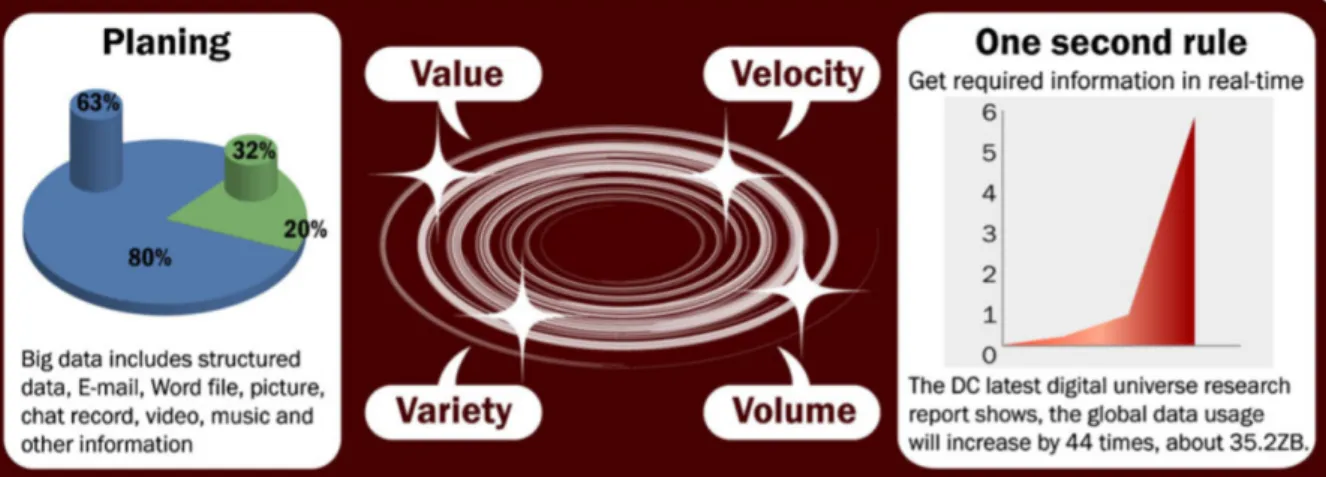
When the Gutenberg press was invented, there was a doubling of information stock every 50 years. In 2011, a report from International Data Corporation (IDC) stated that the overall created and copied data volume in the world was 1.8ZB (≈1021 B) [GR11]. As of 2012, data volume grows by 2.5 exabytes per day, and it is more than doubling every two or three years [Loh12, MBD+12]. Figure 2.1 illustrates the rapid global growth of data volume.
Big data have an enormous potential value for both research and business. Two premier scientific journals, Nature and Science, opened special columns to discuss the challenges and impacts of big data [Nat08, Sci11]. Also, issues on big data are covered in public media, such as New York Times [Loh12], National Public Radio [Nog11a, Nog11b], and The Economist [Cuk10, blo11]. Information extraction from big data may support the decision process of a
8 CHAPTER 2. THE AGE OF BIG DATA
CHAPTER 2. THE AGE OF BIG DATA 9 large variety of organizations, from public and private enterprises to the financial sector, political parties, etc., enabling managers to make more conscious choices.
The increasing amount of data, along with extraordinary opportunities, brings about many challenging problems that require quick solutions. Data generation is fostered by the advances of information technology (IT), which make really fast to produce and store data. For example, on average, 72 hours of videos are uploaded to YouTube in every minute[JW14]. Data sources are typically heterogenous and widely distributed, so that the rapid growth of massive data makes it hard their gathering and integration.
The advent of cloud computing and the Internet of Things further promote the sharp growth of data. Cloud computing provides on demand network access to a shared pool of computing resources (e.g. networks, servers, storage, applications, and services) that can rapidly be provi-sioned and released with minimal management effort or service provider interaction. Resource usage is automatically controlled and optimized, and can be monitored for both the provider and the consumer of the utilized service in order to provide transparency [MG+11]. In the IoT paradigm, sensors all over the world are collecting and transmitting data to be stored and processed in the cloud. In terms of quantity, such data and their mutual relations are much more than the IT architectures and infrastructures of existing enterprises can actually deal with. Con-sequently, storing and managing such massive heterogeneous datasets with moderate hardware and software requirements become a challenge.
In order to disclose interesting properties and effectively support decision making, a dataset has to be mined at different levels during the analysis, modeling, visualization, and forecasting. Indeed, the heterogeneity, scalability, real-time, complexity, and privacy of big data pose different challenges that cannot trivially be solved, and that often require multiple approaches to be adequately managed.
2.1.1
The features of big data
Although people have different opinions on the correct definition of Big data, their importance has been generally recognized. The various definitions clarify the profound social, economic and technological connotations of big data. The common conception is that big data involve datasets that cannot be managed, processed and analyzed by traditional hardware and software tools within a tolerable time.
The very first definition is found in a research report by Laney in 2001, who defined challenges and opportunities brought about by increased data with a 3Vs model that considered Volume, Velocity, and Variety [Lan01].
Volume Data scale becomes increasingly big. Large-scale datasets are much more difficult to process and analyze through traditional softwares and mining algorithms.
Velocity Data grow very fast, typically real-time, especially if we think about sensors data or social media content, just to mention some. Therefore, data collection and analysis must be
10 CHAPTER 2. THE AGE OF BIG DATA
Figure 2.2: The four dimensions of big data according to IDC: Volume, Velocity, Variety, and Value.Source: [CML14].
quickly and timely conducted in order to properly process data, mine interesting insights and exploit their commercial value.
Variety Data sources are heterogeneous. Beside traditional structured data, e.g. relational databases, semi-structured as well as unstructured data emerge, such as text, audio, video, web content, etc.
The 3Vs model was not originally used to define big data, but many companies, including Gartner [Bey11], IBM [ZE+11], and Microsoft [Mei11], continued to employ the ”3Vs” model to describe big data within the following ten years.
In 2011, the global consulting agency McKinsey & Company announced big data as the next frontier for innovation, competition, and productivity [MCB+11a]. According to their definition, the expression ”big data” refers to datasets that could not be acquired, stored, and managed by classic database software. This means that dataset volumes considered as big data are continuously changing, possibly growing over time or due to technological advances.
In the same year, an IDC report defined big data as a new generation of technologies and architectures, designed to economically extract value from very large volumes of a wide variety of data, by enabling a high-velocity capture, discovery, and/or analysis [GR11]. The IDC definition adds the Value dimension to the traditional 3Vs model, which turns into a 4Vs model, as shown in Figure 2.2. Mining values from large-scale, heterogeneous, and quickly-generated datasets is probably the most critical problem in big data scenarios.
Finally, NIST defines big data as follows: ”Big data shall mean the data of which the data volume, acquisition speed, or data representation limits the capacity of using traditional relational methods to conduct effective analysis or the data which may be effectively processed with important horizontal zoom technologies”. Such a definition indicates that novel efficient as
CHAPTER 2. THE AGE OF BIG DATA 11 well as effective methods or technologies need to be developed and used to analyze and process big data.
2.1.2
The value of big data
McKinsley & Company pointed out that big data may improve the productivity and competit-iveness of enterprises and public sectors, and create benefits for customers. The value can be obtained through research on the core industries that represent the global economy, namely the U.S. healthcare and retail, the EU public sector administration, the global personal location data, and the global manufacturing.
In [MCB+11a], McKinsey declared that big data could be employed to improve efficiency and quality. The U.S. medical industry may exceed USD 300 billion, thus reducing the expenditure for the U.S. healthcare by over 8%; retailers may improve their profit by more than 60%; the developed economies in Europe could save over EUR 100 billion.
In [GMP+09], Google found that during the 2009 flu pandemic, entries frequently sought at its search engines were different than usual, and the usage frequencies of the entries were correlated to the influenza spreading in both time and location. Analyzing big data, Google found 45 search entry groups that were closely related to the outbreak of influenza, and included them in mathematical models to forecast the spreading of influenza in terms of both time and location.
According to a well-known survey [CML14], data has nowadays become an important production factor that could be comparable to material assets and human capital. As multimedia, social media, and IoT are developing, enterprises will collect more information, leading to an exponential growth of data volume. Big data will have a huge and increasing potential in creating values for businesses and consumers.
2.1.3
Open challenges
The enormous increase of data induces challenges on data collection, storage, management, processing and analysis. Traditional relational database management systems (RDBMSs) are no longer adequate to handle the huge volume and heterogeneity of big data. Indeed, RDBMSs are increasingly using more expensive hardware, and they only deal with structured data.
Some solutions have been proposed in literature to meet different requirements. Cloud computing provides an efficient and elastic infrastructure, facilitating resource upgrading or downgrading. Distributed file systems [HKM+88] and NoSQL [Cat11] databases offer storage and management for very large datasets. Big data applications can be developed based on these technologies or platforms, but several challenges should be taken into account during development and deployment. Challenges and opportunities, broadly discussed in [ABB+11, LJ12, CDN11], are summarized in a survey by Chen et al. [CML14], who identified the following aspects:
12 CHAPTER 2. THE AGE OF BIG DATA
Data representation Data representation consists in finding the most appropriate format for data analysis and user interpretation. It should reflect the different levels of heterogeneity datasets have in structure, type, organization, granularity, semantics, and accessibility. Ef-ficient representation allows exploiting information richness and mining valuable insights. Redundancy reduction and data compression Redundancy reduction and data compression
are useful techniques to reduce the cost of a system, in particular from the computational point of view. Such approaches are especially relevant for datasets with high level of redundancy, and only if values are not affected by the process. A misapplication of reduction and compression techniques may entail a loss of information.
Data life cycle management Data life cycle management is a policy-based approach to manage the data flow of an information system throughout its life cycle, i.e. from creation and initial storage to obsolescence and deletion. Such mechanisms are required, since storage systems could not support the massive data that are generated by sensors, social media, and other data sources.
Analytical mechanism A well-devised analytical procedure is necessary to timely process large-scale heterogeneous data. Differently from RDBMSs, which typically are not scalable and are employed in the processing of structured data, non-relational databases have shown advantages in the processing of unstructured data. Compromise solutions are often required that integrate the benefits of RDBMSs and non-relational databases. In-memory databases as well as sample data based on approximate analysis are hot research topics. Data confidentiality Data confidentiality is among the most critical topics to date, in particular
after General Data Protection Regulation [gdp18] has been approved in EU and the scandal that involved Cambridge Analytica [Cad17] came out. Big data service providers frequently rely on third party data analysis tools to deal with their limited storage and computational capacity. This data processing increases the potential safety risks, since sensitive information may be present within data. Proper preventive measures should be taken to protect sensitive data and ensure its safety.
Energy management Energy management has recently drawn attention with the increase of data volume and analytical demands. The processing, storage, and transmission of massive datasets bring about more power consumption; as a consequence, efficient energy manage-ment and control mechanisms are needed.
Expendability and scalability Algorithms should be able to process increasingly expanding and more complex datasets. Scalability and the capability to seamlessly learn from new examples are key characteristics that big data algorithms should have.
Cooperation Cooperation is required to fully exploit the potential of big data, because of its interdisciplinariety. A comprehensive big data network architecture is advisable to help experts cooperating in order to reach common analytical objectives.
CHAPTER 2. THE AGE OF BIG DATA 13
Figure 2.3: Main components of cloud computing. Source: [CML14].
2.2
Related technologies
The phenomenon of Big Data is facilitated by other outstanding technologies, including cloud computing, IoT, data mining and machine learning. Such technologies support the evolution of large-scale data and contribute to the extraction of relevant information from massive het-erogeneous data sources. These recent advances are briefly introduced, giving special attention to their relationships with big data, so as for readers to gain a deeper understanding of current technological trends.
2.2.1
Cloud computing
Cloud computing is an IT paradigm that enables ubiquitous access, usually over the Internet, to a shared pool of configurable resources and higher-level services that can rapidly be provisioned with minimal management effort.
14 CHAPTER 2. THE AGE OF BIG DATA
using huge distributed computing and storage resources with minimal concentrated management. Big data can be subject to computationally intensive operations, and make use of the storage capacity of cloud systems. The distributed storage technology based on cloud computing can effectively manage big data, whereas the parallel computing capacity can improve the efficiency of collecting and analyzing big data thanks to cloud computing.
Although cloud computing and big data are closely related technologies, they have different purposes. The former is a new way to conceive an IT architecture, whereas the latter impacts on the decision-making process. As a consequence, the target customers of cloud computing are Chief Information Officers (CIO) focusing on IT solutions, whereas the target customers of big data are Chief Executive Officers (CEO) focusing on business. In spite of having different objectives, the evolution of these two technologies is positively correlated, because the growth of cloud computing from virtualized technologies provides the necessary infrastructure for big data processing.
2.2.2
IoT
The name Internet of Things (IoT) refers to the spread of embedded systems, devices, machines that are connected with each other through some kind of communication media, e.g. NFC, Bluetooth, the Internet, etc. Mobile devices, electrical appliances, public facilities are examples of such systems that are able to collect and transfer data, as shown in Figure 2.4. Devices are typically provided with sensors and actuators, respectively to perceive and affect the state of the environment wherein they are located. Different kinds of data can be gathered through sensors, such as location data (e.g. latitude, longitude, distance), environmental data (e.g. temperature, humidity, pressure), traffic data, and so on.
Different IoT devices exist that are used for disparate purposes; consequently, the collected data are typically heterogeneous. The IoT data are also unstructured and redundant, because values are periodically sensed and transmitted in raw form. Moreover, their physical nature makes sensors producing data that are inherently affected by noise.
According to HP, the quantity of sensors will reach one trillion by 2030 and then the IoT data will become the most important source of big data [CML14]. A report from Intel pointed out that the IoT data have three features that conform to the big data paradigm:
• abundant terminals generating masses of data;
• data generated by the IoT are usually semi-structured or unstructured;
• the IoT data are useful only when they are analyzed.
Despite their relatedness, the diffusion of the IoT is mainly due to the effective integration of big data and cloud computing. The IoT is a fundamental factor in the growth of data that will be a great opportunity for the application and development of big data, which in turn will boost research advances in the IoT.
CHAPTER 2. THE AGE OF BIG DATA 15
Figure 2.4: Data acquisition equipment in IoT.Source: [CML14].
2.2.3
Data mining and machine learning
Data mining is an interdisciplinary subfield of computer science, providing techniques and methodologies that allow the discovery of interesting, unexpected or valuable structures in large datasets [WFHP16]. Data mining takes advantage of statistical techniques, information retrieval, and machine learning for data processing and analysis.
Machine learning (ML) is a branch of artificial intelligence (AI) that focuses on the devel-opment of computer programs that can access data and automatically learn from them, without being explicitly programmed [Alp09]. Learning from examples allows machines performing complex tasks without human intervention, sometimes with better performance. The general ML workflow can be seen in Figure 2.5.
Machine learning tasks and algorithms are generally divided in several categories depending on the type of learning process:
Supervised learning Supervised learning entails the use of past labeled examples to learn a model that is able to predict future events. In particular, a function is inferred from a known training set, then applied in order to make predictions about the events of interest (i.e. the output values).
Unsupervised learning Unsupervised learning is used when the information used to train the model is unlabeled. Unsupervised approaches try to find a function that extracts a hidden structure from unlabeled data, without figuring out the right output.
16 CHAPTER 2. THE AGE OF BIG DATA
Figure 2.5: The ML process. Source: [Rok12].
Semi-supervised learning Semi-supervised algorithms make use of both labeled and unlabeled data to train a model. They are particularly useful when few labeled data are available and labeling new examples is a costly task.
Reinforcement learning Reinforcement learning is a learning method based on trial and error search and delayed reward. Basically, an agent interacts with the environment, performing actions and receiving real-valued rewards. Such rewards are reinforcement signals that are used by agents to identify their ideal behavior, that is, the policy that maximizes future rewards.
Conventional machine learning techniques have a limited ability to process raw data. For decades, constructing a pattern recognition or machine learning system required careful engin-eering. Considerable domain expertise was needed to design a feature extractor that transformed raw data (e.g. the pixel values of an image) into a suitable internal representation or feature vector from which the learning subsystem, often a classifier, could detect or classify patterns in the input [LBH15].
With the advent of representation learning methods as deep learning, the representations needed to perform complex tasks are automatically learned from data. The huge amount of information available in big data, and the computational support provided by cloud computing, accelerate the progress of machine learning algorithms and architectures. More accurate func-tions, better describing phenomena of interest, can be extracted by mining massive datasets with the help of cloud resources.
3
Sentiment analysis
This chapter gives an overview of sentiment analysis, which is the first text mining topic this thesis contributes to in Part II. Readers are provided with a background of the task, including its rationale, main analytical techniques, and utility in real world scenarios.
Specifically, the task is introduced, emphasizing the aspects that make it a compelling research thread and pointing out its practical implications. Afterwards, some notable sentiment analysis techniques that are relevant to this thesis are described, namely feature selection, sentiment classification, and transfer learning in cross-domain tasks.
3.1
Introduction
Sentiment Analysis (SA), also known as Opinion Mining (OM), is the computational study of people’s opinions, appraisals, attitudes, and emotions toward an entity (surveys are in [LZ12, Liu12, PL+08, VC12, MHK14]). The entity can represent individuals, events, or topics, which are most likely to be covered by reviews. Although some researchers stated that OM and SA have slightly different notions [TP12], the former extracting and analyzing people’s opinion about an entity while the latter identifying the sentiment expressed in a text then analyzing it, the two expressions can mostly be considered as interchangeable.
Sentiment analysis is a challenging, but very useful task in practice. Understanding people’s opinions about products, services, brands and so on is of valuable importance for operational as well as strategic business decisions. Companies always want to know customers’ opinions about their products and services to identify what people are looking for, to establish which features to add next, or to find the reason behind a complaint.
As illustrated in Figure 3.1, sentiment analysis can be considered a classification process. There are three main classification levels in sentiment analysis, namely document-level, sentence-level, and aspect-level. Document-level sentiment analysis aims at classifying an opinion document as expressing a positive or negative opinion or sentiment. The assumption is that a document is a basic information unit that discusses about only one topic. Sometimes this hypothesis is too restrictive, since opinions on different entities can be expressed in a document. However, a document-level analysis is very useful to identify the overall sentiment orientation, or polarity, of a plain text.
18 CHAPTER 3. SENTIMENT ANALYSIS
Figure 3.1: Sentiment analysis process on product reviews.Source: [MHK14].
In order to classify the polarity of each sentence, sentence-level sentiment analysis si required. The first-step is to identify whether a sentence is subjective or objective. In case it is subjective, sentence-level sentiment analysis will determine its sentiment orientation. However, Wilson et al. [WWH05] pointed out that subjective expressions do not necessarily have a polarity (i.e. they can also be neutral).
Liu [Liu12] argued that there is no fundamental difference between document and sentence level classifications, because sentences are just short documents. Classifying text at the document level or at the sentence level does not require to extract opinions on all aspects of the entity involved. In case detailed opinions about specific aspects of entities are needed, aspect-level sentiment analysis is involved. The first step is to identify the entities and their aspects. The opinion holders can give different opinions for different aspects of the same sentence, e.g. ”The actors of the movie are very good, but I don’t like the plot.”
The data sets used for sentiment analysis primarily are from product reviews, whose sources typically are review sites. However, sentiment analysis is not only applied on product reviews but also on stock market [YWCC13, HLN13], news articles [XPC12], or political debates [MV12]. For example, people’s opinions on certain election candidates or political parties can be identified within a political debate. The election results can also be predicted from political posts. Social networks and micro-blogging sites are considered a very good source of information because people freely share and discuss opinions about a certain topic.
In order to build a model that is able to identify the sentiment orientation of a plain text, a set of documents is required. Text representation methods are applied to map raw data into a more suitable representation, for instance the bag-of-words model, where documents are transformed
CHAPTER 3. SENTIMENT ANALYSIS 19 into a document-term matrix [ZJZ10], whose entries are functions of the word occurrences in documents. Before such a transformation, documents are generally denoised using standard pre-processing steps, such as word tokenization, case folding, number removal, stopwords removal. Stemming [Por80] as well as lemmatization [PLM+04] are sometimes applied.
3.2
Techniques
Many applications and enhancements on sentiment analysis have been proposed in the last few years. Techniques can be divided into logically different subareas, namely Feature Selection (FS), Sentiment Classification (SC), Emotion Detection (ED), Building Resources (BR), and Transfer Learning (TL). Feature selection approaches allow to identify and choose only the features that are supposed to be promising for classification. Sentiment classification copes with the problem of automatically organizing a corpus of documents into a predefined set of categories, or classes, according to their polarity, e.g. positive, negative, neutral. Emotion detection aims at extracting and analyzing emotions in sentences, which could be either explicit or implicit. Building resources consists in creating lexica, corpora in which opinion expressions are annotated according to their polarity, sometimes relying on dictionaries. Transfer learning and cross-domain classification are concerned with analyzing data from one domain and then using this knowledge in a heterogeneous target domain.
Feature selection, sentiment classification, and transfer learning will be further discussed in this section, pointing out their rationale, operations, and practical utilities, and reviewing the main related research advances. On the other hand, the contributions of this thesis based on such techniques will be introduced in Part II.
3.2.1
Feature selection
Bag-of-words models are inherently affected by the curse of dimensionality [Bel13], because every term in the analyzed corpus becomes a feature of the model. As a consequence, the representation also suffers from the data sparsity problem, which affects both model efficiency and effectiveness. To address these issues, only the most relevant features are selected. Examples of features that usually support the identification of sentiment are [AZ12]:
Terms presence and frequency These features are individual words or word n-grams, and their frequency counts. Binary weighting as well as term frequency weights can be used to indicate the relative importance of features [MS11].
Parts of speech (POS) Part-of-speech tagging maps each word to a part of speech (e.g. nouns, attributes, verbs, etc.). Attributes foster opinion detection and discovery, because they frequently are polarity-bearing terms (e.g. good,bad). However, nouns (e.g. disaster,
miracle), verbs (e.g.accomplish,fail), conjunctions (e.g.but) and negations (e.g. not) can also help to identify the polarity.
20 CHAPTER 3. SENTIMENT ANALYSIS
Opinion words and phrases Opinion words are terms (i.e. parts of speech) commonly used to express opinions, such asgoodorbad,loveorhate,greatorawful. Some phrases may express opinions without using opinion words, e.g.cost me an arm and a leg.
Negations Negations are particular parts of speech that may change the sentiment orientation, e.g. not goodis more similar tobadthangood.
Feature selection methods can be divided into lexicon-based methods and statistical methods. The former require human annotation: they usually start with a small set of ”seed” words, which are then expanded through synonym detection or online resources to obtain larger lexica. On the other hand, the latter are fully automatic approaches, widely used in sentiment analysis. Examples of statistical feature selection approaches are:
Point-wise Mutual Information (PMI) Point-wise mutual information provides a formal way to represent the mutual information between features and classes. The point-wise mutual information Mi(w) between word w and class i depends on their co-occurrence. The expected co-occurrence of class i and word w is given by F(w)·Pi, whereas the true co-occurrence is given byF(w)·pi(w). The mutual information is given by the following equation: Mi(w) =log F(w)·pi(w) F(w)·Pi =log pi(w) Pi (3.1)
Mi(w)is greater than 0 when wordwis positively correlated to classi, whereasMi(w)is less than 0 in case of a negative correlation.
Yu et al. [YWCC13] extended PMI by developing a contextual entropy model to expand a set of seed words. Such a model discovers other words similar to the seed words, by comparing the contextual distribution between each couple of words using an entropy measure. Considering both co-occurrence strength and contextual distribution is beneficial for sentiment classification, because it allows acquiring more useful emotion words and fewer noisy words.
Chi-square χ2 Chi-square statistic between wordwand classiis defined as in [AZ12]:
χi2= n·F(w) 2·(p
i(w)−Pi)2
F(w)·(1−F(w))·Pi·(1−Pi) (3.2)
where n is the total number of documents in the collection, pi(w) is the conditional probability of classifor documents that containw,Piis the global fraction of documents containing classi, andF(w)is the global fraction of documents that contain wordw. Applications of chi-square include contextual advertising, to identify ads that are positively correlated with a blogger’s personal interests [FC11], and stock market data, where feedback features obtained by capturing market feedback are used as a part of the feature selection process [HLN13].
CHAPTER 3. SENTIMENT ANALYSIS 21 Latent Semantic Indexing (LSI) Latent semantic indexing is a feature transformation method that maps the text space to a new axis system, which is a linear combination of the original features [DDF+90]. This goal is achieved through Principal Component Analysis techniques as Singular Value Decomposition (SVD) [Jol11], an unsupervised method that determines the axis-system that retains the greatest level of information about the variations in the underlying attribute values.
Other statistical methods exist apart from those just mentioned, including information gain and Gini index [AZ12], Hidden Markov Models (HMMs) and Latent Dirichlet Allocation (LDA). The last two techniques have been used in [DS12] to separate the entities in a review document from the subjective expressions that describe those entities in terms of polarities, and combined in [GSBT05] to simultaneously model topics and syntantic structures within a corpus.
One of the most challenging tasks where feature selection plays an important role is irony detection. For this purpose, Reyes and Rosso [RR12] defined a feature model in order to represent part of the subjective knowledge within reviews, and tried to describe salient characteristics of irony. Six categories of features were taken into account to model irony, such as n-grams, POS-grams, funny profiling, positive/negative profiling, affective profiling, and pleasantness profiling. Using na¨ıve bayes, support vector machine, and decision tree as sentiment classifiers, they achieved good results in terms of accuracy, precision, recall, and F-measure.
3.2.2
Sentiment classification
In general, text classification copes with the problem of automatically organizing a corpus of documents into a predefined set of categories or classes, which usually are the document topics, like for instance sport, politics, cinema and so on. Sentiment classification is a particular text classification task that distinguishes documents based on their polarity. The polarity, or sentiment orientation, of a plain text is typically denoted by either a label (e.g. positive, negative, or possibly neutral) or a numeric value (e.g. a score from 1 to 5).
This supervised approach learns a classification model from a training set of documents, labeled according to their sentiment orientations, in order to classify new unlabeled documents, whose polarities have to be discovered. The more new documents reflect the peculiarity of the training set, the more the classification of the test set will be accurate. Generally, the parameters of the learning algorithm adopted can be tuned on a validation set of documents, labeled as the training set, in order to maximize the performance on the test set.
The semantic comprehension of natural language text is arduous, because of its intrinsic am-biguity and context dependence. Both word polarity, namely its positive or negative orientation, and relationships among words have to be taken into account to properly understand the meaning of a sentence. The task becomes even more challenging when document-level understanding is required, namely when the overall document polarity has to be discovered.
The typical approach to sentiment classification assumes that both the training set and the test set deal with the same topic. For example, a model is learned on a set of board game reviews
22 CHAPTER 3. SENTIMENT ANALYSIS
and applied to a distinct set of reviews, but always about board games. This modus operandi, known as in-domain sentiment classification, guarantees optimal performance provided that documents from the same domain are semantically similar. Nevertheless, the implicit assumption in-domain classification relies on is to have labeled documents from the same domain of the text set whose sentiment orientation has to be found. Unluckily, given that most documents are usually unlabeled, the in-domain approach is often inapplicable in practice. Tweets, blogs, fora, chats, emails, public repositories, social networks are sources of unsupervised data that could bear opinions, but no information is available on whether such opinions are positive, negative or neutral.
A really simple solution to the absence of labeled data is to manually pre-classify documents, so as to have enough labeled data to train an in-domain sentiment classifier. This method is expensive and not scalable with very large text sets; therefore, it cannot be used in big data scenarios.
This is the reason why cross-domain solutions are needed, where a model can be reused across different domains. A deeper discussion on cross-domain sentiment classification and transfer learning techniques will be provided in Section 3.2.3.
Sentiment classification techniques
Sentiment classification techniques, whose overview can be found in Figure 3.2, can be distin-guished according to the approach used. Macro categories are machine learning approaches, lexicon-based approaches and hybrid approaches [MF11].
The Machine Learning (ML) approach relies on ML algorithms that treat sentiment analysis as a text classification task, where the polarity of plain text is identified by means of syntactic and/or linguistic features. The lexicon-based approach, which includes dictionary-based and corpus-based methods, relies on a sentiment lexicon, that is a collection of known and precompiled sentiment terms. The hybrid approach simply is the combination of the previous two. Lexicon having a well-known polarity is frequently used together with traditional machine learning algorithms.
In a sentiment classification task, we have a set of training instancesD={X1,X2, . . . ,Xn}, where each example is labeled with a sentiment orientation, which can be either a score or a nominal tag identifying the polarity. Classification algorithms first learn a mapping function from instances to classes, then are used to predict a label for each new unlabeled example. The approach just mentioned is an example of supervised learning, which is applicable anytime enough labeled training instances are available to train a robust model.
Many supervised classifiers are used in sentiment analysis. A first category are probabilistic classifiers, which use mixture models for classification, assuming that each class is a component of the mixture. Each mixture component is a generative model that provides the probability of sampling a particular term for that component.
Probabilistic classifiers, sometimes referred as generative classifiers, include Na¨ıve Bayes, Bayesian Network, and Maximum Entropy Classifier. Na¨ıve Bayes computes the posterior
CHAPTER 3. SENTIMENT ANALYSIS 23
24 CHAPTER 3. SENTIMENT ANALYSIS
probability of a class, based on the distribution of the words in the document. Each feature of the model is assumed to be conditionally independent of others. On the other hand, bayesian network assumes that the features are fully dependent, specifying a complete joint probability distribution over all variables. Maximum entropy classifier encodes labeled feature sets to vectors. The encoded vector is used to compute weights for each feature that can then be combined to determine the most likely label for a feature set. This classifier is parameterized by a set of weights, which is used to combine the joint features that are generated from a feature-set by an encoding.
A second category of classifiers are linear classifiers, such as Support Vector Machine and Neural Network. Support vector machine aims at determining the linear separators in the search space that can best divide classes. SVM is particularly suitable for text data because of the sparse nature of text, in which few features are irrelevant, but they tend to be correlated with one another and generally organized into linearly separable categories [Joa96]. SVM can also divide nonlinearly separable instances. Relying on kernel functions, data are mapped from the original feature space into a new space where the classes can be linearly separated with a hyperplane [Aiz64]. On the other hand, a neural network consists of many neurons where the neuron is the basic unit. Neurons can compute a function of their inputs, which typically are word frequencies as well as a set of weights. Neural networks can be composed of many layers to deal with nonlinear surfaces, where the outputs of the neurons in the earlier layers feed into the neurons in the later layers. Neural networks are trained by back-propagating errors over different layers [RHW86]. Researchers have already been employed neural networks for text data [RS99, NGL97], and also compared support vector machines and artificial neural networks [MVN13].
A third category of classifiers are decision trees, which recursively decompose the training data space according to conditions on the attribute values [Qui86]. The condition may be the presence or absence of some words, or a value interval for some attributes. The division of the data space is done recursively until the leaf nodes are eventually reached. The main difference among decision tree approaches is the criterion used to split data, for example single attribute [LR94], similarity-based multi-attribute and discriminant-based multi-attribute [CRS03]. The decision tree implementations in text classification tend to be small variations on standard packages such as ID3 and C4.5.
The last category of classifiers are rule-based classifiers, which label data according to a predefined set of rules. The left hand side typically represents a condition on the feature set, whereas the right hand side represents the class. The two most frequently used criteria to generate rules are support and confidence [ML98].
Beyond the just mentioned approaches, meta classifiers are also used to learn more robust models. Among the most known meta classifiers methods there are bagging [Bre96], which generates multiple versions of a predictor and uses them to get an aggregate predictor, and boosting [FS97], which iteratively learns weak classifiers with respect to a distribution until a strong classifier is eventually obtained.
CHAPTER 3. SENTIMENT ANALYSIS 25 to learn a robust sentiment classifier. When labeled data are unavailable, either unsupervised techniques or transfer learning approaches are employed to identify the sentiment orientation of a set of documents. Transfer learning techniques will be discussed in Section 3.2.3.
Among the unsupervised methods, Turney [Tur02] introduced an algorithm to evaluate mutual information between the given sentence and two words taken as reference: ”excellent” and ”poor”. Furthermore, Taboada et al. [TBT+11] built a dictionary of words annotated with both their semantic polarities and their weights, also including intensification and negation. These are examples of lexicon-based techniques.
The lexicon-based approach is the other primarily used approach for sentiment classification. It basically consists in finding a set of opinion words, which can help identifying the sentiment orientation of documents.
For this purpose, a first commonly used strategy is the dictionary-based [KH04, HL04]. A small set of opinion words with known orientations is manually constructed, then synonyms and antonyms are added by searching in well-known corpora as WordNet [Mil95] or in thesaurus [MDD09]. The newly found words are iteratively added, and the process stops when no new words are found. The main drawback of the dictionary-based strategy is its inability to find opinion words with domain and context specific orientations. To solve this problem, the corpus-based strategy is adopted.
Corpus-based methods generally depend on syntactic patterns or patterns that occur together, along with a seed list of opinion words to find other opinion words in a large corpus. Although this approch can help finding domain and context specific opinion words, it is not as effective as the dictionary-based if used alone, because it is hard to have a huge corpus covering all English words.
Natural language processing (NLP) techniques are often used with the lexicon-based approach to find syntactical structures and mining semantic relations [BG04]. Such techniques have been employed for the identification of tense and time expressions [MP12], to analyze sentences by means of a dependency parsing [DCG13], and as a pre-processing stage before the application of a lexicon-based sentiment analysis algorithm [MRCZ12].
Most methods usually employed hybrid approaches to take advantage of both the machine learning and the lexicon-based approaches. For example, Dave et al. [DLP03] draw on in-formation retrieval methods for feature extraction, and to build a scoring function based on words found in positive and negative reviews. In [TWC08, QZHZ09], a dictionary containing commonly used words in expressing sentiment is employed to label a portion of informative examples from a given domain. These instances reduce the labeling effort and allow using the labeled documents as a training set to learn a supervised classifier. Melville et al. [MGL09] showed that lexical information about associations between words and classes can be exploited and refined for specific domains by means of training examples to enhance accuracy.
Finally, term weighting could also foster sentiment classification, as shown by some re-searchers that propose different term weighting schemes. Notable examples are a variant of the well-known tf-idf [PT10], a supervised scheme based on both the importance of a term in a document and the importance of a term in expressing sentiment [DLY14], the usage of
26 CHAPTER 3. SENTIMENT ANALYSIS
regularized entropy in combination with singular term cutting and bias term in order to reduce the over-weighting issue [WG14].
3.2.3
Cross-domain and transfer learning
Cross-domain learning is a very attractive research thread that paves the way for the use of large-scale unsupervised data. Basically, a model is learned on a labeled source domain, then used to classify the polarity of a distinct unlabeled target domain. For example, let us suppose to have learned a model on a set of reviews about movies, and now to be interested in understanding people’s thoughts about kitchen appliances, whose reviews unfortunately are not labeled. A manual categorization of the unlabeled reviews can be a time-consuming solution, infeasible with large-scale text sets. Instead of manually labeling the kitchen appliances’ reviews and building a model from scratch, we want to exploit a model that is already available.
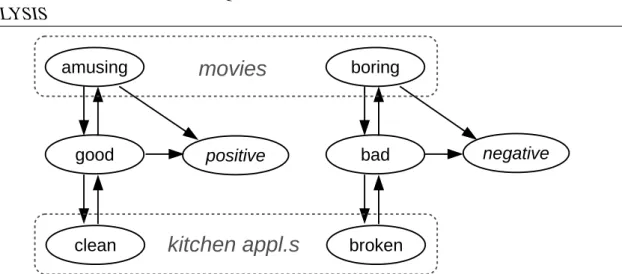
The rationale behind the cross-domain approach is the fact that it allows for model reuse: a model is built once, and used multiple times. The reusability of a model is relevant for both research and business, since collecting, labeling, processing and analyzing data can really be time-consuming tasks, which hinder scalability in big data scenarios. However, the test documents may not reflect the regularities of the training set due to the heterogeneity of language. For example, if a movie review is likely to include terms like amusingor boring, a kitchen appliance review is more plausible to containcleanorbroken. Hence, a transfer learning phase is typically demanded to bridge the inter-domain semantic gap.
Transfer learning generally entails learning knowledge from a source domain and using it in a target domain. Specifically, cross-domain methods are used to handle data of a target domain where labeled instances are only available in a source domain, similar but not equal to the target one. While these methods are used in image matching [SMGE11], genomic prediction [DMMP16] and many other contexts, classification of text documents by either topic or sentiment is perhaps their most common application.
Two major approaches can be distinguished in cross-domain classification [PY+10]: ”in-stance transfer” directly adjusts source in”in-stances to the target domain, while ”feature representa-tion transfer” maps features of both domains to a different common space. The most popular transfer learning methods are clustering algorithms and approaches that make use of feature expansion and external, sometimes hierarchical, knowledge bases. These techniques, employed in conjunction with standard text classification algorithms, lead to good results in sentiment classification [TWC08, QZHZ09, MGL09]. Nevertheless, a tuning of parameters is necessary to ensure adequate effectiveness, because the parameter values that yield optimal accuracy with a text set do not usually produce analogous best results with different corpora. Parameter tuning is a bottleneck anytime a new text set has to be classified. Defining algorithms that are not affected (or slightly affected) by such a problem represents an open research challenge.
With reference to text categorization by topic, transfer learning has been fulfilled in different ways, for example by clustering together documents and words [DXYY07], by extending probabilistic latent semantic analysis to unlabeled instances [XDYY08], by extracting latent
CHAPTER 3. SENTIMENT ANALYSIS 27 words and topics, both common and domain specific [LJL12], by iteratively refining target categories representation without a burdensome parameter tuning [DMPS14a, DMPS14b].
Many transfer learning methods have also been proposed for cross-domain sentiment classi-fication. Aue and Gamon [AG05] tried some approaches to customize a classifier to a new target domain: training on a mixture of labeled data from other domains where such data are available, possibly considering just the features observed in target domain; using multiple classifiers trained on labeled data from diverse domains; including a small amount of labeled data from target. Bollegala et al. [BWC13] suggested the adoption of a thesaurus containing labeled data from source domain and unlabeled data from both source and target domains. Blitzer et al. [BDP07] discovered a measure of domain similarity contributing to a better domain adaptation. Pan et al. [PNS+10] advanced a spectral feature alignment algorithm which aims to align words belonging to different domains into same clusters, by means of domain-independent terms. Such clusters form a latent space which can be used to improve sentiment classification accuracy of a target domain. He et al. [HLA11] extended the joint sentiment-topic model by adding prior words sentiment, thanks to the modification of the topic-word Dirichlet priors. Feature and document expansions are performed through adding polarity-bearing topics to align domains. Zhang et al. [ZHL+15] proposed an algorithm that transfers the polarity of features from the source domain to the target domain with the independent features as a bridge. Their approach focused not only on the feature divergence issue, namely different features are used to express similar sentiment in different domains, but also on the polarity divergence problem, where the same feature is used to express different sentiment in heterogeneous domains. Franco et al. [FSCTR15] used the BabelNet multilingual semantic network to generate features derived from word sense disambiguation and vocabulary expansion that can help both in-domain and cross-domain tasks. Bollegala et al. [BMG16] modeled cross-domain sentiment classification as embedding learning, using objective functions that capture domain-independent features, label constraints in the source documents and some geometric properties derived from both domains without supervision.
4
Stock market analysis
It is no mistery that stock market analysis is a primary interest for finance, and has historically attracted interest from shareholders as well as academia. Understanding the market trend allows investors choosing the best trade-off strategy between risk minimization and profit maximization.
This chapter gives an overview of the problem, focusing on the techniques used for analysis and prediction rather than on the financial point of view. In particular, several renowned approaches for stock market forecasting are discussed, emphasizing the predictive potential of social media. Driven by such existing researches, a novel Twitter-based method for stock market prediction and trading will be proposed in Part III.
4.1
Introduction
The Efficient Market Hypotesis (EMH), proposed by Fama [Fam65], states that prices of financial assets are managed by rational investors who rely on new information, i.e. news. Since news is not predictable, neither is the stock market, which generally follows a random walk trend, according to past studies [KAYT90, FAM91]. The EMH was confuted by Malkiel [Mal03], who provided evidences that market prices reflect all the available information. Moreover, several studies showed that the trend of the stock market does not follow a random walk model and can be predicted in some way [LM88, BM92], for example applying mining techniques to market news [GE01, SC06], to past prices [LWD+11], or even to financial reports [LLKC11].
Many approaches to stock market analysis and prediction have been proposed over time, from time series prediction to textual news analysis and social network analysis. In this chapter, we start from traditional approaches to stock market prediction, then we review methods based on text and news analysis, and finally we summarize the most recent works using social network information to forecast the market prices.
4.2
Traditional approaches
Initially, the scientific researches were based on the Efficient Market Hypothesis (EMH) [Fam65], according to which the prices of traded assets reflect all relevant information available at any
![Figure 2.4: Data acquisition equipment in IoT. Source: [CML14].](https://thumb-us.123doks.com/thumbv2/123dok_us/9771916.2468935/27.892.119.789.192.543/figure-data-acquisition-equipment-in-iot-source-cml.webp)
![Figure 2.5: The ML process. Source: [Rok12].](https://thumb-us.123doks.com/thumbv2/123dok_us/9771916.2468935/28.892.127.785.216.405/figure-the-ml-process-source-rok.webp)
![Figure 3.2: Sentiment classification techniques. Source: [MHK14].](https://thumb-us.123doks.com/thumbv2/123dok_us/9771916.2468935/35.892.108.804.363.834/figure-sentiment-classification-techniques-source-mhk.webp)
![Figure 5.1: Model of system requirements for candidates/job recommendation. Source: [AOY12].](https://thumb-us.123doks.com/thumbv2/123dok_us/9771916.2468935/50.892.128.793.201.548/figure-model-requirements-candidates-job-recommendation-source-aoy.webp)