MANAGING KNOWLEDGE ASSETS FOR
COMPETITIVENESS IN THE KNOWLEDGE ERA
MILENA RISTOVSKA, M.Sc.
Teaching Assistant,
Faculty of Economics, University “Ss Cyril and Methodius”, Skopje, Republic of Macedonia
[email protected]
ZLATKA POPOVSKA, Ph.D.
Full professor,
Faculty of Economics, University “Ss Cyril and Methodius”, Skopje, Republic of Macedonia
[email protected]
MICHAEL STANKOSKY, Ph.D.
Professor,
School of Engineering and Applied Sciences, George Washington University, Washington D.C.
[email protected]
Abstract
The primary objective of today’s knowledge-driven companies is achievement of sustainable competitive advantages in global markets, which is based on strong capacity to manage all their knowledge assets in an effective, efficient, and innovative manner. They are flexible organizations, committed to total quality and continuous improvement. The employees are selected for flexibility, creativity and growth potential; and are continuously trained by both rotation throughout the organization and top management mentoring of emergent leaders at lower levels. In practical terms, the training is
facilitated through on-the-job learning, group
brainstorming sessions and one-to-one mentoring. The system of rewards focuses on group performance and knowledge sharing among professionals. The investments in information technologies are moderate, and mainly made in systems that enable real-time knowledge mining, communication and collaboration.
The strategy for management of the knowledge assets in these knowledge-driven companies is increasingly moving from product-centric knowledge-management approach to process-centric. This means that the focus is on the knowledge “owned” by the individuals and on the knowledge sharing and leveraging through human contacts and relations. Since, much of this knowledge is tacit (not codified), these companies develop networks
for linking people, promotion and facilitation of discussions; and actually transform themselves into networked organizations.
The aim of this paper is to present the shift in the approaches to knowledge management, or better, say the shift towards knowledge-based management that the companies should make in order to be competitive on the markets of the global knowledge economy. The paper is an overview of the latest research in this field and by the means of two models, shows the system nature of knowledge and enterprise management and their interrelatedness.
Key words: knowledge economy, knowledge assets,
knowledge management, knowledge-based
management, systems approach.
1. The Knowledge Era
The model of a manufacturing-based and capital-intensive industrial economy in which the market assumptions are stable, the business rules rigid, the command-and-control management model is adequate, competitors and customers are known and the future is almost predictable, has been “extinct” for a quite some time. In 1970-ies Bell announced the post-industrial society; and nowadays, we are witnessing the knowledge
economy1 that produces complex, dynamic and perpetually changing market landscape for which the twentieth-century organization structures and operations have not been designed nor would have been able to deal with the challenges it imposes.
The main features of the knowledge era could be summarized as following:
• The economy is subject to a rapid technological
change due to the rapid pace of innovation which cuts the half-life of their products and services, on one hand and the speedy diffusion of the new technologies, on the other. Routine contexts are morphing into extreme ones with huge risks, so in order to survive in the business arena companies must transform themselves into knowledge-driven, flexible and innovative systems;
• Most economies are knowledge-based, in that
the major source of growth and wealth is found in knowledge-based assets. The economy is concentrated on intangibles rather than tangibles. In terms of output this means a predominance of knowledge-intensive services over goods. In terms of inputs, this means that the primary assets of companies are intangibles, such as human, organizational, and relationship capital, rather than physical capital, such as land, machines, inventories and financial assets. Moreover, technology as a stock of knowledge almost completely trumps: the abundance of natural resources; the proximity to international markets and regional economic integrations and the financial assets. Knowledge has become companies’ key strategic resource, the new dominant driver of their profitability, competitiveness and long-term expansion and domination on the market;
• Digitization of data, information and knowledge
has had huge impacts on the capacity for transferring, storing and processing information
1
An economy is knowledge economy if knowledge is acquired, created, disseminated, and applied to enhance its economic development. It is based on four pillars: 1) workforce dominantly composed of educated and high-skill workers; 2) modern and adequate information infrastructure that facilitates effective communication, dissemination, and processing of
information and knowledge; 3) effective innovation system
consisted of companies, research centers, universities, consultants, and 4) institutional regime and a system of economic incentives that allow for the efficient mobilization and allocation of resources, stimulate entrepreneurship, and induce the creation, dissemination, and efficient use of knowledge. Common view is that the knowledge economy is better performing because of its capacity to reconcile high growth and high employment with price stability. According to
World Bank Institute, 2007, Building Knowledge Economies:
Advanced Strategies for Development, The World Bank, p.23, 24.
and knowledge, and has opened new areas of competitive advantage;
• New complex networks of human capital,
technology, institutional regimes and modes of governance that determine the nations’ developmental prospects have emerged. Actually, the economy is networked and global – there is unprecedented interconnectivity due to the development of new communication media and digitization of some of their major aspects. As a consequence, the formal organizations altogether as institutions for achieving coordinated action have a declining role and there is a rapid development of virtual organizations;
• There is a growing need for shorter and quicker
decision-making and decision-taking processes for which quality information is needed ex ante etc.2
In contrast to the traditional emphasis on optimization, now the focus is on foresight, conversion, innovation and adaptation. Companies must maintain focus on their core business, while at the same time repositioning for the future if the markets gets saturated. Also, they should be very well aware of their clients’ needs and problems, and continuously bring to market better and more affordable products and services “in no time”. From knowledge perspective, the new knowledge economy “forces” companies to generate and leverage relevant, applicable and value added knowledge, so that they could achieve
their goals efficiently and effectively.3
2. The pressing need for
effective knowledge management
According to a model developed by Stankosky, knowledge management is about leveraging relevant knowledge assets to improve effectiveness, efficiency, and innovation. Knowledge assets are the new factors of production, and require management processes that stitch together leadership, organization, technology, and
2
Modified from Graen, George B., What is a
Knowledge-driven Corporation? in Graen, George B., Joni A. Graen
(Editors), 2008, Knowledge-driven Corporation: Complex
Creative Destruction, Information Age Publishing, p. 2 – 4 and
Grant, Robert M., Shifts in the World Economy: The Drivers of
Knowledge Management in Despres, Charles, Daniele Chauvel
(Eds.), 2000, Knowledge Horizons: The Present and the
Promise of Knowledge Management, Butterworth Heinemann, p. 28 – 30.
3
Bixler, Charles H., Developing Foundation for a Successful Knowledge Management System in Stankosky, Michael A.
(Editor), 2005, Creating the Discipline of Knowledge
Management: The Latest in University Research, Elsevier, p. 52 – 54.
INPUTS PROCESS OUTPUTS
FEEDBACK FEEDBACK
ENTERPRISE MANAGEMENT, ENGINEERING, AND INTEGRATION: A Systems Approach to Leverage Enterprise-wide Intellectual Assets
Enhanced organizational performance Efficiency Effectiveness Innovation Enhanced organizational performance Efficiency Effectiveness Innovation Enterprise
Material and Equipment
INPUTPROCESSOUTPUT INPUTPROCESSOUTPUT
Labor Gener al Public Capital Land Customers Ecology Gover nment Competitors Technology Feedback Contr ols The Organization Material and Equipment Material and Equipment
INPUTPROCESSOUTPUT INPUTPROCESSOUTPUT INPUTPROCESSOUTPUT INPUTPROCESSOUTPUT
Labor Labor Gener al Public Gener al Public Capital Capital Land Land Customers Customers Ecology Ecology Gover nment Gover nment Competitors Competitors Technology Technology Feedback Contr ols The Organization Strategic Goals (Measurable) Intellectual assets (Decision Making) L D E R S H IP O R G T E C H L E A R N IN G Valu e Propo sition Value Pr oposition Enterprise Material and Equipment
INPUTPROCESSOUTPUT INPUTPROCESSOUTPUT
Labor Gener al Public Capital Land Customers Ecology Gover nment Competitors Technology Feedback Contr ols The Organization Material and Equipment Material and Equipment
INPUTPROCESSOUTPUT INPUTPROCESSOUTPUT INPUTPROCESSOUTPUT INPUTPROCESSOUTPUT
Labor Labor Gener al Public Gener al Public Capital Capital Land Land Customers Customers Ecology Ecology Gover nment Gover nment Competitors Competitors Technology Technology Feedback Contr ols The Organization
Enterprise Material and Equipment
INPUTPROCESSOUTPUT INPUTPROCESSOUTPUT
Labor Gener al Public Capital Land Customers Ecology Gover nment Competitors Technology Feedback Contr ols The Organization Material and Equipment Material and Equipment
INPUTPROCESSOUTPUT INPUTPROCESSOUTPUT INPUTPROCESSOUTPUT INPUTPROCESSOUTPUT
Labor Labor Gener al Public Gener al Public Capital Capital Land Land Customers Customers Ecology Ecology Gover nment Gover nment Competitors Competitors Technology Technology Feedback Contr ols The Organization Strategic Goals (Measurable) Intellectual assets (Decision Making) L D E R S H IP O R G T E C H L E A R N IN G L D E R S H IP O R G T E C H L E A R N IN G L D E R S H IP O R G T E C H L E A R N IN G Valu e Propo sition Value Pr oposition Michael Stankosky, D.Sc, George Washington University © 2001—All Rights Reserved
Assure Generate
Codify Transfer Use
Codification Personalization KM Technologies •Collaborative •Distributive •Codified Organization Formal Informal Functions Processes Intellectual Assets (Operational) Assure Generate
Codify Transfer Use
Codification Personalization Codification Personalization KM Technologies •Collaborative •Distributive •Codified Organization Formal Informal KM Technologies •Collaborative •Distributive •Codified KM Technologies •Collaborative •Distributive •Codified Organization Formal Informal Organization Organization Formal Informal Formal Formal InformalInformal
Functions Processes Functions Processes Intellectual Assets (Operational) Intellectual Assets (Operational) Integrative Management
Management Plans Systems Approach
Teams Change Management Risk Management
Methods and Standards Information Systems Enterprise
Assess Design Plan Implement
Integrative Management
Management Plans Systems Approach
Teams Change Management Risk Management
Methods and Standards Information Systems Enterprise
Assess Design Plan Implement
Assess Design Plan Implement
INPUTS PROCESS OUTPUTS
FEEDBACK FEEDBACK
FEEDBACK FEEDBACK
ENTERPRISE MANAGEMENT, ENGINEERING, AND INTEGRATION: A Systems Approach to Leverage Enterprise-wide Intellectual Assets
Enhanced organizational performance Efficiency Effectiveness Innovation Enhanced organizational performance Efficiency Effectiveness Innovation Enterprise
Material and Equipment
INPUTPROCESSOUTPUT INPUTPROCESSOUTPUT
Labor Gener al Public Capital Land Customers Ecology Gover nment Competitors Technology Feedback Contr ols The Organization Material and Equipment Material and Equipment
INPUTPROCESSOUTPUT INPUTPROCESSOUTPUT INPUTPROCESSOUTPUT INPUTPROCESSOUTPUT
Labor Labor Gener al Public Gener al Public Capital Capital Land Land Customers Customers Ecology Ecology Gover nment Gover nment Competitors Competitors Technology Technology Feedback Contr ols The Organization Strategic Goals (Measurable) Intellectual assets (Decision Making) L D E R S H IP O R G T E C H L E A R N IN G Valu e Propo sition Value Pr oposition Enterprise Material and Equipment
INPUTPROCESSOUTPUT INPUTPROCESSOUTPUT
Labor Gener al Public Capital Land Customers Ecology Gover nment Competitors Technology Feedback Contr ols The Organization Material and Equipment Material and Equipment
INPUTPROCESSOUTPUT INPUTPROCESSOUTPUT INPUTPROCESSOUTPUT INPUTPROCESSOUTPUT
Labor Labor Gener al Public Gener al Public Capital Capital Land Land Customers Customers Ecology Ecology Gover nment Gover nment Competitors Competitors Technology Technology Feedback Contr ols The Organization
Enterprise Material and Equipment
INPUTPROCESSOUTPUT INPUTPROCESSOUTPUT
Labor Gener al Public Capital Land Customers Ecology Gover nment Competitors Technology Feedback Contr ols The Organization Material and Equipment Material and Equipment
INPUTPROCESSOUTPUT INPUTPROCESSOUTPUT INPUTPROCESSOUTPUT INPUTPROCESSOUTPUT
Labor Labor Gener al Public Gener al Public Capital Capital Land Land Customers Customers Ecology Ecology Gover nment Gover nment Competitors Competitors Technology Technology Feedback Contr ols The Organization Strategic Goals (Measurable) Intellectual assets (Decision Making) L D E R S H IP O R G T E C H L E A R N IN G L D E R S H IP O R G T E C H L E A R N IN G L D E R S H IP O R G T E C H L E A R N IN G Valu e Propo sition Value Pr oposition Michael Stankosky, D.Sc, George Washington University © 2001—All Rights Reserved
Assure Generate
Codify Transfer Use
Codification Personalization KM Technologies •Collaborative •Distributive •Codified Organization Formal Informal Functions Processes Intellectual Assets (Operational) Assure Generate
Codify Transfer Use
Codification Personalization Codification Personalization KM Technologies •Collaborative •Distributive •Codified Organization Formal Informal KM Technologies •Collaborative •Distributive •Codified KM Technologies •Collaborative •Distributive •Codified Organization Formal Informal Organization Organization Formal Informal Formal Formal InformalInformal
Functions Processes Functions Processes Intellectual Assets (Operational) Intellectual Assets (Operational) Integrative Management
Management Plans Systems Approach
Teams Change Management Risk Management
Methods and Standards Information Systems Enterprise
Assess Design Plan Implement
Integrative Management
Management Plans Systems Approach
Teams Change Management Risk Management
Methods and Standards Information Systems Enterprise
Assess Design Plan Implement
Assess Design Plan Implement
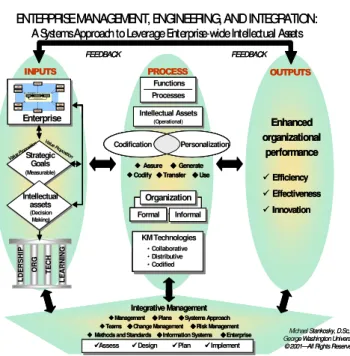
learning: all operating in a harmony. All need to be operational, and leaving out anyone is detrimental to the competitive advantage of nations and organizations. The author designed an enterprise management-engineering framework, which integrates all the best practices of systems engineering, integrative management, and
knowledge management. The name, Enterprise
Management-Engineering, was selected because it reflects how the enterprise (defined as the organization and its environment: stakeholders, alliances, competitors, customers, and environmental factors) is engineered from a management perspective. This framework focuses on knowledge assets from the perspective as inputs, processes, and outputs (see Figure 1).
Figure 1: Enterprise Management-Engineering Framework
It is divided into four general areas:
1. Inputs: incorporates over 40 elements of KM
(four pillars of Knowledge Management); a definition of the enterprise, to include its environment; its strategic objectives in measurable terms; and a list of the knowledge assets needed for decision-making.
2. Processes: includes the operational objectives in
measurable terms; lists the functions and processes needed to accomplish these objectives; shows the required knowledge assets and their sources; requires incorporating the two KM strategies of codification and personalization, with their attendant functions of knowledge assurance, generation, codification, transfer, and use; diagrams the formal organizational
structure, and lists the informal structure, to support these functions and KM strategies; and finally, architects the KM technologies needed to support all the above.
3. Integrative Management: integrates the various
management areas necessary to assess, design, plan, implement, and sustain the Enterprise Management-Engineering framework. It includes key aspects of the following
management disciplines: strategic management, operations management, organizational behavior and dynamics, process improvement, business process reengineering, risk management, change management, and information technology management.
4. Outputs: reflects the measured outputs of
efficiency, effectives, and innovation in measurable terms. These outputs measure against the stated strategic and operational objectives. All three outputs should be positively impacted by a well-designed enterprise management-engineering system. The four principle areas (pillars) under which the elements or the subsystems of the knowledge management in organizations are:
• Leadership/ management –
environmental, strategic and enterprise-level decision-making processes highly influenced by knowledge as strategic assets/resources;
• Organization – operational aspects of
knowledge assets, including functions, processes, formal and informal organizational structures, control measures and metrics, process improvement and business process reengineering;
• Learning – organizational behavioral
aspects and social engineering in order to identify and apply the attributes
necessary for collaboration and a learning organization;
• Technology – various information
technologies peculiar to supporting and/or enabling knowledge management
strategies and operations.4
These four pillars must be present in any enterprise management-engineering framework that has knowledge assets as the prime factors of production. They are the DNA of the system.
As we see, iteration and feedback are essential to the functioning of the framework. Given the constantly changing environment the enterprise operates in, management indicators and economic assessments must
4
Stankosky, Michael A., Advances in Knowledge Management:
University Research Toward an Academic Discipline in Stankosky, Michael A. (Editor), 2005, Creating the Discipline of Knowledge Management: The Latest in University Research, cit., p. 4 – 6.
SYSTEMS THINKING SYSTEMS ANALYSIS SYSTEMS MANAGEMENT SYSTEMS ENGINEERING / BPR INFORMATION SYSTEMS ENGINEERING AND MANAGEMENT KNOWLEDGE MANAGEMENT ENGINEERING THE ENTERPRISE
INTEGRATIVE MANAGEMENT / ENGINEERING KNOWLEDGE MANAGEMENT INFRASTRUCTURE
THE ENTERPRISE
INTEGRATIVE MANAGEMENT / ENGINEERING KNOWLEDGE MANAGEMENT INFRASTRUCTURE
SYSTEMS APPROACH INPUT PROCESS OUTPUT
SYSTEMS THINKING SYSTEMS ANALYSIS SYSTEMS MANAGEMENT SYSTEMS ENGINEERING / BPR INFORMATION SYSTEMS ENGINEERING AND MANAGEMENT KNOWLEDGE MANAGEMENT ENGINEERING SYSTEMS THINKING SYSTEMS ANALYSIS SYSTEMS MANAGEMENT SYSTEMS ENGINEERING / BPR INFORMATION SYSTEMS ENGINEERING AND MANAGEMENT KNOWLEDGE MANAGEMENT ENGINEERING SYSTEMS THINKING SYSTEMS ANALYSIS SYSTEMS MANAGEMENT SYSTEMS ENGINEERING / BPR INFORMATION SYSTEMS ENGINEERING AND MANAGEMENT KNOWLEDGE MANAGEMENT ENGINEERING THE ENTERPRISE
INTEGRATIVE MANAGEMENT / ENGINEERING KNOWLEDGE MANAGEMENT INFRASTRUCTURE
THE ENTERPRISE
INTEGRATIVE MANAGEMENT / ENGINEERING KNOWLEDGE MANAGEMENT INFRASTRUCTURE
THE ENTERPRISE
INTEGRATIVE MANAGEMENT / ENGINEERING KNOWLEDGE MANAGEMENT INFRASTRUCTURE
THE ENTERPRISE
INTEGRATIVE MANAGEMENT / ENGINEERING KNOWLEDGE MANAGEMENT INFRASTRUCTURE
SYSTEMS APPROACH INPUT PROCESS OUTPUT
SYSTEMS APPROACH INPUT PROCESS OUTPUT
be in place at the enterprise definition area. It is via these indicators and assessments that management must react; and evaluate if their strategic and operational objectives need to change. If so, all the elements of the enterprise
management-engineering framework must be
reevaluated, and modified accordingly. This is the main purpose of the feedback loops highlighted throughout. They also ensure that only “relevant” knowledge assets are collected and managed. One other point: continuous iteration is an essential dynamic of the model. As new elements enter the framework, an impact assessment must be made, and change accommodated.
The modern enterprise is both complex and global. In order to incorporate adequately the many elements that comprise it, a systems perspective is useful. This perspective not only facilitates an understanding of the many elements and their relationship to each other, but also ensures that a harmonious relationship among the parts exists, and that each is supportive of the other. The systems perspective is embodied by a systems approach and systems engineering and integration. The former requires a systematic and repeatable process for design, development, and operations of the system; the latter is an iterative process of top-down synthesis. They provide both the connectivity and trace-ability of the many elements, thus allowing for evaluation of alternatives at all levels, and system optimization throughout. Figure 2 is an illustration overview of the various perspectives, approaches, and management sciences that under-gird the framework.
Figure 2: System Perspectives, Approaches, and Management Science
The driving forces behind the knowledge management could be categorized as:
1. External driving forces:
• Globalization of business and fierce
international competition, where only the most efficient and effective will survive by being efficient, effective, and innovative in operations, marketing and production of products and services;
• Sophisticated and more demanding customers
who require new features of products and services, better fulfillment of individual needs, higher quality and quicker response;
• Sophisticated competitors which continuously
implement innovations in products, services and processes;
• Sophisticated suppliers who improve their
capabilities and can participate in creating and supporting innovations to deliver sophisticated products.
2. Internal driving forces
• Bottlenecks in enterprise effectiveness which
have moved from visible and tangible sites to knowledge-intensive work areas, thereby imposing the need for better understanding, expertise and intelligent behavior;
• Increased technological capabilities;
• Understanding of how human cognitive
functions (understanding, mental models, associations) affect decision making and performing knowledge intensive-work.
3. Other ongoing developments that will affect knowledge management further:
• Economics of ideas;
• Information management and technology;
• Cognitive science;
• Shifts in bottlenecks;
• New customization requirements for
sophisticated customers etc.
• Macro economics and policies that deal with
valuing and taxing intangibles on the balance sheets of nations and organizations.
The knowledge management could be effective provided:
• There is a systematic and explicit effort to
maximize the effectiveness of the enterprise business drivers;
• There is a knowledge-based vision to provide
the long-term basis for a broad knowledge management practice;
• There is a clear identification of the knowledge
requirements for individual functions to determine which knowledge should be made readily available;
• The knowledge threats, opportunities,
weaknesses and strengths are determined, so that the priorities could be set and needed knowledge management tasks are developed;
• The knowledge efforts are aligned with the
company’s strategic orientation to realize the best value of the knowledge management practice;
• There are systematized knowledge-related
efforts to make the knowledge management practice effective;
• The knowledge management is implemented in
a purpose-serving manner with priority given to minimizing waste and maximizing knowledge value.5
3. Knowledge-based management
There are some authors who claim that it is apparent that the knowledge economy is not fundamentally different from that which preceded it, and that the current enthusiasm for knowledge management is not so much the result of the fundamental changes in the economic system, but rather a result of the discovery of new concepts and tools for dealing with the management issues. According to them, the significant changes in many aspects of social and economic life do not represent a fundamental rupture, and it is arguably going too far to suggest that we are witnessing the birth of a new type of society/ economy. Even though much change has occurred, there have also been significant elements of continuity. The proponents of this view call for new approaches to knowledge management.
One line of researchers and practitioners points to the apparent importance of the active agency of people in the knowledge processes. The knowledge-related objectives of the organization (to utilize and develop knowledge into an economic asset and to extract economic value from it) may, but also may not, be achieved. When developing an effective knowledge management system the socio-cultural and human factors should not be neglected. Human motivation is of fundamental importance for all the knowledge processes and the willingness of people to generate, share and use knowledge should not be taken for granted. This is because:
• Much of the organizational knowledge is
personal, tacit and embodied in people and as a consequence, knowledge processes occur through interaction and communication among individuals;
• Workers may not be willing to use their
knowledge to help and contribute to the achievement of company’s goals because of the
employment relationships.6
In their book Managing Flow: A Process Theory of the
Knowledge-based Firm, Nonaka, Toyama and Hirata
5
Wiig, Karl M., Knowledge Management: An Emerging
Discipline Rooted in a Long History in Despres, Charles,
Daniele Chauvel (Eds.), 2000, Knowledge Horizons: The
Present and the Promise of Knowledge Management, cit., p. 10 – 12, 22.
6
Hislop, Donald, 2005, Knowledge Management in
Organizations: A Critical Introduction, Oxford University Press, p. 6 – 8, 44 – 49.
stress the need of a knowledge-based management. This approach to management deals with the subjective, process-relational, practical and aesthetic aspects of knowledge creation and management in a holistic framework and is derived from a comprehensive theory of the firm that explains the complex process of how knowledge is created and utilized organizationally through interaction with the environment. According to the authors, the existence of knowledge and of the firm is not independent of the environment but in the environment in relationship with others, emerging in interaction with others, and reshaping itself and others and the environment through these interactions.
The firm is seen as dynamic, evolving, quasi-autonomous system of knowledge production and application. It is seen as both based entity and knowledge-creating process with dynamic capabilities and what is especially significant for firm’s performance is the dynamics in which the firm continuously builds (knowledge) resources through interaction with the environment. As a dynamic entity in an ecosystem of knowledge relationships, the firm can no longer be defined simply by ownership, nor can its interactions with the environment and the boundary setting be explained by the means of contracts and transaction costs. The relationship of this type of firms with the environment is characterized by the active creation of change rather the passive reaction to it. For them, the key to responding to environmental uncertainty is the effective leveraging of both hierarchy and networks to enable flexibility and change in organizational structure when necessary. It obviously calls for a synthesis of the apparent contradictions of knowledge-creation and efficiency and freedom versus control in issues of power and one almost without exception sees a multilayered structure or organic configuration of shared context (time-space) in which knowledge is shared, created and
utilized7 and which is freely formed in accordance with
the organization’s overall objectives. The essence of business is not about bettering the competition to maximize profit; it is about the relentless pursuit of the firm’s own standard of excellence. This excellence comes from a strong commitment and practices to serve the common good of the company, its employees, its customers, stakeholders and the larger society and is
based on the company’s own vision and values.8
7
This is the so called ba – the physical or virtual space of interaction which is the foundation for knowledge-creating activity in which individuals, teams, subsystems etc. engage in dialectic dialogue and practice to implement the vision and driving objectives of the company. By its nature, it is a shared context in motion.
8
Nonaka, Ikujiro, Ryoko Toyama, Toru Hirata, 2008, Managing Flow: A Process Theory of the Knowledge-based Firm, Palgrave Macmillan, p. 2, 3, 18 – 48.
Conclusion
We are clearly in a new economic era, where globalization and strategic knowledge assets are the new realities for producing wealth. This requires new policies, governance, strategies, and management practices to cope effectively and achieve competitive advantage. The shift has occurred sometime ago, and we are just beginning to wake up to this new dawn. We still do not recognize in GDP or international accounting the critical nature of intangibles, especially intellectual capital. Consequently, leaders and managers have no true transparency on their assets, and still look for modes to really leverage them effectively, efficiently, and innovatively. What they all agree upon is that the internal and external environment of the modern enterprise is complex and that in order to incorporate adequately the many elements that comprise it, a systems perspective is useful. This perspective not only facilitates an understanding of the many elements and their relationship to each other, but also ensures that a harmonious relationship among the parts exists, and that each is supportive of the other. With this in mind, the effective management of the enterprise based on its knowledge assets is founded on the following premises:
• Clear insight of the organizational structure
(both formal and informal) and enterprise-wide functions necessary for achievement of the strategic objectives;
• Formulation of strategic objectives and success
factors in measurable terms;
• Identification of the critical enterprise
environmental changes that impact the strategic objectives;
• Use of critical knowledge assets for strategic
decision-making;
• Well defined and feasible codification and
personalization strategies to leverage the knowledge assets;
• Integrated knowledge management system
embedded in the integrative enterprise
management system, and continuous audit of its four pillars;
• Integration of the knowledge management
system with the legacy components (such as current functions, processes, formal and informal organization structures, and IT systems);
• Implementation and management of continuous
change.
References
[Depres et al., 2000] Despres, Charles, Daniele Chauvel,
editors, Knowledge Horizons: The Present and the
Promise of Knowledge Management, Butterworth
Heinemann, 2000.
[Graen, 2008] Graen, George B., Joni A. Graen, editors,
Knowledge-driven Corporation: Complex Creative Destruction, Information Age Publishing, 2008.
[Hislop, 2005], Hislop, Donald, Knowledge Management
in Organizations: A Critical Introduction, Oxford University Press, 2005.
[Mentzas et al., 2003] Mentzas, Gregoris, Dimitris
Apostolou, Andreas Abecker, Ron Young, Knowledge
Asset Management: Beyond the Process-centred and Product-centred Approaches, Springer, 2003.
[Nonaka et al., 2008] Nonaka, Ikujiro, Ryoko Toyama,
Toru Hirata, Managing Flow: A Process Theory of the
Knowledge-based Firm, Palgrave Macmillan, 2008. [Stankosky, 2005] Stankosky, Michael A., editor,
Creating the Discipline of Knowledge Management: The Latest in University Research, Elsevier, 2005.
[Stankosky, 2001] Stankosky, Michael A., Enterprise
Management Engineering: A Systems Approach to Leverage Knowledge Assets in the XXI Century Economy, The George Washington University, 2001. [World Bank Institute, 2007] World Bank Institute,
Building Knowledge Economies: Advanced Strategies for Development, The World Bank, 2007.