Optimal ANFIS Model for Forecasting System Using
Different FIS
Deasy Alfiah Adyanti
Dian Candra Rini Novitasari
Ahmad Hanif Asyhar
Department of MathematicsUniversitas Islam Negeri Sunan Ampel Surabaya Surabaya, Indonesia
[email protected], [email protected], hanif @uinsby.ac.id
Fajar Setiawan
Department of Forecasting
Perak Maritime Meteorology Station II Surabaya Surabaya, Indonesia
Abstract- Adaptive Network Based Fuzzy Inference System (ANFIS) with time series analysis is one of the intelligent systems that can be used to predict with good accuracy in all fields like in meteorology’s field. However, some researches on prediction or forecasting do not emphasize the structure of the ANFIS fuzzy inference system. Thus, in this research, the optimization of the ANFIS model for forecasting maritime weather was carried out by analyzing the exact initialization determination in the three ANFIS fuzzy inference structures, they are grid partition, subtractive clustering, and fuzzy c-means clustering. The input variable used in this research is each variable for the previous two hours, one hour, and at a time and the output of this system is the prediction of one hour, six hours, twelve hours and one day ahead of the ocean current speed (cm/s) and wave height (m) using all three FIS ANFIS approaches. Based on the results, the smallest goal error (RMSE and MSE) of the three FIS ANFIS approaches used for predicting the current speed and wave height, the best model is produced by Subtractive Clustering. It can be seen that Subtractive Clustering produces the smallest RMSE and MSE error values.
Keywords— ANFIS, Grid Partition, Subtractive Clustering, Fuzzy C-Means Clustering, Forecasting
I. INTRODUCTION
Some problems with forecasting require an intelligent system that combines science, techniques, and methods from various sources [1]. The ANFIS with time series analysis is one of the intelligent systems that can be used to predict with good accuracy in all fields [2] [3] [4]. As in the field of meteorology, ANFIS is quite good in forecasting maritime weather system [5].
ANFIS is a method that can handle complex and nonlinear systems through learning algorithms and numerical data (time series) [5], ANFIS can also adapt to atmospheric variables through the neuron system of Artificial Neural Networks (ANN) in ANFIS [5]. This can be seen from researches about predictions using the ANFIS Time Series model. Some of them are research conducted by Agrawal et al on Indian weather forecasting using ANFIS and ARIMA based Interval Type-2 Fuzzy Logic
Model [6]. And then, Babu, et al who comparison of ANFIS and ARIMA model for weather Forecasting [7], then research by Adyanti et al who implements the time series - ANFIS in predicting maritime weather in the Java Sea [5].
Based on the researches that have been developed, maritime weather predictions made only using the model ANFIS design grid partition (genfis1) [5]. Whereas in designing ANFIS models, there are three fuzzy inference system structures namely grid partition (genfis1 function), subtractive clustering (genfis2 function) and fuzzy c-means (FCM or genfis3 function) [3] [8] [9] [10]. The three FIS structures are quite significant to determine the accuracy of ANFIS models [3] because the FIS structure is used to train and test data on ANFIS.
During the training phase, the membership function parameters are iterated until convergence is obtained [11]. This convergence is obtained when the results of the membership function are unchanged and focus on one optimal membership function point. This can be obtained by minimizing the average squared error between output and input. Furthermore, the relationship between input and output from ANFIS is constructed through the FIS structure. FIS structure is obtained by combining the back propagation algorithm and the least squares method [11] [12] [13]. Then the performance of the three models is compared with two statistical criteria, namely RMSE and MSE.
In this research, optimization of the FIS ANFIS model for maritime weather prediction is done by comparing the three FIS ANFIS structures. The purpose of this research was to obtain the best model Ts-ANFIS to predict maritime weather patterns (current speed and wave height) from the comparison of the FIS ANFIS structure. The point taking in this case research was emphasized in one of the coordinates of Gresik waters. The expectations of the researchers from the results of this research are to obtain an effective and efficient forecasting system and be able to assist the shipping of the Gresik coastal community from the results of the ANFIS model which is seen from the point of view of the different FIS ANFIS.
II. THEORETICAL FRAMEWORK
A. Artificial Neural Networks and Adaptive Neural Networks
Artificial neural networks (ANN) are one of the artificial representations of human brain neurons [14]. One type of ANN is backpropagation. Then, adaptive neural networks are networks that consist of directional links [13].
B. ANFIS
ANFIS is a hybrid method of artificial neural networks as an implementation of a fuzzy inference system [15] [16] [17]. The ANFIS method has an architecture that functionally resembles the Sugeno model fuzzy rule base architecture [18] [19]. The ANFIS parameter is divided into two, namely the premise parameter and the consequences that can be adapted to a hybrid algorithm [17].
The ANFIS structure is shown in Figure 1 below:
Fig. 1 ANFIS Method Structure
The steps of each layer ANFIS has been described in the theoretical framework of Adyanti et al. [5] [17].
C. ANFIS Fuzzy Inference System Structure
In ANFIS there are three structures of FIS, they are genfis1 (Grid Partition), genfis2 (subtractive clustering), and genfis3 (FCM clustering) [3] [7], with an explanation of the three structures of the FIS:
a. Genfis1 (Grid Partition) applies a grid partition from the input space to produce the initial stage of a FIS. This genfis1 is optimized from various combinations of input variables, a number of data and types of membership functions [8] [9].
b. Genfis2 (subtractive clustering) is applied to generate models from data using clustering. The genfis2 clustering algorithm uses a one-pass algorithm to estimate the number of clusters and cluster centers in a set of data but does not perform optimization repeatedly [9] [10] [11] [12]. This function is built based on the subtractive clustering function with the one-pass method and training of input-output data and produces a Sugeno type fuzzy inference system [10]. c. Genfis3 (FCM clustering) implements fuzzy c-means
as a mechanism for clustering input data and output from this genfis3 is Mamdani or Sugeno [3] [10] [11] [12]. Genfis3 is built based on FIS that uses the FCM function by extracting a set of rules that model data behavior.
D. Statistical Analysis
In this research two statistical criteria were used for measuring predict performance. They are the root mean
square error (RMSE) and mean square error (MSE). These statistical criteria are used to indicate the accuracy of marine weather prediction [3]. The formula of RMSE and MSE are as follow:
Where n is the number of data, X and Y are the predicted and actual values.
III. RESEARCH METHODS
A. Types of Research
This research is a quantitative descriptive study whose function aspect is applied research. In this study, a comparison of the FIS ANFIS model for maritime weather forecasting systems (current speed and wave height) was compared.
B. Data Collection and Analysis
Data obtained from BMKG Perak II Surabaya through Automatic Weather System (AWS) record data of 17,520 data from 1 January 2016 to 31 December 2017. Data are time series of current speed and wave height. The data is used as input in the ANFIS process. Time series analysis of current speed and wave height data is converted into three forms, that is, previous two hours, one hour, and at a time. Three forms are used as input in predicting the current speed and wave height. Furthermore, this system output is the prediction of one hour, six hours, twelve hours and the days ahead.
C. Testing System and Evaluation
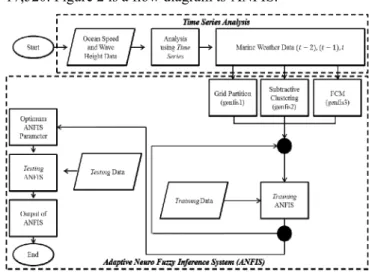
The first test is a time series analysis of weather parameters. The time series data from these parameters are divided into two data sections with a ratio of 75: 25 from 17,520. Figure 2 is a flow diagram ts-ANFIS.
Following are the steps from the flowchart:
a. Maritime weather data in the form of wave height data and current speed data for the past two years. b. The data that has been obtained is then analyzed by
the time series by observing input variables and output variables. Then the data is divided into two parts, 75% is used as training data and around 25% is used for data testing.
c. All data that has been analyzed is time series processed using ANFIS method using MATLAB. d. In the initial process, training data is managed using
ANFIS with initialization of the FIS ANFIS structure, namely genfis1 (grid partition), genfis2 (subtractive clustering) and genfis3 (Fuzzy C-Means clustering).
e. Conduct ANFIS training from the three ANFIS fuzzy Inference structures by entering existing training data, then the ANFIS testing phase is by entering testing data.
f. Prediction results and statistical criteria are obtained. IV. RESULT AND DISCUSSION
The maritime weather data used is current speed data and wave height data per hour. The data is presented in Table 1.
TABLE I. DATA SAMPLES OF CURRENT SPEED AND WAVE HEIGHT
Date Time(UTC) CuSpd (cm/s) H 1/100 (m)
1/1/2017 0 21.88 0.57
1/1/2017 1 21.36 0.55
1/1/2017 2 20.84 0.54
1/1/2017 3 20.33 0.52
Time series analysis data is used as input variables (t – 2, t - 1 and t) and output variables (t +1, t + 6, t + 12and t + 24). In predicting, three FIS ANFIS structure approaches are used namely genfis1, genfis2, and genfis3. Following are the results of the prediction of current speed and wave height using all three FIS approaches.
A. Genfis1 (Grid Partition)
In conducting the training process in ANFIS, three FISs have the same role of training and testing data to get convergent membership functions. However, the results are adjusted according to orders from ANFIS. The grid partition (genfis1) produces an input variable partition where each rule has a zero coefficient on its output. This genfis1 produces a Sugeno type FIS that models data behavior. To predict the current speed and wave height, several parameters are needed to train and test the ANFIS model.
This parameter is in the form of a membership function of 2 with the "Gaussmf" membership function type and the "Linear" membership function output. The ANFIS training process is determined by parameters that include iteration, target error, level of decline and increase. The maximum iteration is 100, the target error is 0.00001, the initial step size is 0.01, the step size decrease rate is 0.9 and the step size increase is 1.1.
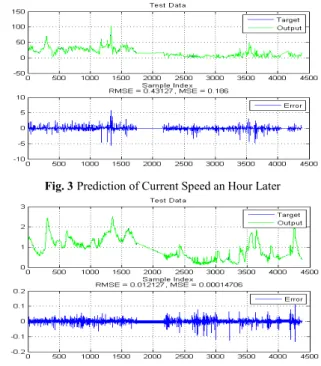
From the parameters that have been determined to predict next hour through the genfis1 training process, it will stop when the specified goal error value has been reached. For this approach, evaluation of statistical criteria uses RMSE and MSE for prediction of current speed and wave height as in Figures 3 and 4.
Fig. 3Prediction of Current Speed an Hour Later
Fig. 4Prediction of Height Wave an Hour Later
Based on the test results in Figures 3 and 4, it can be seen that the prediction chart from the actual test data (blue line) with the Ts-ANFIS result test data (green line) has the same tendency and the prediction of ts-ANFIS with genfis1 approach shows the results on the variable current speed and wave height are quite good. It is seen from the results of forecasting that is not so far from the actual data. Then, the biggest error chart of the two variables is located in the range [-7: 7]. The largest range is in the current speed variable. The RMSE and MSE values as represented in tables 2 and 3.
TABLE II. OCEAN CURRENT SPEED PREDICTION WITH FIS GENFIS1
No Prediction Time Number of Validation Data Predicted
Results RMSE value MSE Value
1 1 Hour 4380 16.268 0.43127 0.186
2 6 Hours 4380 11.531 3.1344 9.8247
3 12 Hours 4380 5.572 5.8223 33.8995
4 24 Hours 4380 9.698 7.7315 59.7767
TABLE III. WAVE HIGHT PREDICTION WITH FIS GENFIS1 No Prediction Time Number of Validation Data Predicted Results RMSE value MSE Value 1 1 Hour 4380 0.39 0.012127 0.00014706 2 6 Hours 4380 0.367 0.081407 0.0066271 3 12 Hours 4380 0.403 0.13814 0.019084 4 24 Hours 4380 0.555 0.21427 0.04591
In table 2 and table 3, the prediction results, the RMSE and MSE values of current speed and wave height are stated. In the tables, it can be seen that genfis1 is quite good at predicting because the results of RMSE and MSE values are good values. Especially the RMSE and MSE value from the wave height, the value is less than 0.05.
B. Genfis2 (Subtractive Clustering)
In the ANFIS model, the subtractive clustering algorithm is used to design a rule base. Before designing the basic rules of the initial maritime weather variable data (current speed and wave height) are clustered based on the subtractive clustering algorithm. The method of grouping data is based on the degree of membership which includes the fuzzy set as the basis for weighting in clusters by determining the data that has a high potential for the surrounding data [20] [21]. This genfis2 has a pretty good estimate when the input-output is in the form of a time-scale data collection and can estimate the number of clusters and cluster centers in a data set.
Similar to genfis1 (Grid Partition), this genfis2 produces a Sugeno type FIS to model data behavior. The parameters selected for this approach are the number of membership functions in number 2 with the type of membership function "Gaussmf", the output of the membership function "Linear" and the Radius of the influence of 0.55.
The difference in the parameters of genfis2 with genfis1 is the radius of influence, in this research the radius of influence determined is 0.55 with the aim to determine the high potential of a data. The ANFIS training process is determined by the same parameters as genfis1.
In the genfis2 training process, iterations will stop when the specified goal error value has been reached. For this approach, the evaluation of statistical criteria uses RMSE and MSE for the prediction of current speed and wave height as in Figures 5 and 6.
Fig. 5Prediction of Current Speed an Hour Later
Based on the test results in Figures 5 and 6, as in the previous genfis1, the prediction chart from the actual test data (blue line) with the Ts-ANFIS result test data (green line) has the same tendency. The results of good predictions are also seen in the Ts-ANFIS forecasting with a genfis2 approach. Ts-ANFIS forecasting with the genfis2 approach shows charts of the same pattern between prediction results
and actual data. In this genfis2 approach, the biggest error chart is the current speed prediction with the range [-10; 3].
Fig. 6Prediction of Height Wave an Hour Later
This significant error reduction occurs in a current speed data because the data with the previous data has a far range. Then, in tables 4 and 5 shows the results of the RMSE and MSE values on the prediction of current speed and wave height from the genfis2 approach. When viewed from the genfis1 table, genfis2 is better in forecasting one hour and 24 hours ahead at current speed variables. In wave height forecasting, genfis2 is better than genfis1. So, genfis2 result is relatively smaller than genfis1.
TABLE IV. OCEAN CURRENT SPEED PREDICTION WITH FIS GENFIS2 No Prediction
Time Number of Validation Data
Predicted
Results RMSE value MSE Value
1 1 Hour 4380 16.234 0.42611 0.18157
2 6 Hours 4380 11.752 3.2997 10.888
3 12 Hours 4380 5.676 5.9421 35.3083
4 24 Hours 4380 9.932 7.5599 57.1528
TABLE V. WAVE HEIGHT PREDICTION WITH FIS GENFIS2 No Prediction Time Number of Validation Data Predicted Results RMSE value MSE Value 1 1 Hour 4380 0.39 0.012153 0.00014769 2 6 Hours 4380 0.37 0.080863 0.0065388 3 12 Hours 4380 0.41 0.13727 0.018843 4 24 Hours 4380 0.57 0.2111 0.044562
C. Genfis3 (Fuzzy C-Means Clustering)
This genfis3 uses FIS type Fuzzy C-Means Clustering by extracting a set of rules to model data behavior. Input and output variables in this genfis3 are separate from the first rule using FCM as a determinant of the number of rules and functions of membership for antecedents and their consequences. This genfis3 produces a Sugeno or Mamdani type fuzzy inference system to model data behavior. The parameters in genfis3 are the number of membership functions 2 with the type of membership function "Gaussmf", the membership function output is "Linear", the number of clusters is 10, the exponential partition matrix is 2, the maximum number of iterations is 100 iterations and the maximum improvement is 0.00001. The ANFIS training
process is determined by the same parameters as genfis1 and genfis2 parameters.
Like the previous genfis1 and genfis2, the process of training 3 will stop when the specified goal error value has been reached. For this approach, evaluation of statistical criteria uses RMSE and MSE for prediction of current speed and wave height as shown in Figures 7 and 8.
Fig. 7Prediction of Current Speed an Hour Later
Fig. 8Prediction of Height Wave an Hour Later
Based on the test results in Figures 7 and 8, the results of the genfis3 approach produce a prediction chart of the actual test data (blue line) with the Ts-ANFIS test results (green line) having a fairly good tendency. Genfis3 also produces good predictions, like genfis1 and genfis2. Genfis3 chart results have the same pattern between prediction results and actual data. However, the chart of errors in genfis3 is a chart that produces the farthest range, is [-9; 5]. A range error occurs in a current speed variable data.
In tables 6 and 7 show the results of the prediction, the RMSE, the MSE value of the prediction of current speed and wave height. Based on the results of the RMSE and MSE statistical criteria on weather forecasting using genfis3, the largest RMSE and MSE results were obtained. So, based on the range in the error chart, the RMSE and MSE value of genfis3 are not good for forecasting current speed and wave height.
TABLE VI. OCEAN CURRENT SPEED PREDICTION WITH FIS GENFIS3 No Prediction Time Number of Validation Data Predicted Results RMSE value MSE value 1 1 Hour 4380 16.23 0.43625 0.19031 2 6 Hours 4380 12.354 3.3237 11.047 3 12 Hours 4380 4.731 5.9516 35.421 4 24 Hours 4380 7.81 7.6473 58.4817
TABLE VII. WAVE HIGHT PREDICTION WITH FIS GENFIS3 No Prediction
Time Number of Validation Data
Predicted
Results RMSE value The value of MSE
1 1 Hour 4380 0.39 0.012101 0.00014644
2 6 Hours 4380 0.366 0.080958 0.0065543
3 12 Hours 4380 0.419 0.13741 0.018881
4 24 Hours 4380 0.549 0.21613 0.046712
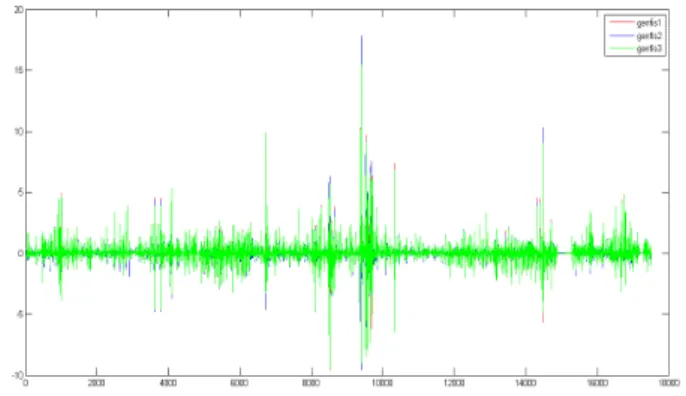
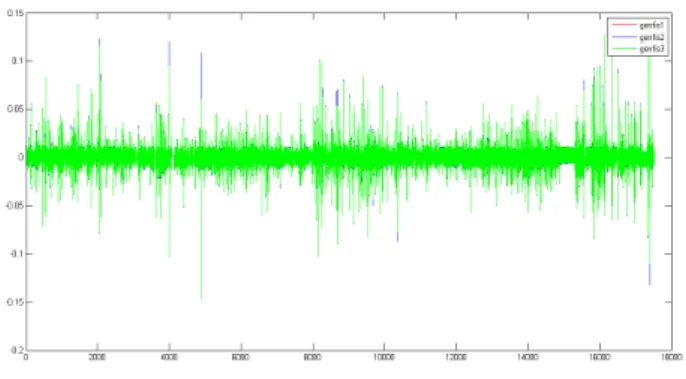
Of the three FIS approaches used, the membership function which aims to map the value of the membership of a data using the same type of "gaussmf" curve. Because the Gaussian curve is quite a good curve for continuous data. In this research uses marine weather data, it is continuous. Then, the number of membership functions is only two because it does not affect the results of the fuzzification [10]. The fuzzification remains smooth even though the Gaussian set range is wider. Based on the results of the FIS ANFIS approach, the three FIS ANFIS model approaches can be used to predict the current speed and wave height quite good. Meanwhile, to see the model of the FIS ANFIS approach that is best in predicting the current speed and wave height is to look at the results of the error chart of the three FIS approaches shown in Figures 9 and 10.
Fig. 9 Chart of Error from Three Generates of FIS to Predict Ocean Current Speed (Red = Genfis1, Blue = Genfis2, Green = Genfis3)
The ts-Anfis model of the three FIS ANFIS is a quite good predictor. Seen in the chart in Figure 3 to Figure 8 the prediction model can follow the pattern every hour of the variable current speed and wave height. On the chart of the three error ANFIS prediction in Figures 9 and 10, it can be seen that the error change pattern does not have a significant difference from the three FIS ANFIS. However, the error value of the current speed is greater than the wave height.
The range of errors seen on the Y-axis of the largest current speed is the range [-10: 3] from genfis3.
Fig. 10 Chart of Error from Three Generates of FIS to Wave Height Prediction (Red = Genfis1, Blue = Genfis2, Green = Genfis3)
The error value of current speed is large because of the range between the data so far. So, the most optimal FIS ANFIS approach for prediction of current and wave height, it can be seen from the smallest RMSE, MSE values and seen from the range of error testing. From RMSE, MSE, and range of error, the best result for forecasting marine weather is genfis2 or Subtractive Clustering.
I. CONCLUSION
The results of research on the optimization of the ANFIS model in predicting maritime weather patterns (current speed and wave height) using the FIS ANFIS structure comparison can be concluded as follows:
a. The data training process using Ts-ANFIS with three FIS-ANFIS approaches produces the smallest goal error value (RMSE and MSE) of 0.186, respectively; 9.8247; 33.8995; and 59.7767 for current speed and 0.00014706; 0.0066271; 0.019084; and 0.04591 for wave heights using the genfis1. And for genfis2 the results of the smallest goal error (RMSE and MSE) are 0.18157, 10.888, 35.3083 and 57.1528 for current velocities and are 0.00014769, 0.0065388, 0.018843, and 0.044562 for wave height. Whereas for genfis3 the results of the smallest goal error values (RMSE and MSE) are 0.19031, 11.047, 35.421 and 58.4817, respectively for current speed and 0.00014644, 0.0065543, 0.018881, and 0.046712 for wave heights.
b. Based on the results of the smallest goal error (RMSE and MSE) and from range error of the three FIS ANFIS approaches used for prediction of current speed and wave height, the best model is produced by genfis2 (Subtractive Clustering). REFERENCES
[1] M. Ali, R. C. Deo, N. J. Downs and T. Maraseni, "An Ensemble-ANFIS based Uncertainty Assessment Model for Forecasting multi-scalar Standardized Precipitation Index," Atmospheric Research, pp. 1-71, 2018.
[2] K. Prasad, A. K. Gorai and P. Goyal, "Development of ANFIS models
for air quality forecasting and input optimization for reducing the computational cost and time," Atmospheric Environment, vol. I, no. 128, pp. 246-262, 2016.
[3] M. Mostafaei, "ANFIS models for prediction of biodiesel fuels cetane number using desirability function," Fuel, no. 216, pp. 665-672, 2018. [4] A. Baghban, J. Sasanipour, P. Haratipour, M. Alizad and M. V.
Ayouri, "ANFIS Modeling of Rhamnolipid Breakthrough Curves on Activated Carbon," Chemical Engineering Research and Design, pp. 1-39, 2017.
[5] D. A. Adyanti, A. H. Asyhar, D. C. R. Novitasari, A. Lubab and M. Hafiyusholeh, "Forecast Marine Weather on the Java Sea using Hybrid Methods: Time Series - ANFIS," 2017 4th International Conference on Electrical Engineering, Computer Science and Informatics (EECSI)., pp. 1-6, 2017.
[6] A. Agrawal and Q. M. F, "Indian Weather Forecasting using ANFIS and ARIMA based Interval Type-2 Fuzzy Logic Model," AMSE JOURNALS –2014-Series, vol. 19, no. 1, pp. 52-70, 2014.
[7] R. Babu, C. B. A. Babu, D. P. Reddy and M. Gowtham, "Comparison of ANFIS and ARIMA Model for Weather Forecasting," Indian Journal of Science and Technology, Vol 8(S2), 70–73, January 2015, DOI: 10.17485/ijst/2015/v8iS2/58732, vol. 8, pp. 70 - 73, 2015. [8] N. Arora and J. R. Saini, "Time Series Model for Bankruptcy
Prediction via Adaptive Neuro-Fuzzy Inference System,"
International Journal of Hybrid Information Technology, vol. 6, no. 2, pp. 51-64, 2013.
[9] M. Azamathullah, A. A. Ghani and S. Y. Fei, "ANFIS - based Approach for Predicting Sediment Transport in Clean Sewer," Applied Soft Computing Journal, vol. I, no. 12, pp. 1227-1230, 2012. [10] R. V. Wasu, "Medium-Term Load Forecasting using Adaptive
Neuro-Fuzzy Inference System," International Journal of Innovative and Emerging Research in Engineering, vol. 3, no. 1, pp. 610-614, 2016. [11] M. W. Dewan, D. J. L. W. Huggett, M. A. Wahab and A. M. Okeil,
"Prediction of Tensile Strength of Friction Stir Weld Joints with Adaptive Neuro-Fuzzy Inference System (ANFIS) and Neural Network," Journal of Mechanical and Industrial Engineering Department, 2016.
[12] H. Abbasimehr, M. Setak, and M. Tarokh, "A Neuro-Fuzzy Classifier for Customer Churn Prediction," International Journal of Computer Applications (0975 - 8887), vol. 19, no. 8, pp. 35-41, 2011.
[13] R. H. Wirasasmita, "Sistem Prediksi Intensitas Curah Hujan Menggunakan Algoritma Neuro-Fuzzy (ANFIS)," Universitas Islam Indonesia, Yogyakarta, 2006.
[14] N. Ghetiya and K. Patel, "Prediction of tensile strength in friction stir welded aluminium alloy using the artificial neural network," 2nd International Conference on Innovations in Automation and Mechatronics Engineering (ICIAME) 2014, no. 14, pp. 274-281, 2014. [15] A. Muslim, "Peramalan Harga Paritas Kedelai Model ANFIS,"
Widyariset, vol. 17, no. 17, pp. 13-24, 2014.
[16] I. L. Zulfa and Suhartono, "Peramalan Beban Listrik di Jawa Timur Menggunakan Metode ARIMA dan Adaptive Neuro Fuzzy Inference System (ANFIS)," JURNAL SAINS DAN SENI ITS, vol. 4, no. 1, pp. 91-96, 2015.
[17] H. Koivo, ANFIS (Adaptive Neuro Fuzzy Inference System), Heikki Koivo 2000, 2000.
[18] S. Barak and S. S. Sadegh, "Forecasting energy consumption using ensemble ARIMA–ANFIS hybrid algorithm," Electrical Power and Energy Systems, vol. I, no. 82, pp. 92-104, 2016.
[19] H.-T. Ouyang, "Input optimization of ANFIS typhoon inundation forecast models using a Multi-Objective Genetic Algorithm," Journal of Hydro-environment Research, no. 19, pp. 16-27, 2018.
[20] S. Kusumadewi, Analisis & Desain Sistem Fuzzy menggunakan Tool Box Matlab, Yogyakarta: Graha Ilmu, 2002.
[21] S. Kusumadewi and H. Purnomo, Aplikasi Logika Fuzzy Edisi 2, Yogyakarta: Graha Ilmu, 2013.