EXPLORING APHID-VIRUS-WHEAT INTERACTIONS USING CURRENT WHEAT VARIETIES, APHID CONTROL TECHNIQUES AND VECTOR SURVEYS
by
JOHN JACOB GIRVIN III
B.S., Kansas State University, 2012
A THESIS
submitted in partial fulfillment of the requirements for the degree
MASTER OF SCIENCE
Department of Entomology College of Agriculture
KANSAS STATE UNIVERSITY Manhattan, Kansas
2015
Approved by: Major Professor C. Michael Smith
Copyright
JOHN JACOB GIRVIN IIIAbstract
The bird cherry oat aphid, Rhopalosiphum padi, and one of the viruses it vectors, barley yellow dwarf virus (BYDV), form a very damaging pest unit on cereals. Understanding how people can better manage crops to prevent damage or recognize environmental or geographic factors that put their crops at risk for BYDV could lead to improved virus aphid management strategies.
One of the most successful methods for mitigating pest damage is using pest-resistant varieties of crops. Seven candidate wheat varieties were screened for resistance to R. padi, by testing aphid population densities and aphid host choice. Results of this research identified six varieties of wheat that show resistance to R. padi.
One of the major knowledge gaps in BYDV management is forecasting potential damage. Our objective was to create viral presence maps, to start building the foundation of correlations between persistent and changing frequency of viruliferous R. padi. The results of BYDV assays in R. padi in wheat fields across Kansas indicated that the amount of BYDV infection in
viruliferous aphids changes rapidly from year to year, and differs considerably between geographic regions and field landscape characteristics in Kansas.
Neonicotinoid wheat seed treatment is a management technique that reduces R. padi
populations. However, a common question among producers is whether or not seed treatments stop viral transmission. Results of greenhouse seed treatment experiments with plants from neonicotinoid treated and untreated seed infested with viruliferous R. padi indicated no significant difference in viral transmission due to seed treatment.
This new information about R. padi wheat varietal resistance, geographic distribution of BYDV in Kansas, and neonicotinoid seed treatment creates a better understanding of aphid-virus-wheat interactions. Results from this thesis directly enhance producer ability to forecast
risk from BYDV, select wheat varieties that effectively reduce R. padi as a BYDV vector, and to make better decisions about the use of insecticide to reduce BYDV infection.
Table of Contents
List of Figures ... vii
List of Tables ... ix
Acknowledgements ... x
Dedication ... xi
Chapter 1 - Literature Review ... 1
Wheat ... 1
Bird cherry oat aphid ... 2
Viral transmission ... 3
Barley yellow dwarf virus ... 4
Objectives ... 5
Chapter 2 - Barley yellow dwarf virus presence across Kansas ... 7
Introduction ... 7
Materials and methods ... 8
Aphid collection and field selection... 8
RNA extraction ... 9
Reverse transcription, PCR and electrophoresis ... 9
Results ... 10
Total Kansas BYDV ... 10
Discussion ... 25
Chapter 3 - Host plant resistance of select wheat (Triticum aestivum) varieties to Rhopalosiphum padi ... 26
Abstract ... 26
Introduction ... 26
Materials and methods ... 27
Initial Screening ... 27
Potting and caging ... 27
Antixenosis ... 28
Statistical Analysis ... 29
Results ... 29
Discussion ... 33
References ... 34
Appendix A - Neonicotinoid seed treatment effect on Rhopalosiphum padi transmission of barley yellow dwarf virus ... 38
Introduction ... 38
Materials and methods ... 38
Seed treating ... 38
Caging ... 39
Potting ... 39
Infesting ... 39
RNA extraction, Reverse transcription, PCR, and electrophoresis... 39
Statistics ... 40
List of Figures
Figure 2.1: Mean percent of R. padi sampled that were viruliferous for RPV-PAV-BYDV in Kansas counties during 2013, 2014, and 2015. Counties that were sampled but R. padi was absent are categorized as undetected. ... 17 Figure 2.2: Mean percent of RPV-PAV-BYDV viruliferous R. padi sampled in Kansas in 2013,
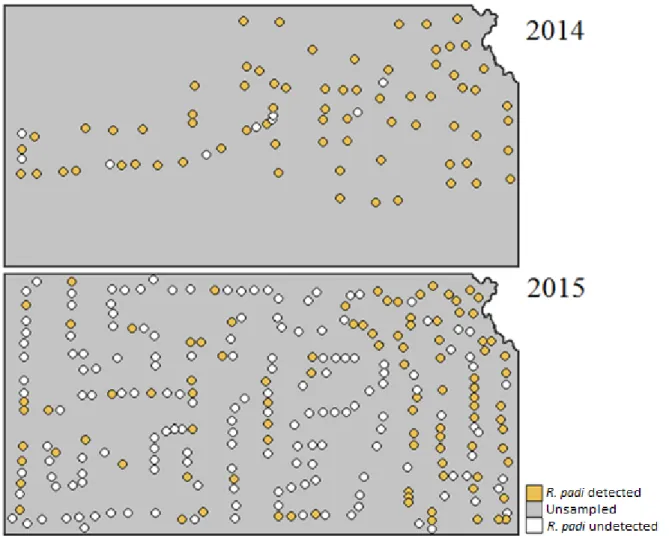
2014 and 2015. Dots represent sample sites. Sites that were sampled but R. padi was absent are categorized as undetected. ... 18 Figure 2.3: Incidence of R. padi detected in samples across Kansas in 2014 and 2015. Dots
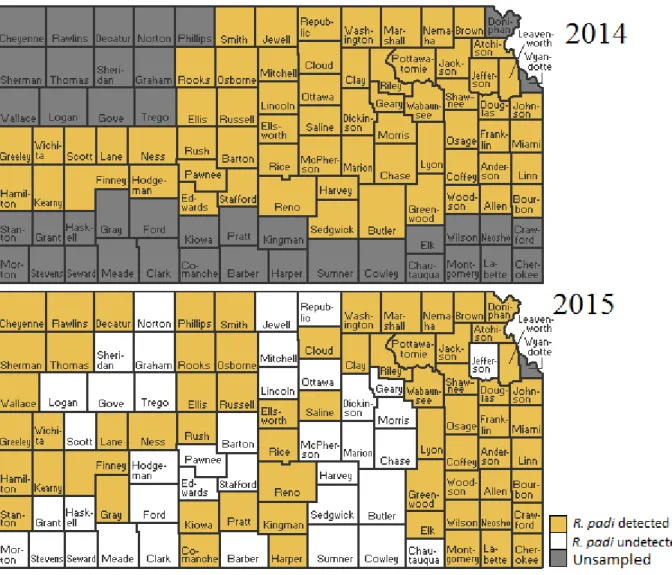
represent sample site. Sites that were sampled but R. padi was absent are categorized as undetected. ... 19 Figure 2.4: Incidence of R. padi in samples, by Kansas counties in 2014 and 2015. Counties that
were sampled but R. padi was absent are categorized as undetected. ... 20 Figure 2.5: Incidence of S. avenae in samples, by Kansas counties in 2014 and 2015. Counties
that were sampled but S. avenae was absent are categorized as undetected. ... 21 Figure 2.6: Incidence of S. avenae in Kansas in 2014 and 2015. Dots represent sample site. Sites
that were sampled but S. avenae was absent are categorized as undetected. ... 22 Figure 2.7: Incidence of S. graminum in Kansas counties in 2014 and 2015. Counties that were
sampled but S. graminum was absent are categorized as undetected. ... 23 Figure 2.8: Incidence of greenbug S. graminum in Kansas in 2014 and 2015. Dots represent
sample site. Sites that were sampled but S. graminum was absent are categorized as
undetected. ... 24 Figure 3.1: Mean number of R. padi on 8 varieties of wheat after 14 days of infestation. Means
that do not share a letter are significantly different using Tukey’s HSD test analysis of means. N=3, 95% CI, F=33.1 ... 30 Figure 3.2: Mean proportional weight of above ground biomass loss (DWT) of wheat plants
uninfested and infested with R. padi. Percent loss of biomass was calculated with the equation (uninfested plant biomass – infested plant biomass) / uninfested plant biomass. Means that do not share a letter are significantly different using Tukey HSD test. N=3, 95% CI, F= 9.24 ... 31
Figure 3.3: Mean number of R. padi aphids on 8 varieties of wheat after 24 hours of infestation with 5 adult R. padi. Means that do not share a letter are significantly different using Tukey HSD test. N=18 95% CI, F= 21.1 ... 32 Figure A.1: Proportion of plants in which presence of BYDV was detected. Each cage was
considered a replication, n=9. Analysis of indicated means did not significantly differ. F=1.9 ... 40
List of Tables
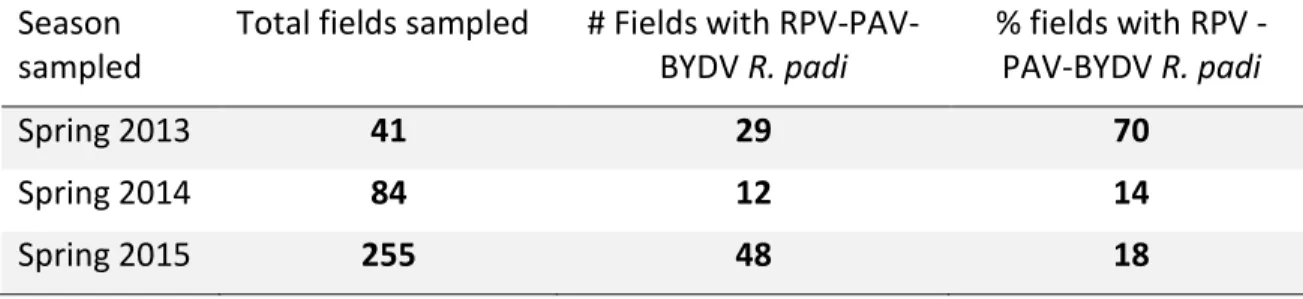
Table 2.1: Total number of wheat fields sampled across Kansas in 2013, 2014, and 2015; number of fields containing R. padi with RPV-PAV-BYDV and % of fields with R. padi containing RPV-PAV-BYDV (RPV-PAV-BYDV is the combined detection of the RPV and PAV BYDV strains). ... 11 Table 2.2: RPV-PAV-BYDV viruliferous R. padi collected in wheat fields of Kansas counties
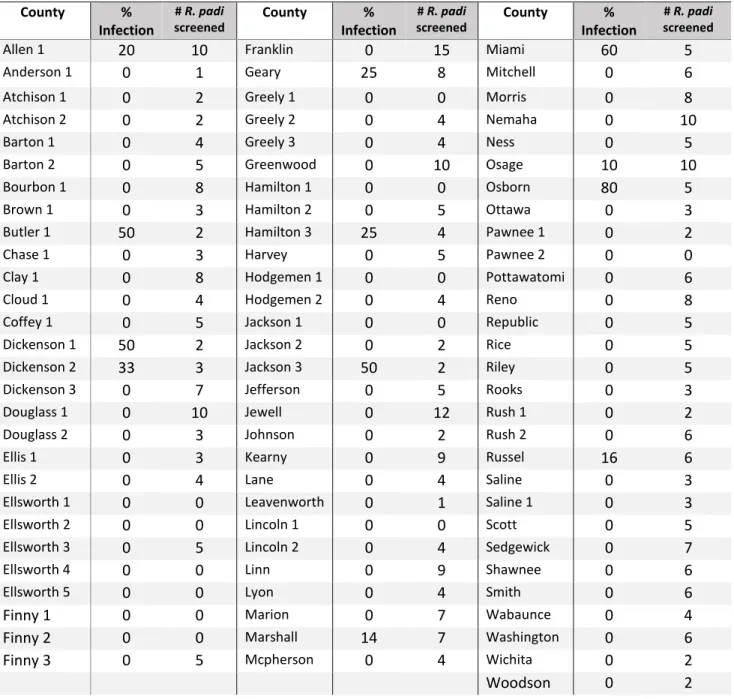
2013 (RPV-PAV-BYDV is the combined detection of the RPV and PAV BYDV strains). 12 Table 2.3: RPV-PAV-BYDV viruliferous R. padi collected in wheat fields of Kansas counties in 2014 (RPV-PAV- BYDV is the combined detection of the RPV and PAV BYDV strains).13 Table 2.4: RPV-PAV-BYDV viruliferous R. padi collected in wheat fields of Kansas counties in 2015 (RPV-PAV BYDV is the combined detection of the RPV and PAV BYDV strains). 14
Acknowledgements
I want to start off by thanking the people who got me into Entomology: Dr. Gregory Zolnerowich who first taught me about insects and Dr. Tony Joern for my first technician job. In the job for Tony, I met Angela Laws, Jesus Gomez, and Ellen Welti who were all a great
influence on my love of insects. In my undergrad, Jesse Nippert was a mentor who gave me really good advice and pushed me to challenge what I think I can and can’t do.
I want to thank my advisor Dr. Michael Smith for taking a chance on me, since I would be starting my graduate program under academic probation. He’s given me a lot of advice and feedback on my writing, and given me the freedom to shape my project.
I want to thank the post docs in the lab who helped me learn the skills necessary to collect and analyze my data: Dr. Wen Po Chong, Dr. Alicia Timm. I also want to say thank you to my lab mates who have given me support and helped me learn how to be a better student, a harder worker, and helped me with my projects: Luaay Khalaf, Lina Aguirre-Rojas. And thanks to my wife Kelsey Girvin for helping me with everything.
Dedication
Chapter 1 - Literature Review
Wheat
Wheat, family Poaceae, is a domesticated grass originating in the Levant region of the Middle East [Shewry 2009]. Wheat is one of the earliest cultivated crops and has been associated with the emergence of settled agrarian culture [Feldman and Kislev 2007]. Wheat is composed of multiple species of the genus Triticum. The six key species are T. aestivum, T. monococcum, T. dicoccoides, T. dicoccum, and T. durum [Dvorak et al 2012]. Wheat is a temperate crop, grown above the tropics, accounting for approximately 20% of the caloric intake of the peoples living there [FAOSTAT 2015]. Wheat is the third largest crop grown globally, with 6.9 million metric tons grown in 2010 [FAOSTAT 2015]. In Kansas, wheat is one of the most important crops grown, accounting for over 50% of annual production. Wheat can be grown as spring wheat planted in spring and harvested in fall, or winter wheat planted in the fall and harvested in early summer. Wheat requires about 3 months to mature, in both spring and winter planting, during which time plants progress through nine distinct physiological phases [Satorre and Slafer 1999]. Wheat defence against herbivory, in agricultural and ecological systems, are often referred to as host plant resistance, and consist of three main categories: antibiosis, antixenosis, and tolerance [Smith 2005]. In smith (2005) wheat plant resistance prevents loss of yield to many pests, but the pest of interest for this study that plagues the wheat cropping system is the bird cherry oat aphid,
Rhopalosiphum padi L. and a viral pathogen vectored by R. padi, barley yellow dwarf virus (BYDV).
Bird cherry oat aphid
Insects utilize plant resources very efficiently, which comes into conflict with the use of plants as a food source for humans. Insects have many strategies to extract plant resources, some causing physical damage and actively taking biomass from the plant, and others superficially causing little damage but drinking the phloem, which causes plant stress. Several of the most devastating insect pests belong to the insect order Hemiptera superfamily: Aphididae [Dixon, 1985].
Aphids are a group of piercing-sucking insects that are characterized primarily by their ability to reproduce asexually and the presence of cornicles that produce defensive fluids. This enables them to produce extremely large populations in a short amount of time, exerting more stress on plants they inhabit. Aphids have a fairly unique feeding mechanism. Even though piercing-sucking mouthparts appear in other orders, aphids directly tap into the plant’s vascular tissue with their stylets. Aphids bypass many traditional host plant resistance mechanisms by being “stealthy”, and not eliciting jasmonic acid defense responses in the plant [Kuśnierczyk et al 2011]. This feeding is stealthy but still causes significant damage because of saliva and pathogens injected into the plant that cause a cascade of other effects besides feeding damage [Dixon, 1985]. Aphids are considered a superpest because of their ability to quickly achieve large populations, their ability to develop a winged life stage that allows long distance migration, and their ability to transmit diseases [Van Emden and Harrington 2007].
The major aphid species of interest to this thesis is Rhopalosiphum padi L., the bird cherry oat aphid. Rhopalosiphum padi is recognized as one of the grain aphids causing
significant damage to all Poaceae crops [Van Emden and Harrington 2007], but it is known more as a highly effective vector of viral plant diseases [Leather et al 1989].
In Dixon (1985) aphids move long distances in response to two biological cues:
appetitive dispersal and long-distance migration. Appetitive dispersal is characterized by flying behavior resulting from over-crowding or poor food source quality. Migratory behavior is characterized by a strong attraction to ultraviolet radiation for a short duration [Dixon 1985]. According to Tjallingii (1978) when aphids feed, they use chemoreceptors in their mouthparts to taste and find appropriate feeding sites, and then make an initial opening with the sclerotized beak-like stylet sheath containing their mouthparts. The hollow grooves inside the sheath allow for the stylet to move into the plant. The aphid stylet mouthparts search the plant for vascular tissue and determine host suitability [Tjallingii 1978]. The flexible sheath is very thin and needs a protective coating of hardened saliva secreted during feeding probes to protect against plant physical barriers. Aphids occasionally puncture cells with their stylets, ingesting cytoplasm and tasting it. According to Mutti et al (2006) once the aphid finds the phloem, it stops secreting the hard, protective sheath saliva and begins to secrete digestive saliva a cocktail of effector proteins and enzymes [Mutti et al 2006]. Saliva shuts down defensive pathways in the plant, allowing for uninterrupted feeding. In the case of R. padi, digestive saliva does not cause chlorosis or the generation of a feeding site like other aphids. Rhopalosiphum padi will feed at this particular site for the duration of its life if conditions do not become intolerable [Dunn et al 2007,
Giordaneengo et al 2010].
Viral transmission
The feeding site created by aphids is an easy access point for pathogens to enter the plant, since it is a maintained, open wound [Stroyan 1997]. Possibly the most destructive aspect of aphid infestations is their capacity to transmit diseases. The ability of aphids to tap into the plant’s vascular system and suppress its defenses makes it an ideal vector for a myriad of
diseases. Plant diseases can be transmitted in multiple fashions, the three most common being the non-circulative method, the circulative method, and the propagative method [Schumann and D’arcy 2010]. Non-circulative transmission is when an aphid feeds on an infected plant, the pathogenic agent becomes embedded in the stylet, binds with membrane-bound proteins and is carried for a short period of time before being introduced into a new host plant. Circulative transmission is when infected phloem is ingested, pathogenic agent enters the aphid gut and salivary glands before being injected into a new host with the saliva. Circular-propagative transmission is when the pathogen behaves similarly to the circulative method but also infects the insect, allowing the pathogen population to increase separately from an infected host plant [Gray and Gildow 2003].
Barley yellow dwarf virus
Many diseases exploit plant resources. The disease most pertinent to this thesis is BYDV. BYDV and cereal yellow dwarf virus are lumped into the same group because they cause similar symptoms, and are both transmitted by aphids in a circulative manner [Gray 1999]. Yellow dwarf viruses are physiologically and phylogenetically similar, both being icosahedral in shape and in the Luteoviridae family [Henry and McNab 2002]. They are both positive sense, single-stranded RNA without highly adenated transcribing regions [Malmstrom and Shu 2004]. BYDV is globally present and causes substantial yield loss wherever it occurs [McKirdy et al 2002]. Barley yellow dwarf virus is only compatible with plants of the family Poaceae and cannot infect dicotyledonous plants. BYDV has an obligate vector, being only transmitted by aphids compatible with the particular strain of yellow dwarf virus. There are six strains of yellow dwarf virus that have varying levels of transmission by different aphid species [Plumb 1974]. The strains also have varying levels of severity that correspond to the host plant. Yellow dwarf
viruses can only be transmitted by their vectors, so the vector population biology is completely linked to yellow dwarf transmission. Yellow dwarf virus’s name is useful as it describes two of its most recognizable symptoms: yellowing (chlorosis) and dwarfism (stunting) [D’Arcy and Burnett 1995]. This damage can cause moderate to total plant production loss. The virus has two hosts: its aphid vector and the host plant. The virus is brought into the aphid with infected phloem, and the virons pass through a membrane-bound protein in the gut lining. The viral particles then migrate through the hemolymph to the salivary glands, passing first through the transparent organ and then accumulate in the accessory tissue of the salivary gland [Pieffer et al 1997]. When the aphid starts to feed, the virons are introduced into the plant via saliva. While in the host plant, the virus penetrates the plant cell walls and replicates [Miller and Rasochova 1997].
Objectives
The major knowledge gaps addressed in this thesis are the lack of understanding of R. padi resistance in currently grown Kansas wheat varieties and the effect of imidacloprid seed treatment on the R. padi vector of BYDV transmission. BYDV is detected frequently in Kansas, but the extent to which the virus occurs has not been quantified. Many variables impact BYDV persistence, movement, and transmission that can drive outbreaks. The potential prevention of R. padi and BYDV damage through host plant resistance prompted the assessment of wheat
varieties commonly grown in Kansas for R. padi resistance. One of the questions from Kansas producers has been if insecticidal wheat seed treatments protect plants from BYDV infection. Results of a greenhouse experiment indicate that imidacloprid insecticide is highly effective in reducing R.padi populations but treatment of plants at recommended doses does not stop BYDV infection [appendix A]. The geographic distribution of BYDV and its concentration, also major
concerns of Kansas wheat producers, prompted the mapping of BYDV virus concentration as a starting point to asses BYDV risk in Kansas wheat production.
Chapter 2 - Barley yellow dwarf virus presence across Kansas
Introduction
Winter wheat Triticum aestivum (L.) is the third-largest field crop produced in the United States, which produces more than 2 billion bushels of wheat per year [USDA ERS 2011, 2012, 2013, and 2014]. The state of Kansas produced 240 million bushels of wheat in 2014,
representing a billion dollar industry [USDA ERS 2014]. Wheat is expected to be grown more as climates around the world become drier due to climate change and will become even more important as a source of nutrition [Ortiz et al 2008].
A global and severe disease of wheat is Barley yellow dwarf virus (BYDV) which occurs annually in Kansas, but prevelance, distribution, and epidemiology of this virus is poorly
understood. Yield losses due to BYDV in wheat are substantial, ranging from 1,300 to 2,700 kg/ha [McKirdy et al 2002]. BYDV has multiple strains, some varying in their severity. The most severe strain of BYDV is RPV, which stands for Rhopalosiphum padi virus.
Rhopalosiphum padi (L), the bird cherry oat aphid, effectively vectors RPV-BYDV, with transmission efficiency in the range of 70% [Gray et al 1991]. In Kansas, R. padi is the aphid most commonly associated with BYDV infections [Whitworth and Ahmad 2010]. For these reasons, R. padi was used as the monitoring organism in viral surveys in 2013, 2014, and 2015. Other aphids that commonly occur in Kansas and also vector BYDV are the corn leaf aphid,
Rhopalosiphum maidis L., the English grain aphid, Sitobion avenae (Fab.) and greenbug,
Schizaphis graminum Rondani, which were included in the survey in this study.
BYDV causes a variety of symptoms such as stunting and chlorosis, and can lead to plant mortality or plant sterility [Fauquet et al 2005]. BYDV infection is difficult to identify because many other plant pests and environmental factors can cause similar symptoms, leading to
problems of misidentification of BYDV [Loi et al 2004]. The problem of misidentification is exacerbated by the fact that BYDV is an RNA virus and degrades quickly after plant or aphid mortality, requiring special sampling procedures. The only accurate and satisfactory way to diagnose BYDV is with molecular techniques, such as ELISA or PCR amplification and electrophoresis [Miller and Rasochova 1997]. The goal of this research was to investigate the distribution of BYDV in R. padi in Kansas in multiple years. The spatial and temporal data maps provides useful information to forecast the risk of damage by BYDV.
Materials and methods
Aphid collection and field selection
Aphids were collected from wheat fields in 2013 by multiple technicians, using canvas sweep nets and a non-standard transect for an undetermined amount of time or number of sweeps. In 2014, the number of sweeps per field was standardized to 250, and in 2015 this number was reduced to 100 sweeps. Field selection was random, and fields were deemed acceptable to sample if plants appeared green. Sampled aphids were transferred from nets to plastic 0.38 L Ziploc® bags and kept in a cooler stocked with ice to reduce insect mortality until returning to the lab. The same field selection and storing methods were used in 2014 and 2015. Live aphids were selected from the samples, frozen in liquid nitrogen and stored at -80oC for later extraction. GPS location was recorded at each field site with a hand held Garmin® GPS for mapping. In 2015, the distance between sampled fields was maintained to at least 8 km.
In 2013, 41 fields were sampled; in 2014, 84 fields; and in 2015, 255 fields were sampled (Table 2.1). Samples were collected in 2013 between May 13th and June 16th (34 days); in 2014, between May 12th and June 9th (27 days); and in 2015, between the 18th of April and the 7th of June (50 days). All plants were sampled in physiological stages 8 to 11 on the Feekes plant
growth scale [Miller 1999]. Specimens used in this research are deposited as voucher number 242 in the KSU Museum of Entomological and Prairie Arthropod Research
RNA extraction
In order to detect the RNA virus in aphid sample, total RNA from whole body of a single aphid was extracted using the TRIzol method [Chomczynski and Sacchi 1987]. A maximum of 10 aphids per field site were randomly chosen for the test. For RNA extraction from a single aphid, 80 µl of TRIzol was added to a 1.7 mL centrifuge tube, and the aphid was homogenized in TRIzol for less than 1 min using an electric hand mortar and pestle. 50 µl of chloroform was added to the homogenized mixture, the tube was vortexed and left to incubate at room
temperature for 3 min, moved to a centrifuge cooled to 5oC and spun at 12,000 g for 15 min. The upper phase was collected and precipitated by adding 50 µl of isopropanol after a brief vortex and incubation at room temperature for 3 min. The mixture was then centrifuged in a 5oC centrifuge for 10 min at 12,000 g. The pellet was washed with 50µl of 75% ethanol for three times total. The pellet was resuspended in 10 µl of DDH2O. The RNA concentration was assessed using a Nanodrop 2000 for the ratio A260nm/A280nm. The samples were stored in -80
oC until the use for reverse transcription. Concentrations of the majority of samples were 30
ng/µl of RNA or higher, but the samples with lower concentrations than 30 ng/µl were excluded in the subsequent PCR diagnostic test.
Reverse transcription, PCR and electrophoresis
Reverse transcription of RNA to single-stranded DNA was performed with Applied Biosystems High Capacity cDNA Reverse Transcription Kit® (Applied Biosystems, Foster City, CA) using forward and reverse primers that binds to the PAV and RPV viral strains outlined in [Malmstrom and Shu 2004]. PCR of ssDNA was preformed using Promega GoTaq® Green
Master Mix (Promega life sciences, Madison, WI) following manufacturer’s instructions for a 25µl reaction volume. PCR and electrophoresis was performed using the protocol and primers for PAV outlined in [Fabre et al 2012]. PCR products were analyzed by electrophoresis on a 2.5% agarose gel and visualized under UV illumination. Glycerol & bromophenol blue dye was used when loading PCR products to reduce loss of products into ETH buffer.
Results
Total Kansas BYDV
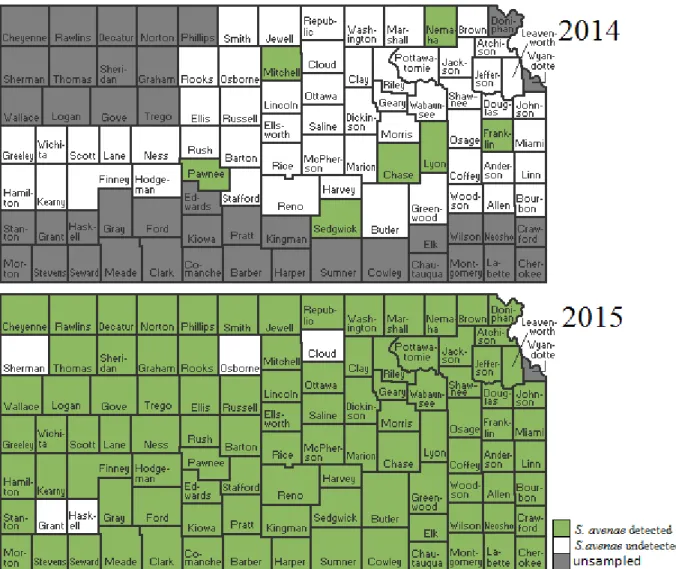
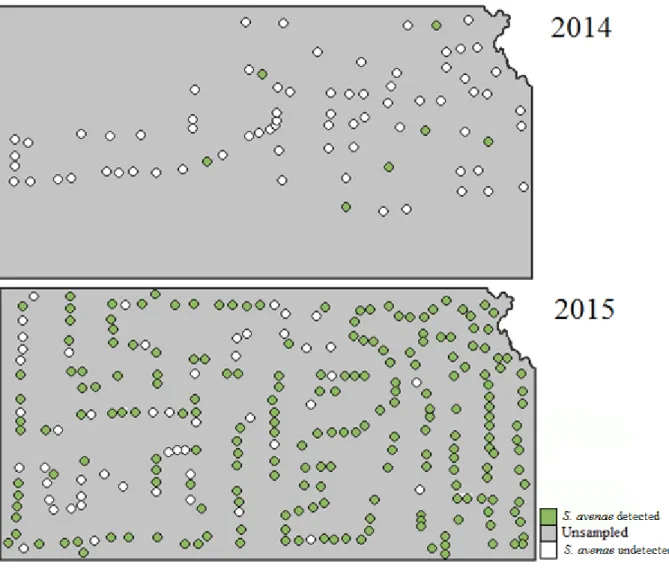
Spring surveys of wheat fields in 2013, 2014, and 2015 gave information on the relative abundance of the PAVand RPV isolates of BYDV across Kansas (Table 2.1). In 2013, 70% of fields contained R. padi that were viruliferous for PAV-RPV-BYDV. In 2014, only 14% of fields contained R. padi that were viruliferous for PAV-RPV-BYDV, and in 2015, only 18% of fields contained R. padi viruliferous for PAV-RPV-BYDV. Tables 2.2 through 2.4 give more specific information for PAV-RPV-BYDV infection by county, cite, and R. padi sample size. To better visualize these data, a colored map representing the mean percent viruliferous R. padi found by county (Figure 2.1) and by sample site (Figure 2.2) were created. These figures illustrate how PAV-RPV-BYDV concentrations change annually, as evidenced by regions with a high presence of virus one season having none the next year. The composition of aphid vector species also changed rapidly from 2014 to 2015, with some species being detectable in some years and not in other years (Figures 2.3 through 2.10).
Table 2.1: Total number of wheat fields sampled across Kansas in 2013, 2014, and 2015; number of fields containing R. padi with RPV-PAV-BYDV and % of fields with R. padi containing RPV-PAV-BYDV (RPV-PAV-BYDV is the combined detection of the RPV and PAV BYDV strains).
Season sampled
Total fields sampled # Fields with
RPV-PAV-BYDV R. padi % fields with RPV -PAV-BYDV R. padi Spring 2013 41 29 70 Spring 2014 84 12 14 Spring 2015 255 48 18
Table 2.2: RPV-PAV-BYDV viruliferous R. padi collected in wheat fields of Kansas counties 2013 (RPV-PAV-BYDV is the combined detection of the RPV and PAV BYDV strains). County % infection # R. padi screened County % Infection # R. padi screened Atchison 1 90 10 Marion 1 33 9 Atchison 2 0 10 Marion 2 40 10 Brown 1 80 10 Marshall 1 50 10 Brown 2 60 5 Mcpherson 1 0 2 Butler 1 10 10 Mitchell 1 0 10 Butler 2 100 1 Mitchell 2 11 9 Butler 3 80 10 Morris 1 <10 9 Chase 1 56 9 Nemeha 1 40 10 Cheyenne 1 50 6 Nemeha 2 20 10 Clay 2 0 10 Pottawatomie 1 70 10 Clay 3 10 10 Reno 1 10 10 Cloud 2 10 10 Republic 1 0 10 Crawford 1 100 10 Riley 1 70 10 Dickinson 1 0 0 Riley 2 20 10 Dickinson 2 50 2 Saline 1 0 10 Dickinson 3 67 3 Saline 2 90 10 Dickinson 4 25 4 Saline 3 17 6 Dickinson 5 0 7 Sherman 1 0 2 Geary 1 0 10 Wilson 1 20 10 Jefferson 1 30 10 Wilson 2 20 10 Jewell 1 <10 9 Wilson 3 10 10 Lincoln 1 10 10 Logan 1 0 1 Lyon 1 0 10
Table 2.3: RPV-PAV-BYDV viruliferous R. padi collected in wheat fields of Kansas
counties in 2014 (RPV-PAV- BYDV is the combined detection of the RPV and PAV BYDV strains). County % Infection # R. padi screened County % Infection # R. padi screened County % Infection # R. padi screened
Allen 1 20 10 Franklin 0 15 Miami 60 5
Anderson 1 0 1 Geary 25 8 Mitchell 0 6
Atchison 1 0 2 Greely 1 0 0 Morris 0 8
Atchison 2 0 2 Greely 2 0 4 Nemaha 0 10
Barton 1 0 4 Greely 3 0 4 Ness 0 5
Barton 2 0 5 Greenwood 0 10 Osage 10 10
Bourbon 1 0 8 Hamilton 1 0 0 Osborn 80 5
Brown 1 0 3 Hamilton 2 0 5 Ottawa 0 3
Butler 1 50 2 Hamilton 3 25 4 Pawnee 1 0 2
Chase 1 0 3 Harvey 0 5 Pawnee 2 0 0
Clay 1 0 8 Hodgemen 1 0 0 Pottawatomi 0 6
Cloud 1 0 4 Hodgemen 2 0 4 Reno 0 8
Coffey 1 0 5 Jackson 1 0 0 Republic 0 5
Dickenson 1 50 2 Jackson 2 0 2 Rice 0 5
Dickenson 2 33 3 Jackson 3 50 2 Riley 0 5
Dickenson 3 0 7 Jefferson 0 5 Rooks 0 3
Douglass 1 0 10 Jewell 0 12 Rush 1 0 2
Douglass 2 0 3 Johnson 0 2 Rush 2 0 6
Ellis 1 0 3 Kearny 0 9 Russel 16 6
Ellis 2 0 4 Lane 0 4 Saline 0 3
Ellsworth 1 0 0 Leavenworth 0 1 Saline 1 0 3
Ellsworth 2 0 0 Lincoln 1 0 0 Scott 0 5
Ellsworth 3 0 5 Lincoln 2 0 4 Sedgewick 0 7
Ellsworth 4 0 0 Linn 0 9 Shawnee 0 6
Ellsworth 5 0 0 Lyon 0 4 Smith 0 6
Finny 1 0 0 Marion 0 7 Wabaunce 0 4
Finny 2 0 0 Marshall 14 7 Washington 0 6
Finny 3 0 5 Mcpherson 0 4 Wichita 0 2
Table 2.4: RPV-PAV-BYDV viruliferous R. padi collected in wheat fields of Kansas counties in 2015 (RPV-PAV BYDV is the combined detection of the RPV and PAV BYDV strains). County % Infection # R. padi screened County % Infection # R. padi screened County % Infection # R. padi screened
Allen 1 0 0 Greenwood2 40 10 Osage1 12 8
Allen 2 70 10 Greenwood3 0 0 Osborne1 0 0
Anderson 1 0 0 Hamilton1 0 1 Osborne2 0 1
Anderson 2 0 0 Hamilton2 0 7 Osborne3 0 0
Anderson 3 0 2 Harper1 33 3 Ottawa1 0 1
Atchison 1 10 6 Harper2 80 10 Ottawa2 0 0
Atchison 2 25 8 Harper3 0 0 Pawnee1 0 0
Barber 1 0 0 Harvey1 0 0 Pawnee2 0 0
Barber 2 0 0 Harvey2 0 0 Phillips1 0 0
Barton 1 0 0 Harvey3 0 0 Phillips2 0 0
Barton 2 0 0 Haskell1 0 0 Pottawatomie1 50 6
Barton 3 0 0 Haskell 2 0 0 Pottawatomie2 57 7 Bourbon 1 50 10 Haskell3 0 0 Pottawatomie3 70 10
Bourbon 2 44 9 Hodgeman1 0 0 Pratt1 0 0
Brown 1 40 10 Hodgeman2 0 0 Pratt2 0 2
Brown 2 0 9 Hodgeman3 0 0 Pratt3 0 0
Butler 1 0 0 Jackson1 1 1 Rawlins1 0 1
Butler 2 0 0 Jackson2 83 6 Rawlins2 0 0
Chase 1 0 0 Jackson3 0 0 Rawlins3 0 0
Chase 2 0 0 Jefferson1 0 0 Reno1 0 2
Cherokee 1 0 0 Jefferson2 0 0 Reno2 0 3
Cherokee 2 100 2 Jefferson3 0 0 Reno3 0 2
Cherokee 3 66 3 Jewell1 0 0 Rice1 0 1
Cheyenn 1 25 4 Jewell2 0 0 Rice2 0 0
Cheyenn 2 0 0 Jewell3 0 0 Rice3 0 1
Cheyenn 3 0 0 Johnson1 33 3 Riley1 40 10
Clay 1 50 10 Johnson2 20 5 Riley2 40 5
Clay 2 0 0 Kearny1 0 0 Riley3 66 3
Cloud 1 0 0 Kearny2 0 1 Rooks1 0 2
Cloud 2 0 0 Kearny3 0 0 Rooks2 0 1
Clark 1 0 0 Kingman1 0 1 Rush1 0 0
Coffey 1 100 4 Kingman2 0 1 Rush2 0 0
County % Infection # R. padi screened County % Infection # R. padi screened County % Infection # R. padi screened
Coffey 3 0 0 Kio2 0 0 Russell1 0 0
Comanche1 100 1 Labette1 0 2 Russell2 0 2
Comanche2 0 0 Labette2 0 0 Saline1 0 0
Comanche3 0 1 Lane1 0 4 Saline2 100 2
Cowly1 0 0 Lane2 0 0 Saline3 0 0
Cowly2 0 0 Lincoln1 0 0 Scott1 0 0
Cowly3 0 0 Lincoln2 0 0 Scott2 0 0
Chantaqua1 0 0 Linn1 60 10 Sedgwick1 0 0
Crawford1 0 0 Linn2 66 3 Sedgwick2 0 0
Crawford2 0 0 Logan1 0 0 Sedgwick3 0 0
Crawford3 50 2 Logan2 0 0 Seward1 0 0
Decatur1 0 0 Logan3 0 0 Seward2 0 0
Decatur2 0 0 Leavnworth1 14 7 Seward3 0 0
Decatur2' 0 0 Leavnworth2 25 4 Sherman1 0 5
Dickenson1 0 0 Leavnworth3 10 10 Sherman2 0 0
Dickenson2 0 0 Lyon1 0 0 Sherman3 0 0
Dickenson3 0 0 Lyon2 0 10 Shridan1 0 0
Doniphan1 0 10 Lyon3 0 10 Shridan2 0 0
Doniphan2 0 5 Marion1 0 0 Shridan3 0 0
Douglas1 0 2 Marion2 0 0 Shwn1 80 10
Douglas2 20 10 Marion3 0 0 Smith1 0 7
Douglas3 0 0 Marshall1 10 10 Smith2 0 0
Edwards1 0 0 Marshall2 40 5 Smith3 0 0
Edwards2 0 0 Marshall3 14 7 Stafford1 0 0
Ellis1 0 3 Mcpherson1 0 0 Stafford2 0 0
Ellis2 0 0 Mcpherson2 0 0 Stanton1 0 0
Elk1 0 1 Mcpherson3 0 0 Stanton2 0 5
Elk2 0 10 Mead1 0 0 Stanton3 0 0
Elk3 0 3 Mead2 0 0 Stevens1 0 0
Ellsworth1 0 1 Miami1 0 0 Stevens2 0 0
Ellsworth2 0 0 Miami2 90 10 Sumner1 0 0
Finney1 0 0 Mitchell1 0 0 Sumner2 0 0
Finney2 0 2 Mitchell2 0 0 Sumner3 0 1
Ford1 0 0 Montgomery1 0 3 Thomas1 0 3
Ford2 0 0 Montgomery2 0 0 Thomas2 0 0
Frnklin1 0 2 Montgomery3 0 2 Trego1 0 0
Frnklin2 66 3 Morris1 0 0 Trego2 0 0
Frnklin3 66 9 Morris2 0 0 Wabaunsee1 0 7
Geary1 0 0 Morton1 0 0 Wabaunsee2 0 1
Geary2 0 0 Morton2 0 0 Wabaunsee3 0 0
County % Infection # R. padi screened County % Infection # R. padi screened County % Infection # R. padi screened
Gove2 0 0 Nemaha1 0 0 Wallace2 0 5
Graham1 0 0 Nemaha2 0 1 Washington1 0 6
Graham2 0 0 Nemaha3 33 3 Washington2 0 0
Gray1 0 0 Neosho1 0 2 Washington3 0 0
Gray2 0 1 Neosho2 0 2 Wichita1 0 4
Greeley1 0 8 Neosho3 0 0 Wichita2 0 0
Greeley2 0 7 Ness1 0 0 Wilson1 0 0
Greeley3 0 0 Ness2 0 1 Wilson2 100 5
Grant1 0 0 Ness3 0 0 Wilson3 0 0
Grant2 0 0 Norton1 0 0 Woodson1 100 1
Figure 2.1: Mean percent of R. padi sampled that were viruliferous for RPV-PAV-BYDV in Kansas counties during 2013, 2014, and 2015. Counties that were sampled but R. padi was absent are categorized as undetected.
Figure 2.2: Mean percent of RPV-PAV-BYDV viruliferous R. padi sampled in Kansas in 2013, 2014 and 2015. Dots represent sample sites. Sites that were sampled but R. padi was absent are categorized as undetected.
Figure 2.3: Incidence of R. padi detected in samples across Kansas in 2014 and 2015. Dots represent sample site. Sites that were sampled but R. padi was absent are categorized as undetected.
Figure 2.4: Incidence of R. padi in samples, by Kansas counties in 2014 and 2015. Counties that were sampled but R. padi was absent are categorized as undetected.
Figure 2.5: Incidence of S. avenae in samples, by Kansas counties in 2014 and 2015. Counties that were sampled but S. avenae was absent are categorized as undetected.
Figure 2.6: Incidence of S. avenae in Kansas in 2014 and 2015. Dots represent sample site. Sites that were sampled but S. avenae was absent are categorized as undetected.
Figure 2.7: Incidence of S. graminum in Kansas counties in 2014 and 2015. Counties that were sampled but S. graminum was absent are categorized as undetected.
Figure 2.8: Incidence of greenbug S. graminum in Kansas in 2014 and 2015. Dots represent sample site. Sites that were sampled but S. graminum was absent are categorized as
undetected.
Discussion
Little is known about the ecological interactions between RPV-PAV-BYDV and R. padi, due perhaps to R. padi having a complex host-altering life cycle and BYDV having multiple strains. The annual changes in the percent of RPV-PAV-BYDV viruliferous R. padi observed in 2013, 2014, and 2015 add insight into these interactions, showing that BYDV persistence and introduction are determined on a yearly basis. This result poses potential problems for effective BYDV management, because knowing the percent of RPV- PAV-BYDV viruliferous R. padi in a region does not necessarily extend to a better understanding of BYDV infection in an
individual wheat field. This limitation makes individual field-based scouting less accurate in monitoring BYDV [Lister 1985].
2014 and 2015 had extreme differences, in rainfall and aphid species vector composition. Different aphid species vector different BYDV strains, to modify the viral landscape [Rochow 1970, Gray et al 1991]; indicating that screening BYDV in one species of aphid vector alone will not give a complete picture of BYDV ecology. Schizaphis graminum, R. padi, and S. avenae, the primary grain aphids and BYDV vectors of Kansas, should be sampled equally to accurately determine BYDV infection. Species carrying the most damaging and most common virus strains are good candidates for a robust monitoring system.
Eastern Kansas varies markedly from western and central Kansas in elevation,
precipitation and soil type. Determination of which of these features make different regions more likely to have BYDV viruliferous aphid vectors is now needed to improve wheat pest
Chapter 3 - Host plant resistance of select wheat (
Triticum aestivum
)
varieties to
Rhopalosiphum padi
Abstract
The bird cherry oat aphid, Rhopalosiphum padi L., is one of the most effective vectors of barley yellow dwarf virus (BYDV), and is a common pest of wheat in Kansas [Grey 1991, Whitworth and Ahmad 2010]. The Kansas State University Agricultural Experiment Station and Cooperative Extension Service release annual ratings of wheat variety disease and insect rating [DeWolf et al. 2015]. However, varietal reactions to R. padi are not included. Results of research described below identified varieties of wheat in DeWolf et al (2013) with R. padi resistance. The varieties Pioneer (S) 25R77 and Limagrain LCS Mint exhibited antibiosis, suppressing R. padi
populations. MFA (S) 2248 and Pioneer (S) 25R40 exhibited antixenosis, indicating that when given a choice, R. padi preferred other wheat varieties. MFA (S) 2248, Pioneer (S) 25R40 and Limagrain LS Wizard all exhibited tolerance, having no significant loss in biomass, compared to susceptible varieties, after R. padi infestation.
Introduction
The bird cherry oat aphid, Rhopalosiphum padi L., is one of the most economically important wheat pests in Kansas, and is the aphid most commonly associated with Barley yellow dwarf virus (BYDV) in Kansas. According to Gaunce (2014), Kansas wheat producers lose 20%-30% of crop yields to BYDV and can lose up to 40% if R. padi is present in high numbers [Gaunce 2014]. Identifying wheat varieties resistant to both R. padi and BYDV could be a very useful tool in preventing yield losses to these pests [Smith 2014, Dunn et al 2007]. Most of its damage stems from its ability to vector the most damaging strains of barley yellow dwarf virus,
BYDV [Razmjou et al 2012]. One of the most economically effective methods of preventing damage from insects is through selecting resistant wheat varieties. An increase in productivity on a field level can be very substantial. With a small net gain in individual plant productivity that can scale up to a massive net gain [Gatehouse et al 2011]. Kansas State University Agricultural Experiment Station and Cooperative Extension Service releases “Wheat Variety Disease and Insect Ratings” that highlights commonly grown varieties of wheat and their pest resistance ratings. Varietal ratings of R. padi resistance or susceptibility are lacking in this piublicatin, and if presented would add more information to this publication that producers can use to make informed decisions about varietal selection. The objectives of this study were to screen varieties of wheat commonly grown in Kansas for R. padi resistance and to determine if resistance is expressed as antibiosis, antixenosis and/or tolerance.
Materials and methods
Initial Screening
Seed of varieties of wheat included in the 2013 Wheat Varietal Disease and Insect Ratings [DeWolf 2013] were germinated under R. padi feeding pressure in a common garden, in a non-experimental manner. Plants of the varieties Pioneer (S) 25R77, Pioneer (S) 25R40, Limagrain LS Wizard, Limagrain LCS Mint, Limagrain T153, Limagrain T158, and MFA (S) 2248 survived 120-180 days after infestation and were tested in replicated experiments, .
Potting and caging
Plants were grown in 5.5 x 5.5 x 5.5 cm plastic pots. Seeds were sown in 1.5 cm deep in peat moss and plants were caged to prevent R. padi escape or mortality from outside sources. Plants in pots were caged in 61 x 30.5 x 30.5 cm Bioquip® collapsible cages (BioQuip Products Inc. Rancho Dominguez, CA) covered with mite-proof mesh. Pots were bottom-watered in a
tray, and water was added when the tray was dry. The temperature of the greenhouse fluctuated between 15.5 and 21 °C and the photoperiod was 14:10 [L:D].
Antixenosis
In antixenosis tests, each plant was infested with 5 adult aphids delivered to a plant on a 1 x 1 cm cutting of the original host plant, barley variety 8:12. Aphids were counted every 2 days for 14 days. The choice test cages contained three pots, each with a plant of the seven varieties of wheat, plus three pots of the susceptible control, Jagger. The 24 pots were placed in the cages in a completely random design, using a random generator to decide pot placement. A total of 18 cages of 24 plants were processed for R. padi feeding choice.
Antibiosis and Tolerance
In the antibiosis and tolerance test, 25 two leaf stage plants were infested with three adult aphids each, delivered to each plant on a 1 x 1 cm cutting of their original host plant, barley veriety 8:12. Aphids on each plant were counted every 2 days for 14 days and plants were allowed to grow to the six leaf stage, which took about 28 days. This was repeated two times for each of the eight wheat varieties. In one set of cages, plants were infested with R. padi, and the second set of cages were left uninfested. A third replication was done having only three plants of each variety instead of 25. After 28 days, previously infested and uninfested plants were
harvested and dried for 24 hours in a 27 °C dryer. To asses tolerance the dry biomass of each plant was measured using an electronic scale, and percent loss of biomass was calculated with the equation [(uninfested biomass – infested biomass) / uninfested biomass] [Reese et al 1994]. The 3 cages were arranged on green house benches in a completely random design.
Statistical Analysis
Analyses of variance of all data were conducted using a generalized Minitab 17 model [Minitab 17 2010] When the F- test was significant at P < 0.05, pairwise comparisons were conducted useing a Tukey’s HSD test and 95% confidence level, since the number of possible comparison combinations was small.
Results
The trial testing for antibiosis indicated that Pioneer (S) 25R77 and Limagrain LCS Mint caused statistically significant reductions in R. padi populations, categorizing them as antibiotic to R. padi [Figure 3.1]. Both varieties reduced R. padi populations by 40% compared to the susceptible Jagger control. In plants allowed to grow an additional 14 days post infestation, dry biomass comparisons showed three of the seven varieties tested to be more tolerant than the susceptible Jagger control. Plants of varieties MFA (S) 2248, Pioneer (S) 25R40, and Limagrain LS Wizard infested with R. padi had very similar mean above ground dry biomass compared to uninfested counterparts, indicating these varieties tolerated R. padi feeding [Figure 3.2].
In the antixenosis (choice) test, R. padi populations were allowed to grow for 14 days, but the initial decision of which plant to feed on is most important [Figure 3.3]. Aphids chose to abandon the varieties Pioneer (S) 25R40 and MFA (S) 2248 in significant numbers at 24 hours post infestation, with some plants having no aphids. Over time, populations in the cages increased and aphid densities caused appetitive dispersal to occur.
Figure 3.1: Mean number of R. padi on 8 varieties of wheat after 14 days of infestation. Means that do not share a letter are significantly different using Tukey’s HSD test analysis of means. N=3, 95% CI, F=33.1 0 20 40 60 80 100 120 M e an ± S E # o f R . p ad i Wheat variety A A B B B B B C
Figure 3.2: Mean proportional weight of above ground biomass loss (DWT) of wheat plants uninfested and infested with R. padi. Percent loss of biomass was calculated with the
equation (uninfested plant biomass – infested plant biomass) / uninfested plant biomass. Means that do not share a letter are significantly different using Tukey HSD test. N=3, 95% CI, F= 9.24 0 0.1 0.2 0.3 0.4 0.5 0.6 M e an ± S D Pep o rtion ab o ve gr o u n d b io m ass l o ss Wheat variety BC BC C A AB AB AB AB
Figure 3.3: Mean number of R. padi aphids on 8 varieties of wheat after 24 hours of infestation with 5 adult R. padi. Means that do not share a letter are significantly different using Tukey HSD test. N=18 95% CI, F= 21.1
Discussion
The study objectives were to find varieties of wheat that exhibited resistance and to categorize the types of resistances. From these results we conclude that two varieties exhibited antibiosis (Pioneer (S) 25R77 and Limagrain LCS Mint), two varieties exhibited antixenosis (MFA (S) 2248 and Pioneer (S) 25R40), and four varieties exhibited some degree of tolerance (Pioneer (S) 22R40, MFA (S) 2248, Limagrain LS Wizard, and Limagrain LCS Mint).
Numerous reports have indicated varieties of European wheat soft red and soft white wheat that are resistant to R. padi [Hesler et al 1999, Hesler and Tharp 2005, Cheung et al 2010]. To our knowledge, the R. padi resistance identified in the Limagrain, MFA, and Pioneer wheat varieties assessed is the first reported in the United States. These results provide new decision-making information of benefit to producers in R. padi affected areas.
Producers in areas of Kansas with consistently high proportions of BYDV viruliferous R. padi (Figure 2.1) could benefit from planting the R. padi resistant varieties identified in this research. BYDV is also a major problem in these areas, and five of the R. padi resistant varieties also have moderate BYDV resistance [DeWolf et al 2013]. Combining control of the vector and virus could lead to prevention of loss in those areas most affected by R. padi and BYDV.
References
Cheung, W. Y., L. Di Giorgio, and I. Åhman. 2010. Mapping resistance to the bird cherry-oat aphid (Rhopalosiphum padi) in barley. Plant Breeding. 129: 637-46.
Chomczynski, P., and N. Sacchi. 1987. Single-step method of RNA isolation by acid
guanidinium thiocyanate-phenol-chloroform extraction. Anal. Biochem. 162: 156-159. D'Arcy, C. J., and P. A. Burnett. 1995. Barley yellow dwarf: 40 years of progress. American
Phytopathological Society Press, St. Paul, MN.
Delp, G., T. Gradin, I. Åhman, and L. V. Jonsson. 2008. Microarray analysis of the interaction between the aphid Rhopalosiphum padi and host plants reveals both
differences and similarities between susceptible and partially resistant barley lines. Mol. Genet. Genomics. 281: 233-48.
DeVuyst, E. A., J. Edwards, B. Hunger, and L. Weaver. 2014. Insecticide and fungicide wheat seed treatment improves wheat grain yields in the US southern plains. Crop Management. 13. Doi: 10.2134 km-2013-0039-RS
DeWolf, E.D., W. W. Bockus, and R. J. Whitworth. 2013. Wheat Variety Disease and Insect Ratings 2013. Kansas State University Agricultural Experiment Station and Cooperative Extension Service. Publication MF 991.
DeWolf, E.D., W. W. Bockus, and R. J. Whitworth. 2015. Wheat Variety Disease and Insect Ratings 2015. Kansas State University Agricultural Experiment Station and Cooperative Extension Service. Publication MF 991.
Dixon, A. F. G. 1985. Aphid Ecology: Second ed. Blackie and Son, Glasgow.
Dunn, B. L., B. F. Carver, C. A. Baker, and D. R. Porter. 2007. Rapid phenotypic assessment of bird cherry-oat aphid resistance in winter wheat. Plant Breeding. 126: 240-243
Dvorak, J., K. R. Deal, M. C. Luo, F. M. You, K. Von Borstel, and H. Dehghani. 2012. The origin of spelt and free-threshing hexaploid wheat. J. Heredity. 103: 426-441.
(FAOStat) Food and Agriculture Organization of the United Nations. 2015. Retrieved 27 January.
Fabre, L., J. Zhang, G. Guigon, S. Le Hello, V. Guibert, and M. Accou-Demartin. 2012. CRISPR typing and subtyping for improved laboratory surveillance of salmonella infections. PLoS ONE. 7: e3-6995.
Fauquet, C. M., M. A. Mayo, J. Maniloff, U. Desselberger, and L. A. Ball. 2005. Virus taxonomy: VIIIth report of the international committee on taxonomy of viruses. Academic Press. Part II-885.
Feldman, M., and M. E. Kislev. 2007. Domestication of emmer wheat and evolution of free-threshing tetraploid wheat. Isr. J. Plant. Sci. 55: 207-221.
Gatehouse, A. M. R., N. Ferry, M. G. Edwards, and H. A. Bell. 2011. Insect-resistant biotech crops and their impacts on beneficial arthropods. Philos. T. R. Soc. B. 366: 1438-1452. Gaunce, G.M. 2014. Quantifying yield losses due to barley yellow dwarf on winter wheat in
Kansas using disease phenotypic data. M.S. thesis. Kansas State University, Kansas. Giordanengo, P., L. Brunissen, C. Rusterucci, C. Vincent, A. Van Bel, S. Dinant, C.
Girousse, M. Faucher, and J. Bonnemain. 2010. Compatible plant-aphid interactions: how aphids manipulate plant responses. C. R. Biologies. 333: 516-23.
Gourmet, C. 1993. Use of imidacloprid as a seed-treatment insecticideto control barley yellow dwarf virus (BYDV) in oat and wheat. Plant. Dis. 80:136-141.
Gray, S. M., F. E. Gildow. 2003. Luteovirus-aphid interactions. Annu. Rev. Phytopathol. 41:539-566.
Gray, S. M. 1999. Intraspecific variability of luteovirus transmission within aphid vector populations. The Luteoviridae. CAB International Wallinford.
Gray, S. M., A. G. Power, D. M. Smith, A. J. Seaman, and N. S. Altman. 1991. Aphid transmission of barley yellow dwarf virus: acquisition access periods and virus concentration requirements. Phytopathology: 81: 539-545.
Henry, M., and A. McNab. 2002. Barley yellow dwarf disease: recent advances and future strategies: proceedings of an international symposium held at El Batan, Texcoco, Mexico, 1-5 September 2002. CIMMYT.
Hesler, L. S., and C. I. Tharp. 2005. Antibiosis and antixenosis to Rhopalosiphum padi among triticale accessions. Euphytica. 143: 153-60.
Hesler, L. S., W. E. Riedell, R. W. Kieckhefer, S. D. Haley, and R. D. Collins. 1999. Resistance to Rhopalosiphum padi (Homoptera: Aphididae) in wheat germplasm accessions. J. Econ. Entomol. 92: 1234-1238.
Kuśnierczyk, A., D. H. Tran, P. Winge, T. S. Jørstad, J. C. Reese, J. Troczyńska, and A. M. Bones. 2011. Testing the importance of jasmonate signaling in induction of plant
defenses upon cabbage aphid (Brevicoryne brassicae) attack. BMC Genomics. 12:423-439.
Leather, S. R., K. F. A Walters, and A. F. G. Dixon. 1989. Factors determining the pest status of the bird cherry-oat aphid, Rhopalosiphum padi (L.) (Hemiptera: Aphididae), in
Europe: A Study and Review. Bull. Entomol. Res.79: 345-360.
Lister, R. M., D. Clement, M. Skaria, and J. A. McFatridge. 1985. Stability of ELISA
Loi, N., R. Osler, and H. Lapierre. 2004. Barley yellow dwarf associated to BYDV-PAV virus. Viruses and Virus Diseases of Poaceae (Gramineae). Eds. H. Lapierre, PA Signoret. INRA, Paris. 618-620.
Madden, L. V., and G. Hughes. 2007. The Study of Plant Disease Epidemics. American Phytopathological Society, St. Paul. pp. 145-171.
Makkouk, K. M., and S. G. Kumari. 2001. Reduction of incidence of three persistently transmitted aphid-borne viruses affecting legume crops by seed-treatment with the insecticide imidacloprid (Gaucho®). Crop. Prot. 20: 433-437.
Malmstrom, C. M., and R. Shu. 2004. Multiplexed RT-PCR for streamlined detection and separation of barley and cereal yellow dwarf viruses. J. Virol. Methods. 120: 69-78. McKirdy, S. J., R. A. C. Jones, and F. W. Nutter Jr. 2002. Quantification of yield losses
caused by barley yellow dwarf virus in wheat and oats. Plant. Dis. 86: 769-773.
Miller, W. A., and L. Rasochová. 1997. Barley yellow dwarf viruses. Annu. Rev. Phytopathol. 35: 167-190.
Miller, T.D. 1999. Growth stages of wheat: Identification and understanding improved crop management. Texas agricultural extension service, texas A&M university system, college station, TX. SCS-1999-16.
Minitab 17 Statistical Software. 2010. [Computer software]. State College, PA: Minitab, Inc. (www.minitab.com)
Mutti, N. S., J. Louis, L. K. Pappan, K. Pappan, K. Begum, M. S. Chen, Y. Park, N. Dittmer, J. Marshall, J. C. Reese, and G. R. Reeck. 2008. A protein from the salivary glands of the pea aphid, Acyrthosiphon pisum, is essential in feeding on a host plant. Proc. Natl. Acad. Sci. U S A. 105: 9965-9969.
Ortiz, R., K. D. Sayre, B. Govaerts, R. Gupta, G. V. Subbarao, T. Bana, D. Hodsona, J. M. Dixona, I. Ortiz-Monastarioa, and M. Reynolds. 2008. Climate change: can wheat beat the heat? Agr. Ecosyst. Environ. 126: 46-58.
Papp, M.R., and K. M. Zy. 1993. Resistance to bird cherry-oat aphid (Rhopalosiphum padi L.) in winter wheat varieties. Euphytica. 67: 49-57.
Peiffer, M. L., S. M. Gray, and F. E. Gildow. 1997. Two distinct mechanisms regulate luteovirus transmission efficiency and specificity at the aphid salivary gland. J. Gen. Virol. 78: 495-503.
Plumb, R. T. 1974. Properties and isolates of barley yellow dwarf virus. Ann. Appl. Biol. 77: 87-91.
Razmjou, J., P. Mohamadi, A. Golizadeh, M. Hasanpour, and B. Naseri. 2012. Resistance of wheat lines to Rhopalosiphum padi (Hemiptera: Aphididae) under laboratory conditions. J. Econ. Entom. 105: 592-97.
Reese, J. C., J. R. Schwenke, P. S. Lamont, and D. D. Zehr. (1994). Importance and
quantification of plant tolerance in crop pest management programs for aphids: greenbug resistance in sorghum. J. Agric. Entomol. 11: 255-270.
Rochow, W. F. 1970. Barley yellow dwarf virus. CMI/AAB Descriptions of plant viruses. 32-4 Satorre, E. H., and G. A. Slafer. 1999. Wheat: Ecology and physiology of yield determination.
Haworth Press Inc.
Schumann, G. L., C. J. D’arcy. 2010. Essential Plant Pathology. 2nd ed. St. Paul, Minn. APS. Shewry, P. R. 2009. Wheat. J. Exp. Bot. 60: 1537-553.
Smith, C. M., and W. Chuang. 2014. Plant resistance to aphid feeding: behavioral,
physiological, genetic and molecular cues regulate aphid host selection and feeding. Pest. Manag. Sci. 70: 528-40.
Smith, C. M. 2005. Plant Resistance to Arthropods: molecular and conventional approaches. Springer Verlag, Dordrecht, The Netherlands. pp 423.
Stroyan, H. G. 1997. Aphid. Eighth edition. McGraw-Hill Encyclopedia of Science and
Technology, New York.
Tjallingii, W. F. 1978. Electronic recording of penetration behaviour by aphids. Entomol. Exp. Appl. 24: 721-730.
(USDA ERS). United States Department of Agriculture Economic Research Service. 2015. United States Department of Agriculture Economic Research Service - Wheat Data. Van Emden, H. F., and R. Harrington. 2007. Aphids as Crop Pests. Wallingford, UK: CAB
International.
Whitworth, R., and A. Ahmad. 2010. Bird cherry oat aphid. Kansas State University Agricultural Experiment Station and Cooperative Extension Service. Publication MF-2823.
Appendix A - Neonicotinoid seed treatment effect on
Rhopalosiphum
padi
transmission of barley yellow dwarf virus
Introduction
Insecticidal seed treatment has been advised to control many species of aphids and the viruses they vector but there is conflict in the literature DeVuyst (2012) Makkouk and Kumari (2001) has found that neonicotinoid seed treatment significantly reduces aphid populations, but did not specifically investigate transmission. Gourmet has found that neonicotinoid seed
treatments increase aphid movement from host to host, increasing the transmission of BYDV [Gourmet 1994]. Gray et al (1991) clearly outlined how fast BYDV can be transmitted, and the transmission efficacy of BYDV vectors. The objective of this experiment was to investigate whether neonicotinoid seed treatment prevents R. Padi from transmitting BYDV to young (3 leaf stage) wheat plants.
Materials and methods
Seed treating
Imidacloprid (neonicotinoid systemic insecticide Gaucho 600® Bayer) was used in this assay. Seed is usually treated by the US short hundred weights of wheat seed, but for this research we treated our own seed in batches of 100 grams (0.0022% of a US short hundred weight). The total amount of imidacloprid added for the high dose was 154 µl and 50 µl for the low dose. According to the label, 2.4fl oz (70 mL) and 0.8 fl oz (23 mL) per hundred weight of seed was the range advised by the product label (Gaucho 600®), and was used as the high and low dose, respectively. Fifty mL of water was added to coat the seed with insecticide and allowed to soak for one hour before planting.
Caging
Five plants from each treatment (High dose, Low dose, and untreated) were grown in their in cages (30.48 x 30.48 x 60.76 cm). There were 9 cages or replications. Imidacloprid is highly mobile in water, so aluminum trays were used to prevent water from different treatments from mingling. Cages had mite-proof mesh, preventing the introduction of natural predators, enemies, and foreign aphids.
Potting
Wheat was grown in 5.5 x 5.5 x 5.5 cm, plastic pots. Plants were germinated and grown 1.27 cm, deep in peat moss potting media. Plants were caged in 61 x 30.5x 30.5 cm BioQuip collapsible cages (BioQuip Products Inc. Rancho Dominguez, CA) made with mite- and aphid-proof mesh. Plants were bottom-watered in a tray, and water was added when the tray was dry. The temperature of the greenhouse fluctuated between 15.5-23.8 °C. Light was regulated to 14 hours of light and 10 hours of dark.
Infesting
10 apterous R. padi aphids were placed on each plant in this trial. The viral status was determined by testing a sample of the population of 10 R. padi before infestation. All 10 aphids tested positive for BYDV, leading to the conclusion that all aphids used were viruliferous and plants had equal chance to contract BYDV biased on aphid status. The extractions were prerformed in the same way as chapter 2.
RNA extraction, Reverse transcription, PCR, and electrophoresis The extractions were performed in the same way as in chapter 2
Statistics
Analyses of variance were conducted on plant BYDV infection data using a generalized Minitab 17 model [Minitab 17 2010]. Pairwise comparisons were conducted with a Tukey’s HSD test and 95% confidence level since the number of possible comparison combinations was small.
Results
There was no significant difference between treated seed and untreated seed [Figure 3-4]. The average transmission of BYDV according to [Gray 1991] is 70% in the same time frame of this experiment so the transmission observed is in agreement with other transmission studies.
Figure A.1: Proportion of plants in which presence of BYDV was detected. Each cage was considered a replication, n=9. Analysis of indicated means did not significantly differ. F=1.9 0 0.1 0.2 0.3 0.4 0.5 0.6 0.7 0.8 0.9 1
High Low Control
Pr e p o rt io n ± SD o f p lan ts in fe ct e d w ith B YDV Dose A A A