Modular Verification of Preemptive OS Kernels
Alexey Gotsman
IMDEA Software Institute [email protected]
Hongseok Yang
University of Oxford [email protected]Abstract
Most major OS kernels today run on multiprocessor systems and are preemptive: it is possible for a process running in the kernel mode to get descheduled. Existing modular techniques for verify-ing concurrent code are not directly applicable in this settverify-ing: they rely on scheduling being implemented correctly, and in a preemp-tive kernel, the correctness of the scheduler is interdependent with the correctness of the code it schedules. This interdependency is even stronger in mainstream kernels, such as Linux, FreeBSD or XNU, where the scheduler and processes interact in complex ways. We propose the first logic that is able to decompose the verifi-cation of preemptive multiprocessor kernel code into verifying the scheduler and the rest of the kernel separately, even in the pres-ence of complex interdependencies between the two components. The logic hides the manipulation of control by the scheduler when reasoning about preemptable code and soundly inherits proof rules from concurrent separation logic to verify it thread-modularly. This is achieved by establishing a novel form of refinement between an operational semantics of the real machine and an axiomatic seman-tics of OS processes, where the latter assumes an abstract machine with each process executing on a separate virtual CPU. The refine-ment is local in the sense that the logic focuses only on the relevant state of the kernel while verifying the scheduler. We illustrate the power of our logic by verifying an example scheduler, modelled on the one from Linux 2.6.11.
Categories and Subject Descriptors D.2.4 [Software Engineer-ing]: Software/Program Verification; F.3.1 [Logics and Meanings of Programs]: Specifying and Verifying and Reasoning about Pro-grams; D.4.1 [Operating Systems]: Process Management General Terms Languages, Theory, Verification
Keywords Verification, Concurrency, Scheduling, Modularity
1.
Introduction
Developments in formal verification now allow us to consider the full verification of an operating system (OS) kernel, one of the most crucial components in any system today. Several recent projects have demonstrated that formal verification can tackle real-istic OS kernels, such as a variant of the L4 microkernel [16] and Microsoft’s Hyper-V hypervisor [3]. Having dealt with relatively small microkernels, these projects nevertheless give us hope that in
Permission to make digital or hard copies of all or part of this work for personal or classroom use is granted without fee provided that copies are not made or distributed for profit or commercial advantage and that copies bear this notice and the full citation on the first page. To copy otherwise, to republish, to post on servers or to redistribute to lists, requires prior specific permission and/or a fee.
ICFP’11, September 19–21, 2011, Tokyo, Japan. Copyright c2011 ACM 978-1-4503-0865-6/11/09. . . $10.00
the future we will be able to verify the likes of kernels from today’s mainstream operating systems, such as Windows and Linux.
In this paper, we tackle one of the main challenges in realising this hope—handling kernel preemption in a multiprocessor system. Most major OS kernels are designed to run with multiple CPUs and are preemptive: it is possible for a process running in the kernel mode to get descheduled. Reasoning about such kernels is difficult for the following reasons.
First of all, in a multiprocessor system several invocations of a system call may be running concurrently in a shared address space, so reasoning about the call needs to consider all possible interac-tions among them. This is a notoriously difficult problem; how-ever, we now have a number of logics [3–5, 13, 19, 22] that can reason about concurrent code. The way the logics make verifica-tion tractable is by using thread-modular reasoning principles that consider every thread of computation in isolation under some as-sumptions about its environment and thus avoid direct reasoning about all possible interactions.
The problem is that all these logics can verify code only un-der so-called interleaving semantics, expressed by the well-known operation semantics rule:
Ck−→Ck0
C1k. . .kCkk. . .kCn−→C1k. . .kCk0 k. . .kCn This rule effectively assumes an abstract machine where every processCkhas its own CPU, whereas in reality, the processes are multiplexed onto available CPUs by a scheduler. Furthermore, in a preemptive kernel, the scheduler is part of the kernel being verified and its correctness isinterdependentwith the correctness of the rest of the kernel (which, in the following, we refer to as just the kernel). Thus, what you see in a C implementation of OS system calls and what most logics reason about is not what you execute in such a kernel. When reasoning about a system call implementation in reality, we have to consider the possibility of context-switch code getting executed at almost every program point. Upon a context switch, the state of the system call will be stored in kernel data structures and subsequently loaded for execution again, possibly on a different CPU. A bug in the scheduling code can load an incorrect state of the system call implementation upon a context switch, and a bug in the system call can corrupt the scheduler’s data structures. It is, of course, possible to reason about the kernel together with the scheduler as a whole, using one of the available logics. However, in a mainstream kernel, where kernel preemption is enabled most of the time, such reasoning would quickly become intractable.
In this paper we propose a logic that is able to decompose the verification of safety properties of preemptive OS code into ver-ifying the scheduler and preemptable code separately. This is the first logic that can handle interdependencies between the scheduler and the kernel present in mainstream OS kernels, such as Linux, FreeBSD and XNU. Our logic consists of two proof systems, which we call high-level and low-level. The high-level system verifies preemptable code assuming that the scheduler is implemented
cor-rectly (Section 4.3). It hides the complex manipulation of control by the scheduler, which stores program counters of processes (de-scribing their continuations) and jumps to one of them during a context switch. In this way, the high-level proof system provides the illusion that every process has its own virtual CPU—the con-trol moves from one program point in the process code to the next without changing its state. This illusion is justified by verifying the scheduler code separately from the kernel in the low-level proof system (Section 4.4).
A common way to simplify reasoning about program compo-nents sharing an address space, such as the scheduler and the ker-nel, is to introduce the notion ofownershipof memory areas: only the component owning an area of memory has the right to access it. The main difficulty of decomposing the verification of the main-stream OS kernels mentioned above lies in the fact that in such kernels there is no static address space separation between data structures owned by the scheduler and the rest of the kernel: the boundary between these changes according to a protocol for trans-ferring the ownership of memory cells and permissions to access them in a certain way. For example, when an implementation of the forksystem call asks the scheduler to make a new process runnable, the scheduler usually gains the ownership of the process descriptor provided by the system call implementation. This leads to several technical challenges our logic has to deal with.
First, this setting introduces an obligation to prove that the scheduler and the kernel do not corrupt each other’s data structures. To this end, we base our proof systems on concurrent separation logic [19], which allows us to track the dynamic memory partition-ing between the scheduler and the rest of the kernel and prohibit memory accesses that cross the partitioning boundary. For exam-ple, assertions in the high-level proof system talk only about the memory belonging to the kernel and completely hide the memory belonging to the scheduler. Aframe property, validated by concur-rent separation logic, implies that in this case any memory not men-tioned in the assertions, e.g., the memory belonging to the sched-uler, is guaranteed not to be changed by the kernel. A realistic in-terface between the scheduler and the kernel is supported by proof rules for ownership transfer of logical assertions between the two components describing permissions to access memory cells.
Second, in reasoning about mainstream operating systems, the ownership transfer between the scheduler and the kernel can in-volve not only fixed memory cells, but arbitrary logical facts de-scribing them (Section 4.3). Such ownership transfers make even formalising the notion of scheduler correctness non-trivial, as they are difficult to accommodate in an operational semantics of the ab-stract machine with one CPU per process the scheduler is supposed to implement. In this paper we resolve this problem by introduc-ing a concept oflogical refinementbetween an operational seman-tics of the real machine and an axiomatic (as opposed to opera-tional) semantics of the abstract machine, defined in our logic by the high-level proof system. Namely, desired properties of OS code are proved with respect to the abstract machine using the high-level proof system; the low-level system then relates the concrete and the abstract machines. However, proofs in neither of the two systems are interpreted with respect to any semantics alone, as would be the case in the usual semantic refinement. Instead, our soundness state-ment (Section 6) interprets a proof of the kernel in the high-level system and a proof of the scheduler in the low-level one together with respect to the semantics of the concrete machine.
Finally, while we would like to hide the scheduler state com-pletely when reasoning about the kernel, the converse is not true: the scheduler has to be able to access at least some of the local state of every process, such as its register values. For this reason, the low-level proof system (Section 4.4) includes special assertions to describe the state of the OS processes the scheduler manages.
These assertions are also interpreted as exclusive permissions to schedule the corresponding processes, which allows us to reason about scheduling on multiprocessors. A novel feature of the low-level proof system that allows verifying schedulers separately from the rest of the kernel is itslocality: proofs about the scheduler focus only on a small relevant part of the state of processes.
Even though all of the OS verification projects carried out so far had to deal with a scheduler (see Section 7 for a discussion), to our knowledge they have not produced methods for handling practical multiprocessor schedulers with a complicated scheduler/kernel in-terface. We illustrate the power of our logic by verifying an exam-ple scheduler, modelled on the one from Linux 2.6.11 (Sections 2.2 and 5), which exhibits the issues mentioned above.
2.
Informal development
We first explain our results informally, sketching the machine we use for formalising them (Section 2.1), illustrating the challenges of reasoning about schedulers by an example (Section 2.2) and describing the approach we take in our program logic (Section 2.3). 2.1 Example machine
To keep the presentation tractable, we formalise our results for a simple machine, defined in Section 3. Here we present it informally to the extent needed for understanding the rest of this section.
We consider a machine with multiple CPUs, identified by in-tegers from1toNCPUS, communicating via the shared memory. We assume that the program the machine executes is stored sepa-rately from the heap and may not be modified; its commands are identified by labels. For simplicity we also assume that programs can synchronise using a set of built-in locks (in reality they would be implemented as spin-locks). Every CPU has a single interrupt, with its handler located at a distinguished labelschedule, which a scheduler can use to trigger a context switch. There are four special-purpose registers,ip,if,ssandsp, andmgeneral-purpose ones,
gr1, . . . ,grm. The ipregister is the instruction pointer. Theif register controls interrupts: they are disabled on the corresponding CPU when it is zero and enabled otherwise. Asifaffects only one CPU, we might have several instances of the scheduler code execut-ing in parallel on different CPUs. Upon an interrupt, the CPU sets
ifto0, which prevents nested interrupts. Thessregister keeps the starting address of the stack, andsppoints to the top of the stack, i.e., its first free slot. The stack grows upwards, so we always have
ss<sp.
Since we are primarily interested in interactions of components within an OS kernel, our machine does not make a distinction between the user mode and the kernel mode—all processes can potentially access all available memory and execute all commands. The machine executes programs in a minimalistic assembly-like programming language. It is described in full in Section 3; for now it suffices to say that the language includes standard commands for accessing registers and memory, and the following special ones:
•lock(`)andunlock(`)acquire and release the lock`.
•savecpuid(e)stores the identifier of the CPU executing it at the addresse.
•call(l)is a call to the function that starts at the labell. It pushes the label of the next instruction in the program and the values of the general-purpose registers onto the stack, and jumps to the labell.icall(l)behaves the same ascall(l), except that it also disables interrupts by modifying theifregister.
•retis the return command. It pops the return label and the saved general-purpose registers off the stack, updates the registers with the new values, and jumps to the return label.iretis a variant ofretthat additionally enables interrupts.
2.2 Motivating example
Figure 1 presents an implementation of the scheduler we use as a running example. We would like to be able to verify safety proper-ties of OS processes managed by this scheduler using off-the-shelf concurrency logics, i.e., as though every process has its own vir-tual CPU. The scheduler uses data structures and an interface with the rest of the kernel similar to the ones in Linux 2.6.11 [2]1. To concentrate on key issues of scheduler verification, we make some simplifying assumptions: we do not consider virtual memory and assume that processes are never removed and never go to sleep. We have also omitted the code for data structure initialisation.
The scheduler’s interface consists of two functions:schedule
andcreate. The former is called as the interrupt handler or directly by a process and is responsible for switching the process running on the CPU and migrating processes between CPUs. The latter can be called by the kernel implementation of the forksystem call and is responsible for inserting a newly created process into the scheduler’s data structures, thereby making it runnable. Both functions are called by processes using theicallcommand that disables interrupts, thus, the scheduler routines always execute with interrupts disabled.
Programming language.Even though we formalise our results for a machine executing a minimalistic programming language, we present the example in C. We now explain how a C program, such as the one in Figure 1, is mapped to our machine.
We assume that global variables are allocated at fixed addresses in memory. Local variable declarations allocate local variables on the stack in the activation records of the corresponding procedures; these variables are then addressed via the spregister. When the variables go out of scope, they are removed from the stack by decrementing the sp register. The general-purpose registers are used to store intermediate values while computing complex ex-pressions. We allow the ss and sp registers to be accessed di-rectly as_ssand_sp. Function calls and returns are implemented using thecall andret commands of the machine. By default, parameters and return values are passed via the stack; in partic-ular, a zero-filled slot for a return value is allocated on the stack before calling a function. Parameters of functions annotated with
_regparam(such ascreate) are passed via registers. We assume macroslock,unlock,savecpuidandiretfor the correspond-ing machine commands. We also use some library functions: e.g.,
remove nodedeletes a node from the doubly-linked list it belongs to, andinsert node afterinserts the node given as its second argument after the list node given as its first argument.
Data structures.Every process is associated with a process de-scriptor of type Process. Its prev and next fields are used by the scheduler to connect descriptors into doubly-linked lists of processes it manages (runqueues). The scheduler uses per-CPU runqueues with dummy head nodes pointed to by the en-tries in the runqueue array. These are protected by the locks in therunqueue_lockarray, meaning that a runqueue can only be accessed with the corresponding lock held. The entries in the
currentarray point to the descriptors of the processes running on the corresponding CPUs; these descriptors are not members of any runqueue. Thus, every process descriptor is either in thecurrent
array or in some runqueue. Note that every CPU always has at least one process to run—the one in the corresponding slot of the
currentarray. Every process has its own kernel stack of a fixed sizeStackSize, represented by thekernel_stackfield of its
de-1We modelled our scheduler on an older version of the Linux kernel (from
2005) because it uses simpler data structures. Newer versions use more ef-ficient data structures [17] that would only complicate our running example without adding anything interesting.
#define FORK_FRAME sizeof(Process*)
#define SCHED_FRAME sizeof(Process*)+sizeof(int) struct Process {
Process *prev, *next;
word kernel_stack[StackSize]; word *saved_sp; int timeslice; }; Lock *runqueue_lock[NCPUS]; Process *runqueue[NCPUS]; Process *current[NCPUS]; void schedule() { int cpu; Process *old_process; savecpuid(&cpu); load_balance(cpu); old_process = current[cpu]; if (--old_process->timeslice) iret(); old_process->timeslice = SCHED_QUANTUM; lock(runqueue_lock[cpu]); insert_node_after(runqueue[cpu]->prev, old_process); current[cpu] = runqueue[cpu]->next; remove_node(current[cpu]); old_process->saved_sp = _sp; _sp = current[cpu]->saved_sp; savecpuid(&cpu); _ss = &(current[cpu]->kernel_stack[0]); unlock(runqueue_lock[cpu]); iret(); }
void load_balance(int cpu) { int cpu2;
Process *proc;
if (random(0, 1)) return;
do { cpu2 = random(0, NCPUS-1); } while (cpu == cpu2); if (cpu < cpu2) { lock(runqueue_lock[cpu]); lock(runqueue_lock[cpu2]); } else { lock(runqueue_lock[cpu2]); lock(runqueue_lock[cpu]); } if (runqueue[cpu2]->next != runqueue[cpu2]) { proc = runqueue[cpu2]->next; remove_node(proc); insert_node_after(runqueue[cpu], proc); } unlock(runqueue_lock[cpu]); unlock(runqueue_lock[cpu2]); }
_regparam void create(Process *new_process) { int cpu; savecpuid(&cpu); new_process->timeslice = SCHED_QUANTUM; lock(runqueue_lock[cpu]); insert_node_after(runqueue[cpu], new_process); unlock(runqueue_lock[cpu]); iret(); } int fork() { Process *new_process; new_process = malloc(sizeof(Process)); memcpy(new_process->kernel_stack, _ss, StackSize); new_process->saved_sp = new_process->kernel_stack+ _sp-_ss-FORK_FRAME+SCHED_FRAME; _icall create(new_process); return 1; }
activation recordsip gr1 . . . grmcpu old process. . . ↑
saved sp Figure 2. The invariant of the stack of a preempted process
scriptor. When a process is preempted, thesaved_spfield is used to save the value of the stack pointer registersp. Finally, while a process is running, thetimeslicefield gives the remaining time from its scheduling time quantum and is periodically updated by the scheduler.
Apart from the data structures described above, a realistic kernel would contain many others not related to scheduling, including additional fields in process descriptors. The kernel data structures reside in the same address space as the ones belonging to the scheduler, thus, while verifying the OS, we have to prove that the two components do not corrupt each other’s data structures. Theschedule function.According to the semantics of our ma-chine, whenschedulestarts executing, interrupts are disabled and the previous values of ip and the general-purpose registers are saved on the top of the stack. The scheduler uses the empty slots on the stack of the process it has preempted to store activation records of its procedures and thus expects the kernel to leave enough of these. Intuitively, while a process is running, only this process has the right to access its stack, i.e.,ownsit. When the scheduler pre-empts the process, the right to access the empty slots on the stack (theirownership) is transferred to the scheduler. When the sched-uler returns the control to this process, it transfers the ownership of the stack slots back. This is one example of ownership transfer we have to reason about.
Theschedulefunction first callsload_balance, which mi-grates processes between CPUs to balance the load; we describe it below. The function then decrements the timeslice of the cur-rently running process, and if it becomes zero, schedules another one. The processes are scheduled in a round-robin fashion, thus, the function inserts the current process at the end of the local runqueue and dequeues the process at the front of the runqueue, making it current. The function also refills the scheduling quantum of the process being descheduled. The runqueue manipulations are done with the corresponding lock held. Note that in a realistic OS choos-ing a process to run would be more complicated, but still based on scheduler-private data structures protected by runqueue locks.
To save the state of the process being preempted,schedule
copiesspinto thesaved_spfield of the process descriptor. This field, together with the kernel stackof the process forms its saved state. The stack of a preempted process contains the activa-tion records of funcactiva-tions called before the process was preempted, the label of the instruction to resume the process from, the values of general-purpose registers saved upon the interrupt, and the ac-tivation record ofschedule, as shown in Figure 2. This invariant holds for descriptors of all preempted processes.
The actual context switch is performed by the assignment to
sp, which switches the current stack to another one satisfying the invariant in Figure 2. Since this changes the activation record of
schedule, the function has to update thecpuvariable, which lets it then retrieve and load the new value ofss. Theiretcommand at the end ofscheduleloads the values of the registers stored on the stack and enables interrupts, thus completing the context switch. Theload balancefunctionchecks if the CPU given as its pa-rameter is underloaded and, if it is the case, tries to migrate a pro-cess from another CPU to this one. The particular way the function performs the check and chooses the process is irrelevant for our purposes, and is thus abstracted by a random choice. To migrate a process, the function chooses a runqueue to steal a process from
and locks it together with the current runqueue in the order deter-mined by the corresponding CPU identifiers, to avoid deadlocks. The function then removes one process from the victim runqueue, if it is non-empty, and inserts it into the current one. Note that two concurrent scheduler invocations executingload balanceon dif-ferent CPUs may access the same runqueue. While verifying the OS, we have to ensure they synchronise their accesses correctly. Thecreatefunctioninserts the descriptor of a newly created pro-cess with the address given as its parameter into the runqueue of the current CPU. We pass the parameter via a register, as this simplifies the following treatment of the example. The descriptor must be ini-tialised like that of a preempted process, hence, its stack must sat-isfy the invariant in Figure 2. To prevent deadlocks,createmust be called usingicall, which disables interrupts. Upon a call to
create, the ownership of the descriptor is transferred from the ker-nel to the scheduler.
Theforkfunctionis not part of the scheduler. It illustrates how the rest of the kernel can usecreate to implement a common system call that creates a clone of the current process. This function allocates a new descriptor, copies the stack of the current process to it and initialises the stack as expected bycreate(Figure 2). This amounts to discarding the topmost activation record offorkand pushing a fake activation record ofschedule(note that the values of registers the new process should start from have been saved on the stack upon the call tofork). Since stack slots for return values are initialised with zeros, this is whatforkin the child process will return; we return 1 in the parent process.
The need for modularity.We could try to verify the scheduler and the rest of the kernel as a whole, modelling every CPU as a process in one of the existing program logics for concurrency [3–5, 13, 19, 22]. However, in this case our proofs would have to consider the possibility of the control-flow going from any statement in a process to theschedule function, and from there to any other process. Thus, in reasoning about a system call implementation we would end up having to reason explicitly about invariants and actions of both schedule and all other processes, making the reasoning unintuitive and, most likely, intractable. In the rest of the paper we propose a logic that avoids this pitfall.
2.3 Approach
Before presenting our logic in detail, we give an informal overview of the reasoning principles behind it.
Modular reasoning via memory partitioning.The first issue we have to deal with while designing the logic is how to verify the scheduler and the kernel separately, despite the fact that they share the same address space. To this end, our logic partitions the mem-ory into two disjoint parts. The memmem-ory cells in each of the parts areownedby the corresponding component, meaning that only this component can access them. It is important to note that this parti-tioning does not exist in the semantics, but is enforced by proofs in the logic to enable modular reasoning about the system. Mod-ular reasoning becomes possible because, while reasoning about one component, one does not have to consider the memory par-tition owned by the other, since it cannot influence the behaviour of the component. An important feature of our logic, required for handling schedulers from mainstream kernels, is that the memory partitioning is not required to be static: the logic permits ownership transfer of memory cells between the areas owned by the scheduler and the kernel according to an axiomatically defined interface. For example, in reasoning about the scheduler of Section 2.2, the logic permits the transfer of the descriptor for a new process from the kernel to the scheduler at a call tocreate.
As we have noted before, our logic consists of two proof sys-tems: the high-level system (Section 4.3) for verifying the
ker-nel and the low-level one for the scheduler (Section 4.4). These proof systems implement a form of assume-guarantee reasoning between the two components, where one component assumes that the other does not touch its memory partition and provides well-formed pieces of memory at ownership transfer points.
Concurrent separation logic. We use concurrent separation logic [19] as a basis for modular reasoning within a given com-ponent, i.e., either among concurrent OS processes or concurrent scheduler invocations on different CPUs. This choice was guided by the convenience of presentation; see Section 8 for a discussion of how more advanced logics can be integrated. However, the use of a version of separation logic is crucial, because we inherently rely on theframe propertyvalidated by the logic: the memory that is not mentioned in the assertions in a proof of a command is guar-anteed not to be changed by it. While reasoning about a component, we consider only the memory partition belonging to it. Hence, we automatically know that the component cannot modify the others.
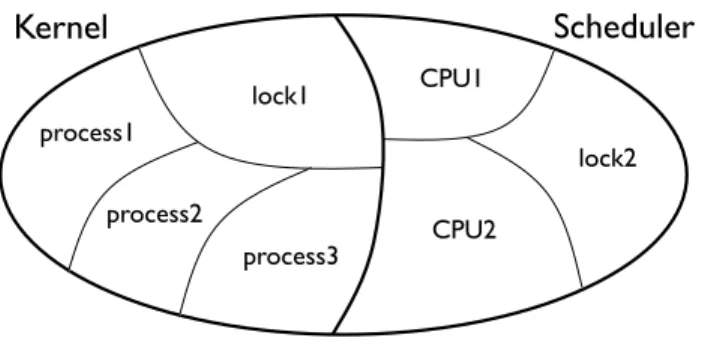
Concurrent separation logic achieves modular reasoning by fur-ther partitioning the memory owned by the component under con-sideration into disjoint process-local parts (one for each process or scheduler invocation on a given CPU) and protected parts (one for each free lock). A process-local part can only be accessed by the corresponding process or scheduler invocation, and a lock-protected part only when the process holds the lock. The resulting partitioning of the system state is illustrated in Figure 3. The frame property guarantees that a process cannot access the partition of the heap belonging to another one. To reason modularly about parts of the state protected by locks, the logic associates with every lock an assertion—itslock invariant—that describes the part of the state it protects. Resource invariants restrict how processes can change the protected state, and hence, allow reasoning about them in isolation. Scheduler-agnostic verification of kernel code. The high-level proof system (Section 4.3) reasons about preemptable code assum-ing an abstract machine where every process has its own virtual CPU. It relies on the partitioned view of memory described above to hide the state of the scheduler, with all the remaining state split among processes and locks accessible to them, as illustrated in Fig-ure 4. We have primed process identifiers in the figFig-ure to emphasise that the virtual state of the process can be represented differently in the abstract and physical machines: for example, if a process is not running, the values of its local registers can be stored in scheduler-private data structures, rather than in CPU registers.
Apart from hiding the state of the scheduler, the high-level system also hides the complex manipulation of the control-flow performed by it: the proof system assumes that the control moves from one point in the process code to the next without changing its state, ignoring the possibility of the scheduler getting executed upon an interrupt. Explicit calls to the scheduler are treated as if they were executed atomically.
Technically, the proof system is a straightforward adaptation of concurrent separation logic, which is augmented with proof rules axiomatising the effect of scheduler routines explicitly called by processes. The novelty here is that we can use such a scheduler-agnostic logic in this context at all.
Proving schedulers correct via logical refinement. The use of the high-level proof system is justified by verifying the scheduler implementation using a low-level proof system (Section 4.4). What does it mean for a scheduler to be functionally correct? Intuitively, a scheduler must provide an illusion of a system where every process has its own virtual CPU with a dedicated set of registers. To formalise this, we could define a semantics of such an abstract system and prove that any behaviour of the concrete system is reproducible in the abstract one, thus establishing a refinement between the two systems. The main technical challenge we have to
Scheduler
Kernel
CPU1 CPU2 lock1 lock2 process1 process2 process3Figure 3. The partitioning of the system state enforced by the logic. The memory is partitioned into two parts, owned by the scheduler and the kernel, respectively. The memory of each compo-nent is further partitioned into parts local to processes or scheduler invocations on a given CPU, and parts protected by locks.
lock1 process1’
process2’
process3’
Kernel
Figure 4. The state of the abstract system with one virtual CPU per process. Process identifiers are primed to emphasise that the virtual state of the process can be represented differently in the abstract and physical machines (cf. Figure 3). Dark regions illustrate the parts of process state that are tracked by a scheduler invocation running on a particular physical CPU.
deal with in this paper is that for realistic OS schedulers, defining a semantics for the abstract system a scheduler implements is difficult. This is because, in reasoning about mainstream operating systems, the ownership transfer between the scheduler and the kernel can involve not only fixed memory cells, but arbitrarylogical facts describing them, which is difficult to describe operationally (see the treatment of thedescpredicate in Section 4.3).
In this paper we resolve this problem in a novel way. Instead of defining the semantics of the abstract machine operationally, we define it only axiomatically as the high-level proof system described above. As expected, the low-level proof system is used to reason about the correspondence between the concrete and the abstract system, with its assertions relating their states. However, proofs in neither of the two systems are interpreted with respect to any semantics alone: our soundness statement (Section 6) interprets a proof of the kernel in the high-level system and a proof of the scheduler in the low-level one together with respect to the semantics of the concrete machine. Thus, instead of relating sets of executions of the two systems, the soundness statement relates logical statements about the abstract system (given by high-level proofs) to logical statements about the concrete one (given by a constraint on concrete states). We call this form of establishing a correspondence between the two systems alogical refinement. Note that in this case the soundness statement for the logic does not yield a semantic statement of correctness for the scheduler being considered. Rather, its correctness is established indirectly by the fact that reasoning in the high-level proof system, which assumes
Reg={ip,if,ss,sp,gr1, . . . ,grm} Loc⊆Val
Context=Reg→Val CPUid={1, . . . ,NCPUS} GContext=CPUid*Context Heap=Loc*Val Lock={`1, `2, . . . , `n} Lockset=P(Lock)
Config=GContext×Heap×Lockset
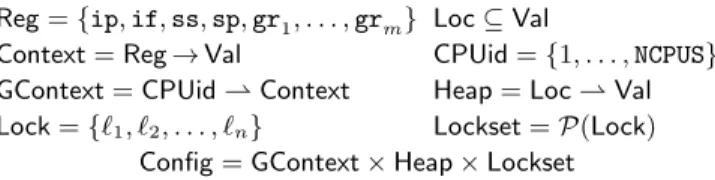
Figure 5. The set of machine configurationsConfig. We assume setsLocof valid memory addresses andValof values, respectively.
the abstract one-CPU-per-process machine, is sound with respect to the concrete machine.
To verify the scheduler separately from the processes it man-ages, low-level assertions focus only on a small relevant part of the state of the kernel, which we callscheduler-visible. Namely, the assertions relate the state local to a scheduler invocation on a par-ticular CPU in the concrete system (e.g., the region markedCPU1 in Figure 3) to parts of abstract states of some of the OS processes (e.g., the dark regions in Figure 4). The latter parts can include, e.g., the values of registers of the virtual CPU of the process, but not the process-local memory. They are used in the low-level proof system to verify that the operations performed by the scheduler in the concrete machine correctly implement the required actions in the abstract machine. These parts also function as permissions to schedule the corresponding processes, i.e., a given part can be owned by at most one scheduler invocation at a time. For example, a scheduler invocation owning the parts of process states marked in Figure 4 has a permission to schedule processes 1 and 2, but not 3. Such a permission reading is crucial for handling scheduling on multiprocessors, as it ensures that a process may not be scheduled at two CPUs at the same time.
Summary.In the following we formalise the above approach for a particular class of schedulers. Despite the formalisaton being performed for this class, the technical methods we develop here can be reused in other settings (see Section 8 for a discussion). In particular, we propose the following novel ideas:
• exploiting a logic validating the frame property to hide the state
of the scheduler while verifying the kernel and vice versa;
• using a logical refinement in a context where defining an abstract semantics refined by the concrete one is difficult; and
• focusing on relevant parts of the two systems related in the refinement and giving a permission interpretation to them.
3.
Preliminaries
In this section, we give a formal semantics to the example machine informally presented in Section 2.1.
3.1 Storage model
Figure 5 gives a model for the set of configurationsConfigthat can arise during an execution of the machine. A machine configuration is a triple with the components describing the values of registers of the CPUs in the machine, the state of the heap and the set of locks taken by some CPU. The configurations in which the heap or the global context is a partial function are not encountered in the semantics we define in this section. They come in handy in Sections 4 and 6 to give a semantics to the assertion language and express the soundness of our logic.
In this paper, we use the following notation for partial functions: f[x: y]is the function that has the same value asfeverywhere, except for x, where it has the valuey; [ ]is a nowhere-defined function;f]gis the union of the disjoint partial functionsfandg.
3.2 Commands
Programs for our machine consist of primitive commandsc:
r∈Reg− {ip} `∈Lock l∈Label=N e ::= r | 0 | 1 | 2 | . . . | e+e |e−e
b ::= e=e | e≤e | b∧b | b∨b | ¬b
c ::= skip | r:=e | r:= [e] | [e] :=e | assume(b)
| lock(`) | unlock(`) | savecpuid(e)
| call(l) | icall(l) | ret | iret
In addition to the primitive commands listed in Section 2, we have the following ones:skipandr :=ehave the standard meaning;
r:= [e]reads the contents of a heap celleand assigns the value read tor;[e] :=e0updates the contents of cellebye0;assume(b)
acts as a filter on the state space of programs, choosing those satisfyingb. We writePCommfor the set of primitive commands. Note that the commands cannot access theipregister directly.
Commands C are partial maps from Label to PComm× P(Label). Intuitively, ifC(l) = (c, X), thencis labelled withlin Cand is followed by commands with labels inX. In this case we letcomm(C, l) = candnext(C, l) = X. We denote the domain ofCwithlabels(C)and the set of all commands withComm.
The language constructs used in the example scheduler of Sec-tion 2, such as loops and condiSec-tionals, can be expressed as com-mands in a standard way, with conditions translated usingassume. 3.3 Semantics
We now give a standard operational semantics to our programming language. We interpret primitive commands cusing a transition relation;cof the following type:
State = Context×Heap×Lockset
;c ⊆ CPUid×State×Label2× State×Label∪ {>}) The input to;cconsists of four components. The first is the identi-fier of the CPU executing the command, and the next the configura-tion of the system projected to this CPU, which we call a state. The latter includes the context of the CPU and the information about the shared resources—the heap and locks. The last two components of the input are the labels of the commandcand a primitive command following it in the program. Given this input, the transition relation
;cforcnondeterministically computes the next state of the CPU after runningc, together with the label of the primitive command to run next. The former may be a special>state signalling a machine crash. The latter may be different from the label given as the last component of the input, whencis a call or a return.
The relation;cappears in Figure 6. In the figure and in the rest of the paper, we write for an expression whose value is irrelevant and implicitly existentially quantified. The relation follows the informal meaning of primitive commands given in Sections 2.1 and 3.2. Note that;cmay yield no post-state for a given pre-state. Unlike a transition to the>state, this represents the divergence of the command. For example, according to Figure 6, acquiring the same lock twice leads to a deadlock, and releasing a lock that is not held crashes the system. Note that we do not prevent a held lock from being released by a CPU that did not acquire it, so locks behave like binary semaphores.
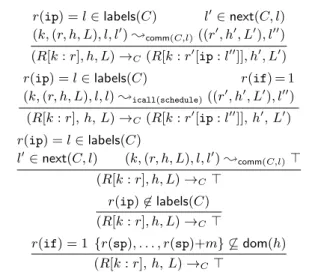
The program our machine executes is given by a commandC that includes a primitive command labelledschedule, serving as the entry point of the interrupt handler. For such a commandC, we give its meaning using a small-step operational semantics, for-malised by the transition relation→C ⊆ Config×(Config∪{>})
in Figure 7. The first rule in the figure describes a normal execu-tion, where theipregister of CPUkis used to choose the primitive commandcto run. After choosingc, the machine picks the label l0of a following command, runscaccording to the semantics;c,
(k,(r, h[[[e]]r:u], L), l, l0);r:=[e] ((r[r:u], h[[[e]]r:u], L), l0) (k,(r, h, L), l, l0) ;assume(b) ((r, h, L), l0),if[[b]]r=true (k,(r, h, L), l, l0) ;6 assume(b) if[[b]]r=false (k,(r, h, L), l, l0) ;lock(`) ((r, h, L∪ {`}), l0),if`6∈L (k,(r, h, L), l, l0) 6;lock(`) if`∈L (k,(r, h, L), l, l0) ;unlock(`) ((r, h, L− {`}), l0),if`∈L (k,(r, h[[[e]]r: ], L), l, l0) ;savecpuid(e)((r, h[[[e]]r:k], L), l0) (k,(r, h[r(sp) : , . . . , r(sp)+m: ], L), l, l0) ;call(l00)((r[sp:r(sp)+m+1], h[r(sp) :l0, r(sp)+1 :r(gr1), . . . , r(sp)+m:r(grm)], L), l00) (k,(r, h[r(sp)−m−1 :l00, r(sp)−m:g1, . . . , r(sp)−1 :gm],L), l, l0) ;ret((r[sp:r(sp)−m−1,gr1:g1, . . . ,grm:gm], h[r(sp)−m−1 :l00, r(sp)−m:g 1, . . . , r(sp)−1 :gm], L), l00) (k,(r, h, L), l, l0);c>,otherwise
Figure 6. Semantics of primitive commands. We have omitted standard definitions forskipand most of assignments (see [20]). We have also omitted them foricallandiret: the definitions are the same as forcallandret, but additionally modifyif. In the figure;c>indicates that the commandccrashes, and6;cmeans that it does not crash, but diverges. The function[[·]]r evaluates expressions with respect to the contextr.
r(ip) =l∈labels(C) l0∈next(C, l) (k,(r, h, L), l, l0);comm(C,l)((r0, h0, L0), l00)
(R[k:r], h, L)→C(R[k:r0[ip:l00]], h0, L0)
r(ip) =l∈labels(C) r(if) = 1
(k,(r, h, L), l, l);icall(schedule)((r0, h0, L0), l00) (R[k:r], h, L)→C(R[k:r0[ip:l00]], h0, L0) r(ip) =l∈labels(C) l0∈next(C, l) (k,(r, h, L), l, l0);comm(C,l)> (R[k:r], h, L)→C> r(ip)6∈labels(C) (R[k:r], h, L)→C> r(if) = 1 {r(sp), . . . , r(sp)+m} 6⊆dom(h) (R[k:r], h, L)→C >
Figure 7. Operational semantics of the machine
and uses the result of this run to update the registers of CPUkand the heap and the lockset of the machine. The next rule concerns interrupts. Upon an interrupt, the interrupt handler labelschedule
is loaded intoip, and the label of the command to execute after the handler returns is pushed onto the stack together with the val-ues of the general-purpose registers. The remaining rules deal with crashes arising from erroneous execution of primitive commands, undefined command labels and a stack overflow upon an interrupt.
4.
The logic
In this paper we consider schedulers whose interface consists of two routines:createandschedule. Like in our example sched-uler (Section 2.2), create makes a new process runnable, and
scheduleperforms a context-switch. (Our results can be extended when new scheduler routines are introduced; see Section 8 for a discussion.) Our logic thus reasons about programs of the form:
C][lc: (iret,{lc+1})]]S][ls: (iret,{ls+1})]]K (OS)
whereCandSare pieces of code implementing thecreateand
scheduleroutines of the scheduler andKis the rest of the kernel code. Our high-level proof system is designed for provingK, and the low-level system for provingCandS.
We place several restrictions on programs. First, we require that C and S define primitive commands labelled create and
schedule, which are meant to be the entry points for the corre-sponding scheduler routines. Thecreateroutine expects the ad-dress of the descriptor of the new process to be stored in the regis-tergr1. By our conventionschedulealso marks the entry point of the interrupt handler. Thus,schedulemay be called both directly by a process or by an interrupt. For simplicity, we assume that the scheduler data structures are properly initialised when the program starts executing.
To ensure that the scheduler routines execute with interrupts disabled, we require thatCandSmay not containicall,iret
and assignments accessing theifregister. We also need to ensure that the kernel may not affect the status of interrupts, become aware of the particular CPU it is executing on, or change the stack address. Thus,Kmay not containsavecpuid,icalland iret
(except calls to the scheduler routinesschedule and create), assignments accessing if or writing to ss. In reality, a kernel might need to disable interrupts. We discuss how our results can be extended to handle this in Section 8. Finally, we require that the kernelKand the schedulerCandSaccess disjoint sets of locks. This condition simplifies the soundness statement in Section 6 and can be lifted.
The core part of our logic is the low-level proof system for ver-ifying scheduler code, which we present in Section 4.4. It extends the high-level proof system used for verifying kernel code, which, in turn, adapts concurrent separation logic to our setting. For this reason, we present the high-level system first.
4.1 Assertion language
We now present the assertion language of the high-level proof system. Assertions describe properties of a single process, as if it were running on a separate virtual CPU. The state of the pro-cess thus consists of the values of the CPU registers (its context), the heap local to the process and the locks the process has a per-mission to release (its lockset). Mathematically, states of a pro-cess are just elements ofStatedefined in Section 3.3: State =
Context×Heap×Lockset. However, unlike in the semantics of Section 3.3, a heap here can be a partial function, with its domain defining the part of the heap owned by the process. A lockset is now meant to contain only the set of locks that the process has a permis-sion to release (in our logic such permispermis-sions can be transferred between processes).
To denote sets of process states in our logic, we use a minor extension of the assertion language of separation logic [20]. Let NVarand CVarbe disjoint sets containing logical variables for values and contexts, respectively. Assertions are defined as follows:
x, y∈NVar γ∈CVar r∈Reg− {ip} r∈ {ip,if,ss,sp,gr1, . . . ,grm} E::=x|r|0|1|. . .|E+E|E−E|G(r) G::=γ | [ip:E,if:E,ss:E,sp:E, ~gr:E~] Σ ::=ε|E|Σ Σ B::=E=E|Σ=Σ|G=G|E≤E|B∧B|B∨B| ¬B P::=B|true|P∧P | ¬P | ∃x. P | ∃γ. P |emp | E7→E|E..E7→Σ|P∗P |dllΛ(E, E, E, E)|locked(`)
ExpressionsEand BooleansBare similar to those in programs, except that they allow logical variables to appear and include the lookup G(r) of the value of the register rin the context G. A contextGis either a logical variable or a finite map from register
(r, h, L)|=ηB iff [[B]]ηr=true
(r, h, L)|=ηP1∧P2 iff (r, h, L)|=ηP1and(r, h, L)|=ηP2
(r, h, L)|=ηemp iff h= [ ] and L=∅
(r, h, L)|=ηE07→E1iff h= [[[E0]]ηr: [[E1]]ηr] and L=∅
(r, h, L)|=ηE0..E17→Σ iff ∃j≥0.∃v1, . . . , vj∈Val. L=∅, j= [[E1]]ηr−[[E0]]ηr+1, v1v2. . . vj= [[Σ]]ηr and h= [[[E0]]ηr:v1, . . . ,[[E1]]ηr:vj]
(r, h, L)|=ηlocked(`)iff h= [ ] and L={`}
(r, h, L)|=ηP1∗P2 iff ∃h1, h2, L1, L2. h=h1]h2, L=L1]L2, (r, h1, L1)|=ηP1 and (r, h2, L2)|=ηP2 PredicatedllΛis the least one satisfying the equivalence below: dllΛ(Eh, Ep, En, Et) ⇔ ∃x.(Eh=En∧Ep=Et∧emp)∨
Eh.prev7→Ep∗Eh.next7→x∗Λ(Eh)∗dllΛ(x, Eh, En, Et) Figure 8. Semantics of high-level assertions. We have omitted the standard clauses for most of the first-order connectives. The function[[·]]ηrevaluates expressions with respect to the contextr and the logical variable environmentη.
labelsrto expressions. We denote the set of assertions defined here withAssertK. Let a logical variable environmentηbe a mapping
from NVar∪CVarto Val∪Context that respects the types of variables. Assertions denote sets of states fromStateas defined by the satisfaction relation|=ηin Figure 8. For an environmentηand an assertionP, we denote with[[P]]ηthe set of states satisfyingP. The assertions in the first line of the definition ofP except empare connectives from the first-order logic with the standard semantics. We can define the missing connectives from the given ones. The following assertions fromempup to thedllΛpredicate are standard assertions of separation logic [20]. Informally,emp describes the empty heap, andE 7→ E0 the heap with only one cell at the addressE containingE0. The assertion E..E0 7→ Σ
is the generalisation of the latter to several consecutive cells at the addresses fromEtoE0inclusive containing the sequence of values
Σ. For a value uof a C typettaking several cells, we shorten E..(E+sizeof(t)−1)7→uto justE 7→u. For a fieldfof a C structure, we useE.f7→E0as a shortcut forE+off7→E0, where offis the offset offin the structure. The separating conjunction P1∗P2talks about the splitting of the local state, which consists of the heap and the lockset of the process. It says that a pair(h, L)can be split into two disjoint parts, such that one part(h1, L1)satisfies P1and the other(h2, L2)satisfiesP2.
The assertion dllΛ(Eh, Ep, En, Et) is an inductive predicate describing a segment of a doubly-linked list. It assumes a C struc-ture definition with fieldsprevandnext. HereEhis the address of the head of the list,Etthe address of its tail,Epthe pointer in the
prevfield of the head node, andEnthe pointer in thenextfield of the tail node. TheΛparameter is a formula with one free logi-cal variable describing the shape of each node in the list, excluding theprevandnextfields; the logical variable defines the address of the node. For instance, a simple doubly-linked list can be expressed usingΛ(x) =emp. We includeddllΛto describe the runqueues of the scheduler in our example. Predicates for other data structures can be added straightforwardly [20].
Finally, the assertionlocked(`) is specific to reasoning about concurrent programs and denotes states with an empty local heap and the lockset consisting of `, i.e., it denotes a permission to release the lock`. Note thatlocked(`)∗locked(`)is inconsistent: acquiring the same lock twice leads to a deadlock.
To summarise, our assertion language extends that of concurrent separation logic with expressions to denote contexts andlocked assertions to keep track of permissions to release locks.
4.2 Interface parameters
As we noted in Section 2.3, our logic can be viewed as imple-menting a form of assume-guarantee reasoning between the sched-uler and the kernel. In particular, interactions between them in-volve ownership transfer of memory cells at points where the con-trol crosses the boundary between the two components. Hence, the high- and low-level proof systems have to agree on the description of the memory areas being transferred and the properties they have to satisfy. These descriptions form the specification of the inter-face between the scheduler and the kernel, and, correspondingly, between the two proof systems. Here we describe parameters used to formulate it. We note that the interface parameters we present here are tied to a particular class of schedulers for which we present our logic. As we argue in Section 8, our results can be carried over to schedulers with more elaborate interfaces.
Ownership transfer happens at calls to and returns from the scheduler routinescreateandschedule. When the kernel calls thecreateroutine of the scheduler, the latter should get the own-ership of the process descriptor supplied as the parameter. In the two proof systems, we specify this descriptor using an assertion desc(d, γ)∈AssertKwith two free logical variables and no
regis-ter occurrences. Our intention is that it describes the descriptor of a process with the contextγ, allocated at the addressd. However, the user of our logic is free to choose any assertion, depending on a particular scheduler implementation being verified. As the sched-uler and the kernel access disjoint sets of locks, we require that all states in[[desc(d, γ)]]ηhave an empty lockset.
We fix the piece of state transferred from the kernel to the
scheduleroutine upon an interrupt to be the free part of the stack of the process being preempted. The parameters determining its size are the size of the stackStackSize∈Nand the upper bound
StackBound∈Non the stack usage by the kernel (excluding the scheduler). To ensure that the stack does not overflow while calling an interrupt hander, we require thatStackSize−StackBound≥ m+1, wheremis the number of general-purpose registers. 4.3 High-level proof system
The high-level proof system reasons about the kernel codeK. It is obtained by adapting concurrent separation logic to our setting and adding proof rules axiomatising the effect of scheduler routines.
The judgements of the high-level proof system are of the form I,∆ ` C, where I : Lock * AssertK is a partial mapping
from locks accessible in the kernel code to their invariants (see Section 2.3) and∆ : Label → AssertKis a total mapping from
code labels to preconditions. The parameter∆in our judgement specifies local states of the process at various program points, which induce pre- and post-conditions for all primitive commands in C. When considering a complete system in Section 4.5, we restrict∆so that it isfalseeverywhere except at labels in the kernel code. An example of a lock invariant is
∃x, y.10.prev7→y∗10.next7→x∗dllΛ(x,10,10, y), whereΛ(x) = emp. It states that the lock protects a non-empty cyclic doubly-linked list with the head node at address 10. We forbid lock invariants to contain registers or free occurrences of logical variables. We consider a version of concurrent separation logic where resource invariants are allowed to be imprecise [19] at the expense of excluding the conjunction rule from the proof system [12].
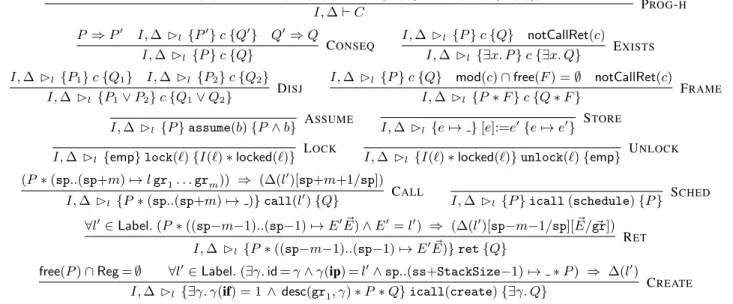
The rule PROG-Hfor deriving the judgements is given in Fig-ure 9. The first premise of the rule says that all assertions in∆
have to satisfy some restrictions regarding stack usage, formulated using parametersStackSizeandStackBoundintroduced in Sec-tion 4.2. These ensure that the interrupt handler can safely execute on the stack of the process it preempts:
∀l∈Label(C).∃P ∈AssertK.∆(l)⇔(0≤sp−ss≤StackBound∧P∗sp..(ss+StackSize−1)7→ )
∀l∈labels(C).∀l0∈next(C, l).(I,∆l0 {∆(l)}comm(C, l){∆(l0)})
I,∆`C PROG-H P ⇒P0 I,∆l{P0}c{Q0} Q0⇒Q I,∆l {P}c{Q} CONSEQ I,∆l {P}c{Q} notCallRet(c) I,∆l {∃x. P}c{∃x. Q} EXISTS I,∆l {P1}c{Q1} I,∆l{P2}c{Q2} I,∆l {P1∨P2}c{Q1∨Q2}
DISJ I,∆l {P}c{Q} mod(c)∩free(F) =∅ notCallRet(c) I,∆l {P∗F}c{Q∗F} FRAME I,∆l {P}assume(b){P∧b} ASSUME I,∆l {e7→ }[e]:=e0{e7→e0} STORE
I,∆l {emp}lock(`){I(`)∗locked(`)} LOCK
I,∆l {I(`)∗locked(`)}unlock(`){emp}
UNLOCK (P∗(sp..(sp+m)7→lgr1. . .grm)) ⇒ (∆(l0)[sp+m+1/sp]) I,∆l {P∗(sp..(sp+m)7→ )}call(l0){Q} CALL I,∆l {P}icall(schedule){P} SCHED ∀l0∈Label.(P∗((sp−m−1)..(sp−1)7→E0E~)∧E0=l0) ⇒ (∆(l0)[sp−m−1/sp][E/ ~~ gr]) I,∆l {P∗((sp−m−1)..(sp−1)7→E0E~)}ret{Q} RET free(P)∩Reg=∅ ∀l0∈Label.(∃γ.id=γ∧γ(ip) =l0∧sp..(ss+StackSize−1)7→ ∗P) ⇒ ∆(l0)
I,∆l{∃γ. γ(if) = 1∧desc(gr1, γ)∗P∗Q}icall(create){∃γ. Q}
CREATE
Figure 9. High-level proof system. Heremod(c)is the set of registers modified byc,free(F)is the set of registers appearing inF, and notCallRet(c)means thatcis not one ofcall,icall,retandiret. Finally,id= [ip: ,if:if,ss:ss,sp:sp, ~gr:gr]~ .
• the free part of the stack of the process must always be in its local state so that it can be transferred to the handler at any time;
• this part must always be large enough for the handler to run
without a stack overflow; and
• the assertions should be independent of any changes to the empty
slots of the stack, which may be modified by the handler. The other condition in the PROG-Hrule is that for every primitive command c in C and the label l0 of a command following c, we have to prove I,∆l0 {∆(l)} c {∆(l0)}. This informally means that, ifcis run from an initial state satisfying∆(l), thenit accesses only the memory specified by∆(l)and either terminates normally and ends up in a state satisfying ∆(l0), or jumps to a label l00 whose assertion ∆(l00) holds in the current state. Note that the italicised clause enforces the frame property (Section 2.3). The proof rules for such judgements are also given in Figure 9. The rules CONSEQ, DISJand EXISTSare standard rules of Hoare logic. The FRAMErule is inherited from separation logic; it states that executing a command in a bigger local state does not change its behaviour. The rule is useful to restrict the reasoning about primitive commands to the memory they actually access. To keep the logic sound we have to forbid EXISTSand FRAMEto be applied to calls or returns. The logic also provides standard separation logic axioms for primitive commands. In Figure 9 we show two of them, ASSUMEand STORE, and omit the others to save space; see [20].
The LOCKand UNLOCKaxioms are inherited from concurrent separation logic and provide tools for modular reasoning about con-current processes. The LOCKaxiom says that, upon acquiring a lock, the process gets the ownership of its invariant and a permis-sion to release it. According to UNLOCK, before releasing the lock, the process must have the corresponding permission and must re-establish the lock invariant. When the lock is released, the process gives up the ownership of the permission and the invariant.
The CALLand RETaxioms mirror the operational semantics of
callandret(see Section 2.1 and Figure 6). CALLrequires us to provide enough space on the stack to store the values of registers before a call. The precondition together with the modified stack
then has to establish the assertion given by∆at the target label. RETsimilarly requires the precondition to establish the assertion at the target label after the values of general-purpose registers andip
(denoted withE~ andE0) have been loaded from the stack. The axioms CALL and RETprovide only a very rudimentary treatment of procedures. In particular, our logic does not have analogues of the usual modular Hoare proof rules for procedures and does not allow applying the FRAMErule over a procedure call. This is because soundly formulating such proof rules in the setting where the stack is visible to procedure code and can potentially be modified by it is non-trivial. This issue is orthogonal to the problem of scheduler verification we are concerned with, thus, in this paper we chose the simplest high-level logic possible. See Section 8 for pointers to more expressive logics for procedures.
What we have presented so far is just an adaptation of concur-rent separation logic to our setting. We now provide axioms for calling the scheduler routinesschedule andcreate, which are specific to our logic. As the high-level proof system hides the im-plementation of scheduler routines, the corresponding axioms are significantly different from CALL. In particular, the axioms are for-mulated as if after theseicall commands the control just pro-ceeded to the next statement in the program instead of jumping to the implementation of the routines. This is despite the fact that after a call toschedule, the process may be preempted and the control-flow given to any other process in the system. In this way, the axioms abstract from the scheduler implementation.
The SCHEDaxiom states that invokingschedulehas no effect from the point of view of the process—if it is preempted, the scheduler resumes it in the same context, and no other process can touch its local heap. The axiom does not place any requirements on the process, as the preconditions necessary for the execution ofschedule, which anyway can be invoked at any time as the interrupt handler, are established by the first condition in PROG-H. The CREATEaxiom is more complicated. First, it requires the caller ofcreateto provide a new descriptordesc(gr1, γ)for the process being created with the contextγ. We pass the parameter via the registergr1 and not via the stack, as this simplifies the
following technical presentation. The context is required to have
ifset, since after the context switch is finished, the process starts executing with interrupts enabled. Note that the descriptor is not present in the postcondition: it gets transferred to the scheduler and reappears in the precondition of the implementation ofcreate
(Section 4.5). The axiom also allows us to transfer the ownership of the part of the heap given byP to the newly created process, thus providing it with an initial local state. This is a typical idiom for high-level reasoning about processes in separation logics [13]. The premise of the rule correspondingly requires that, after the registers and the stack are properly initialised, the stateP we are transferring should establish the assertion at the label the process starts executing from. The effect of loading registers from γ is formulated using the contextid.
For the example scheduler in Section 2.2,desc(d, γ) should describe a process descriptor with the stack initialised accord-ing to the invariant of a preempted process pictured in Figure 2: desc(d, γ) =d.prev7→ ∗d.next7→ ∗desc0(d, γ), where
desc0(d, γ)⇔γ(if)=1∧γ(ss)=d.kernel stack∧
0≤γ(sp)−γ(ss)≤StackBound∧d.timeslice7→ ∗ d.saved sp7→(γ(sp)+m+1+SCHED FRAME)∗ γ(sp)..(γ(sp)+m)7→γ(ip)γ(gr~)∗
(γ(sp)+m+1)..(γ(ss)+StackSize−1)7→
andSCHED FRAMEis the size of the activation record ofschedule
(Figure 1). The descriptor does not include filled stack slots; they can be passed to the process directly in the preconditionP.
As we have noted before,desc(d, γ)can be an arbitrary log-ical predicate. In some cases, e.g., when it is imprecise [19], its transfer from the kernel to the scheduler is hard to express oper-ationally when defining a semantics of the kernel separately from the implementation of the scheduler; see [12] for a discussion. The situation would be worse had we based our logic on one of ad-vanced modular concurrency logics, such as deny-guarantee [4], which are needed to handle real OS code. This is because proofs of soudness for such logics do not give an operational semantics to separate components of a program. The above difficulties with an operational definition of ownership transfer are a prime reason for using logical refinement in this paper.
The high-level proof system provides modern tools for modular reasoning about concurrent processes using proof rules of concur-rent separation logic. The PROG-Hrule of the system subsumes the usual sequential composition rule of Hoare logic, which assumes that the control-flow follows the structure of the process code and ignores the possibility of scheduler code getting executed at an in-terrupt. The axioms SCHEDand CREATEabstract the implementa-tion of scheduler routines by treating them like atomic commands. Thus, the state and the control-flow of the scheduler is completely hidden by the proof system. The soundness of such an illusion is established by verifying the scheduler code using a low-level proof system, which we describe next.
4.4 Low-level proof system
We now present the core of our logic—the low-level proof sys-tem, which is used to prove that the commands Cand Sof the OSprogram implement scheduling correctly. As we explained in Section 2.3, assertions of the proof system relate the states of the concrete machine and an abstract one, where every process has its own virtual CPU. The state of the concrete machine can be de-scribed using separation logic assertions introduced in Section 4.1. To describe states of the abstract machine, we extend the assertion language of Section 4.3 with an additional predicate:P ::=. . . | Process(G), whereGranges over context expressions. We denote the set of such assertions withAssertS. TheProcess(G)predicate
(r, h, L), M|=ηProcess(G)iffh= [ ], L=∅, M ={[[G]]ηr}
(r, h, L), M|=ηP∗Q iff∃h1, h2, L1, L2, M1, M2. h=h1]h2, L=L1]L2, M =M1]M2,
(r, h1, L1), M1|=ηPand(r, h2, L2), M2|=ηQ
(r, h, L), M|=ηemp iffh= [ ], L=∅andM =∅
(r, h, L), M|=ηP∧Qiff
(r, h, L), M |=ηPand(r, h, L), M |=ηQ
Figure 10. Semantics of low-level assertions. The]operation on multisets adds up the number of occurrences of each element in its operands.
describes a process with the values of registers of its virtual CPU given by the contextG.
The addition of theProcesspredicate changes objects described by assertions: they now denote relations defined by subsets of RelState = State × M(Context), whereM(A) is the set of all finite multisets with elements fromA. Relations inRelState connect the states of the concrete machine and the abstract machine with one CPU per process. As we have noted before, these relations do not describe the full state of the machines. The first component in a relation describes the local state of a scheduler invocation running on a CPU, including its context and the heap and the lockset local to it (e.g., the region markedCPU1in Figure 3). The multiset in the second part records the scheduler-visible states of processes described byProcess predicates in the assertion, i.e., parts of their local states that may be referred to by proofs about the scheduler (cf. the dark regions in Figure 4). These include the context of a process, but exclude its local heap and lockset: the latter are irrelevant for the schedulers we consider here and are therefore invisible to them. The low-level logic we present in this section is based on separation logic, hence, the invisibility of parts of process state to the scheduler automatically guarantees that it cannot access them.
Apart from keeping track of the state of a process, aProcess predicate serves in the logic as an exclusive permission for the scheduler invocation owning it to schedule the corresponding pro-cess. To enforce this, the semantics of assertions defined below forbids the duplication of Process predicates: Process(G) 6⇒ Process(G)∗Process(G). Furthermore, the proof obligations for the scheduler we define in Section 4.5 state that it needs aProcess predicate to schedule a process. Such a permission interpretation of Processis a key feature of our logic that allows us to reason about schedulers for multiprocessors: it ensures that, at a given time, only one scheduler invocation can own aProcesspredicate for a pro-cess, and hence, it can be scheduled only on one CPU at a time.
We give the formal semantics of assertions using the satisfac-tion relasatisfac-tion|=η in Figure 10, parameterised by environmentsη. The first two cases in the figure are the most interesting ones. Process(G)relates a scheduler invocation having the empty heap and the empty lockset to a single process with the register values G. To be related by the separating conjunctionP∗Q, all parts of the state-multiset pair except the context should be split such that the first part is related byP and the second byQ. The semantic definitions of the remaining assertions are obtained from the corre-sponding cases in our high-level proof system (Figure 8) either by requiring the multiset componentMto be empty, like in the case of emp, or by propagatingM to their sub-assertions, like in the case ofP∧Q. We denote with[[P]]ηthe set of states satisfyingP.
The judgements of the low-level proof system have the form I,∆`k C, wherek ∈ CPUid,I :Lock *AssertSis a vector
of resource invariants for locks accessible to the scheduler, and∆ :
Label→AssertSis a mapping from program positions to low-level
we restrict ∆so that it is falseeverywhere except at labels in the scheduler code. The intuitive meaning of the judgements is the same as in the high-level system (Section 4.3), with the component describing scheduler-visible process states unchanged during the execution of scheduler commands. The judgements thus express how the scheduler code changes the relationship between the state of the scheduler on the CPUkand those of processes running on the machine. The proof rule for deriving our judgements is:
∀l∈labels(C).∀l0∈next(C, l). I,∆k
l0 {∆(l)}comm(C, l){∆(l0)}
I,∆`kC PROG-L
Note that the syntactic structure of theOSprogram (see the be-ginning of Section 4) ensures that the scheduler always executes with interrupts disabled. Thus, in the rule we are able to follow the control flow ofC. The low-level system inherits the proof rules for deriving judgements for primitive commandsI,∆l {P}c{Q} in Figure 9, adding the superscriptktoland ignoring the rules foricall(schedule)andicall(create). It also has a rule for
savecpuid, which makes use of the indexk: I,∆k
l {e7→ }savecpuid(e){e7→k} CPUID
4.5 Putting the two proof systems together
The proof systems presented in Sections 4.3 and 4.4 allow us to reason about the kernel and the scheduler code. We now describe a rule for combining judgements from the two systems, which defines proof obligations for the OS components. This allows us to prove theOSprogram defined at the beginning of Section 4.
As can be seen from the example of Section 2.2, a scheduler might need to maintain some data structures related to every CPU, which can be accessed by a scheduler invocation on it. A data structure of this kind in our example scheduler is the element of thecurrent array corresponding to the current CPU. LetJk be an invariant of such data structures for CPUk, which is meant to be maintained when the scheduler is not running on it. Similarly to lock invariants, we forbidJkto contain free logical variables or registers, exceptss. In this case we can allowssbecause we have previously required that the kernel cannot modify it. We denote withJthe vector of invariantsJk.
Consider assertionsIK,∆KandIS,∆kSfor allk∈CPUid, such
that:
• dom(IK)∩dom(IS) =∅; • ∀l. l6∈dom(K)⇒∆K(l) =false;
• ∀l. l6∈dom(S)]dom(C)] {ls, lc} ⇒∆kS(l) =false.
The proof rule for the programOSis as follows: IK,∆K`K
∀k∈CPUid. IS,∆kS `kS, IS,∆kS `kC
∀k∈CPUid.∆k
S(schedule) = ∆kS(ls) = ∆kS(lc) =SchedStatek ∀k∈CPUid.∆kS(create) = (∃γ. γ(if)=1∧
SchedStatek∗desc(gr1, γ)∗Process(γ)) IK,∆K|IS,{∆Sk}k∈CPUid|J`(S,C,K)
where
SchedStatek=∃l, ~g.if=0∧0≤sp−ss−m−1≤StackBound
∧(sp−m−1)..(sp−1)7→l~g∗sp..(ss+StackSize−1)7→ ∗ Jk∗Process([ip:l,if: 1,ss:ss,sp:sp−m−1, ~gr:~g]) The first three premises require us to prove the kernel and the scheduler code in their respective proof systems. The rest define pre- and postconditions forscheduleandcreate by fixing the
assertions at the corresponding labels. This is done using the predi-cateSchedStatek, which describes the state of a scheduler invoca-tion at CPUkright after it is called usingicallor before it returns by executingiret.
When schedule is called, the stack satisfies the bound on stack usage and interrupts are disabled. The scheduler gets the ownership of the per-CPU data structureJk, a part of the stack of the process being preempted (which contains the values of registers saved upon the call together with the empty slots), and aProcess predicate consistent with the registers saved on the stack. The predicate certifies that, when the scheduler starts executing, the state of the preempted process in the machine corresponds to its state in the abstract machine. Theschedule routine has to re-establish the same assertion before returning. In the case when it schedules a different process, this will be done using a different Processpredicate. However, since the scheduler can only get a Processpredicate in the precondition ofschedule(and when a new process is created; see below), its postcondition guarantees that the process being scheduled has the same register values it had last time it was preempted. Note that the precondition ofschedule
mirrors the first premise of the PROG-Hrule. Thus, the assumptions it makes about the kernel are justified by the proof of the latter in the high-level system.
The precondition of create is similar to that ofschedule, but additionally assumes a process descriptor for a new process with the address ingr1, and a correspondingProcessassertion ini-tialised according to the information in the descriptor. This descrip-tor is guaranteed to be provided by the kernel by the precondition of the CREATErule. Adding the newProcessassertion can be under-stood intuitively as creating a fresh virtual CPU for the new process in the abstract machine.
5.
Verifying the example scheduler
We have used the logic to manually construct a proof of the ex-ample scheduler of Section 2.2, establishing the judgements about
scheduleandcreaterequired by the proof rule in Section 4.5. By the soundness theorem for our logic (presented in Section 6), this implies that any property of a piece of high-level code proved in concurrent separation logic, including memory safety and func-tional correctness, holds of the code when it is managed by the ex-ample scheduler. The detailed proof is given in Appendix A. Here we present only lock and per-CPU scheduler invariants together with some informal explanations.
The invariants of runqueue locks are as follows: I(runqueue lock[k]) =∃x, y, z.runqueue[k]7→z∗
desc0(z, )∗z.prev7→y∗z.next7→x∗dllΛ(x, z, z, y)
whereΛ(d) =∃γ.desc0(d, γ)∗Process(γ)anddesc0is defined in Section 4.3. The per-CPU scheduler invariants are:
Jk=∃d.(d.kernel stack=ss)∧current[k]7→d∗ d.prev7→ ∗d.next7→ ∗d.timeslice7→ ∗d.saved sp7→ According to these definitions, a runqueue for a CPUkcontains a list of descriptors of preempted processes together withProcess predicates matching the state stored in them. When an invocation of
scheduleacquires the runqueue lock and removes a node from the list, it gets the ownership of the correspondingProcesspredicate, which lets it schedule the process by establishing the postcondition SchedStatekofschedule(see Section 4.5). The descriptor of the process just scheduled, pointed to by an entry in thecurrentarray, forms the scheduler’s per-CPU state and is described byJk. When the process is preempted again,schedule receives theProcess predicate in its preconditionSchedStatek. This predicate and the state inJk let the scheduler insert the descriptor back into the runqueue while maintaining its invariant.