Static Analysis of Atomicity for Algorithms Using Non-Blocking
Synchronization
∗
Liqiang Wang
†and Scott D. Stoller
‡Abstract
In concurrent programming, non-blocking synchronization is very efficient but difficult to design cor-rectly. This paper presents a static analysis to show that code blocks using non-blocking synchronization are atomic, i.e., that every execution of the program is equivalent to one in which those code blocks execute without interruption by other threads. Our analysis determines commutativity of operations based primarily on how synchronization primitives (including locks, Load-Linked, Store-Conditional, and Compare-and-Swap) are used. A reduction theorem states that certain patterns of commutativity imply atomicity. Atomicity is itself an important correctness requirement for many concurrent programs. Furthermore, an atomic code block can be treated as a single transition during subsequent analysis of the program; this can greatly improve the efficiency of the subsequent analysis; for example, it can signif-icantly reduce the time and space for model checking. We demonstrate the effectiveness of our approach on several concurrent non-blocking programs.
Categories and Subject Descriptors
[D.2.4] Software Engineering: Software/Program Verification [D.1.3] Programming Techniques: Concurrent Programming General Terms Verification, Algorithms, Design
Keywords Atomicity, Lock-free, Non-blocking, Synchronization, Static Analysis, Verification, Lineariz-ability
∗This work was supported in part by NSF under Grant CCR-0205376 and ONR under Grant N00014-02-1-0363. This paper significantly extends our previous work [WS05].
†Address: Department of Computer Science, University of Wyoming, Laramie, WY 82071-3315. Email: [email protected]. ‡Address: Department of Computer Science, Stony Brook University, Stony Brook, NY 11794-4400. Email: [email protected].
1
Introduction
Many concurrent programs use blocking synchronization primitives, such as locks and condition variables. Non-blocking synchronization primitives, such as Compare-and-Swap, and Load-Linked / Store-Conditional, never block (i.e., suspend execution of) a thread. Non-blocking (also called “lock-free”) synchronization is becoming increasingly popular, because it offers several advantages, including better performance, immunity to deadlock, and tolerance to priority inversion and pre-emption [Mic04b, MS96].
An important use of non-blocking synchronization is in the implementation of non-blocking objects. A concurrent implementation of an object isnon-blocking if it guarantees that some process can complete its operation on the object after a finite number of steps of the system, regardless of the activities and speeds of other processes [Her93]. Non-blocking synchronization is also used to implement blocking objects, such as spin locks.
Algorithms that use non-blocking synchronization are often subtle and difficult to design and verify. This paper presents a static analysis to show that code blocks using non-blocking synchronization are atomic. Informally, a code block is atomic if every execution is equivalent to one in which the code block is executed serially, i.e., without interruption by other threads. Atomicity is well known in the context of transaction processing, where it is often calledserializability.
Atomicity is an important correctness requirement for many concurrent programs. Furthermore, each atomic code block can be treated as a single transition during subsequent static or dynamic analysis of the program; this can greatly improve the efficiency of the subsequent analysis.
This paper presents a conservative intra-procedural static analysis to infer atomicity. We build on Flana-ganet al.’s work on atomicity types [FQ03] and purity [FFQ05] in order to develop an analysis that is much more effective for programs that use non-blocking synchronization primitives. Our analysis first classifies all actions (i.e., operations) in a program into different types based on their commutativity, which is determined based primarily on how locks and non-blocking synchronization primitives are used in the program. The analysis then combines those types to determine the types of larger code blocks, and then determines the atomicity of the program.
We formalize the analysis for a language SYNL that allows declaration of top-level procedures (as in an API) that implicitly get concurrently called by the environment. The language does not allow explicit procedure calls; internal procedures are inlined, and we do not handle recursion. Despite these limitations, SYNL is powerful enough for expressing many non-blocking algorithms. The analysis can be extended to be
inter-procedural. It applies equally to non-blocking objects and blocking objects.
The analysis is incomplete (i.e., sometimes fails to show atomicity), but is effective for common patterns of non-blocking synchronization, as demonstrated by the applications in Section 6. We applied it to four interesting non-trivial non-blocking programs: the running example in Sections 4 and 5, and three other programs described in Section 6. Our analysis can be applied directly to one of them. For the next two, we modify the algorithms slightly before applying our analysis and show that the modification preserves the behaviors of the algorithms. For the fourth one, we just omit some optional optimizations before applying our analysis.
We consider the results encouraging, since we do not know of any other algorithmic (i.e., automatable) analysis that can show atomicity of the same (or larger) code blocks in the modified or original versions. We believe our analysis provides a useful method for manual verification of atomicity, as well as being suitable for automation. The experiments in Section 6 show that the atomicity analysis can significantly reduce the time and space of subsequent verification.
2
Related Work
This paper significantly extends our previous work [WS05] with a refined definition for pure loop, a formal semantics for the language SYNL, correctness proofs for core aspects of the analysis, and an analysis for DCAS-based double-ended queue.
Gao and Hesselink [GH04] used simulation relations to prove that a non-blocking (called lock-free in [GH04]) algorithm refines a higher-level (coarse-grained) specification. Using the PVS theorem prover, they proved correctness of algorithms similar to the ones in Figures 3 and 9. The proofs took a few man-months and are not easily re-usable for new algorithms.
Flanagan et al. developed type systems [FQ03] based on Lipton’s reduction theorem [Lip75] to verify atomicity. Wang and Stoller [WS03, WS06b, WS06a] and Flanagan et al. [FF04] developed runtime al-gorithms to check atomicity. All of this work focuses on locks and is not effective for programs that use non-blocking synchronization.
Flanagan et al. extended their atomicity type system with a notion of purity [FFQ05]. A code block is pure if, whenever it evaluates without interruption by other threads and terminates normally, it does not change the program state. Non-blocking programs often contain code blocks that abort an attempted update to a shared variable if the variable was updated concurrently by other threads; these code blocks are
often pure according to our definition of purity, which generalizes the definition in [FFQ05] by taking into account liveness of variables and use of unique references. The type system in [FFQ05] can show atomicity of simple non-blocking algorithms but not of any of the algorithms analyzed in this paper, because it does not accurately analyze usage of non-blocking synchronization primitives; for example, it has no analogue of the notions of “matching read” or “matching LL” in Section 5.2, and does not analyze exceptional variants (also defined in Section 5.2) of a procedure separately.
Atomicity used to optimize model checking can be regarded as a partial-order reduction [Pel98], i.e., a method for exploiting commutativity to reduce the number of states explored by a verification algorithm. For non-blocking algorithms, traditional partial-order reductions are less effective than our analysis, because they do not distinguish left-movers and right-movers, and they focus on exploiting commutativity of operations with little regard for the context in which the operations are used, while our analysis considers in detail the context (surrounding synchronization and conditions) of each operation.
The model-checking (i.e., state-space exploration) algorithm in [QRR04] dynamically identifies transac-tions, which correspond roughly to executions of atomic blocks. Their algorithm relies on a separate analysis to determine commutativity of actions. An inter-procedural extension of our analysis could be used for this. This would allow their algorithm to be applied effectively to non-blocking programs.
Linearizability[HW90] is a correctness condition for objects shared by concurrent processes. Informally, a concurrent object o is linearizable if and only if each concurrent operation history h for o is equivalent to some legal sequential history s, and s preserves the real-time partial order of operations in h. The equivalence is based on comparing the arguments and return values of procedure calls. Legality is defined in terms of a specification of the correct behaviors of the object. We focus on proving atomicity rather than linearizability, because atomicity does not require a specification of correct behaviors. Atomicity can help establish linearizability: first show that the concurrent implementation executed sequentially (i.e., single-threaded) satisfies the sequential specification, and then apply our analysis to show that the procedures of the implementation are atomic.
3
Background
3.1
Non-Blocking Synchronization Primitives
Non-blocking synchronization primitives include Load-Linked (LL) and Store-Conditional (SC), supported by PowerPC, MIPS, and Alpha, andCompare-and-Swap(CAS), supported by IBM System 370, Intel IA-32 and IA-64, Sun SPARC, and the JVM in Sun JDK 1.5.
LL(addr) returns the content of the given memory address. SC(addr, val) checks whether any other thread has written to the addressaddr(by executing a successful SC on it) after the most recent LL(addr) by the current thread; if not, the new value val is written into addr, and the operation returns true to indicate success; otherwise, the new value is not written, andfalseis returned to indicate failure. Another primitive VL (validate) is often supported. VL(addr) returnstrue iff no other thread has written toaddr
after the most recent LL(addr) by the current thread.
In a run of a program, thematchingLL (if any) for a SC(v, val) or VL(v) action is the last LL(v) before that action in the same thread. If there is no matching LL for a SC action, the SC action fails. Similarly, thematchingSC (if any) for a LL(v) is the next SC(v, val) after that action in the same thread.
CAS(addr, expval, newval) compares the content of addressaddrto the expected valueexpval; if the two values are equal, then the new valuenewval is written toaddr, and the operation returns trueto indicate success; otherwise, the new value is not written, and the operation returnsfalseto indicate failure.
3.2
A Language: SYNL
We formalize our analysis for a language SYNL (Synchronization Language). The syntax of SYNL is shown in Figure 1. There is no explicit procedure call, as discussed in Section 1.
A program consists of global variable declarations, thread-local variable declarations, and procedure definitions. A thread-local variable is accessible in only one thread, and its value persists between procedure calls of the same thread.
An execution of a SYNL program consists of an arbitrary number of invocations (by the environment) of its procedures with arbitrary type-correct arguments (for brevity, we leave the type system implicit), and with an arbitrary amount of concurrency. Therefore, SYNL does not need constructs to create threads.
Statements include assignments,synchronized (for lock synchronization), sequential composition, con-ditionals,localblocks, loops, continue, return,break, and skip. synchronizedhas the same semantics
as in Java. A local statement introduces a scoped variable. In this paper, a local variable is introduced
by a localstatement, athread-local declaration, or a procedure parameter declaration. The loop
state-ment defines an unconditional loop: “loops” is equivalent to “while (true)s”. Everywhileloop can be re-written usingloop,if, andbreak. All loops in SYNL are unconditional.
Expressions in SYNL include constant values, variables, field accesses, array accesses, non-blocking syn-chronizations, object allocations new, and calls to primitive operations (such as arithmetic operations). Variables may have primitive types and reference types. A local variable may contain a reference to a shared object. For example, a field access x.fd may access both a local variable x and a shared variable (i.e., a field of a shared object). Primitive operations have no side effect.
As syntactic sugar, we allow non-blocking primitives to be used as statements when their return values are not needed; for example, SC(x, e) used as a statement is the syntactic sugar for: local dummy =
SC(x, e)in skip.
P rogram ::= global var∗;thread-localvar∗;procproc∗
P rocedure ::= pn(var∗)stmt∗
Statement ::= loc=e|synchronized(e)s|s;s|ife s s|localx=eins|loops
|continue|return|returne|break|skip
Expr ::= val|loc|CAS(loc, e, e)|LL(loc)|VL(loc)|SC(loc, e)|newC |prim(e, ...) Location ::= x|x.f d|x[e] proc ∈ P rocedure s ∈ Statement e ∈ Expr loc ∈ Location pn ∈ P rocedureN ame val ∈ V al x ∈ V ariable f d ∈ F ield prim ∈ P rimitiveOperation C ∈ Class
Figure 1: Syntax of SYNL.
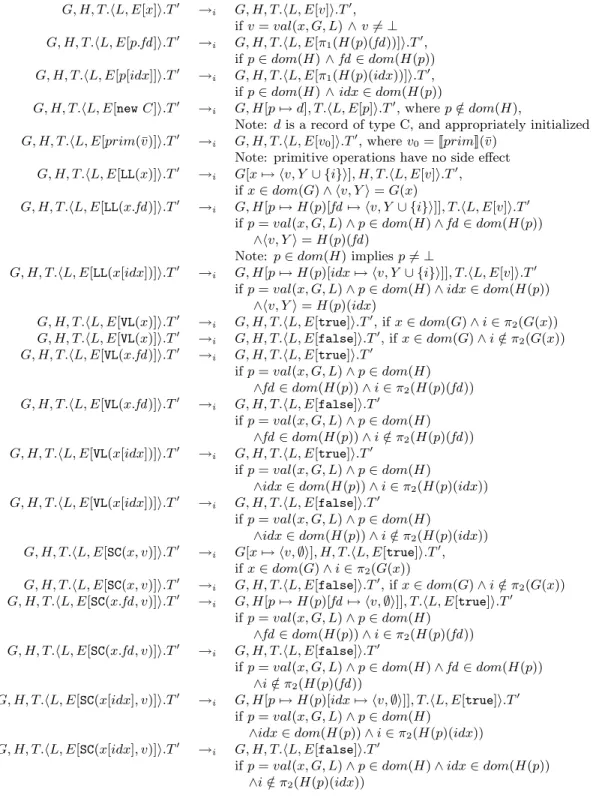
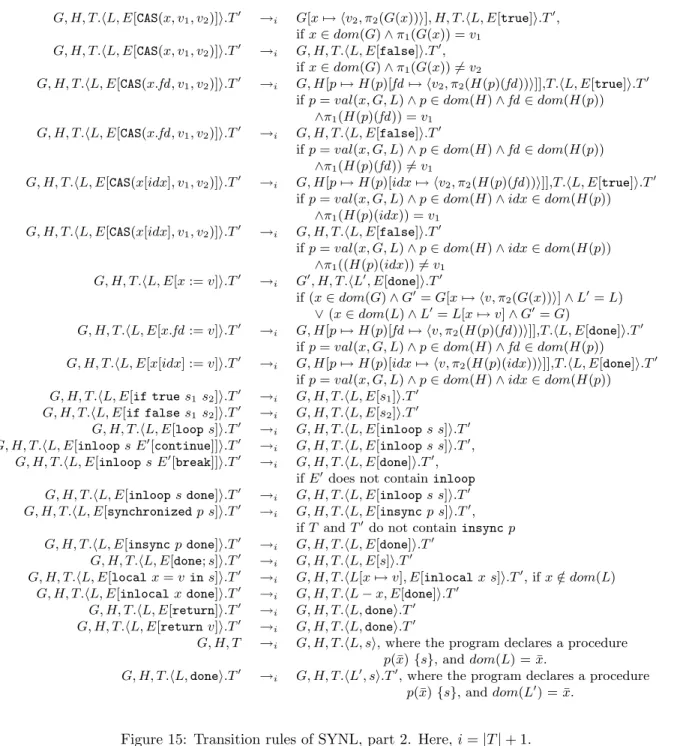
Anexecution is an initial state followed by a sequence of transitions. A program state is a tuple which consists of a global storeG, a heapH, each thread’s local storeLand program statements (this indicates the next statement to execute; it takes the place of a program counter). Each transition corresponds to one step of evaluation of an expression or statement in a standard way. The formal definitions of states and transitions are in Appendix B. For each transition, we consider the action performed by it. These actions capture the relevant behavior of the transition for our analysis and are described in Section 3.3. Note that all constructs in SYNL are deterministic, so the intermediate states during an execution are uniquely determined by the
initial state and the sequence of transitions, and we will sometimes talk about executions as if those states were present in them.
Code blocks in a program P are atomic if: for every reachable state s of P in which all threads are executing outside those code blocks,sis also reachable in an execution ofP in which those code blocks are executed serially,i.e., without interruption by other threads.
3.3
Commutativity and Atomicity Types
The live scope of a local variable consists of control points where the variable is in scope and live. We overload “live scope” by also saying that a state (of a multithreaded program) with some thread at such a control point is in the live scope of the variable. SYNL does not allow references to local variables, so the live scope of every local variable can easily be determined.
A local reference variablev in a programP isuniqueif, in every reachable state of P that is in the live scope ofv, no other variables contain the same reference asv. Thus, during the live scope ofv, the object pointed byv is unshared, although it may be shared outside the live scope of v. In this paper, “reference” is often short for “reference variable”. Any static uniqueness analysis may be used to identify unique local references.
An unshared object is an object accessed by only one thread. An unshared variableis a local variable, a field of an unshared object, or a field of an object referenced by a unique local reference (this definition could be extended to include fields of objects reachable by a chain of unique references). Other variables are shared variables. Escape analysis can be used to determine when objects become shared; before that, their fields are unshared variables.
Alocal actionis an access to an unshared variable. Conservatively, other variable accesses can be treated as global actions. Acquire and release on shared locks are also global actions. Thus, there are four kinds of global actions: read, write, acquire lock, and release lock. LetR(v), W(v),acq(v), andrel(v) denote these global actions, respectively, wherev denotes the accessed variable or lock. LL and VL are global reads. SC and CAS are global writes to their first argument and, if their second or (for CAS) third argument are shared variables, also global reads of those variables. Every action is atomic, since a single action is executed in a single step of execution.
Following [Lip75], actions are classified according to their commutativity. An action is aright-mover/ left-mover if, whenever it appears immediately before/after an action from a different thread, the two actions
can be swapped without changing the resulting state. An action is aboth-moverif it is a left-mover and a right-mover. An action not known to be a left-mover or right-mover isatomic(type), since a single action is executed in a single step of execution.
Theorem 3.1. Local actions are both-movers.
Proof. Accesses to local variables and fields of unshared objects are obviously both-movers. For accesses to a fieldf of an objectothrough a unique local referencev, they are all in the live scope ofv. During the live scope ofv, other threads cannot hold any reference to the objecto. So they cannot accesso.f concurrently throughv. Hence, accesses to o.f throughv are both-movers.
Theorem 3.2. Lock acquires are right-movers. Lock releases are left-movers.
Proof. See [FQ03], from which this theorem is taken. Here is a proof sketch. For acq(v), its immediate successor global actionafrom another thread can not be a successfulacq(v) orrel(v), becauseacq(v) would block, and rel(v) would fail (in Java, it would throw an exception). Hence acq(v) and a can be swapped without affecting the result, so lock acquire is a right-mover. For similar reasons, lock release is a left-mover.
Theorem 3.3. (1) For a global read R(v), if no global write W(v)from other threads can happen immediately before/after R(v), R(v) is a left/right mover. (2) For a global write W(v), if no global read R(v) or write W(v)from other threads can happen immediately before/after W(v), W(v)is a left/right mover.
Proof sketch. The main observations are that two reads commute, and accesses to different variables com-mute.
We briefly review atomicity types, which were introduced by Flanagan and Qadeer [FQ03]. An atomicity type is associated with an action. The atomicity types are: right-mover (R), left-mover (L), both-mover (B), atomic (A), and non-atomic (N, called compoundin [FQ03]). The first three mean that the actions have the specified commutativity. Atomicis used for single actions that are not left-movers or right-movers and for atomic (as defined in Section 3.2) sequences of actions. Non-atomic is used when none of the other atomicity types are known to apply. Atomicity types are partially ordered such that smaller ones give stronger guarantees. The ordering is: B@t@A@N fort∈ {L, R}. The atomicity type of an expression or statement can be computed from the atomicity types of its parts (such as actions) using the following operations on atomicity types. Thejoin (i.e., least upper bound) operation based on this ordering is used to compute the atomicity of anifstatement from the atomicity types of thethenandelse branches. The
iterative closuret∗ of an atomicity type t denotes the atomicity of a statement that repeatedly executed a
sub-statement with atomicity typet. It is defined by: B∗ =B, R∗=R,L∗=L, A∗ =N, N∗ =N. The
sequential compositiona;b is defined by the following table (the rows are labeled by the first argument; the columns are labeled by the second argument):
; B R L A N B B R L A N R R R A A N L L N L N N A A N A N N N N N N N N
4
Pure Loops
For a loop (recall that all loops in SYNL are unconditional, likewhile (true)s), if an iteration terminates exceptionally via abreakorreturn statement, it is called anexceptional iteration; otherwise, it is called a normal iteration. For simplicity, we do not consider nested loops in this paper. We define pure loops based on the notion of pure statements introduced in [FFQ05]1. Informally, a loop ispureif all normal iterations of
the loop have no side effect (a formal definition appears in Section 4.1.1). Typically, a normal iteration uses some side-effect-free actions to check whether some conditions on the current state are satisfied. When these conditions are not satisfied, another iteration is needed. When these conditions are satisfied, an exceptional iteration occurs; it may have side effects and exit the loop. Therefore, following the idea proposed in [FFQ05], to determine the atomicity of a pure loop, we may ignore its normal iterations and focus on its exceptional iterations.
Note that pure is not the same as side-effect free, because a pure loop may have side effects in exceptional iterations.
A simple example of a pure loop appears in the implementation of the Downoperation on a semaphore shown in Figure 2. Iterations that end at returnare exceptional. Iterations that end at line 4 (i.e., when
tmp > 0is false) or line 5 (i.e., when SC returnsfalse) are normal and have no residual side effects.
1 proc Down(sem) {
2 loop
3 local tmp = LL(sem) in local tmp = LL(sem) in
4 if (tmp > 0) TRUE(tmp > 0)
5 if (SC(sem, tmp-1)) TRUE(SC(sem, tmp-1))
6 return; return;
7 }
Figure 2: Down operation on a semaphore. Its exceptional variant introduced in Section 5.2.1 is shown on the right.
4.1
Formal Definition of Pure Loops
4.1.1 Pure Actions and Pure Loops
Some local reference is not unique according to the definition in Section 3.3, but all its effects on other threads are limited to normal iterations of loops, which can be ignored under some condition when analyzing atomicity, as shown below in Theorem 4.1. To capture this, we define: a local reference variablev is quasi-uniquein a programP ifvis unique (as defined in Section 3.3) when allloop-localvariables (i.e., their entire scopes are in the loop body) in normal iterations of loops inP are ignored (in other words, some loop-local variables in normal iterations may contain the same reference asvwhilevis in scope and live). In this paper, quasi-unique local references are identified manually. This could be done automatically using an extended static uniqueness analysis.
Informally, an action in a normal iteration of a loop is pureif any update performed by the action is not visible to other threads or to the current thread after the current normal iteration; in other words, there is no data flow from the action to outside of the normal iteration in which it occurs. Formally, a pure action should satisfy the following two conditions:
(1) If it performs an update, the target location loc must satisfy the following conditions: (1.i)loc is a local variable, a field of an unshared object, or a field of an object oaccessed through a quasi-unique local reference; and (1.ii) for all paths in the control flow graph from the beginning of the loop body to exit points of the loop (i.e., break and return statements), if there is any access to loc, the first one must be write (and iflocis a field of a shared object, the write is performed by dereferencing a unique local reference); and (1.iii) ifloc is not accessed on some path described in (1.ii), thenloc is loop-local.
(2) (2.i) If it is a LL action, each matching SC(loc,-) is in the same iteration of the loop; if it is a SC action, each matching LL(loc) is also in the same iteration. (2.ii) It is not a successful SC.
Condition (1) as a whole ensures that the updates in normal iterations have no side-effects outside. Condition (1.i) ensures that the updates in normal iterations effectively have no side-effects on other threads. Suppose a fieldf of a shared objectois updated in a normal iteration through a quasi-unique local reference, other threads concurrently accesso.f(and hence see the update) only in normal iterations, so those accesses and their effects also disappear when normal iterations are deleted, as in Theorem 4.1. Conditions (1.ii) and (1.iii) ensure that updates in normal iterations are not visible to subsequent operations of the same thread. Condition (2.i) is needed because LL implicitly performs an update that can affect subsequent SC operations by the same thread. Condition (2.ii) is needed because a successful SC has side-effects on SC operations in other threads.
Formally, a loop ispureif, for each normal iteration of the loop, every action that can occur in it is pure. To check whether a loop is pure, we construct a control flow graph (CFG), analyze it to identify actions that can occur in normal iterations of the loop, and then check whether those actions are pure according to the above definition. There is a special case for SC and CAS. When a SC is used as the test condition of an
ifstatement (e.g., the SC in Figure 3), if only the false branch of theifstatement can be executed under normal iterations, the SC is treated as a read (not an update). CAS is handled similarly.
4.1.2 An Example of Pure Loop
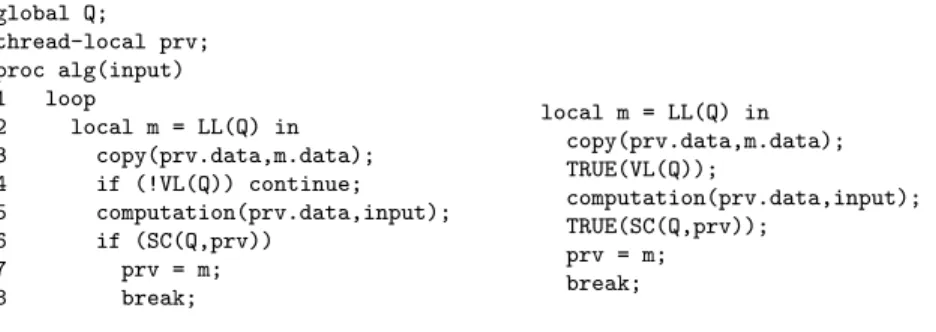
An example appears in Figure 3, which shows Herlihy’s algorithm for non-blocking concurrent implementa-tion of small objects [Her93]. Suppose a small object (i.e., small enough to be copied efficiently) is shared by a set of threads. The main steps on each thread in the algorithm are: (1) read the shared object reference
Qusing LL; (2) copy the data from the shared object into a private (i.e., currently unshared) working copy of the object,i.e., the object referred byprv; (3) perform the requested computation on the private object; (4) switch the reference values inQandprvbetween the shared object and the private object using SC and an assignment statement. Note that the formerly shared object becomes a private copy, and the formerly private object becomes the current shared copy.
Before a threadt1switches the reference of the shared copyowith the private copy oft1, another thread t2 may read the reference toousingLL(Q). Even thoughobecomes the private copy oft1,t2 may still hold
the reference too, though the SC oft2 will fail later, causingt2 to loop and read the current reference from Q. Thus,t1 may write to owhile t2 copies data fromo. Ift2 tried to perform a computation on a copy of
global Q; thread-local prv; proc alg(input) 1 loop 2 local m = LL(Q) in 3 copy(prv.data,m.data); 4 if (!VL(Q)) continue; 5 computation(prv.data,input); 6 if (SC(Q,prv)) 7 prv = m; 8 break; local m = LL(Q) in copy(prv.data,m.data); TRUE(VL(Q)); computation(prv.data,input); TRUE(SC(Q,prv)); prv = m; break;
Figure 3: Herlihy’s non-blocking algorithm for small objects. Its exceptional variant, defined in Section 5.2.1, is shown on the right.
prevents this: ifo.data(accessed asm.data) is modified by another thread during the copy in line 3, the VL will fail.
Initially, prv is a unique local reference. After the reference values in Q and prv are switched, some other threads executing the loop may still have references to the formerly shared object as described in the previous paragraph. Note thatprvcan be aliased only bymandQvariables at those threads during normal iterations. Therefore, when normal iterations are ignored,prvis a unique local reference except in the states between a successful SC and “prv =m” because the thread temporarily has two references to the object. Sinceprv andm are both local variables, “prv=m” contains only local actions. It is well known that the set of reachable states is not affected when a sequence of local actions executes atomically together with a non-local action that immediately precedes or immediately follows the sequence, if the intermediate states between those actions are ignored. In this case, ignoring those intermediate states is justified because these transitions are in a loop body, and our goal (shown in Theorems 4.1 and 4.2) is to preserve reachability of states where all threads are executing outside of loops (because the theorems require that all loops are pure). Therefore, according to the definition in Section 4.1.1, all actions in normal iterations are pure, so the loop is pure.
4.1.3 Normal Iterations of Pure Loops Can Be Deleted
Theorem 4.1 shows that all normal iterations of all pure loops can be deleted from an execution without affecting the result of the execution. Informally, deleting a transition from an execution means removing it and adjusting the subsequent states. Details are in Appendix C. Theorem 4.1 is the basis for proving in Section 5 that normal iterations of pure loops can be ignored when analyzing atomicity.
Theorem 4.1. Suppose all loops in a programP are pure. Letσbe an execution ofP. Letσ0be an execution
obtained fromσby deleting all transitions in all normal iterations of all pure loops inP. Thenσ0 is also an
execution ofP, andσ andσ0 contain the same states in which all threads are executing outside pure loops.
Proof sketch. A detailed proof appears in Appendix C. Here is a proof sketch.
Recall that loops in SYNL are equivalent to while (true) s. When the body of a loop terminates normally, the thread begins another iteration of the same loop body.
According to the definition of pure loop, normal iterations can update only unshared variables and fields of shared objects accessed by dereferencing quasi-unique local references. The values written are dead by the end of the loop body, except that an update to a field of a shared object accessed by dereferencing a quasi-unique local reference can be visible in normal iterations of pure loops in other threads. Because all normal iterations of pure loops are removed simultaneously, all of these side-effects on other threads are also eliminated. The syntax of SYNL ensures that lock acquire and release actions occur in matching pairs in an execution of a loop body, so deleting them does not affect the resulting state of the lock; also, note that other threads cannot perform any operations on a lock while it is held by this thread. Because the definition of pure loop implies that no successful SC occurs in normal iterations, and the matching pairs of LL and SC (if they exist) must occur in the same iteration of a loop, so deleting them does not affect subsequent LLs and SCs in this thread or LLs and SCs in other threads. CAS just reads and writes variables, and the same reasoning as for other reads and writes applies.
Theorem 4.2. Suppose all loops in a program P are pure. After deleting all transitions in all normal iterations of all loops, accesses to fields of shared objects by dereferencing quasi-unique local references are both-movers.
Proof. According to the definition of quasi-unique local references, these references become unique after all normal iterations of all loops are deleted. As shown in Theorem 3.1, accesses through unique local references are both-movers.
5
Checking Atomicity
The main issue in applying Theorem 3.3 is determining whether a global action can happen immediately before or after another global action. Our analysis determines this based on how synchronization primitives are used.
5.1
Lock Synchronization
Lock synchronization is well studied. We sketch a simple treatment of lock synchronization, to illustrate how analysis of locks fits into our overall analysis algorithm.
Theorem 5.1. If expressions e1 and e2 appear in the bodies of different synchronized statements that
synchronize on the same lock, then e1 cannot be executed immediately before or aftere2.
Proof sketch. Sincee1 and e2 are protected by the same lock, at least one acquire and release of the lock
must occur betweene1 ande2in any execution.
Alias analysis may be used to determine whether twosynchronizedstatements synchronize on the same lock.
5.2
Non-Blocking Synchronization
5.2.1 Exceptional Variants
Based on Theorem 4.1, for each pure loop, it suffices to analyze atomicity of each exceptional iteration of the loop. For each break or return statement in a loop, the backward slice of the loop body starting at
thatbreak orreturnand ending at the loop’s entry point is called anexceptional slice of the loop.
The atomicity of a procedure can be determined by analyzing atomicity of its exceptional variants. Each exceptional variant is a specialized version of the procedure, and corresponds to a selection of exceptional slices of its pure loops, with each pure loop replaced by its selected exceptional slice. If the selected excep-tional slice includes only the true branch of an “ife S1 S2” statement, then we replace theif statement
with “TRUE(e);S1” in the corresponding exceptional variants of the procedure; if the slice includes only the
false branch, we replace the ifstatement with “TRUE(!e);S2”. A SC expression inTRUE(SC(v, val))must
be successful, and we call it asuccessfulSC expression. Non-pure loops appear unchanged in the exceptional variants. For example, Figures 2 and 3 show the exceptional variants for the semaphoreDownprocedure and Herlihy’s non-blocking algorithm, respectively.
Theorem 5.2. If all exceptional variants of a procedurepare atomic, then pis atomic.
Proof Sketch. LetP denote the original program that containsp. Letσbe an execution of P. Let ϕbe a state inσin which all threads are executing outsidep.
According to Theorem 4.1, an execution σ0 of P can be obtained from σ by deleting all transitions in
variant, there must be exceptional variants ofpwhich can produce the same exceptional iterations of pure loops of p as in σ0. Let P0 denote the program obtained by replacing procedure pwith such exceptional
variants. Thus,σ0 is also an execution ofP0.
By hypothesis, all exceptional variants ofpare atomic. Based onσ0, by the definition of atomicity, there
exists an executionσ00 ofP0 in which the exceptional variant ofpare executed atomically and in whichϕis
reachable.
By the definition of exceptional variants of a procedure, every execution of an exceptional variant ofpis also an execution of p. Therefore, σ00 is also an execution ofP, and all executions ofp inσ00 are executed
atomically, andϕis reachable inσ00. Thus, by the definition of atomicity,pis atomic.
5.2.2 Atomicity Analysis of Non-Blocking Synchronization Primitives LL/SC/VL
There is a unique matching LL action for each successful SC action in an execution. In program code, there might be multiple LL expressions or statements that can produce the matching LL action for an occurrence of SC. We call these the matching LL expressions of the SC expression. For example, if there is an if
statement before a SC, and both branches of the ifstatement contain LL, both of the LL expressions can possibly match the SC.
For a SC(v, val) in a program, to find its matching LL expressions, we do a backward depth-first search on the control flow graph starting from the SC, and not going past edges labeled with LL(v). All of the visited occurrences of LL(v) match the SC. For a VL(v), its matching LLs can be found in the same way.
We implicitly assume hereafter that each SC expression has a unique matching LL expression. This assumption is not essential, but it simplifies the analysis and is satisfied by the non-blocking algorithms we have seen. We also implicitly assume that a variable updated by a SC is updated only by SC, not by other actions (such as regular assignment or CAS).
Theorem 5.3. A successful SC or VL is a left-mover, and the matching LL is a right-mover.
Proof. By the semantics of LL, SC and VL, for a successful SC(v, val) or VL(v) action and its matching LL(v), any other SC action (successful or failed) onvexecuted by another thread cannot be executed between them. Therefore, the successful SC or VL is a left-mover, and the matching LL is a right-mover.
Theorem 5.4. Let SC andLL denote a successful SC(v, val) expression and its matching LL(v) executed by a thread t, respectively. Let SC0 and LL0 denote a successful SC(v, val0) expression and its matching
LL(v) executed by another threadt0, respectively. SC0,LL0, and all transitions oft0 between them cannot be
executed betweenSC andLL.
Proof sketch. According to Theorem 5.3, SC0 cannot happen between LL and SC. Thus, there are two
cases: SC0happens beforeLL, orSC0happens afterSC. For the first case, the theorem obviously holds. For
the second case, ifLL0 happens betweenLL andSC,SC must also happen betweenLL0 andSC0 (because
SC succeeds), which is impossible since SC0 also needs to succeed; if LL0 happens afterSC, the theorem
obviously holds.
5.2.3 Atomicity Analysis of Non-Blocking Synchronization Primitive CAS
CAS is often used in a similar way as LL/SC. CAS takes an address, an expected value, and a new value as arguments. There is often an assignment before CAS to save the old value into a temporary variable that is used as the expected value. For a CAS, itsmatching read, if any, is the action which reads the old value and saves it as the expected value. Note that a CAS can succeed even without a matching read; a SC cannot succeed without a matching LL. We use a backward search on the control flow graph to find the matching reads for a CAS expression. We implicitly assume hereafter that there is a unique matching read for each CAS.
CAS-based programs may suffer from the ABA problem: if a thread reads a valueAof a shared variable
v, computes a new valueA0, and then executes CAS(v, A, A0), the CAS may succeed when it should not, if the
shared variable’s value was changed fromAtoB and then back toAby CASs of other threads. A common solution is to associate a modification counter with each variable accessed by CAS [Mic04b]. The counter is read together with the data value, and each CAS checks whether the counter still has the previously read value. A successful CAS increments the counter. With this mechanism, variants of Theorem 5.3 and 5.4 hold for CAS: just replace “matching LL” with “matching read”, and replace “SC” with “CAS”.
5.3
Non-Blocking Synchronization and Invariants
In many algorithms, an invariant holds throughout execution of a code block. If the invariants for two code blocks contradict, executions of the two code blocks by different threads cannot be interleaved.
A predicatep(lvar) is called alocal invariantof a code block “locallvar=einstmt” (which is called a local block onlvar), if it satisfies the following two conditions: (i)lvar is not updated instmt, and (ii)
Condition (i) is easy to check, because there is no aliasing of local variables in SYNL. When condition (i) holds, a local invariant for a block can easily be obtained from the TRUEstatements instmtthat depend only onlvar. For example, in the exceptional variant of procedureDownshown in Figure 2, a local condition for the code block in lines 3-6 istmp >0. If condition (i) does not hold, or no appropriateTRUE statements appear in the local block, its local invariant istrue.
A local block of the form “local lvar =LL(svar)in {stmt;TRUE(SC(svar, val));}” is called a LL-SC blockonsvar.
Theorem 5.5. Suppose a shared variablesvaris updated only by SC expressions in LL-SC blocks, and every LL-SC block on svar in the program has the same local invariant p(lvar). Suppose a local block S “local lvar0 = svar instmt0” has a local invariant!p(lvar0).
(a) No successful SC(svar) in the LL-SC blocks onsvar can occur inside S.
(b) No transition in local block S can be executed inside any LL-SC block onsvar, and no transition in any LL-SC block onsvar can be executed inside local block S.
Proof of(a). We prove (a) by contradiction. Let “locallvar=LL(svar)in{stmt;TRUE(SC(svar, val));}” be a LL-SC block onsvar. Suppose a successful SC(svar) in this LL-SC block occurs insideS; this implies thatS and the LL-SC block are being executed by different threads. Without loss of generality, we consider the first such SC(svar). According to the assumption for the local block S, !p(lvar0) holds during stmt0.
Because svar is updated only by SC actions from LL-SC blocks,lvar0 ==svar and hence !p(svar) holds
from the start of stmt0 until SC(svar) is executed. This implies that !p(svar) holds when SC(svar) is
executed. The LL-SC block has local invariantp(lvar), andlvar==svar holds until the SC, becauselvar
is not updated in the LL-SC block, andsvar is not updated before the first successful SC on it, sop(svar) holds when SC(svar) is executed. This contradicts the previous conclusion.
Proof of (b). According to the proof of (a), no successful SC(svar) can happen inside S. Consider an execution of a LL-SC block onsvar. There are two cases:
Case 1: the successful SC happens beforeS. Thus, the whole LL-SC block happens beforeS. Obviously, the theorem holds in this case.
Case 2: the successful SC happens after S. If the matching LL also happens after S, the whole LL-SC block happens after S. Hence the theorem holds. Suppose the matching LL happens insideS or beforeS. Similar to the proof of (a), becausesvaris updated only by SC actions from LL-SC blocks, and no successful SCs happen inside S or between the matching LL and the SC, lvar0 == svar and hence !p(svar) holds
from the start ofstmt0 until the SC(svar) happens. Thus, !p(svar) holds when SC(svar) happens. By the
same reasoning as in the proof of (a),p(svar) holds when SC(svar) happens. This contradicts the previous conclusion. Therefore, when SC happens afterS, the matching LL cannot happen insideS or beforeS.
The definition of LL-SC block and the above theorem can be generalized, so that the LL does not need to occur at the beginning of a local block, and the SC does not need to occur at the end of a local block. A similar theorem holds for CAS.
5.4
Atomicity Inference
To analyze atomicity of each procedure in a program, we identify pure loops, then check atomicity of each procedure’s exceptional variants, by computing atomicity types for all expressions and statements, as follows: • Step 1: Identify all local actions and lock actions. According to Theorem 3.1, all local actions have atomicity type B. According to Theorem 3.2, all lock acquires and releases have atomicity type R and L, respectively.
• Step 2: According to Theorem 5.3, if all updates on a variable v are done through SC, all successful SC(v, val) and VL(v) have atomicity type L, and their matching LL(v) have atomicity type R. A successful VL(v) between a successful SC(v, val) and the matching LL(v) has atomicity type B. The analogous theorem for CAS is used for successful CAS and the matching reads.
• Step 3: Infer local invariants for local blocks, as described in Section 5.3.
• Step 4: Using Theorems 5.1, 5.4 and 5.5, for each read, check whether there is a write on the same variable that can happen immediately before/after it; for each write, check whether there is a read or write on the same variable can happen immediately before/after it. For access to variables on the heap, the analysis does a case split on whether two field accesses refer to the same location; both cases are considered, unless alias analysis shows one is impossible. Our current alias analysis just checks whether the references have the same type and whether the accessed fields have the same name; if not, the two field accesses must be to different locations. Assign atomicity types to the reads and writes based on Theorem 3.3, if they were not given atomicity types in previous steps.
• Step 5: For actions not given an atomicity type in previous steps, conservatively assign them atomicity type A.
local m = LL(Q) in a1:R local m = LL(Q) in copy(prv.data,m.data); a2:B copy(prv.data,m.data);
if (!VL(Q)) continue; a3:B TRUE(VL(Q));
computation(prv.data,input); a4:B computation(prv.data,input);
if (SC(Q,prv)) a5:L TRUE(SC(Q,prv))
prv = m; a6:B prv = m;
break; a7:B break;
Figure 4: Atomicity types for actions of Herlihy’s non-blocking algorithm.
• Step 6: Propagate atomicity types from the actions up through the abstract syntax trees of the procedures using the atomicity calculus sketched in Section 3.3 and detailed in [FQ03]. The atomicity type of a compound program construct is computed from the atomicity types of its parts using join, sequential composition, and iterative closure, as appropriate.
At last, for each procedurepin the original program, if every exceptional variant ofphas atomicity type A, then by Theorem 5.2,phas atomicity type A.
As an example, we compute the atomicity of Herlihy’s non-blocking algorithm for small objects as shown in Figure 4. Recall that the procedure has one exceptional variant, given in Section 5.2.1. In step 1, local actions in line a6 and line a7 are identified and assigned atomicity type B. Since prv is a quasi-unique local reference, the computation action in line a4 and the copy action in line a2 (the read in line a2 will consider later) are both-movers according to Theorem 4.2, hence, they are assigned atomicity type B. In step 2, successful SC in line a5 has atomicity type L, the matching LL in line a1 has atomicity type R, and successful VL in line a3 has atomicity type B. Step 3 is skipped in this algorithm. In step 4, we know any write tom.data(which must through successful SC) in other threads cannot happen immediately before or after the read to m.data in line a2, since a successful SC is followed. Hence, both actions in line a2 have atomicity type B. Now we can propagate atomicity types from the actions, and conclude the only exceptional variant is atomic. Therefore, the procedure is atomic.
6
Applications
This paper demonstrates the applicability of our analysis to four non-trivial non-blocking algorithms from the literature. One is the running example,i.e., Herlihy’s non-blocking algorithm; the other three are presented in this section. Although in two cases we must modify the algorithms slightly, and in one case we omit some
proc Enq(value)
local node = new Node(); node.value = value; node.next = null; loop
local t = LL(Tail) in local next = LL(t.Next) in
if (!VL(Tail)) continue; if (next != null) SC(Tail,next); continue; if (SC(t.Next,node)) // optional [SC(Tail,node);] return; proc Deq() loop local h = LL(Head) in local next = h.Next in
if (!VL(Head)) continue; if (next == null) return EMPTY; if (h == LL(Tail)) SC(Tail,next); continue;
local value = next.Value in if (SC(Head,next))
return value;
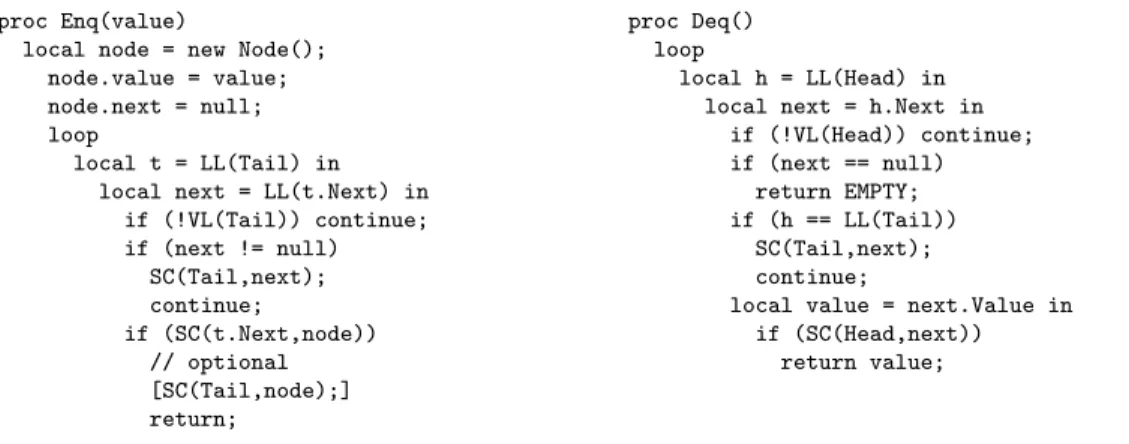
Figure 5: Michael and Scott’s Non-Blocking FIFO Queue (NFQ). HeadandTailare global variables. optimizations before applying our analysis, we consider the results encouraging, since we do not know of any other algorithmic (i.e., automatic) analysis that can show atomicity of the modified or original versions.
6.1
Michael and Scott’s Non-Blocking FIFO Queue Using LL/SC/VL
6.1.1 NFQ and NFQ0
Figure 5 contains code for a non-blocking FIFO queue (NFQ) that uses LL/SC/VL [Mic04a]. It is similar to the well-known CAS-based algorithm in [MS96]. It uses a singly-linked list whose head and tail are pointed to by global variables Head and Tail. Enqueue consists of three main steps: create a node, add it to the end of the list, and updateTail. A blocking implementation would use a lock around the second and third steps to achieve atomicity. In the non-blocking algorithm, if a thread gets delayed (or killed) after the second step, other threads may updateTail on its behalf; in that case, if the delayed thread later tries to update
Tail, its SC will harmlessly fail. To avoid blocking, the dequeue operation also updates Tail. Dequeue is also non-blocking. A dummy node is used as the head of the queue to avoid degenerate cases. The code for
Deqin [Mic04a, MS96] stores the value ofLL(Tail)in a local variable; the code in Figure 5 does not. This does not affect the correctness or performance of the algorithm but makes it easier to analyze.
We would like to show that NFQ is linearizable, using the two-step approach described in Section 2: one step is to show that the concurrent implementation executed sequentially satisfies the sequential specification; the other step is to apply our analysis to show that the procedures of the implementation are atomic.
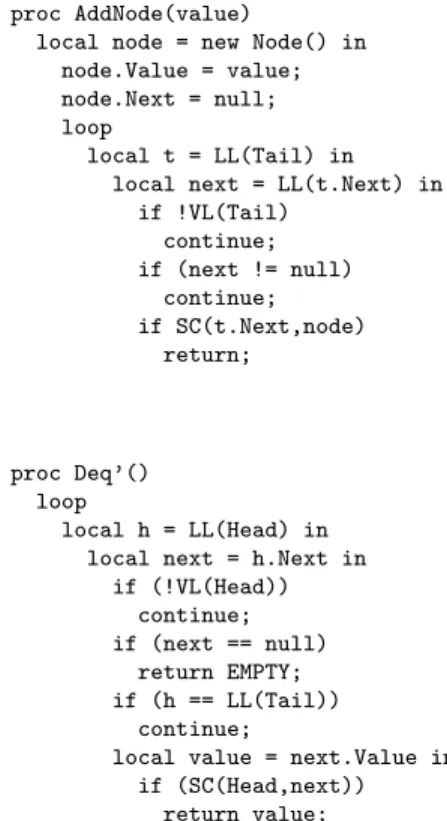
An obstacle to apply our atomicity analysis to NFQ is that the loops in Enq and Deq are not pure, because of the updates toTail in normal iterations. Therefore, we modify the program to make the loops
proc AddNode(value)
local node = new Node() in node.Value = value; node.Next = null; loop
local t = LL(Tail) in local next = LL(t.Next) in
if !VL(Tail) continue; if (next != null) continue; if SC(t.Next,node) return; proc UpdateTail() loop local t = LL(Tail) in local next = t.Next in
if !VL(Tail) continue; if (next != NULL) SC(Tail,next); return; proc Deq’() loop local h = LL(Head) in local next = h.Next in
if (!VL(Head)) continue; if (next == null) return EMPTY; if (h == LL(Tail)) continue;
local value = next.Value in if (SC(Head,next))
return value;
Figure 6: NFQ0, a modified version of NFQ.
pure before applying our analysis algorithm; specifically, we consider the modified program NFQ0 in Figure
6, and we prove in Appendix A that the modification preserves linearizability. In NFQ0, all updates toTail
are performed in a separate procedure UpdateTail. UpdateTail may be invoked (by the environment) at any time, so NFQ0 is effectively more non-deterministic than NFQ.
6.1.2 Atomicity of NFQ0
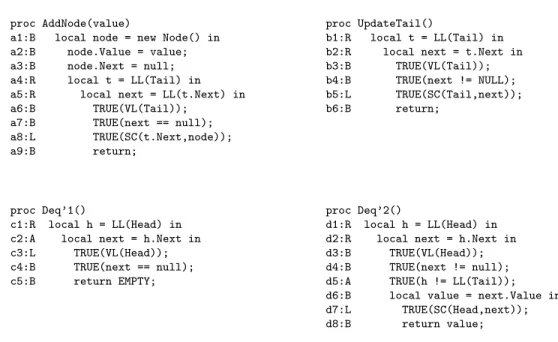
All exceptional variants for the procedures of NFQ0 are listed in Figure 7. Each line of code is labeled on the
left with a line number and the atomicity type of the code on that line. A line may contain multiple actions; we refer to the sequential composition of their atomicity types as the atomicity type of the line. Next we describe how the atomicity analysis algorithm in Section 5.4 works on these procedures.
In step 1, a1, a2, a3, a7, a9, b4, b6, c4, c5, d4 and d8 are classified as both-movers, because they access local variables.
proc AddNode(value)
a1:B local node = new Node() in a2:B node.Value = value; a3:B node.Next = null; a4:R local t = LL(Tail) in a5:R local next = LL(t.Next) in
a6:B TRUE(VL(Tail));
a7:B TRUE(next == null);
a8:L TRUE(SC(t.Next,node));
a9:B return;
proc UpdateTail()
b1:R local t = LL(Tail) in b2:R local next = t.Next in
b3:B TRUE(VL(Tail)); b4:B TRUE(next != NULL); b5:L TRUE(SC(Tail,next)); b6:B return; proc Deq’1() c1:R local h = LL(Head) in c2:A local next = h.Next in
c3:L TRUE(VL(Head));
c4:B TRUE(next == null);
c5:B return EMPTY;
proc Deq’2()
d1:R local h = LL(Head) in d2:R local next = h.Next in
d3:B TRUE(VL(Head));
d4:B TRUE(next != null);
d5:A TRUE(h != LL(Tail)); d6:B local value = next.Value in
d7:L TRUE(SC(Head,next));
d8:B return value;
Figure 7: Exceptional variants for procedures of NFQ0.
SCs or VLs; a6 (which is reclassified as a both-mover in step 4), a8, b5, c3, and d7 are classified as left-movers because they are successful SCs or VLs; b3 and d3 are classified as both-movers because they are between matching LLs and successful SCs.
In step 3, the local invariant for a5-a9 and c2-c5 isnext==null. The local invariant for b2-b6 and d2-d8 isnext! =null.
Now consider step 4. Letta andtudenote the local variabletinAddNodeandUpdateTail, respectively. If ta.Next of the LL-SC block in AddNode is aliased with tu.Next of the local block in UpdateTail, then according to Theorem 5.5, the update on Tail (i.e., b5) cannot happen between a6 and a7, so a6 is a both-mover. a8 cannot happen between b2 and b3, so b2 is a right-mover. Supposeta.Nextis not aliased withtu.Next; this impliesta is not aliased withtu,i.e.,ta6=tu, so even if a8 happens between b2 and b3, b2 is a right-mover by Theorem 3.3. ta 6=tu implies that the value of Tailread in line of a4 inAddNodeis not equal to the value ofTail read in line of b1 inUpdateTail. Thus, even if b5 happens between a6 and a7, a6 is still a both mover by Theorem 3.3. For d2, ifh.Nextis aliased witht.NextofAddNode, a8 cannot happen between d2 and d3 according to Theorem 5.5, hence d2 is a right-mover by Theorem 3.3; ifh.Next
is not aliased with t.Next, d2 is again a right-mover. Also in step 4, d6 is inferred to be a both-mover, because there is no write to theValuefield of any shared object; the only write a2 to theValuefield is on an object that has not escaped.
program without atomic with atomic states time states time unbounded AddNodethreads 4500 >19h 13 3.0s unbounded Deq’threads 1285 88 m 10 1.7s incorrect AddNode 13 5 s 13 3.0s Table 1: Experimental results for verification of NFQ0 with TVLA.
In step 5, the unclassified c2 and d5 are given atomicity type A. Step 6 infers that each procedure in Figure 7 has atomicity type A. Step 7 infers that all procedures in NFQ0 are atomic.
6.1.3 Linearizability of NFQ0 and NFQ
We showed in Section 6.1.2 that the procedures in NFQ0are atomic, and we showed in Appendix A that NFQ0
can simulate all behaviors of NFQ. To conclude that NFQ0, and hence NFQ, are linearizable with respect
to a sequential specification of FIFO queues, we need to show that NFQ0 executed sequentially satisfies that
specification. One approach is to use a powerful verification tool such as TVLA [YS03], which is a model checker based on static analysis. With our approach, TVLA only needs to consider sequential executions of NFQ0, so the verification is much faster and use much less memory than the verification in [YS03], where
TVLA was used to show directly that NFQ satisfies some complicated temporal logic formulas.
To evaluate the speedup that our atomicity analysis can provide for subsequent verification, following [YS03, Table 2], we used TVLA to verify several correctness properties of NFQ0. We analyzed the correct
program with two different environments: in the first one, the number of threads that concurrently call
AddNodeis unbounded (but there is only one thread that performs dequeues, and there is only oneUpdateTail
thread, since it contains a non-terminating loop); in the second one, the number of threads that concurrently perform dequeues is unbounded (but there is only one thread that performs AddNode, and one that calls
UpdateTail). We also checked the properties for an incorrect version of NFQ0; specifically, we deleted
the statement “if (next != null) continue” in the AddNode procedure; TVLA catches this error. We performed all experiments twice: once with each procedure body declared as atomic, as inferred by our analysis algorithm, and once without those declarations. The atomicity declarations had little effect on the time needed for TVLA to find an error in the incorrect program, but it reduced the time and space needed to verify the correct versions by a factor of 100 or more. The experimental results appear in Table 1.
6.2
Gao and Hesselink’s Non-Blocking Algorithm for Large Objects
For large objects, copying is the major performance bottleneck in Herlihy’s algorithm. Gao and Hesselink [GH04] proposed an algorithm that avoids copying the whole object. The fields of each object are divided into W disjoint groups such that each operation changes only fields in one group. When copying data between the shared and private copies of an object, only the modified groups are copied. To efficiently detect modifications, a version number is associated with each group of fields of each copy of the object. The algorithm works as follows: (1) read the shared object reference using LL; (2) copy data and version numbers in all modified groups of fields of the currently shared copy of the object into the corresponding groups of fields of the current thread’s private copy; (3) do the computation on the private copy, updating fields in some group, and incrementing the corresponding version number; (4) switch the references between the shared object and the private object using SC. The algorithm is more complicated than Herlihy’s algorithm for small objects in Figure 3 mainly because of the loop over groups of fields, the conditional behavior depending on which groups of fields changed, and the use of version numbers to efficiently detect changes.
Our analysis cannot directly show that the algorithm is atomic, due to the use of version numbers. Our analysis algorithm is able to show that a version of the algorithm that does not use version numbers is atomic. We then show that the transformations that optimize the algorithm by introducing and using version numbers preserve atomicity; this is relatively easy.
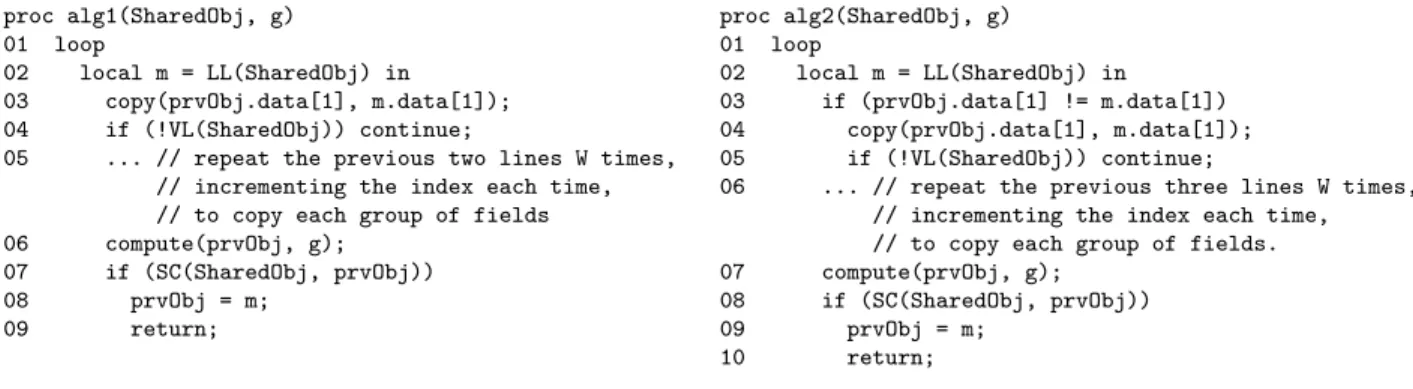
We show that the non-blocking algorithm for large objects (specifically, Algorithm 3 in Figure 9) is atomic. The procedure callcopy(prvObj.data[i],m.data[i]) copies the data inm.data[i]to prvObj.data[i]. Lines 3-8 are an unrolled loop that copies each group of fields; we unrolled the loop because our cur-rent analysis does not support nested loops, although it could be extended to do so. The procedure call
compute(prvObj,g)does computation based on the data inprvObjand writes the result intoprvObj.data[g].
Algorithm 3 in Figure 9 differs in some minor ways from the original algorithm in [GH04]. It does not contain the redundant array oldused in [GH04]. Like Herlihy’s algorithm in Figure 3, it uses VL (line 6) to prevent errors due to inconsistent states ofprvObjthat may result from updates during copying (line 5). [GH04] simply assumed that such errors do not occur. Also, we omit the guard predicate used in [GH04], which is used to optimize cases wherecomputeis applied in a state in which it performs no updates.
Algorithm 1 in Figure 8 is a simplified version of the algorithm, in which all data of the shared object (i.e.,m) are copied into the working object (i.e.,prvObj) of the current thread in every iteration of the loop. Likeprv in Herlihy’s algorithm in Figure 3, prvObj is a quasi-unique local reference. Moreover, for all i,
proc alg1(SharedObj, g) 01 loop
02 local m = LL(SharedObj) in
03 copy(prvObj.data[1], m.data[1]); 04 if (!VL(SharedObj)) continue;
05 ... // repeat the previous two lines W times, // incrementing the index each time, // to copy each group of fields
06 compute(prvObj, g); 07 if (SC(SharedObj, prvObj)) 08 prvObj = m; 09 return; proc alg2(SharedObj, g) 01 loop 02 local m = LL(SharedObj) in 03 if (prvObj.data[1] != m.data[1]) 04 copy(prvObj.data[1], m.data[1]); 05 if (!VL(SharedObj)) continue;
06 ... // repeat the previous three lines W times, // incrementing the index each time, // to copy each group of fields.
07 compute(prvObj, g);
08 if (SC(SharedObj, prvObj))
09 prvObj = m;
10 return;
Figure 8: Gao and Hesselink’s non-blocking algorithm for large objects: Algorithms 1 and 2. SharedObjis a global variable. prvObjis a thread-local variable.
proc alg3(SharedObj, g) 01 loop
02 local m = LL(SharedObj) in
03 local newVersion[1] = m.version[1] in 04 if (newVersion[1] != prvObj.version[1])
05 copy(prvObj.data[1], m.data[1]);
06 if (!VL(SharedObj)) continue;
07 prvObj.version[1] = newVersion[1];
08 ... // repeat lines 3-7 W times, incrementing the index each time, to copy each group of fields.
09 compute(prvObj, g); 10 prvObj.version[g]++; 11 if (SC(SharedObj, prvObj)) 12 prvObj = m; 13 return; 14 else 15 prvObj.version[g] = 0;
Figure 9: Gao and Hesselink’s non-blocking algorithm for large objects: Algorithm 3. SharedObjis a global variable. prvObjis a thread-local variable.
prvObj.data[i]is dead at the end of the loop’s body under all normal terminations. Therefore, the loop is
pure. By the same reasoning as for the non-blocking algorithm for small objects in Figure 3, the procedure of Algorithm 1 in Figure 8 is atomic.
Algorithm 2 in Figure 8 is an improved version of Algorithm 1 in which the copy is omitted from
m.data[i] to prvObj.data[i] when those two locations already contain the same value. Algorithm 2
clearly has the same behavior as Algorithm-1. Therefore, the procedure in Algorithm 2 is atomic.
Algorithm 3 in Figure 9 is an improved version of Algorithm 2 in which version numbers are used to efficiently and conservatively check whether m.data[i] and prvObj.data[i]are equal. “Conservatively” here means that the check might return false when they contain the same value (e.g., because the values
boolean DCAS(val *addr1, val *addr2, val old1, val old2, val new1, val new2){ atomically{
if ((*addr1 == old1) && (*addr2 == old2)) { *addr1 = new1; *addr2 = new2; return true; } else return false } }
Figure 10: The double compare-and-swap operation shown in C language format.
stored inm.data[i]andprvObj.data[i]happen to be equal), but this merely causes the code in the full algorithm to do an unnecessary copy (i.e., the copy does not actually change the value ofprvObj.data[i]). The last statement “prvObj.version[g] = 0” is needed so that the update toprvObj.version[g]from line 10 will be discarded if the SC fails. Algorithm 3 clearly has the same behaviors as Algorithm 2. Therefore, the procedure in Algorithm 3 is atomic.
To evaluate the benefit of our atomicity analysis compared to a traditional partial-order reduction, we implemented Algorithm 3 in the model checker SPIN [Hol03]. We wrote a driver with 3 threads that concurrently invoke arithmetic operations on a shared object with 3 integer fields, each in its own group. The numbers of reachable states are: 4,069,080 with no optimization; 452,043 with SPIN’s built-in partial-order reduction; 69,215 with the procedure body declared as atomic, as inferred by our analysis algorithm; and 4619 with both optimizations.
6.3
DCAS-Based Double-ended Queue
6.3.1 The DCAS operation
There is a growing realization that the synchronization operations on single memory locations, such as CAS, are not expressive enough to support designing efficient non-blocking algorithm [ADF+00]. Double
compare-and-swap (DCAS) shown in Figure 10 is a proposed stronger synchronization operation. DCAS is similar as CAS; it just adds another addressaddr2 which is handled together withaddr1. It is easy to give theorems for DCAS analogous to Theorems 5.3, 5.4, and 5.5 for LL/SC.
6.3.2 The Array-based Double-ended Queue
Agesen et al. proposed an array-based double-ended queue [ADF+00] using DCAS as shown in Figure 11.
The algorithm shown in Figure 11 is slightly simpler than the algorithm in [ADF+00], because we removed
an optional optimization from each procedure. In a double-ended queue (DEQ), elements can be enqueued (pushed) or dequeued (popped) from both ends. The array-based DEQ is bounded: it can hold at most
lengthS elements. DEQ has four procedures: popRight, pushRight, popLeft, and pushLeft. We show
onlypopRightandpushRight. The other two are similar.
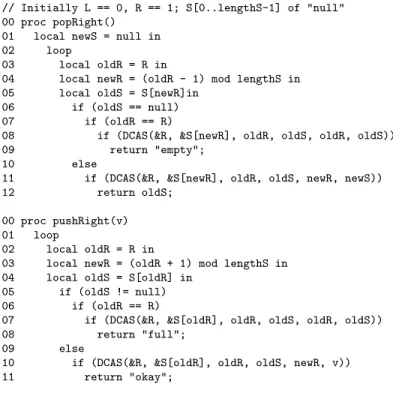
All elements are saved in an arrayS. Global variableRcontains the index of the next position to insert an element on the right. Thus,R-1is the position which holds the element to pop from the right.
The procedure popRight accesses two shared variables R and S[newR]. The loop in popRight is pure, because in all normal iterations, there is no update on shared variables, and all local variables are dead at the end of the loop body. popRighthas two exceptional variants. One exceptional variant is from line 3 to line 9, in which the first DCAS returns true. According to our theorem for DCAS (the analogue of Theorem 5.4 for LL/SC), there is no write by other threads to shared variableRbetween line 3 and line 8, and there is no write to shared variableS[newR]by other threads between line 5 and line 8. All other accesses between line 3 and line 8 are to local variables. Thus, all the actions in this variant have atomicity type B, so this exceptional variant is atomic. The other exceptional variant is from line 3 to line 12. It is also atomic. The analysis is similar to the analysis for the first variant.
The procedure pushRightaccesses two shared variables,RandS[oldR]. The loop inpopRightis pure.
popRighthas two exceptional variants. One is from line 2 to line 8. Our analysis shows that other threads
cannot update the shared variables Rand S[oldR]during execution of this variant, and that it is atomic. Similarly, the exceptional variant from line 2 to line 11 is atomic.
Therefore, according to Theorem 5.2, the procedurespushRightandpopRightare atomic.
7
Conclusions
This paper presents a static analysis to infer atomicity of code blocks in programs with non-blocking syn-chronization and applies it to four case studies. The concept of pure loop used in our analysis formally expresses a common design pattern for non-blocking algorithms. Although we need to slightly modify some of the case studies before applying our analysis, we consider the results encouraging, since we do not know
// Initially L == 0, R == 1; S[0..lengthS-1] of "null" 00 proc popRight()
01 local newS = null in
02 loop
03 local oldR = R in
04 local newR = (oldR - 1) mod lengthS in
05 local oldS = S[newR]in
06 if (oldS == null)
07 if (oldR == R)
08 if (DCAS(&R, &S[newR], oldR, oldS, oldR, oldS)) 09 return "empty";
10 else
11 if (DCAS(&R, &S[newR], oldR, oldS, newR, newS))
12 return oldS;
00 proc pushRight(v)
01 loop
02 local oldR = R in
03 local newR = (oldR + 1) mod lengthS in 04 local oldS = S[oldR] in
05 if (oldS != null)
06 if (oldR == R)
07 if (DCAS(&R, &S[oldR], oldR, oldS, oldR, oldS)) 08 return "full";
09 else
10 if (DCAS(&R, &S[oldR], oldR, oldS, newR, v)) 11 return "okay";
Figure 11: The array-based double-ended queue using DCAS. VariableRand arraySare shared. of any other algorithmic (i.e., automatable) analysis that can show atomicity of the same (or larger) code blocks in the modified or original versions. Our analysis significantly reduces the number of states considered during subsequent analysis, such as verification.
Acknowledgment
We thank Cormac Flanagan for helpful comments and Eran Yahav for help with TVLA.
References
[ADF+00] Ole Agesen, David L. Detlefs, Christine H. Flood, Alexander T. Garthwaite, Paul A. Martin,
Nir N. Shavit, and Guy L. Steele Jr. DCAS-based concurrent deques. InSPAA ’00: Proceedings of the Twelfth Annual ACM Symposium on Parallel Algorithms and Architectures, pages 137–146. ACM Press, 2000.
[FF04] Cormac Flanagan and Stephen N. Freund. Atomizer: A dynamic atomicity checker for mul-tithreaded programs. In Proc. of ACM Symposium on Principles of Programming Languages
(POPL), pages 256–267. ACM Press, 2004.
[FFQ05] Cormac Flanagan, Stephen N. Freund, and Shaz Qadeer. Exploiting purity for atomicity. IEEE Transactions on Software Engineering, 31(4), April 2005.
[FQ03] Cormac Flanagan and Shaz Qadeer. A type and effect system for atomicity. In Proc. ACM SIGPLAN Conference on Programming Language Design and Implementation (PLDI). ACM Press, 2003.
[GH04] Hui Gao and Wim H. Hesselink. A formal reduction for lock-free parallel algorithms. In Proceed-ings of the 16th International Conference on Computer-Aided Verification (CAV), Lecture Notes in Computer Science, pages 44–56, 2004.
[Her93] Maurice P. Herlihy. A methodology for implementing highly concurrent data objects. ACM Transactions on Programming Languages and Systems, 15(5):745–770, November 1993.
[Hol03] Gerard J. Holzmann. The SPIN Model Chec