Core Self-Evaluations
A Predictor Variable for Job Stress
Geir Scott Brunborg
Faculty of Psychology, University of Bergen, Norway
Abstract.Core self-evaluations (CSE), a personality construct underlying self-esteem, locus of control, generalized self-efficacy, and neuroticism, has previously been found to relate strongly to job satisfaction. While previous research has shown relationships between personality traits and various adverse psychosocial job outcomes, no published studies have looked at the relationship between CSE and job stress. A study was conducted to test the effects of job demands, job control, and social support, as hypothesized in the job demand control support (JDCS) model, and the effect of CSE on job stress. Two hundred and twelve employees from 12 work places in southern Norway filled in a questionnaire consisting measures of job demands, job control, social support, CSE, and job stress. Initially, the results from hierarchical multiple regression analysis showed significant main effects of demands and control on job stress. However, when social support was included in the analysis, control was no longer significant. In addition, ANOVA showed that the two-way job de-mands × job control interaction effect, and the three way job dede-mands × job control × social support interaction effect, as predicted by the JDCS model, were nonsignificant. The results showed a strong positive main effect of CSE on perceived job stress, and that CSE accounted for a large proportion of the variance in job stress. This is in accordance with studies that have shown relationships between other personality measures and job stress. The present study confirms the relevance of CSE for further research on links between per-sonality and job stress.
Keywords:personality, psychosocial work conditions, job stress
As much as 10% of the gross national product in Western countries may be lost each year because of the various effects of job stress (Arnold, Cooper, & Robertson, 1998). Job stress affects physical and mental health directly, and is indirectly related to job dissatisfaction, absenteeism, loss of production, and high turnover rates. An under-standing of its underpinnings is needed in order to reduce job stress and the devastating effects it has on modern working life.
One framework for studying job stress is based upon the job demand-control model (JD-C model) developed by Karasek and Theorell (1990). According to this model, a job can be seen as consisting of two independent factors. The first is psychological demands: The level of mental processing, concentration, and focus the job situation re-quires. The other factor is control, or decision latitude: The degree to which a person has influence on his or her job tasks, as well as opportunity for learning. The JD-C model proposes that demands increase job stress, while control reduces job stress. In addition, the model also implies that job control will moderate the relationship between job de-mands and job stress, and that high job control will lead to greater levels of learning and general fulfillment (Karasek & Theorell, 1990; Taris & Feij, 2004).
Following criticism that the JD-C model failed to con-sider the role of social support, the model was expanded to include social support as a moderating factor in the rela-tionship between high strain work (high demands com-bined with low control) and job stress (Johnson & Hall,
1988; Karasek & Theorell, 1990). Hence, the job demand-control-support-model (JDCS) was developed.
Subsequent studies have included additional variables, one of which is personality, in an attempt to explain more of the variance in job stress. Personality in relation to job stress has been studied in numerous ways. Some studies have looked at how various personality measures affect job stress, while other studies have looked at how personality relates to job stress through more indirect mechanisms. An issue concerning this research is which personality con-structs should be used. One such construct islocus of con-trol: “one’s belief in one’s ability to control one’s environ-ment” (Bono & Judge, 2003, p. 6). This term was intro-duced by Rotter who divided betweeninternalandexternal
locus of control (Rotter, 1966). Internal locus of control is defined as an individual believing that he or she can control his or her own environment. External locus of control, on the other hand, describes an individual viewing his or her life as controlled by external forces (other people and events). According to Kahn and Byosiere (1992), locus of control should be included in job stress research, since in-dividuals with internal locus of control are more likely to cope actively with job stress and show greater levels of health and well-being in comparison to individuals with external locus of control. Research has found that the JD-C model premise of job control as a moderating variable on job stress (Karasek, 1979) only worked for those with in-ternal locus of control (Daniels & Guppy, 1994). Further-more, control had an adverse effect on those with external European Psychologist2008; Vol. 13(2):96–102 © 2008 Hogrefe & Huber Publishers
locus of control. The relationship between control and job stress may therefore be more complicated than initially as-sumed by Karasek (1979).
Another trait that has received attention in relation to a vast array of psychological concepts is self-esteem. Self-esteem is “the approval of oneself and the degree to which one sees oneself as capable, significant, and worthy” (Coo-persmith, 1967, pp. 4–5). In theory, it seems likely that a person who lacks self-approval and views himself or her-self in a negative way will also will be dissatisfied with his or her job. Research suggests that self-esteem may moder-ate the stress-illness relationship. There are two explana-tions for this (Rector & Roger, 1997). First, self-esteem may be a stable pattern of influence on a person’s appraisal of threats and also in patterns of autonomic arousal (i.e., heartbeat and respiration). Individuals with high self-es-teem may, thus, have a higher threshold for experiencing job stress compared to their low self-esteem counterparts. Second, self-esteem may play a role in coping with job stress, and hence, influence the likelihood of job stress turn-ing into strain and health problems. It seems that individ-uals with low self-esteem are less likely to cope effectively with stress at work. For example, Moreland and Sweeney (1984) found that negative feedback on work tasks elicited more negative affect in low self-esteem workers than in high self-esteem workers.
Other studies have investigated self-efficacy in relation to job stress (Bandura, 1997). There are two forms of self-efficacy,specificandgeneralized. The first is task specific, whereas the other,generalizedself-efficacy is defined as “ones’s estimate of one’s capabilities of performing, at a global level across many contexts” (Bono & Judge, 2003, p. 6). Salanova, Peiro, and Schaufeli (2002) studied the ef-fects of job demands, job control, and self-efficacy on burn-out (measured by levels of exhaustion and cynicism). The results showed a three-way interaction effect of generalized self-efficacy, job demands, and job control on exhaustion. This indicates that high self-efficacy individuals will cope better with high job control, while low self-efficacy indi-viduals will feel that high job control exacerbates job stress in demanding jobs.
Core Self-Evaluations
In order to provide a reliable measure of personality traits that are related to job satisfaction, Judge, Locke, and Dur-ham (1997) conducted factor analysis of items measuring self-esteem, locus of control, generalized self-efficacy, and neuroticism (reverse scored). An underlying factor fitted the data well and was named core self-evaluations (CSE). According to Judge et al. (1997), CSE are fundamental as-sessments people make about themselves and their self-worth. Subsequent studies have shown that levels of CSE are positively associated with job satisfaction (Bono & Judge, 2003; Judge, Bono, & Locke, 2000). One explana-tion for this is that positive CSE individuals tend to deny
or repress frustrations, disappointments, and problems, while individuals with negative CSE dwell on frustrations and perceive the work place more negatively. The relation-ship between CSE and job satisfaction was also found to be consistent regardless of the attributes of the job itself (Judge et al., 1997).
Previous research in this area was conducted without a specific measure of CSE, but rather by combining separate measures of esteem, locus of control, generalized self-efficacy and neuroticism. Judge, Erez, Bono and Thoresen later developed the CSE scale by compiling twelve items that loaded strongly on the CSE factor (Judge, Erez, Bono, & Thoresen, 2003).
At present no published studies that have looked at the relationship between measures of CSE and perceived job stress. Since measures of CSE are suitable for predicting job satisfaction, and studies show relationships between job stress and the personality traits CSE comprises (Kahn & Byosiere, 1992; Rector & Roger, 1997; Salanova, Peiro, & Schaufeli, 2002), there is reason to believe that CSE will account for a significant proportion of the variance in job stress.
The first goal of the present study was to test the hypoth-eses of the JDCS model with a Norwegian sample. This included assessing the main effects of job demands, job control, and social support on job stress, and to investigate the three-way interaction effect of demands, control, and support when predicting job stress. The second goal of the study was to investigate whether CSE was related to job stress, that is: Will CSE have a significant negative main effect on job stress? Second, will more variance in job stress be explained by adding CSE to the JDCS model?
Method
Participants
The participants were 212 (86 female, 107 male, 19 un-known) employees from 12 workplaces in southern Nor-way. Occupations included seven computer programmers, seven retail workers, 29 teachers, 13 factory workers, 24 health workers, 19 administrators, 21 bank employees, 33 park department workers, 23 painters, 17 educators, and 19 workers in high-tech engineering. Participants’ mean age was 41.9 years (range 19–60 years, SD= 12.36). The length of service at their present work place ranged from 1 month to 40 years. Mean length of service was 10 years (SD= 8.69). The participants were recruited by setting up appointments to meet with managers. On offering feedback on the psychological work conditions at each workplace, the managers agreed to have as many of their employees as possible filling in the forms and mailing them back. Par-ticipation was voluntary and not paid.
Measures
Sociodemographic Variables
Age was measured in years, and gender was dummy coded into 0 = female, 1 = male. Years spent in the present job was also registered.
JCQ
A Norwegian version of the short Swedish version of the Job Content Questionnaire (Theorell, Michelsen, & Norde-mar, 1991) was used to measure the JDCS model. One sub-scale comprising five items measured job demands. For ex-ample: “How often do you perform work tasks under con-stant time pressure?” and “How often do you perform work tasks that demand constant vigilance?” Job control was measured by a subscale comprising four items. For exam-ple: “How often do you have influence over decisions in your job” and “How often can you learn new things in your job?”. Social support was measured by a subscale compris-ing three items. For example: “How often do you receive support and help from your coworkers”. All questions were scored on a 5-point scale ranging fromvery seldomtovery often.
CSES
CSE was measured by the 12 items from the Core Self-Evaluations Scale (CSES) (Judge et al., 2003). This scale was translated into Norwegian for the purpose of this study since no other translation existed. The items were measured on a five-point scale, ranging from strongly disagree to
strongly agree.
JSQ
Job-stress was measured using the 16 items of Cooper’s Job Stress Questionnaire (Cooper, 1981). This measure com-bines work-related stress and communication stress, and participants reported how much stress they associated with various elements of their work environment on a six-point scale ranging fromno stresstovery much stress.
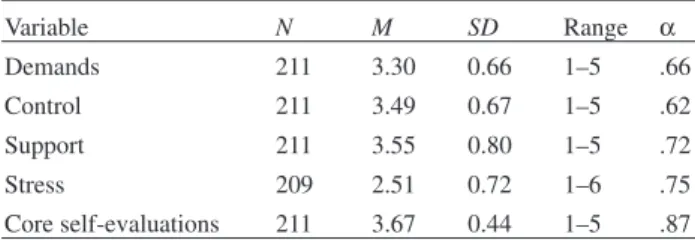
A summary of sample sizes, means, standard deviations, range, and Cronbach’sαfor the study variables can be seen in Table 1.
Procedure
Questionnaires were either handed out or e-mailed to the managers of the work places. The managers distributed the questionnaires to the employees, collected them, and sent them back for analysis by mail. The forms included
assur-ance of anonymity, and no names were recorded to ensure truthful replies. Participation was voluntary and hence some employees did not participate. The participants were informed that they would receive feedback at a later date, which could form a basis for work place improvement.
Data Analysis
The data were analyzed using SPSS v.14.0. First, a point-biserial correlation was computed for the dichotomized gender variable and the other study variables, and Pear-son’s product moment correlations were computed for the interval and ratio variables (all remaining variables). Sec-ond, hierarchical multiple regression analysis was con-ducted to test the hypotheses of the JDCS model. Follow-ing the suggestions of Frazier, Tix and Barron (2004), all variables were centered (producing revised sample means of zero) to reduce problems associated with multicollin-earity among the variables in the regression equation. At the first step of the analysis, age, gender, and years were entered in order to control for the impact of the demo-graphic variables on the study variables. At the second step, demands and control were added to test whether both showed significant main effects on stress. In accordance with Karasek (Karasek & Theorell, 1990), social support was added at the third step to examine whether it would show a significant main effect on stress, to examine whether social support would impact on the main effects of demands and control on stress, and whether it would impact on the explained variance. At the fourth step CSE was added to establish whether it would have a significant main effect on stress, and to examine whether it would contribute to explained variance.
In addition, to test Karasek’s (Karasek & Theorell, 1990) buffer and three-way interaction hypotheses, interaction ef-fects were assessed using ANOVA. Demands, control, and support were therefore entered into an ANOVA model with stress as the dependent variable.
Results
Correlations
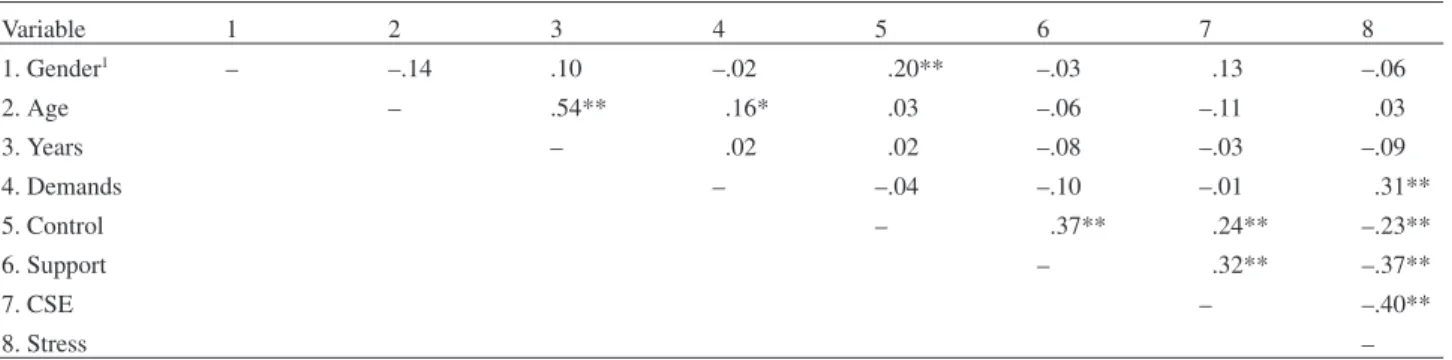
Table 2 shows intercorrelations of the study variables.
Table 1.Sample sizes, means, standard deviations, range and Cronbach’sαfor the study variables
Variable N M SD Range α Demands 211 3.30 0.66 1–5 .66 Control 211 3.49 0.67 1–5 .62 Support 211 3.55 0.80 1–5 .72 Stress 209 2.51 0.72 1–6 .75 Core self-evaluations 211 3.67 0.44 1–5 .87
The correlations concerning the study questions were: Demands and job stress,r= .31,p< .001; control and job stress,r= –.23,p= .001; support and job stress,r= –.37,
p< .001; and CSE and job stress,r= –.41,p< .001. There were also some significant correlations between the demo-graphic variables and the study variables: Gender and con-trol,rpb= .20,p< .01; gender and CSE,r= .13,p< .05, age and demands,r= .16,p <.05.
Hierarchical Regression
Results for hierarchical multiple regression analysis can be seen in Table 3. In the first step of the analysis, age, gender, and years were entered. This was done in order to control for the impact of the demographic variables on the study variables. However, none of theβvalues at this step were significant,R² change was not significant, and adjustedR² was zero. At the second step, demands and control were added. Demands had a significant positive main effect on job stress, and control had a significant negative main effect on stress. Demands and control combined added signifi-cantly to adjustedR². Social support was added at the third step. Social support had a significant main effect on job stress. This step also added significantly to adjustedR². At this step, the effect of control on job stress was reduced
nonsignificant. At the fourth step CSE was added. CSE had a significant negative main effect on job stress, and the inclusion of CSE added significantly to adjustedR².
ANOVA
ANOVA was conducted in order to test the buffer hypoth-esis and the hypothesized three-way interaction of de-mands, control, and social support. Job-stress was entered as the dependent variable and demands, and control and support were entered as independent variables. The inter-action between demands and control on job stress was not significant,F(1, 208) = 2.131,p> .05. The three-way in-teraction between demands, control, and support on job stress was also nonsignificant,F(1, 200) = .987,p> .05.
Discussion
Main Findings
Bono and Judge (Bono & Judge, 2003) showed that indi-viduals with high CSE would experience more job satisfac-tion compared to individuals with low CSE. The present study sought to investigate whether this would apply to
lev-Table 2. Pearson’s intercorrelations of variables
Variable 1 2 3 4 5 6 7 8 1. Gender1 – –.14 .10 –.02 .20** –.03 .13 –.06 2. Age – .54** .16* .03 –.06 –.11 .03 3. Years – .02 .02 –.08 –.03 –.09 4. Demands – –.04 –.10 –.01 .31** 5. Control – .37** .24** –.23** 6. Support – .32** –.37** 7. CSE – –.40** 8. Stress –
Note. CSEs = Core self-evaluations.1Gender was coded 0 = female, 1 = male. *p< .05; **p< .01. two-tailed.
Table 3.Hierarchical regression predicting job stress
Step 1 Step 2 Step 3 Step 4
Variable B SE B β B SE B β B SE B β B SE B β Gender 0.21 1.83 .01 0.90 1.74 .04 –0.18 1.62 –.01 0.62 1.53 .03 Age 0.13 0.09 .14 0.08 0.08 .08 0.06 0.08 .07 0.03 0.07 .03 Years –0.21 0.12 –.16 –0.18 0.11 –.14 –0.20 0.11 –.15 –0.19 0.10 –.14 Demands 1.06 0.27 .29* 0.93 0.25 .26* 0.92 0.23 .25* Control –0.95 0.32 –.21* –0.33 0.32 –.07 –0.17 0.30 –.04 Support –1.80 0.34 –.38* –1.35 0.33 –.29* Core self-evaluations –0.69 0.14 –.33* R² .02 .15 .28 .37 ΔR² .13* .13* .09* *p< .05.
els of job stress as well. The results showed that levels of CSE had a significant effect on job stress. CSE scores were negatively associated with levels of perceived job stress, and was the single strongest predictor variable of job stress in this study. This is in accordance with other studies using personality traits as predictor variables for job stress (Bond & Bunce, 2003; Kahn & Byosiere, 1992).
In relation to the JDCS model (Karasek & Theorell, 1990), the present study found initial support for the sug-gestion that demands and control were significant (positive and negative respectively) predictors of job stress. Howev-er, when social support was included in the analysis, con-trol was no longer a significant predictor of job stress. Thus, on the basis of the results from the present study, control is not a predictor of job stress when social support is taken into consideration. The hypothesis that control would buf-fer the effects of demands on job stress was not supported as the results failed to find a significant interaction effect between the two variables. These findings support other studies questioning the validity of Karasek and Theorell’s model (Jonge, Bosma, Peter, & Siegrist, 2000; Van der Doef & Mae, 1999). Social support was found to have a significant negative main effect on perceived job stress, and was the second strongest predictor variable in the study. This supports the importance of including the effects col-leagues and management may have on worker well-being in work-place research (Johnson & Hall, 1988).
Limitations and Further Research
A methodological limitation in the present study concerns the use of self-report measures, especially considering that the measures could have had greater internal consistency, although this is partly due to the small number of items measuring demands and control. Considering that both de-pendent and indede-pendent variables were simultaneously measured using self-report, there is a potential problem of common method variance. Replication of these findings using other measures of demands, control, and support (e.g., the full version of the JCQ) and measures other than self-report for the dependent and independent variables, is therefore recommended.
Another limitation in the present study is that it was based on cross-sectional design. The study fails to investi-gate whether the findings may persist over time. This is especially relevant for CSE and job stress. It is possible that job stress could affect CSE. Judge et al. (Judge et al., 2003) however, found no significant change in CSE over three months in their study, which suggests some degree of sta-bility. More studies may be needed in order to assert that CSE is indeed a stable personality trait. Studies using pro-spective design where CSE is measured prior to job stress, would also help ascertain the nature of the relationship be-tween CSE and job stress.
Another way to study work and health outcomes would be to look at the effects of job stress rather than job stress
itself. Health outcomes, in the form of visits to the doctor, blood pressure, or symptom checks, may be appropriate objective measures. Other areas of study could be to look at absenteeism, job change, and burnout as dependent vari-ables.
The main goal with the selection of participants was to cover a wide range of occupations in order to gain data from a representative cross-section of the Norwegian work-ing population, rather than generalizwork-ing from one or two large organizations. Replicating the present findings using participants from a more homogeneous group would be of interest, but perhaps the variance in job stress would be somewhat smaller. A limitation concerning the population was that the managers of the 12 work places were asked to obtain as many replies as possible from their employees, and that no information about the possible number of re-plies was collected, resulting in an inability to calculate a response rate.
Despite these limitations, the present study makes an im-portant contribution to the field, as it is the first to investi-gate the relationship between CSE and job stress. The find-ings suggest that CSE may be a personality construct suit-able for studying the relationship between personality and job stress, as well as other psychosocial job outcomes, be-cause it accounts for a high proportion of the variance in both job stress as well as in job satisfaction, as shown else-where (Bono & Judge, 2003).
Implications
If personality traits can explain and predict job stress, one result may be that less effort will be made to improve work conditions. This can be justified by the fact that job stress can in part be attributed to individuals’ personality traits. On the other hand, work places may exaggerate the impact of the personality/job stress relationship and focus solely on personality traits. This could result in attributing job stress, illness, and dissatisfaction to the individual to an exaggerated degree. It is axiomatic that interplay between work conditions and personality traits will result in varying degrees of job stress. For example, Judge et al. (Judge et al., 2000) found that subjective job characteristics and job complexity mediate the relationship between CSE and job satisfaction. Hence, job satisfaction levels are likely to vary over time regardless of work conditions.
One possible solution would be to control for the effects of personality on job stress, for example, by removing the variance in job stress explained by CSE in work conditions surveys. This could lead to more objective measures of work conditions (Judge, Erez, & Thoresen, 2000). Im-proved measures of work conditions will provide a more accurate basis for work place improvement. It would also improve methods for assessing the outcomes of work place improvement efforts.
It could prove fruitful to administer the CSE scale in combination with personality tests (for example, the
NEO-PI-R (Costa & McCrae, 1992) in personnel selec-tion. Using the CSE scale in applicant selection could help reassure that the person who is hired will experience less job stress, and perhaps contribute to a good working environment.
In addition to securing valuable knowledge about how individuals interact with work conditions, one main goal in job stress research is to guide practitioners who work at improving work conditions. According to the hypotheses in the JDCS model, job stress can be reduced by giving more job control to workers in high demand jobs. However, as discussed, personality traits seem to influence this pro-cess. Indeed, after controlling for social support and CSE, control had no significant effect on job stress. Hence, if practitioners increase control in workers, this may not cause the intended effect in all individuals. Indeed, Sala-nova et al. (2002) showed that increasing control for work-ers with low self-efficacy may increase rather than decrease job stress. Based on this research, care should therefore be taken when advising work places to increase job control for all its workers.
Conclusions
The results for the present study showed that CSE is a strong predictor variable for job stress. When seen in con-text with the JDCS model, demands and social support re-main significant predictor variables, but control was not significant after controlling for social support. The best set of predictor variables for job stress may therefore be de-mands, social support, and CSE. More studies are needed, however, to validate these findings. Such studies should use measures with greater validity, alternative populations, and prospective design. The implications of the present study are that personality in the form of CSE may be used in job stress research in order to explain the phenomenon beyond that which may be explained by work environments them-selves. Further, employers may benefit from using person-ality constructs such as CSE in addition to personperson-ality mea-sures to tests for suitability and performance. This could assist in securing work places that comprise stable, low-stressed, and satisfied workers, which may accumulate to greater cooperation and social support within the work place. This could in turn reduce absenteeism, high turnover, and health problems related to work.
References
Arnold, J., Cooper, C.L., & Robertson, I.T. (1998).Work psychol-ogy understanding human behavior in the workplace(3rd ed.). Harlow: Pearson Education Ltd.
Bandura, A. (1997).Self-efficacy: The exercise of control. New York: Freeman.
Bond, F., & Bunce, D. (2003). The role of acceptance and job control in mental health, job satisfaction, and work perfor-mance.Journal of Applied Psychology, 88, 1057–1067. Bono, J.E., & Judge, T.A. (2003). Core self-evaluations: A review
of the trait and its role in job satisfaction and job performance.
European Journal of Personality, 17, 5–18.
Cooper, C. (1981).The Stress Check: Coping with the stresses of life and work. New York: Prentice Hall.
Coopersmith, S. (1967).The antecedents of self-esteem. San Fran-cisco: Freeman.
Costa, P., & McCrae, RR. (1992).NEO PI-R. professional man-ual. Odessa, FL: PAR.
Daniels, K., & Guppy, A. (1994). Occupational stress, social sup-port, job control, and psychological well-being.Human Rela-tions, 47, 1523–1544.
de Jonge, J., Bosma, H, Peter, R, & Siegrist, J. (2000). Job strain, effort-reward imbalance and employee well-being: A large-scale cross-sectional study.Social Science & Medicine, 50, 1317–1327.
Frazier, P., Tix, AP, & Barron, KE. (2004). Testing moderator and mediator effects in counseling psychology research.Journal of Counseling Psychology, 51, 115–134.
Johnson, J.V., & Hall, E.M. (1988). Job strain, work place social support, and cardiovascular disease: A cross-sectional study of a random sample of the Swedish working population. Amer-ican Journal of Public Health, 78, 1336–1342.
Judge, T.A., Bono, J.E., & Locke, E.A. (2000). Personality and job satisfaction: The mediating role of job characteristics.
Journal of Applied Psychology 85, 237–249.
Judge, T.A., Erez, A., Bono, J.E., & Thoresen, C.J. (2003). The core self-evaluations scale: Development of a measure. Per-sonnel Psychology, 56, 303–331.
Judge, T.A., Erez, A., & Thoresen, C.J. (2000). Why negative affectivity (and self-deception) should be included in job stress research: Bathing the baby with the bath water.Journal of Or-ganizational Behavior, 21, 101–111.
Judge, T.A., Locke, E.A., & Durham, C.C. (1997). The disposi-tional causes of job satisfaction: A core evaluations approach.
Research in Organizational Behavior, 19, 151–188.
Kahn, K.L., & Byosiere, P. (1992). Stress in organizations. In M.D. Dunnette & L.M. Hugh (Eds.),Handbook of industrial and organizational psychology(2nd ed., pp. 571–630). Palo Alto, CA: Consulting Psychologists Press.
Karasek, R.A. (1979). Job demands, job decision latitude, and mental strain: Implications for job redesign.Administrative Science Quarterly, 24, 285–308.
Karasek, R.A., & Theorell, T. (1990).Healthy work: Stress, pro-ductivity, and the reconstruction of working life.New York: Basic Books.
Moreland, R.L., & Sweeney, P.D. (1984). Self-expectancies and reactions to evaluations of personal performance.Journal of Personality, 52, 156–176.
Rector, N.A., & Roger, D. (1997). The stress buffering effects of self-esteem. Personality and Individual Differences, 23, 799–808.
Rotter, J. (1966). Generalized expectancies for internal versus ex-ternal control of reinforcement.Psychological Monographs, 81, 609–620.
Salanova, M., Peiro, J.M., & Schaufeli, W.B. (2002). Self-effica-cy specificity and burnout among information technology workers: An extension of the job demand-control model.
Eu-ropean Journal of Work and Organizational Psychology, 11, 1–25.
Taris, T.W., & Feij, J.A. (2004). Learning and strain among new-comers: A three-wave study on the effects of job demands and job control.The Journal of Psychology, 138, 543–563. Theorell, T., Michelsen, H., & Nordemar, R. (1991). Tre
ar-betsmiljöindeks som använts i stockholmundersökningen 1 [Three work environment indices used in the Stockholm Sur-vey]. In M. Hagber, Hagstedt, C (Ed.), Stockholmundersökn-ingen 1[The Stockholm Survey]. Stockholm: MUSIC Books. Van der Doef, M., & Maes, S. (1999). The job demand-control(-support) model and psychological well-being: A review of 20 years of empirical research.Work & Stress, 13, 87–114.
About the authors
Geir Scott Brunborg works at the Faculty of Psychology at the University of Bergen, Norway, were he is involved in a number of research projects, including pathological gambling, cross-cul-tural psychology, educational psychology, and health promotion.
Geir Scott Brunborg Faculty of Psychology University of Bergen Christiesgate 12 N-5020 Bergen Norway Tel. +47 55 583290 Fax +47 55 589879 E-mail [email protected]