U
sing
P
lant
g
rowth
r
egUlators
on
C
ontainerized
h
erbaCeoUs
P
erennials
U
sing
P
lant
g
rowth
r
egUlators
on
C
ontainerized
h
erbaCeoUs
P
erennials
Using Plant Growth Regulators on
Containerized Herbaceous Perennials
Joyce G. Latimer, Extension Specialist, Greenhouse Crops, Virginia Tech Holly Scoggins, Associate Professor, Herbaceous Perennials Program, Virginia Tech
Production of Herbaceous
Perennials
There is a tremendous diversity of herbaceous peren-nial plant species being grown for both the retail and landscaping sectors of the industry. Because of the diversity of species grown, there is much more unknown about perennials production than is known. Growth regulation is of particular concern. In production set-tings, as well as in retail locations, herbaceous perenni-als grown in pots tend to stretch and become leggy or simply overgrow their pots before their scheduled market date. These plants are less marketable and harder to maintain. Many growers resort to pruning, which is not only costly in terms of labor, but also delays plant production for two to four weeks.
Plant growth regulators (PGRs) are chemicals that are designed to affect plant growth and/or development. They are applied for specific purposes to bring about specific plant responses. Although there is much scien-tific information on using PGRs in the greenhouse, it is not an exact science. Achieving the best results with PGRs is a combination of art and science — science tempered with a lot of trial and error and a good under-standing of plant growth and development.
Availability of chemical plant growth regulators for perennials is not a problem. All of the primary floricul-ture growth retardants are labeled for use on perennials. The issues are (1) lack of knowledge about rates, and (2) the wide disparity of plant responses to these PGRs. Even after years of research, many of the herbaceous perennials in the market have never been evaluated for their response to any of these chemicals (figure 1).
Figure 1. Greenhouse and nursery production of herbaceous perennials encompass hundreds of different crops. Growth management needs vary widely with species and cultivar.
This publication provides basic information on select-ing and applyselect-ing PGRs to affect growth, branchselect-ing, and flowering — with an emphasis on their use on perennials — followed by a discussion of specific growth regulators used on herbaceous perennials. This discussion references a table located in the appendix that summarizes the results of research trials using PGRs on more than 100 perennial species/cultivars.
Choosing the Correct PGR
For best results, PGRs should be handled as production tools — like water and fertilizer. They should not be used as crutches for poor management of other cultural practices. PGRs should be an integrated part of your crop production cycle.
The selection of PGRs and their application rates will be affected by how your crop is grown. Especially with very vigorous plants, as many of the herbaceous perennials are, higher fertility and irrigation levels will increase the amounts of growth regulator required to prevent exces-sive growth. Shading, lower light levels, or tight plant spacing — especially under higher growing temperatures — will also increase plant stretch and reduce lateral branching. For the highest-quality plants, the use of PGRs must be integrated into your production plan. PGRs are most effective when applied at the appropri-ate times to regulappropri-ate plant growth or development. In other words, growth retardants cannot shrink an over-grown plant. They must be applied before the plant is overgrown to avoid plant stretch. When planning PGRs in your production schedule, consider what you want to accomplish with the treatment.
• Do you want to regulate shoot growth of the plant, resulting in a sturdier, more compact plant with improved color? If so, you probably want a growth retardant. • Do you want to increase plant branching for
enhanced cutting production or for a bushier potted plant or hanging basket? If so, you probably want to use a branching agent or “chemical pincher.” • Do you want to enhance flower initiation or
syn-chronize flowering? If so, you probably want to use
chlormequat chloride or gibberellic acid.
• Do you want to remove flowers from stock plants to increase the number of vegetative cuttings? If so, you probably want to use an ethylene generating
Answering these questions will indicate what type of PGR you need to use to accomplish your goal and the most appropriate timing of the application. Then you will need to select a specific PGR in that class and determine the appropriate dosage and application method to attain the desired response. We’ll get into those details later.
Regulating Shoot Growth
Most PGRs used in the greenhouse or nursery are used to regulate shoot growth of containerized crops. These PGRs are referred to as “growth retardants.” Typical growth retardants are daminozide (B-Nine or Dazide), chlormequat chloride (Citadel or Cycocel), ancymidol (Abide or A-Rest), flurprimidol (Topflor), paclobutra-zol (Bonzi, Downsize, Pacpaclobutra-zol, Piccolo, or Piccolo 10 XC), and uniconazole (Concise or Sumagic) (table 1). These PGRs control plant height by inhibiting the pro-duction of gibberellins — the primary plant hormones responsible for cell elongation. Therefore, these growth-retardant effects are primarily seen in stem, petiole, and flower stalk tissues. Lesser effects are seen in reductions of leaf expansion, resulting in thicker leaves with a darker green color (figure 2).
Other benefits of using these PGRs in plant production include improved plant appearance by maintaining plant size and shape in proportion with the pot. Plant growth retardants also increase the tolerance of plants to the stresses of shipping and handling, as well as drought or temperature stresses common during retail marketing, thereby improving shelf life and extending plant marketability.
Generally, growth-retarding PGRs should be applied just prior to rapid shoot growth. This is usually one to two weeks after transplanting a plug/liner, after the roots are established and as the plant resumes active growth. On pinched plants, it is after the new shoots are visible and starting to elongate.
This is where the art of plant growth regulation is most important. You must learn how your crop grows and when to intervene to obtain the desired results. Remember to note details of crop development in your records of PGR treatments. For example, due to weath-er conditions, next year you may need to treat at seven days after transplanting instead of at 10 days after transplanting, which you used this year. You must gauge when rapid elongation will likely occur and treat to counter it.
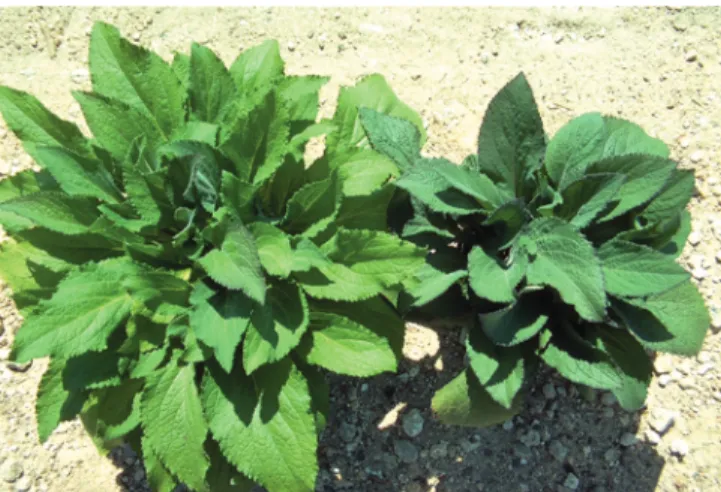
Figure 2. Digitalis ‘Foxy’ untreated (left) and treated with 15 ppm unicon-azole (right). Plant growth regulators “green up” plants by concentrating chlorophyll into smaller leaf cells, improving plant color and appearance.
Enhancing Lateral Branching
Another group of PGRs used in floricultural crops are those that enhance branching, including ethephon (Florel), benzyladenine (BA; Configure), dikegulac sodium (Augeo), and methyl esters (Off-Shoot-O) (table 2). These PGRs are frequently called “chemical pinchers” because they generally inhibit the growth of the terminal shoots or enhance the growth of lateral buds, thereby increasing the development of lateral branches. They can be used to replace mechanical pinching of many crops like Vinca vine, Verbena,
Lantana, and English ivy (Hedera). Often, this
increased branching will also reduce the overall height of the plant.
The ethylene released inside the plant by ethephon also inhibits internode elongation, keeping treated plants more compact than untreated plants. Ethephon also affects flowering (see Enhancing Plant Flowering). Configure is a synthetic cytokinin (6-benzyladenine), which is a plant hormone that stimulates lateral branch-ing. If you are looking for enhanced branching, you must have sufficient growth on the plant to allow for sites of lateral development. They cannot enhance lat-eral branching if there are no latlat-erals on the plant. Timing of the application is critical to a good branching response.
Again, read the label for details of when to apply for optimum response. Always consider the side effects of treatments. As mentioned in tables 1 and 2, some of these PGRs reduce or eliminate flowering.
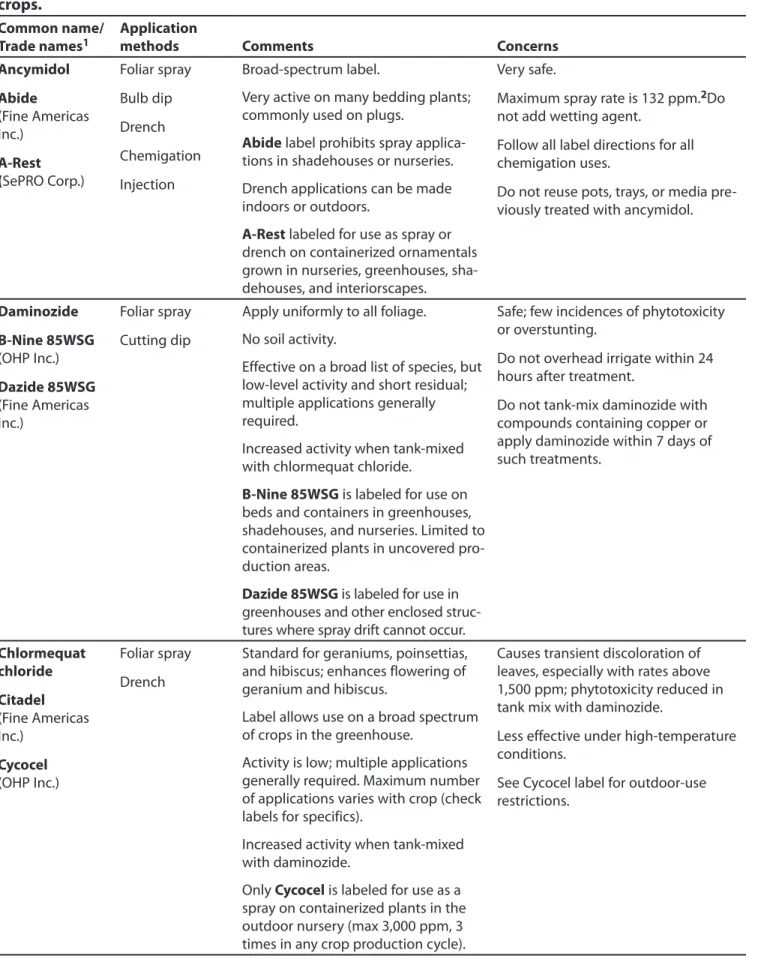
Table 1. Plant growth regulators used to reduce plant height during the production of floricultural crops.
Common name/
Trade names1 Application methods Comments Concerns
Ancymidol Abide (Fine Americas Inc.) A-Rest (SePRO Corp.) Foliar spray Bulb dip Drench Chemigation Injection Broad-spectrum label.
Very active on many bedding plants; commonly used on plugs.
Abide label prohibits spray
applica-tions in shadehouses or nurseries. Drench applications can be made indoors or outdoors.
A-Rest labeled for use as spray or
drench on containerized ornamentals grown in nurseries, greenhouses, sha-dehouses, and interiorscapes.
Very safe.
Maximum spray rate is 132 ppm.2Do
not add wetting agent.
Follow all label directions for all chemigation uses.
Do not reuse pots, trays, or media pre-viously treated with ancymidol.
Daminozide B-Nine 85WSG (OHP Inc.) Dazide 85WSG (Fine Americas Inc.) Foliar spray Cutting dip
Apply uniformly to all foliage. No soil activity.
Effective on a broad list of species, but low-level activity and short residual; multiple applications generally required.
Increased activity when tank-mixed with chlormequat chloride.
B-Nine 85WSG is labeled for use on
beds and containers in greenhouses, shadehouses, and nurseries. Limited to containerized plants in uncovered pro-duction areas.
Dazide 85WSG is labeled for use in
greenhouses and other enclosed struc-tures where spray drift cannot occur.
Safe; few incidences of phytotoxicity or overstunting.
Do not overhead irrigate within 24 hours after treatment.
Do not tank-mix daminozide with compounds containing copper or apply daminozide within 7 days of such treatments. Chlormequat chloride Citadel (Fine Americas Inc.) Cycocel (OHP Inc.) Foliar spray Drench
Standard for geraniums, poinsettias, and hibiscus; enhances flowering of geranium and hibiscus.
Label allows use on a broad spectrum of crops in the greenhouse.
Activity is low; multiple applications generally required. Maximum number of applications varies with crop (check labels for specifics).
Increased activity when tank-mixed with daminozide.
Only Cycocel is labeled for use as a spray on containerized plants in the outdoor nursery (max 3,000 ppm, 3 times in any crop production cycle).
Causes transient discoloration of leaves, especially with rates above 1,500 ppm; phytotoxicity reduced in tank mix with daminozide.
Less effective under high-temperature conditions.
See Cycocel label for outdoor-use restrictions.
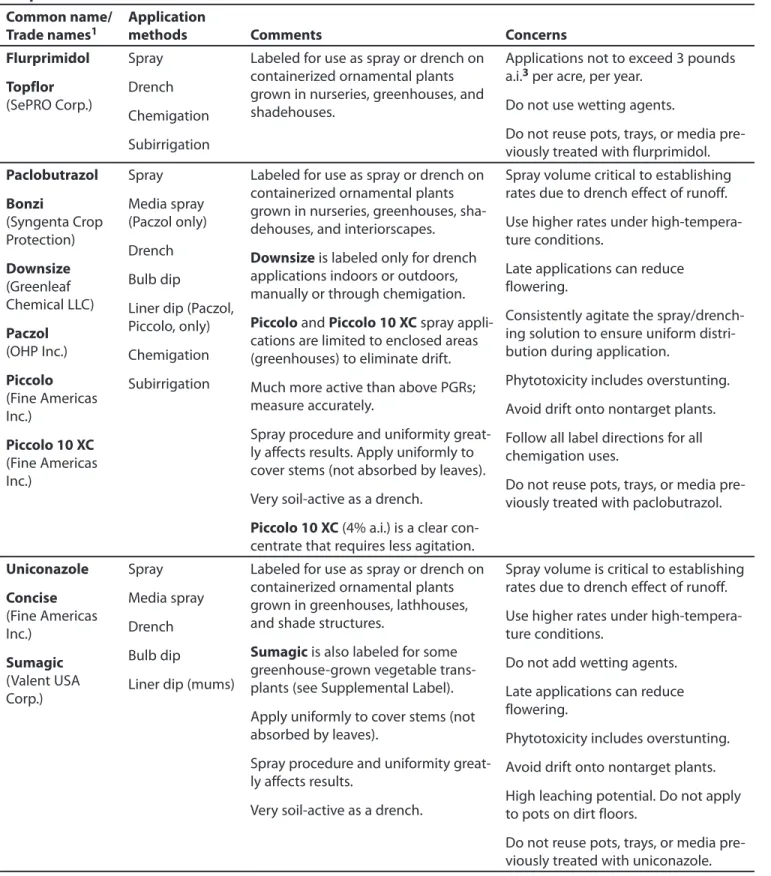
Table 1. Plant growth regulators used to reduce plant height during the production of floricultural crops.
Common name/
Trade names1 Application methods Comments Concerns
Flurprimidol Topflor (SePRO Corp.) Spray Drench Chemigation Subirrigation
Labeled for use as spray or drench on containerized ornamental plants grown in nurseries, greenhouses, and shadehouses.
Applications not to exceed 3 pounds a.i.3 per acre, per year.
Do not use wetting agents.
Do not reuse pots, trays, or media pre-viously treated with flurprimidol.
Paclobutrazol Bonzi (Syngenta Crop Protection) Downsize (Greenleaf Chemical LLC) Paczol (OHP Inc.) Piccolo (Fine Americas Inc.) Piccolo 10 XC (Fine Americas Inc.) Spray Media spray (Paczol only) Drench Bulb dip
Liner dip (Paczol, Piccolo, only) Chemigation Subirrigation
Labeled for use as spray or drench on containerized ornamental plants grown in nurseries, greenhouses, sha-dehouses, and interiorscapes.
Downsize is labeled only for drench
applications indoors or outdoors, manually or through chemigation.
Piccolo and Piccolo 10 XC spray
appli-cations are limited to enclosed areas (greenhouses) to eliminate drift. Much more active than above PGRs; measure accurately.
Spray procedure and uniformity great-ly affects results. Appgreat-ly uniformgreat-ly to cover stems (not absorbed by leaves). Very soil-active as a drench.
Piccolo 10 XC (4% a.i.) is a clear
con-centrate that requires less agitation.
Spray volume critical to establishing rates due to drench effect of runoff. Use higher rates under high-tempera-ture conditions.
Late applications can reduce flowering.
Consistently agitate the spray/drench-ing solution to ensure uniform distri-bution during application.
Phytotoxicity includes overstunting. Avoid drift onto nontarget plants. Follow all label directions for all chemigation uses.
Do not reuse pots, trays, or media pre-viously treated with paclobutrazol.
Uniconazole Concise (Fine Americas Inc.) Sumagic (Valent USA Corp.) Spray Media spray Drench Bulb dip
Liner dip (mums)
Labeled for use as spray or drench on containerized ornamental plants grown in greenhouses, lathhouses, and shade structures.
Sumagic is also labeled for some
greenhouse-grown vegetable trans-plants (see Supplemental Label). Apply uniformly to cover stems (not absorbed by leaves).
Spray procedure and uniformity great-ly affects results.
Very soil-active as a drench.
Spray volume is critical to establishing rates due to drench effect of runoff. Use higher rates under high-tempera-ture conditions.
Do not add wetting agents. Late applications can reduce flowering.
Phytotoxicity includes overstunting. Avoid drift onto nontarget plants. High leaching potential. Do not apply to pots on dirt floors.
Do not reuse pots, trays, or media pre-viously treated with uniconazole. Notes:
1. Mention of specific products does not imply endorsement. However, some products that have not been tested by the authors have been omitted. 2. ppm = parts per million
3. a.i. = active ingredient
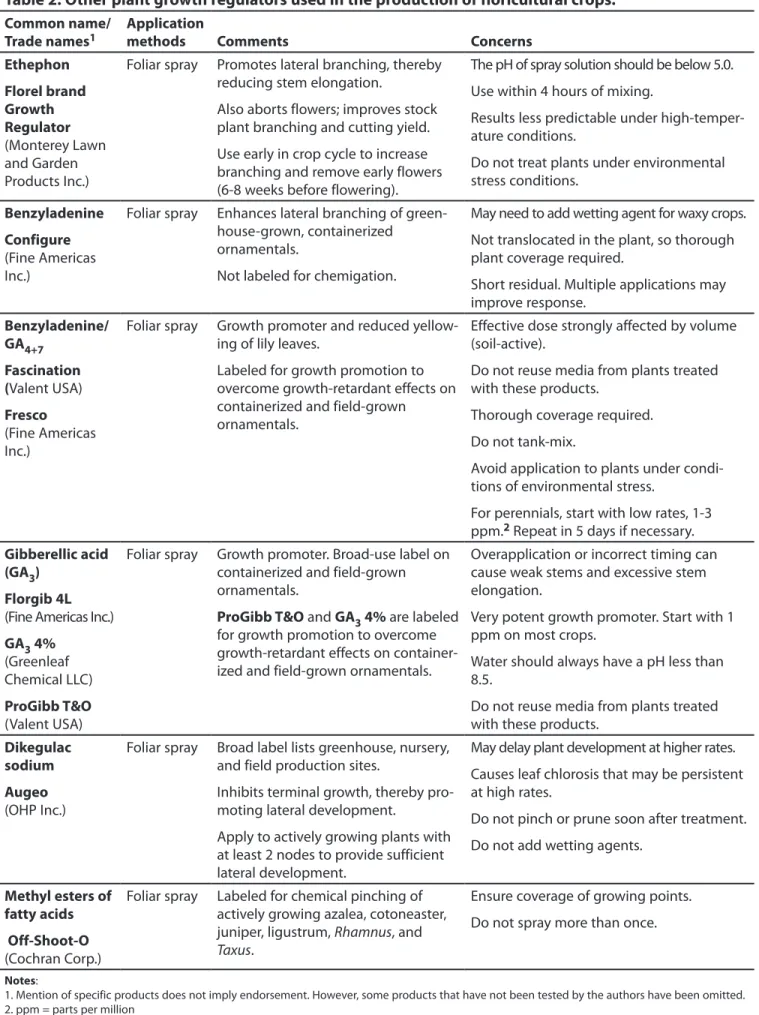
Table 2. Other plant growth regulators used in the production of floricultural crops.
Common name/
Trade names1 Application methods Comments Concerns
Ethephon Florel brand Growth Regulator (Monterey Lawn and Garden Products Inc.)
Foliar spray Promotes lateral branching, thereby reducing stem elongation.
Also aborts flowers; improves stock plant branching and cutting yield. Use early in crop cycle to increase branching and remove early flowers (6-8 weeks before flowering).
The pH of spray solution should be below 5.0. Use within 4 hours of mixing.
Results less predictable under high-temper-ature conditions.
Do not treat plants under environmental stress conditions.
Benzyladenine Configure
(Fine Americas Inc.)
Foliar spray Enhances lateral branching of green-house-grown, containerized ornamentals.
Not labeled for chemigation.
May need to add wetting agent for waxy crops. Not translocated in the plant, so thorough plant coverage required.
Short residual. Multiple applications may improve response. Benzyladenine/ GA4+7 Fascination (Valent USA) Fresco (Fine Americas Inc.)
Foliar spray Growth promoter and reduced yellow-ing of lily leaves.
Labeled for growth promotion to overcome growth-retardant effects on containerized and field-grown ornamentals.
Effective dose strongly affected by volume (soil-active).
Do not reuse media from plants treated with these products.
Thorough coverage required. Do not tank-mix.
Avoid application to plants under condi-tions of environmental stress.
For perennials, start with low rates, 1-3 ppm.2 Repeat in 5 days if necessary.
Gibberellic acid (GA3)
Florgib 4L
(Fine Americas Inc.)
GA3 4%
(Greenleaf Chemical LLC)
ProGibb T&O
(Valent USA)
Foliar spray Growth promoter. Broad-use label on containerized and field-grown ornamentals.
ProGibb T&O and GA3 4% are labeled
for growth promotion to overcome growth-retardant effects on container-ized and field-grown ornamentals.
Overapplication or incorrect timing can cause weak stems and excessive stem elongation.
Very potent growth promoter. Start with 1 ppm on most crops.
Water should always have a pH less than 8.5.
Do not reuse media from plants treated with these products.
Dikegulac sodium Augeo
(OHP Inc.)
Foliar spray Broad label lists greenhouse, nursery, and field production sites.
Inhibits terminal growth, thereby pro-moting lateral development.
Apply to actively growing plants with at least 2 nodes to provide sufficient lateral development.
May delay plant development at higher rates. Causes leaf chlorosis that may be persistent at high rates.
Do not pinch or prune soon after treatment. Do not add wetting agents.
Methyl esters of fatty acids Off-Shoot-O
(Cochran Corp.)
Foliar spray Labeled for chemical pinching of actively growing azalea, cotoneaster, juniper, ligustrum, Rhamnus, and
Taxus.
Ensure coverage of growing points. Do not spray more than once. Notes:
Enhancing Plant Flowering
Plant growth regulators can be used to enhance flower-ing (GA3 products). To improve flowering, Florgib 4L or ProGibb T&O, which contains the growth promoter gibberellic acid (GA3), can be used to substitute for all or part of the chilling requirement of some woody and herbaceous ornamentals typically forced in the green-house, including azalea for florist crops and Aster for cut flowers. These compounds can also improve flow-ering and/or bloom size of camellia, baby’s breath (Gypsophila), and statice (Limonium). Gibberellic acid is also used to promote growth and increase stem length of other cut flowers like stock (Matthiola),
Delphinium, and Sweet William (Dianthus). See
prod-uct labels for specific uses and recommended rates. Again, timing is critical because late applications or excessive rates may cause excessive plant stretching, resulting in weak, spindly stems. Chlormequat chloride (a plant growth retardant) used to control stem height of hibiscus and geranium also improves early flower-ing of these crops.
Removal of Flowers
Flower removal is especially desirable for stock plants maintained for cuttings of vegetatively propagated ornamentals, like Verbena or Lantana. Ethephon is the primary compound used for flower removal. Once eth-ephon is absorbed by the plant, it is converted to gas-eous ethylene — a natural plant hormone effective in many plant processes. Ethylene is the primary hormone responsible for flower senescence and fruit ripening. It is the “postharvest” hormone. With proper rates and timing, it will remove unwanted flowers from stock plants, cuttings, or plugs/liners. Flower removal diverts more energy into vegetative growth, increases the num-ber of laterals available for cuttings on stock plants, and promotes increased branching of plugs/liners and finished plants, which increases fullness in the con-tainer. Because initiation and development of flowers require time, ethephon should not be used on crops within six to eight weeks of marketing.
Read the Label!
Plant growth regulators are classified as pesticides. Therefore, they are subject to all of the same U.S. Department of Agriculture (USDA) recordkeeping and Worker Protection Standard (WPS) rules as all of your other pesticides. Their use is governed by the manufac-turer’s label, as with other pesticides. The label not only contains information on restrictions, but it also has
a great deal of information on how to use the product effectively. Before going to the time and expense of applying PGRs to your crop, answer these questions: • Is the chemical labeled for the crop you wish to treat?
Most PGR labels have undergone revisions that apply to a broad range of similar crops not specifi-cally listed on the label, with the user taking respon-sibility for determining appropriate rates. This provides label permission to use the compound on these crops without the manufacturer accepting the responsibility for the rate selection.
• Is the chemical labeled for the area you wish to treat? Many PGRs are only labeled for use inside a green-house or other growing structure.
• Are there any potential side effects, such as phytotox-icity? Note that you may need to look elsewhere for this information for your specific crop.
• Are there label warnings regarding the PGR’s effect on plant flowering? For example, many branching enhancers delay flowering. Ethephon causes flower bud abscission prior to enhancing branching; there-fore, is not recommended within six to eight weeks of marketing. Side effects are frequently affected by the timing of the application, e.g., late applications of growth retardants may delay flowering.
Application Guidelines for
Growth Regulators
Spray Application
Plants to be treated with PGRs should be healthy, tur-gid, and unstressed — never wilted. The label will identify the target tissue for that PGR. For example, daminozide is only effective as a foliar spray, whereas paclobutrazol and uniconazole sprays must reach the stems. When making spray applications, look at the growth and development of the plant to see that there is sufficient development to make the treatment effective and accomplish your goal. Generally, there should be sufficient foliage or stems to absorb the PGR.
Uptake and effectiveness of a PGR also depend on selecting the application technique that will ensure proper coverage of the target tissue. Daminozide is not soil-active. Therefore, a foliar spray application, wet-ting most of the foliage, is necessary to provide a uni-form reduction in growth. Leaf surfaces should be dry for foliar applications, and the best uptake of PGRs
from spray applications will occur under low-stress, low-drying conditions. This is more critical for dami-nozide and ethephon than for some of the newer chem-istries, like the triazoles. Overhead irrigation after treatment with daminozide or ethephon should be delayed for 18 to 24 hours to avoid washing the mate-rial off of the leaves.
The triazoles — paclobutrazol and uniconazole — are absorbed primarily by stem tissue and then translocated upward in the plant. Therefore, consistent and complete coverage of the stems is necessary for uniform effects. In other words, if the stem of one lateral receives an inadequate amount of spray, it will grow faster than the others, resulting in a poorly shaped plant. Ancymidol and flurprimidol are taken up by both foliage and stems. In addition, all four of these compounds are very “soil-active,” which means they may be adsorbed to particles in the media and become available to the plant through root uptake. Therefore, drenching is a very effective application method for these chemicals in crops where it is economically feasible (see How to Apply Drenches).
The label will provide a recommended application vol-ume for sprays, especially for chemicals that are soil-active. All foliar applications of PGRs should be applied on an area basis, i.e., uniformly spray the area where the plants are located with the recommended volume of solution. Do NOT spray individual plants or spray to reach a subjective target, like “spray to glisten-ing.” Every applicator will have a slightly different definition of these goals, so there is no way of recom-mending appropriate rates or obtaining predictable or consistent results.
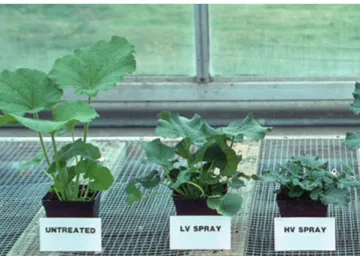
For soil-active PGRs, dosage is dependent on both the concentration of the solution and the volume of that solution applied in the treated area. Therefore, to improve predictability, the label-recommended spray application rates are generally set at 2 quarts of finished spray per 100 square feet, which is sufficient to cover the plant and permit a small amount of runoff onto the medium. It is also considered to be a comfortable walk-ing pace for applicators with hand-held sprayers. This is the same application volume recommended for dami-nozide, which is not soil-active.
With the soil-active PGRs, precautions should be taken to avoid overapplication with sprays. Spray applica-tions require more attention to detail, because
over-overspray from an application of 2 quarts per 100 square feet is part of the recommended dosage. However, if your application volume exceeds that rec-ommendation, your application dosage also exceeds the recommendation (figure 3).
Figure 3. For the soil-active PGRs, spray application volume is critical. Hollyhock (Alcea rosea), left to right: untreated; treated with a foliar spray of 50 ppm paclobutrazol at the label-recommended volume of 2 quarts per 100 square feet; and treated at a high volume of 4 quarts per 100 square feet. Practice your technique to ensure a consistent application volume.
Recognizing that stem coverage is necessary for the triazoles, you may need to apply a higher-than-recom-mended volume to large or dense plants to obtain ade-quate coverage. In fact, the paclobutrazol label recommends 3 quarts per 100 square feet for “larger plants with a well-developed canopy.” Adjust the con-centration you apply accordingly.
This suggests the importance of recordkeeping (see Recordkeeping). Always consider the rates presented in the appendix or from any other resource to be guide-lines to assist you in developing your own rates based on your growing conditions and application methods. The relationship of rate and volume can be exploited when treating multiple crops with different PGR needs. With a single solution of PGR in the spray tank, you can apply the label-recommended volume to attain your basic application dosage, or you can apply addi-tional volume to crops that need addiaddi-tional growth regulation to attain a higher dosage. Application vol-ume is another tool you can use to maximize your efforts and reduce time mixing or reloading higher concentrations of PGR solutions.
Spray Equipment
regulator, and you should consistently use the same nozzle for all PGR applications. Your sprayer should be calibrated by determining the output of the chemi-cal with the selected nozzle at the selected pressure within a specified time period. Using this information, you can apply a known amount of material to a known area.
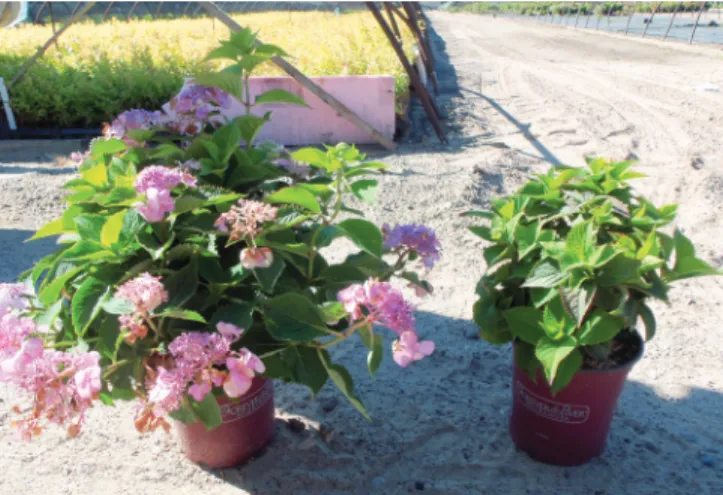
Spray droplet size also affects response, with smaller droplet sizes providing better coverage — but only up to a point. Mist- or fog-type applicators do NOT pro-vide adequate volume for coverage of plant stems and the medium and, therefore, have not been effective when used with compounds like paclobutrazol and conazole. PGR applicators should be trained to uni-formly apply a given amount of clear water in the greenhouse before they make PGR applications. Uniformity of the application is critical to the unifor-mity of the crop response (figure 4).
Figure 4. Uniformity of the spray application is critical to the quality of the crop. Both of these ‘Forever and Ever’ hydrangeas were treated with 10 ppm of uniconazole during the same spray application.
Applying Drenches
Although drench application has several advantages over sprays, traditional drenches are seldom used on perennials due to the higher application costs of han-dling individual pots. Drenches generally have less effect on flowering or flower size and tend to provide longer-lasting growth regulation than sprays. Drenches are easier to apply uniformly than sprays because the drench volume is easily measured; when applied to moist media, it is easy to obtain good distribution of the PGR in the media. Therefore, the resulting growth regulation is frequently more uniform.
The product label specifies the recommended volumes for drench applications to different size pots or types of media. In general, 4 fluid ounces of drench solution is
applied to a 6-inch “azalea” pot, and that volume is adjusted up or down with pot size to obtain a volume where about 10 percent of the solution runs out of the bottom of the pot when the media is moist.
Remember that the amount of active ingredient applied to plants depends on both the concentration (ppm) of the solution and the volume applied. Read the label.
Alternative methods of applying PGRs directly to the media have been developed and are described on the label. For example, ancymidol, flurprimidol, and paclobutrazol are labeled for application through the irrigation system (chemigation). These are generally labeled for flood (subirrigation), drip irrigation, and overhead sprinkler systems. Again, rates vary with the volumes used and method of application. Paclobutrazol applied once by subirrigation requires 50 percent to 75 percent of the amount of paclobutrazol that is applied in a typical drench application.
Pressure-compensated drippers are recommended for use with PGRs to more accurately regulate the volume of solution applied to each pot. Read and exactly fol-low the label for chemigation applications, especially with regard to safety of municipal water supplies. Growers are using three other methods of providing a drench-type application of soil-active PGRs on a more economical scale: media surface application sprays, sprenches, and watering in.
Media surface application sprays are spray applica-tions made to the surface of the media of filled flats or pots. The treatment is applied at normal-to-high spray volumes, but because it is applied to the media surface, it is activated by irrigation and is available to the plant in the root zone. Both paclobutrazol (Paczol only) and uniconazole are labeled for this method of application. Rates are lower than used for sprays but higher than used for drench applications.
Sprenches, the second method, is a high-volume foliar spray that results in additional runoff into the media, providing a drench effect. Rates are lower than those recommended for spray rates.
Watering in, the third technique, is a type of chemiga-tion where the PGR is injected into the irrigachemiga-tion water and applied at each irrigation at very low rates of active ingredient. Only PGRs labeled for chemigation can be used for watering in.
All of these application methods use the relationship between rate and volume to provide the desired control. Again, you must develop techniques that fit your pro-duction methods and your growth management preferences.
Liner dips or drenches are another specialized way to use soil-active growth retardants. Although many of the soil-active PGRs have been tested, only Paczol and Piccolo (paclobutrazols) are labeled for this application (table 1). The root system of rooted liners or plugs is dipped into a solution of the PGR (or they may be thor-oughly drenched in the plug tray). Extensive work has been conducted at the University of Florida on this application method:
• Liners should be dry, which is defined as the root ball being ready for irrigation but not under drought stress.
• Time in the solution is not critical; 30 seconds to two minutes is sufficient for saturation of the rootball. • Liners may be planted immediately or held up to 10
days without loss of PGR effect.
• There is no loss of effectiveness of the dip solution during treatment.
Advantages of the liner dip include early control of very vigorous crops and flexibility of the treatment with respect to not having to handle plants during the
restricted-entry interval. The liner dip is especially use-ful in combination plantings where the more vigorous plants can be treated prior to planting without reducing the growth of the slower plants in the group. The liner dip rates should be selected to provide early control of plant growth. Additional PGR applications can be made as necessary for longer-term crops (figure 5).
Be Aware of Bark
For many years, the adage in PGR drenches has been, “Bark ties up soil-active PGRs.” However, new research shows that this is not necessarily true. As long as the bark is properly aged before the media is mixed, it has little effect on the availability of these soil-active PGRs to the plant roots.
Growing Conditions
Look also for label recommendations on time of day or condition of the plant for optimum treatment response. Generally, a healthy, unstressed plant growing under low evaporative conditions, e.g., early in the morning or late in the afternoon, is most responsive to treatment.
To maximize uptake, the chemical must remain in con-tact with the leaf long enough to be absorbed. This time varies for the different PGRs, but generally, foliar uptake is enhanced with slower drying conditions, which in turn increases the effectiveness of the treat-ment. Plants treated with daminozide or ethephon
Figure 5. Russian sage (Perovskia atriplicifolia) treated with paclobutrazol liner dips (10 minutes in solution) at the time of planting. Top photo shows good baseline control of plant height at five weeks after treatment with, left to right: 0-, 2-, 4-, 6-, 8-, and 10-ppm paclobutra-zol. Bottom photo shows the same plants at eight weeks after treat-ment; plants treated with 2-ppm paclobutrazol were comparable to controls, while those treated with 6 ppm were still well-controlled.
should not be overhead irrigated for at least 18 to 24 hours after treatment, but plants treated with flurprimi-dol, paclobutrazol, or uniconazole may be irrigated one hour after treatment. Read the label for any warnings on how irrigation or environmental conditions will affect plant response to the PGR treatment.
Specific Plant Growth Regulators
The following discussion of the effects of specific growth-retarding PGRs on perennials references the appendix, which summarizes the results of our research trials in Virginia and Georgia using PGRs on more than 100 perennial species/cultivars. Foliar spray applica-tions are tested more often than drenches, presumably due to the higher labor costs involved in applying drenches in large-scale production areas. All of these research results are from the Mid-Atlantic and Southern U.S., which means they should be adjusted down for growers located farther north (see Summary).Daminozide (B-Nine or Dazide; Restricted-Entry Interval [REI] = 24 hours) was one of the first PGRs labeled for use in the floriculture industry and is still widely used. In general, it is not phytotoxic and has a short-term effect that seldom results in overstunting of treated plants. The low activity of daminozide and its lack of soil activity make it easier to get consistent, predictable responses than with the newer, more-potent PGR chemistries. Plants should be well-irrigated prior to treatment, but foliage should be dry at the time of treatment. Do not irrigate overhead for 18 to 24 hours after treatment.
The low activity also means that daminozide must be applied more frequently to maintain control over vigor-ous crops. Nearly one-half of the perennial species tested have shown some response to multiple applica-tions of daminozide (appendix). Generally, for perenni-als in the Mid-Atlantic and Southern U.S., foliar sprays of 5,000 ppm are applied every 10 to 14 days as neces-sary. Daminozide is labeled for use on containerized or bed-grown crops in the greenhouse and on container-ized plants grown outdoors under nursery conditions. Frequency of application may need to be increased to weekly for more vigorous cultivars grown outdoors.
Chlormequat chloride (Citadel or Cycocel; REI = 12 hours) is another PGR with a long history in floricul-ture. Note that the product-use labels for the chlorme-quat chloride products vary in application limits. See the label for your product for the specific rates and sites of application (table 1). Chlormequat chloride is
generally applied as a foliar spray at 200 to 3,000 ppm with a maximum of three to six applications per crop cycle, depending on which product you use. Although rates above 1,500 ppm often cause chlorosis on young, treated leaves of other floricultural crops, we have seen few examples of phytotoxicity on perennials. However, chlormequat chloride alone has not been tested on a wide variety of perennials. Rose mallow (Hibiscus moscheutos), like the tropical Hibiscus, is responsive to chlormequat chloride, responding well to multiple applications of 500-ppm chlormequat chloride (appen-dix). Chlormequat chloride also promotes earlier flow-ering and greater flower numbers on Hibiscus. First application should be made when the laterals are 0.5 to 1.0 inch long.
Chlormequat chloride is also labeled for drench appli-cations at rates of 2,000 to 4,000 ppm when applied inside a greenhouse, depending on the specific product label. Again, rose mallow was very responsive to a 2,000-ppm chlormequat chloride drench (4 fluid ounc-es per 6-inch pot). However, drench applications of chlormequat chloride are seldom cost-effective. Only Cycocel is labeled for use on containerized plants in the outdoor nursery, where it may be applied at a maximum spray rate of 3,000 ppm up to three times in any crop production cycle. This limit includes any applications of Cycocel combined with daminozide. Drench applications of Cycocel are not permitted in the outdoor nursery, even on containerized plants. Read the pesticide label for your product: It is the law for appli-cation sites and rates. Chlormequat chloride is not labeled for application through the irrigation system. A daminozide/chlormequat chloride tank mix has more PGR activity than either daminozide or chlorme-quat chloridealone and generally causes less phytotox-icity than chlormequat chloride applied by itself. Both the daminozide and chlormequat chloride labels have approved tank-mix instructions. This combination has been tested on a wide variety of perennials. For exam-ple, three-lobed coneflower (Rudbeckia triloba) was very responsive to daminozide applied twice at 5,000 ppm but was not responsive to chlormequat chloride at rates up to 4,000 ppm. However, a tank mix of 5,000-ppm daminozide with increasing rates of chlormequat chloride resulted in height control similar to the dami-nozide treatments — but with a single application. The high activity rate generally used for the tank mix is 5,000-ppm daminozide plus 1,500-ppm chlormequat chloride.
Although the rate of daminozide is usually adjusted to increase or decrease activity, changing the chlormequat chloride rate also affects activity. Shoot height of many of the perennials listed in the appendix was effectively controlled by this tank mix, including blanket flower
(Gaillardia grandiflora ‘Burgundy’) and Russian sage
(Perovskia atriplicifolia), along with two of the orna-mental grasses, Sorghastrum ‘Indian Steel’ and
Calamagrostis ‘Karl Foerster’ (figure 6). Single
appli-cations of the tank mix are frequently more effective than multiple applications of daminozide alone. In other crops where the tank mix is listed in the appendix as nonresponsive (NR) with one application, the effects may have been too short-term for the research evalua-tion. Multiple applications of the tank mix may provide control of these species.
Figure 6. Blanket flower (Gaillardia x grandiflora ‘Burgundy’) was respon-sive to daminozide. Left to right: untreated control, two applications (at a two-week interval) of 5,000-ppm daminozide, and one application of a tank mix of 5,000-ppm daminozide and 1,500-ppm chlormequat chloride. Photo was taken at three weeks after treatment. Multiple applications of the tank mix were required for long-term control.
Ancymidol (Abide or A-Rest; REI = 12 hours) is a more active compound than daminozide or chlorme-quat chloride. Ancymidol is active as a spray or a drench, so application volume affects plant response. In addition, ancymidol is labeled for chemigation, i.e., distribution through the irrigation system via flood, sprinkler, or drip systems. Follow all label directions. Abide is not labeled for spray applications in
shadehouses or nurseries, but drench applications can be made indoors and outdoors. A-Rest is labeled for use as a spray or drench on containerized plants in greenhouses, nurseries, shadehouses, and interiorscapes.
Although ancymidol has not been evaluated for effec-tiveness on a large number of perennial species, the labels specifically list foliar sprays on bleeding heart
(Dicentra) and columbine (Aquilegia) at 65 to 132
ppm, gayfeather (Liatris) at 25 to 132 ppm, and hybrid bee delphinium (Delphinium) at 35 to 132 ppm. Ancymidol can also be applied as a drench at 2 to 4 ppm for these crops. For best results, treatments should be applied to well-rooted plants in active growth, prior to the initiation of flowering.
The higher rates necessary for foliar applications to some crops may not be economically feasible. The use of ancymidol as a treatment of plants in the plug stage is more economical than foliar applications on finished plants. In our studies on finished plants, we had excel-lent control of Veronica ‘Icicle’ and Hemerocallis
‘Happy Returns’ with 2-ppm drenches of ancymidol (2 fluid ounces per quart pot and 10 fluid ounces per trade gallon pot, respectively) and Delphinium ‘Blue Bird’ at 4-ppm ancymidol (10 fluid ounces per trade gallon pot (appendix; figure 7).
Flurprimidol (Topflor; REI = 12 hours) is similar in chemistry to ancymidol but much more potent. Its activity is similar to that of the triazoles. Herbaceous perennials have proven very responsive to flurprimidol. With spray applications, Topflor rates are similar to those used with paclobutrazol. However, in soil appli-cations, its activity is more similar to that of unicon-azole. It is labeled for use as a spray or drench on containerized ornamental plants grown in nurseries, greenhouses, and shadehouses. Topflor is labeled for chemigation. Test spray rates around 15 to 40 ppm. We have not researched drench applications on perennials but reports on other bedding plants suggest drench rates of about 0.25 to 4 ppm.
Figure 7. Veronica ‘Icicle’ treated with drenches of ancymidol, left to right: untreated, 2-, 4-, 6-, and 8-ppm drenches of ancymidol applied as 2 fluid ounces per quart pot. Higher rates caused excessive growth reductions and bronzing of the leaves. Photo was taken at six weeks after treatment.
The triazole class of PGRs includes paclobutrazol
(Bonzi, Downsize, Paczol, Piccolo, or Piccolo 10 XC; REI = 12 hours) and uniconazole (Concise or Sumagic; REI = 12 hours). These compounds are much more active than most of the previous compounds. Uniconazole is more potent than paclobutrazol.
As mentioned above, the activity of flurprimidol (Topflor) is between these two triazoles depending on application method. For perennials in the South and Mid-Atlantic, paclobutrazol is generally applied at spray rates of 30 to 100 ppm and uniconazole is applied at 15 to 45 ppm. These PGRs are rapidly absorbed by plant stems and petioles or through the roots. Excess spray dripping off of treated plants acts as a drench to the substrate, increasing the activity of the treatment. For foliar sprays of triazoles, uniform application of a consistent volume per unit area is critical to uniform and consistent crop response.
Both compounds (see table 1) are labeled for applica-tion to the media surface prior to planting plugs. In this case, the PGR is applied as a spray to the surface of the medium in filled pots. The PGR moves into the medi-um with subsequent irrigations and effectively behaves as a drench. Effectiveness is also reduced by nonaged bark in the medium, as with drenches.
Neither paclobutrazol nor uniconazole has resulted in any specific phyotoxicity symptoms on perennials, but care must be taken with application on sensitive plants (figure 8). In some cases, excessive stunting can be very persistent, e.g., goldenrod (Solidago sphacelata) treated with higher rates of paclobutrazol (240 ppm) or uniconazole (60 ppm) did not recover normal size at five months after planting into the landscape. Growth of velvet sage (Salvia leucantha) was excessively reduced by 45- or 60-ppm uniconazole in the green-house. Furthermore, 60-ppm uniconazole caused a significant delay in landscape growth of the Salvia. These compounds must be used carefully and appropri-ately. Especially when working with the triazoles,
thoroughly test your application methods and rates on a small number of plants before treating your entire crop. Avoid late applications of the triazoles. They should be applied prior to flower initiation when possible. The persistence of these compounds in plant stems and petioles can have significant effects on the flower dis-play as well. As with many of the growth retardants, the triazoles inhibit gibberellin synthesis. Generally, the most rapidly elongating tissues have the highest pro-duction of gibberellins and, therefore, are most affected by reductions in gibberellin production. For example, PGR application affects the elongation of flowering stems of gaura (Gaura lindheimeri) much more than the leafy stems (figure 9). Usually this is acceptable because it keeps the flower height in better proportion to the plant height. However, differences in response vary, and in some yarrow (Achillea) cultivars, flower height has been excessively stunted at moderate appli-cation rates. We have also seen significant height sup-pression of flower stalks with drench applications of paclobutrazol or uniconazole on daylily (Hemerocallis). Nursery producers deemed these plants acceptable because of their improved ability to be shipped.
Paclobutrazol has a broad label for ornamentals that includes use on greenhouse or outdoor-grown, contain-erized crops. See table 1 for label restrictions for the different products. All of the paclobutrazol products are labeled for application through the irrigation system, including ebb/flow or flooded floor systems. Paclobutrazol has been tested on a wide variety of perennials, with species ranging from extremely sensi-tive to low rates to nonresponsive to very high rates. To establish rates for plants not listed in the appendix or on the product label, treat a small number of plants with 30 to 100 ppm as a foliar spray or up to 10 ppm as a drench. In many cases, multiple treatments with lower rates have been more effective, with less chance of overstunting than a single application at a higher rate.
Figure 8. Larkspur (Delphinium ela-tum ‘Blue Bird’) at four weeks after treatment with paclobutrazol, left to right: untreated control, treated with paclobutrazol as a foliar spray at 30 ppm and at 60 ppm, and treated with paclobutrazol as a drench at 1 ppm and at 2 ppm. Overdose symp-toms were evident on the plants treated with the 2-ppm drench. The triazole-type PGRs are actively taken up by the roots and are very effective in growth regulation.
Uniconazole also has a broad label for ornamentals, but its use is limited to containerized plants grown in greenhouses, overwintering structures, shadehouses, or lath houses. It is not labeled for outdoor nursery use. Uniconazole also is not labeled for application through any irrigation system. It has been very effective on a large number of perennials, with spray rates in the 15- to 45-ppm range in the South and Mid-Atlantic areas. We have done less research on drench rates on perenni-als. However, we have found them to be very sensitive to uniconazole with good growth control using 0.5- to 2.0-ppm drenches. Because it is very potent, pay spe-cial attention to uniform application and proper vol-umes. Use caution in the higher rates or on more sensitive species because uniconazole effects can be very persistent in plants even after they have been transplanted into the landscape.
NOTE: Ancymidol, flurprimidol, paclobutrazol, and uniconazole are persistent on plastic surfaces and in soil. Do not reuse flats, pots, or soil from treated plants — especially for plug production of sensitive crops.
Ethephon (Florel brand Growth Regulator; REI = 48 hours) is a compound that breaks down in plant tissue after application to release ethylene, a natural plant hormone. As with ethylene, its effects can vary depend-ing on the species and the stage of growth at time of application. Florel has a broad-use label (EPA Reg. No. 54705-8) for increasing lateral branching of
floricul-Ethephon also inhibits internode elongation of many plants, but research with perennials has been limited (see appendix). It has controlled runner elongation of clump verbena (Verbena ‘Homestead Purple’) and increased inflorescence numbers of sage (Salvia ‘May Night’) and yarrow (Achillea ‘Coronation Gold’). Ethephon should be applied to actively growing plants prior to flower development(figure 10).If flowers are present at the time of application, they are likely to abort. Ethephon may delay flowering by about one to two weeks, particularly if applied close to the time of flower initiation. Ethephon should not be applied to plants that are heat- or drought-stressed.
Figure 10. Young dianthus plants treated with ethephon to enhance Figure 9. Elongation of flower inflo-rescence may be more affected by plant growth regulators than elon-gation of stem tissue is, as seen with white gaura (Gaura lindheimeri ‘Siskiyou Pink’) treated with increas-ing rates of uniconazole, left to right: 0, 15, 30, 45, and 60 ppm. Photo was taken at five weeks after treatment.
The pH of water used for the spray solution can be important. If the pH is too high, the ethephon will con-vert to ethylene before it gets to the plant and activity will be reduced. Ethephon contains sufficient acidifiers and buffers to maintain a pH of 5.0 or lower when mixed with most greenhouse water supplies. In gener-al, water that has sufficient quality for irrigation of greenhouse crops (moderate pH and alkalinity) is suit-able for mixing ethephon. However, if you are acidify-ing your water prior to irrigation, use the acidified water for mixing the ethephon as well. The solution should be applied within four hours of mixing.
Benzyladenine (Configure; REI = 12 hours) is a syn-thetic cytokinin (6-benzyladenine or 6-BA) — a plant hormone that stimulates lateral branching. It is a rela-tively inexpensive PGR and has been very effective in enhancing the branching of a wide variety of perenni-als. Configure stimulates — but does not cause — an increase in branching. Therefore, application timing is important. Treated plants must have sufficient lateral buds formed to respond to the treatment. BA has a short period of activity and has no residual in the plant, so multiple applications may be useful with many of the perennial crops. Furthermore, it is not translocated in the plant, so thorough coverage is required.
Initial work on herbaceous perennials focused on
Hosta and Echinacea, both of which are very
respon-sive to BA. In our trials, multiple cultivars of Echinacea
have developed two to four times the number of basal branches versus untreated plants when treated about two weeks after potting. Other researchers have report-ed similar results with a number of other Echinacea
cultivars. Further screening trials with other herba-ceous perennials have identified a large number of crops that showed increased basal or lateral branching in response to a 600-ppm BA spray (see appendix) (figure 11).
Figure 11. Benzyladenine (Configure) improved branching and flowering of white gaura (Gaura lindheimeri ‘Siskiyou Pink’): untreated (left) and 600 ppm applied at two weeks after transplant (right). Photo taken at four weeks after final treatment.
We have found little incidence of phytotoxicity with Configure application. Successful use of Configure to increase the number of shoots on perennial plugs/liners has been reported by several growers. We found that Configure had little effect on root growth of plugs treated after the cuttings were moderately rooted, whereas branching was significantly increased for many crops.
Although the primary objective with Configure is to increase branching, it has resulted in growth reduction in some crops. However, if additional growth control is necessary, we have found that growth retardants may be used following the Configure treatment without reducing the branching response.
Dikegulac sodium (Augeo; REI = 4 hours) is a com-pound that interferes with terminal growth by inhibit-ing cell-wall development, which is required for new growth. By primarily inhibiting terminals, apical domi-nance is reduced, which enhances the production of lateral branches. Dikegulac sodium usually causes leaf chlorosis that can be very persistent at higher rates (above 1,500 ppm).
Augeo was labeled in 2010 with an REI of 4 hours for use on container- and field-grown ornamentals and trees, including Christmas trees. It is important to note that Augeo has a different carrier than Atrimmec (PBI Gordon), which was the dikegulac sodium product pre-viously labeled for nursery production. Atrimmec is now labeled for landscape use and fruit removal only. In our research with Augeo, we have seen far less phytotoxicity and less delay in the resumption of growth than we saw with Atrimmec.
Augeo should be applied to actively growing plants with at least two nodes to provide sufficient lateral development. In addition to creating a fuller plant, enhancing the number of laterals in a pot generally reduces the overall height of the plant due to the greater distribution of resources. Responses are very species-specific, so test several rates under your growing con-ditions. Our research suggests that dikegulac sodium can increase branching of big-flowered hybrids of
Clematis. We have found increased branching with
Augeo applied to a variety of herbaceous perennials, both as finished plants and rooted liners (see appendix; figure 12). Foliar spray rates in the 400 to 1,600-ppm range improved branching without excessive phytotox-icity or growth inhibition. Growers should apply the product early in production to allow time for plant growth to “cover” any chlorotic leaves.
Figure 12. Spike speedwell (Veronica ‘Goodness Grows’) treated with dikegulac sodium (Augeo) at, left to right: 0, 400, 800, and 1,600 ppm showed enhanced branching at 400 ppm but excessive growth reduction at higher rates. Photo taken at four weeks after treatment.
Recordkeeping
Keeping notes on your application methods and the results of your PGR treatments will allow you to improve the consistency of your own application meth-ods and establish rates and volumes appropriate for your production system. Note the concentration and the volume applied, the stage of development of the crop (number of leaves, approximate height, presence of flowers), and the environmental conditions under which the PGR was applied. It is always recommended to keep a few untreated plants for comparison, espe-cially if you are new to using PGRs.
Summary
The degree of growth regulation by PGRs is impacted by all other phases of plant culture. Remember that you have to fit PGRs into your own production program. Plan ahead to achieve the best results from PGRs; do not use them as an afterthought when the plants are out of control. You cannot shrink an overgrown plant! The multitude of variations possible in application methods, cultivar and species grown, and growing con-ditions make it impossible to recommend specific rates for all operations. The appendix provides a resource of research trial results in Georgia and Virginia using PGRs on herbaceous perennials. In the Mid-Atlantic and the South, use these rates as suggested effective rates for starting your own trials. Growers in more northern or southern areas will need to adjust the rates as noted below.
There are two general rules for using rate recommenda-tions from other sources:
1. Southern growers use higher rates and more fre-quent applications than northern growers. Rates for Virginia tend be closer to the southern rates.
2. Outdoor applications usually require higher rates or more frequent applications than plants grown under cover.
Always consider any rate recommendation as a starting point for your own trials and keep records of your suc-cesses and failures with PGRs. Whenever you treat your crop, hold back a few untreated plants so that you can judge the effectiveness of your treatment. Remember that methods of application have significant effects on results. Develop your own program, then test and refine it. Watch for PGR compounds new to the floriculture market and for expanded labeling of cur-rent products as we develop more guidelines for their use on perennials.
Recommended Resources
PGR Calculator
For a ready resource for preparing PGR solutions, use the online plant growth regulator calculator (PGR CALC) developed by floriculture specialists from North Carolina State University and the University of New Hampshire Cooperative Extension: http://extension. unh.edu/agric/AGGHFL/plantgrowthregulatorcalculator. cfm. This online calculator allows you to enter your own PGR costs and calculate solutions based on the rate desired and the amount of area to be treated. The calculator includes information on both spray and drench applications. It not only gives you the amount of PGR to mix per gallon or liter of water, it also pro-vides the cost of the application based on the area or number of containers treated. These specialists have also developed smartphone apps for PGR mixing which can be found at http://extension.unh.edu/Agric/ AGGHFL/PGRMixMasterHome.htm.
OHP PGR Calculator
OHP Inc. also has an app for mixing their PGR solu-tions for iPhone, iPad, and iTouch. The PGR calculator app is available for free from the Apple App Store. Product information bulletins and other publications are also available with this app. See www.ohp.com for more information.
Disclaimer
Commercial products are named in this publication for informational purposes only. Virginia Cooperative Extension does not endorse these products and does not intend discrimination against other products which also may be suitable.
General Resources
Latimer, Joyce, and Brian Whipker, eds. 2010.
Configure: Product Information and University Trial
Results. Walnut Creek, Calif.: www.fine-americas.
com/DocFrame/DocView.asp?id=750&sec=-1.
Michigan State University Plant Growth Regulator Research website: http://hrt.msu.edu/floraoe/pgrinfo/. N.C. State University Commercial Floriculture web-site: www.floricultureinfo.com/.
Pilon, Paul. 2006. Perennial Solutions: A Grower’s
Guide to Perennial Production. West Chicago, Ill.: Ball
Publishing.
Virginia Tech Floriculture website: www.hort.vt.edu/ floriculture/index.html.
Appendix. Growth Regulators for Containerized Herbaceous Perennial
Plants
This table lists results of research trials on herbaceous perennials at Virginia Tech (VT) and the University of Georgia (UGA). Spray rates listed were applied at the label-recommended volume of 0.5 gallon per 100 square feet, unless otherwise stated. Use the rates listed as starting points for your own plant growth regulator (PGR) trials. “NR” means that the plants were not responsive to the rates tested.
Note: Not all uses are listed on the label; always check the product label before using. Consult product labels for a complete listing of precautions and recommended-use rates. When using any PGR for the first time, always test the rate on a few plants and compare the results to untreated plants before treating an entire crop. Keep in mind that these rates are applicable to Sun Belt growers. Northern growers should test lower rates.
Crop
(Scientific name/
Common name) Purpose Trade name
Application rate
(ppm1) x number
of applications2 Precautions or remarks Achillea
millefolium
Common yarrow
To control
plant growth B-Nine, Dazide 5,000 ppm spray x 2 Good control of ‘Red Beauty’ and ‘Paprika’ with 2 applications, 2 weeks apart, but ‘Moonshine’ was NR3 @ 5,000 ppm x 2 (UGA and VT). B-Nine, Dazide + Citadel, Cycocel tank mix 5,000 ppm + 1,500 ppm spray x 1
Good control on ‘Paprika’ (UGA). Citadel,
Cycocel NR @ 5,000 ppm spray x 1 ‘Coronation Gold’ NR (UGA). Bonzi, Paczol,
Piccolo, Piccolo 10 XC
100-120 ppm
spray x 1 Good control on ‘Summer Pastels’ with 120 ppm spray (VT). Concise,
Sumagic 10-15 ppm spray x 1 Excellent response with ‘Paprika’ and ‘Coronation Gold’; however, ‘Red Beauty’ and ‘Moonshine’ were NR @ 60 ppm spray x 1 (UGA and VT).
To increase lateral or basal branching
Augeo 800 ppm spray
x 2 70% increase in branching when applied to ‘Moonshine’ as plug (21 days after sticking) and again at 5 days after transplanting; some leaf yel-lowing still visible at 7 weeks after treatment; single application not effective and no effect at 400 ppm x 2 (VT).
Configure 600 ppm spray
x 2 60% increase in branching when applied to ‘Moonshine’ as plug (21 days after sticking) and again at 5 days after transplanting; no phytotoxicity (VT).
Agastache hybrids
Anise hyssop
To control
plant growth B-Nine, Dazide 5,000 ppm spray x 3 Based on research results with ‘Blue Fortune’ (UGA). B-Nine, Dazide + Citadel, Cycocel tank mix 5,000 ppm + 1,500 ppm spray x 1
Crop
(Scientific name/
Common name) Purpose Trade name
Application rate
(ppm1) x number
of applications2 Precautions or remarks Agastache hybrids Anise hyssop (cont.) Bonzi, Downsize (drenches only), Paczol, Piccolo, Piccolo 10 XC 60-80 ppm x 1; much less than 5 ppm drench x 1
‘Tutti Frutti’ responsive; test 1-2 ppm drenches; 2 fl oz/quart pot; volume and mg a.i.4 vary with pot
size (VT). Concise,
Sumagic 10 ppm spray x 1 Based on research results with ‘Blue Fortune,’ which is very sensitive to uniconazole (UGA). To enhance
lateral branch-ing of liners
Configure 300 ppm spray
x 1 on liners ‘Purple Haze’ treated ~4 days after liners were removed from mist increased lateral branching. Multiple applications during liner production or higher rates decreased root growth (VT).
Alchemilla mollis
Lady’s mantle
To control
plant growth B-Nine, Dazide NR @ 5,000 ppm spray x 2 NR in VT trials. B-Nine, Dazide + Citadel, Cycocel tank mix 5,000 ppm + 1,500 ppm spray x 1
Multiple applications at 10-14 day intervals may be necessary (VT).
Bonzi, Paczol, Piccolo, Piccolo 10 XC
NR @ 200 ppm
spray x 1 NR in VT nursery trials. Concise,
Sumagic NR @ 90 ppm spray x 1 NR in VT nursery trials.
Aquilegia x hybrida Hybrid columbine To control plant growth, apply as flow-er stalks get above foliage B-Nine, Dazide 5,000 ppm
spray x 2 Effective on ‘McKana Giants’ (UGA). Bonzi, Paczol,
Piccolo, Piccolo 10 XC
NR @ 240 ppm
spray x 1 ‘McKana Giants’ was NR to a single spray applica-tion of 240 ppm (UGA). Concise,
Sumagic NR @ 120 ppm spray x 1 ‘McKana Giants’ was NR to a single spray applica-tion of 120 ppm (UGA).
Aquilegia vulgaris Columbine To induce lat-eral or basal branching Configure NR @ 600 ppm
spray x 1 No effect with our screening rate on ‘Winky Purple White’ in VT research. Test multiple applications or higher rates. Artemisia schmidtiana Wormwood, white sage To control
plant growth B-Nine, Dazide 5,000 ppm spray x 2 Moderate control of ‘Silver Mound’ with multiple applications in VT research. B-Nine, Dazide + Citadel, Cycocel tank mix 5,000 ppm + 1,500 ppm spray x 1
Moderate control of ‘Silver Mound’ in VT research; multiple applications may be required.
Bonzi, Paczol, Piccolo, Piccolo 10 XC
200 ppm spray
x 1 Moderate control of ‘Silver Mound’ with 200 ppm sprays in VT research; may require multiple applications.
Concise,
Sumagic 30-60 ppm spray x 1 Moderate control of ‘Silver Mound’ with 45 ppm spray; the hybrid ‘Oriental Limelight’ was more sen-sitive — use 30 ppm sprays. The hybrid ‘Powis Castle’ was less responsive — test 60 ppm sprays; multiple applications may be necessary (VT).
Crop
(Scientific name/
Common name) Purpose Trade name
Application rate
(ppm1) x number
of applications2 Precautions or remarks Asclepias
tuberosa
Butterfly weed
To control
plant growth B-Nine, Dazide NR @ 5,000 ppm spray x 3 NR in UGA trials. B-Nine, Dazide + Citadel, Cycocel tank mix NR @ 5,000 ppm + 1,500 ppm spray x 1 NR in UGA trials. Bonzi, Downsize (drenches only), Paczol, Piccolo, Piccolo 10 XC NR @ 50 ppm spray x 1; NR @ 2 ppm drench x 1
No effect on plant height but reduced width of ‘Hello Yellow’ by 10-18%.
Drenches applied at 2 fl oz/quart pot; volume and mg a.i. vary with pot size (VT).
Concise,
Sumagic 45 ppm spray x 1 Good control in UGA trials. To induce
lat-eral branching Configure NR @ 600 ppm spray x 1 No effect with our screening rate in VT research. Higher rates or multiple applications may be effective. Aster dumosus Bushy aster Aster x frikartii Frikart’s aster Aster novae-angliae New England aster To control
plant growth B-Nine, Dazide 5,000 ppm spray x 2 Apply first application after pinching when new shoots are ~1-inch long. Aster x frikartii cvs. ‘Monarch’ and ‘Monch’ were responsive to 2 spray applications of daminozide, but A. dumosus
‘Sapphire’ was NR to this rate in VT research trials. B-Nine, Dazide + Citadel, Cycocel tank mix NR @ 5,000 ppm + 1,500 ppm spray x 1
A. dumosus ‘Sapphire’ was NR to this rate in VT research trials. Bonzi, Downsize (drenches only), Paczol, Piccolo, Piccolo 10 XC 80 ppm spray x 1; 2-16 ppm drench x 1
80 ppm spray controlled width of A. dumosus
‘Sapphire’ but had little effect on height. A. x frikar-tii ‘Monarch’ and ‘Monch’ were NR to 1 spray appli-cation of 240 ppm but were responsive to a drench application. Drench applied at 2 fl oz/quart pot; volume and mg a.i. vary with pot size (VT, UGA). Concise,
Sumagic 30 ppm spray x 1 Moderate width control of but little effect on height. A. x frikartii A. dumosus ‘Alpine Mix,’ ‘Sapphire’ ‘Monarch,’ and ‘Monch’ were NR to 1 spray applica-tion of 60 ppm or a drench of 4 ppm. Drench applied at 2 fl oz/quart pot; volume and mg a.i. vary with pot size (VT, UGA).
Topflor NR @ 60 ppm
spray x 1 No response in fall trial with (VT). A. dumosus ‘Sapphire’ To induce
lat-eral branching Augeo 1,600 ppm spray x 1 on liners
Reduced plug height but increased branching; no effect on root growth or finished plant quality (VT). Configure Phytotoxic Significant phytotoxic response at a single spray of
Crop
(Scientific name/
Common name) Purpose Trade name
Application rate
(ppm1) x number
of applications2 Precautions or remarks Astilbe x arendsii False spirea Astilbe chinensis Chinese astilbe Astilbe thunbergii False spirea To control
plant growth B-Nine, Dazide Less than 5,000 ppm spray x 2
Excessive height reduction of A. chinensis
‘Purpurkerze’ in VT trials; use lower rate and/or fewer applications. However, A. x arendsii ‘Elizabeth Bloom’ was NR to these rates in VT trials.
B-Nine, Dazide + Citadel, Cycocel tank mix Less than 5,000 ppm + 1,500 ppm spray x 1
Excessive height reduction of A. chinensis
‘Purpurkerze’ in VT trials; reduced both daminozide and chlormequat rates.
Citadel,
Cycocel 1,500 ppm spray x 1 Moderate control of trials. A. chinensis ‘Purpurkerze’ in VT Bonzi, Downsize (drenches only), Paczol, Piccolo, Piccolo 10 XC 40-80 ppm
spray x 1-2 40 ppm x 1 resulted in good control of A. chinensis ‘Purpurkerze’ in VT trials. However, 80 ppm x 1 resulted in only short-term height control of A. x arendsii ‘Elizabeth Bloom’; plan on multiple applica-tions (VT).
Concise,
Sumagic 25-35 ppm spray x 1-2 Good control of als. Short-term response on A. chinensis ‘Purpurkerze’ in VT tri-A. x arendsii ‘Elizabeth Bloom’; plan on multiple applications (VT).
Buddleia davidii
Butterfly bush
To control
plant growth B-Nine, Dazide 5,000 ppm spray x 2 Moderate control of ‘Royal Red’; apply at 10-14 day intervals (UGA). This rate resulted in no control of ‘Pink Delight’ in VT trials.
B-Nine, Dazide + Citadel, Cycocel tank mix NR @ 5,000 ppm + 1,500 ppm spray x 1
No height control of ‘Royal Red’ or ‘Pink Delight in UGA or VT trials. Bonzi, Downsize (drenches only), Paczol, Piccolo, Piccolo 10 XC NR @ 160 ppm spray x 1; NR @ 10 ppm drench x 1
No height control of ‘Royal Red’ in VT trials. Drench applied at 10 fl oz/trade gallon pot; volume and mg a.i. vary with pot size.
10 mg a.i4
drench x 1 Excellent control of ‘Dubonnet’ under nursery con-ditions with drench (100 ml/2.8 L pot); drench vol-ume and mg a.i. vary with pot size (UGA).
Concise,
Sumagic 60 ppm spray x 1; 0.025 ppm drench x 1
Moderate control of ‘Royal Red’; multiple applications may be required. Drench applied at 10 fl oz/trade gal-lon pot; volume and mg a.i. vary with pot size (VT). To increase lateral branching Augeo 532-1,600 ppm spray x 1-2
Sprays should be applied to unpinched shoots when they reach 1-3 inches or at 3 days after pinching; 2 applications may be required (label).
Buddleia fallowiana ‘Lochinch’
butterfly bush
To control
plant growth Concise, Sumagic 60 ppm spray x 1; 1.5 ppm drench x 1
Short-term height control with sprays and drench-es. Multiple applications required. Drench applied at 10 fl oz/trade gallon pot; volume and mg a.i. vary with pot size (VT).
Buddleia weyeriana ‘Honeycomb’
butterfly bush
To control
plant growth Bonzi, Paczol, Piccolo 4 ppm liner dip x 1 Good control (VT). Concise,
Crop
(Scientific name/
Common name) Purpose Trade name
Application rate
(ppm1) x number
of applications2 Precautions or remarks Caryopteris x
clandonensis ‘Dark Knight’
bluebeard
To control
plant growth B-Nine, Dazide NR @ 5,000 ppm x 2 Not responsive in VT trials. B-Nine, Dazide + Citadel, Cycocel tank mix NR @ 5,000 ppm + 1,500 ppm x 1
Not responsive in VT trials. Bonzi, Paczol,
Piccolo, Piccolo 10 XC
NR @ 160 ppm
x 1 Not responsive in VT trials. Concise,
Sumagic 30 ppm x 1 Moderate control (VT).
Chrysanthemum parthenium
Feverfew
To control
plant growth Bonzi, Paczol, Piccolo, Piccolo 10 XC,
Much less than 40 ppm x 1
Very sensitive to paclobutrazol. Test rates much less than 40 ppm (UGA).
Concise,
Sumagic Much less than 15 ppm x 1
Very sensitive to uniconazole. Test rates much less than 15 ppm (UGA).
Coreopsis grandiflora
Tickseed
To control
plant growth B-Nine, Dazide 5,000 ppm spray x 2 Good control of ‘Sunray’ with multiple applications at 10-14 day intervals under nursery conditions (VT). B-Nine, Dazide + Citadel, Cycocel tank mix 5,000 ppm + 1,500 ppm spray x 1
Moderate control of ‘Sunray’; multiple applications may be required (UGA, VT).
Bonzi, Downsize (drenches only), Paczol, Piccolo, Piccolo 10 XC 80-100 ppm spray x 1; 5-10 ppm drench x 1
‘Sunray’ and ‘Baby Sun’ responsive to sprays or drench. Drenches applied at 2 fl oz/quart pot; v