New decoding strategy for underdetermined mimo
transmission sparse decomposition
Yasser Fadlallah, Abdeldjalil Aissa El Bey, Karine Amis Cavalec, Dominique
Pastor, Ramesh Pyndiah
To cite this version:
Yasser Fadlallah, Abdeldjalil Aissa El Bey, Karine Amis Cavalec, Dominique Pastor, Ramesh
Pyndiah. New decoding strategy for underdetermined mimo transmission sparse decomposition.
EUSIPCO 2013 : 21st European Signal Processing Conference, Sep 2013, Marrakech, Morocco.
2013.
<hal-00937815>
HAL Id: hal-00937815
https://hal.archives-ouvertes.fr/hal-00937815
Submitted on 28 Jan 2014
HAL
is a multi-disciplinary open access
archive for the deposit and dissemination of
sci-entific research documents, whether they are
pub-lished or not.
The documents may come from
teaching and research institutions in France or
abroad, or from public or private research centers.
L’archive ouverte pluridisciplinaire
HAL, est
destin´
ee au d´
epˆ
ot et `
a la diffusion de documents
scientifiques de niveau recherche, publi´
es ou non,
´
emanant des ´
etablissements d’enseignement et de
recherche fran¸
cais ou ´
etrangers, des laboratoires
publics ou priv´
es.
NEW DECODING STRATEGY FOR UNDERDETERMINED MIMO TRANSMISSION USING
SPARSE DECOMPOSITION
Yasser Fadlallah, Abdeldjalil Aïssa-El-Bey, Karine Amis, Dominique Pastor, and Ramesh Pyndiah
Institut Télécom; Télécom Bretagne; UMR CNRS 6285 Lab-STICC
Technopôle Brest Iroise CS 83818 29238 Brest, France
Université européenne de Bretagne
Email: [email protected]
ABSTRACT
In this paper we address the problem of large dimension de-coding in MIMO systems. The complexity of the optimal maximum likelihood detection makes it unfeasible in practice when the number of antennas, the channel impulse response length or the source constellation size become too high. We consider a MIMO system with finite constellation and model it as a system with sparse signal sources. We formulate the de-coding problem as an underdetermined sparse source recov-ering problem and apply theℓ1-minimization to solve it. The
resulting decoding scheme is applied to large MIMO systems and to frequency selective channel . We also review the com-putational cost of someℓ1-minimization algorithms.
Simula-tion results show significant improvement compared to other existing receivers.
1. INTRODUCTION
Multiple input multiple output (MIMO) systems have known a regain of interest since the mid nineties as a solution to in-crease the data rate in wireless point-to-point networks at the expense of a multi-antenna interference (MAI) [1]. The per-formance of the MIMO system is conditioned to a clever man-agement of the MAI. Maximum likelihood joint detection en-ables to detect at once the signals transmitted in the same time interval [2]. It has been proved to minimize the error proba-bility for medium to high signal to noise ratio (SNR) values. It can be applied even if the decoding problem is underdeter-mined [3] (for example when the number of transmit anten-nas is higher than the number of receive antenanten-nas). However, its complexity grows exponentially with the constellation size and the antenna dimensions, and makes it unfeasible in prac-tice. Linear equalizers such as minimum mean square error (MMSE) and zero-forcing (ZF) present rather low complexity but achieve poor performance when used in underdetermined MIMO systems. Solutions alternative to ML detection and with reduced complexity have been proposed, among which the sphere decoder performs the best provided the search-ing sphere is well defined. The sphere decoder suffers from
three major weaknesses. First its performance depends on the searching sphere radius value. Secondly it is based on an iterative algorithm and the required iteration number is not bounded. Thirdly, the computation cost keeps high in the low-to-medium SNR region and for large MIMO dimensions [4].
In this paper, we consider an underdetermined MIMO sys-tem with finite constellations. We aim to find an efficient de-coder with polynomial time complexity . We adapt the detec-tion algorithm that we have proposed in [5] to the underdeter-mined MIMO decoding problem. The first step is the trans-formation of the MIMO channel with input belonging to a finite alphabet into an equivalent higher-dimensional MIMO channel with sparse input vector. Then the decoding prob-lem becomes equivalent to theℓ0-norm minimization
lem subject to some constraints that we define. This prob-lem is usually solved using exhaustive search; also NP-hard. On the other hand, theℓ0-norm minimization problem can be
relaxed by ℓ1-norm minimization [6]. Based on this
relax-ation, the transmitted data can be decoded or recovered using iterative algorithms reviewed in [6, 7]. In addition, we show the performance of the proposed decoding scheme for the fol-lowing applications i) large MIMO systems, and ii) frequency selective MIMO channel.
This paper is organized as follows. In Section 2, we de-scribe the system model. In Section 3, we reformulate the MIMO channel with finite input constellation, and we intro-duce the decoding strategy based onℓ1-norm minimization.
This decoding strategy is then applied to two different appli-cations described in Section 4. The computational require-ments are discussed in Section 5. In Section 6, the simulation results enable to evaluate our work. Finally, Section 7 con-cludes the paper.
Notations: boldface upper case letters and boldface lower case letters denote matrices and vectors, respectively. For the transpose, transpose conjugate and conjugate matrices we use
(.)T, (.)H and(.)∗, respectively, ||.||
p denotes the norm ℓp
2. SYSTEM MODEL
We consider a MIMO transmission over a flat fading channel, where the transmitter and the receiver are equipped withN
andnantennas, respectively. We assume no prior knowledge of the channel state information (CSI) at the transmitter and a perfect CSI knowledge at the receiver. The received signal for MIMO transmission channel is defined as
y=Hx+z, (1)
where H is an n ×N random channel (or mixing) ma-trix (n < N), x is the N ×1 data vector, and z is the
n × 1 circularly symmetric additive Gaussian noise vec-tor with zero mean and covariance σ2I. The components of x belong to a finite alphabet constellation defined as
Q={q1, q2,· · · , qM}. For example, assuming 4-QAM con-stellation yieldsQ={1+i√
2, 1√−i 2, −√1+i 2 , −√1−i 2 }andM = 4.
The goal of our work is to find out an efficient decod-ing scheme of the transmitted data symbols with moderate computational complexity order on the whole SNR region. To this end, we exploit the fact that the transmitted data vec-tor components belong to a finite alphabet, and we transform the MIMO channel above into an equivalent MIMO chan-nel where the input data vector becomes sparse. The sparse source vector is then recovered using iterative algorithms usu-ally employed to resolveℓ1-minimization problems.
3. MIMO DECODING SCHEME OF AN EQUIVALENT SPARSE INPUT
In this section we exploit the fact that transmitted data sym-bols belong to the finite alphabet setQ, and we formulate the
vectorxas
x = Bqs, (2)
where
s = [s1, s2, · · ·, sN]T, and
si = [I(xi=q1), I(xi=q2), · · · , I(xi=qM)],
I(xi=qj) = 1 ifxi=qj 0 otherwise Bq = IN⊗qM qM = [q1, q2,· · · , qM]. (3)
I(xi =qj)is the indicator function indexed byi,0M is the
zeros vector of lengthM, andBq is a block diagonal matrix
with dimensionN×N M. Substituting (2) into (1) yields
y=HBqs+z. (4)
The new problem is the decoding of the binary source vector
s, it is equivalent to the following minimization problem arg min||s||0, subject tos∈S, (5)
whereS=
||y−HBqs||22< ǫ, andB1s=1N . Theℓ0
-minimization problems are usually solved using exhaustive search where all coefficients ofsbelong to{0,1}. TheN×
N MmatrixB1is defined as
B1 = IM⊗1TM (6)
where 1M is the ones vector of length M. The equality constraintB1s = 1N ensures that the solutionB
qshasN
nonzero components, and that the decoded symbols belong to the finite input constellation. The other inequality constraint aims to select a codeword within an euclidean less than a con-stantǫfrom the received signal. Hence, the problem in (5) is somehow similar to the ML decoding problem. However, in our problem the decoded symbols depend heavily on the choice ofǫ, which in turn depends on the current SNR value. In order to judiciously selectǫ, we define it as follows
ǫ=F−1
χ2
d(ρ2)(1−γ),
(7) whereFχ2
d(ρ2) is the cumulative distribution function of the
non-centralχ2distributionχ2
d(ρ2)withddegrees of freedom
and non-central parameterρ2. The threshold parameters in
our problem are defined as follows: d= 2ndue to the com-plex noise, ρ2 = (2 log(n))σ2 i.e. the universal threshold, andγ ∈(0,1]. Discussion on the optimality of the chosenǫ
is given in the Appendix.
When the minimization problem in (5) is solved via an exhaustive search, the complexity grows exponentially with the number of transmitted symbols per channel use; result-ing in an NP-hard problem. That is why the authors in [6] have proposed to replace theℓ0-minimization problem by the
ℓ1-minimization, and have shown that the equivalence holds
when the restricted isometry property (RIP) is less than a small constant. On the other hand, as mentioned in [8], in our case, the RIP condition is sufficient and not necessary. It is also shown that for binary alphabet, when the random mixing matrix satisfiesn≥N/2the convergence to the optimal solu-tion obtained by the problem in (5) is guaranteed for largeN
usingℓ1 minimization. Thus, more transmitted symbols per
channel use results in a robuster decoding scheme. 4. APPLICATIONS
In this section, we apply the decoding scheme based onℓ1
-minimization to the following applications: i) Large MIMO systems, ii) Frequency selective MIMO channel.
4.1. large MIMO systems
Large MIMO systems, also known as large-scale antenna sys-tems, is a research topic proposed recently in communication theory, antenna systems, and some other fields [9,10]. The in-creased attention is mainly due to their high spectral efficien-cies [1]. Large MIMO scheme involves tens to hundreds of
antennas at the transmitter and the receiver sides. The model is similar to the standard MIMO scheme except that the di-mensions are larger. Assuming a point-to-point MIMO trans-mission in flat fading channel, the received signal is expressed as:
y=Hx+z=HBqs+z, (8)
whereH is then×N channel matrix, andxis theN ×1
data vector. The equivalence between (8) and (1) is obvious. The decoding problem can be solved using the following min-imization problem
arg min||s||1, subject tos∈S. (9)
whereSis given in (5).
4.2. Frequency Selective MIMO channel
Another application is the frequency selective MIMO channel whereL+ 1multipaths interfere at every channel use. The transmitter and the receiver are equipped withNandn anten-nas, respectively. We consider a transmission over a frame, and for every transmitted symbolsL+ 1copies are received throughL+ 1different paths. A guard interval is inserted be-tween consecutive frames to avoid inter-symbol interference from one frame to another. The frequency selective channel output at instantnis expressed as
y(n) = L X l=0 Hlx(n−l) +z= L X l=0 HlBas(n−l) +z, (10) whereHl represents thelthpath in the frequency selective
channel. In order to decode the original symbol vector, we propose a joint detection over the whole frame. Thus, instead of applying the decoding processT times, one time for each data vector, we only decode at once a concatenated vector which consists of all transmitted vectors. The channel model is reformulated as yT1= IN.T⊗ H0T· · ·HLT T .x+z, (11) where T1 = T + L, yT1 = yT(1),· · · ,yT(T 1) T is the n.T1×1 vector with all received vectors stacked over
one frame observation, x =
xT(1),· · ·,xT(T)T and z= zT(1),· · ·,zT(T 1) T .
One can notice that the performance of the proposed de-coding scheme is heavily dependent on the number of multi-paths. So when there are no multipaths, the channel matrix
Hbecomes block diagonal, and the problem of (10) is then equivalent to decoding eachN×1data vector independently, and the joint decoding over the received frame is no longer ex-ploited. In contrast, more multipaths results in higher achiev-able diversity order implying more reliachiev-able joint decoding via
ℓ1-minimization. This explanation is better clarified in
sec-tion 6. 14 21 28 35 42 49 56 60 10−1 100 101 102
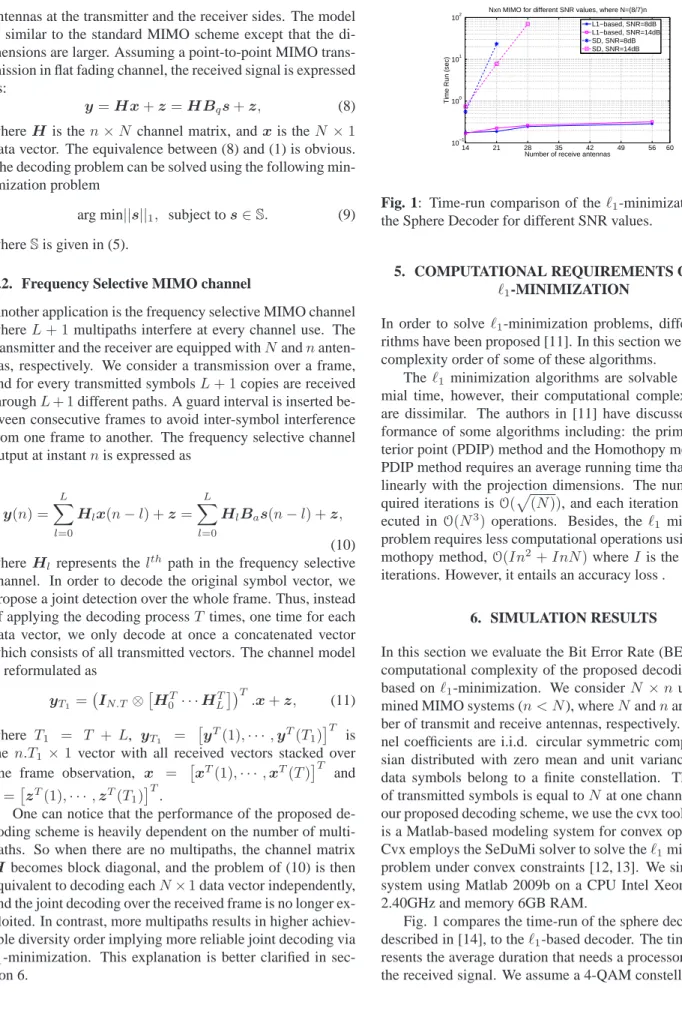
Number of receive antennas
Time Run (sec)
Nxn MIMO for different SNR values, where N=(8/7)n L1−based, SNR=8dB L1−based, SNR=14dB SD, SNR=8dB SD, SNR=14dB
Fig. 1: Time-run comparison of theℓ1-minimization versus
the Sphere Decoder for different SNR values.
5. COMPUTATIONAL REQUIREMENTS OF THE
ℓ1-MINIMIZATION
In order to solveℓ1-minimization problems, different
algo-rithms have been proposed [11]. In this section we review the complexity order of some of these algorithms.
The ℓ1 minimization algorithms are solvable in
polyno-mial time, however, their computational complexity orders are dissimilar. The authors in [11] have discussed the per-formance of some algorithms including: the primal-dual in-terior point (PDIP) method and the Homothopy method. The PDIP method requires an average running time that increases linearly with the projection dimensions. The number of re-quired iterations isO(p(N)), and each iteration can be
ex-ecuted in O(N3)operations. Besides, the ℓ1 minimization
problem requires less computational operations using the Ho-mothopy method,O(In2+InN)where Iis the number of iterations. However, it entails an accuracy loss .
6. SIMULATION RESULTS
In this section we evaluate the Bit Error Rate (BER) and the computational complexity of the proposed decoding scheme based onℓ1-minimization. We considerN ×n
underdeter-mined MIMO systems (n < N), whereNandnare the num-ber of transmit and receive antennas, respectively. The chan-nel coefficients are i.i.d. circular symmetric complex Gaus-sian distributed with zero mean and unit variance, and the data symbols belong to a finite constellation. The number of transmitted symbols is equal toN at one channel use. For our proposed decoding scheme, we use the cvx toolbox which is a Matlab-based modeling system for convex optimization. Cvx employs the SeDuMi solver to solve theℓ1minimization
problem under convex constraints [12, 13]. We simulate this system using Matlab 2009b on a CPU Intel Xeon E5620 at 2.40GHz and memory 6GB RAM.
Fig. 1 compares the time-run of the sphere decoder (SD), described in [14], to theℓ1-based decoder. The time-run
rep-resents the average duration that needs a processor to decode the received signal. We assume a 4-QAM constellation
map-0 2 4 6 8 10 12 14 16 18 20 10−5 10−4 10−3 10−2 10−1 100 SNR [dB]
Bit Error Rate
Nxn MIMO single user channel
L1−based, 16x14 L1−based, 21x24 L1−based, 28x32 L1−based, 64x56 SD, 16x14 SD, 21x24
Fig. 2: Performance of theℓ1-minimization versus the Sphere
decoder for different antenna dimensions in large MIMO sys-tems 3 4 5 10−1 100 101 102 Number of multipaths
Time Run (sec)
frequency selective 3x2 MIMO channel L1−based, SNR=14dB
Viterbi decoder, SNR=14dB
Fig. 3: Time-run comparison of theℓ1-minimization versus
the Viterbi-ML for SNR =14dB, assuming BPSK modulation
ping known at both the transmitter and the receiver. One can notice that using theℓ1-based decoder, the computational
complexity keeps almost invariant with the system dimen-sions and the SNR level, whereas the SD time-run increases exponentially with these two factors. For the SD, we do not go beyond the24×21due to a too high computational com-plexity, which is upper-bounded by O(MγN), where γ ∈
(0,1][15]. On the other hand, Fig. 2 illustrates a slight perfor-mance gain of our scheme in the low SNR region. Otherwise, i.e. beyond8dB, the SD outperforms the proposed scheme. For example at BER10−2, we observe a gain of about5dB
with a16×14and of4dB with a24×21.
Next, Fig. 3 compares the time-run of our proposed de-coder to the Viterbi dede-coder one. The Viterbi algorithm ex-ploits the channel multi-paths, and achieves optimal perfor-mance over a frequency selective channel. The frame length is equal toT = 20, and the constellation mapping is BPSK. The computational complexity of the Viterbi decoder is known to grow exponentially with the number of transmit antennas and the number of channel multi-pathsτasO(2N.τ). This is
con-sistent with the obtained results in Fig. 3, where the Viterbi time-run increases from 0.73 seconds forτ = 3to 6.77 sec-onds forτ= 4, whereas the time-run of our proposed scheme remains constant and equal to around 0.25 seconds. However, the Viterbi decoder leads to a BER improvement as illustrated
0 5 10 15 20 10−7 10−6 10−5 10−4 10−3 10−2 10−1 100 SNR [dB]
Bit Error Rate
3x2 MIMO sinlgle user channel
L1−based, τ=2 L1−based, τ=3 L1−based, τ=4 L1−based, τ=5 Viterbi, τ=2 Viterbi, τ=3 Viterbi, τ=4
Fig. 4: Performance of theℓ1-minimization versus the
ML-Viterbi decoder for different number of multipaths assuming BPSK modulation.τrepresents the number of multipaths.
in Fig. 4. For example, at BER10−2, the gain fluctuates
be-tween1dB and2.5dB, and at BER10−3the gain fluctuates
between3dB and4dB, for different multi-path number. Remarks: 1) It is important to mention that despite the non-optimality of the current Matlab solver, it can always show the increase of the computational complexity order of the above decoding schemes.
2) The gain obtained over the proposed scheme can be re-duced using an error-correcting code e.g. turbocode.
7. CONCLUSION
In this paper we have addressed the problem of decoding in high dimension MIMO systems with finite constellation. We have modeled the transmission as a higher-dimension MIMO channel with sparse input vector. We have then defined anℓ1
-minimization problem to detect the sparse vector. An iterative algorithm of polynomial moderate complexity has been used to solve the problem. Simulations carried out in the cases of large MIMO systems on flat fading channel and MIMO systems on frequency selective channels, where the efficiency of the proposed decoding scheme has been proved.
8. APPENDIX
From a general point of view, letY,Θ, Xbe threed-dimensional real random vectors whereX ∼N(0, σ2Id)whenΘandX
are independent andY = Θ +X. Given toleranceτ > 0, Random Distortion Testing (RDT) [16] is the problem of test-ing whetherkΘ(ω)−θ0k 6τor not, when we are givenY
and the probability distribution ofΘis unknown. By analogy with standard terminology in statistical inference, we say that this problem is the testing of the null event
kΘ−θ0k6τ
against the alternative eventkΘ−θ0k > τon the basis
follows: RDT: Observation:Y = Θ +X ΘandXindependent, X ∼N(0, σ2Id), Null event: kΘ−θ0k6τ, Alternative event: kΘ−θ0k> τ. (12) Given any η > 0, let Tη be any thresholding test with
threshold heightηdefined for anyy∈Rdby
Tη(y) =
1 if ky−θ0k> η
0 if ky−θ0k6η.
(13)
Givenγ ∈ (0,1]andρ > 0, there exists a unique solu-tionλγ(ρ)>0inηto1−Fχ2
d(ρ2)(η
2) =γ, whereF χ2
d(ρ2)is
the cumulative distribution function of the non-centralχ2
dis-tributionχ2
d(ρ2)withddegrees of freedom and non-central
parameterρ2. In [17], it is then proved that the
threshold-ing testTλ
γ(τ) with threshold heightλγ(τ) is such that the
conditional probability valuesP
Tλ
γ(τ)(Θ +X) = 1
kΘ−
θ0k 6τhave supremum equal toγ, whateverΘsuch that
P
kΘ−θ0k 6 τ 6= 0. We thus say that Tλγ(τ)has size
γfor RDT. Moreover, it turns out thatTλ
γ(τ) is optimal for
RDT among all tests with same size in the following sense: 1) Save for values ofρ in some subset D ⊂ (τ,∞) such that P
kΘ−θ0k ∈ D
= 0, the conditional probability
PT
λγ(τ)(Θ +X) = 1
kΘ−θ0k = ρ does not depend
on the distribution ofΘfor every ρ ∈ (τ,∞)\D and 2)
PT
λγ(τ)(Θ +X) = 1
kΘ−θ0k =ρ>PT(Θ +X) =
1
kΘ−θ0k = ρ for all testT with levelγ and such that
PT
(Θ + X) = 1kΘ−θ0k = ρ does not depend on
the distribution ofΘeither. In other words, with respect to some criterion suitable for the natural invariance exhibited by RDT on the spheres centered atθ0inRd, thresholding tests
Tλ
γ(τ)are optimal.
9. REFERENCES
[1] Emre Telatar, “Capacity of multi-antenna gaussian channels,” European Transactions on
Telecommunica-tions, vol. 10, pp. 585–595, 1999.
[2] M. O. Damen, H. El Gamal, and G. Caire, “On maximum-likelihood detection and the search for the closest lattice point,” IEEE Transactions on Information
Theory, vol. 49, no. 10, pp. 2389–2402, October 2003.
[3] S. J. Grant and J. K. Cavers, “Further analytical results on the joint detection of cochannel signals using diver-sity arrays,” IEEE Transactions on Communications, vol. 48, no. 11, pp. 1788–1792, Noc 2000.
[4] B. Hassibi and H. Vikalo, “On the sphere decoding al-gorithm i. expected complexity,” IEEE Trans. on Signal
Processing, vol. 53, no. 8.
[5] S. M. Aziz-Sbai, A. Aissa-El-Bey, and D. Pastor, “Un-derdetermined Source Separation of Finite Alphabet Signals via L1 Minimization,” in IEEE Conference on
Information Sciences, Signal Processing and their Ap-plications, July 2012, pp. 625–628.
[6] S. Foucart, “A note on guaranted sparse recovery via L1 minimization,” Applied and Computational Harmonic
Analysis, vol. 29, no. 1.
[7] J. Yang and Y. Zhang, “Alternating direction algorithms for L1-problems in compressive sensing,” (preprint) arXiv:0912.1185, 2009.
[8] A. Aissa-El-Bey, D. Pastor, S. M. Aziz-Sbai, and Y. Fad-lallah, “Recovery of Finit Alphabet Solutions of Under-determined Linear System,” Submitted to IEEE
Trans-actions on Information Theory.
[9] E.G. Larson and F. Tuvesson, “Very Large MIMO Sys-tems,” in in Proc. of IEEE ICASSP, May 2012.
[10] F. Rusek, D. Person, B.K. Lau, E.G. Larson, T.L. Marzetta, O. Edfors, and F. Tuvesson, “Scaling up MIMO: Opportunities and Challenges with very Large Arrays,” IEEE Signal Processing Magazine, 2012. [11] A. Yang, A. Ganesh, S. Sastry, and Y. Ma, “Fast
L1-Minimization Algorithms and An Application in Ro-bust Face Recognition: A Review,” Technical Reports, February 2010.
[12] J.F. Sturm, “Using SeDuMi 1.02, a MATLAB toolbox for optimization over symmetric cones,” Optimization
Methods and Software, 11-12:625-633, 1999. Special issue on Interior Point Methods.
[13] M. Grant and S. Boyd, “CVX: Matlab software for disciplined convex programming, version 2.0 beta,” http://cvxr.com/cvx, Sept. 2012.
[14] T. Cui and C. Tellambura, “An Efficient Generalized Sphere Decoder for Rank-Deficient MIMO Systems,”
IEEE Communications Letters, vol. 9, no. 5, May 2005.
[15] J. Jalden and B. Ottersten, “On the Complexity of Sphere Decoding in Digital Communications,” IEEE
Trans. on Signal Processing, 2005.
[16] D. Pastor and Q. T. Nguyen, “Random distortion testing and applications,” in ICASSP 2013 : IEEE international
conference on acoustics, speech and signal processing, Vancouver, Canada, Mai 26-31, 2013.
[17] D. Pastor and Q.T. Nguyen, “Testing the mahalanobis distance between a random signal with unknown distri-bution and a known deterministic model in additive and independent standard gaussian noise: the random dis-tortion testing problem,” Tech. Rep., Institut Telecom, Telecom Bretagne,.