Explorations of Quantum-Classical Approaches to Scheduling a Mars Lander
Activity Problem
Tony T. Tran
+,‡,†,∗, Zhihui Wang
+,∗∗, Minh Do
‡,†, Eleanor G. Rieffel
+,
Jeremy Frank‡, Bryan O’Gorman+,†, Davide Venturelli+,∗∗, and J. Christopher Beck∗
+Quantum Artificial Intelligence Lab., NASA Ames Research Center, Moffett Field, CA ‡Intelligent Systems Division, NASA Ames Research Center, Moffett Field, CA
∗∗Universities Space Research Association, Mountain View, CA
†Stinger Ghaffarian Technologies, Inc., Greenbelt, MD
∗Department of Mechanical and Industrial Engineering, University of Toronto, Toronto, ON
Abstract
An effective approach to solving problems involving mixed (continuous and discrete) variables and constraints, such as hybrid systems, is to decompose them into subproblems and integrate dedicated solvers geared toward those subproblems. Here, we introduce a new framework based on a tree search algorithm to solve hybrid discrete-continuous problems that incorporates: (1) a quantum annealer that samples from the configuration space for the discrete portion and provides in-formation about the quality of the samples, and (2) a classical computer that makes use of information from the quantum an-nealer to prune and focus the search as well as check a contin-uous constraint. We consider four variants of our algorithm, each with progressively more guidance from the results pro-vided by the quantum annealer. We empirically test our algo-rithm and compare the variants on a simplified Mars Lander task scheduling problem. Variants with more guidance from the quantum annealer have better performance.
Introduction
One approach to solving complex problems is to decom-pose them into subproblems that can be handled by dedi-cated solvers. Such an approach is particularly effective for large problems that involve different types, such as discrete and continuous, of variables and constraints. The key tech-nical issue in such an approach is developing a framework to effectively decompose the problem and integrate the solvers. Here, we introduce a new framework based on a tree search algorithm to solve hybrid discrete-continuous prob-lems that incorporates:
• a quantum annealer that samples from the configuration space for the discrete portion and provides information about their quality
• a classical computer that (1) makes use of information from the quantum annealer to prune and hone the search; and (2) checks the continuous constraints on results re-turned by the quantum annealer.
Our framework takes advantage of the strength of quantum annealing, a metaheuristic for combinatorial optimization, and complements it with classical processing that enables the entire algorithm to be complete. As a result, this en-ables larger problems to be solved than is possible on current quantum annealing hardware. We evaluated our framework
on a simplified Mars lander task scheduling problem that in-cludes a continuous battery constraint and discrete require-ments on the tasks to be scheduled. To keep the problem size manageable for the quantum annealer, we use it to search for schedules that meet the discrete requirements, and then use the classical computer to check the continuous requirements. The results returned by the quantum annealer can be used for two different purposes: (1) prune the high-level search tree; and (2) guide which part of the tree to explore next using quality of results. Within our framework, we compare two different heuristics to guide the tree search:
1. node selection based only on the estimation by the classi-cal computer without incorporating a quality measure for the results returned by the quantum annealer.
2. node selection incorporating information about the qual-ity of the results returned by the quantum annealer. The intuition behind the second heuristic is that parts of the tree that have returned better results for the discrete sub-problem are more promising places to explore than parts that have returned worse results.
We compare specific settings of these two heuristics on in-stances of the Mars lander activity scheduling problem. For the quantum annealing component, we ran on the D-Wave 2X machine housed at the NASA Ames Research Center. Each run of a quantum annealer returns a pre-determined number ofconfigurations, variable assignments to all of the variables in the cost function for the subproblem run on the annealer. We reserve the phrasecandidate solutionfor feasi-ble solutions to the subprofeasi-blem andglobal solutionfor fea-sible solutions to the full problem. We also compare with a baseline approach in which instead of using the quantum annealer, random configurations are generated and used to prune the tree.
The main contributions of this work are:
• A novel framework for quantum-classical approaches to optimization problems that iteratively concentrates first on the discrete aspects of the problem and then on the continuous constraints.
• Instantiations of this framework that make use of a quan-tum annealer to sample the search space and guide future searches.
• Instantiations that make use of all configurations returned by the quantum annealer, not just the best configurations. https://ntrs.nasa.gov/search.jsp?R=20190030474 2019-09-26T18:57:17+00:00Z
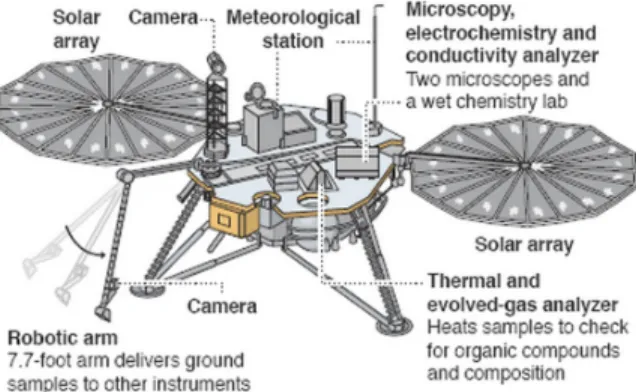
Figure 1: NASA’s Phoenix Mars Lander. Source: NASA
• Full integration of a quantum annealer and a classical al-gorithm.
• Empirical results comparing different instantiations of this framework, with each other, and with a baseline.
• Established that feasible solutions can be found with less effort when the search is guided using configurations re-turned by the quantum annealer.
While our work is in an early stage and the scale of the problems we tested is limited, this decomposition framework also supports many other instantiations of these quantum-classical algorithms. We intend to explore other in-stantiations in future work.
The Mars Lander Problem
As a testbed to explore quantum-classical approaches, we consider a Mars lander that is tasked to perform multiple ac-tivities over the course of a Martian day. The Mars lander robotic spacecraft can land on the surface of Mars, but is not mobile like a rover. The lander has various scientific instru-ments and a robotic arm that can interact with its environ-ment. Its activities include (1) scientific studies to achieve mission goals, (2) communication of data, and (3) operations to maintain the lander in a functioning state. The number of requested tasks can be large.
We consider a simplified application with a shorter scheduling horizon than a typical Martian day and fewer tasks. The scientific activities we consider are:
• Obtain panoramic pictures:Panoramic pictures of Mars landscape requires atime-windowwhen there is sunlight, but also must take into account the strength and direction of the sun due to shadows and glare.
• Measure Martian weather: Measuring the Martian weather can havetime-windows since scientists may be interested in measurements of particular times as the con-ditions change over the course of a day.
• Sample Martian soil: Sampling of Martian soil is sub-divided into three different tasks: (1) taking a picture of the workspace, (2) digging, and (3) baking. The prece-dence constraints mean that digging can only occur once a picture of the workstation is taken and baking a sample only after soil is retrieved via digging.
The Mars lander will also need tosend stored datavia com-munication satellites when it has unobstructed line-of-sight to these satellites. Thus, there are only several disjoint time-windows in which an uplink task can occur.
In addition to the time-window and precedence con-straints, the Mars lander has a limited-capacity battery and performing tasks depletes the battery at different rates. To ensure that there is enough power, the Mars lander is equipped with solar panels thatrecharge the batterywhen the sun is visible. The solar panel can be used at any time that the sun is visible, but the amount of power will depend on the amount of light which varies with weather conditions, time of day, and time of year. If the battery is at its max-imum capacity, the excess power production from the sun cannot be stored. However, it is possible for the lander to draw power directly from the solar panels to power tasks rather than from the battery. This allows the lander to uti-lize power from the solar panels when the battery is fully charged rather than wasting it.
In our simplified problem, the Mars lander is capable of performing only a single task at a time. The only operation that can be done in parallel with other tasks is solar panel charging, which occurs automatically when the sunlight and battery capacity conditions are met. The goal is to construct a schedule that assigns each task a start time, adhering to the tasks’ time-windows, precedence and battery constraints.
Problem Details: The parameters chosen here are artifi-cially generated for the purposes of providing a problem in-spired by the real NASA’s Phoenix Mars lander problem. The scheduling horizon is 10 hours broken into twenty 30-minute-long time segments.
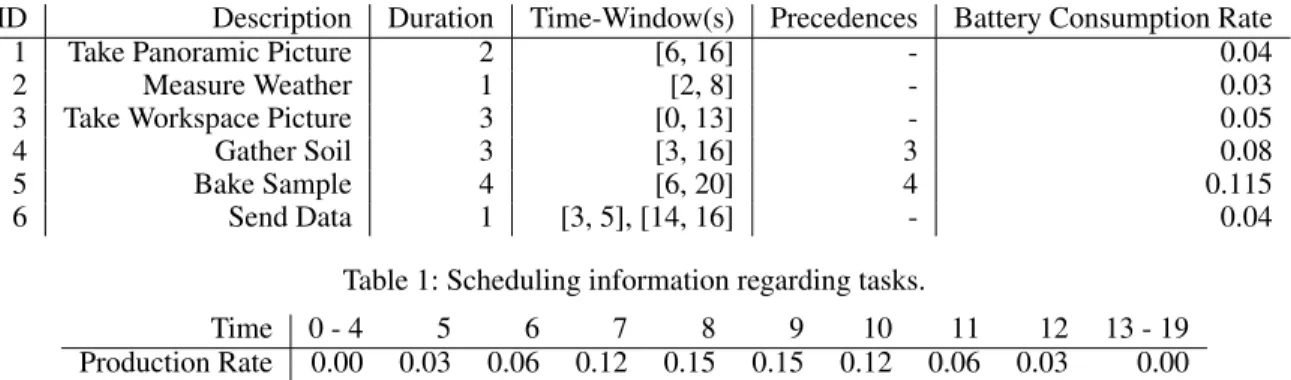
Table 1 provides a list of the tasks, their duration (in mul-tiples of 30-minute slots), time-window(s), any precedence constraints, and the battery consumption rates. The type of tasks chosen are based on actual tasks performed by the Phoenix Mars lander, but the detailed values are fabricated. The durations and time-windows were chosen with three ob-jectives in mind: to provide an interesting scheduling prob-lem, to have it small enough to fit on the quantum hardware, and to still be an abstracted version of the real Mars lan-der problem with reasonable values. The consumption rate is the total power consumed every 30 minutes. This consump-tion is assumed to be constant throughout the duraconsump-tion of the task. Therefore, a baking task that lasts for two hours will consume a total of0.115×4 = 0.46units of power. Con-sumption rates were chosen so that the total battery power required to complete all tasks sum to 1.
Finally, Table 2 presents an example of the battery charge increase due to solar power during each time segment. We chose these parameters to mimic changing conditions in the course of a day, and to sum to 1 so the production total is equivalent to the consumption total. The time periods at the start and end of the schedule have charging rate of0, repre-sent times when the sun is not visible to the solar panels. As the day progresses, the sunlight increases until midday, after which the sunlight decreases.
The instances we consider all have the same tasks and task constraints. We vary instances by altering the
parame-ID Description Duration Time-Window(s) Precedences Battery Consumption Rate
1 Take Panoramic Picture 2 [6, 16] - 0.04
2 Measure Weather 1 [2, 8] - 0.03
3 Take Workspace Picture 3 [0, 13] - 0.05
4 Gather Soil 3 [3, 16] 3 0.08
5 Bake Sample 4 [6, 20] 4 0.115
6 Send Data 1 [3, 5], [14, 16] - 0.04
Table 1: Scheduling information regarding tasks.
Time 0 - 4 5 6 7 8 9 10 11 12 13 - 19
Production Rate 0.00 0.03 0.06 0.12 0.15 0.15 0.12 0.06 0.03 0.00 Table 2: Example solar power production rate.
ters that correspond to the battery constraints. The battery has a starting charge that varies during a mission based on the battery consumption and production from previous time periods. For our experiments, we use initial battery levels of either 0.3, 0.5, or 0.7. The maximum capacity changes due to battery degradation over the length of a mission. Early on, the battery capacity may be large, but over time, the battery will be expected to hold much less of a charge. For our experiments, we use battery capacities of either 0.5, 0.7, or 0.9. Finally, we vary the solar power production intensity. Table 2 acts as the baseline power production from the solar panels. We test three power production scenarios where all production is updated to be 75%, 100% or 125% of the baseline. These intensities represents changes in the distance of Mars to the Sun and the visibility of the Sun due to the Martian weather, dust storms and other such obstructions. Ignoring any cases in which the initial battery power is larger than the maximum capacity and any instances that do not have a feasible solution,1 we are left
with a total of 21 problem instances.
Scheduling problem formulation:LetJ be the set of all tasks to schedule. For each taskj∈J, letpjbe its
process-ing time, andWjits set of time windows. For each time
win-dowwi ∈Wj, letrj,ianddj,ibe the start and end times of
that window. LetTj={t| ∀wi∈Wj, rj,i≤t≤dj,i−pj}
be the set of all possible start times of taskj. To encode the task scheduling problem, we use a time-indexed formula-tion: for each taskjand time indext, we introduce a binary variablexj,t, which is 1 if and only taskjstarts at timet.
A valid schedule for a Mars lander task scheduling prob-lem is a complete assignment for allxj,tvariables
satisfy-ing the followsatisfy-ing constraints: (1) no two tasks overlap; (2) precedence constraints between tasks are satisfied; and (3) battery constraints are satisfied.
Quantum Annealing
Quantum computing enables more efficient solution to cer-tain classes of problems than classical computing (Rief-fel and Polak 2011; Chuang 2001). While large-scale uni-versal quantum computers are likely decades away, special
1
We determined the infeasible problem instances by performing a complete search using our algorithm.
purpose quantum computational devices are emerging. The first of such are quantum annealers, special purpose hard-ware designed to run quantum annealing (Farhi et al. 2000; Das and Chakrabarti 2008; Johnson et al. 2011; Smelyan-skiy et al. 2012), a metaheuristic that can make use of certain non-classical effects, such as quantum tunneling and quan-tum interference (Das and Chakrabarti 2008; Boixo et al. 2014), for computational purposes. For classically-trained computer scientists, quantum annealing is one of the most accessible quantum algorithms because of its close ties to classical optimization algorithms such as simulated anneal-ing (Smelyanskiy et al. 2012; Nishimori, Tsuda, and Knysh 2015) and because the most basic aspects of the algorithm can be captured by a classical cost function and classical parameter setting. Special purpose hardware such quantum annealers mean it is now possible to empirically evaluate heuristic quantum algorithms such as quantum annealing, potentially opening up a broader range of applications for quantum computation.
A quantum annealer is designed to minimize Quadratic Unconstrained Binary Optimization (QUBO) problems, problems of minimizing a cost function of the form
C(x) =X i cixi+ X i<j ci,jxixj,
where{ci, ci,j} are real coefficients and x ∈ {±1}n is a
vector of binary-valued variables. Using a quantum annealer requires mapping the problem of interest to QUBO; the fol-lowing section contains an example for the discrete portion of the Mars lander problem. The solution space of the origi-nal problem is mapped to a subset of bit strings, and the cost function encoded in the coefficients such that the minimum value of f(s)and corresponding optimumsgive the solu-tion to the original problem. Penalty funcsolu-tions are added so that bit strings that do not correspond to valid solutions are penalized.
Figure 2 shows the procedure for solving on the quantum annealer the Mars lander scheduling problem without the battery constraint (MLWoB), a single-machine scheduling (SMS) problem which is the discrete part of our hybrid problem. The first step is to encode our MLWoB scheduling problem in the QUBO form described above. To implement the resulting QUBO on the quantum annealer hardware, an additional embedding step is needed. Variables in
Figure 2: Steps in solving the Mars lander scheduling prob-lem without the battery constraints (MLWoB) using quan-tum annealer.
the QUBO map to qubits on the hardware. A quadratic constraint can only be implemented directly when the qubits corresponding the variables in the constraint are connected in the hardware. But the physical hardware has only limited connectivity, so often multiple qubits are needed to represent a single variable. Embedding is the process of determining which physical qubits will represent which variables (Kaminsky and Lloyd 2004; Choi 2008; 2011). The coupling strength used between physical qubits representing the same variable is a parameter of the quantum annealing algorithm. More details about embedding and the process of using a quantum annealer to solve application problems can be found in (O’Gorman et al. 2015).
Mapping Mars lander without battery (MLWoB) prob-lems to QUBO:For the rest of this section, we will describe in details how to map MLWoB problems to QUBO form, us-ing the notations, variables, and constraints described in the problem formulation at the end of the previous section.
In the QUBO representation we model constraints in the MLWoB through penalty terms in the cost function objec-tive. To ensure that every task is assigned to exactly one starting time, the term
Cone−start= X j∈J (X t∈Tj xj,t−1)2
is added to the objective function. To ensure that no two tasks overlap, we introduce another cost function term
Coverlap= X j∈J X t∈Tj X l∈J l6=j X t0∈T0 j,t∩Tl xj,txl,t0.
The setTj,t0 = {t0|t ≤ t0 ≤ t+pj −1} represents the
time points that the Mars lander will be occupied with task jif it starts at timet. Thus, if another task starts during this time, a penalty is incurred. Finally, to model the precedence
Global Search Tree Manager (Classical Computer) Quantum Annealer (DWave 2X) Search node as ML WoB in QUBO forma t BaAery Constraint Checker (Classical Computer) configu ration set battery co nst raints for a ca ndid ate ML WoB so lution battery feasi bility ch eck resu lt
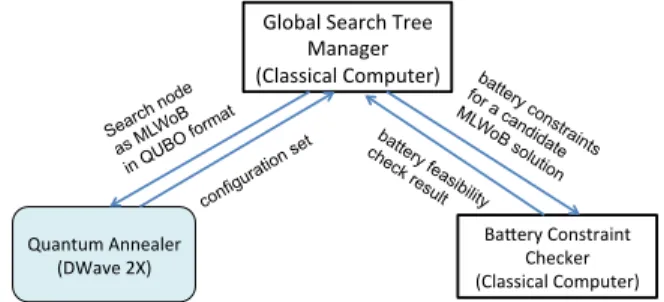
Figure 3: Tree-search based Quantum-Classical Algorithm. constraints, the cost function term
Cprec= X (j,l)∈P X t∈Tl X t0∈T˜j,t xj,t0xl,t
is used. LetPbe the set of all pairs of tasks with precedence constraints such that(j, l)∈ P implies that taskjmust be scheduled before task l. The setT˜j,t0 = {t0 ∈ Tj|t ≤ t0}
represents the times where taskj cannot start if a task that must start after taskj is scheduled at timet. The objective function for the complete QUBO is
C=Cone−start+Coverlap+Cprec.
A candidate solution will haveC= 0. IfC >0, one or more of the constraints has been violated and the configuration is infeasible.
Quantum Annealing Guided Tree Search
We propose a classical-quantum decomposition algorithm that makes use of (1) aclassical computer to manage the global search tree and check battery-profile feasibility for schedules produced by the quantum annealer; and (2) aquantum annealerto generate the lander schedules, ignoring the battery constraints. Our algorithm is outlined in Figure 3. At a high-level, the main steps are:
1. Build the global search tree: with root node representing an empty schedule and leaf nodes representing the com-plete Mars lander’s schedules.
2. Search node simplification: Ignore the constraints on the continuous variable representing battery. This results in a MLWoB problem outlined in the previous section. 3. Run the quantum annealer on the MLWoB problems: Each
run consists of a preset number of anneals, each of which returns a qubit configuration for the MLWoB problem. 4. Use results from the quantum annealer to guide the
high-level tree search: Each configurationx returned by the quantum annealer has an associated “energy” value or cost C(x). The results returned from the quantum an-nealer are used to (1) prune infeasible nodes from the high-level search tree; and (2) guide the subsequent ex-ploration of the remaining search tree.
Checking Battery Constraint: Candidate solutionsx re-turned by the quantum annealer that have zero cost (C(x) =
Algorithm 1Quantum Annealing Guided Tree Search. open nodes: a priority queue
pushroot nodetoopen nodes whileopen nodes6=N U LLdo
pop first nodenfromopen nodes
run quantum annealer onnwith pre-defined number of anneals to return a setSof configurations
ifanyC∈Sis a battery-ignorant schedulethen
check battery constraints onC else
build partial tree from the configurations generate opennode(s)
foreach opennodegenerateddo ifnodeis infeasiblethen
prunenode else
perform forward checking onnode pushnodeontoopen nodes return infeasible
0) must be checked to see if they satisfy the battery con-straints and are therefore a global solution. The check calcu-lates the battery state at every time pointt,
Bt= min(Bmax, Bt−1+b+t −b − t ),
whereb+t is the battery power produced by the solar panels andb−t is the battery consumption for the task processed at timet. IfBt<0at any time, the schedule is infeasible.
Complete Tree Search guided by the Quantum
Annealer’s Results Profile
For the rest of this section, we will describe in details the guided tree search, which ties the quantum annealer and the classical computation together.
As a stochastic solver, the quantum annealer returns mul-tiple configurations of varying quality, and has no guarantee of finding one with C(x) = 0when one exists. In order to guarantee that a candidate solution is found when one exists, a systematic search over the state space of the ML-WoB problem must be performed. We introduce a binary tree search that is guided by the quantum annealer. We pro-vide pseudocode for the algorithm, and then describe each step in more detail in the subsequent subsections.
Using the Quantum Annealer to build the partial tree.
For each job submitted to the quantum annealer,Kanneals are performed (see the last step in Figure 2). Of theK con-figurations returned,K¯ are unique withK¯ ≤K. Configura-tions are of varying quality with associated costC(x)≥0. All configurationsxwithC(x) = 0, representing candidate solutions, are checked to see if the battery constraints are satisfied. If none of them satisfies the battery constraint, the search is continued.
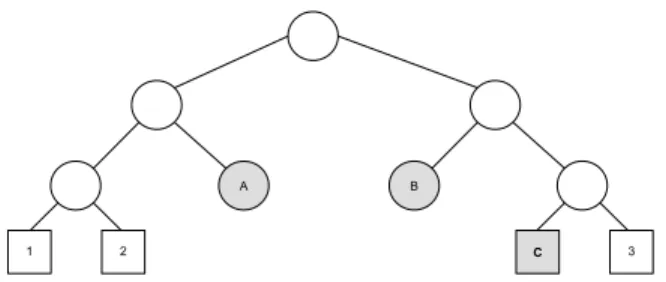
From theK¯ configurations, a partial tree can be built, a binary tree with a fixed variable ordering, where variables pertaining to the same task are grouped together. The un-shaded nodes (1), (2), and (3) in Figure 4 presents an
exam-A B
1 2 C 3
Figure 4: Partial binary search tree example with open nodes shown as shaded nodes. Square nodes here represent the configurations.
ple of such a partial tree where the square nodes are the con-figurations. The left (right) branch of a node represents the corresponding variable being set to 0 (1). A problem withN variables will have a tree of size2N+1−1, of which2N are
leaf nodes corresponding to configurations (assignment of 0 or 1 to all variables). The partial tree is traversed to generate all open nodes (the shaded nodes (A), (B), and (C) in Figure 4), which are defined as nodes that do not exist in the partial tree, but have a sister node that does.
Node pruning. Open nodes are pruned by an inference algorithm based on the MLWoB problem constraints and the battery constraints. At any open node, a subset of de-cisions variables,xj,t, have been set. Based on this partial
configuration, it is possible to check whether any of the con-straints have been violated by looking at the three MLWoB constraints: (1) a task must be assigned to one start time (P
t∈Tjxj,t= 1), (2) no tasks can overlap ( P
j∈Jxj,t≤1),
and (3) precedence constraints cannot be violated (txj,t+
pj ≤ t0xl,t0). These constraints are checked only for the
tasks that have been assigned a start time (or have been as-signed 0 to all possible start time variables) at the open node in question. If any of the constraints are violated, the node can be pruned.
Constraint propagation is also performed on the battery constraint. LetJ0 ∈Jbe the set of already scheduled tasks andyltheir scheduled start times. Forj ∈J\J0, the set of
tasks that have yet to be scheduled, consider all remaining decision variablesxj,tand check whether
yl+pl≤tort+pj≤yl ∀l∈J0.
For all such timestthat are still available for taskj, the bat-tery check is called for the set of tasksJ0 starting at times yland the taskjassuming that it is assigned to start at time
t. Letτjbe the set possible values fortwhere both the
tem-poral and battery constraints for a taskjare satisfied given the partial schedule. If any remaining task to schedule has τj =∅, it is impossible to schedule the task with the partial
schedule and so the node can be pruned.
If no constraints have been violated, then a final forward checking procedure is performed. The depth of a node in-dicates the task that is currently being considered. In some cases, it is possible to set the next few variables in the tree that pertain to the task at the current depth. For example, if the start time of a task has already been decided, the remain-ing start time decision variables for that task can be set to 0.
The current open node can then skip down to the proper lo-cation and ignore branches to the right since configurations built from the partial solution of those nodes would violate the single start time constraint.
Node exploration. Once an open node is selected for fur-ther exploration, we set the variables of the corresponding partial configurations and invoke the quantum annealer to find the configurations for the remaining variables. New con-figurations are found and the partial tree beneath the open node is built in the same manner as described above. Be-cause configurations are built upon the partial configurations of the open node, all configurations found will not have been explored previously.
Node selection. To decide which node to explore next, we considered three node selection heuristics. The first uses task scheduling slackness. The second heuristic uses the cost value C(x) of the configurations returned by the quantum annealer to guide selection. The final combines slackness with the cost value. We call the first heuristic
Slack-Only, the secondQA-Only, and the lastWeighted.
Slack-Only measures the remaining slack of times left that a task can be scheduled assj = |τj|, whereτj is the
set defined during constraint propagation. We calculate a scoring function, S = Q
j∈J\J0sj |J\1J0 |
, for each node. The geometric mean is taken over the slack of each remaining task to better compare nodes at different depths and to avoid partial candidate solutions that greatly restrict some tasks even if others have large slack. Nodes with more slack have more time in which to fit all the remaining tasks, so slack is a reasonable measure of how likely candidate solutionsxwithC(x) = 0exists below the node.
QA-Only uses the cost value C(x) of configurations to guide node selection. A scoreC∗ is defined for each open node as the lowestC(x)for any configuration x that has been found from the sub-tree of the open node’s parent. This is a proxy measure for how good the partial configuration is for the MLWoB. Here, we choose the open node with the minimum cost value since these configurations are closer in cost to candidate solutions.
Weighted (α)weights the Slack-Only and QA-Only heuris-tics. The scoring function that Weighted (α) uses is (1−
α)S−αC∗, whereα∈[0,1]is a control parameter that de-termines how much influence the cost function will have on the scoring function. In general, we see the slack function ranges between 1 and 7. The cost value has a much greater range, but the nodes of interest will have low cost within the same range as the slack since these solutions are closer values to candidate solutions. Note that we subtract the cost value from the scoring function as a lower cost value is asso-ciated with a better configuration. Ifα= 1, then the scoring function is the QA-Only heuristic and ifα= 0then the scor-ing function will be equivalent to the Slack-Only heuristic. Thus, an open node that has a parent that was found to be part of a good MLWoB schedule will have increased priority
whenα >0. The intuition for this heuristic is that it is better to explore parts of the tree where other good configurations were found rather than parts where only poor configurations have been found.
Conditions for Termination. The algorithm continues to explore open nodes until either a global solution has been found or there are no longer any open nodes to explore. An empty open node list implies that no global solution exists.
Empirical Evaluation and Analysis
We evaluated our algorithm 10 times on each of the21Mars lander instances. Since the MLWoB problem is the same across instances, the initial QUBO at the root node is always the same. This QUBO has 52 variables, one for each possi-ble start time of a task. For example, the “measure weather” action has time-window [2, 8] and a processing time of 1, so it will have 6 binary variables representing the possible start times of the task from time 2 until time 7. Embedding this QUBO into the D-Wave 2x hardware results in the use of many more qubits. For our experiments, we generated a single embedding at the root node and used the same em-bedding for all problems. This emem-bedding has 764 qubits. Nodes deeper in the tree correspond to restricted MLWoB problems where some variables are already set, so we can use the same embedding but with a subset of the variables.We examine four variants of our algorithm: 1. Slack-Only
2. QA-Only
3. Weighted heuristic with four different weightings 4. aRandom-Samplebaseline algorithm that does not make
use of the quantum annealer, but instead generates config-urations from open nodes through random sampling. The baseline algorithm naively explores the tree without di-rectly trying to find feasible MLWoB schedules. Constraint propagation is still performed on the nodes of the tree to guide search and the node selection is done by choosing the node with the largest geometric mean of the slack.
We implement all classical components of our algorithms in Python and run quantum annealing on the D-Wave 2X machine housed at NASA Ames. To explore an open node, we submit a job request withK = 10,000anneals with an anneal time of 20 micro-seconds. Embedding and parameter setting for the embedded QUBO are done using D-Wave’s software with default parameters (Cai, Macready, and Roy 2014) with one exception. Our previous experiments showed that for the MLWoB problem, increasing by 5 times the default D-Wave parameter for the coupling strength be-tween qubits representing the same single variable resulted in greatly improved performance. For Random-Sample, we generate 10,000 samples at each explored node.
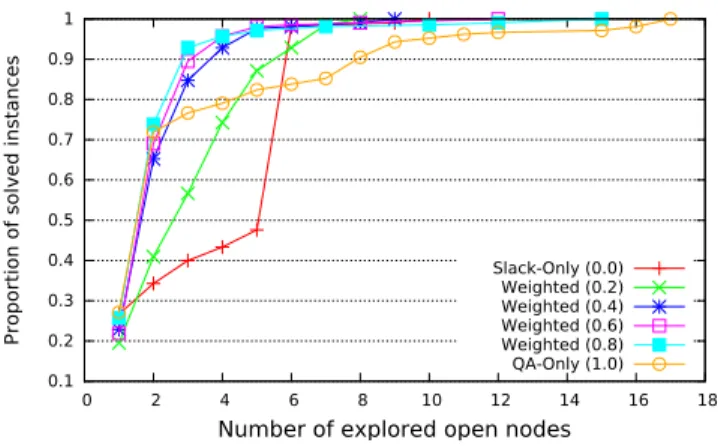
Results: Table 3 displays the performance of the different variants. The number of explored nodes correlates with the effort required to solve a problem. The number of unique configurations found defines the size of the tree built. A larger tree results in a larger computation on the classical computer because the number of open nodes increases.
avg. # of avg. # of open nodes configurations explored found Random-Sample 420.27 4,088,269.03 Slack-Only (0.0 4.10 2,143.21 Weighted (0.2) 3.27 2,042.94 Weighted (0.4) 2.38 1,795.79 Weighted(0.6) 2.27 1,784.30 Weighted (0.8) 2.22 1,728.33 QA-Only (1.0) 3.25 1,822.60 Table 3: Results for the algorithm variants on the twenty-one problem instances considered: solving each instance ten times for each variant. Slack-Only uses the quantum anneal-ing configurations to build the tree and Weighted and QA-Only goes a step further to use the objective function from configurations to guide node selection, with the Weighted (0.8) variant performing best.
The results show a reduction in the number of open nodes explored with guidance from the configurations found by the quantum annealer. The most naive approach, Random-Sample, explores the most open nodes. Slack-Only and QA-Only significantly reduce the search effort as the configura-tions used to build the partial tree is guided by a better solver. All values ofαtested for the Weighted variation further im-prove the results. A deeper understanding of how to choose theαvalue is left for future work.
Not only is exploration happening in a more directed manner in our algorithms compared to Random-Sample, but the construction of the tree is more focused. For Random-Sample, a much larger portion of the tree is built during ex-ploration than for the quantum annealing guided searches; Random-Sample usually returns10,000distinct configura-tions, whereas the quantum annealer often returns the same configuration multiple times as it tries to find good quality MLWoB schedules. Random-Sample also had significantly more open nodes due to the larger partial trees built.
Figure 5 provides further insight into the performance of the different variants. We see that the Weighted variants gen-erally find global solutions much faster than the Slack-Only or QA-Only variants. The Weighted variants exhibit more regular distributions. QA-Only is able to solve many prob-lems quickly, but has a heavy tail as strictly using low cost value configurations to guide search can lead to the search staying longer in bad branches. Slack-Only is not able to quickly find global solutions, but does solve many problems at the sixth open node explored. We suspect this behavior is in part due to the order of the variables, with variables representing a single job’s start time clustered.
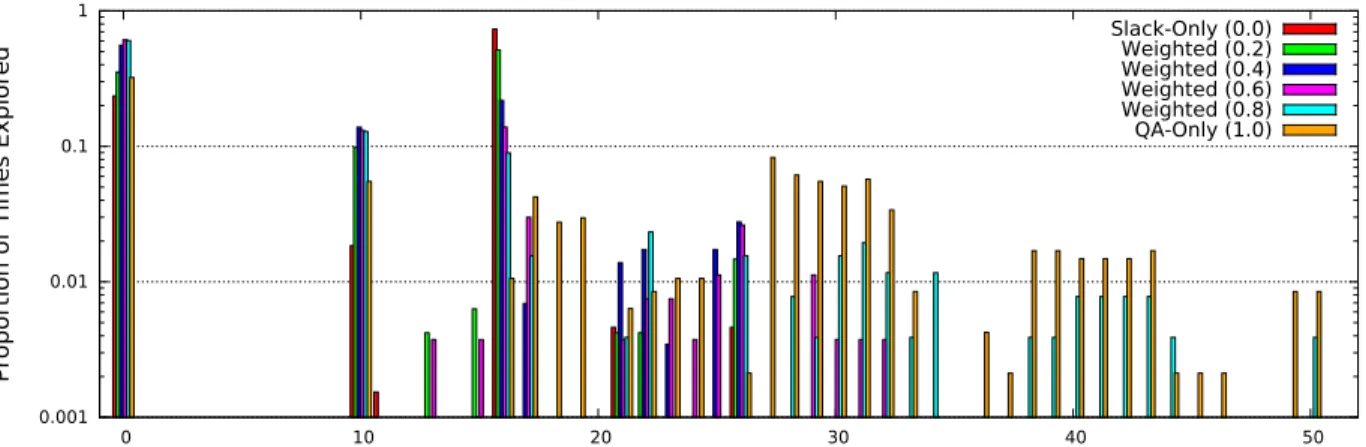
Figure 6 indicates how often a node of a certain depth is explored for all variants other than Random-Sample. We see that Slack-Only spends proportionately more time at shal-lower depths. Particularly, between depths of 10 and 26, we see a large increase in exploration. Using the quality of configurations from the quantum annealer, search is fo-cused towards deeper nodes in the tree. Weighted (0.6 and 0.8) along with QA-Only are the only variants that searches nodes deeper than a depth of 26, with Weighted (0.8) and
0.1 0.2 0.3 0.4 0.5 0.6 0.7 0.8 0.9 1 0 2 4 6 8 10 12 14 16 18 Pro p o rti o n o f so lv ed i n sta n ces
Number of explored open nodes Slack-Only (0.0) Weighted (0.2) Weighted (0.4) Weighted (0.6) Weighted (0.8) QA-Only (1.0)
Figure 5: Cumulative proportion of instances solved versus the number of open nodes explored. This graph provides a better picture into the distribution of performance over the set of instances tested. Random-Sample results are omitted. QA-Only searching even to depth of 33. As more empha-sis is given to theC(x)values to guide node selection, the search algorithm will spend time at deeper nodes near what it believes are other good configurations.
The results presented should not to be considered thor-ough benchmarks of the quantum annealer’s performance. Several performance boosting methodologies have been de-veloped (Perdomo-Ortiz et al. 2015; Venturelli et al. 2015; Vinci et al. 2015) that can improve the quality of the config-urations by orders of magnitude with respect to the basic use of the annealer. In order to keep the discussion restricted to the topic of the decomposition approach, other than for the coupling strength between qubits representing the same log-ical variables, we used the default parameters of the D-Wave 2X APIs. To make the best use of quantum annealers, it will be crucial to take full advantage of state-of-the-art tuning and programming techniques.
Related Work
Given the relative novelty of the quantum annealing hard-ware, research in this area has been limited. Pure quantum annealing formulations have been built for some planning and scheduling problems (Rieffel et al. 2015; Venturelli, Marchand, and Rojo 2015). Instead of using the quantum annealer to optimize, Benedetti et al. (2015), and Adachi and Henderson (2015) explore the possibility of using it as a Boltzmann sampler to aid the training in deep learning, quite a different use of sampling than our approach.
Combining quantum and classical computing in algo-rithms have only recently begun being explored. Rosen-berg et al. (2015) present a large-neighbourhood local search with a method to integrate the quantum annealer as a sub-routine within a classical algorithm. In a similar fashion, Zintchenko, Hastings, and Troyer (2015) propose a hier-archical search that decomposes the set of decisions vari-ables into multiple groups and cycles through groups opti-mizing the sub-problem of a particular group while fixing all other variables, performing quantum annealing on each group. However, both of these studies do not implement the
0.001 0.01 0.1 1 0 10 20 30 40 50 Pro p o rti o n o f T imes E x p lo red Slack-Only (0.0) Weighted (0.2) Weighted (0.4) Weighted (0.6) Weighted (0.8) QA-Only (1.0)
Figure 6: Node Depth Histogram. Proportion of time spent exploring nodes of various depths. Using the quantum annealing results guides search towards deeper nodes that were found to be near other good configurations.
algorithm on a quantum annealer. Rosenberg et al. present results using a tabu-search and Zintchenko, Hastings, and Troyer use simulated annealing in place of quantum anneal-ing. Furthermore, our work is distinguished from these in that our approach performs a complete search.
Conclusion and Future Work
We presented a tree-search based quantum-classical frame-work in which all results from a quantum annealer are used to prune and guide the search. We tested multiple heuris-tics in this framework on instances of a Mars Lander ac-tivity scheduling problem. The framework enables the use of a stochastic quantum-annealing solver within a complete search framework. In summary, key observations include (1) results from the quantum annealer can effectively prune and guide the search process; (2) taking into account all, and not just the low-cost, configurations returned by the quan-tum annealer is useful. The extent to which quanquan-tum anneal-ing results are used in node selection improves performance, suggesting that further exploration of node selection metrics incorporating quantum annealing results is warranted. Other metrics of different forms should be explored. For example, such a metric could incorporate other information, such as how close the configuration is to being feasible in terms of battery power.
An obvious direction for future work is to apply this framework to a larger variety of problems beyond the Mars Lander task scheduling problem. Our approach is adaptable to a large set of problems with a variety of characteristics, which can be incorporated directly into the QUBO or allo-cated to a classical sub-solver in a similar manner to how we handle the battery constraint. A particularly interesting set to explore would be problems with more complicated battery models, such as models in which production and consump-tion of battery power is nonlinear and depends on the bat-tery’s state. Also, the framework could be extended to larger problems in which the battery-ignorant problem doesn’t fit on the D-Wave machine, but parts of the tree are explored via classical and quantum guided tree search.
Our framework is not limited to strictly quantum-classical algorithms. The tree search we propose can just as easily be
applied to classical-classical decompositions. In particular, it allows the use of specialized heuristic solvers for difficult problems that can be decomposed in a way similar to the Mars lander task scheduling problem. The heuristic can be used to find good solutions quickly, while the framework ensures that a complete search is being performed.
Another potential extension of this work is to incorporate further classical heuristics into the tree search, borrowing ideas from the extensive classical literature, such as vari-able ordering (Smith 1996), conflict analysis and cutting planes (Achterberg 2007; Kelley 1960), and discrepancy-based search (Harvey and Ginsberg 1995; Walsh 1997). One challenge to incorporating these ideas is keeping the result-ing problems small enough that they can be run on current or near-term quantum annealers. Additional variable would need to be added to the QUBO formulation in order to incor-porate constraints from cutting planes or nogood cuts. For this reason, it is interesting to explore the design of such ex-tensions while keeping additional variables to a minimum.
There remains much to learn about quantum annealing and about the optimal interplay between classical and quantum approaches. This work contributes an early step to a broader effort to provide insights into how best to design and use special-purpose quantum hardware in service of practical applications.
Acknowledgement:The authors would like to acknowledge support from the NASA Advanced Exploration Systems pro-gram and NASA Ames Research Center. This work was sup-ported in part by the AFRL Information Directorate under grant F4HBKC4162G001, the Office of the Director of Na-tional Intelligence (ODNI), and the Intelligence Advanced Research Projects Activity (IARPA), via IAA 145483. The views and conclusions contained herein are those of the au-thors and should not be interpreted as necessarily represent-ing the official policies or endorsements, either expressed or implied, of ODNI, IARPA, AFRL, or the U.S. Government. The U.S. Government is authorized to reproduce and dis-tribute reprints for Governmental purpose notwithstanding any copyright annotation thereon.
References
Achterberg, T. 2007. Conflict analysis in mixed integer pro-gramming. Discrete Optimization4(1):4–20.
Adachi, S. H., and Henderson, M. P. 2015. Application of quantum annealing to training of deep neural networks.
arXiv:1510.06356.
Benedetti, M.; Realpe-G´omez, J.; Biswas, R.; and Perdomo-Ortiz, A. 2015. Estimation of effective temperatures in a quantum annealer and its impact in sampling appli-cations: A case study towards deep learning applications.
arXiv:1510.07611.
Boixo, S.; Smelyanskiy, V. N.; Shabani, A.; Isakov, S. V.; Dykman, M.; Denchev, V. S.; Amin, M.; Smirnov, A.; Mohseni, M.; and Neven, H. 2014. Computa-tional role of collective tunneling in a quantum annealer.
arXiv:1411.4036.
Cai, J.; Macready, W. G.; and Roy, A. 2014. A practical heuristic for finding graph minors. arXiv:1406.2741. Choi, V. 2008. Minor-embedding in adiabatic quantum com-putation: I. the parameter setting problem. Quantum Infor-mation Processing7(5):193–209.
Choi, V. 2011. Minor-embedding in adiabatic quantum com-putation: II. minor-universal graph design. Quantum Infor-mation Processing10(3):343–353.
Chuang, M. N. L. 2001.Quantum Computing and Quantum Information. Cambridge: Cambridge University Press. Das, A., and Chakrabarti, B. K. 2008. Colloquium: Quan-tum annealing and analog quanQuan-tum computation. Rev. Mod. Phys.80:1061–1081.
Farhi, E.; Goldstone, J.; Gutmann, S.; and Sipser, M. 2000. Quantum computation by adiabatic evolution. arXiv:quant-ph/0001106.
Harvey, W. D., and Ginsberg, M. L. 1995. Limited dis-crepancy search. In Proceedings of the Fourteenth Inter-national Joint Conference on Artificial Intelligence (IJCAI), 607–615.
Johnson, M. W.; Amin, M. H. S.; Gildert, S.; and et al. 2011. Quantum annealing with manufactured spins. Nature
473:194–198.
Kaminsky, W., and Lloyd, S. 2004. Scalable architecture for adiabatic quantum computing of NP-hard problems. Quan-tum Computing and QuanQuan-tum Bits in Mesoscopic Systems
229–236.
Kelley, J. 1960. The cutting-plane method for solving con-vex programs. Journal of the Society for Industrial and Ap-plied Mathematics703–712.
Nishimori, H.; Tsuda, J.; and Knysh, S. 2015. Comparative study of the performance of quantum annealing and simu-lated annealing.Phys. Rev. E91:012104.
O’Gorman, B.; Rieffel, E. G.; Do, M.; Venturelli, D.; and Frank, J. 2015. Compiling planning into quantum opti-mization problems: a comparative study. Constraint Satis-faction Techniques for Planning and Scheduling Problems (COPLAS-15) 11.
Perdomo-Ortiz, A.; Fluegemann, J.; Biswas, R.; and Smelyanskiy, V. N. 2015. A performance estimator for quantum annealers: Gauge selection and parameter setting.
arXiv preprint arXiv:1503.01083.
Rieffel, E. G., and Polak, W. 2011.A Gentle Introduction to Quantum Computing. Cambridge, MA: MIT Press.
Rieffel, E. G.; Venturelli, D.; O’Gorman, B.; Do, M. B.; Prystay, E. M.; and Smelyanskiy, V. N. 2015. A case study in programming a quantum annealer for hard operational plan-ning problems. Quantum Information Processing14(1):1– 36.
Rosenberg, G.; Vazifeh, M.; Woods, B.; and Haber, E. 2015. Building an iterative heuristic solver for a quantum annealer.
arXiv preprint arXiv:1507.07605.
Smelyanskiy, V. N.; Rieffel, E. G.; Knysh, S. I.; Williams, C. P.; Johnson, M. W.; Thom, M. C.; Macready, W. G.; and Pudenz, K. L. 2012. A near-term quantum computing approach for hard computational problems in space explo-ration. arXiv:1204.2821.
Smith, B. M. 1996. Succeed-first or fail-first: A case study in variable and value ordering. InProceedings of the ILOG Solver and ILOG Scheduler Second International Users’ Conference, 321–330.
Venturelli, D.; Mandr`a, S.; Knysh, S.; O’Gorman, B.; Biswas, R.; and Smelyanskiy, V. 2015. Quantum opti-mization of fully connected spin glasses. Physical Review X5(3):031040.
Venturelli, D.; Marchand, D. J.; and Rojo, G. 2015. Quantum annealing implementation of job-shop scheduling.
arXiv preprint arXiv:1506.08479.
Vinci, W.; Albash, T.; Paz-Silva, G.; Hen, I.; and Lidar, D. A. 2015. Quantum annealing correction with minor embed-ding. Physical Review A92(4):042310.
Walsh, T. 1997. Depth-bounded discrepancy search. In
Proceedings of the Fifteenth International Joint Conference on Artificial Intelligence (IJCAI), volume 97, 1388–1393. Zintchenko, I.; Hastings, M. B.; and Troyer, M. 2015. From local to global ground states in ising spin glasses. Physical Review B91(2):024201.