in Task-parallel
Programming Models
Jan Ciesko
Doctoral Thesis
Computer Architecture Department Universitat Polit`ecnica de Catalunya
Director: Rosa M. Badia
Co-director: Jes´us Labarta Mancho
Barcelona, Spain 2017
W
ide adoption of parallel processing hardware in mainstream computingas well as the interest for efficient parallel programming in developer communities increase the demand for programming models that offer support for common algorithmic patterns.
An algorithmic pattern of particular interest are reductions. Reductions are iterative memory updates of a program variable and appear in many applications. While their definition is simple, their variety of implementations including the use of different loop constructs and calling patterns makes their support in parallel programming models difficult and requires a careful design for programmability, transparency and performance. Further, their charac-teristic update operation over arbitrary data types that requires atomicity makes their execution computationally expensive and scalable execution chal-lenging. These challenges and their relevance makes reductions a benchmark for compilers, runtime systems and hardware architectures today.
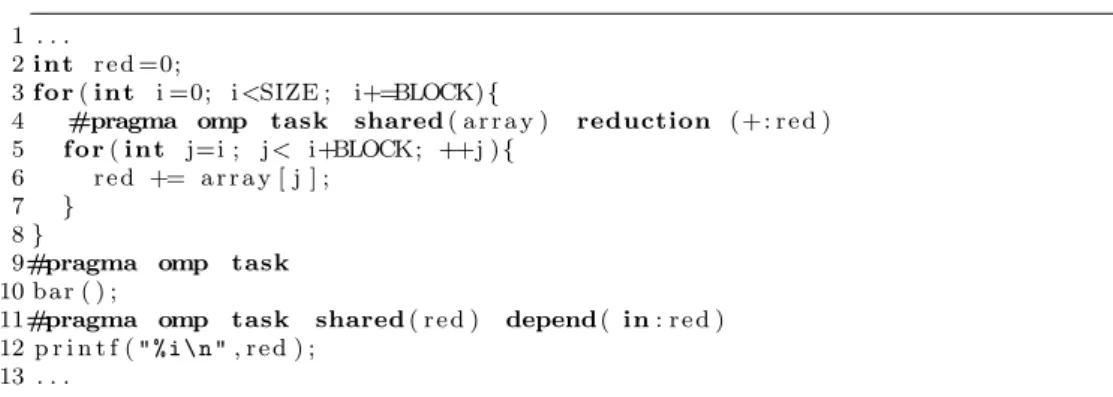
Driven by our own demand for their efficient support in the OmpSs parallel programming model, we have developed new ideas and features that we present in this work. Our contributions are as follows: first, we add support for task-parallel reductions (forwhile-loops and generally recursive functions) in the OmpSs programming model and develop a proposal for their inclusion in the OpenMP specification. Second, we develop new software techniques to accelerate irregular and near-regular array-type reductions and evaluate their impact with different applications on different hardware architectures. Third, we show how these techniques can be supported in OmpSs and OpenMP; and fourth, we show that reductions benefit from smart runtimes implementing an inspector-executor and that this execution model can be integrated into a task-parallel programming model. Our proposal for task-parallel reductions has been recently accepted into the OpenMP standard.
L
a amplia adopci´on de hardware de procesamiento paralelo para lacom-putaci´on de prop´osito general, as´ı como el inter´es por una programaci´on paralela eficiente en la comunidad de desarrolladores, han aumentado la demanda de modelos de programaci´on que ofrezcan soporte para patrones algor´ıtmicos comunes.
Un patr´on algor´ıtmico de particular inter´es son las reducciones. Las reduc-ciones son actualizareduc-ciones iterativas de memoria de una variable del programa y aparecen en muchas aplicaciones. Aunque su definici´on es simple, su var-iedad de implementaciones, incluyendo el uso de diferentes construcciones de bucle y patrones de llamada, hace que su soporte en los modelos de progra-maci´on paralelos sea dif´ıcil y requiera un cuidadoso dise˜no en lo que respecta a programabilidad, transparencia y rendimiento. Adem´as, la necesidad de atomicidad en la ejecuci´on de estas operaciones hace que sean costosas desde el punto de vista computacional y dif´ıcilmente escalables. Estos desaf´ıos y su relevancia convierten a esta clase de operaciones en una referencia para medir el rendimiento de compiladores, sistemas en tiempo de ejecuci´on y arquitecturas de hardware actuales.
Impulsados por la necesidad de disponer de una implementaci´on eficiente en nuestro modelo de programaci´on paralelo, hemos desarrollado nuevas ideas que presentamos en este trabajo. Nuestras contribuciones son las siguientes: en primer lugar, a˜nadimos soporte para reducciones de tareas paralelas (para bucleswhile y funciones recursivas) en el modelo de programaci´on OmpSs y desarrollamos una propuesta para su inclusi´on en la especificaci´on de OpenMP.
En segundo lugar, desarrollamos nuevas t´ecnicas para acelerar las reducciones irregulares y casi-regulares de tipo array y evaluamos su impacto mediante diferentes aplicaciones en varias arquitecturas.
de sistemas en tiempo de ejecuci´on inteligentes implementando un esquema inspector-ejecutor.
Nuestra propuesta de reducci´on de tareas paralelas ha sido aceptada reciente-mente en el est´andar OpenMP.
We thankfully acknowledge the support of the European Commission through the ENCORE project (FP7-248647), the TERAFLUX project (FP7-249013), the TEXT project (FP7- 261580), and the HiPEAC-3 Network of Excellence (FP7/ICT 217068), further the support of Intel-BSC Exascale Center, the Spanish Ministry of Education (TIN2007-60625, TIN2012-34557, TIN2015-65316-P and CSD2007- 00050) and the Generalitat de Catalunya (2009-SGR-980).
List of Figures xiii
List of Publications xxiii
1 Introduction 1
1.1 Challenges for scalability and correctness . . . 2
1.2 Current and future software techniques . . . 6
1.3 Challenges to support irregular access patterns . . . 7
1.4 Challenges to support near-regular access patterns . . . 8
1.5 Language support and programmability . . . 10
1.6 Contributions . . . 12
1.7 Thesis organization . . . 14
2 Background and Related work 15 2.1 On Atomics and Data Replication . . . 17
2.2 Related Work . . . 21
2.3 The OmpSs Programming Model . . . 25
3 Task-parallel Reductions in OmpSs and OpenMP 29
3.1 Introduction to Task-parallel Reductions . . . 30
3.2 Specification for OmpSs and OpenMP . . . 31
3.3 Implementation in OmpSs . . . 37
3.4 Evaluation . . . 41
3.5 Related Work . . . 45
3.6 Conclusions . . . 46
4 Towards Task-parallel Reductions in the OpenMP Specifica-tion 47 4.1 Introduction to Task-parallel Reductions in OpenMP . . . 48
4.2 Discussion of Concerns . . . 50
4.3 Specification for OpenMP . . . 56
4.4 Evaluation . . . 57
4.5 Conclusions . . . 61
5 Supporting Irregular Array-type Reductions on Distributed Memory Systems with CachedPrivate 65 5.1 Introduction to CachedPrivate . . . 66
5.2 Language Support in OmpSs . . . 69
5.3 CachedPrivate . . . 75
5.4 Evaluation . . . 80
5.5 Results . . . 82
6 Supporting Irregular Array-type Reductions on Shared
Mem-ory Systems with PIBOR 87
6.1 Introduction . . . 88
6.2 Implementation . . . 89
6.3 Evaluation . . . 93
6.4 Conclusion . . . 100
7 Towards Unified Support for Array-type Reductions 103 7.1 Introduction . . . 104
7.2 Generalization through Reductions with AMLs . . . 106
7.3 Towards Generalization of Reductions with AIS . . . 111
7.4 Implementing the Inspector-Executor . . . 113
7.5 Language Support for AMLs and AIS . . . 117
7.6 Conclusion . . . 119
8 Case Studies 121 8.1 Introduction . . . 122
8.2 Performance Evaluation of LULESH . . . 124
8.3 Performance Evaluation of SPECFEM3D . . . 141
8.4 Performance Evaluation of SmartJumper . . . 143
8.5 Conclusion . . . 144
9 Conclusion 147
1.1 A commonly occurring reduction kernel performing iterative updates in a for-loop over a scalar data type . . . 2
1.2 IntegrateStressForElems(), a reduction kernel from the LULESH hydrodynamics application defined over array-type variables with an irregular access pattern, representing a challenging use-case . . . 3
1.3 Representative memory access patterns of scalar and array-type reductions showing conflicting accesses resulting from parallel execution by multiple processors . . . 5
1.4 Common occurrences that require the support of task-parallel reductions to express concurrency . . . 10
2.1 Different ISAs implement atomics differently. While the x86 ISA issues a global barrier, the POWER8 ISA (on the right) implements a conditional write. . . 18
2.2 Reduction support through replication redirects original mem-ory accesses to the reduction variabler into thread-private data copiesr1 and r2. This operation is preceded by a concurrent initialization and followed by a serial reduction of private copies into the original reduction variable. . . 19
2.3 Concurrent executions of LULESH and SmartJumper on dif-ferent systems show the degree at which atomic updates and privatization affect performance. While for LULESH, privati-zation results in significant performance degradation due large overheads, it is the technique of choice for SmartJumper and small data sets (2.3(a)). . . 20 2.4 Schematic overview of LocalWrite, a techniques that
imple-ments an ”owner computes” execution model by replicating the iteration space and selectively executing only those iterations that result in updates of owned memory. . . 22
2.5 Landscape of algorithms, support strategies and techniques . 24
2.6 A complete application shows the use of different OmpSs prag-mas to implement a parallel array-sum. Reduction support is based on the functionality implemented for the concurrent
clause. . . 27
2.7 A dependency graph generated for the application shown in Figure 2.6, shows three different node types representing pro-gram methods and directed edges representing dependencies among them. . . 28
3.1 A concurrent reduction using a taskwait to ensure data consis-tency so a function would return a correct value of red . . . . 32
3.2 A concurrent reduction within thetaskgroup performs a wait on all children and their descendant tasks (this is often referred to as ”deep wait”) . . . 33
3.3 The reduction domain over the variable red is ended by a task dependency . . . 34
3.4 A multi-level domain reduction is computed over the same variable by tasks participating at different nesting levels . . . 35
3.5 Element-wise matrix sum implemented as a nested-domain reduction, where each dimension is processed in a different nesting level over a different variable . . . 35
3.6 Nested task-parallel reduction in a worksharing construct
per-forms a reduction over the shared variablered . . . 36
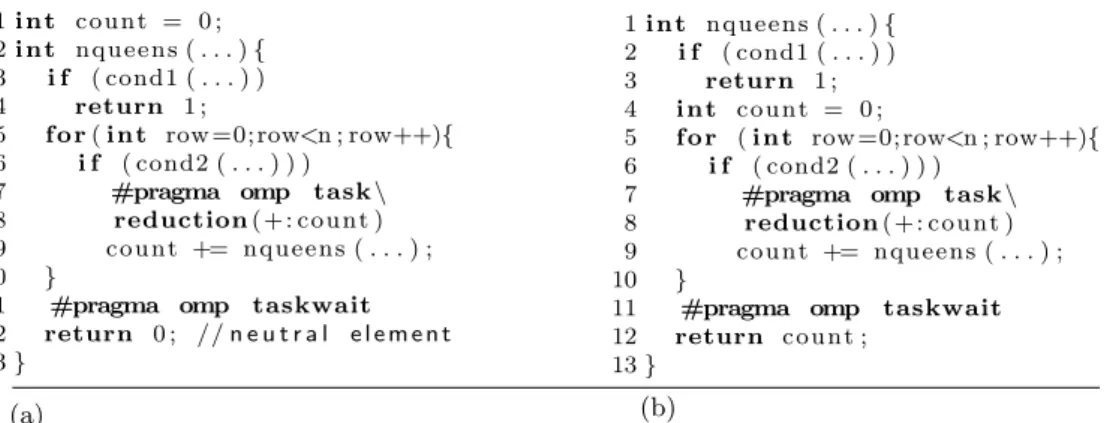
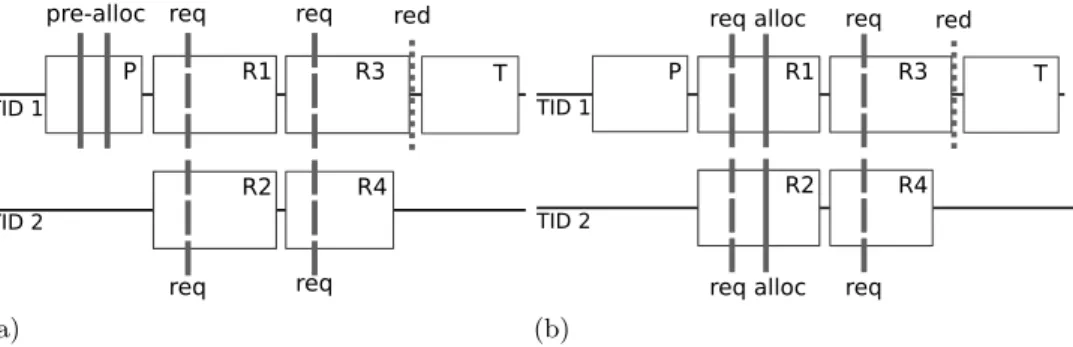
3.7 A concurrent implementation of N-Queens as a multi-level (a) and nested-level domain (b) reduction over the variable count 37 3.8 Static (a) and dynamic (b) allocation differs in when and where thread-private memory is requested (req), allocated (alloc) and reduced (red) . . . 38
3.9 Transformations applied by the compiler redirecting accesses to a thread-private reduction store . . . 42
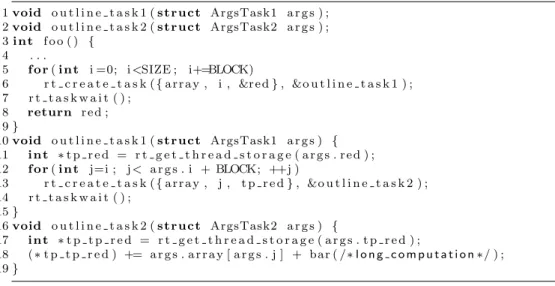
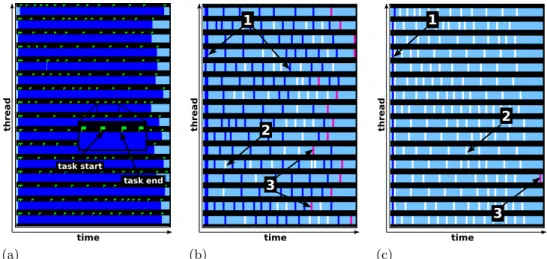
3.10 An execution trace for the n-Queens application (n=15 and creating tasks in two nesting levels) shows tasks (a) and alloca-tion (1), reuse (2) and reducalloca-tion (3) of thread-private reducalloca-tion storages over a task-local (b) and global variable (c) as shown in Figure 3.7 . . . 43
3.11 Application speed-up over serial execution implemented with (a) nested-domain and (b) multi-level domain reductions as well as with regular tasking using atomics . . . 44
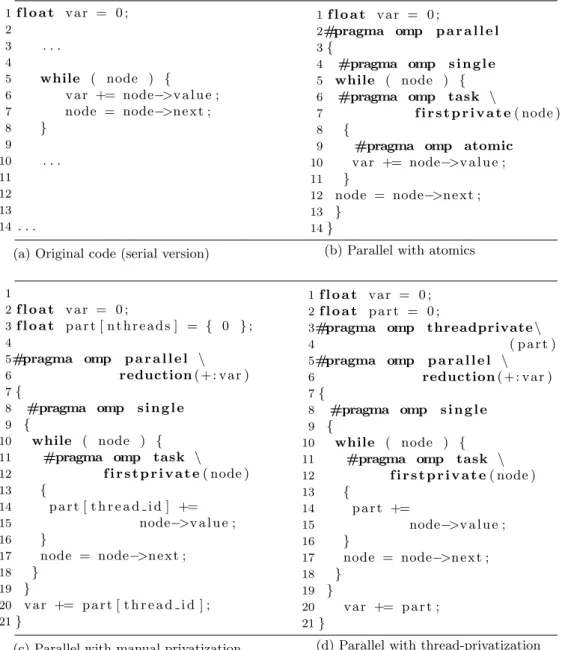
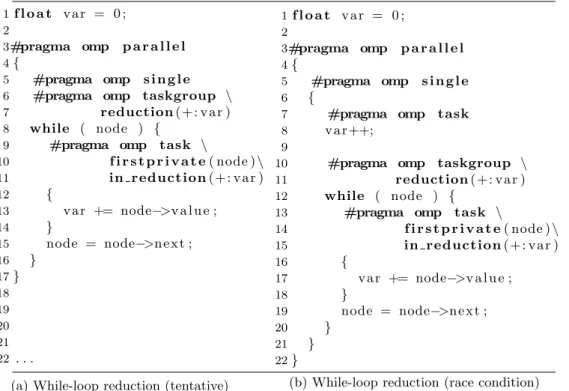
4.1 Different versions of a while-loop reduction over a linked list . 49 4.2 Examples of our proposal . . . 51
4.3 Array Sum UDR benchmark results . . . 53
4.4 Nested taskgroup reduction scenarios . . . 54
4.5 Array Sum and Dot Product benchmarks results . . . 59
4.6 NQueens benchmark results . . . 60
4.7 Unbalance Tree Search benchmark results . . . 62
4.8 NQueens benchmark results on Xeon Phi . . . 63
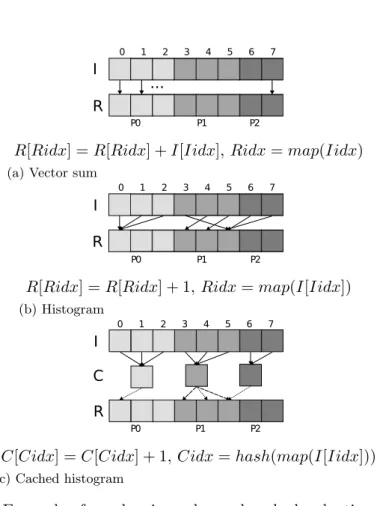
5.2 Example of regular, irregular and cached reductions running
in parallel on processors P1, P2 and P3 . . . 68
5.3 Parallel histogram with locks . . . 71
5.4 Parallel histogram with privatization . . . 72
5.5 Reduction support in task and work-sharing language con-structs in OmpSs . . . 72
5.6 User-defined reductions in OmpSs . . . 73
5.7 Histogram with CachedPrivate and explicit tasking . . . 74
5.8 Histogram with CachedPrivate and implicit tasking . . . 75
5.9 Parallel histogram, as shown in Figure 5.7, after compiler translation to CachedPrivate . . . 77
5.10 Reading from reduction cache . . . 78
5.11 Initialization tasks defining CachedPrivate reduction topology 80 5.12 Task dependency graph with initialization and reduction tasks 80 5.13 Node- and SMP scalability on dense, loosely connected input data (2GB input, 512MB output, 256KB cache and eviction buffer sizes) with CachedPrivate (CP) and ReplicateBufs (RB) with one worker thread per node and atomics . . . 83
5.14 Worker thread scalability of CachedPrivate (CP) and Repli-cateBufs (RB) . . . 84
6.1 Speed-up of the RandomAccess benchmark on the Intel Xeon E5 processor with 16 threads implemented with different par-allelization techniques. . . 88
6.2 Concurrent RandomAccess kernel benchmark showing two common parallelization schemes. . . 89
6.3 Schematic view of PIBOR showing access redirection into buffers (scatter 1) and regions of configurable size (scatter 2) avoiding scatter-updates over large memory. . . 91
6.4 Execution diagram of PIBOR. . . 91
6.5 Language support for array-type reductions in OmpSs. . . 92
6.6 Unsupported use-cases with reductions performed over aliased variable names and in external functions. . . 92
6.7 PIBOR parameter exploration on a single thread of the IBM POWER8 system shows different speed-ups over original code. 94
6.8 Execution speed-ups with PIBOR for single-threaded execution on three different system architectures. . . 96
6.7 Scalability of RandomAccess with PIBOR, atomic and privati-zation on different socket configurations on the IBM POWER8 system. . . 98
6.8 RandomAccess scalability on the Intel Xeon E5 processor. . . 99
6.9 RandomAccess scalability on Intel Xeon Phi. . . 99
6.10 Access hot-spots are supported by reducing region size which results in an increased number of regions and less contention on region locks. . . 100
7.1 Structure of a typical scientific application with an array re-duction in a global simulation loop . . . 105
7.2 Representative kernel from SPECFEM3D application imple-menting an irregular array-type reduction over an array that is called iteratively within a global simulation loop . . . 105
7.3 Landscape of algorithms, parallelization strategies and techniques106
7.4 Redirecting accesses into thread-private data containers gives implementors the freedom to implement any arbitrary data placement strategy . . . 107
7.5 Interface to an AML object that implements binning with selective privatization . . . 110
7.6 The OmpSs Reductions Model includes a set of header files that implement different techniques, a header file that imple-ment generic data types and a runtime components handling reduction scopes and inspector-executor data. . . 110
7.7 Ordering through Scheduling is a strategy that implements an alternative iteration space through dependency-aware task scheduling. ComRed is a technique relying on commutative execution of tasks that share overlapping region(s). . . 114
7.8 Dependency stride defines an offset in task creation order at which any two tasks can be scheduled for execution in parallel. In case of a scattered updated over the entire reduction array, the entire execution is serialized. . . 114
7.9 A simplified, intermediate code shows the support of AMLs and inspector-executors in OmpSs . . . 116
7.10 Redirection with Selective Privatization combines benefits of an inspector-executor approach with access redirection into thread-private data containers. This allows to bypass access redirection for accesses into owned memory thus effectively reducing the overhead of access redirections. . . 118
7.11 OmpSs implementation of a reduction kernel showing the pro-posed language extensions . . . 119
8.1 Element-centric computation over a staggered mesh results in scatter-updates to nodal variables once the computation of values finishes. This represents the irregular array-type reduction in the LULESH hydrodynamics code which simulates a wave blast propagation in a compressible medium (b) . . . 123
8.2 IntegrateStressForElems() with explicit tasking and the pro-posed language extensions. This method shows how node values are gathered, processed and distributed back, thus creating the scattered update access pattern typical for array-type reductions.125
8.3 SmartJumper is a modern implementation of the popular Ran-domAccess benchmark . . . 126 8.4 Performance scalability of both LULESH reduction kernels
obtained on a 2-way Intel Xeon E5 processor with 16 cores shows that Commutative Reductions achieves a four times higher speedup compared to other techniques and is en par
with the unprotected version marked asRACE. . . 127 8.5 Performance scalability of both LULESH reduction kernels
reaches a plateau with 96 threads and 4 SMT threads per core. Also in this case, Commutative Reductions produces the highest speedups compared to other techniques. . . 128 8.6 Execution trace of LULESH with Commutative Reductions
shows the first four iterations of the global global simulation loop. The augmented view B (b) of the marked region shows three taskified methods including the two reduction kernels (1
and 2) with the associated dependencies (lines). . . 130 8.7 Execution traces show differences in execution speeds and time
gains after the fourth iteration of the LULESH simulation loop with both reduction kernels1 and2 implemented with different techniques. . . 131
8.8 Histograms over IPC and total instructions show that the use of atomics in the LULESH reduction kernel causes a drop in IPC by a factor of 2.8 and increases the total instructions count by 18 %. This results in a performance degradation by a factor of approximately 4 compared to the implementation using ComRed. . . 132
8.9 LULESH with replication does not scale due to large over-heads associated with the initialization (A), reduction (B) and deallocation (C) of thread-private array copies. . . 133
8.10 Execution traces of LULESH showing only reduction tasks and the dependency stride length of 2 (b) computed during the inspection phase. . . 135
8.11 A dependency stride length of 2 requires at least twice as many tasks as available threads in order to generate enough independent work to keep all threads busy. . . 135
8.12 ComRed relies on an efficient implementation of commutative task scheduling or on a suitable task creation order that allows to generate independent task sufficiently fast. The opposite case leads to performance degradation for larger thread count which is shown in the graph asCOMRED-NoOffset. . . 137
8.13 Creating tasks in a sequence where the immediate successor has a commutative dependency on the previous task results in a high lock contention, slows down task creation and degrades the number of ready tasks. . . 138
8.14 Certain thread counts result in nonuniform distribution of SMT threads over available cores. The resulting execution speed imbalance reduces the efficiency of task creation offsetting especially towards the end of the execution of the reduction kernel. This effect is visible in the execution traces of the
IntegrateStressForElems method on the IBM POWER8 system when comparing different thread configurations. . . 140
8.15 Unevenly distributed SMT threads shown in Figure 8.14 result in execution speed differences and manifest as lower IPC rates on the affected processor cores (lower picture). Differences in execution speed affect the efficiency of the ComRed technique. 141
8.16 Selective Privatization with PIBOR results in imbalanced hard-ware utilization as some tasks can avoid up to 94% of redirec-tions while others cannot. . . 142
8.17 Execution traces of both reduction kernels of LULESH on the MareNostrum supercomputer in an 8x8 configuration of MPI processes and threads shows the performance benefit of commutative reductions in OmpSs that avoids the reduction phase (A) and freeing of memory (B). . . 142
8.18 Performance scalability of the SPECFEM3D reduction ker-nel shows speedup relative to the serial execution time with different support techniques includingComRed. . . 143
8.19 Achieved memory bandwidths obtained from different imple-mentations of the SmartJumper reduction kernel show that array replication is a viable technique for small data sizes. PI-BOR achieves the highest memory bandwidth for array sizes larger than 4 MB. . . 144
[P1] Jan Ciesko, Sergi Mateo, Xavier Teruel, Xavier Martorell, Eduard Ayguad´e, and Jes´us Labarta. Supporting Adaptive Privatization Techniques for Irregular Array Reductions in Task-parallel Pro-gramming Models. 12th International Workshop on OpenMP (IWOMP 2016), Nara, Japan: Springer, p. 336-349, 2016.
[P2] Jan Ciesko, Sergi Mateo, Xavier Teruel, Vicen¸c Beltran, Xavier Mar-torell, and Jes´us Labarta. Boosting Irregular Array Reductions through In-lined Block-ordering on Fast Processors. 19th IEEE High Performance Extreme Computing Conference (HPEC15), Waltham, USA, IEEE Explore, 2015. (Best Paper Candidate)
[P3] Jan Ciesko, Sergi Mateo, Xavier Teruel, Xavier Martorell, Eduard Ayguad´e, Jes´us Labarta, Alex Duran, Bronis R. de Supinski, Stephen Olivier, Kelvin Li, and Alexandre E. Eichenberger. Towards Task-parallel Reductions in OpenMP. 11th International Workshop on OpenMP (IWOMP 2015), Aachen, Germany: Springer, p. 189-201, 2015.
[P4] Jan Ciesko, Sergi Mateo, Xavier Teruel, Vicen¸c Beltran, Xavier Martorell, Rosa M. Badia, Eduard Ayguad´e, and Jes´us Labarta. Task-parallel Reductions in OpenMP and OmpSs. 10th International Workshop on OpenMP (IWOMP 2014), Salvador, Brazil: Springer, pp 1-15, 2014.
[P5] Jan Ciesko, Javier Bueno, Nikola Puzovic, Alex Ramirez, Rosa M. Badia, and Jes´us Labarta. Programmable and Scalable Reductions on Clusters. 27th IEEE International Parallel and Distributed Processing Symposium (IPDPS 2013), Boston, United States, IEEE Explore, 2013.
Chapter
1
Introduction
Reductions are iterative updates of a program variable, a simple algorithmic pattern with significant impact keeping computer scientists busy for over two decades. Looking back it turns out that the majority of research conducted on this matter coincides with the advent of parallel architectures in mainstream computing and the rising demand for programming productivity on these systems. It corresponds to the time where energy constraints shifted ad-vancements to increase processor performance from frequency scaling towards parallel hardware and where programmers were becoming ready to dedicate some of the processor’s cycles to run more advanced programming models. Their use promises higher development efficiency and performance portability.
As a result, concurrent algorithms and parallel programming models gained attention and also moved reductions into the spotlight. Unfortunately, soon it became clear that reductions do not achieve a satisfactory efficiency on parallel hardware. While the update loops can be parallelized easily, data is shared among processors. This results in caching effects that impact scalabil-ity. Further, data races may occur during parallel execution compromising correctness.
Consequently, reduction support in software and hardware is desired with the common objective of delivering scalable performance while maintaining correctness of code. In case of software implementations, support in parallel programming models alleviates the programmer of implementing optimization techniques manually. Hardware support accelerates software implementations
1 v a r r = 0 ;
2f o r( v a r i =0; i<8; i ++)
3{
4 r ++;
5}
Figure 1.1: A commonly occurring reduction kernel performing iterative updates in a for-loop over a scalar data type
at the cost of additional hardware complexity. The extent of complexity is to be determined in future work.
In software, designing language support and integrating advanced runtime techniques into parallel programming models are the two key challenges that are being faced in academia and industry today. Approaching these challenges in the context of task-parallel programming models is the objective of our work. Figure 1.1 shows a simple case where the reduction variable r of a scalar type is iteratively updated in a for-loop - the only reduction pattern supported in OpenMP [1] at the time we started work on this topic.
While researching programming model support for reductions we identified five particular areas of interest:
• Challenges for scalability and correctness
• Current and future software techniques
• Challenges to support irregular access patterns
• Challenges to support near-regular access patterns
• Language support and programmability
The following sections provide more context for each area.
1.1
Challenges for scalability and correctness
Maintaining correctness is a fundamental property, therefore approaches are needed that are race condition free while offering scalable performance on
1 . . .
2f o r( I n d e x t k=0 ; k<numElements ; ++k )
3{
4 const I n d e x t∗ const elemToNode = domain . n o d e l i s t ( k ) ;
5 R e a l t f x l o c a l [ 8 ] ; 6 R e a l t f y l o c a l [ 8 ] ; 7 R e a l t f z l o c a l [ 8 ] ; 8 9 CollectDomainNodesToElemNodes ( f x l o c a l , f y l o c a l ,\ 10 f z l o c a l , . . . ) ; 11 Computation1 ( f x l o c a l , f y l o c a l , f z l o c a l , . . . ) ; 12 . . . 13 ComputationN ( f x l o c a l , f y l o c a l , f z l o c a l , . . . ) ; 14 15 f o r( I n d e x t l n o d e =0 ; l n o d e<8 ; ++l n o d e ) { 16 I n d e x t gnode = elemToNode [ l n o d e ] ; 17 domain . f x [ gnode ] += f x l o c a l [ l n o d e ] ; 18 domain . f y [ gnode ] += f y l o c a l [ l n o d e ] ; 19 domain . f z [ gnode ] += f z l o c a l [ l n o d e ] ; 20 } 21} 22 . . .
Figure 1.2: IntegrateStressForElems(), a reduction kernel from the LULESH hydrodynamics application defined over array-type variables with an irregular access pattern, representing a challenging use-case
current parallel architectures. To eliminate race conditions, two fall-back strategies exist: atomic updates and privatization.
Atomic updates guarantee atomicity of the read-modify-write cycle and are generally well suited for low-contention situations where the atomic update is invoked infrequently. Unfortunately for the opposite case, execution perfor-mance depends on the underlying architectural support. This results in low performance portability between systems. Further, sharing of data between processors results in coherence traffic and higher access latencies. Together with the fact that only a subset of common data types is supported, requiring mutexes for the generic case, their use turns out to be less favorable in parallel programming models.
To avoid overheads associated with atomic accesses, the popular approach of privatization can be applied. Privatization, also called replication, describes the idea of redirecting memory access into thread-private copies of the original
variable. The redirection is typically generated by a parallelizing compiler where occurrences of the reduction variable are syntactically replaced by references to thread-private copies. The privatization step, that is allocation of the thread-private data and its initialization, is followed by a hierarchical and parallel merge phase once the computation is complete. Privatization is the de facto standard with implementations reaching across programming models and hardware architectures today. It gained popularity as this ap-proach supports reductions over small data (as being the case in Figure 1.1) reasonably well, keeping overheads of allocation, initialization and reduction of thread-private copies small. Further, this approach does not require complex code transformations, making support in parallelizing compilers relatively straightforward. Unfortunately, for larger data (array types) and for higher numbers of processors, privatization does not scale. Figure 1.2 shows a re-duction kernel from the LULESH hydrodynamics simulation code [2]. It represents a particularly challenging use-case where a reduction is defined over three arrays, fx, fy and fz of type float, each accessed in an irregular pattern as defined by elemToNode. To support array-type reductions, neither atomic access nor replication are suitable approaches.
Consequently a wide body of research has been conducted on more advanced parallelization strategies with projected implementations in both hardware and software. Among these techniques only a small fraction gained relevance. The lack of hardware support can be mainly attributed to the fact that established processor functionality such as atomics or access synchronization cover certain scenarios sufficiently well which together with the complexity of adding new features discourages hardware manufacturers to invest into further development. A thinkable hardware support may include extensions to the processor ISA to relax cache coherence for cache lines that correspond to reduction variables as well as offloading computation to functional units located on memory controllers, thus implementing a push semantic and avoiding data round trips. Still, the question arises if software-based techniques are not sufficient enough making reduction support a matter of software support after all.
Figures 1.3(a) and 1.3(b) show representations of memory access patterns for codes in Figures 1.1 and 1.2. It illustrates the distribution of iterations between processors represented by circles, memory accesses as edges and
Processor: P1 P2
Shared variable: r
1 2 3 4 5 6 7 8
Iters: i
(a) Memory access pattern of a concurrent scalar-type reduction over the variabler
...
...
Processor: P1 PN
Iter: i
1 2 3 4 s-4 s-3 s-1
1 2 3 4 i-4 i-3 i-2 i-1
1,2 2,3 3,4 4,s-4 s-4, s-3 s-3,s-2 s-2,s-1 s-1 Access: idx
Shared variable: r[idx]
s-2
(b) Memory access pattern of a concurrent near-linear reduction defined over an array-type variabler with one element being updated by two processors. It represents a simplified version of the memory access pattern of the reduction kernel shown in 1.2 ... ... Processor: P1 PN Iter: i 1 2 3 4 s-4 s-3 s-2 s-1
1 2 3 4 i-4 i-3 i-2 i-1
2 3 s-4 s-2 2 4 s-3 s-2
Access: idx
Shared variable: r[idx]
(c) Memory access pattern of a concurrent, irregular array-type reduction defined over an array-type variabler
Figure 1.3: Representative memory access patterns of scalar and array-type reductions showing conflicting accesses resulting from parallel execution by multiple processors
accessed memory locations as rectangles. Figure 1.3(c) shows the memory access pattern for irregular array-type reductions. We discuss application with this access pattern later in this work.
1.2
Current and future software techniques
While synchronized access or privatization works well for scalar types, solutions are needed to cover reductions over arrays. Several advanced techniques have been proposed among which SelectivePrivate [3] and LocalWrite [3] gained most significance and also influenced our work. Selective privatization uses a conditional redirection of accesses into thread-private data replicas. LocalWrite is a technique where memory updates remain unchanged but the iteration space for each thread is modified in order to avoid data races. Both techniques are suited for cases where the application exhibits a particular memory access pattern, a property which limits their general applicability. However, these techniques gave inspiration for our work towards generalization and deriving the following classification.
In our work, we group techniques by their underlying approach into three categories:
• Reductions with direct access. This strategy relies on atomicity or equivalent implementation of the read-modify-write operation. An example of this technique is the use of atomics.
• Reduction support through access redirection. This group covers techniques that use the idea of access redirection into thread-private objects. This eliminates potential race conditions and caching effects due to sharing. Replication, as discussed in the previous section, is therefore a special case of access redirection where the thread-private object is a copy of the reduction variable. A generalization of this approach can be achieved if the original memory updates are replaced by a function
f(address, value, parameters). It is left to the programming model vendor to implement f following any particular placement strategy including conditional redirection. Consequently the allocated private storage is implementation dependent and we refer to it as thread-private data container. Techniques within this category are suited for
algorithms with irregular memory accesses where the placement function can improve locality and where the cost of privatization can be amortized. SelectivePrivatization is an approach that falls within the category.
• Reduction support through ordering. This covers techniques that avoid race conditions and shared accesses by assigning particular itera-tions of the reduction loop to each thread. LocalWrite is an example for this category. Techniques following this strategy are typically suited for reductions with sparse or near-regular memory access pattern as in this cases, cost of ordering is low.
We call techniques that redirect accesses into thread-private data containers by implementing the placement function f as reductions with alternative memory layouts, AML, and techniques that order iterations as reductions with alternative iteration spaces,AIS.
It is interesting to point out that integration of advanced approaches into existing programming models has not been carried out successfully yet. As a result these techniques are rarely used leaving cases like that shown in Figure 1.2 unsupported. We believe that by abstracting from particular techniques, a generic support in parallel programming models can be achieved. We show how techniques with redirection and ordering can be supported transparently in task-parallel programing models in this work.
1.3
Challenges to support irregular access patterns
Irregularity is a dynamic property of an algorithm that results in a random sequence of accessed memory locations, an access pattern that is inherently cache inefficient. Irregular array-type reductions exhibit such an access pattern where seemingly random array positions are updated. Supporting these cases is non-trivial as conventional techniques of atomic access and privatization do not improve cache performance. With these techniques, the sequence of accessed memory addresses remains unchanged. It turns out that irregular array reductions can be well supported by techniques with access redirection that implement a data placement strategy for improved cache efficiency. Taking a closer look at techniques with access redirection reveals that four design features are important for scalable performance:
• Avoidance of data replication (creating full data copies) for non-scalar data types
• Avoidance of privatization for unrelated threads
• Support for custom data placement strategies (by allowing different implementations of f)
• Support of arbitrary thread-private data containers (objects)
In this work we propose two new approaches that fulfill these requirements. One implements access redirection into software caches to support architec-tures with high memory latencies (clusters), also called CachedPrivate; and binning, an approach that uses a fast hash function to sort accesses into bins corresponding to memory regions for higher data locality. We also refer to binning asPIBOR,Privatization with In-lined Block Ordering. Both, software caching and binning are examples of reduction techniques with redirection, im-plementing alternative memory layouts and data placement strategies. These techniques achieve the highest speed-ups compared to replication and atomic access. A schematic representation of an irregular access pattern is shown in Figure 1.3(b).
We discuss these techniques in chapters 5 and 6. The generalized support is discussed in Chapter 7.
1.4
Challenges to support near-regular access
pat-terns
A special case occurs when a seemingly irregular memory access pattern turns out to be sparse or near-regular. The latter typically occurs when the reduction kernel is preceded by a sorting phase (e.g. coloring), a technique to reduce irregularity of accesses. In these cases each participating thread accesses either disjoint memory regions or memory regions with small overlaps with other regions accessed by other threads. To support these cases, techniques are needed that benefit from these access properties. In turns out that techniques building on top of an inspector-executor approach are well suited for this purpose. Techniques that build on top of this execution model fall within both aforementioned categories.
From the programming model perspective, the following features are required to support inspector-executor techniques:
• The reduction kernel must be executed multiple times during the lifetime of the application such that the cost of inspection can be amortized.
• The programmer must define a point in the source code where the runtime completes inspection and switches to execution.
• The inspection phase must not change application behavior.
• The runtime must implement task instance identifiers and their tracking across instantiation. This guarantees that inspection results are applied to the same task instance during the next iteration.
• The programmer must be aware of the requirement that the instantiation order of tasks must remain unchanged.
Once access properties are recorded and ownerships defined, the execution phase can switch from inspection to execution. We propose an executor that avoids privatization all together based on dependency-aware task scheduling, called DepRed. It is an approach that uses work scheduling based on data dependencies. During inspection, accessed memory regions and their overlaps are identified. During execution, overlapping memory regions are interpreted as dependencies between units of work (tasks). To avoid data races, only tasks with no overlapping regions are scheduled for execution at a time. This approach is well suited for task-parallel programming models that support the expression of data-flows in the code. Since dependency-aware task execution results in a different order of how loop iterations are processed, this approach falls into the category of techniques with alternative iteration spaces (AIS). This technique yields near-linear speed ups for the reduction kernel of the LULESH application shown in Figure 1.2. In this case the inspector is able to detect a near-regular access pattern (as shown in Figure 1.3(b)) with small overlapping regions. How AIS techniques with an inspector-executor execution model can be supported in task-parallel programming models is discussed in Chapter 7.
It is important to point out that our programming model support for reduc-tions foresees that the programmer is in charge to take a decision on which
1i n t f o o ( . . . ){ 2 i f ( c h e c k 1 ( . . . ) ) return 1 ; 3 i n t c o u n t = 0 ; 4 f o r (i n t i =0; i<wi d th ; i ++){ 5 i f ( c h e c k 2 ( . . . ) ) ) 6 c o u n t += f o o ( . . . ) ; 7 } 8 return c o u n t ; 9}
(a) Recursive reduction
1 . . . 2i n t r e d = 0 ; 3i n t f o o ( n o d e t node , . . . ){ 4 while( node−>n e x t ){ 5 r e d+=b a r ( node−>v a l u e ) ; 6 node=node−>n e x t ; 7 } 8} 9 . . . (b) While-loop reduction
Figure 1.4: Common occurrences that require the support of task-parallel reductions to express concurrency
technique to use. Therefore, in Chapter 7, we discuss a key indicator that hints on the suitability of particular approaches for particular cases.
1.5
Language support and programmability
Language support for common algorithmic patterns is a key property for achieving programming efficiency. In the context of declarative task-parallel programing models, language constructs are needed that capture programmer intention and algorithmic parameters. With this information parallelizing compilers can generate the appropriate code and invoke runtime functionality. At the same time language design is needed that maintains consistency and programmer understanding inherited from the surrounding parallel program-ming model. For general reduction support, the expression of the following programmer intents must be supported syntactically:
• Declaration of a reduction computation in the context of a parallel region. This applies to programming models that implement the concept of a parallel region. In OpenMP, worksharing constructs support this feature through thereduction clause already.
• Declaration of a reduction computation in the context of a task. This would allow the support of task-parallel reductions including while-loop programs and recursions. (Unsupported intent)
• Expression to invoke a particular underlying reduction technique. (Un-supported intent)
• Expression of inspector-executor phases. (Unsupported intent)
The three unsupported intents are further explained in the next paragraphs.
Expressing task-parallel reductions Task-parallel algorithms represent a super-class of for-loop computable algorithms. These algorithms include while-loop computable, also called general recursive, algorithms. Further task-parallelism is a convenient way to express concurrency in recursive algorithms. Adding reduction support for this type of algorithms represents an important step towards programmability.
While for-loop reductions were supported in OpenMP from early on, task-parallel reductions remained unsupported. This is due to the following reasons:
• Task-parallel reductions do not define a scope per se. For a parallel programming model it is impossible to know when the scope of a reduction ends, a piece of information that is crucial since the runtime is required to invoke functionality corresponding to a given reduction support technique to finalize a reduction.
• The occurrence in recursions rises the demand for reductions support that avoids the step of invoking a runtime technique for each recursive call.
• The specification of OpenMP does not foresee the allocation of a data context in its task specification. In case of reductions, a data context is always required. This collision with existing specification requires non-trivial changes of the OpenMP specification.
Consequently, a solution is needed that allows the definition of scope, supports recursions and minimizes impact on the specification. Our solution presented in chapters 3 and 4 shows a solution that complies with these requirements and was recently accepted into the OpenMP specification.
Expression of technique To enable meaningful support for array-type reductions, syntactical means are needed to allow the developer to express which underlying technique to apply. Once a technique is selected by the programmer, the compiler can perform the appropriate code transformations and invoke the selected runtime support.
Expression of inspector-executor phases The inclusion of inspector-executor based techniques requires the definition of a switch-point. This point in code indicates to the programming model runtime that the inspection phase is completed and execution mode can transfer to an executor.
In Chapter 7 we present language constructs to define a technique as well as to express inspector-executor phases for OpenMP and OmpSs [4].
1.5.1 Why building on top of task-parallelism?
We base our work on declarative task-parallel programming models. For programmers, tasking represents a well understood and easy to use concept of work decomposition. For programming model vendors, it offers freedom to define surrounding concepts and to provide runtime libraries implementing advanced functionality in areas such as scheduling, accelerator- or distributed memory support. A runtime that implements such features is included in the
OMP Superscalar (OmpSs) programming model.
OmpSs is a declarative, task-parallel programming model supporting data-flow based task scheduling. Data-flows are expressed by the programmer using the input and output clauses in the task pragma. While OmpSs supports comparable programming primitives as OpenMP, its execution model is centered around tasks, leaving the concept of threads or parallel regions out of concern. Parallel execution is obtained when tasks become ready as their data dependencies are progressively satisfied and are scheduled for execution. Its proximity to OpenMP makes OmpSs a forerunner for many novel techniques and a suitable experimentation platform for our work.
1.6
Contributions
Our work advances reduction support in OmpSs and OpenMP, two relevant parallel programming models in academia and industry. In particular, we
contribute to the adoption of task-parallel and array-type reductions in both programming models. Support for task-parallelism increases programmability by allowing the expression of while-loop and recursive reductions.
For array support, we provide the ground work consisting of language and runtime features for a more generic support. This allows software vendors to implement optimized techniques that follow either the strategy of redirection or of implementing an alternative iteration space. Techniques with redirection are generalized by providing a programmable placement function that stores data into thread-private containers with arbitrary memory layouts. Software caching and binning are two exemplary implementations. Alternative iteration spaces can be implemented through dependency-aware task scheduling but generalization is yet to be determined. Finally we show that runtimes benefit from inspector-executors, an execution model allowing optimizations based on dynamic properties of an algorithm. For evaluation we have selected three representative applications: LULESH, SPECFEM3D [5] and SmartJumper [6]. LULESH and SPECFEM3D are production codes and represent array-type reductions with near-linear access patterns. SmartJumper is based on the popular RandomAccess [7] benchmark and is representative for irregular array-type reductions.
Our contributions can be structured as follows:
1. Support for task-parallel reductions in the OmpSs programming model.
2. Proposal to support task-parallel reductions in OpenMP.
3. Development of CachedPrivate - a technique implementing redirection into software caches to accelerate near-regular array-type reductions on distributed memory systems (clusters).
4. Development of PIBOR - a software technique implementing address-based binning to support irregular array-type reduction on shared memory systems.
5. We show how support for advanced techniques with access redirection and ordering can be generalized through the ideas of AMLs and AIS. This includes the addition of the inspector-executor and related pragmas in the OmpSs programming model.
6. Evaluation of techniques with LULESH, SPECFEM3D and SmartJumper.
1.7
Thesis organization
In the next chapter we describe the current state of reductions support with popular techniques on current hardware architectures and discuss related work.
The rest of this document is structured as follows. In Chapter 3 we discuss language and runtime support for task-parallel reductions in OmpSs. In Chapter 4 we present our proposal for OpenMP. In Chapters 5 and 6 we introduce techniques to support array-type reductions. In Chapter 7 we discuss support for AMLs and AIS and the inclusion of an inspector-executor in OmpSs. Further, in Chapter 8 we present case studies. Finally, Chapter 9 concludes this topic and previews future work.
Chapter
2
Background and Related work
The promise of parallel processing is performance scalability - a claim that heavily relies on an application’s algorithm. One particular group of algorithms that periodically brings up the discussion on how to achieve scalability are concurrent updates of scalar and array-type data. A concurrent update operation contains at least two sequences of read-modify-writes. Due to a non-atomic implementation of this sequence on most hardware architectures, parallel execution results in data races. Data races manifest themselves as altered program behavior relative to serial execution (and typically relative to the programmer’s expectations). Updates over array-types have similar correctness properties but are defined over array-types. Both, scalar as well as array-type updates require techniques that ensure correctness.
Among techniques to support concurrent updates only a single generally applicable solution exists, namely access synchronization. Synchronization uses software and hardware assisted techniques to implement atomicity. Syn-chronization constructs are often members of either the language or runtime specification of a programming model and therefore easy to use but come at a cost of execution overhead.
A special case occurs when the update operation implements an iterative function that is associative, commutative and has no control dependency between loop iterations. These algorithms are called reductions and allow a whole set of additional techniques to improve performance and scalability.
Thread 1 Thread 2 Access Data Value 0 READ ↑ 0 MODIFY 0 WRITE ↓ 1 READ ↑ 1 MODIFY 1 WRITE ↓ 2 (a) Sequential
Thread 1 Thread 2 Access Data Value 0 READ ↑ 0 MODIFY READ ↑ 0 WRITE MODIFY ↓ 1 WRITE ↓ 1 1 1 (b) Parallel
Table 2.1: Without proper synchronization, parallel updates implemented as read(↑), modify and write (↓) sequences, produce data races on current processors. This results in altered program behavior (results)
In programming, a reduction occurs when a variable,var, is updated iteratively as
iter: var=op(var, expression), (2.1) where opis a commutative and associative operator performing an update on
var and where vardoes not occur in expression. An array-type reduction over the variable var* is defined as
iter i:var[i] =op(var[i], expression), (2.2)
wherei is an induction variable,itersis an iteration space, and where v is a reduction variable withop being an algebraic monoid.
Similarly, an irregular array-type reduction is defined as
iter i:
j=f(i);
var[j] =op(var[j], expression)
(2.3)
with f implementing a function that returns integers in the range of zero to number of addressable elements in var* .
Such irregular array-type reductions appear in FEM solvers where simulation data is updated over irregular mashes, in n-body simulations as well as other graph algorithms where edges connect vertices and processing of each vertex results in at least two irregular memory updates.
Implications of the mathematical properties are two-fold: firstly, the order of memory accesses does not matter anymore which allows concurrent ex-ecutions without maintaining a constant execution order of tasks or loop iterations and the existence of the neutral element allows the use of scratch data to temporarily store intermediate results. These properties led to the development of different support techniques among which atomic updates and data replication are the most commonly used. Their objective is to eliminate potential race conditions while trying to keep associated overheads small. Table 2.1 shows sequences of read-modify-writes with two potential execution orders. An undetermined program behavior is called data race or race condition.
2.1
On Atomics and Data Replication
The use of atomic updates is perhaps the most straight-forward solution to avoid data races. As the name suggests, atomic updates make the sequence of read-modify-write appear as one atomic operation. Implementations dif-fer. Lock based atomicity relies on an atomic compare and swap instruction ( sync val compare and swap). This instruction represents the basic
build-ing block to implement any lockbuild-ing strategy. Other instructions exist that offer more functionality such as the atomic addition ( sync f etch and add) or subtraction ( sync f etch and sub). However, the underlying implementation in hardware differs substantially with variations in performance.
IBM’s POWER8 processor implements atomic via a pair of load-link and store-conditional instructions. This solution is lock-free as a load operation returns the value in memory but a store only succeeds if no update has occurred by another processor since the last load. If the value was updated, a store miss triggers a reload from memory.
On Intel Xeon E5, atomics are implemented with locks on cache-line granular-ity. In addition, locks enforce in-order execution which affects data prefetching. Taking a look at the GCC manual reveals the following: ”In most cases, these builtins are considered a full barrier. That is, no memory operand will be moved across the operation, either forward or backward. Further, instructions will be issued as necessary to prevent the processor from speculating loads across the operation and from queuing stores after the operation.” [8]. On
1while( c o n d i t i o n ( ) )
2{
3 #pragma omp atomic
4 a++;
5}
(a) Sample code
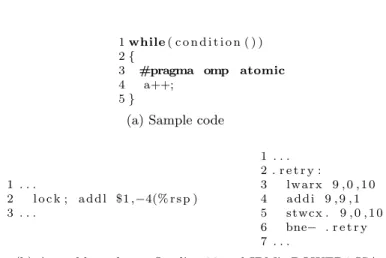
1 . . . 2 l o c k ; a d d l $1 ,−4(% r s p ) 3 . . . 1 . . . 2 . r e t r y : 3 l w a r x 9 , 0 , 1 0 4 a d d i 9 , 9 , 1 5 s t w c x . 9 , 0 , 1 0 6 bne− . r e t r y 7 . . .
(b) Assembly codes on Intel’s x86 and IBM’s POWER8 ISAs (right)
Figure 2.1: Different ISAs implement atomics differently. While the x86 ISA issues a global barrier, the POWER8 ISA (on the right) implements a conditional write.
Intel Xeon Phi, atomics have a smaller impact since the processor implements in-order execution only.
Figure 2.1 shows the implementations on assembly level of an atomic increment on the Intel x86 and IBM POWER8 ISAs produced by the GCC compiler on each platform. While the x86 implements a memory barrier (lock), the POWER8 uses a conditional storestwxc. If the store fails, the operation is repeated. Further comparison of synchronization primitives was conducted by David, Guerraoui and Trigonakis [9].
The other common technique is replication. Replication avoids data races by redirecting memory accesses to thread-private data copies and is typically implemented by parallelizing compilers for scalar-type reductions. Data privatization is efficient in cases where the cost of allocation, initialization and reduction of data is sufficiently small relative to the computation, and performance and applicability are not limited by memory bandwidth (that is if data fits into cache) or physical memory size. Unfortunately, with growing core counts per processor as well as higher numbers of threads per core (SMT), privatization of even small arrays becomes expensive as the algorithm becomes memory bound or even unusable due to memory size limitations.
Processor: P1 P2 1 2 3 4 Init 5 6 7 I Init 8 Temporal variable: r1 r2 Variable: r RedP1 RedP1 Iters: i
(a) Scalar-type reduction
... 1 2 3 4 s-4 s-3 s-2 s-1 Processor: P1 PN Iter: i ... 1 2 3 4 s-4 s-3 s-2 s-1 2 3 4 i-3 i-2 1 2 3 s-4 s-2 i-4 2 4 s-3 i-1 s-2 Access: idx
Shared variable: r[idx]
... ... 1 2 3 4 s-4 s-3 s-2 s-1 ... Init [1,s-1] Init [1,s-1] Temporal variable: r1 rN Red N[1,s-1] (b) Array-type reduction
Figure 2.2: Reduction support through replication redirects original memory accesses to the reduction variable r into thread-private data copiesr1 and r2. This operation is preceded by a concurrent initialization and followed by a serial reduction of private copies into the original reduction variable.
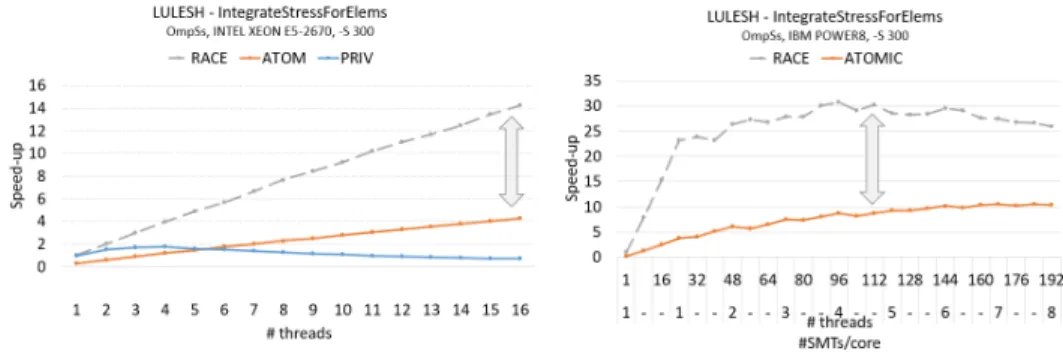
(a) Scalability of theIntegrateStressForElemsreduction kernel over different thread counts
(b) Scalability of the SmartJumper micro benchmark over different problem sizes
Figure 2.3: Concurrent executions of LULESH and SmartJumper on different systems show the degree at which atomic updates and privatization affect per-formance. While for LULESH, privatization results in significant performance degradation due large overheads, it is the technique of choice for SmartJumper and small data sets (2.3(a)).
Furthermore, privatization does not address the inherently low data locality of irregular accesses. Figure 2.2 shows a schematic representation of this support technique for scalar and array types.
In Figure 2.3 we show the performance impact of both, atomic updates and data replication applied to the LULESH and SmartJumper application. SmartJumper is a modern implementation of a random access benchmark that scatters memory updates over an array of variable sizes. Its irregular memory access pattern is shown in Figure 1.3(c) in Chapter 1. The measurements were taken on an Intel XEON E5 and IBM POWER8 system. The charts
show achieved speedups expressed as speedup over serial execution time and fixed problem size for LULESH (2.3(a)) and achieved bandwidth with variable problem size for SmartJumper(2.3(b)). They show the performance impact of atomic updates and replication. Interestingly, while the use of replication produces large overheads due to the handling of private memory, this technique yields the best performance results for small array sizes as shown in the lower charts. In this case the overhead of private memory handling is small due to small array copies. Further, the use of thread-private copies, data sharing among processors can be avoided. This effect is visible on the POWER8 system for execution with 192 threads, where the use of replicas results in a significantly better performance. For bigger sizes, handling of large memory copies becomes the limiting factor. In these charts, Race refers to a hypothetical version with no applied technique that produces data races. Throughout our work we use this version as a reference for comparison.
Consequently, it is desirable to follow two design recommendations when implementing support techniques:
• Keep small data apart
• Remove atomic updates from the hot path of an application
Still the question remains if execution speeds can be improved for these algorithms and if similar or even better speedups can be achieved in comparison to Race. We discuss a technique that does so in Chapter 6 and present more results in Chapter 8.
2.2
Related Work
In this section we take a look at the most influential work on supporting reductions in software and hardware.
One commonly known technique to avoid the large memory overheads of privatization is called selective privatization, (SelectPriv). This approach inspects accesses by traversing the iteration space and marks conflicting elements in a hash table. During execution, called the executor phase, the hash map is consulted for each memory access. In case an entry is marked
Processor: P1 PN Replicated iter1: i
1 2 3 4 s-4 s-3 s-1
1 2 i-4 i-3 3 4 i-2 i-1
2 3 2 4 s-4 s-2 s-3 s-2
Access: idx
Shared variable: r[idx]
s-2
... ... i 1
... ...
...
Replicated iter2: i
Figure 2.4: Schematic overview ofLocalWrite, a techniques that implements an ”owner computes” execution model by replicating the iteration space and selectively executing only those iterations that result in updates of owned memory.
as conflicting, the update is redirected to private memory. At the end of the computation, privatized data is reduced to global memory. In case of many conflicts, it converges to privatization. In our work we have implemented selective privatization as an additional feature to our techniques with access redirection. More information on this technique as well as experiences gained from its use are discussed in Chapters 7 and 8.
Another technique that avoids data races falls into the category of iteration reordering and is called LocalWrite. It implements an ”Owner computes” -policy. This approach defines ownerships over regions of the reduction array and assigns iterations (loop indexes) to processors depending on the ownership of the resulting memory access location. This significantly improves data locality as each processor updates local data only. Implementations differ. One implementation builds on top of iteration space replication. In this case, each processor iterates over the entire iteration space but updates only those iterations that result in updates of owned memory. A schematic overview of LocalWrite with iteration space replication is shown in Figure 2.4. Other implementations rely on descriptors that mark relevant iterations and help to avoid iterating over unnecessary section of the iteration space. Unfortunately, in scenarios where many iterations update the same data causing many conflicts, execution is serialized. Similarly to SelectPriv, LocalWrite requires an inspector-executor execution model.
A particular implementation of a LocalWrite approach is called Synch-Write [10] [11]. The idea is that the iterations space is partitioned based on the range of accessed data. Such partitions can be processed in parallel to each other using synchronization to separate groups of conflicting iterations into different execution phases. While it is considered as a scalable scheme for near-linear or not non-overlapping access patterns, its execution performance is limited by underutilization of processing power in the opposite case. A comparison of LocalWrite, SelectePriv and replication was conducted by Han and Tseng [3]. Their work discusses each approach as well as their implications on performance in respect to key algorithmic properties.
An automated decision framework based on algorithmic properties was pre-sented byYu andRauchwerger [12]. In their work they identified a multitude of different static and dynamic properties of reduction kernels that allowed them to develop a decision tree. Using that tree, a runtime system could select a technique for a particular problem. This work led to the publication byYu,Dang and Rauchwerger [13] where the decision making process was further formalized by introducing a pattern descriptor and a decision tree learning algorithm.
We think that automated decision making is beneficial for programmers as it lowers the requirement to know system or even algorithmic properties and follows the trend of abstraction. However, we direct our attention more towards investigating generic and extensible solution frameworks that allow programming model implementors to provide a portfolio of documented techniques instead. This approach favors programming transparency and leaves decision making to the programmer. In Chapter 7 we discuss this in more detail.
Figure 2.5 shows a landscape of algorithms and associated software techniques as discussed in this section. The picture shows a grouping that we propose based on the underlying strategy of direct access, iteration ordering or access redirection.
On hardware support for reductions, two main contributions were made that also reflect the general direction of thinking. Firstly, Ahn, Erez and
Dally propose the addition of a functional unit that includes a local memory (a combine store) to either the memory interface of the processor or to
Direct access Update Reduction Redirection (Privatization) Replication Ordering LocalWrite Algorithm Strategy Technique Locks SelectPrivate SynchWrite
Figure 2.5: Landscape of algorithms, support strategies and techniques
the memory controller [14]. If access to an address corresponding to a memory location of an ongoing reduction is detected, a new entry in the local memory of the functional unit is created, initialized to the neutral element and immediately returned to the requesting processor. In the meantime, the functional unit issues a request to the memory subsystem. Once data arrives, it is combined with the current, temporal result located in the combine store by the functional unit itself. Address lookup is implemented via CAM (content addressed memory). The functional unit proposed in this work implements an adder only but the addition of more functional units is thinkable.
Garzar´an et al. propose a similar approach but instead of using functional units with local memories, they propose the use of private cache lines [15]. Private cache lines hold temporal reduction data provided from the memory controller to the processor on request. Private cache lines are excluded from cache coherence and serve for the purpose of aggregating temporal, processor-private results. In case a cache line is evicted, the memory controller performs a load from memory, combines it with the temporal results and writes it back to memory.
We believe that both hardware assisted approaches are feasible and also of interest to us as they coincide with our future work of implementing a push semantic towards memory to avoid data round trips.
2.3
The OmpSs Programming Model
OmpSs is the representative task-parallel programming model used in this work for feature development and experimentation. Therefore in this section we give a quick introduction to this programming model.
OmpSs is a high-level, task-based, parallel programming model supporting SMPs, heterogeneous systems and clusters. It consists of a language spec-ification, a source-to-source compiler for C, C++ and Fortran [16] and a runtime [17]. The language defines a set of directives that allow a descriptive expression of tasks. Further, OmpSs allows the programmer to annotate task parameters with an input or output semantic depending on access type of this parameter within that task. This information establishes a producer-consumer relationship between tasks, also called task dependency or data flow. Due to the internal representation of these relationships in a directed, acyclic graph (DAG) with nodes being tasks and edges representing relationships, this semantical information is also called directionality information of a parameter or directionality for short.
In OmpSs, a task is defined as
1#pragma omp task in( l i s t ) out( l i s t ) [ o t h e r c l a u s e s ]
2 s t r u c t u r e d−b l o c k
with in andout being the corresponding directionality clauses.
With this information the runtime is capable of automatic scheduling of tasks that maintains correctness of code while alleviating the programmer of implementing manual synchronization. While this is similar to tasking in the recent specification of OpenMP, the OmpSs runtime implements a different execution model. In OmpSs, every application starts with a predefined set of execution resources and an explicit parallel region does not exist. This view avoids the exposure of threading to the programmer as well as the requirement to handle an additional scope, the scope of a parallel region.
At compile time, the OmpSs compiler processes pragma annotations and generates an intermediate code file. This file includes both, user code as well as all required code for task generation, synchronization and error handling. In the final step of compilation, OmpSs invokes the native compiler to create
a binary file. At runtime, the main thread progresses through code, creates tasks and stops at synchronization points (explicit or implicitbarriers).
Task creation is composed of creation of that task object itself that carries all descriptive information and of handling of its dependencies. Once a task object has been created, the runtime inspects the dependency graph to determine the relationship to previously created tasks. If a dependency has been found, progression into deeper levels of the graph can be stopped and a representative node is added to the graph. In the opposite case, the task is placed into a ready queue.
2.3.1 Handling Reductions in Data-flow Graphs
Reductions, due to the read-modify-write sequence, represent inout depen-dencies. Naturally this type of dependency serializes execution. Concurrency can be restored by overriding this dependency between reduction tasks. This can achieved by defining reduction variables as concurrent. Since OmpSs implements this feature already, reduction support in OmpSs builds on top of this infrastructure.
Figure 2.6 shows a sample application that includes an initialization task, 4 commutative tasks and one additional task that frees memory. Its dependency graph is shown in Figure 2.7.
1#d e f i n e SIZE 1000
2i n t main ( i n t a r g c , char∗∗ a r g v )
3{
4 i n t sum=0 , s t a r t =0 ,∗ a r r a y =(i n t ∗) c a l l o c (s i z e o f (i n t) , SIZE ) ; 5
6 #pragma omp task out( a r r a y , sum ) shared( sum ) l a b e l ( i n i t )
7 { 8 sum=0; 9 f o r (i n t i = 0 ; i < SIZE ; i ++) a r r a y [ i ] = 1 ; 10 } 11 12 f o r(i n t j =0; j<4; j ++) 13 {
14 #pragma omp task in( a r r a y ) concurrent( sum )\
15 l a b e l ( concurrent)
16 {
17 f o r (i n t i = s t a r t ; i < s t a r t+SIZE / 4 ; i ++){
18 #pragma omp atomic
19 sum += a r r a y [ i ] ; 20 } 21 } 22 s t a r t+=SIZE / 4 ; 23 } 24
25 #pragma omp task in( a r r a y , sum ) l a b e l ( f r e e )
26 {
27 p r i n t f (" % i \ n ", sum ) ;
28 f r e e ( a r r a y ) ;
29 }
30
31 #pragma omp taskwait
32 return 1 ;
33}
Figure 2.6: A complete application shows the use of different OmpSs pragmas to implement a parallel array-sum. Reduction support is based on the functionality implemented for the concurrent clause.
Figure 2.7: A dependency graph generated for the application shown in Figure 2.6, shows three different node types representing program methods and directed edges representing dependencies among them.
Chapter
3
Task-parallel Reductions in OmpSs
and OpenMP
In this chapter we present an extension to the OmpSs and OpenMP task
construct to add support for reductions in while-loops and general-recursive algorithms. Further we discuss implications on the OpenMP standard and present a prototype implementation in OmpSs. We explain the concepts of multi-level and nested-level domains as a solution to define the scope of a task-parallel reduction and also implement on-demand (dynamic) private memory allocation to minimize overheads associated to privatization. Benchmark results confirm applicability of this approach and scalability on current SMP systems.
3.1
Introduction to Task-parallel Reductions
Taking a broader look at usage patterns across applications reveals three common types of reductions: for-loop (bounded loop),while-loop (unbounded loop) and recursive. For-loop reductions enclose a reduction in a for-loop body. They are often used in scientific applications to update large arrays of simulation data in each simulation step (such as updating particle positions by a displacement corresponding to a time slice) or in numerical solvers where values are accumulated over a scalar to indicate convergence behavior and break conditions [5]. They are often referred to as array or scalar reductions. For-loops represent the class of primitive-recursive algorithms where the itera-tion space is computable and where control structures of no greater generality are allowed. The iterative formulation of primitive-recursive functions is currently supported in OpenMP.
While-loop reductions represent another usage pattern and define the class of general-recursive functions. They appear in algorithms where the iteration space is unknown such as in graph search algorithms.
The last occurrence represents recursions. Recursive reductions can be found in backtracking algorithms used in combinatorial optimization. Even though one could argue that for each recursion an iterative formulation exists (either as a for-loop or a while-loop), recursions often allow very compact and readable formulations. Examples of a recursive and while-loop reductions are shown in Figure 1.4.
In this work we propose an extension to OmpSs by adding support for while-loop and recursive reductions through thetask reduction directive. Formally, this extends the existing support for primitive-recursive, iterative algorithms by the class of general-recursive algorithms for both, iterative and recursive formulations.