This is the author’s version of a work that was submitted/accepted for
pub-lication in the following source:
Kanagasundaram, Ahilan,
Dean, David, &
Sridharan, Sridha
(2014)
Im-proving PLDA speaker verification with limited development data. In
2014
IEEE International Conference on Acoustics, Speech, and Signal
Process-ing
, Institute of Electrical and Electronics Engineers, Florence, Italy.
This file was downloaded from:
http://eprints.qut.edu.au/66933/
c
Copyright 2014 Please consult the authors
Notice
:
Changes introduced as a result of publishing processes such as
copy-editing and formatting may not be reflected in this document. For a
definitive version of this work, please refer to the published source:
IMPROVING PLDA SPEAKER VERIFICATION WITH LIMITED DEVELOPMENT DATA
Ahilan Kanagasundaram, David Dean and Sridha Sridharan
Speech Research Laboratory, Queensland University of Technology, Australia
{a.kanagasundaram, d.dean, s.sridharan}@qut.edu.au
ABSTRACT
This paper analyses the probabilistic linear discriminant anal-ysis (PLDA) speaker verification approach with limited de-velopment data. This paper investigates the use of the me-dian as the central tendency of a speaker’s i-vector rep-resentation, and the effectiveness of weighted discrimina-tive techniques on the performance of state-of-the-art length-normalised Gaussian PLDA (GPLDA) speaker verification systems. The analysis within shows that the median (us-ing a median fisher discriminator (MFD)) provides a better representation of a speaker when the number of representa-tive i-vectors available during development is reduced, and that further, usage of the pair-wise weighting approach in weighted LDA and weighted MFD provides further improve-ment in limited developimprove-ment conditions. Best performance is obtained using a weighted MFD approach, which shows over 10% improvement in EER over the baseline GPLDA system on mismatched andinterview-interviewconditions.
Index Terms— Speaker verification, PLDA, WLDA, WMFD
1. INTRODUCTION
Speaker verification has traditionally required a large volume of speech during development and evaluation, particularly in the presence of high intersession variability. However, it can be hard to acquire a sufficient quantity of data in many real-world environments, limiting the suitability of speaker verifi-cation for many everyday appliverifi-cations. Recently, a number of interesting techniques have focussed on reducing the amount of speech required during evaluation (covering the enrolment of speaker models, and their verification), but little effort has been put into reducing the volume of speech required to de-velop new models for deployment into previously unseen en-vironments.
Reducing the amount of speech required during enrolment and verification whilst maintaining satisfactory performance has been the focus in a number of recent studies focused
This paper was based upon research conducted through the Australian Research Council (ARC) Linkage Grant No: LP130100110, and supported by the Cooperative Research Centre for Advanced Automotive Technologies (AutoCRC).
on a variety of speaker verification technologies: joint fac-tor analysis (JFA) [1], support vecfac-tor machines (SVM) [2], i-vectors [3] and probabilistic linear discriminant analysis (PLDA) [4]. These studies have shown that, across all tech-nologies, the verification performance degrades considerably when very-short utterances (< 10s) are used as evaluation data. A number of attempts to compensate for this reduc-tion in performance have been undertaken in the literature. Kennyet al.[5] have investigated how to quantify the uncer-tainty associated with summarising various length utterances down to a constant-length i-vector and demonstrated how to propagated that into the PLDA classifier. An alternative ap-proach was demonstrated by Hasanet al.[6] where they found that the duration variability can be modelled as additive noise in the i-vector space, also using a PLDA classifier.
Speaker verification is a data-driven research field, and it has clearly been established that state-of-the-art speaker verification systems require a significant volume of develop-ment data covering multiple sessions across a large number of speakers [7]. However, the volume of data required to ad-equately model the background behaviour of speaker models is not always available, particularly in new environments. In a recent study, the i-vector and PLDA speaker verification sys-tems’ performance were analysed when the long- and short-length utterance development data was used for speaker de-velopment, where Kanagasundaram et al. have found that instead of using the full-length utterance development data, when short-length utterance development data is used for PLDA modelling, speaker verification systems shows a sig-nificant improvement [4]. However, there hasn’t yet been any detailed investigations on how state-of-the-art PLDA speaker verification copes with limited session development data.
In this paper, initially a LDA-projected Gaussian PLDA (GPLDA) speaker verification system’s is analysed with lim-ited development data to investigate the effect on speaker verification performance. An alternative approach to LDA projection, the median Fisher discriminator (MFD) is then introduced to show better speaker discriminative perfor-mance from limited channel development data than the mean-centroid approach of LDA. Finally, weighted approaches, where weighting the speakers that are closer to each other to reduce speaker confusion, of LDA (WLDA) and MFD (WMFD) are introduced to provide a further boost in speaker
discrimination from limited development data.
This paper is structured as follows: Section 2 outlines a typical state-of-the-art GPLDA speaker verification system, and Section 3 gives a brief overview of dimensionality reduc-tion approaches, including the MFD and weighted approaches introduced in this paper. The experimental protocol and cor-responding results are given in Section 4 and Section 5. Sec-tion 6 concludes the paper.
2. GPLDA SPEAKER VERIFICATION 2.1. I-vectors
I-vectors represent a Gaussian mixture model (GMM) mean super-vector by a single total-variability subspace. This single-subspace approach was motivated by the discovery that the channel space of the earlier, related JFA technique con-tained valuable speaker-discriminant information [8]. An i-vector speaker-and-channel-dependent GMM super-i-vectorµ
can be represented by,
µ = m+Tw, (1)
where m is a universal background model (UBM) mean super-vector trained over a large development set and T
is a low-rank total-variability matrix. The total-variability factors (w) are the i-vectors, and are normally distributed with parameters N(0,1). Extracting an i-vector from the total-variability subspace is essentially a maximum a-posteriori(MAP) adaptation ofwin the subspace defined by
T. An efficient procedure for the optimisation of the total-variability subspaceTand subsequent extraction of i-vectors is described by Dehaket al.[9, 10]. In this paper, the pooled total-variability approach is used for i-vector feature extrac-tion where the total-variability subspace (Rwtelmic = 500) is trained on telephone and microphone speech utterances to-gether to provide the best i-vector representation [11].
2.2. GPLDA modelling
When originally introduced by Kenny [12], the Gaussian (GPLDA) and Heavy-tailed PLDA (HTPLDA) approaches were introduced to directly model the speaker and channel variability directly in the i-vector space, with better perfor-mance obtained using HTPLDA at a cost of higher com-plexity. However, recently Garcia-Romero et al. have shown that a simple whitening and length-normalisation ap-proach can bring the performance of GPLDA up to HT-PLDA with a much simpler approach, and it is this length-normalised GPLDA approach that will be used in this pa-per. The length-normalisation approach is detailed by Garcia-Romero et al. [13], and this approach is applied on devel-opment and evaluation i-vectors prior to GPLDA modelling. A speaker and session-dependent length-normalised i-vector,
w0s,ican be defined as,
w0s,i = w¯0+U1x1,s+εs,i (2) where for a given speaker, s, having nS sessions i = 1, . . . , ns,w¯0 is the mean length-normalised i-vector,x1,s is the speaker factors andεs,iis the residual for each session; Fi-nally,U1is the eigenvoice matrix trained in PLDA modelling. The speaker specific part can be represented asw¯0+U1x1,s, which represents the between-speaker variability and the co-variance matrix of the speaker part isU1U1T. The
session-specific part is represented asεs,i, which describes the within-speaker variability, and the covariance matrix of the session variability isΛ−1. We assume that the precision matrix (Λ) is full rank.
Prior to length-normalisation and GPLDA modelling, a number of dimensional reduction techniques can be used, as outlined in Section 3, to compensate for session variation prior to GPLDA modelling as well as reducing the compu-tational time of the modelling itself [14].
2.3. GPLDA scoring
Scoring in GPLDA speaker verification systems is conducted using the batch-likelihood ratio between a target and test i-vector [12]. Given two length-normalised i-i-vectors,w0target
andw0test, the batch-likelihood ratio can be calculated as fol-lows, ln P(w 0 target,w0test|H1) P(w0target|H0)P(w0test|H0) (3)
whereH1denotes the hypothesis that the i-vectors represent
the same speakers andH0denotes the hypothesis that they do
not.
3. DIMENSIONALITY REDUCTION OF I-VECTOR FEATURES
3.1. Linear discriminant analysis
Because i-vectors are calculated on a subspace covering both speaker and session variation, session compensation tech-niques are typically introduced after i-vector extraction and before modelling to improve the speaker discriminative abil-ity of the i-vector subspace. A typical approach is to first reduce the dimensionality using linear discriminant analy-sis (LDA) and then scale the resultant space using within-class covariance normalisation (WCCN) [15]. In this paper, we will refer to this technique as WCCN of the LDA space or WCCN[LDA], and in the first stage of this process, an LDA transformation attempts to find a reduced set of axesA
through the eigenvalue decomposition ofSbv=λSwv, where the standard within- and between-class scatter estimationsSb
andSw, are calculated as Sb = S X s=1 ns( ¯ws−w¯)( ¯ws−w¯)T, (4) Sw = S X s=1 ns X i=1 (ws,i−w¯s)(ws,i−w¯s)T, (5)
whereS is the total number of speakers,nsis number of ut-terances for speakers, andws,iis theith i-vector for speaker
s. The mean i-vector,w¯sfor each speaker, and the mean,w¯, across all speakers are defined by
¯ ws= 1 ns ns X i=1 ws,i, (6) ¯ w= 1 N S X s=1 ns X i=1 ws,i. (7)
whereNis the total number of sessions.
In the second stage, the WCCN transformation matrix (B) is trained on LDA-projected development i-vectors. The WCCN matrix (B) is then calculated using Cholesky decom-position ofBBT = W−1, where the within-class covariance matrixWis calculated using
W = 1 S S X s=1 ns X i=1 (AT(ws,i−w¯s))(AT(ws,i−w¯s))T.(8)
3.2. Median fisher discriminator
In traditional LDA, the mean i-vector of each speaker plays a major role in the definition of the between-class and within-class scatter matrices. Therefore, the accuracy of estimate the mean has a substantial effect on the resulting projected directions of the LDA transformation. In this paper, as we investigate speaker verification with limited session develop-ment data, averaging these few recording could lead to a loss of speaker-discriminant information. By taking the median as the estimator for the central tendency, instead of the mean, the MFD approach should help to attenuate this loss, as the me-dian tends to provide a more robust estimate. [16]. MFD esti-mation is performed by calculating the between- and within-class scatter estimations using the median as the central ten-dency rather than the mean,Smedianw andSmedianb , calculated as follows; Smedianb = S X s=1 ns( ˜ws−w˜)( ˜ws−w˜)T, (9) Smedianw = S X s=1 ns X i=1 (ws,i−w˜s)(ws,i−w˜s)T (10)
whereSis the total number of speakers, andnsis number of utterances of speakers. The median i-vectors, w˜sfor each
speaker, andw˜ across all speakers are defined by ˜ ws = Median({ws,1,ws,2,ws,3, . . . ,ws,ns}), (11) ˜ w = 1 N S X s=1 nsw˜s. (12)
whereN is the total number of sessions. The MFD trans-formation is estimated using the same approach as the LDA transformation in the previous section.
3.3. Weighted LDA and MFD
Traditional discriminative dimensional reduction techniques focus on the scatter matrices of the development space as a whole, but recently more advanced weighted-approaches have been introduced that can calculate the scatter matrices on a pair-wise basis, taking advantage of the discriminative infor-mation contained in the relationship between individual pairs of speakers [17]. In this paper, we will investigate the effec-tiveness of the weighted variants of LDA and MFD (WLDA and WMFD respectively) when trained on limited session development data. For the WLDA approach, the weighted between-class scatter matrix,Swb, is defined as
Swb = 1 N S−1 X p=1 S X q=p+1 w(dpq)npnq( ¯wp−w¯q)( ¯wp−w¯q(13))T,
wherew¯p andw¯q are the mean i-vectors of speakerpandq respectively,np andnq the number of sessions, andw(dpq) is a weighting function defined such that the classes that are closer to each other will have a higher weight in forming the final scatter matrix. In this paper, we will be investigating the Euclidean distance weighting function,w(dpq)
Euc,
w(dpq)
Euc = (( ¯w
p−w¯q)T( ¯wp−w¯q))−n. (14) The standard within-class scatterSw and the corresponding WLDA and WCCN transformation matrices can be estimated as described in Section 3.1. For the WMFD estimation, a similar approach is taken, but withw¯pandw¯q replaced with ˜
wpandw˜q in Equations 13 and 14.
4. EXPERIMENTAL METHODOLOGY
The GPLDA based experiments were evaluated using the common set of NIST 2008 short2-short3 evaluation cor-pora. The performance was evaluated using the equal error rate (EER) and the minimum decision cost function (DCF), calculated using Cmiss = 10, CF A = 1, and Ptarget = 0.01[18].
We have used 13 feature-warped MFCC with appended delta coefficients and two gender-dependent UBMs contain-ing 512 Gaussian mixtures throughout our experiments. The UBMs were trained on telephone and microphone from NIST
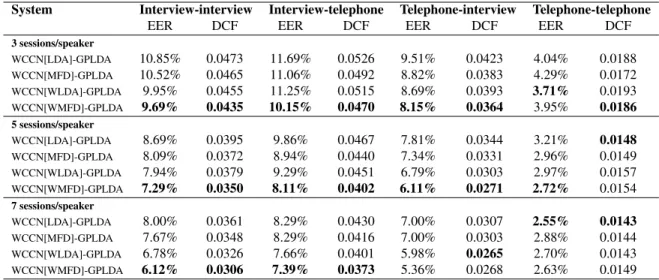
Table 1. Weighted LDA and MFD performance versus unweighted LDA performance of length-normalised GPLDA as the number of development sessions is increased.
System Interview-interview Interview-telephone Telephone-interview Telephone-telephone EER DCF EER DCF EER DCF EER DCF 3 sessions/speaker WCCN[LDA]-GPLDA 10.85% 0.0473 11.69% 0.0526 9.51% 0.0423 4.04% 0.0188 WCCN[MFD]-GPLDA 10.52% 0.0465 11.06% 0.0492 8.82% 0.0383 4.29% 0.0172 WCCN[WLDA]-GPLDA 9.95% 0.0455 11.25% 0.0515 8.69% 0.0393 3.71% 0.0193 WCCN[WMFD]-GPLDA 9.69% 0.0435 10.15% 0.0470 8.15% 0.0364 3.95% 0.0186 5 sessions/speaker WCCN[LDA]-GPLDA 8.69% 0.0395 9.86% 0.0467 7.81% 0.0344 3.21% 0.0148 WCCN[MFD]-GPLDA 8.09% 0.0372 8.94% 0.0440 7.34% 0.0331 2.96% 0.0149 WCCN[WLDA]-GPLDA 7.94% 0.0379 9.29% 0.0451 6.79% 0.0303 2.97% 0.0157 WCCN[WMFD]-GPLDA 7.29% 0.0350 8.11% 0.0402 6.11% 0.0271 2.72% 0.0154 7 sessions/speaker WCCN[LDA]-GPLDA 8.00% 0.0361 8.29% 0.0430 7.00% 0.0307 2.55% 0.0143 WCCN[MFD]-GPLDA 7.67% 0.0348 8.29% 0.0416 7.00% 0.0303 2.88% 0.0144 WCCN[WLDA]-GPLDA 6.78% 0.0326 7.66% 0.0401 5.98% 0.0265 2.70% 0.0143 WCCN[WMFD]-GPLDA 6.12% 0.0306 7.39% 0.0373 5.36% 0.0268 2.63% 0.0149
2004, 2005, and 2006 SRE corpora, and then used to calcu-late the Baum-Welch statistics before training a gender de-pendent total-variability subspace of dimensionRw = 500. The pooled total-variability representation and the GPLDA parameters were trained using telephone and microphone speech data from NIST 2004, 2005 and 2006 SRE corpora as well as Switchboard II. We empirically selected the num-ber of eigenvoices (N1) equal to 120 as best value
accord-ing to speaker verification performance over an evaluation set. 150 eigenvectors were selected for LDA, MFD, WLDA and WMFD estimations. S-normalisation was applied for experi-ments, and randomly selected telephone and microphone ut-terances from NIST 2004, 2005 and 2006 were pooled to form the S-normalisation dataset [19].
5. RESULTS AND DISCUSSIONS
Table 1 presents the results comparing the performance of the weighted LDA and MFD systems against the baseline un-weighted LDA approach. It can be observed from Table 1 that, as the number of development sessions made available to WCCN[LDA]-projected GPLDA system increases from 3 per speaker to 7, the EER drops considerably across all con-ditions. WCCN[MFD]-projected GPLDA system shows im-provement over WCCN[LDA]-projected GPLDA system, as MFD is robust estimate when limited session data is available. The weighted LDA system shows useful improvement over the unweighted LDA approach on mismatched and interview-interview conditions, showing that the weighted approach effectively extracts more discriminant information from be-tween pair of speakers. This improvement is further extended by the choice of the median over the mean as the central
ten-dency, with the WMFD system showing a further improve-ment of WLDA for a total of over 10% improveimprove-ment in EER over the baseline LDA system on mismatched and interview-interviewconditions.
6. CONCLUSION
In this paper, length-normalised PLDA speaker verification was analysed with limited session data, and it was found that when number of sessions that is used to train the PLDA sub-space and dimensionality reduction techniques is increased, it significantly affects speaker verification performance. It was found that, by taking advantage of pair-wise differences in speaker i-vectors, weighted LDA improved speaker verifica-tion performance in limited development session condiverifica-tions. Further improvement was found by using the median as the measure of central tendency rather than the mean for calculat-ing the scatter matrices. The final median-based and weighted WMFD PLDA system provided over a 10% improvement in EER over the baseline LDA GPLDA system on mismatched andinterview-interviewconditions.
7. REFERENCES
[1] R. Vogt, B. Baker, and S. Sridharan, “Factor analysis subspace estimation for speaker verification with short utterances,” inInterspeech 2008, Brisbane, Australia, September 2008.
[2] M. McLaren, R. Vogt, B. Baker, and S. Sridharan, “Experiments in SVM-based speaker verification using short utterances,” inProc. Odyssey Workshop, 2010.
[3] A. Kanagasundaram, R. Vogt, D.B. Dean, S. Sridharan, and M.W. Mason, “i-vector based speaker recognition on short utterances,” inProceed. of INTERSPEECH. In-ternational Speech Communication Association (ISCA), 2011, pp. 2341–2344.
[4] Ahilan Kanagasundaram, Robert J Vogt, David B Dean, and Sridha Sridharan, “PLDA based speaker recogni-tion on short utterances,” inThe Speaker and Language Recognition Workshop (Odyssey 2012). ISCA, 2012. [5] P. Kenny, T. Stafylakis, P. Ouellet, M. Alam, and P.
Du-mouchel, “PLDA for speaker verification with utter-ances of arbitrary duration,” in IEEE Int. Conf. on Acoustics, Speech and Signal Processing, 2013. [6] T. Hasan, R. Saeidi, J. Hansen, and D. Leeuwen,
“Dura-tion mismatch compensa“Dura-tion for i-vector based speaker recognition systems,” inIEEE Int. Conf. on Acoustics, Speech and Signal Processing, 2013.
[7] T. Kinnunen and H. Li, “An overview of text-independent speaker recognition: From features to su-pervectors,” Speech Communication, vol. 52, no. 1, pp. 12–40, 2010.
[8] N. Dehak, R. Dehak, P. Kenny, N. Brummer, P. Ouel-let, and P. Dumouchel, “Support vector machines ver-sus fast scoring in the low-dimensional total variability space for speaker verification,” inProceedings of Inter-speech, 2009, p. 1559 1562.
[9] N. Dehak, R. Dehak, J. Glass, D. Reynolds, and P. Kenny, “Cosine similarity scoring without score nor-malization techniques,”Odyssey Speaker and Language Recognition Workshop, 2010.
[10] P. Kenny, P. Ouellet, N. Dehak, V. Gupta, and P. Du-mouchel, “A study of inter-speaker variability in speaker verification,” IEEE Transactions on Audio, Speech, and Language Processing, vol. 16, no. 5, pp. 980–988, 2008. [11] M. McLaren and D. van Leeuwen, “Improved speaker recognition when using i-vectors from multiple speech sources,” in Acoustics, Speech and Signal Process-ing (ICASSP), 2011 IEEE International Conference on, 2011, pp. 5460–5463.
[12] P. Kenny, “Bayesian speaker verification with heavy tailed priors,” inProc. Odyssey Speaker and Language Recogntion Workshop, Brno, Czech Republic, 2010. [13] D. Garcia-Romero and C.Y. Espy-Wilson, “Analysis of
i-vector length normalization in speaker recognition sys-tems,” inInternational Conference on Speech Commu-nication and Technology, 2011, pp. 249–252.
[14] A. Kanagasundaram, D. Dean, S. Sridharan, and R. Vogt, “PLDA based speaker verication with weighted LDA techniques,” inProc. Odyssey Workshop, 2012. [15] N. Dehak, P. Kenny, R. Dehak, P. Dumouchel, and
P. Ouellet, “Front-end factor analysis for speaker verifi-cation,”Audio, Speech, and Language Processing, IEEE Transactions on, vol. PP, no. 99, pp. 1 –1, 2010. [16] J. Yang, J. Yang, and D. Zhang, “Median fisher
discrim-inator: a robust feature extraction method with applica-tions to biometrics,” Frontiers of Computer Science in China, vol. 2, no. 3, pp. 295–305, 2008.
[17] A. Kanagasundaram, D. Dean, R. Vogt, M. McLaren, S. Sridharan, and M. Mason, “Weighted LDA tech-niques for i-vector based speaker verification,” inIEEE Int. Conf. on Acoustics, Speech and Signal Processing, 2012, pp. 4781–4784.
[18] NIST, “The NIST year 2008 speaker recognition evalu-ation plan,” Tech. Rep., NIST, 2008.
[19] S. Shum, N. Dehak, R. Dehak, and J. Glass, “Unsu-pervised speaker adaptation based on the cosine simi-larity for text-independent speaker verification,” Proc. Odyssey, 2010.