Copyright by Dong Li
The Dissertation Committee for Dong Li
certifies that this is the approved version of the following dissertation:
Orchestrating Thread Scheduling and Cache
Management to Improve Memory System Throughput
in Throughput Processors
Committee:
Donald S. Fussell, Supervisor Douglas C. Burger, Co-Supervisor Stephen W. Keckler
Calvin Lin Lizy K. John
Orchestrating Thread Scheduling and Cache
Management to Improve Memory System Throughput
in Throughput Processors
by
Dong Li, B.E.; M.E.
DISSERTATION
Presented to the Faculty of the Graduate School of The University of Texas at Austin
in Partial Fulfillment of the Requirements
for the Degree of
DOCTOR OF PHILOSOPHY
THE UNIVERSITY OF TEXAS AT AUSTIN May 2014
Acknowledgments
I would like to thank many people who have been helping me along my journey to complete this dissertation. First, I would like to thank my advisor, Doug Burger, for his excellent guidance and support during my study. Doug is a great researcher and has been a wonderful mentor. I am grateful to him for dedicating his time to guide my research during these years.
I would also like to thank my advisor, Don Fussell, for his great men-toring and encouragement. Don not only shared his amazing insights into the computer architecture research, but also provided me invaluable career ad-vice. I am very thankful to Steve Keckler. Steve played a significant role in my graduate study. He led me to find interesting research topics in the GPU research area. His great guidance during these years has been a key for me to finish my dissertation.
It has been a big pleasure and my great honor to work closely with Doug, Don and Steve when conducting research on GPU. With the excel-lent guidance and inspiration from three great technical leaders, I have been enjoying every minute I spent to investigate this research field.
I would like to thank the other members of my committee, Calvin Lin and Lizy John. They have provided helpful feedback along the way. I am also grateful to Kathryn McKinley. Kathryn has provided great technical guidance
during my study. I am very thankful to my colleagues and friends who helped me to complete this work including Jeff Diamond, Behnam Robatmili, Minsoo Rhu, Renee Amant, Curtis Dunham, Sibi Govindan, Akanksha Jain, Ashay Ranee, Jee Ho Ryoo, Hao Wu and Jia Chen. In particular, I’d like to thank Jeff for his deep technical insights and great encouragement during past several years.
Finally, I would like to thank my family. My parents have always been supportive throughout the years. I want to thank my wife, Mei Ming, who has constantly given me support and encouragement. I thank her for being so understanding and for supporting me through the toughest moments of my life. I also dedicate this Ph.D thesis to my two lovely children, Tyler and Kevin. They bring laughs and joy into my life everyday.
DONG LI The University of Texas at Austin
Orchestrating Thread Scheduling and Cache
Management to Improve Memory System Throughput
in Throughput Processors
Dong Li, Ph.D.
The University of Texas at Austin, 2014 Supervisors: Donald S. Fussell
Douglas C. Burger
Throughput processors such as GPUs continue to provide higher peak arithmetic capability. Designing a high throughput memory system to keep the computational units busy is very challenging. Future throughput pro-cessors must continue to exploit data locality and utilize the on-chip and off-chip resources in the memory system more effectively to further improve the memory system throughput. This dissertation advocates orchestrating the thread scheduler with the cache management algorithms to alleviate GPU cache thrashing and pollution, avoid bandwidth saturation and maximize GPU memory system throughput. Based on this principle, this thesis work proposes three mechanisms to improve the cache efficiency and the memory throughput. This thesis work enhances the thread throttling mechanism with the Priority-based Cache Allocation mechanism (PCAL). By estimating the cache miss ratio with a variable number of cache-feeding threads and monitoring
the usage of key memory system resources, PCAL determines the number of threads to share the cache and the minimum number of threads bypassing the cache that saturate memory system resources. This approach reduces the cache thrashing problem and effectively employs chip resources that would otherwise go unused by a pure thread throttling approach. We observe 67% improvement over the original as-is benchmarks and a 18% improvement over a better-tuned warp-throttling baseline.
This work proposes the AgeLRU and Dynamic-AgeLRU mechanisms to address the inter-thread cache thrashing problem. AgeLRU prioritizes cache blocks based on the scheduling priority of their fetching warp at replacement. Dynamic-AgeLRU selects the AgeLRU algorithm and the LRU algorithm adaptively to avoid degrading the performance of non-thrashing applications. There are three variants of the AgeLRU algorithm: (1) replacement-only, (2) bypassing, and (3) bypassing with traffic optimization. Compared to the LRU algorithm, the above mentioned three variants of the AgeLRU algorithm en-able increases in performance of 4%, 8% and 28% respectively across a set of cache-sensitive benchmarks.
This thesis work develops the Reuse-Prediction-based cache Replace-ment scheme (RPR) for the GPU L1 data cache to address the intra-thread cache pollution problem. By combining the GPU thread scheduling priority together with the fetching Program Counter (PC) to generate a signature as the index of the prediction table, RPR identifies and prioritizes the near-reuse blocks and high-reuse blocks to maximize the cache efficiency. Compared to
the AgeLRU algorithm, the experimental results show that the RPR algorithm results in a throughput improvement of 5% on average for regular applications, and a speedup of 3.2% on average across a set of cache-sensitive benchmarks. The techniques proposed in this dissertation are able to alleviate the cache thrashing, cache pollution and resource saturation problems effectively. We believe when these techniques are combined, they will synergistically fur-ther improve GPU cache efficiency and the overall memory system throughput.
Table of Contents
Acknowledgments v
Abstract vii
List of Tables xiv
List of Figures xv
Chapter 1. Introduction 1
1.1 Memory Systems in Throughput Processors . . . 3
1.2 Key Factors that Affect GPU Memory Throughput . . . 4
1.2.1 Cache Management Policies . . . 4
1.2.2 GPU Thread Scheduling . . . 6
1.2.3 Chip Resource Saturation . . . 7
1.3 Dissertation Contribution . . . 9
1.4 Dissertation Organization . . . 13
Chapter 2. Related Work 14 2.1 Tuning Parallelism to Improve Performance . . . 14
2.1.1 Parallelism Tuning for GPUs . . . 14
2.1.2 Parallelism Tuning for CPUs . . . 16
2.2 GPU Cache Allocation and Replacement Policies . . . 17
2.3 CPU Cache Allocation and Replacement Policies . . . 19
Chapter 3. Background 24 3.1 Contemporary GPU Architecture . . . 24
3.2 CUDA Programming Model . . . 25
3.3 Thread Scheduling . . . 27
3.4.1 Cache-Sensitive Benchmarks . . . 29
3.4.2 Thread Scheduling Effects on Cache Efficiency and Through-put . . . 29
3.5 Methodology . . . 36
Chapter 4. Thread Scheduler Directed Priority-based Cache Al-location 38 4.1 Understanding How Parallelism Affects Caches Hit Ratio, Chip Resource Saturation and Throughput . . . 40
4.1.1 Throughput . . . 42
4.1.2 Cache Miss Ratio . . . 44
4.1.3 Memory Request Latency . . . 46
4.1.4 Chip Resource Utilization . . . 47
4.1.5 Identifying Performance Bottleneck . . . 56
4.2 Motivation: Two Performance Opportunities Beyond Throttling 59 4.2.1 Understanding Throttling Techniques . . . 59
4.2.2 Two Performance Opportunities Beyond Throttling . . . 61
4.3 Token-based Prioritized Cache Allocation (PCAL) . . . 63
4.3.1 Strategies and Challenges . . . 64
4.3.2 Static PCAL . . . 67
4.4 Dynamic Optimization Strategy Selection and Bypassing Threads Count Prediction . . . 71
4.4.1 Motivation for dynamic PCAL . . . 71
4.4.2 Overview . . . 72
4.4.3 Extra Bypassing Thread Number Predictor . . . 75
4.5 Bypassing Traffic Optimization . . . 80
4.6 Opportunistic Caching . . . 82
4.7 PCAL on Top of CTA Level Throttling . . . 83
4.8 Results . . . 83
4.8.1 Static Priority-based Cache Allocation . . . 84
4.8.1.1 Static PCAL with Strategy One: Increasing TLP While Maintaining Cache Hit Ratio . . . 87
4.8.1.2 Static PCAL with Strategy Two: Increasing Cache Hit Ratio While Maintaining TLP . . . 94
4.8.2 Dynamic Priority-based Cache Allocation . . . 101
4.8.3 Bypassing Traffic Optimization . . . 103
4.8.4 Applying PCAL on both L1 and L2 . . . 108
4.8.5 Results Summary . . . 112
4.9 Conclusion . . . 113
Chapter 5. Thrashing-Resistant GPU L1 Cache Replacement and Bypassing algorithms 116 5.1 Motivation . . . 117
5.2 AgeLRU, a Thread-Scheduling Aware GPU Cache Replacement and Bypassing Policy . . . 123
5.2.1 Overview . . . 123 5.2.2 Implementing AgeLRU . . . 126 5.3 Dynamic AgeLRU . . . 129 5.4 Results . . . 131 5.4.1 Evaluating AgeLRU . . . 132 5.4.1.1 Replacement algorithm . . . 134 5.4.1.2 Bypassing algorithm . . . 136
5.4.1.3 Bypassing algorithm with bypassing traffic opti-mization . . . 138
5.4.1.4 Evaluating AgeLRU with varieties of benchmarks 140 5.4.2 Evaluating Dynamic-AgeLRU . . . 143
5.5 Summary . . . 144
Chapter 6. Reuse-Prediction-based Scheduler-Aware GPU Cache Replacement Algorithm 148 6.1 Motivation . . . 150
6.2 Reuse-prediction-based Replacement Algorithms . . . 154
6.2.1 Reuse Distance and Reuse Count Predictor . . . 155
6.2.2 Cache Block Reuse Distance Sampler . . . 158
6.2.3 Cache Replacement Controller . . . 160
6.2.4 Cache Block Scoring Strategy . . . 162
6.3 Optimizing Hardware Cost . . . 164
6.4 Results . . . 166
Chapter 7. Conclusion 171 7.1 Dissertation Contributions . . . 172 7.2 Future Work . . . 176 7.3 Practicality Discussion . . . 180 7.4 Concluding Thoughts . . . 185 Bibliography 186 Vita 204
List of Tables
1.1 Per-thread L1 cache capacity of modern throughput processors 4
3.1 Speedup of large-cache configuration . . . 30
3.2 Cache-sensitive CUDA benchmarks . . . 31
3.3 Classifying Benchmarks by scheduler preference . . . 32
3.4 Baseline GPGPU-Sim configuration. . . 37
4.1 warp-max and warp-opt for key benchmarks . . . 44
4.2 Identifying the bottlenecks for key benchmarks. . . 60
List of Figures
3.1 Chip level overview of baseline GPU . . . 25 3.2 Streaming multiprocessor architecture. . . 26 3.3 Speedup of Greedy-Then-Oldest (GTO) algorithm, normalized
to throughput of Loose-Round-Robin (LRR) Scheduling algorithm 33 3.4 Comparing L1 data cache miss rate of Greedy-Then-Oldest (GTO)
algorithm and Loose-Round-Robin (LRR) scheduling algorithm 34 3.5 Comparing L2 data cache miss rate of Greedy-Then-Oldest (GTO)
algorithm and Loose-Round-Robin (LRR) scheduling algorithm 35 4.1 Chip Resources in a GPU Memory System. . . 41 4.2 IPC and Speedup. Varying maximum number of warps per
scheduler. . . 43 4.3 L1 and global cache miss ratio. Varying maximum number of
warps per scheduler. . . 45 4.4 Round-trip latency of memory requests. Varying number of
warps per scheduler. . . 47 4.5 Network on Chip (NoC) latency. Varying the maximum number
of warps per scheduler. . . 49 4.6 Memory pipeline stall ratio. Varying the maximum number of
warps per scheduler. . . 50 4.7 Breaking down the ratio of memory pipeline stall by its two
causes: L1-Block Reservation Failure, MSHR Reservation Fail-ure. Varying maximum number of warps per scheduler. . . 51 4.8 Memory partition congestion ratio. Varying the maximum
num-ber of warps per scheduler. . . 53 4.9 Off-Chip Bandwidth Utilization of benchmarks. Varying the
maximum number of warps per scheduler. . . 55 4.10 Architectural Overview of PCAL Mechanism . . . 66 4.11 Implementation of dynamic PCAL . . . 74 4.12 Comparing the speedup of optimal static PCAL with optimal
4.13 Speedup for static PCAL on L1 cache . . . 86 4.14 Round-Trip latency of memory requests fetching data from DRAM
and NoC latency when static PCAL applies strategy one . . . 88 4.15 Memory Pipeline Stall caused by L1 MSHR reservation failure
when static PCAL applies strategy one . . . 89 4.16 Overall L1 cache miss ratio and the cache miss ratio of the cache
threads (token holder) when static PCAL applies strategy one 91 4.17 L1 cache miss ratio of the bypassing threads (non token holder)
when static PCAL applies strategy one . . . 92 4.18 Overall L1 cache miss ratio and the cache miss ratio of the cache
threads (token holder) when static PCAL applies strategy two 96 4.19 L1 cache miss ratio of the bypassing threads (non token holder)
when static PCAL applies strategy two . . . 97 4.20 Round-Trip latency of the memory requests fetching data from
DRAM and NoC latency when static PCAL applies strategy two 99 4.21 Ratio of Memory Pipeline Stall when static PCAL applies
strat-egy two . . . 100 4.22 Comparing the speedup of the best static PCAL and dynamic
PCAL . . . 101 4.23 Comparing speedup of static PCAL with bypassing traffic
op-timization (Static PCAL-BTO) . . . 104 4.24 Speedup for static PCAL with bypassing traffic Optimization . 106 4.25 Comparing the speedup of the best static PCAL and dynamic
PCAL, both with bypassing traffic optimization . . . 109 4.26 Comparing the speedup of the best static PCAL on L1 and
static PCAL on L1&L2 . . . 110 4.27 Comparing L1 and L2 Miss rate of the best static PCAL on L1
and static PCAL on L1&L2 . . . 111 4.28 Overall speedup (normalized to baseline with maximum warp
per scheduler) . . . 112 5.1 Breaking down cache hits into inter-warp and intra-warp reuses 120 5.2 Flowchart of AgeLRU Replacement and Bypassing Algorithm 125 5.3 AgeLRU Implementation . . . 127 5.4 Identify Inactive WID with the wrap-around counters . . . 128 5.5 Parallel Voting Mechanism . . . 130 5.6 Speedup of AgeLRU replacement and BIP replacement algorithms133
5.7 L1 miss rate of LRU, AgeLRU replacement and BIP replace-ment algorithms . . . 133 5.8 A case study of KMN, comparing LRU, AgeLRU and BIP . . 136 5.9 Speedup of AgeLRU bypassing and BIP bypassing algorithms 137 5.10 Memory pipeline stall ratio due to L1 block reservation failure:
AgeLRU replacement and AgeLRU bypassing . . . 137 5.11 Speedup of AgeLRU bypassing and BIP bypassing (Both with
bypassing traffic optimization) . . . 138 5.12 Comparing speedup of AgeLRU bypassing with/without traffic
optimization . . . 140 5.13 Comparing memory requests round trip latency with/without
traffic optimization . . . 141 5.14 Speedup of AgeLRU Replacement and Bypassing with/without
traffic optimization . . . 142 5.15 Speedup of AgeLRU, Dynamic-AgeLRU, BIP and Optimal-DIP
replacement algorithms . . . 144 5.16 Speedup of AgeLRU, Dynamic-AgeLRU, BIP and Optimal-DIP
bypassing algorithms . . . 145 5.17 Speedup of AgeLRU, Dynamic-AgeLRU, BIP and Optimal-DIP
bypassing algorithms (all with bypassing traffic optimization) . 145 6.1 Reuse distance distribution of memory blocks in same signature
groups . . . 151 6.2 Overview of implementing the reuse-prediction-based
Replace-ment mechanism . . . 155 6.3 L1 Miss Rate of RPR with various block score function . . . . 167 6.4 Speedup of RPR with various block score function . . . 168
Chapter 1
Introduction
Processors that target throughput computing, such as GPUs and many-core processors, are generally referred to as throughput processors. They have become the dominant architecture for accelerating massively parallel applica-tions as they offer greater instruction throughput and memory bandwidth than conventional CPUs. Such chips are being used to accelerate desktops, work-stations, and supercomputers, and throughput computing is now emerging as an important factor for mobile computing.
However, the transistor density of modern processors increases much faster than the off-chip bandwidth does [6] [76]. Throughput processors are expected to process more data in parallel in every new generation. The gap between the peak arithmetic capability and the off-chip bandwidth will in-evitably grow. Since memory system throughput has become a bottleneck for GPU performance [40], contemporary GPUs integrate an on-chip cache hierar-chy to increase memory system throughput. With a large number of threads sharing the cache hierarchy, GPUs can only supply less than a single cache line on average per thread at L1 level [63] [67]. Such sharing leads to con-tention and reduces the effectiveness of caches in exploiting locality, reducing
the performance improvement available to GPUs for cache-sensitive workloads. Consequently, exploiting data locality in throughput computing systems will increase in importance to reduce both off-chip bandwidth requirements and power.
In throughput processors, both thread scheduler and cache manage-ment logic play important roles in cache efficiency and memory system through-put. The thread scheduler determines the order and time of executing in-structions from a potentially large pool of threads. It shapes memory access patterns directly and thus has a significant effect on cache efficiency. Without considering the effect of the thread scheduling algorithm, applying thrashing-resistant and pollution-thrashing-resistant CPU cache algorithms directly to the GPU cache can not effectively address GPU L1 cache thrashing and pollution prob-lems (We discuss these issues in Chapter 5 and Chapter 6 respectively). With-out being aware of cache performance and chip resource usage, the scheduler may oversubscribe threads which leads to cache thrashing and resource sat-uration problems. My research goal is to orchestrate thread schedul-ing and cache management polices, to improve cache efficiency and memory system throughput.
While our evaluation has simulated NVIDIA GPUs with a CUDA programming model, other throughput processors such as many-core pro-cessors [80] [15] are also facing the challenge of improving memory system throughput [50] [25]. Recent many-core processors such as Intel’s many-core Larrabee [80] and Many Integrated Core (MIC) [15] processor can support
hun-dreds of hardware threads. The benefits of coordinating the thread scheduling and cache management policies may also apply to these processors.
1.1
Memory Systems in Throughput Processors
GPUs rely on massive multithreading to tolerate memory latency and deliver high throughput. For example, a modern NVIDIA Kepler GPU [67] can have up to 30,000 threads hardware-resident and operating simultaneously. GPU memory systems have grown to include a multi-level on-chip cache hi-erarchy with both hardware and software controlled cache structures. The top-end NVIDIA Kepler chip now includes a total of nearly a megabyte of primary cache (including both hardware and software controlled cache) and 1.5MB of L2 cache. Many-core processors, which also target throughput com-puting instead of single-thread performance, employ limited per-core threading and relatively larger data caches. The difference between GPUs and many-core memory systems is highlighted in Table 1.1, which summarizes the thread and cache capacity of contemporary throughput processors. Prior research demon-strates that the cache hierarchy in many-core processors is still essential for good performance and energy efficiency [25]. The primary cache capacity per thread for GPUs is 2 to 3 orders of magnitude smaller than for a many-core processor. GPUs can only supply less than a single cache line of space on av-erage, per thread. As a result, keeping the working set of all threads resident in the primary cache is infeasible on a fully occupied streaming multiprocessor (SM);
Table 1.1: Per-thread L1 cache capacity of modern throughput processors NVIDIA Kepler [67] NVIDIA Fermi [63] Intel Larrabee [80] Intel MIC [15] Oracle T3 [83] L1 Size 48 KB L1 48 KB L1 32 KB L1 32 KB L1 8 KB L1 Threads /Core 2,048 1,536 4 4 8 L1 Ca-pacity /thread 24 B 32 B 8,192 B 8,192 B 1,024 B
1.2
Key Factors that Affect GPU Memory Throughput
Memory systems have been well-known performance bottlenecks for both CPUs and throughput processors [6] [26] [76] [40] [25] [54]. For through-put processors, there are three major factors that affect the cache efficiency and the memory system throughput dramatically, namely cache management policies, GPU thread scheduling and on-chip/off-chip resource saturation. 1.2.1 Cache Management PoliciesCompared to a CPU cache, a GPU cache exhibits two significant dif-ferences. First, as we demonstrate in Section 1.1, the limited per-thread cache capacity causes a significant cache thrashing problem. Second, the cache ac-cess stream is a mix of requests from many threads. The reuse pattern of a cache block is often largely affected by the scheduling priority of the threads fetching the block.
allo-cation algorithms etc., have a direct effect on cache efficiency and thus affect memory system throughput significantly. Parts of this dissertation focus on enhancing cache replacement, bypassing and allocation algorithms by coordi-nating with the GPU thread scheduling to improve cache efficiency.
An optimal cache replacement algorithm always evicts the cache blocks that will be referenced furthest in the future. Unfortunately, oracular knowl-edge about the future reuse of cache blocks is not available in reality, thus cache replacement algorithms predict the reuse interval of all blocks based on past references. The most common replacement algorithms, such as Least Recently Used (LRU) and its approximation Not Recently Used (NRU) [27] [87], are often based on an assumption that cache access patterns are recency-friendly. However throughput processors’ cache access patterns are often highly affected by thread interleaving. The reuse pattern of a cache block could be deter-mined by the thread scheduling algorithm which may radically change reuse distances. For instance, the Greedy-Then-Oldest (GTO) thread scheduling algorithm prioritizes the warps based on their fetch order (i.e. age). A reuse in a young warp is likely to be interrupted by requests from the older warps. The mismatch between the replacement algorithm and cache access patterns is the root cause that leads to GPU cache inefficiency.
Cache thrashingoccurs when the working set of an application is too large to fit in the cache. It is one of the major problems that degrade GPU cache efficiency. GPUs support tens of thousands of hardware threads and hide long-latency operations by issuing instructions from unstalled threads.
Each of the GPU threads normally processes a portion of the input data. The total working set size of a GPU program often is proportional to the number of active threads. The limited GPU cache capacity often cannot capture the total working set of all threads resulting in frequent cache eviction and thus low cache efficiency.
Cache pollution is defined as the problem that occurs when cache blocks with little reuse or no reuse evict the high-reuse blocks. The per-thread cache capacity of the GPU is very limited. The low-reuse blocks waste the limited cache capacity and degrade cache efficiency. It is important that the no/low-reuse cache blocks can be identified so that the replacement algorithm can evict them earlier than the others.
The thrashing and pollution problems often manifest themselves at the same time [68] [91]. This requires complex replacement algorithms to learn the reuse pattern of cache blocks and to achieve higher cache efficiency. In this dissertation, we propose new replacement and bypassing algorithms to improve the cache efficiency. For each block, the new algorithms consider the scheduling priority of the fetching thread and the reuse behavior of the block to improve the replacement and bypassing algorithms.
1.2.2 GPU Thread Scheduling
Unlike CPUs that only support a small number of hardware thread contexts, throughput processors support a large number of hardware thread contexts to hide the memory access latency by fast context-switching among
these threads. The GPU hardware thread scheduler selects warps which al-ready have all the operands al-ready for execution. The scheduling algorithm has a significant effect on cache access patterns. Simple round-robin scheduling al-gorithms check the readiness of all warps one-by-one. Each warp gets roughly equal time-slice. Although loose round robin policies promote fairness, GPUs, unlike CPUs, are designed to provide high throughput. Inter-thread fairness is not the design goal of a GPU. Furthermore, round robin policies allow all warps to be active hence lead to a large aggregated working set, which can result in GPU cache thrashing. Prior research proposes the Greedy then Old-est (GTO) algorithm, which favors the oldOld-est warp and minimizes the total working set. It has been proven [77] that the GTO algorithm provides the highest throughput on average compared to other common thread scheduling policies on cache-sensitive workloads.
We observe that the cache replacement policy and the thread scheduling policy can coordinate to increase the cache efficiency and thus improve the total throughput. We enhance the GPU thread scheduler with a cache allocation mechanism, which not only decides the issue order of warps but also decides the cache allocation policy for the memory access in each warp. Our results show the new scheduler enables GPUs to achieve significant speedup.
1.2.3 Chip Resource Saturation
If it does not hit in the L1 or L2 cache, a memory request needs a col-lection of chip resources to fetch a data block from the main memory. In this
dissertation, we refer to the collection of needed resources to service memory requests as chip resources, which include L1 cache blocks, L1 Miss Status Hold-ing Registers (MSHR) table entries, L2 cache blocks, L2 MSHR entries, DRAM controller scheduling queue entries, Network-on-Chip (NoC) bandwidth, and the off-chip bandwidth. A reservation failure of any of these resources stalls the request and limits the overall memory system throughput.
The off-chip bandwidth has not grown as fast as the transistor density. Consequently, off-chip bandwidth is often a major performance bottleneck. On-chip resources, such as the Network-on-Chip bandwidth and the MSHR table, are designed to satisfy the resource requirements of the common case not the worst case. However, when a GPU program presents a high memory divergence, a warp instruction requests access to multiple cache lines resulting in multiple cache misses. The memory request stream thus becomes bursty and is likely to saturate the on-chip and off-chip memory bandwidth in a short period. The queuing latency increases dramatically when a resource reaches its saturation point. Furthermore, the thread scheduler issues more instructions from other warps to hide the latency, which not only further increases the memory access latency, but also increases the aggregated working set size. As a result, both the off-chip and on-chip bandwidth saturation can degrade memory system throughput.
In our research, the scheduling and replacement policies are further op-timized to reduce NoC traffic by fetching only a portion of a cache line for the memory requests that are characterized as bypassing requests.
Experi-mental results show that this is key to improving overall throughput for some benchmarks.
1.3
Dissertation Contribution
This dissertation advocates orchestrating the thread scheduler with the cache management algorithms for massively multi-threaded throughput pro-cessors to alleviate GPU cache thrashing, avoid bandwidth saturation and maximize GPU memory system throughput. Three independent mechanisms have been proposed based on this principle. As future work, we expect the three techniques could be combined to allow them work synergistically to fur-ther improve the throughput. The major contributions of this work are as follows.
1. Investigating the memory system effect of high TLP and iden-tifying the performance bottleneck of each application
In order to investigate how parallelism affects GPU performance, the cache hit ratio and other chip resource utilization, we characterize a set of cache-sensitive applications by varying the maximum number of warps that each thread scheduler allows. We analyze the Instruction Per Cycle (IPC), L1/L2 cache miss ratio and the chip resource utilization metrics including the memory request round trip latency, the Network-on-Chip (NoC) transmission latency and the DRAM bandwidth utilization. We identify the major performance bottlenecks for each application when
TLP is higher. Applications are grouped into categories based on the bottlenecks.
2. Addressing cache thrashing and memory system resource satu-ration with a thread-scheduling directed cache allocation mech-anism
We enhance the thread throttling technique with the Priority-based Cache Allocation (PCAL) mechanism to address inter-thread L1 cache thrashing and memory system resource saturation. Unlike thread throt-tling approaches which force all threads to feed the L1 cache, PCAL explicitly determines the number of threads to allocate and fill the cache and the minimum number of threads bypassing the cache to saturate memory system resources. PCAL can improve performance with two optimization strategies: either increasing TLP while maintaining cache hit ratio, or optimizing cache hit ratio while maintaining TLP. This ap-proach reduces the cache thrashing problem and effectively employs the chip resources that would otherwise go unused by a pure thread throt-tling approach. We observe 67% improvement on average over the orig-inal as-is code and a 18% improvement on average over a better-tuned warp-throttling baseline.
3. Developing the AgeLRU and Dynamic-AgeLRU GPU-specific thrashing-resistant cache replacement and bypassing algorithms We observe that applying thrashing-resistant CPU cache algorithms,
such as Bimodal Insertion Policy (BIP) [71] and Dynamic Insertion Pol-icy (DIP) [71] to the GPU cache can not effectively address GPU L1 cache thrashing. The primary reasons are: (1) BIP randomly selects memory blocks to reside in the cache. It tends to activate all warps con-currently and thus increase the size of total working set. (2) DIP relies on the set-dueling mechanism to evaluate two algorithms on different sets of the same cache. In a GPU, the order of thread interleaving and cache access patterns may change when set-dueling is applied to estimate two algorithms.
We propose the AgeLRU and Dynamic-AgeLRU mechanisms, which are thread scheduling-aware replacement and bypassing algorithms to over-come the thrashing problem. When selecting a collection of memory blocks to reside in the cache, AgeLRU minimizes the number of warps that fetch the cache-resident blocks by prioritizing older warps at re-placement. Dynamic-AgeLRU selects the AgeLRU or the LRU algorithm adaptively, based on the parallel voting mechanism.
There are three variants of the AgeLRU algorithm: (1) replacement-only, (2) bypassing, and (3) bypassing with traffic optimization. Compared to the LRU algorithm, the above mentioned three variants of the AgeLRU algorithm enable increases in performance of 4%, 8% and 28% respec-tively across a set of cache-sensitive benchmarks.
Our results show that Dynamic-AgeLRU algorithms can avoid degrad-ing the performance of non-thrashdegrad-ing applications by selectdegrad-ing the LRU
algorithm.
4. Proposing Reuse-Prediction based Cache Replacement Algo-rithm
We observe that CPU cache pollution-resistant algorithms can not be applied directly to a GPU L1 cache. The reason is that the GPU thread scheduler has a significant effect on the GPU cache access pattern. With-out considering the effect of the thread scheduling, a high accuracy reuse prediction is not achievable.
We propose a Reuse-Prediction-based cache Replacement (RPR) scheme for a GPU L1 data cache to address the intra-thread cache pollution problem. To increase the prediction accuracy, RPR uses the GPU thread scheduling priority to generate a signature which is the index of the prediction table. RPR can approximate the reuse-distance-based algo-rithm, the counter-based algoalgo-rithm, and the AgeLRU algorithm with various cache block score functions. Among these three configurations, our results show that the reuse-distance-based algorithm outperforms the others. Compared to the AgeLRU algorithm we propose in Section 5, the reuse-distance-based algorithm enables a throughput improvement of 5% on average for regular applications, and a speedup of 3.2% across a set of cache-sensitive benchmarks.
1.4
Dissertation Organization
The rest of this dissertation is organized as follows: Chapter 2 discusses the related work. Chapter 3 introduces the background of our research, and describes the baseline GPU architecture and the CUDA programming model. It also contains characterizations of CUDA applications. The cache sensitivity and the scheduling algorithm sensitivity are investigated. Our experimental methodology is also discussed. Chapter 4 describes the PCAL scheme, which is the thread scheduler directed cache allocation mechanism to address the inter-thread L1 cache contention and the chip resource saturation problem. Chapter 5 proposes AgeLRU, a thread-scheduling-aware cache replacement and bypassing scheme to address the inter-thread cache contention problem. Chapter 6 introduces RPR, a reuse-prediction based cache replacement policy to alleviate intra-thread cache pollution. Chapter 7 draws conclusions from this work and discusses directions for future study.
Chapter 2
Related Work
This section summarizes prior parallelism tuning and cache manage-ment work for both GPUs and CPUs.
2.1
Tuning Parallelism to Improve Performance
2.1.1 Parallelism Tuning for GPUsBakhoda, et al. [4] evaluate a number of workloads across several GPU configurations in which the maximum number of supported CTAs varies. They note that some workloads perform better when the number of concurrent CTAs is limited, and attribute this effect to reduced contention for shared resources (e.g. caches, interconnection network, and DRAM bandwidth). Kayiran, et al. [39] propose a mechanism to dynamically determine the best number of CTAs to concurrently schedule to attain the highest performance in light of these memory system contention effects. They monitor whether a CTA is ex-periencing a high number of memory-induced stalls or whether it is unable to keep the machine busy, and dynamically adjust the number of CTAs allowed to execute on an streaming multiprocessor (SM) to achieve a balance, leading to good performance. Rogers, et al. [77] [78]directly address L1 data cache
contention among threads. Their cache-conscious wavefront scheduling tech-nique monitors the L1 cache using a victim tag cache to detect when locality is being lost due to cache contention among warps. As lost-locality is de-tected, certain warps are made ineligible to issue additional memory requests, thereby preserving locality for the remaining warps. Several researchers have also proposed a variety of schedulers that preferentially schedule out of a small pool of warps [16, 59, 18, 37]. These two-level schedulers have been developed for a number of reasons, but all of them generally have the effect of reducing contention in the caches and memory subsystem by limiting the number of co-scheduled warps. Guz et al. [22] [21] describe “the performance valley” that exists between highly-threaded systems where threading can hide the mem-ory latency and systems in which the working set of the active threads fits primarily within the cache.
These thread scheduling policies generally improve the performance for cache-sensitive applications by reducing thread-level parallelism to avoid en-tering this performance valley. Our approach does not reduce available thread-level parallelism by throttling threads, but rather seeks to directly reduce the memory system contention effects by providing preferential service to only a subset of warps (e.g. those likely to be enabled in one of the thread scheduling policies above). At the same time, our approach allows the remaining threads to remain active, opportunistically takes advantage of inter-warp locality with the warps holding tokens, and exploits available “spare” bandwidth through the memory system. In effect, our approach seeks to eliminate the
“perfor-mance valley” - allowing high thread-level parallelism while mitigating the memory system contention issues that affect these highly-threaded systems. 2.1.2 Parallelism Tuning for CPUs
Nieplocha, et al. [62] note that having too many threads may hurt the performance for some scientific applications. Suleman, et al. [86] propose the first dynamic thread throttling technique for Chip Multiprocessors (CMP). A feedback driven threading (FDT) technique has been proposed to dynamically decide the best number of threads of CMPs. The technique attempts to avoid the synchronisation overhead of executing critical sections sequentially from all threads. It also targets finding the minimum number of threads to saturate the off-chip bandwidth. Compared to our work, this work is a pure thread throttling technique, and it does not attempt to avoid inter-thread cache con-tention problem.
Along with [86], several other dynamic parallelism management ap-proaches have been proposed [84] [53] [61] [49] [101]. Among these techniques, Sridharan, et al. [84]describe a new technique that tunes the degree of paral-lelism dynamically adapting to execution condition changes. Luo, et al. [53] propose to accelerate single thread applications by dynamic spawning specula-tive threads at runtime. Nicolau, et al. [61]propose a technique to decide when and how many threads should be spawned at runtime. Lee, et al. [49] describe a dynamic thread throttling and merging technique which targets optimize both cache efficiency and inter-thread communication overhead.
Compared to our work, all these studies [86] [84] [53] [61] [49] [101] [12], are thread throttling techniques, the only parameter to tune the parallelism is the total number of threads. Our PCAL work separates the concerns of saturating different resources, the total number of threads does not have to be the number for threads to feed the L1 cache or the L2 cache.
2.2
GPU Cache Allocation and Replacement Policies
Jia et al. [33] describe a compile-time algorithm to determine whether to selectively enable cache allocation in the L1 data cache for each load instruction in the program. The algorithm does not attempt to predict temporal cache reuse, but rather focuses on the expected degree of spatial locality among the accesses within a warp. Accesses that are anticipated to require many cache lines to satisfy are marked to bypass the L1 data cache. In contrast to our work, this work identifies the static loads that have the most potential to require a large number cache evictions, and prevents these loads from disrupting the cache. Our work focuses on adaptively determining a subset of the warps that should be enabled to cause cache allocations - allowing temporal reuse, even for loads performing highly divergent accesses. In addition, their compile time analysis, unlike our dynamic system, is unable to handle situations in which the locality is input data dependent.Jia, et al. [34] propose two mechanisms, request-reordering and bypassing-at-stall, to improve GPU cache efficiency. The request reordering mechanism, applies per-warp queues to hold and group memory requests from same warp.
It prevents intra-warp reuse pairs from being interrupted by requests from other warps if the reuse pairs both stay in the queue before accessing cache. The bypassing at stall mechanism allows a memory request to bypass the cache when all cache blocks in a cache set have been reserved. Unlike our work, the bypassing at stall policy only considers the chip resource congestion problem. When chip resources are not congested, memory requests from all warps still can feed the L1 cache and lead to the cache thrashing problem. This policy can be considered as a special case of the bypassing policy we propose for the Priority based Cache Allocation (PCAL) mechanism.
Rhu, et al. [75] proposes an energy-efficient GPU memory hierarchy, which predicts spatial reuse patterns of cache blocks and only fetches a portion of each cache block to save energy consumption and reduce memory bandwidth requirement. Our PCAL work does not predict spatial locality. PCAL only allows bypassing loads to not fetch whole cache blocks.
GPU prefetching techniques [48] [36] [82] have been proposed to uti-lize off-chip bandwidth more effectively and reduce memory access latency to increase GPU occupancy. The mechanisms this dissertation proposes do not consider prefetching. However, both AgeLRU and RPR are able to improve cache efficiency and thus reduce off-chip bandwidth requirement. Prefetching might complement our techniques to utilize the off-chip bandwidth.
GPU cache analytical models [69] [89] [8] have been proposed based on stack distance [56] and reuse distance [5]. These studies demonstrate that reuse distance and stack distance are fundamental to model GPU cache behavior.
This dissertation proposes RPR mechanism to predict reuse distance of GPU cache blocks dynamically to improve GPU cache replacement decision.
Software and compiler techniques [102] [11] [88] [94] [100] [93] [99] have been proposed to improve data layout so that memory system throughput can be improved. These studies generally focus on software techniques to opti-mize data locality. This dissertation proposes techniques to optiopti-mize thread scheduler and cache management which do not change the source code. We expect our techniques and these software techniques might work synergisti-cally to further improve GPU cache efficiency and the overall memory system throughput.
2.3
CPU Cache Allocation and Replacement Policies
Cache thrashing, the cache pollution and dead block problem are com-mon issues that degrade cache efficiency. Many thrashing-resistant [51] [71] [81] [30], pollution-resistant [47] [31] [97] [42] [81] [13] [55] [14] [35] and dead block prediction [79] [96] [45] [46] [43] [52] techniques have been proposed to address these problems. We summarize the most relevant CPU cache studies and compare our work with them.Lin, et al. [51] propose to assign low replacement priorities to prefetches. The prefetched blocks are placed in non-MRU point of the replacement priority chain thus they do not thrash the demand-miss blocks. Qureshi, et al. [71] pro-pose several thrashing-resistant cache adaptive insertion algorithms. Among them, Bimodal Insertion Policy (BIP) randomly selects a small fraction of all
cache blocks to reside in the Most Recently Used (MRU) state while the major-ity of cache blocks are kept in the LRU state. BIP allows a fraction of working set to reside in cache when the programming working set is much bigger than the cache capacity. However, BIP hurts the performance for the no-thrashing workload. The paper proposes the Set-Dueling mechanism which allows mul-tiple replacement/insertion policies to be compared to select one at runtime. Applying the Set-Dueling mechanism beyond BIP, a Dynamic Insertion Policy (DIP) is proposed to choose between BIP and LRU adaptively. Compared to BIP/DIP, the AgeLRU replacement policy we propose targets the thrashing problem of GPU caches. AgeLRU considers the thread scheduler’s effect on the memory access patterns. While BIP/DIP randomly selects cache blocks to stay at MRU position, AgeLRU assigns higher priority to the cache blocks fetched by the older warps.
Lee, et al. [47] propose the Least Frequently Used replacement (LRU) algorithm to avoid no reuse memory requests from polluting the cache. It is able to identify the no reuse or low-reuse cache blocks based on the reuse fre-quency but cannot capture the reuse from the recency-friendly access patterns. Jaleel, et al. [31] propose a replacement policy named Static Re-reference Interval Prediction (SRRIP) to address the cache pollution problem, and ex-tend SRRIP to Dynamic Re-reference Interval Prediction (DRRIP) to address the cache thrashing problem. Both of the algorithms are implemented based on the Not Recently Used (LRU) [27] [87] replacement algorithm. SRRIP predicts that cache blocks that get reused after being fetched are likely to be
reused again. SRRIP promotes cache blocks on cache hit and partially solves t he cache pollution problem. This paper also proposes DRRIP, which applies the Set-Dueling mechanism to select SRRIP and LRU dynamically. However, SRRIP can perform the promotion only if there is reuse happening. When the length of the scan pattern is longer than the cache capacity, SRRIP does not have an opportunity to promote reusable cache blocks and thus cannot filter out the no-reuse blocks. Therefore, SRRIP and DRRIP only partially solve the cache pollution problem. The root reason that SRRIP cannot fully solve the cache pollution problem is that it can only learn the reuse behavior of a cache block when the block is resident in cache. Even if SRRIP learns the reuse pattern of a cache block, it cannot store it externally, thus the learned pattern cannot be applied to this block again or to the other cache blocks that may share similar reuse behavior.
Wu, et al. [97] propose the Signature based Hit Predictor (SHiP) to im-prove on SRRIP [31]. Unlike SRRIP, SHiP does store the learned reuse pattern of cache blocks. but rather stores the hit/miss history of cache blocks and as-sociates the history with a corresponding signature. The memory references that share the same signature are expected to share the reuse pattern. SHiP categorizes memory references into different groups based on the signature of selected attributes of each memory reference. For example, the signature can be formatted by hashing the Program Counter (PC), memory region address or instruction sequence history. As a result, SHiP can predict whether a cache block gets reused or not based on its signature and the corresponding hit/miss
history of this signature. It can place a cache block in the MRU or LRU state based on the predicted hit/miss, thus be able to avoid polluting the cache with no-reuse block .
Keramidas, et al. [42] propose a reuse-distance prediction based cache replacement policy. Compared with SHiP [97], it not only stores and applies the reuse hit/miss history of cache blocks but also the reuse-distance history of cache blocks. With the additional information, this new technique can not only predict whether a cache block hits but also when the reuse happens.
Compared to these thrashing-resistant or pollution-resistant CPU cache management techniques, our work, AgeLRU and RPR, not only leverage the insights from these techniques to address similar problems for GPU caches, but also consider GPU specific attributes to better address GPU cache problems. For example, unlike SHiP [97] which categorizes memory references based on PC or memory region address, our approaches also apply the age of a warp as a factor during categorization.
Dead block problem is also one of the major problems degrading cache efficiency. There are five types of dead block predictor that have been pro-posed: (1) software based dead block identifying mechanism [79] [96], (2) instruction sequence based predictor [45], (3) timing based predictor [46], (4) counter based predictor [43], and (5) burst based predictor [52]. Compared to these techniques, our work AgeLRU algorithm considers the effect of GPU thread scheduling and utilizes the fetching warps ID to evict the dead cache blocks that are fetched by inactive warps. Unlike th CPU cache dead block
predictors, AgeLRU does not need extra prediction table to store reuse infor-mation.
Cache bypassing has been widely exploited in CPU to avoid pollu-tion [19] [32] [38] [92]. These studies rely on cache controllers to make the bypassing decision. In contrast, our work PCAL relies on the scheduler to choose cache threads and bypassing threads.
Other research has been done on partitioning CMPs caches [70] [98] [9] [24] [28] [103] [58] [60] [41]. This work generally deals with multi-programmed workloads, often focusing on fairness and other quality-of-service metrics to ensure one thread does not use a disproportionate share of cache/memory system resources starving the remaining threads. In contrast, our work targets GPU caches. Inter-thread fairness is not the design target of such throughput processors.
Chapter 3
Background
In this chapter, we provide the necessary background for the reader. We begin with contemporary GPU architecture and the CUDA programming model. Next, we characterize a collection of CUDA applications. We in-vestigate their cache sensitivity and select the subset of applications that are cache-sensitive to evaluate our work. We also study the sensitivity of the benchmarks to the thread scheduling policies, and demonstrate that the Greedy-Then-Oldest (GTO) algorithm performs better than other common scheduling algorithms. Finally, our experimental methodology is detailed.
3.1
Contemporary GPU Architecture
Using NVIDIA terminology, modern GPUs consist of many stream-ing multiprocessor cores (SMs) on a chip, along with a logically shared but physically banked on-chip L2 cache and multiple high-bandwidth memory con-trollers. For example, our baseline throughput processor, NVIDIA’s GTX480 Fermi GPU, has 15 SMs, 768KB of on-chip L2 cache, and 6 GDDR5 mem-ory controllers [63]. Figure 3.1 shows the chip level overview of such a GPU. On this chip, each SM includes a 32KB register file, many parallel arithmetic
pipelines, a 64KB local SRAM that can be split between an L1 cache and a software controlled scratchpad memory, and the capacity to execute up to 1,536 threads. Each SM can support multiple warp schedulers, and each warp scheduler selects instructions from a subset of warps. Figure 3.2 provides a detailed diagram of a SM. In this model, the L1 cache that can be carved out of the local SRAM is 16KB or 48KB.
Figure 3.1: Chip level overview of baseline GPU
3.2
CUDA Programming Model
In the CUDA programming model [65], a parallel program is decom-posed into kernels or grids that consist of multiple thread blocks or cooperative thread arrays (CTAs). In contemporary GPUs [63] [67], a CTA contains up
to 1024 threads. The execution of CTAs can be performed in any order. Pro-grammers are encouraged to expose as much parallelism as possible as the GPU driver and hardware handles the mapping and scheduling of parallel tasks to the SMs. Each CTA consists of one or more warps, each of which has 32 threads that execute together in a SIMD fashion.
3.3
Thread Scheduling
When a GPU launches a CUDA application, it enqueues the kernels into a streaming queue and dispatches them in order. In our work, GPUs execute kernels sequentially. A global CTA scheduler [65] dispatches CTAs to all SMs until the SMs can not support more CTAs. The maximum number of CTAs each SM can launch simultaneously is determined by the resource constrains on each SM including the maximum number of threads, the share memory size and the register file size. The total size of the share memory space that the launched CTAs declare can not exceed the share memory ca-pacity on each SM. Similarly, the launched CTAs can not require a register file size that is larger than the register file capacity on each SM. After a SM launches CTAs, each warp scheduler on the SM selects and issues instructions from a subset of warps. In this work, we study the interaction between warp scheduling algorithms and cache management algorithms. We often refer the warp scheduler to the thread scheduler in this dissertation.
The most commonly used thread scheduling algorithms are Loose-Round-Robin (LRR), Two-Level (TwoLev) and Greedy-Then-Oldest (GTO). Each of
the algorithms is summarized briefly below:
• Loose-Round-Robin (LRR)
The LRR algorithm checks whether a warp is ready to execute in a round-robin order, hence that each warp roughly has an equal opportunity to execute. The LRR algorithm tends to activate all warps on each SM. All warps actively access their data working sets, often thrashing the L1D cache and degrading the overall throughput.
• Greedy-Then-Oldest (GTO)
The GTO algorithm prioritizes a single warp until it stalls, then it priori-tizes the warps based on their fetch order. The GTO algorithm minimizes the total number of active threads (i.e. the thread that has outstanding memory requests), and the oldest warp tends to have higher priority to execute.
• Two-Level (TwoLev)
The thread scheduler divides warps into fetch groups. During scheduling, the scheduler prioritizes the warps in current fetch group. It does not check the warps in the next fetch group until all warps in the current fetch group stall.
3.4
Application Characterization
In this section, we describe the benchmarks we evaluate, introduce our criteria to select cache-sensitive benchmarks, and analyze the effect that the
thread scheduling algorithms have on cache hit ratio and overall throughput. 3.4.1 Cache-Sensitive Benchmarks
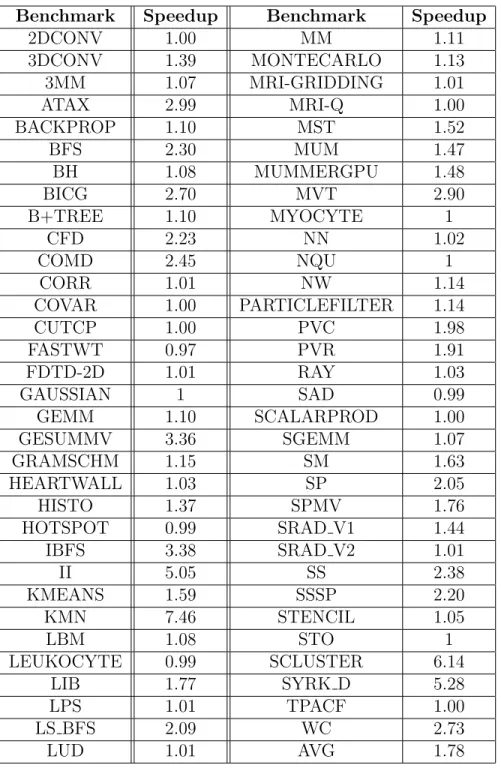
Benchmark Selection Criteria: To evaluate our work, we select cache-sensitive benchmarks from a large collection of applications that include NVIDIA SDK [64], PolyBench [20], Parboil [85], Mars [23], Rodinia [10], LonestarGPU [7] and CoMD [29]. Due to long simulation periods, we execute some applica-tions only up to the point where overall IPC exhibits small variaapplica-tions among different iterations of the kernel. We select cache-sensitive benchmarks us-ing the followus-ing criteria: all the benchmarks are simulated with the baseline configuration as in Table 3.4 plus a large-cache configuration where the L1 and L2 capacity are increased to 16 times larger of the baseline configuration. An application is classified as cache-sensitive if the large-cache configuration achieves a speedup of 2X or higher compared to the baseline configuration. For applications from different benchmark sets but with similar functionality, only one of multiple instances is kept. Table 3.1 shows the speedup that the large-cache configuration achieves over the baseline configuration. Table 3.2 lists the selected cache-sensitive benchmarks based on the benchmark selection criteria.
3.4.2 Thread Scheduling Effects on Cache Efficiency and Through-put
GPU cache access patterns are largely shaped by the thread sched-uler. The scheduling algorithm affects the cache efficiency significantly. Cache
Table 3.1: Speedup normalized to the baseline Fermi configuration, when in-creasing L1 and L2 cache capacity to 16X
Benchmark Speedup Benchmark Speedup
2DCONV 1.00 MM 1.11 3DCONV 1.39 MONTECARLO 1.13 3MM 1.07 MRI-GRIDDING 1.01 ATAX 2.99 MRI-Q 1.00 BACKPROP 1.10 MST 1.52 BFS 2.30 MUM 1.47 BH 1.08 MUMMERGPU 1.48 BICG 2.70 MVT 2.90 B+TREE 1.10 MYOCYTE 1 CFD 2.23 NN 1.02 COMD 2.45 NQU 1 CORR 1.01 NW 1.14 COVAR 1.00 PARTICLEFILTER 1.14 CUTCP 1.00 PVC 1.98 FASTWT 0.97 PVR 1.91 FDTD-2D 1.01 RAY 1.03 GAUSSIAN 1 SAD 0.99 GEMM 1.10 SCALARPROD 1.00 GESUMMV 3.36 SGEMM 1.07 GRAMSCHM 1.15 SM 1.63 HEARTWALL 1.03 SP 2.05 HISTO 1.37 SPMV 1.76 HOTSPOT 0.99 SRAD V1 1.44 IBFS 3.38 SRAD V2 1.01 II 5.05 SS 2.38 KMEANS 1.59 SSSP 2.20 KMN 7.46 STENCIL 1.05 LBM 1.08 STO 1 LEUKOCYTE 0.99 SCLUSTER 6.14 LIB 1.77 SYRK D 5.28 LPS 1.01 TPACF 1.00 LS BFS 2.09 WC 2.73 LUD 1.01 AVG 1.78
Table 3.2: Cache-sensitive CUDA benchmarks
Abbreviation Description Ref.
CoMD Molecular Dynamics [29]
II Inverted Index [23]
BFS Breadth first search [7]
CFD CFD solver [10]
KMN K-means [77]
SM String Match [23]
SS Similarity Score [23]
SCLUSTER Streamcluster [10]
SSSP Single-source shortest paths [7]
ATAX Matrix-transpose-vector multiply [20] BICG BiCGStab linear solver sub-kernel [20] GESUMMV Scalar-vector-matrix multiply [20] MVT Matrix-vector-product transpose [20] SP Survey Propagation, a heuristic SAT-solver [7]
Table 3.3: Classifying Benchmarks by scheduler preference
Groups Definition Number
of Bench-marks LRR-Preferred LRR algorithm outperforms GTO
by more than 5%
5
GTO-Preferred GTO algorithm outperforms LRR by more than 5%
18
No Preference The throughput difference be-tween LRR and GTO is less than 5%
42
oblivious replacement algorithms including LRU are not able to capture the scheduler-algorithm specific reuse patterns. Prior research [77] demonstrates that the GTO algorithm performs best among these scheduling algorithms. We evaluate the LRR, GTO and TwoLev scheduling algorithms across 65 benchmarks.
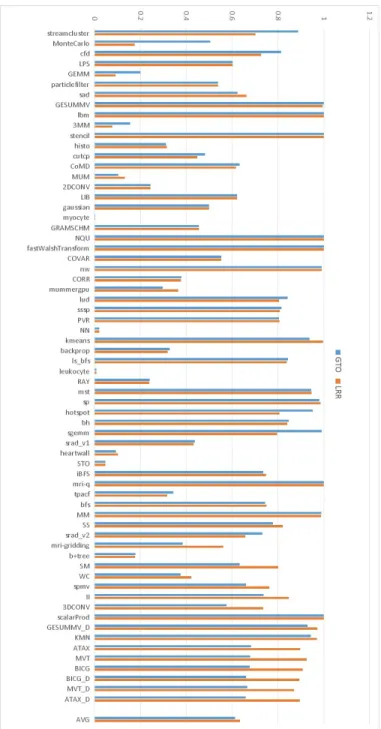
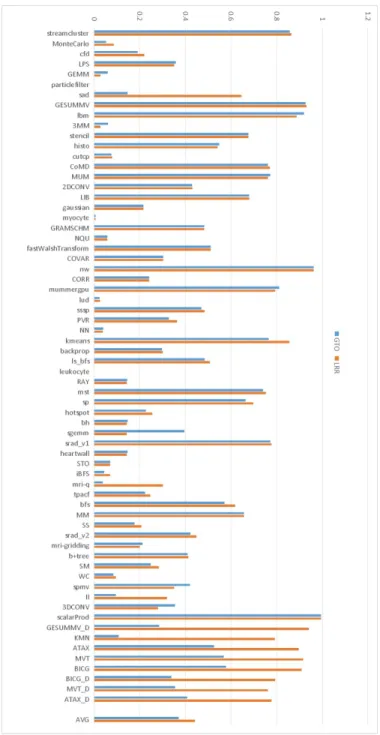
Figure 3.3 shows the speedup of the GTO algorithm normalized to the LRR algorithm. A benchmark with a speedup value smaller than one means the benchmark works better with the LRR algorithm. Likewise, a speedup value bigger than one means the corresponding benchmark works better with the GTO algorithm. To better understand the thread scheduling algorithm effects on performance, we classify all benchmarks into three categories by their scheduling algorithm preference. The results are shown in Table 3.3. Among the 65 benchmarks we evaluate, 42 benchmarks are not sensitive to the scheduling algorithm. 18 benchmarks achieve more than 5% speedup with the GTO algorithm while there are only 5 benchmarks that perform better with the LRR algorithm. Figure 3.4 compares the L1 data cache miss rate
Figure 3.3: Speedup of Greedy-Then-Oldest (GTO) algorithm, normalized to throughput of Loose-Round-Robin (LRR) Scheduling algorithm
Figure 3.4: Comparing L1 data cache miss rate of Greedy-Then-Oldest (GTO) algorithm and Loose-Round-Robin (LRR) scheduling algorithm
Figure 3.5: Comparing L2 data cache miss rate of Greedy-Then-Oldest (GTO) algorithm and Loose-Round-Robin (LRR) scheduling algorithm
between the GTO algorithm and the LRR algorithm. Similarly, Figure 3.5 compares the L2 miss rate for these two scheduling algorithms. As shown in these figures, the benchmarks that prefer GTO algorithms do so mostly because they get lower L1 and L2 data cache miss rates when the GTO algo-rithm is applied.These results match prior studies [77] in terms of scheduling algorithm preference. Therefore, we choose the GTO algorithm as the default thread/warp scheduling algorithm in our study. In this dissertation, we advo-cate that the cache replacement and bypassing algorithm must consider the effect of the thread scheduling algorithm. Based on the scheduling algorithm comparison, we select GTO as the most effective scheduling algorithm. In Chapter 5 and Chapter 6, we develop thrash-resistant and pollution-resistant GPU cache algorithms adapting to the GTO thread scheduling algorithm.
3.5
Methodology
We model the proposed architecture using GPGPU-Sim (version 3.2.1) [1, 4], which is a cycle-level performance simulator of a general purpose GPU ar-chitecture supporting CUDA [65]4.2 and its PTX ISA [66]. The GPU simulator is configured to be similar to NVIDIA GTX480 [63] using the configuration file provided with GPGPU-Sim [2]. Compared with NVIDIA GPUs, GPGPU-Sim obtains IPC correlation of 97.3% on Rodinia benchmarks [10]. Key microarchi-tectural parameters of the baseline configuration are summarized in Table 3.4. We augment the baseline GPGPU-Sim model with cache set index hash-ing to improve memory system robustness. We implement set hashhash-ing at the
Table 3.4: Baseline GPGPU-Sim configuration.
Number of SMs 15
Threads per SM 1536
Threads per warp 32
SIMD lane width 32
Registers per SM 32768
Shared memory per SM 48KB
Schedulers per SM 2
Warps per schedulers 24
Warp scheduling policy Greedy-Then-oldest [77] L1 cache (size/assoc/block size) 16KB/4-way/128B L2 cache (size/assoc/block size) 768KB/16-way/128B
Number of memory channels 6
Memory bandwidth 179.2 GB/s
Memory controller Out-of-order (FR-FCFS)
L1 and L2 to better distribute memory accesses among cache banks to mitigate the effect of bank conflicts and reduce “bank camping” where regular access patterns produce excessive contention for a small subset of cache banks. Any additional deviations to the baseline model are described in the context of the architecture sensitivity studies in the related chapters.
Chapter 4
Thread Scheduler Directed Priority-based
Cache Allocation
In this chapter, we enhance the GPU thread scheduler with a mecha-nism called Priority-based Cache Allocation (PCAL) to address inter-thread L1 cache thrashing and the chip resource saturation problem.
First we motivate this research by investigating how the parallelism that a GPU supports affects the throughput and the chip resource utilization. We demonstrate that throttling techniques [39] [77] are able to reduce the cache miss rate and improve the overall performance, however throttling techniques leave memory bandwidth and other chip resources significantly under-utilized. We observe that the underutilized resources could be sufficient to support extra threads without further polluting the cache.
Next, based on the observations, we propose PCAL to alleviate the L1 cache thrashing problem and the memory system resource saturation. The PCAL-enhanced scheduler separates the concerns of the cache thrashing and the chip resource saturation problem by allowing the total number of threads to be be different with the number of threads to allocate the cache. PCAL exploits the available performance improvement with two optimization
strate-gies, either increasing Thread-Level Parallelism (TLP) while maintaining cache hit ratio, or optimizing cache hit ratio while maintaining TLP. PCAL assigns tokens to threads to indicate their privilege to allocate space in the cache, and gives preferential access to the cache and other on-chip resources to a subset of the threads (i.e. Token-holder threads), allows another subset of threads (i.e. Non-token holder threads) to bypass the caches, and throttles the remaining threads to avoid additional memory access latency. This approach reduces the cache thrashing problem and effectively employs the chip resources that would otherwise go unused by a pure thread throttling approach [39] [77].
Next, we describe the mechanisms for implementing PCAL. We intro-duce an initial implementation of this technique with a static optimization strategy and parameter selection, called static PCAL. We develop a priority-based cache management strategy tailored to the needs of massively threaded processors with limited per-thread cache capacity. Priority tokens are assigned to warps and grant priority to perform various cache actions, including alloca-tion (fill) and replacement (evicalloca-tion). We describe how priority tokens can be used to influence caching and scheduling policy. We describe mechanisms and policies for assignment, transfer, and release of these cache priority tokens.
Next, we introduce a variant of PCAL with a dynamic parameter se-lection mechanism, called dynamic PCAL, to adaptively determine the pa-rameters of PCAL . Dynamic PCAL monitors the key statistics of memory system including cache miss ratio, memory pipeline stall, Miss Status Holding Registers (MSHR) reservation failure, L1 block reservation failure,
Network-on-Chip (NoC) transmission latency. Based on this statistics, it dynamically determines the number of threads to allocate the cache and the number of threads bypassing the cache.
We then describe several extensions to the baseline design, such as optimization bypassing traffic by only fetching a portion of the cache block and applying PCAL to the L2 in addition to the L1. At the end, we analyze the experimental results, and observe 67% improvement over the original as-is code and a 18% improvement over a better-tuned warp-throttling baseline.
4.1
Understanding How Parallelism Affects Caches Hit
Ratio, Chip Resource Saturation and Throughput
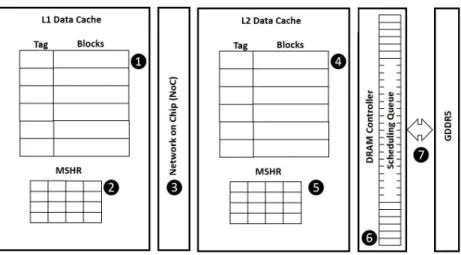
GPGPU programming models, such as CUDA [65] and OpenCL [3], encourage the programmers to expose a large amount of parallelism. However GPU often can not achieve a high occupancy due to control divergence [16] [17] [57] [90] [59] [72] [74] [73] [95] and insufficient memory throughput [57] [39] [77]. This work aims to improve cache efficiency to achieve higher GPU memory system throughput. Mapping the maximum amount of parallel work that the hardware can support often leads to cache thrashing and chip resources saturation problem and thus does not necessarily ensure the best overall per-formance.Figure 4.1 shows the chip resources that a GPU memory system inte-grates, including the L1 and L2 cache blocks (Ê and Í in Figure 4.1), the L1 and L2 MSHR tables (ËandÎin Figure 4.1), the Network-on-Chip bandwidth
Figure 4.1: Chip Resources in a GPU Memory System.
(Ì in Figure 4.1), the DRAM controller scheduling queue (Ï in Figure 4.1) and the Off-chip bandwidth (Ð in Figure 4.1). A memory request, depend-ing on whether it hits the L1 or L2 cache, consumes a subset of these chip resources to fetch a data block from the GPU memory system. For instance, when a load request misses both the L1 and L2 caches, in order to fetch a data block from the main memory, it needs to reserve a L1 cache block, a L1 MSHR table entry, a L2 cache block, a L2 MSHR entry and a DRAM con-troller scheduling queue entry. It consumes both the NoC bandwidth and the off-chip bandwidth. If the resources are already in use, the request stalls until the resource become available again.
To investigate how parallelism affects the cache hit ratio, memory sys-tem utilization and the GPU performance, we characterize a set of cache-sensitive applications by statically varying the maximum number of warps that each thread scheduler allows. Our baseline GPU, simulating a
contem-porary Fermi GPU, allows up to 24 warps per scheduler. When we limit the number of warps per scheduler, we limit the number of warps that a scheduler can select instruction from.
4.1.1 Throughput
Figure 4.2 shows how the Instruction-Per-Cycle (IPC) and the speedup vary with hardware-resident warp count per scheduler for a subset of the bench-marks. For many applications, running with the maximum thread-level par-allelism that the hardware can support does not result in the best application performance. For instance, CoMD performs best with only 6 of 24 warps enabled. Others, like KMN, show no benefit from additional warps beyond one.
To establish a firmer baselines for comparison, we define warp-max as the maximum number of warps that fit per scheduler and warp-opt as the number of warps per scheduler that provides the best performance. The value of warp-max is not only limited by the number of threads a SM supports, but also by the other resource constrains such as the total share memory size that all threads declare can not exceed the share memory capacity that the GPU supports. Roughly, warp-max represents naive code and warp-opt represents software better tuned to our machine configuration. Table 4.1 summarizes the default (max) warp count and performance-optimal warp count.Compared to the warp-max configurations, the speedups that warp-opt configurations provide are also summarized in the table.
(a) IPC
(b) Speedup
Figure 4.2: IPC and Speedup. Varying maximum number of warps per sched-uler.
Table 4.1: warp-maxand warp-opt for key benchmarks
.
application warp-max warp-opt Speedup
CoMD 16 6 1.53 II 24 2 1.24 BFS 24 8 1.02 KMN 24 1 2.68 SM 24 2 1.18 SS 24 2 1.11 SSSP 24 8 1.05 SCLUSTER 24 4 2.44 ATAX 4 4 1 BICG 4 4 1 GESUMMV 4 1 1.69 MVT 4 4 1
4.1.2 Cache Miss Ratio
Figure 4.3a and Figure 4.3b demonstrate how the local L1 miss rate and the global miss rate (ratio of memory requests that miss both L1 and L2 cache) vary with hardware-resident warp count per scheduler. When warp count per scheduler increases from one to maximum, the total TLP increases. However, for many applications, both the L1 and global miss rate increase dramatically with a higher TLP. In this case, the cache thrashing prevents the L1 data cache from capturing most data reuse. The overall cache miss ratio also increase significantly with a higher TLP. For instance, the L1 miss rate of CoMD increases from 7% to 64% when warp count per scheduler increases from one to eight. The global miss rate of CoMD increase from 3% to 48%,
(a) L1 miss ratio
(b) Global miss ratio (L1 miss ratio * L2 miss ratio)
Figure 4.3: L1 and global cache miss ratio. Varying maximum number of warps per scheduler.
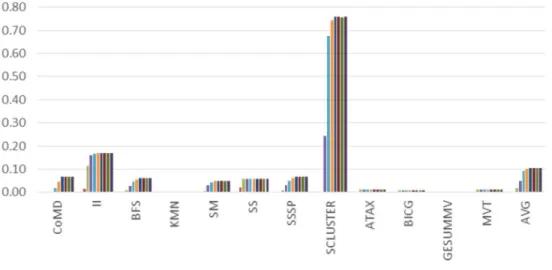
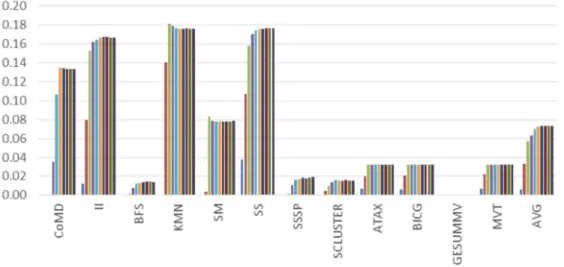
showing a very similar trend as L1 miss rate with a higher TLP. The optimal warp count per scheduler is a trade-off between overall TLP and cache miss ratio. For example, CoMD performs best with 6 warps per scheduler, which leads to neither highest TLP nor lowest cache miss ratio.
4.1.3 Memory Request Latency
When a resource in the GPU memory system is saturated by the out-standing memory requests, the memory requests can not move forward until the resource becomes available again. This saturation-induced latency in-creases dramatically with a higher TLP. We measure this effect with the aver-age round-trip latency of the memory requests that miss both the L1 and L2 cache. The round-trip latency of a memory request is defined as the number of cycles after the request misses the L1 cache for it to go through the memory hierarchy to fetch the data block from the main memory and come back to the SM.
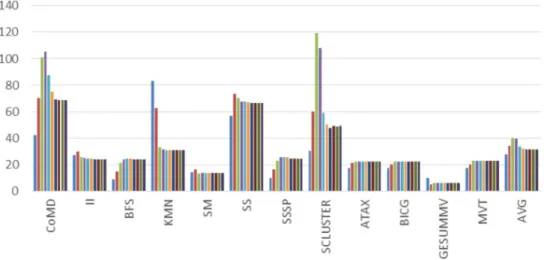
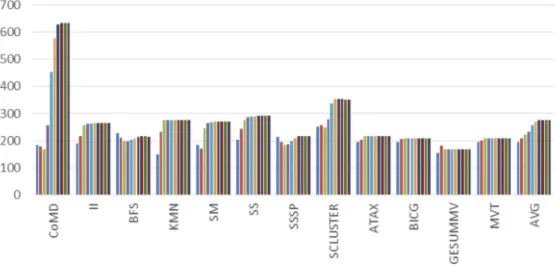
Figure 4.4 shows the average round-trip latency of all memory requests when varying the number of warps per scheduler. The minimal round-trip latency is about 200 cycles. However, when the total TLP increases, some benchmarks experience dramatic round-trip latency increases. For instance, when the TLP increases, the round-trip latency of CoMD increases from less than 200 cycles to more than 600 cycles. In this case, the memory system gets saturated and becomes a performance bottleneck of the GPU.
Figure 4.4: Round-trip latency of memory requests. Varying number of warps per scheduler.
4.1.4 Chip Resource Utilization
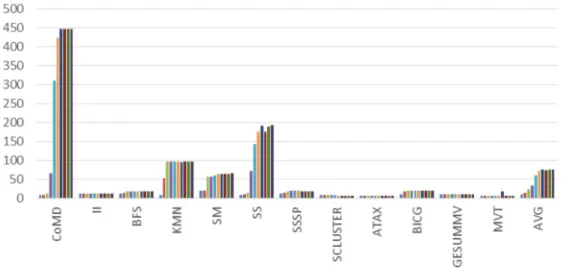
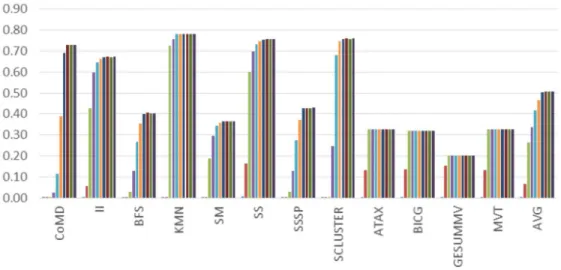
When the TLP increases, the GPU memory system throughput de-grades for two reasons: (1) cache thrashing, which we discussed in Section 4.1.2, (2) chip resource saturation, which often leads to a large memory latency in-creases. These two problems often happen simultaneously. Cache thrashing leads to more outstanding requests and more resource saturations, which in turn increases memory latencies and activates more memory requests to further thrash the cache. In this section, we measure the NoC latency, the memory pipeline stall ratio, the memory partition congestion ratio and the off-chip bandwidth utilization, to identify