Grasshopper Basics And Concepts
Release 2.2
IKV++ GmbH Bernburger Strasse 24-25 10963 Berlin, Germany http://www.grasshopper.deAll Rights Reserved.
Grasshopper, Release 2.2, Basics and Concepts (Revision 1.0), March 2001.
The Grasshopper Basics and Concepts manual is copyrighted and all rights are reserved. Informa-tion in this document is subject to change without notice and does not represent a commitment on the part of IKV++ GmbH. The document may not, in whole or in part, be copied, photocopied, reproduced, translated, or reduced to any electronic medium or machine-readable form without prior consent, in writing, from IKV++ GmbH.
A Reader’s Comment form is included as part of the distribution. Please complete this form to assist IKV++ in preparing future documentation.
Java and all Java-based trademarks and logos are trademarks or registered trademarks of Sun Mi-crosystems, Inc. in the U.S. and other countries.
Microsoft, Windows, and Windows NT are trademarks or registered trademarks of Microsoft Cor-poration in the U.S. and other countries.
All other names are used for identification purposes only and are trademarks or registered trade-marks of their respective companies.
IKV++ GmbH
Informations- und Kommunikationssysteme Bernburger Str. 24-25
D-10963 Berlin Germany
Email: [email protected]
Contents
Contents ... I List of Figures... III List of Tables ... V
1 Preface ... 1
1.1 About this Document ... 1
1.2 Document Structure... 1
1.3 Related Documents ... 2
1.4 Notational Conventions... 2
1.4.1 Fonts ... 2
1.4.2 Icons ... 3
1.5 How to Get in Contact... 4
2 What is Grasshopper? ... 5
3 Concepts... 7
3.1 Distributed Agent Environment ... 7
3.1.1 Agents... 8 3.1.1.1 Mobile Agents ... 8 3.1.1.2 Stationary Agents ... 9 3.1.1.3 Agent States ... 9 3.1.2 Agencies ... 10 3.1.2.1 Core Agency... 10 3.1.2.2 Places... 13 3.1.3 Regions... 13 3.1.3.1 Region Registries ... 13 3.2 MASIF... 14 3.3 Communication Concepts ... 15 3.3.1 Multi-protocol Support... 15 3.3.2 Location Transparency ... 18
3.3.3 Communication Modes ... 19 3.3.3.1 Synchronous Communication ... 20 3.3.3.2 Asynchronous Communication... 20 3.3.3.3 Dynamic Communication ... 21 3.3.3.4 Multicast Communication... 22 3.3.4 Grasshopper URL ... 25 3.4 Security Concepts ... 27 3.4.1 Cryptography... 29 3.4.1.1 Symmetric Algorithms ... 30 3.4.1.2 Asymmetric Algorithms... 30
3.4.1.3 One-Way Hash Functions ... 31
3.4.2 Authentication... 32
3.4.3 X.509 Certificates ... 32
3.4.4 Access Control ... 34
3.4.4.1 Protection of Resources ... 34
3.4.4.2 Access Control Policies ... 34
3.4.5 Security in Grasshopper ... 35
3.4.5.1 External Security... 35
3.4.5.2 Internal Security... 37
3.5 Persistence ... 38
4 Frequently Asked Questions... 41
4.1 Mobility... 41
4.2 Communication... 41
4.3 Security ... 42
4.3.1 Certificates and Encryption... 42
4.3.2 Permissions and Access Control ... 46
4.4 Installation ... 49
List of Figures
FIGURE 1: HIERARCHICAL COMPONENT STRUCTURE... 7
FIGURE 2: MULTI-PROTOCOL SUPPORT... 16
FIGURE 3: SECURE VS. INSECURE PROTOCOLS... 18
FIGURE 4: LOCATION TRANSPARENT COMMUNICATION... 19
FIGURE 5: SYNCHRONOUS COMMUNICATION... 20
FIGURE 6: ASYNCHRONOUS COMMUNICATION... 21
FIGURE 7: MULTICAST COMMUNICATION... 23
FIGURE 8: OR TERMINATION... 23
FIGURE 9: AND TERMINATION... 24
FIGURE 10: INCREMENTAL TERMINATION... 25
FIGURE 11: POTENTIAL SECURITY ATTACKS... 28
FIGURE 12: PROVIDING CONFIDENTIALITY USING PUBLIC KEY ALGORITHMS... 31
FIGURE 13: PROVIDING AUTHENTICATION USING PUBLIC KEY ALGORITHMS... 32
List of Tables
TABLE 1: NOTATIONAL CONVENTIONS... 3
TABLE 2: ICONS... 4
1 Preface
This chapter provides information about this document itself as well as about the remaining parts of the Grasshopper manual.
1.1 About this Document
This document describes Basics and Concepts of mobile agent technology in general and of the Grasshopper platform in particular. However, it is as-sumed that the principles of mobile agent technology are not completely new to the reader, since this document is not meant as a mobile agent tutorial. The intention is just to give the reader some fundamental background infor-mation before using the Grasshopper platform.
1.2 Document Structure
This document is subdivided into the following seven chapters.
CHAPTER 1, Preface, this part of the document, gives an overview of this manual and its background.
CHAPTER 2, What is Grasshopper?, gives a very brief description of the
Grasshopper platform.
CHAPTER 3, Concepts,describes the basic terms associated with the Grass-hopper environment, such as agents, agencies, and regions. Besides, the Grasshopper communication, security, and persistence mecha-nisms are explained in detail.
CHAPTER 4, Frequently Asked Questions
ANNEX A, Acronyms ANNEX B, Glossary ANNEX C, Index
1.3 Related Documents
The whole Grasshopper manual comprises four parts:
Basics and Concepts. This part comprises an introduction to mobile agent
technology and to the Grasshopper platform.
User’s Guide. This part describes the platform installation and its usage via
graphical and command line interfaces.
Programmer’s Guide. This part explains how to realise mobile and
station-ary agents on top of the Grasshopper platform.
Release Notes. This part lists modifications and enhancements compared to
the previous release of Grasshopper.
1.4 Notational Conventions
Several notational conventions are used throughout the whole document in order to improve the readability and to support the reader in finding specific information.
1.4.1 Fonts
The following font types are used through this manual:
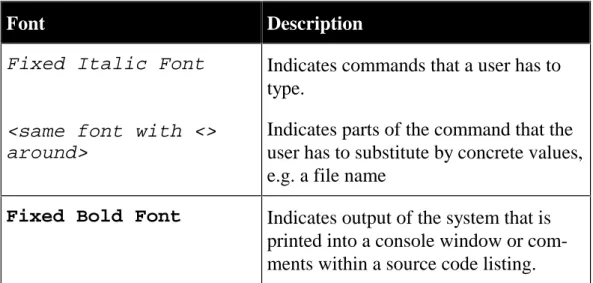
Font Description
Proportional Font Used for standard text
Proportional Italic Font Used to emphasise words or to indicate the first appearance of new terms that can be found in the glossary (Annex 0 of this manual) or in background informa-tion boxes marked with the correspond-ing icon (cf. Section 1.4.2)
Fixed Font Used to identify source code, email
Font Description Fixed Italic Font
<same font with <> around>
Indicates commands that a user has to type.
Indicates parts of the command that the user has to substitute by concrete values, e.g. a file name
Fixed Bold Font Indicates output of the system that is printed into a console window or com-ments within a source code listing. Table 1: Notational Conventions
1.4.2 Icons
The following icons are placed at the page margins in order to indicate cer-tain types of information:
This icon indicates information that is specific for Unix operating systems.
This icon indicates information that is specific for Win-dows operating systems.
This icon indicates paragraphs that provide some back-ground information about a specific topic. This informa-tion is not required for the understanding of the respec-tive section and may be skipped by the reader. However, it may be interesting for readers who want to know more about the concepts realised by the Grasshopper platform. This background information is additionally highlighted by means of a shaded frame.
This icon indicates useful tips and tricks that facilitate the usage of Grasshopper.
This icon indicates paragraphs that are of particular im-portance and that should be read in any case, even if you want to go through the document as fast as possible.
This icon is used to indicate examples.
Table 2: Icons
1.5 How to Get in Contact
To make suggestions, critics, or even compliments, please send an email to
In order to retrieve the comments of other Grasshopper users and participate in discussions, please consult the Grasshopper community discussion board at http://www.grasshopper.de/community.
2 What is Grasshopper?
Mobile agent technology is a relatively new area in the field of distributed applications. Mobile agents are software components which are able to mi-grate actively from one physical network location to another. By moving to locations where required information or logic is hosted, mobile agents are able to take advantage of local communication instead of interacting re-motely via the network.
Grasshopper is a mobile agent platform that is built on top of a distributed processing environment. In this way, an integration of the traditional cli-ent/server paradigm and mobile agent technology can be achieved.
Grasshopper is developed compliant to the first mobile agent standard of the Object Management Group (OMG), i.e. the Mobile Agent System Interoperability Facility (MASIF). The MASIF standard has been initiated in order to achieve interoperability between mobile agent platforms of different manufacturers.
3 Concepts
This chapter provides background information about the concepts of the Grasshopper platform. Among others, this background information com-prises the Grasshopper agent environment as well as realised communication and security mechanisms.
3.1 Distributed Agent Environment
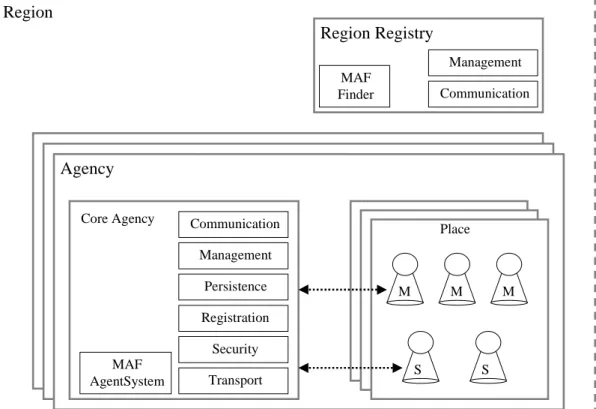
This section describes the structure of the Grasshopper Distributed Agent Environment (DAE). The DAE is composed of regions, places, agencies and different types of agents. Figure 1 depicts an abstract view of these entities.
Agency
Core Agency Communication
Registration Transport Security Management Persistence MAF AgentSystem M S M M S Place Region MAF Finder Communication Management Region Registry
3.1.1 Agents
Up to now, there is no unique definition of a (software) agent. However, agents can be characterised by a set of attributes. The only attribute that is commonly accepted is autonomy. Taking this into account, an agent is a computer program that acts autonomously on behalf of a person or organisa-tion.
Two types of agents act in the Grasshopper context, i.e. stationary agents and mobile agents.
3.1.1.1 Mobile
Agents
Mobile agents are able to move from one physical network location to an-other. In this way, they can be regarded as an alternative or enhancement(!) of the traditional client/server paradigm. While client/server technology re-lies on remote procedure calls across a network, mobile agents can migrate to the desired communication peer and take advantage of local interactions. In this way, several advantages can be achieved, such as a reduction of net-work traffic or a reduction of the dependency of netnet-work availability. Note that mobile agent technology is often regarded as a replacement of the cli-ent/server paradigm. In contrast to this, by building Grasshopper upon a dis-tributed, object-oriented middleware, an integration of both approaches is achieved.
Note that an integration of mobile agent technology and client/server tech-nology includes that an agent may be realised either as client or as server. By doing this it is possible for a client agent to migrate to a (traditional) server or for a server agent to migrate to a (traditional) client, thus taking advantage of local interactions instead of communicating via RPC. On the other hand it is possible for two mobile agents to communicate remotely, i.e. not to meet at a common location. It is very important to evaluate for each scenario both possibilities, i.e. to decide whether to use migration plus local interactions or to use remote interactions instead.
There is a significant difference between mobile agents and simple "tradi-tional" mobile code. This difference can be described by two kinds of mo-bility, i.e. remote execution and migration.
Remote Execution
Remote execution, known from traditional mobile code, means that a pro-gram is sent to a remote location before its activation. The propro-gram remains at this location during its entire life time.
Migration
Migration means that a program (a mobile agent) is able to change its loca-tion during its execuloca-tion. A mobile agent may start its execuloca-tion at localoca-tion A, migrate to location B, and continue its execution at location B exactly at the point at which it has been interrupted before the migration.
3.1.1.2 Stationary
Agents
In contrast to mobile agents, stationary agents do not have the ability to mi-grate actively between different network locations. Instead, they are associ-ated with one specific location.
3.1.1.3 Agent
States
During their life cycle, agents can reside in different states. Grasshopper compliant agents can normally be in one of the following states: active, sus-pended, or flushed.
Active
An agent is active if it is currently performing its task. An active agent can be suspended or deactivated.
Suspended
An agent is suspended if its task execution is temporarily interrupted. How-ever, the agent remains instantiated and continues its task execution when it is resumed. A suspended agent is unable to communicate and thus not reach-able by other parties.
Flushed
A flushed agent is not active any more. Instead, all relevant internal infor-mation is permanently stored, e.g. on a hard disk. A flushed agent can be activated again. This means, a new instance of the agent is created, this new instance is supplied with the execution-relevant data, and the agent continues its task execution. In contrast to the suspended state, a flushed agent behaves
the same way as an active one from the viewpoint of other agent. On in-coming communication requests the agent will be reactivated automatically.
3.1.2 Agencies
An agency is the actual runtime environment for mobile and stationary agents. At least one agency must run on each host that shall be able to sup-port the execution of agents. A Grasshopper agency consists of two parts, i.e. the core agency and one or more places.
3.1.2.1 Core
Agency
Core Agencies represent the minimal functionality required by an agency in order to support the execution of agents. The following services are provided by a Grasshopper core agency:
Communication Service
This service is responsible for all remote interactions that take place between the distributed components of Grasshopper, such as location-transparent in-ter-agent communication, agent transport, and the localisation of agents by means of the region registry. All interactions can be performed via CORBA IIOP, Java RMI, or plain socket connections. Optionally, RMI and plain socket connections can be protected by means of the Secure Socket Layer (SSL) which is the de-facto standard Internet security protocol. The commu-nication service supports synchronous and asynchronous commucommu-nication, multicast communication, as well as dynamic method invocation.
For detailed information about the Grasshopper communication service, please refer to Section 3.3.
Registration Service
Each agency must be able to know about all currently hosted agents and places, on the one hand for external management purposes and on the other hand in order to deliver information about registered entities to hosted agents. The registration service is developed to achieve this.
Besides, the registration service of each agency is connected to the region registry (cf. Section 3.1.3) which maintains information of agents, agencies and places in the scope of a whole region.
Management Service
Management services are developed to allow the monitoring and control of agents and places of an agency by external (human) users. Among others, the following functionality is supported:
Create, remove, suspend and resume agents and places
Get information about specific agents and places
List all agents residing in a specific place
List all places of an agency
Apart from this, configuration management enables human users to specify system, trace, security and communication properties. For detailed informa-tion about the configurainforma-tion of the Grasshopper platform, please refer to the User’s Guide.
Transport Service
This service supports the migration of agents from one agency to another. At the destination agency, the agent continues its task processing exactly at the point where it has been interrupted before the migration. The transport serv-ice handles the externalisation and internalisation of agents, and the co-ordination of the actual transfer which is performed by the communication service.
Security Service
Grasshopper supports two kinds of security mechanisms, i.e. external and internal security.
External security protects remote interactions between the distributed
Grasshopper components, i.e. agencies and region registries. For this pur-pose, X.509 certificates and the Secure Socket Layer (SSL) are used. SSL is an industry standard protocol that makes substantial use of both symmetric and asymmetric cryptography. By using SSL, confidentiality, data integrity, and mutual authentication of both communication partners can be achieved.
Internal security protects agency resources from unauthorised access by
agents. Besides, it is used to protect agents from each other. This is achieved by authenticating and authorising the user on whose behalf an agent is exe-cuted. Due to the authentication/authorisation results, access control policies
are activated. Internal security within Grasshopper is mainly based on the security mechanisms provided by JDK.
For detailed information about the Grasshopper security service, please refer to Section 3.4.
Persistence Service
The Grasshopper persistence service enables the storage of agents and places, i.e. the internal information maintained inside these components, on a persistent medium. In this way it is possible to recover agents or places when needed, e.g. when an agency is restarted after a system crash. Two types of persistence are distinguished, namely implicit and explicit persistence.
Implicit persistence: When the persistence service is activated, places are
automatically persistent when they are created. That means, a place exists even after the agency has been shut down, and the place will be available again after restarting the agency. The agency owner may also enable the automatic saving of all agents when the agency shuts down. Note that im-plicit persistence is not visible for agent programmers. Instead, it is config-ured and activated by agency administrators.
Explicit persistence: Three mechanisms can be distinguished:
An agent is persistently stored periodically after a certain time interval with-out suspending its task execution. The time interval is specified by the agent itself, and after this the agent need not care about the maintenance of its in-formation, since this is done automatically by the persistence service. This mechanism is useful to enable the recovery of agents when an agency is re-started, e.g. after a system crash.
Agents may order the persistence service to terminate them after a certain time of idle processing, i.e. after they have not been used by other entities for a certain period of time. However, the agents remain registered within the agency and the region registry, so that they can be restarted if other entities try to access them. This mechanism is useful to save agency resources.
Agents can be stored explicitly at any time on their own behalf or on behalf of a human user, e.g. the agency administrator. This is useful e.g. if the agency has to be temporarily terminated.
The core functionality explained above can be enhanced in a comfortable way by means of that agents can be created in (or move to) places of an agency.
3.1.2.2 Places
A place provides a logical grouping of functionality inside an agency. For example, there may exist a communication place offering sophisticated communication features, or there may be a trading place where agents offer or buy information or service access. The name of the place should reflect its purpose. For example, in every agency exists by default a place named "In-formationDesk". Every agent with no determined place is transported to the "InformationDesk" where it can look for further information.
3.1.3 Regions
The region concept facilitates the management of the distributed components in the Grasshopper environment, i.e. agencies, places, and agents. Agencies as well as their places can be associated with a specific region, i.e. they are registered within one region registry (cf. Section 3.1.3.1). Each registry automatically registers each agent that is currently hosted by an agency asso-ciated with the region. If an agent moves to another location, the corre-sponding registry information is automatically updated. A region may com-prise all agencies belonging to a specific company or organisation, thus fa-cilitating its management.
3.1.3.1 Region
Registries
A region registry maintains information about all components that are asso-ciated with a specific region. When a new component (i.e. an agency, place, or agent) is created, it is automatically registered within the corresponding region registry. While agencies and their places are associated with a single region for their entire life time, mobile agents are able to move between the agencies of different regions. The current location of mobile agents, i.e. the agency and place in which they are residing, is updated in the corresponding region registry after each migration. By contacting the region registry, other entities (including agents and human users) are at any time able to locate agents, places, and agencies residing in a region. Besides, a region registry facilitates the connection establishment between agencies or agents. For in-stance, agent A which wants to communicate with agent B is able to estab-lish a connection just by knowing the identifier of agent B. The Grasshopper communication service automatically determines the current location of agent B by contacting the region registry and establishes the connection. The same applies to agent migration: An agent is able to migrate just by knowing the name of the desired destination agency. The host name, port number, and
supported transport protocol of the destination is automatically detected by the source agency by contacting the region registry.
Note that the Grasshopper environment can be established even without a region registry. However, in this case agents and agencies must know all in-formation that is required for remote interactions, such as host name, port numbers, communication protocols, etc.
If the Grasshopper environment shall be established with a region registry (what is strongly recommended), the registry must be started before the first agency is created. The registry is not able to register agencies which have been created before the creation of the registry.
3.2 MASIF
Mobile agents represent a relatively new technology. Today, a large number of mobile agent platforms exist which differ widely in architecture and im-plementation. These differences prevent any interoperability between MA platforms. However, interoperability between systems of different vendors or manufacturers is a fundamental requirement in order to fulfil the needs of the upcoming open service market. Since the basis for interoperability is the standardisation of the used technology, one requirement regarding mobile agent platforms is standard compliance.
Currently, the most important standardisation body in the area of mobile agents is the Object Management Group (OMG) with its Mobile Agent
Sys-tem Interoperability Facility (MASIF) specification. The MASIF standard
has been adopted as new OMG technology in February 1998. It comprises several important aspects, such as agent management, mobility, naming, and tracking. Probably, further agent standards will be initiated by the OMG which will all together build a widely accepted standardisation framework for mobile agent technology.
In order to meet future requirements and to provide openness to platforms of different vendors, Grasshopper is developed compliant to the OMG MASIF standard. To do so, you will have to download the Grasshopper MASIF Add-on from http://www.grasshopper.de/.
3.3 Communication Concepts
This section explains the communication concepts of the Grasshopper plat-form. These concepts are realised by means of the Grasshopper
communica-tion service (CS) which is an essential part of each core agency (cf. Seccommunica-tion
3.1.2.1). The communication service allows location-transparent interactions between agents, agencies, and non-agent-based entities.
Alternatively to the communication service, Grasshopper can use its OMG MASIF-compliant CORBA interfaces for remote interactions (cf. Section 3.2). For this purpose, each agency provides the interface MAFAgentSystem, and each region registry provides the interface MAFFinder. Both are defined in the MASIF standard which is available on the OMG FTP server. Note that the following sections only describe the Grasshopper communication serv-ice. Detailed information about MASIF can be found in the standard itself.
3.3.1 Multi-protocol
Support
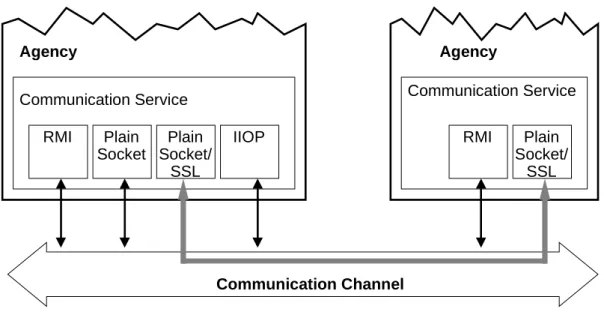
Remote interactions are generally achieved by means of a specific protocol. The CS supports communication via the Internet Inter-ORB Protocol (IIOP), Java’s Remote Method Invocation (RMI), and plain socket connections. To achieve a secure communication, RMI and the plain socket connection can optionally be protected with the Secure Socket Layer (SSL) (cf. Section 3.4).
RMI Plain Socket Plain Socket/ SSL RMI Plain Socket/ SSL Communication Service Communication Service
IIOP
Agency Agency
Communication Channel
CORBA IIOP: The CORBA 2.0-compliant Internet Inter-ORB Protocol
can be used in all environments which support CORBA, independent of a vendor-specific ORB implementation. It uses the standard-compliant mechanism to connect to an object using a CORBA Naming Service. Note that CORBA IIOP communication is possible only if both client and server are running in a CORBA-enabled environment (see the Installation chapter in the User’s Guide).
MAF IIOP: This protocol is a specialisation of CORBA IIOP developed
for agent system interaction. It is introduced in the MASIF standard and provides the connectivity between agent systems of different vendors. Thus, MAF IIOP does not use the Grasshopper communication service and connects to the MASIF interface of the peer agency directly. MAF IIOP has the same requirements as CORBA IIOP. Note that MAF IIOP communication is possible only if both client and server are running in a CORBA-enabled environment (see the Installation chapter in the User’s Guide).
RMI: Java Remote Method Invocation (RMI), introduced in JDK 1.1,
enables Java objects to invoke methods of other Java objects running on another Virtual Machine (VM). Since this protocol is included in every JDK1.1-compliant VM, all Grasshopper agencies support this protocol by default without any further installation or configuration effort.
RMI with SSL: Using this protocol, RMI is running over sockets
pro-tected with the Secure Socket Layer (SSL) protocol. SSL provides secure transport of all data. To run this protocol, the user probably needs to have an additional security package installed (see the Installation Chapter in the User’s Guide). For detailed information about the Grasshopper secu-rity concepts, please refer to Section 3.4 or additional documents if avail-able on the Grasshopper website.
Plain Sockets: The fastest way of remote interactions is the
communica-tion via plain sockets to a specific port of the target host. This technique is robust and avoids the overhead of a distributed object model (apart from the Grasshopper model). Plain socket communication is possible in each Internet-enabled environment, and it is the default protocol used by Grasshopper agencies.
Plain Sockets with SSL: Using this protocol, plain socket connections
are protected via SSL. The preconditions for usage are the same as those mentioned for RMI/SSL. For detailed information about the Grasshopper security concepts, please refer to Section 3.4.
Inside a region, Grasshopper is dynamically able to determine the protocols supported by a desired communication peer and to select the most suitable protocol for the remote interactions.
Since the supported communication protocols are realised via a plugin inter-face, developers can easily integrate new communication protocols by writ-ing their own protocol plugins. In this way Grasshopper is open for future requirements that may come up in the changing communication world.
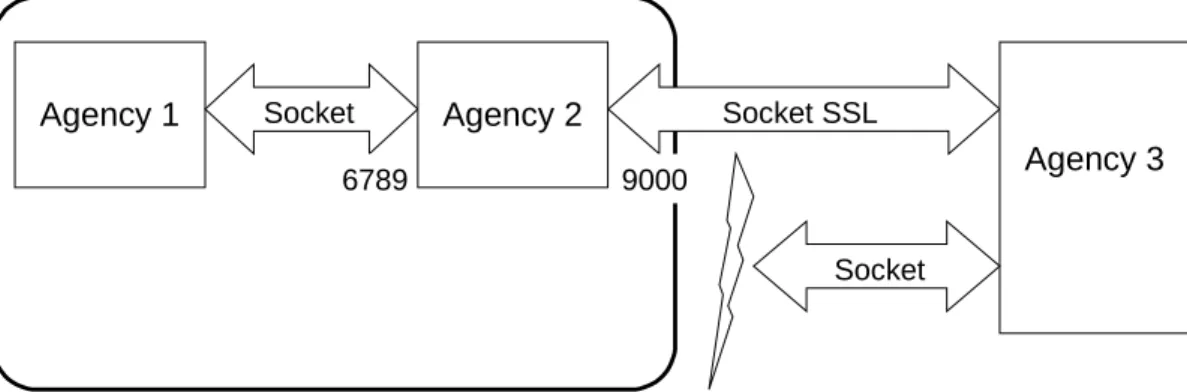
As an example how to combine several protocols to fulfil specific require-ments consider a network in a large company. Usually, this network is con-nected with the Internet via a router and protected with a firewall running on this router. Thus, only a fixed number of ports are visible to users outside the company’s network (called intranet). Grasshopper can use this intranet strat-egy to protect users from malicious agents by providing one single agency as access point to the intranet, allowing only secure interactions to the outer world. Inside the intranet, agencies may interact by taking advantage of fast (but insecure) connections. Figure 3 shows this example network configura-tion.
Agency 1 Socket Socket SSL
Agency 3
Socket
6789 9000
Agency 2
Figure 3: Secure vs. Insecure Protocols
In this example, agency 2 has started two communication receivers. The first one, a plain socket receiver, listens on port 6789 for incoming communica-tion requests. This port is protected by the firewall, i.e. only hosts from in-side the company can connect to this port. The second receiver uses the SSL-socket protocol and listens on port 9000 which is accessible to all Internet hosts world wide. Because the owner of agency 2 cannot be sure which Internet user will send an agent to its agency, Internet users are able to send agents with the SSL protocol only. This protocol provides the authentication of the client, so that the owner of agency 2 can decide whether the communi-cation should be permitted or not. If, for example, an attacker tries to send an agent by using an insecure socket-protocol, the attempt fails at the firewall. On the other side, the agency 2 owner trusts all clients from inside the com-pany. Thus, clients from the intranet can use the faster socket-protocol.
3.3.2 Location
Transparency
On the one hand the communication service is used by the Grasshopper sys-tem, e.g. for agent transport or for locating entities within the DAE. On the other hand, agents can use the CS to invoke methods on other agents. This is done location-transparently, i.e. the agent need not care about the location of the desired communication peer. Within the agent code, remote method in-vocations look exactly like local method inin-vocations on objects residing on the same Java Virtual Machine.
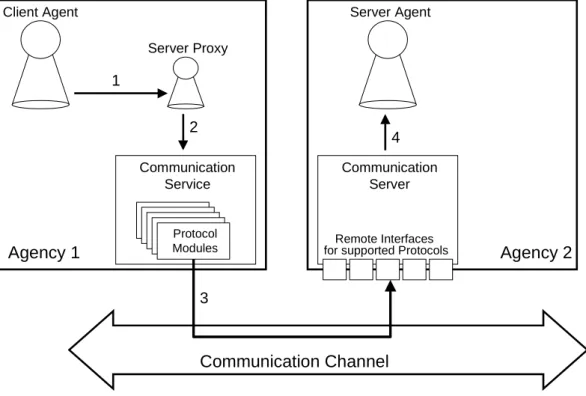
This is achieved by means of so-called proxy objects (or stubs) that are di-rectly accessed by a client. The proxy object forwards the call via the ORB to the remote target object, i.e. the server. In this way, these proxy objects are equivalent to the client stubs used by CORBA implementations. Figure 4 shows this concept on a rather abstract level.
Client Agent Server Proxy Communication Service Protocol Modules Agency 1 Server Agent Communication Server Agency 2 Communication Channel Remote Interfaces for supported Protocols
1
2
3
4
1, 2, 4 Local Java method invocation
3 Remote method invocation via one of the supported protocols
Figure 4: Location Transparent Communication
The usage of the local proxy object offers a simple API to agent program-mers and hides all internal negotiations and requests. Please note that loca-tion-transparent communication requires a running region registry and works inside the same region only. Communication between agents running in the same agency is not constrained to this pre-condition, i.e. without a region
this is still possible. For communication with an object outside the client re-gion, the client has to specify the target location in a URL syntax. This func-tionality is equivalent to the funcfunc-tionality of current CORBA implementa-tions.
3.3.3 Communication
Modes
In the context of Grasshopper, inter-agent communication may be performed in several modes. Grasshopper supports the following communication modes: synchronous communication asynchronous communication dynamic communication multicast communication
3.3.3.1 Synchronous
Communication
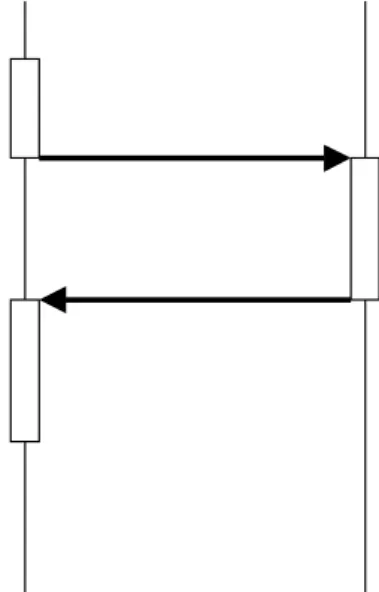
Usually, when a client invokes a method on a server, the server executes the called method and returns the result to the client which then continues its work. This style is called synchronous because the client is blocked until the result of the method is sent back. Figure 5 illustrates this concept.
Sender Receiver
3.3.3.2 Asynchronous
Communication
When using asynchronous communication, the client does not have to wait for the server executing the method. Instead the client continues performing its own task. There are several possibilities for the client to get the result of the invoked method: It can periodically ask the server whether the method execution has been finished, wait for the result whenever it is required, or subscribe to be notified when the result is available. Figure 6 shows these three possibilities.
S ender R eceiver R esult
S torage S ender R eceiver
R esult S torage B lo ck in g P o llin g w aiting ask ask get Sender Receiver Result Storage Call Back subscribe notify
3.3.3.3 Dynamic
Communication
This mechanism is useful if the client does not have access to a server proxy. The client is able to construct a message at runtime by specifying the signa-ture of the server method that shall be invoked. Dynamic messaging can be used both synchronously and asynchronously.
3.3.3.4 Multicast
Communication
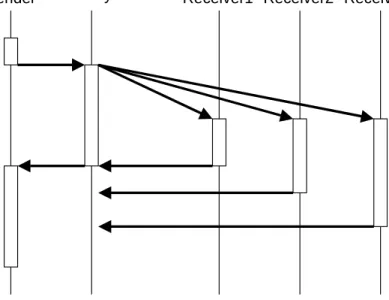
Multicast communication enables clients to use parallelism when interacting with server objects. By using multicast communication, a client is able to invoke the same method on several servers in parallel.
Group proxies provide a framework for designing and implementing
parti-tioned concurrent activities in Java. A Group consists of an arbitrary number of members. Group proxies maintain some kind of collection by enabling objects to join and leave groups dynamically. They also encapsulate the thread-based mechanisms needed to implement Java analogues of execution constructs found in concurrent, parallel languages. Internally, concurrent communication is implemented by the creation of parallel running threads where each of them performs a specific communication task. For this pur-pose, the group request is split and addressed to the appropriate server in the first phase, the so-called scatter phase. In the case that all the threads per-form invocations without return values, only the scatter part firing up the tasks applies. But when actions must be synchronised or results must be col-lected, a co-termination policy is required. The policy depends on the se-mantics of the communication of interest. Three common policies are:
OR Termination
AND Termination
Incremental Termination
A policy characterises how the results returned by the server objects are col-lected and how the group client can access these results. This phase is called
gather phase. Figure 7 shows the roles involved in a multicast
Sender Receiver1 Group
Proxy Receiver2 Receiver3
Figure 7: Multicast Communication
OR Termination
Figure 7 also depicts the gather policy problem of multicast communication: May the client continue its execution while the server methods are running? If not, at which point shall the client be restarted? The first possibility is to suspend the client until a result arrives, i.e. the client continues processing its task when any communication thread terminates. The client does not care about which server has sent the result. All results related to this communica-tion session that arrive after the first one are discarded (cf. Figure 8).
Sender Receiver1
Group
AND Termination
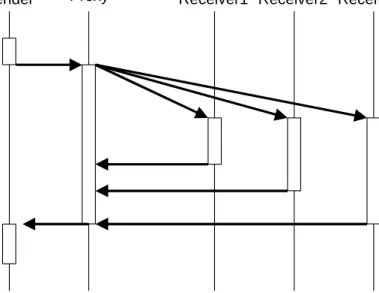
Another possibility is to suspend the client until all results have arrived. In this case, all communication tasks must be terminated before the client can continue its execution. A timeout duration specifies the maximum time for waiting. This avoids the death of the client in the case that a server does not send a result. After restart, the client can access the results sent by the group members.
Sender Receiver1
Group
Proxy Receiver2 Receiver3
Figure 9: AND Termination
Incremental Termination
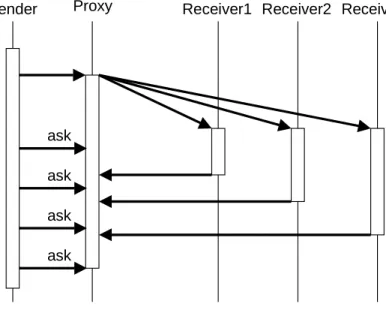
The policies described above suspend the client during the communication session. The communication service also supports a policy that allows the execution of the client immediately after sending a request to the group. Like the polling concept in asynchronous communication (cf. Figure 6), the client can check whether a reply from a specific server is available or not.
Sender Receiver1 Group
Proxy Receiver2 Receiver3
ask ask ask ask
Figure 10: Incremental Termination
3.3.4 Grasshopper
URL
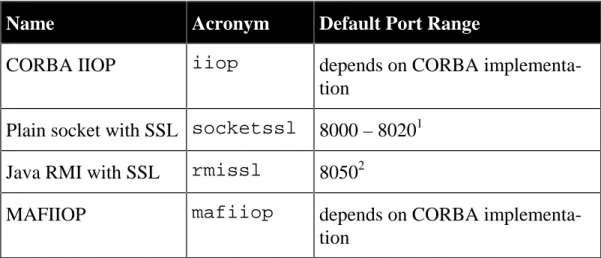
Generally, a Grasshopper location is specified in a URL-like notation of the form
<protocol>://<host>:<port>/<agency>/<place>
protocol: acronym of the desired protocol (cf. Table 3)
host: name or IP address of the destination host
port: number of the port at the destination site (optional)
agencyName: name of the destination agency
placeName: name of the destination place (optional)
Name Acronym Default Port Range
Plain socket socket 7000 – 70201
Java RMI rmi 70502
1
Note that each socket communication receiver requires its own port on each host. If the default port is already in use, the port number is automatically incremented
Name Acronym Default Port Range
CORBA IIOP iiop depends on CORBA
implementa-tion
Plain socket with SSL socketssl 8000 – 80201
Java RMI with SSL rmissl 80502
MAFIIOP mafiiop depends on CORBA
implementa-tion
Table 3: Supported Communication Protocols
Because of RMI internal reasons it is not possible to run RMI and RMI-SSL interactions at the same time within the same agency.
The place name as well as the port number are optional. If no place is speci-fied, the default place "InformationDesk" is contacted which exists within each agency. The default port number depends on the desired protocol (see Table 3). Note that the port number of CORBAIIOP and MAFIIOP depend on the used CORBA implementation. Thus, if one of these protocols shall be used, a port number must be specified.
The location of a region registry is specified in a corresponding way:
protocol://host:port/registryName
The registryName should be set to name of the region registry if the MASIF compliant parts of Grasshopper are used. Otherwise the regis-tryName has no meaning.
The location specification explained above requires that the communication client knows which protocols are supported at the server (i.e. destination) site. If the client does not have this information, the meta-protocol grass-hopperiiop may be used. In this case, the communication service auto-matically contacts the region registry in order to get information about the protocols that are supported at the destination site. Of course, these
2
This number specifies the port of the RMI registry within an agency. Note that more than one RMI or RMI-SSL receivers from several agencies can register to the same RMI registry. If the agency in which the RMI registry is running terminates, all registered RMI receivers lose their communication ability.
tional interactions are time consuming. Thus, if possible, a concrete protocol should be specified when constructing a location.
3.4 Security Concepts
This chapter introduces the basic concepts necessary to understand the secu-rity concepts of the Grasshopper platform.
In open distributed environments such as Grasshopper a number of serious security threats exist that must be considered when designing an effective security policy. Access Control System A Access Control System B Authentication & Access Control ? Confidentiality Integrity
Figure 11: Potential Security Attacks
To address these threats, the Grasshopper security services must provide the following features:
Confidentiality: When an agent transports confidential data, it should
not be of any potential use for anybody else than the communication partners. Disclosure or eavesdropping of the data can be fatal. Since the transmission often takes place over communication media that cannot be physically secured or that are out of the control of the communicating partners, the transmitted agent must be encrypted while in transit. Thus it is made useless for anybody, except for someone who knows how to de-crypt the agent (which should be only the designated server).
Integrity: Upon reception, it must be obvious if the agent was modified
or corrupted, be it by means of transmission errors or intentional acts of vandalism. An attacker must not be able to modify agents without the server noticing it. If in doubt, the server can try to reconstruct the agent
Authentication: In a communication session, authenticity of the
ex-changed data requires authentication of the communication partners. If important data is transmitted, each communication party should be aware of the real identity of the communication peer. The nature of computer networks makes it much easier for an impostor to pretend to be someone else than in real life, where "authentication" is straightforward. Scenarios, where an attacker pretends to have the identity of someone else are called masquerading. Once successful, the attacker can easily pass further secu-rity checks. Therefore, authentication is one of the key requirements to securing distributed systems. Another attack that can be covered by an authentication service is the replay of previously intercepted data.
Access Control: An agent system generally has access to a certain
amount of resources, such as file system, network, CPU time, memory, etc. These resources must be protected from unauthorised access. Usually this is achieved through an access policy that grants access to system re-sources based upon different levels of trust. When an agent manages to get unauthorised access, it can destroy data or perform so-called denial-of-service attacks, where agent system resources are allocated again and again until the system is overloaded and breaks down.
Auditing: In order to get an overview about security relevant events, the
security services mentioned above, especially authentication and the ac-cess control service, should be able to keep track of whenever agents try to access system resources or the system itself, as well as authentication failures or when transmission faults occur. These events should be logged to a file so they can be analysed later.
3.4.1 Cryptography
Most scenarios where cryptography is deployed involve a sender and a re-ceiver of a message. The sender wants to send the message securely and make sure that an eavesdropper cannot read it. Before it is sent, i.e. in its actual clear form, the message is plain text. The process of rendering the message unreadable, i.e. converting it to cipher text, is called encryption. The reverse procedure, i.e. converting cipher text into plain text, is called decryption. The term "plain text" should not be confused with "plain ASCII text". The plain text messages can have any form, e.g. a text file, a video stream, or, in the case of software agents, simply binary data.
A cryptographic algorithm, or cipher, is a mathematical function used for encryption and decryption. However, keeping the cipher secret would be
rather ineffective. Therefore, in addition to the algorithm, a key is used and kept secret. Both encryption and decryption use this key in combination with the cipher. Now the algorithm can be published, analysed and standardised. This can be compared to a door lock. Everybody can get the technical speci-fications of a door lock, but without the key this knowledge is useless.
3.4.1.1
Symmetric Algorithms
Symmetric algorithms are algorithms where the key used for decryption can be calculated from the key used for encryption and vice versa. Usually en-cryption and deen-cryption key are the same. This presupposes that sender and receiver agreed on a key before securely exchanging messages. Here comes the problem inherent to symmetric algorithms. In a scenario, where sender and receiver are located relatively close, they can easily exchange the key physically prior to the actual communication, e.g. on a floppy disk. But in a larger networked application, this prerequisite is often not given. Key ex-change must be done via other "more trusted" media like telephone or mail. Even worse, if the receiver does not know the sender, how can the receiver be sure of receiving the correct key? Furthermore, in a scenario with many secure point-to-point transmissions, the number of keys grows exponentially, thus adding a vast overhead to the application.
3.4.1.2
Asymmetric Algorithms
Asymmetric or public-key algorithms use two different keys for encryption and decryption: a public and a private key. For each communication partner there exists such a key pair, where the private key is kept secret while the public key is made available to the public, e.g. through a directory service or public-key certificates. This requires that the private key cannot be calcu-lated from the public key, at least not in a reasonable amount of time. The keys act as a sort of one-way lock, i.e. once a message is encrypted using the public key of a person, it can only be decrypted by the corresponding private key. Therefore, only that person can convert the cipher text back to plain text (presumed no one else knows the private key). That way, the problem of key distribution can be solved and the overhead is reduced since public and pri-vate key can be used several times.
As a matter of fact, public-key algorithms are generally a thousand times slower than symmetric algorithms, so in real-life applications a combination of both techniques, called hybrid crypto-systems is often used: public-key algorithms are used first to exchange a symmetric session key, which is then used to encrypt and decrypt the actual message.
Sender Receiver ABC ? ? ABC Encryption Decryption Receiver’s Public Key Receiver’s Private Key ?
Figure 12: Providing Confidentiality Using Public Key Algorithms
3.4.1.3
One-Way Hash Functions
One-way hash functions, often also called digital fingerprint, message digest or message checksum, are central to modern crypto-systems. They operate on a message and produce an output of fixed length. Their importance for cryptography is based upon the following common characteristics:
Given a message M, it is relatively easy to compute h(M).
Given h(M), it is hard to compute M. Hard means mathematically infea-sible in a reasonable amount of time.
Given M, it is hard to find another message M’, such that h(M) = h(M’). Therefore it can be determined when a message was modified or corrupted during transmission.
3.4.2 Authentication
Not only privacy and integrity can be ensured through the use of crypto-systems, but also authentication. If sender and receiver share a common se-cret, only known to them, the secret acts as the authentication information, as a proof of the other communication party’s identity. In the case of symmetric algorithms, this would be the session key. However, much more popular is the use of public-key algorithms to ensure authentication. If the sender wants to prove that it is really it who sends the agent, it digitally signs it prior to transmission. In most cases this denotes the act of encrypting the agent with the private key. Now anyone who receives the agent but is not sure if it really comes from the actual sender can decrypt it with the sender’s public key. If the decryption succeeds, the receiver can be sure that only the sender could have encrypted it. This is called verifying a digital signature.
In practical implementations, public-key algorithms are not used to sign the whole agent. Instead, it is far more efficient to generate a one-way hash of the agent together with a timestamp, sign them and transmit them separately. The receiver again generates a hash from the agent and compares it with the received hash.
Sender Receiver
ABC ABC ABC ABC
Sign Verify Sender’s Private Key Sender’s Public Key ABC
Figure 13: Providing Authentication Using Public Key Algorithms
3.4.3 X.509 Certificates
The ITU-T authentication framework introduces the notion of public-key certificates, data structures for storing and exchanging public keys. A trusted third party, called certification authority (CA), assigns a unique distinguished name to each user and issues a digitally signed certificate, consisting of:
Version number: Identifier for the certificate format.
Serial number: Unique to each user of a CA.
Algorithm identifier: Identifies the algorithm used to sign the certificate.
Issuer: The distinguished name of the CA.
Period of validity: A time period, consisting of a Before and
Not-After date, between the certificate is valid.
Subject: The distinguished name of the user.
Subject’s public key: The public key of the user.
Signature: The signature of the CA.
public key. Now, what happens during an authentication scenario using X.509 certificates? Prior to the communication, the receiver gets the sender’s certificate from a public database and verifies the signature. If both sender and receiver share the same certification authority, this is trivial. The re-ceiver knows that the sender certificate is issued by a trusted instance and therefore trusts the certificate itself. If not, it is more complicated. The re-ceiver can either trust the sender’s CA anyway or check if it is certified by yet other certification authorities. Thus, a tree-like structure of trust is built. CAs certified by higher-level CAs can again certify other CAs. The receiver can walk up the tree until reaching a certification authority that is well-known and trusted.
Sender
CA 1
CA 3
Receiver CA 2
Figure 14: An X.509 Certification Tree
3.4.4 Access Control
Access Control denotes the process of controlling access of an entity to a system or to resources within that system. If access to a specific resource is denied, it is the task of auditing to log this for further evaluation. Access control is closely linked to authentication, i.e. the actual access decision is often based upon the identity of the entity performing the access. Within the system where the access occurs, the initiator’s identity can be associated with a set of access rights. Therefore, if an attacker succeeds in masquerading as another user, it obtains the access permissions granted to that user. In this case, the attacker has unauthorised access to system resources and can sub-sequently invoke denial-of-service attacks or destroy data.
3.4.4.1
Protection of Resources
CPU time: In a multi-user and multitasking operating system, a single
user or process must not be able to get hold of the complete CPU, other-wise the work of other users or processes may be disturbed.
Memory: The amount of allocated memory to each process should be
limited. Furthermore, the address spaces of different processes must be protected from one another.
File system: Obviously, in multi-user environments, such as UNIX, files
must be protected from unauthorised access.
Networking capabilities: Since networking resources such as sockets
rep-resent the connection of a system to the outside world, they are vulner-able and subject to access control.
3.4.4.2
Access Control Policies
Access control policies represent the security requirements in a certain secu-rity domain. They usually consist of a set of rules acted upon by Access Control Decision Functions whenever a check is performed. There can be different categories of access control policies, as identified by ITU Recom-mendation X.800. A rule-based access control policy applies to all users of a system, regardless of any privileges or access levels. In contrast, identity-based access control policies assign different access rights to different iden-tities. Of course this presupposes proper authentication. Identity-based ac-cess control policies are often implemented using Acac-cess Control Lists (ACL), where an identity is associated with a set of permissions it is granted. Two particular types of identity-based policies are group-based and role-based access control policies. In the former, the respective permissions are valid for a group of people, e.g. an organisation or enterprise, while in the latter, access rights are assigned to specific roles that can be held by different users at different times, e.g. database administrator or super user. Further-more, one can distinguish between administratively imposed or dynamically selected access control policies.
3.4.5 Security in Grasshopper
This section describes the realisation of a Grasshopper Security Service in-tended to meet the requirements stated above.
3.4.5.1 External
Security
To provide the required security, Grasshopper makes use of X.509 certifi-cates (see above) and the Secure Sockets Layer (SSL). SSL is an industry-standard protocol that makes substantial use of both symmetric and asym-metric cryptography. Widely deployed in client-server products of leading vendors, including Netscape, Microsoft and IBM, SSL provides confidenti-ality, data integrity and mutual authentication of client and server.
Confidentiality: All communication between client and server will be
handled over a secure socket, encrypted with a symmetric key and an en-cryption algorithm negotiated in a handshake prior to the actual SSL ses-sion. Although the IP packets can still be intercepted, encryption renders them useless for eavesdroppers. Currently, Grasshopper is able to use any available encryption algorithm.
Integrity: Message Authentication Codes (MACs) can prove that a
mes-sage was not modified during transport, be it by vandals or transmission errors. These MACs are calculated for each SSL packet using hash func-tions.
Authentication: The purpose of authentication is that both
communica-tion parties convince each other of their identity. During the SSL hand-shake, client and server exchange personal data and their public keys packaged together in the form of X.509 certificates. The authentication process requires both parties to digitally sign protocol data with their pri-vate keys. The certificate itself does not authenticate, but the combination of certificate and correct private key does. Currently, Grasshopper is able to use every available X.509 compliant certificate type.
So what are the prerequisites for doing secure communication? Each agency should have at least a personal certificate and a private key. The key is re-quired for signing data during the SSL handshake (512 bit). This data is hold in the Grasshopper security context that is loaded and initialised at start-up. Now, how can agencies specify their desire to communicate securely? The receiver agency does so by running only secure servers (Socket/SSL or RMI/SSL), which are configured in the communication preferences, while the sender/client can selecting a appropriate protocol if it wants to communi-cate securely or not. If both agencies specified the same, everything is fine. If the sender specified secure communication, but the receiver is only run-ning insecure servers, the communication fails and a security exception is thrown on the sender side. If the sender wants to communicate insecurely, but the receiver has only secure servers, this fails, too.
What happens next? In the SSL handshake, sender and receiver exchange their personal certificates containing the public key. When the Grasshopper agency receives a chain of certificates (this includes a single certificate where the chain has length 1), it verifies the consistency of the chain, checks if each certificate is within its validity period and searches in its database of known signers, to check whether the subject belonging to the certificate is known. If yes, the SSL session is handled as specified in the associated be-haviour (see above). If it is not known, the next certificate is taken from the chain and examined the same way. If the algorithm reaches the end of the chain without encountering a known certificate, the connection is rejected, if not configured otherwise.
If this step is passed on both sides, sender and receiver agency mutually authenticate each other by signing random data with the private key and sending it to the peer, who verifies the signature with the public key. After this, the SSL handshake has been successfully completed, and the secure channel established, meaning that sender and receiver are authenticated and a session key was exchanged. Subsequently, all data transmitted through the socket is encrypted and decrypted using this key and secured by MACs, thus providing confidentiality and integrity for the remaining session.
But what does this mean? A secure session between two agencies is estab-lished. This session can be cached and reused later. In this context, it is of vital importance to understand the fact that it is not agents which are authen-ticated but the agency administrator, or at least the person who specified the personal certificate used for authentication. Different agents from different owners and creators can travel through the same authenticated secure socket. However, in typical applications this can be considered as a minor drawback.
3.4.5.2 Internal
Security
Internal security is all about protecting resources of the agency from unau-thorised access by agents. Furthermore, it is useful to protect agents from one another. But why is access control so important? Well, think of malevo-lent agents as viruses. If you do not protect yourself against them, they could destroy data, shut down your agency, kill other agents and so on.
Regarding access control, Grasshopper is strongly oriented towards the secu-rity mechanisms of JDK 1.2. It makes use of an codesource-based and iden-tity-based access control policy, which is initialised at start-up. In Grasshop-per, an access control policy is an access control list comprising several en-tries, one for each subject treated in this policy, where a subject can be a codebase or a principal. With each subject, there is associated a set of
per-Note that it is not possible to explicitly deny permissions. Only "positive" permissions are allowed.
You might ask, how the agent is linked to the name of the subject in the policy? When an agent tries to make a system access, e.g. by opening a file using the java.io package, an access controller is consulted to make the access decision. In fact, each time a system access happens the access con-troller is invoked, but it is capable of distinguishing whether the access was made by an agent or by trusted system code, e.g. the Grasshopper core. If the access came from an agent, the access controller extracts the agent’s origin and owner from the agent itself. With this information, it contacts the Access Controller to extract the set of permissions valid for this subject. It is then checked if the permission to perform the access is contained in the set of permissions granted to the subject. If not, an access control exception is thrown.
It follows that effective access control presupposes authentication and secure transmission of the agent. Why is this so? When an agent from a remote agency makes a system access, the agent’s signature is taken as a token to retrieve the proper permissions from your local access control policy. This signature is set at the agent’s creation time in the remote agency, and it must be ensured that it was not modified during agent transport to your agency. Otherwise, for example, some attacker could masquerade as a friend to whom you have granted read/write access to your home directory.
Grasshopper uses the notion of protection domains, first introduced in JDK 1.2. Each agent is loaded by a class loader associated to a protection domain, thus properly separating different security domains. Classes from your
CLASSPATH variable are considered as system classes and therefore trusted. They are not subject to any permission checks and therefore run outside the "sandbox". It is of utmost importance to always keep this in mind. If you let someone tamper with your CLASSPATH variable, the access control mecha-nisms can be tricked. Only agent classes loaded from a codebase, such as
file:// or http:// , are subject to access control.
When programming your own agents that perform access to resources, please take care to enclose the code where the access happens in try-catch blocks in order to catch the access control exception if the necessary permis-sion is not granted. If, for example, for performance optimisation, access control is not desired it can be disabled via a command-line option.
3.5 Persistence
Persistence is a very important topic regarding distributed applications. Ob-jects are sent from one computer to another and often have a long life span. That is especially true for mobile agents. The following undesirable scenar-ios have to be taken into account:
An agent moves from one agency to another. The transmission fails for some reason so that the agent never arrives at its destination.
An agent is residing within an agency whose host computer crashes or shuts down unexpectedly (e.g. due to a power failure).
There are many agents residing within an agency, with most of them waiting for external events without performing any task, thus just wasting system resources. The host computer could run out of resources (espe-cially memory) if more agents want to migrate into that agency.
While the first scenario can be avoided by buffering the agent until the arri-val has been confirmed, the remaining two need another approach. A copy of the agent object has to be maintained on a durable (i.e. persistent) medium, e.g. a hard disk. If the agency system crashes, persistent agents can be re-loaded from this medium after the agency has been restarted (keyword: sav-ing). Besides, idle agents (i.e. agents just waiting for an event without exe-cuting any task), need not remain instantiated. Instead, they could be stored permanently and then removed from the agency’s RAM in order to save re-sources (keyword: flushing). If a request for a flushed agent arrives, the agent can be re-instantiated in order to handle the request.
4 Frequently Asked Questions
This chapter contains answers for some Frequently Asked Questions. The chapter is organised to help the Grasshopper user to find answers in different usage areas. Note that additional information is provided in the Glossary (cf. Annex A).
4.1 Mobility
How can agents move?
Grasshopper agents are implemented in Java. Thus, their code can be exe-cuted on every host that supports Java - independent of the hardware archi-tecture. Grasshopper agents can either use the Grasshopper-specific commu-nication service or optionally a CORBA 2.0 compliant ORB for MASIF con-formant migration. To move an agent to another agency residing on the same or another host can be initiated by invoking the move() method of an agent. This method can be invoked by the moving agent itself or even by other en-tities. A detailed description can be found in the Programmer’s Guide.
4.2 Communication
How does inter-agent communication work?
Grasshopper agents can invoke methods of other agents in a location-transparent way. Therefore, agents need not know the actual location of their communication peer. For the agent programmer, a method invocation of a remote object can be implemented like a method invocation of an object re-siding in the same Java Virtual Machine (JVM). Grasshopper supports syn-chronous, asynsyn-chronous, and multicast communication.
What communication protocols are supported?
The Grasshopper communication service supports the following protocols:
CORBA IIOP
Plain Socket Protocol
RMI with SSL
Plain Socket Protocol with SSL
4.3 Security
Questions associated with Grasshopper security are separated into the fol-lowing sections:
Certificates and Encryption (Section 4.3.1)
Permissions and Access Control (Section 4.3.2)
4.3.1 Certificates and Encryption
Does Grasshopper support strong cryptography?
Yes. Communication in Grasshopper can be secured using the Secure Socket Layer (SSL) protocol. By default, 1024 bit RSA keys are used for key ex-change and authentication and 128 bit RC4 keys are used for encryption and decryption of the actual data.
What’s the deal with U.S. export restrictions and patents?
The U.S. government restricts the use of U.S. products which secure their data with strong cryptography to U.S. citizens only. Export versions of U.S. products using cryptography are constrained to weak cryptography. Grass-hopper uses an Austrian toolkit named IAIK that supports both weak and strong cryptography. RSA and RC4 are patented by RSA Security Corp. Please keep this in mind when using Grasshopper in the U.S.
What are symmetric key algorithms?
In symmetric key algorithms, the keys for encrypting and decrypting the data are identical. Although much faster than asymmetric key algorithms, they raise the problem of exchanging the key prior to a communication session. The most prominent members of this family are DES and RC2/RC4.
What are asymmetric key algorithms?
Invented in 1976 by Diffie and Hellman, asymmetric or public key algo-rithms solve the problem of key distribution by having a key pair: private and public key. The public key can be published, while the private key should be kept secret. Once data is encrypted with the public key of a person, it can be only decrypted with the corresponding private key. Although overcoming the key exchange problem, asymmetric key algorithms are much slower than symmetric. A well-known example is RSA.
What is RSA?
Named after its inventors, Rivest, Shamir and Adleman, the RSA public key algorithm works for both encryption and digital signatures. It is based upon the difficulty of factoring very large numbers. Although RSA’s security has been never fully proven by crypt-analysts, it is widely used and very popular. Suppose Alice wants to send Bob a message, then there are two ways of us-ing RSA:
For encrypting data: Alice takes Bob’s public key and encrypts the data. Now, only Bob can decrypt the data with his private key.
For digitally signing data: Alice takes her private key and encrypts the data. When Bob gets the message and succeeds in decrypting it with Alice’s public key, he can be sure that it could only have been encrypted by Alice, given the fact that only Alice knows her private key. Note that everybody else can decrypt the message with Alice’s public key and read it.
In real life scenarios, a combination of both techniques is often used.
What is RC4?
RC4 is a variable-key-size symmetric cipher developed in 1987 by Ron Rivest for RSA Data Security, Inc. For several years it was proprietary until the source code was posted anonymously to a mailing list and quickly spread throughout the Internet. It is about 10 times faster than the popular DES (Data Encryption Standard) cipher.
What is SSL?
The Secure Sockets Layer (SSL) is an industry-standard protocol that makes substantial use of both asymmetric and symmetric cryptography. It delegates encryption and authentication procedures from the application to the trans-port layer. Widely deployed in client-server products of leading vendors
in-cluding Netscape, Microsoft and IBM, SSL provides privacy, data integrity and mutual authentication of client and server.
Privacy: All communication between client and server goes over a
secure socket, encrypted with a symmetric key and an encryption algorithm negotiated in a handshake prior to the actual SSL session. Although the IP packets can still be intercepted, encryption renders them useless for eavesdroppers.
Integrity: Message Authentication Codes (MACs) can prove that a
message was not modified during transport, be it by vandals or transmission errors. These MACs are calculated for each SSL packet using hash functions.
Authentication: The purpose of authentication is that both
communi-cation parties convince each other of their identity. During the SSL handshake, client and server exchange personal data and their pub-lic keys packaged together in the form of X.509 certificates. The authentication process requires both parties to digitally sign proto-col data with their private keys. The certificate itself does not authenticate, but the combination of certificate and correct private key does.
What is a X.509 certificate?
A X.509 certificate is a data structure containing personal data about an en-tity (person or organisation), such as name, e-mail address, location, country and the public key. Furthermore it contains a digital signature of an issuing entity, testifying that the certificate data belongs to that entity. Usually, cer-tificates are issued by so-called certification authorities (CAs) and are valid only for a certain time. Thus, certificates act as a digital version of an ID, passport or driver’s license. The combination of certificate and correspond-ing private key (which is NOT inside the certificate) authenticates you to someone who needs proof of your identity.
What is a certificate chain?
Certificates can build a tree-like structure, where each node certificate issued its child certificates. In an authentication process, usually the verifier gets a chain of certificates. If he does not trust a leaf certificate, he goes up the tree until he finds a well-known certificate. The so-established trust model is transitive, i.e. if there is one certificate that is considered trusted, all child and grandchild certificates are, too.
What is a certification authority (CA)?
A certification authority issues certificates to users, thus guaranteeing that the personal data and the public key in that certificate belong together. A CA usually has the reputation of being a trustworthy entity, so it acts as a trusted third party in authentication processes.