Efficient Ciphertext-policy Attribute
Based Encryption for Cloud-Based
Access Control
Ruqayah Rabeea Hashim Al-Dahhan
A Thesis Submitted in Partial Fulfilment of the Requirements of
Liverpool John Moores University for the Degree of Doctor of
Philosophy
i
We certify that the thesis entitled “Efficient Ciphertext-policy Attribute
Based Encryption for Cloud-Based Access Control" was prepared under our
supervision at the Department of Computer Science, Faculty of Engineering
and Technology, Liverpool John Moores University as a partial of fulfilment
of the requirements of Liverpool John Moores University for the degree of
Doctor of Philosophy.
Name
Prof. Qi Shi
Title
Director of study
Address
James Parsons Building, 3 Byrom St, Liverpool L3 3AF, UK.
Name
Dr. Gyu Myoung Lee
Title
Second Supervisor
Address
James Parsons Building, 3 Byrom St, Liverpool L3 3AF, UK.
Name
Dr.
Kashif Kifaya
Title
Third Supervisor
Address
Computer Science Department, Air University, Islamabad,
Pakistan.
Signed (Director of Studies):
Date:
ii
Outsourcing data to some cloud servers enables a massive, flexible usage of cloud computing resources and it is typically held by different organizations and data owners. However, various security concerns have been raised due to hosting sensitive data on an untrusted cloud environment, and the control over such data by their owners is lost after uploading to the cloud. Access control is the first defensive line that forbids unauthorized access to the stored data. Moreover, fine-grained access control on the untrusted cloud can be enforced using advanced cryptographic mechanisms. Some schemes have been proposed to deliver such access control using Ciphertext-policy attribute based encryption (CP-ABE) that can enforce data owners’ access policies to achieve such cryptographic access control and tackle the majority of those concerns. However, some challenges are still outstanding due to the complexity of frequently changing the cryptographic enforcements of the owners’ access policies in the hosted cloud data files, which poses computational and communicational overheads to data owners. These challenges are: 1) making dynamic decisions to grant access rights to the cloud resources, 2) solving the issue of the revocation process that is considered as a performance killer, and 3) building a collusion resistant system. The aim of our work is to construct an access control scheme that provides secure storing and sharing sensitive data on the cloud and suits limited-resources devices.
In this thesis, we analyse some of the existing, related issues and propose a scheme that extends the relevant existing techniques to resolve the inherent problems in CP-ABE without incurring heavy computation overhead. In particular, most existing revocation techniques require issuing many private keys for all non-revoked users as well as re-encrypting the related ciphertexts. Our proposed scheme offers a solution to perform a novel technique that dynamically changes the access privileges of legitimate users. The scheme drives the access privileges in a specific way by updating the access policy and activating a user revocation property. Our technique assigns processing-intensive tasks to cloud servers without any information leakage to reduce the computation cost on resource-limited computing devices. Our analytical theoretical and experimental findings and comparisons of our work with related existing systems indicate that our scheme is efficient, secure and more practical compared to the current related systems, particularly in terms of policy updating and ciphertext re-encryption. Therefore, our proposed scheme is suited to Internet of Things (IoT) applications that need a practical, secure access control scheme.
iii
which mainly supports storing data only on a private cloud storage system managed by only one single authority, our proposed access control scheme is extended to a secure, critical access control scheme with multiple authorities. This scheme ought to be carefully designed to achieve fine-grained access control and support outsourced-data confidentiality. In addition, most existing multi-authority access control schemes do not properly consider the revocation issue due to the difficulty of addressing it in distributed settings. Therefore, building a multi-authority CP-ABE scheme along with addressing changes to policy attributes and users, have motivated many researchers to develop more suitable schemes with limited success. By leveraging the existing work, in this thesis, we propose a second CP-ABE scheme that tackles most of the existing work’s limitations and allows storing data securely on a public cloud storage system by employing multiple authorities which manage a joint set of attributes. Furthermore, the proposed scheme efficiently maintains the revocation by adapting the two techniques used in the first proposed single authority access control scheme to allow dynamic policy update and invalidate a revoked user’s secret key that eliminates collusion attacks. In terms of computation overhead, the proposed multi-authority scheme outsources expensive operations of encryption and decryption to a cloud server to mitigate the burden on a data owner and data users, respectively. Our scheme analysis and the theoretical and implemented results demonstrate that our scheme is scalable and efficient.
iv
I would like to express my deepest thankfulness and gratitude to the Almighty Allah for granting me this opportunity and for blessing this project.
I acknowledge my sincere appreciation and gratitude to my Director of study Prof. Qi Shi for his invaluable feedback on my research, for his support of my PhD, for his guidance and encouragement. I also would like to thank my second and third supervisors Dr. Gyu Myoung Lee, and Dr. Kashif Kifayat.
My sincere gratitude goes to my sponsor the Iraqi government, Ministry of Higher Education and Scientific Research of Iraq, Iraqi Cultural Attaché in London, University of Anbar and College of Computer and Information Technology for the support and the funding received towards my PhD.
Also, I really appreciate the support that I received from Liverpool John Moores University, particularly, the Department of Computer Science to improve my skills and to earn this research degree. I am especially grateful to Tricia, Elizabeth, Tracy, Carol, Natasha, Laura, Alexia and all Faculty Research Administrators for going far beyond their duty.
Thanks go out to my supportive friends Ruba, Hiba, Samar, Shaymaa, Ruqayah, Rana, Afaf, Libyan Ruqayah, Islam, Aseel, Raghad, Nashwa, Toey and Basma for encouraging and helping me during the PhD period in whatever way they could.
My heartfelt thanks to my family; Mum (Anaam), Dad (Rabeea), Sisters (Fatima, Zainab, and Aaisha) and Brothers (Omar, Yaseen, and Mohammed) for always believing in me and encouraging me to achieve my goals and dreams.
v
Conference Papers:
1. Ruqayah R. Al-Dahhan, Qi Shi, Gyu Myoung Lee, Kashif Kifayat, “Revocable, Decentralized Multi-Authority Access Control System,” 2018 IEEE/ACM International Conference on Utility and Cloud Computing (UCC Companion), December 2018. (Zurich, Switzerland)
2. Ruqayah R. Al-Dahhan, Qi Shi, Gyu Myoung Lee, Kashif Kifayat, “Access Privilege Elevation and Revocation in Collusion-Resistant Cloud Access Control,” IEEE Word Conference on Smart Trends in Systems, Security & Sustainability (WORLDS4), October 2018. (London, UK)
3. Ruqayah R. Al-Dahhan, Qi Shi, Gyu Myoung Lee, Kashif Kifayat, “Context-Aware Cloud-Based Access Control for the Internet of Things – Refined Work,” Faculty Research Conference: Liverpool John Moores University, 2018, Liverpool, UK. 4. Ruqayah R. Al-Dahhan, Qi Shi, Gyu Myoung Lee, Kashif Kifayat,
“Context-Aware Cloud-Based Access Control for the Internet of Things – Extended Work,” Faculty Research Conference: Liverpool John Moores University, 2017, Liverpool, UK.
5. Ruqayah Rabeea Al Dahhan and Qi Shi, “Context-Aware Cloud-Based Access Control for the Internet of Things – Initial Work,” Faculty Research Conference: Liverpool John Moores University, 2016, Liverpool, UK.
Journal Papers:
1. Ruqayah R. Al-Dahhan, Qi Shi, Gyu Myoung Lee, Kashif Kifayat, "Survey on Revocation in Ciphertext-Policy Attribute Based Encryption,” Sensors, vol. 19, no. 7, p. 1695, 2019.
vi Abstract ... ii Acknowledgement ... iv Table of Contents ... vi List of Abbreviations ... ix List of Figures ... x List of Tables... xi Chapter 1 Introduction ... i 1 Introduction ... 1 1.1 Research Motivation ... 2
1.2 Research Problems and Challenges ... 2
1.3.Research Methodology ... 3
1.4 Research Requirements ... 4
1.5 Research Aims and objectives ... 5
1.5.1 Aims ... 5
1.5.2 Objectives ... 6
1.6 Research Contributions ... 6
1.7 Organisation of the Thesis ... 8
Chapter 2 CP-ABE for Outsourcing Data to Cloud ... i
2 Introduction ... 9
2.1 The Internet of Things (IoT) ... 11
2.2 Cloud Computing System ... 13
2.3 Access Control ... 15
2.4 Context awareness ... 16
2.5 Attribute-based Encryption (ABE) ... 17
2.5.1 Ciphertext–policy Attribute Based Encryption (CP-ABE) ... 19
2.5.2 The Revocation Problem ... 22
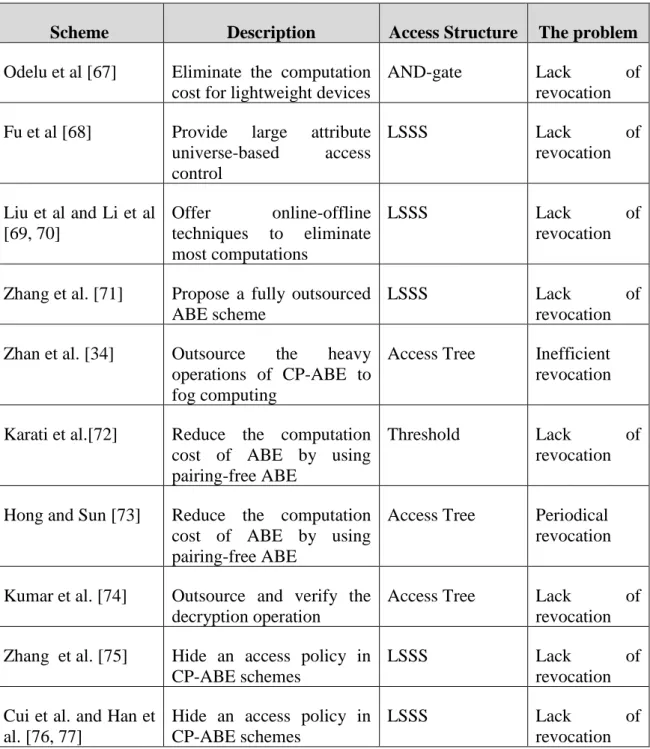
2.6 The Types of CP-ABE Scheme ... 28
2.6.1 The Single Authority Scheme ... 28
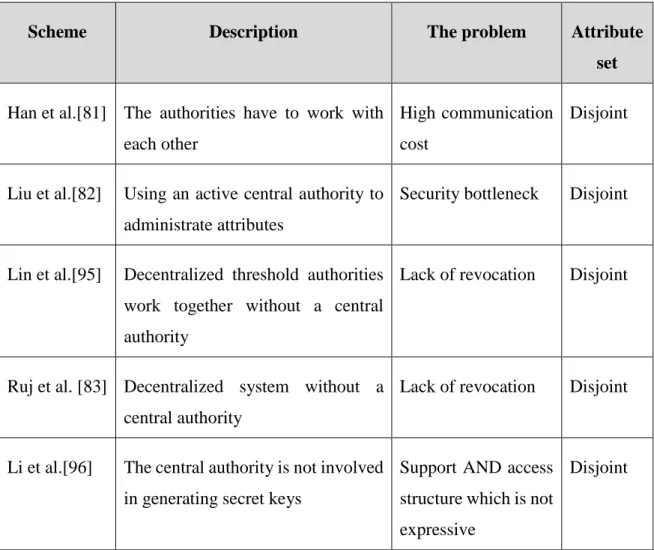
2.6.2 The Multi-Authority Attribute based Access Control System ... 33
2.7 Summary ... 37
Chapter 3 Preliminaries, Basics and Technical Approaches ... i
3 Introduction ... 40
3.1 Mathematical Tool ... 40
vii
3.1.3 Discrete Logarithm Problem (DLP) ... 41
3.1.4 The Diffie-Hellman Protocol (DHP) ... 42
3.2 Pairing-Based Cryptography ... 42
3.2.1 Elliptic Curve Cryptography ... 42
3.2.2 Bilinear Pairing... 43
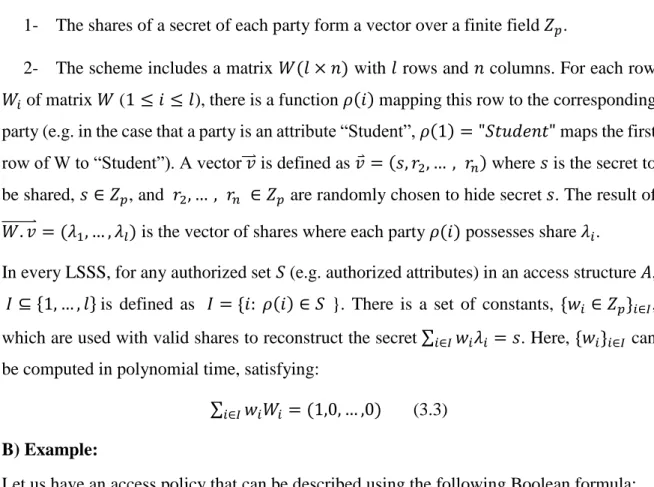
3.3 Shamir’s Secret Sharing Scheme (SSSS) ... 44
3.3.1 Lagrange Polynomial ... 44
3.4 The Access Structure and its Representation Approaches ... 45
3.4.1 Linear Secret Sharing Matrix Generation ... 47
3.5 The Complexity Assumptions... 51
3.5.1 Decisional Bilinear Diffie-Helman (BDH) Assumption ... 51
3.5.2 Decisional 𝑞-Parallel Bilinear Diffie-Hellman Exponent Assumption ... 51
3.6 Selective Security Model ... 52
3.7 Waters’ CP-ABE Scheme (W-CP-ABE) ... 52
3.7.1 Security Proof of BW-CP-ABE ... 54
3.8 Summary ... 57
Chapter 4 The Proposed Single Authority Access Control Scheme ... i
4 Introduction ... 58
4.1 The Scheme Security Requirements and Assumptions ... 58
4.2 Our Proposed Scheme ... 59
4.2.1 The Scheme Entities ... 60
4.2.2 Scheme Entities Relationship ... 61
4.2.3. A Scheme Overview ... 63
4.2.4. Scheme Algorithms... 63
4.3 Scheme Analysis ... 72
4.3.1 Security Analysis ... 72
4.3.2 Performance Analysis ... 78
4.4 The Experiment Results and Evaluation ... 80
4.5 Conclusions ... 83
Chapter 5 The Proposed Multi-authority, Revocable Access Control Scheme ... i
5 Introduction ... 84
5.1 Scheme Security ... 84
5.1.1 Security Requirements and Assumptions ... 85
5.1.2 Security Model ... 85
viii
5.2.2 Scheme Algorithms... 87
5.3 Scheme Analysis ... 96
5.3.1 Security Analysis ... 96
5.3.2 Performance Analysis ... 98
5.4 The Experimental Results and Evaluation... 99
5.5 Conclusion ... 102
Chapter 6: Conclusions and Future Work ... 103
6.1 Conclusions ... 103
6.2 Future work ... 106
ix
AA Attribute Authority
ABE Attribute-based Encryption (ABE)
CAA Central Authority
CDHA Computational Diffie-Hellman Assumption
CP-ABE Cipher text-Policy Attribute based Encryption
CS Cloud Server
DBDHA Decisional Bilinear Diffie-Hellman Assumption
DDHA Decisional Diffie-Hellman Assumption
DHP Diffie-Hellman Problem
DLP Discrete Logarithm Problem
DO Data Owner
ECC Elliptic Curve Cryptography
EHR Electronic Health Record
IaaS Infrastructure as a Service
IoT The Internet of Things
KP-ABE Key-Policy Attribute Based Encryption
LSSS Linear Secret Sharing Scheme
NIST The National Institute of Standards and Technology
PaaS Platform as a Service
PBC Pairing-Based Cryptography
SaaS Software as a Service
SSS Secret Sharing Scheme
SU System User
x
Figure 2.1: The Internet of Things architecture ... 11
Figure 2.2: The integration of the IoT and cloud. ... 12
Figure 2.3: Using ABE to encrypt a symmetric key ... 18
... 19
Figure 2.4: The procedure of KP-ABE ... 19
Figure 2.5: The CP-ABE mechanism... 20
Figure 3.1: Threshold access tree with five attributes located in the leaf nodes and the Boolean AND gate and the threshold gate in the non-leaf nodes ... 47
Figure 3.2: A threshold access tree structure ... 48
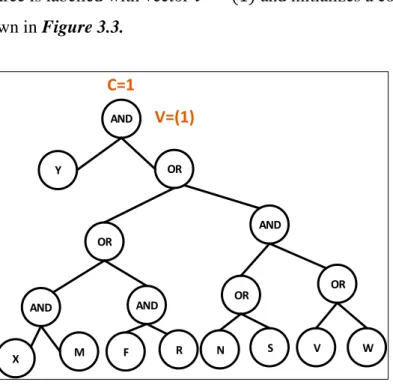
Figure 3.3: The first step of the Lewko-Waters algorithm is to label the root node ... 49
Figure 3.4: Labelling the interior nodes and leaf nodes of the access tree using the Lewko-Waters algorithm ... 50
Figure 4.1: The architecture of the proposed system scheme... 61
Figure 4.2: The flowchart of the Setup algorithm ... 65
Figure 4.3: The steps of the Encrypt algorithm carried out by the data owner ... 66
Figure 4.4: The steps of the Encrypt algorithm carried out by the cloud server. ... 67
Figure 4.5: The steps of the KeyGen algorithm ... 68
Figure 4.6: The steps of the Decrypt algorithm... 70
Figure 4.7: The steps of the PolicyUpdate algorithm. ... 71
Figure 4.8: The Re-Encryption algorithm step... 72
Figure 4.9 A: Encryption performance comparison between our scheme and PU-CP-ABE. ... 81
Figure 4.9 B: Policy update performance comparison between our scheme and PU-CP-ABE ... 82
Figure 4.9 C: Decryption performance comparison between our scheme and PU-CP-ABE ... 83
Figure 5.1: Interactions between the multi-authority scheme entities ... 87
Figure 5.2: The proposed multi-authority system algorithms ... 89
Figure 5.3: The steps of Setup1CAA sub-algorithm... 90
Figure 5.4: The procedure of the Setup2AA sub-algorithm. ... 91
Figure 5.5 A: The experimental results of the Encryption algorithm of our proposed multi-authority system compared with Li et al.’s scheme [85]. ... 100
Figure 5.5 B: The experimental results of the Policy Update algorithm of our proposed multi-authority scheme. ... 101
Figure 5.5 C: The experimental results of the Decryption algorithm of our proposed multi-authority scheme compared with Li et al.’s scheme [85]. ... 102
xi
Table 2.1: Summary of the proposed ABE schemes ... 18
Table 2.2: Classifying main existing systems based on the revocation type. ... 27
Table 2.3: Summary of main existing systems and their limitations ... 32
Table 2.4: Summary of main of the existing systems and their limitations ... 38
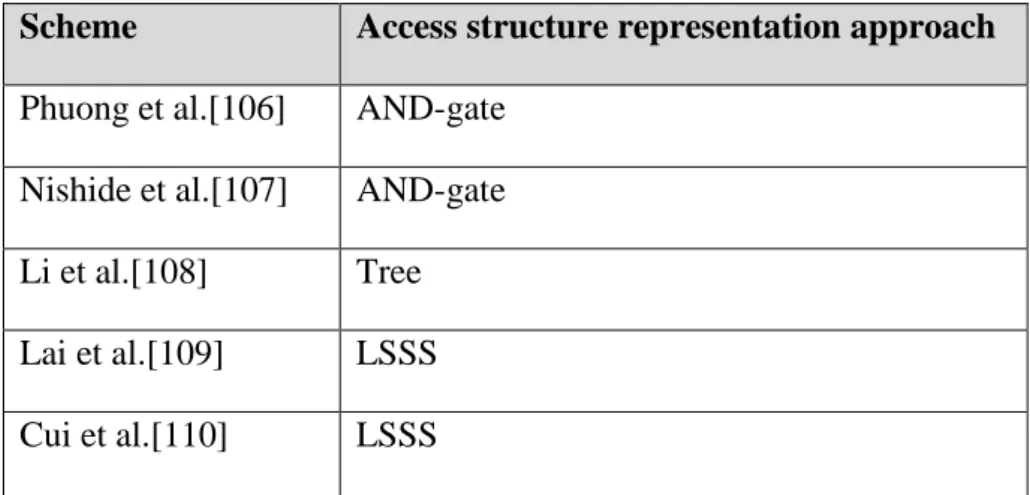
Table 3.1: Summary of the complexity of the access structures in various CP-ABE schemes ... 46
Table 4.1: Main notations used in our proposed single authority CP-ABE scheme. ... 64
Table 4.2: Comparison of scheme abilities to resist collusion attacks. ... 77
Table 4.3: Comparative summary of communication costs of our scheme against related work. . 79
Table 4.4: Comparative summary of computation and storage costs of our scheme against related work. ... 79
Table 5.1: Main notations used in Chapter 5 ... 88
Chapter 1
1
Chapter 1: Introduction
1 Introduction
An innovative technology has been introduced, developed and adopted in 1999. This technology is the Internet of Things (IoT) which has changed human life to a huge extent by optimising the techniques of intelligent, big data analysis, expanding the productivity of systems, and increasing the flexibility. Such services shape the industry and are adopted by the academic sector. However, the limited resources of the IoT devices such as battery life, computing power, and storage are the main issues that prevent consumers from successfully leveraging the IoT services and applications.
On the other hand, the method of storing, sharing, retrieving, and processing data has changed with the recent advancements of technology (e.g. cloud technologies). Organisations and individuals are increasingly encouraged to utilise services that enable data sharing, availability and accessibility from everywhere and at any time. The cloud is a well-established technology providing this type of service. However, the expanding use of such services raises critical security issues, particularly in such untrusted environments like the cloud which has the ability to directly access the data that is stored on it, and process it. To protect sensitive data, data confidentiality needs to be achieved to add a restriction on the range of cloud functions. However, thanks to the fact that the cloud server is the only entity that directly interacts with service-users, it is responsible for deciding who accesses the data. Therefore, an access control mechanism is needed to regulate access to data and expressive access policies are required to be enforced to limit the trust boundaries of the cloud provider.
Therefore, to leverage the merits of the above-mentioned technologies, a new, popular architecture has emerged which combines IoT and cloud, where IoT services and applications are offered and built on the top of the cloud services. In this thesis, we focus on the security of this integrated technology and authorization, mainly access control. In this chapter, Sections 1.1 presents the research motivation. The challenges, the methodology, requirements, research aims and objectives and the contributions of this thesis are introduced in Sections 1.2, 1.3, 1.4, 1.5 and 1.6, respectively. The outline of the thesis is presented in Section 1.7.
2
1.1 Research Motivation
The factor that motivated us to undertake this study will be expressed in this section. Where, we are interested in some applications that control children’s internet activities by running rating systems. These applications help parents to protect their children from accessing unsuitable online materials.
1.2 Research Problems and Challenges
In untrusted cloud environments, many challenges are outlined as a result of widely leveraging storage and sharing services. These challenges are shown as follows:
1- The cloud storage and sharing services are provided by multiple, unknown platforms to serve a great, unlimited number of users (whose identities are unknown) and who outsource a huge amount of their sensitive data to these untrusted servers to store on them. To avoid any sort of information leak, and grant limited access privileges to these untrusted servers which run critical works on these data, a one-to-many encryption scenario is needed to let an untrusted cloud server share encrypted data with the served users without knowing their identities.
2- Some careful measurements have to be taken due to moving data away from owners’ control. Where, making appropriate, required decisions to access the stored data with granting restricted privileges to an untrusted server to participate with this decision-making process, is a major challenge. To establish trust with an untrusted server and tackle the above-mentioned issue, access policies that are identified by data owners as a set of attributes, ought to be enforced.Therefore, granting rights to data owners to enforce their policies to access data and compensate the lack of control, is another critical challenge.
3- Dynamically managing, driving and customising the users’ privileges that are changed in response to the frequent change in the values of users’ attributes are the key issues that have motivated a considerable number of researchers to tackle these challenges.
4- In the context of encrypting data that is stored on the cloud, constructing a collusion resistant system is still an outstanding issue. In particular, it is essential to prevent a cloud server to collude with the system users who are no longer allowed to access data and already know the decryption key.
3
5- Distributing the keys securely to a large, dynamic number of authorized system users whose identities are unknown and overcoming problems with the traditional cryptographic approaches are essential challenging tasks. That needs to happen in a way that prevents malicious, authorized users to collude with each other to access a high level of data.
1.3.Research Methodology
Identifying the key cause of the problems described in section 1.2 is the first step in this research. Then, it followed by creating new solutions to rectify the problems. More specifically, the methodology for this research consists of four distinct phases: (1) literature review, (2) requirement analysis and specification, (3) two schemes design, and (4) implementation and evaluation. The scheme design phase also involves several stages as shown below.
1- Literature review: to fill the knowledge gap and solve the problems identified, we performed a thorough literature review of cloud based access control and current schemes for Attribute Based Encryption (ABE). In addition, we analysed their limitations and tried to find appropriate solutions to overcome these restrictions. 2- Requirements analysis and specification: in this phase, the relevant existing work
critically analysed to determine the needs or conditions for the newly proposed schemes to meet, by taking account of the possibly conflicting requirements of the two different technologies which are cloud and IoT. Since requirements analysis is critical to the success of the proposed schemes, the requirements derived must be practical and related to identified schemes needs. Based on these considerations, the initial requirements selected and specified.
3- Scheme design: based on the analysis from the previous phase, the essential requirements for the design of our two proposed schemes extracted. The design divided into two main stages: 1) designing a single-authority cloud access control scheme including seven algorithms to support storing data on a private cloud storage system, solve the revocation problem stated later, 2) designing a mature scheme of multi-authority cloud access control with eight algorithms to support storing data on a public cloud model and resolve the single-authority scheme limitations.
4-
Implementation and evaluation: the final phase of this proposed scheme consists of two stages that are the implementation and evaluation of the designed schemes.4
In the implementation stage, we implemented the designed schemes including the algorithms and methods of each scheme and tested them according to the requirements specified. In the second stage of this research, the implemented schemes evaluated and compared against the relevant existing work to determine any benefits our schemes offer and any problems it may experience.
1.4 Research Requirements
In this section, some critical requirements that need to be met for sharing data over the cloud, are presented to distinguish the risks. These requirements are as follows:
1. Data Confidentiality and Privacy: It is a set of rules that protects a certain type of information by placing some restrictions on it. It is an essential requirement for cloud storage since the cloud service provider which stores the data, is normally unauthorized to access its content. Thus, the data accessibility ought to be only for explicitly legitimate users. That is satisfied by using cryptographic techniques to enable the legitimate data access even when the data encrypter is offline and preserving the privacy of the users’ identities.
2. Fine-grained Access Control: It is a key mechanism that grants different access privileges to different users even if they are in the same group according to their credentials given by the associated system, and flexibly specifies individual users’ access rights.
3. Expressive access structure: It is important for the access policies specified by a data owner to be expressive to realize fine-grained access control. Moreover, an encryption technique is required to support the expressiveness of these policies. This requirement makes the access control scheme similar to a real-life access control.
4. Collusion Resistance: The system has to prevent any collusion attacks from combining their information together to illegitimately gain unauthorized data through collaboration [30]. In the cloud environment, this type of attack can be either a group of misbehaving system users who collude with each other, combine their information and gain higher access rights or a combination of a cloud server and malicious, revoked users who try to gain the original data.
5. Forward and Backward Security: Forward security means any revoked user ought to be prevented from accessing data and decrypting any new published ciphertext after leaving the system. In terms of backward security, several types of application
5
need to achieve it. Such applications need a mechanism in which the ciphertexts published previously cannot be decrypted by any user who newly joins the system [31].On the other hand, other applications do not need to achieve backward security in the sense that a user who newly joins the system can also be able to decrypt the data published previously [32-34].
6. Revocation: When a user is degraded or leaves the system, its access rights need to be reduced or revoked, respectively, by the related access control scheme without incurring significant computational cost. In addition, attribute updating is not a straightforward process in ABE and it is hard to address, as updating a single attribute could impact a large number of users accessing the same attribute.
7. Scalability: The performance of the system should not to be affected by the increase in the number of the system users.
8. Computation overhead: It is essential to fulfil all the above requirements with minimal computation cost.
1.5 Research Aims and objectives
In this part of the thesis, the critical aims and objectives of the project are presented.
1.5.1 Aims
Based on the challenges and problems identified earlier, the general aim of this proposed project is to construct a scheme that supports a spontaneous coalition between the IoT and the cloud, and provides secure storing and sharing sensitive data on the cloud in a specific way that improves the decision-making process to access its resources. This aim will be useful to apply to some IoT applications that have digital contents such as e-books, videos, patient health records and so on. These applications are becoming pervasive in the era of the cloud and need a mechanism to prevent them from being obtained by inappropriate users.
Offering a novel model for dynamic access to cloud resources in response to access policies changes will provide data owners more flexibility and security by allowing them to share their resources with others for easy access to them. The aim of this project will be accomplished by considering the current research in cloud access control strategies and then developing the model for novel, flexible, secure access control. Although many studies have
6
been done in this field, little work has considered all the mentioned problems in one scheme to enhance the decision-making process of regulating access to cloud resources.
1.5.2 Objectives
To accomplish the aim of this proposed project, the following objectives are set out to: 1. Examine the current approaches to cloud access control by performing a thorough
literature review and identify their strengths and shortcomings.
• This objective is achieved in Chapters 2 and 3 that present the existing, relevant techniques, their limitations and issues, as well as some related fundamentals and principles.
2. Develop an attribute-based encryption technique in a specific way and construct a proposed scheme that is able to handle the frequent attributes changes with reference to solving the user revocation problem and stores data in private storage cloud environments.
• In Chapter 4, the proposed single authority scheme is designed, constructed and implemented. In addition, the security requirements are identified. Based on these requirements and the implementation results, the scheme is analysed and evaluated.
3. Extend the proposed scheme to build an advanced access control scheme that deals with storing data on public storage cloud environments and adjust the proposed revocation techniques to be adapted with the modified scheme, where these two schemes ought to be feasible for IoT technologies.
• The proposed decentralised multi-authority scheme is designed, constructed, implemented and analysed in Chapter 5.
4. Illustrate the effectiveness of the constructed schemes.
• The results and discussions in Chapters 4, 5 and 6 show that our proposed schemes address most of the existing limitations (mentioned above in Section 1.5) and support storing sensitive data in an untrusted cloud environment with dynamic privilege management.
1.6 Research Contributions
In this thesis, the design, theoretical details and implementation of our proposed access control schemes are presented. The novelty of our collusion-resistant schemes are to drive
7
the access privileges in a specific way by updating the access policy as well as user revocation. In this part, our core research contributions and advancements in an untrusted, outsourced environment are discussed as follows:
1- Reformulating the scheme of CP-ABE and presenting a new scheme that constructs our novel cloud access control scheme and achieves data confidentiality, fine-grained access control and supports expressive access policies to be secure in untrusted environments. In particular, our proposed scheme is constructed by rebuilding the most popular existing systems that have many merits but lack dynamicity in a dynamic storage environment.
2- Resolving the issue of frequent attribute changes which has not sufficiently been addressed by the existing systems, by providing a novel technique to efficiently handle users’ attributes by policy updating, leading to managing and customising users’ privileges. This technique helps to elevate, eliminate, or even revoke users’ access rights by efficiently dealing with a monotone access structure without incurring heavy computations.
3- Manipulating the user revocation problem by enforcing constraints and a specific formula into users’ secret keys which are also known to revoked-users for data decryption to invalidate them after the revocation event occurred.
4- Outsourcing a computational part of the expensive encryptionoperation to a cloud server without any information leakage about the plaintext leads to minimizing the long-standing time that is required for encryption and policy update. That happens due to merging the CP-ABE with the traditional encryption techniques to efficiently manage a monotone access structure without incurring heavy computation. In addition, part of the policy update and the whole ciphertext re-encryption process are delegated to cloud.
5- Adding a proxy server that activates the user revocation property, makes the scheme robust against collusion attacks to be a collusion resistant scheme.
6- Further extending the proposed scheme and enhancing its security and performance by developing the scheme from a single attribute authority to multi-attribute authorities, which is suitable for more complicated cloud applications. This extension leverages the power of the proposed single-authority scheme such as
8
dynamic privilege management that is considered as a significant, complicated issue to be achieved in a multi-authority scheme.
7- In the proposed multi-authority scheme, secure outsourced decryption is used to mitigate the burden from users.
1.7 Organisation of the Thesis
Chapter 2 introduces related definitions, fundamentals, and principles of ABE schemes. Furthermore, we identify some issues and limitations as well as some related work.
Chapter 3 brieflypresents some mathematical background, relevant principles and basic concepts related to advanced cryptographic techniques.
Chapter 4 proposes a new Ciphertext-Policy Attribute Based Encryption (CP-ABE) scheme with a single authority that can practically manage users’ access privileges. Moreover, the theoretical model is presented. At the end of this chapter, based on the scheme evaluation and experimental results, we analyse the scheme in terms of security and performance and show that our proposed scheme is secure against collusion attacks.
Chapter 5 extends the proposed algorithm in Chapter4 to build a multi-authority access control scheme that provides higher capabilities compared with the existing work. Furthermore, this chapter presents the implementation of the scheme and discusses the experimental results. In addition, a comparison between the proposed scheme and the most relevant one is carried out to check the practicality of the scheme.
Chapter 6 summarises the chapters presented and concludes the thesis. In addition, it points out some directions of future research extracted from this work.
Chapter 2
CP-ABE for Outsourcing
Data to Cloud
9
Chapter 2: CP-ABE for Outsourcing Data to
Cloud
2 Introduction
Unlimited cloud storage and data outsourcing services provide data owners and enterprises with capacities for storing and processing a massive amount of data. These high quality services enable easy accessibility, high scalability and availability [35]. Despite all the advantages, serious concerns about the data security and confidentiality in such a cloud environment have been raised [36]. To preserve data confidentiality, many techniques support encrypting the outsourced data stored in the cloud environment. However, these techniques cannot regulate access to specific stored data or enforce access policies [3]. In an untrusted cloud environment, preserving data confidentiality, making an appropriate decision on data and enforcing access policies are core challenges. Therefore, many system models and techniques for access control based on cryptographic operations have been characterized and described by researchers to provide secure and efficient cloud access control. Although such techniques enable sharing data with a large number of users, some open issues still need to be addressed, particularly for Internet of Things (IoT) applications. Firstly, access control policies should be expressive enough to incorporate relevant contextual information on the properties, features or characteristics that are associated with users, objects, or the environment (e.g. age, position, time etc.), reflecting the frequently changing conditions and correlating with ongoing activities in the environment concerned [37].
Secondly, since IoT applications are varying widely (e.g., e-health including patients’ medical records management and remote diagnoses, military systems including soldiers’ data management and monitoring, smart vehicles including traffic jam management, and smart cities), securing such applications by building a collusion resistant system and providing fine-grained access control is a key challenge. The reasons for this are the sensitivity of such application data and the consequences of attacking such applications cause great damage to systems and their users. Thirdly, the most important issue from the user point of view is how to flexibly join and leave a system with a low computational cost (i.e. efficient user revocation).
10
To address the above challenges, a considerable amount of research has been conducted to develop necessary cryptographic techniques. This chapter will critically examine and compare these techniques to demonstrate their effectiveness and efficiency as well as limitations.
In a large-scale distributed environment, particularly the cloud environment, traditional symmetric cryptographic techniques with the same key for both encryption and decryption operations suffer from a key distribution and management problem. On the other hand, traditional asymmetric cryptographic approaches, which utilise a public key for encryption and a private key for decryption, lack computational efficiency. These one-to-one schemes are not desirable to encrypt data and send it to a group of recipients. The reason for this is that a data owner needs to know who the recipients are, their identities, or their public keys, before encrypting its data and sending it to the corresponding authorized users separately. However, to eliminate the enormous computational costs of the traditional cryptographic operations, and to achieve the mentioned requirements (such as preserving data confidentiality, regulating access to stored data and using expressive policies), attribute based access control has been introduced, which grants access privileges to users based on their attributes. To perform attribute-based access control while preserving data confidentiality, ABE has been proposed, which is an advanced asymmetric cryptographic technique invented to leverage the merits of the symmetric encryption (e.g. high efficiency) and solve its key management and distribution problems.
Two variants of ABE were discussed in [38]. These variants are ciphertext policy attribute based-encryption (CP-ABE) and key policy attribute-based encryption (KP-ABE). The major difference between them lies in how to associate a secret key and an access policy with relevant data and attributes. In KP-ABE, an access policy is associated with a secret key and a set of attributes are associated with the data encrypted with the key. Conversely, in CP-ABE, each encrypted data item is assigned with a specific access policy and a user’s secret key for the data decryptionis assigned with a set of attributes. As a consequence of embedding an access policy into a user’s secret key in KP-ABE, a data owner (who encrypts the data) can only select a set of attributes but will not be able to decide which user can access its ciphertext. To decrypt the ciphertext, a key generator (i.e. an attribute authority), which generates the decryption key for authorized users, will be responsible for granting or denying access to the key [39]. Due to this property, we pay little attention to KP-ABE and
11
focus on CP-ABE in the rest of this thesis, as our objective is to give data owners full control of their sensitive data and CP-ABE is more suitable for this purpose.
The criteria used to choose the related works, in this chapter, are based on selecting various CP-ABE schemes using different methods to solve the same problem (i.e. the revocation problem). In addition, covering all the existing techniques is under our consideration. This chapter is structured as follows: Section2.1 gives a basic description of IoT. The cloud computing technology is described in Section 2.2. The aspects of access control are discussed in Section 2.3. Section 2.4 presents the principle of context awareness. The background of ABE and the main problems of CP-ABE are described in Section 2.5. Existing single authority and multi-authority CP-ABE schemes are introduced in Section 2.6. Finally, Section 2.7 summarises the chapter.
2.1 The Internet of Things (IoT)
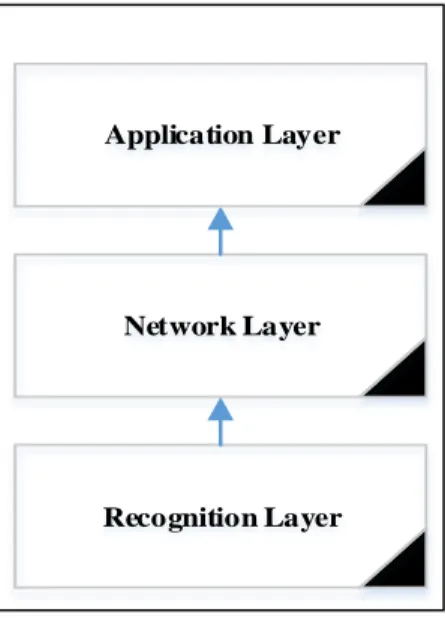
The Internet of Things (IoT) refers to a system of smart devices which are intelligently connected to the physical world collecting data by embedded sensors and then leveraging such data. The architecture of the IoT consists of three layers [1]. These layers are the recognition layer, network layer and application layer shown in Figure 2.1.
Figure 2.1: The Internet of Things architecture
In the recognition (or perception) layer, data is collected from the environment or things, to be transformed into a digital form. The network layer is the main layer of the IoT which connects the other two layers together and transmits the data from the recognition layer to
Recognition Layer Network Layer Application Layer
12
the application layer which is the top layer of the architecture. The application layer provides the relevant services that meet users’ needs.
Hence, this technology offers many services that enhance the quality of consumers’ life and increase enterprises’ productivity by improving the efficiency of education, health, decision making, and so on [2]. However, the IoT devices are resource–limited things. Therefore, one of the main IoT challenges is the huge amount of data that has to be dealt with. Storing and processing these data needs powerful computing and storage abilities exceeding that found in the IoT. Therefore, integrating the IoT with the cloud that has unlimited storage and computing power, is a critical issue.
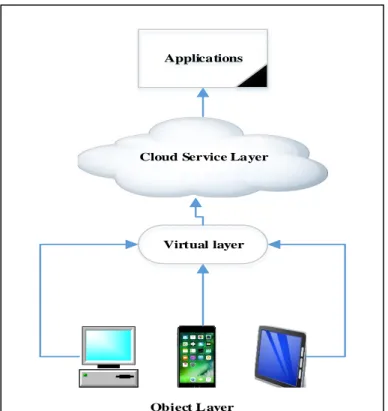
To leverage the cloud resources, IoT applications deliver their data to the cloud service provider which provides considerable storage and computational resources for the IoT devices (e.g., in e-healthcare networks). On the other hand, delivering data to the cloud means losing the control and the management of these data, raising serious security issues which form open challenges. To sum up, the combination of cloud computing and IoT (as illustrated in Figure 2.2) can provide a universal environment of data collecting services and powerful processing of such data. Whereas IoT produces rich contextual information, the cloud effectively serves as the brain to improve decision-making based on the information provided.
Figure 2.2: The integration of the IoT and cloud.
Virtual layer Cloud Service Layer
Applications
13
2.2 Cloud Computing System
Cloud computing is a large-scale computing paradigm for a wide range of functional capabilities, which enables convenient, on-demand network access to a large, shared pool of virtualized, managed computing and storage resources[3]. These resources are delivered effortlessly as services to billions of consumers through the network anywhere and anytime [4]. These services were categorized into three various models by the National Institute of Standards and Technology (NIST)[5] as Software as a Service (SaaS), Platform as a Service (PaaS), and Infrastructure as a Service (IaaS).
Software as a Service (SaaS) is a software distribution model. In particular, the cloud service provider hosts applications and makes them available to a large number of consumers over the internet. As a result, SaaS provides shared access to the applications running on the cloud infrastructure instead of running these applications on the organization’s computers and hardware [6]. That eliminates the expense of hardware acquisition, maintenance and the need for software installation. In addition, SaaS offers high scalability by giving consumers the option to access more or fewer features or services.
The second model is Platform as a Service (PaaS), in which, hardware and software tools which are needed for application development such as java development or application hosting, are delivered by the provider to users through the network, which in turn allows shared access to tools and programming languages demanded to deploy an application. This is beneficial to companies and consumers by allowing them to focus on creating and developing applications instead of maintaining the infrastructure. The access to PaaS will be charged by a provider on a pay-per-use-basis that many enterprises prefer.
The last model is Infrastructure as a Service (IaaS). It provides a virtual machine to the cloud users, which is overcommitted physical servers to expand profits from investing hardware. Where, it allows shared access to underlying hardware resources such as network, storage and other computing resources. The need for more physical machines is reduced by Server virtualization. That helps to avoid the complexity and expense of maintaining and managing their own physical resources.
Generally speaking, cloud computing can be categorised into three deployment models based on the type of data that are dealt with and the required levels of security and management. These types are public, private and hybrid clouds. In a private cloud, only exclusive use is offered for the cloud infrastructure to a single organisation. Such
14
infrastructure and services may be managed by the organisation or a third party. While in a public cloud, public use is provided for the cloud infrastructure which is managed by a government or an academic organisation or combined organisations. The composition of these two models is considered as a hybrid cloud.
Many applications which use intensive data and depend on SaaS and PaaS models, require logical data storage as these applications need to operate simultaneously on contiguous data. Cloud storage is a service in which managing, maintaining and backing up data are made remotely available to users over the internet. It maximises the benefits by hosting users’ data on the cloud servers from anywhere at any time. Recently, many companies have started to offer the cloud storage service.
Due to being provided with the accessibility, flexibility and data recovery with low cost by the cloud storage service [7], many companies are motivated to outsource their data to cloud storage servers. In that way, the companies’ need for housing special equipment for storing their data is minimised with a guarantee that those data are protected against any natural disaster, stealing or system crash. In addition, scalability is one of the major benefits that the cloud provides. That enables the company to be enlarged to accommodate future needs. However, storing data on remote external servers and assigning a variety of essential responsibilities of managing and maintaining those data to the cloud service provider without any intervention from the data owners is a critical issue. Once the data is outsourced to the cloud servers, the data owners will lose the control of their data. Since the cloud service provider is not totally trusted by the cloud consumers and a large amount of the stored data is highly sensitive, integrity, security and privacy are major issues in cloud computing.
Therefore, to maximise the adoption of the cloud storage service, some appropriate cryptographic techniques ought to be undertaken to satisfy two key features [8]. The first one is the confidentiality which ensures that the cloud service provider has no knowledge about the customers’ data. The second feature is the integrity which means the ability of the cloud customers to detect any illegitimate modification carried out on their data by the cloud service provider or any attackers.
In terms of cloud users who need to access to data which is stored on the cloud, one of the main mechanisms used in the cloud environment to manage authorized access, is access control whose main responsibility is to manage users’ access rights. It grants access to
15
authorized users and forbids others access to data [9]. Due to the distributed environment with untrusted cloud servers, efficient mechanisms for regulating access over encrypted data are required. Therefore, many system models and algorithms for access control have been characterized and described by researchers to provide secure and efficient cloud access control.
2.3 Access Control
In the cloud environment, the sensitive, large, scalable, stored data requires a secure manner to protect and preserve its integrity and confidentiality without affecting the scalability and the performance of the system. One of the critical security mechanisms for data protection is access control that permits, restricts or denies access to system files by setting some conditions and rules which are combined together to make and enforce an access control decision [10]. In this way, the access control technique can ensure only authorized users who need to access certain data, have the ability to do that.
Some core requirements need to be achieved in any effective cloud access control system. The first one is fine-grained access control [11]. In particular, each user in a system has their own access right which may differ from others in the same group. Due to lack of control, the second requirement is to assign control to the data owners after residing their data on the cloud without computation overhead which is the third requirement. To keep data safe and guarantee the security, the data has to be encrypted. That will keep data away from being illegitimately accessed by a cloud server or any unauthorized users. Therefore, the fourth requirement is confidentiality [12].
To meet the above requirements, attribute based access control has been introduced [13]. However, to hide the data from a storage server, encrypting data is essential before storing them on such servers. Thus, data encryption with attribute-based access control is known as an Attribute-Based Encryption (ABE) technique.An attribute is a piece of information that describes the properties, features or characteristics of an object [14]. This information can be recognised by either automated or human approaches. For example, an attribute could be a department (e.g. engineering, computer science, etc.), an occupation (e.g. teacher, student, researcher, etc.), and experience years (e.g. two-years, five-years, etc.). In general, attributes are classified into two types [15]: 1) non-temporal attributes with discrete attribute values (e.g. age, address, email, etc.), and 2) temporal attributes with continuous values (e.g. interval, time, etc.).
16
Many studies have been carried out on the cloud access control using ABE with discrete attribute values [13, 16, 17]. These studies have a lot of problems which remain unsolved. For example, Yang et al. [17] proposed an access control model with low computational costs for decryption. However, the work incorporated weak privacy and security considerations. On the other hand, some schemes require intensive computations in return for stronger privacy and security protection, meaning that they are unsuitable for mobile devices with limited computation power [18, 19].
In addition, some work has been carried out using ABE with continuous attribute values, which is known as temporal access control [20, 21]. The access structure can be in the form of time (e.g. between 8 am and 12 pm). These temporal attributes are familiar in the cloud. For instance, only during a particular period of time, can users access certain data. However, such schemes have their shortcomings. For example, the scheme of Zhu et al. [21] does not address user revocation, and the scheme of Yang et al. [20] manages the revocation problem inefficiently by refreshing an update key and sending it to all users at every time slot with a valid set of attributes which represent the revocation.
Achieving data confidentiality and access control for the cloud data is a core challenge that needs to be taken into account. Addressing this challenge supports data security management, and allows data owners to regulate their data and enforce restrictions on accessing data. Traditional cryptographic techniques can keep data confidentiality. However, the other requirements (mentioned above) are hard to achieve with these types of techniques.
2.4 Context awareness
Due to rapid changes in users’ context, the use of the context information is crucial in interactive applications, particularly for ubiquitous computing applications [22]. Context can be defined as “any information that can be used to characterize the situation of an entity. An entity is a person, place, or object that is considered relevant to the interaction between a user and an application, including the user and applications themselves” [23]. If a system uses the context to supply relevant information to a user who uses it in a specific task, it is considered as context-aware [24].
Some critical issues have to be considered when the systems and applications intend to use context information gathered from the environment [25]. The first one is organizing the
17
gathered information in an effective way that is compatible with the system requirements. The second one is how systems can utilize contextual information to provide improved services to the system users [26].
Although different researchers have developed context-aware access control models, the use of context has been targeted at detecting devices and network environments that were used to request an access to the cloud data. This information can be useful to detect the computational power of the devices or to check if the requested data will be transmitted through insecure channels [27, 28].
However, an active access control model requires a much broader scope of context and is centred on the context which consists of all the characterizing information considered relevant to it. This context can be identified as identities, locations, times or activities which are collected and labelled in some meaningful way and represented in terms of attributes [29].
2.5 Attribute-based Encryption (ABE)
ABE is one of the advanced cryptographic techniques for one-to-many encryption that overcomes thelimited functionalities of the traditional public-key cryptographic techniques. This scheme was proposed by Sahai and Waters [40] as an application of fuzzy identity-based encryption which uses human-intelligible identities (such as unique name, IP address, email address, etc.) as public keys, where a data sender directly encrypts its data with the receivers’ identity. Later, Goyal et.al. [38] present a more general construction of ABE in which attributes have been utilized to issue a public key and to generate a logical expression of these attributes called an access policy. Both the public key and access policy are used for encrypting data. In contrast with the traditional cryptographic systems which encrypt data to one particular user or group that knows the decryption key, there is no more need to share the same private key or store several versions of the ciphertext encrypted with different keys [41]. Moreover, ABE has no restriction onthe number of users in the system. Based on these considerations, this scheme has been leveraged to regulate users’ access to cloud data by using attributes as an access policy.
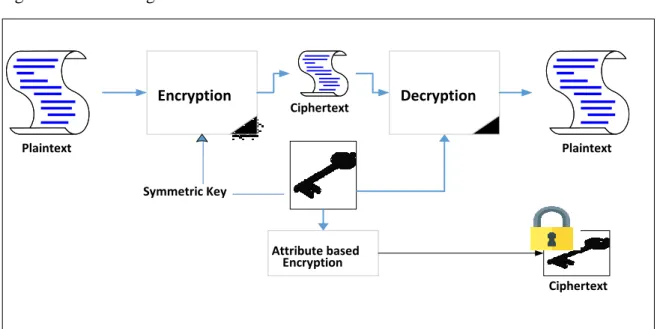
To apply ABE, a data owner encrypts its data using a symmetric encryption algorithm with a symmetric key and then encrypts the key using an ABE scheme with a public key. The encrypted key is distributed to a group of recipients/users as a ciphertext. Each user obtains
18
the private key 𝑠𝑘 for the encrypted key decryption from a key generator that calculates the key according to the user’s attributes. In this case, the data owner does not need to know the identities of the legitimate users and their dynamicity. Figure 2.3 illustrates the above operational process. Applying ABE to the two variants (i.e. CP-ABE and KP-ABE) follows the same procedure (as shown in Figures 2.4 and 2.5). The main difference is, in KP-ABE, users' secret keys are issued using an access policy that defines the access privileges of the authorised user, and the symmetric key is encrypted over a set of attributes. However, CP-ABE uses access policies to encrypt data (i.e. symmetric key) and secret keys of the legitimate users are generated over a set of attributes.
Figure 2.3: Using ABE to encrypt a symmetric key
Many KP-ABE and CP-ABE schemes were proposed with some notable examples listed in
Table 2.1.
Table 2.1: Summary of the proposed ABE schemes
Scheme Description Revocation Access Policy
Bethencourt et al.[39] The first CP-ABE scheme using a tree access structure.
Lack of
revocation Less expressive Waters[42] The first fully expressive
CP-ABE scheme using a linear secret sharing access structure.
Lack of
revocation Full expressive Wang et al.[43] The first hierarchical
ABE scheme with a disjunctive normal form (DNF) policy.
Addressing
revocation Not expressive
Plaintext Encryption Ciphertext Decryption Symmetric Key Attribute based Encryption Plaintext Ciphertext
19
Figure 2.4: The procedure of KP-ABE
2.5.1 Ciphertext–policy Attribute Based Encryption (CP-ABE)
The most popular variant of ABE techniques is CP-ABE. Four entities are responsible for running this scheme. These entities are attribute authority, data owner, data user and cloud server. The role of the attribute authority is to generate secret keys for users according to their attributes to decrypt data. In addition, it is responsible for generating a public key and a master key. A data owner’s role is to define an access policy that describes who can access its data as well as encrypting those data under this access policy. Firstly, the data owner uses a symmetric encryption technique (e.g. AES) to encrypt its data. After that, the owner encrypts the symmetric key under its access policy using CP-ABE by selecting a random value as a secret which is shared using a linear secret sharing (LSS) technique to generate some values associated with each corresponding attribute in the ciphertext according to the owner’s access policy. This policy is determined over a set of attributes by the data owner and can be demonstrated as a Boolean function with (AND, OR) gates between attributes (e.g. (lecturer AND experience >= 2 years) OR Professor). Then the encrypted data is sent to the designated cloud for storage including the data ciphertext, the CP-ABE ciphertext and the access policy. Associating the access policy with the ciphertext means that the ciphertext chooses which key can recover the plaintext, giving the data owner more control of its outsourced data [44]. The eligible users who possess the required attributes in a right combination (i.e. satisfy the access policies) can successfully decrypt the encrypted data. As
PK: Public Key MSK: Master Key SK: Secret Key
20
a result, the main benefit from using CP-ABE is that sensitive data can be stored on an untrusted server without performing authentication checks for the data access [45].
A common framework of a CP-ABE scheme includes four algorithms as demonstrated in
Figure 2.5: Setup, Encryption, Key Generation and Decryption [42], which are defined below:
• 𝑺𝒆𝒕𝒖𝒑(𝝀, 𝑼) → (𝑴𝑺𝑲, 𝑷𝑲): Takes a set of attributes 𝑼 in the system and an
implicit security parameter 𝝀 (such as the type of the elliptic curve group used and the base finite field) as inputs to generate a public key 𝑷𝑲 and a master key 𝑴𝑺𝑲 as outputs.
• 𝑬𝒏𝒄𝒓𝒚𝒑𝒕(𝑷𝑲, 𝑨, 𝑴 ) → 𝑪𝑻: Takes as inputs a public key 𝑷𝑲, an access
structure 𝑨, and a message 𝑴 to be encrypted. The output will be a ciphertext 𝑪𝑻.
• 𝑲𝒆𝒚𝑮𝒆𝒏(𝑴𝑺𝑲, 𝑺) → 𝑺𝑲: In this algorithm, a master key 𝑴𝑺𝑲 and a set of
attributes 𝑺 are taken as inputs. A user’s secret key 𝑺𝑲 is generated as output.
• 𝑫𝒆𝒄𝒓𝒚𝒑𝒕 (𝑪𝑻, 𝑺𝑲) → 𝑴: This algorithm takes as inputs a user’s secret key 𝑺𝑲 and
a ciphertext 𝑪𝑻. It returns a message 𝑴 when the user’s attributes satisfy the access structure.
21
There are some appealing merits of the CP-ABE technique over other one-to-one traditional encryption techniques that enable coarse-grained access control. First, CP-ABE is to enable fine-grained access control in an encrypted form. This is desirable for many access control applications that run some cloud services such as storage and sharing services. Secondly, it supports highly expressive policies representing any access structures. Thirdly, it offers a good solution to data confidentiality. As generating a secret key for a user happens only once but it can be used to decrypt all the subsequent ciphertexts, CP-ABE reduces communication overhead [44]. Fourthly, it is collusion resistant against misbehaving authorized users, which is achieved by associating a random number or polynomial with each attribute of a user’s secret key so that only the attributes with the same random value can be used for decryption, leading to preventing different legitimate users from colluding with each other [46]. Finally, it is possible to integrate CP-ABE with a proxy re-encryption
technique in cloud in order to increase security by re-encrypting ciphertexts without
disclosing the plaintexts to the cloud[44].
However, there are some weaknesses related to the CP-ABE scheme. These include that CP-ABE only works fine when attributes are descriptive [11]. In other words, temporal attributes are not well handled by CP-ABE. In addition, this technique is difficult to handle
the attribute/user revocation problem [47] without trusting the cloud service provider that
already hosted the data, particularly in dynamic environments where users’ attributes can change over time. Trusting a cloud server raises another issue which is a collusion attack. This attack involves revoked users colluding with the cloud server to combine their information together to gain access to unauthorized data. Therefore, the adoption of CP-ABE requires additional refinements.
Based on the entities that a user can obtain authorization from, CP-ABE is classified into two different categories[48]. They are single authority CP-ABE, where all attributes are handled by a single authority, and multi-authority CP-ABE in which different authorities manage the attributes in a distributed manner. However, in multi-authority systems, many complicated issues can be experienced when the CP-ABE systems are built. For example, to tie the work of all authorities together, some existing systems use either a central authority that could cause a bottleneck problem and is contradictory to the distributed control principle[49], or coordination between the authorities, which increases communication and computational costs. In addition, each authority needs to be aware of each other, running the risk of collusion bycombining their information to figure out unauthorised information.
22
In addition, the revocation process is more complicated to manage in this type of system [41, 49].
On the other hand, some issues can be encountered in any single authority systems. The first one is the key escrow problem that happens due to the ability of the authority in this type of the system to gain access to all users’ keys. This ability is obtained by the authority as it possesses the master key from which the users’ keys are derived. The second issue is the limited ability of any single authority system to handle a wide range of different attributes. Moreover, it represents a single-point bottleneck on security. Once an adversary compromises the system, the authority’s master key is easy to obtain.
To efficiently exploit the advantages of CP-ABE and avoid most of its drawbacks, we need to construct a new scheme of CP-ABE that mitigates the difficulties in the existing schemes, uses sufficient, alternative solutions that dynamically change users’ privileges without entrusting information to a cloud server, and builds a collusion resistant system. The main issues that we are concerned about, are:
• Resolving the revocation problem.
• Covering a wide range of attributes needed by any system, and eliminating a single point failure.
• Reducing the computation overhead.
2.5.2 The Revocation Problem
Revocation is a property to change the access rights of users when unexpected events occur such as malicious behaviour from a user, or an expired service that a user had purchased [41]. There are two scenarios where the revocation can be conducted. The first one is called attribute revocation that happens when some of a user’s attributes are removed from the current set due to being degraded in the system. For example, degrading a manager of an organization to a normal employee role leads to losing some of its possessed attributes and hence access rights. The second scenario occurs when a user leaves the system; its access rights have to be revoked so that the user is no longer able to access the system and decrypt any stored data on it, which is called user revocation[50]. Based on these considerations, designing a mechanism to revoke the user’s certain access rights must be embedded in the system from the beginning. Otherwise, the whole system has to be rebuilt with the advent of each revocation event.
23
In attribute-based access control schemes, the attribute revocation is a severe problem and very costly to apply for two reasons. The first one is the same attribute may be associated with different users’ secret keys, causing significant computational overhead throughout the revocation process. This happens due to the need for updating all relevant keys for the non-revoked users and re-encrypting the related ciphertexts [41]. The second reason is most of the existing proposed attribute revocation methods are based on a semi trusted server, but this is an unrealistic assumption [50]. This is because the server could breach the trust and even be compromised, resulting in permitting unauthorized users to access the data stored in the cloud for gaining profits, e.g. when the cloud illegitimately permits a company to access the data of its competitors.
Therefore, the following crucial requirements are needed to handle the revocation problem: 1) Permit instantaneous banning of a malicious user,
2) Resist collusion attacks or invalidate the secret keys of the revoked users [41] (which means the cloud cannot collude with a revoked user to illegally obtain encrypted data),
3) Minimise the computation overhead of a revocation process,
4) Support forward security which means any newly published ciphertext cannot be decrypted by any revoked user with revoked attributes [51].
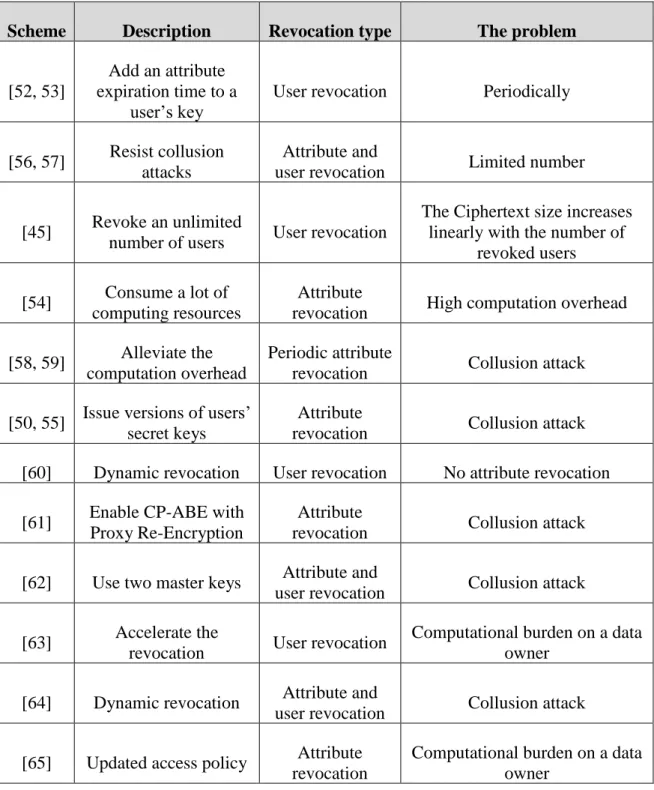
Although considerable research has been devoted to solving the revocation issue, most of the existing studies lack practicality and the revocation process is considered as the major hindrance (Table 2.2 illustrates the main existing systems). The current strategies and assumptions utilised for the revocation are either considering that the server used is a trusted entity that can be assigned critical, essential, auxiliary processes of access control or, in the worse-case scenario, assuming that the data owner and a private key generator (attribute authority) stay online all the time [50].
Some studies have been done to handle the revocation problem periodically [52, 53]. Wan et al. [52] propose a hierarchical attribute-set-based encryption scheme with user revocation. To cope with user revocation, they added an attribute expiration time to a user’s key. This time indicates the validity period of the user’s key. However, this causes serious vulnerabilities due to the uncontrolled period from the revocation time of a user to the expiration time of its key, as well as bringing an extra computational burden to the authority
24
for frequent key updating and maintaining secure channels for all transactions. On the other hand, other schemes have also been proposed with instantaneous attribute revocation [41, 50, 54, 55].
Several researchers have worked to build systems that resist collusion attacks [56, 57]. These schemes [56, 57] use a secret sharing scheme in order to prevent the server from decrypting the ciphertexts or illegitimately granting permissions to revoked users to access the data. In addition, they achieve dynamic, immediate attribute and user revocation without updating keys of non-revoked users. However, these schemes can only revoke a limited number of users. On the other hand, some schemes can revoke an unlimited number of users [45]. In [45], a unique identifier is associated with every user’s secret key, which is in turn used to construct the revocation information to be embedded in the ciphertext. However, the ciphertext size increases linearly with the number of revoked users, which has a negative impact on available storage capacities, particularly when the amount of data is large.
Moreover, applying the revocation process consumes a lot of computing resources. The attribute revocable system proposed in [54] needs to update all keys for the non-revoked users and re-encrypt the related ciphertext, which leads to low scalability and high computational overheads. Other recent studies have utilized a refereed delegation of computation models to alleviate the computation overhead of the identity-based encryption during the revocation process [58, 59]. These schemes introduce an aided server which is a Key Update Cloud Service Provider, to outsource most operations of the key generation related to the revocation process. They assign, for each user, a hybrid private key which contains two types of component, identity and time components which ar