DDX-2060/DDX-2050
All-Digital High Efficiency Power Amplifiers
Specifications are subject to change without notice.
FEATURES
• HIGH OUTPUT CAPABILITY • DDX® Mono-Mode: * DDX-2060: 1 x 90 W, 4Ω, <10% THD * DDX-2050: 1 x 80 W, 4Ω, <10% THD • DDX® Full-Bridge Mode: * DDX-2060: 2 x 45 W, 8Ω, <10% THD * DDX-2050: 2 x 40 W, 8Ω, <10% THD
• Binary Half-Bridge Mode:
* DDX-2060: 4 x 25 W, 4Ω, <10% THD
* DDX-2050: 4 x 20 W, 4Ω, <10% THD
• SINGLE SUPPLY (+9V to +36V)
• COMPACT SURFACE MOUNT PACKAGE • HIGH EFFICIENCY, > 90% @ 8Ω, 10%THD • THERMAL OVERLOAD PROTECTION • SHORT CIRCUIT PROTECTION • OVER-VOLTAGE PROTECTION
BENEFITS
• COMPLETE SURFACE MOUNT DESIGN • POWER SUPPLY SAVINGS
APPLICATIONS
• DIGITAL POWERED SPEAKERS • PC SOUND CARDS
• CAR AUDIO
• SURROUND SOUND SYSTEMS • DIGITAL AUDIO COMPONENTS
1.0 GENERAL DESCRIPTION
The DDX-2060/DDX-2050 power devices are monolithic, dual channel H-Bridges that can provide audio power up to:
• 45 watts per channel @10%THD, 8Ω (DDX-2060) • 40 watts per channel @10%THD, 8Ω (DDX-2050)
at very high efficiency.
Each device contains a logic interface, integrated bridge drivers, high efficiency MOSFET output transistors and protection circuitry. Each device may be used in DDX® Mode as a dual bridge or reconfigured as a single bridge with double the output current capability. Alternatively, in Binary Mode, they may be configured as either a dual bridge or (at lower power output) a quad half-bridge or a combination of both types.
The benefits of the DDX® amplification system are: an all-digital design that eliminates the need for a digital to analog converter (DAC), and the high efficiency operation derived from the use of Apogee's patented damped ternary pulse width modulation (PWM). This approach provides an efficiency advantage over conventional PWM designs and more than three times the efficiency of Class A/B amplifiers with music input signal.
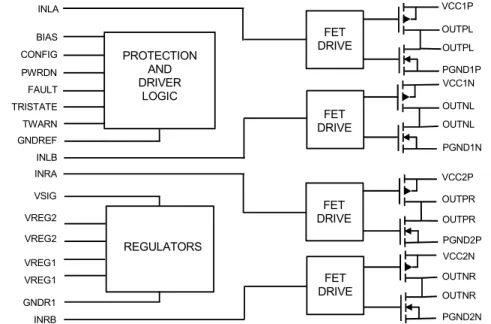
TRISTATE CONFIG INLA BIAS OUTPL OUTPL VCC1P PGND1P PGND1N OUTNL OUTNL VCC1N PGND2P OUTPR OUTPR VCC2P PGND2N OUTNR OUTNR VCC2N PWRDN FAULT TWARN INLB INRA INRB VREG2 VREG2 VREG1 VREG1 GNDREF VSIG GNDR1 FET DRIVE FET DRIVE PROTECTION AND DRIVER LOGIC REGULATORS FET DRIVE FET DRIVE
DDX-2060/DDX-2050
1.1 Absolute Maximum Ratings [Note 1]
SYMBOL PARAMETER VALUE UNIT
VCC Power supply voltage 40 V
VL Input logic reference 5.5 V
PTOT Power Dissipation, Theat-spreader = 25°C [See Figure 4] 50 W
Tj Operating junction temperature range 0 to +150 °C
Tstg Storage temperature range -40 to +150 °C
Note 1 - Permanent device damage may occur if ABSOLUTE MAXIMUM RATINGS are exceeded. Exposure to absolute maximum rating conditions for extended periods may affect device reliability.
1.2 Recommended Operating Conditions [Note 2]
SYMBOL PARAMETER MIN TYP MAX UNIT
VCC Power supply voltage 9.0 36.0 V
VL Input logic reference 2.7 3.3 5.0 V
TA Ambient Temperature 0 70 °C
Note 2 - Performance not guaranteed beyond recommended operating conditions.
1.3 Thermal Data
SYMBOL PARAMETER MIN TYP MAX UNIT
θJ-C Thermal resistance junction-case (heat spreader) 2.5 °C/W
Tj-SD Thermal shut-down junction temperature 150 °C
TWARN Thermal warning temperature 130 °C
ThSD Thermal shut-down hysteresis 25 °C
1.4 Electrical Characteristics. [Refer to circuit in Figure 18] Unless otherwise specified, performance is measured using the DDX-8001/DDX-8229 processor family, VCC=28V, VL=3.3V, fsw=384kHz, TC=25°C, RL=8Ω.
SYMBOL PARAMETER CONDITION MIN TYP MAX UNIT
THD+N <10%, RL = 4Ω 90
DDX-2060 - Power Per Channel
THD+N <1%, RL = 4Ω 70
THD+N <10%, RL = 4Ω
VCC = 26V 80
PO-DM (DDX®
Mono Mode)
[Figure 19] DDX-2050 - Power Per Channel
THD+N <1%, RL = 4Ω VCC = 26V 60 WRMS THD+N <10%, RL = 8Ω 45 THD+N <1%, RL = 8Ω 35 THD+N <10%, RL = 6Ω VCC = 25V 45
DDX-2060 - Power Per Channel
THD+N <1%, RL = 6Ω VCC = 25V 35 THD+N <10%, RL = 8Ω, VCC = 26V 40 PO-DF (DDX® Full Bridge Mode) [Figure 18]
DDX-2050 - Power Per Channel
THD+N <1%, RL = 8Ω,
VCC = 26V 30
WRMS
THD+N <10%, RL = 4Ω
VCC = 30V 25
DDX-2060 - Power Per Channel
THD+N <1%, RL = 4Ω VCC = 30V 20 THD+N <10%, RL = 4Ω, VCC = 26V 20 PO-Bin (Binary Half-Bridge Mode) [Figure 20]
DDX-2050 - Power Per Channel
THD+N <1%, RL = 4Ω,
VCC = 26V 16
DDX-2060/DDX-2050
Specifications are subject to change without notice.
1.4 Electrical Characteristics. [Refer to circuit in Figure 18] Unless otherwise specified, performance is measured using the DDX-8001/DDX-8229 processor family, VCC=28V, VL=3.3V, fsw=384kHz, TC=25°C, RL=8Ω.
SYMBOL PARAMETER CONDITION MIN TYP MAX UNIT
Po = 1 Wrms 0.06
THD+N Total Harmonic Distortion + Noise,
Po = 35 Wrms 0.09 %
Signal to Noise Ratio, DDX® Mode 100
SNR Signal to Noise Ratio, Binary Half-Bridge Mode
A-Weighted relative to
Full-scale 92 dB
Peak Efficiency, DDX® Mode Po = 2 x 45 W, 8Ω,
10%THD 90
η Peak Efficiency,
Binary Half-Bridge Mode Po = 4 x 20 W, 4Ω 87
%
DDX-2060 3.5 6 8
ISC Speaker Output Short-Circuit Protection Limit per Bridge [Note 3] DDX-2050 3.0 6 8 A
Rds-on Power MOSFET output resistance Id = 1A 200 270 mΩ
gN Power Nchannel Rds-on matching Id = 1A 95 %
gP Power Pchannel Rds-on matching Id = 1A 95 %
Idss Power Pchannel/Nchannel leakage VCC = 35 V 50 uA
UVL Under-voltage Lockout Threshold 7 9 V
IPD VCC supply current, Power-down PWRDN = 0 1 3 mA
ICC-tri VCC supply current, Tri-state TRISTATE = 0 22 mA
DDX® mode VCC supply current 2-Channel switching at 384kHz. 75
ICC
Binary mode VCC supply current 4-Channel switching at 384kHz. 84
mA
ton Turn-on delay time Resistive load 100 ns
toff Turn-off delay time Resistive load 100 ns
tr Rise time Resistive load 25 ns
tf Fall Time Resistive load 25 ns
Low logic input voltage: PWRDN, TRISTATE pins VL = 2.7V VL = 3.3V VL = 5.0V 0.7 0.8 0.85 VIL
Low logic input voltage: INLA, INLB, INRA, INRB pins
VL = 2.7V VL = 3.3V VL = 5.0V 1.05 1.35 2.2 V
High logic input voltage: PWRDN, TRISTATE pins VL = 2.7V VL = 3.3V VL = 5.0V 1.5 1.7 1.85 VIH
High logic input voltage: INLA, INLB, INRA, INRB pins
VL = 2.7V VL = 3.3V VL = 5.0V 1.65 1.95 2.8 V
Ifault Output Sink Current, FAULT, TWARN pins Fault Active 1 mA
PWmin Minimum output pulse width No load 70 150 ns
Note 3 – If used in single BTL (Mono Mode) configuration, the device may not be short-circuit protected.
1.5 Logic Truth Table
TRISTATE InxA INxB OUTPx OUTNx OUTPUT MODE
0 X X OFF OFF Hi-Z
1 0 0 GND GND DAMPED
1 0 1 GND VCC NEGATIVE
1 1 0 VCC GND POSITIVE
DDX-2060/DDX-2050
2.0 DDX-2060/DDX-2050 Pin Function Description:
2.1 PWM Inputs
Pin No. Description
INLA 29 Left A logic input signal
INLB 30 Left B logic input signal
INRA 31 Right A logic input signal
INRB 32 Right B logic input signal
2.2 Control/Miscellaneous
Pin Name Pin No. Description
PWRDN 25 Power Down (0=Shutdown, 1= Normal).
TRI-STATE 26 Tri-State (0=All MOSFETS Hi-Z, 1=Normal).
FAULT [Note 4] 27 Fault output indicator; Overcurrent, Overvoltage or Overtemperature (0=Fault, 1=Normal). TWARN [Note 4] 28 Thermal warning output (0=Warning T
J >= 130°C, 1=Normal).
CONFIG [Note 5] 24 Configuration (0=Normal, 1=Parallel operation for mono).
NC 18 Do not connect.
Note 4: FAULT and TWARN outputs are open-drain
Note 5: Connect CONFIG Pin 24 to VREG1 Pins 21, 22 to implement single bridge (mono mode) operation for high current.
2.3 Power Outputs for DDX® Mode or Binary Full Bridge Mode [Note 6]
Pin Name Pin No. Description
OUTPL 16, 17 Left output, positive reference OUTNL 10, 11 Left output, negative reference
OUTPR 8, 9 Right output, positive reference
OUTNR 2, 3 Right output, negative reference
Note 6: DDX® outputs are bridged. The outputs OUTPx produce signals in phase with the input.
2.4 Power Outputs for Binary Half-Bridge Mode [Note 7]
Pin Name Pin No. Description
OUTNR 2, 3 CH4 output, positive reference
OUTPR 8, 9 CH3 output, positive reference
OUTNL 10, 11 CH2 output, positive reference OUTPL 16, 17 CH1 output, positive reference
Note 7: Half-Bridge Binary Mode outputs are NOT bridged. All outputs produce signals in phase with the input.
DDX-2060/DDX-2050
Specifications are subject to change without notice.
2.5 Power Supplies [Note 8]
Pin Name Pin No. Description
VCC [1P, 1N, 2P, 2N] 4, 7, 12, 15 Power
PGND [1P, 1N, 2P, 2N] 5, 6, 13, 14 Power grounds
VREG1 21, 22 Internal regulator voltage requires bypass capacitor. VREG2 33, 34 Internal regulator voltage requires bypass capacitor.
VSIG 35, 36 Signal Positive supply.
VL 23 Logic reference voltage.
GNDREF 19 Logic reference ground.
GNDS 1 Substrate ground.
GNDR1 20 Internal regulator ground.
Note 8: VL (Logic Reference Voltage) is recommended to be powered and stable prior to Vcc achieving > 7V to assure proper
power up sequence. VL is recommended to remain powered and stable until after Vcc has decayed below 7V during
DDX-2060/DDX-2050
3.0 DDX-2060/DDX-2050 POWER DEVICES
The DDX-2060/DDX-2050 Power Devices are dual channel H-Bridges that can deliver more than 45/40 watts per channel (<10%THD) of audio output power at very high efficiency. They convert both
DDX® and binary-controlled PWM signals into audio power at the load. Each includes a logic interface,
integrated bridge drivers, high efficiency MOSFET outputs, and thermal and short circuit protection
circuitry. In DDX® mode, two logic level signals per channel are used to control high-speed MOSFET
switches to connect the speaker load to the input supply or to ground in a bridge configuration, according to Apogee's patented damped ternary PWM. In Binary Mode operation, both Full Bridge and Half Bridge Modes are supported. These devices include over-current and thermal protection as well as under-voltage lockout with automatic recovery. A thermal warning status is also provided.
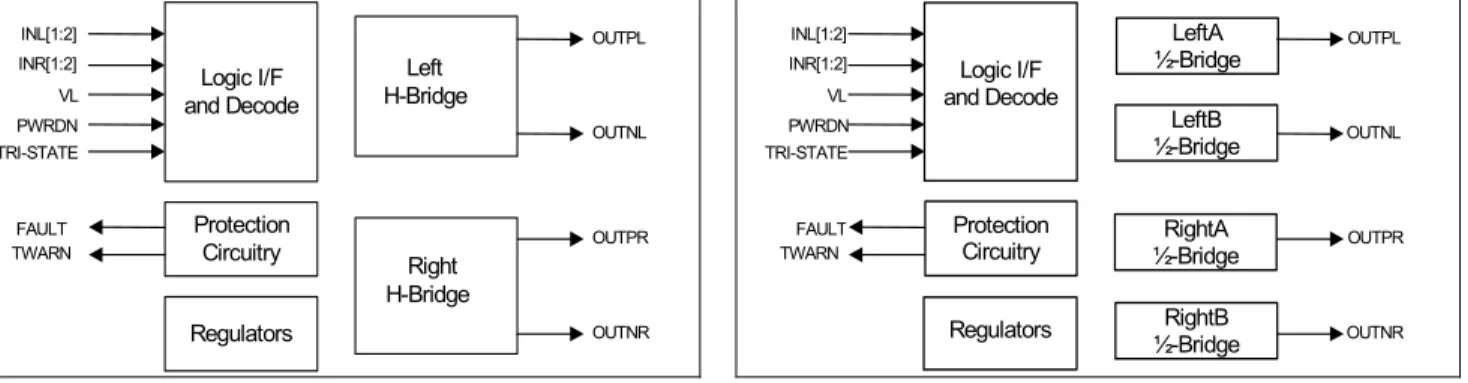
Logic I/F and Decode Left H-Bridge Protection Circuitry INL[1:2] INR[1:2] PWRDN OUTPL FAULT VL TRI-STATE OUTNL OUTPR OUTNR TWARN Regulators Right H-Bridge Logic I/F and Decode LeftA ½-Bridge Protection Circuitry INL[1:2] INR[1:2] PWRDN OUTPL FAULT VL TRI-STATE OUTNL OUTPR OUTNR TWARN Regulators RightA ½-Bridge LeftB ½-Bridge RightB ½-Bridge Figure 2 - DDX-2060/2050 Block Diagram,
Full- Bridge DDX® or Binary Modes Figure 3 - DDX-2060/2050 Block Diagram, Binary Half-Bridge Mode
3.1 Logic Interface and Decode
The DDX-2060/DDX-2050 power outputs are controlled using one or two logic level timing signals. In
order to provide a proper logic interface, the VL input must operate at the same voltage as the DDX®
controller logic supply. VL (Logic Reference Voltage) is recommended to be powered and stable prior to Vcc achieving > 7V to assure proper power up sequence. VL is recommended to remain powered and stable until after Vcc has decayed below 7V during power removal.
3.2 Protection Circuitry
Both the DDX-2060 and the DDX-2050 include protection circuitry for over-current, under-voltage and thermal overload conditions. A thermal warning pin TWARN is activated low (open-drain MOSFET) when the IC temperature exceeds 130°C, in advance of the thermal shutdown protection. When a fault condition is detected (logical OR of over-current and thermal), an internal fault signal acts to immediately disable the output power MOSFETs, placing both H-bridges in a high impedance state. At the same time an open-drain MOSFET connected to the FAULT pin is switched on. There are two possible modes subsequent to activating a fault. The first is a SHUTDOWN mode. With FAULT (pull-up resistor) and TRI-STATE pins independent, an activated fault will disable the device, signaling low at the FAULT output. The device may subsequently be reset to normal operation by toggling the TRI-STATE pin from High to Low to High using an external logic signal.
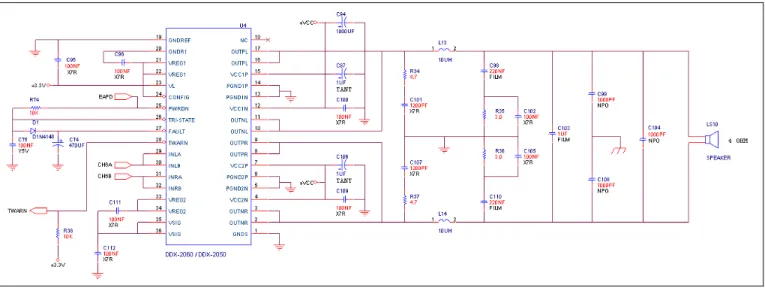
The second is an AUTOMATIC recovery mode. This is depicted in the application circuit in Figure 18. The FAULT and TRI-STATE pins are shorted together and connected to a time constant circuit
comprising of RT and CT. An activated FAULT will force a reset on the TRI-STATE pin causing normal
operation to resume following a delay determined by the time constant of the circuit. If the fault condition is still present, this circuit operation will continue repeating until the fault condition is removed.
DDX-2060/DDX-2050
Specifications are subject to change without notice.
An increase in the time constant of the circuit will produce a longer recovery interval. Care must be taken in the overall system design so as not to exceed the protection thresholds under normal operation.
3.3 Power Outputs
The DDX-2060/DDX-2050 power and output pins are duplicated to provide a low impedance path for the device’s bridged outputs. All duplicate power, ground and output pins must be connected for proper operation. The PWRDN or TRI-STATE pins should be used to set all MOSFETS to the Hi-Z state
during power-up until the logic power supply, VL, is settled.
3.4 Parallel Output/High Current Operation
When using DDX® Mode output, the DDX-2060/DDX-2050 outputs can be connected in parallel to
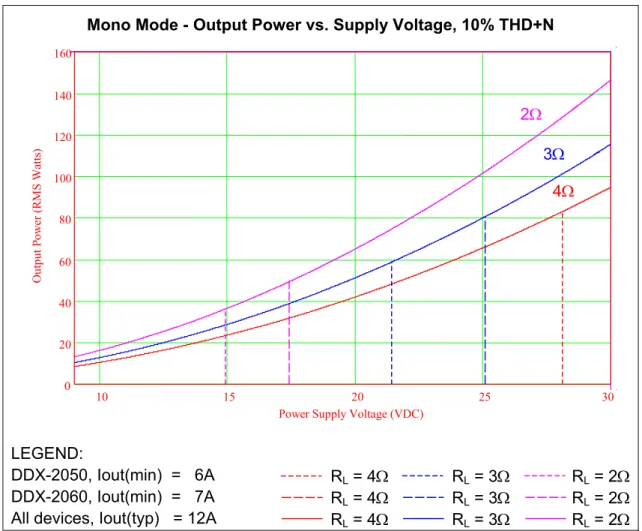
increase the output current to a load. In this configuration the device can provide over 90/80 Watts into
4Ω (see Figure 6). This mode is enabled with the CONFIG pin connected to VREG1 and the inputs
combined INLA = INLB, INRA = INRB and outputs combined OUTLA = OUTLB, OUTRA = OUTRB.
3.5 ADDITIONAL INFORMATION
3.6 Output Filter
A passive two-pole low-pass filter is used on the DDX-2060/DDX-2050 power outputs to reconstruct an analog signal. System performance can be significantly affected by the output filter design and choice
of components. (See appnote: AN-15, Component Selection for DDX Amplifiers.) A filter design for
6Ω/8Ω loads is shown in the Typical Application Circuit in Figure 18.
3.7 Power Dissipation & Heat Sink Requirements
The power dissipated within the device will depend primarily on the supply voltage, load impedance, and output modulation level.
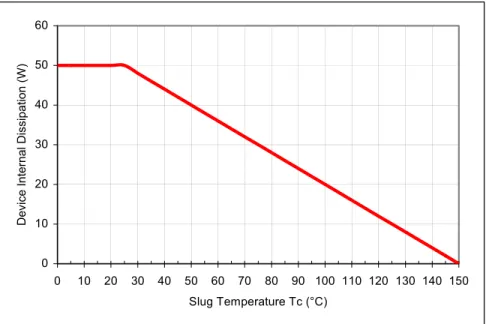
The surface mount package of the DDX-2060 and DDX-2050 includes an exposed thermal slug on the bottom of the device to provide a direct thermal path from the integrated circuit to the PC Board. Careful consideration must be given to the overall thermal design. See Figure 4 for power derating.
For additional thermal design
considerations, see application notes: AN-02, Power Stage Thermal Design for DDX Amps and
AN-19, Power Device Thermal Calculator.
For additional design considerations with binary mode operation, see application notes:
AN-16, Applying the DDX-8000/DDX-8228 in Binary Mode.
0 10 20 30 40 50 60 0 10 20 30 40 50 60 70 80 90 100 110 120 130 140 150 Slug Temperature Tc (°C)
Device Internal Dissipation (W)
DDX-2060/DDX-2050
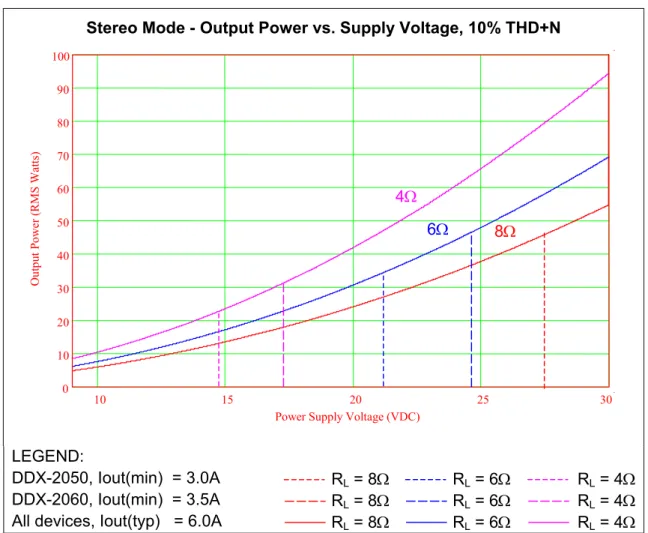
Stereo Mode - Output Power vs. Supply Voltage, 10% THD+N
10 15 20 25 30 0 10 20 30 40 50 60 70 80 90 100
Power Supply Voltage (VDC)
Ou tp ut P owe r (RM S W att s) LEGEND: DDX-2050, Iout(min) = 3.0A RL = 8Ω RL = 6Ω RL = 4Ω DDX-2060, Iout(min) = 3.5A RL = 8Ω RL = 6Ω RL = 4Ω
All devices, Iout(typ) = 6.0A RL = 8Ω RL = 6Ω RL = 4Ω
Figure 5. Stereo Bridge Output Power vs. Supply Voltage, 10% THD+N.
Figure 5 shows the 10% THD output power as a function of Power Supply Voltage for 4, 6, and 8 Ohm
loads in either DDX® Mode or Binary Full Bridge Mode. Output power is constrained for higher
impedance loads by the maximum voltage limit of the DDX-2060/DDX-2050 ICs and by the over-current protection limit for lower impedance loads. The minimum threshold for the over-current protection circuit is 3.5/3.0A (at 25 ºC) but the typical threshold is 6A. Solid curves depict typical output power capability of each device. Dotted and dashed curves depict the output power capability constrained to the minimum current specification of the DDX-2050 and DDX-2060 respectively. The output power curves assume proper thermal management of the power device’s internal dissipation. See Figure 4.
NOTE: Output power at <1% THD is approximately 22% lower. 4Ω
DDX-2060/DDX-2050
Specifications are subject to change without notice.
Mono Mode - Output Power vs. Supply Voltage, 10% THD+N
10 15 20 25 30 0 20 40 60 80 100 120 140 160
Power Supply Voltage (VDC)
Ou tp ut P owe r (RM S W att s) LEGEND: DDX-2050, Iout(min) = 6A RL = 4Ω RL = 3Ω RL = 2Ω DDX-2060, Iout(min) = 7A RL = 4Ω RL = 3Ω RL = 2Ω
All devices, Iout(typ) = 12A RL = 4Ω RL = 3Ω RL = 2Ω
Figure 6. Mono Bridge, DDX® Mode Only, Output Power vs Supply Voltage at 10% THD+N.
Figure 6 depicts the mono mode 10% THD output power as a function of power supply voltages for loads of 2, 3, and 4 Ohms. The same current limit observations from Figure 5 apply, except output current is 9A/7A minimum, 12A typical in mono bridge configuration. Solid curves depict typical performance and dotted and dashed curves depict the minimum current limit for the DDX-2050 and DDX-2060 respectively. Again, the output power curves assume proper thermal management of the power device’s internal dissipation.
NOTE: Output power at <1% THD is approximately 22% lower. 2Ω
3Ω
DDX-2060/DDX-2050
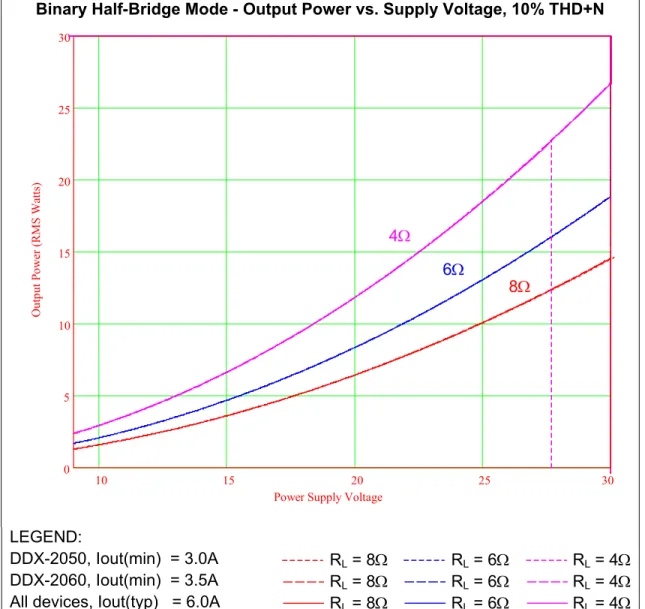
Binary Half-Bridge Mode - Output Power vs. Supply Voltage, 10% THD+N
10 15 20 25 30 0 5 10 15 20 25 30
Power Supply Voltage
Ou tp ut P owe r (RM S W att s) LEGEND: DDX-2050, Iout(min) = 3.0A RL = 8Ω RL = 6Ω RL = 4Ω DDX-2060, Iout(min) = 3.5A RL = 8Ω RL = 6Ω RL = 4Ω
All devices, Iout(typ) = 6.0A RL = 8Ω RL = 6Ω RL = 4Ω
Figure 7. Half-Bridge Binary Mode Output Power vs Supply Voltage at 10% THD+N. (NOTE: Curves taken at f = 1 kHz and using a 330uF blocking capacitor.)
Figure 7 depicts the 10% THD output power as a function of power supply voltages for loads of 4, 6, and 8 Ohms when the DDX-2060/DDX-2050s are operated in a half-bridge Binary Mode. Solid curves depict typical performance and dotted and dashed curves depict the minimum current limit for the DDX-2050 and DDX-2060 respectively. Once again, the output power curves assume proper thermal management of the power device’s internal dissipation.
NOTE: Output power at <1% THD is approximately 22% lower. 4Ω
6Ω
DDX-2060/DDX-2050
Specifications are subject to change without notice.
3.8 Power Supply and Control Sequencing.
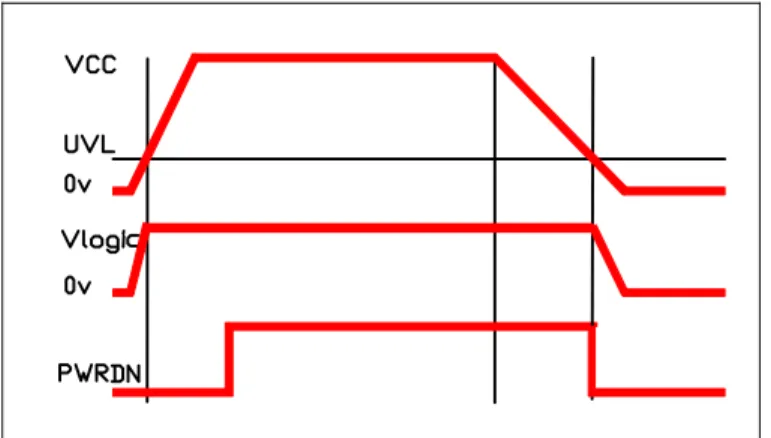
Figure 8 shows the recommended power-up and power-down sequencing. The “time zero” reference point is taken where Vcc crosses the Undervoltage Lockout threshold.
Figure 8 – Recommended Power-Up & Power-Down Sequence
DDX-2060/DDX-2050
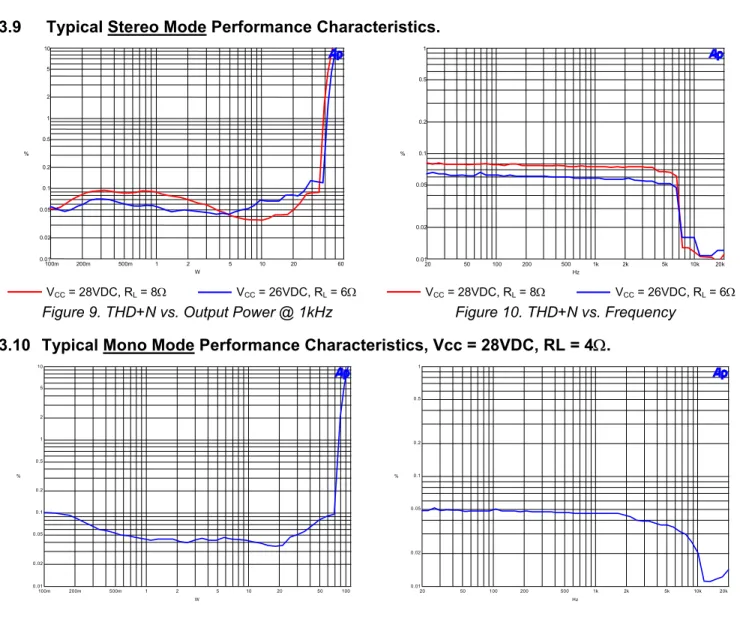
3.9 Typical Stereo Mode Performance Characteristics.
0.01 10 0.02 0.05 0.1 0.2 0.5 1 2 5 % 100m 200m 500m 1 2 5 10 20 60 W 0.01 1 0.02 0.05 0.1 0.2 0.5 % 20 50 100 200 500 1k 2k 5k 10k 20k Hz VCC = 28VDC, RL = 8Ω VCC = 26VDC, RL = 6Ω VCC = 28VDC, RL = 8Ω VCC = 26VDC, RL = 6Ω
Figure 9. THD+N vs. Output Power @ 1kHz Figure 10. THD+N vs. Frequency
3.10 Typical Mono Mode Performance Characteristics, Vcc = 28VDC, RL = 4Ω.
0.01 10 0.02 0.05 0.1 0.2 0.5 1 2 5 % 100m 200m 500m 1 2 5 10 20 50 100 W 0.01 1 0.02 0.05 0.1 0.2 0.5 % 20 50 100 200 500 1k 2k 5k 10k 20k Hz
Figure 11. THD+N vs. Output Power @ 1kHz Figure 12. THD+N vs. Frequency
3.11 Typical Binary Half-Bridge Mode Performance Characteristics, VCC = 30 VDC, RL - 4Ω.
0.01 10 0.02 0.05 0.1 0.2 0.5 1 2 5 % 100m 200m 500m 1 2 5 10 20 40 W 0.01 10 0.02 0.05 0.1 0.2 0.5 1 2 5 % 20 50 100 200 500 1k 2k 5k 10k 20k Hz
DDX-2060/DDX-2050
Specifications are subject to change without notice.
3.12 Typical DDX-Mode Performance Characteristics at VCC = 28V, 8Ω Load, <1% THD+N.
0 10 20 30 40 50 60 70 80 90 100 0 10 20 30 40 50 60 70 80 90 100 110 120
Total Output Power (Watts)
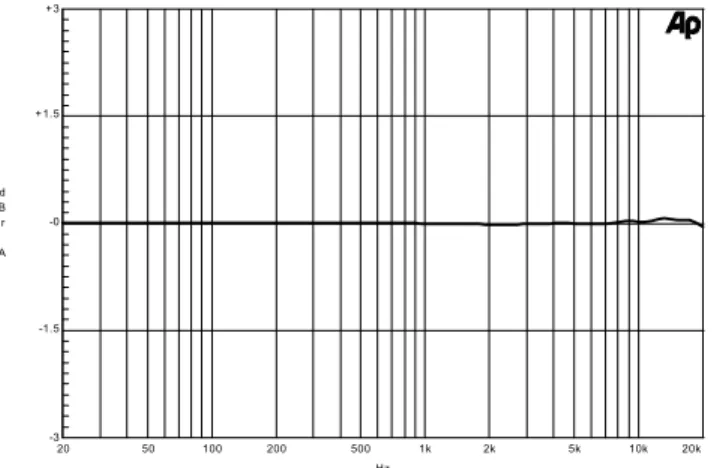
E ffi ci ency (%) -3 +3 -1.5 -0 +1.5 d B r A 20 50 100 200 500 1k 2k 5k 10k 20k Hz
Figure 15. Typical Efficiency vs. PowerEfficiency Figure 16. Typical Frequency Response
-140 +0 -122.5 -105 -87.5 -70 -52.5 -35 -17.5 d B r B -140 +0 -130 -120 -110 -100 -90 -80 -70 -60 -50 -40 -30 -20 -10 d B r A 20 50 100 200 500 1k 2k 5k 10k 20k Hz Figure 17. Typical FFT @ -60 dB
DDX-2060/DDX-2050
4.0 APPLICATION REFERENCE DESIGN.
Apogee can provide reference designs for most applications. Contact Apogee Technical Support for more information.
Figure 18. DDX® Stereo Mode Audio Application Circuit
DDX-2060/DDX-2050
Specifications are subject to change without notice.
Figure 20. Binary Mode, 2.1 Channel Audio Application Circuit (See Note 9)
Figure 21 - DDX® ½-Bridge Mode Audio Application Circuit (See Note 9) Note 9: Channel mappings in Binary mode schematics apply to DDX-8229 PWM output channels.
DDX-2060/DDX-2050
5.0 PACKAGE INFORMATION
DDX-2060/DDX-2050
Specifications are subject to change without notice.
5.2 Marking Configuration
Packages with Date Code (YWW) = 514 & after
LEGEND:
PPLLLWXTF Traceability Coding
COO Country Of Origin
Y Assembly Year
WW Assembly Week
Pb-Free (RoHS Compliant) (no symbol if not Pb-Free)
Packages with Date Code (YWW) = 513 & before
LEGEND:
WATNN Traceability Coding
YY Assembly Year
WW Assembly Week
COUNTRY Country Of Origin
Note: Pb-free packages never marked with this configuration.
Information furnished in this publication is believed to be accurate and reliable. However, Apogee Technology, Inc. assumes no responsibility for its use, or for any infringements of patents or other rights of third parties that may result from its use. Specifications in this publication are subject to change without notice. This publication supersedes and replaces all information previous supplied.