Squirro’s Smart Filter
Technology
Search is one of the most important core technologies in to-day’s knowledge industry. The ever-growing amount of digital data available poses a real challenge to current search solu-tions as their results risk lacking in relevance, timeliness, and adaptability and their usage can be extremely time consuming. Squirro’s patent pending Smart Filter Technology offers the next evolutionary step in search technologies. Broader than feeds and more specific than search, Squirro scans multiple
sources from Internet channels and social media, private databases and even internal systems such as QlikView, Sales-force.com and SAP to find the most relevant information on your topic of interest and update it continuously and automati-cally.
This white paper outlines the core principles of Squirro’s Smart Filter Technology, its application in business settings.
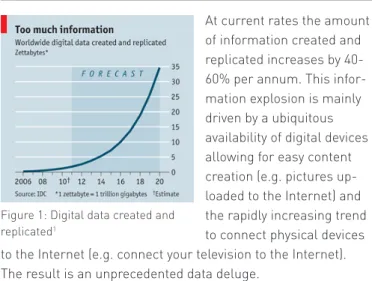
At current rates the amount of information created and replicated increases by 40-60% per annum. This infor-mation explosion is mainly driven by a ubiquitous availability of digital devices allowing for easy content creation (e.g. pictures up-loaded to the Internet) and the rapidly increasing trend to connect physical devices to the Internet (e.g. connect your television to the Internet). The result is an unprecedented data deluge.
As a consequence search solutions have to index, retrieve and rank information at an ever faster pace, dealing with an ever-growing amount of data. Both businesses and con-sumers today can choose from a wide range of tools to help them manage their searches and databases. Here are some examples:
• Public search engines such as Google, Bing or Baidu, • Enterprise search platforms such as Attivio, Autonomy, • Numeric intelligence solutions such as Wolfram Alpha, Atomic Intelligence,
• Business Intelligence solutions such as Qlikview, Business Objects, Tableau,
• Social network search as possible on LinkedIn, Facebook or Twitter,
• Social media monitoring tools like Radian6, WildFire or Vocus.
While each of these solutions delivers great value for manifold use cases, research shows that information workers still in-vest significant amounts of time – up to 66% of their work time – in (re-) finding information they already found. The impact on
The Current State of Search
specific business functions is significant: For example ramp up times for sales people have gone up 50% in the last four years.2
A search on a particular topic may return millions of results, which you have to manually parse to identify what is really relevant.
Imagine instead of searching for information and getting mil-lions of results, you have a tool that analyses data you have stored on your desktop, in your e-mail client in your Business Intelligence suite (BI) or Customer Relationship Manage-ment tool (CRM) and feeds you relevant content based on the context it can access.
Imagine also that as your data set changes (new documents, new e-mails new information on prospects and leads) and your interaction with it changes too, the search results evolve and stay adapted to your needs and focus.
To quote Derrick Harris of GigaOM:
“Call it “anticipatory computing,” or “information gravi-tation” or whatever you want, but it appears the future of search isn’t search at all. Rather, next-generation applications will surface the information we need when we need it — whether we know we need it or not.” 3
Computers cannot read our minds (just yet), but by connect-ing the dots between inputs and outputs, between the traces we provide on social networks and e-mail clients, using our search history, looking at how much time we spend on specific sites, at what videos, music or general content we download and upload, they can start determining trends in the way we consume and respond to information stimuli. By building such models, search becomes dynamic, personalized and evolutive. Figure 1: Digital data created and
The Squirro Smart Filter Technology
There are two key insights that drive the development of theSquirro Smart Filter Technology:
Context
Search is not an independent activity but always carried out in context of a broader activity. Inviting guests may include a search for cooking recipes, planning a business trip may involve a search for a hotel, an upcoming client meeting may comprise a background search. Yet with traditional search this context, at the time of search, is not included. Rather the information worker types in a sequence of search terms without any connection to the context for which this informa-tion is relevant.
Time
Some searches are performed repeatedly every hour or every day. Examples include a continued interest in cooking reci-pes with repeated searches or a continued interest in a client company requiring a daily time investment in researching to stay up-to-date. Each time these searches are performed they need to be formulated again and the result set parsed again. Time is one of the least considered factors to add relevance to search results.
At Squirro we are developing a technology that enables con-necting these dots.
Based on signals gathered from any source (open web, BI, CRM, social networks...), Squirro delivers documents you are more likely to find interesting and starts building your Smart Filter. This Smart Filter adapts to your behavior. The more you read about a topic, the more weight Squirro gives it, this way any future information about it will be prioritized.
How does it work?
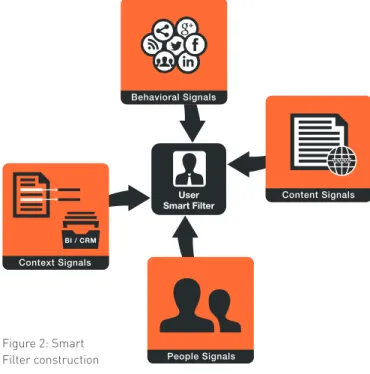
The mechanism is based on both contextual and behavioral elements. These elements are gathered, analyzed, computed and combined to create the Smart Filter.
Contextual Element
The contextual element is about getting the initial signals that will be the basis for the construction of the Smart Filter. The first contextual signals come from data you input in the system e.g. topic names, URL’s, Excel or CSV formatted files or BI dashboards or CRM records. The contextual element also includes content signals. These are information sources that get subdivided into elementary parts like single words or word
concepts. We then analyze these signals to determine which are distinct enough to best express the topic chosen.
Behavioral Element
The behavioral element is all about assembling and analyzing person- and community-based meta- information. For ex-ample, in each document we watch out for its social mentions by e.g. counting the Facebook likes or look at the number of retweets. These values give the document a certain general importance, independently of your interest. On the other hand, we put these metadata in relationship to your interests. To stay with the social mentioning example, if public popularity is of no importance to you, we will ignore this weight and give more power to other criteria.
Computing the Context
The context of a topic is built on input we gather when initiating the topic. For example we look for the name of the company, any URL or the current selection in a BI dashboard or a complete CRM record. Searching multiple structured data sources and specialized databases completes this data.4 We
also look for blogs, Twitter accounts or Facebook pages that complement your interest in this topic.
Computing this context is a complex process as topics can overlap. If your interest is for example the Caterpillar com-pany, doing a standard search will give you results for both the insect and the company – see Figure 3.
Figure 2: Smart Filter construction
Inclusion of Meta-Information
To solve this issue of overlapping contexts the Smart Filter Technology incorporates layers of additional meta-information to your topic. This topical Smart Filter uniquely identifies your personal interest in a topic and is unique to each user. Based on a combination of state of the art retrieval algo-rithms, semantical, and statistical analysis we calculate the concepts and criteria that describe your interest the best. We take multiple dimensions into account when finding the per -fect Smart Filter for you.
For example we analyze the language and content of all your documents, evaluate the core concepts out of them that make your interest unique, look into the popularity of a document, be it within Squirro or on the Internet, and many more criteria. These different criteria are weighted based on your personal preferences to calculate a score for each document and de-liver the results that are most relevant:
score (d,u)= f([w1(user) * criteria1(content), ... , wn(user) * criterian(content)])
where d=document; u=user interest
Combining the Elements into a Smart Filter
The above-mentioned layers of computed meta-information are (Figure 5):
• Users: Your relative position to other users with similar interests
• Topics / Keywords: Your topics of interest • Pages / Documents: Matching documents
• Semantic Keywords: A semantic representation of the Pages / Document & Topic space
Individual Smart Filters are maintained on a per user and a per topic level. On a per user level we profile user interactions, preferences, and social network connections. On a per topic level we maintain a profile based on content, content interac -tions, and external content signals.
The Smart Filter provides a very concise meta-representation of your topical interest. The Smart Filter may now be ap-plied to filter out the noise in any data stream. The user gets results, which are focused and relevant.
The Smart Filter applied
In the case of the ambiguous term ‘Caterpillar’ the power of the Smart Filter Technology is evident. As shown in Figure 3 the search term Caterpillar on any standard search engine returns an ambiguous result set consisting of results relating to both the company and the insect.
Initial result set
At first, a result set generated with Squirro differs only in it being a result stream continuously updated with fresh and relevant content as opposed to the static result page of tradi-tional search results (Figure 6).
Figure 3: Search for “Caterpillar” in Google returns 117 million results for both the company and the insect
Figure 4: Computation of aspects of the Squirro Smart Filter
Figure 5: Computed layers of the Smart Filter
Figure 6: Search in Squirro for “Caterpillar” without Smart Filter Technology returns 200 results for both the insect and the company, which are continuously updated
In the case of Caterpillar, Squirro learns in real-time that you are interested in the company and not in the insect based on the context (E.g. BI dashboard), your interaction patterns with the result set, and additional signals as outlined above. The result is a Smart Filter representing your interest in the com-pany Caterpillar (Figure 7).
Evolving over Time
The Smart Filter is not computed as a ‘one-off’ filter element but evolves over time by incorporating user feedback and other signals related to the use of Squirro. The parameters are continuously re- evaluated based on new documents, your active interaction (or passive ‘non-interaction’ with them). The Smart Filter does not need any explicit feedback but will pick up signals of whether you open or not a search result, whether you share it or delete it (Figure 8).
This Smart Filter computation takes place continuously and in the background. There is no need to change or adjust your well-established way of consuming information. You can actively train the Smart Filter for immediate improvements. However the passive listening mode of the Smart Filter will pick up other signals emitted by your BI or CRM, other at-tached systems or the open Internet to train the Smart Filter over time.
Figure 7: Search in Squirro for “Caterpillar” with Smart Filter applied returns 33 results only related to the company.
1 Economist, 24 Feb 2011, http://www.economist.com/node/18226961 2 Wright et al., 2006, Cowley et al., 2005, Destination CRM 2011.
3 GigaOM, The future of search is gravitational: Content will come to you, Derrick Harris, 07.02.2013, http://gigaom.com/2013/02/07/the-future-of-search-is-gravitational-content-will-come-to-you/
4 Examples include open sources like DB Pedia (http://dbpedia.org/), Reuters, Dun & Bradstreet, company internal sources.
5 CSO Insights 2012, Leveraging Sales Intelligence To Advance Relationships, Arming Your Sales Teams with Insights & Knowledge, Jim Dickie and Barry Trailer
Smart Filter Technology impacts your Bottom-line
Squirro’s Smart Filter Technology solves the ‘too-much data’problem in a novel way by focusing on the context of your information request. This contextual intelligence allows users to reduce time invested in re-searching already found informa-tion by up to 90%. nformainforma-tion workers can spend their time on what they are actually paid for: Analysis and recommendation. Early usage analysis of Squirro employed as a Sales Intel-ligence solution show improvements of key performance indicators such as client win rates by up to 14.6% and revenue
increases by nearly 15%, while shortening sales cycle times by up to 8.7%.5
Context Intelligence and topical content streams are the future of information work. Squirro’s Smart Filter Technology deliv-ers an essential component to automatically construct such content streams for consumption and colaboration. The result is a living collection of curated content you can save, synthe-size and share with colleagues in your own private workspace. Figure 8: Smart Filter usage. The Smart Filter gets more accurate over time by including active and passive user feedback.
Squirro by Nektoon AG Badenerstrasse 120 8004 Zurich Switzerland Tel CH: +41 44 586 98 98 Tel US: +1 650 353 93 68 Email: [email protected] Web: www.squirro.com
Contact
provide the ‘Why’ behind the data. Squirro brings the relevant context from the sea of information directly to your regular workplace.
What Business Intelligence systems did for numbers, Squirro does for content: make unstructured data usable. ‚So What?‘ - because achieving this reduces searching time by 90% and allows for better, more effective decision-making.
The highly skilled Swiss team of search experts has been working together for over 10 years to create a precise software engineering solution that delivers a real-time, self-learning embedded 360° context radar.