ANALYSIS OF ENERGY USAGE
OF THE LIBRARY BUILDING IN
UTeM MAIN CAMPUS
by Malik Raihan RSshieh
Submission date: 18-Jun-2018 11:35AM (UTC+0800)
Submission ID: 957536982
File name: MEng_Thesis_by_Malik2.docx (11.3M)
Word count: 25300
UNIVERSITI TEKNIKAL MALAYSIA MELAKA
Faculty of Mechanical Engineering
ANALYSIS OF ENERGY USAGE OF
THE LIBRARY BUILDING IN
UTeM MAIN CAMPUS
Malik Raihan Rshieh
Master of Mechanical Engineering (Energy Engineering)
ANALYSIS OF ENERGY USAGE OF THE LIBRARY BUILDING IN UTeM MAIN CAMPUS
MALIK RAIHAN RSHIEH
A thesis submitted
in fulfillment of the requirements for the degree of Master of Mechanical Engineering (Energy Engineering)
Faculty of Mechanical Engineering
UNIVERSITI TEKNIKAL MALAYSIA MELAKA
DECLARATION
I declare that this project entitled "Analysis of Energy Usage of the Library Building in UTeM Main Campus" is the result of my own research except as cited in the references. The project has not been accepted for any degree and it is not concurrently submitted in candidature of any other degree.
Signature Name Date
APPROVAL
I hereby declare that I have read this report and in my opinion, this thesis is sufficient in terms of scope and qualily for the award of Master of Engineering in Mechanical Engineering (Energy Engineering).
Signature Supervisor Name Date
DEDICATION
I would like to present my work to those who did not stop their daily support since I was born, my dearest father, and my kindest mother, who never hesitate to provide me all the facilities to push me foreword as much as they can. This work is a simple and humble reply to their much goodness I have received all this while. I thank them for giving me many chances and I love them so much.
I also dedicate this project to my wife and brothers who haYe supported me through my life. I always miss and I cherish the memories that we had. I love all of you.
ABSTRACT
Air-conditioning and mechanical ventilation system (ACMV) is one of the main contributors to the total building energy consumption. According to previous works, buildings use about 60% on air-conditioning of the total energy consumption. At the same time, the most economical way was to determine the most efficient system for air conditioning system. Temperature, humidity, pressure and air motion are some of the important variables that refrigeration and air conditioning deals with the techniques to control the environment and provide comforts to enable the better living. Factors that affect human comfort were determined by using Indoor Air Quality Meters and also by calculating the building energy index for 2016 and 2017. From the study, measurement and evaluation of the existing indoor comfort parameters of the Laman Hikmah Library building located in the Universiti Teknikal Malaysia Me/aka (UTeM) main campus were conducted. The area of the library building is 10,063.68 square meters that covers of four floors. The physical parameters such as air velocity, average flow, average operating temperature, average relative humidity, lighting, and C02 readings were recorded, analysed and then compared to the current ASHRAE-55 and MS1525:2014 standards. Based on the collected data and information, the total building cooling load is then being estimated. In addition, the Building Energy Index could also be detennined, where it was found that the results were 94.4252 kWh/m2/year and 117.8952 kWh/m2/year for the years 2016 and 2017 respectively. All of these values were less than the MS 1525:2014 Standard of 135 kWh/m2/year. The current energy consumption for all floors that the air conditioning recorded the highest rate consumption was 67.75% of electricity usage in building, followed by the consumption of lighting was found to be 17% and others equipment 15.25%. Finally, economic analysis is included with potential alternative measures to achieve optimum building energy usage.
ABSTRAK
Pendinginan Hawa dan Pengudaraan Mekanikal (ACMV) adalah penyumbang besar dalam pengunaan tenaga untuk sesebuah bangunan. Kajian seblum ini mem11~jukkan sekitar 60% penggunaan tenaga adalah untuk pendingin hawa. Pada masa yang sama, cara paling ekonomik ditentukan melalui sistem yang paling cekap untuk operasi sistem pendingin hawa. Suhu, kelembapan, tekanan dan pergerakan udara adalah beberapa pembolehubah penting untuk penyejukan dan pendingin hawa menangani teknik-teknik untuk mengawal persekitaran dan memberikan keselesaan bagi membolehkan kehidupan yang lebih baik. Faktor-jaktor yang mempengaruhi keselesaan manusia ditentukan melalui bacaan menggunakan Meter Kualiti Udara Dalaman dan juga mengira indeks tenaga binaan untuk tahun 2016 dan 2017. Dari kajian ini, pengukuran dan penilaian parameter keselesaan dalaman memberikan tumpuan kepada bangunan perpustakaan Laman Hikmah yang terletak di kampus induk UTeM Pe1pustakaan ini mempunyai keluasan 10, 063. 68 meter persegi, merangkumi empat aras. Parameter fizikal seperti halaju udara, aliran purata, operasi purata suhu, kelembapan relatif purata, pencahayaan, dan kanduangan gas C02 direkodkan, dianalisis dan kemudian dibandingkan dengan piawaian ASHRAE-55 dan MSl 525:2014 serta Jndeks Tenaga Bangunan. Hasilnya, untuk tahun 2016 dan 2017 bacaan indeks adalah 94.4252 kW /m1/tahun dan 117.8952 kWhlm1/tahun. Semua nilai ini
adalah kurang daripada daripada yang dicadangkan dalam Standard MS 1525: 2014 iaitu sebanyak 135 kWh/m1/tahun. Keputusan untuk projek ini memberikan corak ilustrasi dalam turun naik dalaman dan parameter keselesaan. Penggunaan tenaga semasa ketika itu adalah 67. 75% digunakan untuk pendingin hawa, diikuti oleh pencahayaan sebanyak 17% dan peralatan lain 15. 25%. Akhirnya, analisis ekonomi turut disertakan dengan langkah-langkan alternatifyang be1potensi untuk mencapai penggunaan tenaga bangunan yang optimum.
ACKNOWLEDGEMENT
First and foremost, praise be to Allah, for giving me this opportunity, the strength and the patience to complete my thesis finally, after all the challenges and difficulties. I would like to thank my supervisor Dr. Shamsul Anuar Shamsudin and co-supervisor Dr. Tee Boon Tuan. from the Faculty of Mechanical Engineering Universiti Teknikal Malaysia Melaka (UTeM) for their essential supervision, support and encouragement towards the completion of this thesis.
I would also very thankful to lecturers and professors in University Teknikal Malaysia Melaka (UTeM) for their guidance, advice and motivation. They deserve special thanks for the assistance in supporting students by conferences, technical talks and workshops.
TABLE OF CONTENTS DECLARATION APPROVAL DEDICATION ABSTRACT ABSTRAK ACKNOWLEDGEMENT TABLE OF CONTENTS LIST OF TABLES LIST OF FIGURES LIST OF APPENDICES LIST OF SYMBOLS LIST OF ABBREVIATION CHAPTERS 1. INTRODUCTION
2.
1.1 Research Background 1.2 Problem Statement 1.3 Research Objectives 1. 4 Scope of the Study 1.5 Significant of the Study 1.6 Expected Outcomes LITERATURE REVIEW 2.1 Introduction2.2 The Optimal Policy Response to Global Wanning 2.2. l Energy Consumption Awareness 2.2.2 Reducing Standby Consumption 2.2.3 Adaptive control
2.3 Building Energy Index (BEI)
2.4 Building Energy Management System
2.4.1 Reducing the building energy operating costs 2.4.2 Improve the level of comfort of building occupant 2.4.3 Reducing the level of availability of the building's utility equipment
2.5 Indoor Environmental Quality (IEQ) 2.4. l Thennal Comfort
2.4. l Indoor Air Quality (IAQ)
2.6 Air Conditioning and Mechanical Ventilation (ACMV) 2.7 HVAC Systems
2. 7.1 Air-Conditioning System Categories 2.7.2 Air Decentralized systems (Local) 2.7.3 Ventilation
2.8 Energy Consumption In Malaysia's Buildings 2.9 Energy Audit
2.10 ASHRAE Standard
IV PAGE ii iii iv vi vii x xi xii 1 l 3 4 5 5 7 8 8 8 9 10 11 11 12 12 13 13 14 14 15 15 17 18 18 19 19 21 22
2.11 Malaysian Standard-Msl525:2014 23
2.12 Lighting system 23
2.13 Cooling Load 24
2.14 Previous Studies 32
3. METHODOLOGY 40
3.1 Introduction 40
3.2 Building Description 40
3.3 ACMV System 44
3.4 Flowchart of Methodology 46
3.5 Physical Parameters Measurement 48
3.5.l Indoor Air Quality Meter 7545 48
3.5.2 Lux Meter CENTER-337 49
3.5.3 Air Velocity Meter 50
3.5.4 Kyoritsu 20 l 7 Digital Clamp Meter, 600A/600V 51
3.5.5 Flexible Measuring Tape 52
3.6 Gathering Field Data 53
3.7 Energy Data Analysis 55
4. RESULTS AND DISCUSSION
56
4.1 Introduction 56
4.2 Energy Data Analysis 56
4.3 Energy Consumption for each floor 58
4.4 Cooling Load 65
4.5 Building Energy Index 65
4.6 Physical Parameter Measurements of Building 67
4.6.l Physical Measurement Parameters in the Ground Floor 68 4.6.2 Physical Measurement Parameters in the First Floor 72
4.6.3 Physical Measurement Parameters in the Second Floor 77
4.6.4 Physical Measurement Parameters in the Third Floor 81
4.7 Data Comparison 85
4.7.l Average Air Velocity (m/s) 85
4.7.2 Average Flow (cfm) 87
4.7.3 Average Operating Temperature (0
C) 89
4.7.4 Average Relative Humidity(%) 90
4.7.5 Average C02 (ppm) 92
4.7.6 Average Lighting (lux) 93
4.7 Economic Analaysis for ACMV System 95
5.
CONCLUSION AND RECOMMENDATION 975.1 Conclusion 97 5.2 Recommendation 98 5.3 Future Work 99 REFERENCES 100 APPENDICES 107 v
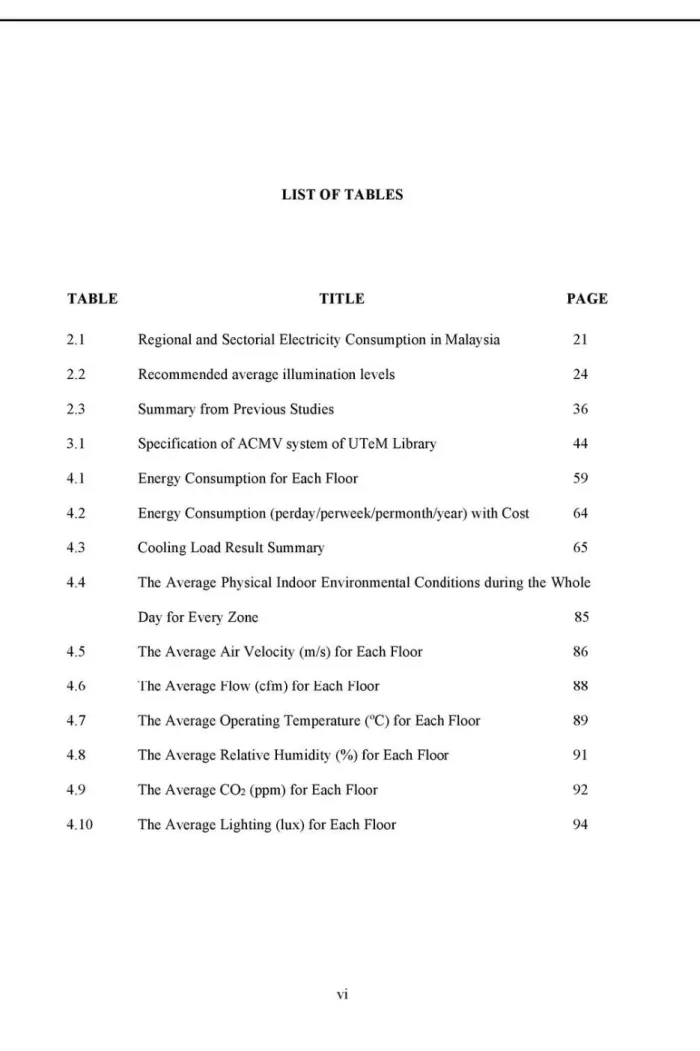
LIST OF TABLES
TABLE TITLE
2.1 Regional and Sectorial Electricity Conswnption in Malaysia 2.2 Recommended average illumination levels
2.3 Summary from Previous Studies
3 .1 Specification of ACMV system of UTeM Library
4.
1
Energy Consumption for Each Floor4.2 Energy Consumption (perday/penveek/permonth/year) with Cost
4.3 Cooling Load Result Swnmary
PAGE 21 24 36 44
59
64
65
4.4 The Average Physical Indoor Environmental Conditions during the WholeDay for Every Zone
85
4.5
The Average Air Velocity (m/s) for Each Floor86
4.6
The Average How (cfm) for Each Floor 884.7
The Average Operating Temperature (0C) for Each Floor
89
48
The Average Relative Humidity(%) for Each Floor91
4
.
9
The Average C02 (ppm) for Each Floor92
4.
1
0
The Average Lighting (lux) for Each Floor9
4
LIST OF FIGURES
FIGURES TITLE PAGE
3.1 UTeM's Library 41
3.2 UTeM's Library (Ground Floor) 42
3.3 UTeM's Library (First Floor) 42
3.4 UTeM's Library (Second Floor) 43
3.5 UTeM's Library (Third Floor) 43
3.6 Flowchart of Methodology 47
3.7 Indoor Air Quality Meter 7545 48
3.8 Lux Meter CENTER-337 50
3.9 Air Velocity Meter 51
3.10 Digital Clamp Meter 52
3.11 Flexible Measuring Tool 30M Length 52
3.12 Gathering Field Data (A) 53
3.13 Gathering Field Data (B) 54
3.14 Gathering Field Data (C) 54
3.15 Gathering Field Data (D) 55
4.1 Energy consumption (2017) 57
4.2 Energy consumption (2016) 57
4.3 Energy consumption between 2016 and 2017 58
4.4 4.5 4.6 4.7
4.8
Ground Floor Total Consumption (W)
First Floor Total Consumption (W)
Second Floor Total Consumption (W)
Third Floor Total Consumption (W)
Energy Consumption with Cost
59 61
62
63
64 4.9 Malaysian standard Building energy index compare with Library building
energy index for 2016 and 2017 67
4.10 Average Air Velocity (m/s) in the Ground Floor 69
4.11 Average Flow ( cfm) in the Ground Floor 70
4.12 Average Operating Temperature (°C) in the Ground Floor 70
4.13 Average Relative Humidity(%) in the Ground Floor 71
4.14 Average C02 (ppm) in the Ground Floor 71
4.15 Lighting (lux) in the Ground Floor 72
4.16 Average Air Velocity (m/s) in the First Floor 74
4.17 Average Flow ( cfm) in the First Floor 74
4.18 Average Operating Temperature (°C) in the First Floor 75
4.19 Average Relative Humidity (%)in the First Floor 75
4.20 Average C02 (ppm) in the First Floor 76
4.21 Lighting (lux) in the First Floor 76
4.22 Average Air Velocity (m/s) in the Second Floor 78
4.23 Average Flow (cfm) in the Second Floor 78
4.24 Average Operating Temperature (0C) in the Second Floor
79
4.25 Average Relative Humidity(%) in the Second Floor 79
4.26 Average C02 (ppm) in the Second Floor 80
4.27 Lighting (lux) in the Second Floor 80
4.28 Average Air Velocity (m/s) in the Third Floor 82
4.29 Average Flow ( cfm) in the Third Floor 82
4.30 Average Operating Temperature (0
C) in the Third Floor 83
4.31 Average Relative Humidity(%) in the Third Floor 83
4.32 Average C02 (ppm) in the Third Floor 84
4.33 Lighting (lux) in the Third Floor 84
LIST OF APPENDICES APPENDIX TITLE A B
c
DSample Calculation of Cooling Load Physical Measurement Data Electricity Bills Gantt chart x PAGE 108 115 127 129
LIST OF SYMBOLS
M/s Meter per second
oc
Degrees Celsiushr Hour
BTU British thermal unit
M Meter KW kilowatt lb Pound W/m2 Watt per meter square % Percentage TR Tones Refrigerant C02 Carbon Dioxide Ft Feet
Cfm Cubic feet per minute
ppm Parts-per Million
ABBREVIATIONS PMV PPD ACMV IEQ BEi TNB GMT GW GDP USG BC BRE BREEAM MRT UTCI IAQ LEO
co
C02 Rn LIST OF ABBREVIATION DESCRIPTIONPredicted Mean Vote
Predicted Percentage Dissatisfied
Air-conditioning & Mechanical Ventilation Indoor Environmental Quality
Building Energy Index Tenaga National Berhad Greenwich Mean Time Giga Watts
Gross Domestic Product
Building Council of the United States of America Building Research Establishment
BRE Environmental Assessment Method Mean Radiant Temperature
Universal Thermal Climate Index Indoor Air Quality
Low Energy Office Carbon Monoxide Carbon Dioxide Radon
voe
RACTM HVAC GHG SET TAC RH N02voe
AHU UTeM UTHM MS ISO EN CONSVolatile Organic Compounds Room Acoustic Comfort™
Heating, Ventilation and Air-Conditioning Greenhouse Gas
Standard Effective Temperature Task/Ambient Conditioning Systems Relative Hwnidity
Nitrogen Dioxide
Volatile Organic Compound Air Handling Unit
Universiti Teknikal Malaysia Melaka
Universiti Tun Hussein Onn Malaysia Malaysian Standard
International Organization for Standardization European Standard
Consumption
CHAPTER I
INTRODUCTION
1.1 Research Background
These days, the demand for electricity has increased because of the population
growth and the improvement of living standards all over the world. Most power plants are
using fossil fuels to produce the energy of electric, leading to the increase of the prices for
energy and the increase of the pollution. In terms of the renewable energy sources such as solar energy, wind energy, geothennal energy and ocean energy they play an effective role in the production of energy and most effectively to deal with the problems of energy
conservation.
The increasing levels of global warming, depleting sources of fossil fuels and
increasing energy costs are all having a large detrimental effect on today's society. Many efforts are being made to try and increase energy efficiency all over the world (Lau et al.,
2009). One of the most difficult problems to achieve energy efficiency is to reduce energy costs for a building when the energy costs are accounted as part of the general overhead.
Therefore, building energy audit is one approach that is being studied and implemented to
reduce energy costs. The energy audit serves to identify and evaluate how much the
building facility uses energy and identifies energy conservation opportunities. It also serves to establish an energy consumption pattern, monitoring of how the energy used in the
building, how the system elements interrelate and study the external environment affecting
The buildings in which human live, play and work are protecting them from nature's extreme. But people have to remember that buildings also affect their health and
environment in countless way. Building have significant impact on the environment. It was
harmful to our living environment and brewing an unsecure environment for our next generation (Muzar, 2011). In this research, an attempt is made to determine the indoor environmental quality (IEQ) for a library building of its respective data, and recommend the effective ways to thermal comfort in the non-residential buildings. In the partitioning scenario, without conditioned space interior design should pose a threat is great not only for the comfort of the occupants but also to energy use in the building. Therefore, it is important to study qualitatively impact restrictions in place of interaction of the air-conditioned comfort of heat, and energy consumption when restrictions are installed in or removed from the air conditioned space (Azar et al.,2014, Li,z et al., 2014).
According to previous studies, the energy used to run the fans and pumps which operate in the chiller system, heat transfers and cooling from central heating and cooling plants to conditioned spaces, can represent a significant portion of this energy from 20% to 60% of electricity usage in a building (Sarbu et al.,2014). Air conditioning is the control of
the humidity of air by either increasing or decreasing its moisture content. In addition to the control of the humidity is the control of temperature by either heating or cooling the air, the purification of the air by washing or filtering the air and the control of the air motion
and ventilation. Ventilation refers to the process of supplying and removing air by natural
or mechanical means to and from any space; such air may or may not be conditioned
(Jazizadeh and Ghahramani, 2014).
A new and existing building must comply with Malaysia Standard policies that are
stated in MS 1525:2014 while undergoing the design, construction, operation and
maintenance. Hence, it is clear that energy is utilised in sizeable quantities to provide
comfort air conditioning in offices, educational institutions, commercial buildings and
homes. Therefore, Department of Standards Malaysia (DSM) published code of practice for energy efficiency and the use of renewable energy for non-residential building. This
provides the criteria and minimum energy-efficient design standards for air conditioning installations, reducing the use of energy without constraining creativil}' in design, building function and the comfort or productivil}' of the building occupants (Malaysian Standard,
2014).
Referring to Malaysia Standard, MS1525:2014, it was recommended that the commercial building energy index (BEi) in Malaysia is 135kWh/m2/yr (Noranai and Yusof,
2011). For this wok, the electricity bills for the years 2016 and 2017 are enclosed in
Chapter Four. In a related development, starting January 2017, cost of energy has also increased, which contributes to an increase in energy charge. Therefore, regarding on matters mentioned above, it is important to seek for efficient ways for building operation at optimum stage and meet the best energy conservation level. Hence, the research is interested to investigate in detail the energy consumption, evaluation of ACMV system and
building energy index (BEi) for the whole building up to four floors for the library
building UTeM located on main campus. This project aims to reduce energy consumption and recommend the effective ways to thermal comfort in the non-residential buildings.
1.2 Problem Statement
Air-conditioning and mechanical ventilation systems are the main sources of energy consumption for a non-residential building (Malaysian Standard, 2014). Any saving made on the energy consumption of this system will give significant impact on the building energy cost. Critical evaluation and advanced study is required in order to provide measures in achieving optimal building energy efficiency. In order to achieve thermal
comfort inside an library building in the university and to choose the best design
ventilation strategies for that building, it is very important to know the actual conditions of the indoor environment concerning temperature, C02 and relative humidity. This project examines IEQ field measurement for the Laman Hikmah library building in UTeM. The project is aimed to answer the following question:
• Whether current energy usage is used efficiently or is being wasted and how to
evaluate energy use for the building.
• Whether the physical parameters in the building are suitable with recommended human comfort zone specifications in accordance with available standards such as
ASHRAE-55 and MS1525:2014.
1.3 Research Objectives
At present, there are vanous energy-saving methods available. The impact of energy conservation, viability of the operation, acceptance by the end user and the payback of the investment cycle are factors to consider when choosing appropriate energy-saving
methods. The effectiveness of the same method used in the different building types affected by variables such as climate, habits of residents, ACMV system, enclosure
properties, geometric properties, etc., and therefore, the final decision varies greatly.
Researchers need to invest time and money with the thoroughness of the properties for building and different methods. There is no quick way to policy makers and engineers to make broad judgments about the appropriate energy-saving methods. About the study
before, most of the studies done abroad aimed at specific zones of a country's climate, and
various applied certain energy-saving methods are usually limited to one building. These specific study objectives below:
• To characterise the physical indoor environmental conditions of selected library building.
• To evaluate and analyse energy use in the library and identify the building energy
index (BEi) of the building.
• To conduct a comparison between measurement parameters with the available
standard such as ASHRAE-55 and MS1525:2014.
1.4 Scope of the Study
The scope of this study is to evaluate the electrical energy consumption in a library building, using the practical experiment method to measure the Indoor Environmental Quality parameter. This project also illustrates how heat changes result in different
conditions and how sensitive is the comfort of heat associated with changes in different parameters. This study involves data collection and measuring physical parameters, such as Average Air Velocity, Average Flow, Average Operating Temperature, Average Relative Humidity, Lighting, and C02 concentration.
• Reviewing and evaluating the current energy consumption.
• Obtain the physical characteristics of the building and collect gross sectional area
of the building.
• Identify important physical parameters that may influence the system performance. Determine the relationship betv,ieen energy consumption with the indoor condition.
1.5 Significance of the Study
The study of the building energy demand has become a topic of great importance,
because of the significant increase of interest in energy sustainability. According to the
circumstances, it can be possible to determine the energy performance of a building