Looking at the Server Side of Peer-to-Peer Systems
Yi Qiao
Dong Lu
Fabi ´an E. Bustamante
Peter A. Dinda
{yqiao,donglu,fabianb,pdinda}@cs.northwestern.edu
Department of Computer Science, Northwestern University
ABSTRACT
Peer-to-peer systems have grown significantly in popularity over the last few years. An increasing number of research projects have been closely following this trend, looking at many of the paradigm’s technical aspects. In the context of data-sharing services, efforts have focused on a variety of issues from object location and rout-ing to fair sharrout-ing and peer lifespans. Overall, the majority of these projects have concentrated on either the whole P2P infrastructure or the client-side of peers. Little attention has been given to the peer’s
server-side, even when that side determines much of the
everyday-user’s experience. In this paper, we make the case for looking at the server-side of peers, focusing on the problem of scheduling down-load requests at the server-side of P2P systems with the intent of minimizing the average response time experienced by users. We start by characterizing server workload based on extensive trace collection and analysis. We then evaluate the performance and fair-ness of different scheduling policies through trace-driven simula-tions. Our results show that average response time can be dramat-ically reduced by more effectively scheduling the requests on the server-side of P2P systems.
1.
INTRODUCTION
The popularity and tremendous success of peer-to-peer (P2P) sys-tems have motivated considerable research on many of the paradigm’s technical aspects. In the context of data-sharing services, a number of projects have explored a wide variety of issues including more scalable object location, query and routing protocols, fair resource sharing, and high churn-resilient systems, just to name a few. The majority of these projects have, so far, concentrated on either the whole P2P infrastructure or the client side of a peer. Little atten-tion has been given to the peer’s server-side, although that side determines much of the everyday user’s experience.
After determining alternative sources for a desired object, the re-questing peer initiates the object downloads from a subset of pos-sible providers; each party effectively adopting client and server roles. Recent studies suggest that the server-side in this interaction often turn out to be a performance bottleneck. From the analysis of P2P traffic collected at border routers at the University of
Wash-ington, Saroiu et al. [17] report that a small number of Kazaa [4] servers are responsible for serving the majority of requests for con-tent. Their traces indicate that over 80% of all download requests are rejected because of the saturation of server capacity. Similarly, another study of P2P workload by the same group [12] shows that object downloading in Kazaa can be extremely slow, with 50% of all requests for large objects (>100MB) taking more than one day and nearly 20% taking over one week to complete!
These results clearly argue for taking a closer look at the server-side of peers, and this paper reports on our initial steps. We focus here on the scheduling problem, and our goal is to design efficient and fair scheduling algorithms for P2P servers that result in a lower average response time (a.k.a. sojourn time) for serving download-ing requests of client peers. Despite the similarity in purpose with research on scheduling algorithms for web servers [6, 10, 7, 13], a closer look at the characteristics of P2P request traces indicate that many findings from the web context are not directly applicable to our problem:
• The fetch-at-most-once behavior of P2P client makes the dis-tribution of object popularity decidedly not conform to Zipf or other power-laws [12].
• Requests to P2P servers are often not for the whole object, but instead for only a small chunk (with the remaining parts downloaded from other servers). In fact, as our traces show, the amount of data actually served is often just a fraction of the requested size.
• While web servers can reasonably assume full control over resources, P2P servers are commonly configured with quite conservative upper bounds for resource consumption to con-trol their impact on their users’ other tasks.
• Although web servers often experience high load1, close to
1, they are typically not overloaded. Popular P2P servers, on the other hand, normally operate overloaded [17] due in part to low resource availability and, on average, large object sizes.
We start by characterizing server workload through trace collec-tion and analysis. Our traces of download requests were collected
1
In this paper, the load is defined as mean job arrival rate over mean service rate, as is the standard definition for load in queuing theory [19].
from a set of P2P servers behind 100Mbps and cable modem con-nections. To the best of our knowledge, ours is the first attempt at characterizing server workload on P2P systems.
We study the performance and fairness of different scheduling poli-cies using our workload characterization and trace-driven simula-tions. Our results show that average response time can be dra-matically reduced by scheduling jobs on the server-side of P2P systems using policies based on preemptive
Shortest-Remaining-Processing-Time (SRPT).
We describe our trace collection methodology in Section 2 and characterize different aspects of server workload in Section 3. Sec-tion 4 presents our trace-based evaluaSec-tion of various scheduling policies for P2P servers. We summarize our results, conclude and indicate directions for future work in Section 5.
2.
TRACE COLLECTION
For our study of server workload characterization and the subse-quent analysis of scheduling policies for P2P servers, we make use of set of traces collected from Gnutella [3], a popular data-sharing P2P system.
Our workload traces were collected using a set of honey-pots, peers offering a large number of popular files to other peers in the Gnutella network. At each honey-pot and for each incoming download re-quest, we record request arrival time, object name, size of requested and served data chunk and transfer finish time for further analy-sis. Each of our honey-pots was built on a modified open-source Gnutella client [5].
To avoid potential bias in data collection, we employed multiple honey-pots at different hosts, each serving its own collection of shared objects, and each configured with different upper bounds for outgoing bandwidth and number of threads serving requests. To ensure we capture the behavior of busy server peers, most of these limits were set much higher than their default settings. In order to capture potential differences due to bandwidth classes, we also collected traces using a peer behind a cable connection. Some key parameters of our traces are summarized in Figure 1.
3.
SERVER WORKLOAD
CHARACTERIZA-TION
Server workload characterization forms the basis for any work on scheduling policies. In this section we address the following ques-tions for the case of data-sharing P2P servers. We use the terms “job” and “request” interchangeably.
• What is the distribution of job interarrival time?
• Are the job arrivals independent?
• What is the distribution of job size and job service time2? • What is the likely performance bottleneck? To understand
which of the P2P server’s resources needs to be scheduled, we need to understand which one is the bottleneck.
2
In this paper, we define job service time as the wall clock time it takes a server to finish sending data to a client over the Internet given the bounded outgoing bandwidth for the job. Similarly, the response time of a job is the sum of its service time and its total waiting time in the queue.
• What are the implications of our findings on P2P system scheduling?
3.1
Job Arrivals Form a Poisson Process
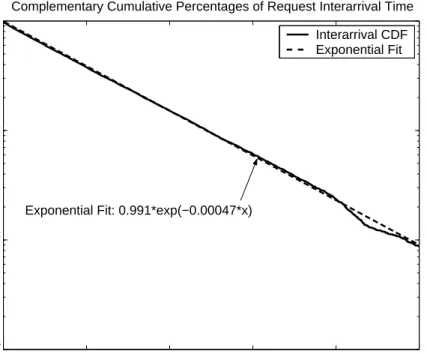
We characterized job interarrival times for P2P servers based on our collected traces. Figure 2 gives the complementary cumulative dis-tribution function (CCDF) of job interarrival time at a P2P server for a typical trace. Notice that the vertical axis is logarithmic; the straight line of the CCDF curve strongly indicates that the ar-rival process can be modeled by an exponential. The least-squares curve-fitting using an exponential function, indicated by the dash-line in Figure 2, with coefficient of determinationR2 = 0.9943
quantifies our argument.
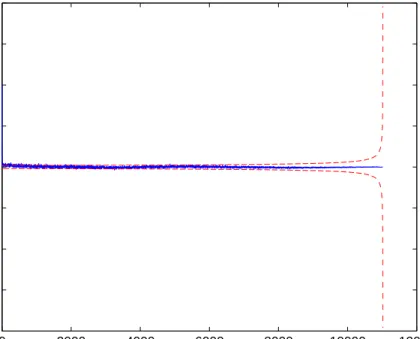
We tested the independence of job arrivals by computing the serial correlation of their interarrival times, as shown in Figure 3. Clearly, the correlation between any two separate interarrival times is effec-tively nil. Since each of our traces exhibits similar behavior, job interarrivals for a P2P server can be well modeled as independent of each other, clearly a significant difference from the web server case. Exponentially distributed, independent interarrival times are the definition of a Poisson process.
Previous research [15, 11] has shown that Poisson processes are valid for modeling the arrival of user-initiated TCP sessions such as TELNET and FTP connections. HTTP arrivals, on the other hand, have been shown not to be Poisson. Deng et al [11] point out that the aggregated interarrival times of HTTP requests can better be modeled by a heavy-tailed Weibull distribution. This is because HTTP document transmissions are not entirely initiated by the user; some are automatically generated by the browser (requesting em-bedded files), resulting in a more bursty process.
Although P2P server requests, like web requests, are not solely ini-tiated by the users, there are some interesting peculiarities of client peers that may explain the observed differences. For example, a client searching for a given object collects a set of candidate servers from which it later initiates parallel downloads. In addition, clients can abandon (switch) servers in the middle of a download, after finding an alternative source with higher available bandwidth [5, 2, 8].
3.2
Job Sizes are Pareto
Job size is an important property for queuing models. Interestingly, for P2P scheduling, there are three different possible definitions for job size: full object size, requested data chunk size, and served data
chunk size. While the full object size is usually very large, most
re-quested data chunks are small, covering only a small fraction of the whole object. More importantly, there is usually also a significant difference between the requested data chunk size and the actual served data chunk size. We discuss some possible explanations for this difference in Section 4.
The CCDFs of the three job sizes are depicted in log-log scale in Figure 4. As it is clear from the graph, the three often differ by several orders of magnitude. This clearly distinguishes P2P server requests from web requests and supports the argument for taking a closer look at the server side of P2P systems. For the remainder of this paper, we focus mainly on the requested and served data chunk sizes as these two are the main determinants of P2P server performance. For all of our traces, the distribution of these sizes can be modeled as a Pareto with highR2
values (0.9293 and 0.9452 for the example in Figure 4).
Connection Number of Number of Number of Type Threads Objects Requests 100Mbps Ethernet 200 1,533 300,000 100Mbps Ethernet 100 1,533 150,000 100Mbps Ethernet 50 500 80,000
Cable Modem 20 1,533 40,000
Figure 1: Key parameters of collected traces from P2P servers. Number of Threads is the number of available server threads.
0 2000 4000 6000 8000 10000
10−3 10−2 10−1 100
Request Interarrival Time (Millisec)
Probability[X>x]
Complementary Cumulative Percentages of Request Interarrival Time Interarrival CDF Exponential Fit
Exponential Fit: 0.991*exp(−0.00047*x)
Figure 2: CCDF of interarrival time of requests to P2P server
Given the relatively limited number of requests (up to 300,000) in our traces, one may question if these results could not be strongly related to our particular traces. While this is certainly possible, the fact that we see similar results in each trace gives at least some confidence that we have captured general behavior. We are working to expand the set of traces.
As we did for job arrivals in subsection 3.1, we also performed time series analysis for arrived job sizes. Our traces show that there are no correlations between arrived job sizes.
3.3
Job Service Times Are Pareto
Job service time is another aspect of the workload that will help us understand the potential benefits of different scheduling policies. Due to the different download speeds of clients, job service time is not directly proportional to any of the three job sizes we have seen, but can be well approximated by a Pareto distribution, one of the simplest forms of heavy-tailed distributions.
3.4
Server Resource Utilization
Despite their apparent similarities with web servers, the resource utilization of P2P servers could be quite different. Web servers typ-ically try to serve requests as quickly as possible and, as it has been shown, their bottleneck resource is commonly the limited band-width of the outgoing link [7]. P2P servers, on the other hand, are
normally run on the background of common users’ machines and are thus more conservative in their use of resources.
To understand resource utilization on P2P servers, we instrumented our honey-pots3to periodically (every three seconds) record differ-ent metrics such as CPU and memory usage. Our traces show that even when our servers support 200 concurrent downloads and use up to 2 MBytes/second of bandwidth, CPU utilization is always be-tween 1.2% and 20%, and memory usage is consistently below 20 MBytes. Thus, unlike the web server case, neither CPU, memory, nor bandwidth turn out to be the performance bottleneck for a P2P server, not even for the most popular of our honey-pots.
These low resources utilization can be largely attributed to the user-defined upper-bounds on bandwidth usage and number of concur-rent server threads. These same tight upper-bounds are what make P2P servers the performance bottleneck of the whole system [17, 12].
It is clear from this analysis that the bottleneck resource to schedule is the set of server threads on a server, i.e., the collection of concur-rent jobs that a server can serve. Our scheduling problem can then be formulated as follows: Given the total number of concurrent
3Each of our servers is a dual 1 GHz Pentium III machine with 1 GB RAM and two 30GB IDE disks running Red Hat Linux 7.3.
0 2000 4000 6000 8000 10000 12000 −2 −1.5 −1 −0.5 0 0.5 1 1.5 2 Lag Serial Correlation
Serial Correlation of Job Interarrivals (3.91143 % sig at p=0.05)
Figure 3: Serial correlation of interarrival time of requests to P2P server
100 101 102 103 104 105 10−4 10−3 10−2 10−1 100
Chunk Size (KBytes)
Probability[X>x]
CCDFs of Served Chunk Size, Requested Chunk Size, and Object Size
Served Chunk Requested Chunk Full Object
jobs that a server can take, how should we schedule the incoming jobs so that their mean response time is minimized?
4.
EVALUATION OF SCHEDULING
POLI-CIES
4.1
Scheduling Policies
A good scheduling policy should minimize the average waiting time without starving any jobs. Fairness is another important metric for evaluation of a scheduling policy. Fairness has several metrics, with the most recent work [7] using slowdown – defined as a re-quest’s response time divided by the time it would require if it were the sole request in the system.
The most commonly used scheduling polices are Processor
Shar-ing (PS) and First Come First Serve (FCFS). PS is commonly
em-ployed for CPU scheduling and in the current Apache web server, while FCFS is used by common Gnutella implementations such as Mutella, the implementation we use [5]. Neither of these policies makes use of other available information, such as size of a job, to improve performance.4
Shortest Remaining Processing Time (SRPT) has been studied since
the 1960s [19]. For a general queuing system (G/G/1) Schrage [18] proved that SRPT is optimal in the sense that it yields – compared to any other conceivable strategy – the smallest mean value of oc-cupancy and thus also of minimum waiting and delay time. Per-era [16] and Harchol-Balter, et al [7] evaluated SRPT in terms of fairness. Perera [16] studied the variance of delay time in the M/G/1/SRP T queuing systems and concluded that the variance is lower than FIFO and LIFO [16], while in [7] the authors proved that SRPT also outperforms PS in terms of mean slowdown, their fairness metric. SRPT has been successfully applied to a number of application areas. Bux [9], for example, introduced SRPT into packet networks using the message size as the service time. More recently, Harchol-Balter et al. [7] proposed the use of SRPT in web servers, relying on file sizes as the estimator of service time.
In this paper we introduce SRPT into P2P server-side scheduling. The adoption of SRPT faces some challenges, however. To begin with, ideal SRPT requires knowledge of requests’ service times, something not available a priori. In addition, while it may be pos-sible to estimate it [9, 7], the estimation is in itself challenging due to the dynamic characteristics of P2P systems we have discussed.
4.2
SRPT Scheduling in P2P Systems
Since a typical P2P download request is for a specific chunk of the whole object, as described in Section 3, we could use the requested chunk size as a rough estimate of service time, and as the metric for SRPT scheduling. Unfortunately, as Figure 5 shows, there are only weak correlations between requested chunk size and either served chunk size or the real service time, which implies that requested chunk size may not be a good estimate of service time. This dis-crepancy between the requested and served chunk sizes could com-promise the performance of SRPT [13].
Several characteristics of the P2P environment could help explain the weak correlation:
• A client can exit at any time during the data transmission. 4However, some P2P systems (such as eDonkey [2]) consider rep-utation (scores) as part of their scheduling policy.
• As already discussed, a P2P client can switch servers for a given data chunk before the request is completed. We spec-ulate that the more popular the object, the more likely this switching is.
• Although each downloading process is supposed to share equal outgoing bandwidth from the P2P server, bandwidth bottle-necks along the path to the destination can make the individ-ual download speed vary.
Figure 5 also shows a much stronger correlation between served chunk size and service time, indicating that served chunk size can be a very good estimate for service time.
Despite the aforementioned discrepancies between requested and served chunk sizes and the weak correlation between requested chunk size and service time, it may be worthy to evaluate SRPT performance using requested chunk size as its scheduling metric. Lu et al. [14] have studied the behavior of size-based schedulers with inaccurate job size information and concluded that the SRPT can outperform PS given an effective job size estimator. They [13] showed that SRPT outperforms PS whenR >0.15in the case of web server scheduling.
We explored how SRPT performs when using requested chunk size (CS) and served chunk size (SS) as the scheduling metric. For com-parison purposes, we will also present the scheduling performance for ideal SRPT. The three scheduling policies are denoted as SRPT-CS, SRPT-SS, and SRPT, respectively. Notice that SRPT-CS can be directly implemented with current tools, while SPRT-SS would require an accurate estimator.
4.3
Performance Analysis
We built a general purpose queuing simulator to evaluate the perfor-mance of different policies, including PS, FCFS, CS, SRPT-SS and ideal SRPT. All simulations were driven by our server-side request traces. For all of our simulations we set queue capacity to 500. A time slice of 0.01 seconds is used for PS. Besides our own work [14], we are not aware of other previous research addressing SRPT performance with inaccurate job size information.
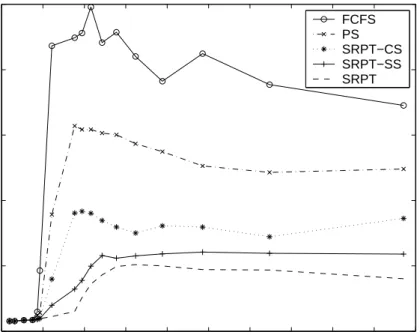
Figure 6 gives the mean response time of the five scheduling poli-cies handling all requests for a P2P server, with the system load varying between 0.1 to 10. The advantages of the three SRPT-based policies over PS and FCFS are clear, especially when the load is close to or above 15. When the load is 1.76, for instance, mean response time is 2244.08 seconds under FCFS and 1569.89 seconds under PS. For SRPT-CS, SRPT-SS, and SRPT, however, the number drops to 903.61 seconds, 322.621 seconds, and 151.451 seconds, respectively. This confirms our expectations of SRPT per-formance.
Similar to what we have observed for web servers [13], even with only a weak correlation between requested chunk size and actual 5In this paper we are mostly interested in the case where server load is larger than 1, which is normal for a popular P2P server. More-over, since job arrivals form a Poisson process and lack burstiness, the queue length shrinks abruptly when the load drops below 1. In all scheduling policies we evaluated, for example, the mean queue length drops to around 0.10 when system load is 0.75. As can be seen in Figure 6, SRPT-based scheduling policies still outperform FCFS and PS when the load is smaller than 1, as long as there are jobs waiting in the queue.
Statistics Service Served Requested Time Chunk Size Chunk Size Service Time 1.0000 0.7023 0.2833 Served Chunk Size 0.7023 1.0000 0.2339 Requested Chunk Size 0.2833 0.2339 1.0000
Figure 5: Correlation coefficients between service time, served chunk size and requested chunk size.
0 1 2 3 4 5 6 7 8 9 10 0 500 1000 1500 2000 2500 Load
Mean Response Time (Second)
Mean Response Time under Different Loads FCFS PS SRPT−CS SRPT−SS SRPT
0
1
2
3
4
5
6
7
8
9
10
0
0.1
0.2
0.3
0.4
0.5
0.6
0.7
0.8
0.9
1
Load
Rejection Rate
Rejection Rate under Different Loads
FCFS
PS
SRPT−CS
SRPT−SS
SRPT
Figure 7: Rejection rate for different scheduling policies under varying load
service time, SRPT-CS achieves considerable performance gains over both PS and FCFS. As would be expected, due to the strong correlation between served chunk size and service time, SRPT-SS performs significantly better and even approaches the performance of ideal SRPT under several different system loads.
The actual served chunk size, upon which SRPT-SS relies, is not known until the request is completed. However, we believe it should be possible to predict it fairly accurately. One possible way of achieving this, which we are currently exploring, is by finding cor-relations between object popularity and the level of discrepancy be-tween the requested and served data chunk size. Another approach could be based on both the prediction of served chunk size and the download speed of the client. For the latter, the connection type and the network distance to the client, such a domain-based scheduling, could be potentially applied [13].
4.4
Fairness Concerns
One major concern with SRPT scheduling is that it is possible to design an adversarial workload in which SRPT leads to starvation of large jobs. That is, SRPT can be made to behave unfairly. Fortu-nately, previous research on M/G/1 queuing systems with compa-rable workloads have shown that the starvation does not occur [16, 7]. Perera [16] proves that the variance of delay time of ideal SRPT is smaller than that of FIFO and LIFO, while Harchol-Balter [7] shows that the mean slowdown of ideal SRPT is actually smaller than that of FCFS and PS. In the context of P2P server schedul-ing, we consider fairness issues of a scheduling policy from three different aspects: mean slowdown oflargejobs, rejection rate of requests, and distribution of rejected job size.
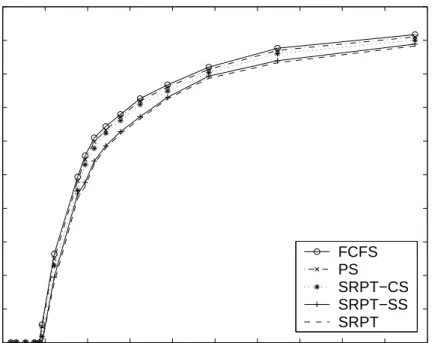
Figure 7 shows the rejection rates for the five policies under var-ious system loads. We can see that SRPT actually results in the
lowest rejection rate; SRPT-CS and SRPT-SS also reject fewer jobs than FCFS and PS. Our simulations also demonstrate that the dis-tribution of rejected job size is almost identical for all evaluated scheduling policies. Moreover, under various system loads, SRPT-based scheduling policies yield lower mean slowdown for large jobs. When the system load is two, for instance, the mean slow-down for the top 10% largest jobs in the system are: 15.496 (FCFS), 25.615 (PS), 10.723 (SRPT-CS), 8.741 (SRPT-SS), and 7.707 (SRPT).
5.
CONCLUSIONS AND FUTURE WORK
The server-side of P2P systems often turns out to be the perfor-mance bottleneck. Surprisingly, it has received little attention from the research community. In this paper, we start this exploration by looking at the problem of download request scheduling. We col-lected trace data of P2P download requests experienced by individ-ual P2P servers and performed analysis and modeling of this server workload. We proposed two SRPT-based scheduling policies and show their advantages through trace-driven simulations.
Analysis of several inherent characteristics of P2P server requests also reveals considerable room for improvement in estimating re-quest service time, which would let us approach the performance of ideal SRPT. Two possible approaches for estimating service time we plan to explore include: predicting served data chunk size based on object popularity and requested chunk size, and predicting trans-fer rate based on client type and Internet path characteristics.
We also identified other interesting directions of future work in P2P server-side scheduling:
• Deeper and more thorough analyses of fairness issues for var-ious scheduling policies.
• P2P server trace collection from different hosts, increasing both the geographical and connection variety.
• Modeling and scheduling for cooperative uploading/downloading, as employed in [2, 1].
• Implementation and evaluation of various scheduling mod-els in P2P software and its evaluation on large-scale Internet testbeds.
6.
REFERENCES
[1] Bittorrent homepage, 2004. http://bitconjurer.org/BitTorrent.
[2] eDonkey homepage, 2004. http://www.edonkey2000.com.
[3] Gnutella homepage, 2004. http://www.gnutella.com.
[4] Kazaa homepage, 2004. http://www.kazaa.com.
[5] Mutella homepage, 2004. http://mutella.sourceforge.net.
[6] ALMEIDA, J., DABU, M., MANIKUTTY, A.,ANDCAO, P. Providing differentiated quality-of-service in web hosting services. In Proc. 1st WISP (1998).
[7] BANSAL, N.,ANDHARCHOL-BALTER, M. Analysis of SRPT scheduling: Investigating unfairness. In Proc. ACM
SIGMETRICS (2001).
[8] BERNSTEIN, D. S., FENG, Z., LEVINE, B. N.,AND
ZILBERSTEIN, S. Adaptive peer selection. In Proc. 2nd
IPTPS (2003).
[9] BUX, W. Analysis of a local-area bus system with controlled access. IEEE TC 32, 8 (1983), 760–763.
[10] CROVELLA, M., FRANGIOSO, R.,AND
HARCHOL-BALTER, M. Connection scheduling in web servers. In Proc. USENIX USITS (1999).
[11] DENG, S. Empirical model of WWW document arivals at access links. In Proc. IEEE ICC (1996).
[12] GUMMADI, K. P., DUNN, R. J., SAROIU, S., GRIBBLE, S. D., LEVY, H. M.,ANDZAHORJAN, J. Measurement, modeling, and analysis of a peer-to-peer file-sharing workload. In Proc. 19th ACM SOSP (2003).
[13] LU, D., SHENG, H.,ANDDINDA, P. A. Effects and implications of file size/service time correlation on web server scheduling policies. Tech. Rep. NWU-CS-04-33, Northwestern University, Department of Computer Science, 2004.
[14] LU, D., SHENG, H.,ANDDINDA, P. A. Size-based scheduling policies with inaccutate scheduling information. In Proc. 12th Annual Meeting of the IEEE/ACM
International Symposium on Modeling, Analysis and Simulation of Computer and Telecommunication Systems (MASCOTS) (2004).
[15] PAXSON, V.,ANDFLOYD, S. Wide area traffic: the failure of Poisson modeling. IEEE/ACM TN 3, 3 (1995), 226–244.
[16] PERERA, R. The variance of delay time in queueing system M/G/1 with optimal strategy SRPT. Archiv fur Elektronik
und Uebertragungstechnik 47, 2 (1993), 110–114.
[17] SAROIU, S., GUMMADI, K. P., DUNN, R. J., GRIBBLE, S. D.,ANDLEVY, H. M. An analysis of internet content delivery systems. In Proc. 5th USENIX OSDI (2002).
[18] SCHRAGE, L. E. A proof of the optimality of the shortest remaining processing time discipline. Operations Research
16 (1968), 678–690.
[19] SCHRAGE, L. E.,ANDMILLER, L. W. The queue M/G/1 with the shortest remaining processing time discipline.