DEECD ITD Solution Architectural Standards
Release: Final Date of this version: Oct 1st 2008
Author: Seng Hee Tan Solution Architect ITD, DEECD Owner: Jim Hayes Projects Director ITD, DEECD Client: ITD, DEECD Document Version Number: 1.0
Copyright© 2008
This document is the property of the Department of Education and Early Childhood Development who shall retain its copyright. It may not be reproduced or recorded in whole or part in any form or media without the explicit written approval of the Department of Education and Early Childhood Development.
Contents
1 DEECD Standards ... 3 2 Introduction ... 4 2.1 Purpose ... 4 2.2 Background ... 4 2.3 Scope ... 4 2.4 Exceptions ... 4 2.5 Assumptions ... 4 2.6 References ... 5 2.7 Definitions ... 5 3 Definition of Class ... 6 4 Application Architecture ... 6 4.1 Development Language ... 64.2 Integrated Development Environment (IDE) ... 6
4.3 Software Development Framework ... 6
4.4 Application Design ... 6
4.5 Development Environment Tools Standards Summary ... 8
4.6 Application Transaction Management Standards ... 8
4.7 Application Reporting Standards ... 8
4.8 Client-Side Presentation Standards ... 9
4.9 Web Browser Standards ... 9
4.10 Enterprise Portal ... 9 5 Platforms ... 9 5.1 Client Platform ... 9 5.2 Web Server ... 9 5.3 Application Server ... 10 5.4 Load Balancing ... 10 6 Application Security ... 10 6.1 General Security ... 10 6.2 Authentication ... 10 6.3 Authorisation ... 11 6.4 Cryptography ... 11
6.5 Auditing, Logging and Alerting ... 12
6.6 Data Protection in a Distributed Environment ... 13
7 Data and Databases ... 13
7.1 Database Management ... 13
7.2 Data Transfer Standards ... 13
8 MS Access Based Solutions ... 14
9 Infrastructure Server System Architecture ... 14
9.1 Client Operating Systems ... 14
9.2 Server Operating Systems ... 14
9.3 Virtualisation Services ... 14
9.4 Server and Storage Hardware ... 14
9.5 Network Hardware and Services ... 15
10 Infrastructure Management Tools ... 15
2 Introduction
2.1 Purpose
This document defines the standard technological requirements for ITD application development at DEECD. All technologies use for DEECD application development must fall within the stated standards. Technologies not within the guidelines are implicitly prohibited.
Consult ITD Solution Architect if advice and assistance is required
2.2 Background
DEECD ITD has standardise on a consistent and organisation-wide approach to application development to ensure that as vendors engaged on various IT Projects, they produce consistent and measurable applications in-line with departmental standards.
2.3 Scope
This document defines standards to which software development teams should conform when providing solutions for DEECD.
This document covers
• Application Architecture
• Technology Standards including but not limited to n-tier design considerations, development platform, data and database considerations
• Reporting and reporting services
This document does not address detailed design, although recommendations are made across some areas, and should be used in conjunction with other artefacts such as:
• Developer’s resource kits
• Technical Architecture
• Security Guidelines
• Infrastructure Standards.
2.4 Exceptions
There are no exceptions to these standards. Business units with compelling business cases for varying from these standards will be required to submit proposal to the DEECD Enterprise Architectural Board and ITD GM.
2.5 Assumptions
All technologies defined and classified in this document are valid from August 2008 onwards or until a new version of this document is released.
2.6 References
Ref# Title Document Id Version Issue
Date
1. ICT Policies, Standards and Guidelines for the Victorian Government
http://www.dtf.vic.gov.au/CA25713E0002EF43/pages/servic es-to-government-ict-services-ict-policies,-standards-and-guidelines-for-victorian-govt.
2. Developers’ Resource Kit http://www.education.vic.gov.au/devreskit.
2.7 Definitions
Acronym/Term Meaning
BAU Business as usual
COM Microsoft Component Object Model COTS Commercial Off The Shelf product
DNA Microsoft Distributed Internet Application Architecture DEECD Department of Education and Early Childhood Development
EA Enterprise Architecture
EAB Enterprise Architecture Board
GAC Global Assembly Cache
HTTP Hypertext Transfer Protocol
ICT Information Communication Technology ITD Information Technology Division of the DEECD Light Touch Projects that are typically developed offsite by vendors
Medium Touch Projects that have a combination of both on-site (DEECD) and off-site (Vendor) involvement OEM Original Equipment Manufacturer
NFR Non-Functional Requirement
SLA Service Level Agreement
SOA Service Oriented Architecture
UML Unified Modeling Language
WSE Microsoft Web Service Enhancements
WCF Windows Communication Foundation
3 Definition of Class
This section specifies the term used in this document.
Class Definition
DEECD Standard
This is the standard technology for DEECD application developments. DEECD Host
DEECD Support
4 Application
Architecture
4.1 Development
Language
VB.Net is the development language for new applications
Class Language
Standard Microsoft Visual Basic.Net
4.2 Integrated Development Environment (IDE)
The current development environment is Microsoft Visual Studio.Net 2005.
Product
Microsoft Visual Studio .NET 2005 (only VB.Net)
4.3 Software
Development
Framework
Microsoft .Net Framework v2.0 is the software development framework.
Product
Microsoft.Net Framework v2.0
4.4 Application
Design
DEECD applications are to be developed with an n-tier design.
Design Description
N-Tier The presentation, business and data tiers all
completely separated, having each tier designed to transparently talk to subsequent tiers whether they are
hosted locally or remotely. The ability of host separation allows scalability.
The recommended guideline for software solution would include, but is not limited to, the following software layers.
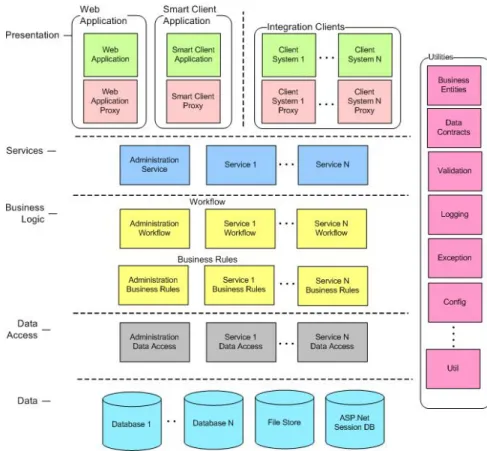
Figure 1 Recommended N-tier Application Architecture
The structural representation of the solution abides by the architectural principals of a layered application. Application elements are separated into distinct layers of components to enable high coherence and low coupling.
o Presentation: This layer is the location for any user interface related code. The presentation of the system can be in the form different types of clients with the need of consuming the application services.
o Service Agents: This layer hides from the client application the details required to successfully invoke the service or perform remote service calls.
o Service Layer: This layer encapsulates the data contracts, or business entities, and services which are exposed for the vertical partitions. To the extent possible this layer must isolate from the rest of the system any service communication concerns such as fault management and data contract definitions.
o Business Logic: Components of the system which define the business logic boundaries such as workflow, validation and business rules. The diagram above encourages the separation of workflow and business rules, based on the assumption that business rules are more likely to have frequent changes in comparison to business processes.
o Data Access: Components solely used for the purpose of accessing data from the system data stores. This layer abstracts the semantics of the underlying data store and data access technology providing a simple interface for retrieving and performing operations on data.
o Data: This layers houses any databases and persistent storage participants such as files.
o Utilities: The components in this partition are components which are common across two or more layers of the entire system and are therefore represented as a vertical slice of the architecture.
4.5 Development Environment Tools Standards Summary
Product• Enterprise Libraries 3.0
• Web Client Software Factory (WCSF)
• Composite Application Block (CAB)
• Web Service Software Factory Modelling Edition 2005
• MSBuild
• MSTest
4.6 Application
Transaction Management Standards
Transactions are to be used for any operation where the state of the systems is expected to alter after the execution of the request such as the creation of a database record. Operations where data is only presented to the user without the need of modifications do not need the use of a transaction.
The selection criteria for using transactions is tightly coupled with the architecture of the components involved within the business operation. As per the above criteria, transaction should be used throughout the system. However if a business operation(s) requires a long running transaction – I.e. expected to take longer than a minute – and the user may experience a long delay or a request failure; transactions should be implemented by separating the process or workflow steps into individual transactional operations. A transactional queue is a good candidate for such an
implementation. Such separation allows the operation to be enclosed within transactions without resulting in unwanted user experiences.
Explicit management of transactions is labour intensive and error prone. .Net 2.0 introduced a new model for transaction management which greatly simplifies the effort and implementation for the developers. Application developers should consider the use of the Transaction Scope feature of .Net
4.7 Application Reporting Standards
Report data may be printed, stored locally, emailed, transmitted by a notification channel (SMS) or may be the trigger of other business processes via a messaging or bulk data transfer interface. Furthermore, report information may also be used as part of an enterprise reporting facility such as a data warehouse and may therefore need to be injected into other systems.
Reports may be produced using specific functionality designed into the application code or by the use of a generic report generation program or service. The report generator can be called from within the application using specific service calls (APIs) or manually by extracting the data in an agreed format (e.g. XML) and submitting it to the report generator.
Applications developed internally using SQL Server as a backend database should use SQL Server Reporting Services (SSRS) as the means of delivering such information.
Technology
Microsoft SQL Server Reporting Services 2005 Microsoft SQL Server BI 2005
4.8 Client-Side Presentation Standards
Product Comments HTML XHTML Java Script CSSAlthough JavaScript can be used, the site is functional with JavaScript turned off. More detail at
http://www.eduweb.vic.gov.au/devreskit/qa/qafurther4.htm#qa7 2
4.9 Web Browser Standards
ProductInternet Explorer 6.0 Internet Explorer 7.0
4.10 Enterprise Portal
The DEECD enterprise portal is Microsoft Office Sharepoint Services 2007.
Product
Microsoft Office Sharepoint Services 2007 SP1
5 Platforms
5.1 Client
Platform
Product Microsoft Office 2003 Microsoft Office 20075.2 Web
Server
Product
Microsoft IIS v6.0
5.3 Application
Server
Application servers perform the processing logic in most web applications. These can either be hosted on the same box as the web server or they can be hosted separately.
Product
Microsoft IIS 6.0 /.Net Framework
5.4 Load
Balancing
Microsoft ISA terminates HTTPS or SSL Certificates and securely publishes web content across multiple web farms on hosts. Contact Edumail Services telephone: 96372956 for additional information.
Product
Microsoft ISA 2006 SP1
6 Application
Security
6.1 General
Security
DEECD has a published set of clear guidelines on ICT Security Standards. Contact Manager, Risk Management telephone : 96373490 on ICT Security Policy.
6.2 Authentication
Authentication can be defined as the process of identifying the source (Identity) of engagement for a system – a source being a user or another system. DEECD application users must be protected against threats such as:
• Identity high jacking
• Password cracking
DEECD uses an LDAP compliant directory as its source of user data for network level authentication. Currently this directory is Microsoft Active Directory (Microsoft Windows 2003)
All applications developed for the DEECD must use this directory as its source of user authentication.
6.3 Authorisation
Authorisation is the process of granting access to a network resource based on the already established identity. Authorisation ensures that the authenticated user is given the correct privileges to the correct resources accessible by the system. The resources each user has access to will depend on their role membership.
DEECD user roles must have appropriate access to confidential data as well as system operations. A control mechanism must exist within the application to prevent:
• Escalation of privileges
• Access to restricted system areas and or features
• Tampering with data
Authorisation methods should be based on the security principle of ‘Least Privilege’ where architects and team leads of the system are encouraged to design the application to allow the code executing under an authenticated identity to function with the minimum set of user rights required to successfully complete the intended operation. This creates a ‘Secure by Default’ system user configuration.
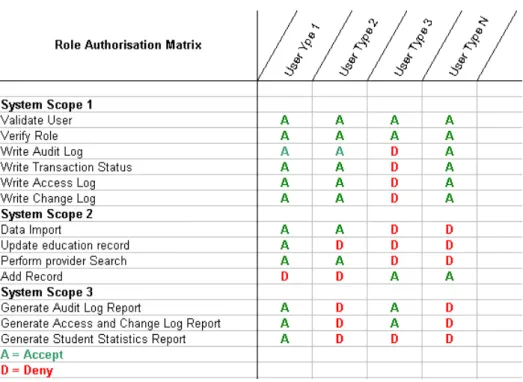
Solutions must also provide a user authorisation matrix as part of the documentation. This document facilitates the solution auditing and configuration.
Figure 2 Authorisation Matrix
The diagram above illustrates a sample authorisation matrix documented required by the solution.
6.4 Cryptography
The DEECD has a published set of clear guidelines on what, where and how cryptography should be used within developed software, databases and the servers hosting these systems. This document is known as the ‘ICT Security Standard – Using Cryptography to protect information’. See References Section 2.6 above for more information or contact Manager, Risk Management telephone: 96373490.
The following points highlight some of the standards used within the DEECD environment:
• Cryptography must be used for sensitive information which is either:
o Kept on persistent storage
o Transmitted over the network
• Code signing of all DLL’s and Executables published on a public facing website (including those that are visible to schools) must be code-signed by the DEECD so that the receiver knows they come from a trusted sourced.
• Message layer encryption for public facing websites should use X.509 certificates and be combined with SSL 128bit encryption. The DEECD uses Thawte (www.thawte.com) for acquiring SSL certificates.
• Sensitive data (including data on backup media, in logs, exchange of information in from and out to external systems) must be rendered into unreadable form anywhere it is stored. Different approaches can be applied to do:
o One-way hashes
o Truncation
o Index tokens with PADs (with the PAD being securely stored)
o Strong cryptography such as Triple DES 128-bit should be used as a minimum although AES 1024-bit with associated key-management process and procedures is preferred
• The Architecture team must approve any different approaches proposed by application development teams
• If a development team chooses to encrypt data using a key-management technique, the encryption keys must be protected against both disclosure and misuse
• Key-management processes and procedures must be fully documented, including:
o Generation of strong keys
o Secure key distribution
o Secure key storage
o Periodic key changes
o Destruction of old keys
o Split knowledge
• Dual control of keys (this requires two or three people knowing only their part of the key and the whole key only being constructed using all of their keys).
6.5 Auditing,
Logging and Alerting
The following requirements concern auditing, logging and alerting:
• All applications must be designed in such a way that it will be easy to detect intrusion into the system or application
• The application and infrastructure must have a good logging, auditing and altering mechanism in place
• Auditing and logging must take place across all the tiers in the delivered application
• Security systems and processes must be regularly tested
• Any user operation must be auditable through the system
Application developers should consider the use of the Microsoft Logging Application Block, part of the Microsoft Enterprise Libraries, as part of the implementation. See References Section 2.6 above.
6.6 Data Protection in a Distributed Environment
DEECD has sensitive data in its production systems. Protecting, securing and maintaining the integrity and
confidentiality of sensitive data has the highest priority within DEECD in order to adhere to legal standards and audit requirements.
DEECD has many environments such as development, system test, user acceptance testing and production. Data must be protected in all of these environments.
The following points need to be considered when considering the use of sensitive data in any environment:
• Protection of Real-Time Data: The information used in testing is generally used by various groups at DEECD. These include groups such as the DEECD internal testing team, outsourced testers and consultants from various outsourcing organisations. Availability of information to various groups increases the likelihood of compliance violation. The Architecture team suggests that you protect and scramble data early in the test cycle.
• Data Creation: The data for the test cycle must be created by the application owner. The data must be realistic in order to conduct proper testing; attempting to obtain data from production and scrambling it may result in too many failed tests.
• Data Obfuscation: Data obfuscation can cause serious problems such as loss of natural data distribution. An obfuscated system may end up behaving quite differently from a clear-text system. Clustering factors, data lengths and distribution of values may all be quite different from the real system.
• Important Data Fields: Important data is often referenced by many fields. Care must be taken when altering the key fields; for instance, where the name field of a student is scrambled but is also referenced in a comments section.
• System Outputs: Where data has been scrambled, you must also consider system outputs very carefully, such as printouts, faxes, e-mails etc. This may result in compliance violation.
• Data sensitivity: Avoid using production data in non production environments
Note: The use of production data in other environments must be approved by the IT Standards and Integration Architecture team as well as all stakeholders.
7 Data and Databases
7.1 Database
Management
Microsoft SQL Server 2005 is the database management system for new applications.
Product
Microsoft SQL Server 2005
7.2 Data Transfer Standards
DEECD has the following standards for data transfer.
Technology
SQL Server Integration Services (SSIS) 2005
8 MS Access Based Solutions
Externally developed MS Access-based applications are not permitted within the DEECD environment. Applications written in MS Access should only be used to meet short-term needs and have:
• No access to sensitive data
• No interface to external applications
• No more than 3 concurrent users
• A low volume of transactions
• No scalability requirements
• No security requirements
• No audit trail requirements
• No general compliance requirements
This technology is not suitable for applications containing sensitive and important information.
The use of this technology (or enhancements to existing MS Access-based applications if applicable) requires the approval of the Architecture team.
9 Infrastructure Server System Architecture
9.1 Client Operating Systems
Product
Microsoft Windows XP SP2 Microsoft Windows Vista
9.2 Server Operating Systems
The operating systems at DEECD is Microsoft Windows 2003
Product
Microsoft Windows Server 2003
9.3 Virtualisation
Services
VMWare is the virtualisation services.9.4 Server and Storage Hardware
IBM X-Series Server is the Server hardware used in DEECD SAN is the DEECD Storage Hardware of choice.
9.5 Network Hardware and Services
The network hardware and services are:• Gigabit Switched Ethernet network
• Cisco switching
• Routing and firewall equipments
10 Infrastructure Management Tools
The current monitoring tools in DEECD are as listed:
Product
Microsoft MOM 2005/ SCOM IBM Director
Backup Exec HP BAC