The “Biogasification” of Linköping
A Large Technical Systems Perspective
Michael Martin
Department of Management and Engineering
Environmental Technology and Management Linköping University
The “Biogasification”
of Linköping
A Large Technical Systems Perspective
Michael Martin
,
Environmental Technology and Management, Linköpings Universitet
Summary
Biogas production is synonymous with Linköping, as an increasing number of international visitors are coming to the region to learn of the biogas system in place. Moreover, Linköping is a world leader in the production, distribution and research on biogas. Since the 1990s, Linköping, Sweden has been developing a biogas system which is benchmarked worldwide. This system has grown rapidly, and has the potential to expand even further in Sweden and abroad. Many of the leading biogas development industrial actors originate and call Linköping their home. Technologies from this region have thus begun to spread worldwide, as many of the benchmarking practices have concluded that the system could provide parallel benefits to communities abroad.
The biogas system thus provides many examples of a budding large technical system. However, just as other large technical systems, there are obstacles to overcome and the biogas system, which is relatively recent, has a long way to go before it is able to dominate the market. Moreover, large technical systems as such owe a great deal to both the technical as well as the social systems enabling their success. Nonetheless, the biogas system is thus analyzed an up-and-coming large technical system with force to prevail and expand nationally and globally.
Introduction
History of Biogas in Linköping
Linköping has had a long and fruitful history in the realm of biogas production since the 1990s. Inspiration this biogas development came from none other than diminishing environmental standards and pollution created from the, then dirty and less maintained, diesel buses. Around the area known as Trädgårdstorget, a noticeable smog was recognizable from diesel fumes, and localities were being caked with soot and other emissions. This is when Linköping’s leaders, transport authority and citizens began brainstorming on how to transform the area, better the environment and bring Linköping ahead economically. The solution was apparent; biogas was to be Linköpings future.
Figure 1: Early Picture of Trädgårdstorget, Linköping
Initially in 1992, 5 methane/biogas buses from Scania were employed in the regional transport authority of the time, Lita. Ironically, Lita began promoting their biogas program as “Lita på biogas” which literally means “rely (or trust) on/in biogas.” This pilot program was a success and Linköping decided to advocate the employment of biogas further. Linköping Biogas AB was then formed in 1995 under the cooperation of Tekniska Verken and Scan Foods. In 1996 the first biogas was being produced at Linköping Biogas AB, and further development and research led to further expansion in the system. By 1999, Linköping boasted the largest biogas bus fleet in the world and currently have over 1,000 biogas fuelled vehicles in the region. Furthermore, a biogas train was added to the transport system; another first. (Miljöteknikcentrum, 2008; Svensk Biogas, 2008)
Development has not stopped only in Linköping. Linköping Biogas AB later became Svensk Biogas AB and began exporting knowledge and technology regionally and abroad through their daughter company Swedish Biogas International. Moreover, Scandinavian Biogas AB, also from Linköping, are working heavily with technological transfer and knowledge exchange abroad. This company, which has ties to Linköping University, continues to aid development and research into the anaerobic digestion and biogas system designs. (Scandinavian Biogas, 2008; SBI, 2008)
Biogas Production and Use in Linköping
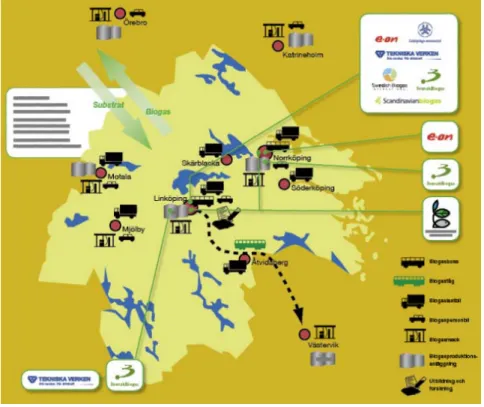
The key player in the production of the biogas system and the provider of regional services is Tekniska Verken AB. Thereafter, responsibility for biogas production and the processors lays within control of their subsidiary, Svensk Biogas i Linköping AB. The largest and most well defined biogas systems in Östergötland are those run by Svensk Biogas AB, whom are responsible for the production of biogas at several locations in Östergötland, which are ultimately used to fuel the regional buses at Östgöta Trafik, the regional traffic authority. Biogas production for Svensk Biogas is conducted at Åby Västergård, Nykvarn waste water treatment facility and in Norrköping on Händelö. (Tekniska Verken, 2008; Svensk Biogas, 2008) Biogas production started in Linköping at Åby Västergård and has continued to produce the largest proportion biogas in the region. Today’s system at Åby Västergård has two 3,700 m3 digestors which together produce around 6.5 M m3 of raw biogas each year. This raw gas contains around 68% methane and must be concentrated to around 97% for use as a vehicle fuel. Raw materials for this system amount to around 55,000 tons of wastes each year. The system then produces around 40,000 tons of certified bio-fertilizer each year to be used locally at farms throughout Östergötland.
Additional biogas is produced in Östergötland by Svensk Biogas at two other locations, as previously mentioned. The waste water treatment plant produces roughly 2.4 million m3 of raw biogas from about 110,000 m3 sewage sludge. Sewage sludge is then used for energy production and fertilizer in local agriculture. Moreover, in Norrköping biogas is produced using a by-product from the adjacent ethanol plant. Lantmännen Agroetanol AB supplies around 20,000 m3 of stillage from ethanol production to Svensk Biogas which produces 2.6 million m3 of raw biogas and roughly 14,000 tons of KRAV marked biofertilizer annually. (Svensk Biogas, 2008) Biogas is also produced at a number of farms in the region using animal wastes and biomass. These systems have support from Swedish Biogas International and a few other firms. AgroÖst and others are continuting to develop concepts for regional farms to employ biogas systems for energy and heating purposes. (AgroÖst, 2008)
Figure 2: Biogas Infrastructure and Development in Östergötland
Source: Miljöteknikcentrum, 2008
Biogas has grown considerably since the introduction in the 1990s. Initially, 5 buses were employed in the regional transport authority. Since the introduction there are now over 1000 personal vehicles and 89 biogas buses in the Linköping region. Thereafter Linköping Kommun has even been awarded the “Bästa miljöbilskommunen diploma” (Best Environmental Car City Award) in 2008 for their outstanding record of environmental cars, first and foremost biogas cars. (Linköpings kommun, 2008) Biogas production has even expanded throughout the region to Västervik, Örebro, Norrköping, Mjölby and Katrineholm were these cities are either producing biogas or connected to the biogas grid with plans to subsidize fossil fuel use and include biogas vehicles for private fleets and personal vehicles.
Developing Large Technical System
In the development of large technical systems, technology is not only the most important factor; the development is also governed by social and cultural contexts. Technology has driven biogas development where it stands today, i.e. the infrastructure, digestion processes, fuelling stations, grids, vehicle technologies, etc. However social aspects also have played a major role in the development as well, i.e. the users, politicians, decision makers and laws. (Ivner, 2009; Börjesson, 2007)
The special conditions provided in Linköping have led regional politicians, researchers and companies to advance the biogas system to the benchmarked process of today, and large technical systems theories offer an approach to analyze and explain conditions and barriers toward success and expansion. Hereafter the theories of large technical systems will be used to provide details into the development of the biogas system in Linköping including the concepts of technological style, momentum, systems culture and reverse salients. Studies as such give great benefit toward learning more about the contribution of these technologies toward society and essentially may offer a means by which to make them “better.” (Ewertsson & Ingelstam, 2004) More information on the theories of large technical system can be obtained from authors such as Thomas P. Hughes (1983 & 1998) as well as Ewertsson & Ingelstam (2004).
Technological Style
Interestingly in the case for Linköping, the focus on biogas production has been dissimilar to other regional programs for biogas production. Linköping has focused essentially on the production of biogas for vehicle fuel and continues to do so with further expansion. Furthermore, the production of biogas regionally is done dissimilar to other regions, i.e. with a smörgåsbord of inputs to the system. But why is this as such? Many of the reasons for this contradict what is essentially understood from the literal reasoning of technological style.
Thomas P. Hughes uses the term technological style to explain the local conditions, external to technological factors alone that characterize specific developments. Factors such as a natural gas grid, political will, energy pricing and industrial raw materials have regionally influenced the technological style significantly in the case for Linköping.
First and foremost, as Linköping developed their biogas system, the option for a coming natural gas grid gave promise. The gas grid never came however, and therefore methane was extracted and purified from the raw biogas. On the west coast of Sweden however, conditions are different and biogas is even included in the natural gas grid in Laholm, i.e. upon upgrading. (Berglund, 2006)
Political will has also been a strong driving factor for the development of biogas for vehicle fuels. Since the start, Linköping politicians have continued to drive the development of biogas and have supported research. Gösta Gustavsson, City Comissioner of Linköping, states that, “Biogas has never been a contentious issue in Linköping. It has always enjoyed broad support in the municipality, and that has carried us to where we are today.” Moreover, Tekniska Verken concurs with this statement and declares that their success in biogas development for vehicle fuels and infrastructure have come primarily from “political consensus and the municipalities firm belief in the project.” (Miljöteknikcentrum, 2008)
Biogas developments in other regions, especially Germany, have developed with the intent to use biogas for energy production (electricity and heat). This is due primarily to the fact that
electricity produced from biogas in Germany benefits from generous tariffs and high revenue. Sweden however, does not have high revenues for the production of electricity from renewables such as biogas, due to the current energy systems in place today. Due to this, the focus on vehicle fuels in Sweden especially in Linköping has been dominant, though some electricity producing biogas plants do exist in Sweden, especially at farms.
Finally, due to the conditions, infrastructure and raw materials of the region, biogas production has developed to produce vehicle fuel with a wide variety of inputs. Biogas production regionally is done so dissimilar to other regional applications of biogas. The production started with using waste food products and has literally produced a “smörgåsbord” of inputs to the system, something Svensk Biogas is proud to bring forward. Since the onset, local industries have supplied waste products otherwise landfilled to produce biogas. Most of these inputs must be traceable, and thus legislation and certifications must be made from “trusted sources,” i.e. foodstuffs. As an example of another process, as mentioned previously, biogas is also produced from the waste water treatment facilities as well as using distillers waste from ethanol production. These biogas production methods are unique to the region; except for the case of waste water treatment. (Svensk Biogas, 2008)
Momentum
As biogas development and expansion continues, regionally and abroad, by actors from Linköping, technological momentum has begun come into focus in recent years. Developments in the Linköping region are well maintained and the processes continue to produce biogas from immense research and design optimizations, both conducted by university researchers and companies. However, abroad and even regionally more focus is being put into new methods of biogas production. New substrates are being used continuously, and regionally there has been a focus on the use of biomass and other substrates for energy production. Recently, LRF Östergötland, AgroÖst and Länstyrelsen Östergötland (the County Administrative Board of Östergötland) have teamed together and focused attention to the vast quantitles of biomass and raw materials available for bioenergy production, namely biogas. The potential and quantity of substrates for biogas production seem to be plentiful, thus allowin much more opportunity to expand and take care of these substrates. (AgroÖst, 2008) Processes will have to be optimized for methane extraction from these, and thus system designs continue to change. The focus here is not necessarily on vehicle fuel, thus these systems do not seem to have become institutionalized as Hughes describes.
Locally, biogas development has not reached maturity. As the number of vehicles continues to expand running with biogas, so too will the need for biogas fuelling stations. Infrastructural capacity, which is already quite large locally, must expand. More biogas will be needed in the future as well, as this fuel is gaining a larger share energy use regionally. As stated before, substrates continue to arise, and thus local concentration may shift toward biogas production from more wastes and even local rubbish. There is some scepticism about this, though it offers even further substrate supplies for biogas production.
Systems Culture
Regionally, the focus for biogas production has been primarily for vehicle applications. This is coupled with the fact that biogas use is most cost effective in this manner, as opposed to electricity and heat production; more information is given in the subsequent section, reverse salients. Regional biogas producers seem to focus primarily on the vehicle technology, and not necessarily on the use of biogas for energy puroposes on farms, for example. The outlook
and cooperation for vehicle applications thus has, to some extent, led the development of biogas regionally, if not nationally, leaning toward one direction. This may have made them “blind” to changes and other innovative methods to use biogas and produce it. (Ivner, 2009) Nonetheless, local farmers and administrative boards are researching into the possibilities given the large material flows of biomass and wastes, as described previously.
Reverse Salients
Biogas development in the region has also had its share of barriers, and continues to do so as the system expands regionally as well as abroad. Hughes’ concept of reverse salients tries to address the problems that occur when systems are expanding and components of the system constrain continued expansion or progress. (Hughes, 1983) Hereafter several of these barriers will be concentrated upon to find barriers toward expansion and development.
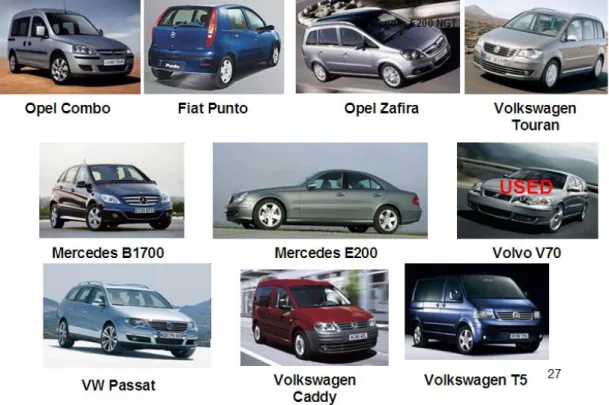
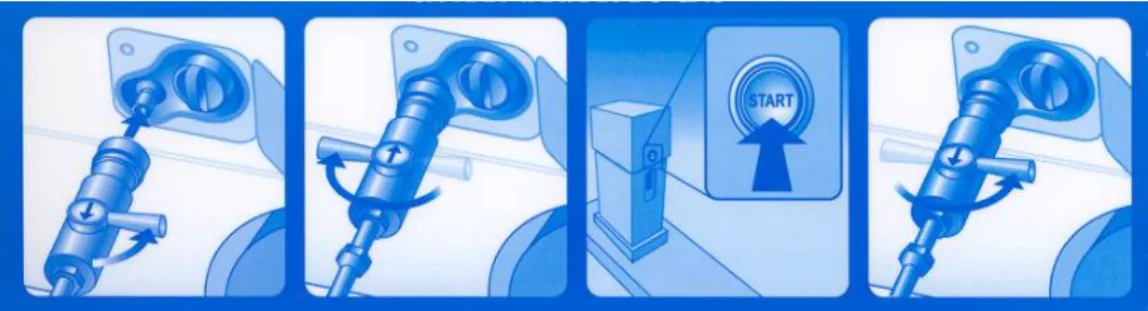
In the promotion and development of biogas many of the barriers come primarily due to the application for use in vehicles. Biogas in vehicles brings forward certain barriers such as user attitudes, technology, storage systems, fuelling infrastructure and vehicle selection. Customer concerns on the choice of vehicles as well as their availability offer challenges toward the expansion of biogas systems. Figure 3 below shows the current selection of biogas vehicles available in Linköping. However, in order to obtain several of these vehicles, one must be placed in waiting lines as the demand for biogas vehicles is currently greater than the supply. Captivatingly at the same time, Volvo decided to stop supplying biogas vehicles in 2008 and the much sought after Volvo V70 can only be obtained second hand. Customers also perceive risks being present when driving a biogas vehicle. A high pressure biogas tank brings up images of “bombs” and this is present with many concerns. Moreover, filling the vehicles is slightly different than that of liquid fuel vehicles. Leakage and backpressure during connection and disconnection of the biogas filling nozzle concern customers and may make them a bit hesitant while refuelling. (Eklund, 2008; Svensk Biogas, 2008)
Figure 3: Current Biogas Vehicle Selection in Linköping
Figure 4: Biogas Refuelling Directions
Source: Svensk Biogas, 2008
Technologically biogas production is pretty sound. New methods for dealing with substrates are being researched and developed all the time, and interesting solutions are coming to light. However, once the biogas is produced, in order to use it as fuel for vehicles or to add it to a methane grid, upgrading must be done. The upgrading process is a limiting factor in biogas production. Currently the only financially feasible method is to use water cleaning technology, where water is actually “sprayed” in a cross-current flow of biogas to capture CO2 and other gases. Other methods are also available, but at a high price. Scandinavian Biogas AB has been working with a method of cryogenic freezing technology to separate the methane from CO2 due to the nature of these two gases, i.e. having different freezing points. (Scandinavian Biogas, 2008; Miljöteknikcentrum, 2008; Svensk Biogas, 2008)
For the producers and developers of biogas systems in Linköping, possibly the most limiting of all conditions and factors is the infrastructure needed for biogas development and transport. As mentioned previously there exists no current natural gas grid in the region similar to that in the western portions of the country. Therefore, in order to transfer the biogas from production site to distribution centers (filling stations) pipelines must be built. The production of biogas is currently economically beneficial; however initial investments in these infrastructural concerns are very costly. As the biogas system expands even further these should alleviate themselves, but there is no doubt that they are limiting availability in many parts of the regions close to Linköping. Figure 2 shows an example of the current infrastructure.
Inputs and outputs to the system, i.e. material flows also offer their own reverse salients for biogas development. Much of this owes to the production and use of the end product of the biogas process, digestate. As biogas production increases so too does the amount of digestate created. Svensk Biogas denotes this as a limiting factor in the expansion of biogas, and the current “market” for this waste product is limited. In some processes, like the production of biogas from ethanol stillage, this digestate can be used as bio-fertilizer. However, concerns are raised when the biogas is produced by an inconsistent flow of materials, such in the case of the Åby plant as well as production with sewage. Inputs must be homogonized if they are to be used for subsequent fertilization, adding energy and economic expenses. (Ek, 2008; Svensk Biogas, 2008)
In summary the reverse salients for biogas exist primarily due to the infrastructural issues, vehicle limitations, raw materials, wastes and rest products as well as legislation. Future work to alleviate these “bottlenecks” will allow for further system expansion and development.
Conclusion: The Future of Biogas in Linköping
Infrastructural issues and vehicle selection are being addressed in recent times to alleviate biogas development. Biogas vehicles are being re-introduced at Volvo and many car manufacturers are following suit. Saab has not come into the picture however, and it is unclear what this firm will do. However, too meet demands Tekniska Verken even upgrades vehicles for biogas use and many of these end up in fleets, which tend to be a huge market for biogas. Svensk Biogas continues to expand regionally, and initiatives such as free parking and lower costs for fuel are drawing in more customers every day.
The work of local organizations, researchers and businesses is by far not complete. Biogas research continues to expand as well. Biogas research also is beginning to become a major focus at Linköping University. Recently an initiative was started at Linköping University to begin a Biogas Research Center composed of an interdisciplinary team of researchers throughout the university. Research topics include, infrastructural capacity, anaerobic digestion, methane separation, small vs. large scale developments, biogas to electricity production and biogas in the energy systems perspective. This will prove as a means to further development, research and marketing of the region as “the” biogas region in Sweden.
Regionally the focus on biogas for vehicles is also being addressed further, and is adding energy production into the mix. In the future connecting local farms to a biogas grid may ease raw material handling costs, and allow for a larger network of biogas production. However, biogas firms of the region tend to focus on large scale production plants located near areas of large material flows. This seems logical, though more should be done to encompass small scale plants into the mix for greater expansion, material flows and coverage.
In summary the hindrances for biogas development exist primarily due to the infrastructural issues, vehicle limitations, raw materials, wastes and rest products as well as legislation. Future work to alleviate these “bottlenecks” will allow for further system expansion and development. Many of these are being addressed, as may be previously mentioned. By conducting a large technical systems analysis of this system, it is apparent that the system is not mature, but could be classified as a developing large technical system. Moreover, this approach has produced a means by which to show conditions and barriers toward success and expansion to allow for a more broad view of the biogas system.
References
AgroÖst, 2008. Förstudie: Förnybar Energi I Östergötland. Slutrapport. [Online] Available: http://www.ostsam.se/%5Cupload%5Cfiles%5Cfiles%5C1482_F%C3%B6rstudie%20F%C3 %B6rnybar%20energi.pdf [Accessed: 10 Jan 2009]
Berglund, M., 2006. Biogas Production from a Systems Analytical Perspective. Doctoral Dissertation. ISBN: 91-88360-80-6, Lund University.
Börjesson, P. & Mattiasson, B., 2007. Biogas as a resource-efficient vehicle fuel Trends in Biotechnology, Volume 26, Issue 1, January 2008, Pages 7-13.
Ek, A., 2008. Personal Communication with Anders Ek. Svensk Biogas AB & Tekniska Verken.
Ewertsson, L. & Ingelstam, L., 2004. Large Technical Systems: A Multidisciplinary Research Tradition. Chapter 15 from Olsson, M-O. and Sjöstedt, G., 2004: Systems Approaches and Their Application: Examples from Sweden. Pages 291-309.
Hughes, T. P., 1983. Networks of Power. Electrification in Western Society 1880-1930. Baltimore: Johns Hopkins Press.
Hughes, T. P. & Mayntz, R., 1998. The Development of Large Technical Systems. Campus Verlag.
Ivner, J., 2009. Municipal Energy Planning- Scope and Method Development. Doctoral Dissertation No. 1234. ISBN: 978-91-7393-716-0. Linköping University.
Linköpings kommun, 2008. Linköping – bästa miljöbilskommunen.[Online] Available: http://www.linkoping.se/informationtill/press/_news/miljobilsdiplom.htm [Accessed: 14 Jan 2009]
Miljöteknikcentrum, 2008. Miljöteknikcentrum i Östergötland AB. Home Page. [Online] Available: http://mtc.fjarde.se/ [Accessed: 29 September 2008]
SBI, 2008. Swedish Biogas International AB. Homepage. [Online] Available: www.swedishbiogas.eu [Accessed: 20 January 2008]
Scandinavian Biogas, 2008. Scandinavian Biogas AB, Homepage. [Online] Available: www.scandinavianbiogas.se [Accessed: 20 January 2008]
Svensk Biogas, 2008. Svensk Biogas i Linköping AB, Homepage. [Online] Available: www.svenskbiogas.se [Accessed: 14 September 2008]
Tekniska Verken, 2008. Home Page. [Online] Available: www.tekniskaverken.se [Accessed: 29 August 2008]