Basic Quality
Management Systems
Essentials for Quality Management
in the Medical Laboratory
James O. Westgard, PhD
Sten A. Westgard, MS
with contributions from
Leo Serrano MS, FACHE, DLM
Cheryl Wildermuth, MS, MT(ASCP)
ISBN 1-886958-28-9
ISBN-13 978-1-886958-28-9
Published by Westgard QC, Inc.
7614 Gray Fox Trail
Madison, WI 53717
Phone 608-833-4718
Copyright © 2014 by Westgard QC, Inc. (WQC). All rights reserved. No part of this publication may be reproduced, stored in a retrieval system, or transmitted in any form or by any means, electronic, mechanical, photocopying, recording, or otherwise, without prior written permission of Westgard QC, Inc.
Preface: Managing the Quality of
Laboratory Testing Processes
In 1986, Patricia Barry and I authored a book titled Cost-Effective Quality Control: Managing the Quality and Productivity of Analytical Processes [1]. That book introduced industrial principles of Total Quality Management (TQM) and demonstrated their application to analytical testing in Medical Laboratories. We paid particular attention to optimizing the quality and productivity (or cost) through optimization of Statistical QC procedures. We outlined the principles and approach that has guided our work on analytical quality management ever since. The foundation of TQM, together with enhancements from Six Sigma Quality Management, still provides the basis for ongoing improvement of quality in the Medical Laboratory. This book also begins with the principles of quality management, as described in the ISO 15189 global standard for medical laborato-ries [2]. ISO 15189 represents the adaptation of industrial quality management for the particular application in medical laboratories. ISO standards, by their nature, provide general advice on what needs to be done, but the standards do not provide the details on how to do it. The ISO approach provides flexibility for implementing the guid -ance and permits adaptation for the particular operating conditions in a medical laboratory and the economic and legal environment in different countries. The difficulty for many laboratories is figuring out the “how to do it” part, which has become a crucial issue now that ISO 15189 is being adopted as the laboratory accreditation model in many countries. It is the purpose of this book to provide some practical guidance on “how to do it”.
In today’s vernacular, the principles of quality management are embodied in a Quality Management System (QMS). “How to do it” involves the implementing a QMS that includes both manage-ment and technical requiremanage-ments, as described in ISO 15189. In this context, the first part of this book focuses on the “management” requirements and the second part on the “technical” requirements.
Page ii
How this book is structured
Part I – Basic Quality Management Systems for Regulation and Accreditation – reviews management requirements and outlines the steps for QMS implementation. Chapters 1 through 3 provide a description of QMS, review QMS essentials, and discuss the specific ISO 15189 management requirements. Guidance for implementation is provided in chapter 4 through 6. Deming’s Plan-Do-Check-Act cycle (PDCA) provides the basic organization for the implementation plan. Chapter 7, written by Leo Serrano and Cheryl Wildermuth, describes a real world application in the first laboratory to be accredited by the College of American Pathologists CAP-ISO 15189 program.
Part II – Six Sigma Quality Management Systems for Examination Procedures – focuses on the technical requirements, particularly those for the assurance of quality in the analytic or examination procedures. Chapters 8 through 15 provide guidance for developing a scientific QMS, defining quality for intended use, selecting examination procedures, validating the performance of examination procedures, designing SQC procedures, formulating a Total Quality Control plan, monitoring nonconformities, and determining the uncertainty of measurements. These chapters provide the “how to do it” guidance for some of the most difficult technical requirements. They feature Sigma-metric tools to support quantitative assessments of laboratory tests and scientific guidance for managing and improving the quality of those tests.
Acknowledgements
A special thank you to Leo Seranno and Cheryl Wildermuth for authoring chapter 7 and providing a real world example of the implementation of the CAP-ISO 15189 guidelines.
The Wallace H. Coulter Foundation stimulated the development of this book with their support for Spanish translations of our books on Basic Method Validation and Basic QC Practices (as well as this book). We thank Dr. Gabriel Migliarino and Evangelina Hernandez for providing the Spanish translations and also for providing their insights on ISO 15189 accreditation in chapter 17.
It has been a privilege to author this book together with my son Sten, who has provided the motivation for Westgard QC to move forward in this area, as well as providing the technical support for converting my drafts into a finished product. It has been one of the great pleasures in my career to work with Sten on the development of the books and training materials and to have his support and participation in our educational programs. This is the tenth book published by Westgard QC! Few scientists have the resources to promote their ideas with minimum “editorial” oversight. I am one of those lucky few, thanks to Sten.
About the authors and contributors
James O. Westgard, PhD is an Emeritus Professor in the Department of Pathology
and Laboratory Medicine at the University of Wisconsin Medical School. He is also the President of Westgard QC, Inc. His complete bio can be found at http://www.westgard.com/jimbio.htm
Sten Westgard, MS, is Director of Client Services and Technology for Westgard QC, where (among other duties) he manages the website and online training portal... and nags his father to write more books.
Leo Serrano, MS, FACHE, DLM Lean/Six Sigma Black Belt, is the Corporate Director of Laboratory Systems for Broward Health in Florida.
Cheryl Wildermuth, MS, MT(ASCP), Lean Green Belt, is the Quality Systems Manager at the Laboratory of Avera McKennan Hospital and University Health Center in Sioux Falls, South Dakota.
Gabriel Migliarino, Ph.D. is the president of GMigliarino Consultores. He
provided the Spanish translation of three Westgard manuals, including the Spanish edition of this book, Basic QC Practices and Basic Method Validation.
Evangelina Hernandez, MS, is a Quality Assurance and Quality Control
consultant at GMigliarino Consultores.
References
1. Westgard JO, Barry PL. Cost-Effective Quality Control: Managing the Quality
and Productivity of Analytical Processes. Washington DC: AACC Press, 1986. 2. ISO 15189. Medical laboratories – Requirements for quality and competence. ISO,
Page iv
A Note on ISO standards and CLSI guidelines
This book discusses many different standards and guidelines related to Quality Management Systems, including ISO 15189 and CLSI EP23A. We should note that CLSI has trademarked EP23, and that they are extremely careful in their commercial use of that guideline.
In that spirit, readers should note that each standard, guideline, and regulation is inevitably a moving target. ISO and CLSI continu-ously review and attempt to improve their documents, issuing an update or revision every few years. The regulatory and accreditation bodies (CLIA, CAP, JC, A2LA, COLA, etc.) do the same. Thus, the specific language of some of these standards will change. However, as you are probably well aware, major changes in regulatory policy are infrequent. It is unlikely that significant changes will occur that change the goals of these organizations and their recommendations.
It is also important to note that this book is NOT meant to replace or substitute for ISO standards or CLSI guidelines. Laboratories are strongly encouraged to purchase the specific documents that they intend to implement in their operations. For a laboratory that intends to implement a Quality Management System, it will not be sufficient to read this book alone.
Where this book can be helpful is to give an overview and a comparison of ISO and CLSI (and other) recommendations. Labo-ratories may be able to decide which documents to purchase, as well as how to reconcile the differences between the different standards and guidelines.
The unique feature of this book is the Sigma-metric ap-proach. While the other recommendations tend to be vague on how to implement and monitor the specifics of a quality management system, this book is very quantitative and data-driven. Assessing your processes on the sigma scale will give you a concrete estimate of the performance of your QMS. The combination of the Six Sigma approach with Quality Management System concepts can provide powerful tools and techniques to your laboratory.
Table of Contents
Part One: Basic Quality Management Systems for
Regulation and Accreditation
1. Understanding Quality Management Systems ...1
2. Reviewing QMS Essentials ...11
3. Focusing on ISO 15189 ...23
4. Preparing for QMS Implementation ...37
5. Implementing Management Requirements ...59
6. Implementing Technical Requirements ...79
7. A Lab’s Journey to CAP-ISO 15189 Accreditation...95
Part Two: Six Sigma Quality Management Systems for
Examination Procedures
8. Developing a Scientific Quality System ...1079. Defining Quality for Intended Use ...131
12. Defining Statistical QC Procedures ...171
13. Formulating Total Quality Control Plans ...189
14. Monitoring Non-Conformities...207
15. Measuring the Uncertainty of Measurements ...223
16. Managing Quality in the Real World ...239
17. Improving Quality in the Real World ...245
Index ...285
But Wait, That’s Not All!
Readers who visit Westgard Web can gain access to online extras, such as a full reference list, glossary of terms, links to spreadsheets, checklists, worksheets, and other downloads related to this book.
Part I. Basic Quality Management
Systems for Regulation and
Accreditation
The first part of this book presents a broad perspective of management and technical requirements for laboratory accreditation, with a focus on the plan and process for implementing a Quality Management System. It emphasizes the management responsibility to make a commitment to quality and implement a quality system that supports all laboratory personnel in their efforts to produce quality test results and continually improve production processes.
Chapter 1 – Understanding Quality Management Systems – introduces Deming’s Plan-Do-Check-Act cycle (PDCA) as the fundamental building block for a QMS.
Chapter 2 – Reviewing QMS Essentials – compares and contrasts the principles and approaches of Total Quality Management, the US CLIA regulations for laboratories, the WHO/CLSI/CDC quality system essentials, and the ISO 15189 guidance.
Chapter 3 – Focusing on ISO 15189 – enumerates the list of management and technical requirements to provide an overview of the complete QMS for a medical laboratory.
Chapter 4 – Preparing for QMS Implementation – reviews Deming’s principles for Total Quality Management and his requirements
for implementation, along with other more specific guidance for
implementation in medical laboratories.
Chapter 5 – Implementing Management Requirements – provides a step-by-step description of a PDCA plan for addressing the ISO 15189 management requirements.
Chapter 6 – Implementing Technical Requirements– provides a step-by-step description of a PDCA plan for addressing the ISO 15189 technical requirements.
1. Understanding Quality Management
Systems
There is extensive literature about quality management in medical laboratories. Topics frequently include Quality Control, Quality Assurance, Quality Assessment, Quality Improvement, and Quality Planning, which are all part of Quality Management today. In addition, there is discussion of Quality Indicators, Lean Management, Six Sigma, Risk Analysis, ISO standards, and CLSI guidelines. For laboratory scientists, it’s a challenge to integrate all these programs, guidelines, standards, and tools into a cohesive Quality Management
System, whose purpose is to define the organizational structure and
essential activities that are necessary to achieve quality in routine laboratory services.
W. Edwards Deming, who is often considered the father of Quality Management, described a “system” as a “series of functions
or activities within an organization that work together for the aim of the organization” [1]. The parts of the system are interdependent
and therefore require management to keep them in balance. Deming
often referred to “optimization of the system” as the responsibility of
management. He suggested that an orchestra was a good example of a system and that the conductor was a manager responsible for
optimizing quality and performance.
Today there is a new emphasis on Quality Management Systems in medical laboratories and an increased recognition that management leadership and commitment are essential to guarantee the quality in all activities and processes in the laboratory. In ef-fect, this is the second coming (or re-discovery) of the Total Quality
Management principles and lessons learned back the 1990s when healthcare organizations began to adopt industrial models for Quality
Management. The ISO 15189 standard adapts industrial principles and concepts specifically for application in the medical laboratory,
creating a global standard for quality and competence in medical
laboratories [2]. In addition, CLSI has developed detailed guidance
for development of QMS in healthcare organizations [3] and medical laboratories [4]. CLSI’s Quality System Essentials (QSEs)
Page 2
equipment, process management, documents and records, informa-tion management, nonconforming event management, assessments, and continual improvement.
All of these activities are part of current management practices and are already included in regulatory and accreditation require-ments. So what is new and different about a Quality Management System?
ISO/CLSI definitions of terms
The language of quality today is defined by ISO (International
Organization for Standardization) in an effort to standardize
terminology for world-wide commerce. Because of that focus on commerce, business and industry are the main drivers and contributors to ISO standard development. CLSI functions as an agent of ISO for development of standards of practice for medical
laboratories. In that role, CLSI provides a “harmonized terminology
database” that is accessible at www.clsi.org.
Here are the ISO/CLSI definitions of some of the common terms
in quality management:
• Quality management – coordinated activities to direct and control an organization with regard to quality. Note (GP29): Direction and control with regard to quality usually includes establishment of the quality policy and quality objectives, quality planning, quality control, quality assurance, and quality improvement.
• Quality – degree to which a set of inherent characteristics
fulfills requirements.
• Quality policy – overall intentions and direction of an organization related to quality as formally expressed by top management
• Quality objective – something sought, or aimed for, related to quality
• Quality planning – part of quality management focused on setting quality objectives and specifying necessary
operational processes and related resources to fulfill the
quality objectives.
• Quality control – part of quality management focused
on fulfilling quality requirements.... Note 2. In health care
testing, the set of procedures designed to monitor the test method and the results to ensure appropriate test system performance.... Note 8. The purpose of quality control is to ensure that all quality requirements are being met. Note 9: The set of mechanisms, processes, and procedures designed to monitor the measuring system to ensure the results are reliable for the intended clinical use. [see CLSI database for complete definition and all the notes, which run more than a page]
• Quality assurance – part of quality management focused
on providing confidence that quality requirements will be fulfilled. Note 1: The practice that encompasses all
procedures and activities directed toward ensuring that a
specified quality of product is achieved and maintained. In the testing environment, this includes monitoring all
the raw materials, supplies, instruments, procedures, sample collection/transportation/storage/processing, recordkeeping, calibrating and maintenance of equipment,
quality control, proficiency testing, training of personnel,
and all else involved in the production of the data reported. • Quality improvement – part of quality management focused on increasing the ability to fulfill quality requirements.
• Quality management system – management system to
direct and control an organization with regard to quality.
Note 1: Systematic and process-oriented efforts are essential to meet quality objectives. Note 2: For the purposes of ISO 15189, the “quality” referred to in this definition relates to
matters of both management and technical competence; Note 3: A quality management system typically includes the organizational structure, resources, processes, and procedures
Page 4
needed to implement quality management; Note 4: These principles include the following categories: documents and records, organization, personnel, equipment, purchasing and inventory, process management, information management, nonconforming event management, assessments, continual improvement, customer focus, and facilities and safety.
• Quality system – the organizational structure, resources, processes, and procedures needed to implement quality management. [same as note 3 above]
• Quality System Essentials – coordinated management activities to direct and control an organization with regard to quality. [the activities defined in note 4 above]
Practical Purpose of QMS
Quality objectives and requirements must be defined if quality is to
be measurable and manageable.
Quality Management describes the activities that are neces-sary to achieve quality objectives and requirements.
A Quality Management System provides the organizational
structure, processes, procedures, and tools for implementing the ac-tivities necessary to achieve the quality objectives and requirements.
Defining Quality Objectives and Requirements
Given the importance of defining quality objectives and requirements, the ISO definition of quality may need some additional explanation. Other definitions are helpful to supplement and expand its meaning,
such as the following:
• Juran – Quality is fitness for use. [5]
• Deming – Quality should be aimed at the needs of the customer. [6]
• Crosby – Quality is conformance to requirements. [7]
• CDC 1986 – Quality of a laboratory testing service depends on providing the totality of features and characteristics that conform to the stated or implied needs of users or customers. [8]
Important points are (a) the focus on needs of users and
cus-tomers to define requirements; (b) the phrase “totality of features
and characteristics” which reveals that quality is multi-dimensional, e.g., right patient, right specimen, right turnaround time, right test
result, right report format, right patient record, etc.; (c) recognition
that needs may be stated or implied, e.g., turnaround time will be a stated need that can be defined by the user, whereas analytical
quality is an implied need that must be defined by the laboratory based on the intended clinical use of the test results; (d) “confor -mance to requirements” reveals how quality itself can be measured by identifying non-conformities or defects.
Developing a QMS
The fundamental model for a quality management system is Deming’s
Plan-Do-Check-Act cycle, which embodies the principles of scientific
investigation and objective decision-making. The PDCA cycle is
commonly presented as shown in Figure 1-1.
Figure 1-1. Deming’s Plan-Do-Check-Act (PDCA) cycle.
• PLAN clearly aligns with quality planning.
• DO describes the policies, procedures, and processes for laboratory testing.
PLAN
DO
CHECK
Page 6
• CHECK involves quality control of the laboratory production processes.
• ACT relates to actions based on results obtained, such as decisions on the acceptability of production, root cause
identification, quality improvement, etc.
Westgard TQM model. In adapting the Deming model for
application in medical laboratories [9], the PDCA cycle can be expanded to include a component for quality assessment (QA) and also to provide a central focus on quality goals and objectives, as
shown in Figure 1-2.
Figure 1-2. Total Quality Management Laboratory Process.
QP refers to Quality Planning; QLP to Quality Laboratory
Processes; QC to Quality Control; QA to Quality Assessment; QI to Quality Improvement; and QS to Quality Standards, which represent the quality policy, goals, objectives, and requirements that need to be achieved. It bears repeating that the term QA here refers to quality assessment, not quality assurance. Quality assessment provides for measuring and monitoring the “totality of features and characteris
-tics,” whereas quality control is focused on monitoring the analyti-cal quality of the test results. In the CLIA regulations, QA always means quality assessment, rather that quality assurance. Quality assurance is the outcome of the entire quality management system.
Q
Q
Q
Q Q
P
lanningL
aboratoryP
rocessesC
ontrolA
ssessmentI
mprovementS
Q
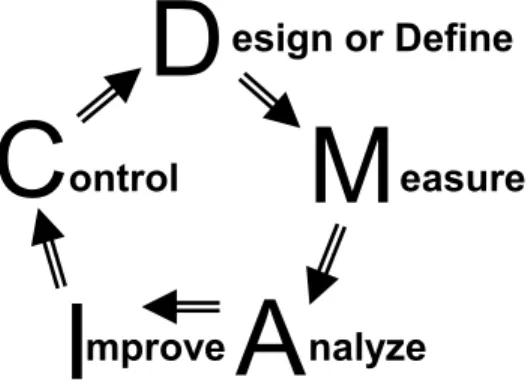
tandardsSix Sigma DMAIC model. Another well-known version of the Deming model is found in Six Sigma Quality Management and is
called DMAIC [9]. As shown in Figure 1-3, the steps or components start at the top with Define, then complete the cycle with Measure, Analyze, Improve, and Control. In this adaptation, the Define step relates to quality-planning and includes definition of quality
objectives and requirements, the Measure step applies to determining
the performance of a procedure, process, or product; the Analyze
step involves evaluation of the observed quality, which naturally
leads to the Improve step of the process; finally, Control here means
maintaining the quality of the improved procedure, process, or product so that it continues to meet the quality objectives and requirements.
Figure 1-3. Six Sigma DMAIC Model for Process Improvement.
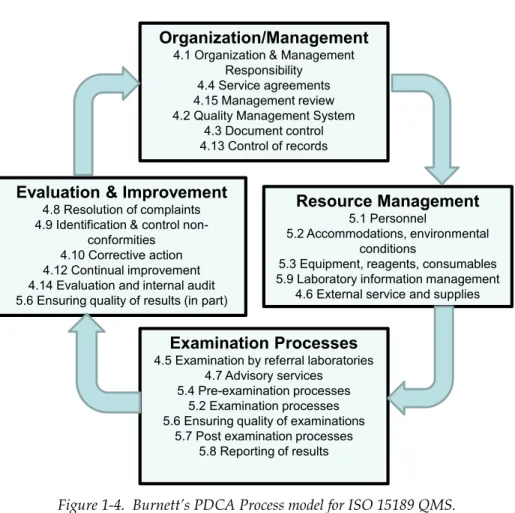
ISO 15189 PDCA model. The Deming cycle can also be applied to
the ISO 15189 management and technical requirements, as described
by Dr. David Burnett, who chaired the committee that developed
the latest 2012 standard. Figure 1-4 represents Burnett’s view of ISO as a process, rather than as a list of activities [Note that in the figure shown here, the PDCA cycle is presented as a clockwise rotation to have the same orientation as the other models.] This
process perspective is not presented in the ISO standard itself, but
Dr. Burnett features it in his public lectures about ISO 15189 and it is also presented in his book on ISO 15189 implementation[10].
D
C
M
I
A
esign or Define
easure
nalyze
mprove
ontrol
Page 8
Figure 1-4. Burnett’s PDCA Process model for ISO 15189 QMS.
ISO Requirements versus QMS
The ISO 15189 management and technical requirements, as well as
the US CLIA regulatory requirements, are often presented as items in checklists in order to facilitate inspection and accreditation. However, for practical applications in the laboratory, those activities must be
organized to support the daily management of testing processes. That organization, along with support for implementation, defines
the Quality Management System.
Organization/Management
4.1 Organization & Management Responsibility
4.4 Service agreements 4.15 Management review 4.2 Quality Management System
4.3 Document control 4.13 Control of records Resource Management 5.1 Personnel 5.2 Accommodations, environmental conditions
5.3 Equipment, reagents, consumables 5.9 Laboratory information management
4.6 External service and supplies
Examination Processes
4.5 Examination by referral laboratories 4.7 Advisory services
5.4 Pre-examination processes 5.2 Examination processes 5.6 Ensuring quality of examinations
5.7 Post examination processes 5.8 Reporting of results
Evaluation & Improvement
4.8 Resolution of complaints 4.9 Identification & control
non-conformities 4.10 Corrective action 4.12 Continual improvement 4.14 Evaluation and internal audit 5.6 Ensuring quality of results (in part)
Given the inherent differences between laboratories based on their resources, skills, and missions, it is expected that Quality Management Systems will vary from one laboratory to another, yet
they should all be designed to guarantee that the laboratory fulfills
its quality objectives and requirements. Certain principles guide the formulation of all Quality Management Systems, certain approaches may prove to be useful in many laboratories (such as Six Sigma), and certain tools are almost universally needed (method validation
protocols, SQC, PT/EQA), yet the organization and deployment in
individual laboratories will depend on the available resources and skills.
What is different about QMS is not the activities or require-ments necessary to guarantee the quality of laboratory tests, but
how to organize and embed those activities to ensure quality in the
daily management and production of laboratory tests. Deming’s PDCA model provides the fundamental guidance for structuring Quality Management Systems, but needs to be adapted, expanded,
and detailed for efficient and effective management of laboratory
testing processes.
What’s the point?
On the road to quality, there is an itinerary for the journey. That itinerary details the important landmarks along the way that contribute to the success of the journey. The implementation of that
journey requires a map to effectively organize the trip and to identify the correct path. Quality management identifies the itinerary of activities; a quality system provides a plan or map for organizing
and implementing those activities. There is a basic structure for maps (North is up, rivers are blue, interstate highways are bold, etc.) and likewise, there is a basic structure for a QMS in the form of Deming’s PDCA model. The maps for individual states and the QMSs from one laboratory to another may differ, but they should maintain a commonality of structure and purpose even though there may be unique paths for each laboratory’s journey.
Page 10
References
1 Nillson Orsini J. The Essential Deming: Leadership Principles
from the Father of Quality W. Edwards Deming. Mc-Graw Hill,
2013.
2 ISO 15189. Medical laboratories – Requirements for quality and competence. ISO, Geneva, 2012.
3 CLSI HS1. A Quality Management System Model for Health Care.
Clinical and Laboratory Standards Institute, Wayne, PA.
4 CLSI GP26. Application of a Quality Management System Model for
Laboratory Services. Clinical and Laboratory Standards Institute, Wayne PA.
5 Juran JM. The Quality Trilogy. Quality Progress. 1986;August:19-24. 6 Deming WE. Out of the Crisis. Cambridge MA:MIT Center for
Advanced Engineering Study, 1986.
7 Crosby PB. Quality is Free. New York:New American Press, 1979. 8 Centers for Disease Control. Proceedings of the 1986 Institute
– Managing the quality of laboratory test results in a changing
health care environment. DuPont Company, 1987.
9 Westgard JO, Burnett RW, Bowers GN. Quality management
science in clinical chemistry: a dynamic framework for continuous
improvement of quality. Clin Chem 1990;36:1712-1716.
10 Burnett D. A Practical Guide to Accreditation, 2nd ed. London:Association of Clinical Biochemists, 2013.
6. Implementing Technical
Requirements
Establishing a QMS begins with the implementation of management requirements as the first phase and the implementation of technical requirements as the second phase. This doesn’t necessarily mean the two phases have to be entirely sequential, only that management requirements must be considered first to ensure top level commitment and leadership and the availability of necessary resources. Top management and/or the Management Planning Team (MPT) could authorize a second Technical Planning Team (TPT) that would work in parallel to implement the technical requirements. That would help minimize the time for implementation, utilizing the scientific expertise of the laboratory analysts and supervisors, and achieving more widespread buy-in throughout the laboratory.
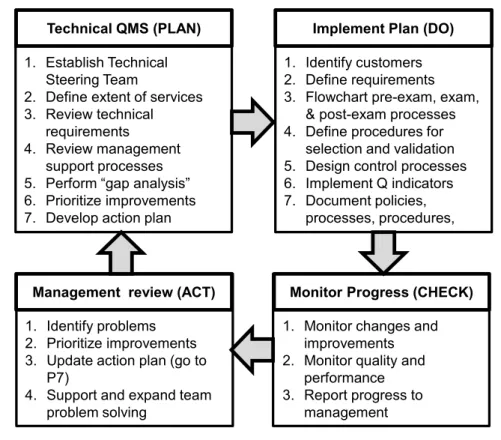
The implementation model recommended here follows Deming’s Plan-Do-Check-Act cycle, is similar to the PDCA cycle for imple-menting management requirements, but focuses on the technical requirements found in section 5 of ISO 15189 [1] and the Process Control essentials in the WHO/CLSI/CDC methodology [2-4]. Figure 6-1 summarizes the implementation process.
PLAN stage of implementation
Top management must consider how and when to begin the implementation of technical requirements. The priorities are first to deal with management requirements for organization of the QMS, designation of a Quality Manager, formation of a Management Planning Team, definition of quality goals and objectives, analysis of gaps in quality practices, development of an action plan, and implementation of a document control system. The MPT should also consider how to share the responsibilities for the technical requirements (5.1) personnel, (5.2) accommodations and environmental conditions, and (5.3) laboratory equipment, reagents, and consumables.
Page 80
Figure 6-1. Plan for implementing QMS technical requirements.
P1. Establish a Technical Planning Team
In a small to moderate size laboratory, the Management Planning Team could also function as the Technical Planning Team. In a large laboratory, separate teams would be better to keep the sizes of the teams small and to provide specific focus for the management and technical planning activities. The Quality Manager must be a part of the TPT in order to coordinate the activities of the two teams. Other members should represent the pre-examination, examination, and post-examination phases of the testing process, along with the various laboratory disciplines, e.g., hematology, clinical chemistry, microbiology, blood bank, molecular diagnostics, etc. In a large laboratory, the TPT will also include Quality Specialists (those with
Technical QMS (PLAN) 1. Establish Technical
Steering Team
2. Define extent of services 3. Review technical
requirements
4. Review management support processes 5. Perform “gap analysis” 6. Prioritize improvements 7. Develop action plan
Implement Plan (DO) 1. Identify customers 2. Define requirements 3. Flowchart pre-exam, exam,
& post-exam processes 4. Define procedures for
selection and validation 5. Design control processes 6. Implement Q indicators 7. Document policies,
processes, procedures,
Monitor Progress (CHECK) 1. Monitor changes and
improvements 2. Monitor quality and
performance 3. Report progress to
management Management review (ACT)
1. Identify problems 2. Prioritize improvements 3. Update action plan (go to
P7)
4. Support and expand team problem solving
7: A Community Hospital Laboratory’s
Journey To CAP-ISO 15189
Accreditation
Leo Serrano, MS, FACHE, Lean/Six Sigma Black Belt, Broward Medical Center Cheryl Wildermuth, MS, MT(ASCP), Quality Manager, Avera McKennan Lab
A brief introduction
During Leo Serrano’s tenure as laboratory director for the Avera McKenna Hospital and University Medical Center in Sioux Falls, South Dakota, the hospital was the first in the nation to achieve ISO 15189 accreditation through CAP. He has valuable insights into the accreditation process through uniquely American eyes.
Some of these observations were reported in the May 2009 issue of CAP Today, in the article by Anne Ford, Making the Leap to ISO 15189 – What Lab Leaders Have Learned.
Leo shared some of his experiences about the impact of achiev-ing ISO 15189 on the hospital and its business:
“‘We’re already seeing the financial benefits pay off....We have a very strong research arm, the Avera Research Institute, and they are using our ISO accreditation to help them garner grants.... We’ve also been able to use it to our advantage as we have discussions with payers. When you can show them that your laboratory is 15189-ac-credited, that definitely gets their attention.’’
“‘And then there are the non-financial rewards,’ Leo continues, ‘It gives us a significantly more powerful platform from which to tout the laboratory and its contributions to patient care and to quality. While we have consistently world-class turnaround times, world class error rates, we still had physicians who emphasized the outliers. This acheivement confirms what we had been telling them.’”
While Leo Serrano has since moved on to another institution, we are fortunate that he has agreed to share with us his past experiences with developing and implementing a Quality Management System.
Page 96
Introduction
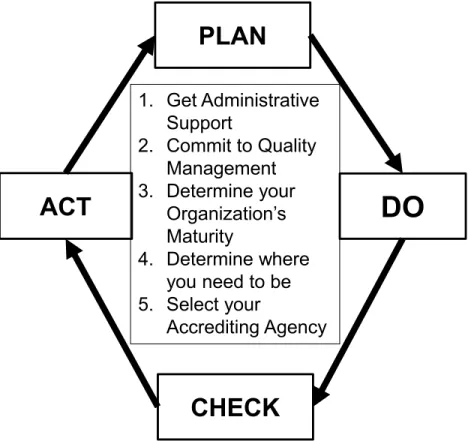
This is the true rendition of the journey to becoming the first hospital laboratory in the US to achieve CAP-ISO15189 accreditation. No names are used but otherwise the details are as they actually occurred. The basic layout of this chapter is following the PDCA format. As you take this journey, PDCA becomes second nature in helping you achieve success in any endeavor you choose to undertake. Our journey began when one of our senior pathologists approached us with the idea of being a “pilot site” for a new ISO based CAP Accreditation. A little investigation into the idea intrigued us and fit in to our organization’s culture of excellence. The rest is history.
PLAN:
As you choose to undertake this journey, and it truly is a never-ending journey, the planning portion is critical to the success and smoothness of the process.
1. Obtaining Administrative Support
The first step of the journey was obtaining support from the hospital administration as well as from the pathologists. In order to obtain their support, it was important to demonstrate the advantages of obtaining a “world-class” internationally recognized accreditation. This required research into the ISO-15189:2007 standards and how they differed from our standard CAP accreditation standards. This was an interesting challenge since the laboratory was already widely recognized as a leading exponent of LEAN (Toyota Production System) and was accredited by the College of American Pathologists, the AABB and FDA (for our full service blood bank) and FACT (for our Stem Cell transplant processing lab). Why do we need another accreditation? What is the advantage? What is the burning platform?
2. Commitment to Quality Management
Because of our robust TPS/LEAN experience, we already had a strong and well-developed commitment to quality. Our MPT had several LEAN certified members. Many of the details that are important in
ISO-15189 were already in place; although in some areas, we had to expand or strengthen our efforts. Through planning and investigation, we were able to determine our strengths and weaknesses and work on those areas in need of shoring up.
Figure 7-1. The CAP-15189 experience at Leo Serrano’s hospital
3. Determining Your Organization’s Maturity
This is the most emotionally demanding portion of the preparation. It is not an easy thing to critique an organization that you and your team have been developing over the years. It requires a willingness to look outside of the bounds and think out of the box. Because the QMS manager had been away from the laboratory for a while, hers were fresh eyes looking at our operation, culture and processes. This became an invaluable tool.
PLAN
DO
CHECK
ACT
1. Get Administrative
Support
2. Commit to Quality
Management
3. Determine your
Organization’s
Maturity
4. Determine where
you need to be
5. Select your
Accrediting Agency
Page 105
Part II. Six Sigma QMSs for Examination
Procedures
The first part of this book presents a broad perspective of management and technical requirements for laboratory accreditation. The second part provides a more detailed example of a QMS that is focused on the technical requirements, particularly the analytical quality of the examination procedure. Six Sigma concepts and metrics are applied to develop an objective, quantitative QMS, which we call a Six Sigma Quality Management System (6sQMS).
Our intention is to describe and develop this 6sQMS as an extension of Deming’s Plan-Do-Check-Act (PDCA) cycle. However, we do not provide a complete set of policies, processes, and procedures (that probably can’t be done for all laboratories and all scenarios), but rather examples for specific technical requirements that require quantitative assessments and implementation guidance.
Chapter 8 – Developing a Scientific Quality System – provides an overview of the recommended Six Sigma Quality Management System, along with some illustrations of the tools and techniques that are applicable at different steps in the 6sQMS.
Chapter 9 – Defining Quality for Intended Use – focuses on the most critical step for making quality measurable. How good does an examination need to be?
Chapter 10 – Selecting an Examination Procedure – emphasizes the need to consider traceability as a critical characteristic in the choice of any examination procedure in order to achieve comparability of results across methods, laboratories, and countries.
Chapter 11 – Validating Performance of an Examination Procedure – describes how to assess quality on the Sigma Scale to provide a standard yardstick for measuring quality and making decisions about the acceptability of performance.
Chapter 12 – Designing SQC Procedures – addresses the critical ISO 15189 requirement that laboratories design QC procedures to verify the attainment of the intended quality of results.
Chapter 13 – Formulating Total Quality Control Plans – considers the broader issue of managing the quality of the Total Examination Process and the development of risk-based QC Plans.
Chapter 14 – Monitoring Nonconformities – recommends the broad application of Sigma metrics for Quality Indicators throughout the Total Examination Process and reviews the traditional “counting methodology” that can be used for pre- and post-examination characteristics.
Chapter 15 – Measuring the Uncertainty of Measurements
– discusses issues related to measurement uncertainty and provides some practical guidance for monitoring the quality of examination processes.
Chapter 16 – Managing Quality in the Real World – summarizes our recommendations and advice and hopefully provides some perspective for how you can approach QMS in the real world.
Chapter 17 – Improving Quality in the Real World – This chapter is contributed by Gabriel Migliarino, PhD, and Evangelina Hernandez, MS, who have guided more than a dozen laboratories through the ISO 15189 accreditation process in Latin and South America. They provide their observations on the challenges that labs face not only from this region, but in any region of the world.
Page 171
12. Designing SQC Procedures
All laboratories perform quality control, but merely analyzing controls does not ensure that the necessary quality is achieved.
The necessary quality must be defined, as discussed in chapter 10.
The performance of the examination procedure must be validated to achieve the quality for intended use, as discussed in chapter
12. In addition, Statistical QC procedures (SQC) must be properly designed and properly implemented to detect medically important errors that occur during routine service operation.
ISO 15189 [1] imposes a demanding requirement in Section 5.6.2.1 with the statement “the laboratory shall design quality con-trol procedures that verify the attainment of the intended quality of results”. It is recommended that quality control materials be ex
-amined at a frequency that reflects the stability of the examination
procedure and the patients’ consequence of harm if erroneous results are produced. The laboratory should apply statistical control rules to make decisions on the acceptability of analytical results and the need to reject runs and repeat patient testing.
6sQMS Policy. The laboratory shall design Statistical Quality Control procedures to ensure the quality of routine testing meets the needs of the intended use of examination procedures.
Guidance on the design of SQC procedures can be found in
ISO 15198 (which should not be confused with 15189). The 15198 document [2] provides guidance to manufacturers on how to design
SQC procedures and validate their performance:
“For existing IVD medical devices, conventional statistical quality control procedures (e.g. as described in CLSI C24) are considered adequate unless evidence from risk-monitoring activities indicates [other] quality control procedures are essential for maintaining risk at an acceptable level. In such cases, the quality control procedures shall be validated …. NOTE: Demonstration that a statistical quality control procedure will detect results that exceed predetermined limits does not require induction of actual failure modes. Validation may be based on statistical evaluation of the simulated effects of imprecision and/or bias on actual performance data obtained in routine operating mode.”
There are two important considerations here: (a) SQC pro -cedures can be readily validated based on existing information on their rejection characteristics, as determined from simulation studies documented in the clinical chemistry literature. (b) Validation of
other non-SQC control procedures will require induction of actual failure modes to determine whether the QC procedures can detect medically important errors. Manufacturers can do this when they are validating new systems, but laboratories will find it very dif
-ficult to induce specific failures to validate detection of individual
controls. SQC is important in the laboratory because it is an inde-pendent control mechanism that can be designed to detect medically important errors.
Quality-Planning Tools make it practical for laboratories to se-lect the right SQC procedures. Power curves [3, 4] and critical-error
graphs [5] have been used for planning SQC procedures for many decades. Today’s version of the critical-error graph is known as the
Sigma-metrics SQC Selection Tool and its application is illustrated in the CLSI C24A3 guidance for Statistical QC procedures [6]. Charts
of Operating Specifications [7, 8] are a related tool and there are “normalized” charts that are available for manual applications [9].
There also are computer programs available, both an standalone
automatic QC design program [10] and an online production tool.
6sQMSProcess. The laboratory shall select SQC procedures on the basis of the quality required for intended use, the imprecision and bias observed for the examination procedure, and the known rejection characteristics of different control rules and different numbers of control measurements.
ISO 15198 makes reference to CLSI C24 [6], which discusses
the principles of SQC and describes a process for selecting appropri-ate control rules and the number of control measurements to detect
medically important errors. While C24A3 provides a Sigma SQC Selection Tool, it is also possible to employ Charts of Operating Specifications, thus there are two planning tools that are practical
Page 245
17. Improving Quality in the Real World
Editor’s note: about Gabriel Migiliarino
In the last 6 years, Gabriel Migliarino and his consulting service have taken more than a dozen laboratories through the ISO 15189 accreditation process, in Argentina, Chile, the Dominican Republic, Mexico, Panama and Uruguay.
As a Quality Management System consultant, Dr. Migliarino has useful insights to share with us. Even though the resource and logistical environment of US hospitals are often far better than those of labs in Latin and South America, there are many common challenges and deficits that face labs all over the world.
We know Dr. Migliarino best from his collaboration with us in the translation projects sponsored by the Wallace Coulter Founda-tion. Dr. Migliarino delivers training in Latin and South America about verification of measurement procedures and internal statistical quality control. This workshop is delivered in 5 different countries in the area per year and has an estimated total duration of five years.
Experiences from the field
Gabriel Migliarino, PhDEvangelina Hernandez, MS
Introduction
Each laboratory takes its own individual path towards Quality Management Systems accreditation but many share the same weaknesses and concerns during the journey.
In Latin and South America, scientists have not received a lot of education on “management.” When laboratories seek accreditation, this is a new concept – to “manage quality” – for the laboratory. As mentioned on Chapter 5, the accreditation project comprises three stages: management requirements, technical requirements and accreditation.
What happens generally with the accreditation process in the Latin and South American region? The second stage, particularly the application of technical requirements (5.5 Analytical Procedures, 5.6 Quality Assurance of Analytical Results), often moves forward before the first stage (management requirements). Why? Applying technical requirements involves the area of operations where most laboratory scientists are more comfortable and more interested in making improvements. Most scientists are already working on the technical parts of measuring, monitoring, and improving quality. But “managing quality” is something new to them.
The Starting Point : Management Requirements
For most laboratories, starting the process of accreditation for Quality Management Systems, applying the management requirements of ISO 15189:2012 [1] standard moves forward slowly and with great difficulty.
Below we list the management requirements that generally present the most difficulty to our clients:
1. Documents
2. Quality Policy and Objectives
3. Nonconformities and corrective actions 4. Indicators
1. Documents. How to organize them.
Generally, the documents system has a basic common structure as shown on Figure 1.
Figure 17-1 Document Pyramid
QC Procedures Operation Instructions
Page 247
Quality Manual
The Quality Manual is the “Big Daddy” of all the documents in the Quality Management System and is therefore of crucial importance. Its function is to express the policies (intentions) of the company to comply with the regulatory requirements and criteria of the accreditation entity.
What we observe
Many times, the Quality Manual is a complex document, difficult to read and understand. Other times it is an almost exact copy of the ISO 15189:2012 standard, so generic and repetitive of the official requirements, it loses all usefulness for the laboratory.
What we recommend
Labs should focus on the idea that the Quality Manual is the foundation for the entire Quality Management System. If this is true, the Quality Manual must be as clear as possible. It has to concisely express the will of the laboratory to comply with the regulatory requirements, provide a guide to the documented procedures, and explain the activities to implement.
Other documents
The documents of the Quality Management System must show traceability, in the sense indicated by Figure 1. Namely, each document must have its “father/reference document” which enables tracing every procedure back to its foundation in the Quality Manual.
What we observe
We find many “orphan” documents, fatherless, and, consequently, not traceable to any part of the Quality Manual. It is most common to find forms and records that are controlled but without documentary traceability.
What we recommend
The first step is to identify all the procedures in the Quality Manual. Then, for instructions and forms, we suggest generating a coding
system that indicates the origin of each document. The codes enable the “traceability” of the procedures back to the references in the Quality Manual.
2. Quality Policy and Objectives. How to present them.
The Quality Policy reflects the laboratory’s intentions concerning quality and is the reference framework to establish the Quality Objectives.What we observe
Generally, we find Quality Policies are too complex and difficult to understand. Concerning Quality Objectives, they show several weaknesses, among them:
a. They are not coherent with the Quality Policy. b. They are not concrete or measurable.
c. Sometimes they are not realistic or achievable, sometimes they are too easy (not ambitious).
d. They are not planned and lack follow-up. e. They are not communicated to staff.
What we recommend
To establish a Quality Policy appropriate to the organization, it should be short and clear. It should be kept in mind that it must be communicated and understood within the organization; any member of the organization should be able to explain it.
To define coherent quality objectives, they should be SMART: Specific, Measurable, Achievable, Realistic and on Time.
Objectives must align with procedures, not only the operative procedures (pre-analytical, analytical and post-analytical) but also supportive (staff management, services and supplies management, among others). Remember that managing a system, and consequently its procedures, implies that you have established Quality Objectives.
Page 249 Manage objectives according to the following stages:
1. Establish objectives.
2. Develop the general plan: scope, time frame, costs, specifications, risks.
3. Develop the resources plan: staff, materials, equipment, funding. 4. Implement: organization, communication, leadership, decision-making, problem-solving, monitoring, corrective actions.
5. Review: final evaluation, lessons learnt.
3. Nonconformities. Corrective Actions. How to identify
and manage them.
The laboratory must have a procedure to identify and manage non-conformities on any aspect of the Quality Management System. The most common sequence, though not the only one, to treat non-conformities is as follows:
Stage 1. Identification of the nonconformity. Stage 2. Immediate action.
Stage 3. Analysis of the root cause. Stage 4. Corrective action.
Stage 5. Verification of the corrective action efficacy.
What we observe
There are several weaknesses that often occur.
1. Some nonconformities are not recorded in the system. According to our experience, we see see mainly four causes.
a. Implementation of models centered on finding a culprit, not a root cause.
b. Failure to identify nonconformities. In the absence of data, the staff doesn’t even know a nonconformity has occurred. c. Notification and recording systems so complex and unwieldy that they are not used by the staff, so nonconformities are not recorded.
d. Lack of confidence in the usefulness of the nonconformities management system (a consequence of causes 2 and 3 below).
Index
ISO 15189 sections4.1 Organization and management responsibil-ity 27
4.2 Quality management system 27 4.3 Document control 28 4.4 Service agreements 28
4.5 Examination by referral laboratories 28 4.6 External services and supplies 29 4.7 Advisory services 29
4.8 Resolution of complaints 29
4.9 Identification and control of nonconformi-ties 29, 207
4.10 Corrective actions 29, 207 4.11 Preventive actions 30, 207 4.12 Continual improvement 30, 208 4.13 Control of records. 30 4.14 Evaluation and audits 30 4.15 Management review 31 5.1 Personnel 31
5.2 Accommodation and environmental condi-tions 31
5.3.1.4 Equipment calibration and metrological traceability 82
5.3.2.3 Reagents and consumables – Acceptance testing 82
5.3 Laboratory equipment, reagents, and consum-ables 31
5.4 Pre-examination processes 32
5.5.1.4 Measurement uncertainty of measured quantity values 83
5.5.1 Selection, verification and validation of examination procedures 83 5.5 Examination processes 32 5.6.2.3 Quality control data 84 5.6.2 Quality control 84
5.6.4 Comparability of examination results 85 5.6 Ensuring the quality of examination results 33 5.7 Post-examination processes 34
5.8 Reporting of results 34
5.9.2 Automated selection and reporting of re-sults 85
5.9 Release of results 34
5.10 Laboratory information system 35
A A2LA 11, 238 AABB 96 acceptance testing 31, 83 accreditor 75 ACT 6 action plan 87 allowable bias 88 allowable imprecision 88 allowable total error 88
Allowable Total Eror 138, 152, 156, 163, 177, 182, 184, 231
Allowable Total Error (TEa) 173
American Association for Laboratory Accreditation (A2LA) 52
American Diabetes Association (ADA) 133 analytical run 202 ANOVA 226, 234 Armbruster 156 Assessments (QSE) 18 audits 74 audit training 101 autoverification 86 B biological variation 132 biologic variability 200 biologic variation 134, 141 blood bank 80
Bruns and Boyd 223 Burnett 7 C calcium 149 calibrator materials 148 CAP 151, 232, 238 CAP-ISO 15189 Accreditation 11, 95–106 CDC 4, 11, 14 CEN 14316 150 CLIA 6, 11, 13, 145, 193, 199, 203, 230, 238 CLIA Quality Systems for the Total Testing
Pro-cess 13 clinical chemistry 80 CLSI 1, 2, 11, 14, 50–58, 239 CLSI C24A3 171, 172, 173, 201, 222, 230 CLSI C51A 221, 222, 226, 234 CLSI EP5 153, 162
Page 286 CLSI EP6 162 CLSI EP7 162 CLSI EP9 153, 162 CLSI EP15 226 CLSI EP17 162 CLSI EP18 208 CLSI EP22P 239 CLSI EP23A 189, 190, 209 CLSI EP27 138 CLSI EP28 162 CLSI GP26 15, 66 CLSI GP35A 211 CLSI guidelines 1 CLSI Quality Essentials 46 Collection procedures 88
College of American Pathologists (CAP) 11, 52, 96
Commitment to quality 96
Commitment to Quality Management 99 Commutability 146
Comparability 85, 145, 148 Comparison of methods 161 Continual improvement 62 Continual improvement (QSE) 18 Control mechanisms 196 Corrective actions 18, 29, 69, 85 Corrective Actions and Preventive Actions
(CAPA) 209
Cost-Effective Quality Control 37 Critical decision concentration (Xc) 177 Critical difference. See also Reference Change
Value (RCV) Critical-error graphs 172 Critical medical decision level 152
see also Critical decision concentration Critical to Quality, CTQ 45
Crosby 4
Customer focus 16, 61 D
Decoding ISO 15189 (IQMH) 51 Defects Per Million (DPM) 213
Defining Quality for Intended Use 131–144 Delta checks 196, 198
Deming 1, 4, 38, 62, 237, 239 Deming 14 points 39, 241 Design control procedures 89 Designing SQC Procedures 171–188
Detection 192 Detection limit 161
Determining Your Organization’s Maturi-ty 97, 100
Developing a Scientific Quality System 107–130 Directions for calculation of DPM and conversion
to a Sigma metric 214
Directions for Using a Sigma SQC Selection Tool 176
Directions for Using Normalized OPSpecs Charts 184
Disclosure of residual risk 196, 200 Distribution procedures 88
DMADV, Define-Measure-Analyze-Design-Verify 45
DMAIC 7, 44, 45
Document control system 55, 59, 66, 79 Documents and records (QSE) 17 DPMO 73, 89
E
Education, training, and guidance 48 EP23A 193
see also CLSI EP23A EQA 132, 150, 198, 210, 231 EQA/PT 81, 91
Equipment (QSE) 17
Equivalent Quality Control (EQC) proce-dures 230, 238
Error grid 137
Establish a Management Planning Team (MPT) 63
Evolution of laboratory quality practices 42 Expanded measurement uncertainty 228 External Quality Assessment 196 F
Facilities and safety 16 FACT 96
Factual approach to decision making 62 Failure Mode and Effects Analysis (FMEA) 45,
192, 208
Failure modes 171, 189, 192, 198
Failure Reporting and Corrective Action System (FRACAS) 208-209
FDA 96, 137, 138, 145 Final validation experiments 161
Forms and records 72 Formulate a Quality Policy 63
Formulating a Total Quality Control Plan 189– 206
Fraser 201
Frequency of controls 198 G
Gap analysis 45, 49, 55, 68, 82, 98 General Checklist for ISO 15189 (A2LA) 76 General Laboratory System 13
Glucose 149 GP26 72
see also CLSI GP26
Guide to the expression of uncertainty in measure-ment (GUM) 33, 84, 221 H Harmonization 146 HbA1c 107, 133, 134, 146, 150, 151, 164, 166, 178, 182, 223, 232 CAP PT criteria 136 NGSP certification requirement 139 Hematology 80, 175
Hierarchy of quality specifications 131 I
Identify customers 88
ILAC (International Laboratory Accreditation Cooperation) 52, 75, 238
Immunoassays 175
Implementing Management Requirements 59–78 Implementing Technical Requirements 79–94 Improving the safety of patients in England 41 Individualized Quality Control Plans
(IQCP) 191, 238 Information for safety 194 Information management (QSE) 17
Institute for Quality Management in Healthcare (IQMH) 23, 51
Intended quality 84, 171 Intended use 83, 159, 163 Interferences 85, 161, 200
Intermediate precision conditions 33, 84, 228 Internal audit 74
International Bureau of Weights and Measures (BIPM) 147
International Committee of Weights and Measures (CIPM) 147
International Federation of Clinical Chemistry (IFCC) 133
Involvement of people 61 ISO 2
ISO 212 Technical Committee 50 ISO 9001 61
ISO 14971 189
ISO 15189 1, 7, 11, 39, 95–
106, 145, 159, 171, 207, 221, 237 ISO 15189 Requirements for Quality and
Compe-tence 18–22 ISO 15198 171, 172 ISO 17025 52, 147 ISO 17511 147 ISO 18153 147 ISO 22367 209 ISO Requirements 8 ISO standards 1 J Jassam et al 107
Joint Committee for Traceability in Laboratory Medicine (JCTLM) 147
Journey To CAP-ISO 15189 Accreditation 95–106 Juran 4
K
Krouwer 193, 199 L
Laboratory Developed Tests (LDTs) 159 Laboratory Quality Management: A Roadmap 15 Laboratory Quality Management System
Hand-book (WHO) 49
Laboratory Quality Management Systems (LQMS from CLSI) 50
Leadership 61 LEAN 1, 96, 99
Lenters and Slingerland 154, 157 Levett and Burney 61
Long-term replication 161 M
Magnusson and Ellison 225
Page 288
Have Learned 95
Management commitment and leadership 39–58 Management Planning Team (MPT) 63, 77,
79, 86, 100, 237
Management requirements 18, 27, 59– 78, 65, 79, 237
Management responsibility (IQMH) 23-24 Management review 69
Management Steering Team 77
Managing Quality in the Real World 237–242 Manufacturer’s claims 145, 159
Measurement, analysis, and improvement (IQMH) 23, 26
Measurement Uncertainty (MU) 32, 83, 84, 86, 221-236, 241 “bottom up” methodology 221 Correcting for bias 223
Correcting for uncorrected bias. 225 intermediate precision conditions 228 “top down” methodology 221 Measuring the Uncertainty of
Measure-ments 221–236
Medical Testing Scope Selection List (A2LA) 54, 76
Medical traceability 150
Method Decision Chart 163, 164, 240 Method Validation 32, 81
Method Verification 32
Metrological traceability 32, 82, 148 Metrology 157
Microbiology 80
Minimum Analytical Performance Specifications (MAPS) 107
Mitigation 193
Models for establishing traceability and compara-bility 149
Molecular diagnostics 80
Monitoring Non-conformities 207–222 Monitor SQC design 199
MPT 74, 81, 90, 92, 96, 100
see also Management Planning Team Mutually beneficial supplier relationships 62 N
National Glycohemoglobin Standardization Pro-gram (NGSP) 133
National Institute for Clinical Excellence (NICE, in UK) 134
NGSP certification criteria 136
Nonconforming event management (QSE) 18 Non-conformities 29, 42, 69, 74 , 207, 241 Normalized Method Decision
Chart 157, 165, 167, 168 O
Obtaining Administrative Support 96 Occurrence 192 Occurrence management 54, 74 Operating specifications 141 Operator competency 210 OPSpecs charts 165, 172-173, 181 Organization (QSE) 16
Outline of the contents of a Quality Manual 67 P
Part II. Six Sigma QMSs for Examination Proce-dures 105
Parvin 199, 202 Patient data controls 196 Patient data QC 198
Patient preparation directions 88 Patient safety goals 211 PDCA PDCA cycle 6 Peer comparison programs 210 Personnel (QSE) 16
Physician Office Laboratories 14 Physio-chemical complexity 149, 151, 224 Plan-Do-Check-Act cycle (PDCA) 5, 6,
7, 20, 23, 26, 59, 75-76, 79, 93, 96, 105-106, 237, 239
Plan for implementing a Quality Management System 60
Plebani 107
Policies, processes, procedures, and forms for records 59, 66, 91 Policy official definition 72 Post-examination processes 88, 189 Potassium 149 Power curves 172 Pre-assessment for QMS 76 Pre-diabetes 133 Pre-examination 189
Preliminary validation experiments 161 Preparing for QMS Implementation 37–58
Preventive actions 30
Principles of Quality Management 37 Probability of error detection (Ped) 173, 175 Probability of false rejection (Pfr) 173, 175 Procedure officiel definition 72 Process official definition 72 Process approach 61 Process capability 156 Process control 54 Process flowchart 88 Process management (QSE) 17 Process Model for ISO 15189 23–36 Proficiency Testing 14, 96, 198, 210, 231 Project team 71
Purchasing and inventory (QSE) 16 Q
QC clearance 238 QC Toolbox 189, 193
QMS implementation steering committee 55 QMS manager 97
QMS Manager 99
Q-Probes and Q-Trends 211 Quality Assessment 1, 6 Quality assurance 1, 3, 6 Quality compliance 238
Quality control (QC) 1, 3, 6, 171–188 Quality control materials 83
Quality Control Plan (QCP) 189, 190, 209 Quality control strategy 201
Quality Goal 64
Quality Improvement 1, 3, 6 Quality Indicators 1, 31,
73, 81, 89, 207, 211, 241 definition 89
Quality Laboratory Practices (QLPs) 44 Quality Laboratory Processes 6 Quality Management 1, 2, 4
Quality Management Essentials (QME) 239 Quality Management System 1, 3, 4, 9, 37 Quality Management Systems 237, 240 Quality Management Systems for Nonwaived
Test-ing 14 Quality Manager 55, 62, 74, 79, 80, 92, 99 Quality Manual 28, 59, 66, 75, 91 Quality Objectives 2, 65 Quality Planning 1, 3, 6 Quality Policy 2, 55, 63, 64 Quality requirements 86, 131 Quality Specialists 80 Quality specifications 131 Quality Standards 6 Quality System 4
Quality System Essentials 1, 4, 11, 50, 64 R
Reagents 82
Record the metrological traceability of the calibra-tion standard 147
Recovery 161
Recovery (Risk Management) 199 Reference change value (RCV) 135 Reference intervals 33
Residual risks 195
Resource management (IQMH) 23, 25 Reviewing QMS Essentials 11 Risk 201
Risk Analysis 1 Risk assessment 208
Risk-Based QC Plans 142, 209, 230, 239 Risk-based quality control 203
Risk management 69, 189-190, 192, 194, 202, 204, 238
Risk Mitigation Information 239 Risk Priority Number (RPN) 192 Root cause 69
Root Cause Analysis (RCA) 44-45, 69 Run length 201
S
Scope of testing 81
Selecting an Examination Procedure 145–158 Service realization (IQMH) 23, 26
Severity 192 Shewhart 38
Sigma Assessment from Proficiency Testing Data 233
Sigma-metric 141, 152, 177, 213, 231 Sigma Proficiency Assessment Chart 232, 241 Sigma Scale 241
Sigma SQC Selection Tool 172, 174, 176, 241 Sigma strategy for a Total Quality Control
Page 290
Six Sigma 1, 7, 9, 90, 141, 142, 237 counting methodology 219 variation methodology 219
Six Sigma Defects-Per-Million Table 216–217 Six Sigma Quality Management System 210, 231,
240
Six Sigma Risk Analysis 203 Sodium 149
Specimen requirements 88 SQC selection process 173 Stability 201
Standard measurement uncertainty 228 Standard operating procedures (SOPs) 44, 91, 196 Standard Uncertainty 234
Startup SQC design 199
State Operations Manual (SOM) 13
Statistical QC procedures (SQC) 171, 201, 210 Status of hemoglobin A1c measurement and goals
for improvement 133 Strategic planning 47
Strategies to Set Global Analytical Quality Specifi-cations in Laboratory Medicine 131 Strengths, weaknesses, opportunities, and risks
(SWOT analysis) 68 Susceptibility 201
Systems approach to management 61 T
Technical Planning Team (TPT) 75, 77, 79-81, 86, 90, 237
Technical requirements 18, 31-36, 79–94, 237 The Key to Quality (CLSI) 50
Thienpont et al 148 Total Error 137, 162-163 Total Quality Control strategy 241 Total Quality Management 1, 43
Total Quality Management Model for a Medical Laboratory 12
Total Testing Process 13, 71 Toyota Production System 96 TQC Plan 194
TQM 6
TQM Process Model 43
Traceability 81, 82, 133, 146-147, 156 Traceability chain 148, 149, 151 Training Toolkit (WHO) 50 Transport 88
Trueness 146
Trueness controls 198, 210 U
Uncertainty 81, 134, 149, 221–236 Understanding Quality Management
Sys-tems 1–10
Using ISO 9001 in Healthcare 61 V
Validating Performance of an Examination Proce-dure 159–170
Validation 89, 159 Verification 89, 159
Verify the attainment of the intended quality of test results 33, 89
W
Waived medical devices, Waived methods 14, 137 Westgard Sigma Rules 185–188
Westgard Sigma Rules for 2 levels of control 186 Westgard Sigma Rules for 3 levels of control 186 White 222
WHO 14
WHO/CLSI/CDC methodology 79
WHO/CLSI/CDC Quality System Essentials 14 Within-run replication 161
Within-subject biological variation 201 World Health Organization (WHO) 11, 49 Y
YOU 239, 242 Young 200
CALL 1-608-833-4718 if you wish to pay by purchase order or other means. Fax: 608-833-0640 or 203-389-6753
Item Price (US$) Quantity Subtotal
Westgard reference manuals
NEW! Basic Quality Management Systems $80.00
The Poor Lab’s Guide to the Regulations $80.00 Six Sigma Risk Analysis $90.00
Most Popular! Basic QC Practices manual, 3rd Edition $80.00
Six Sigma Quality Design & Control, 2nd Edition $90.00 Assuring the Right Quality Right (Advanced Quality Management) $90.00 Basic Method Validation, 3rd Edition $80.00
Westgard Online Courses
Risk Analysis Guidelines (4 credits) $155.00
Introduction to Risk Analysis for the Laboratory (4 credits) $155.00 Quality Management and Design of Analytical Systems (5 credits) $75.00 "Westgard Rules" and Levey-Jennings Charts minicourse (3 credits) $75.00 Basic QC Practices – complete online course (14 credits) $135.00 Basic Method Validation – complete online course (15 credits) $175.00
Grand Subtotal Shipping & Handling: Within US = $9 Canada & Mexico = Add 10%; Europe, Asia, & all other countries = Add 20% Sales Tax (Add 5.5% in WI, 6.0% in CT)
GRAND TOTAL
Your Name Institution Department Street Address
City State Zip Code
Country
Business Phone/Business Fax E-mail Address
Credit Card Type (circle one) VISA Mastercard American Express
Credit Card Number Exp. Date