of Firewall Policy Faults
FEI CHEN and ALEX X. LIU
Dept. of Computer Science and Engineering Michigan State University
East Lansing, MI 48824-1266, U.S.A. {feichen, alexliu}@cse.msu.edu and
JEEHYUN HWANG and TAO XIE Dept. of Computer Science North Carolina State University Raleigh, NC 27695, U.S.A.
[email protected], [email protected]
Firewalls are critical components of network security and have been widely deployed for protecting private networks. A firewall determines whether to accept or discard a packet that passes through it based on its policy. However, most real-life firewalls have been plagued with policy faults, which either allow malicious traffic or block legitimate traffic. Due to the complexity of firewall policies, manually locating the faults of a firewall policy and further correcting them are difficult. Automatically correcting the faults of a firewall policy is an important and challenging problem. In this paper, we first propose a fault model for firewall policies including five types of faults. For each type of fault, we present an automatic correction technique. Second, we propose the first systematic approach that employs these five techniques to automatically correct all or part of the misclassified packets of a faulty firewall policy. Third, we conducted extensive experiments to evaluate the effectiveness of our approach. Experimental results show that our approach is effective to correct a faulty firewall policy with three of these types of faults.
Categories and Subject Descriptors: D.4.6 [Operating Systems]: Security and Protection—
Access controls
General Terms: Algorithm, Performance, Security
Additional Key Words and Phrases: Automatic Fault Fixing, Firewall Faults, Firewall Policy
The preliminary version of this paper titled “First Step Towards Automatic Correction of Firewall Policy Faults” was published in USENIX LISA 2010 [Chen et al. 2010]. This work is supported in part by NSF grant CNS-0716579, NSF grant CNS-0716407, an MSU IRGP Grant, and an NIST grant. Alex X. Liu is the corresponding author. Tel: 517-353-5152.
Permission to make digital/hard copy of all or part of this material without fee for personal or classroom use provided that the copies are not made or distributed for profit or commercial advantage, the ACM copyright/server notice, the title of the publication, and its date appear, and notice is given that copying is by permission of the ACM, Inc. To copy otherwise, to republish, to post on servers, or to redistribute to lists requires prior specific permission and/or a fee.
c
1. INTRODUCTION 1.1 Motivation
Firewalls serve as critical components for securing the private networks of business, institutions, and home networks. A firewall is often placed at the entrance between a private network and the outside Internet so that it can check all incoming and outgoing packets and decide whether to accept or discard a packet based on its policy. A firewall policy is usually specified as a sequence of rules that follow the first-match semantics where the decision for a packet is the decision of the first rule that the packet matches. However, most real-life firewall policies are poorly config-ured and contain faults (i.e., misconfigurations) [Wool 2004]. A policy fault either creates security holes that allow malicious traffic to sneak into a private network or blocks legitimate traffic and disrupts normal business processes. In other words, a faulty firewall policy evaluates some packets to unexpected decisions. We call such packetsmisclassified packetsof a faulty firewall policy. Therefore, it is important to develop an approach that can assist firewall administrators to automatically correct firewall faults. Besides, the automatic fault fixing techniques are under-investigated in many areas of computer and networking, and these techniques are very important for building self-organizing systems and autonomic computing systems. Because in reality, we cannot avoid errors or faults in any computer or networking systems. Without automatic fault fixing techniques, one fault may cause a system to fail. Thus, we hope to attract attention from the research community on this important, yet challenging, problem.
1.2 Technical Challenges
There are three key challenges for automatic correction of firewall policy faults. First, it is difficult to determine the number of policy faults and the type of each fault in a faulty firewall. The reason is that a set of misclassified packets can be caused by different types of faults and different number of faults. Second, it is difficult to correct a firewall fault. A firewall policy may consist of a large number of rules (e.g., thousands of rules) and each rule has a predicate over multi-dimensional fields. Locating a fault in a large number of rules and further correcting it by checking the field of each dimension are two difficult tasks. Third, it is difficult to correct a fault without introducing other faults Due to the first-match semantics of firewall policies, correcting a fault in a firewall rule affects the functionality of all the subsequent rules, and hence may introduce other faults into the firewall policy. 1.3 Our Approach
To correct a faulty firewall policy, essentially we need to correct all misclassified packets of the policy such that all these packets will be evaluated to expected decisions. However, it is not practical to manually find every misclassified packet and then correct it due to the large number of misclassified packets of the faulty policy.
The idea of our approach is that we first find some samples of all the misclassified packets and then use these samples to correct all or part of the misclassified packets of the faulty policy. We propose the first comprehensive fault model for firewall policies. The proposed fault model includes five types of faults,wrong order,missing rules, wrong decisions, wrong predicates, andwrong extra rules. For each type of ACM Journal Name, Vol. V, No. N, Month 20YY.
fault, we propose a correction technique based on the passed and failed tests of a firewall policy. Passed tests are packets that are evaluated to expected decisions. Failed tests are packets that are evaluated to unexpected decisions. Note that the failed tests are samples of all misclassified packets.
To generate passed and failed tests, we first employ automated packet genera-tion techniques [Hwang et al. 2008] to generate test packets for a faulty firewall policy. The generated packets can achieve high structural coverage,i.e., covering all or most rules [Hwang et al. 2008]. Second, administrators classify these pack-ets into passed and failed tests by checking whether their evaluated decisions are correct. Identifying passed/failed tests can be automated in some situations,e.g., when policy properties are written, or multiple implementations of the policy are available. Even if this operation cannot be done automatically, manual inspec-tion of passed/failed tests is also common practice for ensuring network security in industry. For example, applying some existing vulnerability testing tools, such as Nessus [Nessus 2004] and Satan [Satan 1995], does need manual inspection. In this paper, our goal is to automatically correct policies after we have passed/failed packets. Identifying passed/failed tests is out of scope of this paper.
Given passed and failed tests, correcting a faulty firewall policy is still difficult because it is hard to identify the number of faults and the type and the location of each fault in the firewall policy. To address this problem, we propose a greedy algorithm. In each step of the greedy algorithm, we try every correction technique and choose one technique that can maximize the number of passed tests. We then repeat this step until there are no failed tests.
Our proposed approach is not guaranteed to correct all faults in a firewall policy because it is practically impossible unless the formal representation of the policy is available. However, in practice, most administrators do not have such formal representations of their firewall policies. To correct a faulty firewall policy without its formal representation, administrators need to examine the decisions of all 2104 packets1and manually correct each of misclassified packets; doing so is practically impossible. This paper represents the first step towards automatic correction of fire-wall policy faults. We hope to attract more attention from the research community on this important and challenging problem.
1.4 Key Contributions
Our major contributions can be summarized as below:
(1) We propose the first systematic approach that can automatically correct all or part of the misclassified packets of a faulty firewall policy.
(2) We conduct extensive experiments on real-life firewall policies to evaluate the effectiveness of our approach.
1.5 Summary of Experimental Results
We generated a large number of faulty firewall policies from 40 real-life firewalls, and then applied our approach over each faulty policy and produced the fixed policy. 1A packet typically includes five fields, source IP (32 bits), destination IP (32 bits), source port (16 bits), destination port (16 bits), and protocol type (8 bits). Thus, the number of possible packets is 232+32+16+16+8= 2104.
Faulty policies with kfaults (1≤k≤5) were tested. These faults in a faulty policy were of the same type. The experimental results show that for three types of faults, wrong order, wrong decisions, and wrong extra rules, our approach can effectively correct misclassified packets. Whenk≤4, our approach can correct all misclassified packets for over 53.2% faulty policies. This result is certainly encouraging and we hope that this paper will attract more attention from the research community to this important problem. For two other types of faults, missing rules and wrong predicates, our approach does not achieve satisfactory results, deserving further study.
2. RELATED WORK
2.1 Firewall Policy Fault Localization
Fault localization for firewall policies has drawn attention recently [Hwang et al. 2009; Marmorstein and Kearns 2007]. Marmorstein et al. proposed a technique to find failed tests that violate the security requirement of a firewall policy and further use the failed tests to locate two or three faulty rules in a firewall pol-icy [Marmorstein and Kearns 2007]. However, they did not provide a systematic methodology to identify faulty rules according to different types of firewall faults, e.g., wrong order of firewall rules. Furthermore, they applied their approach only to a simple firewall policy (with 5 rules), which cannot strongly demonstrate the effectiveness of their approach.
Our previous work proposed a technique to locate a fault in a firewall policy [Hwang et al. 2009]. The approach first analyzes a faulty firewall policy and its failed tests and then finds the potential faulty rules based on structural coverage metrics2. However, this work has three limitations: (1) it considers only two types of faults, which are wrong decisions and wrong predicates, while a firewall policy may contain other types of faults; (2) it considers only a firewall policy with a single fault, while a firewall policy may contain multiple faults; (3) it does not propose a technique to correct the faults in a firewall policy.
2.2 Firewall Policy Analysis and Testing
Firewall policy analysis tools,i.e., conflict detection, anomaly detection, and change impact analysis, have been proposed in prior work (e.g., [Al-Shaer and Hamed 2004; Baboescu and Varghese 2002; Hari et al. 2000; Tang et al. 2008; Liu 2007; Yuan et al. 2006]). Tools for detecting potential firewall policy faults by conflict detection were proposed in [Baboescu and Varghese 2002; Hari et al. 2000; Tang et al. 2008]. Similar to conflict detection, some other tools were proposed for detecting anomalies in a firewall policy [Al-Shaer and Hamed 2004; Yuan et al. 2006]. Detecting conflicts or anomalies is helpful for finding faults in a firewall policy. However, the number of conflicts or anomalies could be too large to be manually inspected. Therefore, correcting a faulty policy is difficult by using these firewall policy analysis tools. Change impact analysis of firewall policies has also been studied [Liu 2007]. Such tools are helpful to analyze the impact after changing a firewall policy, but no algorithm has been presented for correcting a faulty firewall policy.
2Firewall policy coverage is measured based on which entities (e.g., rules or fields) are involved (called “covered”) during packet evaluation.
Firewall policy testing tools have also been explored in prior work (e.g., [CERT 2001; J¨urjens and Wimmel 2001; Lyu and Lau 2000; Hoffman and Yoo 2005; Al-Shaer et al. 2009]). Such tools focus on injecting packets as tests into a firewall to detect faults in the firewall policy. If the evaluated decision of a packet is not as expected, faults in the firewall policy are exposed. However, because a firewall policy may have a large number of rules and the rules often conflict, it is difficult to manually locate faults and correct them based on the passed and failed tests. 2.3 Software Fault Localization and Fixing
Fault localization and fixing have been studied for years in the software engineering and programming language communities. Such research focuses on locating and fixing a fault in a software program. For example, Zeller et al. proposed a technique based on delta debugging, which isolates causes based on difference of program runs [Zeller 2002]. While their approach finds likely fault locations (e.g., fault-inducing variables among set of variables) based on difference of program runs, our approach finds and fixes likely fault locations based on an increase in the number of passed tests. Furthermore, using delta debugging in the context of firewall policies is not effective. Delta debugging relies on dependency information (cause-effect chain) of variables. However, in our context, values assigned for fields do not change over evaluation and there is no dependency (i.e., data dependency) among the fields of the firewall policy.
3. BACKGROUND
3.1 Firewall Policies
A firewall policy is a sequence of rules hr1,· · ·, rniand each rule is composed of
a predicate over d f ields, F1,· · ·, Fd and a decision for the packets that match
the predicate. Figure 1 shows a firewall policy, whose format follows Cisco Access Control Lists [Cisco Reflexive ACLs ].
AfieldFiis a variable of finite length (i.e., of a finite number of bits). The domain
of field Fi of w bits, denoted as D(Fi), is [0,2w−1]. Firewalls usually check five
fields, source IP (32 bits), destination IP (32 bits), source port (16 bits), destination port (16 bits), and protocol type (8 bits). For example, the domain of the source IP is [0,232−1]. Note that in this paper we only consider the stateless firewalls which make decisions by checking the packet itself. Stateful firewalls, which make decisions by checking not only the packet but also the packets that were accepted previously, are out of the scope of this paper.
A packet p over the d fields F1,· · ·, Fd is a d-tuple (x1,· · ·, xd) where each xi
(1 ≤i ≤ d) is an element of D(Fi). An example packet over these five fields is
(1.2.3.5, 192.168.1.1, 78, 25, TCP).
Apredicate defines a set of packets over the fieldsF1,· · ·, Fd, and is specified as
F1 ∈ S1∧ · · · ∧Fd ∈ Sd. Each Si is a subset of D(Fi) and is specified as either
a prefix or a range. A prefix {0,1}k{∗}w−k (with k leading 0s or 1s) denotes the
range [{0,1}k{0}w−k,{0,1}k{1}w−k]. For example, prefix 01** denotes the range
[0100,0111].
A decision is an action for the packets that match the predicate of the rule. For firewalls, the typical decisions includeaccept, discard,accept with logging, and discard with logging.
Note that some firewall policies may not follow the above firewall model. For example, a Linux firewall policy may consist of multiple chains and each chain consists of a sequence of rules with first-match semantics. The decision of a rule could be jump to other chain. The stateless firewall policy in Linux can also be converted to our firewall policy model. For the rules in each chain of a Linux firewall policy, it is trivial to convert their predicates into our firewall model. Without loss of generality, we assume that the decision of a ruleri in chainc1is jump to chain
c2 and chainc2consists of 2 rulesrj1, rj2 with the default decisiondiscard. Ruleri in chainc1 and chainc2 are shown as follows.
Ruleri in chainc1
ri:F1∈S1i∧ · · · ∧Fd∈Sdi →jump toc2
Chainc2 with the default decisiondiscard rj1 :F1∈S j1 1 ∧ · · · ∧Fd∈Sdj1 →decisionj1 rj2 :F1∈S j2 1 ∧ · · · ∧Fd∈Sj 2 d →decisionj2
Then we can convert ruleri to three rulesri1, ri2, ri3 as follows: ri1 :F1∈(S i 1∩S j1 1 ) ∧ · · · ∧Fd∈(Sdi ∩S j1 d ) → hdecisionj1i ri2 :F1∈(S i 1∩S j2 1 ) ∧ · · · ∧Fd∈(Sdi ∩S j2 d ) → hdecision j2i ri3 :F1∈S i 1 ∧ · · · ∧Fd∈Sdi → hdiscardi
It is trivial to prove that the functionality of the three rulesri1, ri2, ri3 is equivalent to that of rule ri with the decision jump to c2. Thus, we can replace ri with
ri1, ri2, ri3 in chain c1. Repeat the above steps for rules with the decision jump to other chain. Finally we can convert a stateless Linux firewall policy into our firewall model.
A packet (x1,· · ·, xd)matches a ruleF1∈S1∧ · · · ∧Fd ∈Sd→ hdecisioniif and
only if the conditionx1∈S1∧ · · · ∧xd ∈Sdholds. For example, the packet (1.2.3.5,
192.168.1.1, 78, 25, TCP) matches the ruler1 in Figure 1.
A ruleF1∈S1∧ · · · ∧Fd∈Sd→ hdecisioniis called asingleton rule if and only
if eachSihas only one element.
Rule Src. IP Dest. IP Src. Port Dest. Port Prot. Dec.
r1 1.2.3.* 192.168.1.1 * 25 TCP accept
r2 * * * * * discard
Fig. 1. An example firewall
A firewall policyhr1,· · ·, rniiscomplete if and only if for any packetp, there is
at least one rule thatpmatches. To ensure that a firewall policy is complete, the predicate of the last rule is usually specified asF1∈D(F1)∧ · · · ∧Fd∈D(Fd),i.e.,
the last ruler2in Figure 1.
Two rules in a firewall policy mayoverlap; that is, there exists at least one packet that matches both rules. Two rules may conflict; that is, the two rules not only overlap but also have different decisions. For example, in Figure 1, two rulesr1,r2 overlap and conflict because the packet (1.2.3.5, 192.168.1.1, 78, 25, TCP) matches r1and r2, and the decisions ofr1 andr2 are different.
Firewalls typically resolve conflicts by employing thefirst-match semantics where the decision for a packetpis the decision of the first (i.e., highest priority) rule that pmatches in the firewall policy. Thus, for the packet (1.2.3.5, 192.168.1.1, 78, 25, TCP), the decision of the firewall policy in Figure 1 is accept.
3.2 Packet Generation
To check the correctness or detect faults in a firewall policy, administrators need to generate test packets to evaluate that the policy is correct. In our previous work [Hwang et al. 2008], we developed automated packet generation techniques to achieve high structural coverage. One cost-effective technique is packet generation based on local constraint solving. In this paper, we use this technique to generate packets for firewall policies. This technique statically analyzes rules to generate test packets. Given a policy, the packet generator analyzes the predicate in an individual rule and generates packets to evaluate the constraints (i.e., rule fields) to be true or false. The generator first constructs constraints to evaluate each field in a rule to be either false or true, and then it generates a packet based on the concrete values derived by constraint solving. For example, given rule r1 in Figure 1, the generator analyzes r1 and generates a packet (e.g., packet (1.2.3.5, 192.168.1.1, 23447, 25, TCP)) to coverr1; this packet evaluates each of r1’s fields to be true during evaluation. Then, the generator analyzes r2 and generates a packet (e.g., packet (2.2.3.5, 192.168.1.1, 23447, 26, UDP)) to coverr2; this packet evaluates each of r2’s fields to be true during evaluation. When firewall policies do not include many conflicts, this technique can effectively generate packets to achieve high structural coverage.
4. A FAULT MODEL OF FIREWALL POLICES
A fault model of firewall policies is an explicit hypothesis about potential faults in firewall policies. Our proposed fault model includes five types of faults.
(1) Wrong order. This type of fault indicates that the order of rules is wrong. Recall that the rules in a firewall policy follow the first-match semantics due to conflicts between rules. Misordering firewall rules can misconfigure a firewall policy. Wrong order of rules is a common fault caused by adding a new rule at the beginning of a firewall policy without carefully considering the order between the new rule and the original rules. For example, if we swapr1andr2 in Figure 1, all packets will be discarded.
(2) Missing rules. This type of fault indicates that administrators need to add new rules to the original policy. Usually, administrators add a new rule regarding a new security concern. However, sometimes they may forget to add the rule to the original firewall policy.
(3) Wrong predicates. This type of fault indicates that predicates of some rules are wrong. When configuring a firewall policy, administrators define the predicates of rules based on security requirements. However, some special cases may be overlooked.
(4) Wrong decisions. This type of fault indicates that the decisions of some rules are wrong.
(5) Wrong extra rules. This type of fault indicates that administrators need to delete some rules from the original policy. When administrators make some changes to a firewall policy, they may add a new rule but sometimes forget to delete old rules that filter a similar set of packets as the new rule does. In this paper, we consider faults in a firewall policy that can be represented as a set of misclassified packets. Under this assumption, given a set of misclassified packets, we can always find one or multiple faults in our fault model that can generate the same set of misclassified packets. One simple way to find such faults is that for each misclassified packet, we consider that the faulty policy misses a singleton rule for this misclassified packet. Therefore, we can always find multiple missing rules faults that can generate the same set of misclassified packets.
The correction techniques for these five types of faults are called wrong-order correction,missing-rule correction, wrong-predicate correction,wrong-decision cor-rection, and wrong-extra-rule correction, respectively. Each operation in these five techniques is called amodification.
5. AUTOMATIC CORRECTION OF FIREWALL POLICY FAULTS
Normally, a faulty firewall policy is detected when administrators find that the pol-icy allows some malicious packets or blocks some legitimate packets. Because the number of these observed malicious packets or legitimate packets is typically small, these packets may not provide enough information about the faults in the firewall policy, and hence correcting the policy with these packets is difficult. Therefore, af-ter finding a faulty firewall policy, we first employ the automated packet generation techniques [Hwang et al. 2009], which can achieve high structural coverage, to gener-ate test packets for the faulty policy. Second, administrators identify passed/failed tests automatically or manually. According to security requirements for the firewall policy, if the decision of a packet is correct, administrators classify it as a passed test; otherwise, administrators classify it as a failed test. In some situations,e.g., when some policy properties are written, classifying some test packets can be auto-mated. Manual inspection is also a common practice for ensuring network security in industry. For example, applying some existing vulnerability testing tools, such as Nessus [Nessus 2004] and Satan [Satan 1995], does need manual inspection. Our goal is to automatically correct policies after we have passed/failed packets. Iden-tifying passed/failed tests is out of the scope of this paper.
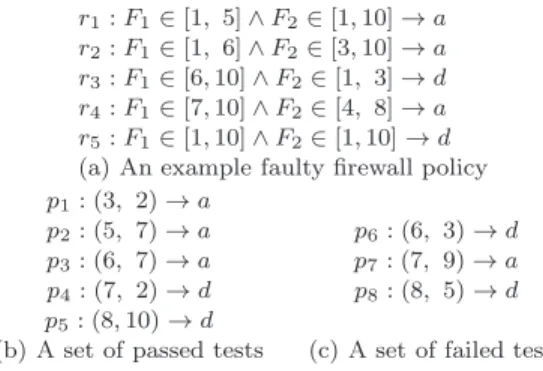
Figure 2 shows a faulty firewall policy and its passed and failed tests. This policy includes 5 rules over two fieldsF1 andF2, where the domain of each field is [1,10]. We use a as a shorthand for “accept” anddas a shorthand for “discard”. For the passed and failed tests, we useaanddto denote expected decisions. We assign each test a distinct IDpi(1≤i≤8).
Given passed and failed tests, it is difficult to automatically correct a faulty firewall policy for three reasons. First, it is difficult to locate the faults because a firewall policy may consist of a large number of rules, and the rules often conflict. Second, before correcting a fault, we need to first determine the type of the fault and then use the corresponding correction technique to fix this fault. However, it is difficult to determine the type of a fault because the same misbehavior of a firewall policy,i.e., the same set of misclassified packets, can be caused by different ACM Journal Name, Vol. V, No. N, Month 20YY.
r1:F1∈[1, 5]∧F2∈[1,10]→a r2:F1∈[1, 6]∧F2∈[3,10]→a r3:F1∈[6,10]∧F2∈[1,3]→d r4:F1∈[7,10]∧F2∈[4,8]→a r5:F1∈[1,10]∧F2∈[1,10]→d (a) An example faulty firewall policy p1: (3, 2)→a
p2: (5, 7)→a p3: (6, 7)→a p4: (7, 2)→d p5: (8,10)→d (b) A set of passed tests
p6: (6, 3)→d p7: (7, 9)→a p8: (8, 5)→d
(c) A set of failed tests
Fig. 2. An example faulty firewall policy with its failed and passed tests
types of faults. Third, it is difficult to correct a fault. Due to the first-match semantics, changing a rule can affect the functionality of all the subsequent rules. Without thorough consideration, correcting a fault may introduce a new fault into the firewall policy.
In this paper, we formalize the problem of correcting a faulty firewall policy as follows.
5.1 Problem Statement
Given a faulty firewall policyF W, a set of passed testsP T, and a set of failed tests F T, where|P T|≥0 and |F T|>0, find a sequence of modifications hM1,· · ·, Mmi,
where Mj (1≤j≤m) denotes one modification, such that the following two
condi-tions hold:
(1) After applyinghM1,· · ·, MmitoF W, all tests inP T∪F T become passed tests.
(2) No other sequence that satisfies the first condition has a smaller number of modifications thanm.
Correcting a faulty firewall policy with the minimum number of modifications is a global optimization problem and hard to solve because the policy may consist of a large number of rules, and different combinations of modifications can be made. To address this problem, we propose two algorithms: a greedy algorithm and its improved algorithm that considers the preference of different modifications. 5.2 Greedy Algorithm
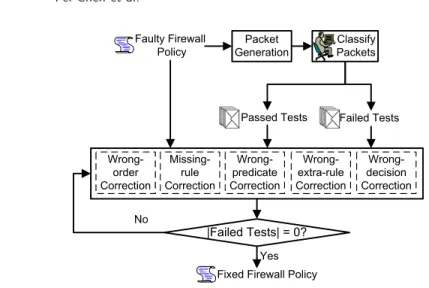
In the greedy algorithm, for each step, we correct one fault in the policy such that the number of passed tests increases (in other words, the number of failed tests decreases). To determine which correction technique should be used at each step, we try the five correction techniques. Then, we calculate the number of passed tests for each type of modifications and choose the correction technique that corresponds to the maximum number of passed tests. We then repeat the preceding step until there are no failed tests. Figure 3 illustrates this greedy algorithm for automatic correction of firewall policy faults.
Our greedy algorithm can guarantee to find a sequence of modifications that satisfies the first condition in the problem statement. For each step, the greedy algorithm can increase at least one passed test because of themissing-rule correction
Packet Generation Faulty Firewall
Policy
Passed Tests Failed Tests
Wrong-order Correction |Failed Tests| = 0? No Yes Fixed Firewall Policy
Classify Packets Missing-rule Correction Wrong-predicate Correction Wrong-extra-rule Correction Wrong-decision Correction
Fig. 3. The greedy algorithm for automatically correcting a faulty firewall policy
technique. Using this technique, we can convert each failed test to a singleton rule and then add these singleton rules at the beginning of the faulty firewall policy. For example, convert the failed test (6, 3) →d in Figure 2(c) to a singleton rule F1∈[6,6]∧F2∈[3,3]→d. Note that adding a singleton rule for each failed test is the worst case of our greedy algorithm,i.e., the maximum number of modifications, while in most cases our greedy algorithm rarely generates singleton rules. According to our missing-rule correction technique in Section 7, the worst case happens if and only if in each round of our greedy algorithm two conditions hold: (1) only missing-rule correction technique can increase the number of passed tests while other four fixing techniques cannot; (2) missing-rule correction technique cannot add a firewall rule, which is not a singleton rule, to correct multiple failed tests without changing passed tests to failed tests. These two conditions are very difficult to achieve in reality. However, the greedy algorithm cannot guarantee to find the global optimization solution that satisfies the second condition in the problem statement.
5.3 Improved Algorithm
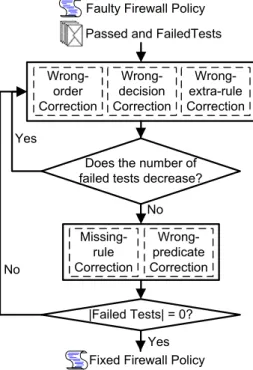
In the improved algorithm, we consider correction technique preferences over five correction techniques. We prefer to correct the faulty firewall policy using three techniques, wrong-order correction, wrong-decision correction, and wrong-extra-rule correction. Figure 4 illustrates the improved algorithm for automatic correc-tion of firewall policy faults. In this algorithm, for each step, we first try three techniques, wrong-order correction, wrong-decision correction, and wrong-extra-rule correction, and then find out which one can decrease the maximum number of failed tests. If none of them can decrease the number of failed tests, we try two other correction techniques, missing-rule correction and wrong-predicate correction. Note that administrators can supervise this process. For each step, adminis-trators can choose their preferred technique for correcting a fault in the policy. If administrators do not want to supervise the process, our greedy algorithm can automatically produce the fixed policy.
Does the number of failed tests decrease? Yes
No
|Failed Tests| = 0? Yes Fixed Firewall Policy No
Faulty Firewall Policy Passed and FailedTests
Wrong-order Correction Missing-rule Correction Wrong-predicate Correction Wrong-extra-rule Correction Wrong-decision Correction
Fig. 4. The improved algorithm for automatically correcting a faulty firewall policy
Further note that without any restriction, our automatic approach for correcting firewall policy faults could introduce potential faults in the firewall policy. However, an administrator typically has some critical requirements when he/she designs the firewall policy. These critical requirements define that some packets should be accepted or discarded. The administrator can restrict the proposed approach not to violate the critical requirements. Consider a critical requirement that a data server in an organization should not be accessed by any outside connection. For each step of our greedy algorithm, if the modification generated in this step violates the requirement, the approach can simply choose the next modification that does not violate the requirement.
In the next five sections, we discuss our scheme for each correction technique, respectively. Recall that the last rule of a firewall policy is usually specified as F1∈D(F1)∧· · ·∧Fd∈D(Fd)→ hdecisioni. Checking whether the last rule is correct
is trivial. Therefore, we assume that the last rule of a firewall policy is correct in our discussion.
6. WRONG-ORDER CORRECTION
Due to the first-match semantics, changing the order of two rules in a firewall policy (i.e., swapping two rules) affects its functionality. Therefore, after swapping two rules of a firewall policy, we need to test and reclassify all passed tests and failed tests. It is computationally expensive to directly swap every two rules in a faulty firewall policy and then find the two rules such that swapping them can maximize colorredthe increase in the number of passed tests. Given a firewall policy withn
rules, without considering the last rule, there are (n−1)(n−2)/2 pairs of rules that can be swapped. Furthermore, for each swapping, we need to reclassify all passed and failed tests. Assume that the number of passed tests is m1 and the number of failed tests is m2. The computational cost of this brute-force way is (n−1)(n−2)(m1+m2)/2.
To address this challenge, we use all-match firewall decision diagrams (all-match FDDs) [Liu et al. 2008] as the core data structure. An all-match FDD is a canonical representation of a firewall policy such that any firewall policy can be converted to an equivalent all-match FDD. Figure 5 shows the all-match FDD converted from the faulty firewall policy in Figure 2. An all-match FDD for a firewall policy F W:hr1,· · ·, rni over attributes F1,· · ·, Fd is an acyclic and directed graph that
has the following five properties:
(1) There is exactly one node that has no incoming edges. This node is called the root. The nodes that have no outgoing edges are calledterminal nodes. (2) Each node v has a label, denoted as F(v). If v is a nonterminal node, then
F(v)∈ {F1,· · ·, Fd}. Ifvis a terminal node, thenF(v) is a list of integer values hi1,· · ·, ikiwhere 1≤i1<· · ·<ik≤n.
(3) Each edge e:u→v is labeled with a nonempty set of integers, denoted asI(e), where I(e) is a subset of the domain of u’s label (i.e., I(e)⊆D(F(u))). The set of all outgoing edges of a nodev, denoted asE(v), satisfies two conditions: (1)consistency: I(e)∩I(e′)=∅ for any two distinct edgese ande′ in E(v); (2)
completeness: Se∈E(v)I(e)=D(F(v)).
(4) A directed path from the root to a terminal node is called a decision path. No two nodes on a decision path have the same label. Given a decision path P:(v1e1· · ·vdedvd+1), the matching set of P is defined as the set of all
pack-ets that satisfy F(v1)∈I(e1)∧· · ·∧F(vd)∈I(ed). We use C(P) to denote the
matching set ofP.
(5) For any decision path P : (v1e1· · ·vdedvd+1) where F(vd+1) = hi1,· · ·, iki, if
C(P)∩C(rj)6=∅,C(P)⊆C(rj) andj ∈ {i1,· · ·, ik}.
For ease of presentation, we use{P1,· · ·,Ph} to denote the all-match FDD of the
firewall policyF W. The following theorem is based on this definition, the proof of which is in Appendix A.
Theorem 6.1. Given two firewall policiesF W1:hr1
1,· · ·,r1niandF W2:hr21,· · ·,rn2i,
and their all-match FDDs{P1
1,· · ·,Ph11}and{P 2
1,· · ·,Ph22}, if{r 1
1,· · ·,r1n}={r21,· · ·,r2n},
without considering terminal nodes, {P1
1,· · ·,Ph11}={P 2
1,· · ·,Ph22}.
According to Theorem 6.1, for swapping two rules, we only need to swap the sequence numbers of the two rules in the terminal nodes of the all-match FDD. For finding two rules such that swapping them maximizes the number of passed tests, our correction technique includes five steps:
(1) Convert the policy to an equivalent all-match FDD.
(2) For each failed test p, we find the decision path P: (v1e1· · ·vdedvd+1) that
matches p(i.e., p∈ C(P)). Let hi1,· · ·, iki (1≤i1<· · ·<ik≤n) denote F(vd+1).
Note that the decision of ri1 is not the expected decision for the failed test p; otherwise,pshould be a passed test.
(3) Find the rules in {ri2,· · ·, rik} whose decisions are the expected decision of p.
Suppose {rj1,· · ·, rjg} are those rules that we find for p, where {rj1,· · ·, rjg} ⊆ {ri2,· · ·, rik}. Because the decision of rules in {rj1,· · ·, rjg} is the expected
decision forp, swappingri1 with any rule in{rj1,· · ·, rjg}changespto a passed
test. Note that because the last rule of a firewall is a default rule, colorredit is pointless to swap it with any preceding rule. If rjg is the last rule of the faulty
firewall (i.e.,jg=n), we deleterjg from{rj1,· · ·, rjg}.
(4) For all failed tests, we find out all rule pairs such that swapping two rules in a rule pair may increase the number of passed tests. Then we swap two rules in each rule pair. Note that swapping two rules in a rule pair changes the corresponding failed test to a passed test. However, this modification may change some passed tests to failed tests. Therefore, after swapping two rules in each rule pair, we reclassify all tests and calculate the number of passed tests.
(5) Find a rule pair such that swapping the two rules in this pair can maximize the number of passed tests.
Note that if there are more than one rule pair such that swapping two rules in each pair can maximize colorredthe increase in the number of passed tests, we choose the rule pair that affects the functionality of the minimum number of original firewall rules. Let (ri1, rj1),· · ·,(rig, rjg) denote these rule pairs, where ik≤jk (1≤k≤g).
Due to the first-match semantics, we choose the rule pair (ri, rj) where i is the
maximum integer in{i1,· · ·, ig}.
[1, 5] [7, 10] F1 [1, 2] F2 F2 [1,2] F2 [3, 10] [3,3] [4,10] [1,3] [4,8] [9,10] [6, 6] 1,5 1,2,5 3,5 2,3,5 2,5 3,5 4,5 5
Fig. 5. All-match FDD converted from the faulty firewall policy in Figure 2
For the faulty firewall policy in Figure 2, we first convert the faulty firewall policy to an all-match FDD, which is shown in Figure 5. Second, for each failed test, we find the corresponding rule pairs. In the example, we find only one rule pair (r2, r3) for the failed test (6, 3)→d. Third, after swappingr2andr3, (6, 2)→dbecomes a passed test and no passed test changes to a failed test. Therefore, swapping r2 andr3 increases the number of passed tests by 1.
7. MISSING-RULE CORRECTION
There are two challenges for adding a rule to a faulty firewall policy. First, given a faulty firewall policy with nrules, there aren positions where we can add a rule. Determining which position is the best for adding a rule is a challenge. Second, because the predicate of a firewall rule is composed of multiple fields and the num-ber of possible values in each field is typically large, brute-force addition of every possible rule for each position is computationally expensive. Considering a firewall rule with five fields (i.e., 32-bit source IP, 32-bit destination IP, 16-bit source port, 16-bit destination port, and 8-bit protocol type) and two possible decisions (i.e.,
accept anddiscard), the number of possible firewall rules that we can add for each position is O(2204), because for each field with d-bit length, the number of pos-sible ranges is (2
2d)=O(2
2d−1). Furthermore, after adding a rule, we still need to reclassify all passed and failed tests.
The basic idea of our solution is that for each position, we first find all possible failed tests that can be corrected by adding a rule at this position, and then compute a rule that matches the maximum number of failed tests. To avoid changing a passed test to a failed test, the rule that we compute does not match any possible passed test. More formally, given a faulty firewall policy with n rules hr1,· · ·, rni, let
positioni(1≤i≤n) denote the position betweenri−1 andri. Note that we cannot
add a rule after rn because rn is the default rule. Our correction technique for
adding a rule includes five steps:
(1) For each positioni, find a set of passed testsP T(i) and a set of failed testsF T(i) such that colorredno testpinP T(i)∪F T(i) matches any rulerj (1≤j≤i−1).
Note that wheni= 1,rjdoes not exist. In such case,P T(1) =P T andF T(1) =
F T. Due to the first-match semantics, if a failed testpmatches a ruleri, adding
a rule after rule ri cannot change the decision ofpand hence cannot correctp.
Therefore, the setF T(i) includes all possible failed tests that we can correct by adding a rule at positioni.
(2) Based on the expected decisions of tests, divideP T(i) into two setsP T(i)a and
P T(i)d where P T(i)a consists of all passed tests with expected decision accept
andP T(i)d consists of all passed tests withdiscard. Similarly, we divide F T(i)
into two sets F T(i)a and F T(i)d. The purpose is that adding a rule cannot
correct two failed tests with different expected decisions.
(3) For setF T(i)a, compute a rule with decisionaccept, denoted asri,a′ , that satisfies
two conditions:
(a) No passed test in P T(i)d matchesri,a′ .
(b) Under Condition (a), r′
i,a matches the maximum number of failed tests in
F T(i)a.
The algorithm for computing ruler′
i,a based onF T(i)a andP T(i)d is discussed
in Section 7.1.
(4) Similar to Step 3, for setF T(i)d, compute a rule with decisiondiscard, denoted
asr′
i,d, that satisfies two conditions:
(a) No passed test in P T(i)a matchesri,d′ .
(b) Under Condition (a), r′
i,d matches the maximum number of failed tests in
F T(i)d.
(5) Find a ruler′
j, decision(1≤j≤n) that corrects the maximum number of failed tests
and then addr′
j, decision to positionj.
Note that if there is more than one rule that can correct the maximum number of failed tests, we choose ruler′
j, decisionwherej is the maximum integer among these
rules such that adding this rule affects the functionality of the smallest number of original rules in a firewall policy.
For the faulty policy in Figure 2, Figure 6 shows the four setsP T(i)a, P T(i)d,
F T(i)a, and F T(i)d for each rule of the policy.
d d r1 p1, p2, p3 p4, p5 p7 p6, p8 r2 p3 p4, p5 p7 p6, p8 r3 – p4, p5 p7 p8 r4 – p5 p7 p8 r5 – p5 p7 –
Fig. 6. P T(i)a,P T(i)d,F T(i)a, andF T(i)dfor each rule in Figure 2
7.1 Computing Rulesr′
i,a andr′i,d
Without loss of generality, in this section, we discuss the algorithm for computing r′
i,a based on a set of failed tests F T(i)a and a set of passed testsP T(i)d. First,
we generate a rule that can match all failed tests in F T(i)a. Suppose that the
predicate of a firewall rule is composed ofdfields. For each fieldj(1≤j≤d), assume that xj is the minimum value of all failed tests inF T(i)a andyj is the maximum
value. Therefore, the ruler:F1∈[x1, y1]∧· · ·∧Fd∈[xd, yd]→amatches all failed tests
in F T(i)a. Second, we use the passed tests inP T(i)d to split the rule to multiple
rules, each of which does not match any passed test. Let (z1,· · ·, zd)→ddenote the
first passed testpin P T(i)d. If ruler matchesp, for each field j, we generate two
rules by using zj to split [xj, yj] into two ranges [xj, zj−1] and [zj+ 1, yj]. The
resulting two rules for fieldj are as follows.
F1∈[x1, y1]∧· · ·∧Fj−1∈[xj−1, yj−1]∧Fj∈[xj, zj−1]
∧Fj+1∈[xj+1, yj+1]∧· · ·∧Fd∈[xd, yd]→a
F1∈[x1, y1]∧· · ·∧Fj−1∈[xj−1, yj−1]∧Fj∈[zj+ 1, yj]
∧Fj+1∈[xj+1, yj+1]∧· · ·∧Fd∈[xd, yd]→a
Note that ifxj>zj−1 (orzj+1>yj), the rule that includes [xj, zj−1] (or [zj+1, yj])
is meaningless and it should be deleted from the resulting rules. If rule rdoes not match p, p cannot split r. Then, we use the second test in P T(i)d to split the
resulting rules generated from p. Repeat this step until we check all the passed tests inP T(i)d. Finally, we choose one rule that matches the maximum number of
failed tests.
Take two sets P T(2)a and F T(2)d in Figure 6 as an example, rule r′2,d can be
computed asF1∈[6,8]∧F2∈[3,5]→d, which can correct two failed testsp6 and p8.
8. WRONG-PREDICATE CORRECTION
There are two challenges for fixing a predicate in a faulty firewall policy. First, for a faulty firewall policy withnrules, there aren−1 possible predicates that we can correct. Note that the last rule rn is the default rule. Second, similar to adding
rules, brute-force fixing of the predicate for each rule is computationally expensive. The number of possible predicates for each rule isO(2203).
The basic idea for wrong-predicate correction is similar to adding rules. We first find all possible failed tests that can be corrected by fixing a predicate, and then compute a rule that matches the maximum number of failed tests. However, there are two major differences. First, for fixing the predicate of ri, we compute only
a rule with the same decision of ri. Second, after fixing the predicate of rule ri,
whose first-matching rule is ri may become failed tests. The set of these passed
tests forri can be computed asP T(i)−P T(i+ 1) (shown in Figure 8). The passed
tests whose first-matching rule is not ri should be prevented from changing to
failed tests. Therefore, the set of all possible failed tests that we can correct by fixing ri’s predicate is F T(i)∪(P T(i)−P T(i+ 1)). Our correction technique for
wrong-predicate correction includes five steps:
(1) For each positioni(1≤i≤n), find a set of passed tests P T(i) and a set of failed testsF T(i) such that no testpinP T(i)∪F T(i) matches any rulerj (1≤j≤i−1).
(2) For each ruleri (1≤i≤n−1), compute the set of all possible failed tests
F T(i)∪(P T(i)−P T(i+1)) that we can correct by fixingri’s predicate. LetF T\(i)
denoteF T(i)∪(P T(i)−P T(i+ 1)). The complement of the set
F T(i)∪(P T(i)−P T(i+ 1)) is P T(i+ 1), which is the set of passed tests that we cannot change to failed tests by fixingri’s predicate.
(3) Based on the expected decisions of tests, divideP T(i+1) into two setsP T(i+1)a
andP T(i+ 1)d, and divideF T\(i) into two setsF T\(i)a andF T\(i)d.
(4) Without loss of generality, assume that ri’s decision is accept. For setF T\(i)a,
we computer′′
i,a that satisfies two conditions:
(a) No passed test in P T(i+ 1)d matchesr′′i,a.
(b) Under condition (a), r′′
i,a matches the maximum number of failed tests in
\
F T(i)a.
The algorithm for computing rule r′′i,a based on F T\(i)a and P T(i+ 1)d is the
same as that in Section 7.1. Letri′′denote the resulting rule.
(5) Find a ruler′′
j (1≤j≤n−1) that can correct the maximum number of failed tests
and then replace rulerj.
Note that if there is more than one rule that can correct the maximum number of failed tests, we choose ruler′′
j wherej is the maximum integer among these rules.
For the faulty policy in Figure 2, Figure 7 shows the four setsP T(i+ 1)a,P T(i+
1)d, F T\(i)a, and F T\(i)d for each rule. Rule r2′′,a can be computed asF1∈[6,7]∧
F2∈[7,9]→a, which can correct one failed testp7.
P T(i+ 1)a P T(i+ 1)d F T\(i)a F T\(i)d
r1 p3 p4, p5 p1, p2, p7 p6, p8 r2 – p4, p5 p3, p7 p6, p8
r3 – p5 p7 p4, p8
r4 – p5 p7 p8
Fig. 7. P T(i+1)a,P T(i+1)d,F T\(i)a, andF T\(i)dfor each rule in Figure 2
9. WRONG-DECISION CORRECTION
The idea of fixing a decision is that for each ruleri, we first find the passed tests
and failed tests whose first-matching rule is ri. The colorredset of passed tests for
ri can be computed asP T(i)−P T(i+1) and the set of the failed tests for ri can
be computed asF T(i)−F T(i+1). If we change the decision of ri, the passed tests
in P T(i)−P T(i+1) become failed tests and the failed tests in F T(i)−F T(i+1) ACM Journal Name, Vol. V, No. N, Month 20YY.
become passed tests. Then, we can calculate colorredthe increase in the number of passed tests by fixing ri’s decision. Finally, we fix the decision of the rule that
corresponds to the maximum increased number of passed tests. Our correction technique for fixing a decision includes three steps:
(1) For each rule ri (1 ≤ i ≤ n−1), compute two sets: P T(i)−P T(i+ 1) and
F T(i)−F T(i+ 1).
(2) Calculate colorredthe increase in the number of passed tests by fixingri’s decision,
which is|F T(i)−F T(i+1)|−|P T(i)−P T(i+ 1)|.
(3) Fix the decision of a rule that can maximize colorredthe increase in the number of passed tests.
Note that if there is more than one rule such that fixing the decision of each of them can maximize colorredthe increase in the number of passed tests, we choose the rule with the largest sequence number.
For the faulty policy in Figure 2, Figure 8 shows the two setsP T(i)−P T(i+ 1) andF T(i)−F T(i+ 1) for each rule. Clearly, fixing the decision ofr4 can change the failed testp8to a passed test.
P T(i)−P T(i+ 1) F T(i)−F T(i+ 1)
r1 p1, p2 –
r2 p3 p6
r3 p4 –
r4 – p8
Fig. 8. P T(i)−P T(i+1) andF T(i)−F T(i+1) for each rule in Figure 2
10. WRONG-EXTRA-RULE CORRECTION
The idea of deleting a firewall rule is that we use the all-match FDD to calculate colorredthe increase in the number of passed packets by deleting each rule, and then delete the rule that can maximize colorredthe increase in the number of passed packets. Given a faulty policy withnrules and its all-match FDD, our correction technique for deleting a rule includes three steps:
(1) For each rule ri (1≤i≤n−1), find every decision pathP:(v1e1· · ·vdedvd+1) such
that C(P)⊆C(ri) andi is the first rule id inF(vd+1). Let{P1i,· · ·,Phi} denote
the set of such decision paths. (2) For each decision pathPi
g:(v1e1· · ·vdedvd+1) (1≤g≤h), find the set of passed
tests P T(Pi
g) and the set of failed tests F T(Pgi), where any test inP T(Pgi) or
F T(Pi
g) matches Pgi. Let hi1,· · ·, iki (1≤i1<· · ·<ik≤n) denote F(vd+1). Note
that i1 = i because of the first-match semantics. Let lg denote colorredthe
increase in the number of passed tests that match Pi
g after deleting ruleri. To
calculate lg, we need to check whether ri and ri2 have the same decision. If ri andri2 have the same decision, deletingri does not change the two setsP T(P
i g)
andF T(Pi
g). In this case,lg=0. Otherwise, the passed tests inP T(Pgi) become
failed tests and the failed tests in F T(Pi
g) become passed tests. In this case,
lg = |F T(Pgi)| − |P T(P i
g)|. Therefore, colorredthe increase in the number of
passed packets after deleting ruleri can be computed asP h g=1lg.
(3) Delete the rule that can maximize the number of passed packets.
Note that if rule ri is not the first-matching rule for any failed test, |F T(Pgi)|=0
(1≤g≤h) and hence Phg=1lg ≤ 0. In this case, deleting ri cannot increase the
number of passed packets. We can easily find such rules by computing the set F T(i)−F T(i+ 1) for each ruleri. Further note that if there is more than one rule
such that deleting each of them can maximize colorredthe increase in the number of passed tests, we choose the rule with the maximum sequence number.
For the faulty firewall policy in Figure 2, by checkingF T(i)−F T(i+1) in Figure 8, we find that deleting ruler1 orr3cannot increase the number of passed packets. In the all-match FDD of the faulty policy (shown in Figure 5), for ruler2, there are two paths,F1∈[6,6]∧F2∈[3,3] andF1∈[6,6]∧F2∈[4,10], where 2 is the first integer in their terminal nodes. Because the failed testp6 matches the first path, and r2 and r3 have different decisions, deleting r2 changesp6 to a passed test. Because the passed testp3matches the second path, andr2 andr5 have different decisions, deleting r2 changes p3 to a failed test. Therefore, deleting r2 does not increase the number of passed tests. Similarly, deletingr4 changesp8 to a passed test, and hence increases the number of passed tests by 1.
11. EXPERIMENTAL RESULTS
11.1 Evaluation Setup
In our experiments, faulty firewall policies were generated from 40 real-life firewall policies that we collected from universities, ISPs, and network device manufacturers. The 40 real-life policies were considered as correct policies with respect to these faulty policies. Each firewall examines five fields: source IP, destination IP, source port, destination port, and protocol type. The number of rules for each policy ranges from dozens to thousands.
To evaluate the effectiveness and efficiency of the greedy algorithm, we first em-ployed the technique of mutation testing [DeMillo et al. 1978] to create faulty firewall policies. The technique for injecting synthetic faults with mutation testing is a well-accepted mechanism for carrying out testing experiments in real practice. Particularly, each faulty policy contains one type of fault, and the number of faults in a faulty firewall policy ranges from 1 to 5. Given a real-life firewall withnrules, for each type of fault, we employed mutation testing [DeMillo et al. 1978] to ran-domly createn−1 faulty policies. In other words, we created 5×(n−1) policies for each real-life firewall withnrules. Recall that it is trivial to check whether the last rule is correct. Thus, we did not change the last rule for generating faulty policies in our experiments. For example, to create a faulty firewall policy with k wrong decisions faults, we randomly changed the decisions of thekrules in a real-life fire-wall policy. Overall, we generated 35618 faulty firefire-wall policies in our experiments. Second, for each faulty policy, we employed the firewall testing tool [Hwang et al. 2008] to generate test packets. Note that the test packets were generated based on the faulty policy rather than its corresponding real-life policy. For each faulty policy, on average, the total number of passed and failed tests is about 3n, where n is the number of rules in the policy. Third, we classified the test packets into passed and failed tests. Recall that the real-life firewall policies were considered as correct policies in our experiments. Thus, to classify each test packet, we compared ACM Journal Name, Vol. V, No. N, Month 20YY.
two decisions generated by the faulty policy and its corresponding real-life policy. If the two decisions were the same, we classified the test packet as a passed test; otherwise, we classified it as a failed test. Note that in practice this step should be done by administrators. Finally, we implemented and applied our greedy algorithm over the faulty firewall policy, and then produced the fixed policy. For each step of the greedy algorithm, if different techniques increase the same number of passed tests, we randomly colorredchose one technique.
To evaluate the effectiveness and efficiency of the improved algorithm, we first created another set ofn−1 faulty policies for each real-life firewall withnrules. Each faulty policy contains five faults and each fault is one distinct fault type defined in the fault model of firewall policies (Section 4). Note that thesen−1 faulty policies are different from 5×(n−1) faulty policies we generated for evaluating the greedy algorithm. Second, we employed the firewall testing tool [Hwang et al. 2008] to generate test packets and classified them into passed and failed tests. Third, we applied our improved algorithm over the faulty firewall policies and produced the fixed policies. To compare the improved algorithm with the greedy algorithm, we also applied our greedy algorithm over these n−1 faulty policies. The reason of creating anther set ofn−1 faulty policies is that we can evaluate the effectiveness of the two algorithms over the faulty policies with different types of faults instead of the faulty policies with a single type of faults, which provides another perspective to understand the two algorithms.
11.2 Methodology
To measure the effectiveness of our approach, we need to first define thedifference between two firewall policies. Given two policies F W1 and F W2, the difference betweenF W1 andF W2, denoted as ∆(F W1, F W2), is the total number of packets each of which has different decisions evaluated by F W1 and F W2. To compute ∆(F W1, F W2), we employed the firewall comparison algorithm [Liu and Gouda 2008]. This algorithm first finds the functional discrepancies between F W1 and F W2, where each discrepancy denotes a set of packets and each packet has different decisions evaluated by the two policies, and then compute the number of packets included by all the discrepancies.
Next, we define three metrics to measure the effectiveness of our approach. Let F Wrealdenote a real-life firewall policy andF Wf aultydenote a faulty policy created
from F Wreal. Let F T denote the set of failed tests and |F T|denote the number
of failed tests. Let F Wf ixed denote the fixed policy by correcting F Wf aulty and
m(F Wf aulty) denote the number of modifications. LetS(t, k) denote a set of faulty
policies, where t denotes the type of fault andk denotes the number of faults in each faulty policy. We define the three metrics for evaluating the effectiveness of our approach as follows:
(1) Thedifference ratio overF Wreal, F Wf aulty, and F Wf ixed:
∆(F Wreal, F Wf ixed)
∆(F Wreal, F Wf aulty)
∆(F Wreal, F Wf aulty)−∆(F Wreal, F Wf ixed) |F T|
(3) Theaverage number of modifications overS(t, k): P
F Wf aulty∈S(t,k)m(F Wf aulty) |S(t, k)|
The intuition behind the difference ratio ∆(∆(F WF Wreal,F Wf ixed)
real,F Wf aulty) is to measure what
percentage of misclassified packets were corrected after applying our approach. Be-cause ∆(F Wreal, F Wf aulty) denotes the total number of misclassified packets in the
faulty firewall policy, and ∆(F Wreal, F Wf aulty) denotes the total number of
mis-classified packets in the fixed firewall policy. If ∆(∆(F Wreal,F Wf aultyF Wreal,F Wf ixed)) = 0, F Wf ixed
corrects all misclassified packets, which means thatF Wf ixedis equivalent toF Wreal
in terms of functionality. For the example policy in Figure 1, if we generate a faulty firewall policy by changingr1’s decision todiscard, the difference between the faulty policy and the example policy, ∆(F Wreal, F Wf aulty), is 28×216=224. Hence, the
total number of packets that are misclassified by the faulty firewall policy is 224. If the fixed firewall policy corrects r1’s decision in the faulty firewall policy, the difference between the fixed policy and the example policy, ∆(F Wreal, F Wf ixed),
is 0. Thus, ∆(∆(F Wreal,F Wf aultyF Wreal,F Wf ixed)) = 0, which means that F Wf ixed is equivalent to
F Wrealin terms of functionality.
The intuition behind correction rate ∆(F Wreal,F Wf aulty|F T)−∆(| F Wreal,F Wf ixed) is to measure how much our algorithms outperform the algorithm of adding singleton rules to correct the failed tests. Note that F T is only a small portion of all misclassified packets in F Wf aulty. The algorithm of adding singleton rules can
only fix the failed tests in F T. For ease of presentation, we call the algorithm of adding singleton rules the simple algorithm. Based on the discussion of the dif-ference ratio, we know that ∆(F Wreal, F Wf aulty)−∆(F Wreal, F Wf ixed) denotes
the number of misclassified packets that have been fixed by our algorithms. If ∆(F Wreal,F Wf aulty)−∆(F Wreal,F Wf ixed)
|F T| >> 1, our algorithms significantly
outper-form the simple algorithm. If ∆(F Wreal,F Wf aulty|F T)−∆(| F Wreal,F Wf ixed) = 1, our algo-rithms have the same effectiveness as the simple algorithm. In other words, our algorithms are not better than the simple algorithm.
11.3 Effectiveness of the Greedy Algorithm
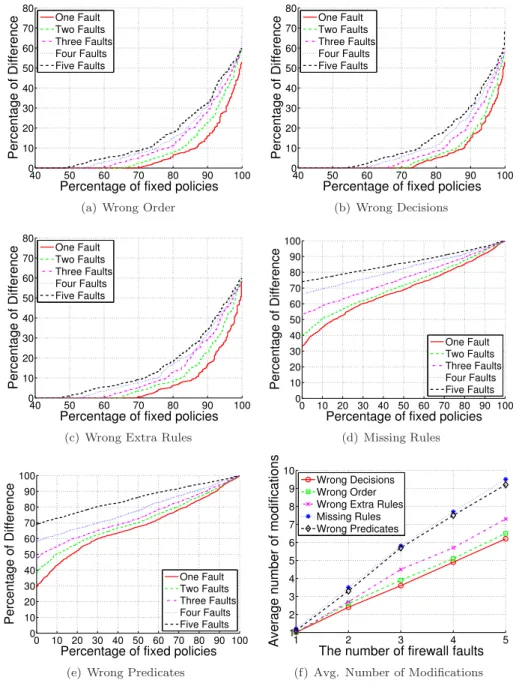
Figures 9(a)-9(e) show the cumulative distribution of difference ratios overF Wreal,
F Wf aulty, andF Wf ixed for each type of fault. In Figures 9(a)-9(e), we use “One
Fault”,· · ·, “Five Faults” to denote the number of faults in faulty firewall policies. A point (X, Y) in these figures describes that the difference ratios of X% fixed policies are less than or equal toY%. For example, the point (73.5, 0) in Figure 9(a) describes that the difference ratios of 73.5% fixed policies are equal to 0. In other words, 73.5% fixed policies are equivalent to the corresponding real-life policies. We observe that for three types of faults, wrong order, wrong decisions, and wrong extra rules, fixed policies can significantly reduce the number of misclassified packets. For ACM Journal Name, Vol. V, No. N, Month 20YY.
40 50 60 70 80 90 100 0 10 20 30 40 50 60 70 80 Percentage of Difference
Percentage of fixed policies One Fault
Two Faults Three Faults Four Faults Five Faults
(a) Wrong Order
40 50 60 70 80 90 100 0 10 20 30 40 50 60 70 80 Percentage of Difference
Percentage of fixed policies One Fault Two Faults Three Faults Four Faults Five Faults (b) Wrong Decisions 40 50 60 70 80 90 100 0 10 20 30 40 50 60 70 80 Percentage of Difference
Percentage of fixed policies One Fault
Two Faults Three Faults Four Faults Five Faults
(c) Wrong Extra Rules
0 10 20 30 40 50 60 70 80 90 100 0 10 20 30 40 50 60 70 80 90 100 Percentage of Difference
Percentage of fixed policies
One Fault Two Faults Three Faults Four Faults Five Faults (d) Missing Rules 0 10 20 30 40 50 60 70 80 90 100 0 10 20 30 40 50 60 70 80 90 100 Percentage of Difference
Percentage of fixed policies
One Fault Two Faults Three Faults Four Faults Five Faults
(e) Wrong Predicates
1 2 3 4 5 1 2 3 4 5 6 7 8 9 10
Average number of modifications
The number of firewall faults Wrong Decisions
Wrong Order Wrong Extra Rules Missing Rules Wrong Predicates
(f) Avg. Number of Modifications
Fig. 9. Cumulative distribution of difference ratio and average number of modifi-cations for each type of firewall policy faults
faulty policies withkfaults, wherekfaults are one of these three types andk≤4, over 53.2% fixed policies are equivalent to their corresponding real-life policies. For faulty policies with 1 to 5 wrong decisions faults, the percentages of fixed policies that are equivalent to their corresponding real-life policies are 73.5%, 68.8%, 63.7%, 59.3%, and 53.8%, respectively. For faulty policies with 1 to 5wrong order faults, the percentages of fixed policies that are equivalent to their corresponding real-life policies are 69.7%, 64.2%, 59.7%, 54.3%, and 48.9%, respectively. For faulty policies with 1 to 5 wrong extra rules faults, the percentages of fixed policies that are equivalent to their corresponding real-life policies are 68.3%, 63.5%, 59.3%, 53.2%, and 47.3%, respectively.
We also observe that fixed policies can reduce only a small number of misclassified packets for two types of faults, missing rules and wrong predicates. For faulty policies with 1 to 2missing rules faults, the percentages of fixed policies that have 50% difference ratio with their corresponding real-life policies are 15.7% and 8.32%, respectively. For faulty policies with 1 to 2wrong predicates faults, the percentages of fixed policies that have 50% difference ratio with their corresponding real-life policies are 17.3% and 9.1%, respectively. The reason is that, in most cases, the information provided by failed tests is not enough to recover the missing rule (or correct predicate). A firewall rule (or predicate) with 5 fields can be denoted as a hyperrectangle over a 5-dimensional space, and failed tests are only some points in the hyperrectangle. To recover the missing rule (or correct the wrong predicate), for each surface of the hyperrectangle, there should be at least one point on it. However, the chance of such a case is very small.
Figure 9(f) shows the average number of modifications for each type of faults. We observe that for faulty firewall policies withkfaults (k≤5), the ratio between the average number of modifications and the number of faults is less than 2.
We also measured the correction rates for the fixed firewall policies. Our ex-perimental results show that all the correction rates are larger than 158, and the average correction rate is 2268, which demonstrates that our algorithms significantly outperform the simple algorithm.
11.4 Effectiveness of the Improved Algorithm
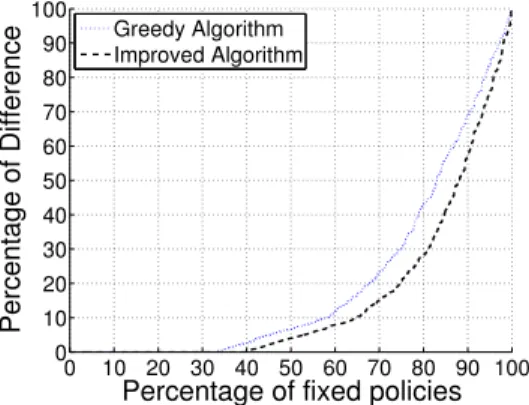
Figure 10 shows the cumulative distribution of difference ratios overF Wreal,F Wf aulty,
andF Wf ixedby applying both the greedy and improved algorithms to the firewall
policies with five different faults. We observe that the improved algorithm performs better than the greedy algorithm in terms of percentage of fixed policies. The per-centage of fixed policies generated by the improved algorithm is 5% more than that of fixed policies generated by the greedy algorithm.
Similar as evaluating the greedy algorithm, we also measured thecorrection rates for the fixed firewall policies. Our experimental results show that all the correction rates are larger than 137, and the average correction rate is 2537, which demon-strates that our algorithms significantly outperform the simple algorithm.
11.5 Efficiency of Our Approach
We implemented our approach using Java 1.6.0. In our experiments, for a faulty firewall policy, we measure the total processing time of generating test packets, classifying packets into passed and failed tests, and fixing the policy to evaluate ACM Journal Name, Vol. V, No. N, Month 20YY.
0 10 20 30 40 50 60 70 80 90 100 0 10 20 30 40 50 60 70 80 90 100 Percentage of Difference
Percentage of fixed policies Greedy Algorithm
Improved Algorithm
Fig. 10. Cumulative distribution of difference ratio for firewall policies with five different faults
the efficiency of our approach. Note that classifying test packets is automatically done in our experiments by comparing two decisions evaluated by the faulty firewall and its corresponding real-life firewall for test packets. In practice, this step should be done by administrators. Our experiments were carried out on a desktop PC running Linux with 2 quad-core Intel Xeon at 2.3GHz and 16GB of memory. Our experimental results show that for the faulty firewall policy with 7652 rules, the total processing time for fixing this faulty policy is less than 10 minutes.
12. CASE STUDY
In this section, we applied our automatic correction tool for firewall policy faults to a real-life faulty firewall policy with 87 rules and demonstrated that our tool can help the administrator to correct the misconfiguration in the firewall policy. The real-life firewall policy is shown in the Appendix B where the policy is anonymized due to the privacy and security concern.
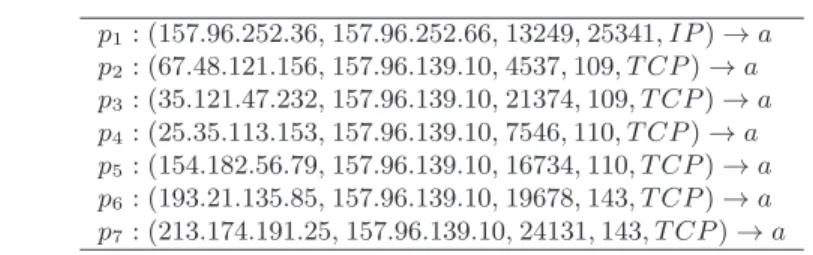
We first employed the automated packet generation techniques [Hwang et al. 2009] to generate test packets for the firewall policy and then asked the adminis-trator to identify passed/failed tests. The total number of generated tests is 162 and classifying all these tests takes less than 30 minutes. Among these test packets, we obtained seven failed tests, which are shown in Table I. Second, we applied our proposed solution to this firewall policy and generated a sequence of modifications to correct the seven failed tests in Table I. The resulting sequence includes four modifications: swapping rule 6 and rule 38, deleting rules 48, 49, and 50, which sug-gest that the firewall policy has one wrong-order fault and three wrong-extra-rule faults. We confirmed these faults with the administrator and he admitted that the resulting sequence of modifications generated by our tool can correct these faults automatically.
13. CONCLUSIONS
We make two key contributions in this paper. First, we propose the systematic approach that can automatically correct all or part of the misclassified packets of a faulty firewall policy. To the best of our knowledge, our paper is the first one for automatic correction of firewall policy faults. Second, we implemented our approach and evaluated its effectiveness on real-life firewalls. To measure the effectiveness
p1: (157.96.252.36,157.96.252.66,13249,25341, IP)→a p2: (67.48.121.156,157.96.139.10,4537,109, T CP)→a p3: (35.121.47.232,157.96.139.10,21374,109, T CP)→a p4: (25.35.113.153,157.96.139.10,7546,110, T CP)→a p5: (154.182.56.79,157.96.139.10,16734,110, T CP)→a p6: (193.21.135.85,157.96.139.10,19678,143, T CP)→a p7: (213.174.191.25,157.96.139.10,24131,143, T CP)→a Table I. Seven failed tests for the real-life firewall policy
of our approach, we propose three metrics, which we believe are general metrics for measuring the effectiveness of firewall policy correction tools. The experimental results demonstrated that our approach is effective to correct a faulty firewall policy with three types of faults: wrong order, wrong decisions, and wrong extra rules.
REFERENCES
Al-Shaer, E.,El-Atawy, A.,and Samak, T.2009. Automated pseudo-live testing of firewall configuration enforcement. IEEE Journal on Selected Areas in Communications 27, 302–314. Al-Shaer, E. and Hamed, H.2004. Discovery of policy anomalies in distributed firewalls. In
Proceedings of IEEE Conference on Computer Communications (INFOCOM). 2605–2616. Baboescu, F. and Varghese, G.2002. Fast and scalable conflict detection for packet classifiers.
InProceedings of IEEE International Conference on Network Protocols (ICNP). 717–735. CERT. 2001. Test the firewall system.
http://www.cert.org/security-improvement/practices/p060.html.
Chen, F.,Liu, A. X.,Hwang, J.,and Xie, T.2010. First step towards automatic correction of firewall policy faults. InProceedings of USENIX Large Installation System Administration Conference (LISA).
Cisco Reflexive ACLs. http://www.cisco.com/.
DeMillo, R. A.,Lipton, R. J.,and Sayward, F. G.1978. Hints on test data selection: Help for the practicing programmer.IEEE Computer 11,4 (April), 34–41.
Hari, A.,Suri, S.,and Parulkar, G. M.2000. Detecting and resolving packet filter conflicts. InProceedings of IEEE Conference on Computer Communications (INFOCOM). 1203–1212. Hoffman, D. and Yoo, K. 2005. Blowtorch: a framework for firewall test automation. In
Proceedings of International Conference on Automated Software Engineering (AES). 96–103. Hwang, J.,Xie, T.,Chen, F.,and Liu, A. X.2008. Systematic structural testing of firewall
policies. InProceedings of IEEE International Symposium on Reliable Distributed Systems (SRDS). 105–114.
Hwang, J.,Xie, T., Chen, F., and Liu, A. X. 2009. Fault localization for firewall policies. InProceedings of IEEE International Symposium on Reliable Distributed Systems (SRDS). 100–106.
J¨urjens, J. and Wimmel, G.2001. Specification-based testing of firewalls. InProceedings of International Conference Perspectives of System Informatics (PSI). 308–316.
Liu, A. X.2007. Change-impact analysis of firewall policies. InProceedings of European Sympo-sium Research Computer Security (ESORICS). 155–170.
Liu, A. X. and Gouda, M. G.2008. Diverse firewall design.IEEE Transactions on Parallel and Distributed Systems (TPDS) 19,8.
Liu, A. X.,Zhou, Y.,and Meiners, C. R.2008. All-match based complete redundancy removal for packet classifiers in TCAMs. InProceedings of IEEE Conference on Computer Communi-cations (INFOCOM). 574–582.
Lyu, M. R. and Lau, L. K. Y.2000. Firewall security: Policies, testing and performance eval-uation. InProceedings of International Conference on Computer Systems and Applications (COMPSAC). 116–121.