Resource Overbooking and Application
Profiling in a Shared Internet Hosting
Platform
BHUVAN URGAONKAR The Penn State University PRASHANT SHENOY University of Massachusetts and
TIMOTHY ROSCOE ETH Z ¨urich
In this article, we present techniques for provisioning CPU and network resources in shared In-ternet hosting platforms running potentially antagonistic third-party applications. The primary contribution of our work is to demonstrate the feasibility and benefits of overbooking resources in shared Internet platforms. Since an accurate estimate of an application’s resource needs is nec-essary when overbooking resources, we present techniques to profile applications on dedicated nodes, possibly while in service, and use these profiles to guide the placement of application compo-nents onto shared nodes. We then propose techniques to overbook cluster resources in a controlled fashion. We outline an empirical appraoch to determine the degree of overbooking that allows a platform to achieve improvements in revenue while providing performance guarantees to Internet applications. We show how our techniques can be combined with commonly used QoS resource al-location mechanisms to provide application isolation and performance guarantees at run-time. We implement our techniques in a Linux cluster and evaluate them using common server applications. We find that the efficiency (and consequently revenue) benefits from controlled overbooking of re-sources can be dramatic. Specifically, we find that overbooking rere-sources by as little as 1% we can increase the utilization of the cluster by a factor of two, and a 5% overbooking yields a 300–500% improvement, while still providing useful resource guarantees to applications.
Categories and Subject Descriptors: D.4.7 [Operating Systems]: Organization and Design— Distributed systems; D.4.8 [Operating Systems]: Performance—Measurements, modeling and A portion of this research appeared inProceedings of the 5th USENIX Symposium on Operating Systems Design and Implementation (OSDI’02), USENIX, Berkeley, CA, 2002, 239–254.
Authors’ addresses: B. Urgaonkar, Penn State University, Department of Computer Science and Engineering, University Park, PA 16802; email: [email protected]; P. Shenoy, Uni-versity of Massachusetts, Department of Computer Science, Amherst, MA 01003; email: [email protected]; T. Roscoe, ETH Z ¨urich, Department of Computer Science, IFW B 45.2, Haldeneggsteig 4, 8092 Z ¨urich, Switzerland; email: [email protected].
Permission to make digital or hard copies of part or all of this work for personal or classroom use is granted without fee provided that copies are not made or distributed for profit or commercial advantage and that copies show this notice on the first page or initial screen of a display along with the full citation. Copyrights for components of this work owned by others than ACM must be honored. Abstracting with credit is permitted. To copy otherwise, to republish, to post on servers, to redistribute to lists, or to use any component of this work in other works requires prior specific permission and/or a fee. Permissions may be requested from Publications Dept., ACM, Inc., 2 Penn Plaza, Suite 701, New York, NY 10121-0701 USA, fax+1 (212) 869-0481, or [email protected].
C
2009 ACM 1533-5399/2009/02-ART1 $5.00 DOI 10.1145/1462159.1462160 http://doi.acm.org/ 10.1145/1462159.1462160
1. INTRODUCTION AND MOTIVATION
Internet applications of various kinds burst onto the scene in the early to mid 1990s and revolutionized the way we conduct business and education, access news and other information, and seek various forms of entertainment. The ex-plosive growth of the Web, advances in software technologies such as proxy caches, continuous growth in the capacities of servers as well as personal com-puters, and ever-increasing network availability have helped transform In-ternet applications into indispensable utilities in our personal, commercial, and educational lives. Consequently, Internet hosting platforms—large clus-ters of compute and storage servers often built using commodity hardware and software—have emerged as an important business. These hosting platforms have become an increasingly attractive alternative to traditional large multi-processor servers for housing these applications, in part due to rapid advances in computing technologies and falling hardware prices.
This article addresses challenges in the design of a particular type of Internet hosting platform we call ashared hosting platform. This can be contrasted with adedicated hosting platform, where either the entire cluster runs a single ap-plication (such as a Web search engine), or each individual processing element in the cluster is dedicated to a single application (as in the “managed hosting” services provided by some data centers). In contrast, shared hosting platforms run a large number of different third-part Internet applications (Web servers, streaming media servers, multi-player game servers, e-commerce applications, etc.), and the number of applications typicallyexceeds the number of nodes in the cluster.More specifically, each application runs on a subset of the nodes and these subsets can overlap with one another. Whereas dedicated hosting plat-forms are used for many niche applications that warrant their additional cost, the economic reasons of space, power, cooling, and cost make shared hosting platforms an attractive choice for many application hosting environments.
Shared hosting platforms imply a business relationship between the plat-form provider and the application providers: the latter pay the former for resources on the platform. In return, the platform provider gives some kind of guarantee of resource availability to applications [Roscoe and Lyles 2000].
Perhaps the central challenge in building such a shared hosting platform is resource management: the ability to reserve resources for individual applications, the ability to isolate applications from other misbehaving or over-loaded applications, and the ability to provide performance guarantees to ap-plications. Arguably, the widespread deployment of shared hosting platforms has beenhamperedby the lack of effective resource management mechanisms that meet these requirements. Consequently, most hosting platforms in use to-day adopt one of two approaches. The first avoids resource sharing altogether by employing a dedicated model. This delivers useful resources to applica-tion providers, but is expensive in machine resources. The second approach is to share resources in a best-effort manner among applications, which con-sequently receive no resource guarantees. While this is cheap in resources, the value delivered to application providers is limited. Consequently, both ap-proaches imply an economic disincentive to deploy viable hosting platforms.
Some recent research efforts have proposed resource management mecha-nisms for shared hosting platforms [Aron et al. 2000; Chase and Doyle 2001; Appleby et al. 2001; Urgaonkar and Shenoy 2004b; Chen et al. 2005, 2006]. While these efforts take an initial step towards the design of effective shared hosting platforms, many challenges remain to be addressed. In particular, the focus of these bodies of research is on devising algorithms for dynamic resource provisioning and server consolidation in shared hosting platforms. The goal of dynamic resource provisioning is to vary resource allocations for the hosted applications to match their varying workloads. The goal of server consolidation is to minimize the server resources used to house the applications to reduce costs related to electricity, maintenance, etc. Despite this research, resource utilization in most hosting platforms continues to be abysmally low, resulting in wasted operational costs. An important reason for this wastage is the lack of research on revenue maximization techniques such as yield management that are well-studied in several other domains such as the airline industry [Davis 1994; Smith et al. 1992]. To enable these techniques as well as to achieve ef-fective dynamic provisioning and server consolidation, it is crucial to devise mechanisms to accurately identify the resource requirements of the applica-tions. Such mechanisms for inferring the resource requirements of applications have received little attention in the existing research on hosting platforms. In the absence of such mechanisms, a shared platform often has to resort to either over-provisioning resources (i.e., allocating more resources than needed by the applications) or provisioning to meet the worst-case resource needs. Such pro-visioning can result in significant wastage of resources [Chandra et al. 2003b]. As a result, the hosting platform may end up hosting fewer applications than it could, or allocating more server resources to host a set of applications than needed—this would result in an increase in the operational costs associated with electricity, cooling, and maintenance. Accurately characterizing the re-source needs of the applications can allow a shared hosting platform to care-fully multiplex its resources among the hosted applications and significantly improve its resource utilization, thereby improving its revenue. This is the con-text of the present work.
[2001]) implicitly assumes that the resource requirements of an application are either known in advance or can be derived, but does not satisfactorily address the problem of how to determine these requirements. Several researchers have developed analytical models for deriving the resource requirements of hosted applications [Pradhan et al. 2002; Benani and Menasce 2005; Urgaonkar et al. 2005a; Cohen et al. 2004; Doyle et al. 2003]. These approaches, however, have proven to be of limited use in the context of shared hosting. Analytical mod-els have been found to become unwieldy when they attempt to capture mul-tiple resources within a server machine. Moreover, these models, often rooted in queuing theory, only capture steady-state resource requirements and lim-ited workload regions (e.g., single bottleneck resource). The effectiveness of a resource management technique for a shared hosting platform is crucially dependent on the ability to reserve appropriate amount of resources for each hosted application—overestimating an application’s resource needs can result in idling of resources, while underestimating them can degrade application performance.
A shared hosting platform can significantly enhance its utility to users by automatically deriving the quality-of-service (QoS) requirements of an appli-cation. Automatic derivation of QoS requirements involves (i) monitoring an application’s resource usage, and (ii) using these statistics to derive QoS re-quirements that conform to the observed behavior.
In this article, we employ kernel-based profiling mechanisms to empirically monitor an application’s resource usage and propose techniques to derive QoS requirements from this observed behavior. We then use these techniques to ex-perimentally profile several server applications such as Web, streaming, game, and database servers. Our results show that the bursty resource usage of server applications makes it feasible to extract statistical multiplexing gains by over-booking resources on the hosting platform.
Revenue Maximization through Overbooking. The goal of the owner of a hosting platform is to maximize revenue, which implies that the cluster should strive to maximize the number of applications that can be housed on a given hardware configuration. We believe that a hosting platform can benefit from existing research in the area of Yield Management (YM) [Davis 1994] in this regard. YM is the process of understanding, anticipating, and reacting to
consumer behavior in order to maximize revenue. American Airlines, which was a pioneer in the innovation of YM systems, estimated that the utiliza-tion of YM increased its revenue by $1.4 billion between 1989 and 1991 [Smith et al. 1992]. The use of modern telephone and networking infrastructure allows airlines to monitor how seats are being reserved and use this information to
overbookflights (i.e., sell more tickets than there are seats) or offer discounts when it appears as if seats will otherwise be vacant. Overbooking seats in an airplane improves profit because past observations of passenger behavior have demonstrated that the likelihood of all passengers arriving for a flight are very low—some passengers do not turn up for their scheduled flights due to delays or last-minute changes of plan. Therefore, by selling a few more tickets than the number of seats, an airline can improve the chances of its flights being full. The number of extra tickets is chosen so as to ensure that a passenger not getting his promised flight is a rare event.
A shared hosting platform can also benefit from such overbooking of re-sources. Overbooking resources in a shared hosting platform would be achieved by provisioning each application lower than its peak (worst-case) resource re-quirements. Whereas a passenger’s requirement for a seat can be captured by abinaryrandom variable (0 if the passenger does not turn up for his scheduled flight and 1 otherwise), an application’s requirement for a temporal resource (like CPU or network bandwidth) over a period of time needs to be represented by acontinuousrandom variable (ranging from 0 to the maximum available ca-pacity for the purposes of this article).1Overbooking of a resource would yield
improved utilization but would result in violations of the resource needs of one or more applications whenever the aggregate requirement of the applications hosted on the same machine exceeds the capacity of the machine. Excessive overbooking could cause a significant degradation in the performance of the application’s clients. The resulting customer dissatisfaction could result in a loss of revenue for the application provider. The degree of overbooking should, therefore, be chosen such that such degradation occurs rarely. This is analogous to the rarity of the event that all the passengers on a flight turn up (causing some of them to be denied seats on the flight) when the degree of overbooking is properly chosen.
A well-designed hosting platform should be able to provide performance antees to applications even when overbooked, with the proviso that this guar-antee is now probabilistic instead of deterministic (for instance, an application might be provided a 99% guarantee (0.99 probability) that its resource needs will be met). Since different applications have different tolerance to such over-booking (e.g., the latency requirements of a game server make it less tolerant to violations of performance guarantees than a Web server), an overbooking mechanism should take into account diverse application needs.
The primary contribution of this article is to demonstrate the feasibility and benefits of overbooking resources in shared hosting platforms. We propose
1Resources such as memory and disk bandwidth are known to behave differently and are beyond
the scope of this article [Berger et al. 2003; Shenoy and Vin 1998; Zhang et al. 2005a, 2005b]. We conduct a discussion on how memory may be overbooked in a shared platform in Section 6.
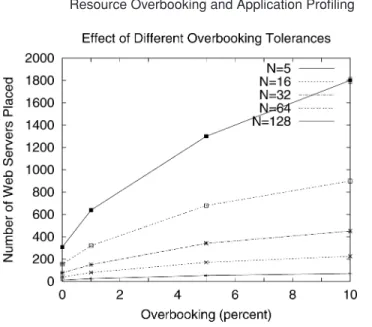
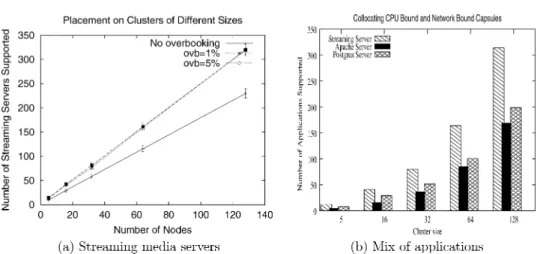
resource needs, the higher are the benefits of resource overbooking. We also find that collocating CPU-bound and network-bound applications as well as bursty and non-bursty applications yields additional multiplexing gains when overbooking resources.
Placement and Isolation of Antagonistic Applications. In a shared hosting platform, it is assumed that third-party applications may be antagonistic to each other and/or the platform itself, either through malice or bugs. A hosting platform should address these issues by isolating applications from one an-other and preventing malicious, misbehaving, or overloaded applications from affecting the performance of other applications.
A third contribution of our work is to demonstrate how untrusted third-party applications can be isolated from one another in shared hosting platforms. This isolation takes two forms. Local to a machine, each processing node in the plat-form employs resource management techniques that “sandbox” applications by restricting the resources consumed by an application to its reserved share. Globally, the process of placement, whereby components of an application are assigned to individual processing nodes, can be constrained by externally im-posed policies—for instance, by risk assessments made by the provider about each application, which may prevent an application from being collocated with certain other applications. Since a manual placement of applications onto nodes is infeasibly complex in large clusters, the design of automated placement tech-niques that allow a platform provider to exert sufficient control over the place-ment process is a key issue.
1.2 System Model and Terminology
The shared hosting platform assumed in our research consists of a cluster of
N nodes, each of which consists of processor, memory, and storage resources as well as one or more network interfaces. Platform nodes are allowed to be heterogeneous with different amounts of these resources on each node. The nodes in the hosting platform are assumed to be interconnected by a high-speed LAN such as gigabit Ethernet. Each cluster node is assumed to run an operating system kernel that supports some notion of quality of service such as reservations or shares. Such mechanisms have been extensively studied over the past decade and many deployed commercial and open-source operating
systems such as Solaris [Sun98b 1998], IRIX [Sgi99 1999], Linux [Sundaram et al. 2000], and FreeBSD [Blanquer et al. 1999; Banga et al. 1999] already support such features.
In this article, we primarily focus on managing two resources—CPU and network interface bandwidth—in shared hosting platforms. The challenges of managing other resources in hosting environments, such as memory, disk band-width, and storage space, are beyond the scope of this article. Nevertheless, we believe the techniques developed here are also applicable to these other resources.
We use the term,application, for a complete service running on behalf of an application provider; since an application will frequently consist of multiple distributed components, we use the termcapsuleto refer to that component of an application running on a single node. Each application has at least one cap-sule, possibly more if the application is distributed. Capsules provide a useful abstraction for logically partitioning an application into subcomponents and for exerting control over the distribution of these components onto different nodes. To illustrate, consider an e-commerce application consisting of a Web server, a Java application server and a database server. If all three components need to be collocated on a single node, then the application will consist of a single capsule with all three components. On the other hand, if each component needs to be placed on a different node, then the application should be partitioned into three capsules. Depending on the number of its capsules, each application runs on a subset of the platform nodes and these subsets can overlap with one another, resulting in resource sharing.
The rest of this article is structured as follows. Section 2 discusses techniques for empirically deriving an application’s resource needs, while Section 3 dis-cusses our resource overbooking techniques and capsule placement strategies. We discuss implementation issues in Section 4 and present our experimental results in Section 5. In Section 6, we discuss related work. Finally, Section 7 presents concluding remarks.
2. AUTOMATIC DERIVATION OF APPLICATION QOS REQUIREMENTS
The first step in hosting a new application is to derive its resource requirements. While the problem of QoS-aware resource management has been studied exten-sively in the literature [Banga et al. 1999; Blanquer et al. 1999; Chandra et al. 2000; Duda and Cheriton 1999; Goyal et al. 1996a, 1996b; Jones et al. 1997; Lin et al. 1998; Leslie et al. 1996; Berger et al. 2003], the problem ofhow much
resource to allocate to each application has received relatively little attention. We assume that an application provider wishes to provide some kind of guar-antee on the QoS it will offer its clients. For example, a Web server may wish to ensure that the response time experienced by its clients is below 1 second on average for requests of a certain type. Similarly, a streaming media server may wish to ensure that the streaming rate it provides to its clients is high enough so that they do not experience more than one playback discontinuity during a two-hour-long movie. In order to provide such guarantees, the application provider needs to determine the amount of resources that the hosting platform
based on worst-case needs, they do not provide sufficient information to enable controlled overbooking of resources. Furthermore, all of these models have to be necessarily developed by the application provider, since developing them re-quires an intimate knowledge of the software architecture of the application. Consequently, the resource requirements inferred using such models leaves lit-tle room for a shared hosting platform to make efficient decisions regarding placing the applications in a manner that will allow it to reduce its costs and improve its revenue.
In this section, we present an alternative approach for application model-ing. We propose a measurement-based technique to automatically derive the resource requirements of an application. As opposed to existing models, our modeling technique can be used by a hosting platform to infer the resource requirements of an application without explicit knowledge of the application’s software architecture. The hosting platform can essentially treat an application as a “black-box”. At the same time, it relieves the application provider of the task of modeling its application to provide the hosting platform with its resource requirements. Our approach is similar in spirit to black-box [Kelly et al. 2004] and gray-box [Arpaci-Dusseau and Arpaci-Dusseau 2001; Burnett et al. 2002] modeling techniques that have been used in other systems domains. In the re-mainder of the article, we will use the terms resource requirements and QoS requirements interchangeably. Deriving the QoS requirements is a two-step process: (i) we first use profiling techniques to monitor application behavior, and (ii) we then use our empirical measurements to derive QoS requirements that conform to the observed behavior.
2.1 Application QoS Requirements: Definitions
The QoS requirements of an application are defined on a per-capsule basis. For each capsule, the QoS requirements specify the intrinsic rate of resource usage, the variability in the resource usage, the time period over which the capsule desires resource guarantees, and the level of overbooking that the application (capsule) is willing to tolerate. As explained earlier, in this article, we are con-cerned with two key resources, namely CPU and network interface bandwidth. For each of these resources, we define the QoS requirements along the above dimensions in an OS-independent manner. In Section 4.1, we show how to map
these requirements to various OS-specific resource management mechanisms that have been developed.
More formally, we represent the QoS requirements of an application capsule by a quintuple (σ,ρ,τ,U,O):
—Token Bucket Parameters(σ,ρ).We capture the basic resource requirements of a capsule by modeling resource usage as a token bucket (σ,ρ) [Tang and Tai 1999]. The parameterσ denotes the intrinsic rate of resource consumption, whileρdenotes the variability in the resource consumption. More specifically,
σ denotes the rate at which the capsule consumes CPU cycles or network interface bandwidth, whileρcaptures the maximum burst size. By definition, a token bucket bounds the resource usage of the capsule toσ·t+ρover any intervalt.
—Periodτ.The third parameterτ denotes the time period over which the cap-sule desires guarantees on resource availability. Put another way, the system should strive to meet the QoS requirements of the capsule over each interval of length τ. The smaller the value ofτ, the more stringent are the desired guarantees (since the capsule needs to be guaranteed resources over a finer time scale). In particular, for the above token bucket parameters, the capsule requires that it be allocated at leastσ ·τ +ρresources everyτ time units. —Usage Distribution U .While the token bucket parameters succinctly capture
the capsule’s resource requirements, they are not sufficiently expressive by themselves to denote the QoS requirements in the presence of overbooking. Consequently, we use two additional parameters—U and O—to specify re-source requirements in the presence of overbooking. The first parameterU
denotes the probability distribution of resource usage. Note thatUis a more detailed specification of resource usage than the token bucket parameters (σ,ρ), and indicates the probability with which the capsule is likely to use a certain fraction of the resource (i.e.,U(x) is the probability that the capsule uses a fraction x of the resource, 0 ≤ x ≤ 1). A probability distribution of resource usage is necessary so that the hosting platform can provide (quan-tifiable) probabilistic guarantees even in the presence of overbooking. —Overbooking Tolerance O. The parameter O is the overbooking tolerance
of the capsule. It specifies the probability with which the capsule’s require-ments may be violated due to resource overbooking (by providing it with less resources than the required amount). Thus, the overbooking tolerance indicates the minimum level of service that is acceptable to the capsule. To illustrate, if O = 0.01, the capsule’s resource requirements should be met 99% of the time (or with a probability of 0.99 in each intervalτ).
In our prior work [Urgaonkar et al. 2002], we had assumed that the pa-rametersτ andOare specified by the application provider. This was assumed to be based on a contract between the platform provider and the application provider (e.g., the more the application provider is willing to pay for resources, the stronger are the provided guarantees), or on the particular characteristics of the application (e.g., a streaming media server requires more stringent guar-antees and is less tolerant to violations of these guarguar-antees than a Web server).
platforms, for a number of reasons. First, being kernel-based, these mecha-nisms work with any application and require no changes to the application at the source or binary levels. This is especially important in hosting environ-ments where the platform provider may have little or no access to third-party applications. Second, accurate estimation of an application’s resource needs re-quires detailed information about when and how much resources are used by the application at a fine time-scale. Whereas detailed resource allocation in-formation is difficult to obtain using application-level techniques, kernel-based techniques can provide precise information about various kernel events such as CPU scheduling instances and network packet transmissions times.
The profiling process involves running the application on a set of isolated
platform nodes (the number of nodes required for profiling depends on the num-ber of capsules). By isolated, we mean that each node runs only the minimum number of system services necessary for executing the application and no other applications are run on these nodes during the profiling process—such isolation is necessary to minimize interference from unrelated tasks when determining the application’s resource usage. The application is then subjected to a realistic workload, and the kernel profiling mechanism is used to track its resource us-age. It is important to emphasize that the workload used during profiling should be both realistic and representative of real-world workloads. While techniques for generating such realistic workloads are orthogonal to our current research, we note that a number of different workload-generation techniques exist, rang-ing from trace replay of actual workloads to runnrang-ing the application in a “live” setting, and from the use of synthetic workload generators to the use of well-known benchmarks. Any such technique suffices for our purpose as long as it realistically emulates real-world conditions, although we note that, from a business perspective, running the application “for real” on an isolated machine to obtain a profile may be preferable to other workload generations techniques. We use the Linux trace toolkit as our kernel profiling mechanism [LTT02]. The toolkit provides flexible, low-overhead mechanisms to trace a variety of kernel events such as system call invocations, process, memory, file system, and network operations. The user can specify the specific kernel events of interest as well as the processes that are being profiled to selectively log events. For our purposes, it is sufficient to monitor CPU and network activity of capsule processes—we monitor CPU scheduling instances (the time instants at which
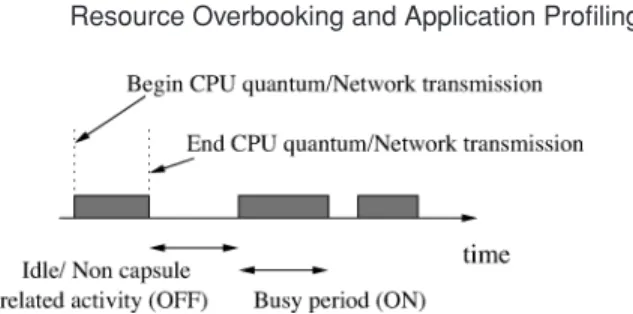
Fig. 1. An example of an On-Off trace.
capsule processes get scheduled and the corresponding quantum durations) as well as network transmission times and packet sizes. Given such a trace of CPU and network activity, we now discuss the derivation of the capsule’s QoS requirements.
2.3 Empirical Derivation of the QoS Requirements
We use the trace of kernel events obtained from the profiling process to model CPU and network activity as a simple On-Off process. This is achieved by ex-amining the time at which each event occurs and its duration and deriving a sequence of busy (On) and idle (Off) periods from this information (see Figure 1). This trace of busy and idle periods can then be used to derive both the resource usage distributionU as well as the token bucket parameters (σ,ρ).
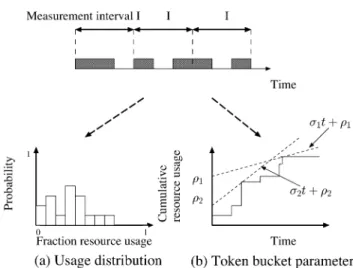
2.3.1 Determining the Usage Distribution U . Recall that the usage distri-butionU denotes the probability with which the capsule uses a certain fraction of the resource. To deriveU, we simply partition the trace into measurement intervals of lengthI and measure the fraction of time for which the capsule was busy in each such interval. This value, which represents the fractional resource usage in that interval, is histogrammed and then each bucket is nor-malized with respect to the number of measurement intervalsI in the trace to obtain the probability distributionU. Figure 2(a) illustrates this process.
2.3.2 Determiningτ and O. We take an empirical approach for determin-ing the parametersτ and O. Our reasons for choosing such an approach are similar to those that we described earlier concerning the shortcomings of an-alytical approaches in accurately capturing the distributions of resource re-quirements needed for achieving controlled overbooking in a shared hosting platform.
Qualitatively, higher values ofτ andOallow the platform to achieve higher utilization while resulting in more instances of QoS violations for the applica-tion. The goal of the hosting platform is to determine the parametersτ andO
that would maximize its revenue. To capture this tradeoff quantitatively, the platform needs to be able to compare the improvement in its revenue due to higher utilization with the possible loss in its revenue due to QoS violations. We assume that an application provider specifies a bound on an application-specific QoS metric (such as an upper bound on the average response time or a lower bound on the throughput) that it requires the hosting platform to guarantee. We also assume that the application provider and the hosting platform agree upon
Fig. 2. Derivation of the usage distribution and token bucket parameters.
a penalty that the platform must pay whenever QoS violations occur despite the application’s workload conforming to its expected intensity.
We conduct a simple search over reasonable values forτ and Oto estimate how the expected revenue for the platform would vary withτ andO. For each chosen pair ofτ andO, we provision the concerned resource (CPU or network bandwidth) corresponding to the (100−O)th percentile of the distributionU de-rived earlier—this represents the minimum amount of the resource that would be available to the application if we were to overbook the resource byO%. We then re-subject the application to the workload used during offline profiling and measure the expected revenue (taking into account penalties due to QoS vio-lations). Our search space is manageably small. First, we discretize the search space and only consider integral values ofτ (in seconds) andO(in multiples of 1%). Second, the time period over which Internet server applications desire re-source guarantees is at most a few seconds. Therefore, we need to search over a small set of values ofτ. Finally, we use a binary search over the range [0%, 50%] to determine the value ofOwhich is expected to provide the peak revenue—a smaller degree of overbooking would not fully exploit statistical multiplexing gains whereas a larger degree of overbooking would cause enough QoS viola-tions to offset the improvement in revenue due to higher utilization.
Deriving Token Bucket Parameters(σ,ρ).Recall that a token bucket limits the resource usage of a capsule toσ·t+ρover any intervalt. A given On-Off trace can have, in general, many (σ,ρ) pairs that satisfy this bound. To intuitively understand why, let us compute the cumulative resource usage for the capsule over time. The cumulative resource usage is simply the total resource consump-tion thus far and is computed by incrementing the cumulative usage after each ON period. Thus, the cumulative resource usage is a step function as depicted in Figure 2(b). Our objective is to find a lineσ·t+ρthat bounds the cumulative re-source usage; the slope of this line is the token bucket rateσand its Y-intercept is the burst size ρ. As shown in Figure 2(b), there are in general many such curves, all of which are valid descriptions of the observed resource usage.
Several algorithms that mechanically compute all valid (σ,ρ) pairs for a given On-Off trace have been proposed recently. We use a variant of one such algorithm [Tang and Tai 1999] in our research—for each On-Off trace, the algo-rithm produces a range ofσ values (i.e., [σmin,σmax]) that constitute valid token
bucket rates for observed behavior. For eachσwithin this range, the algorithm also computes the corresponding burst sizeρ. Although any pair within this range conforms to the observed behavior, the choice of a particular (σ,ρ) has important practical implications.
Since the overbooking tolerance O for the capsule is given, we can use O
to choose a particular (σ,ρ) pair. To illustrate, if O =0.05, the capsule needs must be met 95% of the time, which can be achieved by reserving resources corresponding to the 95th percentile of the usage distribution. Consequently, a good policy for shared hosting platforms is topick aσ that corresponds to the(1−O)∗100thpercentile of the resource usage distribution U ,and to pick the correspondingρas computed by the above algorithm. This ensures that we provision resources based on a high percentile of the capsule’s needs and that this percentile is chosen based on the specified overbooking toleranceO.
2.4 Profiling Server Applications: Experimental Results
In this section, we profile several commonly-used server applications to illus-trate the process of deriving an application’s QoS requirements. Our experimen-tally derived profiles not only illustrate the inherent nature of various server application but also demonstrate the utility and benefits of resource overbook-ing in shared hostoverbook-ing platforms.
The test bed for our profiling experiments consists of a cluster of five Dell Pow-eredge 1550 servers, each with a 966 MHz Pentium III processor and 512 MB memory running Red Hat Linux 7.0. All servers runs the 2.2.17 version of the Linux kernel patched with the Linux trace toolkit version 0.9.5, and are con-nected by 100 Mb/s Ethernet links to a Dell PowerConnect (model no. 5012) Ethernet switch.
To profile an application, we run it on one of our servers and use the remain-ing servers to generate the workload for profilremain-ing. We assume that all machines are lightly loaded and that all nonessential system services (e.g., mail services, X windows server) are turned off to prevent interference during profiling. We profile the following server applications in our experiments:
—Apache Web Server.We use the SPECWeb99 benchmark [SPECWeb99] to gen-erate the workload for the Apache Web server (version 1.3.24). The SPECWeb benchmark allows control along two dimensions—the number of concurrent clients and the percentage of dynamic (cgi-bin) HTTP requests. We vary both parameters to study their impact on Apache’s resource needs.
—MPEG Streaming Media Server. We use a home-grown streaming server to stream MPEG-1 video files to multiple concurrent clients over UDP. Each client in our experiment requests a 15-minute-long variable bit rate MPEG-1 video with a mean bit rate of MPEG-1.5 Mb/s. We vary the number of concurrent clients and study its impact on the resource usage at the server.
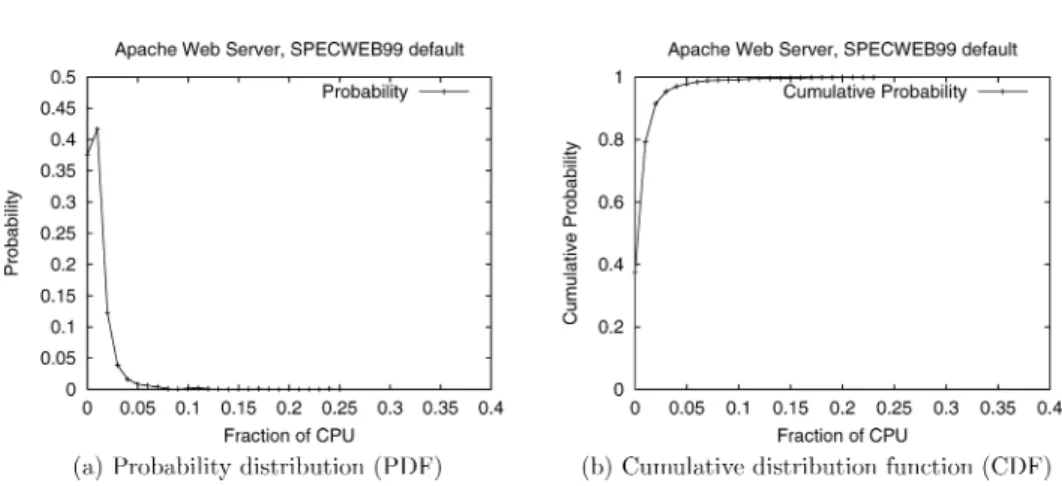
Fig. 3. Profile of the Apache Web server using the default SPECWeb99 configuration.
—Quake Game Server.We use the publicly available Linux Quake server to un-derstand the resource usage of a multi-player game server; our experiments use the standard version of Quake I—a popular multi-player game on the Internet. The client workload is generated using a bot—an autonomous soft-ware program that emulates a human player. We use the publicly available “terminator” bot to emulate each player; we vary the number of concurrent players connected to the server and study its impact on the resource usage. —PostgreSQL Database Server.We profile the postgreSQL database server
(ver-sion 7.2.1) using thepgbench 1.2benchmark. This benchmark is part of the postgreSQL distribution and emulates the TPC-B transactional benchmark [pgbench 2002]. The benchmark provides control over the number of concur-rent clients as well as the number of transactions performed by each client. We vary both parameters and study their impact on the resource usage of the database server.
We now present some results from our profiling study.
Figure 3(a) depicts the CPU usage distribution of the Apache Web server obtained using the default settings of the SPECWeb99 benchmark (50 concur-rent clients, 30% dynamic cgi-bin requests). Figure 3(b) plots the corresponding cumulative distribution function (CDF) of the resource usage. As shown in the figure (and summarized in Table I), the worst-case CPU usage (100th profile) is 25% of CPU capacity. Furthermore, the 99th and the 95th percentiles of CPU usage are 10 and 4% of capacity, respectively. These results indicate that CPU usage is bursty in nature and that the worst-case requirements are significantly higher than a high percentile of the usage. Consequently, under provisioning (i.e., overbooking) by a mere 1% reduces the CPU requirements of Apache by a factor of 2.5, while overbooking by 5% yields a factor of 6.25 reduction (implying that 2.5 and 6.25 times as many Web servers can be supported when provision-ing based on the 99th and 95th percentiles, respectively, instead of the 100th profile). Thus, even small amounts of overbooking can potentially yield signif-icant increases in platform capacity. Figure 4 depicts the possible valid (σ,ρ) pairs for Apache’s CPU usage. Depending on the specified overbooking tolerance
Fig. 4. Token bucket parameters describing the CPU requirements of the Apache Web server using the default SPECWeb99 configuration.
Table I. Summary of Profiles
Res. usage at percentile (σ,ρ)
Application Resource 100th 99th 95th forO=0.01
WS, default CPU 0.25 0.10 0.04 (0.10, 0.218) WS, 50% dynamic CPU 0.69 0.29 0.12 (0.29, 0.382) SMS, k=4 Net 0.19 0.16 0.11 (0.16, 1.89) SMS, k=20 Net 0.63 0.49 0.43 (0.49, 6.27) GS, k=2 CPU 0.011 0.010 0.009 (0.010, 0.00099) GS, k=4 CPU 0.018 0.016 0.014 (0.016, 0.00163) DBS, k=1 (def) CPU 0.33 0.27 0.20 (0.27, 0.184) DBS, k=10 CPU 0.85 0.81 0.79 (0.81, 0.130)
Although we profiled both CPU and network usage for each application, we only present results for the more constraining resource. Abbreviations: WS=Apache, SMS=streaming media server, GS=Quake game server, DBS=database server, k=num. clients.
O, we can setσ to an appropriate percentile of the usage distributionU, and the correspondingρcan then be chosen using this figure.
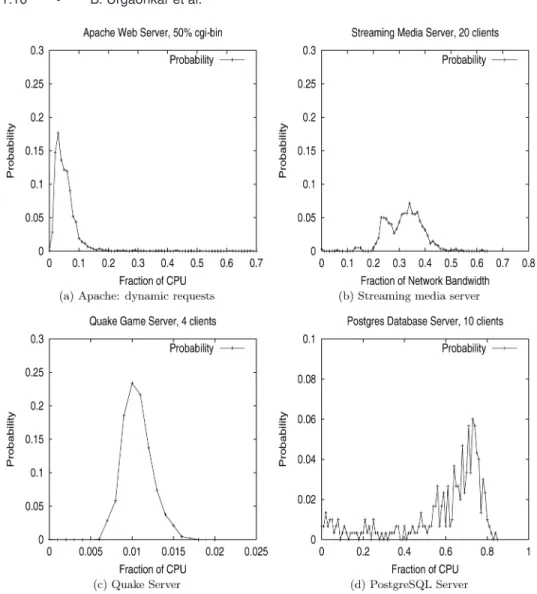
Figures 5(a)–(d) depict the CPU or network bandwidth distributions, as ap-propriate, for various server applications. Specifically, the figure shows the us-age distribution for the Apache Web server with 50% dynamic SPECWeb re-quests, the streaming media server with 20 concurrent clients, the Quake game server with 4 clients and the postgreSQL server with 10 clients. Table I sum-marizes our results and also presents profiles for several additional scenarios (only a small representative subset of the three dozen profiles obtained from our experiments are presented here). Table I also lists the worst-case resource needs as well as the 99th and the 95th percentile of the resource usage.
Together, Figure 5 and Table I demonstrate that all server applications ex-hibit burstiness in their resource usage, albeit to different degrees. This bursti-ness causes the worst-case resource needs to be significantly higher than a high percentile of the usage distribution. Consequently, we find that the 99th percentile is smaller by a factor of 1.1-2.5, while the 95th percentile yields a
Fig. 5. Profiles of Various Server Applications.
factor of 1.3-6.25 reduction when compared to the 100th percentile. Together, these results illustrate the potential gains that can be realized by overbooking resources in shared hosting platforms.
3. RESOURCE OVERBOOKING AND CAPSULE PLACEMENT IN HOSTING PLATFORMS
Having derived the QoS requirements of each capsule, the next step is to deter-mine which platform node will run each capsule. Several considerations arise when making such placement decisions. First, since platform resources are be-ing overbooked, the platform should ensure that the QoS requirements of a capsule will be met even in the presence of overbooking. Second, since multi-ple nodes may have the resources necessary to house each application capsule,
the platform will need to pick a specific mapping from the set of feasible map-pings. This choice will be constrained by issues such as trust among competing applications. In this section, we present techniques for overbooking platform resources in a controlled manner. The aim is to ensure that: (i) the QoS require-ments of the application are satisfied and (ii) overbooking tolerances as well as external policy constraints are taken into account while making placement decisions.
3.1 Resource Overbooking Techniques
A platform node can accept a new application capsule so long as the resource requirements of existing capsules are not violated, and sufficient unused re-sources exist to meet the requirements of the new capsule. However, if the node resources are overbooked, another requirement is added: the overbooking toler-ances of individual capsules already placed on the node should not be exceeded as a result of accepting the new capsule. Verifying these conditions involves two tests:
Test 1: Resource requirements of the new and existing capsules can be met.
To verify that a node can meet the requirements of all capsules, we simply sum the requirements of individual capsules and ensure that the aggregate requirements do not exceed node capacity. For each capsuleion the node, the QoS parameters (σi,ρi) andτi require that the capsule be allocated (σi·τi+ρi)
resources in each interval of duration τi. Further, since the capsule has an
overbooking toleranceOi, in the worst case, the node can allocate only (σi·τi+ ρi)∗(1−Oi) resources and yet satisfy the capsule needs (thus, the overbooking
tolerance represents the fraction by which the allocation may be reduced if the node saturates due to overbooking). Consequently, even in the worst case scenario, the resource requirements of all capsules can be met so long as the total resource requirements do not exceed the capacity:
k+1
i=1
(σi·τmin+ρi)·(1−Oi)≤C·τmin, (1)
whereCdenotes the CPU or network interface capacity on the node,kdenotes the number of existing capsules on the node, k+1 is the new capsule, and
τmin=min(τ1,τ2,. . .,τk+1) is the periodτ for the capsule that desires the most
stringent guarantees.
Test 2: Overbooking tolerances of all capsules are met.The overbooking tol-erance of a capsule is met only if the total amount of overbooking is smaller than its specified tolerance. To compute the aggregate overbooking on a node, we must first compute the total resource usage on the node. Since the usage distributionsUi of individual capsules are known, the total resource on a node
is simply the sum of the individual usages. That is, Y = ki=+11Ui, where Y
denotes the of aggregate resource usage distribution on the node. Assuming each Ui is independent, the resulting distribution Y can be computed from
(1−Omin)×100% of the time.
Equations (1) and (3) can easily handle heterogeneity in nodes by using appropriateCvalues for the CPU and network capacities on each node. A new capsule can be placed on a node if Eqs. (1) and (3) are satisfied for both the CPU and network interface. Since multiple nodes may satisfy a capsule’s CPU and network requirements, especially at low and moderate utilizations, we need to devise policies to choose a node from the set of all feasible nodes for the capsule. We discuss this issue next.
3.2 Capsule Placement Algorithms
Consider an application with mcapsules that needs to be placed on a shared hosting platform with N nodes. For each of themcapsules, we can determine the set of feasibleplatform nodes. A feasible node is one that can satisfy the capsule’s resource requirements (i.e., satisfies Eqs. (1) and (3) for both the CPU and network requirements). The platform must then pick a feasible node for each capsule such that all m capsules can be placed on the platform, with the constraint that no two capsules can be placed on the same node (since, by definition, two capsules from the same application are not collocated).
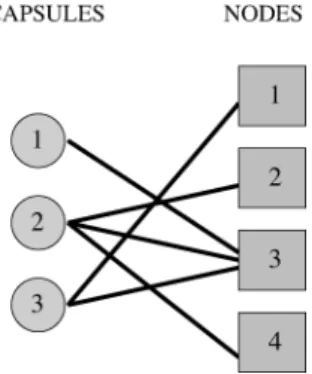
The placement of capsules onto nodes subject to the above constraint can be handled as follows. We model the placement problem using a graph that contains a vertex for each of the m capsules and N nodes. We add an edge from a capsule to a node if that node is a feasible node for the capsule (i.e., has sufficient resources to house the application). The result is a bipartite graph where each edges connects a capsule to a node. Figure 6 illustrates such a graph with three capsules and four nodes. As shown in the figure, determining an appropriate placement is a non-trivial problem since the placement decision for one capsule can impact the placement of other capsules. In the above figure, for instance, placing either capsule 2 or 3 onto node 3 eliminates any possible placement for capsule 1 (which has node 3 as its only feasible node). Multiple
2This is done using the z-transform. The z-transform of a random variableUis the polynomial
Z(U)=a0+za1+z2a2+ · · ·where the coefficient of theith term represents the probability that
the random variable equalsi(i.e.,U(i)). IfU1,U2,. . .,Uk+1arek+1 independent random variables,
andY =ki=+11Ui, thenZ(Y)=ki=+11Z(Ui). The distribution ofY can then be computed using a polynomial multiplication of the z-transforms ofU1,U2,. . .,Uk+1[Papoulis and Pillai 2002].
Fig. 6. A bipartite graph indicating which capsules can be placed on which nodes.
such constraints may exist, all of which will need to be taken into account when determining the final placement.
Given such a graph, we use the following algorithm to determine a placement. This algorithm solves the maximum bipartite matching problem [Cormen et al. 1991] on this graph. If it finds a maximum matching of sizem, then it places the capsules on the nodes that they are associated with in the matching. If, however, the maximum matching is smaller thanm, then there is at least one capsule that cannot be placed. In this case, the algorithm terminates declaring that no placement exists for the application.
LEMMA 1. An application with m capsules can be placed on a hosting
plat-form if, and only if, there is a matching of size m in the bipartite graph G modeling its placement on the platform.
PROOF.
(⇒) A matching of sizeminGspecifies a one-to-one correspondence between capsules and nodes. Since edges connote feasibility, this correspondence is a valid placement.
(⇐) IfG admits no matching of sizem, then any placement of capsules on nodes must end up with distinct capsules sharing the same node. This means that the application cannot be placed without violating the capsule placement restriction.
The run-time of this algorithm is given by the time to solve the maximal bipartite matching problem [Cormen et al. 1991], that is,O((n+M)3).
When there are multiple nodes that a capsule may be placed on, which node should we select?As we will show in Section 5.2, the choice of a particular fea-sible node can have important implications of the total number of applications supported by the cluster. As a baseline, we use a policy that picks a node uni-formly at random when multiple feasible nodes exist. We consider three other policies, in addition to random, for making this decision. The first policy is best-fit, where we choose the feasible node that has the least unused resources (i.e., constitutes the best fit for the capsule). The second policy is worst-fit, where we place the capsule onto the feasible node with the most unused resources. In gen-eral, the unused network and CPU capacities on a node may be different, and
(since Omin = min(0.01, 0.05) = 0.01). On the other hand, placing this
less-tolerant capsule on another node may allow future, more less-tolerant capsules to be placed onto this node, thereby allowing nodes resources to be overbooked to a greater extent. We experimentally compare the effectiveness of these three policies in Section 5.2.
3.3 Policy Constraints on Capsule Placement
Whereas the strategies outlined in the previous section take QoS requirements into account while making placement decisions, they do not consider exter-nally imposed policies that might constrain placement. For example, a platform provider might refuse to collocate capsules from applications owned by compet-ing providers. Alternatively, the decision as to whether to collocate application capsules might be a quantitative one, involving some model of risk assessment. To capture these notions, we quantify the “trust” between a newly ar-riving application and the existing k applications using a trust vector
<T1,T2,. . .,Tk>. Essentially, the vector specifies trust between applications in
a pair-wise fashion; theith element of the vector,Ti, denotes the trust between
the new application and applicationi.Ti can vary between 0 and 1 depending
on the level of trust between the two applications—a value of 0 indicates no trust whatsoever, a 1 indicates complete trust, and intermediate values indi-cate varying degrees of trust. An application capsule should not be colloindi-cated with a capsule with Ti =0. In general, application capsules should be placed
on nodes containing capsules with larger trust values.
3.3.1 Dynamic Determination of Trust Values. In practice, a platform may have little or no basis for determining the trust values between a newly arriving application and the already placed applications. We envision dynamically vary-ing trust values based on measurements of resource usage interference between co-located applications. A shared platform should allow application providers to choose that their application be hosted on dedicated server(s). Such applica-tions would be guaranteed to be immune to any resource assignment violaapplica-tions that overbooking may result in. Such dedicated hosting would, however, come at the cost of higher price of hosting.
Multiple approaches are possible for associating trust values with applica-tions willing to be co-located with other applicaapplica-tions. A simple approach is to
assume any newly arriving application to be completely trustworthy and up-date its trust values (and those of other applications for it) dynamically, as described below. A more sophisticated approach would consider the burstiness in an application resource needs as an indicator of how much other applications may trust it. Intuitively, already placed applications should have lower trust values for more bursty applications.
Our platform would employ dynamic measurements to keep track of chang-ing resource needs of applications. Details of this mechanism appear in Section 3.4. These measurements would be used to update the mutual trust values of co-located applications. Applications whose resource usage behavior deviates from their expected profiles would decrease in how much other applica-tions should trust them. Once such updated trust values have been determined, the platform can employ the enhanced placement algorithm described below for determining where to host various capsules.
3.3.2 Trust-Aware Placement Mechanisms. The policies outlined in the previous section can be modified to account for this notion of potentially an-tagonistic applications (as determined by an external policy). To do so, we en-hance the bipartite graph with a weight on each edge. The weight of an edge is the trust value of the least trust-worthy application capsule on that node and the current application. Edges with a weight 0 are deleted. Given the result-ing bipartite graph, we need to pick a placement that attempts to maximize the sum of the weights of the chosen edges (which ensures that capsules get placed onto nodes running applications that are trusted to a greater extent). The resulting placement decisions are driven by two considerations: (i) metrics such as best-fit, worst-fit or the overbooking tolerance (which impacts the ef-fective platform capacity), and (ii) the weight of the edges (which determines the level of trust between collocated capsules). Such decisions can be made by computing a weighted sum of the two metrics—namely the nature of the “fit” and the weight of the edge—and picking a feasible node with the maximum weighted sum. Thus, we can ensure that external policy constraints are taken into account when making placement decisions.
We now outline an algorithm that a hosting platform can use to determine the “most preferred” placement. We reduce our placement problem to a well-known graph-theoretic problem. The first step in our reduction consists of modifying the weights on the edges of our feasibility graph to ensure that
lower weights mean higher preference. This os done simply by replacing the weight of each edge by its reciprocal. As an example, see the graph on the left of Figure 7 wherein capsule C1 prefers node N2 more than node N1, etc.
The placement problem in such scenarios is to find a maximum matching of minimum weight in this weighted graph. This placement problem reduces to theMinimum-Weight Perfect Matching Problem.
Minimum-Weight Perfect Matching (MWPM). Aperfect matching in a graphGis a subset of edges that “touch” each vertex exactly once. Given a real weightcefor each edgee, theMWPMrequires one to find a perfect matching
The reduction works as follows: By normalization, we may assume that each weightω in the feasibility graphG lies in the range 0 ≤ ω ≤ 1 and that the weights sum to 1. Let there bemcapsules andN ≥mnodes.3Create an
aug-mented graphGby addingN−mnew,dummycapsules and unit-weight edges connecting each with allnodes. Figure 7 exemplifies this reduction. The left-hand graphGshows the normalized preferences of the capsulesC1,C2,C3 for their feasible nodes. The right-hand graphGadds a new capsule,C4, to equal-ize the numbers of capsules and nodes, and adds unit-weight edges betweenC4 and all nodes. (Since the weights of the original edges do not change, they are not shown inG.)
LEMMA 2. A matching of size m and cost c exists in the feasibility graph G
of an application with m capsules and a cluster with N ≥m nodes if, and only if, a perfect matching of cost(c+N−m)exists in the augmented graphG.
PROOF.
(⇒) Given a matching M of sizemand costcinG, we construct a perfect matching M inG as follows.M contains all edges in M, in addition to edges that “touch” each dummy capsule. To choose these latter edges, we consider dummy capsules one by one (in any order), and, for each, we add toM an edge connecting it to any as-yet “untouched” node. SinceGadmits a matching of size
m, and since each dummy capsule connects to allN nodes,Gis certain to have a size-N (hence, perfect) matching. Further, since each edge that “touches” a dummy capsule has unit weight, and there are (N−m) such edges, the cost of
M isc+(N−m).
(⇐) LetGadmit a perfect matchingMof costc+N−m. Consider the setM
comprising allmedges inM that do not “touch” a dummy capsule. SinceM is a matching inG,M is a matching inG. Moreover, the cost of M is justN−m
less than the cost ofM, namely,c.
Thus, the reduction preceding Lemma 2 yields the desired placement algo-rithm. We construct the feasibility graphGAfor application Aand augment it
toGA. IfGAcontains a perfect matching, then we remove the edges that “touch”
dummy capsules and obtain the desired placement. If GA does not contain a
perfect matching, then we know thatAcannot be placed. One finds polynomial-time algorithms for MWPM in Edmonds [1965] and Cook and Rohe [1999].
3.4 Handling Dynamically Changing Resource Requirements
Our discussion thus far has assumed that the resource requirements of an application at run-time do not change after the initial profiling phase. In re-ality though, resource requirements change dynamically over time, in tandem with the workload seen by the application. Hosting platforms need to employ dynamic capacity provisioning to match the resources assigned to hosted ap-plications to their varying workloads [Benani and Menasce 2005; Ranjan et al. 2002; Urgaonkar et al. 2005a; Appleby et al. 2001; Chase and Doyle 2001; Chen et al. 2005; Aron et al. 2000].How should a hosting platform that employs over-booking of resources implement dynamic capacity provisioning?In this section, we outline our approach to address this question.
First, recall that we provision resources based on a high percentile of the application’s resource usage distribution. Consequently, variations in the ap-plication workload that affect only the average resource requirements of the capsules,but not the tail of the resource usage distribution, will not result in violations of the probabilistic guarantees provided by the hosting platform. In contrast, workload changes that cause an increase in the tail of the resource usage distribution will certainly affect application QoS guarantees.
How a platform should deal with such changes in resource requirements depends on several factors. Since we are interested in yield management, the platform should increase the resources allocated to an overload application only if it increases revenues for the platform provider. Thus, if an application provider only pays for a fixed amount of resources, there is no economic incentive for the platform provider to increase the resource allocation beyond this limit even if the application is overloaded. In contrast, if the contract between the application and platform provider permits usage-based charging (i.e., charging for resources based on the actual usage, or a high percentile of the usage4), then
allocating additional resources in response to increased demand is desirable for maximizing revenue. In such a scenario, handling dynamically changing requirements involves two steps: (i) detecting changes in the tail of the resource usage distribution, and (ii) reacting to these changes by varying the actual resources allocated to the application.
To detect such changes in the tail of an application’s resource usage distribu-tion, we propose to conduct continuous, on-line profiling of the resource usage of all capsules using low-overhead profiling tools. This would be done by recording the CPU scheduling instants, network transmission times and packet sizes for all processes over intervals of a suitable length. At the end of each interval, this data would be processed to construct the latest resource usage distribu-tions for all capsules. An application overload would manifest itself through an increased concentration in the high percentile buckets of the resource usage distributions of its capsules.
4ISPs charge for network bandwidth in this fashion—the customer pays for the 95th percentile of
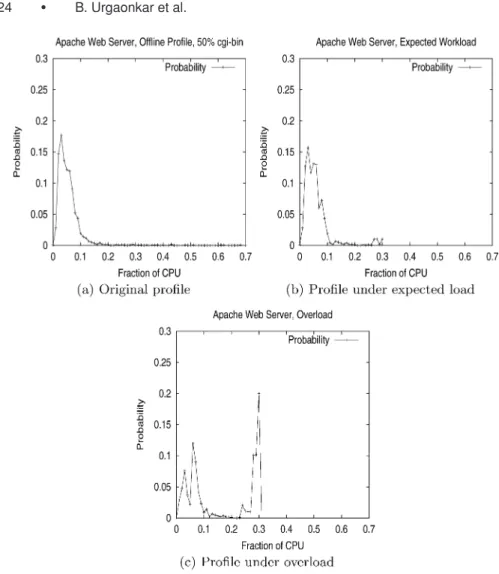
Fig. 8. Demonstration of how an application overload may be detected by comparing the latest resource usage profile with the original offline profile.
We present the results of a simple experiment to illustrate this. Figure 8(a) shows the CPU usage distribution of the Apache Web server obtained via of-fline profiling. The workload for the Web server was generated by using the SPECWeb99 benchmark emulating 50 concurrent clients with 50% dynamic cgi-bin requests. The offline profiling was done over a period of 30 minutes. Next, we assumed an overbooking tolerance of 1% for this Web server cap-sule. As described in Section 2.3, it was assigned a CPU rate of 0.29 (corre-sponding to the 99th percentile of its CPU usage distribution). The remaining capacity was assigned to a greedydhrystoneapplication (this application per-forms compute-intensive integer computations and greedily consumes all re-sources allocated to it). The Web server was then subjected to exactly the same workload (50 clients with 50% cgi-bin requests) for 25 minutes, followed by a heavier workload consisting of 70 concurrent clients with 70% dynamic cgi-bin requests for 5 minutes. The heavier workload during the last 5 minutes was
to simulate an unexpected flash crowd. The Web server’s CPU usage distribu-tion was recorded over periods of length 10 minute each. Figure 8(b) shows the CPU usage distribution observed for the Web server during a period of ex-pected workload. We find that this profile is very similar to the profile obtained using offline measurements, except being upper-bounded by the CPU rate as-signed to the capsule. Figure 8(c) plots the CPU usage distribution during the period when the Web server was overloaded. We find an increased concentra-tion in the high percentile regions of this distribuconcentra-tion compared to the original distribution.
The detection of application overload would trigger remedial actions that would proceed in two stages. First, new resource requirements would be com-puted for the affected capsules. Next, actions would be taken to provide the capsules the newly computed resource shares—this may involve increasing the resource allocations of the capsules, or moving the capsules to nodes with sufficient resources. Implementing and evaluating these techniques for han-dling application overloads are part of our ongoing research on shared hosting platforms. We have designed, implemented, and evaluated such remedial ac-tions in a recent paper on dynamic capacity provisioning in hosting platforms [Urgaonkar et al. 2005b]. These techniques can be used by a shared hosting platform employing resource overbooking to dynamically adjust the placement of hosted applications in response to varying workloads.
4. IMPLEMENTATION CONSIDERATIONS
In this section, we first discuss implementation issues in integrating our re-source overbooking techniques with OS rere-source allocation mechanisms. We then present an overview of our prototype implementation.
4.1 Providing Application Isolation at Run Time
The techniques described in the previous section allow a platform provider to overbook platform resources and yet provide guarantees that the QoS require-ments of applications will be met. The task of enforcing these guarantees at run-time is the responsibility of the OS kernel. To meet these guarantees, we assume that the kernel employs resources allocation mechanisms that sup-port some notion of quality of service. Numerous such mechanisms—such as reservations, shares and token bucket regulators [Banga et al. 1999; Duda and Cheriton 1999; Jones et al. 1997; Leslie et al. 1996]—have been proposed re-cently. All of these mechanisms allow a certain fraction of each resource (CPU cycles, network interface bandwidth) to be reserved for each application and enforce these allocations on a fine time scale.
In addition to enforcing the QoS requirements of each application, these mechanisms also isolate applications from one another. By limiting the re-sources consumed by each application to its reserved amount, the mechanisms prevent a malicious or overloaded application from grabbing more than its allo-cated share of resources, thereby providing application isolation at run-time— an important requirement in shared hosting environments running untrusted applications.
by setting (1−Oi)·σi= xyii and (1−Oi)·ρi =xi. To see why, recall that (1−Oi)·σi
denotes the rate of resource consumption of the capsule in the presence of overbooking, which is same as xi
yi. Further, since the capsule can request xi
units of the CPU every yi time units, and in the worst case, the entirexi units
may be requested continuously, we set the burst size to be (1−Oi)·ρi = xi.
These equations simplify toxi =(1−Oi)·ρiand yi =ρi/σi.
Proportional-Share and Lottery Schedulers. Proportional-share and lottery schedulers [Duda and Cheriton 1999; Goyal et al. 1996a, 1996b; Waldspurger and Weihl 1994] enable resources to be allocated in relative terms—in ei-ther case, a capsule is assigned a weight wi (or wi lottery tickets) causing
the scheduler to allocate wi
jwj fraction of the resource. Further, two
cap-sules with weights wi and wj are allocated resources in proportion to their
weights (wi :wj). For such schedulers, the QoS requirements of a capsule can
be translated to a weight by settingwi=(1−Oi)·σi. By virtue of using a
sin-gle parameterwi to specify the resource requirements, such schedulers ignore
the burstiness ρ in the resource requirements. Consequently, the underlying scheduler will only approximate the desired QoS requirements. The nature of approximation depends on the exact scheduling algorithm—the finer the time-scale of the allocation supported by the scheduler, the better will the actual allocation approximate the desired requirements.
Rate Regulators. Rate regulators are commonly used to police the network interface bandwidth used by an application. Such regulators limit the sending rate of the application based on a specified profile. A commonly used regulator is the token bucket regulator that limits the amount of bytes transmitted by an application toσ ·t+ρover any intervalt. Since we model resource usage of a capsule as a token bucket, the QoS requirements of a capsule trivially map to an actual token bucket regulator and no special translation is necessary.
4.2 Prototype Implementation
We have implemented a Linux-based shared hosting platform that incorpo-rates the techniques discussed in the previous sections. Our implementation consists of three key components: (i) a profiling module that allows us to profile
applications and empirically derive their QoS requirements, (ii) a control plane that is responsible for resource overbooking and capsule placement, and (iii) a QoS-enhanced Linux kernel that is responsible for enforcing application QoS requirements.
The profiling module runs on a set of dedicated (and therefore isolated) plat-form nodes and consists of a vanilla Linux kernel enhanced with the Linux trace toolkit. As explained in Section 2, the profiling module gathers a kernel trace of CPU and network activities of each capsule. It then post-processes this information to derive an On-Off trace of resource usage and then derives the usage distributionU and the token bucket parameters for this usage.
The control plane is responsible for placing capsules of newly arriving ap-plications onto nodes while overbooking node resources. The control plane also keeps state consisting of a list of all capsules residing on each node and their QoS requirements. It also maintains information about the hardware characteris-tics of each node. The requirements of a newly arriving application are specified to the control plane using a resource specification language. This specification includes the CPU and network bandwidth requirements of each capsule and the trust vector. The control plane uses this specification to derive a placement for each capsule as discussed in Section 3.2. In addition to assigning each capsule to a node, the control plane also translates the QoS parameters of the capsules to parameters of commonly used resource allocation mechanisms (discussed in the previous section).
The third component, namely the QoS-enhanced Linux kernel, runs on each platform node and is responsible for enforcing the QoS requirements of capsules at run time. We choose Linux over other operating system kernels since a number of QoS-aware resource allocation mechanisms have already been implemented in Linux, allowing us to experiment with these mecha-nisms. For the purposes of this article, we implement the H-SFQ proportional-share CPU scheduler [Goyal et al. 1996a, 1996b]. H-SFQ is a hierarchical
proportional-share scheduler that allows us to group resource principals (pro-cesses, lightweight processes) and assign an aggregate CPU share to the entire group. This functionality is essential since a capsule contains all processes of an application that are collocated on a node and the QoS requirements are specified for the capsule as a whole rather than for individual resource prin-cipals. To implement such an abstraction, we create a separate node in the H-SFQ scheduling hierarchy for each capsule, and attach all resource princi-pals belonging to a capsule to this node. The node is then assigned a weight (determined using the capsule’s QoS requirements) and the CPU allocation of the capsule is shared by all resource principals of the capsule.5We implement
a token bucket regulator to provide QoS guarantees at the network interface card. Our rate regulator allows us to associate all network sockets belonging to a group of processes to a single token bucket. We instantiate a token bucket regulator for each capsule and regulate the network bandwidth usage of all resource principals contained in this capsule using the (σ,ρ) parameters of the
5The use of the scheduling hierarchy to further multiplex capsule resources among resource