R
R
O
O
A
A
D
D
S
S
A
A
F
F
E
E
T
T
Y
Y
A
A
U
U
D
D
I
I
T
T
S
S
:
:
C
Notice
This document is disseminated under the sponsorship of the U.S.
Department of Transportation in the interest of information exchange. The
U.S. Government assumes no liability for the use of the information
contained in this document. This report does not constitute a standard,
specification, or regulation.
The U.S. Government does not endorse products or manufacturers.
Trademarks or manufacturers’ names appear in this report only because
they are considered essential to the objective of the document.
Quality Assurance Statement
The Federal Highway Administration (FHWA) provides high-quality
information to serve Government, industry, and the public in a manner
that promotes public under-standing. Standards and policies are used to
ensure and maximize the quality, objectivity, utility, and integrity of its
information. FHWA periodically reviews quality issues and adjusts its
programs and processes to ensure continuous quality improvement.
5. Report Date
December 2006
4. Title and Subtitle
Road Safety Audits: Case Studies
6. Performing Organization
Code
7. Authors
Margaret Gibbs; Sany R. Zein; Dan Nabors; Hugh McGee; Kim Eccles
8. Performing Organization
Report No.
9. Performing Organization Name and Address
10. Work Unit No.
Opus Hamilton Consultants Ltd
900 – 1199 West Hastings Street
Vancouver, B.C., Canada V6E 3T5
Vanasse Hangen Brustlin Inc
700 – 8300 Boone Boulevard
Vienna, VA 22182-2626
11. Contract or Grant No.
DTFH61-03-D-00105
13. Type of Report and Period
Covered
Final Report
Dec 2004 – April 2006
12. Sponsoring Agency Name and Address
Office of Safety
Federal Highway Administration
U.S. Department of Transportation
400 Seventh Street SW, HSA-20
Washington, D.C. 20590
14. Sponsoring Agency Code
15. Supplementary Notes: The Federal Highway Administration (Office of Safety) sponsored the RSAs
reported in this document. The FHWA Office of Safety Contract Task Order Manager was Louisa Ward.
16. Abstract
Road Safety Audits (RSAs) are an effective tool for proactively improving the future safety performance of a
road project during the planning and design stages, and for identifying safety issues in existing transportation
facilities. To demonstrate the effectiveness of RSAs, the Federal Highway Administration (FHWA) Office
of Safety sponsored a series of ten RSAs. The aim of these case studies was to demonstrate the usefulness
and effectiveness of RSAs for a variety of projects and project stages, and in a variety of agencies throughout
the United States.
The results of the RSAs have been compiled in this case studies document. Each case study includes
photographs, a project description, a summary of key findings, and the lessons learned. The aim of this
document is to provide state and local agencies and Tribal governments with examples and advice that can
assist them in implementing RSAs in their own jurisdictions.
17. Key Words
Safety, Road Safety Audit
18. Distribution Statement
No restrictions. This document is available to the public through
the National Technical Information Service, Springfield, VA
22161.
PREFACE
Road Safety Audits (RSAs) are an effective tool for proactively improving the
future safety performance of a road project during the planning and design stages,
and for identifying safety issues in existing transportation facilities. Additional
information on RSAs is available on the web at
http://safety.fhwa.dot.gov/rsa
and
www.roadwaysafetyaudits.org
.
Information for the case studies reported in this document was gathered during a
series of ten RSAs conducted throughout the United States during 2004-2006,
involving transportation agencies at the city, county, state, federal, and tribal
levels, and examining roadway projects at all stages of design and operation.
FHWA and the authors greatly appreciate the cooperation of the following
agencies for their willing and enthusiastic participation in the FHWA-sponsored
RSA series: Illinois DOT, Oklahoma DOT, Oregon DOT, Wisconsin DOT, the
Standing Rock Sioux Tribe, the City of Cincinnati, the City of Tucson, Clark County
(WA), Collier County (FL), and the National Park Service.
TABLE OF CONTENTS
INTRODUCTION 1
Background 1
What is an RSA? 1
The FHWA RSA Case Study Program 3
THE RSA PROCESS 5
Eight Steps of an RSA 5
Prioritization of Issues for Design-Stage RSAs 8
RSAs: COSTS AND BENEFITS 10
RSA Costs 10
RSA Benefits 11
THE FHWA RSA CASE STUDY PROJECT: PROMOTING THE ACCEPTANCE OF RSAs 14
Key Factors for Success 14
Lessons Learned 19
CONCLUSION 22
APPENDIX A: CASE STUDY RSAs A-1
RSA 1 Illinois DOT A-2
RSA 2 Oklahoma DOT A-5
RSA 3 Oregon DOT A-8
RSA 4 Wisconsin DOT A-12
RSA 5 Clark County A-17
RSA 5 Collier County A-21
RSA 7 City of Cincinnati A-25
RSA 8 City of Tucson A-29
RSA 9 Standing Rock Sioux Tribe A-32
RSA 10 Yellowstone National Park A-36
LIST OF FIGURES
FIGURE 1 RSA PROCESS 5
FIGURE 2 START-UP MEETING 6
FIGURE 3 FIELD REVIEW 6
FIGURE 4 RSA ANALYSIS SESSION 7
FIGURE 5 PRELIMINARY FINDINGS MEETING 7
LIST OF TABLES
TABLE 1 CASE STUDY RSAs 3
TABLE 2 FREQUENCY RATING 9
TABLE 3 SEVERITY RATING 9
INTRODUCTION
Background
Road Safety Audits (RSAs) are an effective tool for proactively improving the
future safety performance of a road project during the planning and design stages,
and for identifying safety issues in existing transportation facilities.
To demonstrate the effectiveness of RSAs, in December 2003 the Federal
Highway Administration (FHWA) Office of Safety sponsored a RSA of the
Marquette Interchange in Milwaukee, WI. The RSA team reviewed the detailed
design for an $800 million interchange reconstruction project. Subsequently, in
the summer of 2004, the FHWA Office of Safety commissioned a series of nine
additional RSAs. The aim of these case studies was to demonstrate the
usefulness and effectiveness of RSAs for a variety of projects and project stages,
and in a variety of agencies throughout the United States.
The results of the RSAs have been compiled in this case studies document. Each
case study includes photographs, a project description, a summary of key findings,
and the lessons learned. The aim of this document is to provide state and local
agencies and Tribal governments with examples and advice that can assist them
in implementing RSAs in their own jurisdictions.
What is an RSA?
A road safety audit (RSA) is a formal safety performance examination of an
existing or future road or intersection by an independent, multidisciplinary team.
Compromises and constraints among the competing interests that typically drive a
road project (such as cost, right of way, environment, topographic and
geotechnical conditions, socioeconomic issues, and capacity/efficiency) are a
normal part of the planning and design process. The design team has the
responsibility of integrating these competing interests to arrive at a design that
accommodates these interests in as balanced and effective a manner as possible.
RSAs, conducted by a team that is independent of the design, enhance safety by
explicitly and exclusively identifying the safety implications of project decisions. By
focusing on safety, RSAs make sure that safety does not “fall through the cracks”.
The RSAs followed the procedures outlined in the FHWA Road Safety Audit
Guidelines document (Publication Number FHWA-SA-06-06). The procedures
involve an eight-step RSA process discussed later in this case study document.
The multidisciplinary RSA team is typically composed of at least three members
having a background in road safety, traffic operations, and/or road design, and
members from other areas such as maintenance, human factors, enforcement,
and first responders. Members of the RSA team are independent of the
operations of the road or the design of the project being audited. The RSA team’s
independence assures two things: that there is no potential conflict of interest or
defensiveness, and the project is reviewed with “fresh eyes”.
RSAs can be done at any stage in a project’s life:
•
A
pre-construction RSA (planning and design stages)
examines a road
before it is built, at the planning/feasibility stage or the design (preliminary
or detailed design) stage. An RSA at this stage identifies potential safety
issues before crashes occur. The earlier a pre-construction RSA is
conducted, the more potential it has to efficiently remedy possible safety
concerns.
•
Construction RSAs (work zone, changes in design during construction, and
pre-opening)
examine temporary traffic management plans associated with
construction or other roadwork, and changes in design during construction.
RSAs at this stage can also be conducted when construction is completed
but before the roadway is opened to traffic.
•
A
post-construction or operational RSA (existing road)
examines a road that
is operating, and is usually conducted to address a demonstrated crash
problem.
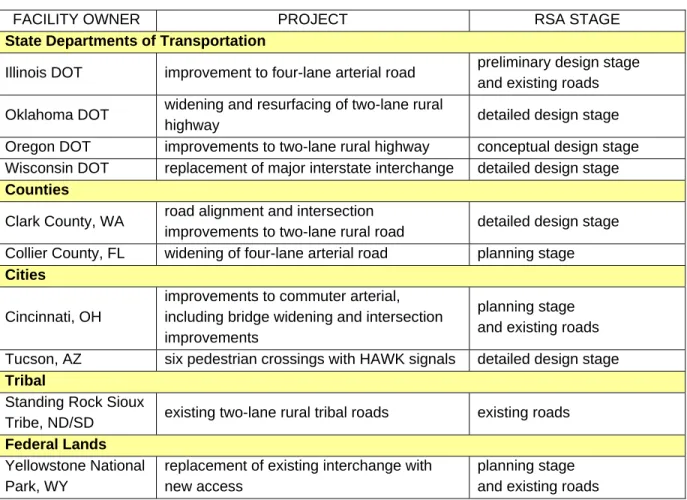
The FHWA RSA Case Study Program
The ten RSAs conducted in this case study program are summarized in Table 1.
TABLE 1 CASE STUDY RSAs
FACILITY OWNER PROJECT RSA STAGE
State Departments of Transportation
Illinois DOT improvement to four-lane arterial road preliminary design stage and existing roads Oklahoma DOT widening and resurfacing of two-lane rural
highway detailed design stage
Oregon DOT improvements to two-lane rural highway conceptual design stage Wisconsin DOT replacement of major interstate interchange detailed design stage
Counties
Clark County, WA road alignment and intersection
improvements to two-lane rural road detailed design stage Collier County, FL widening of four-lane arterial road planning stage
Cities
Cincinnati, OH
improvements to commuter arterial, including bridge widening and intersection improvements
planning stage and existing roads Tucson, AZ six pedestrian crossings with HAWK signals detailed design stage
Tribal
Standing Rock Sioux
Tribe, ND/SD existing two-lane rural tribal roads existing roads
Federal Lands
Yellowstone National Park, WY
replacement of existing interchange with new access
planning stage and existing roads
All participating transportation agencies volunteered to be involved in this RSA
program. Involvement in the case study program required the agency to nominate
the project for the RSA; provide the RSA team with the materials (such as design
drawings) on which the RSA would be based, or that provided useful background
information, such as justification reports, traffic counts, collision data, or the results
of public hearings; participate at a senior level in the RSA start-up and closing
meetings; and contribute at least one engineer from their staff, not previously
involved in the project, to participate on the RSA team. The RSA teams were led
by two experienced and independent consultants.
THE RSA PROCESS
Eight Steps of an RSA
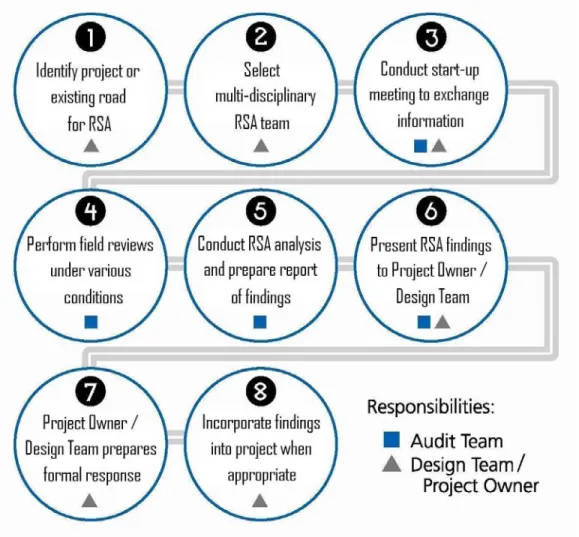
The eight steps of an RSA are shown in Figure 1, and are discussed below with
reference to the case studies.
FIGURE 1 RSA PROCESS
RSA projects
and the
RSA team
(Steps 1 and 2) were pre-selected in this FHWA
case studies project. All meetings and site visits for the RSAs in the case studies
project were conducted over two to four days, depending on the size and
complexity of the project. The RSAs typically began with a
start-up meeting
(Step 3) attended by the Project Owner (hereafter referred to as the Owner), the
Design Team, and the RSA team:
•
The Owner described the objectives of the road project, including why it
was being pursued and the improvements it was expected to accomplish.
The Owner also explained why this project had been chosen for an RSA.
•
The Design Team then described the road design (if the RSA was being
conducted on a design), including a description of its individual elements;
the current design stage and anticipated design/construction schedule; and
the constraints and challenges involved in the design.
•
The
multidisciplinary
RSA team then described the RSA process. This
included an overview of the RSA process with examples of safety issues
that are typically encountered and mitigation measures to address them.
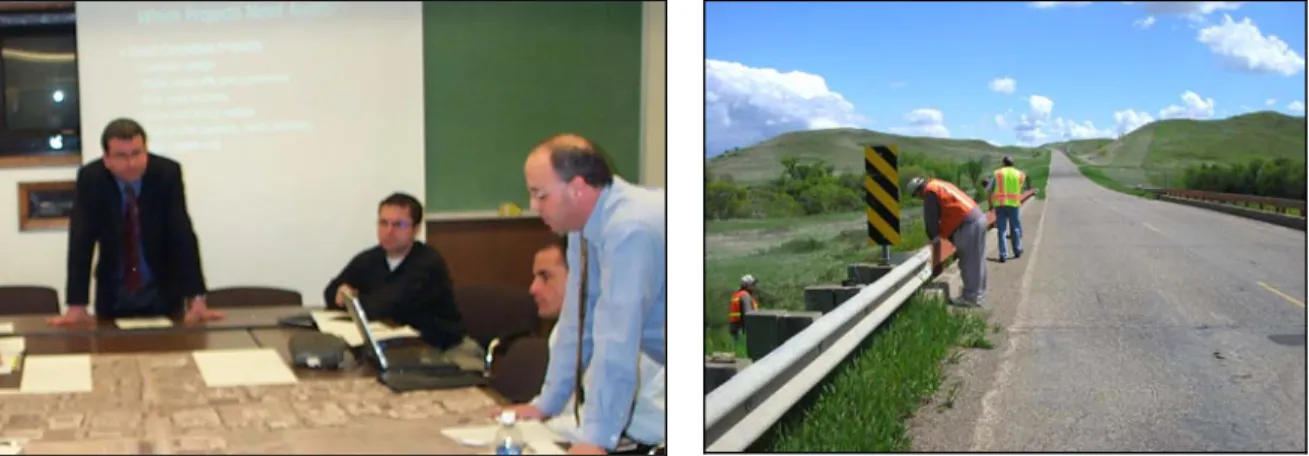
Illinois DOT Standing Rock Sioux Reservation
FIGURE 2
START-UP MEETING
FIGURE 3
FIELD REVIEW
Following the start-up meeting and a preliminary review of the design or site
documentation provided by the Owner and Design Team, the RSA team
conducted a
field review
(Step 4). The purpose of the field review was to observe
the ambient conditions in which the proposed design would operate (for
design-stage RSAs), or to observe geometric and operating conditions (for RSAs of
existing roads). The RSA team observed road user characteristics (such as
typical speeds and traffic mix), surrounding land uses (including traffic and
pedestrian generators), and link points to the adjacent transportation network.
Field reviews were conducted by the RSA team under a variety of environmental
conditions (such as daytime and night-time) and operational conditions (such as
peak and non-peak times).
The team conducted the
RSA analysis
(Step 5) in a setting in which all team
members reviewed available background information (such as design criteria,
project/justification reports, traffic volumes, and any relevant collision data) and
drawings. The RSA analysis methodology involved a systematic review of design
drawings, examining features such as road geometry, sight distances, clear zones,
drainage, signing, lighting, and barriers. Human factors issues were also
considered by the RSA team, including road and intersection “readability”, sign
location and sequencing, older-driver limitations, and driver perception of
geometric features constructed to minimum standards. On the basis of this review
of drawings, reports, and information obtained during the field review, the RSA
team identified and prioritized safety issues, project features that could contribute
to a higher frequency and/or severity of crashes. For each safety issue, the RSA
team generated a list of possible ways to mitigate the crash potential.
At the end of the analysis session, the Owner, Design Team, and RSA team
reconvened for a
preliminary findings meeting
(Step 6). Presenting the
preliminary findings verbally in a meeting gave the Owner and Design Team the
opportunity to ask questions and seek clarification on the RSA findings, and also
provided a useful forum for the Owner and Design Team to suggest additional or
alternative mitigation measures in conjunction with the RSA team. The discussion
provided practical information that was subsequently used to write the RSA report.
Marquette Interchange RSA (Milwaukee, WI) Collier County, FL
FIGURE 4
RSA ANALYSIS SESSION
FIGURE 5
In the weeks following the on-site portion of the RSA, the RSA team wrote and
issued the
RSA report
(also part of Step 6) to the Owner and Design Team
documenting the results of the RSA. The main contents of the RSA report were a
prioritized listing and description of the safety issues identified (illustrated using
photographs taken during the site visit), with suggestions for improvements.
The Owner and Design Team were then encouraged to write a brief
response
letter
(Step 7) containing a point-by-point response to each of the safety issues
identified in the RSA report. The response letter identifies the action(s) to be
taken, or explains why no action would be taken. The formal response letter is an
important “closure” document for the RSA. As a final step, the Owner and Design
Team use the RSA findings to identify and implement safety improvements as and
when policy, manpower, and funding permit (Step 8).
Prioritization of Issues for Design-Stage RSAs
For design-stage RSAs, a prioritization framework was applied in both the RSA
analysis and presentation of findings. The likely
frequency
and
severity
of crashes
associated with each safety issue were qualitatively estimated, based on team
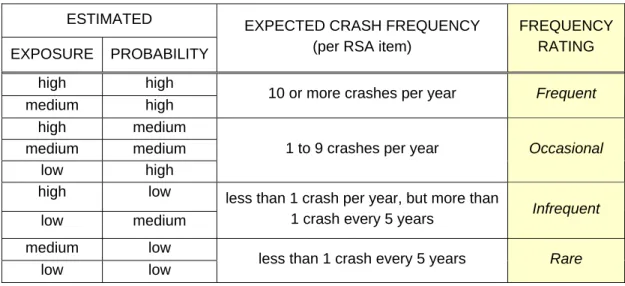
members’ experience and expectations. Expected crash
frequency
(Table 2) was
qualitatively estimated on the basis of expected exposure (how many road users
would likely be exposed to the identified safety issue?) and probability (how likely
was it that a collision would result from the identified issue?). Expected crash
severity
(Table 3) was qualitatively estimated on the basis of factors such as
anticipated speeds, expected collision types, and the likelihood that vulnerable
road users would be exposed. These two risk elements (frequency and severity)
were then combined to obtain a qualitative risk assessment on the basis of the
matrix shown in Table 4. Consequently, each safety issue was prioritized on the
basis of a ranking between A (lowest risk and lowest priority) and F (highest risk
and highest priority). It should be stressed that this prioritization method was
qualitative, based on the expectations and judgment of the RSA team members,
and was employed to help the Owner and Design Team prioritize the multiple
issues identified in the RSA.
For each safety issue identified, possible mitigation measures were suggested.
The suggestions focused on measures that could be cost-effectively implemented
at the current design stage.
TABLE 2 FREQUENCY RATING
ESTIMATED
EXPOSURE PROBABILITY
EXPECTED CRASH FREQUENCY (per RSA item)
FREQUENCY RATING high high
medium high 10 or more crashes per year Frequent
high medium medium medium
low high
1 to 9 crashes per year Occasional high low
low medium
less than 1 crash per year, but more than
1 crash every 5 years Infrequent medium low
low low less than 1 crash every 5 years Rare
TABLE 3 SEVERITY RATING
TYPICAL CRASHES EXPECTED (per RSA item)
EXPECTED CRASH SEVERITY
SEVERITY RATING crashes involving high speeds or heavy
vehicles, pedestrians, or bicycles
probable fatality or
incapacitating injury Extreme crashes involving medium to high speed;
head-on, crossing, or off-road crashes moderate to severe injury High crashes involving medium to low speeds;
left-turn and right-turn crashes minor to moderate injury Moderate crashes involving low to medium speeds;
rear-end or sideswipe crashes
property damage only or
minor injury Low
TABLE 4 CRASH RISK ASSESSMENT
SEVERITY RATING FREQUENCY
RATING Low Moderate High Extreme
Frequent C D E F
Occasional B C D E
Infrequent A B C D
Rare A A B C
Crash Risk Ratings: A: lowest risk level C: moderate-low risk level E: high risk level B: low risk level D: moderate-high risk level F: highest risk level
RSAs: COSTS AND BENEFITS
RSA Costs
Three main factors contribute to the cost of an RSA:
•
RSA team costs,
•
design team and owner costs,
•
costs of design changes or enhancements.
The
RSA team costs
reflect the size of the team and the time required for the
RSA, which in turn are dependent on the complexity of the RSA project. For the
RSAs in this case studies project, the following cost components are noted:
•
RSA teams were composed of between four and ten persons in this case
studies project, but these teams were large since the RSAs served as
training exercises for local engineering staff. Without the need for training,
the RSA teams would more typically have been composed of three or four
persons.
•
Opening and closing meetings, site visits, and RSA analysis sessions were
conducted in a three-day period for each RSA.
•
Prior to and following the on-site portion of the RSA, the time required for
analysis (such as analysis of collision records, and research on applicable
design standards or mitigation measures) and writing the RSA report
ranged between 20 and 55 man-hours, with 30 to 40 man-hours being
typical. The wide range primarily reflected the number and complexity of
the issues identified during the RSA.
For this case studies project, additional RSA team costs were incurred in travel for
experienced RSA team leaders. However, typical RSAs would employ local team
members, and consequently entail only minor travel costs.
The
design team and owner costs
reflect the time required for staff to attend the
start-up and preliminary findings meetings, and to subsequently read the RSA
report and respond to its findings. In addition, staff time is required to compile
design drawings and other project or site materials for the RSA team.
The final cost component is that resulting from
design changes or enhancements,
which reflect the number and complexity of the issues identified during the RSA.
Suggested design changes and enhancements, listed in the Appendix (Tables A.1
through A.12) for each of the RSAs conducted for this case studies project, have
focused on low-cost improvements or countermeasures where possible.
•
Suggested improvements for the four RSAs of existing roads focused
mainly on improved signing, signal enhancements, parking and access
management.
•
Suggested improvements for the four detailed-design RSAs focused on
improved signing and pavement markings, minor or moderate geometric
changes (such as added auxiliary lanes at intersections), and barrier
improvements. It should be noted, however, that one project owner initiated
a fundamental reconsideration of its entire project on the basis of the RSA
findings, which identified fundamental concerns regarding the net safety
benefits of the improvement project.
•
Suggestions for the preliminary and planning stage RSAs ranged from
minor improvements such as signing, through moderate geometric
improvements such as median and gateway treatments, to suggestions
related to fundamental issues such as design vehicles, design volumes,
and access restrictions.
RSA Benefits
The primary benefits of RSAs are to be found in reduced crash costs as road
safety is improved. The costs of automotive crashes are estimated by the US
Department of Transportation
1as:
•
$3,000,000 for a traffic fatality,
•
$2,290,000 for a critical injury,
•
$565,000 for a severe injury,
•
$175,000 for a serious injury,
•
$45,000 for a moderate injury,
•
$6,000 for a minor injury.
1 Intersection Safety Issue Brief No. 15 (“Road Safety Audits: An Emerging and Effective Tool for Improved Safety”), issued
Other benefits of RSAs include reduced life-cycle project costs as crashes and the
need for retrofitted safety improvements are reduced, and the development of
good safety engineering and design practices, including integration of multimodal
safety concerns and consideration of human factors in the design.
As mentioned in the recent FHWA/ITE Intersection Safety Issue Brief on RSAs, it
is difficult to quantify the benefits of design-stage RSAs, since they aim to prevent
crashes from occurring on new or improved facilities that have no crash record.
However, when compared with the high cost of motor-vehicle injuries discussed
above, the moderate cost of a design-stage RSA suggests that changes
implemented from an RSA only need to prevent a few moderate- or high-severity
crashes for an RSA to be cost effective.
The benefits of RSAs on existing roads can be more easily quantified, since
pre-and post-improvement collision histories are available. As an example, the Road
Improvement Demonstration Project conducted by AAA Michigan in Detroit and
Grand Rapids (MI), which is based on RSAs of existing high-crash urban
intersections and implementation of low-cost safety measures at them, has
demonstrated a benefit-cost ratio of 16:1.
Another example of U.S. data on the quantitative safety benefit of RSAs
conducted on existing roads comes from the New York DOT, which reports a 20 to
40 percent reduction in crashes at more than 300 high-crash locations that had
received surface improvements and had been treated with other low-cost safety
improvements suggested by RSAs.
The South Carolina DOT RSA program has had a positive impact on safety. Early
results from four separate RSAs, following one year of results, are promising. One
site, implementing four of eight suggested improvements, saw total crashes
decrease 12.5 percent, resulting in an economic savings of $40,000. A second
site had a 15.8 percent increase in crashes after only two of the thirteen
suggestions for improvements were incorporated. A third site, implementing all
nine suggested improvements, saw a reduction of 60 percent in fatalities, resulting
in an economic savings of $3,660,000. Finally, a fourth location, implementing 25
of the 37 suggested safety improvements, had a 23.4 percent reduction in
crashes, resulting in an economic savings of $147,000.
The most objective and most often-cited study of the benefits of RSAs, conducted
in Surrey County, United Kingdom, compared fatal and injury crash reductions at
19 audited highway projects to those at 19 highway projects for which RSAs were
not conducted. It found that, while the average yearly fatal and injury crash
frequency at the RSA sites had dropped by 1.25 crashes per year (an average
reduction from 2.08 to 0.83 crashes per year), the average yearly fatal and injury
crash frequency at the sites that were not audited had dropped by only 0.26
crashes per hear (an average reduction from 2.6 to 2.34 crashes per year). This
suggests that RSAs of highway projects make them almost five times more
effective in reducing fatal and injury crashes.
Other major studies from the United Kingdom, Denmark, New Zealand, and
Jordan quantify the benefits of RSAs in different ways. However, all report that
RSAs are relatively inexpensive to conduct and are highly cost effective in
identifying safety enhancements.
THE FHWA CASE STUDIES: PROMOTING THE ACCEPTANCE OF RSAs
The RSAs in this case studies project have been well received by all participating
agencies. Characteristics of the FHWA RSAs that have promoted their
acceptance by the participating agencies are generally those that are aimed at
making the RSA as useful and “user-friendly” as possible:
Key Factors for Success
1. The RSA suggestions have been consistent with the project’s design stage.
When a safety issue is identified by the RSA team, one or more possible mitigation
measures are suggested for consideration by the Design Team and Owner.
Suggested mitigation measures must be consistent with the design stage at which
the RSA is being conducted.
For example, an RSA was conducted on the detailed design of improvements to
US 60 in Oklahoma within 12 weeks of the date on which the final design was due
for submission. In the course of the RSA, the team identified a vertical crest curve
that limited sight distance to an intersection and driveways. Both the RSA team
and Design Team agreed that redesign of the road profile would improve sight
distance, but was infeasible financially and at such an advanced project stage,
when the land acquisition process had already been completed and utility
relocation was underway. The Design Team had already incorporated geometric
features to address the limited sight distance in the design, and the RSA team put
forward further mitigation measures that could feasibly be implemented at the
advanced design stage, such as signing and driveway relocation. Conversely, for
the RSA conducted at an early (planning) stage for widening an arterial roadway in
Collier County, FL, the RSA team could consider a wider range of safety
improvements that could feasibly be included in subsequent design stages.
Suggested measures included improved pedestrian and cycling facilities (since the
arterial was adjacent to newly constructed schools) and a comprehensive access
management program.
2. Preliminary RSA results (findings and suggestions) have been presented to the
Owner twice, verbally and in a draft written form, to provide the Owner and Design
Team with the opportunity for input and review before the results are documented
in the final report.
Since RSA reports may become public documents, transportation agencies may
be sensitive to their contents and the way in which the RSA results are presented.
To address an agency’s concerns and provide it with an opportunity for input, the
RSA team first discusses the RSA results in the preliminary findings meeting. In
this discussion, the design team and the Owner have the opportunity to identify
potentially sensitive safety issues or alternative suggestions to those that have
been identified by the RSA team. In practice, the safety issues identified by the
RSA team in this case studies project have been consistently accepted as valid,
and no agency has attempted to discourage their inclusion in the RSA report. In
contrast, the RSA team’s suggestions for improvements were discussed at some
length.
After discussion in the preliminary findings meeting, a final set of suggestions can
be identified and incorporated in the RSA report. A draft version of the RSA report
is provided to the Owner for review. The Owner or Design Team can suggest
clarifications or provide additional information that can be incorporated in the final
RSA report. In practice, of the ten RSA reports completed to date in this case
studies project, changes to the draft have been requested in only three reports.
These changes were minor in nature, dealing with details such as terminology and
clarification of some transportation agency policies.
By discussing RSA findings in the preliminary findings meeting and issuing a draft
version of the report, the RSA team, Design Team, and Owner can work together
to ensure that potentially sensitive issues are appropriately presented. It remains
the responsibility of the RSA team to ensure that, while the Owner’s concerns are
adequately addressed, the final RSA report is an objective and accurate reflection
of its findings, and that the integrity and independence of the RSA process are
maintained.
3. For RSAs at an early design stage, the RSA team has provided guidance on
possible low-cost improvements that could be implemented as interim measures to
decrease interim crash risks.
Two of the RSAs in this pilot series were conducted in the planning or preliminary
design stage, when construction was expected to start two or more years in the
future. In the interim, while waiting for the public consultation, design and funding
processes to proceed, the RSA team and Owner agreed that the safety issues that
had partly motivated the projects should be addressed. Accordingly, during field
reviews, the RSA team conducted an RSA of the existing facilities aimed at
identifying safety issues and low-cost countermeasures that could be implemented
as stopgap measures to improve safety as much as possible while waiting for the
redesign to be implemented. Representative stopgap improvements included
improved signing, improved pedestrian facilities (crosswalks and signal heads),
and a suggestion to review signal operations to determine if left-turn phasing
should be changed.
4. The RSA process has been applied to enhance the implementation of
innovative road safety measures, with the aim of promoting their success.
Transportation agencies may develop or adopt technologies or measures that are
innovative (locally or nationally) with the aim of promoting road safety. A common
example of such a measure is the modern roundabout. Since these measures
may be new to both the transportation agency and the wider community of road
users, they may involve unforeseen consequences that ultimately compromise,
rather than promote, safety. An RSA can be beneficial as a means of reviewing
the innovative improvement in its intended environment, identifying possible
factors that may compromise its successful implementation, and suggesting
measures to address them.
For example, the City of Tucson has developed an innovative pedestrian crossing
device, the HAWK signal (
H
igh Intensity
A
ctivated Cross
W
al
K
, a type of flashing
beacon), and is implementing it at intersections where pedestrian safety is a
concern. The City of Tucson received approval from FHWA to experiment with
this device; it is not yet adopted in the
Manual of Uniform Traffic Control Devices
.
One of the outcomes of the RSA conducted for six implementation sites in Tucson
was a set of suggestions to enhance the HAWK system with a view to its wider
(statewide or nationwide) application. Another outcome was a set of suggestions
for site-specific low-cost improvements that could be “piggybacked” onto the signal
implementation works to further enhance pedestrian and traffic safety.
5. The safety benefits of a project have been identified as part of the RSA process
and report.
In this RSA case studies project, all of the road improvement projects on which
RSAs were conducted during the planning or design stages were initially
motivated, wholly or in part, by a desire to address safety issues. Part of the RSA
process developed in this case studies project has been to identify safety issues
that were observed on-site or through collision data, and to clearly state how the
elements of the Design Team’s proposed improvements or design can be
expected to positively address these issues. Acknowledging the safety benefits of
the original design puts the RSA findings in an appropriate context.
6. RSA teams have been composed of a multidisciplinary group of experienced
professionals.
The core disciplines on an RSA team are traffic operations, geometric design, and
road safety. Beyond these core requirements, all of the RSA teams in this case
studies project have included members who have brought a range of backgrounds
and specialties to the RSA. For example, the RSA of a preliminary design for
arterial road upgrades for the Illinois DOT involved a team of professionals with
individual specialties in construction, maintenance, access management, and
enforcement. In addition, the RSA team included members from outside the state
as well as locally based members from Illinois DOT and FHWA Field Safety staff.
Those team members with local experience provided first-hand knowledge of local
policies, practices, and conditions (including important information on commuter
routes and local land use), while those from outside the state contributed ideas
gained from experience with other agencies and in other jurisdictions.
7. RSA reports have been brief.
The RSA report is concise, and focuses on describing safety issues and
suggested mitigation. Graphics and photographs were used as extensively as
possible. The reports included:
•
RSA team and process:
a listing of the RSA team members, the design or
as-built drawings used, site visit dates, and a description of the prioritization
method used;
•
site observations
made during site visits, including photographs;
•
safety benefits of the proposed improvements,
describing elements of the
project that are expected to effectively address existing safety issues or
otherwise enhance road safety;
•
RSA findings:
a listing of safety issues and suggested mitigation, usually
one or two pages each. A two-page example is shown in FIGURE 6. A
safety issue has been identified in a single sentence at the top of the page.
A description of the safety issue follows, describing the nature of the safety
concern and how it may contribute to collisions. A figure has been used to
illustrate the safety issue. Prioritization of the safety issue follows, using the
prioritization matrix described earlier, and ways to address the safety issue
are suggested.
Lessons Learned
Over the course of the RSA case studies project, the RSA teams have identified
several key elements that help to make an RSA successful.
1. The RSA team must acquire a clear understanding of the project background
and constraints.
At the RSA start-up meeting, a frank discussion of the constraints and challenges
encountered in the design of the project, or operation of existing road, is critical to
the success of the RSA. It is crucial that the RSA team understand the trade-offs
and compromises that were a part of the design process. Knowledge of these
constraints helps the RSA team to identify mitigation measures that are practical
and reasonable.
2. The RSA team and Design Team need to work in a cooperative fashion to
achieve a successful RSA result. It is important to maintain an atmosphere of
cooperation among all participants in the RSA process – the Design Team, RSA
team, and the Owner.
The RSA team should be consistently positive and constructive when dealing with
the Design Team. Many problems can be avoided if the RSA team maintains
effective communication with the Design Team during the RSA (including the
opportunities presented in the start-up and preliminary findings meetings) to
understand why roadway elements were designed as they were, and whether
mitigation measures identified by the RSA team are feasible and practical. This
consultation also gives the Design Team a “heads-up” regarding the issues
identified during the RSA, as well as some input into possible solutions, both of
which can reduce apprehension (and therefore defensiveness) concerning the
RSA findings.
The cooperation of the Design Team is vital to the success of the RSA. An RSA is
not a critical review of the design team’s work, but rather a supportive review of
the design with a focus on how safety can be further incorporated into it.
Cooperation between the RSA team and Design Team usually results in a
productive RSA, since the RSA team will fully understand the design issues and
challenges (as explained by the Design Team), and suggested mitigation
measures (as discussed in advance with the Design Team) will be practical and
reasonable.
Support from the Owner is vital to the success of individual RSAs and the RSA
program as a whole. It is essential that the Owner commit the necessary time
within the project schedule for conducting the RSA and incorporating any
improvements resulting from it, as well as the staff to represent the Owner in the
RSA process (primarily the start-up and preliminary findings meetings).
3. A “local champion” can greatly help to facilitate the establishment of RSAs.
Wilson and Lipinski
2noted in their recent synthesis of RSA practices in the United
States
(1)
that the introduction of RSAs or an RSA program can face opposition
based on liability concerns, the anticipated costs of the RSA or of implementing
suggested changes, and commitment of staff resources. To help overcome this
resistance, a “local champion” who understands the purposes and procedures of
an RSA, and who is willing and able to promote RSAs on at least a trial basis, is
desirable. Thus, measures to introduce RSAs to a core of senior transportation
professionals can help to promote their wider acceptance. “Local champions”
have been found within state DOTs, FHWA field offices, or city, county, or Tribal
transportation agencies.
4. The RSA field review should be scheduled to coincide with important site
conditions.
The RSA team should visit the project site when traffic conditions are typical or
representative. For example, the RSA in Yellowstone National Park was
conducted at the start of the Park’s summer season when visitor volumes were
2
Eugene Wilson and Martin Lipinski. NCHRP Synthesis 336: Road Safety Audits, A Synthesis of Highway Practice (National Cooperative Highway Research Program, TRB, 2004)
increasing. Consequently, the RSA team observed parking and circulation issues
that were characteristic of the Park’s high-volume summer season. In contrast,
the RSA in Cincinnati was conducted in late December, after classes at a nearby
university had ended. The RSA team was consequently unable to observe the
impact of university traffic at the site. Although this did not significantly affect the
RSA findings, scheduling the field review to observe typical or usual traffic
conditions is preferable, since it allows the RSA team to see how
regularly-recurring traffic conditions and road user behavior may affect safety.
CONCLUSION
The RSA case studies project sponsored by the FHWA Office of Safety has been
well received by the participating transportation agencies. The case studies
project has exposed State and local agencies and Tribal governments to the
concepts and practices of an RSA, and provided the opportunity for agency staff
members to participate on the RSA team as part of the process. Within a year of
the first case study RSA, at least two of the participating agencies have
implemented regular RSA programs for their new and upgrade transportation
projects.
This case study document has summarized the results of each RSA, with the
intent of providing State and local agencies and Tribal governments with examples
and advice to assist them in implementing RSAs in their own jurisdictions. In the
future, an evaluation of these RSAs, as well as other RSAs conducted in the
United States, will be conducted and published to provide further guidance to
agencies contemplating an RSA program in their jurisdictions.
APPENDIX A
RSA CASE STUDIES
RSA NUMBER 1
ILLINOIS DEPARTMENT OF TRANSPORTATION:
RSA OF IMPROVEMENTS TO CLEAR LAKE AVENUE AND DIRKSEN PARKWAY
Project: improvements to roadways and intersections in a commercial area adjacent to an interchange
Planned Improvements: • access consolidation and construction of two new service roads
• dual left turn lanes at existing intersection • realignment of local road
• new signalized intersection
Project Environment: urban 5 suburban rural
Project Design Stage: conceptual (0 to 30%) 5 preliminary (40 to 80%) advanced (over 80%)
Project Cost: < $100,000 $100,000 - $1,000,000 5 >$1,000,000
Project Owner: Illinois Department of Transportation
Road Safety Audit
Date of RSA: 8-10 February 2005
RSA Stage(s): 5 design stage 5 RSA of existing roads
RSA team: staff from Federal Highway Administration Resource Center, Federal Highway Administration Illinois Field Office, Illinois DOT, and Opus Hamilton
PROJECT BACKGROUND:
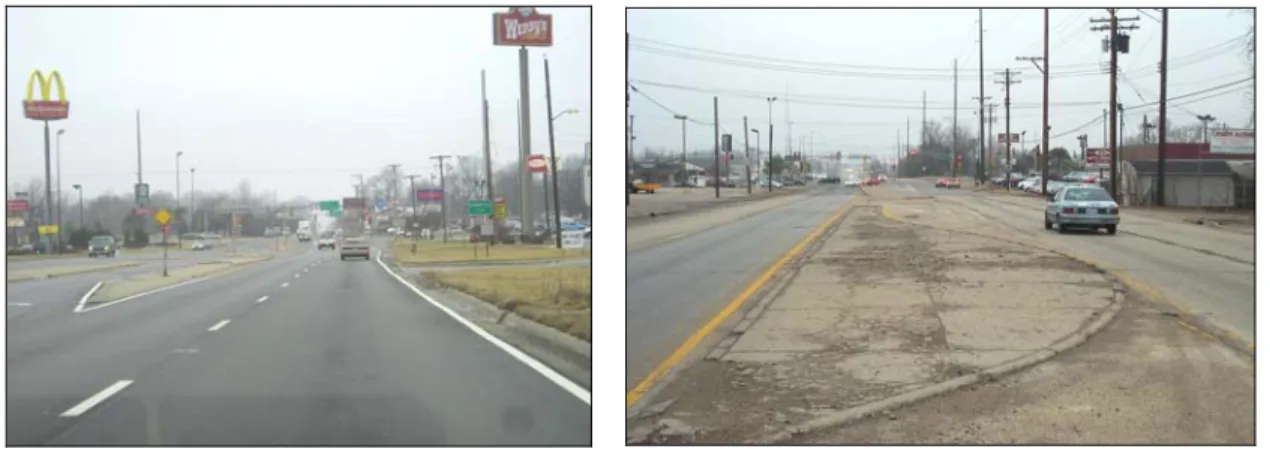
Clear Lake Avenue connects the I-72/I-55 interchange east of Springfield, Illinois, with downtown Springfield. Dirksen Parkway intersects Clear Lake Avenue just west of the interchange. Views of Clear Lake Avenue and Dirksen Parkway are shown in FIGURE A.1. In addition to functioning as major arterials, both roadways provide access to adjacent commercial properties.
The intersection of Clear Lake Avenue and Dirksen Parkway was designated a high accident location for six consecutive years (1998 through 2003), and the intersection of Hill Street and Clear Lake Avenue was designated a high accident location in 2003. In response, the Illinois Department of Transportation (IDOT) developed plans to upgrade Clear Lake Avenue between Dirksen Parkway and the I-72/I-55 interchange. The scope of the planned improvements, shown in FIGURE A.2, included:
• access consolidation and construction of two new service roads intersecting Clear Lake Avenue at a new signalized intersection east of Dirksen Parkway;
• realignment of Hill Street (a local road) to intersect Clear Lake Avenue at new signalized intersection;
• dual left turn lanes on all legs of the intersection of Clear Lake Avenue and Dirksen Parkway, and dual right turn lanes on the southeast corner of the intersection.
Clear Lake Avenue (looking west toward intersection with Dirksen Parkway)
Dirksen Parkway (looking south toward intersection with Clear Lake Avenue)
FIGURE A.1 VIEWS OF RSA SITE (ILLINOIS DOT RSA)
FIGURE A.2 RSA PROJECT (ILLINOIS DOT RSA)
KEY RSA FINDINGS AND SUGGESTIONS:
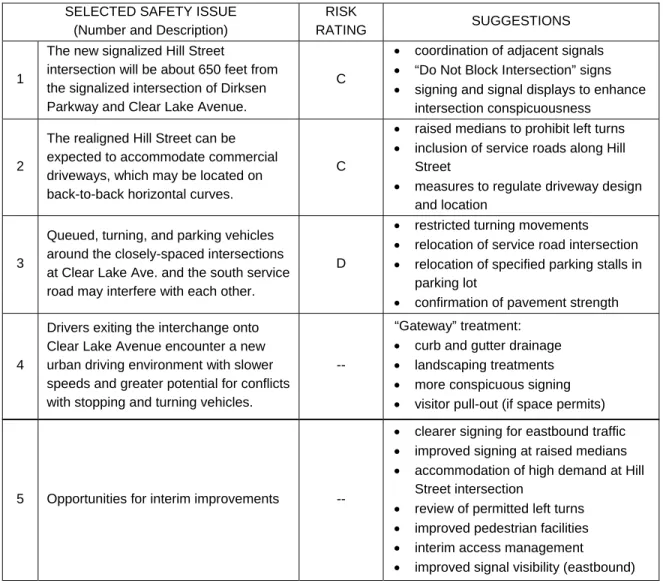
The key findings and suggestions of the RSA are summarized in TABLE A.1.
realigned Hill Street
new north service road
new south service road
additional left- and right-turn lanes
new signalized intersection
DIRKS
E
N
P
ARKWAY
TABLE A.1 SUMMARY OF SELECTED SAFETY ISSUES AND SUGGESTIONS ILLINOIS DOT RSA
SELECTED SAFETY ISSUE (Number and Description)
RISK
RATING SUGGESTIONS 1
The new signalized Hill Street
intersection will be about 650 feet from the signalized intersection of Dirksen Parkway and Clear Lake Avenue.
C
• coordination of adjacent signals • “Do Not Block Intersection” signs • signing and signal displays to enhance
intersection conspicuousness 2
The realigned Hill Street can be expected to accommodate commercial driveways, which may be located on back-to-back horizontal curves.
C
• raised medians to prohibit left turns • inclusion of service roads along Hill
Street
• measures to regulate driveway design and location
3
Queued, turning, and parking vehicles around the closely-spaced intersections at Clear Lake Ave. and the south service road may interfere with each other.
D
• restricted turning movements • relocation of service road intersection • relocation of specified parking stalls in
parking lot
• confirmation of pavement strength
4
Drivers exiting the interchange onto Clear Lake Avenue encounter a new urban driving environment with slower speeds and greater potential for conflicts with stopping and turning vehicles.
--
“Gateway” treatment: • curb and gutter drainage • landscaping treatments • more conspicuous signing • visitor pull-out (if space permits)
5 Opportunities for interim improvements --
• clearer signing for eastbound traffic • improved signing at raised medians • accommodation of high demand at Hill
Street intersection
• review of permitted left turns • improved pedestrian facilities • interim access management
• improved signal visibility (eastbound)
KEY LESSONS LEARNED:
The benefit of a design-stage RSA can be increased by including a review of existing roads, based on the RSA team’s site visit, particularly where the design project will not be implemented for several years. Typically, roadway improvements are motivated at least in part by an effort to improve traffic safety. Consequently, traffic safety issues are frequently already a concern at the RSA site. The RSA site visit provides an opportunity for a group of traffic and road safety experts to examine the site with a view to identifying immediate, low-cost improvements that can be implemented on an interim basis before the start of construction.
OKLAHAMA DEPARTMENT OF TRANSPORTATION: RSA OF IMPROVEMENTS TO US HIGHWAY 60
Project: widening and resurfacing a two-lane rural highway
Planned Improvements: • replacement of three bridges over two creeks
• shoulder widening to provide a continuous 8-foot paved shoulder
• intersection improvements (one intersection)
• resurfacing of improved section as well as an adjacent 1.2-mile section
Project Environment: urban suburban 5 rural
Project Design Stage: conceptual (0 to 30%) preliminary (40 to 80%) 5 advanced (over 80%)
Project Cost: < $100,000 $100,000 - $1,000,000 5 >$1,000,000
Project Owner: Oklahoma Department of Transportation
Road Safety Audit
Date of RSA: 1-3 February 2005
RSA Stage(s): 5 design stage RSA of existing roads
RSA team: staff from Federal Highway Administration Oklahoma Field Office, Oklahoma DOT, and Opus Hamilton
PROJECT BACKGROUND:
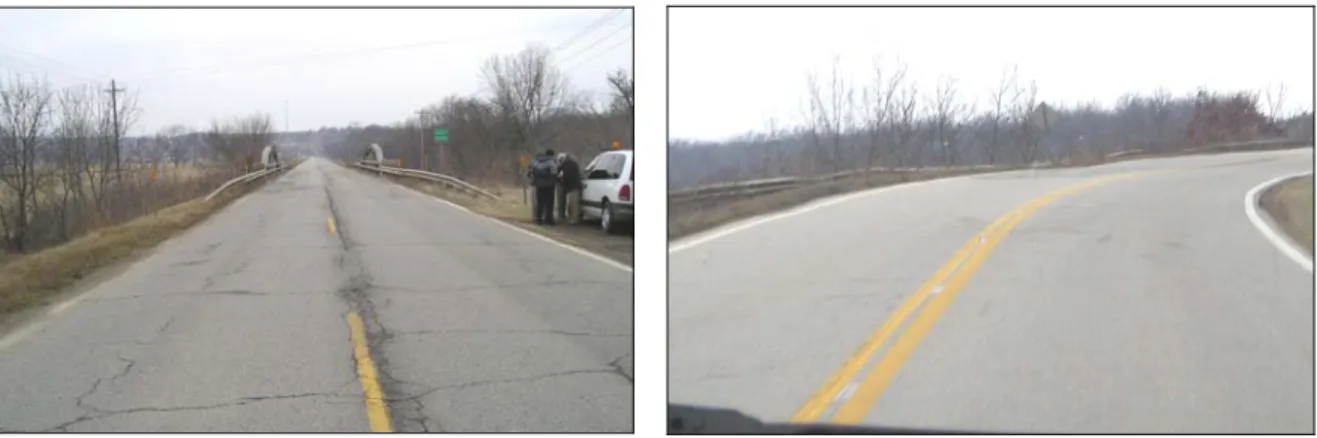
US 60 is a US numbered highway (part of the National Highway System) extending for 350 miles across northern Oklahoma. The RSA team reviewed detailed (90 percent) design stage drawings of upgrades to a 2.9-mile stretch of US 60 in Osage County. Along the upgraded section, US 60 has a posted speed limit of 65 mph, and a reported AADT of 3,500 vehicles. The existing roadway, shown in FIGURE A.3, is a two-lane rural roadway having 12-foot driving lanes with narrow or absent paved shoulders. In addition to resurfacing, the upgrades included:
• replacing existing bridges over Buck Creek and Turkey Creek, including reconstructing the approach roadways as two 12-foot lanes with 8-foot paved shoulders;
• between the bridges, widening shoulders to provide a continuous 8-foot paved shoulder and adding one channelized right turn lane at the unsignalized intersection with Bowring Road, a section-line road;
• resurfacing a 1.2-mile “incidental section” west of Buck Creek (12-foot lanes with 2-foot paved shoulders) to connect with an adjacent segment of US 60 further west that had been recently overlaid.
Buck Creek bridge
(planned improvements include repaving, bridge improvements, and 8’ paved shoulders)
adjacent “incidental” section
(planned improvements include repaving and 2’ paved shoulders)
FIGURE A.3 VIEWS OF RSA SITE (OKLAHOMA DOT RSA)
KEY RSA FINDINGS AND SUGGESTIONS:
The key findings and suggestions of the RSA are summarized in TABLE A.2. The DOT responded that changes would be made as suggested except for changes that would involve re-negotiation with property owners or utility relocation (Issue 1), since these processes were already complete, or changes that would entail substantial delay or additional expense (redesign of cross-section elements on the incidental section, Issue 2D). The DOT also declined the suggestion to install rumble strips, since they are not typically used on Oklahoma highways.
KEY LESSONS LEARNED:
It is important to identify the safety benefits of the design as part of the RSA process. The improvements to US60 were motivated largely by safety, to provide a consistent and high-quality roadway where the existing roadway was characterized by poor pavement and roadside conditions. As part of the RSA process, the RSA team identified how the elements of the Design Team’s proposed improvements were expected to positively address existing safety concerns. Examples cited in the RSA report included the following:
• Paved 8-foot shoulders and shallower fill slopes will reduce the risk and severity of off-road collisions.
• Resurfacing will improve the travel surface, and new pavement markings will improve driver guidance.
• Bridge reconstruction will increase the clearance distance to roadside safety issues, and provide the opportunity to improve barrier end treatments.
Acknowledging the safety benefits of the original design put the RSA findings in an appropriate context.
OKLAHOMA DOT RSA
SELECTED SAFETY ISSUE (Number and Description)
RISK
RATING SUGGESTIONS 1
Vertical crest curves limit drivers’ advance view of the intersection of US60 with Bowring Road.
C
• “Intersection Ahead” warning signs • relocate private driveways to minor
approach
• provide acceleration lane 2 The safety impacts of improving the incidental section should be reviewed:
2A The overlay may reduce the
effectiveness of an existing guardrail.
• Reinstall guardrail at an appropriate height.
2B The shoulder width will drop from 8 feet to 2 feet for westbound traffic.
• Provide appropriate tapers at transition point.
• Provide appropriate delineation. 2C
Westbound drivers may fail to follow the horizontal curve near the east end of the incidental section.
• Provide appropriate signs and delineation.
2D
The improved overlay surface may encourage higher prevailing speeds along the incidental section, which may be designed to an outdated standard.
C
• Confirm that existing design elements are consistent with likely speeds and current geometric standards.
• Introduce edgeline and/or centerline rumble strips.
3 Potential roadside safety issues may
be present during construction. C
• Consider reduction in construction speed limit.
• Flare or protect ends of temporary barrier.
• Introduce temporary barrier near 2:1 slope.
4 A proposed guardrail ends at a private
RSA NUMBER 3
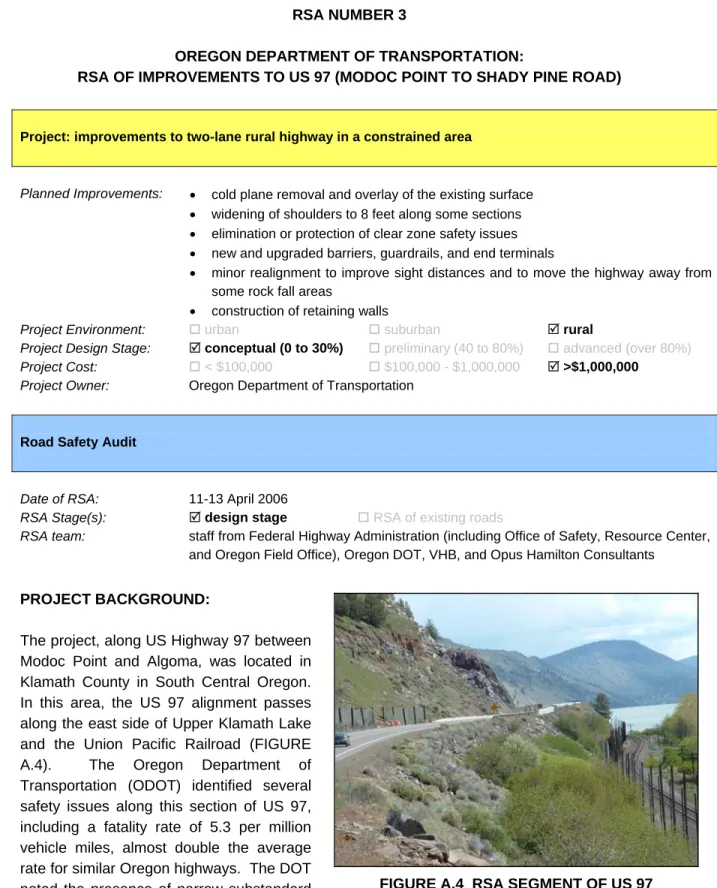
OREGON DEPARTMENT OF TRANSPORTATION:
RSA OF IMPROVEMENTS TO US 97 (MODOC POINT TO SHADY PINE ROAD)
Project: improvements to two-lane rural highway in a constrained area
Planned Improvements: • cold plane removal and overlay of the existing surface
• widening of shoulders to 8 feet along some sections • elimination or protection of clear zone safety issues • new and upgraded barriers, guardrails, and end terminals
• minor realignment to improve sight distances and to move the highway away from some rock fall areas
• construction of retaining walls
Project Environment: urban suburban 5 rural
Project Design Stage: 5conceptual (0 to 30%) preliminary (40 to 80%) advanced (over 80%)
Project Cost: < $100,000 $100,000 - $1,000,000 5 >$1,000,000
Project Owner: Oregon Department of Transportation
Road Safety Audit
Date of RSA: 11-13 April 2006
RSA Stage(s): 5 design stage RSA of existing roads
RSA team: staff from Federal Highway Administration (including Office of Safety, Resource Center, and Oregon Field Office), Oregon DOT, VHB, and Opus Hamilton Consultants
PROJECT BACKGROUND:
The project, along US Highway 97 between Modoc Point and Algoma, was located in Klamath County in South Central Oregon. In this area, the US 97 alignment passes along the east side of Upper Klamath Lake and the Union Pacific Railroad (FIGURE A.4). The Oregon Department of Transportation (ODOT) identified several safety issues along this section of US 97, including a fatality rate of 5.3 per million vehicle miles, almost double the average rate for similar Oregon highways. The DOT noted the presence of narrow substandard
shoulders widths, substandard cut and fill slopes, and unprotected safety issues within clear the zone, including barriers, guardrail, and guardrail end terminals that did not meet current standards.
ODOT. Phase One work, which began in early 2005 and was in progress at the time of the RSA, included replacement/repair of four bridges as well as rockfall work and widening on the east side of the highway. Phase Two work, which was to be let in September 2007 with a projected completion date of November 2009, was expected to take place on the west side of US 97, between the highway and the adjacent railroad tracks.
The improvement projects were subject to several conditions that imposed unique and substantial constraints on design and construction:
• Topography and slope stability were challenging constraints. Steep, unstable slopes were present on both sides of the highway (FIGURE A.4). The project limits included six rockfall sites, one of which would be affected by construction.
• To the west of the roadway, the Union Pacific Railroad imposed right-of-way constraints that affected road design. In addition, the railroad’s rockfall warning system affected construction methods.
• Cultural sites associated with the area’s Indian tribes affected slope stabilization efforts.
• The roadway, which was to remain open during construction, must accommodate mobility needs. ODOT required that the construction design maintain specified minimum lane widths and that average traffic delay not exceed six minutes. In addition, US 97 is a designated truck corridor, and was expected to accommodate additional truck traffic diverted from nearby construction works on Interstate Highway 5.
This RSA incorporated the use of the Interactive Highway Safety Design Model (IHSDM), a suite of software analysis tools3 being developed by the FHWA to provide an explicit, quantitative evaluation of safety and operational effects of geometric design on two-lane rural highways. IHSDM was used to evaluate the elements of the existing and proposed design against design policy values, design consistency, and to predict the expected safety of the future road. IHSDM may be downloaded free of charge at http://www.ihsdm.org.
KEY RSA FINDINGS AND SUGGESTIONS:
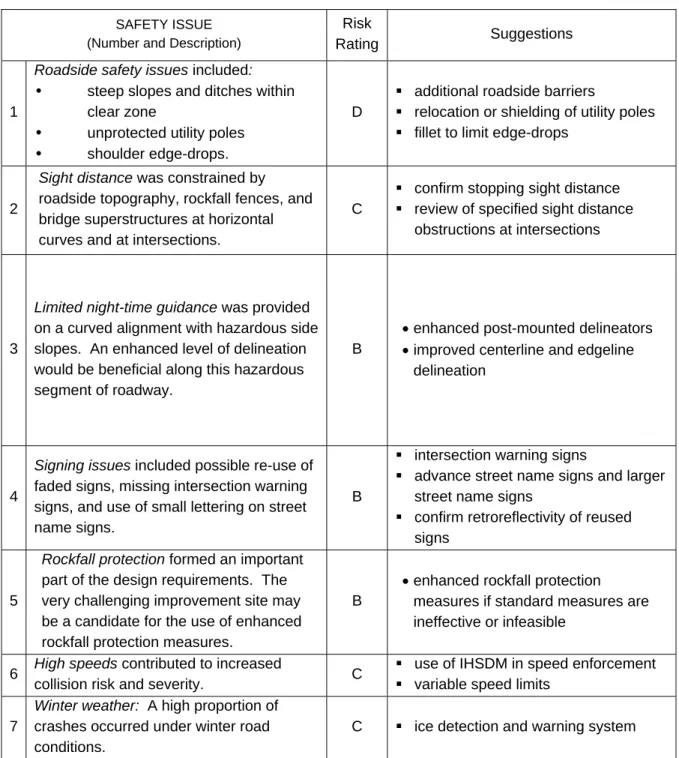
The key findings and suggestions of the RSA are summarized in TABLE A.3.
3
IHSDM currently includes five evaluation modules: Crash Prediction Module (CPM), Design Consistency Module (DCM), Intersection Review Module (IRM), Policy Review Module (PRM), and Traffic Analysis Module (TAM).
TABLE A.3 SUMMARY OF RSA SAFETY ISSUES AND SUGGESTIONS OREGON DOT RSA
SAFETY ISSUE (Number and Description)
Risk
Rating Suggestions
1
Roadside safety issues included:
• steep slopes and ditches within clear zone
• unprotected utility poles
• shoulder edge-drops.
D
additional roadside barriers
relocation or shielding of utility poles fillet to limit edge-drops
2
Sight distance was constrained by roadside topography, rockfall fences, and bridge superstructures at horizontal curves and at intersections.
C
confirm stopping sight distance review of specified sight distance
obstructions at intersections
3
Limited night-time guidance was provided on a curved alignment with hazardous side slopes. An enhanced level of delineation would be beneficial along this hazardous segment of roadway.
B
• enhanced post-mounted delineators
• improved centerline and edgeline delineation
4
Signing issues included possible re-use of faded signs, missing intersection warning signs, and use of small lettering on street name signs.
B
intersection warning signs
advance street name signs and larger street name signs
confirm retroreflectivity of reused signs
5
Rockfall protection formed an important part of the design requirements. The very challenging improvement site may be a candidate for the use of enhanced rockfall protection measures.
B
• enhanced rockfall protection measures if standard measures are ineffective or infeasible
6 High speeds contributed to increased
collision risk and severity. C
use of IHSDM in speed enforcement variable speed limits
7
Winter weather: A high proportion of crashes occurred under winter road conditions.
The Interactive Highway Safety Design Model (IHSDM) is a useful tool to quantify safety issues associated with the audited design.
This RSA used IHSDM to evaluate design consistency, compliance with selected design policy values, and to predict the expected safety of the future roadway. Specifically, the proposed alignment was analyzed using:
• the IHSDM Policy Review Module (PRM) to identify two locations where stopping sight distance did not appear to meet minimum sight distance requirements. It is important to note that an RSA is not simply a check that design standards have been met. Therefore, minimum policy checks using IHSDM were limited to sight distance policy checks. This enabled the RSA team to observe conditions in the field that IHSDM identified as having a sight distance issue.
• the IHSDM Crash Prediction Module (CPM) and five years of crash data (2000-2004) to identify the potential for a future increase in crash frequency at two intersections along the alignment;
• the IHSDM Design Consistency Module (DCM) to estimate free flow 85th percentile operating speeds between successive alignment elements, as a measure of design consistency. The results from the DCM suggested that, with the proposed improvements, the alignment of US 97 was reasonably consistent. The DCM found no locations requiring speed reductions greater than 6 mi/hr entering a curve, which was considered the upper limit for good consistency. There were however, two horizontal curves where the DCM module identified speed differentials approaching this limit, and the PRM module identified insufficient stopping sight distances. The RSA team flagged the locations where the combination of design-consistency and sight-distance issues was found for the Design Team's further consideration.
The ability to quantify values associated with design issues such as stopping sight distance, and to estimate future crash frequencies based on the road re-design, enhanced the value of the RSA by demonstrating the magnitude of the safety issues identified by the RSA team. Without IHSDM estimates, the RSA team could identify, but could not necessarily quantify, expected changes in safety parameters such as operating speeds or in expected crash frequencies. Quantifying these parameters and frequencies provided a higher level of confidence to all parties (the RSA team, Design Team, and Owner) concerning the magnitude and importance of the safety issues identified in the RSA.
RSA NUMBER 4
WISCONSIN DEPARTMENT OF TRANSPORTATION: RSA OF IMPROVEMENTS TO MARQUETTE INTERCHANGE
Project: reconstruction of a major interstate interchange in Milwaukee, Wisconsin
Planned Improvements: • replacement of three bridges over two creeks
• shoulder widening to provide a continuous 8-foot paved shoulder
• intersection improvements (one intersection)
• resurfacing of improved section as well as an adjacent 1.2-mile section
Project Environment: 5urban suburban rural
Project Design Stage: conceptual (0 to 30%) preliminary (40 to 80%) 5 advanced (over 80%)
Project Cost: < $100,000 $100,000 - $1,000,000 5 >$1,000,000
Project Owner: Wisconsin Department of Transportation
Road Safety Audit
Date of RSA: 1-3 February 2005
RSA Stage(s): 5 design stage RSA of existing roads
RSA team: staff from Wisconsin DOT, Milwaukee County Sheriff’s Office, Federal Highway Administration, and Opus Hamilton
PROJECT BACKGROUND:
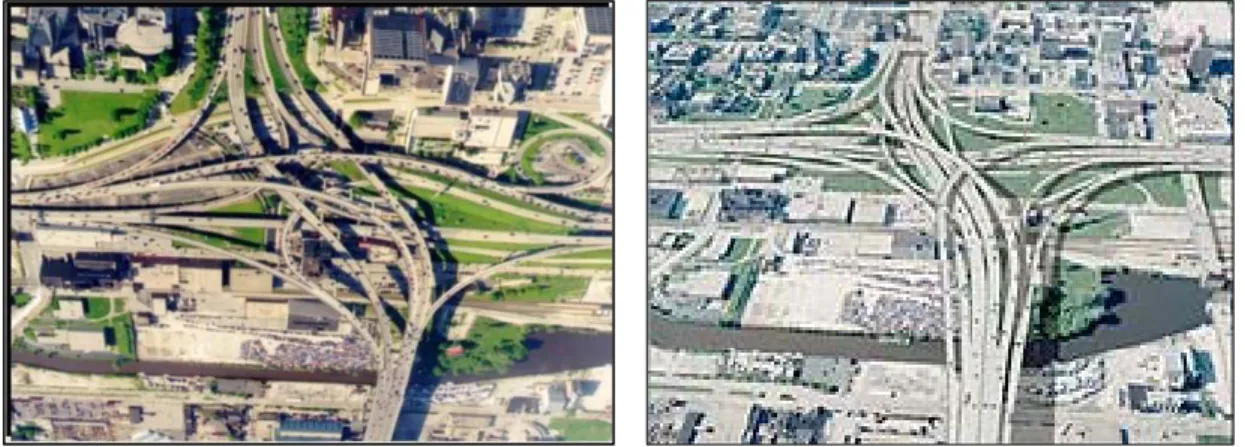
Highways I-94, I-794, and I-43 meet at the Marquette Interchange in Milwaukee. The interchange, considered the cornerstone of the southeastern Wisconsin freeway system, accommodates Milwaukee’s commuter traffic, as well as interurban traffic traveling to and from Madison, Green Bay, and Chicago, and long-distance interstate traffic. Reconstruction of the existing interchange, which built in 1968, was required to address structural deterioration and operational concerns. At the time of the RSA in December 2003, planning and design for the reconstructed interchange had been ongoing for several years, and construction was to commence in about six months. The RSA examined both the proposed changes and construction-stage plans, since the interchange was required to remain operational throughout the four-year construction period. The existing and redesigned interchanges are shown in FIGURE A.5. The total cost of the interchange reconstruction was anticipated to be $800 million.
Existing Interchange Improved Interchange (simulation)
FIGURE A.5 EXISTING INTERCHANGE AND PROPOSED IMPROVEMENTS
The planned reconstruction includes upgrades and improvements include:
• replacement of left-side ramps with conventional right-side ramps,
• lengthening or elimination of existing short weaving sections,
• increased curve radii on ramps,
• lane continuity and consistency for through traffic,
• increased capacity on system ramps,
• increased barrier height.
KEY RSA FINDINGS AND SUGGESTIONS:
The key findings and suggestions of the RSA are summarized in TABLE A.4. In their response, the design team accepted a number of suggestions that could be implemented at the late design stage for this RSA, but declined suggestions that would entail revisiting the public involvement, design, or environmental assessment processes. A number of suggestions were identified as already in the design plans (see discussion below on document control under “Lessons Learned”). Where signing could be retroactively deployed to correct a safety issue (Issue 2), the design team suggested monitoring operations after improvements were completed to confirm whether the safety issue would actually occur before implementing suggested signing changes.
TABLE A.4 SUMMARY OF SELECTED SAFETY ISSUES AND SUGGESTIONS WISCONSIN DOT RSA
SELECTED SAFETY ISSUE (Number and Description)
RISK
RATING SUGGESTIONS 1
Plankinton Exit Ramp and Clybourn Street Entry Ramp: Mainline drivers may attempt an abrupt, unsafe lane change to access these ramps.
D • Extend a proposed concrete barrier to block unsafe movements.
2
Westbound I-94: Traffic from two high-volume system ramps meets the east-west mainline approximately about 1,700 feet upstream of Exit 309B, resulting in a limited weave distance.
E
• Provide advanced signing for Exit 309B to reduce the need for sudden lane changes.
• Block access to Exit 309B from westbound I-94.
3A
Wisconsin Avenue at 11th Street: Dual turning lanes leading to different destinations may cause driver confusion and erratic movements.
C
• Improve signing and pavement marking. • Consider geometric changes (possibly
as a future retrofit).
3B
Highland Street: During peak periods, left-turn queues may extend into or past adjacent closely-spaced intersections on Highland Street.
D
• Conduct microsimulation modeling. • Signalize / coordinate ramp intersection. • Restrict some left-turn movements.
3C
Highland Street at 12th: Long crossing distances, diagonal curb ramps, and a partial crosswalk obstruction may increase the pedestrian collision risk.
D • Review / improve accommodation of pedestrians.
4
Barrier Heights at Ramps: The proposed barrier height of 42 inches on system-to-system ramps may not be sufficient to prevent truck roll-over collisions.
C • Consider higher barriers where needed and where feasible.
5
Signing: Some proposed signing may not provide sufficient guidance, especially to unfamiliar drivers.
B
• Clarify “Downtown” signing. • Clarify cardinal directions.
• Add advance signing at noted locations. • Add ramp advisory speed limit signs. 6A
Distractions During Construction: Roadside construction activities may distract or startle drivers,