Database Access Control & Privacy: Is There A Common
Ground?
Surajit Chaudhuri
Microsoft Research[email protected]
Raghav Kaushik
Microsoft Research[email protected]
Ravi Ramamurthy
Microsoft Research[email protected]
ABSTRACT
Data privacy issues are increasingly becoming important for many applications. Traditionally, research in the database community in the area of data security can be broadly clas-sified into access control research and data privacy research. Surprisingly, there is little overlap between these two areas. In this paper, we open up a discussion that asks if there is a suitable middle-ground between these areas. Given that the only infrastructure provided by database systems where much sensitive data resides is access control, we ask the ques-tion how the database systems infrastructure can step up to assist with privacy needs.
1. INTRODUCTION
Data privacy issues are becoming increasingly important for our society. This is evidenced by the fact that the re-sponsible management of sensitive data is explicitly being mandated through laws such as the Sarbanes-Oaxley Act and the Health Insurance Portability and Accountability Act (HIPAA). Accordingly, data privacy has received sub-stantial attention in previous work [3]. The key technical challenge is to balance utility with the need to preserve pri-vacy of individual data. Initial work on data pripri-vacy fo-cused on data publishing where an “anonymized” data set is released to the public for analysis. However, the evidence increasingly points out the privacy risks inherent in this ap-proach [9]. It is now believed that a query-based apap-proach where the database system answers a query in a privacy-sensitive manneris generally superior from the privacy per-spective to the data publishing paradigm [9].
However, the only support provided by database systems where much sensitive structured data reside is the mecha-nism foraccess control. Briefly, the idea is to authorize a user to access only a subset of the data. The authorization is enforced by explicitly rewriting queries to limit access to the authorized subset. Such a model of authorization is in-tuitive to application developers and users of the database system. The programming model remains the same as
be-This article is published under a Creative Commons Attribution License (http://creativecommons.org/licenses/by/3.0/), which permits distribution and reproduction in any medium as well allowing derivative works, pro-vided that you attribute the original work to the author(s) and CIDR 2011. 5th Biennial Conference on Innovative Data Systems Re-search (CIDR ’11)
January 9-12, 2011, Asilomar, California, USA.
fore — (1) data is accessed using SQL queries, (2) the results returned are deterministic, hence the utility of query results is clear, (3) there is no restriction on the class of queries that can be executed, and (4) there is no restriction on the total number of query executions. In other words, an access control mechanism is fully compatible with the functionality of a general purpose database system. Not surprisingly, ac-cess control is supported in all commercial database systems and the SQL standard. (In fact, some commercial database systems also support fine-grained access control [11].)
The main limitation of the traditional access control mech-anism in supporting data privacy is that it is “black and white”. Consider for example advanced data analysis tasks such as location-aware services of operational Business In-telligence that need to stitch together multiple sources of data such as sales history, demographics and location sensors many of which have sensitive data. For these examples, ef-fective analytics needs to leverage many “signals” derived by aggregating data from sources who have sensitive private in-formation, at the same time without revealing any sensitive individual information. But the access control mechanism offers only two choices — (1) release no aggregate informa-tion thereby preserving privacy at the expense of utility, or (2) release accurate aggregates thus risking privacy breaches for utility.
There is considerable previous work in privacy-preserving query answering that goes beyond the “black and white” world of access control [1, 8]. The class of queries is generally restricted to aggregate queries and the approach adopted broadly is to add noise to the aggregates. However, non-aggregate queries are a large class of database queries and the support for them is rather limited in the above bodies of previous work.
In this paper, we ask if we can get the best of both worlds — combine the advantages offered by access control mechanisms while at the same time going beyond the “black and white” world by leveraging previous work on privacy pre-serving query answering. We can break down this question as follows: (1) What is the database API that combines tra-ditional access control mechanisms with privacy-preserving query answering? (2) How do we implement the suggested APIs in a principled manner? (3) How do we mix and match both mechanisms to ensure privacy guarantees?
We explore a natural hybrid system that combines (a) a set of authorization predicates restricting access per user to only a subset of the data, and (b) a set of “noisy” views that (as the term suggests) expose perturbed aggregate informa-tion over data not accessible through the authorizainforma-tion
pred-icates. For example in an employee-department database, we could allow employees to see their own employee record and also publish a “noisy” view exposing the average salary of the organization. This hybrid potentially has significant advantages. Accessing data through a set of views is natural for users of database systems and thus provides a simple ex-tension to today’s database API. It offers the functionality of access control for queries that refer only to the database ta-bles and views, and the privacy guarantees of previous work for queries that only refer to the “noisy” views. In addition, we obtain value beyond the sum of the individual parts by allowing rich queries that refer tobothdatabase tables and “noisy” views.
We implement the “noisy” views by using previous work on implementingdifferential privacy [5, 8]. In order to answer question (3) above, we introduce the notion of differential privacy relative to an authorization policy and explain its desirable theoretical properties. We show that the seemingly ad hoc hybrid system described above satisfies differential privacy relative to the authorization policy.
We note that it is possible to expose the APIs we propose by extending libraries supporting differential privacy such as PINQ with access control mechanisms. However, given that the recent trend in the industry is to implement data secu-rity primitives in the database server, our discussion in this paper is presented as a modification to the database server. We think of our paper more as a first step in initiating dis-cussions on how database systems can provide meaningful support to address privacy concerns. We comment on open issues, including a critique of state of the art privacy models.
2. REVIEWING ACCESS CONTROL
There has been a lot of work in the area of access con-trol in databases. The idea with access concon-trol is that each database user gets access to a subset of the database that the user can query. The current SQL standard allows coarse grained access both to database tables as well as views.
Recent work [2, 6, 11, 13] has emphasized supporting predicate based fine-grained access control policies in the database server. For example, we wish to be able to grant each employee in an organization access their own record in the employee table.
In this paper, we consider fine-grained access control poli-cies. We assume that access control policies expose per user a subset of each database table (this is the approach adopted by some commercial systems like Oracle VPD). The policy is formally captured by specifying for each user and each database table, anauthorization predicate. Since the number of users can be potentially large, the predicate is specified succinctly as a parameterized predicate that references the functionuserID() that provides the identity of the current user. For example, we can grant each employee access to their own record as follows. (We adopt the syntax proposed in previous work [2].)
grant select on employee where (empid = userID()) to public
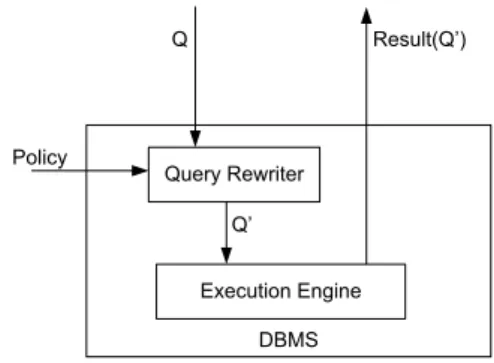
Access can be granted not only to tables but also to views. In this way, we can expose additional information such as aggregate information. For example, we can create a view that counts the total number of employees and grant access to the view to every employee. For ease of exposition and
DBMS Query Rewriter Policy Q Result(4¶) Execution Engine 4
Figure 1: Leveraging Fine-Grained Access Control
without loss of generality, in the rest of this paper, we re-strict authorization predicates to only be specified for tables. We now formalize the notion of anaccess control policy. Definition 1. A access control policyP specifies for each user and for each database table, a corresponding authoriza-tion predicate. We also refer to an access control policy as anauthorizationpolicy.
We assume that the functionauth(T, u)denotes the autho-rization predicate on table T corresponding to user u. For instance, in the above example auth(T, u) is the predicate
empid = u.
Let the tables in the database be T1, . . . , Tk. Fix
a database instance A. We refer to the vector
<σauth(T1,u)(T1), . . . , σauth(Tk,u)(Tk)> as evaluated on the instance A as the authorized subset for user u, denoted P(u, A). (In all our notation, if the user is clear from the context, we drop the reference to the user.)
Queries are executed byrewritingthem to add the autho-rization predicates. For example, the query:
select salary from employee
gets rewritten to:
select salary from employee where empid = userID()
In the same way, update statements are also rewritten to go only against the authorized subset. For example, the update:
update employee set nickname = ’Jeff’
is rewritten as follows:
update employee set nickname = ’Jeff’ where empid = userID()
We note that in general, the access control policy can allow a different “pre-update” authorization predicate than the one for queries. Further, previously proposed access control pol-icy languages also support the notion of a “post-update” au-thorization predicate which checks whether the new values of the updated rows are authorized. For ease of exposition, we assume that (1) there is only one authorization predicate used for both queries and pre-update and that (2) there are no post-update predicates, while noting that our techniques and results extend if we relax this assumption.
Figure 1 illustrates the infrastructure supporting access control mechanisms in a database system.
2.1 Limitations
As we discussed in Section 1, granting access to accu-rate aggregations over different subsets of the data can po-tentially leak information. For instance, in an Employee-Department database, suppose we grant a data analyst ac-cess to the number of employees at various levels of the organizational hierarchy grouped by the department, gen-der and ethnicity. If the analyst knows an employee with a rare ethnicity, the level of the employee could potentially get breached. Basically, the choices offered by access control mechanisms are “black-and-white”; we can grant access ei-ther to accurate aggregate information ei-thereby compromis-ing privacy, or to no aggregate information compromiscompromis-ing utility.
Previous work in data privacy has studied techniques for releasing information while preserving privacy allowing us a middle ground in the above scenario. Briefly, the idea is to add noise to the result of a computation. We next address the question of how the database API can be extended to exploit this previous work.
3. NOISY VIEWS
In Section 1, we proposed the notion ofnoisy views as a possible abstraction for integrating privacy mechanisms in a traditional database. The core properties of noisy views that we support may be summarized as follows:
• Noisy Views are a DDL construct: Noisy views may be defined by a data provider in the same way a tra-ditional view is declared, e.g., through a CREATE VIEW statement.
• Noisy Views are Non-Deterministic: Although the DDL expression for a noisy view is no different from that of a traditional view, their semantics is non-deterministic. Intuitively, they correspond to the re-sult of executing the DDL associated with the noisy views but enriched with a random “noise” to ensure no privacy leaks happen.
• Noisy views and Access Control co-exist: A query can reference both a noisy view and other authorized ob-jects.
• Noisy Views are Access Control Aware: Noise is only added to the part of the result derived from unautho-rized data. The part derived from authounautho-rized data is not perturbed.
• Noisy Views are Named: To reflect to the appli-cation developer the fact that noisy views are non-deterministic, the noisy views need to be explicitly named, much like views in the SQL standard. • Traditional DBMS Execution Engine: The DBMS
query execution engine is left unchanged. Only min-imal changes to the database system are needed: (1) a noise-injecting function and (2) a modified query rewriter that rewrites a reference to a noisy view. • No Change in Data: The privacy-sensitive database
content is left unchanged.
The above properties summarize the core facets of a noisy view object. The advantages of this approach are that (1) it builds on the familiar notion of views thereby inheriting the benefits of access control mechanisms, and (2) by requir-ing that queries access the noisy views by explicitly namrequir-ing them, it clearly separates the deterministic components from
the non-deterministic components of the system. Any query that does not name the noisy views will have the same be-havior as with just access control mechanisms.
However, the specific details of the privacy model being supported determines several additional details: (1) What subset of SQL can be supported as noisy views? (2) How exactly is the noise added? (3) What is the additional in-formation that needs to be specified: for users as well as queries? (4) What are the privacy guarantees? The answers to the above questions critically depend on the specific pri-vacy model that is adopted.
The rest of the paper answers precisely these questions for the well-known model of differential privacy [5]. We first review state of the art differential privacy in Section 4 and then describe our implementation in Section 5. Finally, we note that the model of noisy views is more general and pro-vides a template for capturing privacy models in database systems like the approach adopted by Netz et al. [10] for encapsulating data mining models in databases.
4. REVIEWING DIFFERENTIAL
PRI-VACY
We now briefly discussdifferential privacy[5] which is con-sidered to be the current state of the art in privacy models.
4.1 Definition
Intuitively, differential privacy requires that computations be formally indistinguishable when run with and without any single record. The following definition makes the intu-ition precise. We denote the symmetric difference between two data setsAandB asA⊕B(for a database with multi-ple tables, we take the union of the symmetric difference of the corresponding tables).
Definition 2. A randomized computation M provides � -differential privacy if for any two database instancesAand
B and any set of possible outputsS⊆Range(M): Pr[M(A)∈S]≤Pr[M(B)∈S]×exp(�× |A⊕B|)
✷ The parameter�quantifies the degree of privacy. A smaller value of�corresponds to a stronger guarantee — for example if we set�to be 0, thenMis constrained to produce the same output independent of input. On the other hand, a larger value of�indicates a weaker guarantee.
Intuitively, differential privacy ensures that adding an in-dividual record to the database does not reveal much addi-tional information. Thus, an adversary would not be able to learn if any particular data item was used as a result of this computation. Perhaps the biggest advantage of differential privacy is that it makes no reference to (and hence no as-sumptions about) background knowledge. It thus relieves us from the burden of changing privacy models as assumptions about background knowledge change.
4.2 Implementation Using PINQ
Most techniques implementing differential privacy such as Privacy Integrated Queries (PINQ) [8] focus on aggregations (our discussion below is also based on PINQ). Aggregates are supported byoutputperturbation — the original aggre-gate is first computed and then perturbed by adding random noise (thus the noise corresponds to an absolute error in the output).
DBMS Differential Privacy API Privacy
Budget (B)
(AggQ, İ) Result(AggQ) + Noise(İ)
AggQ Result(AggQ)
Figure 2: Leveraging Differential Privacy
Figure 2 illustrates how an application can leverage PINQ. Each aggregate queryAggQ is issued with a privacy param-eter � (see Definition 2). The query execution algorithm guarantees�-differential privacy by adding a carefully cho-sen random noise to the output; the noise is chocho-sen as a function of � and the aggregation being performed. The noise added is inversely related to� — a larger value of �
(weaker privacy guarantee) can be accommodated with a smaller noise, whereas a smaller value of�(stronger privacy guarantee) requires more noise.
As more queries are run, the overall privacy guarantee gets weaker. Formally, we have the following previously pub-lished result [8].
Theorem 1. LetMi each provide�i-differential privacy. Then the sequence ofMi providesΣi�i-differential privacy.
Thus, overall the system satisfies Σi�i-differential privacy
where theithquery is run with parameter �i.
There is previous work [4] that formally shows that if an unbounded number of queries are allowed, then eventually privacy is breached. Therefore, the notion of aprivacy bud-getBis introduced that bounds the number of queries a user can run. As each query is run with its privacy parameter�, the budget is decremented by�. Queries can only be run so long as permitted by the remaining budget. A larger privacy budget allows a larger number of queries to be run but with a greater risk of privacy breach. Thus, both the budget and the query-specific privacy parameters can be used to trade off privacy with utility.
PINQ supports differentially private variants for all the standard SQL aggregations such assum,countandaverage. We refer to the differentially private variants respectively as
noisySum,noisyCountandnoisyAvg. The aggregations can be computed over a restricted class of SQL operations such as filters and key-key joins. By using a partitioning opera-tion, it also supports a limited form of grouping. Since the implementation only adds noise to the output of queries, all of the query processing can be done using the DBMS exe-cution engine without modifying the underlying data (this is in contrast with input perturbation techniques [3]).
4.2.1 Limitations
As noted above, using differential privacy requires the programmer to set various parameters and also understand that an unbounded number of queries cannot be run by the same user. While the meaning of the parameters is intu-itive, choosing appropriate values for them is non-trivial. The random noise added is a function not only of the pri-vacy parameter�but also thesensitivityof the aggregation, which is the maximum influence any single record can have on the output of the aggregation. Differential privacy imple-mentations work best for low-sensitivity computations. For example, the sensitivity of aggregates such as countis low. On the other hand, for aggregates such assumthe sensitivity can be arbitrarily large (that said, when a large number of records are being summed, a large absolute error can be tol-erated since it might not correspond to large relative error). For a given privacy guarantee�, we need to add significantly more noise as the sensitivity increases. On the other hand, answering higher sensitivity queries without increasing the noise reduces the total number of queries that can be exe-cuted within the privacy budget. Such interactions between the parameters makes them difficult to set. We note that the above limitations hold not only for PINQ but for all previously proposed differential privacy algorithms.
Although differential privacy comes with the above “bag-gage”, it offers a principled mechanism to navigate the pri-vacy/utility trade off. This is in stark contrast to the “black-and-white” world of access control. Further, recent empirical work has begun to apply differential privacy to several real-world data analysis tasks successfully [8, 14]. Given this fact, it is natural to ask if we can implement our noisy view ab-straction through differential privacy primitives. We study this question next.
5. DIFFERENTIALLY PRIVATE NOISY
VIEWS
In this section, we discuss how we implement noisy views based on differential privacy and discuss how it can be in-tegrated in a database system. We term noisy views im-plemented using differential privacy asdifferentially private viewsorDPViewsin short. We present our system as an en-hancement of the database server while noting that much of the functionality can also be supported through middleware requiring no changes to the server, say by enhancing PINQ with access control primitives.
Since the class of DPViews we consider is influenced by our privacy guarantees, we begin this section by discussing the privacy guarantee we seek to provide.
5.1 Differential Privacy Relative To Views
The main challenge in formalizing the privacy guarantee is that we do not want to charge the system with protect-ing the privacy of information that is revealed through the authorization policy. We illustrate with an example. We assume that the authorization predicates are known to all users.
Example 1. Suppose that in an organization, a user is au-thorized to see the records of all employees whose salary is greater than $100000. Even though the user is not autho-rized to see the records of other employees, he/she knows that their salary is less than or equal to $100000. ✷
A user knows that the underlying database has to be con-sistent with the authorized subset. This is how information
is revealed about the overall data. Accordingly, we introduce the notion of differential privacyrelative toan authorization policy as follows.
Definition 3. We say a randomized computationM pro-vides�-differential privacy relative to an authorization pol-icyP for useruif for any two database instancesAandB
such thatP(u, A) =P(u, B) and any set of possible outputs
S⊆Range(M):
Pr[M(A)∈S]≤Pr[M(B)∈S]×exp(�× |A⊕B|) ✷ We note that the main difference from the usual notion of differential privacy is that we only consider instance pairs that agree on the authorized subsets. Definition 3 offers us a principled way to reason about privacy in the context of a given access control policy. At one end, if the user is not granted access to any data, then Definition 3 reduces to standard differential privacy. By granting access to more data, the system is only charged with providing a weaker privacy guarantee.
Finally, we carry out the discussion in this section for a single user noting that all results generalize to multiple users. So the references to the user are dropped in the notation.
5.2 Overall Architecture
The overall policy specified to the system initially consists of an authorization policy and a set of DPViews. We use the access control infrastructure to grant and/or deny access to the DPViews in the same way as with traditional views.
In general, a query can reference database tables and DPViews. An update can only reference database tables. Queries and updates are executed by rewriting them in a way that guarantees differential privacy relative to the au-thorization policyP.
References to database tables are rewritten as described in Section 2 to reflect the authorization policy. For queries and updates that do not reference DPViews, the behavior is identical to only having an authorization policy. The differ-ential privacy guarantee is obtained via the following result.
Theorem 2. Fix an authorization policy P and a query that does not refer to DPViews. The rewritten query is 0-differentially private relative to P. Similarly, an update (that is not allowed to refer to DPViews) when rewritten is 0-differentially private relative toP.
Proof. We can think of the authorization semantics for queries and updates as follows. The database instance A
is replaced with the authorized subsetP(A) and the origi-nal unrewritten statement (query or update) is run on this smaller instance. The result follows.
Any reference to a DPView in a query is made with a privacy parameter�(the�here refers to Definition 3) and rewritten in a way that guarantees�-differential privacy rel-ative to the authorization policy. The way in which DPView references are rewritten is described in Section 5.3.
In general, a query can referenceboththe database tables and the DPViews. Such queries are also issued with the privacy parameter �. We prove below in Theorem 4 that their rewriting guarantees �-differential privacy relative to the authorization policy.
DBMS Q (Q, İ) (AggQ, İ) Privacy Budget (B) Query Rewriter Auth Views DP Views Policy
Figure 3: Leveraging Access Control and Differential
Privacy
As multiple queries and updates are run, we prove that the system satisfies Σi�i-differential privacy relative to the
authorization policy where theithquery is run with param-eter�i.
Theorem 3. Fix an authorization policyP. LetMieach provide �i-differential privacy relative to P. Then the se-quence of Mi provides Σi�i-differential privacy relative to P.
Proof. The proof is almost identical to the analogous previously known result [8] (stated in Theorem 1) — we only have the additional restriction of focusing on instances
AandB withP(A) =P(B).
Together with the following straightforward result, The-orem 3 can be used to infer that queries that reference database tables and a DPView with parameter �satisfy � -differential privacy relative to the authorization policy.
Theorem 4. Fix authorization policyP. Any determin-istic computation that operates on the output of a compu-tation that is �-differentially private relative to P is also� -differentially private relative toP.
We also inherit the notion of a per-user privacy budget which is maintained in the same way as in PINQ. The overall architecture is shown in Figure 3.
5.3 Differentially Private Views
We now discuss the class of DPViews we support coupled with how we rewrite them to yield privacy guarantees. The class of queries we encapsulate as DPViews is based on the class of queries for which differentially private algorithms are known [8]. If differentially private algorithms are de-veloped for larger classes of queries in the future, we could correspondingly accommodate a larger class of DPViews.
We note that when the user budget is exhausted, the DPView expression is always rewritten in accordance with the authorization policy while signaling to the application that the privacy budget is exhausted. Thus, the discussion below focuses on the rewriting method for the case when the user budget is not exhausted.
5.3.1 Single Table DPViews
We start our discussion with single-table DPViews. Sup-pose that a user is only authorized to see a subset of table
T. In order to expose privacy-preserving computations on the unauthorized subset of T we can declare a DPView as follows.
create noisy view NoisySelect(agg1,...,aggn) as (select scalarAgg(A1),...,scalarAgg(An)
from T)
We consider standard SQL aggregations namelysum,count
andaverage.
A reference to NoisySelectis rewritten as follows if the user privacy budget is not exhausted. We decompose the table T into two parts — the authorized subset and the unauthorized subset. An accurate aggregate is computed over the authorized subset and a differentially private ag-gregate over the unauthorized subset. The two agag-gregates are combined. The rewriting for the case where there is only one aggregation and thescalarAggiscountis shown below in relational algebra-like notation.
count(σauth(T)(T)) +noisyCount�(σ¬auth(T)(T)) By Theorems 2 and 4, we can see that the above rewriting guarantees�-differential privacy relative to the authorization policy.
5.3.2 Incorporating Joins
The main challenge in combining joins with differentially private aggregations is that joins have a large sensitivity (re-call from Section 4.2.1 that the sensitivity is the maximum influence any single record can have on the output of the ag-gregation.) Even for the special case of key-foreign key joins the sensitivity can be large since deleting a record from the “key side” can have an unbounded effect on the output join cardinality. Therefore, PINQ essentially only supports key-key joins [8].
In our system, since our goal is to guarantee differential privacy relative to the authorization policy, wecansupport foreign key joins as follows. We introduce the notion of a stabletransformation relative to an authorization policy.
Definition 4. A transformation T is c-stable relative to authorization policy P if for any two data sets A and B
such thatP(A) =P(B),
|T(A)⊕T(B)| ≤c× |A⊕B|
Example 2. If we have two tablesRandS withRhaving a foreign key referencing S, then the join R ✶ σauth(S)S is 1-stable.
If we perform stable transformations relative to an autho-rization policy before a differentially private aggregation, then the overall computation is differentially private rela-tive to the policy.
Theorem 5. Fix an authorization policy P. LetM pro-vide�-differential privacy and letT be an arbitraryc-stable transformation relative to P. The composite computation
M◦T provides�×c-differential privacy relative toP.
Proof. Fix data instancesAandBwithP(A) =P(B). We have:
Pr[M(T(A))∈S]
≤ Pr[M(T(B))∈S]×exp(�× |T(A)⊕T(B)|) ≤ Pr[M(T(B))∈S]×exp(�×c× |A⊕B|)
We use Theorem 5 to extend the class of DPViews to support foreign key joins as follows.
create noisy view NoisyJoin(agg1,...,aggn) as (select scalarAgg(A1), ..., scalarAgg(An) from R, S1, ..., Sk
where pJoin and pSelect)
In the above expression, the predicate pJoin captures the join predicate andpSelect, additional selection predicates. We require that each Si is joined via a foreign key lookup
from one ofR, S1, . . . , Si−1(the intuition behind the require-ment is illustrated in Example 2).
We illustrate how the reference to NoisyJoin is rewrit-ten when the user budget is not exhausted. We always en-force the authorization on each of the Si. We decompose
the result ofσpSelect(R✶σauth(S1)(S1). . .✶σauth(Sk)(Sk)) into two parts. The authorized join result is the sub-setσpSelect(σauth(R)(R)✶σauth(S1)(S1). . .✶σauth(Sk)(Sk)) and the rest, i.e. σpSelect(σ¬auth(R)(R)✶σauth(S1)(S1). . .✶
σauth(Sk)(Sk)) is the unauthorized join result. We decom-pose the join into the authorized subset and the unautho-rized subset. An accurate aggregate is computed over the authorized subset and a differentially private aggregate over the unauthorized subset. The two aggregates are combined. The rewriting for the case where there is only scalar ag-gregate namely count and no predicatespSelect is shown below.
count(σauth(R)(R)✶σauth(S1)(S1). . .✶σauth(Sk)(Sk))+ noisyCount�(σ¬auth(R)(R)✶σauth(S1)(S1). . .✶σauth(Sk)(Sk)) Again, it is not hard to see that the above rewriting guaran-tees�-differential privacy relative to the authorization policy.
5.3.3 Incorporating Group By
Suppose that we wish to also incorporate grouping into the class of queries that can define a DPView. Specifically we consider the following expression that extends the DPView
NoisyJoinabove with grouping columnsg:
create noisy view NoisyGb(g,agg1,...,aggn) as (select g, scalarAgg(A1), ..., scalarAgg(An) from R, S1, ..., Sk
where pJoin and pSelect group by g)
Intuitively, we can think of supporting group by by tak-ing each distinct value (group) in the grouptak-ing columns and runningNoisyJoin with additional predicates to select the given group. The first thing to note about this strategy is that a user may not be authorized to see all the groups. So we modify the strategy to only consider authorized groups which are the distinct values in the grouping columns in the authorized join result. Second, since the strategy invokes
NoisyJoin in succession, the privacy guarantee we get is based on Theorem 3. However, since the groups are disjoint we can do better as we show below.
Theorem 6. Fix an authorization policyP. LetMieach provide �-differential privacy relative to P. Let pi be ar-bitrary disjoint predicates over the input domain. The se-quence ofMi(σpi(D))provides�-differential privacy relative toP.
Proof. The proof is almost identical to the analogous previously known result [8] — we only have the additional
restriction of focusing on instancesA and B withP(A) = P(B).
We now describe how a reference toNoisyGbis rewritten (when the budget is not exhausted.) The rewriting logically invokesNoisyJoinfor each authorized group with additional predicates to select the group. However, Theorems 5 and 6 are used to decrement the user’s budget only once.
Note that our system is designed such that an unbounded number of queries can be run. So long as the budget per-mits, the rewriting invokes the unauthorized subset. But after the budget is exhausted, we fall back to basic access control mechanisms. Further, we also note that our seman-tics can be achieved without any changes to the query execu-tion engine merely by rewriting the reference to the DPView suitably.
5.4 Integrating Parameters
We now sketch one possible manner in which the privacy budget and noise parameters can be integrated into our sys-tem. The privacy budget for DBMS users is set as part of the policy specification and managed as a part of the user’s metadata. The noise parameter is passed with each query as a connection property. For application users, both the privacy budget and the noise parameter reside in the user application context [11].
5.5 Illustrative Example
We consider a simplified sales database extending the Employee-Department database we have used earlier in the paper. The sales database has the following ta-bles — Sales(ProductID, EmployeeID, CustomerID, SalesAmount), Employee(EmployeeID, ManagerID),
Product(ProductID, Category), Customer(CustomerID, RegionID)andRegion(RegionID, NationID).
The authorization policy lets managers access all records in theCustomer,ProductandRegiontables (note that the
Customertable in our example does not store sensitive cus-tomer information) and the records of employees that are direct reports and their corresponding sales records. Under the above authorization policy, a manager can find the total sales undertaken by each direct report per product through the following query:
select E.EmployeeID, S.ProductID, sum(SalesAmount) from Employee E, Sales S
where E.EmployeeID = S.EmployeeID group by E.EmployeeID, S.ProductID
We note that the above query is rewritten first before exe-cution to only reference the rows the manager is authorized to see. Using the same query above, depending on which manager logs in, we get different rewritten queries (which is the point of supporting authorizations within the database server). In this sub-section, we describe queries as issued by the application noting that they would be rewritten by the system before execution.
Suppose that in order to give a better sense of an em-ployee’s sales we wish to compare them with the total per-product sales. The above authorization policy does not grant access to the total per-product sales. We can expose the total per-product sales using the following noisy view.
create noisy view NoisyPerProductSales as
select S.ProductID, sum(SalesAmount) as TotalSales
from Sales S
group by S.ProductID
Each employee’s per-product sales can be compared with the total per-product sales by issuing the following query:
select E.EmployeeID, S.ProductID, sum(SalesAmount), min(NV.TotalSales)
from Employee E, Sales S, NoisyPerProductSales NV where E.EmployeeID = S.EmployeeID and
S.ProductID = NV.ProductID group by E.EmployeeID, S.ProductID
Again, just as with the authorization predicates,
NoisyPerProductSales is rewritten differently depend-ing on which manager logs in. Thus the output of the query also changes depending on the current user.
Now we consider a different analysis task where a manager wishes to analyze the sales in her department grouped by product category and by nation. Issuing the following query accomplishes this task.
select R.NationID, P.Category, sum(SalesAmount) from Product P, Sales S, Customer C, Region R where P.ProductID = S.ProductID
and S.CustomerID = C.CustomerID and C.RegionID = R.RegionID group by R.NationID, P.Category
As in the previous case above, in order to compare the sales from a given department with the overall sales while at the same time preserving privacy, we can define the following noisy view.
create noisy view NoisyPerProductPerRegionSales as select P.Category, R.NationID,
sum(SalesAmount) as TotalSales
from Sales S, Product P, Customer C, Region R where S.CustomerID = C.CustomerID
and C.RegionID = R.RegionID and S.ProductID = P.ProductID group by P.Category, R.NationID
The sales within the department and across all departments can be compared by issuing the following query.
with DeptSales(NationID,Category,TotalSales) as (
select R.NationID, P.Category, sum(SalesAmount) from Product P, Sales S, Customer C, Region R where P.ProductID = S.ProductID
and S.CustomerID = C.CustomerID and C.RegionID = R.RegionID group by R.NationID, P.Category )
select N.Category, N.NationID, N.TotalSales, D.TotalSales from DeptSales D,
NoisyPerProductPerRegionSales N where D.Category = N.Category
and D.NationID = N.NationID
5.6 Summary
The hybrid architecture we sketched above satisfies the noisy view properties outlined in Section 3. We can reduce to the functionality of PINQ using DPViews. On the other
hand, if have only authorization predicates, we reduce to standard access control mechanisms. Further, the examples in Section 5.5 illustrate that we can combine access to au-thorized and unauau-thorized portions of data in sophisticated ways, joining them and aggregating them. This is only made possible by integrating the mechanisms of access control and differential privacy (specifically PINQ). In this way, we ob-tain value beyond the sum of the individual parts. We have also shown that our architecture, while seemingly ad-hoc is in fact a principled approach to integrate differential privacy primitives while preserving its privacy guarantees.
However, we also inherit the baggage associated with existing differential privacy implementations. Therefore, the utility of our framework for complex queries over real datasets remains to be studied. We view our implementation only as a first step in opening up a debate in our community on how database systems can provide meaningful support to address privacy concerns.
6. RELATED WORK
There has been considerable amount of previous work in data privacy [3] and access control [2, 6, 11, 13]. However, to the best of our knowledge, ours is the first paper that studies how access control primitives and privacy preserving mechanisms can be integrated within a database system in a principled manner. The previous work that is most closely related is the Airavat system [14] that combines access con-trol primitives with differential privacy. However, Airavat focuses on the cloud setting where the execution engine is MapReduce. Further, the model of access control considered is mandatory access control rather than discretionary access control supported by the SQL standard and addressed in this paper. Finally, in contrast with Airavat, we formally analyze the privacy implications of combining access control with differential privacy.
Other related work includes techniques for access control over probabilistic data [12] where since the data is proba-bilistic, the system may not be able to decide whether or not a user has access to a tuple. This is addressed by re-turning a perturbed tuple — the noise added is such that when it is certain that the user has access, the noise added is 0 and when it is certain that the user does not have access, the value returned is random.
Recent work [7] has addressed setting privacy policies for releasing information about search logs. The privacy policy is implemented using PINQ for differential privacy by setting different privacy budgets for different users. This work is complementary to what we study in this paper.
7. CONCLUSIONS
Data privacy issues are increasingly becoming impor-tant for database applications. However the current “black and white” world of access control primitives supported by database systems is clearly inadequate for supporting data privacy. In this paper, we sketch an architecture for a hy-brid system that enhances an authorization policy with the abstraction of noisy views that encapsulate previously pro-posed privacy mechanisms. Accessing data through a set of views is natural for users of database systems and thus the noisy views abstraction represents a natural progression of the concept of authorization views.
We also discuss how we can implement noisy views based
on differentially private algorithms. A key advantage of the proposed hybrid system is its flexibility. It can support queries that refer to both the base tables and the differen-tially private views thus resulting in a system that is more powerful than using access control techniques or differential privacy techniques in isolation. While combining authoriza-tions and differentially private views in this manner seems ad-hoc, we show that it is a principled way to integrate dif-ferential privacy primitives with privacy guarantees.
However, our system also inherits some of the limitations of state of the art differential privacy. Therefore, the util-ity of our framework for complex queries over real datasets remains to be studied. On the whole, we think of our pa-per as a first step in initiating discussions on how database systems can provide meaningful support to address privacy concerns.
8. ACKNOWLEDGMENTS
We are very grateful to Arvind Arasu for his many thoughtful and insightful comments that have greatly in-fluenced this paper. We also thank the anonymous referees for their valuable feedback.
9. REFERENCES
[1] R. Agrawal, R. Srikant, and D. Thomas. Privacy preserving olap. InSIGMOD, 2005.
[2] S. Chaudhuri, T. Dutta, and S. Sudarshan. Fine grained authorization through predicated grants. In ICDE, 2007.
[3] B.-C. Chen, D. Kifer, K. LeFevre, and A. Machanavajjhala. Privacy-preserving data publishing.Foundations and Trends in Databases, 2(1-2), 2009.
[4] I. Dinur and K. Nissim. Revealing information while preserving privacy. InPODS, 2003.
[5] C. Dwork. Differential privacy. InICALP (2), 2006. [6] G. Kabra, R. Ramamurthy, and S. Sudarshan.
Redundancy and information leakage in fine-grained access control. InSIGMOD, 2006.
[7] P. B. Kodeswaran and E. Viegas. Applying differential privacy to search queries in a policy based interactive framework. InCIKM-PAVLAD, 2009.
[8] F. McSherry. Privacy integrated queries: an extensible platform for privacy-preserving data analysis. In SIGMOD, 2009.
[9] A. Narayanan and V. Shmatikov. Myths and fallacies of “pii”.Communications of the ACM, 2010.
[10] A. Netz, S. Chaudhuri, J. Bernhardt, and U. M. Fayyad. Integration of data mining with database technology. InVLDB, 2000.
[11] Oracle Corporation. Oracle virtual private database. http://www.oracle.com/technology/deploy/security
/database-security/virtual-private-database/index.html.
[12] V. Rastogi, D. Suciu, and E. Welbourne. Access control over uncertain data.PVLDB, 1(1), 2008. [13] S. Rizvi, A. O. Mendelzon, S. Sudarshan, and P. Roy.
Extending query rewriting techniques for fine-grained access control. InSIGMOD, 2004.
[14] I. Roy, S. Setty, A. Kilzer, V. Shmatikov, and E. Witchel. Airavat: Security and Privacy for MapReduce. InNSDI, 2010.