Cloud is not a silver bullet: A Case Study of Cloud-based
Mobile Browsing
Ashiwan Sivakumar†, Vijay Gopalakrishnan‡, Seungjoon Lee‡, Sanjay Rao†,
Subhabrata Sen‡and Oliver Spatscheck‡ †Purdue University‡ AT&T Labs - Research
ABSTRACT
In recent years, there has been growing interest in both in-dustry and academia in augmenting mobile web browsing with support from the cloud [4, 1, 3, 16, 18]). These ef-forts are motivated by the goals of lowering costs of data transfer, and reducing web latencies and device energy con-sumption. While these efforts have adopted different ap-proaches to cloud-based browsing, there isn’t a systematic understanding of the rich design space due to the proprietary nature of many of the solutions. In this paper, we take a step towards obtaining a better understanding by evaluat-ing an extreme point in the design space that involves cloud support for most browsing functionality including execution ofJavaScript (JS), and for compaction of data (e.g., image transcoding and compression). Our study is conducted in the context ofCloud Browser (CB), a popular commercially available browser that embodies this design point. Our re-sults indicate thatCBdoes not provide clear benefits over Direct (a device-based browser) either in energy or down-load time. For e.g. whileCBdecreases the download time compared toDirect for 38.87% of pages, it increases it by as much as 29.8s for other pages. Similarly whileCB de-creases the total energy by up to 20.77J compared toDirect for 52.7% of the pages, it increases it by up to 21.31J for other pages. Interestingly, even thoughCBdoesJS execu-tion in the cloud, it increases the CPU and network energy for close to 50% of the pages. Overall our study indicates that cloud-based browsing is not always a win, and there are important trade-offs that must be carefully considered when moving functionality to the cloud.
1
Introduction
Mobile internet users are growing rapidly given the spread of higher speed cellular technologies like 3G and LTE. By 2014, it is predicted that mobile internet usage will surpass desktop internet usage [2]. There has been much interest in using cellular-connected devices such as smart-phones to perform network-related tasks and the market has responded
Permission to make digital or hard copies of all or part of this work for personal or classroom use is granted without fee provided that copies are not made or distributed for profit or commercial advantage and that copies bear this notice and the full citation on the first page. To copy otherwise, to republish, to post on servers or to redistribute to lists, requires prior specific permission and/or a fee.
ACM HotMobile’14,February 26–27, 2014, Santa Barbara, CA, USA. Copyright 2014 ACM 978-1-4503-2742-8 ...$15.00.
with a wide variety of applications that serve this growing need.
In recent years, there has been much interest in both academia (e.g., [16], [18], [12]) and industry (e.g., [4], [1], [3], [5]) in using the cloud to augment mobile web browsing, in order to overcome the processing and energy limitations of mobile devices. These efforts are related to but distinct from efforts like [15, 8, 10, 7, 11, 14] which develop frame-works for offloading code of applications (e.g., face recogni-tion) that primarily run on the mobile device to the cloud. In contrast, in mobile web browsing, data naturally flows into mobile devices from remote servers, and cloud servers could potentially be on the data path from the server to the device. The potential benefits with cloud-based mobile browsing include improving data download time, reducing device energy consumption, and reducing data usage and costs. The technology has sufficiently matured that there are a number of cloud-based mobile web browsers that are available in the market – popular ones include Opera Mini [4], Amazon Silk [1], Sky Fire [5] and Chrome beta [3].
The existing approaches to cloud-based web browsing rep-resent a range of points in a rich design space. At one end of the design spectrum we have the traditional mobile browser that performs all browsing functionality in the client. At the other end of the spectrum, there are many cloud browsers that take a ‘cloud-heavy thin-client‘ approach (e.g., [18, 4, 5]) relying on cloud support for most functionality including parsing and rendering web pages,JavaScript (JS)execution, and compaction of data (e.g., data compression, transcoding images). Other approaches move a subset of browser func-tionality to the cloud – e.g., [3] executesJSat the client but uses the cloud to fetch individual objects and perform data compaction, while [16] has argued for offloading parts of the page load process, though a specific design is not provided. Overall there is limited understanding in the community to-day of the trade-offs between these different design points.
In this paper we take a first step towards understanding the performance implications of mobile cloud browsing solu-tions by comparing the two extreme points – one that does not use the cloud at all, and another that primarily relies on the cloud. Our evaluation is conducted in the context of a popular commercially available cloud-based mobile browser (as per recent reports it has about 300 million unique users), that uses the cloud for performing JS execution and data compaction. To keep the focus on the scientific aspects of our study, we anonymize the browser and call it Cloud Browser (CB). We compare CBwith a traditional browser that runs locally in the device (which we refer to asDirect).
Direct Browser Object ID 1 Object ID 16 15 14 13 12 11 10 9 8 7 6 5 4 3 2 1 0 0.2 0.4 0.6 0.8 1 1.2 1.4 Connect Time Wait Time Download Time 0 1 2 3 4 5 6 Time (sec) Cloud Browser Time (sec)
Figure 1: Waterfall diagrams showing the network
ac-tivity for a page download withDirect andCB.
Our evaluation focuses on two metrics: (i) page download time, and (ii) device energy consumption. While the former directly impacts user experience, the latter captures the en-ergy consumed by both the CPU and the network (the power consumed by the radio interface is known to contribute a considerable fraction of the total device power [9]). We consider this metric to be relevant for the foreseeable future since even though processing capabilities of mobile devices have dramatically improved in recent years, battery capacity remains a major resource limitation.
Our evaluations indicate that neither Direct nor CB is better under all scenarios. For e.g. whileCBdecreases the download time compared toDirectfor 38.87% of pages, it in-creases it by as much as 29.8s for other pages. SimilarlyCB increases energy usage by up to 21.31J compared toDirect for some pages. WhileCBsaves CPU energy by offloading JSto the cloud and network energy by not sending theJS to the client, interestingly it does worse for many pages that are heavy onJSprocessing. Further, the benefits of running JSin the cloud are less clear over user sessions that involve extensive client interactivity.
We also isolate the impact of data compaction through experiments with pages withoutJS content. We find that for such pages, CBdoes better than Directin total energy only for 17% and increases the network energy usage for 75% of the pages. Data compaction does not always lead to net-work energy savings due to the time involved in performing these sophisticated data compaction tasks, and the complex network radio state transitions.
Our contributions in this paper are (i) we conduct one of the first studies of operational cloudbased mobile browsers -such a study is useful in its own right given the limited tech-nical information available on many existing solutions today; and (ii) we take a first step towards understanding the trade-offs involved in moving browser functionality, specificallyJS execution, and data compaction, to the cloud. While our evaluations are conducted withCB, we believe the results ex-pose important and more broadly applicable trade-offs that must be considered when using the cloud to support these functionalities.
2
Background
In this section we give an overview of the working of CB based on a combination of publicly available information and carefully constructed experiments.
Figure 1 shows the waterfall diagram for network activ-ity when downloading a page using Direct and CB. Each bar corresponds to a HTTP object request-response pair.
We break the total time for each bar into three parts - 1.
Setup time, 2. Wait time, 3. Download Time. The
Setup time includes the times for DNS resolution, initial connection establishment and the actual URL request; The Wait Timeis the time before the client starts receiving the data; The Download time is the time taken to transfer the data from the server to the client. TheWait Time in CB consists of (i) processing time at the cloud proxy like pars-ing, processing JSetc. and (ii) time taken by the proxy to fetch all the objects from the server.
As shown in the figure,Directfirst fetches the main HTML page directly from the web server, parses it and loads the other objects required to render the page using multiple (parallel) HTTP connections. The page is then rendered locally on the device. On the other hand, CBconnects to the cloud proxy and after aWait Timereceives a compact version of the page from the proxy in a proprietary format (which we callCloud Browser Markup Language (CBML)). During theWait Time, the cloud proxy employs data com-paction techniques on the page like reformatting, re-sizing images, compression for small-screen rendering. The client extracts theCBMLand renders the page.
CB offloads JS processing to the cloud proxy. It sup-ports two modes of operation for pages with JS. In older versions CB supports a mode where all JS in a page are run for a timeout of 5s, after which they are stopped and a CBMLis sent to the client. There are many web pages that change their content either automatically (e.g., timer-based) or through user-interaction (e.g., user-clicks) usingJS. The older version could not accurately render many pages that change content through long-runningJS(>5s) and does not
support rich interactivity. In newer versions CB supports a second mode where the client opens a secure, persistent connection with the cloud proxy and the proxy continuously runs the JS, pushes different bursts of objects at different times whenever the page changes. This approach helpsCB accurately render most pages. Even with the second ap-proach, in our experiments we have seenCBfailing to ren-der some pages that continuously download objects through JSthat run forever. We use the second mode ofCBin our experiments since it renders most pages accurately.
3
Evaluating Cloud Browser Design
We evaluate key design decisions taken by existing mobile cloud browsers in the context ofCB. In this section we de-scribe the evaluation goals and methodology.Evaluation goals: In evaluatingCB, our primary goals
are (i) to understand and quantify the impact of offloading JS execution to the cloud under various scenarios and (ii) to understand the benefits of performing data compaction of pages in the cloud.
Setup and Methodology: We ran experiments using
CBandDirecton a Samsung galaxy S3 phone using an LTE network in West Lafayette. We choose 40 of the top US pages in Alexa [6]. The pages cover a wide range of cate-gories like news, sports, photo streaming, business and sci-ence. We conduct experiments in the wild by downloading these pages usingDirectandCB. We conduct 20 experiment runs with each page. To subject the two schemes to similar signal strength conditions, in each run we first download a page usingDirect and then using CBback-to-back. More-over, we request the URLs with 60 secs time interval be-tween each request when using bothDirectandCB. We run
0 0.2 0.4 0.6 0.8 1 -30 -20 -10 0 10 20 30 CDF
Download Time Increase(seconds) CB better
Figure 2: CDF of the median
Download time increase (Time CB
-Time Dir)for each page withCB.
0 0.2 0.4 0.6 0.8 1 -25 -20 -15 -10 -5 0 5 10 15 20 25 CDF Energy Increase(Joules) CB better CPU Network Total
Figure 3: CDF of the median
En-ergy increase (EnEn-ergy CB - EnEn-ergy Dir)for each page withCB.
0 0.5 1 1.5 2 2.5 -15 -10 -5 0 5 10
Data compaction ratio
Network Energy Increase (J)
Figure 4: Scatter plot
compar-ing the data compaction ratio and the medianincrease in energy (net-work) for each page withCB. a majority of our experiments during the night time when
the load in the cell tower is low. Since we observe intermit-tent cellular technology hand-off (LTE to 3G), we log the network type throughout the experiment in a background process and filter out runs that do not use LTE completely for all schemes. We have at least 15 runs per page after this filtering step. Further we collect packet traces on the device to analyze request-response timings, object sizes, and other TCP flow-level information for each page download.
Most of our experiments focus on the first-time download of a web page, and hence we disable local device caching for bothCBandDirectunless otherwise mentioned. In practice, we believe enabling local caching on the device will benefit Directmore since (i) caching of JSand CSS files helps Di-rectbut notCB, since the latter processes these files in the proxy and does not send them to the client; and (ii) CB does not use a persistent cache – consequently, cached ob-jects disappear between invocations of the application. Fi-nally, disabling caching ensures that our comparison results are not impacted by proprietary implementation artifacts ofCB(e.g., how effectively the proxy learns the content of the client cache). Our experiments in Section 4.2 do how-ever consider local caching for both schemes since the focus of these experiments is on performance over an entire user session, and not first-time page downloads alone.
Metrics Used: We consider two important metrics:
•Page download time: We define page download time as the
time between the first SYN and the last ACK for all objects in a page, as observed in the packet traces collected on the device. We measured (i) the onload time, i.e., the time until an onload event occurs at the browser. An onload event denotes the browser has finished loading the web-page and this includes time to run a subset ofJS(e.g., synchronous JS); and (ii) the page download time, as described above. For all the pages we considered, the browser onload event was found to be smaller than the page download time. Thus, withDirect, the page download time metric includes allJS execution until the onload event, as well asJSexecution time after the onload until the last object downloaded. While the metric does not include the JSexecution time beyond the last object downloaded, this time is observed to be relatively small for the pages we considered.
• Total energy: This is the aggregate device energy
con-sumption and consists of two components: (i) CPU energy consumed by a browser process to download a web page and render it on the device. We collected the CPU utilization of theDirect andCBprocesses (every 100 ms) for the full 60
sec period from when the download was initiated. We found this to be a sufficiently long duration for allJSto complete execution for the pages we considered. We then calculate the CPU energy by using the PowerTutor model [17] whose in-put is the CPU utilization collected as described above. (ii) Network energy (communication) consumed by the radio in-terface for a web page download. We calculate the network energy value using the open source ARO tool [13], which captures the Radio Resource Control (RRC) state transi-tions1and the corresponding energy consumption levels by performing fine-grained simulation on the packet traces col-lected from the client device (UE) We focus on CPU and network energy since they account for the bulk of the differ-ence in device energy consumption betweenCBandDirect. While we do not consider screen energy in this work, we believe our download time metric should correlate to the duration for which the screen is on. However, incorporating screen energy is a direction of future work.
We preferred using energy models to measure the CPU and network energy consumption, than a direct power mon-itor hardware because running experiments using a power monitor requires fair bit of manual intervention to accurately collect the traces discarding noisy components. Since we were running a large number of experiments (several pages, with at least 20 runs for each scheme and each page), we wanted to make it fully automated for better scalability of experiment runs. However, we have validated our models with measurements using power monitor hardware.
4
Results
4.1 Impact of offloading JavaScript execution
In this section we present results from experiments in the wild using the setup described in section 3. Since many 1In 3G/LTE networks, a key factor affecting the network energy efficiency is the Radio Resource Control (RRC) state machine which is designed to efficiently utilize limited radio resources and to improve the device battery life time. The LTE spec defines two states - RRC CONNECTED (the ra-dio is active and consumes data) and RRC IDLE (the rara-dio is idle and promotes to RRC CONNECTED before consum-ing data) [9]. Further, each of these states implements a mechanism to save power without impacting latency called Discontinuous Reception (DRX), with available/unavailable RX cycles/periods. In RRC CONNECTED state, the de-vice will be in a higher power Continuous Reception (CR) mode when actually consuming data and in a lower power LONG DRX mode otherwise. The power consumed in LONG DRX is higher than that in the RRC IDLE state.
modern web pages have dynamic content generated byJS, we choose 40 pages from the top 100 Alexa pages, all contain-ingJSfor the experiments. In order to reduce the impact of signal strength variability on the experiment results, we per-form multiple runs for each of the pages back-to-back, first usingDirectand then usingCB(as described in section 3). We then compute theEnergy increase (Energy CB - Energy Dir)andDownload time increase (Time CB - Time Dir)for each of the back-to-back runs. In figure 2 we present the median of theincrease in download time and in Figure 3 the median of theincrease in energyfor each page including CPU, communication (network) and total.
We observe from figures 2 and 3 thatCBdoes not pro-vide clear benefits overDirect either in energy or download time. e.g., whileCBdecreases the download time compared toDirectfor 38.87% of pages, it increases the download time by as much as 29.8s for other pages. Similarly whileCB de-creases the total energy by up to 20.77J compared toDirect for 52.7% of the pages, it increases the total energy by up to 21.31J for other pages. Interestingly, even thoughCBdoes JSexecution in the cloud, it increases the CPU and network energy for close to 50% of the pages.
On further analysis, we found a few key factors that de-termine whenCBis beneficial:
Extent of JS in the page: In general, for pages that are heavy onJSprocessing (CPU intensive),CBsaves on CPU energy as theJSis processed in the cloud whileDirect pro-cessesJSlocally on the device. Further, CBsaves on net-work energy by not shipping theJScode down to the client, thereby achieving significant data compaction (atleast 61%) on such pages. For pages that are light onJS processing, generallyCBdoes not save on CPU energy because the over-head involved in decompressing theCBML(the proprietary format of the page sent by the CB proxy) outweighs the savings obtained by not processing theJSlocally, and the savings in network energy may be small becauseCB does not decrease the bytes transferred considerably.
Long Vs. short running JS:While the previous observa-tion may be expected, interestingly we find many pages that are heavy onJS, but usingDirectis better thanCB. To aid our understanding on whyDirectdoes better for such pages, we choose two pages, one whereCBdoes better thanDirect and other whereCBdoes worse and look at the RRC state transitions for one download for both the pages in figure 5. As seen from figure 5(a) for ‘page A‘,CBtransmits all the data in one burst. Further, we found thatCBtransmits a single burst of data for pages that complete allJSexecution in a short time (<5s). For ‘page B‘, as shown in figure 5(b)
CBsends multiple bursts of data at different times. This page has a long-runningJS(> 10s) that runs towards the
end of the page load and downloads 5 different images one after another with a fixed timeout, then shows each image in the form of a slide show. In newer versionsCBsupports long-runningJSby streaming different bursts of data to the client (Section 2) and hence we see multiple bursts of data for this page.
To further understand why streaming multiple bursts from the cloud can potentially hurt network energy, we show a scatter plot comparing the data compaction ratio for each page with the corresponding medianincrease in energy (net-work) in figure 4. It can be observed from the figure that in all pages whereCBdoes better thanDirect, it achieves sig-nificant data compaction whereas for many pages whereCB
(a) CB Download – page A
(b) CB Download – page B
!" #" $" %" &" '" (" )" *" +" #!" ##" #$" #%" #&" #'" #(" #)" #*"
!" #" $" %" &" '" (" )" *" +" #!"
Figure 5: LTE RRC state transition diagram for two
page downloads withCB.CBdoes better in ‘page A‘ and
Direct does better in ‘page B‘. The periods with active
data transfer are shown as darker regions (dark yellow) and the inactive periods are shown with lighter regions (light yellow). Note that the radio is still on during the inactive periods too [9].
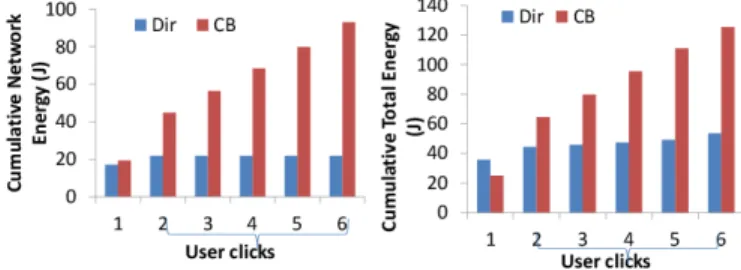
Figure 6: Running JS in the cloud impacts network
energy with user interactivity in a session
does worse, it obtains lesser compaction. In fact for some pages where CB does worse, the compaction ratio is >1.
Further we found that for pages where CB streams multi-ple bursts of data it is not able to achieve better compaction when compared to pages where it compresses the whole page and sends in one burst. A possible reason is each of the bursts might have redundant data sinceCBstreams multi-pleCBMLfor the page. We hypothesize, sending deltas in each burst could potentially help achieve better data com-paction. Using multiple bursts may diminish network energy savings (since the radio may need to be in the connected state throughout).
Overall these results indicate that even though offloading JS to the cloud could potentially reduce CPU energy, the benefits have to be carefully weighed against the different trade-offs based on the page and the network characteristics.
4.2 Comparing energy usage over a user session
In the previous section, we focused on one-time download of a web page, whereas in practice, users may interact with pages a lot. e.g., users may submit forms, click on images or hyperlinks etc. If JSprocessing is completely offloaded to the cloud, any interactivity may involve communicating with the cloud proxy throughout the session. So in this section we compare the cumulative energy usage with CB and Direct over an entire user session to study the impact of user interactivity.
Here we choose ‘page B‘ from the figure 5. As described earlier, page B shows a slide show of 5 images and contains buttons for the user to view each images separately. We
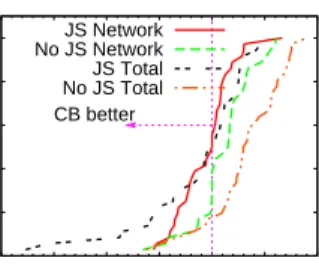
0 0.2 0.4 0.6 0.8 1 -20 -15 -10 -5 0 5 10 CDF
Energy Increase (Joules) CB better
JS Network No JS Network JS Total No JS Total
Figure 7: CDF of the median
in-crease in energy (network, total)
for pages with and withoutJS
0 0.2 0.4 0.6 0.8 1 0 0.5 1 1.5 2 2.5 CDF
Data compaction ratio (CBSize/DirSize) With JS
Without JS
Figure 8: CDF of data
com-paction ratios - ratio of CB size
and Direct size for all pages with
and withoutJS 0 0.2 0.4 0.6 0.8 1 0 1 2 3 4 5 6 7 8 9 10 CDF
Page Download Time(s) Direct
CB
Figure 9: CDF of page download
times usingCBand Directusing a 3G network in NJ
duct an experiment, where we emulate an interactive session by generatinguser clickson the buttons once every minute to view a particular image. Since the focus of this experi-ment is on a single user session, we enable caching on the device for both Direct and CB. Each impulse in figure 6 from minutes 2 to 6 represents a user click.
Figure 6 shows the cumulative energy usage (total and network) every minute for the whole session. When the user clicks on the button,Directruns theJSlocally in the client and displays the particular image that is already cached dur-ing the first download of the page. Since all 5 images are available in the local cache, Direct needs no further data transfer and does not consume any network energy. This is easily seen from figure 6 as the network energy withDirect remains unchanged for the whole session, while the total en-ergy increases by as much as 9.2J over the whole session, attributed to the CPU energy consumed by running theJS locally.
In contrast, sinceCBdoes not send theJS to the client and processes it in the cloud, every user click results in the client communicating with the cloud proxy to run theJSand send a newCBMLof the page to the client. Despite per-forming data compaction on each of these differentCBML, CBincreases both the cumulative network and total energy over the session. e.g., while the cumulative CPU energy con-sumed byCBis almost the same asDirectat the end of the session, it consumes about 60.9J more network energy than Direct for the whole session, thus consuming considerably more total energy overall. We conclude that the benefits withCBare not clear if there is lot of user interactivity be-cause offloadingJSto the cloud increases the communication cost significantly over a user session.
4.3 Impact of data compaction
There are two key design elements that could impact energy savings withCB: (i) offloading JSexecution; and (ii) data compaction. In this section we separate these two factors and study the impact of data compaction in greater detail. Data compaction here refers to techniques that reduce data usage by transforming the web page (e.g., reformatting, sizing images for small form factor etc.) and excludes the re-duction obtained by not shipping theJSdown to the client. We note that the data compaction libraries used byCBare well-known and many mobile browsers adopt these libraries. For this study, we prepare and host snapshots of the 40 pages on our local server in Purdue to understand the im-pact of data comim-paction in a more controlled setting. We
then remove all JS code from these pages thus preparing two versions of each page - one with JS and other with-out. We conduct an experiment in which we first download theJSversion of a page using bothCBandDirect back-to-back, then download the version withoutJSusing bothCB and Direct. Similar to the experiments in section 4.1, we perform 20 runs for each version of the page and compute theEnergy increase (Energy CB - Energy Dir)for both the versions of the pages.
In figure 7 we present the medianincrease in energy(both network and total) with CB compared to Direct for both versions - one with JSand another without JS. The figure shows that CB does not always perform better than Di-rect for both versions of the pages (with and without JS). Moreover, the benefits withCBare more limited for pages withoutJS. than pages withJS. For instance,CBincreases the total energy for 83% of pages without JSas compared to only 47.3% for theJSversion of the same pages. To fur-ther aid our analysis, we plot the data compaction ratio for the pages with and withoutJSin figure 8. We see that the data compaction ratios are smaller whenJSis excluded from the pages, explaining the higher increase in energy withCB when compared to the version with JS. As a side point, it is interesting to note that there are some pages for which the data compaction ratio is>1, even whenCBdownloads
these pages in a single burst. We hypothesize thatCBmight send page layout information in theCBMLto aid the page rendering in the client and this might be an additional over-head for small pages.
To understand the correlation between the data compaction ratio and the energy savings withCB, we analyzed the data further and found a few factors that determine when data compaction is beneficial. In general as expected, while the energy savings withCBdoes show some correlation with the compaction ratio, we also find theWait Timeat the proxy (Section 2) to be a key reason for the additional energy expended by CB. When theWait Timeis large, the total download time increases. For the pages withoutJS,CB in-curs higher download time for 60% of pages. e.g., we find a page for which CBconsumes more network energy than Direct, even though the data compaction ratio achieved by CBis 0.09. This is because, theCBproxy takes a longWait
Time(6.8s) to download the page from the server and per-form data compaction, thereby increasing the total down-load time compared toDirect.
A higher download time leads to increase in network en-ergy since the client radio stays in the RRC CONNECTED state [9] throughout the download. In this state, the client will be in LONG DRX mode periodically, consuming rel-atively lower power than the CR state (refer footnote 1). However spending a longer time in LONG DRX through higherWait Time, can outweigh the energy savings obtained by reducing the time spent in the CR state by compression. Thus our results suggest that the decision to perform data compaction, should takeWait Timeand the LTE radio state transitions into account.
4.4 Sensitivity study
In this section we perform a sensitivity study using a 3G network in NJ and a tablet device (Samsung galaxy tab 8.9). We download thenon-JSversion of the pages that are hosted from our server in Purdue locally. Again we findCBdoes not provide clear benefits overDirect. e.g., Figure 9 shows CBincreases the page download time compared to Direct for 70% of pages. We also observed thatCBincreases the total energy compared toDirectfor about 60% of the pages. Specifically, CB increases the network energy by up to 6J for 40% of the pages and increases the CPU energy for all the pages compared to Direct. Since these pages do not haveJS, it may be thatCBconsumes more CPU cycles to decompress theCBMLthereby consuming more CPU energy thanDirect. We omit the energy results due to lack of space.
5
Conclusions
In this paper, we argue that there is need to revisit trade-offs in the design of cloud-assisted mobile browsing given the dramatic improvements in the processing capabilities of mobile devices, and given that the cellular radio interface constitutes a growing component of the total device power. We substantiate these arguments through one of the first studies of an operational and widely used cloud-based mobile browsing solution.
In particular, our observations are:
•Offloading JS to the cloud is not necessarily beneficial:While
the conventional wisdom is that offloadingJSto the cloud could lead to much benefits, our evaluations indicate the benefits are dependent on the the characteristics of pages – e.g., by offloadingJS to the cloud, CB decreased the to-tal energy for 52.7% of the pages while increasing the toto-tal energy by up to 21.31J for remaining pages. While pages heavy onJSprocessing do better with cloud-based solutions, pages with long-runningJS involving periodic data down-loads from servers (e.g., to support rolling advertisements) are harder to support in an energy efficient manner for cloud-based solutions. For such pages, transmitting all data in a single burst may reduce response times for the client – use of multiple bursts may diminish network energy savings (since the radio may need to be in the connected state through-out), and lead to less effective data compaction. Performing page characteristic analysis to determine the best design for a given page is an important direction for future research.
•Considering user interactivity when offloading JS is im-portant: Supporting interactive sessions in a energy-efficient manner is challenging when offloadingJSto the cloud. The network energy consumed owing to communication with the cloud server for each client interaction may outweigh the CPU energy saved by processingJSin the cloud – e.g., in
an interactive session experiment,CBincreased the overall network energy by as much as 60.9J compared toDirect.
•Data compaction is not always beneficial: Performing data
compaction in the cloud is not always beneficial and the ben-efits in energy savings have to be weighed against the time taken to perform data compaction, in order to not increase the network energy – e.g., in our experiments with pages withoutJScontent, CBperformed better thanDirectonly for 25% of the pages in network energy and 17% in total energy. Even though CBachieved 90% compaction of data on some pages, it increased the energy usage by as much as 9.8J because of the time to perform the compaction.
Overall, our study points to the need to carefully con-sider these new trade-offs while designing cloud-based mo-bile browsing solutions. As part of our ongoing work, we are investigating other design points that have been taken by existing cloud-based mobile browsers, as well as designing new solutions driven by our insights.
6
Acknowledgments
We thank our shepherd Michael Piatek and the anonymous reviewers for their constructive feedback and comments. This work was supported in part by National Science Foundation (NSF) Career Award No. 0953622. Any opinions, findings and conclusions or recommendations expressed in this ma-terial are those of the authors and do not necessarily reflect the views of NSF.
7
References
[1] Amazon silk split browser architecture.https:
//s3.amazonaws.com/awsdocs/AmazonSilk/latest/silk-dg.pdf. [2] By 2014, mobile internet usage will take over desktop internet
usage.http://www.digitalbuzzblog.com/
2011-mobile-statistics-stats-facts-marketing-infographic/. [3] Data compression proxy in android chrome beta.https:
//developers.google.com/chrome/mobile/docs/data-compression. [4] Opera mini architecture and javascript.http:
//dev.opera.com/articles/view/opera-mini-and-javascript/. [5] Skyfire - cloud based mobile optimization browser.
http://www.skyfire.com/operator-solutions/whitepapers. [6] Alexa. Available athttp://www.alexa.com/topsites.
[7] B.-G. Chun et al. Clonecloud: Elastic execution between mobile device and cloud. InProc. ACM Eurosys, 2011.
[8] E. Cuervo et al. Maui:making smartphones last longer with code offload. InProc. ACM MobiSys, 2010.
[9] J. Huang et al. A close examination of performance and power characteristics of 4g lte networks. InProc. ACM Mobisys, 2012. [10] R. Kemp et al. Cuckoo: a computation offloading framework
for smartphones. InProc. MobiCASE, 2010.
[11] S. Kosta et al. Thinkair: Dynamic resource allocation and parallel execution in cloud for mobile code offloading. InProc.
IEEE INFOCOM, 2012.
[12] K. Matsudaira. Making the mobile web faster.
Communications of the ACM, Vol 56. No 3., 2013.
[13] F. Qian et al. Profiling resource usage for mobile applications: A cross-layer approach. InProc. ACM Mobisys, 2011. [14] A. Saarinen et al. Can offloading save energy for popular apps.
InProc. ACM MobiArch, 2012.
[15] M. Satyanarayanan et al. The case for vm-based cloudlets in mobile computing.IEEE/Trans. Pervasive Computing, 2009. [16] X. S. Wang et al. Accelerating the mobile web with selective
offloading. InProc. ACM MCC, 2013.
[17] L. Zhang et al. Accurate online power estimation and automatic battery behavior based power model generation for smartphones. InProc. ACM CODES+ ISSS, 2010.
[18] B. Zhao et al. Reducing the delay and power consumption of web browsing on smartphones in 3g networks. InProc. ICDCS, 2011.