Eindhoven University of Technology
Department of Mathematics and Computer Science
Information Security Technology
Server based DoS vulnerabilities in
SSL/TLS Protocols
Master Thesis
Sukalp Bhople
Supervisors:
dr.ir. L.A.M. (Berry) Schoenmakers Faculteit Wiskunde & Informatica [email protected] Technische Universiteit Eindhoven prof. dr. Eric R. Verheul
Institute for Computing & Information Sciences [email protected]
Radboud University Nijmegen
Abstract
When availability is an important security requirement for the organizations then (D)DOS ((Distributed) Denial of Service) attack is one of the important attacks that needs to be addressed.
The SSL protocols are widely used to secure e-commerce and other sensitive online trans-actions. The SSL protocol imposes a significant overhead on the web server. However, it does not create a significant overhead on the client-side. This creates an opportunity for an attacker to execute the computational DoS attacks on the SSL servers. In addition, the SSL protocols are complex in nature.
In this thesis, we perform a number of experiments to analyse the DoS attack possibilities on the SSL protocol. To do so, we study the SSL protocols to come up with a number of SSL functionalities those are likely to be the weak-link and can be exploited to execute the DoS attacks. We also review the Openssl implementation to investigate the presence of DoS attack vulnerabilities in the implementation. Our experimental results show that the client authentication can create a significant computational overhead on the server side. The compression utility does not introduce any buffer overflow condition. The cryptographic operations involved in the SSL protocols are expensive and these operations are unbalanced. The server has to perform more expensive operations than the client especially when RSA key exchange method is used.
We also perform the comparative experiments in which, we measure the impact of the three different DoS attack strategies on the SSL server performance. We found that the SSL renegotiation based DoS attack outperforms the other two DoS attack strategies. We describe the SSL renegotiation feature and working of the thc-ssl-dos tool [1] which is based on the SSL renegotiation feature. The results of these tests also indicate that the SSL protocol is processor intensive. Therefore, adding more CPUs can help in alleviating the impact of the DoS attack. Since, SSL renegotiation based DoS attack only works when the renegotiation is supported, it is easy to mitigate such attack just by disabling the renegotiation.
Our results suggest that there is no simple fix to completely mitigate the DoS attacks. However, the likelihood of the DoS attacks can be reduced by employing enough CPU power, hardware accelerators, memory and network bandwidth. The SSL server needs be configured carefully according to the business requirements.
Keywords: DOS, (D)DOS, Denial-of-Service, SSL, TLS, SSL performance, DOS
trends, DoS strategy comparison, SSL computational vulnerabilities.
Contents
1 Introduction 1 1.1 Context . . . 1 1.2 Problem Description . . . 2 1.3 Research Goal . . . 3 1.4 Research Approach . . . 3 1.5 Contribution . . . 4 1.6 Outline . . . 52 Denial of Service Attack 7 2.1 Introduction . . . 7
2.2 Distributed Denial of Service attacks . . . 8
2.3 Trends . . . 8
2.3.1 Emerging trends . . . 10
2.3.2 DoS activities . . . 12
2.4 SSL protocol: DoS Attack Threat Model . . . 13
2.5 Summary . . . 14
3 SSL / TLS protocols 15 3.1 Introduction . . . 15
3.2 SSL Protocol: Higher Layer . . . 15
3.2.1 The SSL Handshake protocol . . . 16
3.2.2 The SSL Change Cipher Spec (CCS) protocol . . . 21
3.2.3 The SSL Alert protocol . . . 21
3.2.4 The Application Data protocol . . . 22
3.3 SSL Protocol: Lower Layer . . . 22
3.3.1 The SSL record protocol processing . . . 22
3.3.2 SSL connection state . . . 22 3.3.3 Compression . . . 23 3.3.4 MAC calculation . . . 23 3.4 SSL Features . . . 24 3.4.1 Session resumption . . . 24 3.4.2 SSL renegotiation . . . 25
3.4.3 SSL resumption versus SSL renegotiation . . . 26
3.5 Model of Operation: SSL & TCP . . . 26
3.5.1 TCP . . . 26
3.5.2 SSL session over TCP . . . 26
3.6 Summary . . . 29
4 SSL Renegotiation and Computational DoS 31 4.1 SSL Renegotiation . . . 31
4.1.1 Definition . . . 31
4.1.2 Renegotiation application scenarios . . . 32
4.1.3 Authentication Gap in SSL renegotiation . . . 33
4.1.4 Secure renegotiation . . . 33
4.2 The SSL renegotiation based DoS attack tool: thc-ssl-dos . . . 34
4.2.1 Background . . . 34
4.2.2 SSL renegotiation based computational vulnerability . . . 35
4.2.3 Work-flow of thc-ssl-dos tool . . . 35
4.2.4 Impact . . . 37
4.3 Mitigation techniques and their effectiveness . . . 38
4.3.1 Server control . . . 38
4.3.2 Disable renegotiation . . . 38
4.3.3 Heuristic based SSL Handshake Rate Limitation . . . 38
4.4 SSL Renegotiation support in Apache web server . . . 40
4.4.1 Test for renegotiation . . . 40
4.5 Summary . . . 41
5 DoS Attack Analysis: SSL Record Processing 43 5.1 Record Processing . . . 43
5.1.1 Replay/Re-order attacks . . . 43
5.1.2 Missing record attack . . . 45
5.1.3 Incomplete session establishment attacks . . . 46
5.1.4 False data handling attack . . . 47
5.2 Compression in SSL . . . 48
5.2.1 Background . . . 48
5.2.2 Utility of Compression in SSL . . . 48
5.2.3 HTTP (Level) Compression and SSL (Level) Compression . . . 49
5.2.4 Compression Burst Handling . . . 50
5.2.5 Computational Overhead due to Compression . . . 53
5.3 Summary . . . 54
6 DoS Attack Analysis: Cryptographic Operations in SSL 55 6.1 Cryptographic Operations . . . 55
6.1.1 Introduction . . . 55
6.1.2 Cost of cryptographic operations . . . 55
6.2 Distribution of work overhead . . . 58
6.2.1 Client-Vs-Server: Computational Differences . . . 58
6.2.2 Set-up & Tool . . . 58
6.2.3 Result & Analysis . . . 59
6.3 Summary . . . 60
7 DoS Attack Analysis: Client Authentication using RSA Certificates 61 7.1 Introduction . . . 61
7.2 Certificate Chain Construction . . . 62
7.2.1 Background . . . 62
CONTENTS v
7.2.3 Certificate Loop . . . 63
7.3 RSA Certificate Verification (Signature Verification) . . . 65
7.3.1 Role of size of exponents . . . 65
7.3.2 Chain of certificates . . . 66
7.3.3 Long chain of certificates with large public exponent . . . 67
7.4 Summary . . . 74
8 Comparative Analysis: DOS Attack Strategies on SSL 75 8.1 Methodology . . . 75
8.1.1 Platform . . . 76
8.2 DoS tools and attack strategies . . . 76
8.2.1 thc-ssl-dos tool . . . 76
8.2.2 sslsqueeze tool . . . 76
8.2.3 BFC (Brute Force with Crypto) tool . . . 78
8.3 Experiments and Analysis . . . 79
8.3.1 Performance benchmarking . . . 79 8.3.2 Micro-benchmarking . . . 84 8.4 Summary . . . 87 9 Miscellaneous 89 9.1 Related Work . . . 89 9.1.1 Reverse SSL . . . 89
9.1.2 Improving secure server performance by re-balancing SSL/TLS hand-shakes . . . 92
9.1.3 Performance analysis of SSL web servers . . . 94
9.1.4 Using client puzzles to protect SSL . . . 94
9.2 Random Discussions: DoS attacks on SSL . . . 95
9.2.1 Session Tickets . . . 95
9.2.2 DoS attacks with respect to different SSL/TLS protocol versions . . . 96
9.3 Summary . . . 97
10 Summary and Conclusion 99 10.1 Attack Vectors . . . 99
10.1.1 Client authentication using RSA certificates . . . 99
10.1.2 Record processing . . . 102 10.1.3 Compression in SSL . . . 102 10.1.4 Cryptographic operations . . . 103 10.1.5 SSL renegotiation . . . 104 10.2 Attack Strategies . . . 104 10.2.1 sslsqueeze tool . . . 104
10.2.2 Brute Force with Cryptography . . . 105
10.2.3 thc-ssl-dos . . . 105
10.2.4 Final remarks . . . 105
10.3 DoS Attack Mitigation Techniques . . . 107
10.3.1 Mitigation by monitoring . . . 107
10.3.2 Mitigation by load balancing and abbreviated handshakes . . . 108
10.3.3 Mitigation by strategic changes . . . 108
10.3.4 Mitigation by configurational changes . . . 109
10.4 SSL Server Performance Improvement Techniques . . . 109
10.4.2 Elliptic curve cryptography . . . 109
10.5 Future Scope . . . 110
10.6 Conclusion . . . 110
11 Acknowledgments 113 References 115 A Cryptographic Algorithms and their working 119 A.1 RSA . . . 119
A.2 Diffie-Hellman . . . 120
B Networking 121 B.1 Rate Limiting SSL Handshakes . . . 121
B.2 Wireshark Screen Shots . . . 122
B.2.1 Compression Method Support in Browsers . . . 122
B.3 OpenSSL command line options . . . 123
B.3.1 Obtaining RSA key length of the Target . . . 123
List of Figures
2.1 Attack Type Distribution (First Quarter of 2012) (source: [2]). . . 10
2.2 Largest Bandwidth Consumption Attacks Reported (source: [3]).. . . 11
3.1 The SSL with its (sub)layers and (sub)protocols (Source:[4]) . . . 16
3.2 Overview of Handshake Protocol . . . 17
3.3 The SSL Record Protocol Processing (source: [5]) . . . 23
3.4 SSL Record . . . 24
3.5 Session Resumption (Abbreviated SSL Handshake Protocol) . . . 25
3.6 SSL Session Flow over TCP Connection . . . 27
4.1 An Empty Renegotiation Extension Format . . . 34
4.2 Wireshark Screen-shot: SSL renegotiation packet is flagged with "PUSH". . . 39
5.1 Record boundary division: A scenario where a part of Record 1 is not sent. . 45
5.2 Method Tree (Function Hierarchy) for decompression in SSL . . . 52
6.1 Performance Comparison of Cryptographic Operations . . . 57
6.2 Digital Signature Performance Comparison . . . 57
6.3 Comparison of computational power needed by server and client to complete 1000 SSL handshakes . . . 59
7.1 A Basic Certificate Chain . . . 62
7.2 The set of malicious certificates that forms a loop during certificate chain construction . . . 63
7.3 Client Certificate Verification: Comparison with respect to public exponent . 72 7.4 Client Certificate Verification: Comparison with respect to length of certificate chain . . . 73
8.1 Web server throughput under different categories of attacks . . . 80
8.2 Total request time under different categories of attacks . . . 81
8.3 The Connection Time: brute force with crypto (BFC) Vs brute force without crypto (sslsqueeze)with respect to normal connections . . . 82
8.4 Total Wait Time: brute force with crypto (BFC) Vs brute force without crypto (sslsqueeze) with respect to normal connections . . . 83
9.1 Reverse SSL Handshake: (a) with client authentication and (b) without client authentication (source: [6]). . . 90
B.1 Wireshark Screen-shot: Compression Support in Chrome Browser . . . 122 B.2 The basic constraint "path length constraint" is set to none. . . 123
List of Tables
3.1 Session ID and its significance . . . 18
3.2 Sample cipher suites and their meaning . . . 19
5.1 Terminology used in Listing 5.1 . . . 51
5.2 Terminology used in Listing 5.2 and in Figure 5.2. . . 53
6.1 A simple performance comparison of different cryptographic operations in SSL protocol . . . 56
6.2 Public Key Cryptographic Operations in SSL during handshake . . . 58
7.1 Terminology used in Listing 7.1 . . . 65
7.2 Terminology used in Listing 7.2 . . . 66
7.3 Terminology used in Listing 7.3 and 7.4 . . . 71
7.4 Summary of certificate chain experiment . . . 71
7.5 Comparison of different public key exponent usage with respect to time re-quired by the server to complete 1000 handshakes . . . 72
7.6 Comparison of different size of the certificate chain usage with respect to time required by the server to complete 1000 handshakes . . . 73
8.1 System information of SSL server . . . 76
8.2 Comparison of web server performance under different attack scenarios . . . . 84
8.3 Micro-benchmarking for Attacker’s machine . . . 85
8.4 Micro-benchmarking for Victim’s machine . . . 86
9.1 SSL Version History . . . 96
10.1 Certificate verification experiment: Summary of risk analysis of the client au-thentication based DoS attacks . . . 101
10.2 Comparison of time required by the server & the client to perform 1000 hand-shakes for different RSA private key sizes . . . 103
10.3 Applicability of DoS attack strategies on different versions of the SSL protocols 106 10.4 Overview of DoS strategies comparison Experiment: Impact on the target machine and client machine . . . 106 10.5 Applicability of DoS attack strategies on different versions of the SSL protocols 107
List of Listings
4.1 iptable Entry: Heuristic based Rate Limiting SSL handshakes (source:[7]). . . . 39
4.2 Secure Renegotiation Support in Apache Web Server. . . 40
5.1 Compression Boundary Check . . . 50
5.2 Decompression Method call . . . 52
7.1 Certificate Chain Building in OpenSSL . . . 63
7.2 Constraint on the public exponent (e) in OpenSSL . . . 65
7.3 The client configuration to load the SSL context with cipher suite and certifi-cates and corresponding private key . . . 69
7.4 A server configuration to request the client certificate during the SSL handshake 70 B.1 Heuristic based Rate Limiting SSL handshakes iptable Entry(source: [7]). . . . 121
B.2 Openssl s_client usage(source: [8]). . . 123
CHAPTER
1
Introduction
1.1
Context
I
n the IT world today, most of the business’s processes depend upon their IT infrastructure and online presence. Performance and availability being the key factors in daily operations, an outage of the online service could cause hazardous effect on the core business of the organization.Denial of Service (DoS) attack is one of the main threats to the (continuous) availability of the organizational resources. This attack is an attempt to make the services or the network resources unavailable to its intended users. The severity of this kind of attack is greater when this attack is conducted from the different number of places at the same time. This variety of DoS is called Distributed Denial of Service (DDoS or (D)DoS) attack.
In one variety of DoS and/or (D)DoS attack methodology, an attacker produces a huge amount of network traffic targeted at the victim server. This can cause anything from minor slowdown to complete shutdown of the service provided by the server. This is because the server cannot handle the sudden increase in demand of its service and has to partially or completely shut down its online services (resources). This makes its service unavailable to its legitimate users. In upcoming trends of DoS attacks, an attacker creates limited number of connections with the server and maintains them for a longer time. This eventually can cause depletion of the server’s resources such as a connection pool, processing power, memory. This alters the server’s behavior causing denial of service situation for legitimate users of the server. This variety of DoS attack does not require a huge amount of traffic.
The motivation for DoS attacks can be numerous. Number of surveys and news portals available on the internet have reported that the protests against controversial activities, operations [9, 10], government actions [11, 12] or mere vandalism [13, 14] is the popular reasons for organizations to be the victim of DoS attack. One of the incidents reported at [15] gives an evidence of usage of DDoS for money extortion. There is one more situation where a website ends up denied without any deliberate attempt from the attacker. Such situation may arise due to increased web traffic on a web portal that is totally unprepared for a huge amount of web traffic. One such incident is reported at [16]. It describes the time when Michal Jackson was dead in 2009, people all around the world visited the web portal reporting the news to verify the fact. The web site was not configured to handle so many requests concurrently. This resulted in a slowdown of the website.
In recent past, hackers are found to be using advanced techniques to construct DoS attacks
on websites. Automated tools such as Slow-loris, LOIC (Low Orbit Ion Cannon), #RefRef are being used in wild. Hacker organizations such as Anonymous are openly taking responsibilities of DoS attacks. Recent News articles [11, 14] indicate that large financial organization such as MasterCard is also a victim of such attacks. The (D)DOS attacks on Amazon, CNN, eBay, Yahoo [9] and VISA, MasterCard, Winklers [11, 14] are well acknowledged.
The financial organizations handle one of the most critical and sensitive transactions everyday. The portals for online banking are supposed to provide service to its customers 24x7. Any outage in its service could cause great financial loss to financial organizations. Along with these financial institutions, e-commerce websites that handle sensitive customer information such as usernames, passwords, credit card numbers are protected using SSL/TLS 1 protocols. The four main objectives of SSL/TLS protocols are cryptographic security, interoperability, extensibility and relative efficiency. It ensures that the data sent over the internet is secure.
Communication between a client (generally a user of the online service) and a server (for instance, website of a bank) that uses SSL2 protocol begins with SSL handshake. The SSL handshake uses public key cryptography to (optionally) authenticate each other (in general server is the one who gets authenticated) and to agree on a cipher and a corresponding shared secret key3. This secret key is used to protect the application layer data and communication. The SSL protocols were developed to protect the sensitive data communicated over the inter-net. The possibilities of DoS attacks were not considered while developing these protocols. This is because these attacks are usually not easy to mitigate or completely protect against. Due to increased complexity in the SSL protocols, there is always a possibility to exploit some feature of the protocol to construct the DoS attack. It is therefore, equally important to continuously revise and carefully implement the SSL protocol. Finally, it is necessary to investigate the possibility of DoS attacks on widely used SSL protocols and its implementa-tions.
1.2
Problem Description
The SSL protocol is being used extensively to protect the sensitive information traveling across the internet. The SSL refers to a secure layer that consists of the number of sub-protocols. The SSL runs transparently on the top of the transport layer protocols such as TCP and just below the other higher level protocols such as HTTP (Hyper Text Transfer Protocol). The SSL protocol is easy to use but equally hard to configure safely because of its complex nature.
The SSL handshake protocol deals with the most expensive cryptographic operations. It is not balanced in terms of the distribution of the work load among the server and the client. The SSL handshake is computationally expensive for the server than it is for the client. The clients can request the server to perform computationally expensive operations without doing any work themselves. Therefore, an attacker can deploy (D)DOS attacks by generating too many handshake requests to exhaust the computational resource of the target server.
In spite of doubling CPU speed for every 18 month, the performance of the SSL server remains an important issue. This is due to the requirement of serving increasingly high number of clients at the same time [6].
1
SSL: Secure Socket layer, TLS: Transport Security layer. More about these protocols in upcoming chapters.
2In this thesis, the word "SSL" refers to both SSL and TLS protocols unless the difference between them
needs to be addressed.
3The details of the SSL Handshake protocol are described later in this thesis. For now, only basic
1.3 Research Goal 3
Recently, one of the hacker groups known as "The Hacker’s Choice" released a proof-of-concept tool over the internet [1]. This tool exploits the computational imbalance between the server and the client using a feature in the SSL protocol. This feature is the SSL renegotiation. This feature enables the client or the server to send a number of handshake requests to the other communication end in a single connection.
Therefore, SSL protocol can be the easy target of the DoS attack due to its computational imbalance and complexity.
1.3
Research Goal
The goal of this research is to investigate the server based (D)DOS vulnerabilities in the SSL/TLS protocols and provide countermeasures and their effectiveness for the identified DoS attack vectors.
The intension is to assess the different features in SSL/TLS protocols with respect to possibility of the DoS attack. Whenever SSL is used to protect the communication and data transmission, it is also very important to carefully implement it. The SSL specification pro-vides implementation guidelines for only some part of the protocol. Therefore, it is important to verify whether the implementation is in accordance with the specification.
The goal of this research can be given as follows:
• Provide a general overview of the DoS attacks and explain the importance of the inves-tigation of DoS attacks on application layer protocols such as SSL.
• Study the SSL protocol and its implementation to provide causes of DoS attacks on the SSL protocol. On the basis of the findings, perform some experiment to measure the impact of the identified attack vectors.
• Study the SSL renegotiation and its severity with regard to the DoS attacks.
• Investigate the most common DoS strategies on the SSL protocols and measure their impact on the SSL server. Finally, provide the mitigation techniques and their effec-tiveness.
• To investigate the efforts-impact of the DoS attacks on the SSL infrastructure.
• Assess the available state of the art literature with the help of the findings from this research and conclude this research.
1.4
Research Approach
This study starts with the SSL specification review and implementation review. The speci-fication review is done to understand the working of the SSL protocol and identify the DoS attack vectors in the protocol. This is followed by the implementation review.
There are number of implementation softwares such as OpenSSL [8], CrytpLib etc. An OpenSSL implementation is selected to be reviewed. It is OpenSSL source and written in C programming language. The OpenSSL is platform independent. The latest statistics at [17] suggests that the OpenSSL is a popular and significantly used open source implementation of the SSL/TLS protocols. The implementation review will focus on identifying the DoS related vulnerabilities.
In order to investigate DoS vulnerability in the SSL protocols some strategies are identi-fied. An overview of these strategies is given below.
• Check the robustness of the SSL protocol when certain steps in the SSL protocol are not followed or changed in order to create DoS anomaly.
• Analyze the possibility of implementation of the existing DoS strategies on the SSL protocols to produce DoS attack.
• Search for common implementation mistakes in the OpenSSL that can cause the DoS on the SSL protocols.
• SSL runs transparently between the higher level protocol such HTTP and the transport layer protocols such as TCP (Transmission Control Protocol). TCP is widely used over the internet and is the de facto standard of the communication over the internet. Therefore it is reasonable to consider the DoS attacks that are possible on the TCP protocol and consider impact on the SSL infrastructures.
• Prepare the client-server environment to test the effectiveness of the traditional DoS attacks against the some new approaches.
1.5
Contribution
In this research, we investigated the possibilities of the DoS attacks on the SSL protocols. To do so, we constructed the DoS attack threat model for the SSL protocols.
In this thesis, we perform the series of experiments on various aspects of the SSL protocols to find the possibilities of the DoS attack. We have divided the experimental investigations into three categories. These categories are referred as attack vectors. These attack vectors are described below.
SSL record processing We perform a number of experiments to check if the malicious record construction can introduce any vulnerability that can be exploited to execute the successful DoS attack on the SSL servers. We show that there is no possibility to construct DoS attack using this vector. However, we stress that since the SSL works on the top of the TCP, the SSL servers are vulnerable to TCP based DoS attacks. However, such attacks do not affect the core functionality of the SSL protocol.
Cryptographic operation We demonstrate that the cryptographic operations in SSL are expensive. In addition, these are not balanced. That is, the server needs to work more when compared to the client. This is a well-known fact; however, we make an attempt to provide practical results with the help of a proof-of-concept tool. This tool is originally developed by Vincent Bernat [7]. We have modified this tool to provide the appropriate results in this thesis.
Client authentication using RSA certificates We perform a number of tests in this cat-egory of experiment. We make use of different sizes of public exponent and certificate chain length to demonstrate the impact of the client authentication on the SSL server. We found that, the OpenSSL [8] allows a large public exponent to be used in the signature verification step of the client certificate verification process.
In addition, we describe the SSL renegotiation process and its impact on the SSL proto-cols. We also describe the working of the thc-ssl-dos tool [1]. Finally, we decide upon the three DoS attack strategies to test their impact on the SSL servers. These strategies are described below.
• The traditional brute force DoS attack that follows standard SSL protocol and uses cryptography. A proof-of-concept tool is built as a part of this research.
1.6 Outline 5
• The SSL renegotiation based computational DoS attack. The thc-ssl-dos tool [1] is used to test its impact.
• The traditional brute force attack that does not use cryptography but follows the pro-tocol with the help of canned propro-tocol messages. The sslsqueeze tool [18] is used to test its impact.
We compare the impact of each tool on the same SSL web server. We have found that, the SSL renegotiation based DoS attack has the greatest impact on the SSL servers. Surpris-ingly, the sslsqueeze has the lowest impact on the SSL server. We analyse the result of this comparative experiment in respective chapter.
We give the analysis of some of the techniques that focus on improving the SSL server’s performance using the results obtained through the experiments performed in this research. On the basis of all the results obtained in this research, we suggest a number of important DoS mitigation techniques and discuss some more SSL server improvement techniques.
1.6
Outline
The remainder of this thesis is organized as follows. Chapter 2 provides an overview of the DoS attacks. It explains the basic concepts of DoS attacks as a primer to understand the number of issues discussed in this thesis. It also describes the DoS attack threat model for the SSL protocols. Chapter 3 provides the fundamental information about the SSL protocol with respect to its (sub)layers and (sub)protocols. In addition, it describes the SSL operations over the TCP (Transmission Control Protocol). Chapter 4 is dedicated to the SSL renegotiation feature of the SSL protocol. This chapter introduces the SSL renegotiation based DoS vulnerability. This information is accompanied with the description of the thc-ssl-dos [1] tool.
Rest of the chapters are dedicated to the experimental analysis of the SSL protocol with respect to the DoS attacks. Chapter 5 considers the number of test cases to verify the applicability of the DoS attacks due to the way SSL records are constructed and handled in the SSL protocol. Further, this chapter explains the test case that focuses on the compression utility in the SSL protocol. Chapter 6 investigates the cryptographic operations involved in the SSL protocol and provides the evidence of the cryptographic overhead and its unbalance nature, which contributes to the susceptibility of the SSL protocols to DoS attacks. Chapter 7 describes the experimentation performed on the client authentication process of the SSL handshake protocol. Chapter 8 deals with the comparison of the effectiveness of the three different DoS attack strategies on the SSL protocol. Chapter 9 reviews the literature that focuses on the server performance improvement in the SSL protocol. In addition, it talks on the SSL session tickets and the effectiveness of the DoS attack on the different versions of the SSL protocols.
Finally, Chapter 10 summarizes the work done in this thesis followed by the brief dis-cussion of the issues considered in this research. It also provides mitigation techniques for DoS attacks on the SSL/TLS web servers and two methods that can be used to improve the server’s performance. At the end, the future scope is given followed by the conclusion of the thesis.
CHAPTER
2
Denial of Service Attack
I
n this chapter, an overview of the Denial of Service attacks is given. This chapter aims atproviding the fundamental and basic principles that are necessary to understand the issues addressed in this thesis. More specifically, this chapter provides all the basic information about the DoS attacks and gives a summary of the types, methodologies and trends in the DoS attacks. This chapter starts with the introduction of the DoS attacks in Section 2.1, Section 2.2 talks about the (D)DoS attacks. Section 2.3 explains the trends in the DoS attacks and discusses the emerging trends of the DoS attacks. Finally, a brief description of the possibility of the DoS attacks on the SSL protocol is given in Section 2.4.2.1
Introduction
Denial of Service (DOS) attack is an attempts to make an online resource or service unavail-able to its intended (legitimate) users. A resource can be anything from a personal computer, router, network infrastructure, web services or any other possible entity on the network, in-tranet or internet. The DoS attacks are undoubtedly a very serious problem on the internet and have manifested its hazardous impact frequently on the internet architectures.
The DoS attacks are becoming progressively common and easy to execute day after day. The attackers are building more sophisticated tools and strategies to produce the DoS attacks. Few years before, it used to require a great deal of technical knowledge and a large number of resources to launch the successful DoS attack. Today, anyone with an adequate computer skills and decent internet connectivity can launch DoS attack with the push of a button. Certainly, this is one of the biggest threat to any business that is dependent on availability of its services on the internet.
These attacks can be classified into 2 broad categories. The first category is a simple case where an attacker launches the attack from single computer. The other category includes the DoS attacks that involve the participation of more than one computer to execute the DoS attacks. This kind of attack is called (D)DOS (Distributed Denial of Service) attack; because the attack is conducted from number of different (distributed) locations. The distributed machines could consist of compromised computers (known as zombies), or machines belonging to multiple people who are perpetrating the attack as a result of concerted efforts. Intuitively, the effect of (D)DOS attack is likely to be more destructive as compared with the simple DOS attack described earlier.
ADenial of Serviceattack can be rendered in number of ways. Some of these are gathered and mentioned below.
• Consumption of computational resources. These may include network bandwidth, disk-space, CPU cycles, entropy source.
• Disruption of configuration information. For instance, routing information [19].
• Disruption of state information, such as unsolicited resetting of TCP (Transport Control Protocol) sessions [19].
• Disruption of physical network components [20].
• Obstructing communication media between a client-server pair so as to disrupt the communication between two of them [21].
2.2
Distributed Denial of Service attacks
A Distributed Denial of Service (DDoS) attack is a superior kind of general Denial of service attack. The DDoS attack differs from the DoS in a way it is executed. The DDoS is said to occur when multiple systems participate in the DoS attack. The impact of DDoS is expected to be larger than DoS attack due to obvious reasons. Now, these multiple systems or machines participate in the DDoS attack either voluntarily or because they are previously compromised by the attacker. These machines can be compromised by the different methods such as installing malware when a user (accidently) visits some malicious website.
There are several advantages of DDoS type of attack to the attacker. This kind of attack can purportedly generate more traffic than a single machine attack. The attack conducted from multiple machines is not easy to detect and/or block as these machines are likely to be distributed over the multiple network areas (Wide range of IP addresses). Blocking any of the attack source network can cause blocking the legitimate user or customers of the service. The effectiveness of a mitigation technique in which a web server employs the larger bandwidth is limited since an attacker can circumvent this countermeasure by using more resource to generate enough traffic to create the DoS attack.
DDoS attacks can be further classified into number of different types according to method-ology used to create Denial of Service condition. For instance, Reflected/ Spoofed attack. This is the attack in which intermediate machines are used in such a way that these machines will help the attacker to create DoS attack on the victim’s infrastructure. ICMP (Internet Control Message Protocol) Echo Request attacks are the type of Reflected attacks.
In addition, a web portal can be a victim of (D)DoS attack if there are more number of visitors to the website (concurrent requests to use its services or resources) than it can handle.
2.3
Trends
This section describes the types and trends in the DoS attacks.
There are several types of DoS attacks. Some of the most common attack types are explained in brief.
TCP Floods In this type of DoS attack, an attacker often sends a huge number of TCP SYN (synchronization) packets with the forged source IP address to the target server. The SYN packets are nothing but the first message of the 3-way TCP handshake to request
2.3 Trends 9
the connection to the server1. On the receipt of this request (SYN Packet), target server respond with SYN-ACK packet and waits for the respons. The response is the final message (ACK) in the 3-way TCP handshake. However, because the source address inside the SYN packet is forged, the response ACK never arrives at the target server. This way, the server is kept engaged in the half-opened connection with the client that does not exists and therefore, the servers resources needed to serve to this connection are locked till the time the TCP connection is terminated by the server due to the connection timer expiration (TCP connection time-out). The enough number of such half-opened connections depletes the server’s resources and/or capacity to respond to the new connection requests. This creates Denial of Service condition for the legitimate users of the service provided by the server. This attack is described at [23].
ICMP Floods This is a variant of DoS attack where bandwidth of the victim server’s network is consumed so that legitimate packets cannot reach to the victim server. A generic method to launch such attack is to send number of ICMP (Internet Control Message Protocol) echo requests to a network device which broadcasts these requests to all the hosts on that particular IP network. On the receipt of such ICMP echo request most of the host reply to the given source address (through echo request) with theecho reply[24]. An attacker makes sure that the source address of echo request
packets are forged to be the address of the victim server. In this way bandwidth at the victim’s network can be consumed depending upon the number of hosts replying to these ping requests and the bandwidth available to the victim server.
UDP Floods In this variant of DoS attack, an attacker sends a large number of UDP packets (with the forged source IP address) to random ports of the victim server. This will cause the victim server to check if any application listens on that port. If no application is listening on that port it will reply with ICMP Destination Unreachable packet. With sufficient amount such incoming UDP packets, the victim server will get entangled with sending too many ICMP packets. This could result in the server to be unreachable by other legitimate clients.
GET Floods This DoS attack generates a huge load on the server by sending large number of HTTP (Hyper Text Transfer Protocol) GET requests. These requests are designed in such a way that server requires more time to process each request. For instance, requesting large image on the web page or requesting some data from the database of the server that requires complex database query operations. This attack is usually launched with the number of bots (Distributed DoS type of attack) to produce large number of such requests. This attack is different from other traditional DoS attacks in a way that it focuses on consuming server’s CPU power instead of server’s network bandwidth.
POST Floods POST Flood attack is similar to GET flood DoS attack. The main difference is that the request method is POST method instead of GET method. The idea of depleting server’s resources remains the same.
An overview of the types of DoS attacks reported in the first quarter of the year 2012 is given in Figure 2.1. This distribution of attack types is taken from the attack report (for the 1st quarter of the year 2012) released by Prolexic2. This distribution also indicates that the infrastructure layer (Layer 3-4) (The OSI protocol stack 3). are mostly used to execute the
1
The explanation of the 3-way TCP handshake can be referred from[22].
2Prolexic is a security service provider company. 3
DoS attacks. Te attack methodologies such as SYN Flood, ICMP Flood and UDP Floods are mostly used. Among application level (Layer 7) attacks GET Floods, POST Floods are the next most observed attacks. It should be noted that this statistics is only an indicative distribution of DoS attack types obtained from the survey.
Figure 2.1: Attack Type Distribution (First Quarter of 2012)(source: [2]).
Figure 2.2 is taken from Annual Security Report of Arbor Network Inc. 2012. The information is collected from the survey that focused on the trends in the DoS attacks. This is a bar chart that shows the highest bandwidth consumption attack recorded in the span of year 2002 till year 2011. The Y-axis denotes the bandwidth consumption in GBPS 4. The X-axis denotes the years from 2002 to 2011.
In the year 2010, the highest DoS attack traffic produced was 100 GBPS. Even if in the year 2011, the decrease in the amount of network traffic from 100 GBPS to 60 GBPS does not necessarily represent a reduction in the overall DoS attack risk. There could be numerous reasons for this reduction in bandwidth. Perhaps, this could be an indication of the change in the trends of the DoS attack. The probable change in the trends is discussed in the next section.
2.3.1 Emerging trends
According to the recent network security surveys [3, 2], the current trends in the DoS attacks are somewhat different than they were just few years before. For instance, most of the DoS attacks were based on bandwidth depletion attacks. In other words, most of the attacks were found to be executed at the layer 3 and 4 of the protocol stack. Few examples of such attacks are TCP flood and UDP flood attacks. These attacks are generated by exploiting the flaws in the network protocols (TCP, UDP, ICMP etc).
The scenario is different now. New attack types are emerging. These attack types does not require large number of resources and can be easily executed with basic understanding of the system. These attacks are significantly dependent on the complexities and flaws in application layer protocols rather than lower layer protocols. These types of attacks are immune to the existing DoS mitigation techniques such as packet level filtering. In packet level filtering mechanism, firewalls and routers are updated with definitions (signatures) that
4
2.3 Trends 11
Figure 2.2: Largest Bandwidth Consumption Attacks Reported (source: [3]).
describes ill packets that are likely to cause DoS attack. Application level DoS attack-traffic looks normal at packet level since they are likely to follow the protocol. The server under such type of DoS attack has greater impact. In addition, the execution of the attack does not need large number of resource like in the case of layer 3 and 4 DoS attacks. This is because, these attack concentrate on the resources available to the service and not the resources available to the whole system. For instance, one of this kind attack focus on creating new connections and maintaining them for longer time. The server usually has limited connection pool through which it can accept the number of connection requests from the client. As number of such long duration connections with the server increases, a time comes when the server can no more serve new legitimate connections. This leads to DoS condition.
On the lines of trends described in this section, some of the application level DoS attacks are identified that have gained special attention due to their greater impact with lesser re-source investment at the attacker side. These attack methodologies does not focus on flooding the network bandwidth but on depletion of the server’s resources in a way that the attack keeps the server engaged in malicious connections and makes the server deny services to the legitimate users. These attacks specially focus on slowing down the connection.
Slow Loris
A Slow loris is HTTP DoS tool developed by RSnake [25]. The Slow loris exploits one of the old vulnerability in the HTTP protocol and the way few web servers handle this vulnerability. The web servers such as Apache will start engaging its resources in the connection as soon as the first byte of the request is received. The Slow loris sends the partial HTTP request and never completes it. It continues sending subsequent parts of headers at regular intervals to keep the sockets from closing. For example, Apache web server has a default timeout of 300 seconds. This is the time limit the Apache web server waits for a reply from end entity. But slow loris continues to follow this timeout to continue without connection getting closed. That is, it sends a byte value of the header with the time interval just less than the "time-out" value. In this way a web server gets quickly tied up with the attack’s connections [25].
This attack requires minimum bandwidth. This attack is not a flood attack (E.g. TCP SYN flood). This attack consumes all the sockets that a web server can create for new connection. Once all the sockets are consumed by slow loris traffic, no legitimate user can access the website hosted on the server. As long as slow loris is consuming server’s sockets, the server-side becomes irresponsive. As soon as the attack stops (and the sockets become
available), the server becomes available for other legitimate users.
Slow Post
Slow POST is another variant of slow attacks. This attack is similar to the Slow Loris attack. It focuses on consuming server CPU cycles and memory instead of network bandwidth. The HTTP POST DoS attack uses POST requests instead of GET as in slow loris. A POST request includes a message body along with a URL. This message body is usually used to specify information for the action being performed [26]. The length of this message body is specified in POST headers through field "Content Length".
The HTTP POST DoS attack starts with sending a complete header to the server unlike in the slow loris attack where a HTTP header is not sent completely. This header specifies a large value for content length. E.g. 1000 bytes. After completing the header, the message body is sent very slowly. The web server waits for the message body to arrive completely as specified by the "content length" field in the HTTP POST header. Enough number of such connections depletes all the server’s resources that are engaged in handling such slow connections with large message body. Therefore, the web server can no more handle the new connection requests from the legitimate users.
HTTP POST requests are commonly used for login, uploading photos/videos, sending webmail/attachments, submitting feedbacks etc [26].
Slow Read
Slow read is the HTTP DoS attack similar to slow loris and slow post strategies. This technique produces DoS attack on the HTTP web servers by draining concurrent connection pool as well as by consuming significant memory and CPU cycles on the server side. This attack sends a complete request to the server unlike slow loris. However, when server replies to the request, the response is read very slowly by the attacker [27]. This is possible due to a feature in the TCP protocol. In every SYN packet that contains the request to the server, the client advertises the incoming buffer window. The server has to send the data limited by the buffer window size. Therefore, the attack advertises very small incoming buffer capacity causing slowing down the connection. Such slow connection can consume significant amount of CPU cycles and memory at server side. As well as such concurrent (multiple) requests disables server capacity to serve to any new connection ultimately denying the service/access to the legitimate users.
2.3.2 DoS activities
Internet has become a medium to communicate and share. This is not an exception for the DoS attacks and related activities. There are number of tools that are being developed and distributed actively. Easy to use tools play an important role in attacking the target. Anony-mous, a underground hacker community is said to have used tools such as slow-loris, HOIC (High Orbit Ion cannon) for DoS attack [11, 28]. These tools are very much sophisticated. Anyone with sufficient computer skills can use these tools and launch the attack with a push of a button. Due to the wide network of such communities huge number of users can launch the attack simultaneously on a same or different target resulting in Distributed Denial of Service ((D)DoS) attack.
The number of DoS tools share similarities in terms of architecture, impact etc. These tools are developed and modified continually. Number of recent tool are the result of little modification of the older tools adapting the model of changing internet architectures to be attacked.
2.4 SSL protocol: DoS Attack Threat Model 13
2.4
SSL protocol: DoS Attack Threat Model
The SSL/TLS protocols are used widely to protect the network communication over the internet. These protocols are described in Chapter 3. The SSL protocols involves the number of cryptographic operations. The public key cryptography is used to perform authentication and key exchange process. The key negotiated through the key exchange process is processed to generate the symmetric key that is used to protect the communication between the server and the client. As one can imagine, this operation is an integral part of the SSL protocol and is something that cannot be avoided.
Unfortunately, process of key exchange and authentication, especially when the RSA method is used, are the most expensive operations on the server to perform. The client, however, can get away with this operation with a little investment of the memory and com-putational resources. Therefore, clients can easily open a number of new SSL connections to request a server to perform such computationally expensive operations without doing any significant work themselves. This leads to the fact that an attacker can deploy (D)DOS attacks by generating too many requests (probably from multiple sources) to exhaust the computational resource of the target server. In spite of doubling CPU speed for every 18 months, SSL performance of server machines remains an important issue. This is due to the requirement of serving increasingly high number of clients at the same time [6].
The SSL protocol has one feature called SSL Renegotiation. This feature is easily ex-ploitable to execute the computational DoS attack on the SSL web servers. The original description can be found at[1]5
Other than these cryptographic operations, the SSL also has requirements in terms of proper memory management, data marshaling (such as copying, fragmenting, etc.), SSL session cache management. All these operations involve the risk of exploitation to build a DoS attack.
In order to protect the network infrastructures such as web servers those uses SSL to protect network communication, it has become very important to investigate the possibility of the DoS attacks on the SSL protocols. There is always a possibility to exploit some features in this protocol to construct the destructive DoS attack.
Therefore, a study that describes the broad picture of the DoS possibility in the SSL protocols is required. The following list summarizes the DoS attack threat model of the SSL protocol.
Flood of connection requests The SSL server can be flooded with a number of gratuitous requests to consume the bandwidth available to the SSL server. This is the traditional type of DoS attack.
DoS attack threats inherited from TCP and HTTP protocols The slow attacks
de-scribed in this chapter can be executed on the SSL protocol too.
The SSL Server configuration The server needs to configure balancing the requirements of the service it is providing. For instance, the server should be equipped with adequate processing power to handle estimated6amount of concurrent connections. If the users of the server are likely to re-visit the server multiple times in a short time, the server should be equipped with the appropriate cache memory in order to enable the abbreviated SSL handshakes 7.
5
The SSL renegotiation and corresponding DoS attack are investigated in Chapter4.
6The estimated amount could be derived from history of server usage hits 7
The SSL server features The SSL renegotiation can be exploited to execute computa-tional DoS attack.
2.5
Summary
This chapter provided the fundamental and basic concepts that are necessary for dealing with the DoS attacks on the SSL protocols. More specifically, the DoS attacks are explained and their popular types are described. A note on the emerging trends in the DoS attacks is given to understand the possibility of the DoS attacks on the application layer protocols and its effectiveness compared to traditional flood DoS attacks.
In the later part of this chapter, three types of DoS attacks are given those work on the strategy of slowing down the connection (between the attacker traffic and the server). Finally, a DoS attack threat model is drawn for the SSL protocols. This chapter gave the basic understanding of the DoS attack in general followed by the DoS attack threat on the SSL protocols. In rest of this thesis, SSL protocol is explained and investigated for the possibilities of executing the DoS attack on it.
CHAPTER
3
SSL / TLS protocols
T
his chapter provides describes the SSL protocols and provides all the information relatedto the SSL protocols that is required to understand DoS attack vectors and strategies described in this thesis. This chapter starts with the explanation of the logical location of the SSL in the protocol stack. The SSL protocol can be seen as a layered protocol. It is explained in Section 3.1. Section 3.2 explains the higher layer of the SSL. Section 3.3 explains the SSL record protocol that is responsible for encapsulating the higher layer protocol data and its protection during transmission.Section 3.4 explains the two of the important SSL features and continues with their differentiation. Section 3.5 provides the details of the SSL protocol with respect to its working on the TCP protocol. Finally, this chapter is summarized in Section 3.6.
3.1
Introduction
S
ecure Socket Layer/ Transport Layer Security protocolstween two machines[29] over the intranet/internet. It facilitates the authentication of1 provide a secure channel be-the communicating parties to each obe-ther and confidentiality and integrity of be-the communica-tion between them. Any protocol that can be run over transport layer protocol such as the TCP (Transmission Control protocol) can be run over the SSL with minimal modification [29].The term SSL can be referred to a layer2 that is best viewed as an intermediate layer between the transport and the application layer [4]. The placement of the SSL layer is shown in Figure 3.1.
3.2
SSL Protocol: Higher Layer
This section describes all the sub-protocols from the Higher Layer as indicated in Figure 3.1. The higher layer SSL protocol comprises of four protocols. These protocols are listed below and are described in this section.
1For convenience, the term "SSL" is used to refer to both the SSL and the TLS protocols in rest of the thesis;
unless some protocol version-specific feature needs to be addressed. In fact TLS protocols are predecessors of SSL protocols and there are no fundamental differences in them.
2
Please note that the SSL stands forSecure Socket LAYER.
Figure 3.1: The SSL with its (sub)layers and (sub)protocols(Source:[4])
• The SSL Handshake Protocol.
• The SSL Change Cipher Spec Protocol.
• The SSL Alert Protocol.
• The Application Data Protocol.
3.2.1 The SSL Handshake protocol
The SSL protocol starts with The Handshake Protocol. The cryptographic parameters of the session state are produced by the SSL Handshake protocol [30].
Overview
The Handshake Protocol allows communicating parties (referred as client and server) to (optionally)3 authenticate each other and negotiate a cipher suite and a compression method used for the communication. The cipher suite and derived cryptographic keys are further used to protect the application level data in terms of the authenticity, integrity and confidentiality [4].
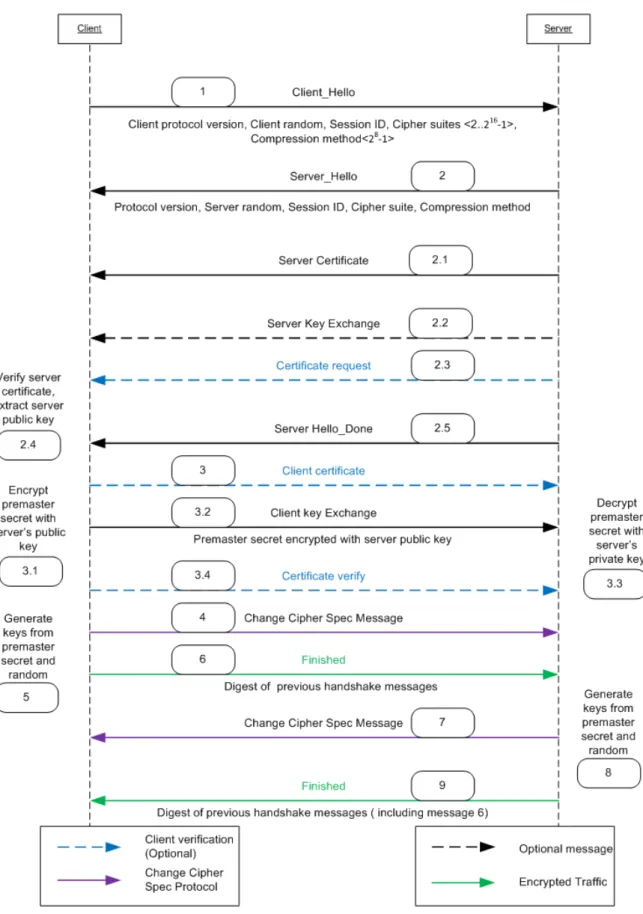
The Handshake protocol commence by exchangingHellomessages to agree upon the SSL protocol version to be used, authentication mechanism, key exchange algorithm to generate shared secret and encryption algorithm to protect application level data. TheHellomessages also optionally decide upon compression method. This is followed by authentication phase in which the server and the client optionally authenticate each other. This is done using exchanging certificates signed by some trusted entity. If the certificate provided by the server does not provide necessary cryptographic information to allow client and server to agree on a
pre-master secret then a separate message calledServer key exchangeis sent by the server to the client so that the client can transfer thepre-master secret to the server by appropriate secure method. Thispre-master secret is further used to generate amaster secret and other secret material calledkey block required to communicate secretly.
Before actually starting an encrypted communication protected under just negotiated al-gorithms and secrets, the client and the server exchanges one special message calledFinished
3
3.2 SSL Protocol: Higher Layer 17
message. The successful verification of the Finishedmessage at each side of the communi-cation confirms that the same security parameters have been generated and the handshake communication is not tampered in any way.
An overview of the Handshake protocol messages with its variations (optional client au-thentication and server key exchange messages) is shown in figure 3.2. The SSL handshake messages are described in the following sections.
Hello request
This message is sent by the server. This message is NOT shown in Figure 3.2. According to protocol specification [31, 30, 32], the server can send this message at any time to the client. This is an empty message to request the client to begin the handshake protocol. On the receipt of this message client may begin with the handshake protocol by sending theclient hello message. This message is not included in Handshake hashes4 used and maintained throughout the Handshake Protocol [30].
This message typically allows the server to request renegotiation of a session [30]5. The SSL protocol specifications [31, 30, 32] does not specify any other application of hello requestmessage than Session Renegotiation.
Client hello
Client initiates handshake by sending a client hello message. The client hello message consist of following attributes.
Protocol version This is a highest protocol version supported by the client or protocol version with which the client wishes to initiate the negotiation (Handshake) with the server.
Client Random This is a structure consisting of 4I byte current unix GMT time-stamp and 28 bytes long number generated by a secure random number generator. This structure is unique to each session between the server and the client.
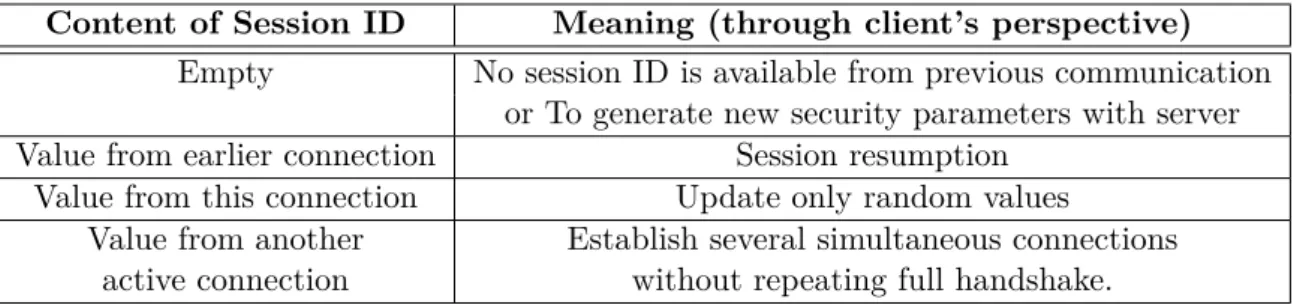
Session ID This is a variable length byte sequence (up to 32 bytes as defined in RFC 4346 [30]) which identifies a session. The significance of thesession IDin theclient hello
message is described in Table 3.1.
Content of Session ID Meaning (through client’s perspective)
Empty No session ID is available from previous communication or To generate new security parameters with server Value from earlier connection Session resumption
Value from this connection Update only random values
Value from another Establish several simultaneous connections active connection without repeating full handshake.
Table 3.1: Session ID and its significance
Cipher Suites This is a list of set of algorithms supported by the client in its preferred order. The cipher suite defines the authentication method, the key exchange algorithm,
4
The handshake messages are recorded and hash of the handshake message is exchanged at the end of the handshake protocol to confirm the integrity of the communication and detection of any possible intrusion
5
3.2 SSL Protocol: Higher Layer 19
the cipher and the hashing algorithm. The illustrative samples of the cipher suites are given in Table 3.2.
Cipher suites Authentication Key Encryption Digest
Establishment
TLS_NULL_WITH_NULL_NULL NULL a NULL NULL NULL TLS_DHE_DSS_WITH_AES_256_CBC_SHA DSS DHE AES_256_CBC SHA-1 TLS_DHE_RSA_WITH_AES_256_CBC_SHA RSA DHE AES_256_CBC SHA-1 TLS_RSA_WITH_RC4_128_SHA RSA RSA RC4_128 SHA-1 TLS_DH_anon_WITH_RC4_128_MD5 NULLb DH RC4_128 MD5
aNo Authentication bNo Authentication
Table 3.2: Sample cipher suites and their meaning
Compression Methods This is a list of compression methods supported by the client. If the session is aresumed session, this field contains the same compression method nego-tiated in the last session. This vector must also contain the CompressionMethod.null. Therefore, the server that does not support any compression method as listed in the
client hello message can choose for theCompressionMethod.null method [30].
Server hello
TheServer Hellomessage is a reply to theclient hellomessage sent by the client to initiate the handshake. On the receipt of the client hello message, the server checks for its will-ingness to negotiate with the client supplied protocol version. It generates theserver random
in the similar way as that of the client. This is continued with the selection of the cipher suite and the compression method from the list provided by the client through the client hello message.
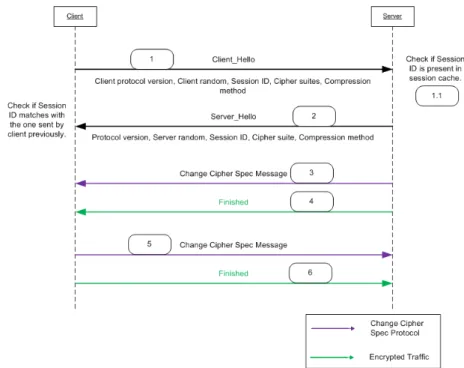
Session ID Thesession IDidentifies a particular session between the client and the server. The server is responsible for generating thesession ID. If thesession IDfield from theclient hello message is not empty then the server will search for the session ID into its session cache, if thesession IDis found and the server is willing to resume the session identified by the matched value then thesession ID field in theserver hellowill contain the same value as that of the session ID from the client hellomessage. In any other case, the server will generate the new session ID.
Session ID generation The SSL protocol specification does not comment on how the
session ID should be generated. It only provides a guideline that the session ID should not contain any confidential data since it is transferred in plain text. The length of the session ID is 16 byte for SSL v2 [33]. SSLv3.0 [31] and TLSv1.0 [30] uses variable length Session ID ranging from 1 byte to 32 bytes.
The OpenSSL [8] generates unique session ID from pseudo random number generator. The session ID generator can be optionally configured for using additional information like a unique host id, a unique process number, and a unique sequence number into the Session ID [34].
Server certificate
This message consist of either a single server certificate or a chain of certificates starting with a server’s certificate. These certificate are such that each certificate except the last CA (Certificate Authority) certificate certify the one preceding it. This message is sent when the negotiated authentication method is not anonymous (i.e. NULL in first row and last row of table 3.2).
Server key exchange
This message is sent followed by theserver hellomessage if anonymous negotiation is in use or followed by the server certificate message if it does not contain enough information for the client to exchange thepre-master secret with the server. This is an optional message. This message has two variants. The structure of finalserver key exchangemessage consists of either of the following key exchange parameters followed by the signature of the parameters.
RSA This variant of Server Key Exchange consist of RSA key exchange algorithm. It constitutes of RSA modulus and exponent.
Diffie-Hellman This variant ofServer Key Exchange consist of Diffie-Hellman parameters (prime modulus and public value).
Certificate request
This message is an optional message. This message is sent to request the client certificate and to indicate that client needs to be authenticated to the server. The certificate request
message consists of the list of certificate types and certificate authorities accepted by the server.
Server hello done
This message is sent by the server to indicate that the server has completed sendingserver helloand associated handshake messages and the client can proceed with the further steps in thehandshake protocol.
Client certificate
This message is an optional message in the handshake protocol and it is sent by the client. This message is only sent whenever client authentication is requested by the server through
certificate requestmessage.
Client key exchange
This message is sent by the client. The client obtains the required server’s parameters from either the server certificate or the server key exchange message. These parameters are used to encrypt the pre-master secret. The encrypted pre-master secret is sent as the
client key exchange message. The pre-master secret is the 48 byte structure produced by the client. This structure consists of the following two attributes: The latest protocol version supported by the client (2 bytes) and the random data (46 bytes) produced using a cryptographically secure pseudo random number generator.
3.2 SSL Protocol: Higher Layer 21
Case RSA: RSA Encrypted premaster secret The client key exchange message
con-sists of the premaster secret encrypted with server’s public key obtained from the server certificate or the RSA parameters obtained from server key exchangemessage.
Case Diffie-Hellman: Client Diffie-Hellman Public value The client key exchange message consist of the client’s DH (Diffie-Hellman) public value. This message could also be empty whenever the client authentication is requested and the client can produce the certificates with matching public key as specified in thesevers certificateor the server key exchange message.
The pre-master secret is further processed to obtain the master secret and other key materials required to protect the application layer data.
Certificate verify
This is an optional message and is sent only when the client’s certificate with a signing capability is sent. This message provides the explicit verification of the possession of the certificate by the client. The content of this message is a digest of all the previous handshake messages. The algorithm used for the digest depends upon the signature algorithm (i.e. anonymous, RSA, or DH) used in current connection.
Finished messages
This message is sent immediately after the change cipher spec6. This message consist of the digest of all the messages exchanged so far in the handshake protocol. This is the first encrypted message in the current active connection. The digest does not consist of Alert
protocol messages and Change Cipher Specprotocol messages exchanged so far. Since, these are not considered as the SSL Handshake protocol.
The finished messages are sent by both the client and the server. These finished
messages are different since the digest included in the finished message sent by the server contains the finishedmessage sent by the client. This scenario reverses in anabbreviated handshakeprotocol (see Section 3.4.1), where the server is the one who sends its finished
message first and then the client sends its finishedmessage.
3.2.2 The SSL Change Cipher Spec (CCS) protocol
This protocol enables the client and the server to notify the other end in the communication that future messages in the communication will be protected under just negotiated crypto-graphic ciphers and parameters. Under this protocol, a single message of byte value 1 is exchanged. This message is sent by both the client and the server.
3.2.3 The SSL Alert protocol
The SSL alert protocol enables the communicating parties to signal the potential problems. The messages under this protocol are 2 bytes long. The first field (byte) denotes the level of the alert. There are two levels for the alert: the warning alert and thefatal alert. The fatal alert always results in the connection termination from the alert issuing end. The second field (byte) in thealertmessage provides the description the alert, for instance,unexpected _message. The description is denoted by pre-defined (standard) numeric values For instance, theunexpected _message is denoted by value 10.
6The
change cipher specmessage is a part of theChange Cipher Specprotocol which itself not a part of the Handshake protocol. Therefore theChange Cipher Specmessage is not described here.
3.2.4 The Application Data protocol
This protocol is responsible for carrying the higher layer such as HTTP (Hyper Text Transfer Protocol) data and submitting it to the SSL record protocol at the SSL lower layer (see Figure 3.1). The functionality of the SSL record protocol is described in Section 3.3.
3.3
SSL Protocol: Lower Layer
This section describes the SSL sub-protocol calledThe SSL Record Protocolfrom the (SSL) Lower Layer as indicated in Figure 3.1.
3.3.1 The SSL record protocol processing
The record protocol is an encapsulation protocol. The record protocol is responsible for fragmenting the data that into the chunks of 214 bytes or less. The multiple handshake messages and the application layer data can be combined together into a single plaintext fragments provided the data inside the fragments are of same type. If a single message is too long to fit into the plaintext fragment boundaries then such message may be fragmented across several records [30]. The SSL specification does not provide a guideline on how to determine the message boundaries. The boundaries of the messages could be one-to-one with application data write calls [29].
Once the plaintext fragments are ready, these fragments are optionally compressed by the compression method agreed through handshake protocol. The length of the compressed fragment should be less than 214+ 1024. The MAC (Message Authentication Code) is calcu-lated and concatenated at the end of the (compressed) data fragment. This data is applied with the padding in the case of the block cipher mode to match the size of the block in the cipher. This whole content is then encrypted. The length of this encrypted fragment is allowed to be 214+ 2048 at the max. This encrypted block is then pre-appended with SSL record header. An overview of the record protocol processing is given in Figure 3.3. The final product of this process is called SSL record. Generally, such processing (MAC calculation, encryption, padding) of the data fragment is not applicable for the handshake messages that are transmitted before the change cipher spec protocol message because a connection state is initialized after sending thechange cipher specprotocol message. More information about the connection state is given in Section 3.3.2.
The SSL record is divided into two parts. The record header and the record body. Figure 3.4 shown the pictorial view of the SSL record. The record header consists of the record type (Handshake protocol, change cipher spec protocol, alert protocol and application data protocol), version of the SSL/TLS protocol that is being used, the length of the record payload i.e. the length of the record body (in bytes). The record body consists of the protocol specific data. The record body is formatted as described in Figure 3.3. The plaintext (optionally compressed text) is appended with the padding data so as to match the size of the message data with the block size of the cipher. The padding consist of the set of bytes. The last byte of the padding data indicates the size of the padding and rest of the padding data consist of the bytes of value equal to the pad length. The padding is not required when no encryption is performed or the stream cipher is used to encrypt the data.
3.3.2 SSL connection state
The SSL connection state is an operating environment of the SSL Record protocol [30]. There are always two connection states maintained at server and client side. They are calledCurrent
![Figure 2.1: Attack Type Distribution (First Quarter of 2012) (source: [2]).](https://thumb-us.123doks.com/thumbv2/123dok_us/9443825.2424636/24.892.245.629.220.499/figure-attack-type-distribution-first-quarter-of-source.webp)
![Figure 2.2: Largest Bandwidth Consumption Attacks Reported (source: [3]).](https://thumb-us.123doks.com/thumbv2/123dok_us/9443825.2424636/25.892.267.653.119.368/figure-largest-bandwidth-consumption-attacks-reported-source.webp)
![Figure 3.1: The SSL with its (sub)layers and (sub)protocols (Source:[4])](https://thumb-us.123doks.com/thumbv2/123dok_us/9443825.2424636/30.892.116.755.122.372/figure-ssl-sub-layers-sub-protocols-source.webp)
![Figure 3.3: The SSL Record Protocol Processing (source: [5])](https://thumb-us.123doks.com/thumbv2/123dok_us/9443825.2424636/37.892.259.656.116.534/figure-ssl-record-protocol-processing-source.webp)