Yildirim, Z. (2005). Hypermedia as a Cognitive Tool: Student Teachers' Experiences in Learning by Doing. Educational Technology & Society, 8 (2), 107-117.
107
ISSN 1436-4522 (online) and 1176-3647 (print). © International Forum of Educational Technology & Society (IFETS). The authors and the forum jointly retain the copyright of the articles. Permission to make digital or hard copies of part or all of this work for personal or classroom use is granted without fee provided that copies are not made or distributed for profit or commercial advantage and that copies bear the full citation on the first page. Copyrights for components of this work owned by
Hypermedia as a Cognitive Tool: Student Teachers’ Experiences in
Learning by Doing
Zahide Yildirim
Middle East Technical University, Faculty of Education Department of Computer Education and Instructional Technology
Inonu Bulvari, 06531 Ankara, Turkey Tel: +90 312 210 3679 Fax: +90 312 210 1006 [email protected] ABSTRACT
This study investigates student teachers’ opinions about learning “instructional technology and material preparation” subjects in a hypermedia-based constructivist learning context. A qualitative case study design was employed. The students of one classroom were the focus of an in-depth investigation by means of interviews, which were designed to elicit these students’ perceptions concerning the use of hypermedia as a cognitive tool in the learning process. The study sample consisted of twenty-eight second-year students who enrolled in the Instructional Technology and Material Preparation Course in the Fall of 2001 at Middle East Technical University in Ankara, Turkey. The study lasted fourteen weeks (two hours per week). In the group, high, average, and low achievers (based on their GPAs), and both males and females were represented. An interview schedule consisting of sixteen questions was designed to obtain the students’ opinions about developing hypermedia as a cognitive tool to learn the subject. The data collected through the interviews were subjected to content analysis. The results indicate that the majority of the students preferred the hypermedia-based constructivist learning environment in the course to a traditional learning environment. The students thought that the hypermedia-based constructivist learning environment helped them learn the subject matter more effectively.
Keywords
Hypermedia, Cognitive tools, Constructivism, Project-based learning
Introduction
Though many educators in the 20th century advocated the learner-centered approach in education, currently, the
transmission of knowledge rather than the construction of knowledge is favored in educational settings. With technological advances, it was thought that computers would provide solutions to many educational problems. However, as in the case of educational systems, computers are used merely to transmit knowledge most of the time, or simply to perform traditional instruction more efficiently and effectively (Pea, 1985). Perkins (1986) once said, “How we think of knowledge could influence considerably how we go about teaching and learning” (p.2). If knowledge is considered to be information, as Perkins also argued, it is isolated from its context resulting rote learning. But if, on the other hand, knowledge is seen as a sort of design, then knowledge is related to understanding, and to critical and creative thinking. It can then be structured meaningfully, and adapted or revised for different purposes. The value of design experience, as Carver et al. (1992) emphasized, comes from the opportunity provided to students to develop a variety of complex thinking skills.
One way of promoting knowledge as design is to use computers as cognitive tools. With cognitive tools, information is not presented in the educational material to be learned. Students’ roles are those of designers and problem-solvers. The students use the computers as cognitive tools to access, analyze, interpret, and organize their personal knowledge. This approach enables students to think deeply and to perform their learning tasks effectively (Pea, 1985; Kozma, 1992; Mayes, 1992; Reeves, 1999; Jonassen, 2000).
To be able to use technology as cognitive tool, it is important to provide an appropriate learning context for the students. Jonassen and Reeves (1996) have stated that learning with technology requires a constructivist learning context. The constructivist view emphasizes that learning occurs when it is supported by different perspectives within meaningful contexts; social interactions are also critical in this learning process (Oliver & Herrington, 2003). Duffy and Cunningham (1996) highlighted some pedagogical goals in the constructivist learning context. These include the provision of experience in the knowledge construction process, the provision of realistic and relevant contexts, the encouragement of ownership, embedded learning in a social context, the use of multiple modes of representation, the appreciation of multiple perspectives, and the development of self-awareness in the knowledge construction process (Oliver and Herrington, 2003).
Jonassen, Mayes, and McAlessi (1993) categorized the learning process as three learning phases: introductory, advanced, and expert. They argued that when the student lacks complicated schemata and has limited transferable prior knowledge in the subject area to be learned, introductory learning occurs. In the advanced learning phase, students are more mature and are able solve more complex and context-specific problems; they also acquire more advanced knowledge. In the expert learning phase, students have complex and meaningfully linked knowledge structures relating to the subject. Jonassen et al. (1993) state that the introductory phase is better served by classical instructional design, while constructivist learning environments are generally more viable for the advanced knowledge acquisition phase. Universities and secondary education institutions are the appropriate places in which to encourage advanced knowledge acquisition in a constructivist environment. Duffy and Cunningham (1996) highlighted another characteristic of constructivist learning. They emphasized the importance of language and dialogue in human culture and cognition. In order to facilitate dialogue among students, group work should be practiced to share different viewpoints, and to challenge and develop alternative perspectives. So, rather than sticking to only one way of thinking, in a constructivist learning context, the student should be able to benefit from other individuals’ thinking/ideas by means of engaging in group work (Steketee, 2002).
In a constructivist environment, learning is arranged around a project. The two essential components of an appropriate project are the product and the problem. The product component is the starting point, which allows the students to learn the essential and critical points of the topic while developing the end product (Liu, 2003). The problem component is related to conducting investigations, searching for solutions to problems, solving problems, and making decisions in order to produce the product. In this process, the students come to understand the main principles and concepts related to the problem, and they should feel a great sense of achievement (Blumenfeld et al., 1991; Liu, 2003). To benefit from a project-based learning environment, the students’ engagement over an extended period of time is required, and they must concentrate on complex, integrated modules of long-term instruction (Blumenfeld et al., 1991; Krajcik et al., 1994, cited in Jonassen, 1998)
Blumenfeld et al. (1991) indicated that “technology facilitated, project-based learning has great potential to enhance students’ motivation, and supports information gathering and presentation” (cited in Liu, 2003, p.25). Having students design hypermedia for the subject to be learned is one type of project-based learning, which focuses on the development of design skills (Lui, 2003). In this approach, hypermedia supports knowledge construction, exploration, learning by doing, learning by conversing, and learning by reflection (Jonassen, 2000; Jonassen & Reeves, 1996; Lehrer, 1993). Designing hypermedia as an author promotes not only deep learning of the subject matter, but also social skills like collaboration, project management, decision-making, research, organization and presentation, and reflection (Carver et al., 1992). Kafai, Ching, and Marshall (1997) stated that “the production of technological artifacts as a promising context for students to learn the coordination of multiple demands needed to design and implement such project” (p. 117). They commented that “creating multimedia appears to be a good context for students to learn about collaboration and project management” (p. 118).
Today, we experience various problems when attempting to integrate technology into teaching and the learning process. Technology is used either as a management tool to help teachers and administrators in their management tasks, or it takes the form of educational software, in which content is encoded. Technology has been integrated into the educational system to a large extent; however, all of the potentials embodied in the goals “learning with technology” and “using technology as a cognitive tool” have yet to be fully realized. It is clear that the role of teachers will be integral for future development along these lines.
The influence of a hypermedia learning environment on learning processes has mostly been investigated under the condition where students learn from the hypermedia. In addition, though there are research studies that investigate the implementation of various cognitive tools with a wide range of student groups, student teachers’ use of hypermedia as a cognitive tool within a constructivist learning context has not been studied much. How do student teachers perceive hypermedia as a cognitive tool? How do they interact within such a learning environment? In what ways can they effectively learn with hypermedia, when it is used as a cognitive tool? Questions like these need to be explored in order to understand what processes the student teachers go through as they construct their own knowledge through the use of hypermedia. Therefore the purpose of this study is to explore how student teachers perceive learning through the use of a hypermedia cognitive tool in a constructivist learning environment. The specific focus is student teachers’ opinions about using hypermedia as a cognitive tool to learn the course content of “Instructional Technology and Material Preparation.”
Methods
Overall Design
A qualitative case study design was used in this study. The learning experiences of students in a teacher training course where hypermedia was used as cognitive tool were examined in depth through interviews. The purpose was to understand student teachers’ perceptions of the use of hypermedia as a cognitive tool in their learning process. The study included twenty-eight second-year Computer Education and Instructional Technology students at Middle East Technical University in Ankara, Turkey. The students possessed basic knowledge concerning the design of hypermedia along with associated computer applications. In the group, high, average, and low achievers (based on GPAs) were all represented. Before the study was initiated, the students were informed that the course would proceed within a project-based constructivist learning context, and that hypermedia would be used as a cognitive tool. Throughout the semester, the students were required to work in groups to develop hypermedia relating to the course content. The procedures that the student teachers followed during the course are presented in Figure 1.
Figure 1. The procedures student designers followed
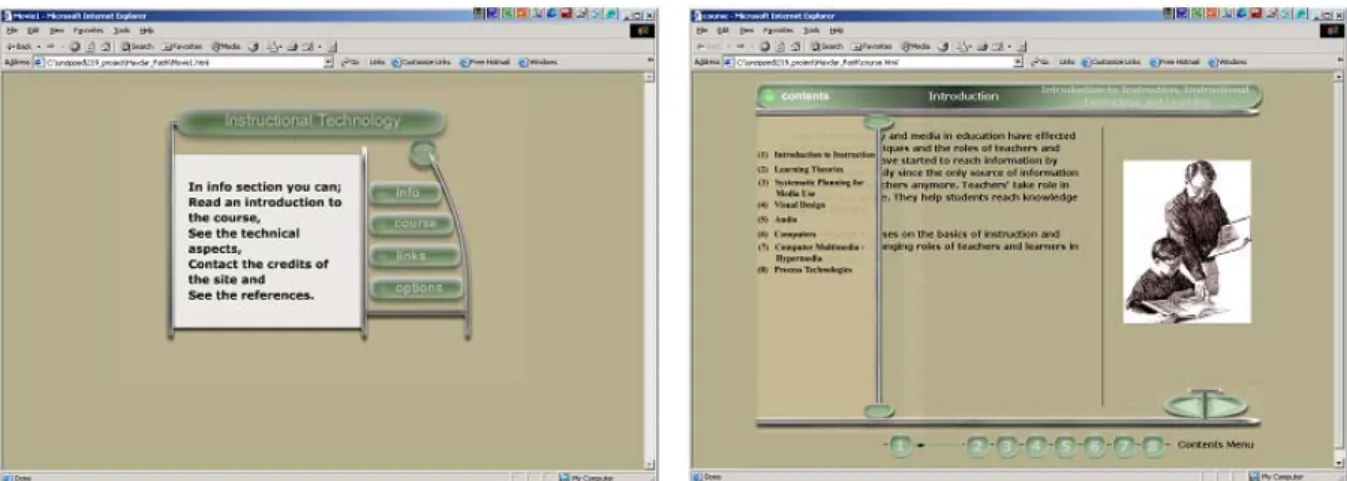
At the beginning of the semester, the students formed their project groups, which consisted of two to five students each. There were eight groups in the study. Throughout the semester, the instructor avoided presenting the course content to the students didactically. Instead, she established a constructivist learning context in which she facilitated, coached, and guided the learning experiences of the students. In order to help the student teachers to use their time more effectively and efficiently, the content was divided into components. These sub-components were scheduled for eight weeks, so that the students could spend sufficient time investigating and forming the content of the hypermedia to be developed. To establish the content of the hypermedia, the students investigated the sub-components of the topic, and wrote weekly reflective journals in which they reported the results of their investigation. Each week, they received feedback from the instructor on their journals, and participated in group discussions and learning activities held in the class (two hours per week). Two computer laboratories in the department served as (two hours per week for fourteen weeks) hypermedia development facilities for the students. While developing their hypermedia learning environment templates, each group presented their work in class and received feedback from the instructor and their classmates. By the end of the semester, the students finished their hypermedia learning environments. Examples from the students’ projects are presented in Figures 2 and 3.
Figure 2. Example 1 from students’ projects
Figure 3. Example 2 from students’ projects Participants
The study included a total of twenty-eight second-year Computer Education and Instructional Technology students (twenty-four male and four female), who enrolled in the Instructional Technology and Material Preparation Course in the Fall of 2001-2002, at Middle East Technical University in Ankara, Turkey. This course lasted for fourteen weeks. The majority of the students in this department (and also in the study) graduated from computer departments in vocational or technical high schools. Since most of the students graduated from computer departments in vocational or technical high schools, they already possessed basic computer knowledge and skills in a variety of computer applications, and some hypermedia design experience prior to this case study. For this reason, they did not require any orientation to designing hypermedia at the beginning of the study.
Data Collection
An interview schedule was developed to collect qualitative data on the students’ opinions and perceptions of the use of hypermedia as a cognitive tool in a constructivist learning environment. The schedule included sixteen questions on the following areas: “how the constructivist learning environment contributes to both the students’ learning of instructional technology and to their material preparation of the course content; advantages and limitations of the use of hypermedia as a cognitive tool in a constructivist learning context, in comparison to traditional instruction; perceptions of the procedures followed during the hypermedia development process; opinions about the role of the instructor in a constructivist learning context; suggestions concerning the effective application of hypermedia as a cognitive tool in a constructivist learning environment; and finally, perceptions and suggestions concerning the assessment of student performance in such a learning environment.”
All of the students who took part in the study were interviewed at the end of the semester in their project groups. Thus, a total of eight group interviews were carried out. There were several reasons for preferring group interviews to individual interviews. First, throughout the study, the students worked in their project groups and experienced this process together. Second, group interviews can be both effective and efficient as a qualitative data collection technique, since they allow the interviewees to consider what others in the group say, and then may build upon those shared opinions. Third, this method provides quality control in data collection, since multiple perspectives on the same issue may provide a basis for validation. Fourth, the group dynamics typically contribute to focusing on the most important topics and issues relevant to the study. Finally, group interviews can be used to identify a program's strengths, weaknesses, and needed improvements (Patton, 1987). For these reasons, I chose to carry out group interviews, which produced a rich data base to answer the research questions in this study.
Before each interview took place, the students were informed of the purpose of the interview. Each interview lasted about one and a half hours, and all of the interviews were tape-recorded with the permission of the participants.
Data Analysis
The data collected from the interviews were subjected to content analysis. As Miles and Huberman (1994) have stated, content analysis involves searching for meaningful phenomena in the data and assigning descriptive codes to describe the data as a meaningful whole. For this purpose, the interview data were first transcribed into eight interview files. Second, the transcribed data were coded using a predetermined set of terms and concepts based on the literature (Duffy and Cunningham, 1996; Jonassen, 2000; Lehrer, R., 1993; and Pea, 1985). Coding was conducted to classify and organize the data. Third, themes were identified in order to arrange the codes in a meaningful and consistent way, and then the codes were grouped under these themes (such as the constructivist learning environment, writing weekly reflective journals, hypermedia development, group work, learning activities, and assessment). Finally, the coded data were presented and described under these main themes, and then the interpretation and discussion of the results was offered.
Results
The analysis of the interviews produced certain themes in relation to the use of hypermedia as a cognitive tool. The results of this study are presented under these themes, along with problems/difficulties that the students faced in relation to these themes.
Overall assessment of the constructivist learning environment
Most of the students (N=25) mentioned that they preferred using hypermedia as a cognitive tool in a constructivist learning environment to traditional classroom instruction. They stated that in traditional instruction, while the instructor was presenting the content, the students could not focus their attention on the subject for a long time. Only three students preferred traditional settings to constructivist settings. One of them reported (in contrast to his teammates), “I learn social subjects better in a traditional setting, and I prefer the instructor to present the content. However, I learn technical subjects by myself, and I do not need group work.” Another said, “I can learn better by listening to the instructor.” The third student commented, “It was a new method, and I had difficulty getting used to it.”
Those who were in favor of constructivist learning indicated that the constructivist learning environment led them to be an active participant in the learning process, to learn and retain the course content more effectively, and to pay more attention to their project. One student stated, “It is not possible to notice if students are listening to the instructor or day-dreaming in traditional instruction. But in this environment, we had tasks to finish by due dates, so we had to work.” One of the groups suggested, “It would be better if a combination of the two strategies, traditional and constructivist, were used together.” Two groups commented that a fourteen week period was too long, and that the project was too large. One student from these groups said, “I learned the subject better with this approach, but dealing with the project’s long duration was tiring and boring.” Another student said, “the content covered in the project was too much; it would be better to keep the content less, or divide the subject into sub-subjects, and after finishing the first, it would be better to move forward.” They suggested that it would be more helpful if such a large project consisted of several smaller projects or modules.
One group reported that the constructivist approach conducted in this course was “a very good approach; however, it cannot be applied in all courses.” This group thought that they would have difficulty applying this approach in all courses, because that would require far more work by the students than they could possibly do. This would place too much pressure on the students and would result in poor performance at least in some courses. One student from the group explained that “this course took too much of my time. If the other courses required that much time and effort, I could not handle them all together.”
For the learning purpose, most of the students (N=25) argued that this method was better than the traditional method. Since they learned actively, they felt more involved, and they retained knowledge better, even though the course created “a huge workload” for them. In the traditional method, they studied only for the exams; then they forgot what they learned. One student said, “I, and my friends too, study the course material just before the exam to get a good grade. One week or two days—it depends on the subject. After the exam, I forget most of what I have studied. But in this approach, I had to focus on the subject several times to present it better. It is better for learning.”
Writing weekly journals to form the content of the hypermedia
To determine the content of the hypermedia that they were to develop, the students searched for information. Based on their search results, as groups they wrote weekly journals. They received feedback on their journals from the instructor and made revisions in their hypermedia content.
The majority of the students (N=23) stated that, even though it was their first experience, writing weekly reflective journals and receiving weekly feedback from the instructor made a significant contribution both to their learning of the subject matter and to their efforts in determining the content of the hypermedia that they developed. One student commented that “it was nice to receive weekly positive and informative feedback; it helped us in the process of content formation.” Another said, “Investigating the subject, writing the results of my investigation, receiving feedback, and making revisions contributed much to my understanding of the subject.” Many of the students perceived the reflective journal as an effective tool which helped them to learn the subject, to retain the knowledge, and to internalize it in their long-term memory. The majority (N=19) of the students stated that the process of searching for knowledge and transferring it into the content of the hypermedia required a detailed examination of the subject, and that this resulted in a deeper understanding of the content. At the same time, they mentioned that it was a difficult and time-consuming process, since it involved examining the information, holding a group discussion on main themes, organizing the main themes based on their importance for the subject area, and writing the journal. Though it was a demanding process for the students, most of them found the journal writing process very beneficial for learning.
However, one group (five students) did not find the journal writing process to be very effective. One of this group’s members said, “It was difficult to get together to discuss the journal, even through e-mail.” They stated that this process would be more beneficial if there were fewer group members. Two of the group members said, “Each week, two or three of us were responsible for journal writing. The members who wrote the journal examined the subject deeply.”
Even though most of the students complained about the workload, they found it very beneficial for learning the subject matter and for helping them prepare for hypermedia development. One student said, “If we did not write the journal beforehand and go with hypermedia development, it would be too difficult to organize the content, design intended hypermedia, and learn the subject.”
One of the problems in writing the journal was attributed to group structure and functioning. First of all, it was difficult to get up to five members together to write the journals. Second, the students had difficulty distributing responsibility and managing the tasks of the journal writing, since this was their first experience with such a project. Third, the duration of the journal writing period (eight weeks) was long for the students in a self-regulated learning process.
Developing hypermedia
All of the students (N=28) stated that in order to present the content in hypermedia, they first had to examine the content, search for information, and learn the content themselves. They indicated that their specific investigations into the subject matter, their journal writing to form the content of the hypermedia, and their
receipt of feedback about the journals all helped them in hypermedia development. Most of their learning occurred while investigating and writing the reflective journals. They indicated that developing the hypermedia required a preliminary examination of the content, and that the journal writing met this requirement in this implementation. While determining their strategy for the presentation, they examined the structure of the content and possible ways to present it. This process helped them review the materials and resulted in long-lasting learning. One student said, “Preparation for the hypermedia development, rather than coding the hypermedia, helped me learn the content.” The majority of the students in the groups stated that the hypermedia development exercise was an important stage of this process. They mentioned that “if we were not required to write journals about the content, we would not spend much time with the content, and the benefit of developing hypermedia would be limited.”
Two groups (eight students) mentioned that the content covered in the hypermedia was too dense, and this affected their learning in a negative way. One student suggested, “rather than covering a lot of content in one hypermedia development project, it would be more beneficial to cover only one subtopic from the whole content. This would give us time to make a deeper investigation into the topic, and would result in better hypermedia design and learning.”
Three students from one group indicated that they learned some technical knowledge and skills related to hypermedia development in this process. One of the students said, “One of our group members was knowledgeable about the programming of hypermedia, and he taught us how to perform certain tasks. With his guidance, we developed our parts, and then we combined all of our work. I learned a lot of new technical knowledge and skills from my group-mates and class-mates in this process.”
However, some groups had problems at this stage, concerning the distribution of the tasks. One student commented, “Since I was the most skillful one in the group, I performed most of the development tasks, and it was too much work for me. I would not prefer such work.” His group members also confirmed his statements about his contribution to the project. This same student suggested, “In the beginning of the semester, the responsibilities of group members should be determined clearly in a contract, and assessment of the performance should be based on this contract.”
At the beginning of the study, the students were asked if they needed any orientation relating to the knowledge and skills they would need to use to develop the hypermedia. The students had replied that they did not require any orientation, because they all had prior knowledge and experience in preparing hypermedia, though this was of varying degrees. In accordance with this variance, some students stated in the interviews that they faced some technical difficulties while developing the hypermedia. To overcome these difficulties, they received help from their peers. The interview results show that students who had more knowledge and skills in this process helped their classmates. One of the students said, “I did not have all the necessary knowledge and skills to develop a good hypermedia project before we started. One of our group members had the necessary skills and knowledge, and he taught me how to carry out some tasks. With his help, I overcame this problem and contributed to the project equally.” All of the students stated that they used the Internet as a source of help in dealing with the technical issues.
Group work
Most of the students (N=18) said that working in groups improved their problem-solving skills, their ability to work collaboratively, and their ability to think critically in regard to the content and its presentation. They learned from each other while preparing the content of the hypermedia and while they were deciding how to present it. In addition, they learned a lot from each other (in groups and between groups) while solving the technical problems they faced during the hypermedia development. They benefited from both content-based and skill-based reflections, within the groups and between groups.
The majority (N=16) stated that they shared responsibilities in the groups based on their abilities and skills. Social involvement was encouraged in group work. They learned to respect each other’s ideas and to reach a consensus. Even though they complained about the extend of journal writing and self-study process, they said that the long duration of the group project (fourteen weeks) helped them learn and produce even more. If they had worked individually, they would have had simpler products, and in turn, they would have ended up with less learning. Group interdependence made them work harder to achieve the course objectives.
However, the interview results show that two members from one group had some personal problems while they were working on their project. These students did not indicate whether this problem resulted from the project or from other factors. However, they mentioned that they solved their problems in a professional way. Their friendship seems to have suffered, but they still managed to work on their project professionally. One of the students from this group suggested, “This may be due to the long period of the project time.” They may have realized that solving this conflict could contribute to their professional cooperation skills. However that may be, it seems that the students were able to develop their conflict resolution skills in this process as well.
The groups which had five students (two of the groups) stated that their group size was not appropriate, because five students were too many to work together while writing journals and developing the hypermedia. One student said, “We expected other members to perform the determined tasks, so not all of us were involved in the process fully.” Another problem was to arrange the meeting times, since students had different course schedules. One student reported, “Since we had difficulty arranging meetings, we distributed the tasks. Even though we examined what other people did in the project, I did not feel fully involved in the project.” Therefore, they suggested that the number of students in each group should be three to four, in order to have more effective collaboration and communication among the group members.
The groups also came up with some further suggestions to make the group work more effective. Though they made group contracts by themselves in the beginning of the semester, they suggested that group rules should be established at the beginning of the semester, with the guidance of the instructor. These rules should be observed throughout the semester, and they should be monitored closely by both the group members and the instructor. Students from three groups indicated that it was difficult to perform group activities in the computer laboratories at the department. If they did not have their own facilities at home or in the dormitory, it would have been difficult for them to perform this task. They suggested that “for such an implementation to take place, logistical support and appropriate facilities should be provided, such as computers, related software, and audio-visual processing technology. These facilities should be scheduled for the groups according to their time.”
Learning activities conducted in the classroom
All of the students (N=28) indicated that the instructional activities conducted by the instructor were effective for helping them learn the content better. The learning activities carried out in class helped them acquire a broader understanding of the subject matter. They discussed the problems which arose or the materials provided in class, and each person in the activity group shared ideas with other group members. They indicated that this resulted in their examination of the issues from different perspectives. One of the students said, “The learning activities conducted in class made me focus on the most important parts of the subject. In the individual group discussion and through whole group sharing, I learned both from my group members and other groups.” Another student said, “The discussions about the activities made me see the problem from different dimensions, and this resulted in better retention of the subject.” One student from the group mentioned that “the use of humor while working on the activities made the knowledge more lasting.” These results indicate that the learning activities helped the students learn abstract concepts more effectively. It also helped them improve their knowledge retention and knowledge-transfer skills, and they became more critical about what they were learning.
In addition to the learning activities, all of the students (N=28) stated that they benefited from discussing each group’s project in terms of design issues, which were included in the course content. The feedback given by the instructor and the other students was valuable in terms of learning the design issues better and refining their projects.
At the same time, all of the students (N=28) stated that the number of learning activities conducted in the class was insufficient. They suggested that immediately after writing the journal, there should be a learning activity related to the journal’s content. In this case, the course could have been more successful in terms of helping the students to learn and apply the course content more effectively.
Assessment of the students’ performance
In this study, the students’ performance assessment was based on their reflective journals (15%), participation in the class activities (10%), their hypermedia development (35%), and their final exam (40%). A majority of the students (N=26) reflected that more weight should be given to journal writing and the term project than to the
final exam and participation. They preferred an assessment based on the tasks they performed throughout the semester. One of the students stated, “40% for the exam is too much. We worked too much for the whole semester, and it was not fair to get 50% (journal writing + hypermedia development) for that much work done for the whole semester.” Another said, “We worked very hard on our projects throughout the semester, but we worked for the exam for one week or one night. Therefore, our work for the project is worth more.”
All of the students (N=28) suggested a midterm exam to allow them to see the degree of their understanding of the essential concepts and processes related to the course objectives. One student said, “I would prefer a midterm exam to see my performance and the way the instructor asks questions in the final exam.” Another student said, “Rather than having one exam for the whole content at the end of the semester, there could be two exams, and we could divide the content into two, so the exams would not be so threatening for us.”
Three students criticized the evaluation process, noting that only academic performance was considered. One of them said, “It is not fair to measure only academic performance, since we worked in groups so long. It would be better to evaluate our behaviors in groups.” They suggested that group-members’ contributions to the projects and participation in the project management process should also be taken into consideration. From these statements, it is clear that the students felt the assessment process should be more directly related to the learning process which the students went through to complete the course objectives.
Discussion
The results of this study reveal that the students found the strategy of using hypermedia as a cognitive tool to be effective for constructing an understanding of the content. All but three of the students indicated that they prefer this approach to traditional instruction, because they are more active and can construct their own knowledge. The students stated that they learned a lot while writing their reflective journals to form the content of the hypermedia. This result is consistent with propositions that Jonassen (2000) has made. He stated that students should make their own decisions about searching for and gathering relevant information, and that they should select the most important parts to represent. According to Jonassen, “this is the heart of the learning process” (p. 222). In line with this statement, journal writing for the purpose of establishing the content of the hypermedia appears to be a valuable learning activity. Mayes (1993), and Turner and Handler (1997) argued that a student who develops hypermedia material learns the topic better than one who is merely exposed to the finished product. In another study by Yildirim (2004), in which students implemented visual design principles from their focal subject into hypermedia products which they were developing as cognitive tools, the author indicated that the students’ hypermedia products reflected that students both learn and implement what they learn in this active process.
Overall, the students did perceive the use of hypermedia as a cognitive tool to be effective for learning. However, their suggestions about the amount of the content to be covered in such a learning environment need to be considered. As they suggested, rather then having too much content, it is better to allow the students to focus on one specific subject in depth.
Another result of this study is that most of the students benefited from the group work. Petraglia (1998) stated that “the presence of other learners provides students with the means to gauge their own progress which, in turn, assists them in identifying their relative strengths and weaknesses and permits them the insight necessary to improve their own learning” (p. 55). In this study, the students not only learned the content from each other but also the technical skills to design the hypermedia, and some social skills, such as project management, reaching a consensus, and respecting each other’s ideas. The long period of collaborative group work was effective in terms of helping them learn the content and build social skills. This result is consistent with Krajcik et al.’s (1994) statement that, through project-based learning, students concentrate on complex, integrated modules of long-term instruction (cited in Jonassen, 1998). In keeping with Krajcik et al.’s suggestion, this study was based on group projects and lasted for a reasonably long period of time. This teaching method was found to be effective by most of the students. To help the students benefit more from the group work, distribution of the tasks at the beginning of the project and close monitoring of the group members’ performances throughout the process should also be considered.
The students felt that the number of learning activities conducted in class was insufficient. To make this strategy more effective, the instructor should provide more learning activities. Providing a contextually rich learning environment that supports the student designers seems to be important for knowledge acquisition.
All of the students in the study felt that the assessment of their performance was problematic. They were not happy with the high emphasis on the final exam, and suggested that it would be better to assess their performance based on the tasks they performed throughout the semester. As Jonassen, Mayes, and McAlesse (1993) mentioned, assessment of constructivist learning experiences should reflect the knowledge construction process. The reflections of student teachers in this study seem to confirm this principle as well.
In their study, Kafai, Ching, and Marshall (1997) concluded that, in collaborative activities, students need more support if the activities are intended to offer an effective learning context for each student in the group. Having students design hypermedia to learn the subject area is a challenging activity and may not result in sufficient learning when it is used alone. To benefit more from using hypermedia as a cognitive tool, students should be guided throughout the process. Moreover, they should be supported by additional learning activities to keep them on track, and to help them focus their attention on the key aspects of the subject area. Finally, they should be assessed in a way that reflects the learning processes they go through.
The results of this study offer important insights into how learners progress through the use of hypermedia as cognitive tools in their knowledge construction processes, and how they compare this learning context with a traditional one. In addition, the results may help instructional material designers/developers and practitioners in schools to better understand the potential contributions and limitations of hypermedia as a cognitive tool in classroom settings. Though it requires commitment from both the students and the instructor, using hypermedia as a cognitive tool is a valuable learning experience. The results of this study show mostly a positive outcomes arising from the use of hypermedia as cognitive tool. However, further research studies are needed to examine the full effects of hypermedia as a cognitive tool for knowledge acquisition, in comparison to traditional classroom instruction and other computer-based cognitive tools.
References
Blumenfeld, P. C., Soloway, E., Marx, W. R., Krajcik, J. S., Guzdial, M., & Palincsar, A. (1991). Motivating project-based learning: Sustaining the doing, supporting the learning. Educational Psychologist, 26 (3/4), 369-398.
Carver, S. M., Lehrer, R., Connel, T., & Erickson, J. (1992). Learning by hypermedia design: Issues of assessment and implementation. Educational Psychologist, 27 (3), 385-404.
Duffy, M. D., & Cunningham, D. J. (1996). Constructivism: Implications for design and delivery of instruction. In Jonassen, D. H. (Ed.), Handbook of research for educational communications and technology, New York: Simon & Schuster Macmillan, 170-198.
Jonassen, D. H., & Reeves, T. C. (1996). Learning with technology: Using computers as cognitive tools. In Jonassen, D. H. (Ed.), Handbook of research for educational communications and technology, New York: Simon & Schuster Macmillan, 693-719.
Jonassen, D. H. (1998). Designing constructivist learning environments. In Reigeluth, C. M. (Ed.), Instructional theories and models (2nd Ed.), New Jersey: Lawrence Erlbaum, 219-239.
Jonassen, D. H. (2000). Computers as mindtools for schools (2nd Ed.), New Jersey: Prentice-Hall.
Jonassen, D. H., Mayes, T., & McAleese, R. (1993). A manifesto for a constructivist approach to uses of technology in higher education. In Duffy, T. M., Lowyck, J. & Jonassen, D. H. (Eds.), Designing environments for constructivist learning, Berlin: Springer-Verlag, 231-247.
Kafai, Y. B., Ching, C. C., & Marshall, S. (1997). Children as designers of multimedia software. Computer Education, 29 (2/3), 117-126.
Kozma, R. B. (1992). Constructing knowledge with learning tool. In Komers, P. A. M., Jonassen, D. H. & Mayes, J. T. (Eds.), Cognitive tools for learning, Berlin: Springer-Verlag, 23-32.
Lehrer, R. (1993). Authors of knowledge: Patterns of hypermedia design. In Lajoie, S. P. & Derry, S. J. (Eds.),
Liu, M. (2003). Enhancing learners’ cognitive skills through multimedia design. Interactive Learning Environments, 11 (1), 23-39.
Mayes, J. T. (1992). Cognitive tools: A suitable case for learning. In Komers, P. A. M., Jonassen, D. H. & Mayes, J. T. (Eds.), Cognitive tools for learning, Berlin: Springer-Verlag, 7-18.
Mayes, J. T. (1994). Hypermedia and cognitive tools, retrieved May 10, 2004 from http://penta.ufrgs.br/edu/telelab/11/paper9.htm.
Miles, M. B., & Huberman, M. (1994). Qualitative data analysis: An expanded sourcebook (2nd Ed.), Thousands
Oak, CA: Sage.
Oliver, R., & Herrington, J. (2003). Exploring technology-mediated learning from a pedagogical perspective.
Interactive Learning Environments, 1 (2), 111-126.
Patton, M. Q. (1987). How to use qualitative methods in evaluation, Newbury Park, California: Sage.
Pea, R. D. (1985). Beyond amplification: Using the computer to reorganize mental functioning. Educational Psychologist, 20 (4), 167-182.
Perkins, D. N. (1986). Knowledge as design, Hillsdale, New Jersey: Lawrence Erlbaum.
Petraglia. J. (1998). The real world on a short leash: The (mis)application of constructivism to the design of educational technology. Educational Technology Research and Development, 46 (3), 53-65.
Reeves, T. C. (1999). A research agenda for interactive learning in the new millennium, retrieved February 18, 2005 from http://it.coe.uga.edu/~treeves/EM99Key.html.
Steketee, C. (2002). Students’ perceptions of cognitive tools and distributed learning environments. In Goody, A., Herrington, J. & Northcote, M. (Eds.), HERDSA Proceedings, Higher Education Research and Development Society of Australasia, 626-633, retrieved October 10, 2004 from http://www.ecu.edu.au/conferences/herdsa/main/papers/ref/pdf/Steketee.pdf.
Turner, S. V., & Handler, M. G. (1997). Hypermedia in education: Children as audience or authors? Journal of Information Technology for Teacher Education, 6 (1), 25-35.
Yildirim, Z. (2004). Outcomes of constructivist learning environment: How learners apply visual design principles. Education and Science, 29 (132) 78-84.