A Guide
to the Management
of Tailings Facilities
A Guide
to the Management
of Tailings Facilities
Foreword
It is with pleasure that I present, on behalf of the members of The Mining Association of Canada (MAC), this updated edition of A Guide to the Management of Tailings Facili-ties. The Guide is the result of collaboration by members of a team of Canadian industry practitioners and experts that make up the MAC Tailings Working Group (TWG). We owe a debt of gratitude to the team members who have brought tremendous skill, dedication and enthusiasm to the task of building consensus in the treatment of such important and complex subject matter.We also acknowledge the efforts of many companies and individuals that have worked so hard to implement these recommendations for effective tailings facility manage-ment. This document builds both on more than a decade’s worth of experience gained in implementing the tailings management framework and on the comments and suggestions received from practitioners throughout the industry.
Since publishing the first edition of the Guide in 1998, MAC has embarked on the Towards Sustainable Mining (TSM) initiative. In keeping with MAC’s commitment to sustainable development, this Guide encourages mining companies to practise safe and environmentally responsible management of tailings facilities. Tailings management is in-tegral to TSM, and I am pleased to note that the updated management framework in this Guide forms the basis of the tailings management performance indicators under TSM. The Guide has been designed to meet the needs of the mining industry and present a management system approach. I trust that the industry and others will find it a useful contribution to improving performance in this important area.
Pierre Gratton
President & CEO The Mining Association of Canada
Preface
Preface to the first edition (September 1998)
In June 1996, The Mining Association of Canada (MAC) Board of Directors established a task force to promote the safe and environmentally responsible management of tailings and mine rock.
The task force determined that engineering capability exists and generally is applied throughout the Canadian mining industry in the safe design, construction, operation and closure of tailings facilities. The key to managing tailings is consistent application of that engineering capability within an effective management framework through the full life cycle.
To promote the exchange of information and best practices, the task force arranged two workshops, one on management of tailings and mine rock (December 1996) and another on tailings risk assessment (May 1997). These workshops and related consultations iden-tified the need for a guide to tailings management.
A Guide to the Management of Tailings Facilities was developed through a collabora-tive effort by representacollabora-tives of the Canadian mining industry, through MAC, to provide guidance on good practices for the safe and environmentally responsible management of tailings facilities. Its purpose is threefold: to provide information on safe and envi-ronmentally responsible management of tailings facilities; to help companies develop tailings management systems that include environmental and safety criteria; and to improve the consistency of application of sound engineering and management principles to tailings facilities.
The Guide reflects sound management practices already in place. It adopts principles and approaches from sources that include mining company manuals, proceedings of the two workshops, the MAC Environmental Policy and Environmental Management Framework, the ISO 14000 Essentials, Canadian Dam Association (CDA) draft Dam Safety Guidelines (September 1997), and international guidelines and standards.
The Mining Association of Canada iv
Preface
This updated Guide reflects information and experience gained throughout the course of developing the companion guides and working with tailings management systems around the world. Together, the three MAC guides provide a strong and consistent message to tailings facility owners, operators and contractors: the key to safe and envi-ronmentally responsible management of tailings is the consistent application of sound engineering capability within an effective management framework and through the full life cycle of a facility.
The mining industry is cyclical; it can change rapidly from periods of unprecedented boom in activity and high commodity prices to periods of downturn with limited eco-nomic development, falling prices and shrinking demand. Both situations present differ-ent challenges to the industry to secure and maintain seasoned expertise to design and manage tailings. It is hoped that this updated Guide will indeed help maintain focus on sound tailings management through the implementation of effective tailings management systems.
Since 1998, MAC has also embarked upon the Towards Sustainable Mining (TSM) initia-tive, the Guiding Principles of which are appended to this Guide. The updated manage-ment framework presented in the Guide is consistent with the principles of TSM and forms the basis of the tailings management performance indicators under TSM. As with the first edition of the Guide, this updated version was prepared through a collaborative effort by members of the MAC Tailings Working Group. It incorporates comments and suggestions received since the publication of the first edition, and it also benefits from experience gained through application of the recommended tailings man-agement framework at mines around the world.
1 IntroductIon . . . . 1-1 2 taIlInGs ManaGeMent FraMework . . . . 2-1
Policy and Commitment . . . 2-1 Planning . . . 2-3 Roles and Responsibilities . . . 2-3 Objectives . . . 2-3 Managing for Compliance . . . 2-4 Managing Risk . . . 2-4 Managing Change . . . 2-4 Resources and Scheduling . . . 2-4 Emergency Preparedness and Response . . . 2-4 Implementing the Plan . . . 2-6 Operational Control . . . 2-6 Financial Control . . . 2-6 Documentation . . . 2-6 Training, Awareness and Competence . . . 2-7 Communications . . . 2-8 Checking and Corrective Action . . . 2-8 Checking. . . 2-8 Corrective Action . . . 2-9 Annual Tailings Management Review for Continual Improvement . . . 2-9
3 ManaGInG throuGh the lIFe cycle oF a taIlInGs FacIlIty . . . . 3-1 4 IMPleMentInG the taIlInGs ManaGeMent FraMework . . . . 4-1 5 Glossary . . . . 5-1 6 checklIst For sIte selectIon and desIGn oF a taIlInGs FacIlIty . . . . 6-1 7 checklIst For constructIon oF a taIlInGs FacIlIty . . . . 7-1 8 checklIst For oPeratInG a taIlInGs FacIlIty . . . . 8-1 9 checklIst For decoMMIssIonInG and closInG a taIlInGs FacIlIty . . . . 9-1 annexe . . . . a-1
1
u A tailings facility
includes the collective structures, components and equipment pertaining to tailings impoundment and management, includ-ing dams and reservoirs, other related facilities and appurtenances.
Introduction
Tailings facilities are site-specific complex systems that have unique environmental and physical characteristics. They pose a significant business risk that must be effectively managed for the long term. The mining industry has the technology and resources to safely site, design, construct, operate, decommission and close tailings facilities, but there remains a need to continually improve their management in a consistent, safe and environmentally responsible manner through the full life cycle.One way to do this is to establish a comprehensive tailings management system, one that integrates technical and managerial aspects, and one that individual companies may adapt and implement under often widely ranging conditions. With this approach, the in-dustry can self-regulate, demonstrate due diligence, complement government legislation and regulations, and protect the environment and the public. Perhaps more importantly, such an approach will help companies to integrate environmental and safety consid-erations in a manner that is consistent with continual improvement in their tailings operations.
A Guide to the Management of Tailings Facilities provides a basis for the development of customized tailings management systems that address the specific needs of indi-vidual mining companies and local regulatory and community requirements. The Guide includes:
n a framework for tailings management; and
n sample checklists for implementing the framework through the life cycle of a
tail-ings facility.
The framework offers a foundation for managing tailings in a safe and environmentally responsible manner through the full life cycle of a tailings facility from site selection and design, through construction and operation, to eventual decommissioning and closure. The tailings management framework is expanded into sample checklists that address the various stages of the life cycle. These checklists provide a basis for developing custom-ized management systems, operating procedures and manuals, exposing gaps within existing procedures, identifying training requirements, communicating with
Communi-The Mining Association of Canada
1
Introduction
1-2
u Communities of Inter-est (COI) include all of the individuals and groups who have or believe they have an interest in the management of decisions about our operations that may affect them. This includes employees, contractors, Aboriginal or indigenous peoples, min-ing community members, suppliers, customers, environmental organiza-tions, governments, the financial community and shareholders.
The Guide is not a technical manual; technical guidance may be found in other publi-cations. Nor does the Guide replace professional expertise or regulatory requirements. Mining companies should obtain professional and/or expert advice to be sure that each company’s specific needs are addressed. Mining companies and tailings facility owners and operators are encouraged to adapt and extend the principles contained in this Guide to meet their own site, operational and community requirements, incorporating appropri-ate site-specific performance measures.
2
Policy and Commitment
u The requirement for a tailings management policy can be met within an overarching company operations, environmental or sustainable devel-opment policy if that policy contains specific reference to tailings man-agement and includes the policies and commitments as outlined here.
Tailings Management Framework
This chapter presents the key elements of a framework to manage tailings facilities in a safe and environmentally responsible manner. It is the foundation for a management system, which can then be built on by completing the management action checklists in subsequent chapters that address tailings management through the full life cycle. The es-sentials of this framework are illustrated in Figure 1.Policy and Commitment
Establish tailings management policies that include commitments to:
n implement the principles outlined in this framework;
n locate, design, construct, operate, decommission and close tailings facilities in a manner such that:
– all structures are stable;
– all solids and water are managed within designated areas; and
– all aspects of tailings management comply with regulatory requirements and conform with sound engineering practice, company standards, the MAC TSM Guiding Principles, this tailings management framework and commitments to Communities of Interest;
n take responsibility for implementing this framework through the actions of its
employees;
n consult with Communities of Interest, taking into account their considerations
relating to the tailings facility management; and
n establish an ongoing program of review and continual improvement to manage
The Mining Association of Canada 2-2
2
Tailings Management Framework
Policy and Commitment Figure 1: Elements of the Tailings Management Framework
Policy and Commitment
Locate, design, construct, operate and close tailings facili-ties in a manner such that:
n all structures are stable
n all solids and water are managed within the
desig-nated areas
n all structures comply with company standards, MAC
TSM Guiding Principles, regulatory requirements and commitments to Communities of Interest
Annual Tailings Management Review for Continual Improvement
Conduct annual review of tailings management Report to the accountable executive officer
Checking and Corrective Action
Checking Corrective Action
Planning
Roles and Responsibilities Objectives
Managing for Compliance Managing Risk Managing Change Resources and Scheduling
Emergency Preparedness and Response
Implementing the Plan
Operational Control Financial Control Documentation
Training, Awareness and Competence Communications
Tailings Management Framework
2
u It is expected that the executive officer will delegate responsibility for tailings management, budgetary issues and other tailings-related functions to operations and other senior corporate personnel while retaining overall accountability for tailings management performance. Planning Roles and Responsibilities Objectives
Planning
Roles and Responsibilities
Assign overall accountability for tailings management to an executive officer of the com-pany (CEO or COO), with responsibility for putting in place an appropriate management structure and for providing assurance to the corporation and its Communities of Interest that tailings facilities are managed responsibly.
Assign responsibility and budgetary authority for tailings management.
Define the personnel roles, responsibilities and reporting relationships, supported by job descriptions and organizational charts, to implement the tailings management framework through all stages in the facility life cycle.
Objectives
Plan to manage tailings through the full life cycle in conformance with regulatory re-quirements, company standards, this framework, commitments to Communities of Inter-est, and sound engineering and environmental practices.
Plan for eventual closure, including:
n protection of public health and safety;
n mitigation of negative environmental impacts; and
n acceptable post-closure use within a feasible technical and economic framework.
Identify and assess significant environmental, health and safety aspects and their associ-ated risks.
Prepare and document tailings facility plans, including descriptions of:
n objectives and performance measures;
n permits and approvals;
Communi-The Mining Association of Canada 2-4
2
Tailings Management Framework
Planning Managing for Compliance Managing Risk Managing Change Resources and Scheduling Emergency Preparedness and Response u Risk denotes a potential negative impact, detrimental to operations, the environment, public health or safety, that may arise from some present process or future event. In evaluating risk, both the potential severity or con-sequence of the impact and its probability of oc-currence are considered.
u A failure is not necessarily failure of the whole facility; it can include malfunction of system components or processes. u Resource require-ments include: l staffing l skills development l budget/financial l technology l contractors l equipment
Managing for Compliance
Ensure that:n applicable legislation, regulations, permits and commitments are identified,
documented and understood;
n actions needed to ensure compliance are understood; and
n processes and procedures to ensure measurement and compliance have been
established, documented and communicated to all facility employees. Establish procedures for reporting compliance and non-compliance.
Managing Risk
Conduct risk assessment, define acceptable risk in the context of the facility, and identify and evaluate possible triggers and failure modes.
Plan for risk management to:
n minimize the likelihood of adverse safety or environmental impacts; and
n detect and respond to potential failures at the facility.
Prepare contingency plans as well as emergency preparedness and response plans.
Managing Change
Prepare and document procedures to ensure that the integrity of both the management system and the approved facility designs and plans is maintained by:
n managing changes in personnel, roles and responsibilities;
n managing changes, including temporary changes, made to approved designs and
plans; and
n responding to changes in regulatory requirements.
Resources and Scheduling
For effective and efficient implementation of the tailings management system, including eventual decommissioning and closure, identify and secure:
n adequate human and financial resources; and
n a schedule.
Emergency Preparedness and Response
Develop and maintain emergency preparedness and response plans to identify pos-sible accident or emergency situations, to respond to emergency situations and to prevent and mitigate on- and off-site environmental and safety impacts associated with emergency situations.
Tailings Management Framework
2
u The tailings facility emergency preparedness and response plan must be integrated with the overall company and site emergency preparedness and response plan.
Planning
Emergency Preparedness and Response Establish procedures for periodic review, testing and distribution of the emergency
preparedness and response plans within the organization and to potentially affected external parties.
typical site selection and materials characterization a) tailings and dam construction materials
Tailings—daily/annual throughput and total quantity, mineralogy, size distribu-tion, percentage of solids, density of solids, specific gravity, plasticity, compress-ibility, liquid phase chemistry, sulphide oxidation and/or metal leaching potential Mill operation parameters related to tailings—reagents used, water re-circulation, mill treatment processes (e.g., cyanide destruction), miscellaneous inflows to tail-ings basin, pipes and appurtenances, open pit and/or underground backfilling Ore, mine rock and other construction materials—reserves, mineralogy, chemical properties, physical and engineering properties (e.g., strength, gradation, slaking potential), acid-generating potential, leachable contaminants, availability of con-struction materials
b) environmental and scientific data and studies
Climate—temperature, wind, precipitation, evaporation, air quality, climate change Water—hydrology, watershed delineation and flow patterns, stream flow,
runoff, floods, lake bathymetry, hydrogeology characteristics, and water and sediment quality
Land forms—including muskeg, peat or talus slopes
Unique geographic considerations—such as permafrost and ice
The Mining Association of Canada 2-6
2
Tailings Management Framework
Implementing the Plan
Operational Control Financial Control Documentation
Terrestrial survey—flora, natural pastures, fauna, endangered and threatened spe-cies, migratory species
Aquatic survey—benthos, macro-invertebrates, fish, aquatic plants, endangered and threatened species
Socio-economic—historical background, demographics, regional economy (e.g., health, education, culture)
Implementing the Plan
Operational Control
Assemble a qualified team and assign responsibilities for implementation of the tailings facility.
Select a site, design, construct, operate, decommission and close tailings facilities in compliance with regulatory requirements and in conformance with the approved plans, appropriate engineering and environmental practices, risk management, the MAC TSM Guiding Principles, commitments to Communities of Interest and this tailings manage-ment framework.
Identify, evaluate the impact of, and document changes made to approved designs, plans and procedures.
Routinely inspect, monitor, test, record, evaluate and report on key characteristics of the tailings facility, including compliance with requirements and commitments.
Implement and periodically test contingency plans and emergency preparedness and response plans.
Financial Control
Establish a budget and financial controls, obtain budget approval, and track capital and operating costs against the budget.
Documentation
Prepare, maintain, periodically review and revise the documents required to design, con-struct, operate, decommission and close a tailings facility.
Maintain current versions of all documents at designated, readily accessible locations. Promptly remove from use and archive obsolete versions of documents.
Tailings Management Framework
2
Implementing the Plan
Documentation Training, Awareness and Competence
typical tailings facility studies and plans
n Site selection
n Environmental impact assessment
n Facility design
n Deposition plan
n Water balance and management plan
n Water quality plan
n Decommissioning, reclamation and closure plan
n Quality control plan
n Risk assessment and management plan, including contingency plans
n Operation, maintenance and surveillance manual
n Emergency preparedness and response plans
n Construction and as-built drawings
n Inspection and monitoring records and analysis
Additional guidance on these studies and plans may be found in MAC’s Develop-ing an Operation, Maintenance and Surveillance Manual for TailDevelop-ings and Water Management Facilities and other technical references.
Training, Awareness and Competence
Employ qualified personnel.Provide appropriate training to all personnel, including contractors and suppliers, whose work may significantly affect the tailings facility. Maintain records of all training.
The Mining Association of Canada 2-8
2
Tailings Management Framework
Implementing the Plan
Training, Awareness and Competence
Communications
Checking and Corrective Action
Checking
typical tailings management aspects to be covered in training
n Tailings facility management plans, permits, approvals and commitments
n Individual roles, responsibilities and reporting relationships
n The importance of conformance to design, operational controls, financial
controls and change management procedures
n Potential risks and environmental impacts
n Risk management
n Emergency preparedness and response
Communications
Implement documented procedures for communications among tailings and related per-sonnel and with management and Communities of Interest.
Checking and Corrective Action
Checking
In addition to routine monitoring and inspections, conduct periodic inspections and reviews of the tailings facility to:
n evaluate operating and financial performance, compliance with regulatory
require-ments, and conformance with plans and commitments;
n revisit the facility design, construction, operation and decommissioning and
closure plans;
n re-evaluate downstream risks (which may change during the life of the facility);
n update the risk assessment; and
n evaluate need for changes or updates to risk management plans, contingency plans
and emergency preparedness and response plans.
Conduct periodic audit and assessment of the entire tailings management system. Identify items requiring corrective action.
Document and promptly report to the designated responsible official, observations and recommendations arising from inspections, reviews, audits and assessments.
Tailings Management Framework
2
Checking and Corrective Action
Corrective Action
Annual Tailings Management Review for Continual Improvement
u The annual review of tailings manage-ment is reported to the accountable executive officer to ensure that the corporation is satisfied that the tailings manage-ment system is effective and continues to meet the needs of the organization. The annual review of tailings management goes beyond technical performance to address all aspects of the man-agement of the tailings facility.
Corrective Action
Develop and implement action plans to address items that require corrective action as identified during inspections, reviews, audits or assessments.
Document completion of corrective actions.
Annual Tailings Management Review for Continual Improvement
Conduct an annual review of tailings management to:n evaluate the performance of the tailings management system, considering
inspec-tion, audit and assessment reports, changing circumstances, monitoring results, spills and other incidents, recommendations, and the commitment to continual improvement;
n evaluate the continuing adequacy of, and need for changes to, policies and
objec-tives for, performance of, and financial resources allocated to the tailings manage-ment system; and
n address the need for changes to commitments to Communities of Interest.
Report the observations and conclusions of the annual review of tailings management to the accountable executive officer.
3
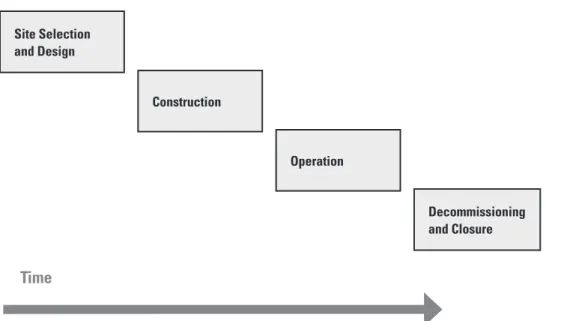
Mining companies face the challenge of effectively and efficiently managing tailings facilities through a life cycle from initial site selection and design, through construction and operation, to eventual decommissioning and closure, as illustrated schematically in Figure 2.
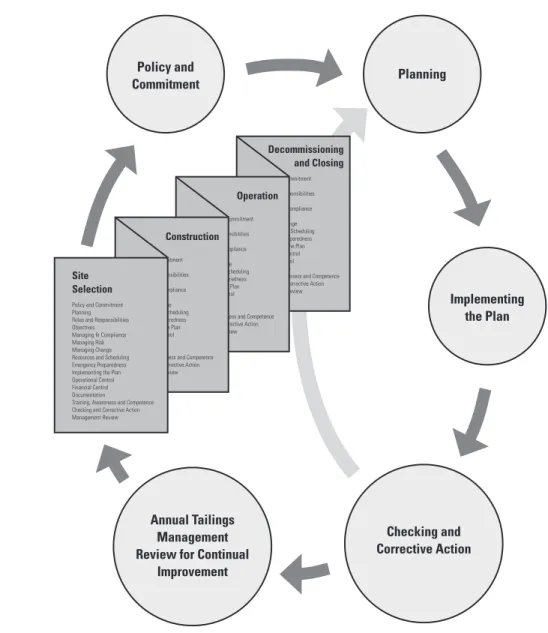
The tailings management framework presented in the preceding chapter provides the essential elements for managing through the life cycle of a tailings facility. There is an ongoing need for planning the work to be done on the facility, for implementing activi-ties, for checking and for reviewing the management. Figure 3, on the following page, illustrates the integration of the tailings management framework with the life cycle of a tailings facility. (It is recognized that some activities, such as construction, extend beyond the specific life cycle stage.)
Managing through the Life Cycle of a Tailings Facility
Figure 2: Stages in the Life Cycle of a Tailings Facility
Site Selection and Design Construction Operation Decommissioning and Closure
The Mining Association of Canada 3-2
Managing through the Life Cycle of a Tailings Facility
3
Figure 3: Application of the Tailings Management Framework through the Life Cycle
Annual Tailings Management Review for Continual
Improvement Policy and Commitment Planning Implementing the Plan Checking and Corrective Action Decommissioning and Closing
P Policy and Commitment Planning Roles and Responsibilities Objectives Managing fir Compliance Managing Risk Managing Change Resources and Scheduling Emergency Preparedness Implementing the Plan Operational Control Financial Control Documentation Training, Awareness and Competence Checking and Corrective Action Management Review
Operation
Polic Policy and Commitment Planning Roles and Responsibilities Objectives Managing fir Compliance Managing Risk Managing Change Resources and Scheduling Emergency Preparedness Implementing the Plan Operational Control Financial Control Documentation Training, Awareness and Competence Checking and Corrective Action Management Review
Construction
Policy and Commitment Planning Roles and Responsibilities Objectives Managing fir Compliance Managing Risk Managing Change Resources and Scheduling Emergency Preparedness Implementing the Plan Operational Control Financial Control Documentation Training, Awareness and Competence Checking and Corrective Action Management Review
Site Selection
Policy and Commitment Planning Roles and Responsibilities Objectives Managing fir Compliance Managing Risk Managing Change Resources and Scheduling Emergency Preparedness Implementing the Plan Operational Control Financial Control Documentation Training, Awareness and Competence Checking and Corrective Action Management Review
Managing through the Life Cycle of a Tailings Facility
3
At each stage in the tailings facility life cycle, implementation of the managementframe-work requires that actions be planned within the context of policies and commitments, implemented in accordance with plans, checked and corrected, and subjected to manage-ment review.
Different people will typically take the lead in the management of a tailings facility at dif-ferent stages of the life cycle:
n site selection and design are usually managed by headquarters-based project
development teams;
n facility construction up to the commissioning of a facility is usually managed on-site by a mine project development and construction management team; n facility operations and continuing construction through the operating life are
usu-ally managed by site operators; and
n a specific project team often takes the lead in preparing for decommissioning and
4
u Site-specific perfor-mance measures to be implemented require iden-tifying both a target to be achieved and indicating progress towards that achievement.
u Additional guidance for implementing the principles of the tailings management framework through the operating, decommissioning and closing stages of the life cycle are provided in MAC’s companion guide:
Developing an Opera-tion, Maintenance and
The tailings management framework has been designed for application through the full life cycle of a tailings facility, beginning at any stage. Companies are encouraged to implement the framework at the earliest opportunity.
Implementing the tailings management framework requires the following:
n confirming and/or customizing the relevant management actions as derived from
the tailings management framework;
n assigning responsibility and authority for the management actions to individuals within the organization;
n determining relevant site-specific performance measures as indicators of progress on management actions and objectives, quantified where practicable, to enable tracking of progress;
n identifying a schedule to provide a time frame for completing significant mile-stones for a management action, which may include specific delivery dates or times, and/or frequency of ongoing or periodic activities such as monitoring and reviews, and providing a clear timeline for key actions; and
n adding references, including technical, managerial and regulatory information relevant to the management action and to the site.
The framework is intended to be customized to suit the requirements of specific sites, company policies and local regulatory and community requirements. It can be imple-mented through the use of checklists that address the various life cycle stages. These sample checklists are provided following the Glossary:
n Checklist for Site Selection and Design of a Tailings Facility; n Checklist for Construction of a Tailings Facility;
n Checklist for Operating a Tailings Facility; and
n Checklist for Decommissioning and Closing a Tailings Facility.
These checklists provide a basis for developing customized, site-specific tailings
manage-Implementing the Tailings Management Framework
5
Glossary
Glossary
acceptable risk The level of risk deemed acceptable to the corporate management taking
into account government standards and guidelines, corporate policy and business factors.
accident An unplanned event that causes injury, loss or damage to people, equipment,
property or the environment.
as-built drawings Engineering drawings portraying the facility, or components of the
fa-cility, as constructed that document actual locations of the components and changes from the original engineering drawings implemented during construction of a facility.
communities of Interest (coI) All of the individuals and groups who have or believe
they have an interest in the management of decisions about operations that may affect them. This includes employees, contractors, Aboriginal or indigenous peoples, mining community members, suppliers, customers, environmental organizations, governments, the financial community and shareholders.
continual improvement The culture of continual aligned small improvements and
stan-dardization, with the overarching aim of compound overall performance improvement.
emergency A situation that poses an immediate risk to health, life, property, the
environ-ment or the integrity of a tailings facility and that requires urgent intervention to prevent a worsening of the situation.
life cycle The succession of phases, from initial site selection, design and construction,
through operations, to decommissioning and closure of a tailings facility, each involving discrete professional disciplines and requiring applied skills, tools and processes.
risk A potential negative impact, detrimental to operations, a facility, the environment, public health or safety, that may arise from some present process or future event. When evaluating risk, both the potential severity and the consequence of the impact and its probability of occurrence are considered.
6
Checklist for Site Selection and Design
of a Tailings Facility
Management Action
Responsibility Performance
Measure Schedule
References
1 POLICY AND COMMITMENT
Select a site and design a tailings facility in compliance with regulatory requirements and in conformance with sound engineering practice, company standards, the MAC TSM Guiding Principles, the MAC tailings management framework, and commitments to Com-munities of Interest
Ensure that the tailings management framework is implemented through the actions of all employees working at the facility Consult with Communities of Interest, taking into account their con-siderations relating to the tailings facility site selection and design Establish an ongoing program of review and continual improvement to manage health, safety and environmental risks associated with tailings facilities
2 PLANNING
2.1 ROLES AND RESPONSIBILITIES
Assign overall accountability for tailings management to an executive officer of the company (CEO or COO), with responsibility for putting in place an appropriate management structure and for providing assur-ance to the corporation and its Communities of Interest that tailings facilities are managed responsibly
Assign responsibility and budget authority for tailings management Define the roles, responsibilities and reporting relationships for the
The Mining Association of Canada
Checklist for Site Selection and Design
of a Tailings Facility
6
6-2Management Action
Responsibility Performance Measure Schedule Referencesn facilitate eventual decommissioning and closure, including: n protection of public health and safety
n mitigation of negative environmental impacts n acceptable post-closure use within a feasible technical
and economic framework
n incorporate risk assessment and risk management, including contingency plans and emergency preparedness and response plans
n provide continued protection of the environment and public health and safety
n enable the specified performance to be achieved Define the interaction and communication procedures among the design team and with management and Communities of Interest Identify requirements for documentation
Identify knowledge and skills (awareness, training and competence) requirements
Plan for site selection and design; establish a process of evaluation, including:
n identification of significant environmental, health and safety aspects and their associated risks
n standards for collection and interpretation of environmental, scientific and engineering data
n environmental assessment
2.3 MANAGING FOR COMPLIANCE
Compile and maintain a log of all applicable legislation, regulations, permits and commitments
Ensure that the applicable legislation, regulations, permits and com-mitments are understood
Checklist for Site Selection and Design
of a Tailings Facility
6
Management Action
Responsibility Performance Measure Schedule ReferencesEstablish and document processes and procedures to ensure compliance
Establish procedures for reporting of compliance and non-compliance Communicate the requirements, processes and procedures to ensure compliance to all employees
2.4 MANAGING RISK
Evaluate hazards and prepare risk assessment for the site selection and design
Develop risk management plans for the site selection and design, including:
n plans to minimize the likelihood of adverse safety or environ-mental impacts
n contingency plans
n emergency preparedness and response plans
2.5 MANAGING CHANGE
Prepare and document procedures to ensure that the integrity of the management system and the approved designs and plans is maintained by managing:
n changes in personnel, roles and responsibilities n changes, including temporary changes, made to approved
The Mining Association of Canada
Checklist for Site Selection and Design
of a Tailings Facility
6
6-4Management Action
Responsibility Performance Measure Schedule References2.7 EMERGENCY PREPAREDNESS AND RESPONSE
Develop and maintain emergency preparedness and response plans to identify possible accident or emergency situations, to respond to emergency situations, and to prevent and mitigate on- and off-site environmental and safety impacts associated with emergency situations
Establish procedures for periodic review, testing and distribution of the emergency preparedness and response plans within the organiza-tion and to potentially affected external parties
3 IMPLEMENTING THE PLAN
3.1 SITE SELECTION AND DESIGN CONTROL
Assemble a qualified team and assign responsibilities for site selec-tion and design of the tailings facility
Obtain approvals and permits for the site selection and design In accordance with the objectives:
n select an appropriate site n design the tailings facility
n prepare a comprehensive risk assessment n develop related plans and procedures, including
n management system n documentation procedures n construction procedures
n operation, maintenance and surveillance (OMS) procedures n communication procedures
n knowledge and skills requirements n decommissioning and closure plan n risk management plans
Checklist for Site Selection and Design
of a Tailings Facility
6
Management Action
Responsibility Performance Measure Schedule References n contingency plansn emergency preparedness and response plans Implement management control to:
n ensure conformance with design objectives and criteria, ap-propriate engineering and environmental practices, risk man-agement, the MAC TSM Guiding Principles, the MAC tailings management framework, and commitments to Communities of Interest
n ensure compliance with legislation, regulations, permits and commitments
n manage risk n manage change
n identify, evaluate the impact of, and document deviations from approved plans, procedures, schedule and budget
Implement and periodically test contingency plans and emergency preparedness and response plans for site selection and design
3.2 FINANCIAL CONTROL
Establish a budget and financial controls Obtain budget approval for the works
The Mining Association of Canada
Checklist for Site Selection and Design
of a Tailings Facility
6
6-6Management Action
Responsibility Performance Measure Schedule Referencesn monitoring results and analyses n unusual or special conditions n conditions encountered
n communications with Communities of Interest Promptly remove from use and archive obsolete versions of documents
3.4 TRAINING, AWARENESS AND COMPETENCE
Employ qualified personnel Ensure that all personnel understand:
n the design intent
n the potential health, safety and environmental risks and impacts of the work
n appropriate measures to minimize risks and impacts Identify training needs, conduct training as appropriate, and maintain records of all training provided
3.5 COMMUNICATIONS
Implement documented procedures for communications n among tailings personnel
n with management n with Communities of Interest
4 CHECKING AND CORRECTIVE ACTION
4.1 CHECKING
Review site selection and design to ensure compliance with regula-tory requirements and conformance with policies and commitments Consider independent review of design
Document and promptly report to the designated responsible official any observations and recommendations arising from reviews, specifi-cally identifying items requiring corrective action
Checklist for Site Selection and Design
of a Tailings Facility
6
Management Action
Responsibility Performance Measure Schedule References 4.2 CORRECTIVE ACTIONDevelop and implement action plans to address items that require corrective action
Document completion of corrective actions
5 ANNUAL TAILINGS MANAGEMENT REVIEW FOR CONTINUAL IMPROVEMENT
Conduct an annual review of tailings management to:
n evaluate the performance of the tailings management system, considering inspection, audit and assessment reports, chang-ing circumstances, recommendations, and the commitment to continual improvement
n evaluate the continuing adequacy of, and need for changes to, policies and objectives and performance of the tailings management system
n address the need for changes to commitments to Communities of Interest
Report the observations and conclusions of this annual review of tailings management to the accountable executive officer
7
Checklist for Construction of a Tailings Facility
Management Action
Responsibility Performance
Measure Schedule
References
1 POLICY AND COMMITMENT
Construct the tailings facility according to the design in a safe and environmentally responsible manner, in compliance with regulatory requirements, and in conformance with sound engineering practice, company standards, the MAC TSM Guiding Principles, the MAC tailings management framework, and commitments to Communities of Interest
Ensure that the tailings management framework is implemented through the actions of all employees working at the facility Consult with Communities of Interest, taking into account their considerations relating to the tailings facility construction Establish an ongoing program of review and continual improvement to manage health, safety and environmental risks associated with tailings facilities
2 PLANNING
2.1 ROLES AND RESPONSIBILITIES
Assign overall accountability for tailings management to an executive officer of the company (CEO or COO), with responsibility for putting in place an appropriate management structure and for providing assur-ance to the corporation and its Communities of Interest that tailings facilities are managed responsibly
The Mining Association of Canada
Checklist for Construction of a Tailings Facility
7
7-2Management Action
Responsibility Performance Measure Schedule References n environmental protectionn construction supervision, health and safety n temporary works
n instrumentation n commissioning
n documentation, including changes to design and management n communications, both internally and to Communities of
Interest
2.2 OBJECTIVES
Develop criteria and procedures to ensure that tailings facility construction will:
n be in conformance with design
n meet regulatory requirements, company policies and stan-dards, sound engineering and environmental practices, and commitments to Communities of Interest
n facilitate eventual decommissioning and closure
n provide continued protection of the environment and public health and safety
n enable the specified performance to be achieved
Define procedures for communication among the construction team and with management and Communities of Interest
Identify requirements for documentation
Identify knowledge and skills (awareness, training and competence) requirements
Prepare detailed plans for construction of the tailings facility to: n establish a quality control system for construction n identify and review deviations from design n produce as-built drawings and construction reports
Checklist for Construction of a Tailings Facility
7
Management Action
Responsibility Performance
Measure Schedule
References
n ensure availability of suitable quality and quantity of construc-tion materials
n install instrumentation n meet environmental objectives n obtain all required construction permits n specify contractor bonding requirements and n establish contractor tendering procedures
2.3 MANAGING FOR COMPLIANCE
Compile and maintain a log of all applicable legislation, regulations, permits and commitments
Ensure that the applicable legislation, regulations, permits and com-mitments are understood
Ensure that the actions needed to ensure compliance are understood Establish and document processes and procedures to ensure compliance
Establish procedures for reporting of compliance and non-compliance Communicate the requirements, processes and procedures to ensure compliance to all employees
2.4 MANAGING RISK
The Mining Association of Canada
Checklist for Construction of a Tailings Facility
7
7-4Management Action
Responsibility Performance Measure Schedule References n contingency plansn emergency preparedness and response plans that include:
n control strategies to manage the identified risks and/or reas-sess the design
n identification of thresholds to trigger implementation of contingency plans and emergency response plans n communication procedures
2.5 MANAGING CHANGE
Prepare and document procedures to ensure that the integrity of both the management system and the approved designs and plans is maintained by managing:
n changes in personnel, roles and responsibilities n changes, including temporary changes, made to approved
plans and procedures
n changes in regulatory requirements
2.6 RESOURCES AND SCHEDULING
Identify budget requirements and secure adequate human and finan-cial resources for construction
Develop a schedule for construction
Update the resource requirements for operations, decommissioning and closure
2.7 EMERGENCY PREPAREDNESS AND RESPONSE
Develop and maintain emergency preparedness and response plans to identify possible accident or emergency situations, to respond to emergency situations, and to prevent and mitigate on- and off-site environmental and safety impacts associated with emergency situations
Checklist for Construction of a Tailings Facility
7
Management Action
Responsibility Performance
Measure Schedule
References
Establish procedures for periodic review, testing and distribution of the emergency preparedness and response plans within the organiza-tion and to potentially affected external parties
3 IMPLEMENTING THE PLAN
3.1 CONSTRUCTION CONTROL
Assemble a qualified team and assign responsibilities for construc-tion of the tailings facility
Obtain approvals and permits Implement management control to:
n ensure conformance with design and plan specifications, ap-propriate engineering and environmental practices, risk man-agement, the MAC TSM Guiding Principles, the MAC tailings management framework and commitments to Communities of Interest
n ensure compliance with legislation, regulations, permits and commitments
n manage risk n manage change
n identify, evaluate the impact of, and document deviations from approved design, plans, procedures, schedule and budget, and to ensure modifications are subjected to appropriate approval processes
The Mining Association of Canada
Checklist for Construction of a Tailings Facility
7
7-6Management Action
Responsibility Performance Measure Schedule ReferencesImplement and periodically test contingency plans and emergency preparedness and response plans
3.2 FINANCIAL CONTROL
Establish a budget and financial controls Obtain budget approval for the works
Track capital and operating costs against the budget
3.3 DOCUMENTATION
Prepare, maintain, periodically review and revise the documents required for construction of the tailings facility
Maintain current versions of all documents at designated, readily accessible locations, including:
n permits, licences and other regulatory requirements n submissions to and from regulatory agencies n facility design and plans
n training records
n quality control reports, construction reports, photos, videos, etc. n monitoring results and analyses
n unusual or special conditions n conditions encountered n as-built drawings and records
n modifications to the tailings facility design and operating plans
n communications with Communities of Interest Promptly remove from use and archive obsolete versions of documents
3.4 TRAINING, AWARENESS AND COMPETENCE
Checklist for Construction of a Tailings Facility
7
Management Action
Responsibility Performance
Measure Schedule
References
Ensure that personnel understand: n the design intent
n the potential health, safety and environmental risks and impacts of the work
n appropriate measures to minimize risks and impacts Identify training needs, conduct training as appropriate, and maintain records of all training provided
3.5 COMMUNICATIONS
Implement documented procedures for communications: n among tailings personnel
n with management n with Communities of Interest
4 CHECKING AND CORRECTIVE ACTION
4.1 CHECKING
Inspect, review and audit construction to ensure compliance with regulatory requirements and conformance with design objectives, plans and commitments
Consider independent review of design and construction should problems occur during construction
The Mining Association of Canada
Checklist for Construction of a Tailings Facility
7
7-8Management Action
Responsibility Performance Measure Schedule References5 ANNUAL TAILINGS MANAGEMENT REVIEW FOR CONTINUAL IMPROVEMENT
Conduct an annual review of tailings management to: n evaluate the performance of the tailings management
system, considering inspection, audit and assessment reports, changing circumstances, monitoring results, spills and other incidents, recommendations, and the commitment to continual improvement
n evaluate the continuing adequacy of, and need for changes to, policies and objectives and performance of the tailings management system
n address the need for changes to commitments to Communities of Interest
Report the observations and conclusions of this annual review of tailings management to the accountable executive officer
8
Checklist for Operating a Tailings Facility
Management Action
Responsibility Performance
Measure Schedule
References
1 POLICY AND COMMITMENT *
Operate the tailings facility in such a manner that all structures are stable, all solids and water are managed within the designated areas, and all aspects of tailings management are in compliance with regulatory requirements and in conformance with sound engineering practice, company standards, the MAC TSM Guiding Principles, the MAC tailings management framework, and commitments to Com-munities of Interest
Ensure that the tailings management framework is implemented through the actions of all employees working at the facility Consult with Communities of Interest, taking into account their considerations relating to the tailings facility management Establish an ongoing program of review and continual improvement to manage health, safety and environmental risks associated with tailings facilities
2 PLANNING
2.1 ROLES AND RESPONSIBILITIES
Assign overall accountability for tailings management to an executive officer of the company (CEO or COO), with responsibility for putting in place an appropriate management structure and for providing assur-ance to the corporation and its Communities of Interest that tailings facilities are managed responsibly
The Mining Association of Canada
Checklist for Operating a Tailings Facility
8
8-2Management Action
Responsibility Performance Measure Schedule ReferencesDefine the roles, responsibilities and reporting relationships for the tailings facility operation, supported by job descriptions and organiza-tion charts, and including:
n site management n operating plans n operating strategy
n obtaining and maintaining approvals
n operation of the tailings facility, including maintenance and surveillance
n health, safety and environmental protection n emergency preparedness and response n continuing expert support
n documentation, including changes to design and management n communications, both internally and to Communities of
Interest on:
n routine performance issues n emergency preparedness
n regulatory compliance and/or incident reporting n the closure plan
2.2 OBJECTIVES
Develop criteria and procedures to ensure that tailings facility opera-tions will:
n be in conformance with design
n meet regulatory requirements, company policies and stan-dards, sound engineering and environmental practices, and commitments to Communities of Interest
n integrate preparation for eventual decommissioning and closure into ongoing operations to ensure:
Checklist for Operating a Tailings Facility
8
Management Action
Responsibility Performance
Measure Schedule
References
n protection of public health and safety n mitigation of negative environmental impacts n acceptable post-closure use within a feasible technical
and economic framework
n provide continued protection of the environment and public health and safety
n enable the specified performance to be achieved Define procedures for communication among the operations team and with management and Communities of Interest
Identify requirements for documentation
Identify knowledge and skills (awareness, training and competence) requirements
Plan for operation and review design documents, regulatory require-ments, as-built construction drawings, conceptual operating and closure plans, environmental assessment and commitments to Com-munities of Interest
Prepare, review and update on a regular basis an operation, main-tenance and surveillance (OMS) manual for the facility (reference: MAC’s companion guide, Developing an Operation, Maintenance and Surveillance Manual for Tailings and Water Management Facilities),
including:
The Mining Association of Canada
Checklist for Operating a Tailings Facility
8
8-4Management Action
Responsibility Performance Measure Schedule Referencesn calibration program for key instrumentation n emergency preparedness and response plan
n decommissioning and closure plan, including progressive rehabilitation
2.3 MANAGING FOR COMPLIANCE
Compile and maintain a log of all applicable legislation, regulations, permits and commitments
Ensure that the applicable legislation, regulations, permits and com-mitments are understood
Ensure that the actions needed to ensure compliance are understood Establish and document processes and procedures to ensure compliance
Establish procedures for reporting of compliance and non-compliance Communicate the requirements, processes and procedures to ensure compliance to all employees
2.4 MANAGING RISK
Prepare and periodically update a comprehensive risk assessment for the facility, to:
n evaluate the risks associated with possible triggers and failure modes for both the operating and closure stages n identify possible impacts on the environment, public health
and safety
n determine the operating parameters that can have an impact on the triggers and failure modes
Develop:
n risk management plans to minimize the likelihood of adverse safety or environmental impacts
n contingency plans
Checklist for Operating a Tailings Facility
8
Management Action
Responsibility Performance Measure Schedule References that include:n control strategies to manage the identified risks and/or reas-sess the design
n identification of thresholds to trigger implementation of contingency plans and emergency response plans n communication procedures
2.5 MANAGING CHANGE
Prepare and document procedures to ensure that the integrity of the management system and of approved designs and plans is maintained by managing:
n changes in personnel, roles and responsibilities n changes, including temporary changes, made to approved
plans and procedures
n changes in regulatory requirements
2.6 RESOURCES AND SCHEDULING
Identify budget requirements and secure adequate human and finan-cial resources for operating the facility, including
n operations, maintenance and surveillance n inspection, review, audit and assessment Develop a schedule for operating the facility
The Mining Association of Canada
Checklist for Operating a Tailings Facility
8
8-6Management Action
Responsibility Performance Measure Schedule ReferencesEstablish procedures for periodic review, testing and distribution of the emergency preparedness and response plans within the organiza-tion and to potentially affected external parties
3 IMPLEMENTING THE PLAN
3.1 OPERATIONAL CONTROL
Assemble a qualified team and assign responsibilities for operating the tailings facility
Obtain approvals and permits Implement management control to:
n apply the operation, maintenance and surveillance (OMS) manual for the facility
n ensure conformance with design and plan specifications, ap-propriate engineering and environmental practices, risk man-agement, the MAC TSM Guiding Principles, the MAC tailings management framework and commitments to Communities of Interest
n ensure compliance with legislation, regulations, permits and commitments
n manage risk n manage change
n identify, evaluate the impact of and document deviations from approved plans, procedures, schedule and budget, and to ensure modifications are subjected to appropriate approval processes
Implement the operation, maintenance and surveillance (OMS) manual for the facility, including:
n operational procedures and controls addressing: n water balance
n water quality
Checklist for Operating a Tailings Facility
8
Management Action
Responsibility Performance
Measure Schedule
References
n groundwater, pore pressure regime and seepage n tailings characteristics and deposition
n physical stability of structures and appurtenances n dust
n environmental impacts n site security
n protection of flora and fauna
n routine inspection, monitoring, testing, evaluation and reporting of:
n conformance with operating objectives n compliance with requirements and commitments n environmental and safety performance n deficiencies, unusual and/or unsafe conditions Implement and periodically test contingency plans and emergency preparedness and response plans
3.2 FINANCIAL CONTROL
Establish a budget and financial controls
Obtain budget approval for the tailings management Track capital and operating costs against the budget
The Mining Association of Canada
Checklist for Operating a Tailings Facility
8
8-8Management Action
Responsibility Performance Measure Schedule Referencesn the operation, maintenance and surveillance (OMS) manual n training records
n quality control reports, construction and operating reports, photos, videos, etc.
n monitoring results and analyses n unusual or special conditions n conditions encountered n as-built drawings and records
n modifications to the tailings facility design and operating plans
n communications with Communities of Interest Promptly remove from use and archive obsolete versions of documents
3.4 TRAINING, AWARENESS AND COMPETENCE
Employ qualified personnel Ensure that all personnel understand
n the design intent
n operating, maintenance and surveillance (OMS) parameters and procedures
n the potential health, safety and environmental risks and impacts of the work
n appropriate measures to minimize risks and impacts Identify training needs, conduct training as appropriate and maintain records of all training provided
Checklist for Operating a Tailings Facility
8
Management Action
Responsibility Performance Measure Schedule References 3.5 COMMUNICATIONSImplement documented procedures for communications n among tailings personnel
n with management n with Communities of Interest
4 CHECKING AND CORRECTIVE ACTION
4.1 CHECKING
In addition to routine monitoring and inspections, conduct periodic inspection of operations to ensure compliance with regulatory requirements and conformance with design objectives, plans and commitments
Conduct periodic review of the tailings facility to:
n verify design assumptions against actual conditions and performance
n revisit or update the design and/or operating plans n re-evaluate downstream risks
n update the risk assessment
n evaluate the need for changes or updates to risk manage-ment plans, contingency plans, emergency preparedness and response plans, and plans for eventual decommissioning and
The Mining Association of Canada
Checklist for Operating a Tailings Facility
8
8-10Management Action
Responsibility Performance Measure Schedule References 4.2 CORRECTIVE ACTIONDevelop and implement action plans to address items that require corrective action, including changes to inspection and review programs, as warranted, following changes in design or fundamental operating parameters
Document completion of corrective actions
5 ANNUAL TAILINGS MANAGEMENT REVIEW FOR CONTINUAL IMPROVEMENT
Conduct an annual review of tailings management to: n evaluate the performance of the tailings management
system, considering inspection, audit and assessment reports, changing circumstances, monitoring results, spills and other incidents, recommendations and the commitment to continual improvement
n evaluate the continuing adequacy of, and need for changes to, policies and objectives and performance of the tailings management system
n address the need for changes to commitments to Communities of Interest
Report the observations and conclusions of this annual review of tailings management to the accountable executive officer
9
Management Action
Responsibility Performance
Measure Schedule
References
1 POLICY AND COMMITMENT *
Decommission and close the tailings facility in a manner such that all remaining structures are stable, all solids and water are managed within the designated areas, and all aspects of tailings management are in compliance with regulatory requirements and in conformance with sound engineering practice, company standards, the MAC TSM Guiding Principles, the MAC tailings management framework and commitments to Communities of Interest
Ensure that the tailings management framework is implemented through the actions of all employees working at the facility Consult with Communities of Interest, taking into account their considerations relating to the tailings facility decommissioning and closure
Establish an ongoing program of review and continual improvement to manage health, safety and environmental risks associated with tailings facilities
2 PLANNING
2.1 ROLES AND RESPONSIBILITIES
Assign overall accountability for tailings management to an executive officer of the company (CEO or COO), with responsibility for putting in place an appropriate management structure and for providing assur-ance to the corporation and its Communities of Interest that tailings facilities are managed responsibly