Decision Support
Preference elicitation from inconsistent judgments using
multi-objective optimization
S. Siraj
a,b,⇑, L. Mikhailov
c, J.A. Keane
baDepartment of Electrical Engineering, COMSATS Institute of Information Technology, Wah, Pakistan b
School of Computer Science, The University of Manchester, M13 9PL, United Kingdom c
Manchester Business School, Booth Street West, The University of Manchester, M15 6PB, United Kingdom
a r t i c l e
i n f o
Article history:
Received 4 July 2011 Accepted 24 January 2012 Available online 1 February 2012
Keywords:
Multiple criteria analysis Pairwise comparisons Multi-objective optimization
a b s t r a c t
Several decision-making techniques involve pairwise comparisons to elicit the preferences of a decision maker (DM). This paper proposes a new approach for prioritization from pairwise comparisons using the concept of indirect judgments. No method exists that simultaneously minimizes deviations from both direct and indirect judgments. In order to estimate preferences, it is sensible to consider both the acquired judgments and the other judgments latent in the DM’s mind. Hence, a technique is developed here to minimize the deviations from both types of judgments.
Estimated preferences are generally evaluated based on two criteria: their deviation from the provided judgments and the number of judgments that have been ordinally violated. Here, it is proposed to opti-mize three objectives simultaneously: the deviations from both direct and indirect judgments, and the number of judgments violated. A prototype application has been developed to generate all non-domi-nated solutions using a multiple-objective evolutionary algorithm. The new approach is shown to offer users greater flexibility than all other tested methods.
Ó2012 Elsevier B.V.
1. Introduction
There are numerous examples of decision making, both in perso-nal and business life, where a number of alternatives need to be ranked with respect to a preference scale. Human thinking often involves inclinations and environmental effects which pollute deci-sion-making. The preferences of a decision maker (DM) or a group of DMs can be extracted using various techniques – seeIttersum et al. (2007)for a review. These techniques are based on either direct-rating or pairwise comparison (PC) method. The PC method is often used when the DM is unable to directly assign the criteria weights or the scores of available options.
The preference structure in several decision-making techniques is based on the PC method. Analytic Hierarchy Process (AHP) (Saaty, 1980) is one of the most widely-used decision making tech-nique based on the PC method. In addition to this, there exist other methods based on this technique, for example, the ELECTRE meth-od (Figueira et al., 2010) and the UTA method (Siskos et al., 2005).
Greco et al. (2010) also proposed the use of PCs for preference learning in case of making decisions under uncertainty.
In the PC method, the DM assesses the relative importance of any two elements by providing a ratio judgment with respect to some predetermined preference scale. In the case oftangible crite-ria, this can be derived from the directly measured information as, for example, weights (in kilograms) or price (in euros). In the case ofintangibles,Saaty (1977)proposed to use a set of verbal ments that correspond to the ratio-scale of 1–9. Pairwise judg-ments can be provided using an additive-scale, however, the use of ratio-scale is considered to be more appropriate for measuring the relative intensities (Krantz, 1972; Harker and Vargas, 1987).
Ishizaka et al. (2010)summarized a comprehensive list of transfor-mations applied to Saaty’s 1–9 scale with a conclusion that there exists no single scale appropriate for all situations.
Once a set of PC judgments is acquired from the DM, the main challenge is the presence of inconsistency among these judgments. The issue of improving consistency in PC judgments has been widely debated and is still considered to be an active area for fur-ther investigation (Bozóki et al., 2011; Ergu et al., 2011). The issue of improving ordinal consistency has been presented in companion work (Siraj et al., 2012). This work focuses on the problem of elic-iting preferences when inconsistency cannot be removed. There exist situations in practice where acquired judgments cannot be changed and preferences need to be estimated from these judg-ments, whether consistent or inconsistent. There are several meth-ods to estimate preferences from inconsistent PCs: and no method performs best in all situations (Choo and Wedley, 2004).
0377-2217Ó2012 Elsevier B.V. doi:10.1016/j.ejor.2012.01.049
⇑ Corresponding author. Address: Allama Iqbal Block, COMSATS Institute of Information Technology, Wah Cantonment 47040, Pakistan. Tel.: +92 51 9272614; fax: +92 51 4546850.
E-mail addresses:[email protected],[email protected](S. Siraj).
Contents lists available atSciVerse ScienceDirect
European Journal of Operational Research
j o u r n a l h o m e p a g e : w w w . e l s e v i e r . c o m / l o c a t e / e j o rOpen access under CC BY license.
For each pair of elements compared in PCs, an indirect (latent) judgment can also be captured with the help of other judgments present in the set of judgments. These indirect judgments are only different in the presence of inconsistency. The most widely used method, Right Eigenvector (EV), takes into consideration the indi-rect judgments while eliciting preferences. Considering optimiza-tion-based prioritization, no method exists that both formulates indirect judgments explicitly and minimizes deviations from direct and indirect judgments. In order to estimate preferences, it is sen-sible to consider both the acquired judgments and the other judg-ments latent in the DM’s mind. Hence, a technique is developed here to minimize the deviations from both types of judgments. We propose here to minimize these deviations using a multi-objec-tive evolutionary approach. The new approach offers the DM a wide range of non-dominated solutions, giving him/her the flexi-bility to select one according to his/her requirements.
The proposed method attempts to generate weights from incon-sistent set of judgments without eliminating the inconsistencies and, therefore, is considered to be useful in situations where the acquired data cannot be revised or changed.
The structure of the paper is as follows: the problem structure for PCs is formulated in Section 2. Section 3 identifies that no method addresses the issue relating to both intransitive judgments and priority violations. Section4explores the concept of indirect judgments; a new method, based on multi-objective optimization, is then proposed in Section5. Section6evaluates this method; and conclusions are presented in Section8.
2. Problem definition
Consider a prioritization ofnelementsE1,E2,. . .,En. In
multi-teria decision-making (MCDM), these elements could be either cri-teria or alternatives. In the PC method, the DM assesses the relative importance of any two elementsEiandEjby providing a ratio
judg-mentaij. It is important to note that the relative importance of two
elements may have different meanings in other MCDM methods (Noghin, 1997; Rachmawati and Srinivasan, 2010). Each set of pair-wise ratio judgments,J, withnelements consists ofmjudgments. Althoughmhas an upper bound ofn2
, in fact,n(n1) judgments are sufficient when self-comparison is considered unnecessary. The number of judgments is further reduced tom¼nðn1Þ
2 , when the reciprocal property is strictly applicable, i.e.,aij= 1/aji.
Then2 judgments in Jcan be used to construct a PC matrix (PCM)A= [aij] of the order nn. The relationships between the
elements ofJcan also be depicted by means of a directed graph (di-graph),G= (E,J), where Eis the set of nodes representingn ele-ments, and J represents the set of all ratio judgments as weighted edges (Ali et al., 1986).
The transitivity condition states that ifEiis preferred toEjandEj
is preferred toEk, thenEishould be preferred toEk. This can be
represented using the preference symbol?, asEi?Ej?Ekimplies
Ei?Ek. The preference judgments are ordinally inconsistent (or
intransitive) ifEk?EiwhenEi?Ej?Ek. Therefore, ordinal
incon-sistency can be defined as Ei?Ej?Ek?Ei, which represents a
circular triadof preferences (Kendall and Smith, 1940), or a three-way cycle. When two comparison elementsEiandEjare equally
preferred, EiEj (preference equivalence or a tie), then ordinal
consistency requires one of the following three conditions to be satisfied:Ei?EkandEj?Ek, orEi EkandEj Ek, orEiEkand
EjEk.
The judgments of the DM arecardinally consistent, ifaij=aikakj
for alli,jandk. If the DM’s judgments arecardinally inconsistent (i.e.,aij–aikakjfor somei,j,k) then the corresponding matrixAis
said to be inconsistent.Saaty (1977)developed a measure of cardi-nal consistency based on the properties of positive reciprocal matrices. This work proved that the largest Eigenvalue, kmax, is
equal tonfor a consistent reciprocal matrix and is always greater thannfor an inconsistent one. Based on this Saaty introduced a measure, Consistency Ratio (CR), calculated from the deviation of kmaxfromn. If the value ofCRis smaller than or equal to 0.1 (or
10%), the inconsistency is considered to beacceptable. If theCRis greater than 10%, then the subjective judgments need to be revised. Suppose there exists a preference vectorr= (r1,r2,. . .,rn)Tsuch
thatrirepresents the preference intensity ofEiwherei= 1, 2,. . .,n.
However, the preference vectorris unknown to the DM and thus must be estimated. The prioritization problem is, therefore, to determine a priority vectorw= (w1,w2,. . .,wn)Tfrom J, which in
turn estimates the unknown preference vectorr. When the DM is perfectly consistent in his/her judgments, then the priority vector wis exactly the same as the preference vectorr, and the judgments aijhave perfect valuesaij¼rrij¼
wi
wj. In such a case, the PCM is said to
be (perfectly)consistentand this can be represented asA¼ wi
wj h i
. In the case of an inconsistent PCM, the estimated priority vectorw approximates the unknown preference vectorr, andaijwwi
j. The
priority weights in ratio-comparisons are considered to have non-zero positive values (wi> 0) and are usually calculated with an
additional constraint endorsing normalization, i.e.,Pwi¼1. The
weights for decision elements are calculated from the PCM using several mathematical techniques. In the case of consistent judg-ments, all prioritization methods give the same results; however, the results are different when judgments are inconsistent. 2.1. Prioritization methods
Saaty (1977)proposed the generation of a PCM fromJand the use of its principal Eigenvector (EV) as the priority vectorw, pro-vided the inconsistency remains acceptable (CR60.1). These EV solutions are unsatisfactory when inconsistencies are larger (CR> 0.1) – this has been investigated extensively from both the prioritization and consistency perspectives (Crawford, 1987; Golany and Kress, 1993; Ergu et al., 2011; Siraj et al., 2012). A sum-mary of prioritization methods is available in (Choo and Wedley, 2004), where 18 different methods are analyzed and compared. Except for EV, all widely-used methods are based on optimization, i.e., minimizing some objective function. Unlike EV, optimization-based methods do not require a complete set of judgments. The objective functions are usually the aggregation of all individual deviations, d, between the given judgment and the estimated one, i.e. dðwÞ ¼X i X j dðaij;wÞ
8
i;j2 f1;2;. . .;ng ð1ÞThe optimization problem can be formulated as: minimizedðwÞ
s:t: X
i
wi¼1; wi>0; i2 f1;2;. . .;ng
The Direct Least Squares (DLS) method, proposed in (Chu et al., 1979), minimizes the total squared error (residuals) defined as the total distance between the judgments and estimations. The individ-ual deviationdfor DLS is calculated asdðDLSÞðwÞ ¼ aijwwi
j
2
. DLS is a non-linear optimization problem having no closed-form solution.
Chu et al. (1979)highlighted this discrepancy of DLS and proposed the Weighted Least Squares (WLS) method as a modification to DLS, minimizing the distance function asd(WLS)(w) = (wjaijwi)2. Unlike
DLS, WLS reduces the problem to a system of linear equations that can easily be solved, providing a unique solution.
The Logarithmic Least Squares (LLS) method, presented in (Crawford, 1987), makes use of the multiplicative properties of the PC. LLS minimization assumes that the best-fit curve of a given
type is the curve that has the minimal sum of the logarithmic squared deviations from a given set of data, i.e., d(LLS)(w) = (logaijlogwi+ logwj)2. The solution for LLS is always unique
and can be found simply as the geometric mean of the rows of a PCM (Crawford, 1987), provided that the set of given judgments is complete, i.e.,m¼nðn21Þ. The Geometric Mean (GM) technique can be formulated aswi¼ ðQnj¼1aijÞ
1 n.
Cook and Kress (1988)related the prioritization from PCM with the tournament ranking problem, and proposed the Logarithmic Least Absolute Value (LLAV) method, introducing the concept of ‘‘independence of irrelevant objects’’. The individual deviation for LLAV is defined asd(LLAV)(w) =jlogaijlogwi+ logwjj.
Prioritization methods have been extensively discussed and compared in the last couple of decades. However, there appears to be no consensus on the evaluation criteria to be used for com-parison. The most widely used criteria are mentioned below.
Quadratic deviation. The quadratic or total deviation,TD(w), can be defined as the sum of all quadratic errors (residuals) between the estimated priority vector and the set of given judgments. The calculation forTD(w) is shown mathematically as:
TDðwÞ ¼X n i¼1 Xn j¼1 aijwi wj 2 ð2Þ
IfTD(w) is the only consideration for ranking prioritization meth-ods, it is obvious that the DLS method will outperform all other methods. This criterion has been used in (Budescu et al., 1986; Golany and Kress, 1993; Srdjevic, 2005). To remove its dependence onn,TD(w) can also be normalized as the Euclidean distance,ED(w), as used in (Herman and Koczkodaj, 1996).
Mean absolute deviation. The mean absolute deviation can be de-fined as the average of all absolute errors (residuals) between the estimated priority vectorwand the ideal preference vectorr, given asMADðwÞ ¼1
n
P
jjwjrjj. This criterion has been used in
simula-tion-based experiments (Choo and Wedley, 2004; Lin, 2007), where PCM is generated from an ideal vector,r, and then pertur-bance is added to it. However,MAD(w) is not applicable to real-world situations, as the preference vectorris unknown to the DM. Priority violations. The concept of priority violation was intro-duced byAli et al. (1986), formulating it for the tournament rank-ing problem. Golany and Kress (1993) used this criterion to compare prioritization methods. WhenEi?Ej, it is assumed that
the priorities of these two elements should preserve the preference direction, i.e.,wi>wj. However, while eliciting preferences, ifEj
re-ceives a larger priority weight, i.e.,wi<wj, then apriority violation
occurs (Ali et al., 1986).Golany and Kress (1993)formulated this violation as:
v
ij¼ 1 if ðwi<wjÞandðaij>1Þ 0:5 ifðwi–wjÞandðaij¼1Þ 0:5 orðwi¼wjÞandðaij–1Þ 0 otherwise 8 > > > > < > > > > : ð3ÞThe definition of
v
ijin(3)can be debated for assigning 0.5 to the twodifferent types of violations. The question of whether two half-violations should be considered equal to a full violation (i.e.,wi<wj
andaij> 1) needs to be further investigated.
The total number of violations,NV(w) is a simple aggregation of all
v
ij: NVðwÞ ¼X i X j>iv
ij ð4ÞA priority vector,w⁄, gives anideal rankingwhen it satisfies all
pref-erence directions expressed by the ordinal comparisons, giving no priority violation.
Other criteria. There are several other criteria used to compare prioritization methods, e.g., conformity, computation complexity, uniqueness of solutions and sensitivity to the changes in original judgments (Golany and Kress, 1993; Srdjevic, 2005). However, these criteria are considered to be secondary.
3. Transitivity and violations
Most prioritization methods derive priorities with the same ranking when the PCM is ordinally consistent (transitive), possibly with different intensities. However, different rankings are pro-duced when the comparisons are ordinally inconsistent (intransi-tive). Hartvigsen (2005) shows the possibility of obtaining different rankings, even in the absence of intransitive judgments. 3.1. Monte-Carlo experiments
In order to analyze the effects of transitivity on the estimated priority vectors, Monte-Carlo simulations were used. Monte-Carlo methods are a class of computational algorithms that rely on re-peated random sampling to compute their results and are useful to model phenomena with significant uncertainty in inputs.
Firstly, a number of preference vectors were randomly gener-ated and, for each vector a consistent PCM, A=baijc was
con-structed, such that aij¼rrji for all i,j= 1, 2,. . .,n. In order to
introduce (cardinal) inconsistency, uniformly distributed noise,
e
ijwas superimposed on the elements, i.e., a~ij¼aij
e
ij8i>j where16
e
ij61.5. In probability theory, a process is said to have uniform distribution when any outcome is equally probable. Although the selection of appropriate distribution function for generating PCMs has been discussed in the PC literature (Carmone et al., 1997; San-chez and Soyer, 1998), the uniform distribution has been widely used in PC-based experiments (Saaty, 1980; Carrizosa and Messine, 2007; Busse and Buhmann, 2011). The elements in the lower trian-gular part were then recalculated using the reciprocal property, so that~aji¼1=~aij. PCMs were generated fornvarying from 3 to 9. Theupper limit ofn= 9 was selected according to the maximal dimen-sion of the PCM, and because it is recommended by Saaty for the AHP method (Saaty, 1980). In order to induce ordinal inconsistency (i.e., three-way cycles) in these PCMs, a random number,
l
ijwasgenerated between 0 and 1 (with uniform distribution) for each
~
aij. The judgment~aijwas swapped with its reciprocal value~aijif
l
ijPhwhereh is a manually adjustable threshold. In this way,PCMs with different levels of ordinal inconsistency were generated by changinghfrom 0 to 1.
An enumeration algorithm has been implemented to calculate thenumber of three-way cycles,L, by testing all possible combina-tions of any three judgments.
In order to explore the relationship betweenLandNV(w), two phases of experimentation have been carried out. In the first phase, PCMs were generated having uniform distribution with no con-straints on their consistency. In the second phase, PCMs were gen-erated with acceptable inconsistency, i.e., CR< 0.1. 3,000 PCMs were generated for each value ofn. For each comparison, priority vectors were estimated using the EV, GM (LLS), DLS, WLS and LLAV methods. Along with these five methods, a new optimization method has been used to estimate the priority vector giving the minimum number of priority violations (NVmin) for a given PCM, as defined in(4). We term this method the Minimum Number of Violations (MNV) method.
All the optimization methods were implemented using a genet-ic algorithm written in Java, with the help of the jMetal toolkit (Durillo et al., 2006). The algorithm was executed with a popula-tion size of 20 and maximum evaluapopula-tions limited to 25000. Simu-lated Binary Crossover (SBX) operator was used with probability
set to 0.85 and distribution index set to 20.0. Finally, the polyno-mial mutation was applied with probability set to 0.05. This config-uration generates near-optimal solutions and the experimental results may further be improved by tuning the parameters for this problem. However, the focus here is to investigate the effects of intransitivity onNVmininstead of generating real optimal solutions. All PCMs with the same value ofLwere grouped together to cal-culate average values for the results. This grouping was done to en-able an analysis of how different number of cycles present in a PCM may affect the number of violations generated by different meth-ods. For each group, an average value of NV(w) was calculated using different prioritization methods.
3.2. Results
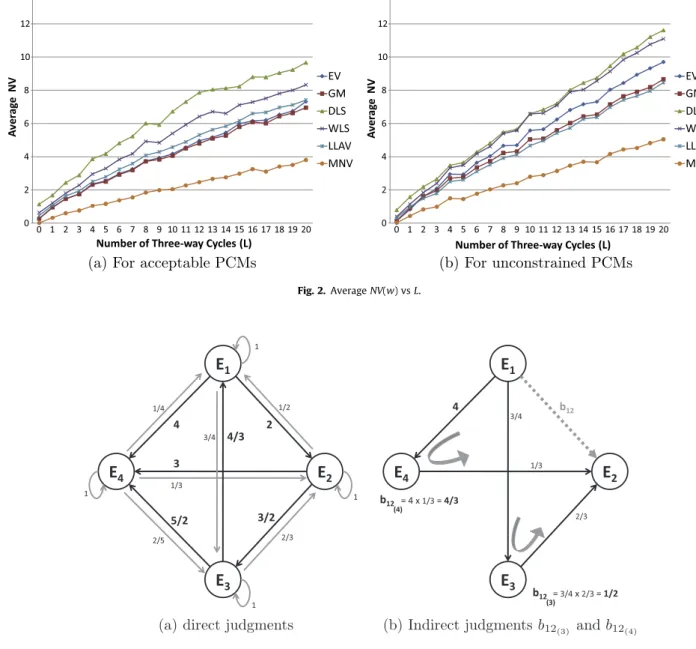
The results show that there is a linear relation between the cy-cles present in the PCMs, and the average number of violations, as shown in Fig. 1. The greater the number of cycles present, the greater the number of violations whilst estimating preferences.
The design of the Monte-Carlo simulations may influence the results and possibly change the rankings of prioritization methods. However, the primary target of this experiment was to indicate that different prioritization methods perform differently in the presence of cycles. The experiment does show a general trend for how different methods behave in the presence of intransitive judg-ments. The average NV(w) generated by all of the prioritization methods are sensitive toL.NVmin gives the lower bound for the number of violations, as would be expected and is confirmed in bothFig. 2(a) and (b).
An important observation is that the EV and GM methods per-form similarly whenCRis bounded to remain less than 0.1. How-ever, on average, GM gives a lower number of violations when compared to EV. WLS performs worse than both the GM and EV methods. In general, LLAV produces the lowest number of viola-tions of all the methods; however, this does not apply for accept-able PCMs, where both EV and GM outperform LLAV. The DLS optimization performs worst giving the highest average value for NV(w). It is important to highlight that no method is performing close to the lower bound (NVmin), indicating well the need to pro-pose a new method to minimize violations.
The results of the Monte-Carlo experiment confirms that the existing methods generate vectors with more violations than NVmin. The experimental results forNVminmay further be improved by tuning the genetic algorithm parameters for this problem. The idea of minimizing the number of violations has already been proposed in the Two-Objective Prioritization (TOP) method
(Mikhailov, 2006), where the objectives, NV and TD, are optimized using multi-objective optimization. Here, we extend this approach to minimize three objectives.
4. Revealing the indirect judgments
Considering the cardinal consistency test betweenEiandEj, i.e.,
aij=aikakj(for alli,j, andk), if the DM’s judgments are cardinally
inconsistent, then we obtain at least one indirect judgmentbij=a i-kakjincongruent withaijfor somei,jandkwherei–j–k–i. For
each pair of elements inJ, a maximum of (n2) indirect judg-ments can be obtained using different intermediary elejudg-ments. Hence, the total number of indirect judgments,mb, inferred from
Jhas an upper bound ofmb6nðn12Þðn2Þ. Consider the following PCM withn= 4:
A1¼ 1 2 3 4 4 1 2 1 3 2 3 4 3 2 3 1 5 2 1 4 1 3 2 5 1 2 6 6 6 6 6 4 3 7 7 7 7 7 5
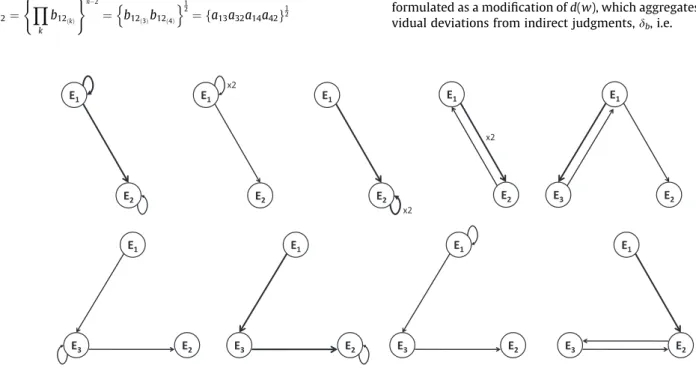
The graph forA1is shown inFig. 3(a). An indirect judgment fora12 can be obtained asb12ð3Þ¼a13a32¼ 3 423¼12orb12ð3Þ¼ 1 a31a23¼ 1 4 332¼ 1 2. The subscript (3) for the index denotes the use ofE3as intermediate element. Similarly, the judgment using E4 is calculated as b12ð4Þ¼a14a42¼
4
3. The use of reciprocal property is obvious in these calculations. The indirect judgmentsb12ð3Þ andb12ð4Þ are highlighted
inFig. 3(b). A complete set of indirect judgments forA1is provided below: b12: b12ð3Þ ¼a13a32¼ 1 2 b12ð4Þ¼a14a42¼ 4 3 b13: b13ð2Þ ¼a12a23¼3b13ð4Þ¼a14a43¼ 8 5 b14: b14ð2Þ ¼a12a24¼6b14ð3Þ¼a13a34¼ 15 8 b23: b23ð1Þ ¼a21a13¼ 3 8 b23ð4Þ¼a24a43¼ 6 5 b24: b24ð1Þ ¼a21a14¼2b24ð3Þ¼a23a34¼ 15 4 b34: b34ð1Þ ¼a31a14¼ 16 3 b34ð2Þ ¼a32a24¼2
The indirect judgments, involving two intermediary elements, can also be calculated as bðij2Þ¼aik1ak1k2ak2j where i, j, k1,
k22{1, 2,. . .,n}. However, unique combinations of i, j, k1 andk2 are only possible forn> 3. The superscript (2) inbð2Þ
ij denotes the
indirect judgment that involves two intermediary elements,Ek1
andEk2). Therefore, b ð2Þ
ij can be termed as second-order indirect
judgments. When viewed as a graph, each indirect judgment is cal-culated with the help of three edges (judgments).
We can further generalize this by estimatingaijthrough indirect
assessments including up to (n2) intermediary elements, i.e., bij;bðij2Þ;b ð3Þ ij ;b ð4Þ ij ;. . .;b ðn2Þ
ij . For example, indirect assessments
including one, two and three intermediary elements are possible forn= 5.
The concept of indirect judgments has been analyzed for the two most widely used methods, i.e., EV and GM.
4.1. EV and indirect judgments
In the EV method preference weights can be estimated using thepower methodby raising the matrixA(PCM) to the powerk, and then normalizing the column sum of the raised matrix (Ak)
(Saaty, 1977).Harker and Vargas (1987)used a graph-theoretic ap-proach to show that the EV method takes into consideration the indirect judgments. Each element,aðkÞ
ij inA
kestimates the overall
intensity ofEioverEjalong paths of lengthk.
Consider a generalized form of PCM withn= 3, as mentioned below:
An3¼ a11 a12 a13 a21 a22 a23 a31 a32 a33 2 6 4 3 7 5
This PCM is represented graphically inFig. 4. Focusing ona12, rais-ingAn3to the powerk= 2 will give the following result forað122Þ:
að122Þ¼a11a12þa12a22þa13a32
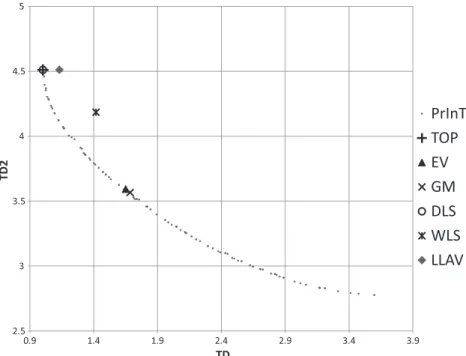
This shows the involvement of three indirect judgments aggregated together. When viewed as a graph, the three indirect judgments correspond to the three paths from E1 to E2, as shown in Fig. 5. Two of the three paths carry self-comparisons, i.e.,a11anda22. Sim-ilarly fork¼3; að123Þcan be calculated as:
að3Þ 12 ¼a12a211þa 2 12a21þa12a13a31þa22a11a12þa222a12þa22a13a32 þa32a11a13þa32a12a23þa32a13a33
Fig. 6shows the paths of lengthk= 3 fromE1toE2. There exist nine such paths, of which most have redundant edges including either self-comparisons or reciprocal judgments, or both. As there are no
indirect judgments of higher order possible for n= 3, raising the matrix to the powerk= 3 provides no additional information. The paths generated forkPnwill always include redundant links that revisit already traversed nodes.
Harker and Vargas (1987)suggested that increasingk reveals more and more of the interactions between alternatives. However, this intuitive justification (‘‘paths of lengthk’’) includes com-parisons. Considering the reciprocal property of judgments, self-comparisons appear redundant in estimating preferences and their inclusion in paths has not been justified.
4.2. GM and indirect judgments
Comprehensive work relating GM to indirect judgments is found in (Brugha, 2000). Brugha advocated that the GM approach synthesizes every direct judgment with the set of respective indi-rect judgments. Brugha explained the aggregation of judgments using GM as wij¼ f½aij2QkbijðkÞg
1
n where i, j, k2{1, 2,. . .,n} and
i–j–k–i. wij is the ratio between the estimated weights wi
andwj, forEiandEjrespectively.
Fig. 2.AverageNV(w) vsL.
Brugha further claimed that this result can be extended to two or more intermediary variables, apparently resulting in a more complicated formula.
In contrast, it is demonstrated here that indirect paths of higher order may be suppressed when geometrically aggregated and are finally reduced to the aggregation ofbij. We show this phenomenon
of suppression forn= 4. Focusing on the judgment a12, the two indirect judgments areb12ð4Þ¼a14a42 andb12ð3Þ¼a13a32. The
geo-metric aggregation ofb12is formulated as:
~ b12¼ Y k b12ðkÞ ( )1 n2 ¼ b12ð3Þb12ð4Þ n o1 2 ¼fa13a32a14a42g 1 2
Next, the geometric aggregation of second-order indirect judgments can be formulated as:
~ bð2Þ 12 ¼ Y k1;k22f1;2;...;ng aik1ak1k2ak2j !1 q ð5Þ
wherei,j,k1,k2are all unique andqis the total number of second-order indirect paths available.
In the case ofn= 4, the value ofqis equal to 2 and the indirect judgments of second-order are bð2Þ
12ð3;4Þ ¼a13a34a42 and b
ð2Þ 12ð4;3Þ ¼
a14a43a32. The geometric aggregation of these judgments is given below: ~ bð2Þ 12 ¼ Y k1;k2 bð122Þðk1;k2Þ ( )1 2 ¼fa13a34a42a14a43a32g 1 2 ¼ a13a34a42a14 1 a34 a32 1 2 ¼fa13a42a14a32g 1 2¼~b 12
The aggregation of second-order judgments has finally reduced to the aggregation ofb12. The same proof can be repeated for all the remaining elements in a PCM withn= 4. Provided that the recipro-cal property is strictly adhered to, geometric aggregation reduces all the paths of higher orders tobij(first-order indirect judgments).
4.3. Critique
Considering the optimization-based prioritization, indirect judgments are not explicitly considered by any existing method. Furthermore, no method exists that simultaneously minimizes deviations from both direct and indirect judgments. In order to estimate preferences, it is sensible to consider both the acquired judgments and the other judgments latent in the DM’s mind. Hence, a technique is developed here to minimize the deviations from both types of judgments.
5. Prioritization using indirect judgments
In order to estimate preferences, it is proposed to minimize the deviations from indirect judgments along with the direct ones, simultaneously. The total deviation for indirect judgments can be formulated as a modification ofd(w), which aggregates all the indi-vidual deviations from indirect judgments,db, i.e.
Fig. 4.Direct judgments.
Fig. 5.Three paths of length 2 fromE1toE2.
dbðwÞ ¼X n i¼1 Xn j¼1 Xn k¼1 dbðbijðkÞ;wÞ ð6Þ wherei–j–k–i.
The individual deviations can be calculated as dðbDLSÞðwÞ ¼ bijðkÞ
wi
wj
2
.dbcan also be calculated using any other
suitable distance function, for exampledðbWLSÞðwÞ ¼ ðwjaikakjwiÞ2
based on WLS ordðbLLAVÞðwÞ ¼ jlogaikakjlogwiþlogwjjbased on
LLAV.
The optimization problem of prioritization using indirect judg-ments can be formulated as:
Minimize dAOFðwÞ ¼ ð1
a
ÞdðwÞ þa
dbðwÞs:t: X
i
wi¼1; wi>0; i2 f1;2;. . .;ng
where 06
a
61.a
gives the DM the flexibility to set the importance of his/her di-rect and indidi-rect judgments. Whena
= 0, the aggregate objective functiondAOF(w) is reduced to the objective functiond(w).The results of the Monte-Carlo experiments suggested the inclusion of priority violations,NV(w), as the third objective along with the direct and indirect deviations. In order to includeNV(w), the optimization problem can be redefined as:
Minimize dAOF2ðwÞ ¼ ð1bÞðð1
a
ÞdðwÞ þa
dbðwÞÞ þbNVðwÞs:t: X
i
wi¼1; wi>0; i2 f1;2;. . .;ng
where 06
a
61 and 06b61.The inclusion of b gives the DM flexibility to give different importance to TD and NV respectively, as suggested in (Mikhailov, 2006). The importance of the three objectives can be controlled using
a
andb. Whena
= 0 andd=dDLS, the proposed methodbe-comes identical to TOP and, when both
a
= 0 andb= 0, the objec-tive is reduced tod(w) suggesting single-objective optimization.The two objective functions,dAOF(w) andNV(w) have different
measurement scales and the aggregation needs to be justified. A possible solution is to normalize the two objectives before aggre-gation; however, this needs to be justified by further investigation. 5.1. Applying multi-objective optimization
Another approach to solve this optimization problem is to use multi-objective optimization that generates all possible non-dom-inated solutions. A non-domnon-dom-inated solution is a solution that can-not be declared inferior to any other solution. In such case, aggregated objective functions are no longer required that require a justification to aggregated(w) andNV(w) having different mea-surement scales.
This technique of prioritization using indirect judgments (PrInT) can be formulated as:
Minimize ½dðwÞ; dbðwÞ; NVðwÞT
s:t: X
i
wi¼1; wi>0; i2 f1;2;. . .;ng
The generated priority vectors using PrInT are then provided to the DM to select one according to his/her requirements. This approach gives greater flexibility to the DM; however, it also demands more computation time considering the generation of all non-dominated solutions.Mikhailov and Knowles (2010)proposed the use of evolu-tionary algorithms (PESA-II for the TOP method) to generate all non-dominated solutions. Evolutionary methods are considered superior to non-convex objective functions as they do not get trapped in local optima. Here, we also suggest using an evolutionary approach to find all optimal solutions, considering the two objec-tivesd(w) anddb(w).
In the next section, we investigate the possible benefits of the proposed technique and compare it to existing methods.
6. Illustrative examples
To illustrate the use of the proposed technique involving indi-rect judgments, we consider four examples of PCM. The weights for each PCM are first estimated using the EV, GM, DLS, WLS, LLAV and TOP methods. The Pareto-optimal front is then generated using PrInT with a fixed population of 100 non-dominated solu-tions. To compare the weights generated by the different methods, we calculate TD, NV and the deviation from second-order indirect judgments, termed TD2 hereafter.
To begin with, consider an example of a consistent PCM given below: A1¼ 1 2 4 12 1 2 1 2 6 1 4 1 2 1 3 1 12 1 6 1 3 1 2 6 6 6 4 3 7 7 7 5
A1is a set of fully consistent judgments and is included to demon-strate correctness of the proposed algorithm in the error-free case. The set of all indirect judgments calculated forA1are congruent (identical) to the direct judgments. Therefore, all the prioritization methods generate the same weights, i.e., w¼½0:545 0:273 0:1360:045.
Next, consider an example of slightly inconsistent but transitive judgments: A2¼ 1 21 2 4 912 2 5 1 3 612 1 4 1 3 1 5 2 19 2 13 1 5 1 2 6 6 6 4 3 7 7 7 5
The judgments inA2are inconsistent and, therefore, the indirect judgments are incongruent to the direct ones. Although different, the order ofpreference dominanceremains the same, as there is no judgment that suggests preference reversal. CR for A2is equal to 0.045 that suggests the PCM is acceptable in AHP terms. The results given inTable 1showNV= 0 for all the methods as expected.
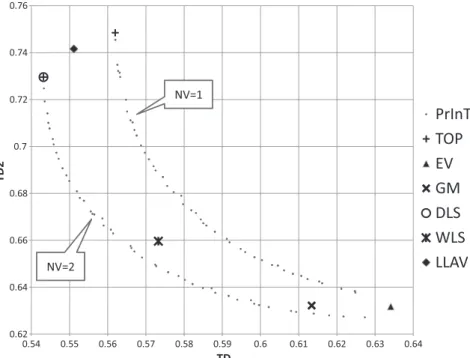
The results are now compared in the objective space, i.e., TD vs TD2.Fig. 7shows a complete set of Pareto-optimal solutions pro-duced by PrInT, where the DLS solution can be seen as one extreme of the optimal front. Interestingly, both the EV and GM solutions appear non-dominated. The LLAV and WLS methods appear domi-nated by other solutions. As there are no priority violations, TOP generates a single solution, which is the same as the DLS solution. Considering the third example, taken from (Hartvigsen, 2005):
A3¼ 1 3 2 6 1 3 1 1 1 5 2 1 2 5 6 1 3 1 6 1 2 1 3 1 2 6 6 6 4 3 7 7 7 5 Table 1
Weight vectors,westimated forA2.
Method w1 w2 w3 w4 TD TD2 NV EV 0.5328 0.2872 0.1390 0.0410 1.650 3.593 0 GM 0.5350 0.2864 0.1377 0.0409 1.685 3.567 0 DLS 0.4742 0.3134 0.1648 0.0475 1.002 4.510 0 WLS 0.5613 0.2616 0.1280 0.0490 1.417 4.184 0 LLAV 0.4966 0.3287 0.1241 0.0505 1.131 4.511 0
Hartvigsen (2005)pointed out that this set of comparisons is tran-sitive, but no method produces an ideal ranking. The value of CR= 0.0161 confirms that A3 is an acceptable set of judgments, however, considering the indirect judgments, a potential violation is noted betweenE2andE3. The direct judgment fora23is 1.2, how-ever, the two indirect judgments suggest 0.66, causing preference reversal while estimating weights.
The generated solutions are given inTable 2. The solutions for DLS, WLS, EV and GM generate one priority violation, despite lying on the Pareto-optimal front in the TD-TD2 objective plane (see
Fig. 8). TOP produces one additional solution (apart from DLS) min-imizing NV to zero. In contrast, the Pareto-optimal front contains 17 solutions with zero violations, which were generated by PrInT. These solutions are plotted inFig. 8.
A4has intransitive judgments, thus anideal rankingis impossi-ble for this PCM:
A4¼ 1 3 2 5 2 3 4 2 3 1 3 2 3 4 2 5 2 3 1 7 4 4 3 4 3 4 7 1 2 6 6 6 4 3 7 7 7 5
Considering this intransitive set of comparisons, there are two three-way cycles present in it, i.e., E1?E3?E4?E1 and
E2?E3?E4?E2. The results given in Table 3 show that the minimum possible value for NV is 1, obtained by TOP. WLS pro-duces most violations (i.e., NV = 3), whilst all other methods give two priority violations (i.e., NV = 2).
An interesting outcome of having two Pareto-optimal curves is visible inFig. 9; each being related to a different value of NV. The optimal front with NV = 2 shows 51 non-dominated solutions. The other set related to NV = 1 has 49 non-dominated solutions that also include a TOP solution. In the presence of intransitivity, the WLS, LLAV, EV and GM solutions are dominated by those obtained by TOP and PrInT.
From the results discussed above, it is evident that the new ap-proach clearly offers the DM a wide range of non-dominated solu-tions, giving him/her the flexibility to select one according to his/ her requirements. This approach outperforms all other methods for intransitive PCM, giving solutions with minimum violations, which are as close as possible to the direct and indirect judgments.
7. Practical limitations
The PrInT method generates several non-dominated solutions. The approach is mathematically and computationally more com-plex than other methods such as GM and EV. This may lead to information overload causing a DM to neither wish nor be able to select from many solutions. Hence, it might not be a practically viable approach to use PrInT for every PCM in the AHP hierarchy. In such cases, PrInT is recommended for the analysis of only those PCMs that the DMs find more difficult to handle. Automated selec-tion of a preferred soluselec-tion from within a set of non-dominated solutions is an area for further work, as discussed below.
7.1. Extracting single solution from PrInT
Considering the minimum number of violations, the TOP meth-od prmeth-oduces a single solution. We emphasize here that although TOP gives a single solution with a minimum number of violations, the weights produced to minimize violations are not well dis-persed. This can be explained with the following example: Fig. 7.Estimated weights forA2in objective space.
Table 2
Weight vectors,westimated forJ3.
Method w1 w2 w3 w4 TD TD2 NV EV 0.5017 0.1961 0.2185 0.0836 0.327 0.685 1 GM 0.5039 0.1945 0.2175 0.0839 0.324 0.685 1 DLS 0.5015 0.1716 0.2435 0.0833 0.210 0.813 1 WLS 0.5054 0.1795 0.2314 0.0836 0.233 0.754 1 LLAV 0.4999 0.1667 0.2499 0.0833 0.218 0.850 1 TOP 0.5045 0.2059 0.2059 0.0836 0.418 0.652 0 TOP 0.5015 0.1716 0.2435 0.0833 0.210 0.813 1 PrInT 0.5038 0.1798 0.2331 0.0833 0.431 0.649 0 PrInT 0.5024 0.1962 0.2184 0.0830 0.469 0.643 0 PrInT 0.5055 0.1876 0.2233 0.0836 0.498 0.640 0 PrInT 0.5094 0.2003 0.2062 0.0841 0.518 0.639 0
A¼ 1 1:9 1:1 0:53 1 1:2 0:91 0:83 1 2 6 4 3 7 5
The preference vectors generated by EV, GM, TOP and PrInT are listed inTable 4. The DLS/TOP solution inTable 4shows that the minimum value of TD possible for this PCM is 0.211. Although the PCM is transitive, the solution for DLS/TOP generates a violation, i.e.,w2<w3 whereasa23> 1 . The EV and GM solutions have also generated the same violation. Other solutions generated by TOP and PrInT confirm that an ideal ranking is possible giving zero violation.
Consider the second solution generated by the TOP method (which is also generated by PrInT): in this case, the value ofw2 should remain greater thanw3 in order to keep NV= 0. As, the TOP method suggests minimizing TD whilst keepingNV= 0, the va-lue ofw2in turn needs to be increased, leading to a solution with w2’w3. Further increasing the value of w2will result in higher values for TD. Hence, the solution withw2’w3gives an equilib-rium state for minimizing TD withNV= 0.
PrInT, in comparison to TOP, has the further objective that TD2 be minimized simultaneously.Table 4shows that PrInT has gener-ated several solutions wherew2andw3do not have similar values. PrInT-7 has been highlighted to show the dispersion of weights for this solution. The ratio betweenw1andw2is 1.86 which is close to the given judgmenta12= 1.9. Similarly, the value ofww2
3¼1:21
com-fortably approximates the value ofa23= 1.2. The judgmenta13= 1.1
has not been satisfied w1
w3¼2:25
, however, the order of prefer-ence has been maintained. We suggest this solution as the most appropriate generated by PrInT based on the dispersion of gener-ated weights.
As an example,Elsner and van den Driessche (2010) demon-strated the use of PCM in music theory where frequencies can be attached to the keys of an instrument (e.g., piano) with the help of ratio comparisons. We consider this an interesting example to justify dispersion of generated weights, as assignment of the same frequency to two different keys is infeasible. A feasible approach would be to assign the frequencies to be as different as possible.
8. Summary and discussion
The problem of obtaining preferences from PCM has been ex-plored by considering indirect judgments. The effect of intransitive judgments on the number of priority violations has been investi-gated. The question of whether two half-violations should be con-sidered equal to a full violation needs to be further investigated. The results, calculated from thousands of random PCMs generated using Monte-Carlo simulation, confirm a relationship between the cyclic judgments and the average minimum number of violations. The results of the experiments suggested minimizing NV(w) along with the total deviation. However, the two objectives have different measurement scales and hence aggregation needs to be justified.
Consequently, a new method based on multi-objective optimi-zation has been proposed to minimize deviation from both direct and indirect judgments, along with priority violations. The ap-proach offers multiple non-dominated solutions and the DM has a choice to select one of them, according to his/her requirements. This approach outperforms all other methods for intransitive PCMs, giving solutions with minimum violations, whilst remaining as close as possible to the direct and indirect judgments.
Due to its computational complexity, PrInT is recommended for analyzing only those problems that the DMs may find difficult to handle. Alternatively, a single solution from within the set of non-dominated solutions may possibly be selected based on the Fig. 8.Estimated weights forJ3in objective space.
Table 3
Weight vectors,westimated forJ4.
Method w1 w2 w3 w4 TD TD2 NV EV 0.3166 0.2174 0.2144 0.2515 0.634 0.632 2 GM 0.3193 0.2294 0.2038 0.2475 0.613 0.632 2 DLS 0.3631 0.2283 0.1623 0.2463 0.543 0.729 2 WLS 0.3346 0.2424 0.1834 0.2395 0.573 0.659 3 LLAV 0.3333 0.2222 0.1481 0.2962 0.551 0.742 2 TOP 0.3175 0.2211 0.1438 0.3175 0.562 0.748 1 TOP 0.3631 0.2283 0.1623 0.2463 0.543 0.729 2
dispersion of generated weights. Automated selection of a pre-ferred solution is an area for further work.
References
Ali, I., Cook, W., Kress, M., 1986. On the minimum violations ranking of a tournament. Management Science 32 (6), 660–672.
Bozóki, S., Fünlöp, J., Poesz, A., 2011. On pairwise comparison matrices that can be made consistent by the modification of a few elements. Central European Journal of Operations Research 19, 157–175.
Brugha, C., 2000. Relative measurement and the power function. European Journal of Operational Research 121 (3), 627–640.
Budescu, D., Zwick, R., Rapoport, A., 1986. A comparison of the eigenvalue method and the geometric mean procedure for ratio scaling. Applied Psychological Measurement 10 (1), 69–78.
Busse, L., Buhmann, J., 2011. Model-based clustering of inhomogeneous paired comparison data. In: Pelillo, M., Hancock, E. (Ed.), Similarity-Based Pattern Recognition, vol. 7005 of Lecture Notes in Computer Science, pp. 207–221. Carmone Jr., F.J., Kara, A., Zanakis, S.H., 1997. A monte carlo investigation of
incomplete pairwise comparison matrices in ahp. European Journal of Operational Research 102 (3), 538–553.
Carrizosa, E., Messine, F., 2007. An exact global optimization method for deriving weights from pairwise comparison matrices. Journal of Global Optimization 38, 237–247.
Choo, E., Wedley, W., 2004. A common framework for deriving preference values from pairwise comparison matrices. Computers & Operations Research 31 (6), 893–908.
Chu, A., Kalaba, R., Spingarn, K., 1979. A comparison of two methods for determining the weights of belonging to fuzzy sets. Journal of Optimization Theory and Applications 27 (4), 531–538.
Cook, W., Kress, M., 1988. Deriving weights from pairwise comparison ratio matrices: An axiomatic approach. European Journal of Operational Research 37 (3), 355–362.
Crawford, G.B., 1987. The geometric mean procedure for estimating the scale of a judgement matrix. Mathematical Modelling 9 (3-5), 327–334.
Durillo, J.J., Nebro, A.J., Luna, F., Dorronsoro, B., Alba, E., 2006. jMetal: A Java Framework for Developing Multi-Objective Optimization Metaheuristics. Technical Report ITI-2006-10, Departamento de Lenguajes y Ciencias de la Computación, University of Málaga, E.T.S.I. Informática, Campus de Teatinos. Elsner, L., van den Driessche, P., 2010. Max-algebra and pairwise comparison
matrices, ii. Linear Algebra and its Applications 432(4), 927–935.
Ergu, D., Kou, G., Peng, Y., Shi, Y., 2011. A simple method to improve the consistency ratio of the pair-wise comparison matrix in anp. European Journal of Operational Research 213 (1), 246–259.
Figueira, J.R., Greco, S., Roy, B., Slowinski, R., 2010. Electre methods: Main features and recent developments. In: Zopounidis, C., Pardalos, P.M., Pardalos, P.M., Hearn, D. (Eds.), Handbook of Multicriteria Analysis, Applied Optimization, Vol. 103. Springer, Berlin Heidelberg, pp. 51–89.
Golany, B., Kress, M., 1993. A multicriteria evaluation of methods for obtaining weights from ratio-scale matrices. European Journal of Operational Research 69 (2), 210–220.
Greco, S., Matarazzo, B., Slowinski, R., 2010. Dominance-based rough set approach to preference learning from pairwise comparisons in case of decision under uncertainty. In: Hnllermeier, E., Kruse, R., Hoffmann, F. (Eds.), Computational Intelligence for Knowledge-Based Systems Design, Lecture Notes in Computer Science, Vol. 6178. Springer, Berlin/ Heidelberg, pp. 584–594.
Fig. 9.Estimated weights forJ4in objective space.
Table 4
Harker, P., Vargas, L., 1987. The theory of ratio scale estimation: Saaty’s analytic hierarchy process. Management Science 33 (11), 1383–1403.
Hartvigsen, D., 2005. Representing the strengths and directions of pairwise comparisons. European Journal of Operational Research 163 (2), 357–369. Herman, M., Koczkodaj, W., 1996. A monte carlo study of pairwise comparison.
Information Processing Letters 57 (1), 25–29.
Ishizaka, A., Balkenborg, D., Kaplan, T., 2010. Influence of aggregation and measurement scale on ranking a compromise alternative in ahp. Journal of the Operational Research Society, 1–11.
Ittersum, K.V., Pennings, J.M., Wansink, B., van Trijp, H.C., 2007. The validity of attribute-importance measurement: A review. Journal of Business Research 60 (11), 1177–1190.
Kendall, M., Smith, B., 1940. On the method of paired comparisons. Biometrika 31 (3/4), 324–345.
Krantz, D.H., 1972. Measurement structures and psychological laws. Science 175 (4029), 1427–1435.
Lin, C., 2007. A revised framework for deriving preference values from pairwise comparison matrices. European Journal of Operational Research 176 (2), 1145– 1150.
Mikhailov, L., 2006. Multiobjective prioritisation in the analytic hierarchy process using evolutionary computing. In: Tiwari, A., Knowles, J., Avineri, E., Dahal, K., Roy, R. (Eds.), Applications of Soft Computing: Recent Trends. Springer, pp. 123– 132.
Mikhailov, L., Knowles, J., 2010. Priority elicitation in the ahp by a pareto envelope-based selection algorithm. Multiple Criteria Decision Making for Sustainable Energy and Transportation Systems, Vol. 36. Springer, pp 249–257.
Noghin, V.D., 1997. Relative importance of criteria: a quantitative approach. Journal of Multi-Criteria Decision Analysis 6 (6), 355–363.
Rachmawati, L., Srinivasan, D., 2010. Incorporating the notion of relative importance of objectives in evolutionary multiobjective optimization. Evolutionary Computation, IEEE Transactions on 14 (4), 530–546.
Saaty, T., 1980. The Analytic Hierarchy Process, Planning, Piority Setting, Resource Allocation. McGraw-Hill, New York.
Saaty, T.L., 1977. A scaling method for priorities in hierarchical structures. Journal of Mathematical Psychology 15 (3), 234–281.
Sanchez, P.P., Soyer, R., 1998. Information concepts and pairwise comparison matrices. Information Processing Letters 68 (4), 185–188.
Siraj, S., Mikhailov, L., Keane, J., 2012. A heuristic method to rectify intransitive judgments in pairwise comparison matrices. European Journal of Operational Research 216 (2), 420–428.
Siskos, Y., Grigoroudis, E., Matsatsinis, N., 2005. Uta methods. In: Multiple Criteria Decision Analysis: State of the Art Surveys. International Series in Operations Research & Management Science. Springer, New York, pp. 297–334. Srdjevic, B., 2005. Combining different prioritization methods in the analytic
hierarchy process synthesis. Computers & Operations Research 32 (7), 1897– 1919.