1
Software Project Initiation and Planning - An Empirical Study
D. Greer1 and R. Conradi2 1
School of Electronics, Electrical Engineering and Computer Science, Queens University Belfast, UK.
Email: [email protected] 2
Department of Computer and Information Science,
Norwegian University of Science and Technology, Norway. Email: [email protected]
Abstract
This paper describes a study of 14 software companies, on how they initiate and pre-plan software projects. The aim was to obtain an indication of the range of planning activities carried out. The study, using a convenience sample, was carried out using structured interviews, with questions about early software project planning activities. The study offers evidence that an iterative and incremental development process presents extra difficulties in the case of fixed-contract projects. We also found evidence that feasibility studies were common, but generally informal in nature. Documentation of the planning process, especially for project scoping, was variable. For Incremental and Iterative Development projects, an upfront decision on software architecture was shown to be preferred over allowing the architecture to just „emerge‟. There is also evidence that risk management is recognised but often performed incompletely. Finally appropriate future research arising from the study is described.
1.0 Introduction
The necessity of planning software projects has been documented and supported for many years. However, the amount and nature of planning is often debated [11]. For example, agile methods and more heavyweight software processes both recommend planning, but disagree on the purpose of it. Extreme Programming emphasises the need for planning, particularly as a way to prioritise effort, facilitate coordination and to help deal with the unexpected [7]. Companies implementing a Capability Maturity Model Integration (CMMI) approach, on the other hand,
2 emphasise the role of thorough planning in the software process for improving predictability and to measure process improvement [2].
Given such diverse advice, what do companies actually do? Without some baseline knowledge, it is difficult to assess what improvements need to be made, if any, and what future research is required. Thus, we are seeking to answer the general research question: “How do software development companies conceive and initially plan software projects?” In seeking to answer this, we describe a study carried out with 14 established Norwegian software companies. In what follows, we will discuss the main activities that we have associated with „early‟ project planning, based on existing knowledge. Section 3 will describe the research method employed. Section 4 will discuss the results from the research, while Section 5 will discuss the findings in relation to existing work, alongside some suggested research for the future. In the final section we will provide some conclusions to the work.
2.0 Background
What constitutes „early planning‟ of software projects is open to discussion. The IEEE Standard Glossary of Software Engineering Terminology [21] describes a concept phase and this is elaborated on in the more recent Software Engineering Body of Knowledge (SWEBOK) [20]. SWEBOK includes „Initiation and Scope Definition‟ and „Software Project Planning‟ under the „Software Engineering Management‟ topic. SWEBOK is not an international standard, but it is backed by the IEEE and the ACM [20]. It has also been used as the basis for curriculum development for software engineering at undergraduate and graduate levels [3]. Hence, in the absence of a universally accepted definition of a body of knowledge, SWEBOK is a satisfactory starting point, alongside established Software Engineering textbooks [37] [41]. In the SWEBOK guide „Initiation and Scope Definition‟ is broken down into:
a) Determination and Negotiation of Requirements; b) Feasibility Analysis;
c) Process for the Review and Revision of Requirements. „Software Project Planning‟ consists of:
a) Process Planning; b) Determine Deliverables;
3 c) Effort, Schedule and Cost Estimation;
d) Resource Allocation; e) Risk Management; f) Quality Management; g) Plan Management.
To make the study more manageable, we have limited it to items a) and b) from „Initiation and Scope Definition‟ and items a), b), c) and f) from „Software Project Planning‟. The selected items relate strongly with the decision process on whether or not to proceed with a project. Those omitted could be argued to be more relevant after the project has been committed to.
Traditional approaches, as recommended in Systems Analysis textbooks, include a feasibility stage [45]. However, these approaches imply a waterfall model and stable requirements being obtained upfront. Feasibility studies also form part of methodologies taking an iterative approach. The Dynamic Systems Development Method (DSDM) [15] describes a feasibility study; the Unified Process (UP) [24] describes an „Inception‟ phase; and Extreme Programming planning includes the collection of „user stories‟ along with initial estimates for effort and value which are then used for release planning. Clearly, the extent and nature of planning is influenced by the choice of software process, and there is not a general agreement of how much planning should be done at the project initiation stages.
2.1 Initiation and Scope Definition Activities
The initiation of a project involves determining its requirements to some degree of detail, outlining candidate solution approaches and an assessment of whether or not to proceed with the project.
Determination and Negotiation of Requirements
Having stable and explicit user requirements makes the planning process a lot simpler, since the information is certain. However, it is more likely that the knowledge of the future process and product requirements is to a substantial degree uncertain. For example, the determination of initial requirements is often influenced by market investigations. An analysis of what is already available is relevant to the feasibility of the project. Market analysis may also inform the requirements negotiation process. Linked to this is some evaluation of the solution space and a
4 consideration of what is possible. Indeed, numerous candidate solutions may be considered and these are fed forward to the feasibility analysis.
Given this complicated planning scenario, the software process cannot simply be the process of „capturing‟ fixed requirements that are waiting to be „found‟ and then developing an unproblematic and stable implementation. Rather, it is a creative process where new ideas are generated, existing ideas combined and often tradeoffs made between the requirements and designs [27]. In such cases, stakeholder collaboration, requirements negotiation and re-negotiation become a reality. Determination and (re)re-negotiation of requirements, so as to enable the setting of the scope of the project, is therefore necessary at an early stage.
Feasibility Study
Traditionally, in systems analysis, a „Feasibility Study‟ has been recommended with the principal aim of determining if the project is viable and also to get some preliminary planning data [28]. More precisely, the Feasibility Study usually refers to an assessment of the product/project against technical, operational, financial and social/political criteria [37]. Such a phase allows the early cancellation of projects with minimal cost or, if the project proceeds, assists in the estimation of funding required and further planning. Despite this recognition of the importance of a feasibility study, the topic does not receive much attention in popular software engineering texts. It is only briefly referred to by Sommerville in [41], where software project planning is covered, but mostly related to later stages in the project after requirements have been more fully documented. Pressman [37] gives it more attention and points to the first activity in software project planning being to determine the software scope. That text identifies the difficulty of determining the scope of a software project without knowing the requirements or having a good perception of the possible solution space. Putman and Myers [38] state that, once the scope is determined, it is essential to estimate the cost of the proposed developments (or candidate solutions), and therefore the feasibility.
2.2 Software Project Planning
We are primarily interested in early project planning in this study. The SWEBOK defined activities under „Software Project Planning‟ assume that the project has already been commenced. Nonetheless, it is fair to assume that before committing to a project some consideration would be given to process planning, determining the deliverables, and risk
5 management. All of these factors could be argued as having a large impact to an accurate feasibility study. For this reason, these activities were included in the study.
Process Planning
Given the scope of a project and some initial requirements, the software process to be used must be decided upon as well as choice of relevant development methods and tools [37]. This could amount to choosing between a finite set of well-defined software process models [20]. Indeed, how to choose between software process models has been a long standing problem. Further, there is empirical evidence to show that there is a non-conformance between defined software process models and enacted software processes [39].
The need for a defined process has long been recognised as a risk reducing strategy for software engineering management [34], and the need for tailoring to suit individual projects increasingly recognised [5][8]. Nonetheless, guidance and methods for tailoring software processes are not well established, with only some recent specific examples [19][44]. Whether or not such methods are useful, or even used in the real world, has not been fully reported. Tailoring of agile methods has received some attention in Taylor et al. [43].
2.3Determining Deliverables
Determining deliverables is not just about implementing each functional requirement, but may also include some upfront infrastructure design [37]. Equally, there may be opportunities for reuse of existing in-house software, use of commercial-off-the-shelf (COTS) software components or acquiring open source software (OSS) components. The decision on this will obviously impact the initial planning of the software project, especially the cost and effort required. Because there are so many dependencies on its outcome, software architecture planning is considered by many an essential upfront activity [6]. In waterfall approaches, there is more incentive for architecture planning at an early stage, since the pressure of an early functioning release is not present. In iterative software processes, the extent of commitment to an upfront architecture may be as little as choosing a metaphor to follow in the development process [7]. Other advice includes planning a short iteration just to develop enough of the architecture to allow the team to understand the planned system sufficiently [36], or to allow architecture to emerge, but with a higher ratio of architecture to feature development in the early iterations [13]. Nonetheless, empirical studies have given evidence of a link between requirements-oriented
6 problems later and the quality of architecture planning at the start [16]. There is also evidence that the decision on architecture is largely made informally [42].
Another aspect of determining the deliverables is to consider the architectural composition of the developed software. This is essential, since it greatly influences the cost, and therefore the outcome of the feasibility study and the decision on whether and how to proceed. The options for reuse include existing in-house built software components or off-the-shelf software components either commercially available or free/ open source [20].
Release planning is the decision process for determining when a functioning software product should be delivered to the customer and with what functionality. Therefore, it may also be an activity of the early planning efforts. For waterfall approaches there is notionally only one external planned release, but functionality may still be deferred to a later evolved version. For iterative and incremental development, it typically refers to the creation of a high-level plan for releases in the future [18].
2.4 Risk Management
Software development risk is the possibility of failure in the software development process, or more precisely the product of the probability of a risk event occurring and its associated loss [9]. Risk Management covers the activities necessary to analyse and control risk. Boehm [9] has defined risk management in six stages: Identification, Assessment, Prioritisation, Management Planning, Resolution and Monitoring. When deciding upon a software project, risks are highly relevant since, by definition, they may negatively impact upon the development cost and therefore threaten the validity of any cost-benefit analysis carried out. Such an approach is recognised in the growing area software economics [12]. Considering risk as a possible cost, and therefore having impact on investment decisions, has received more recent attention [14].
3.0 Research Approach
The research is mainly qualitative in nature. This is justified by the advantages of that approach in complex studies, where richer results are obtained than a necessarily more narrow quantitative study [40]. The instrument of the study is a structured interview [40] which allows better comparison between interviewee responses, than semi structured interviews, where questions are
7 left completely open ended. The approach used can be described as a survey, according to the guide to surveys from Pfleeger and Kitchenham [35].
Since the study was exploratory in nature, convenience sampling was used. Convenience sampling is adjudged to be appropriate where an inexpensive study is planned and in order to get fast and approximate results. The population consisted of 31 successful Norwegian software companies, where there had been previous contact with the authors or their associates in previous research studies. This was pre-filtered to exclude small companies or recent start ups and included only well-established companies, with at least 5 software development employees (the lower limit was in fact 14). This avoided the issue of dormant companies, single person consultancies, or those with very low levels of software development. Of the 31 companies invited by email to participate, 14 (45%) responded positively to the invitation.
The interview was designed so as to last about thirty minutes and was aimed at new software development projects, rather than software maintenance and evolution. The interview was conducted by a single researcher and notes of all responses were recorded on a form, as the interview proceeded. In each case the respondents were asked to give their company‟s general approach to projects. Interviewees were sent a copy of the questions in advance, so that they could prepare their responses. During the conduct of the interview, the interviewee‟s responses were summarised as feedback to the respondent by the interviewer, to help ensure the internal validity of the research.
3.1 Research Questions
In seeking to answer our general research question of how software developments companies conceive and initially plan software projects, we have composed six research questions. Two particular issues arise from the discussion on „Initiation and Scope determination‟: i) the choice of software process and ii) how feasibility analyses are carried out. We also noted a lack of information on how exactly software projects get commissioned and on how the software process gets selected, based on the origin of the project. In fact, many software engineering methods do not recognise development that may be concerned with creating Commercial-Off-the-Shelf (COTS) products, often without a definite customer to seek requirements from. Evidently, the domain in question will also have an influence, on how projects are conceived. Given the small sample size we cannot hope to produce a valid statistical breakdown of the
8 origins of software projects. What is possible is to establish some of the typical origins, and to find an indication of whether the selection of the software process is related to the type of origin. Our discussion noted existing research into software process tailoring. Hence a research question was formulated to help determine this and also how the feasibility of a project is considered. RQ1: Is there a relationship between the origin and type of a software project and the software process employed and related to that, are software processes tailored to suit the origin and type? RQ2: How are feasibility analyses carried out?
We were also interested in what documents were generated at the planning stages of the project. Included in this was the extent of requirements documentation prior to project enactment.
RQ3: What documents are generated in the early pre-enactment stages of a software project? The remaining research questions relate to two areas of planning that could be carried out early, and indeed many have spoken of the need for early treatment. We have previously noted a lack of documented knowledge in the literature on how software products are planned in terms of deliverables, in particular whether there is a need for software release planning and to what extent (RQ4). Related to this is whether companies feel the need to determine an upfront architecture or to allow it to emerge (RQ5). Finally, risk management has been cited by many as something that should be initiated as early as possible. Whether this is the case in real life is tested by RQ6.
RQ4: What impact does product planning have on process planning?
RQ5: Are architectures of products determined and set at the beginning of a project or do they emerge with the development process?
RQ6: Is Risk Management performed at the early project stages and to what extent?
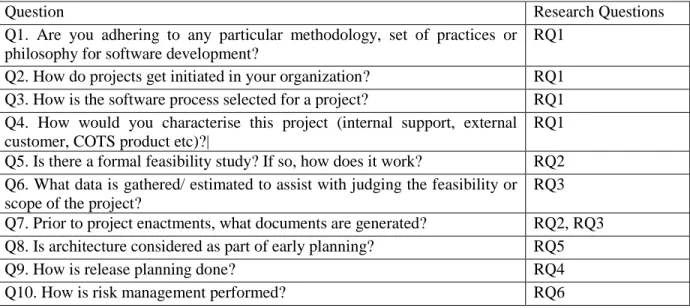
Table 1 shows the research questions and relates them to the structured interview questions that were asked. During the interview, follow up questions were added when needed to ensure that the research question was addressed.
9 Table 1: Interview Questions Related to Research Questions
Question Research Questions
Q1. Are you adhering to any particular methodology, set of practices or philosophy for software development?
RQ1
Q2. How do projects get initiated in your organization? RQ1
Q3. How is the software process selected for a project? RQ1
Q4. How would you characterise this project (internal support, external customer, COTS product etc)?|
RQ1
Q5. Is there a formal feasibility study? If so, how does it work? RQ2
Q6. What data is gathered/ estimated to assist with judging the feasibility or scope of the project?
RQ3
Q7. Prior to project enactments, what documents are generated? RQ2, RQ3
Q8. Is architecture considered as part of early planning? RQ5
Q9. How is release planning done? RQ4
Q10. How is risk management performed? RQ6
3.2 Context
As mentioned, structured interviews ere conducted with project mangers in 14 companies, with number of developers ranging from 14 to several thousand. The majority of the company projects addressed were developing bespoke software (i.e. for a single customer), the remainder developing COTS products (multiple customers). Two of the bespoke projects (C1, C13) were for internal customers (i.e. those in the same company), the other six being for external contracts. Table 2 summarises the context for this study including the software process being used being categorised as either „Waterfall‟ of „Iterative and Incremental Development‟ (IID).
Table 2: Context: Details of Enterprises Investigated
Company Project Internal/ External Customer Process used
C1 Bespoke Product (In-house) Internal IID
C2 Bespoke Product External Waterfall
C3 Bespoke Product External Waterfall
C4 COTS product External IID
C5 Bespoke Product External IID
C6 Bespoke Product External Waterfall
C7 COTS Product External IID
C8 COTS product External Waterfall
C9 Bespoke Product External IID
C10 Bespoke Product External IID
C11 COTS Product External IID
C12 COTS Product External Waterfall
C13 Bespoke Product Internal IID
10 4.0 Research Results
This section will provide a summary of the results from the study and relate them to the research questions being investigated, with further discussion of these following in section 5.
4.1 Software Project Initiation
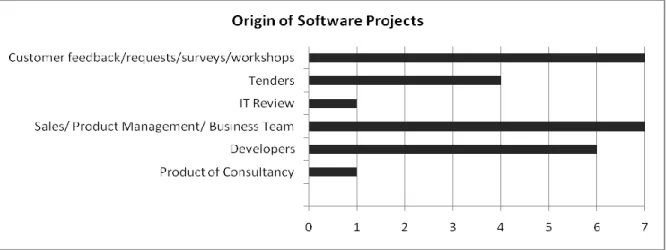
Each respondent in the survey was asked how software projects got initiated in their company. Figure 1 shows a summary of this information. The results show that there are many origins of software projects. The two main origins revealed are where projects arise directly from customer feedback, or indirectly via sales and business teams. Both origins refer to existing software and how it may be improved. The rest mainly relate to new software and includes origins from tenders, IT reviews, from consultancy and from developers themselves.
Figure 1: Breakdown of Origins for Software Projects in the Sample Studied 4.2Software Process Choice and Tailoring (RQ1)
RQ1 asks about the relationship between the origin of a software project and the software process employed. To this end, respondents were asked to specify what software process model they used, if any. The responses can be categorised as those following an Iterative and Incremental Development (IID) process model, and those following a Waterfall process model. All of those employing an IID process claimed to be using an Agile Method, these being Extreme Programming (2), Scrum (7) and Evo (1).
RQ1 asks about the relationship of product type to the software process type. The results show that there were nearly twice as many occurrences of an IID process over waterfall processes. This ratio was in fact mirrored for both COTS and bespoke software, indicating that there is no
11 relationship shown. Of the 5 waterfall model processes, 2 were COTS products and 3 were bespoke development. It would be interesting to analyse the effect of customer type on software process type. In the case of an IT department servicing a company, it might be expected that it is easier to have frequent deliveries of an IID approach. All the waterfall model processes were for external customers, but given that there were only 2 such projects in the study, no significance can be attached to this. It is noteworthy, though, that both the projects with internal customers adopted an IID process model.
A common theme from respondents using an IID process for bespoke development was that IID was difficult, where projects started from a successful tendering process. With tenders, the normal approach is that the requirements are committed to upfront and usually agreed to as part of a contract, along with specific delivery dates. Four of the companies described having been subjected to a tendering process, and three of the four reported difficulties in using an IID approach in such circumstances. Only one stated that they had been successful in convincing the tender issuer that an IID approach could work and had won a bidding process based on this. In fact, that company reported success in negotiating an agile process as part of the tender process. In the other three one adopted an IID process, but only for internal deliveries of software. In that case, as far as customer perception was concerned, the actual process used was a waterfall one. Thus, an internal IID process was used, where increments were developed frequently but not released externally until the end of the project.
In addition to being asked which software process they used in the particular project, respondents were asked if the process was tailored to meet the particular project. Only 4 respondents indicated that this was the case, indicating a preference for a „one size fits all‟ approach to choosing the software process. Interestingly, the 4 who said that they spent time tailoring the process were all employing an IID approach.
Overall our study relating to RQ1 provides evidence for two findings.
Finding F1: Employing an IID software process in projects starting with a tender presents extra difficulties over a waterfall approach.
12 4.3 Project Feasibility (RQ2)
RQ2 asks how companies perform the feasibility study before commencing actual software development. Two thirds of the companies reported having a stage in the process that could be considered a formal feasibility study. That is not to say that one third do not consider feasibility, rather that they do not have a formal stage for this task. However, looking deeper at responses from those investigated, the same one third actually evaluate expected costs as numerical values. Of the 9 companies that claimed a formal feasibility study, all estimated the cost of software development using expert judgement, but only 6 of these quantitatively estimate the expected value of implemented requirements. This apparent discrepancy provides evidence that in many cases cost is the sole driver of economic decision-making in software development and that companies fix the cost and then try to deliver a suitable set of implemented requirements at a suitable level of quality.
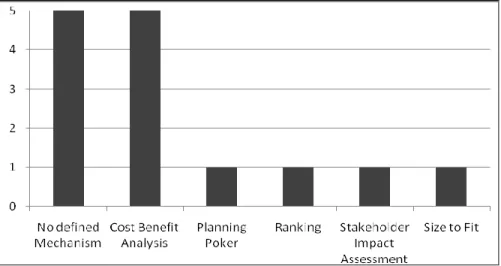
Figure 2: Mechanism for Economic Feasibility Study
The context factors influencing whether or not a feasibility study is carried out were not uncovered by the investigation. The type of software product being either bespoke or product did not seem to influence the outcome; half those using a feasibility study building off-the-shelf products and half supplying bespoke software. Similarly, the software process being employed did not show a conclusive trend, the proportions of those doing a feasibility study being in line with the IID: Waterfall ratio. We might have assumed a feasibility study to be more likely when using the waterfall approach, with its traditionally more heavyweight planning process, but this was not the case here. Indeed of those claiming agile method adherence, 5 out of the 9 agile
13 adoptees performed a feasibility study, and 4 of these used quantitative measures of cost and/or value in doing so.
Looking at all 14 companies (Figure 2), only 5 claimed to use a quantitative cost-benefit analysis approach and, of the remainder who carried out an economic feasibility study, all used a qualitative approach involving comparisons. One respondent, using a quantitative cost-benefit analysis, indicated a consideration of future value of planned developments in the form of a Net Present Value calculation.
With regard to feasibility relating to non-economic issues, technical feasibility was mentioned by many respondents as an important aspect, most commonly in relation to resource availability for completing the development. Other main types of feasibility were not mentioned by any of the respondents as an activity undertaken in early project planning.
The results from RQ2 provide the following indication.
Finding F3: Companies generally conduct a feasibility study before committing to projects, but these tend to be qualitative and informal and include only economic and technical feasibility. For feasibility studies, a follow-up question was asked about how consideration of possible software composition affected the feasibility study. Possible sources of reuse include in-house software, COTS software and OSS. Choosing to employ such components clearly affects the costs and schedule of the developed software, the choice of software architecture, the functionality, and quality. Table 3 shows the results from this question.
All respondents said they planned reuse of in-house software, if possible. OSS and COTS were not universally considered, but still common. The answers to this sub-question revealed no obvious relationship of the type of reuse with the product type or the software process being used. When asked if they considered the effect of reuse on cost estimates, everyone replied positively.
14 Table 3: Feasibility Study and Reuse type considered
Reuse Component Type: In-house COTS OSS C1 Internal Bespoke Incremental
C2 External Bespoke Waterfall C3 External Bespoke Waterfall
C4 External Product Incremental
C5 External Product Incremental
C6 External Bespoke Waterfall
C7 External Product Incremental
C8 External Product Waterfall
C9 External Bespoke Incremental
C10 External Bespoke Incremental
C11 External Product Incremental
C12 External Product Waterfall
C13 Internal Bespoke Incremental
C14 External Product Incremental
4.4 Early Planning Documents (RQ3)
As part of our investigation relating to RQ3, respondents were asked to identify the artefacts created in the early project planning process. The response to this rather depends on what is considered „Early Planning‟. In the preamble to the questionnaire this was specifically defined as being prior to the decision to proceed with the project. This was elaborated as being before detailed requirements were created, before design work and before coding work. The results are summarised in the following list of documents:
Architecture Description;
Blog (web-based log)/Wiki (team-editable web page); Business Case/ Market Analysis;
Contract;
Cost/Budget Analysis Document; Export Assessment;
Make-Buy Analysis; Requirement Specification; Risk Assessment Document; Sample Code;
Schedule Plan; Test Plans; and
15 Of the respondents, 8 stated that they produced at least a partial requirements document, and 3 of those described a full requirements specification. This was despite our contrary definition of early planning. However, these companies were chiefly involved in either responding to tightly defined customer contracts or exacting standards that were imposed on the product. In fact, 2 of these companies specifically mentioned the contract as being a product of early project planning and, presumably, this is tightly linked to the requirements specification. The popularity of user stories relates to the prevalence of the Scrum method in the sample. Only one company stated an architecture description document and this company can be identified as one that includes embedded software, where the architecture of the software is tightly coupled to that of the hardware being used. The remainder of the documents can be associated with project planning. Cost-Benefit analysis documentation is common, but as mentioned in the discussion on economic feasibility in the previous section, it is by no means universally produced.
Finding 4: Most companies produce at least a partial requirements document before taking the decision to proceed or otherwise. Early costs, schedules and budgets are often documented, but other data on decisions taken are often not documented.
4.5 Release Planning (RQ4, RQ5)
Release planning is related to the product but also highly related with the software process used and how the requirements for the product are gathered. This fact was born out in the investigation. In fact, there is a one-to-one mapping from waterfall process to single releases in our results. However, for those using an IID process, 4 still delivered the software to the customer as a single release. In these cases software can be „delivered‟ internally with a single bundled release being given to the customer. Agile methods tend to advocate early feedback from customers but, due to the use of contracts, this is not always convenient. Our results, as shown in Figure 3, indicate that only slightly more IID projects tend to be planned for one release ahead than for two or more. Further, waterfall processes associated with a single release do often include provision for future releases. In other words the evolution after the delivery of the software is often planned at the outset. In that case, the distinction between a waterfall approach and an IID approach is not as clear-cut as might be believed from Software Engineering textbooks.
16 Figure 3: Number of Planned Releases for all Respondents and for IID Process Respondents Even for agile method based projects, 2 of the 9 reported that only 1 release is planned. For Scrum projects, which are generally strong on release planning, the number of releases planned is always 2 or more.
Finding F5: Release planning is a universal activity, not just projects employing an IID process. A related issue is that of planning the architecture of the proposed product. All of the respondents except two stated that the architecture of the product was decided up front, before the rest of the development. This is somewhat different to the often quoted „YAGNI‟ agile principle („You Aren‟t Going to Need It‟), where the implication is that the architecture decision need not be made firmly until later. For the 13 enterprises indicating that architecture was decided up front, 5 of these stated that, nonetheless, later refactoring of the architecture was common.
Finding F6: Companies tend to prefer fixing the software architecture upfront rather than allowing it to emerge. This is true for companies employing a waterfall approach or an IID process, including those using agile methods.
4.6 Risk Management Planning (RQ6)
Project Managers were asked to describe what risk management steps they planned, having been prompted with the 6 risk phases from Boehm [9].
17 Figure 4: Number of companies performing each Risk Management Activity
As shown in Figure 4, the majority of companies consider risk identification important. Smaller amounts go on to actually assess those risks. A follow-up question revealed that 4 of the companies assigned probabilities and impact assessments to risks, meaning that assigning actual numbers is the primary approach in this sample. It is not really surprising that having assessed the risks, those same companies go about planning for how to monitor those risks, usually at regular project meetings. What is surprising is the lack of active planning about what should be done if a risk occurs, with less than half of the respondents indicating that they planned for this. Anecdotally, several companies mentioned the implicit nature of their risk management, being that of employing a good software process. One company, with safety-critical applications, did employ extensive detailed risk management, part of the motivation being from external standards organisations.
Finding F7: Risk Identification and Risk Monitoring are common activities but other risk management activities were not discovered to be explicitly performed in most of the companies. 5. Discussion and Future Research
We will discuss the validity of the findings, discuss their implications and derive several empirically based research directions for further work.
5.1 Validity
Before discussing the findings from the study, it is important to point out the threats to their validity.
18 External Validity: The small sample size and being from a single geographical territory means that the findings cannot be assumed to be representative of software industry in general. Rather this study tries to gain insight into the problem area, and so to inform further studies into early project planning. Further, the sample is not a random one. The use of a convenience sample means that the companies interviewed may not be typical. In fact they cover a range of domains, customer numbers and company sizes.
Construct Validity: There is a threat originating in possible misunderstanding of the interview questions. This could be compounded by the use of a structured rather than semi-structured questionnaire. To reduce this risk, the interview questions were designed based on a literature search but also from the interviewer‟s experience and knowledge. During the interview, as required, further extra explanations of questions were given. Nonetheless, there is no guarantee that the interview covers all of the relevant issues or that the questions are optimal. However, respondents did not report any problems in understanding the questions.
Internal Validity: Respondents in the selected companies were selected to be knowledgeable in project planning, but there is no test in the study for the validity of this assumption. There is also no way to ensure accurate recall from respondents on previous project data. Some of the questions and answers were open to interpretation both from the respondent‟s side and from the interviewer‟s side in judging the responses. To reduce this risk, answers were fed back as they were received to verify correct understanding. We are thus relying on the knowledge of the interviewee and the interviewer.
Conclusion Validity: The research is qualitative and the summaries presented are indicative rather than statistically significant. Being qualitatively based allowed the study to be more flexible and for answers to be explored more deeply. Consistency and accuracy thus potentially suffer. The conclusions made are based on obvious implications rather than an exhaustive analysis of cause and effect.
5.2 Software Process
Finding F1 indicates that Iterative and Incremental approaches present problems where projects have been initiated from a tendering, bidding, or contract negotiation process. Since the IID approaches described are in fact agile approaches, part of the reason for this may be in the ethos
19 of agile methods. The agile manifesto [1] explicitly states that a priority should be given to “customer collaboration over contract negotiation”. However, the study results reveal that this position is not always realistic, since many customer processes involve responding to tenders, submitting bids and negotiating contracts. This problem has been noticed already [29][32][36] but little or no research has been published on how to overcome this, or even the case where the customer is not willing and/or able to collaborate after the contract has been agreed. One solution put forward is to obligate and define the customer collaboration required precisely in an initial contract [43]. Further, the need for alternative risk sharing contracts has been put forward [30] but this depends on the cooperation of the customer, who is frequently not familiar with this approach. A similar approach was mentioned by one of our respondents where a government contract had been awarded for continued IT support, using an agile approach including mandated ongoing customer collaboration. Thus, that there is a need for empirically based research on the use of iterative and incremental software processes for contract driven projects. What is required is some evidence on how effective this type of process is from customer and developer perspectives?
That software processes should be tailored to suit their context is a recognised principle [44]. Previous studies have described case studies showing how software processes have been tailored and identified along with the lessons learned [17]. This study adds to this knowledge in identifying that tailoring is a common practice in software companies, where an IID approach is used (Finding F2). In fact tailoring of IID approaches has been previously investigated, for example Rational Unified Process [19] or XP and Scrum [17].
5.3 Project Feasibility
The study confirms the perceived importance of a feasibility stage in software projects, but raised some questions about the appropriate degree of rigour in this phase. Respondents concentrated mainly on economic feasibility, although several did mention technical feasibility. For economic feasibility, the concentration seems largely to be on costs and schedule, with only a minority of companies estimating the future value of the proposed developments. In fixed price contracts this would be understandable, but the lack of value estimation is evident also in product development companies. The conclusion is that recent publications on the need for a value-based approach to software engineering decision support [10] have not transferred yet to industry. Cost
20 seems to be the main criteria for determining the feasibility of a proposed project. With regard to cost estimation, the majority of methods employed are based on expert opinion. This reflects existing evidence on its superior effectiveness over algorithmic methods [33], although it could also be argued that using expert opinion is merely more convenient. The indication of a preference for expert judgment over formal cost estimation is also backed up by a recent review of cost estimation research [22]. Our discussion on finding F3 noted that there was a range of approaches, and no obvious link to whether the project was delivering to a single customer or to a general market. Further, no explicit cognisance was given in the feasibility study to the extent that reuse could be utilised. The decision on whether to reuse existing software components clearly impacts on the feasibility study results. Previous work shows that the „make versus buy‟ decision is part of COTS-based software development processes [25] and by extension a „make versus download‟ decision should also be made for those considering OSS. Companies in our survey did consider reuse at the feasibility analysis stage. However, it is also possible that COTS or OSS components are also discovered later in the process by the software designers [26]. Reuse of in-house software was favoured by all, but no clear distinction could be made on general preference between OSS or COTS, or when to choose off-the-shelf components over building them. What is missing from this is how to make the decision based on the value of selecting one or the other, or a combination of them. A useful area for future research might be to establish a means to include the possibility of reuse at the feasibility analysis stage. Thus more work is needed on the economics of software composition and configuration as well as software construction.
5.4 Early Planning Documents
In the study, we were particularly interested in what was documented to aid scope definition and cost-value estimation, and what deliverables came out as a result. Our results revealed considerable variation in the degree and nature of documentation created at the early planning stages (Finding F4). The most common documents refer to the requirements and this supports existing views on the importance of having an adequate knowledge of requirements to properly scope a project. Whether high level descriptions of requirements such as in user stories, or on say a wiki page, are sufficient to do this, has not been addressed in the literature. Overall, there seems to be a trade-off between the effort spent in early requirements engineering and the quality of the plans made based on the requirements. To scope a project well, good predictability on
21 effort is required, i.e. a more detailed requirements definition is desirable. However, this is not always the case, since requirements are not necessarily complete or stable. This trade-off and how to adjust it for various project and product environments will be an interesting future research topic.
The findings revealed that, while most companies required the architecture to be decided at the start of a project (Finding F6), the number actually producing an architecture document did not back this up. Only one company stated an architecture description as being one of their early planning documents. This may well be because others have omitted to mention it, or that they include it as part of the requirements document. Since companies were not prompted (and so biased) about which exactly which documents they produce, we can conclude that decisions taken such as choice of platform, what existing software can be reused, details of cost and schedule estimates, or even risk reduction or contingency plans are at worst not documented or at best, not forefront in these project managers‟ minds. Clearly there is a decision to be made on which documents to produce and maintain, since all incur some cost, but can have very different values associated with them. Further, documentation is usually assumed to be text and diagrams held in repositories but much of the knowledge in project planning is manifested at meetings and informal discussions but not documented, or is held tacitly [31].
5.5 Release Planning
Release planning tends to be discussed in the context of iterative and incremental development only [18][23]. However, our finding, F6 reveals that, even in waterfall-based projects, release planning is carried out, referring to the future evolution plans of the delivered product. The methods used for release planning in our sample were all based on human intuition and expert opinion, as opposed to scientific approaches described in the literature. Recent work has indicated that the customer and market base have the biggest influence on release planning decisions [4]. Our findings support this since, anecdotally, respondents cited value to the customer as the main criterion used to plan releases. The number of releases planned in the future varied, but showed that the majority of companies in the study were planning for two or more releases into the future. This supports the need for current ongoing research effort into release planning and its relation with value based software engineering.
22 The issue of when to commit to a software architecture also became apparent in the study. Our finding, F6, is that companies prefer to make the decision earlier rather than later. This supports the traditional view of software architecture design [6], but is at odds with some descriptions of agile approaches, which emphasise the possibility of refactoring versus fixing the architecture at the beginning [7]. Even in the case of agile methods, respondents preferred to decide early on the architecture. Hence, our finding supports more recent evolutions in agile methods thinking to support at least some architecture over functional development at the start of a project [13]. One possible direction for future work might be to investigate the economics of addressing or delaying architecture decisions.
5.6 Risk Management
Our finding, F7, implies that risks are identified, but that planning what to do about them, should they materialise, is deferred until later. The reason for this is possibly due to managers not seeing the benefit of risks planning. This illustrates a need for more understanding of why companies do not do risk management and then to demonstrate the value of risk planning [14]. It also indicates a need for development of more lightweight risk monitoring methods and tools.
6.0 Conclusions
We have presented an empirical study on how companies conceive software projects and carry out initial planning. The use of structured interviews as an instrument worked insofar as we obtained a set of results which were easy to compare, since all respondents were given the same questions and allowed to elaborate, but not to digress too much. Without the constraint of time, semi-structured interviews may have provided richer feedback. However, to encourage uptake we promised to limit the time taken for the interview to thirty minutes, and we found participants very willing to take part on that basis.
The findings indicate that the body of knowledge in this area is not complete and not fully implemented in our sample of the industry. The SWEBOK guide [20] has provided definitions for activities that belong to software project initiation, scope and planning, but evidently these are not widely accepted terms, or agreed sets of activities. One contributing factor to this is the diverse range of software processes, meaning that activities in software project planning are strongly dependent on choice of lifecycle process.
23 Findings F1 and F2 are both related to the choice of software process. We have confirmed that in our sample, projects resulting from a contract negotiation process are often difficult to fit to an IID process. Given their popularity and the claims of lower risk in using IID, a means to fit them to contract-based processes would be highly desirable. Indeed there has been some movement towards this from the Norwegian Computer Society, who have published a standard contract template for iterative development [32]. The template includes elements such as incentives and sanctions as well as procedures for conflict resolution. However, acceptance of these types of contract may be more a socio-technical issue, demonstrating a need for a change in the thinking among those commissioning software projects.
Our findings on feasibility studies reveal that they are often ad hoc and lacking in formality. There is little attention given to basic economic methods such as calculation of net present value, much less identifying future value. The problem of basing economic decisions on uncertain information (such as only very basic requirements or feature descriptions) is also apparent. This finding along with those on how to perform release planning, software architecture planning and risk management planning illustrates a future research direction related to software economics and how to value deliverables (such as software architecture artefacts) that may have no immediate value, but may have some in the future.
Conducting empirical investigations is difficult, and getting high quality responses from large randomly selected samples very time consuming. While a larger sample would be desirable, our smaller convenience sample has provided an initial study into how companies initiate and plan software projects. The study indicates that early planning of software projects is important to companies, but there is much to be done in confirming the motivation for planning, defining what should be done, when it should be done, and in providing the process and methods to support it.
References
[1] Agile Manifesto, http://agilemanifesto.org/, accessed 18 June, 2008.
[2] Ahern, D.M., Clouse, A. and Turner, R., „CMMI Distilled: A Practical Introduction to Integrated Process Improvement‟, Addison Wesley, 2003.
[3] Atlee, J.M., LeBlanc, R.J., Lethbridge54, T.C., Sobel, A., and Thompson, B.J., Proc. 27th International Conference on Software engineering, „ACM/IEEE-CS Guidelines For Undergraduate Programs in Software Engineering‟, 2004, pp. 623 – 624.
24 [4] Barney, S., Aurum, A., and Wohlin, C., „A product management challenge: Creating software product value through requirements selection‟, Journal of Systems Architecture, 2008, 54(6), pp. 576-593.
[5] Basili, V.R. and Rombach, H.D., „Tailoring the software process to project goals and environments‟, Proc. 9th Int. Conference on Software Engineering, 1987, pp. 345 - 357.
[6] Bass, L., Clements, P., Kazman, R., „Software Architecture in Practice (2nd ed)‟, Addison-Wesley, 2003.
[7] Beck, K. and Andres, C., „Extreme Programming Explained‟, 2 ed.‟, Addison Wesley, Reading, MA, 2004.
[8] Biffl, S., Winkler, D. and Höhn, R., and Wetzel, H., „Software process improvement in Europe: potential of the new V-model XT and research issues‟, Software Process: Improvement and Practice, 2006, 11(3), pp. 229-238.
[9] Boehm, B.W., „Software Risk Management‟, IEEE Computer Society Press, Washington D.C, 1989.
[10] Boehm, B.W., „Value-based software engineering: reinventing‟, ACM SIGSOFT Software Engineering Notes, 2003, 28(2), p. 3.
[11] Boehm, B.W. and Turner, R.: „Balancing Agility and Discipline – A Guide for the Perplexed‟ Addison-Wesley, 2004.
[12] Boehm, B.W., Sullivan, K., 2000. „Software Economics: A Roadmap, in the Future of Software Engineering‟, Proc. 22nd Int. Conference on Software Engineering, June, 2000.
[13] Cohn, M., „Agile Estimating and Planning‟, Prentice Hall, 2005.
[14] Costa, H.R., Barros, M.O., Travassos, G.H., „Evaluating software project portfolio risks‟, Journal of Systems and Software, 2007, 80(1), pp. 16-31.
[15] DSDM, Feasibility Study, http://www.dsdm.org/version4/2/public/Feasibility_Study.asp, accessed 18 March 2008.
[16] Ferrari, R.N. and Madhavji, N.H., „Architecting-problems rooted in requirements‟, Information and Software Technology, 2008, 50 (1-2), pp. 53-66.
[17] Fitzgerald, B., Hartnett, G., and Conboy, K., „Customising agile methods to software practices at Intel Shannon‟, European Journal of Information Systems, 2006 15 (2): 200-213. [18] Greer, D. and Ruhe, G., „Software Release Planning: An Evolutionary and Iterative Approach‟, 2004, Journal of Information and Software Technology, 46 (4), pp. 243-253.
[19] Hanssen, G.K., Bjørnson, F.O., and Westerheim, H., „Tailoring and Introduction of the Rational Unified Process‟, Proc. 14th European Conference on Software Process Improvement, Springer LNCS, 2007, pp. 7-18.
[20] IEEE, SWEBOK Guide, accessed at http://www.swebok.org/, accessed , 17 March 2009. [21] IEEE Std 610.12-1990, „IEEE Standard Glossary of Software Engineering Terminology‟, IEEE, 1990.
[22] Jørgensen, M. and Shepperd, M., „A Systematic Review of Software Development Cost Estimation Studies‟, IEEE Transactions on Software Engineering, 2007, 33(1), pp.33-53.
[23] Karlsson, L., Regnell, B., and Thelin, T., „Case studies in process improvement through retrospective analysis of release planning decisions‟, Int. Journal of Software Engineering And Knowledge Engineering, 2006, 16 (6): 885-915.
[24] Larman, C., „Applying UML and Patterns: An Introduction to Object-Oriented Analysis and Design and Iterative Development‟, Prentice Hall, 2005.
25 [25] Li, J., Bjørnson, F.O., Conradi, R., and Kampenes, V.B., „An Empirical Study of Variations in COTS-based Software Development Processes in Norwegian IT Industry‟, Journal of Empirical Software Engineering, 2006,11(3), pp. 433-461.
[26] Li, J., Conradi, R., Bunse, C., Torchiano, M., Slyngstad, O.P.N, and Morisio, M., „Development with Off-The-Shelf Components: 10 Facts‟, IEEE Software, 2009, 26(2), pp.80-87.
[27] Maiden, N. Gizikis, A., „Where do Requirements come from?‟, IEEE Software Sep/Oct pp.10-12, 2001.
[28] McConnell, S., „Feasibility studies‟, IEEE Software, 1998, 15,(3), pp. 119-120.
[29] Misra, S.C., „The organizational changes required and the challenges involved in adopting agile methodologies in traditional software development organizations‟, 1st Int. Conference on Digital Information Management, 2006, pp. 25-28.
[30] Mølokken-Østvold, K., and Furulund, K.M., „The relationship between customer collaboration and software project overruns‟, Proc. Agile 2007, 2007, pp. 72-83.
[31] Mooradian, N. „Tacit knowledge: philosophic roots and role in KM‟, Journal of Knowledge Management, 2005, 9(6) pp. 104-113.
[32] Norwegian Computer Society, PS2000 Standard Contract,
http://dataforeningen.no/?module=Articles;action=ArticleFolder.publicOpenFolder;ID=1044,
accessed 17 March, 2009..
[33] Ohlsson, M.C., Wohlin, C. and Regnell, B., A project effort estimation study, Information and Software Technology, 1998, 40 (14), pp. 831-839.
[34] Ould, M.A., Strategies for Software Engineering: The Management of Risk and Quality, John Wiley, NY, 1990.
[35] Pfleeger, S.L., and Kitchenham, B.A., „Principles of Survey Research Part 1 - Turning Lemons into Lemonade‟, ACM SIGSOFT Software Engineering Notes, 2002, 26(6), pp. 16-18. [36] Poppendieck M. and Poppendieck, T., „Agile contracts - How to develop contracts that support agile software development‟, Proc. 6th Int. Conference on Extreme Programming and Agile Processes In Software Engineering, 2005, p. 302.
[37] Pressman, R., „Software Engineering: A Practitioner's Approach‟, McGraw-Hill, 2004 [38] Putnam, L. and Myers, W., „How solved is the Cost Estimation Problem‟, IEEE Software, 1997, pp. 105-107.
[39] Sadraei, E, Aurum, A., Beydoun, G, and Paech, B., „A Field Study of The Requirements Engineering Practice in Australian Software Industry‟, Requirements Engineering, 2007, 12 (3), pp. 145-162.
[40] Seaman, C.B., „Qualitative Methods in Empirical Studies of Software Engineering‟, IEEE Transactions on Software Engineering , 1999, 25(4), pp. 557 – 572,
[41] Sommerville, I., Software Engineering, 8th ed., Addison Wesley, 2006.
[42] Svahnberg, M., Wohlin, C., „An investigation of a method for identifying a software architecture candidate with respect to quality attributes‟, Journal of Empirical Software Engineering, 2005, 10 (2), pp. 149-181.
[43] Taylor, P.S., Greer, D., Coleman, G., and McDaid, K., „Preparing Small Software Companies for Tailored Agile Method Adoption: Minimally Intrusive Risk Assessment‟, Journal of Software Process: Improvement and Practice, 2008, 13(5), pp. 421 – 437.
[44] Xu, P. and Ramesh, B., „Software Process Tailoring: An Empirical Investigation‟, Journal of Management Information Systems, 2007, 24(2) pp 293 -328.