Device to device communications with WiFi
Direct: overview and experimentation
Daniel Camps-Mur, Andres Garcia-Saavedra and Pablo Serrano
Abstract—Wi-Fi Direct is a new technology defined by the Wi-Fi Alliance aimed at enhancing direct device to device communications in Wi-Fi. Thus, given the wide base of devices with Wi-Fi capabilities, and the fact that it can be entirely implemented in software over traditional Wi-Fi radios, this technology is expected to have a significant impact. In this paper we provide a thorough overview of the novel functionalities defined in Wi-Fi Direct, and present an experimental evaluation that portrays the performance to be expected in real scenarios. In particular, our results quantify the delays to be expected in practice when Wi-Fi Direct devices discover each other and establish a connection, and the performance of its novel power saving protocols. To the best of the authors’ knowledge this is the first paper in the state of the art that provides a wide overview and experimental evaluation of Wi-Fi Direct.
Index Terms—Wi-Fi Direct, Group Formation, Power Sav-ing
I. INTRODUCTION
More than a decade after its initial design, the IEEE 802.11 standard [1], has become one of the most common ways to access the Internet. However, to continue with its striking success the Wi-Fi technology needs to evolve and embrace a larger set of use cases. Given the wide adoption of Wi-Fi in many kinds of devices, a natural way for the technology to progress is to target device to device connectivity, i.e. without requiring the presence of an Access Point (AP), traditionally provided by other technologies [3]. This is the purpose of the Wi-Fi Direct technology that has been recently developed by the Wi-Fi Alliance [4].
Direct device to device connectivity was already possible in the original IEEE 802.11 standard by means of the
ad-hoc mode of operation. However this never became
widely deployed in the market and hence presents several drawbacks when facing nowadays requirements, e.g. lack of efficient power saving support or extended QoS capa-bilities. Another relevant technology in the Wi-Fi device to device communications space is 802.11z, also known as Tunneled Direct Link Setup (TDLS) [2], which enables direct device to device communication but requires stations to be associated with the same AP.
Unlike the previous technologies, the Wi-Fi Direct tech-nology takes a different approach to enhance device to device connectivity. Instead of leveraging the ad-hoc mode
D. Camps-Mur is with NEC Network Laboratories in Heidelberg, Germany.
A. Garcia-Saavedra and Pablo Serrano are with Univ. Carlos III de Madrid, Spain.
of operation, Wi-Fi Direct builds upon the successful IEEE 802.11infrastructuremode and lets devices negotiate who will take over the AP-like functionalities. Thus, legacy Wi-Fi devices may seamlessly connect to Wi-Fi Direct devices (as explained in detail in Section II). By taking this decision, Wi-Fi Direct immediately inherits all the enhanced QoS, power saving, and security mechanisms, e.g. [5] and [6], developed for the Wi-Fi infrastructure mode in the past years.
Wi-Fi Direct beinga recent specification, its deployment
is still on a very early stage. There is however an initial open source implementation, available in [7], which we have used to evaluate experimentally the performance of this technology in realistic scenarios. In the following, we review the main contributions of the paper.
Firstly, we provide an overview of the Wi-Fi Direct specification, focusing on its novel functionalities and il-lustrating three representative group formation procedures. We then present an experimental evaluation of the delay associated with these group formations, based on a popu-lar open source implementation of Wi-Fi Direct [7], and compare its performance against the expected figures from simulations, discussing the observed discrepancies. Finally, we implement a novel power saving protocol (the “Notice of Absence”) and assess the resulting performance trade-offs in various realistic environments.
This paper is organized as follows. Section II provides a detailed overview of Wi-Fi Direct. Section III presents an experimental evaluation of Wi-Fi Direct that analyses the performance of its group formation procedures and of its power saving protocols. Finally, Section IV concludes the paper.
II. WI-FIDIRECT: A TECHNICALOVERVIEW
In a typical Wi-Fi network, clients discover and associate to WLANs, which are created and announced by Access Points (APs). In this way, a device unambiguously behaves either as an AP or as a client, each of these roles involving a different set of functionality. A major novelty of Wi-Fi Direct is that these roles are specified asdynamic, and hence a Wi-Fi Direct device has to implement both the role of a client and the role of an AP (sometimes referred to as Soft-AP). These roles are thereforelogicalroles that could even be executed simultaneously by the same device, for instance by using different frequencies (if the device has multiple physical radios) or time-sharing the channel through virtu-alization techniques (similarly to [14] or [15]). In order to
establish a communication, then, P2P devices have to agree on the role that each device will assume. In the following we describe how this communication is configured, by first introducing the general architecture and then summarizing the main specified procedures, namely device discovery, role negotiation, service discovery, security provisioning and power saving.
A. Architecture
Wi-Fi Direct devices, formally known as P2P Devices, communicate by establishingP2P Groups, which are func-tionally equivalent to traditional Wi-Fi infrastructure net-works. The device implementing AP-like functionality in the P2P Group is referred to as the P2P Group Owner
(P2P GO), and devices acting as clients are known asP2P
Clients. Given that these roles are not static, when two P2P
devices discover each other theynegotiate1their roles (P2P Client and P2P GO) to establish a P2P Group. Once the P2P Group is established, other P2P Clients can join the group as in a traditional Wi-Fi network. Legacy clients can also communicate with the P2P GO, as long as they are not 802.11b-only devices and support the required security mechanisms (see Section II-D) . In this way, legacy devices do not formally belong to the P2P Group and do not support the enhanced functionalities defined in Wi-Fi Direct, but they simply “see” the P2P GO as a traditional AP.2
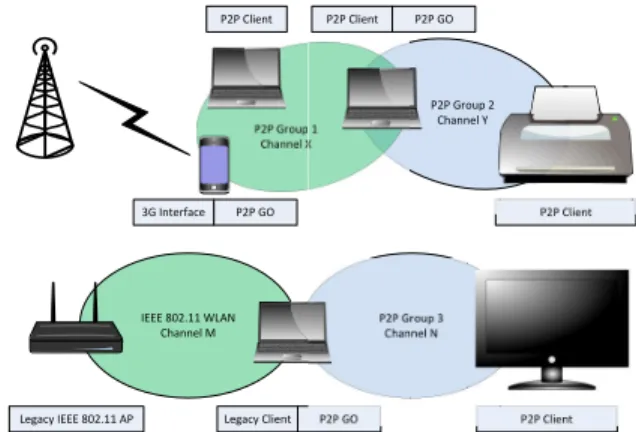
The logical nature of the P2P roles supports different ar-chitectural deployments, two of them illustrated in Figure 1. The upper part of the figure represents a scenario with two P2P groups. The first group is created by a mobile phone sharing its 3G connection with two laptops; for this first group, the phone is acting as P2P GO while the two laptops behave as P2P Clients. In order to extend the network, one of the laptops establishes a second P2P Group with a printer; for this second group, the laptop acts as P2P GO. In order to act both as P2P Client and as P2P GO the laptop will typically alternate between the two roles by time-sharing the Wi-Fi interface; in Section II-E we will introduce the NoA protocol that can be used for this purpose. The lower part of Figure 1 illustrates the case of a laptop accessing the Internet through a legacy infrastructure AP while at the same time streaming content to a TV set by establishing a P2P Group, where the laptop acts as P2P GO (see [13] for more illustrative examples).
Like a traditional AP, a P2P GO announces itself through beacons, and has to support power saving services for its associated clients. The P2P GO is also required to run a
Dynamic Host Configuration Protocol (DHCP) server to
provide P2P Clients with IP addresses. In addition, only the P2P GO is allowed to cross-connect the devices in its P2P Group to an external network (e.g., a 3G network or an infrastructure WLAN as shown in Figure 1), and for this cross-connection bridging is not allowed. Therefore,
1This step might be avoided in some cases as it will be explained in
Section II-B.
2Most P2P functionality is deployed through the P2P Information
Element included in management frames and through novel action frames. Legacy devices ignore these information elements and action frames.
P2P Group 3 Channel N IEEE 802.11 WLAN Channel M P2P Group 2 Channel Y
Legacy IEEE 802.11 AP Legacy Client
3G Interface P2P GO P2P Client
Fig. 1. Example of Wi-Fi Direct supported topologies and use cases.
the connection must be done at the network layer, typically implemented using Network Address Translation (NAT).
Finally, Wi-Fi Direct does not allowtransferringthe role of P2P GO within a P2P Group. In this way, if the P2P GO leaves the P2P Group then the group is torn down, and has to be re-established using some of the specified procedures.
B. Group Formation
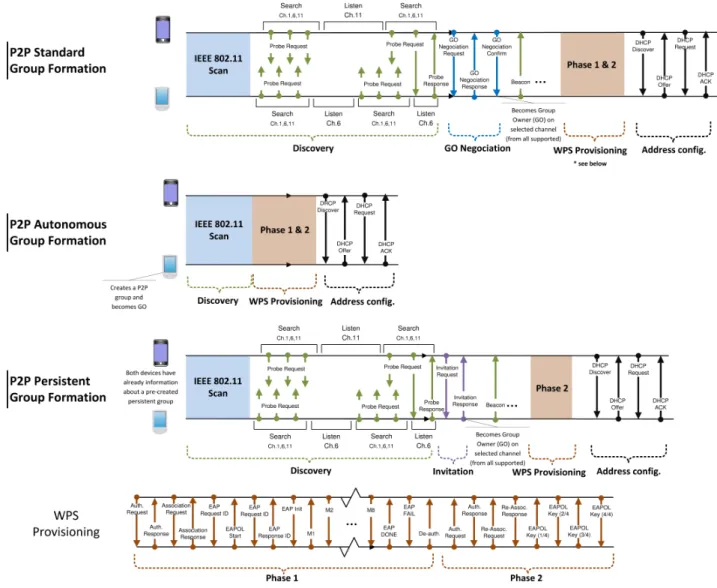
There are several ways in which two devices can es-tablish a P2P Group, depending on, e.g., if they have to negotiate the role of P2P GO, or if there is some pre-shared security information available. Here we first describe the most complex case, which we denote as theStandardcase, to afterwards highlight a couple of simplified cases which we denote as the Autonomous andPersistent cases. These three group formation cases are illustrated in Figure 2.
1) Standard: In this case the P2P devices have first
to discover each other, and then negotiate which device will act as P2P GO. Wi-Fi Direct devices usually start by performing a traditional Wi-Fi scan (active or passive), by means of which they can discover existent P2P Groups3 and Wi-Fi networks. After this scan, a new Discovery
algorithm isexecuted, which we describe next. First, a P2P
Device selects one of the so-calledSocialchannels, namely channels 1, 6 or 11 in the 2.4 Ghz band, as its Listen
channel. Then, it alternates between two states: a search
state, in which the device performs active scanning by sending Probe Requests in each of the social channels; and
alistenstate, in which the device listens for Probe Requests
in its listen channel to respond with Probe Responses. The amount of time that a P2P Device spends on each state is randomly distributed, typically between 100 ms and 300 ms, but it is up to the each implementation to decide on the actual mechanism to e.g. trade-off discovery time with energy savings by interleaving sleeping cycles in the discovery process. An example operation of this discovery algorithm is illustrated in the first part of Figure 2.
Once the two P2P Devices have found each other, they start the GO Negotiation phase. This is implemented using a three-way handshake, namely GO Negotiation
3Passive scanning should be used to discover a P2P GO that is sleeping
Fig. 2. Typical frame exchange sequences in theStandard,AutonomousandPersistentgroup formation procedures.
Request/Response/Confirmation, whereby the two devices
agree on which device will act as P2P GO and on the channel where the group will operate, which can be in the 2.4 Ghz or 5 Ghz bands. In order to agree on the device that will act as P2P GO, P2P devices send a numerical parameter, theGO Intentvalue, within the three-way hand-shake, and the device declaring the highest value becomes the P2P GO. To prevent conflicts when two devices declare the same GO Intent, atie-breakerbit is included in the GO Negotiation Request, which is randomly set every time a GO Negotiation Request is sent.
Once the devices have discovered each other and agreed on the respective roles, the next phase is the establishment of a secure communication using Wi-Fi Protected Setup, which we denote asWPS Provisioning phase and will be described in Section II-D, and finally a DHCP exchange to set up the IP configuration (the Address config. phase in the figure).
2) Autonomous: A P2P Device may autonomously
cre-ate a P2P Group, where it immedicre-ately becomes the P2P GO, by sitting on a channel and starting to beacon. Other devices can discover the established group using
tradi-tional scanning mechanisms,and then directly proceed with the WPS Provisioning and Address Configuration phases.
Compared to the previous case, then, the Discovery phase is simplified in this case as the device establishing the group does not alternate between states, and indeed no GO Negotiation phase is required. An exemplary frame exchange for this case is illustrated in the middle part of Figure 2.
3) Persistent: During the formation process, P2P devices
can declare a group as persistent, by using a flag in the P2P Capabilities attribute present in Beacon frames, Probe Responses and GO negotiation frames. In this way, the devices forming the group store network credentials and the assigned P2P GO and Client roles for subsequent re-instantiations of the P2P group. Specifically, after the Discovery phase, if a P2P Device recognizes to have formed a persistent group with the corresponding peer in the past, any of the two P2P devices can use theInvitation Procedure
(a two-way handshake) to quickly re-instantiate the group. This is illustrated in the lower part of Figure 2, where
the Standard case is assumed as baseline, and the GO
and the WPS Provisioning phase is significantly reduced because the stored network credentials can be reused.
C. Layer Two Service Discovery
A salient feature of Wi-Fi Direct is the ability to support service discovery at the link layer. In this way,priorto the establishment of a P2P Group, P2P Devices can exchange queries to discover the set of available services and, based on this, decide whether to continue the group formation or not. Notice that this represents a significant shift from traditional Wi-Fi networks, where it is assumed that the only service clients are interested in is Internet connectivity. In order to implement the above, service discovery queries generated by a higher layer protocol, e.g., UPnP or Bonjour [8], are transported at the link layer using
the Generic Advertisement Protocol (GAS) specified by
802.11u [9]. GAS is a layer two query/response protocol implemented through the use of public action frames, that allows two non-associated 802.11 devices to exchange queries belonging to a higher layer protocol (e.g. a service discovery protocol). GAS is implemented by means of a generic container that provides fragmentation and re-assembly, and allows the recipient device to identify the higher layer protocol being transported. The interested reader is referred to [4] for a detailed description.
D. Security
Security provisioning starts after discovery has taken place and, if required, the respective roles have been negoti-ated. Wi-Fi Direct devices are required to implementWi-Fi
Protected Setup (WPS) [6] to support a secure connection
with minimal user intervention. In particular, WPS allows to establish a secure connection by, e.g., introducing a PIN in the P2P Client, or pushing a button in the two P2P Devices. Following WPS terminology, the P2P GO is required to implement an internal Registrar, and the P2P Client is required to implement an Enrollee [6]. The operation of WPS is composed of two parts. In the first part, denoted as “Phase 1” in the lower part of Figure 2, the internal Registrar is in charge of generating and issuing the network credentials, i.e., security keys, to the Enrollee. WPS is based on WPA-2 security and uses Advanced Encryption Standard (AES)-CCMP as cypher, and a randomly generated Pre-Shared Key (PSK) for mutual authentication. In the second part, depicted as “Phase 2” in Figure 2, the Enrollee (P2P Client) disassociates and reconnects using its new authenti-cation credentials. In this way, if two devices already have the required network credentials (this is the case in the Persistent group formation), there is no need to trigger the first phase, and they can directly perform the authentication.
E. Power Saving
Using Wi-Fi Direct, battery-constrained devices may typically act as P2P GO (soft-AP), and therefore energy efficiency is of capital importance. However, power saving mechanisms in current Wi-Fi networks are not defined for
APs but only for clients. Notice that with Wi-Fi Direct, a P2P Client can benefit from the existing Wi-Fi power saving protocols, i.e. legacy power save mode [1] or U-APSD [5]. In order to support energy savings for the AP, Wi-Fi Direct defines two new power saving mechanisms:
the Opportunistic Power Save protocol and the Notice of
Absence (NoA)protocol.
1) Opportunistic Power Save: The basic idea of
Oppor-tunistic Power Save is to leverage the sleeping periods of P2P Clients. The mechanism assumes the existence of a legacy power saving protocol, and works as follows. The P2P GO advertises a time window, denoted asCTWindow, within each Beacon and Probe Response frames. This window specifies the minimum amount of time after the reception of a Beacon during which the P2P GO will stay awake and therefore P2P Clients in power saving can send
their frames. If after theCTWindowthe P2P GO determines
that all connected clients are in doze state, either because they announced a switch to that state by sending a frame with the Power Management (PM) bit set to 1, or because they were already in the doze state during the previous
beacon interval, the P2P GO can enter sleep mode until
the next Beacon is scheduled; otherwise, if a P2P Client leaves the power saving mode mode (which is announced
by sending a frame with the PM bit set to 0)the P2P GO is
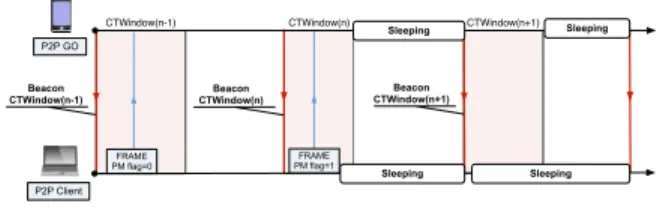
forced to stay awake until all P2P Clients return to power saving mode. Figure 3 provides an example of the operation of the Opportunistic Power Save protocol for a scenario consisting of one P2P GO and one P2P Client.
Notice that, using this mechanism, a P2P GO does not have the final decision on whether to switch to sleep mode or not, as this depends on the activity of the associated P2P Clients. To give a P2P GO higher control on its own energy consumption Wi-Fi Direct specifies theNotice of Absence
protocol, which is described next.
2) Notice of Absence: The Notice of Absence (NoA)
protocol allows a P2P GO to announce time intervals, referred to asabsence periods, where P2P Clients are not allowed to access the channel, regardless of whether they are in power save or in active mode. In this way, a P2P GO can autonomously decide to power down its radio to save energy.
Like in the Opportunistic Power Save protocol, in the case of NoA the P2P GO defines absence periods with a signaling element included in Beacon frames and Probe Responses. In particular, a P2P GO defines aNoA schedule
using four parameters: (i)durationthat specifies the length of each absence period, (ii)intervalthat specifies the time between consecutive absence periods, (iii) start time that
specifies the start time of the first absence period after the current Beacon frame, and (iv) count that specifies
how many absence periods will be scheduled during the current NoA schedule4. A P2P GO can either cancel or update the current NoA schedule at any time by respectively omitting or modifying the signaling element. P2P Clients
4Ifcountis set to 255 the current NoA schedule runs permanently until it is explicitly cancelled.
P2P GO P2P Client Beacon CTWindow(n-1) Sleeping Sleeping Sleeping Sleeping Beacon CTWindow(n) Beacon CTWindow(n+1) FRAME PM flag=0 CTWindow(n-1) FRAME PM flag=1 CTWindow(n) CTWindow(n+1)
(a) Example of Opportunistic Power Save
P2P Client P2P GO
Sleeping Sleeping Sleeping Sleeping
Sleeping Sleeping Sleeping
Sleeping Sleeping
Sleeping Sleeping Sleeping Beacon NoA Schedule 1 Count = 2 Beacon NoA Schedule 2 Count = 3 Beacon NoA Schedule 3 Count = 1 Duration Interval Duration Interval Duration Absent period Start Time Start Time Start Time (b) Example of NoA
Fig. 3. P2P GO power saving protocols in Wi-Fi Direct.
always adhere to the most recently received NoA schedule. Figure 3 depicts an example operation of the NoA protocol. In order to foster vendor differentiation, the Wi-Fi Direct specification does not define any mechanism to compute
theCTWindowin the Opportunistic Power Save protocol or
the schedule of absence periods in the Notice of Absence protocol. In Section III we provide some experimental results comparing the impact of different power saving policies that can be used to configure the NoA protocol.
III. EXPERIMENTALEVALUATION
In this section we report experimental results using Wi-Fi Direct in a testbed composed of commercial, off-the-shelf devices. Our goal is two-fold: first, to analyze the time required to form a P2P group for the three cases described in the previous section; second, to quantify the achievable performance trade-offs using Wi-Fi Direct and compare them against legacy operation.
A. Testbed Setup
We deploy a testbed consisting of two nodes in an office environment, where different WLANs could be detected, and perform our experiments during working hours to guarantee that our numerical figures correspond to realistic settings. Our nodes are two laptops equipped with an 802.11a/b/g D-Link PCMCIA card with an Atheros chipset, running Linux and themac80211/ath5kdriver.
We use an open source implementation of Wi-Fi Direct [7], which builds upon the widely deployed
wpa_supplicant software, and extend it to implement
the Notice of Absence (NoA) protocol. We decided to im-plement NoA as this mechanism provides the AP with the tightest control and therefore should provide the maximum energy savings. Throughout our experiments we always pre-provision the devices with a WPS PIN, to support automatized execution.
B. Group Formation Delays
We first analyze the time needed to establish a P2P Group for the three group formation cases introduced in Section II-B, namelyStandard,AutonomousandPersistent. In order to gain insight on the total time required to form a P2P group, we measured two delays:
• Discovery delay, this being the time required for the
two P2P devices to find each other.
• Formation delay, this being the time required to agree
on the roles, establish a secure communication and perform the DHCP exchange.
With the above, the total delay is obtained by adding the two previous delays. To compute these delays, we process the log files provided by wpa_supplicant to obtain the time instants when a device (i) starts the
dis-covery phase, (ii) discovers the other device, and (iii)
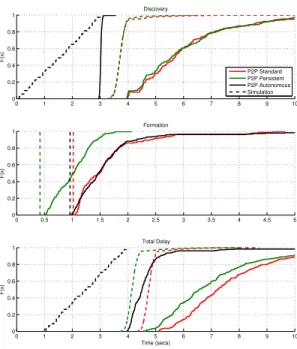
obtains an IP address from the P2P GO. We repeat each group establishment 250 times and report the experimental cumulative distribution function (CDF) of the the above delays in Figure 4. In order to understand the behavior of the experimental implementation, we also plot in the figure using dashed lines the results from an event-driven simulator which closely follows the exchanges illustrated in Figure 2.5
The CDF of thediscovery delay(top subplot) shows that the initial scans delay all procedures by at least 3 seconds, and that the Standard and Persistent cases behave very similarly, an expected result as they use the same discov-ery algorithm. The figure also quantifies the randomness introduced by the novel Wi-Fi Direct discovery algorithm, which results in additional delays between approximately one and seven seconds.The Autonomouscase, in contrast, shows an approximately constant delay of three seconds,
which is caused by the implementation of its discovery
mechanism: the list of P2P GO candidates isreturned only
after an active scanning in all available channels has been completed (note that our card operates in both the 2.4 and the 5 GHz band). The simulation results show, for the Autonomous case, that there is room for significant improvement if the procedure stops immediately after the P2P GO of interest is discovered; for the Standard and Persistent cases, simulations provide the lower bound for the discovery delay in case we were not experiencing inter-ference and traffic from neighboring WLANs(which is the reason for the differences between the simulation and the
experimental results). Given the observeddiscovery times,
we conclude that continuously trying to discover other Wi-Fi Direct devices in a battery constrained device may be a challenging task. For this purpose, smart algorithms would be required that interleave sleeping and discovery cycles in order to trade-off discovery time and battery life.
5Note that our simulator uses anoptimized discovery mechanism for
the autonomous group formation, in which the process stops as soon as the GO is found.
We next analyze the CDF of the (mid-dle subplot), i.e., the time required to negotiate roles (if needed), to establish a secure communication and to provide the IP configuration. It should be first noted that, for the case of the Autonomous group formation, the open source implementation we are using [7] triggers an additional scan right before the WPS phase, something not specified in the standard. This scan increased the delay by approximately three seconds, thus we decided to remove its effect to present a clear overview of the Wi-Fi Direct performance. The figure shows that the three group formations present similar behavior, with the differences over simulations being caused by channel interference and the generation of cryptographic information, and that the simplified signaling of the Persistent case reduces delays in about half a second. It should also be noted that despite the fact that the Autonomous frame exchange is simpler than the Standard one, in practice they result in almost the same delay. This is because the GO Negotiation phase takes very little time as compared to the WPS provisioning phase, which requires a long frame exchange that is affected by the interference from other WLANs.
The addition of the above delays results in thetotal delay
depicted in Figure 4, bottom. The figure shows that 80% of the time the Autonomous group formation took less than five seconds to form the group, while for the Persistent and Standard case this value is eight and nine seconds, respectively, an order that follows the relative complexity of the signaling procedures illustrated in Figure 2. It is also worth remarking that, on average, there are a few seconds of difference between simulations and the use of our real-life testbed, caused by interferences from neighboring WLANs. The above non-negligible delays prevent the use of opportunistic P2P Group establishments to support energy-efficient operation, e.g., setting up a group when traffic is detected, and powering down wireless interfaces when there is no traffic. Instead, in order to amortize the overhead of creating a P2P Group, we expect P2P Groups to have a considerable life time. Thus, in that case, energy efficient operation within a P2P Group, for both P2P Client and P2P GO, becomes a critical feature, and motivates the use of the power saving mechanisms introduced in Section II-E.
C. Energy Efficient Operation
Many Wi-Fi Direct devices will run on batteries, there-fore energy efficiency is of paramount importance. In order to quantify the achievable energy savings using Wi-Fi Direct we consider the case of tethering, i.e., a mobile device acting as a soft-AP and sharing its 3G connection with a client (see Figure 1). Note that in legacy Wi-Fi networks the AP is forced to remain active at all times. In contrast, the Notice of Absence (NoA) protocol lets a P2P GO announce sleep periods and turn its interface(s) to doze in order to save power. Thus, a key challenge with the use of NoA is how to compute the length of the absence periods in order to trade-off the energy saving achieved in the P2P GO with the performance of the traffic in the P2P Group. We analyze this question next.
0 1 2 3 4 5 6 7 8 9 10 0 0.2 0.4 0.6 0.8 1 Discovery F(x) P2P Standard P2P Persistent P2P Autonomous Simulation 0 0.5 1 1.5 2 2.5 3 3.5 4 4.5 5 0 0.2 0.4 0.6 0.8 1 Formation F(x) 0 1 2 3 4 5 6 7 8 9 10 0 0.2 0.4 0.6 0.8 1 Total Delay Time (secs) F(x)
Fig. 4. Evaluation of P2P Group Formation considering Standard,
AutnomousandPersistentgroup formation procedures.
In order to quantify the energy savings supported by Wi-Fi Direct, we fix the Beacon period to 100 ms and analyze three representative policies to implement the NoA protocol: (i) an Active policy where the P2P GO remains always active, thus mimicking the legacy operation. Notice that this policy is optimal in terms of traffic performance, but should result in a worst case in terms of energy efficiency; (ii) aStaticpolicy, where the P2P GO advertises
a fixed presence window of 25 ms right after each Beacon frame, and (iii) aDynamic policy based on the Adaptive
Single Presence Period (ASPP) algorithm, which adjusts the presence window based on the estimated traffic activity (utilization) in the channel. Specifically, ASPP estimates the time the channel is busy using an exponentially weighted moving average, and based on this estimation uses a pro-portional controller to drive the WLAN to the desired point of operation (for more details we refer the interested reader to [11]).
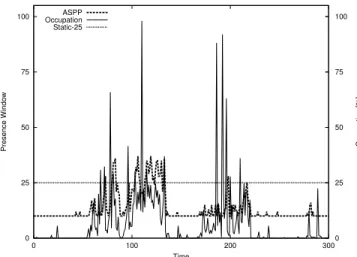
To understand the impact of these policies, we first equip one laptop with a 3G USB dongle and configure it as P2P GO, running NoA with the Dynamic policy; the other laptop is configured as P2P Client and mimics a web-browsing session during ten minutes. We measure the resulting channel activity and the presence window advertised by the P2P GO, and depict both in Figure 5. We also mark in the figure the 25 ms window that would be announced with the Static policy; note that the Active
operation would correspond to a fixed setting of 100 ms. The figure illustrates how an Active policy would disregard any chance to save energy, despite the frequent periods of time when there is little traffic. In contrast, the use of a Static setting of 25 ms would help to significantly
reduce the energy wastage; however, not only this policy requires to manually tune the announced window for each application, but also it would suffer from performance issues due to the accidental traffic bursts. Finally, the figure illustrates how the use of the Dynamic policy is effective in adapting the presence window to the traffic demand in the network. 0 25 50 75 100 0 100 200 300 0 25 50 75 100
Presence Window Occupation [%]
Time ASPP
Occupation Static-25
Fig. 5. ASPPpresence window adaptation with Web traffic.
In order to quantitatively compare these policies in a fair manner, we substitute the 3G dongle by an NS3-based emulator [10], thus ensuring control over the 3G channel conditions and the repeatability of the experiments. We implemented three HSDPA models defined by the Eurane project [12], namely apedestrianchannel with good radio conditions, anurbanchannel with average conditions, and a vehicular channel with poor conditions. For each scenario and policy, we measure the throughput obtained by a TCP download using iperf, and the time that the Wi-Fi interface of the P2P GO spends in the active state and in the sleep state. To provide absolute figures in terms of energy consumption, we translate these times into Joules using the power consumption characteristics of the AR6001 Atheros chipset. In order to have figures with good statistical meaning, each experiment is run for 100 seconds and repeated 5 times. The obtained results for throughput and energy cost are depicted in Figure 6, in which we also add the results for the case of an intra-group communication (i.e., without 3G channel), namely, a TCP download from the P2P GO to the P2P Client.
Figure 6 confirms the results observed in Figure 5. For the case of 3G channels, the Active policy achieves the highest throughput in all cases, but at the highest energy cost, increasing this energy cost as the available bandwidth decreases (e.g., Vehicular channel). In contrast,
the Static policy is able to achieve a good performance
both in terms of throughput and energy cost when the bandwidth is relatively small, but the 25 ms window becomes a bottleneck when the achievable bandwidth is large. This poor performance is exacerbated in the intra-group communication, where the throughput is less than one fourth of the other mechanisms, this being caused by
the overly small presence window, while the energy cost per unit of transferred information is the highest, due to the non-negligible energy consumption of the device during the sleep state. Finally, the Dynamicpolicy is able to achieve throughput figures very close to those of the Active case, while maintaining a small energy cost across all considered scenarios. For the case of 3G channels, then, the energy costs of the communication are reduced by up to 66% as compared to legacy operation (Active case), with almost no price paid in terms of performance. Therefore we conclude that the use of NoA together with an adaptive policy would significantly extend the lifetime of battery-powered devices using Wi-Fi Direct at no significant performance penalty.
0 5 10 15 20 Intra-Group 3G Channel 0 1 2 3 4 5 6 7 Throughput (Mbps) Active Dynamic Static 0 0.05 0.1 0.15 0.2 0.25 0.3 0 0.5 1 1.5 2
Pedestrian Urban Vehicular Energy Cost (Joule/MB)
Fig. 6. Perfomance of theDynamic, Active and Staticpower saving
policies for different scenarios.
IV. CONCLUSIONS
After a tremendous success whereby Wi-Fi has become a predominant way to access the Internet wirelessly, it is now embracing the challenge of becoming pervasive also in direct device to device communications. In this respect, the Wi-Fi Alliance has recently developed the Wi-Fi Direct technology that builds upon the Wi-Fi infrastructure mode to enable direct device to device connectivity.
In this paper we presented a thorough overview of the novel technical features specified in Wi-Fi Direct, following by an experimental evaluation that quantifies the group formation delays to be expected in real-life scenarios. Finally we have analyzed the performance-energy trade-offs of the novel NoA power saving protocol defined in Wi-Fi Direct through extensive experimentation. To the best of the authors’ knowledge this is the first paper in the state of the art that provides a wide overview and experimental evaluation of Wi-Fi Direct.
Regarding future research directions. First, the NoA protocol could also be re-used to virtualize the roles of P2P GO/Client over multiple concurrent P2P Groups. Second, concurrent operation together with the dynamic nature of the P2P GO/Client roles could be used to improve performance in dense environments, for instance by means of dynamic relays. Finally, if Wi-Fi Direct becomes a widespread technology as expected, it faces the challenge of improving coexistence and reducing interference with other unlicensed devices.
A
The authors are grateful to the anonymous referees for their valuable comments which greatly helped in improving the paper.
REFERENCES
[1] IEEE 802.11-2007 Standard, Wireless LAN Medium Access Control
(MAC) and Physical Layer (PHY) Specifications, 2007.
[2] IEEE 802.11z-2010 -Wireless LAN Medium Access Control (MAC)
and Physical Layer (PHY) specifications Amendment 7: Extensions to Direct-Link Setup (DLS).
[3] Jin-Shyan Lee; Yu-Wei Su; Chung-Chou Shen,A Comparative Study
of Wireless Protocols: Bluetooth, UWB, ZigBee, and Wi-Fi, Industrial Electronics Society, 2007. IECON 2007.
[4] Wi-Fi Alliance, P2P Technical Group, Wi-Fi Peer-to-Peer (P2P)
Technical Specification v1.0, December 2009.
[5] Wi-Fi Alliance, Quality of Service (QoS) Task Group,Wi-Fi
Multi-media (including WMM PowerSave) Specification v1.1, 2005.
[6] Wi-Fi Alliance,Wi-Fi Protected Setup Specification v1.0h, Dec. 2006.
[7] Wi-Fi Direct in Linux, http://linuxwireless.org/en/developers/p2p/
[8] Edwards, W. K.,Discovery systems in ubiquitous computing,
Perva-sive Computing, IEEE, vol. 5, no. 2, pp. 70–77, April-June 2006.
[9] 802.11u-2011 - Wireless LAN Medium Access Control (MAC) and
Physical Layer (PHY) specifications Amendment 9: Interworking with External Networks.
[10] ns-3 simulator, http://www.nsnam.org
[11] D. Camps-Mur, X. Perez-Costa, S. Sallent-Ribes, Designing
en-ergy efficient Access Points with Wi-Fi Direct, Computer Networks, September 2011.
[12] Enhanced UMTS Radio Access Network Extensions for NS2 (EU-RANE), http://eurane.ti-wmc.nl/eurane.
[13] Lochan Verma and Scott Seongwook Lee, Proliferation of Wi-Fi:
Opportunities in CE Ecosystem, in Proc. PerNets 2011, Las Vegas, USA, Jan 9 12, 2011.
[14] Nicholson, A.J.; Wolchok, S.; Noble, B.D.; Juggler: Virtual
Net-works for Fun and Profit, Mobile Computing, IEEE Transactions on, vol.9, no.1, pp.31-43, Jan. 2010
[15] Microsoft’s Virtual WiFi Homepage,