by Mustafa Canim
APPROVED BY SUPERVISORY COMMITTEE:
Dr. Murat Kantarcioglu, Chair
Dr. Bhavani Thuraisingham
Dr. Latifur Khan
by
MUSTAFA CANIM, B.S., M.S.
DISSERTATION Presented to the Faculty of The University of Texas at Dallas
in Partial Fulfillment of the Requirements
for the Degree of
DOCTOR OF PHILOSOPHY IN COMPUTER SCIENCE
THE UNIVERSITY OF TEXAS AT DALLAS May, 2011
This dissertation was produced in accordance with guidelines which permit the inclusion as part of the dissertation the text of an original paper or papers submitted for publication. The disser-tation must still conform to all other requirements explained in the “Guide for the Preparation of Master’s Theses and Doctoral Dissertations at The University of Texas at Dallas”. It must include a comprehensive abstract, a full introduction and literature review and a final overall conclusion. Additional material (procedural and design data as well as descriptions of equipment) must be provided in sufficient detail to allow a clear and precise judgement to be made of the importance and originality of the research reported.
It is acceptable for this dissertation to include as chapters authentic copies of papers already pub-lished1, provided these meet type size, margin and legibility requirements. In such cases, con-necting texts which provide logical bridges between different manuscripts are mandatory. Where the student is not the sole author of a manuscript, the student is required to make an explicit state-ment in the introductory material to that manuscript describing the student’s contribution to the work and acknowledging the contribution of the other author(s). The signatures of the Supervis-ing Committee which precede all other material in the dissertation attest to the accuracy of this statement.
1Partial or full content of chapters has been published in [16, 17, 15].
Throughout my four years at UT Dallas I have been blessed with the company of so many won-derful people that I find it difficult to thank and express my appreciation to every single one of them. Nevertheless, I would like to voice my deepest gratitude to some of them who have left indelible traces on my personality, my scholarly development, and my work. Firstly, I would like to give special thanks to my advisor, Dr. Murat Kantarcioglu, for his continuous guidance and support throughout my Ph.D. years. He has been inspirational and enlightening at all stages of my dissertation. I doubt that this work would have been brought to fruition absent his understanding and tolerance. Next, I would like to thank my committee members Dr. Bhavani Thuraisingham, Dr. Latifur Khan and Dr. Kevin W. Hamlen for their invaluable inputs. Their encouragement and positive criticism have been of utmost help throughout the entire dissertation process. I would like to extend my gratitude to my colleagues and co-authors at the IBM T.J. Watson research center. In particular I would like to thank George A. Mihaila, Bishwaranjan Bhattacharjee, Kenneth A. Ross, Christian A. Lang and Yuan-Chi Chang for their contribution to my development as a scholar and a researcher.
The challenges of living in a foreign country and pursuing a graduate degree in computer science would have been much harder to overcome without my friends. Luckily, I have befriended some of the finest and most valuable people on earth. Especially, I cannot express my gratitude to my long time friend Musa Subasi, with whom Dallas felt like home. It was an honor for me to share the same apartment with him for three years. Ali Inan has been the fatherly figure in Dallas
thank Engin Tozal, Mehmet Kuzu, Selami Ciftci, Huseyin Ulusoy, and Dursun Baran for their friendship.
Thank also to my family, especially my mom Muyesser, my sister Fatma Tuba and my dad, Rid-van. Without them I would be a different person today and probably could not get this degree. Last but not least, I would like to thank my wife, Huma Nurper, for her understanding and support. Without her it would be very hard for me to cope with the difficulties I had while I was getting closer to my graduation. Her love made me happy and her smile has given me the hope to finish my PhD.
January, 2011
Publication No.
Mustafa Canim, Ph.D.
The University of Texas at Dallas, 2011
Supervising Professor: Dr. M. Kantarcioglu
Databases and data warehouses facilitate the storage and retrieval of large amounts of informa-tion. These systems have been increasingly used by corporations to store data such as unit cost information, customers credit card numbers, or patients medical records that are confidential in nature. This trend has been accompanied by numerous incidents of data theft and has resulted in more corporations preferring to store their sensitive records in an encrypted format. Since tra-ditional cryptographic operations entail significant amount of arithmetic calculations, latencies generally arise while recording or retrieving sensitive data. We propose novel and efficient tech-niques to minimize the cost of cryptographic operations while processing sensitive information. These techniques involve exploiting the parallel computation capability of multi-core CPUs and IO latencies.
We also present two studies in which we exploit the benefits of a tamper proof cryptographic hardware. In the first study, we discuss how attackers can capture valuable information such as encryption keys from the memories of database systems. We then propose a framework for
results show that the disclosure risk of such attacks can be reduced dramatically while incurring a small performance overhead.
In the second study, we demonstrate that tamper proof cryptographic hardware can be used for sharing and processing biomedical data. The proposed framework eliminates the need for dele-gating the storage and processing of sensitive biomedical data to third parties. Within this frame-work, we define a secure protocol to process genomic data and perform a series of experiments to demonstrate that such an approach can be run in an efficient manner for typical biomedical investigations.
Preface v
Acknowledgements vi
Abstract viii
List of Tables xiv
List of Figures xv
CHAPTER 1 INTRODUCTION 1
CHAPTER 2 RELATED WORK 7
2.1 Querying Encrypted Data . . . 7
2.2 Authenticity of Query Results . . . 9
2.3 Database Auditing and Forensic Analysis . . . 10
2.4 Encrypted Data Storage Problem From File Systems Perspective . . . 11
2.5 Virtualization Based Solutions . . . 11
2.6 Secure Processing of Genomics Data . . . 12
2.7 Background on Secure Coprocessors . . . 13
CHAPTER 3 DESIGN AND ANALYSIS OF QUERYING ENCRYPTED DATA IN RELATIONAL DATABASES 16 3.1 Introduction . . . 17
3.2 Block Cipher Modes Suitable for Databases . . . 17
3.2.1 Overview of Block Cipher Modes . . . 18
3.2.2 Evaluating the Performance of Encryption Modes under Different Encryp-tion Granularity . . . 20
3.2.3 Performance of Encryption Modes under Different Disk Access Patterns . . . . 24
3.2.4 Which Mode? . . . 27
3.3 A New Approach for Storing Encrypted Data in Database Pages . . . 28
3.3.1 Experiments and Analyses . . . 32 xi
CHAPTER 4 QUERY OPTIMIZATION IN ENCRYPTED RELATIONAL DATABASES
BY VERTICAL SCHEMA PARTITIONING 37
4.1 Introduction . . . 37
4.1.1 Advantages of the Proposed Approach . . . 41
4.2 Preventing CPU Bottleneck by Vertical Partitioning . . . 42
4.2.1 Details of the CPU Bottleneck Experiments . . . 43
4.2.2 Mitigating the Join Cost Due to the Partitioning . . . 46
4.3 Partitioning a Single Relation . . . 47
4.3.1 Formal Definition of the Problem . . . 47
4.3.2 Experiment Results . . . 48
4.4 Partitioning Multiple Table . . . 50
4.4.1 Formal Definition of the Problem . . . 50
4.4.2 One Step at a Time (OSAT) Heuristic . . . 51
4.4.3 Experiment Results . . . 52
4.5 Conclusion . . . 54
CHAPTER 5 BUILDING DISCLOSURE RISK AWARE QUERY OPTIMIZERS FOR RELATIONAL DATABASES 56 5.1 Introduction . . . 56
5.1.1 Threat Model and System Overview. . . 59
5.2 Disclosure metrics for memory-based attacks . . . 64
5.2.1 Disclosure Risk for Single-relation Queries . . . 66
5.2.2 Disclosure Risk for Multi-relation Queries . . . 70
5.3 Multi-Objective Query Optimization . . . 72
5.3.1 Combining two cost measures . . . 72
5.3.2 Modifications in MySQL Query Optimizer and InnoDB Storage Engine . . . . 73
5.3.3 An Alternative Implementation Method for Constraint Approach . . . 76
5.4 Experiments . . . 77
5.4.1 Experiments with TPC-H workload . . . 77
5.4.2 Performance Overhead of Key Generation and Audit Log Generation Mech-anism . . . 81
5.4.3 Performance Overhead of Key Generation and audit log generation mecha-nism . . . 81
5.5 Discussion . . . 85
5.5.1 Motivating Example For Query Optimization . . . 85
5.5.2 Granularity of Key Management . . . 85
5.5.3 Optimal Predicate Ordering . . . 89
5.6 Conclusion . . . 90
CHAPTER 6 SECURE MANAGEMENT OF CLINICAL GENOMICS DATA WITH CRYPTOGRAPHIC HARDWARE 92 6.1 Introduction . . . 92
6.2 Description of the Proposed Framework . . . 95
6.2.1 Architecture . . . 96
6.2.2 Data Representation . . . 99
6.2.3 Secure Count Queries . . . 101
6.3 Security Analysis . . . 103
6.4 Joining Patient Records . . . 104
6.5 Experiments and Results . . . 106
6.5.1 Join Operation . . . 107 6.5.2 Selection Operation . . . 108 6.6 Discussion . . . 109 6.7 Conclusion . . . 111 CHAPTER 7 CONCLUSION 112 Bibliography 114 Vita xiii
3.1 Notations used for describing block cipher modes . . . 19
3.2 Encryption of 1 GB data under different block sizes . . . 23
3.3 Results of experiment 3 (reading and decrypting 1 GB file sequentially) . . . 25
3.4 Results of experiment 4 (reading one GB file randomly and decrypting 512 MB) . . 25
4.1 Query execution times for TPC-H queries 5-7-10 and the workload execution times on different partitioning scenarios . . . 53
5.1 Sample query . . . 66
5.2 Notations used for disclosure model . . . 67
6.1 Encryption of Clinical Genomics Data . . . 100
1.1 Semi trusted attack model . . . 3
1.2 Fully untrusted attack model . . . 4
2.1 IBM 4764 PCI-X Cryptographic Coprocessor. . . 14
3.1 Effect of key initialization under different granularity . . . 24
3.2 Illustration of page level CTR approach . . . 31
3.3 Experiment results for projection queries . . . 34
3.4 Experiment results for selection queries . . . 34
3.5 Experiment results for selection queries . . . 34
3.6 Experiment results for selection queries . . . 34
4.1 Left deep join tree of TPC-H query-10 . . . 42
4.2 Multi table partitioning over indexed tables . . . 46
4.3 Effect of CPU bottleneck on encrypted query processing . . . 46
4.4 Various distributions of type 1 and type 2 queries. . . 49
4.5 Various distributions of type 3 queries. . . 49
5.1 System overview . . . 62
5.2 Possible execution plans for a given query . . . 65
5.3 Comparison of query optimizer algorithms . . . 78
5.4 a) Number of SCP accesses during the execution of the workload b) Constraint on disclosure and constraint on performance c) Weighted aggregation approach . . . 79
5.5 Performance overhead of key generation for different granularities . . . 82
5.6 Query execution plans . . . 86
5.7 Execution times of operations . . . 88
6.1 Proposed framework for management of biomedical data in third party crypto-graphic hardware. . . 95
6.2 An overview of the secure count protocol. . . 102 xv
6.5 Execution time for count queries on various datasets with different query sizes (SCP based protocol) . . . 109
6.6 Improvement rate compared to the multiple third party protocol in [50] . . . 110
Databases have become the primary means through which large organizations such as hospitals and financial institutions store and access their valuable customer related information. The highly proprietary nature of data stored in databases has also made these systems the primary target of attackers who want to steal and take advantage of customer specific information. According to a recent report [88], approximately 285 Million records have been stolen from databases in 2008. The same report also indicates that approximately 4.3 million of those records contain personally identifiable information [88]. Another study suggests that companies spend on average between $90 and $305 per lost record after a data theft incident for various forensic, legal, and IT costs [32]. In order to reduce the effect of various attacks and alleviate the disclosure risk in case of a data theft, organizations prefer to store confidential data in an encrypted format in databases. Also recently, legal considerations [26] and new legislations such as California’s Database Secu-rity Breach Notification Act [74] require companies to encrypt sensitive data. However crypto-graphic operations that need to be performed so as to securely store sensitive data entail significant amount of cumbersome arithmetic calculations. Accompanied with bad design choices, expensive cryptographic operations needed for querying and processing encrypted data could substantially decrease the performance of a database system.
The goal of our work is to propose alternative solutions to process encrypted sensitive datawithout compromising on the efficiency of the system. In order to minimize the performance
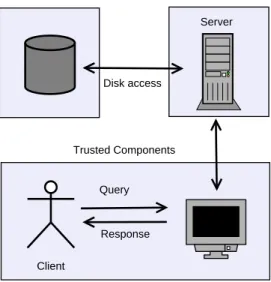
overhead of the cryptographic operations, we present solutions that exploit the hardware charac-teristics of the underlying architecture. We study this problem under different attack models and propose techniques that provide a significant enhancement in the performance of the system. The attack models that we employ are the semi trusted attack model and the fully untrusted attack model. In the semi trusted attack model, it is assumed that the server where the queries are exe-cuted is trusted and only the disk (storage device) is vulnerable to compromise (See Figure 1.1). In other words, the adversary can only see the files stored at the disk but not the access patterns. Also we assume that the adversary does not have access to the content of the memory. In this case, we only need to satisfy the security under chosen plain text attacks [11]. Put differently, we guarantee that (assuming the blockcipher used (e.g. AES) is secure) by looking at the contents of the disk, any polynomial-time adversary will have negligible probability of learning anything about the sensitive data. This is the most commonly considered attack model in the conventional database systems. In Section 3 and Section 4 we consider a framework where this attack model is considered and propose techniques to deal with the performance issues during query processing.
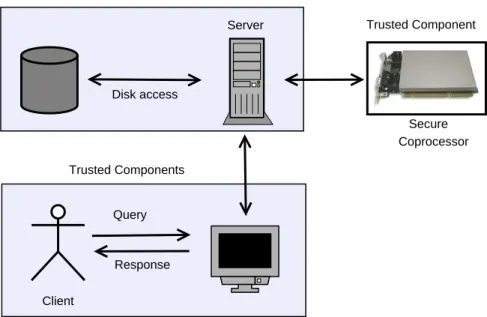
In the fully untrusted attack model, we assume that the adversary can monitor the content of both the memory and the storage devices (See Figure 1.2). In this model, the only trusted com-ponent of the system is the secure coprocessor (SCP). A typical SCP is a single-board computer consisting of a CPU, memory and special-purpose cryptographic hardware contained in a tamper-resistant shell. The device enables developers to implement custom applications and load it to the SCP for execution. Thanks to the special protective hardware, any sensitive encrypted data could be processed within the SCP in any untrusted platform. We provide more information about the details of the secure coprocessors in Section 2.7. In Section 5, we consider a framework where the memory is considered to be untrusted for a certain amount of attack time and the disk is always
Client Query Response Trusted Component Server Disk access Trusted Components Untrusted Component
Figure 1.1. Semi trusted attack model
monitored by the adversary. Under this threat model we show how to handle the cryptographic operations while processing the user queries. In Section 6, we assume that both the memory and the disk is vulnerable to attacks at anytime during the execution of the workloads. This is the strictest model one could consider since the sensitive data should never be stored and processed in plain text format in the memory of the system. Instead, it should be decrypted and processed in the secure processor whenever it is needed.
Below we provide a summary of the problems we address and the solutions we propose to each of these problems in this thesis.
In Section 3 and Section 4, we focus on the performance aspect of processing encrypted data. As we mentioned earlier companies prefer to keep their data in encrypted format for data-at-rest due to the security concerns as well as legal considerations. However, storing the data in an encrypted format entails non-negligible performance penalties while processing queries. Both of these sections target several design issues related to querying encrypted data in relational
Client Query Response Untrusted Components Server Secure Coprocessor Disk access Trusted Components Trusted Component
Figure 1.2. Fully untrusted attack model
databases under semi trusted attack model. In Section 3, we propose new and efficient techniques to reduce the cost of cryptographic operations while processing different types of queries. These techniques enable us not only to overlap the cryptographic operations with the IO latencies but also to reduce the number of block cipher operations with the help of selective decryption capa-bilities. In Section 4, we first present some experiment results conducted on benchmark datasets proving that excessive decryption costs during query processing result in CPU bottleneck. As a solution we propose a new method based on schema decomposition that partitions sensitive and non-sensitive attributes of a relation into two separate relations. Our method improves the system performance dramatically by parallelizing disk IO latency with CPU-intensive operations (i.e., encryption/decryption).
In Section 5, we consider a fully untrusted attack model for a relational database where a malware can monitor both the content of the memory and the disk for a certain amount of time. As we will discuss the details in this chapter, many DBMS products in the market provide built
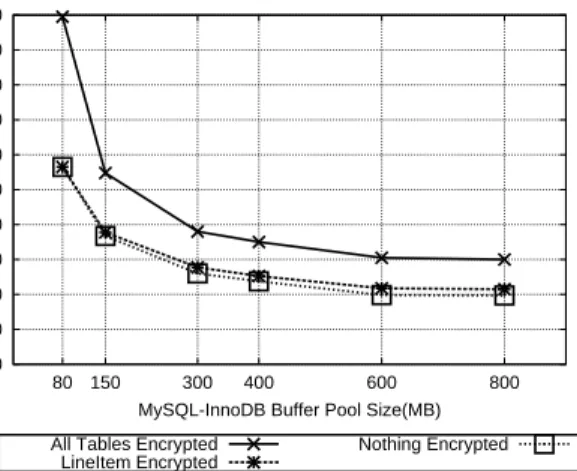
in encryption support for disk encryption. This solution is quite effective in preventing data leak-age from compromised/stolen storleak-age devices. However, recent studies show that a significant part of the leaked records have been done so by using specialized malwares that can access the main memory of systems. These malwares can easily capture the sensitive information that are decrypted in the memory including the cryptographic keys used to decrypt them. This can fur-ther compromise the security of data residing on disk that are encrypted with the same keys. In this section, we quantify the disclosure risk of encrypted data in a relational DBMS for main memory-based attacks and propose modifications to the standard query processing mechanism to minimize such risks. Specifically, we propose query optimization techniques and disclosure models to design a data-sensitivity aware query optimizer. We implemented a prototype DBMS by modifying both the storage engine and optimizer of MySQL-InnoDB server. The experimental results show that the disclosure risk of such attacks can be reduced dramatically while incurring a small performance overhead in most cases.
In Section 6, we consider a fully untrusted attack model for a client server architecture which can be used for processing biomedical genomic data. Nowadays, the biomedical commu-nity is increasingly migrating toward research endeavors that are dependent on large quantities of genomic and clinical data. Also, various regulations require that such data be shared beyond the initial collecting organization (e.g., an academic medical center). It is of critical importance to en-sure that when such data is shared, as well as managed, it is done so in a manner that upholds the privacy of the corresponding individuals and the overall security of the system. In general, orga-nizations have attempted to achieve these goals throughde-identificationmethods that remove ex-plicitly, and potentially, identifying features (e.g., names, dates, and geocodes) [14, 24, 31, 36, 41]. However, recent studies demonstrate that de-identified data can be re-identified to named
individ-uals using simple automated methods [59, 12]. As an alternative, one could design a framework that leverages tamper proof hardware to enable secure clinical genomics data storage and process-ing at a sprocess-ingle third party. Since the hardware is capable of performprocess-ing local computations that are completely hidden from the server, the sensitive data could be stored in a database within an SCP. Despite such enhanced security, however, current SCPs are limited in memory size and computa-tion power. For example, the secure coprocessor used in this work has only 64 MB and a 266MHz PowerPC processor. Yet, GWAS is often executed over large quantities of data. For instance, a typical GWAS study computes the correlation between 600,000 (or more) single nucleotide poly-morphisms (SNPs) and a phenotype for 10000 (or more) individuals, which is approximately 1.5 GB of data. It is not possible to fit all of the data into the SCP’s memory at the same time. In Section 6, we will explain how, given its limitations, such hardware can be leveraged to craft a secure solution for clinical genomics data processing by a single third party.
In this section, we summarize the literature work relevant to our studies presented in the following sections. We also provide a detailed background information about the secure coprocessors we use in our studies.
2.1 Querying Encrypted Data
Querying encrypted data under the untrusted database server attack model was first suggested in [39]. Hacigumus et al. suggested partitioning the client’s attribute domains into a set of inter-vals [39]. The correspondence between interinter-vals and the original values are kept at the client site and encrypted tables with interval information are stored in the database. Efficient querying of the data is made possible by mapping original values in range and equality queries to corresponding interval values. In subsequent work, Hore et al. [43] analyzed how to create the optimum inter-vals for minimum privacy loss and maximum efficiency. In [23], the potential attacks for interval based approaches were explored and models were developed to analyze the trade-off between ef-ficiency and disclosure risk. In [4], Aggarwal et al. suggested to allow the client to partition its data across two, (and more generally, any number of) logically independent database systems that cannot communicate with each other. The partitioning of data is performed in such a fashion as to ensure that the exposure of the contents of any one database does not result in a violation of privacy. The client executes queries by transmitting appropriate sub-queries to each database, and then piecing together the results at the client side. This line of work is different from the problem
we discuss in Section 3 and Section 4 because none of these studies assume that the sensitive information is processed in plain text format in the server side. On the other hand, interval based techniques could be used for the attack models used in Section 5 and Section 6, however, the data processing capability of the server in the interval based solutions is quite limited. Since the server cannot see the data in plain text format, most of the data records are sent to the client for further processing which increases both the network cost and client side processing cost.
Encrypted data storage problem was also studied in [6, 49, 29, 84]. In [6], Agrawal et al. suggested a method for order preserving encryption (OPES) for efficient range query processing on encrypted data. Unfortunately, OPES only works for numeric data and is not trivial to extend to discrete data. In [49], Iyer et al. suggested data structures to store and process sensitive and non-sensitive data efficiently. The basic idea was to group encrypted attributes on one mini page (or one part of the tuple) so that all encrypted attributes of a given table can be decrypted together. In [29], Elovici et al. also suggested a different way for tuple level encryption. In [10], Bayer and Metzger explored the idea of using block ciphers and stream ciphers for encrypting B+ trees and random access files. They suggest generating different keys for each page based on the page id to break potential correlation attacks (pages encrypted with the same key and the same data will have the same cipher text). The disadvantage of this approach is, changing keys for each page imposes big key initialization costs. Hardjono and Seberry [42] suggested special combinatoric structures to disguise keys in B+ trees. Unfortunately, their combinatoric approach has not received the level of scrutiny required to achieve trust (as have others such as AES).
Our consideration is different from the ones described above in many aspects. Unlike the previous work, we provide complete analysis of block cipher modes suitable for databases, present
analysis of the experiments about overlapping the IO latencies with the cryptographic operations by using multi-threading and propose a new approach for storing encrypted data in database pages by utilizing selective decryption property of CTR mode, in Section 3. Also in Section 4, we discuss the CPU bottleneck problem in encrypted databases with experimental observations, show how to utilize the page level approach for selective decryption of sensitive data, and propose a new workload dependent vertical schema decomposition technique to mitigate the negative impacts of cryptographic operations.
2.2 Authenticity of Query Results
Some of the existing work deal with the problem of authenticity of query results in untrusted database server model. In [85] the authors propose a method for proofs of actual query execution in an outsourced database framework, in which a client outsources its data management needs to a specialized provider. They introduce query execution proofs; for each executed batch of queries the database service provider is required to provide a strong cryptographic proof assuring that the queries were actually executed correctly over their entire target data set. In [91] an integrity audit mechanism is proposed to assure that the query results returned by the service provider are both correct and complete. According to this approach the data owner inserts a small amount of records into an outsourced database so that the integrity of the system can be effectively audited by analyzing the inserted records in the query results. The authors in [28] propose some tech-niques based on Merkle hash trees to guarantee the authenticity of the answer of queries provided by third party service providers. The following studies also study different angles of the same problem: [92, 53, 61, 72, 65, 71, 93, 9, 52, 33]. Such approaches could be also applicable in the frameworks described in this thesis but we do not consider those as a part of our project.
2.3 Database Auditing and Forensic Analysis
There are many work that address several problems regarding database auditing and forensic anal-ysis and provide alternative solutions to deal with them. Most of these studies focus on detection and protection of database tampering. In [82] Schneier et al. present a general scheme that allows keeping an audit log on an insecure machine, so that log entries are protected even if the machine is compromised. In [38] a special mechanism is proposed to certify the creation and modification of digital documents such as text, video and audio files. They propose two solutions both involve the use of one way hash functions whose outputs are processed in lieu of the actual documents, and of digital signatures. In [87] Stahlberg et al. investigate the problem of unintended retention of data in database systems, and build a database system that is resistant to unwanted forensic analysis. They show how data remnants in databases pose a threat to privacy. They propose spe-cific techniques such as secure record deletion and log expunction to tackle with this problem. In [73] Pavlou et al. focus on the problem of determining when the tampering occurred, what data was tampered with, and who did the tampering, via forensic analysis. They present four forensic analysis algorithms: the Monochromatic, RGBY, Tiled Bitmap, and a3D algorithms, and characterize their ”forensic cost“ under worst-case, best-case, and average-case assumptions on the distribution of corruption sites. In [86] a security mechanism within a DBMS is proposed that prevents an intruder within the DBMS itself from silently corrupting the audit logs. The solution they propose involves use of cryptographically strong one-way hash functions. In the proposed mechanism the DBMS stores additional information to enable a separate audit log validator to examine the database along with this extra information and state conclusively whether the audit log has been compromised. Unlike our work presented in Section 5, none of these studies address the problem of detecting and minimizing what is revealed in databases during a memory attack.
2.4 Encrypted Data Storage Problem From File Systems Perspective
The following studies focus on encrypted data storage issues from file systems perspective: [13, 62, 63, 22]. In [13] a Unix based file system called CFS is introduced. CFS supports secure storage at the system level through a standard Unix file system interface to encrypted files. Users associate a cryptographic key with the directories they wish to protect. Files in these directories are transparently encrypted and decrypted with the specified key without further user intervention. In [62] Mazi`eres et al. propose a secure file system designed to span the internet. To tackle with the key management issues they propose file names and path names to be used as public keys during the communications. This avoids the necessity for assigning file names to encryption keys which is an inefficient technique used in other secure file systems. In [63] the authors discuss the implementation of a trusted network file system on an untrusted server particularly focusing on the detection of tampering attacks and stale data. Some attack types and vulnerabilities in the modern file systems are also discussed in [22] in great detail.
In [20], Chow et al. discuss data lifetime issue in modern operating systems. They present a strategy for reducing the lifetime of data in memory called secure deallocation. With secure deallocation they suggest zeroing data either at deallocation or within a short, predictable period afterward in general system allocators (e.g. user heap, user stack, kernel heap). They show that this substantially reduces data lifetime with minimal implementation effort in the existing systems. In Section 5, we make use of some of the analysis presented in this paper.
2.5 Virtualization Based Solutions
Some other studies in the literature suggest virtual system based solutions to the data security problem. In [19], Chen et al. introduce a virtual-machine-based system called Overshadow that
protects the privacy and integrity of application data in the event of a system compromise. Over-shadow presents an application with a normal view of its resources, but the OS with an encrypted view. This allows the operating system to carry out the complex task of managing an application’s resources, without allowing it to read or modify them. In [51], Krishnan and Monrose suggest a framework for transparently recording accesses to protected storage in a virtualized environment. In this framework a forensic layer records all transactions in a version-based audit log that allows for faithful reconstruction of accesses to the data store over time. Virtualization based solutions provide strong security against the system attacks however these mechanisms are still susceptible to cold boot attacks which constitute a severe threat as discussed in [58, 40]. Nevertheless the techniques described in these studies can be combined with the security mechanisms that we are suggesting to provide a better protection against all types of attack scenarios.
2.6 Secure Processing of Genomics Data
Secure cryptographic devices have been used for many tasks, including private information re-trieval [8], private record linkage [5, 46], and tamper-resistant intrusion detection [90]. Recently, Trusted Computing Platform Alliance chips were used to protect outsourced private customer data [64]. To our knowledge, none of the previous work applies secure cryptographic hardware for managing or processing clinical genomics data, which has distinct issues in terms of scale and type.
In [47], Illiev et al. propose a system for providing obliviousness for arbitrary large com-putations on secure coprocessors for any algorithm using circuit evaluation methods in the context of SMC. In Section 6, we provide much more efficient solutions for processing genomic data in untrusted platforms.
Not only the cryptographic hardware but also the cryptographic techniques were used for processing of genomics data. In [50], Kantarcioglu et al. introduces a cryptographic framework that can be leveraged for secure clinical genomics data storage. In this framework, the clinical genomics data records are first encrypted by the data owners (e.g., hospitals) and stored in a centralized repository. Using a specific type of public key encryption, the queries of biomedical researchers (e.g. count queries) are executed by the repository managers, without decrypting the clinical genomics data. Instead, only the aggregated result is decrypted.
This framework provides a cryptographically secure way of executing the queries. How-ever, this protocol required the integration of two third parties to achieve such computations, which, as we alluded to in Section 6, is not always practical. Additionally, excessive process-ing cost of specialized encryption techniques can make this mechanism impractical for very large datasets. In Section 6, we provide a much more efficient solution by leveraging the capabilities of secure cryptographic hardware.
2.7 Background on Secure Coprocessors
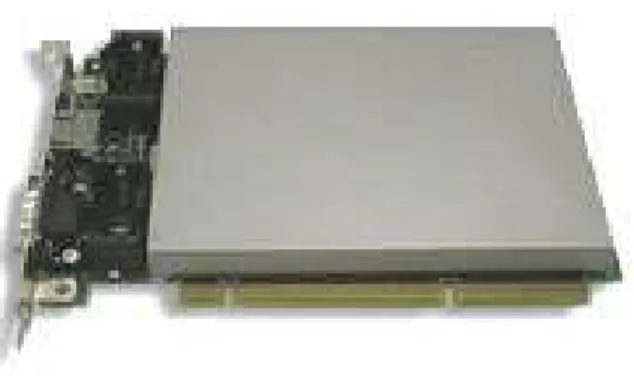
The tamper proof hardware we use in Section 5 and Section 6 is already commercially avail-able in the form of secure coprocessors. An example of an SCP is the IBM 4764 Cryptographic coprocessor [44].
This is a single-board computer consisting of a CPU, memory and special-purpose crypto-graphic hardware contained in a tamper-resistant shell. The hardware is certified to level 4 under FIPS PUB 140-11. When installed on a server, it is capable of performing local computations that 1FIPS PUB 140-1 is the benchmark standard for evaluating the security and proper algorithmic im-plementation of a commercial cryptographic product. Under the supervision of the USA and Canadian
Figure 2.1. IBM 4764 PCI-X Cryptographic Coprocessor
are completely hidden from the server. If tampering is detected, then the SCP clears the internal memory. Despite such enhanced security, current SCPs are limited in memory size and computa-tion power. For example, IBM 4764 Cryptographic coprocessor has only 64 MB and a 266MHz PowerPC processor. Therefore, secure coprocessors are mostly used for handling key manage-ment tasks rather than being used for bulk encryption and decryption operations. In Section 5, we describe how to use the secure coprocessor for generating low granularity keys to encrypt sensitive data records. In Section 6, we use the SCP for performing all operations on the sensitive records. We implement some buffering techniques to speed up the performance of the operations.
The coprocessor has three “segments”: Segment 1, Segment 2, and Segment 3. Each segment has a status, an owner identifier and holds software, a validation public key. Segment 1 has “miniboot” which contains dignostics and code loading controls. Software in this segment administers the replacement of software already loaded to Segment 1 and administers the loading of data and software to segments 2 and 3. This segment is loaded at the factory, but can be replaced Governments, independent laboratories conduct thorough analyses of the product design and actual tests of products. The test report is discussed with the governmental bodies, and when found acceptable, a certificate is issued [44].
using the CLU utility. Segment 2 has an embedded control program, i.e., a mini operating system. The operating system supports applications loaded into Segment 3. Segment 3 has either CCA or a custom created application. The coprocessor Support Program includes a CCA application program that can be installed into Segment 3. The application functions according to the IBM CCA and performs access control, key management, and cryptographic operations [1].
IBM 4764 secure coprocessor comes with a programming API called “Common Crypto-graphic Architecture (CCA) application programming interface (API)” that enables programmers to develop applications that communicate with the secure coprocessor. CCA provide a variety of cryptographic processes and data-security techniques [1]. The application developed by the programmers can call verbs to perform the following functions:
• Data confidentiality: Encrypt and decrypt information, typically using the AES or DES algorithms in Cipher Block Chaining (CBC) mode to enable data confidentiality.
• Data integrity: Hash data to obtain a digest, or process the data to obtain a message authen-tication code (MAC), that is useful in demonstrating data integrity.
• Non-repudiation: Generate and verify digital signatures to demonstrate data integrity and form the basis for non-repudiation.
• Authentication: Generate, encrypt, translate, and verify finance industry personal identifica-tion numbers (PINs) and American Express, MasterCard and Visa card security codes with a comprehensive set of finance-industry-specific services.
• Key management: Manage the various AES, DES, and RSA (PKA) keys necessary to per-form the above operations.
RELATIONAL DATABASES
Cryptographic operations, required to store sensitive data securely, entail significant amount of cumbersome arithmetic calculations. Coupled with bad design choices, expensive cryptographic operations needed for querying and processing encrypted data could decrease the system perfor-mance dramatically. On the other hand, good design choices may drastically affect the overall performance. With this in mind, in this section, we discuss some of the design issues to encrypt and query the sensitive data that resides in database disks. We propose new techniques to reduce the cost of cryptographic operations while processing different types of queries. We show that by exploiting the benefits of multi core CPUs, the cryptographic operations could be performed while reading and writing database pages. Also we show that the number of block cipher oper-ations could be reduced with the help of selective decryption capabilities of certain encryption modes.
In this section, we consider a semi trusted attack model for the database system where the queries are executed. As we discussed in Section 1, in the semi trusted attack model, it is assumed that the server where the queries are executed is trusted and only the disk (storage device) is vulnerable to compromise.
3.1 Introduction
To reduce the performance loss that arises from using cryptographic techniques, we analyzed different block cipher modes of operations and compared their performances under various disk access patterns to see which modes are suitable for databases and allow us to parallelize the IO latencies with the cryptographic operations. Based on our experiments and analyses, we suggest using an efficient and provably secure encryption mode of operation that also enables selective decryption of large data blocks. We also propose a new approach for storing and processing encrypted data and we show that by using suitable encryption mode, the additional time needed for processing different types of queries can be significantly reduced.
3.2 Block Cipher Modes Suitable for Databases
To store privacy-sensitive data securely, we need to use encryption methods secure against chosen plaintext attacks. Also we need general solutions that could support all kinds of data that needs to be encrypted. For example, the Order Preserving Encryption (OPES) idea suggested in [6] works for only numeric data.
Securely encrypting any kind of data is well studied in the cryptography domain. Any kind of long data is encrypted using operation modes based on secure block ciphers (e.g, AES[66]). All of these encryption modes process the long data by dividing into fixed size blocks(e.g 16 bytes in AES[66]) that can be processed by the block cipher. The obvious question is which block cipher mode is preferable for encrypting sensitive data in databases. To choose the best
mode possible, we need to analyze the effect of these modes under specific database operation conditions. Specifically we look at:
• Performance of Encryption Modes under Different Granularity: We need to encrypt and decrypt the data at different granularity. If we are encrypting at the tuple level, we may need to decrypt small blocks at a time, if we use page level encryption, we need to decrypt potentially a page long encrypted data. Ideally, we should have a mode where different granularity has little effect on the total performance.
• Performance of Encryption Modes under Different Disk Access Patterns: We need to have an encryption method that enables efficient decryption under different disk access patterns.
3.2.1 Overview of Block Cipher Modes
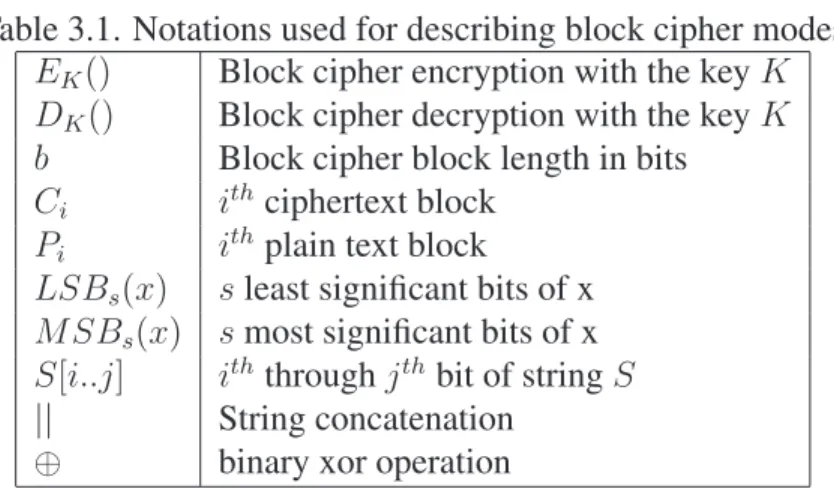
Before we briefly give an overview of different block cipher modes, we discuss the notations we use through out the section. Let EK() be the encryption operation with the key K and DK()
be the decryption operation with the key K. Let Pi be the ith plain text block, Ci be the ith
ciphertext block, IV be the initial random vector and b be the block cipher input size (e.g 128 bits for AES[66]). LetLSBs(x)be the sleast significant bits of x and similarly letMSBs(x)be
thesmost significant bits of x. Also below, S[i..j]denotes theith throughjthbit of stringS , ||
denotes the string concatenation, and⊕denotes the bitwise xor operation. Table 3.1 summarizes the notations used for describing block cipher modes.
Table 3.1. Notations used for describing block cipher modes
EK() Block cipher encryption with the keyK
DK() Block cipher decryption with the keyK
b Block cipher block length in bits
Ci ithciphertext block
Pi ithplain text block
LSBs(x) sleast significant bits of x
MSBs(x) smost significant bits of x
S[i..j] iththroughjthbit of stringS
|| String concatenation
⊕ binary xor operation
Also, for the sake of simplicity, we assume that the plaintextP isn blocks long (i.e. n·b
bit long plaintext). Under these assumption, the block cipher modes of operations suggested by NIST can be summarized as follows:(The details can be found in FIPS-SP 800-38A [2])
• Electronic Code Book(ECB):In ECB mode, each block of the plaintext is encrypted inde-pendently. Similarly each block of the ciphertext decrypted indeinde-pendently. Unfortunately, this mode is not secure since it reveals distribution information. (Note that ifPi =Pj then
Ci =Cj)
ECB Encryption: ECB Decryption:
Ci =EK(Pi), i= 1..n Pi =DK(Ci), i= 1..n
• Cipher Block Chaining(CBC):Each block of the ciphertext is created by encrypting the result of the previous ciphertext block xored with the current plaintext block.
CBC Encryption: CBC Decryption
C1 =EK(P1⊕IV) P1 =DK(C1)⊕IV
• The Cipher Feedback Mode:(CFB)In this mode, successive segments (letsbe the size of these segments where 1≤ s ≤ b andCs
i, Pisdenote thes-bit sized segments of ciphertext
and plaintext respectively.) of ciphertext are concatenated to create an input for forward cipher to create blocks that are xored with plaintext segments.
CFB Encryption: CFB Decryption: I1 =IV I1 =IV Ii =LSBb−s(Ii−1)|Cis−1, i= 2..n Ii =LSBb−s(Ii−1)|Cis−1, i= 2..n Oi =EK(Ii), i= 1..n Oi =EK(Ii), i= 1..n Cs i =Pis⊕MSBs(Oi), i= 1..n Pis =Cis⊕MSBs(Oi), i= 1..n
• Output Feedback Mode(OFB):This mode is very similar to CFB withstaken asb. In this simplified description of OFB, we assume that ciphertext isn∗bbits long.
OFB Encryption: OFB Decryption:
I1 =IV I1 =IV
Ii =Oi−1, i= 2..n Ii =Oi−1, i= 2..n
Oi =EK(Ii), i= 1..n Oi =EK(Ii), i= 1..n
Ci =Pi⊕Oi, i= 1..n Pi =Ci⊕Oi, i= 1..n
• Counter Mode(CTR):In this mode a counter(ctr) is incremented and the encrypted counter value is xored with plaintext block to get the ciphertext block.
CTR Encryption: CTR Decryption:
Ci =Pi⊕EK(ctr+i), i= 0..n−1 Pi =Ci⊕EK(ctr+i), i= 0..n−1
3.2.2 Evaluating the Performance of Encryption Modes under Different Encryption Gran-ularity
In [49], Iyer et al. states that encrypting the same amount of data using few encryption operations with large data blocks is more efficient than many operations with small data blocks. In order
to support this claim, they conduct an experiment using three ciphers: AES[66], DES[69] and Blowfish[80] under different data blocks: 100 bytes, 120 bytes, 16 KBytes. Based on the results of this experiment, they conclude that encrypting data few small units at a time takes longer than encrypting the same amount of data using larger data blocks.
As they stated in their paper [49], the key initialization costs constitute the most important cause of the high amount of time spent in encrypting small blocks of data. We expect to observe less time difference when the data is encrypted under different granularity if we can useone key per database table. Using one key per database table is feasible for many practical applications, because we can encrypt 2128 bits of data securely [55] using CTR mode of encryption with a
given key. To test this view, we conducted some experiments to investigate the effect of key initialization. These experiments are performed under different encryption modes to see which mode is more appropriate to use under different encryption granularity.
In our experiments we used the OpenSSL [21] crypto library’s CBC, CTR, OFB and CFB implementation of AES[66]. We chose AES because it is the current standard and supported by various companies. ECB is not used since it is not regarded as a secure mode of operation. We also implemented a slightly modified version of CTR (referred as CTR4). Modified CTR implementation encrypts all the counter values first (i.e. calculates all theEK(ctr+i)first) and
then xors it with the plain text data. Algorithms 1 and 2 describe the details of the modified CTR implementation. In Algorithm 1, we first create a stringSusing the encrypted counter values and then xor the first l bit of S with plaintext message P to get the ciphertext C. Since encrypted counter values are xored with the plaintext, we do not need to do any padding if the size of the plaintext is not the multiple of the block-cipher lengthb.
Require: Plain textP with lengthl, initial counter valuectr, and block-cipher lengthb.
SetS =EK(ctr+ 0)||EK(ctr+ 1)||. . .||EK(ctr+dlbe −1)
SetC =P ⊕S[0..l−1]
return(ctr, C)
Algorithm 1: Modified CTR Encryption (CTR4)
Similarly, in Algorithm 2, we first create a stringSusing the encrypted counter values and then xor the firstlbit ofSwith ciphertextC to get the plaintextP
Require: CiphertextC with lengthl, initial counter valuectr, and block-cipher lengthb.
SetS =EK(ctr+ 0)||EK(ctr+ 1)||. . .||EK(ctr+dlbe −1)
ReturnP whereP =C⊕S[0..l−1]
Algorithm 2: Modified CTR Decryption (CTR4)
Since all of the block cipher operations are done independent of ciphertext data, CTR4 decryption can be executed in a multi-threaded fashion. One thread could be used for creating the encrypted counters (i.e., for computingS in Algorithm 2), and other thread could be used to read the encrypted data from the disk (i.e. reading C from the disk in Algorithm 2). The origi-nal implementation of CTR mode in OpenSSL crypto library calculatesCi−1 before calculating
EK(ctr+i). Thus it is not suitable for multi-threading.
Experiments:
All of our experiments are conducted on a 2.79 GHz Intel Pentium D machine with 2 GB memory on Windows XP platform. We ran each experiment five times and reported the average results.
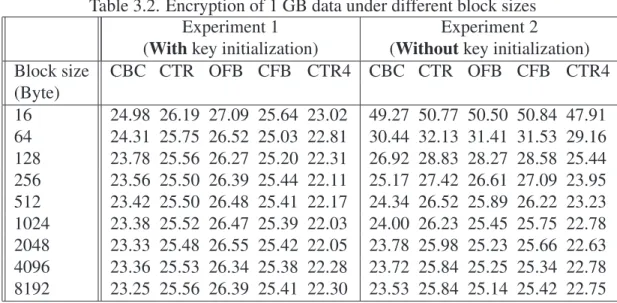
In the first experiment, we encrypted a total of one GB data which is cached in memory 16, 32, 64, 128, 256, 512, 1024, 2048, 4096, and 8192 bytes at a time. In this experiment, the same key is used for encrypting the entire one GB data, and the key initialization is done only
once. In other words, AES set encrypt key() function is called once.1 In Table 3.2, we report the results of experiment 1 in seconds.
Table 3.2. Encryption of 1 GB data under different block sizes
Experiment 1 Experiment 2
(Withkey initialization) (Withoutkey initialization)
Block size CBC CTR OFB CFB CTR4 CBC CTR OFB CFB CTR4
(Byte) 16 24.98 26.19 27.09 25.64 23.02 49.27 50.77 50.50 50.84 47.91 64 24.31 25.75 26.52 25.03 22.81 30.44 32.13 31.41 31.53 29.16 128 23.78 25.56 26.27 25.20 22.31 26.92 28.83 28.27 28.58 25.44 256 23.56 25.50 26.39 25.44 22.11 25.17 27.42 26.61 27.09 23.95 512 23.42 25.50 26.48 25.41 22.17 24.34 26.52 25.89 26.22 23.23 1024 23.38 25.52 26.47 25.39 22.03 24.00 26.23 25.45 25.75 22.78 2048 23.33 25.48 26.55 25.42 22.05 23.78 25.98 25.23 25.66 22.63 4096 23.36 25.53 26.34 25.38 22.28 23.72 25.84 25.25 25.34 22.78 8192 23.25 25.56 26.39 25.41 22.30 23.53 25.84 25.14 25.42 22.75
In the second experiment, we again encrypted one GB of data similar to experiment 1 but in this experiment, key initialization is done at the beginning of each data block. Average results of experiment 2 are shown in Table 3.2 in seconds.
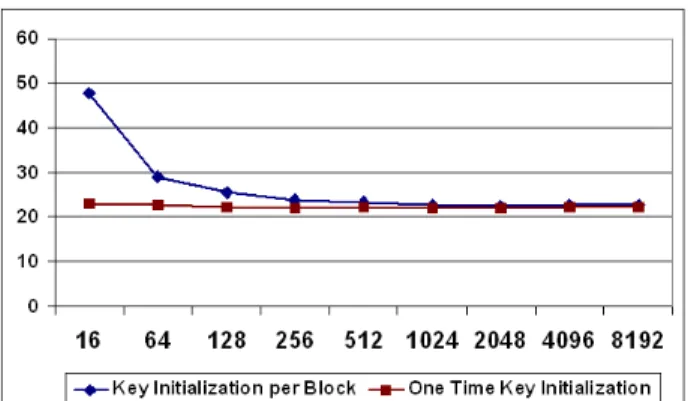
Experiment 1 indicates that CTR4 mode is the fastest, if the key initialization done just once at the beginning of the encryption process. Also, if we compare the results of experiment with or without key initialization for CTR4 (shown in figure 3.1), we can observe that encrypting larger blocks requires less amount of time if the key initialization is performed every time before encrypting each data block. However, the time required to encrypt the data does not depend on block size if key initialization is done just once. In other words, if the blocks used are not too small (i.e. larger or equal to 64 bytes) and one key is used per database table, the encryption block size does not effect the total decryption times. Actually, it is easy to see this fact from the API of 1Initialization means generating substitution tables based on the secret key and this can be a costly operation as reported in [49].
modern crypto packages like the OpenSSL Library. For example in OpenSSL, to start encrypting with a key (similar for decryption), the key initialization function (AES set encrypt key()) should be called first. After the initialization is done, encryption function can be called on various size blocks.
At the same time, experiment 1 indicates that encrypting small blocks (i.e. less than 64 bytes) at a time could be a problem. Fortunately, clever usage of CTR4 mode can solve the small block size problem. (This is not possible with other modes) Since each block is encrypted inde-pendently, we can combine blocks from different tuples (i.e., combine 4 blocks from 4 different tuples to create a 64 byte block) and decrypt/encrypt them together.
Figure 3.1. Effect of key initialization under different granularity
3.2.3 Performance of Encryption Modes under Different Disk Access Patterns
In this part we conducted four experiments to evaluate the performance of encryption modes under random and sequential disk access patterns. In each experiment, data is accessed 4 KB page at a time, since it is the default page size in many DBMSs such as IBM DB2 [45]. We describe those four experiments below.
• Experiment 3:
In the first part, one GB of encrypted file cached in memory is read sequentiallyand de-crypted using different encryption modes. In the second part, the same experiment is re-peated with the same file which is accessed from disk (i.e. file is not cached in memory). The results of the experiment are shown in Table 3.3.
Table 3.3. Results of experiment 3 (reading and decrypting 1 GB file sequentially)
Crypto Mode: CBC CTR OFB CFB CTR4
from memory 29.02 31.17 30.92 30.89 27.89
from disk 28.91 31.94 30.5 31.05 27.31
The results show that whether the data resides in memory or not, does not affect the time for reading and decrypting data sequentially. This implies that during the decryption of the current page disk controller can prefetch the next page.
• Experiment 4:
In the first part, 512 MB of the 1 GB encrypted file is accessedrandomly4K page at a time from memory and decrypted using different encryption modes. In the second part, the same experiment is repeated with the same file which is accessed from the disk. The results of the experiment are shown in Table 3.4
Table 3.4. Results of experiment 4 (reading one GB file randomly and decrypting 512 MB)
Crypto Mode: CBC CTR OFB CFB CTR4
from memory 15.7 16.73 16.38 16.52 15.03
from disk 262.63 262 271.94 266.3 267.64
The results of the experiment 4 indicate that random access to the pages causes significant delays if the data is not cached in the memory.
• Experiment 5:
Multi-threaded version of CTR42is used to decrypt the 512 MBrandomlyaccessed data, which took 257.3 seconds in the average. This experiment is not performed with the other modes since they do not allow multi threading during decryption.
If the result of experiment 5 is compared with experiment 4, we can see that multi threaded version of CTR4 reduces the decryption cost significantly, by overlapping the IO operations with decryption operations. In experiment 4, decrypting 512 MB of 1 GB file randomly takes 266.1 seconds in the average. However, performing the same experiment takes 257.3 seconds in this experiment. Therefore, multi threaded version of CTR4 runs almost 9 sec-onds faster than other modes of operations in the average.
In order to support this claim, we have calculated the time to decrypt 512 MB allocated memory space sequentially with CTR4, which took 11.2 seconds to perform. This result indicates that 9 seconds of running experiment 5 is overlapped with IO operations.
This implies that using hardware accelerators, most of the time required for cryptographic operations can be overlapped with the random access IO operations.
• Experiment 6:
Multi-threaded CTR4 is used to decrypt the 1 GB file sequentially. The average of the results indicates that it takes 28.05 seconds to decrypt the file sequentially. When compared with the results of experiment 3, it can be concluded that the time to read and decrypt one GB file sequentially is not significantly reduced by using the multi threaded version of CTR. 2i.e One thread reads the data, other thread encrypts the counter values. When both threads are done, their results are xored to get the plain text.
The above results imply that the cost of the cryptographic operations can be overlapped with the cost of the IO operations using fast hardware based multi-threaded implementation of CTR mode, which could improve the performance especially in storage area networks where disk access latency could be higher.
3.2.4 Which Mode?
We would like to have a block cipher mode that is suitable forefficientprocessing of encrypted data in databases. Due to reasons stated below, CTR mode emerges as the best choice among classic and proven to be secure block cipher modes for efficiently querying encrypted data. The properties of CTR mode that is useful for database encryption can be given as follows:
• Efficient Implementation:In all of our experiments, modified version of CTR (CTR4) was the fastest. Since the encryption of each block is independent, modern processor architec-ture’s properties such as aggressive pipelining, multiple cores, and large number of registers can be utilized for even more efficient implementation [54]. For example, in [54], optimized version of CTR mode is four times faster than the optimized version of CBC mode. Also CTR mode is suitable for parallel processing.
• Selective Decryption CTR mode could be used to decrypt arbitrary parts of the plaintext. For example, for each tuple encrypted using CTR mode, during the selection operation, we may just decrypt the selection field first and decrypt the rest if the selection criteria is satisfied. To see why we can decrypt the arbitrary substring of a given ciphertext, consider the algorithm 3. In algorithm 3, first the counter values that are used to encrypt theP[u..v]
are calculated. Later on, using the counter valuesbu
bcandd v
created. Finally, the appropriate segment of the encrypted counter values are xored with the required part of the ciphertext (i.e. C[u..v]) to computeP[u..v].
Other block cipher modes such as CBC, CFB, OFB defined for AES[66] in the FIPS-SP 800-38A[2] standard do not allow for selective decryption because the encryption of a block depends on the encryption of the previous block. This implies that we cannot selectively decrypt the required part of the data. ECB and CTR modes of operation encrypt each block independently. Unfortunately, ECB mode reveals the underlying distribution of the data. Therefore, it does not provide the desired level of security.
• PreprocessingIn CTR mode, most costly part of the encryption and decryption (evaluating
EK(ctr+i)) can be done without seeing the data. Actually, we used this property in
Experi-ment 5 and showed that this can reduce the encryption cost significantly. This is not possible for all the modes except OFB mode but OFB mode does not allow selective decryption.
Require: CiphertextC with lengthl, initial counter valuectr, block-cipher lengthb, decryption
start indexuand decryption end indexv
SetS =EK(ctr+bubc)||. . .||EK(ctr+dvbe −1)
returnP[u..v] =C[u..v]⊕S[(u− bu
bc ·b)..(v− bubc ·b)]
Algorithm 3: Decryption of arbitrary substring of ciphertext in CTR mode
3.3 A New Approach for Storing Encrypted Data in Database Pages
Granularity of encryption is another important design issue that needs to be considered for efficient storage of encrypted data. The overall database performance can potentially be affected by small changes in the design choices regarding the way of keeping the records in the pages. Tuple level and page level encryption are the most well known options for this purpose. Alternatively, we can use the mini-page approach suggested in [49].
In tuple level encryption, each tuple is encrypted or decrypted separately. If the database needs to retrieve some of the tuples, there is no need to decrypt all of the tuples in the table.
Page level encryption will correspond to a mechanism where a particular page is com-pletely decrypted when buffer pool needs to access the page from the disk. After some modifica-tions, the page is encrypted again and written to disk.
Mini page level for database encryption was first suggested for encrypted data in [49] based on the work of Ailamaki et.al [7]. In this technique, when a tuple is inserted into a page, its attributes are partitioned and stored in corresponding mini pages on the same page.
Deciding to use one of these approaches depends on two factors:
• the cost of the required block cipher operations under different types of queries
• the amount of modification required to implement these approaches in conventional databases
The mini page level encryption, as discussed in [49], is designed in such a way that the sensitive attributes of the records are encrypted with AES [66] in CBC mode and inserted at the beginning of the page. When a page is read from disk, just the first part of the page is decrypted. Since all the sensitive attributes of the records are located at the beginning of the page, the de-cryption process continues until all sensitive attributes are decrypted.
Although this idea is a neat solution for encrypting sensitive data, there are two issues that are not addressed. The first issue is that it does not allow selective decryption since the encryption mode is selected as CBC mode. When a projection query needs to get specific attributes among the sensitive attributes, all of the encrypted attributes should be decrypted. This cost will linearly
increase if the length of the sensitive attributes increases proportionally to the total length of the records.
Secondly, the mini page level encryption requires significant amount of modification in the page structure of conventional databases. This is because, the attributes of the records are kept in two different parts of the page rather than in a consecutive order.
In the page level encryption, the whole of the page is encrypted before writing into disk and decrypted before loading into buffer pool. If all the data needs to be kept secret, this level of encryption is appropriate. In addition to that, implementing such an approach requires less modification in the page structure of existing databases. However, this is not preferable since it unnecessarily encrypts nonsensitive data along with sensitive data.
Because of the problems discussed above, we propose a new encryption method which we refer to as page level CTR. This method basically utilizes the selective decryption property of CTR4 and combines the useful aspects of page level and tuple level encryption methods. Unlike the mini page approach, sensitive and nonsensitive attributes of the records are kept consecutively. The decryption is performed for each sensitive attribute of the records separately after a page is read from the disk. Therefore, it resembles to tuple level approach.
In our encryption method, we propose using CTR4 for cryptographic operations. So we need to somehow store the counter values in the page. Since each counter value requires a 16-byte of location, keeping one counter value for each record will entail a nonnegligible storage cost. Fortunately, we can use one counter value per page instead of one record. With respect to storage of counter values, our page level CTR approach is similar to page level encryption. Also
we modified and optimized the increment function of CTR mode to increment counter values as much as needed at a time, instead of just one by one.
The page structure of the proposed method is illustrated in figure 3.2 with an example, where we assume that a projection query requires to read the encrypted attributes of two consec-utive records. The start index of the attribute of record 1 isα1 = 220 bytes and of record 2 isα2
= 430 bytes, with respect to the beginning of the page. Before starting the decryption, the counter value of the page is read from the beginning of the page. Then this value is incremented by δ1
whereδ1 =bαβ1c=b22016c= 13 with the optimized increment function of page level CTR approach
( β = 16 since the AES block size is 16 bytes). After finding the necessary counter value, the CTR4 is used to decrypt the sensitive attribute of record 1. Then, the same operation is repeated for record 2. After reading the counter value from the beginning of the page, it is incremented by
δ2 whereδ2 =bαβ2c=b43016c= 26. Using this value, the sensitive attribute of record 2 is decrypted
with CTR4.
Here, we illustrated decrypting the sensitive attributes of two records in a page. However, this operation will be repeated for all records in every page, if there is a projection query that needs to read all of the records in a table.
In the next section, the performance of mini page and page level CTR methods are com-pared based on our experiment results. In these experiments, we observed that selective decryption aspect of page level CTR causes significant performance gain under different query types.
3.3.1 Experiments and Analyses
In order to compare the performance of Mini page and Page level CTR methods, we conducted some experiments. The first experiment is implemented to analyze the performance when all in-coming queries to database are projection queries. The second experiment differs from experiment 1 since the queries are selection queries.
In both of these experiments it is assumed that the tuple lengths are 500 bytes and 70% of the tuples (350 byte/record) are encrypted. In each run, a 512 MB file is read sequentially from the disk and processed. In each read operation, 4 KB data is read from the disk since it is the default page size in many DBMSs.
The mini page method is implemented as it is discussed in the previous section. When a page is read from the disk, only the first part of the page is decrypted. Since all the sensitive attributes of the records are located at the beginning of the page, the decryption process continues until all sensitive attributes are decrypted.
On the other hand, page level CTR method is implemented by consecutively locating each record, which has sensitive and nonsensitive attributes. As it is discussed before, when a particular sensitive attribute of a record needs to be read, the counter value of that page is incremented as much as needed. Then CTR4 is used to decrypt the required sensitive attribute.
Projection Experiments:
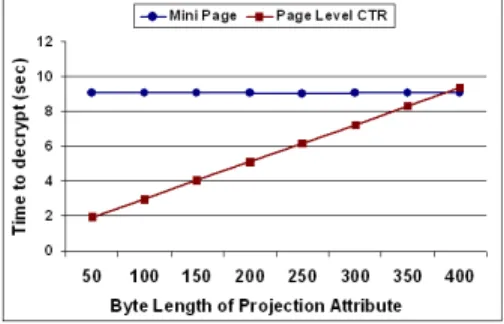
To observe the selective decryption property of page level CTR encryption method, we wanted to analyze the performance of projection queries in this experiment. As it is shown in figure 3.3, in the page level CTR method, the time required to decrypt the encrypted projection attribute is proportional to the length of the attribute. However, it is independent in the mini page level since this method decrypts all sensitive attributes to read the projection attributes of tuples. In contrast, page level CTR, decrypts as much data as needed to be decrypted. Therefore, both of the techniques require almost the same amount of time when the projection attribute is the only sensitive attribute in the record.
As a result of this experiment, we observed that, compared to mini page level encryption, page level CTR has a significant impact on reducing the cost of projection queries.
Selection Experiments:
In projection experiments of page level CTR we were decrypting a certain amount of data for each record. However, in this experiment, in addition to selection attribute, we may need to decrypt the rest of the other sensitive attributes if the selection criterion is satisfied during query processing. This can be illustrated via an example, in which we have a table T with attributes A1, A2, and A3, where A1 and A2 are encrypted but A3 is not. In order to process a query such as ”SELECT * FROM T WHERE A1 = X”, the attribute A1 of each tuple should be decrypted. If the result of the condition A1 = X is true, not only A1 but also A2 should be decrypted. So, the performance of page level CTR depends on the selection condition of each tuples. Because of this reason, we repeated the experiments for different probability values of selecting a tuple.
The results of the experiments are shown in Figure 3.4, 3.5, and 3.6 where the probability of selecting a tuple is 30%, 60% and 100% respectively.
Figure 3.3. Experiment results for projection queries
Figure 3.4. Experiment results for selection
queries
Figure 3.5. Experiment results for selection
queries
Figure 3.6. Experiment results for selection
queries
An important point to note is that the time required to decrypt tuples increases gradually when the probability of selecting tuples increases. When the probability is 100%, the cost of decrypting tuples becomes independent of the byte length of selection attribute. In addition, the cost of decrypting tuples in page level CTR is slightly more than the cost associated with the mini page as it is seen in Figure 3.6. The main reason for this is the overhead of extra index calculations in page level CTR approach.
In the selection experiment, we observed that selective decryption feature of page level CTR causes significant performance gain if the selection probability is low.
3.4 Discussion
We now discuss other encrypted data related issues in database management systems.
• Key Management: Using careful implementation of CTR mode, we can encrypt up to
2128bits of data with a single key. Therefore, for most cases, we only need one encryption
key per table. These encryption keys must be either stored in tamper-proof hardware or encrypted with a master key. If the master key option is chosen, during the system start, this master key can be loaded by the database administrator. If we do not want to trust the DB administrator with the master key, we can use classic threshold schemes to store the master key. For example, using a(k, t)secret sharing scheme, we can distribute this master key to
tpeople and anykor more of them can come together to construct the master key [83]. For security purposes, in the CTR mode, the same counter value should not be used for encrypting two different blocks. A simple way to solve this problem is to maintain a global counter value for each encryption key in use and update the counter value after each incre-mentation.
• Insertion, Deletion, and Updates: As mentioned above, counter values in CTR mode could not be used again. At the same time, we keep one initial counter value per page and calculate the counter values needed for selectively decrypting some attributes of the tuples using this initial counter values. When we need to update a part of the page, we need to encrypt the entire page with a different initial counter value.
• Transaction ManagementWhen there is an insert, delete, or update operation, DBMS will write a log to the log file. Therefore, to protect the sensitive data, we also need to encrypt
the log file pages corresponding to encrypted tables. Otherwise, sensitive data values could be extracted from log files.
3.5 Conclusion
In this section, we discussed the performance of different block cipher m