Design and Implementation of Performance
Management for the DiffServ-aware-MPLS
Network
Dong-Jin Shin, Young-Tak Kim
Advanced Networking Technology Lab.(ANT Lab.) Dept. of Information & Communication Engineering,
Graduate School, Yeungnam University, Kyoungsan-si, KyungBook,712-749, Korea TEL : +82-53-810-2497 FAX : +82-53-814-5713
Email: [email protected]
Abstract
MPLS has been developed to provide efficient traffic engineering capability
for the massive high-speed Internet traffic. The major advantages of the MPLS
are (i) fast label switching mechanism to increase the packet forwarding
capability, and (ii) the connection oriented traffic engineering to provide flexible
load balancing in the transit network. DiffServ-over-MPLS architecture provides
differentiated services with guaranteed quality-of-service(QoS). For the
QoS-guaranteed service provisioning, current IP networks, although they offer
flexibility and scalability, need to be enhanced in availability and guaranteed QoS
provisioning. To guarantee the user-requested QoS and to keep the network
utilization at maximum, the performance management of DiffServ-over-MPLS is
essential. The performance management function monitors the network
utilization and verifies the network performance compared with the agreed SLA
(Service Level agreement).
In this paper, we propose an object-oriented(OO) performance management
module for the integrated management of DiffServ-over-MPLS network. We
define the managed object(MO) of the MPLS LSPs and ports of the MPLS
network, and provide the traffic monitoring and analysis by using the MO of the
LSP and port, so that we can easily manage devices that had been added newly to
the network. If the monitored performance becomes severely degraded, the
performance management module notifies the fault management module.
Performance management module stores log records of performance
measurement and analysis, and provides web-reporting on the performance
YEUNGNAM Univ. ANT Lab. DONG-JIN SHIN
(2)
APNOMS 2003
I. Introduction
Why NMS for DiffServ-over-MPLS is important?
Current Internet
Treats various kinds of service equally in best-effort manner. No guaranteed QoS provisioning.
No differentiated services. Necessary functions
Differentiated Service over MPLS (DiffServ-over-MPLS). Monitoring and analysis function about each flows.
So, we propose the DoumiMan(DiffServ-over-universal mpls internet Manager).
The major functions of the DoumiMan about the PM.
Monitor network utilization
Verify network performance compared with the agreed SLA.
End-to-end performance monitoring.
Analysis function of the DiffServ-aware-MPLS traffic.
I. Introduction
The major goal of Internet traffic engineering is to facilitate efficient and reliable network operations for high throughput while simultaneously maximizing the network resource utilization with optimized network performance[1-3]. Two most promising schemes for the efficient traffic engineering of Next Generation Internet are differentiated service(DiffServ) [4] and MPLS traffic engineering[2]. The two schemes have been proposed and developed individually, but can be applied as an integrated scheme[6].
As current Internet treats various kinds of packets equally in best-effort manner, there is no guaranteed QoS provisioning, and no differentiated services. To deliver services through the DiffServ-over-MPLS network, we must monitor and analyze each flow.
The network management system(NMS) must manage the real network to configure the performance management function to monitor the network utilization and to verify the network performance compared with the agreed SLA(Service Level agreement). Constraint-based routing for guaranteed QoS provisioning must be used in the LSP establishment phase. The established LSPs must be continuously monitored by the performance management function to verify the assured bandwidth and throughput. Two points measurement for end-to-end performance monitoring, and one-point measurement for throughput should be provided. Any severely degraded performance compared with the agreed performance level must be treated promptly to guarantee the agreed QoS provisioning[1].
The rest of this paper is organized as follows. In section II, we review the related works on the performance management function. In section III, we propose an end-to-end performance monitoring, and presents the analysis function of the DiffServ-aware-MPLS traffics. In section IV, we analyze the major results. Finally, in section V, we make conclusion.
YEUNGNAM Univ. ANT Lab. DONG-JIN SHIN
(3)
APNOMS 2003
II. Related Works
Standardizations of DiffServ-over-MPLS Traffic Engineering.
RFC 2702 : Requirements for Traffic Engineering over MPLS. RFC 2475 : An Architecture of Differentiated Services. RFC 3031 : Multiprotocol Label Switch Architecture.
RFC 3270 : Mutiprotocol Label Switching (MPLS) support of Differentiated Services.
IETF Draft : MPLS Support of Differentiated Services using E-LSP.
Standardization of performance management
RFC 2678 : IPPM Metrics for Measuring Connectivity. RFC 2679 : A One-way Delay Metric for IPPM. RFC 2680 : A One-way Packet Loss Metric for IPPM.
II. Related Works
The standardizations of DiffServ-over-MPLS traffic engineering have been pursued mainly in IETF[3-7]. Several MPLS network management schemes have been proposed and some NMSs are commercially available [9-13], but the functions for the DiffServ-over-MPLS are not fully supported yet.
Connectivity is the basic stuff from which the Internet is made. Therefore, metrics determining whether pairs of hosts (IP addresses) can reach each other must form the base of a measurement suite. The RFC2678 defines several metrics, some of which serve mainly as building blocks for the others [18]. The RFC2679 and 2680 defines One-way delay metric and One-One-way packet loss metric for IP performance management[19,20].
RATES(Routing and Traffic Engineering Server) has been developed for MPLS traffic engineering[9]. The RATES also supports restoration of LSPs with a restoration-capable online routing algorithm. RATES, however, does not support DiffServ and does not provide performance measurement and analysis functions.
Wandl’s IP/MPLSView is a tool for the network administers, performance management teams and IP/MPLS network control personnel to optimize time- and cost- savings, network bandwidth and network resources efficiently and productively[10]. It operates in a multi-layer, multi-vendor, multi-protocol environment, supporting the IP/MPLS configuration/performance management, network planning, VPN management, extensive report generation with fully web-enabled user interfaces. Wandl’s IP/MPLSView supports differentiated services (DiffServ) and VPN model as an additional feature.
Sheer Networks’ Broadband Operation Supervisor(BOS)[12] supports multi-layer (physical, ATM, Ethernet/VLAA, IP, MPLS, VPN) topology auto-discovery, real-time fault intelligence and root-cause isolation, GUI-based surveillance, service path tracing, service provisioning and activation, event correlation and service impact analysis, and IP-VPN service management. SheerBOS does not support DiffServ-over-MPLS services and traffic engineering.
YEUNGNAM Univ. ANT Lab. DONG-JIN SHIN
(4)
APNOMS 2003
network
Configuration of the DoumiMan system with the performance
management.
Fig.1 Configuration of the DoumiMan
II. Performance management for the DiffServ-over-MPLS network
3.1 Configuration of the DoumiMan System with the Performance Management
Fig.1 shows an example of real network management architecture for DiffServ-over-MPLS network[1]. The DoumiMan(DiffServ-over-universal mpls internet Manager) consists of layered management modules for IP Subnetwork & VPN network, the MPLS layer network, the physical layer network. Physical layer network creates the managed object (MO) that has the configuration information about the real network topology by using auto discovery module(ADM) service.
In the connection management, the fault management and the performance management of the DiffServ-over-MPLS network, the DiffServ-over-MPLS layer network provides various MOs. So, DiffServ-over-MPLS layer network management is composed of connection management (CM) module, fault management (FM) module, and performance management(PM) module. To construct attributes of the MOs from the real network, the MPLS layer network directly retrieves the attribute information of the MOs using the command line interface(CLI) of the Cisco router. IP Subnetwork & VPN network can compose a VPN network from multiple distributed VPN sites.
For the performance management in the DoumiMan system, we make the PMHandler module. It accesses managed object(MO) that was selected by user, and brings the throughput value. It changes the throughput into the bandwidth utilization, and send to MPLS Monitoring Graph Dialog and Log module.
MPLS Monitoring Graph Dialog module expresses bandwidth utilization on the screen monitor with maximum 8 of the LSP. The Log is the database, and it stores bandwidth according to the MO and the Date. And it provides reporting service through the Web.
YEUNGNAM Univ. ANT Lab. DONG-JIN SHIN
(5)
APNOMS 2003
III. Performance management for the DiffServ-over-MPLS
network (cont.)
LSP performance monitoring
Router# show interface accounting(if Cisco router,)
Fig.2 LSP PM Monitoring Sequence Diagram
3.2 LSP & Port Performance Monitoring
To manage the performance of MPLS layer network, the PerformanceManagerHandler module collects measured throughput(bandwidth) value from the MOs, and transmits the bandwidth value to the MPLS MonitoringGraphDialog module. Also it registers the measured throughput(bandwidth) value as log(Database) records for later analysis.
(1) LSP Performance Monitoring
Fig.2 shows the block diagram for the LSP PM monitoring. The MPLSNetworkView::MobileGUI transfers the LSP list and the Port number to enclose these LSPs to MPLSNetwork class in the XML format. The MPLSNetwork class changes the received Port Number to the reference address that is used in DoumiMan System, and sends the LSP list information to Port MO.
The port class runs the PerformanceManagerHandler class, and sends the Reference address of the port that receives from the MPLSNetwork class to the MPLSLSR class. The MPLSLSR class reads throughput of all LSPs that pass the port using the Cisco router's CLI (Router# show interface accounting), and returns to the Port MO.
The port MO converts the throughput value to the bandwidth, and sends it to the MPLS LSP class's LSP MO attribute. The PerformanceManagerHandler class reads the bandwidth in the LSP MO, carrys it to the MPLS MonitoringGraphDialog module, and registers as log(Database) record. The MPLS MonitoringGraphDialog Module shows the bandwidth value on monitor screen.
YEUNGNAM Univ. ANT Lab. DONG-JIN SHIN
(6)
APNOMS 2003
network (cont.)
Port performance monitoring
Router# show interface accounting(in Cisco router)
Fig.3 Port PM Monitoring Sequence Diagram
(2) Port Performance Monitoring
A port monitoring procedure has resemblance to the LSP monitoring. To require the PM monitoring of the port, the MPLSNetworkView::MobileGUI class transfers the Port List and ID of the Node that have ports of the Port List to the MPLSNetwork class. And it requests monitoring. Using the GetNodeFromID function, the MPLSNetwork changes the Port address into the reference address that is used to discriminate Port in the DoumiMan core modules. The Port MO carries the MPLSLSR class receiving the Reference address, and the MPLSLSR class gets throughput about each Port in the real network using the Cisco router's CLI (Router # show interface accounting), and transmits it to the Port MO. The Port MO puts the throughput that was received from the MPLSLSR class to the Port MO's attribute.
The PerformanceManagerHandler class reads the bandwidth in the Port MO, sends it to the MPLS Monitoring GraphDialog module, and registers as log(Database) record. The MPLS Monitoring GraphDialog Module shows the bandwidth value on monitor screen. Fig.3 depicts the block diagram of PM monitoring about port.
YEUNGNAM Univ. ANT Lab. DONG-JIN SHIN
(7)
APNOMS 2003
III. Performance management for the DiffServ-over-MPLS
network (cont.)
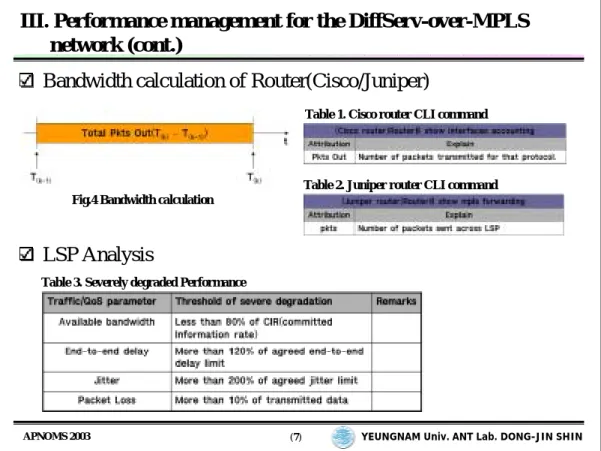
Bandwidth calculation of Router(Cisco/Juniper)
LSP Analysis
Table 1. Cisco router CLI command
Table 2. Juniper router CLI command Fig.4 Bandwidth calculation
Table 3. Severely degraded Performance
(3) Bandwidth calculation of Router(Cisco/Juniper)
For retrieving the throughput of the router, the DoumiMan that is the NMS system for DiffServ-over-MPLS network has various accesses to router through CLI. Table 1 and Table 2 shows two kinds of CLI commands; one is used for Cisco router and the other is used for Jupiter router, respectively.
Fig.4 depicts the conversion diagram from throughput to bandwidth.
As shown in Fig.4, we calculate the bandwidth from the difference of measured at T(k-1) and T(k), divided by time interval T(k) – T(k-1). In order to gather the total packet outputs, we use CLI commands shown in Table 1 and Table 2.
(4) LSP Analysis
To analyze the performance of LSPs, we need bandwidth of two points. One is ingress LSR, and other is egress LSR. We bring these bandwidths to MPLSLSR MO, and compare the bandwidth of LSP from ingress LSR and egress LSR. If loss rate is more than 20% of CIR, we conclude that the LSP is severely degraded, and request fault management to restore the LSP. Table 3 shows the criteria that determine the degradation of LSP.
When PM determines any severe degradation of performance, it notifies the performance degradation to the FM by using a LSPreference->IsNotifiedFault(), we reroute working path to back-up path by using the
YEUNGNAM Univ. ANT Lab. DONG-JIN SHIN
(8)
APNOMS 2003
End-to-end performance measurement
Traffic Generator & Monitor
network (cont.)
Fig.7 Clock synchronization packet format Table 4. Necessary formula in synchronization
Fig.6 Monitoring packet transmission between the Traffic Generator and Monitoring
UI(Input : Packet Size, Port)
UI(Input : Packet Size, Port) UI(Output : throughput,
end-to-end delay, jitter, packet loss) UI(Output : throughput, end-to-end delay, jitter, packet loss)
Generator Monitor VGC VGC TCP TCP UDPUDP VGC VGC TCP TCP UDPUDP VGC VGC TCP TCP UDPUDP VGC VGC TCP TCP UDPUDP
Packet Interval : Fixed, Exponential distribution Packet Size : Fixed, Normal, Exponential distribution
Packet Interval : Fixed, Exponential distribution Packet Size : Fixed, Normal, Exponential distribution
Fig.5 Block Diagram of the Traffic Generator and Monitoring
3.3 End-to-End Performance Measurement
(1) Traffic Generator & Monitor
In order to measure the end-to-end performance in DiffServ-over-MPLS network, we developed traffic generation and monitoring modules. In order to measure jitter, delay, loss rate, synchronization should be achieved between traffic generation and monitoring location. We use virtual global clock(VGC) scheme to maintain synchronized clock[14].
Fig.5 depicts the block diagram of traffic generator and monitor. Fig.6 depicts traffic send-receive pattern between traffic generator and monitor, and packet transmission procedure that is used to maintain the VGC synchronization[17]. We can get initial RTT STATE_INIT_RTD and STATE_RTD section using Loop-Back Delay at the initial-synchronization by VGC algorithm.
Using the formula in Table 4, we transmit several loop back packets, yield RTD average, and use RTD average as D(Delay)[14]. To decrease the burst Delay/Loss/Jitter effect, we apply smoothing techniques with equation (1)-(3). The equation(4) and (5) define throughput and packet loss.
In STATE_TRANS region, general traffic packets are sent to bandwidth between end users. To maintain the synchronization between Traffic Generator and Monitor, we must update VGC information using VGC algorithm periodically, so we transfer synchronization information between Traffic Generator and Monitor in the STATE_SYNC section. Here, a cycle of the STATE_ SYNC is 1 second [14].
When packet flows between Traffic generator and monitor, we divided the general traffic and the VGC traffic. The general traffic packets are used to create traffic. And the VGC traffic packet is used to maintain the synchronization. Fig.7 shows the formats of the clock synchronization packet.
YEUNGNAM Univ. ANT Lab. DONG-JIN SHIN
(9)
APNOMS 2003
IV. Experiment results and Analysis
GUI with the PM in DoumiMan system
(a) Port List Window (b) LSP List Window
Fig.9 Port and LSP List GUI Window
(2) Guaranteed end-to-end Performance Management
Queuing techniques used in DiffServ is used to keep performance in MPLS net that is offered can use various kind methods. If we use WRED queuing techniques, we can regulate maximum threshold and control drop probability. Therefore, we can control throughput, jitter, and user packet flow.
IV. Experiment results and Analysis
4.1 GUI with the PM in DouniMan system
In the DoumiMan System, we use GUI of the PM as shown in Fig.9. Fig.9(a) shows port list information that belongs to the selected router. In composition of the ‘Display Port List’ window, ‘Node IP Address’ field is address of the selected router, and ‘Show LSP List’ button is for the function that show LSP list belongs to Port, and ‘Start Monitoring’ button is for the function that starts PM of the selected Port.
Fig.9(b) shows LSP list information that belongs to the selected port from Fig.9(a). In composition of the ‘Display LSP List’ window, ‘Port IP Address’ field is the address of the selected port from Fig.9(a), and ‘Start LSP Mo…’ button is for the function that starts PM of the selected LSP.
If we select any router in MPLSNetworkView::MobileGUI, and choose port list command by right clicking on the selected router icon, we can see the port list information that belongs to the router. If we select any port to be monitored, and push ‘Start Monitoring’ button, then the PM handler module begins to monitor the port. In order to view the performance of all LSP information of a port, we can use the ‘Show LSP List’, then DoumiMan system shows the LSP information as shown in Fig 9(b).
YEUNGNAM Univ. ANT Lab. DONG-JIN SHIN
(10)
APNOMS 2003
IV. Experiment results and Analysis (cont.)
Traffic generator and monitor diagram
(a) Traffic Generator Diagram (b) Traffic Monitor Diagram
Fig.10 Traffic Generator and Monitor Diagram with the DoumiMan
4.2 Traffic Generator and Monitor Diagram
(1) Traffic generatorFig.10 depicts the designed and implemented traffic generator and traffic monitors for measuring end-to-end performance. We made the traffic generation module that creates packet data rate to maximum 10Mbps. The traffic generator can configure 8 kinds of different packet flows. The functions of traffic generator's field is shown in Table 5.
(2) Traffic monitor
The traffic monitor is composed of main window and monitoring window. Main window manages the flow that transferred from the traffic generator. And it calculates traffic/QoS parameters, such as throughput, delay, jitter and packet loss, and shows the calculated value by text format.
Monitoring window receives the calculated traffic parameters from main window, and shows the value in graph
Throughput control using slider Slider
Packet interval pattern Bit rate pattern
Throughput Bit rate[kbps]
Packet size pattern (Fixed/Exponential/Normal) Packet size pattern
Packet size by the user Packet[byte]
TCP/UDP Protocol
Port number using TCP/UDP connection Port #
IP address of the traffic monitor Target IP
Function Field
YEUNGNAM Univ. ANT Lab. DONG-JIN SHIN
(11)
APNOMS 2003
IV. Experiment results and Analysis (cont.)
Test network topology & Monitoring of DiffServ service and FM
Fig.12 DiffServ Monitoring with the DoumiMan
Fig.13 Fast reroute in the Cisco routers Fig.11 Test network topology
Area that DiffServ is applied
4.3 Test Network Topology
In order to evaluate the proposed scheme, we configure a test-bed network as shown in Fig.11. The test-bed network consists of four CISCO 3620 series as the customer edge(CE) network, two CISCO 7204 series routers as the provider edge(PE) network, and a CISCO 7204 series as the provider core network.
4.4 DiffServ Service Monitoring with the DoumiMan
For monitoring DiffServ services in the DoumiMan system, we constructs Tunnel 100, Tunnel 110, and Tunnel 120 on the test-bed network as shown in Fig.11. We configure Tunnel 100 for NCT traffic, Tunnel 110 for AF traffic, and Tunnel 120 for best-effort traffic. Fig.12 depicts the monitored traffic profile of each tunnel.
4.5 FM Monitoring with the DoumiMan
In Fig.13, for monitoring of the fault management(FM) in the DoumiMan, we constructed the Tunnel 110 as working path LSP with 7204_G as ingress LSR and 7204_F as egress LSR. And, we configured the Tunnel 150 as the backup path with 7204_G as ingress LSR and 7204_F as egress LSR through 7204_H.
If a fault occurs in the working path, the MPLS router automatically reroutes the working path onto backup path according to the configuration of “fast reroute” by DoumiMan. The changes of traffic flow through working LSP that is rerouted to backup path by the DoumiMan system. Fig.13 shows the monitoring result.
YEUNGNAM Univ. ANT Lab. DONG-JIN SHIN
(12)
APNOMS 2003
V. Conclusion
We proposed in this paper:
Configuration of the DiffSer-aware-MPLS network with the performance management by DoumiMan
LSP performance monitoring Port performance monitoring Bandwidth calculation of Router
Cisco router Juniper router
LSP analysis
End-to-end performance measurement
Traffic generator & monitor
Guaranteed end-to-end performance management
Future works
Exact synchronization mechanism among the monitoring/measurement points Network load balancing and performance tuning functions to the DoumiMan system
V. Conclusion
In order to manage DiffServ-over-MPLS network we designed and implemented an object-oriented NMS named DoumiMan(DiffServ-over-universal mpls internet Manager). The proposed NMS manages real MPLS network using MOs that represent the real network elements. It is extensible and modifiable.
In this paper, we also explained the procedures to manage the port or LSP of the MPLS network by the PM in the DoumiMan. In order to measure traffic of the Port/LSP of any Router, we added the monitoring function into DoumiMan. When the measured performance does not provide the agreed QoS level defined in SLA, PMHandler of DoumiMan initiates notification procedure to the FM. To measure the end-to-end performance using the proposed NMS, we designed and implemented traffic generator and monitor. In order to evaluate the proposed DoumiMan system, we made a simple test-bed, and evaluated the produced PM result.
For more accurate performance analysis, we should enhance the synchronization mechanism among the measurement points, such as ingress and egress router. We are developing network load balancing and performance tuning functions for the DoumiMan system.
References
[1] Youngtak Kim, "DoumiMan (DiffServ-over-universal-mpls internet Manager) for Guaranteed QoS Provisioning in Next Generation Internet," Proceedings of ITRC Forum 2003, June 4, 2003.
[2] Xipeng Xiao et al., “Traffic Engineering with MPLS in the Internet,” IEEE Network, March/April 2000, PP.28~33. [3] RFC 2702, Requirements for Traffic Engineering over MPLS, Awduche et al., September 1999.
[4] RFC 2475, An Architecture of Differentiated Services, S. Blake et al., December 1998.
[5] RFC 3031, Multiprotocol Label Switch Architecture, E. Rosen, A. Viswanathan, R. Callon, Jan. 2001. [6] RFC 3270, Mutiprotocol Label Switching (MPLS) support of Differentiated Services, April 2002. [7] IETF Draft, “MPLS Support of Differentiated Services using E-LSP,” S. Ganti et. Al, April 2001. [8] MPLS Forum Super Demo 2002 – Test Plan & Results.
[9] Petri Aukia et al., “RATES : A Server for MPLS Traffic Engineering,” IEEE Network Magazine, Mar./Apr. 2000. [10] Wandal IP/MPLSView, ttp://www.wandl.com/html/mplsview/MPLSview_new.cfm.