A
N
O
PERATIONAL
N
OTE ON
T
RANSITIONAL
R
ESULTS
M
ATRICES
U
SING RESULTS
-
BASED FRAMEWORKS IN
FRAGILE STATES
UNITED NATIONS DEVELOPMENT GROUP
WORLD BANK
I. EXECUTIVE SUMMARY
1. The Transitional Results Matrix (TRM), also referred to as a Transitional Calendar or Results-Focused Transitional Framework (RFTF), is a planning, coordination, and management tool that national stakeholders and donors can use to better prioritize actions necessary to achieve a successful transition in fragile states. The TRM helps launch a poverty reduction strategy (PRS) approach in these environments, either by acting as an early framework to lay the groundwork for a PRS or, later, as a way to operationalize poverty reduction strategies in low capacity countries.
2. The results-based approach of the Transitional Results Matrix was developed by national counterparts, the United Nations Development Group (including extensive work by the UNDP), and the World Bank, with the participation of other IFIs and bilateral donors. The purpose of this note is to provide insights from the operational experience: core principles, key elements and parameters, likely risks and strategies to mitigate them. The TRM is a nationally-owned document, developed with technical and process support from development partners.
3. Transitional Results Matrices are currently being developed and used in five fragile states, characterized by weak policy and capacity, and, in many cases, a fragile political and security situation. Of the five countries where the Transitional Results Matrix tool has been piloted to date, four are emerging from armed conflict and one is in a transition to democracy after a coup.1 In all cases, the fragility of the transition was characterized by four challenges: strong links between political and security reform and delivery of economic and social programs; the need for prioritization in an environment characterized by high needs and limited capacity; unrealistic expectations, on the part of both donors and the population; and the need for urgent action to sustain momentum.
4. Although the Transitional Results Matrix is not a panacea that cures all fragile states problems, the TRM can contribute to addressing these challenges by providing focused support to nascent national leadership to –
• place key actions, outputs, and results for political, security, economic, and social priorities in a simple calendar framework
• clarify and manage expectations (population, leadership, donors) by increasing realism on timing and forcing prioritization
• identify in advance periods of overload and sectoral linkages
• highlight and address actions lagging behind (e.g., voter registration before elections)
• provide a basis for dialogue with donors on resource mobilization and allocation among sectors
1 Timor-Leste (2001-2002, 2002-2005), Haiti, Liberia, and Sudan (all post-conflict); and Central African Republic
(re-engagement in a fragile transition).
Box 1: Summary of Transitional Results Matrix Principles
Transitional Results Matrices help apply the poverty reduction strategy principles of a unified, country-driven plan to fragile settings. TRMs are based on five principles, derived from the Rome Declaration and its harmonization agenda but adapted to the circumstances of fragile states in transition. Matrices need to be simple, selective, integrated across political, security, economic and social aspects of recovery, nationally owned, and have sufficient donor buy-in. They promote the use of outcome indicators and monitorable targets, including intermediate indicators to track progress of recovery programs. They function as a management tool for strategic planning and implementation monitoring and an umbrella for donor coordination. In this way, the framework can become a compact of joint responsibilities between country authorities and the donor community. By enhancing transparency across the board, TRMs can create strong incentives to achieve more visible results in post-conflict reconstruction and provide a basis for participation and domestic scrutiny by civil society organizations.
2
II. RATIONALE AND CORE PRINCIPLES
A. Understanding the rationale for an overarching planning framework in fragile states in
transition.
5. In most low income countries, the Poverty Reduction Strategy (PRS) process drives prioritization and costing of development activities; it also ensures closer donor coordination and alignment in support of improved development results. The TRM is a possible tool to operationalize the PRS process in low capacity, transitional environments, and is consistent with the PRS principle that encourages a high degree of country ownership and customization and harmonization between donors.
6. As a country organizing framework in settings that do not allow for full PRSP process, the TRM provides a “quick and dirty” tool with which to identify key priorities, measure early results, provide a framework in which to embed assistance programs and capacity building initiatives, and function as a vehicle for donor coordination in challenging situations – ranging from abundant resources and high expectations (Timor-Leste), to little money and a legacy of mistrust (CAR). The process of developing a TRM requires a transparent dialogue on capacity issues, and budget constraints. In developing a focused transition framework, the national government works with stakeholders to specify what is to be done, by which institution, and within what approximate timeframe.
7. Political and post-conflict transition plans in the past have suffered from:
• a lack of an overarching nationally-driven plan to which all donors agree, resulting in fragmentation, gaps or duplication in aid-financed programs
• inadequate links between priorities in the political and security arena and priorities in the
economic and social arena
• overloading new governments with too many simultaneous decisions
• loss of momentum after the key transition event (peace agreement, international donors
conference)
• unrealistic expectations on the part of the population (breadth and speed of restoration of
service delivery, individual perceptions of the “peace dividend” to be delivered), national leadership themselves (technical and managerial demands of managing reform or reconstruction, ease or speed of governing compared to leading a resistance, personal or political “pay-back”), and donors (speed of disbursement; how quickly and how deeply reforms can be implemented or state functions can be restored).
8. The use of TRMs in the five countries to date has sought to address these problems:
• by providing a management tool for national authorities to use as a calendar for focusing on key actions;
• by explicitly identifying the links between political-security matters and economic-social issues;
• by articulating a compact between national authorities and their population and providing a framework for demonstrating benefits and gains achieved during the transition; and
• by serving as a catalyst for harmonization among donors, allowing for improved donor coordination, and articulating a compact between the national government and international donors.
9. Experience shows that the very process of developing a results-focused Transitional Results Matrix, identifying key priorities and balancing comprehensiveness with selectivity, can generate significant
3
benefits for a fragile country. Developing and then using a prioritized, selective Transitional Results Matrix helps a low-capacity government get in control, disciplines donors, and fosters coordination and harmonization. National government leaders who have used the Transitional Results Matrix report that it has helped them approach the daunting challenges of mobilizing political will, managing expectations, and structuring dialogue with donors on the mobilization of technical expertise and financial assistance. Of course, political and post-conflict transitions remain very fragile: a good results-focused transitional framework may help in the ways outlined above, but will not be sufficient to guarantee success, and many risks will remain in implementation.
B. Core principles for developing Transitional Results Matrices.
10. Transitional Results Matrices rely on five core principles. These principles build on the comprehensive development approach and the Rome harmonization agenda, but are adapted to the circumstances of fragile, low-capacity states. Good matrices are simple. They must come in a clear format and be easily readable by all stakeholders. Actionable matrices are selective. They need a limited number of focused targets and they must be prioritized to offer sequenced strategic direction. Successful matrices are integrated. They link policy actions and donor interventions across all areas where lack of progress would risk reversal in the recovery process, from political and security issues to economic and social recovery. Effective matrices are nationally owned. Ownership by national leadership is a necessary condition for reforms to be promoted efficiently and sustained after the initial momentum of intense donor interaction fades. Transitional results matrices must get sufficient donor buy-in to see promises translated into financial commitments, disbursements and priority technical assistance and to avoid the fragmentation of donor dialogue and assistance, with associated high transaction costs.
11. Simple. While simplicity is a virtue for any high-profile national document, making information
more accessible to a wider range of stakeholders, this is especially crucial in a fragile states setting. National capacities are thin, communication between stakeholders is most often limited, and the dynamics of politics may create fractures where complex information could be lost or mis-used. In this context, the TRM should be presented in clear language that is accessible to non-specialists, without overly technical terms that would reduce effective debate or dissemination. When communication barriers exist (especially those that divide along ethnic or historical lines of power), the TRM should be translated into relevant languages to further facilitate wide discussion and understanding. Simplicity also means specificity; clarity about the means to the stated ends, but not necessarily extensive technical details. The discussions and process that underpin communicating these simple priorities can help build a more robust capacity that in turn will support a more effective PRS process.
12. Selective. Selectivity and realism in transitional plans is critical in environments of low capacity
and high risk. There are strong forces at work against selectivity in fragile states. Needs are often overwhelming, expectations may be misaligned between government and population or between government and donors – but the risk of failure when a transition plan is overly complex or ambitious is very high, and thus the pressure for selectivity must also be strong. In many cases, selectivity will require that sectors be allowed to differ in the complexity and comprehensiveness of their “part” of the matrix, as per their capacity and the specific transitional challenges facing them. In developing the TRM, it is
Box 2: Simple and Selective - the Transitional Results Matrix as a Management Tool
The Timor Leste Matrix of Key Reconstruction Benchmarks, developed in mid-2000, included only a small subset of the hundreds of actions that were underway as the UN Transitional Administration for East Timor (UNTAET) supervised the creation of an entire new country from the ashes of a long-standing violent conflict. Each of the items in the matrix – e.g. “ex-combatant reinsertion framework in place” – had a number of other actions linked to it, supporting it or resulting from it, but instead of a long “to do” list for the new nation, the matrix presented key actions simply, in terms that all stakeholders could understand. The pattern of using this Transitional Results Matrix as a tool for management and information dissemination continued through the post-Independence period, when the Transitional Support Program Action Matrix became a commonly held document, translated into all national languages and used in meetings with civil society.
4
important to distinguish between selective results and a selective process: while the desirable end result is a matrix that focuses on a few key reform goals that will generate visible results and strengthen a platform for further reform and reconstruction, the process needs to be inclusive and broad-based, both to encourage a wide sense of national ownership and to ensure that the priorities chosen were selected from a comprehensive field of information. Balancing this tension between the principle of selectivity and the principle of national ownership requires managing the trade-off between prioritization and “buy-in”; creating a process which allows national stakeholders to define ownership as participation and involvement rather than as development of a TRM that includes all of their personal priorities.
13. Integrated. Effective and monitorable matrices link policy actions and donor interventions to
priority outcomes in each area where lack of progress would risk reversal in the recovery process, from political and security issues to economic and social recovery. Political and security actions will often be a priority in these settings: it is important to ensure that they are given the importance they deserve in early planning and budgeting exercises. Experience has shown repeatedly that political and security challenges are often not specifically addressed in the same arena as economic and social reconstruction. This has in cases led to serious shortfalls in funding for critical interventions in the political and security spheres, interventions that are critical to creating an environment for economic and social programs to deliver benefits for the population. Well designed economic and social programs can help contribute to political stabilization; ill-timed or badly targeted programs can undermine it. Lastly, it is important to ensure that security issues are treated as an integral part of the national planning and budgetary process, rather than through separate fora which may lead to a lack of transparency or the taking of decisions which are fiscally unsustainable or undermine other reconstruction efforts. The logical linkages must be made clear, between the current situation (fragile transition or post-conflict reconstruction), the key challenges and relevant desired short- and medium-term outcomes, and the government policy actions and donor interventions to be undertaken.
14. Nationally-owned. As aid effectiveness literature has demonstrated, national ownership cannot and
does not require one hundred percent national consensus; rather, ownership runs along a spectrum of participation, dialogue, sharing information, contribution, and sufficient agreement between key stakeholders to ensure that a transitional process will not be derailed by unexpected opposition. Building and maintaining ownership is a dynamic process, one that often involves persuading new groups to support a reform program as its net benefits become clear, and may also require modifying the program to reflect evolving experience and changing circumstances. This is particularly true in fragile states. This principle of dynamic ownership suggests that TRMs can choose an incremental reform strategy that establishes early agreement and offers quick benefits to groups that are potential constituencies for further reforms, and
Box 3: Integrating Interventions across Political, Security, Economic and Social Spheres
Liberia’s Results-Focused Transition Framework identifies the full range of essential actions needed to safeguard the transition, including political and security actions, and for each priority outcome in a sector/cluster it identifies the critical results required in each time period. For example, in order to produce “government functions implemented through a merit-based public service”, the transition government plans to first complete a census of civil servants present and working (including information on qualifications), while simultaneously public safety and security for government workers in key rural areas, then remove persons absent from the payroll, then develop new regulations and begin systematic testing under a new system of oversight and transparency.
The results action matrix under development in Sudan also pays close attention to integration. The matrix under development explicitly acknowledges the links between security and political dimensions of the peace process and desired economic and social reconstruction, based on good governance with special focus on economic governance:
• Oil revenue transfers and wealth-sharing agreements are central to the peace process
• Effective security arrangements are critical to permit demobilization and redirection of military expenditures to social services and productive investments
• Coordination is essential on timing of security actions such as the redeployment from the garrison towns and the start of new civil administration support and reconstruction initiatives.
5
undertake those actions using a process that increasingly broadens the circle of participation in, and support for, the reform agenda. It will be important in post-conflict countries to also ensure that where a national reconciliation process is underway, or a power-sharing arrangement established, that the groups that are part of those processes or structures should be engaged in the development of the matrix – this will be time-consuming but well worth the investment as it broadens and stabilizes the transition effort.
Box 4: Developing National Ownership while Building Common Capacity
In preparations for the Joint Assessment Mission in the Sudan, the United Nations and the World Bank supported a series of facilitated sessions and skills training workshops to be undertaken with sector teams (international experts and Sudanese) to build a robust common capacity including both process and technical skills. This included a joint diagnostic session on what substance and form the outputs of the JAM should include, and a series of facilitated discussions through which the value and purpose of a results-focused TRM was identified and the desired format agreed upon. Teams began their cluster assessments with a common view of their final work product, knowing the matrix would guide the reconstruction efforts.
15. The role of donors in nurturing national ownership must be handled with care; in a very fragile setting, the goal must be to help national counterparts find their stake in how/when the matrix is prepared, to put them in the “driver’s seat” from the beginning, and support them in remaining engaged. This will require taking time for a process of discussion amongst national leadership and technical counterparts, identifying and nurturing champion(s), broadening support, and anticipating incentives for sabotage. It often helps to define “ownership” pragmatically; ownership may begin based on a few key national stakeholders and become broader over time as the process of developing and implementing a matrix proceeds.
16. Donor buy-in. The Rome harmonization agenda attests to the widespread recognition of the need
for unifying mechanisms, but the divergent agendas and incentives of different donors remains a reality. A TRM process that takes a whole-of-government perspective allows creation of a sense of ownership where individual actions are informed by but not driven by donors; the overall scope is sufficient that both key donors and country leadership have had a genuine role in shaping the transitional agenda, and commitment is not limited to how many actions each Ministry or each donor has inserted in the TRM. Donor buy-in to a Transitional Results Matrix is likely to be increased where donors are involved early on in discussions, either through a joint assessment mission or regular meetings and consultations. A realistic TRM will also help donors in planning and timing their program commitments and in reporting back to headquarters on expected and actual results. A matrix that is being implemented as planned provides a powerful advocacy
Box 5: The case of the Central African Republic: the challenge of “ownership”
Early buy-in for the Transitional Results Matrix in CAR was leveraged by a single Minister, who (along with key donors) hoped to use the process itself to build broader support throughout national government. Using a rapid “mini-JAM” as an analytical base, a detailed Transitional Results Matrix was developed and then discussed. An abridged version of the TRM was finally agreed upon, to serve as the basis for government’s efforts to encourage the international community to re-engage.
Because early ownership was so narrow, the future usefulness of the TRM was placed in jeopardy when the Minister resigned, but the ongoing discussions amongst national leaders and donors soon proved that enough momentum had been developed to continue using the matrix as a mechanism for identifying priority actions. In late 2004, the UNDP and the Bank assisted Government leaders in organizing a peer-to-peer leadership seminar in which former leaders from three other African countries shared their own experiences in managing difficult transitions, specifically addressing some of the key areas in the CAR matrix. During the seminar, the matrix “anchored” discussions of the challenges facing the country, generating a stronger commitment to it amongst the diverse group of stakeholders.
This evolving base of national ownership seen in CAR was also the dynamic observed in the case of the Benchmarks Matrix in Timor Leste in 2000-2001, where ownership grew broader and deeper over time.
6
tool for donors when they engage with their own domestic constituencies, but this can not be allowed to be the sole ‘engine’ of the TRM process – the matrix must be more than a tool for leveraging money.
DEVELOPING THE TRANSITIONAL RESULTS MATRIX (TRM)
C. Key elements in a Transitional Results Matrix.
17. LICUS present very different characteristics and needs. A one-model-fits-all approach is unlikely to produce significant results. Post-conflict countries (Timor Leste, Afghanistan, Liberia) which require comprehensive reconstruction efforts, and are generally supported by high volumes of aid, may be able to achieve more ambitious short-term results than the non-post-conflict transitional LICUS, which adopt reforms as they seek a normalization of relations with the international community. This group (for example, Central African Republic, Guinea Bissau) typically experience a more gradual international re-engagement, with lower initial aid volumes - they may therefore require a more disciplined prioritization of efforts due to limited external financial assistance in the initial period. In both cases, the legitimacy and capacity of governmental authorities during the early reform period may impact the process and content of a transitional results matrix. There are certain minimum elements that a Transitional Results Matrix is likely to include, tied to the principles outlined in Section C; this minimum scope is discussed in Section D, while Section E addresses the wide range of possible country-specific elements.
D. Defining the scope of Transitional Results Matrices.
18. Literature on poor performers, in particular on conflict-affected countries, emphasizes the interdependence of political, security, economic and social factors. An effective Transitional Results Matrix will define a scope that addresses and mitigates key risks in the transition, identifies actions that will make progress towards essential recovery goals, and provides for visible results with benefits for the population.
19. The primary decision rule for identifying the priority actions is that a TRM should address the crucial areas where lack of progress would risk reversal in the stabilization and recovery process. For weak or failed states, recovery often means re-establishing a legitimate role for the state. The minimum necessary to do this generally includes progress on national reconciliation, re-establishment of security and public safety, achievement of a minimal level of functioning public finance systems and provision of at minimum basic service delivery and economic recovery Thus, the basic minimal framework for an effective TRM would include pillars or clusters which cover these four key functions: political, security, public finances, and social/economic recovery.
20. It is important to note that in each of these four functional areas (all critical to creating a stable governance environment), many priority actions tend to either be invisible to the population at large (security sector reform, strengthening revenue management) or to involve the removal of abuse (militia activity, illegal taxation) rather than the provision of a positive service. Thus, the TRM should also provide
Box 6: Building Broad Commitment from Donors
In Liberia, the Results-Focused Transition Framework is the overarching framework used for donor alignment and harmonization in support of government’s priorities. While the framework is still new, the first six monthly review of progress showed that the framework worked effectively in identifying lags in both government action and donor support facilitating a structural discussion of actions to fix these problems. In post-independence Timor-Leste, 30% of the recurrent budget is supported by a multi-donor budget support trust fund that is guided by the Transition Support Program (TSP) Action Matrix. Individual TSP donor countries participate fully with Government and the coordinating World Bank team in missions to review progress on key actions; while individual viewpoints and input often differ, the consensus of stakeholders on the “whole-of-government” scope of the matrix, and active involvement of all donors, ensures continuing support even when opinions differ on individual items.
7
for actions that are more visible to the general public. In filtering the many possibilities for priority actions, select those that are possible with limited implementation capacity; include some that generate modest but tangible “quick wins” that deepen or broaden national ownership and support for reform, and do not exacerbate political or social tensions.
21. As important as the early and visible delivery of tangible benefits can be, there are other much less visible actions that must be initiated early on even though their benefits will not be felt for some time. Strategic and planning efforts must not be delayed; sector visioning, strategy development and policy formulation, definition of institutional capacity needs and planning for the associated capacity development – these less tangible, less immediate efforts can be launched at the same time that more specific activities deliver concrete results. These activities are critical to underpinning future development dialogue, without which ownership of the process risks becoming nominal rather than national.
22. The TRM should also consider actions that address direct conflict risks, with a bias towards those that are critical to peace building and stabilization, deliver a quick peace dividend to the population, and help create legitimate national institutions. A comprehensive post-conflict needs assessment (PCNA) can help ensure the TRM is built on solid analytical ground, while conflict analysis, an important component of a PCNA, can help identify these sectors, orient sectoral assessments towards those issues most relevant to the peace process, and set conflict-sensitive sectoral targets.2 In all fragile states where there is a risk that conflict is nascent or simmering, an important role of the matrix is to explicitly seek to monitor and mitigate the causes of conflict.
23. Care must be taken that in delivering concrete and tangible peace dividends no irreversible mistakes are made; in Timor Leste, early decisions created a de facto minimum wage that has left the country with an uncompetitive labor cost structure that does not attract investment, while lack of attention to cost recovery in the power sector created a liability in both budget and political terms.
E. Considering country-specific factors.
24. Different countries face very different immediate priorities: some fragile states may face a window of opportunity for fast structural reform, while in others, too rapid structural reform may be destabilizing, with immediate priorities focusing on rebuilding familiar administrative and service delivery functions or reestablishing government presence in rural areas. In some fragile states, humanitarian assistance may be a significant priority and NGOs important service providers; in some cases the deployment of peace-keeping operations or an agreed electoral transition may be the focus of attention. Taking into account these factors, each country will need to develop a TRM based on its own priorities and capacities: the goal should be to achieve “best fit” rather than “best practice”.
25. Field experience in the five countries where matrices have been used illustrates the range of country-specific priority actions:
• For Timor Leste during the immediate post-conflict transitional administration, creation of an entirely new government structure capable of delivering basic services; Timor Leste’s matrix included recruiting targets for key civil service functions.
• In the Central African Republic, the transitional government’s matrix directly links progress in national security with the electoral calendar, detailing steps taken with donors for training, equipping and deploying additional army and police forces.
• Liberia’s Results-Focused Transition Framework was developed under severe security constraints; an important priority action scheduled in the first six months of the matrix was completing field assessments outside of the capital city of Monrovia.
2
See the “Practical Guide to Multilateral Needs Assessments in Post-Conflict Situations”, World Bank, Conflict Prevention and Reconstruction Unit, Working paper No. 25 or UNDG link:
http://www.undg.org/documents/4937-PCNA_-_Practical_Guide_to_Multilateral_Needs_Assessments_in_Post-Conflict_situations.pdf c, . This document captures experience
8
• For Haiti, repeatedly ravaged by flood and famine, developing an improved early warning and natural disaster management capacity was an immediate reconstruction priority, playing a much more urgent role than it might in other countries.
• Even the structure of the matrix may require country-specific innovations; for example, in the case of Timor Leste in 2000, the existence of a UN transitional administration motivated the inclusion of a separate column for “administrative handover” in the reconstruction matrix. 26. In fragile states undergoing a post-conflict or governance transition, there is great potential value in the role of TRM in demonstrating results which can increase a new government’s credibility or reduce their perceived status among donors as “difficult”. This support to a harmonized effort is especially valuable for LICUS countries in arrears, where credible and timely performance on relevant economic policy actions embedded in a TRM can facilitate resolution of arrears. In these circumstances, scheduling key actions related to arrears clearance or donor re-engagement may be an important part of drafting the Transitional Results Matrix.
27. Timing is highly country-specific. To the extent that Transitional Results Matrices are useful tools
for national governments even in the absence of donor support, they may clearly be developed at any point that national governments deem appropriate. Donors’ support is likely to be most useful where there is potential for renewed (or continued) peace-keeping, diplomatic or financial assistance, and where donors are willing to coordinate efforts together in support of the transition. This is likely to follow a clear political signal on the part of the international community, such as the conclusion of a recognized peace process, the deployment of peace-keeping troops, or structured international reengagement such as the European Commission’s article 96 process. In some cases the point at which “transition” becomes internationally recognized may be less clear, and close consultation with international stakeholders will be necessary to determine appropriate timing. Once a transition is underway, it is generally desirable to move quickly to establish an overarching planning framework and coordinate international re-engagement efforts, to avoid gaps, duplication or fragmentation of assistance.
F. Defining the structure for a Transitional Results Matrix.
28. The Transitional Results Matrix is organized by clusters and sectors that are key to the recovery process. The number of clusters or themes or axis should not be fixed a priori; not all are “equal” in terms of either political or developmental significance, and some will be more important in the first 6-12 months than in the subsequent year. In some cases it may be worthwhile to include a particular sector simply in order to facilitate the active participation and sense of ownership of a key constituency or stakeholder group; perhaps a minister whose support is crucial, or a donor who wants “their” program validated by being included. The challenge is in knowing when to say “no”; as presented in Section H, selectivity is important.
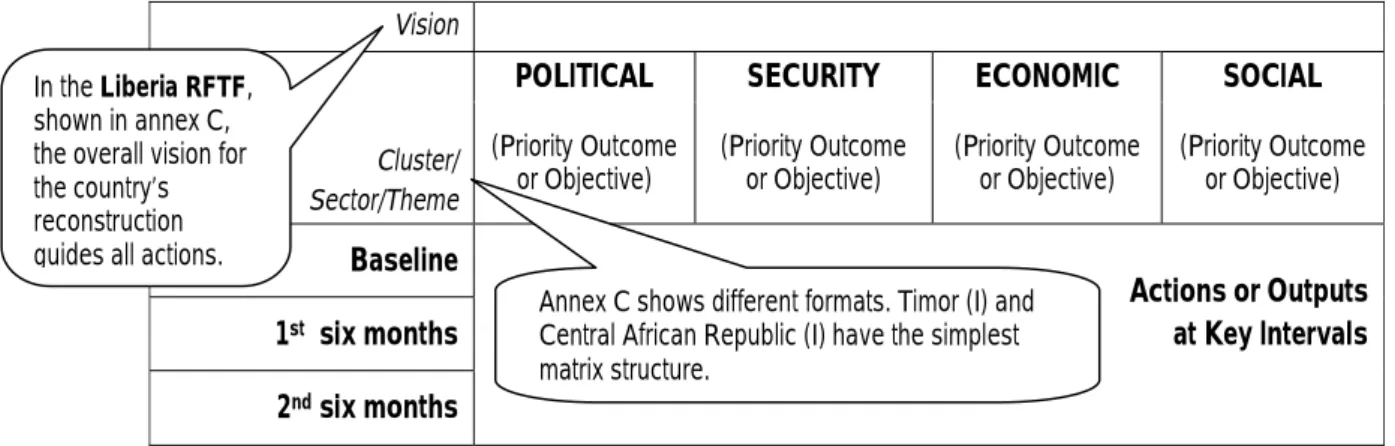
29. While there is no perfect format for a TRM, the decisions on structure –columns, rows, etc. – should be informed by an understanding of key elements:
Table 1: Basic Structure for a Transitional Results Matrix
Vision
POLITICAL SECURITY ECONOMIC SOCIAL Cluster/ Sector/Theme (Priority Outcome or Objective) (Priority Outcome or Objective) (Priority Outcome or Objective) (Priority Outcome or Objective) Baseline 1st six months 2nd six months Actions or Outputs at Key Intervals In the Liberia RFTF, shown in annex C, the overall vision for the country’s reconstruction guides all actions.
Annex C shows different formats. Timor (I) and Central African Republic (I) have the simplest matrix structure.
9
30. The ideal number of sectors and clusters (used synonymously hereafter) will depend on the country’s priorities and administrative capacity, and on the likely scope of donor re-engagement. Some clusters are more appropriate for post-conflict situations (humanitarian assistance), while others will be country-specific (diamond and forestry for the CAR). Post-conflict countries with strong donor support may develop comprehensive matrices with up to ten sectors, possibly including: security including demobilization and reintegration of veterans, political affairs, reintegration of refugees, community-driven development, health and nutrition, education, energy and telecommunications, environment, public finances, rural development, urban development, water and sanitation, transport, governance, employment generation, financial reform, private sector development, information dissemination and communication. 31. By contrast, transitional countries facing less dramatic immediate humanitarian needs, and those with limited or skeptical donor support, will more realistically want to focus on four or five clusters (security, political institutions, economic recovery, and basic social service delivery, for instance). A strategic cluster can regroup several sectors (health, education, social protection) or encompass a single sector only (private sector development). Many combinations are possible as long as the matrix remains manageable during the transition period.
32. The structure for a Transitional Results Matrix should include the following elements:
o strategic objective or goal – For each cluster or sector, identify the longer-term, more
strategic objective. This helps subtly in the process of refining and streamlining the Results Matrix; if it is just a list of actions, it is hard to refine or prioritize, but with a unifying objective, actions are tied to the strategic “big picture”. It is especially useful to anchor these strategic objectives, when appropriate, to the relevant Millennium Development Goal(s); clear linkages to nation-building or peace-making milestones are also appropriate.
o baseline – Although reliable data may be difficult to find across all sectors, it is important
to present the current situation, the baseline. If hard figures are not available; it can be a description of “where we are now”.
o intervals – Actions and priority outputs should be defined by time interval; go beyond
“immediate” or “medium-term” and fix specific dates. When selecting intervals, customize the Results Matrix to country-specific timing (dates for elections, removal of peacekeepers, etc.)
o targets and monitoring indicators – for each action there should be an observable target,
objectively verifiable and useful as a monitoring indicator. It may not necessarily be quantitative; e.g. “law passed” is as useful as “15% of veterans registered”, depending upon the action in question.
o responsibility – the Results Matrix should identify the agency or unit responsible for
implementation of each action, both for management purposes and to nurture a sense of “buy-in”, so national stakeholders “see themselves” in the process.
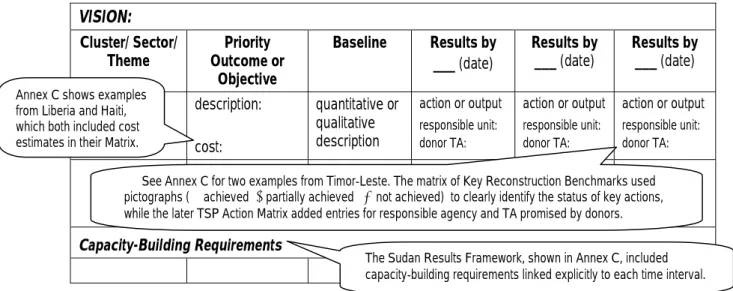
33. In cases where the Transitional Results Matrix is derived from a detailed needs assessment that was grounded in analytical sector work, there may be value in linking it to the budget, as was done in Liberia and Haiti, where all actions are costed. And just as the TRM should be based on financial resources available, so might the matrix make reference to capacity constraints and related investments required, as is being done in the case of Sudan.
10
Table 2: Expanded structure VISION: Cluster/ Sector/ Theme Priority Outcome or Objective Baseline Results by ___ (date) Results by ___ (date) Results by ___ (date) description: cost: quantitative or qualitative description action or output responsible unit: donor TA: action or output responsible unit: donor TA: action or output responsible unit: donor TA: Capacity-Building Requirements
G. Using needs assessments as a platform for developing the TRM.
34. In order to play the role of setting out national priorities for the transition period, the Transitional Results Matrix must be based on a broad diagnostic effort. In many LICUS, however, leadership may lack experience in peacetime national planning, and comprehensive data on key sectors may be missing or outdated. A Joint Assessment Mission (JAM), also referred to in post-conflict settings as a Post Conflict Needs Assessment (PCNA), can often be the best platform upon which to build a matrix of priority transition results. A JAM, or PCNA, groups national counterparts (from inside and outside government where possible) and donors into sectoral or cross-sectoral (e.g., gender, human rights) teams responsible for drafting a strategy addressing the main transitional challenges. The goal of the resulting plan is to clarify priorities and harmonize the respective contributions of the different thematic teams into one coherent multi-sectoral strategy that is realistic in scope considering the country’s capacity and financial constraints. 35. Given the large number of participants and the differences among donor institutions in their mandates, constituencies or bureaucratic culture, strong coordination is essential. Key lessons learned on JAMs include the need for: (i) strong participation of national leadership and technical counterparts; (ii) effective preparation to identify national and international participants and agree upon terms of reference; (iii) attention to logistics; (iv) use of clear, standard results matrix and budget formats for teams; (v) establishment of a follow-up mechanisms for coordination; (vi) link to subsequent national planning and budget processes; and (vii) high level of cooperation between international partners, especially the UNDG and the World Bank.
36. A significant subset of experience to date in undertaking joint assessment missions comes from those conducted in post-conflict settings. A recent comprehensive review of these post-conflict needs assessments (PCNAs)3 highlights key conceptual issues, including the need to embed the process within a longer-term vision on reconstruction, linkages to other processes, the selection of priority sectors, approaches to costing needs, integration of cross-cutting issues such as gender and environment, and the need to focus on institutional capacity building.
37. Field experience in conducting JAMs/PCNAs shows that they are both a methodology and a process. As a methodology, the JAM/PCNA involves the technical assessment of recovery needs and development of a post-conflict transition strategy. As a process of consultation, negotiation and analysis,
3 Ibid. The Guide emphasizes practical approaches and recommendations, with a focus on sequenced steps, phases and
responsibilities.
See Annex C for two examples from Timor-Leste. The matrix of Key Reconstruction Benchmarks used
pictographs (√ achieved ≈ partially achieved χ not achieved) to clearly identify the status of key actions,
while the later TSP Action Matrix added entries for responsible agency and TA promised by donors.
The Sudan Results Framework, shown in Annex C, included capacity-building requirements linked explicitly to each time interval. Annex C shows examples
from Liberia and Haiti, which both included cost estimates in their Matrix.
11
the JAM/PCNA provides a platform for national and international actors to agree on joint priorities, define their commitments and prepare their activities. In practice, limitations on both national implementing capacity and international funds means that assessments must focus on those areas that will help stabilize the country, and promote the successful transition from violent conflict to peace.
38. To be practical and useful in the post-conflict setting beyond the initial pledging meeting, a needs assessment should produce a synthesized coherent planning document that outlines goals, outcomes, and necessary interventions, an end product that requires not only data collection and analysis but also filtering those analytical results to create a prioritized plan for the transition.4 A recent innovation practiced in Liberia, Haiti and Sudan involves integrating the matrix into the JAM/PCNA process – developing the TRM format collaboratively during facilitated sessions, further articulating the basic draft during pre-JAM training events for sectoral teams, and using the TRM to structure the results of the needs assessment.
H. Balancing comprehensiveness with selectivity.
39. Selectivity is made difficult in post-conflict and political transitions both by the wide array of needs present and the wide number of national actors and donors who will want to see their priorities included. With a JAM or PCNA, broad-based analytical and diagnostic work in all sectors should be available as a foundation. This allows the Transitional Results Matrix to be a selective product derived from a widely-cast net, but also creates pressure for the inclusion of many areas which may not be crucial for the success of the transition. Presence of an action or aid program in the TRM may be seen as validation, and the share of actions in the TRM seen as a predictor of share of budget resources and/or political importance for ministries and/or donors.
40. How to short-circuit this dynamic? Start open, broad, and diagnostic, then prioritize and filter. In the prioritization stage, it will generally be critical to establish a small group of key national counterparts (President or PM’s office, ministries of planning or finance, co-leaders for the PCNA, or others bearing in mind power-sharing arrangements and the role played by civil society) to produce the final TRM from submissions by sector teams – it is never possible to produce a selective document when drafting through a committee of 20 or 30 national counterparts and, in some cases, an equal number of donors. It is equally important to ensure the matrix is not perceived as a static long-term plan, but rather is viewed as the priority subset of a strategic development plan that has been agreed upon for immediate transition needs; in this way, areas which are not included do not feel that they are permanently excluded or ignored.
4
The Practical Guide on PCNAs strongly encourages using a results-based approach for the final phase of the assessment (the synthesis and planning using sectoral field results), to include strategic goals, priority objectives, target outcomes, and necessary actions (interventions).
Box 7: Building a National Matrix from Sectoral or Sub-National Matrices
In Sudan, the Transitional Results Matrix for the country is being created through a bottom-up process in which two sets of sectoral teams produce sub-matrices which are then aggregated into a sub-national matrix, one to be used by the Government of Sudan to guide transitional efforts in the north, and one to be used by the Government of Southern Sudan to guide reconstruction in the south. In Haiti, an extremely comprehensive national TRM is the product of detailed results matrices prepared for each sector identified as key to the country’s reconstruction; implementation of those sectoral matrices are overseen by sectoral coordinating groups comprised of government and donor members who monitor progress on key actions. In both these examples, assembling a national matrix that is realistic and balanced was dependent upon development of sectoral/sub-national matrices that were allowed differ in their comprehensiveness and complexity based on their capacity and the most urgent challenges facing them.
12
I. Identifying a time horizon and periodicity.
41. The time horizon of the TRM needs to be adapted to country circumstances. Dependent on national and donor preferences, it may support an agreed political transition (for example, an interim period leading up to elections) or may be independent of the political timetable. Post-conflict countries that have suffered severe human trauma, and institutional and physical destruction, will generally want a transitional framework which extends three years or more, to encompass recovery from the emergency phase; in Timor-Leste, the reconstruction period covered 30 months, and the Transitional Results Matrix used then also served as a foundation for the post-Independence “second-generation” matrix. Non-post-conflict countries may prefer a shorter period, designed to lead up to normalization of donor relations under a PRS or other national planning framework.
42. Several options also exist for periodicity – the TRM may specify quarterly, six monthly or annual targets. In general, more time-critical programs justify setting and monitoring more frequent intermediate targets. The simpler and more selective the program, the easier it is to monitor milestones frequently. Where fairly strong government capacity exists, choosing specific discrete actions to be reported upon quarterly can be a reasonable choice; however, the act of reporting takes time and effort, so in situations of lower capacity governments are likely to face diminishing returns in the effort needed to update the matrix and monitor targets this frequently – six months may be a better choice. Annually, however, tends to be too long a period in most fragile states in transition, where fast moving events on the ground will risk the process going off-track well before this is measured on an annual results basis.
43. The cycle of the TRM can be especially effective if it is aligned with national processes for planning and budgeting, such as being linked with the country’s fiscal year calendar. For example, if the fiscal year is the same as the calendar year, then it might be advisable to consider matrix targets and review processes scheduled for March and September, which would feed into the budget process.
J. Issues in sequencing.
44. Effective sequencing is an important success factor in countries where political and institutional capacity for reform is limited. Post-conflict LICUS recovery programs will generally follow three broad, sequenced phases: (i) quick wins and institutional capacity-building; (ii) large scale reconstruction and delivery through the state (where capacity takes time to build); (iii) resumption of a stable development and poverty reduction program. It is important to recognize that certain security and political governance actions will need to be tackled early on, especially where conflict is still simmering, or actions on economic or social . For all fragile situations, it may be important to sequence actions in the matrix to create some quick successes at the beginning to create confidence for more politically or technically difficult reforms at a later date.
45. Possible criteria for sequencing actions in the Results Matrix are: early actions should generate rapid, visible results; they should not establish institutions or expectations that will conflict with more medium-term policies or goals; and they should avoid actions which are likely to exacerbate social conflict. Sequencing is not strictly linear. While the broad phases identified here generally hold true, there are links between the phases. As implementation of the TRM unfolds, it may require iterations or adjustments such that the short-term actions and outputs do in fact contribute to the desired later actions and their medium-term outcomes, and keep pace with national capacities.
Articulating outcomes, outputs, and intermediate actions.
46. Results-based frameworks promote the use of outcome indicators as monitorable targets. The short timeframe used in most TRMs, and the lack of reliable quantitative baseline data, make long-term development outcomes difficult to specify for many key sectors. In addition, the time-dependent nature of LICUS results (employment generation in June may avert social instability, while November may be too late) argues for a stronger focus on intermediate indicators than would usually be the case in a results-based strategy (monitoring whether key procurement actions have been completed on time, for example). To
13
build this strong base of intermediate indicators, the TRM authors must explicitly articulate the linkages between desired results and the actions, policies, and investments required to achieve them.
Box 8: Examples of effectively linking actions, outputs, and outcomes. SUDAN:
Baseline: Literacy rate less than 30%; school infrastructure damaged.
Actions: Teacher training, curriculum development, textbooks published.
Outputs: Teachers trained, textbooks delivered, schools
built (measured annual intervals)
Outcomes: Increased access to primary education; increase in net enrollment; increase in literacy rate. HAITI:
Priority Objective: Revive and intensify sustainable agricultural production.
Baseline: Rural infrastructure degraded and destroyed; available seed supply inadequate.
Target Sept 04: Rehab 20km rural trails, 20 km rural ravines; repair 20 km canals, 45 pumps.
Target Mar 05: Rehab 250 km rural trails and 80 km rural ravines; repair 150 km canals.
Target Sept 05: Rehab 500 km rural trails, 120 km canals; village committees supervise + monitor.
LIBERIA: Intermediate actions and outputs:
Priority Outcome: Revitalization of primary health care system to deliver community based health + nutrition programs and services. After 6 months: Communities selected, grant funds for core activities made available, staff training programs initiated.
After 12 months: Progress in first group of communities (clinics rehabbed, staff trained, etc.); further 50 identified and mobilized.
After 18 months: 20 clinics operational; next 50 under rehabilitation; advanced training programs underway for preventative care.
After 24 months: Rehab and equip of community clinics complete; community committees in place to supervise and manage.
47. Identify major results first (e.g. school enrollment) and work backwards (e.g. school rehabilitation, textbook distribution, teacher training, contracts for school rehabilitation, recruitment of teachers, school mapping). Include time for decision-making on the part of cabinet, parliament, donors, and for the involvement of civil society – and recognize that these processes will be unwieldy at first, and that investments in time and skills will be needed to build that capacity. Include time for design and contracting for physical outputs, and for investigation of policy options, consultation on policy, and implementation, for legislative and policy outputs. Some results may require a household survey or complex administration to measure, and thus should only be specified when capacity will be available.
48. Outcomes should be clearly linked to key reconstruction or transition goals. For example:
• safe passage/no incidents of violence on major roads
• school enrollment > __%
• malaria death rate < __%
• population with access to potable water > __%
49. Outputs included in the matrix should be key results that are logically linked to and critical to the achievement of the desired outcomes, and to the extent possible should also capture tangible benefits to the population. These may range across:
• Physical: # of schools or clinics rehabilitated, km of road constructed or rehabilitated
• Services: # of animals vaccinated; # of ex-combatants demobilized, % caseload refugees returned; legal cases processed in X days; waiting time at port
• Events: election completed, a reform completed
• Resources: revenue collection as __% of planned
50. Intermediate indicators are also important in LICUS settings, because they provide the earliest opportunity to assess whether a high risk and time dependent program is on track:
14
• # voters registered
• legislation drafted and submitted to parliament
• # personnel recruited or trained in key sectors
• tendering of a large contract
• % budget expenditure against plan
51. The focus on specifying and tracking intermediate indicators can help a relatively inexperienced government keep a recovery program on track. One example of this dynamic process of articulating increasingly specific indicators, which both depends upon and supports a process of building national capacity to use those indicators, is the Transition Support Program action matrix in Timor-Leste, a “second-generation” TRM.5
52. In some cases, the Transitional Results Matrix is created using existing systems and processes (budget, in Haiti); in other cases, the development of the TRM drives the development of systems and institutions, by creating a process, and thus focusing attention on the priorities.
K. Financing the Transitional Results Matrix.
53. Actions in the TRM must be “financable” for it to function as a realistic transitional plan. Financing can be determined through three main mechanisms: (i) the national budget; (ii) donor commitments made on mission or in subsequent discussions with government and between donors; (iii) pledges at formal donor meetings. In general, the first months of a Transitional Results Matrix will only be feasible if actions are realizable with fast-disbursing donor resources (humanitarian projects, UN agencies, ongoing programmes and trust funds, bilateral grants, Post Conflict Fund or LICUS trust fund); failing an event that can leverage those resources, the matrix must begin with domestic resources or existing aid programs, due to the lag in committing and disbursing on new donor projects. Financing can also follow different modalities – technical assistance and project finance (Liberia, Central Africa Republic), pooled donor funds (Comoros), or budget support (Timor-Leste). There will often be a need to ensure that on-going humanitarian funding is not undermined by new pledges for recovery or development assistance, which may come from the same donor budgets. The important issue is less the form of financial assistance and more the coordination within an overarching framework, whether of bilateral programs or of budget support.
54. There are different mechanisms available to estimate costs and agree on amounts and modalities of financial support. For the cost estimates, JAM or PCNA outcomes can be directly used, or standard mechanisms for costing can be pulled from Bank or UN guidance on needs assessments. For agreement on financing amounts and modalities, the standard mechanism for a post-conflict situation is a pledging conference tied to the presentation of the assessment results (and the TRM); in a context where a transitional LICUS is seeking re-engagement with donors, a less visible (and less risky) process of informal consultations using the TRM as a centerpiece may be better suited to mobilizing resources.
L. Clear expectations in lieu of conditionality.
55. Conditionality refers to external assistance conditions, where any action agreed with government that is not met will trigger a suspension of funds disbursement. This often proves ineffective where funds are urgently needed to support essential services or a political transition and will be disbursed whether or not each individual condition is met. The TRM is based on the idea that clear expectations are more effective in these circumstances than specific legal conditionality. Rather than treating each action as a
5 The first use of a transition results matrix was the matrix of Key Reconstruction Benchmarks used in Timor Leste
during the UN transitional regime from 2000-2002. The positive experience of both donors and government with the matrix as a management and planning tool contributed to the decision to anchor the post-independence transition agenda, and the accompanying multi-donor budget support facility, in an action matrix, albeit a more sophisticated one. The TSP Action Matrix is currently in its third year of use.
15
Box 9: Using a TRM as a Development Partner Compact
In Timor-Leste, each year’s TSP Action Matrix is used as an ongoing management tool by Government and development partners to monitor progress (through quarterly progress reports and bi-annual joint government-donor review missions). For each priority listed in the matrix, it shows the Government agency or ministry responsible, and also lists the donor(s) who have offered or are already providing technical assistance in support of achieving that particular action. In this way, the joint commitment of Government and donors is made explicit and linked to the progress (or lack thereof) in priority actions.
condition, periodic reviews of the TRM and progress towards its planned outputs allow donors to clarify with national authorities their expectations on satisfactory progress being made against the broad program of key results, and to reinforce the link with donor agencies’ ability to justify further funding to donor domestic constituencies. Through frequent dialogue, donors and government discuss progress against the TRM targets, and revise those targets where appropriate: government should be clear that, while all concerned will understand if some specific actions lag, failure to make progress across the program as a whole will risk future financial support.
56. Moving towards using the TRM as a compact between donors and government, the matrix might include key bilateral actions and outputs; even though they are not under the sole control of government, if they are crucial to the reconstruction or transition process it is useful to highlight them in the matrix and show their linkages with other actions. By identifying actions of both national authorities and donors, the TRM also helps show where national progress is dependent on donor actions – and increasingly, the perception of success on the part of both donors and national government is overlapping, and aligned. This reduces the tensions and mistrust that are common in fragile LICUS, and creates opportunities for capacity building in new or renewing post-conflict states, through an ongoing monitoring process.
M. Operational lessons in developing a Transitional Results Matrix.
57. Experience from the LICUS countries where TRMs have been used thus far has generated the following suggestions:
Box 10: Key Lessons for Consideration
Output
• Keep the matrix simple: complex matrices (e.g. Haiti) have experienced problems in updating
information on targets and results.
• Be explicit in linking the TRM actions to capacity constraints that might threaten successful
implementation. Process
• In order to create a matrix that is simple and selective, take inputs for the TRM from a range of sectoral
planning exercises (for example, the sector clusters of a PCNA or sector ministries in government), but establish a smaller committee to ensure cross-cutting issues are considered and identify the “priorities of priorities” for the overall matrix.
• Since the TRM aims at helping to mobilize external resources and assist in donor harmonization, ensure
full consultation with donors in its formulation. Ensure early and clear agreement on the format and scope of the matrix between international actors responsible for leading political and security dialogue and those engaged in economic and social planning.
• Discuss at the outset the criteria for selectivity in developing the matrix and selecting key actions.
• Align the timing and frequency of the matrix milestones with critical processes like the fiscal year and
budget cycle, and build in mechanisms to reinforce those linkages. Use
• Once the first TRM is finalized, build ownership and commitment to the matrix by communicating
widely and seeking to constantly broaden the inclusion of stakeholders.
• Manage expectations in the process of defining the TRM, and then use the process of
monitoring/reporting on the Results Matrix as a mechanism for constantly re-aligning expectations throughout the transition or reconstruction process.
• Use the TRM as a basis for donor dialogue . . .
• . . . but embed the TRM in government’s regular planning and budget process to ensure it is seen as a
16
58. Setting Up the Process. Articulate a clear process with milestones to develop and communicate the
matrix and build ownership. Identify possible champions, key stakeholders as well as possible ‘spoilers’ and ensure inclusion and broad-spectrum participation as well as sequencing. Organize workshops of national stakeholders early on to reach agreement on process, standards, and expectations among key players before embarking on the substance of the matrix. Recognize and budget for the significant resources (e.g., staff time) that will be required.
59. Communication and ownership. Messages about the proposed matrix must be both clear and
consistent – to clarify expectations, to unify views of roles, benefits, and process, and to align expectations. Communicate widely, clearly, and repeatedly, to achieve the dual benefits of a matrix created by a tight small group and one that, once launched, is widely known and understood. Start with a larger “sensitization” – don’t deliver a blank matrix and ask government Ministers to “fill it in”, but rather get all players to agree on the need for prioritization, and roles that need to be played, and then collaboratively develop a process that can possibly meet those needs. Be conscious of the need to manage the politics of re-engagement – the value of re-engaging is not necessarily a universally shared vision, there will be divergence among donors, as power and priorities shift.
60. Selectivity and realism. Be explicit about the criteria used to decide what to include, and what not
– selectivity, prioritizing long wish lists, sequencing. Balance short-term gains with long-term goals. Commit to an iterative process – drafting, costing, re-drafting, finalizing. Be thoughtful about selecting intervals for actions and reporting, and use of baseline indicators. Plan to use the TRM as a mechanism for donor coordination and leveraging TA support, but realize that government must prove itself capable of delivering effectively on early actions promised in the matrix.
61. Expectations. Manage expectations throughout the process; government may develop a technically
sound and appropriately costed matrix of interventions and actions, but they may not have the capacity to implement all of them, and it will be important to accurately predict resistance that may exist to actions that represent a change of policy or a threat to vested interests.
III. USING THE TRANSITIONAL RESULTS MATRIX.
N. Using the Transitional Results Matrix for multiple purposes.
62. The process of developing a Transitional Results Matrix can be explicitly used as an opportunity to foster dialog between ministries, and amongst donors, to enable harmonization. Government can use the TRM as a tool to facilitate re-engagement by donors, pushed perhaps by a few reformist ministers, albeit with most technical inputs from donor specialists or consultants – but without Government participating in the work themselves, especially the upstream sectoral analysis, it is likely that the actions in the Results Matrix will be unrealistic. The international community cannot mandate the TRM by handing the Government a short-list of preferred policies or actions, but rather needs to act as a coordinator, mindful when critical actions are neglected, and ready to receive the matrix as a basis for negotiating future or renewed engagement.
63. The Transitional Results Matrix is a process-oriented instrument. It can be used as an instrument
for dialogue at several levels: national-national, national-donor and donor-donor. Dialogue allows country
ownership, particularly if the design phase engages civil society, and trade-offs are openly debated. It helps country-specific solutions emerge, ensuring that strategies are designed and adapted to local conditions and are sustainable. The TRM can also function as a management tool for strategic planning: for Governments it can be a simple and effective way to monitor progress and revise plans at a Cabinet level.
64. For donors, the TRM can operate as a basic national development framework – a simple example of
PRS principles - helping to prioritize, allocate and harmonize assistance. An effective TRM can become
part of a compact of joint responsibility between the country authorities and the donor community. It clarifies the respective responsibilities and commitments between actors (both national and donors), indicating for each action which institutions are responsible for its implementation. For civil society, the
17
matrix can provide a vital input into domestic scrutiny of the government’s policy. By enhancing
transparency, the TRM can create the right incentives to achieve more visible results. For all of these
purposes, wide dissemination of the Transitional Results Matrix inside and outside government, and with donors, is desirable.
65. In the countries where government has been able to use the TRM as the base for a process that creates a mechanism for regular discussion of priority targets and areas of interest and concern, it has contributed to creating an ongoing dialogue that is constructive and not destructive. To continue to broaden and deepen ownership of the matrix, and further exploit its usefulness, wide dissemination lower down in government is required, to involve those operational units in, and inform them about, the routine of reviewing performance against the actions shown in the matrix.
66. Finally, where transitions have made initial progress in establishing the authenticity and credibility of the state in providing basic services, and political and security stability is preserved, the TRM has shown promise in being used as a nationally-unifying instrument, where efforts to inform and educate NGOs and media regarding both the content and the process of implementing the matrix have enabled those civil society actors to engage in greater depth than at the outset.
O. Updating and monitoring the Transitional Results Matrix.
67. Political and economic events are more fluid and can carry a stronger impact in LICUS than in other developing countries. Consequently LICUS strategies will likely require more frequent revisions to remain achievable and meaningful. Revisions to the strategy require a common understanding by all stakeholders of the review cycle, a transparent consultation process on the national side and with donors, and continued ownership by the authorities – all of which will be served more effectively if the ongoing process for monitoring of and reporting upon the matrix is designed with these aspects explicitly in mind. 68. National responsibility, with adequate resources, should be established as soon as possible to monitor and update the matrix, supported where necessary by donors with a strong presence in the field. In the early phases of a transition, the authorities will often lack capacity for data collection. To mitigate this constraint, the Transitional Results Matrix may propose actions and technical assistance to help develop the government’s capacity for monitoring and evaluation. This is an essential element of a successful matrix – no TRM will “monitor itself”, and if basic monitoring of and reporting upon the TRM is not demonstrated in the early months, the matrix risks losing much of its usefulness. Eventually, national authorities should be able to report on a regular basis on progress on targets and milestones and donor activities. This requires two capacities: updating and disseminating the matrix document, and actual monitoring of the transition or reform program.
Liberia – The Results-Focused Transition Framework (RFTF) and RIMCO
The decision-making body for RFTF implementation and coordination (RIMCO) is headed by the Chairman of the Transitional Government, who is regularly briefed by the Minister of Planning, acting as Secretary. RIMCO is supported by several donors. The RFTF avails itself of two tracking tools to monitor progress, namely (i) the cluster-specific RATS (RFTF Activity Tracking Sheets) and (ii) the “informal” funding tracking sheets, which detail commitment and disbursement figures against February 2004 pledges.
The performance of the RFTF and RIMCO since the February 2004 reconstruction conference has been mixed. On the one hand, there is little doubt that the framework and its coordinating body are fulfilling their function as a multi-sector development policy and funding mechanism, in the absence of which the National Transitional Government (NTGL) would have faced a more serious challenge in mobilizing the significant pledges put forward by donors and focusing attention and funds on priority activities. On the other hand, eight months into the implementation of the RFTF, RIMCO is still suffering from relatively low disbursement levels against commitments by donors, with severe funding shortfalls in sectors such as infrastructure and agriculture. Significant measures have been taken by RIMCO to support the clusters in improving their performance (measured as disbursements against agreed priority activities), by pushing donors to seek greater NTGL buy-in while prodding NTGL counterparts to operate more cohesively and efficiently in providing political support to project execution (even with relatively low Government execution execution, since most Donors rely on direct or third-party execution of projects) and to improve fiscal discipline. It is imperative to reach the one-year mark since the reconstruction conference with an improved implementation record. Inevitably, the security climate is a dominant variable, affecting all reconstruction efforts in Liberia. Over the past three months, RIMCO has witnessed increased involvement by UNMIL in many of the various clusters’ operations, which is a welcome development in facilitating security-reconstruction linkages.
18
69. Using the TRM as a monitoring tool demonstrates the value of simplicity, especially in the highly pressurized environment of a post-conflict transition, where expectations are high and urgent competing interests are many. The matrix of Key Reconstruction Benchmarks used during Timor’s reconstruction covered 10 sectors and included dozens of actions (only a small subset of the myriad activities undertaken). To provide a simple mechanism for focusing attention during the periodic review sessions with donors and the transitional government, the matrix was monitoring using pictographs -- √ meant “achieved”, ≈ meant “partially achieved”, and χ meant not achieved; actions that were not c