CHAPTER
2
Types of Web
Hosting Plans
I
n response to the unprecedented growth of the Internet and e-commerce, and business demand, sophisticated hosting plans continue to evolve as web hosting providers, consultants, and systems integrators seek the competitive edge through specialization and win-win partnerships. Businesses are keenly aware of the many advantages that e-commerce and an Internet marketing presence provide on a global scale. By 2003, business and consumer spending on the Internet is estimated to be more than $3.2 trillion. By 2004 some analysts predict that e-commerce will account for 20 percent of the U.S. economy. More traditional brick-and-mortar businesses are especially in need of specialized web expertise, as they lack the in-house IT skills, infrastructure, or the capability to attract high-demand Internet professionals to drive an online e-commerce presence that augments their physical business locations.Competitive market factors also contribute to the growing trend. Smart businesses are using the Web to stay in personal touch with their customers, incorporating e-commerce into their businesses, developing targeted marketing campaigns, and advertising online in combination with traditional marketing avenues. The Web has proven that companies that are purely Internet based rarely survive; especially if they are not built around core business values. There are no magic overnight success formulas. It requires a combination of approaches, including both online and offline marketing, to keep a company's brand name in front of customers. A web host's job should be to take on more of a consulting role for their customers, to assist them with realistically planning or augmenting their online web presence.
Businesses are seeing the many advantages that outsourcing their web hosting provides compared to the infrastructure and high personnel requirements of handling web services themselves. Chief among these concerns is 24/7 web server management and support, fault-tolerant and redundant power systems, hardware and software security, regimented system backups, and application and e-commerce specialization.
NOTE: By 2004 web hosts will derive 91 percent of all revenues from
e-commerce−enabled web sites, driving up an estimated $18 billion in revenues, according to Forrester Research.
The small business market (those with fewer than 100 employees) accounts for 95 percent of all U.S. companies and employs about half of the U.S. workforce. By 2004, 65 percent of large businesses, 83 percent of mid-sized businesses, and more than 99 percent of small businesses are expected to have a web presence that is hosted, according to Forrester Research. By 2003 it is estimated that 49 percent of small businesses will have e-commerce capability, up from 34 percent in 2000.
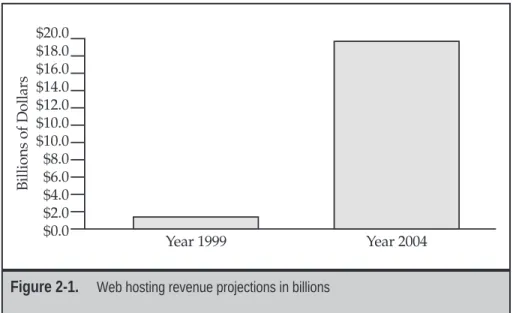
With the growth of opportunities in the market, web hosts need to offer higher quality services that take on the role of business consultation as well as web site hosting. This can enable businesses to become more effective on the Web by reducing their infrastructure IT costs through outsourcing and concentrate more on pursuing their core business objectives. According to analyst Jeanne Schaaf at Forrester Research, web hosting will grow to $19.8 billion by the end of 2004, up from $1.4 billion at the end of 1999, as shown in Figure 2.1. Putting this into market perspective, that is a 1,300% rate of increase over a five-year period.
CHOOSING THE TYPE OF HOSTING TO PROVIDE
Given this rate of growth, IT professionals with varying technical backgrounds have keen interests in entering new web hosting markets and forming partnerships with existing players to develop a
comprehensive suite of services. Just what kinds of web hosting companies are out there and in what niche market areas? What are the characteristics of these?
The main types of web hosts can be loosely organized into the following general categories:
▼ Shared hosting Customer web sites share space on the same physical web servers.
■ Dedicated hosting Involves allocation of a specific web server for use by one customer only, for one or several of that customer's web sites.
■ Co-location hosting The customer houses its web server within a web host provider's secure data center or facility. ■ Reseller hosting Usually a web host provides storage at a
discount to web consultants (which can include web designers, developers, or systems integration firms), who then resell the storage as a service or add-on to complement their other range of services that can include web site design or programming. ■ Template hosting Customer create a web site through a web
browser using standard templates from the template hosting web site; usually with the host's logo viewable on the web pages hosted.
■ Specialized platform hosting A customer will require a specific platform for dynamic pages to be generated or to support a specific technology for custom development such as JSP, ASP, or ColdFusion.
■ Application hosting (Also called application service
providers, or ASPs) Involves the managed hosting of software services and is popular with small- to medium-sized businesses
that want controlled hosting of enterprise software applications securely through the Internet or a VPN (Virtual Private
Network).
■ Managed-services hosting Includes the management of a wide range of value-added IT services that ensure that a web site (or host) is performing effectively.
▲ High-scalability hosting In the upper tier of hosting plans, a customer will require a highly scalable environment to respond to rapidly changing site traffic needs.
Many larger web hosting companies and direct providers have a mixture of plans that encompass several of these categories.
When you decide which hosting markets to focus on, you must consider several core variables, including in-house expertise and infrastructure, market conditions, competition, current trends, and industry partnerships. When you want to gain entry or expand into some of these related hosting markets, you should ask yourself some basic questions, including:
▼ What potential markets are emerging within this niche area of hosting?
■ Who is the competition? Are they profiting in the market? Is the timing right for providing the type of web hosting services you are considering?
■ What competitive advantages can my company provide that are not being met in the industry?
■ Is expertise available in-house?
■ What are the potential drawbacks? Do the advantages outweigh the disadvantages?
▲ What partnership opportunities are available to reduce the level of risk and complement my existing core business? The remainder of this chapter is dedicated to describing the most common types of hosting plans available so you can determine which is right for your business and your particular market.
SHARED HOSTING
In shared hosting, customer web sites share space on the same physical web servers. At this level of hosting, the customer web sites typically are static, meaning the site contents are manually uploaded to a web server through FTP (File Transfer Protocol) or a similar method. Sometimes pages can be dynamic—page content is generated on the fly through server-side scripting or a back-end database (this will vary, according to what a web host allows within a shared plan).
Static pages often are the equivalent of customer marketing advertisements, which is the reason shared hosting is popular with small to medium-sized businesses whose primary goal is to establish a marketing presence on the Web. Depending on the web host, a shared plan might include a few hundred to a thousand different customers using storage space on each individual server. For IT professionals who want to gain entry into the hosting market, shared hosting is attractive, because the costs of entry are low through reseller or partner arrangements with existing web hosts.
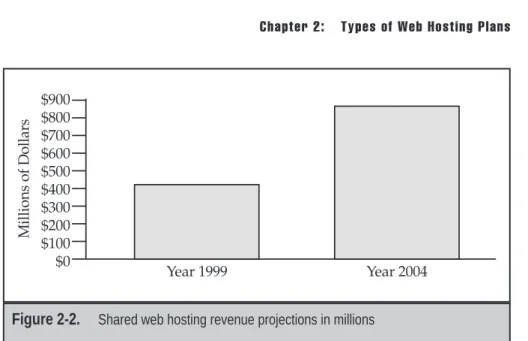
NOTE: According to Forrester Research, shared hosting is expected to
double in the next five years, to $890 million, as shown in Figure 2.2.
The standard range of services provided by web hosts varies, with the most common being a cgi-bin directory, FTP, or administration web access for making updates, e-mail services, domain registration and parking services, and web site design and programming services. These services are discussed in further detail in Chapter 8. Web server spacing plans for a client typically range from ten to one hundred megabytes of storage, with monthly costs ranging from $19 to several hundred dollars per month, depending on the optional services selected (refer to Chapter 9 for more information).
Shared hosting plans are further defined by the level of monthly data transfer permitted, which depends on which plan level the customer selects. Data transfer is defined as the actual files (HTML or XML pages, applets, images, audio files, and so on) that a web server transfers as a response to a web browser request. The average monthly range for data transfers can vary widely from approximately 500 megabytes (20,000 page views) to 5 gigabytes
(200,000 page views). It is misleading for you to list your data transfer as being unlimited, when in actuality there are limits that your systems physically allow.
For clients not looking for a unique domain name to professionally identify themselves in the marketplace, many web hosts provide an alternative, lower-cost method, which allows the use of spacing as a subdirectory extension to the web host's domain name. For example, suppose Triangle Associates decides to have its web site hosted in this way with HostingResolve. Its URL would be listed as http://www.hostingresolve.com/hosting/triangle/index.html instead of www.triangle.com. The client is not required to register a domain name through Network Solutions, Register.com, OpenSRS, or other domain name registration service. This initially was the method used by internet service providers to provide storage to their customers as an add-on service to their dial-up accounts, within a subfolder of the ISP's web address.
A similar method to listing this type of account is to point to the subdirectory in the address before the domain name, instead of www. In this example, Triangle Associates's URL would be http://hosting.hostingresolve.com/triangle/index.html. This type of plan usually does not include the full functions available with a regular, shared hosting plan and is geared toward personal or nonprofit organizations.
The number of web sites that are stored per server can vary significantly, depending on how sites are managed and aggregated on each physical server. Newer technology, called virtual hosting, provides a more scalable method to theoretically store up to 5,000 domain names per server. The obvious advantage to this form of shared hosting is improved potential profit margins for web host providers. The drawbacks include development costs and a higher level of IT expertise required than a routine shared hosting plan.
Two of the largest web hosting providers, XO Communications (formerly Concentric Networks) and Verio each have developed virtual hosting platform solutions for their clients and reseller markets. Verio acquired iServer, which was the first virtual server product. Other companies have addressed these needs by developing and packaging virtual server products for web hosts on different platforms. These include Ensim, Sphera, and Systemsfusion. Ensim was the first to market with its ServerXchange product, released in October 1999.
Verio (home.verio.com) is reported to be the world's largest web host, with an estimated 7 percent share of the market. The company's primary niche market includes to small to mid-range companies. Services include Internet access, VPNs (Virtual Private Networks), and e-commerce solutions. Verio now is a part of NTT, a Japanese telecommunications firm.
XO Communications (www.xo.com) provides a similar range of services, including shared, dedicated, and co-location hosting solutions. The company utilizes an ATM-based network, with an OC-3, OC-12, and OC-48 backbone and provides Internet access services. These types of network backbones are discussed in detail in Chapter 10. As shared hosting is increasingly a commodity item, client support will become more of an issue, as web hosts venture away from providing business-hour technical telephone support. The trend is to provide technical support online through FAQ pages, Q&A support pages, and tracking-ticket submittal forms to log client problems instead of providing direct customer support. The downsides of this are the feedback might not relate to the problem at hand and the client might not be able to get in touch with the web host provider in a timely manner.
Customer service and responsiveness are becoming an increasing requirement for a web host. This subject is discussed in further detail in Chapter 6. Consultants, integrators, and resellers are filling this support need by providing the web site design and software specialization and partnering with web hosts that have the support and data center infrastructure to fulfill the various needs of their clients.
Verio is an example of this customer service model. Verio has more than 5,000 resellers providing direct web site software support to more than 340,000 clients, with Verio handling any hardware or network issues that arise. The client contacts the reseller directly for support issues; the reseller determines whether hardware or network issues require the involvement of the host provider. Verio's reseller program is a key contributing factor to its status as one of the largest web hosts in the industry. Bringing together a comprehensive suite of solutions as a result of industry partnerships, reseller agreements, and affiliations will become standard as the market matures. This form of partnering has multiple benefits, and will be covered more in the following section on reseller hosting and throughout this book.
Examples of companies that are involved within the shared hosting market include
▼ XO Communications www.xo.com
■ Verio www.verio.com
▲ Digex www.digex.com\
As a customer's needs increase, requiring more dynamic page content, enhanced security, a greater share of bandwidth (due to site traffic increases beyond a shared hosting plan's limits), and system scalability, an upgrade to a dedicated or co-located solution becomes necessary. Unlike a shared plan, these plans do not share server space with other customers for security and performance reasons, and provide a greater range of hosting features.
DEDICATED HOSTING
Dedicated hosting (also called virtual hosting), a newer form of hosting,
or multiple web sites. Dedicated hosting enables a customer to host multiple sites from one server. The advantages for the customer include more flexibility, software configuration options, capability to handle greater site traffic, and more scalable bandwidth than available with shared hosting solutions. These factors are especially important to high-traffic sites. In some cases clients are allowed root-level directory access. Dedicated hosting plans typically start at $100 per month and can range up to $5,000 per month for high-end e-commerce or streamed content web sites with multiple servers. The monthly range for data transfers averages 5 gigabytes (200,000 page views).
Typically, a web host provides a guarantee of server uptime, such as 99.9 percent, within a service level agreement (SLA). SLA agreements are discussed in further detail in chapter 6. Be careful to back up whatever percentage you guarantee with the appropriate level of hardware and software, infrastructure, a security plan, and backup procedures. Some clients specify financial penalties or refunds within an SLA agreement in case the web host does not perform as agreed upon. To uphold this level of service, you need written procedures that cover uploading files, hosting plan parameters, server spacing, amount of bandwidth usage allowed before incurring additional charges, limit acceptable server-side usage to specific technologies, bill payments, and acceptable content usage.
Some web hosts, such as Alabanza (www.alabanza.com), prohibit site content that consists entirely of pornographic or derogatory material, based on legal and ethical standards. You also should have a written policy that removes any liability of the web host as applies to site content. Consult with an attorney when preparing or modifying written procedures that apply to client usage of your services to ensure that your company is fully protected under current laws.
It is always good insurance for a web host to have ready access to multiple providers to ensure redundancy and availability. If your provider has critical traffic problems, you can re-route your traffic through another provider and keep clients' web sites fully
operational. Better yet, if the web host is situated within the same building complex, you can be directly connected to the Internet
backbone provider. Many web hosts have lost customers and received negative media and Internet exposure from not being responsive when problems were first experienced. In ensuring a high level of customer satisfaction, web hosts such as Rackspace keep individual customer server profiles and provide 24/7 online technical support. When a customer needs new servers, it can be configured and online within a 24-hour period once an order is placed. For customers who need additional web server resources for a specific timeframefor example if a company is conducting an online contest promotion or needs additional resources for an e-commerce site during the holidaysRackspace can provide services on a monthly basis.
Examples of companies involved within the dedicated market include ▼ Rackspace www.rackspace.com ■ Interland www.interland.net ■ Globix www.globix.com ▲ Verio www.verio.com
CO-LOCATION HOSTING
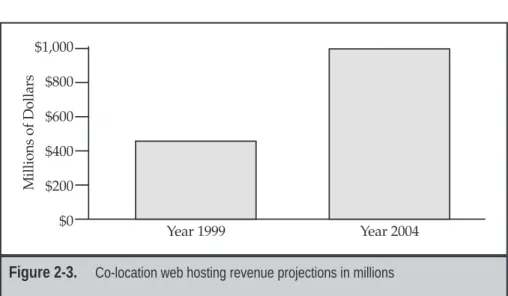
In co-location hosting the client house its web server within a web host provider's secure data center or facility. This form of hosting is popular with small- to large-sized businesses that want control over their web servers within a 24/7 secure environment connected through a major backbone provider without having the infrastructure costs, security issues, or maintenance costs for a data center. Many web hosts that provide co-location services are moving toward providing dedicated and applications hosting services. Still, according to Forrester Research, co-location hosting is expected to double in the next five years to $1 billion, as shown in Figure 2.3.
The standard range of services provided by co-location plans includes 24/7 server monitoring, multiple Tier 1 backbones for scalable bandwidth, and staff on hand to handle server maintenance, housed within a climate-controlled and physically secure data center. Options
should be available to include providing alternate energy sources (such as diesel-powered generators), power cycling, and tape backup services.
Co-location plans are further defined by the level of allowable monthly data transfer available (which is measured in megabits per second), and depend on which plan level the customer selects. Co-location plans typically range from $500 to $3,000 per month ($16 to $96 per day) for physically placing a web server within a 24/7 data center facility, in addition to bandwidth fees. Spacing typically is available in rack or cage increments (one-fourth, one-half, or full), with costs averaging up to $200 per square foot. A data center usually is located near a high-technology area where primary Tier 1 Internet backbones are located such as Boston, Baltimore, Chicago, New York, Los Angeles, San Francisco, Dallas, Atlanta, or other major cities throughout the world.
Large companies that provide backbone carrier services also are involved within the co-location market, including UUNet (www.uunet.com). UUNet provides a unique 100 percent uptime guarantee for co-location and other mid- to high-range hosting services, through an SLA with its customers. If services go below the level agreed in the SLA, the customer's account will receive a credit for that month. Genuity (www.genuity.com) provides an online map
of its ATM-based hosting infrastructure that details its backbone and the location of its data center operations.
Here are some examples of companies involved within the co-location market: UUNet www.uunet.com Genuity www.genuity.com Level 3 www.level3.com Digex www.digex.com Exodus www.exodus.com IBM www.ibm.com
RESELLER HOSTING
In reseller hosting a web host provides storage at a discount to web consultants (including web designers, developers, or integration firms), who then resell the storage as a service or add-on to
complement their other range of services, which might include web site design or programming. Reseller accounts provide the reseller with a virtual hosting package, with the incremental spacing
provided for the purpose of reselling to clients at a markup. This type of plan is especially beneficial to consultants who do not have to be concerned with physically maintaining the hardware or the network (unless a web site goes down). The reselling costs are quite marginal; usually assigned to price breaks tied to the number of hosting
accounts brought in by the reseller. Reseller plans can be organized in a wide range of different business models. Most common is for resellers to receive a 50 percent discount on the price of a hosting account, that the reseller then sells to the client. Some types of reseller incentive plans available include
▼ Referrals These typically are a one-time payment or given as discounts to other services for providing new business to the web host.
■ Commissions For new accounts, resellers are provided a variable percentage commission that generally is based on the annual amount of the hosting plan.
■ Discounts This can include discounts on web hosting plans, marketing items, or special promotions.
■ Virtual plan The reseller is sold spacing on a web server, with the spacing made available by the reseller to resell. The reseller often is sold space on a dedicated or limited-share server, and allowed to set its own pricing structure and establish its unique branding, similar to some commission plans.
▲ Reseller recruitment Think of this as multilevel marketing. The reseller recruits other resellers to join the plan, receiving a commission or payment from the web host for the additional business.
The host can make available a reseller-branded site to provide hosting plan details to prospects under the reseller's company name. A reseller typically will be given a control panel, which allows the reseller and its customers to modify their web accounts. The reseller can modify and control access to these control panels based on their clients' needs. Resellers provide a valuable service to web hosts in providing recurring business, and typically are in the form of systems integrators, consultants, web designers, and developers. The arrangement is beneficial to a reseller in allowing them to offer a full suite of business solutions to their clients, without having to worry about network backbone, infrastructure, or maintenance issues.
The reseller typically handles training and technical support issues relating to their client's web site, and will in most cases correspond directly with the web host when technical problems arise, such as server downtime and access. To the reseller's client, the reseller is the host. web host reseller plans need to clearly delineate what the responsibilities are to the reseller within a mutual agreement. This agreement should also include details of the web hosts' other policies which may exist, including an acceptable site usage policy, a privacy policy, and security policy.
For the web host, billing is normally handled by the reseller in billing for hosting that is resold. In addition, domain registrations and transfers, as well as technical support issues are the mainly the responsibility of the reseller in servicing their customers' hosting needs. The web host may also provide other basic reseller services, including site design templates, control panels, or custom domain name servers which can be listed using the resellers' domain name instead of the web hosts DNS when domain queries are made. Some web hosts even provide resellers with their own toll-free number for co-branded technical support that they can provide to their clients. When the reseller's client calls the number for technical support, the web host uses the reseller's name so the client thinks that the support is coming from the reseller. The control panel account enables the reseller to set up client web site parameters including e-mail, login rights, and scripting functions. The web host can provide anonymous name servers, which help to hide the identity of the web host's
servers being used by the reseller.
Recent studies have shown that more funds than ever are being spent on web consultants with a wide variety of backgrounds. During 1998 companies spent $7.8 billion on web consultants, according to IDC. By 2003 that total is expected to increase to $78 billion worldwide, as shown in Figure 2-4. These consultants encompass, among others, web design firms, ad agencies, independent site developers, systems integrators, IT consulting firms, and web hosts directly.
As with the other hosting plans discussed, the price range can vary significantly for reselling hosting storage and for web consulting services. Much depends on the level of specialties the client requires for building and maintaining its web site. Initial setup pricing charged by web consultants can vary from several hundred dollars for a static web site to upward of $1 million for a dynamic, highly interactive web site. A standard e-commerce site that includes shopping carts and credit card processing can average $10,000 to $60,000. An agreed-upon monthly fee includes a hosting space, web site design and development, and routine site updates. Independent consultants, if not affiliated with a firm, typically charge by the hour; a consulting firm usually charges by the project.
TEMPLATE HOSTING
Template hosting is a newer form of hosting that involves a client
creating its web site through a web browser using standard templates available from the template hosting web site. Typically, this service is lower in cost than all other hosting plans, although the structured options available to the client limit the design and functional options available. Some plans include free hosting in return for agreeing to the dynamic placement of third-party ads, template hosting logo, or co-branding of content on a web site. The client typically is limited to using an extension of the web host's address instead of its own unique domain name address, which usually is not what businesses want when pursuing a professional image and long-term web presence.
Examples of companies involved within the template-based market include:
▼ Imagecafe www.imagecafe.com
■ bCentral www.bcentral.com
SPECIALIZED PLATFORM HOSTING
Often a client will require a specific platform for dynamic pages to be generated, or to support a specific technology. Some of the most sought-after web hosts provide support for Java Server Pages (JSP) and servlets, which can operate on most standard web server operating system platforms (UNIX, NT/2000, Solaris, AIX, and so on). Java Server Pages can consist of multiple servlets, which greatly extends the capabilities of a web server.
Many web hosts now are becoming knowledgeable about the speed and reliability advantages provided by JSP. Server appliances such as Intel's family of NetStructure appliance units and Cobalt are being used to power niche functions, similar to slimmed-down servers. These and other technologies are further discussed in Chapter 9. These technologies include, but are by no means limited to the following:
▼ ASP (Active Server Pages)
■ JSP (Java Server Pages) and Java servlets ■ SSI (Server Side Includes)
■ ColdFusion ■ PHP
■ Enterprise JavaBeans
▲ Specific platform APIs (Application Programming Interfaces) Some web hosts address these specialized platform needs by offering individual hosting plans as part of their overall solutions. Here are some examples of companies providing hosting plans that include some of these specialized platforms:
▼ Interliant www.interliant.com (ASP)
■ WantJava www.wantjava.com (JSP and Enterprise JavaBeans)
■ XO Communications www.xo.com (ColdFusion) ▲ NetNation www.netnation.com (PHP)
APPLICATION HOSTING
Application hosting (also called Application Service Providers or ASP)
involves the managed hosting of software services and is popular with small- to medium-sized businesses that want controlled hosting of enterprise software applications (such as word processing, e-mail, groupware, accounting, ERP, and more) securely through the Internet or a VPN. In this way, for a set monthly rental fee, a company can run applications through a web browser and will always be current with the latest software updates. Companies can provide enterprise applications for all of their employees without being concerned with providing in-house installation, technical support, ongoing training, or site licensing software issues. ASPs usually charge a monthly rental fee that can range widely, and can be based on individual employee usage ($1 per use) or a per-month ($25 to $5,000) model. A lot will depend on the level of complexity for the application that is hosted. There also usually is a setup fee.
Other benefits include allowing companies to test new applications before making a long-term software commitment. A business can have a set monthly cost of hosted applications as long as needed and avoid the capital costs of depreciating software purchases. This frees up IT in-house staff from the continual cycle of routine software installation, maintenance, and support to handle issues more at the core of the business.
Other customer benefits include
▼ Substantial savings in avoiding IT hardware, software, and licensing expenses
■ Faster implementation of applications ■ Ease of updating applications
■ Ease in adding users to applications ■ Easy to understand pricing model
■ One source for application training
■ One source for application technical support ■ Provides a testing environment for new enterprise
applications
■ Capability to scale quickly to suit enterprise growth needs ▲ Making applications available on nontraditional systems such
as wireless devices
The applications that lead the way in this category are messaging and e-mail. Other growing areas include education, e-commerce, accounting, and personnel management. This type of hosting is a central focus of Microsoft's Internet strategy, with the introduction of the Microsoft .NET platform for distributing software through the Web. Microsoft is investing $2 billion per year over a five-year period to develop the technology, which will enable web applications to run in the background among web sites instead of a browser user going to each individual site for information.
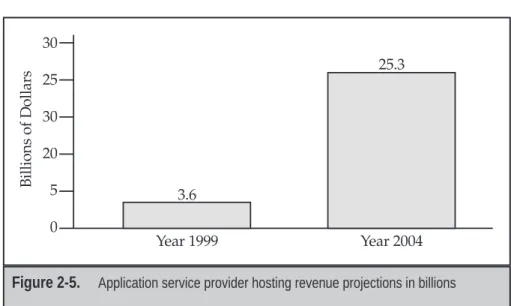
The .NET strategy is based on several core technologies, including XML (eXtensible Markup Language), SOAP (Simple Object Access Protocol), Microsoft Visual Basic, and associated web services. The company is aggressively recruiting web developers for the .NET technology, which will involve downloaded components to individual user desktops instead of being server-side driven. Other examples include online subscription-update services such as McAfee, which provides a monthly service whereby companies can check their systems for viruses and update virus signatures through a web browser. As noted in Figure 2.5, according to Gartner Dataquest, the world market for ASPs will increase from $3.6 billion in 2000 to $25.3 billion by 2004. Others, such as IDC, anticipate revenues in this market to reach only $7.7 billion by 2004.
Many web companies are changing their business focus to an ASP model. B2SB Technologies, which changed its name in 2001 from SmartAge.com, is one such company. The company released an eBusiness Builder application, designed for small- to large-sized businesses, that focuses on front office applications and e-commerce. According to B2SB Technologies CEO Scott Garell, "Despite all its
promise, the Web has failed small businesses. To date, the first chapter of the Web has been to create standalone vertical applications for small businesses. The real win in the next chapter is to bring these applications together to fully share data and maximize return on investment." Large companies also are interested in application hosting because of the many enterprise benefits.
NOTE: By 2004 it is estimated that 66 percent of large companies will be
using ASPs, according to the Phillips Group.
For web hosts considering expanding into ASP markets, the technical expertise, software licensing requirements, and infrastructure are extensive. The first likely consideration will be expanding into a service for which you have trained and specialized IT staff, and providing an add-on service such as a particular database or messaging product. The ASP model presents challenges in the current economic environment and still is not clearly understood by IT professionals or the business community. A company seeking to capture a share of the ASP market must provide potential clients with a clear explanation of the monetary and operational benefits of outsourcing their applications over traditional computing methods
that depreciate over time. Businesses, especially upper management, will understand these value-added services. Savings from an
enterprise by partnering with an ASP have been reported as high as 70 percent.
An ASP can gain access to new market channels through active partnerships. ASPs are also partnering with ISPs that have a large existing customer base, but lack the application specialties which ASPs bring to the table. ASPs could provide the back-end services, whereas ISPs continue to provide front-end Internet connection services to customers and offer new applications services to customers as add-ons. Through coordinated sales efforts, both could realize increased revenues in new channels.
ISPs such as JumpNet (www.jump.net) have developed
partnerships with ASPs that utilize JumpNet's data center to handle storage requirements. "We have some ASPs that are using our data centers, which provide software-related services," says Dewey Coffman, Vice President of Sales and Marketing with JumpNet, "but the majority of our customers are still co-location and dedicated hosting-related. Spacing in our data center has more than doubled, going from 2,500 to 6,000 square feet this year (2001)."
Other ASPs such as Corio (www.corio.com) use XO Communications (www.xo.com) for all of their data center requirements, and directly provide specialized e-commerce applications and enterprise offerings for their customers. Some of the software applications you can rent from XO include PeopleSoft, SAP, Commerce One, and BroadVision. ASPs will be responsible for all technical support and handle all training for an application, differentiating themselves in a fast-moving market.
NOTE: ASPs such as USinternetworking provide a virtual walkthrough
of their data center facilities via their web site, (located at www.usinternetworking.com).
Other ASPs are promoting their successes by highlighting how they have lowered operational costs for existing clients. These types of partnering opportunities available as an ASP are discussed in
further detail in Chapter 14. Software companies such as Oracle, with its Business Online ASP service also are providing ASP services.
ASPs must own a secure data center, or have access to one via partnerships or agreements. The data center must have alternate emergency power sources on site, provide standard backup procedures, and have multiple Tier 1 Internet backbone carriers in place. This will allow for scalable bandwidth, which can be specified through an SLA. Many Tier 1 Internet backbones have public peering at the major traffic exchange points and private peering distribution agreements with each other, which enables data packets to be transmitted quickly among providers.
Some of the larger infrastructure providers for ASPs include the following:
▼ Citrix www.citrix.com ■ IBM www.ibm.com ▲ EDS www.eds.com
Examples of companies involved within the ASP market include ▼ Interliant www.interliant.com
■ USinternetworking www.usinternetworking.com
■ Corio www.corio.com
■ eOnline www.eonlineinc.com
▲ Qwest CyberSolutions www.qwest.com
MANAGED-SERVICES HOSTING
Managed-services hosting is the management of services that ensure
that a web site (or host) is performing effectively. This is a relatively new form of hosting; services can include firewall security, real-time server monitoring, e-commerce services, and content delivery management, typically in partnership with infrastructure providers. San Francisco−based host Xuma (www.xuma.com) offers e-commerce
services that integrate auction bots, tax management, and processing of credit card transactions. One client, CornerHardware.com,
was brought online through Xuma's services two months ahead of schedule.
Examples of companies involved within the managed-services market include ▼ Loudcloud www.loudcloud.com ■ Xuma www.xuma.com ■ Sitesmith www.sitesmith.com ■ InetU www.inetu.com ▲ SiteRock www.siterock.com
Companies such as Alabanza (www.alabanza.com), provide a full range of automated and e-commerce hosting services directly to other web hosts. By using BGP (Border Gateway Protocol), the company can provide the optimal bandwidth for its customers among the bandwidth carriers with which it is partnered. BGP is discussed in further detail starting in Chapter 13.
Interliant (www.interliant.com) provides managed services in coordination with Sun Microsystems (www.sun.com), under which both companies market Interliant services. As an Elite Plus member with Sun's iForce initiatives and Service Provider program, Interliant receives preconfigured, rack-mounted, Sun web servers to provide collocation and data center services. As with many of the companies mentioned here, Interliant also markets within other hosting models discussed in this chapter.
Services that Rackspace now is providing through a partnership with Appliant (www.appliant.com), includes Lateral Line, which enables customers to monitor how a web site is performing through tracking via a web browser. As states chief executive officer of Rackspace Graham Weston, "Downtime can be catastrophic for an e-business, and with the competition literally only a click away, providing optimal performance and reliability becomes even more crucial. A real-time monitoring system like Lateral Line is
HIGH-SCALABILITY HOSTING
In the upper tier of hosting plans, a client will require a highly scalable environment to respond to rapidly changing site traffic needs. According to analyst Jeanne Schaaf at Forrester Research, revenues in this area are expected to rise by more than 1,000 percent, to $10.9 billion for fully-managed, outsourced servers and $6.8 billion for high-end custom web hosting services.
Qwest announced a new service in 2000 called e-Solutions, which is targeted at companies that seek to establish multiple e-commerce web sites. Part of the reasoning behind the move is to accommodate customers that Qwest acquired from the company's merger with US West. The plan, the first shared hosting product that Qwest has established, includes an e-commerce catalog for 100 products and up to 20 web pages developed. The e-Solutions plan includes services that are available from various Qwest divisions, including Qwest Cyber Solutions, ASP services in-house, and consulting operations. Besides the e-Solutions plan, Qwest also offers dedicated solutions that start with a 1,000-item catalog with 80 web pages developed, and consulting services hosted on a Sun Microsystems Netra server with iPlanet Web Server.
High-scalability hosting is popular with medium- to large-sized businesses whose primary goal is to ensure that critical e-commerce and server applications are continually operational on the Web. This includes multiple servers or racks housed in a raised-floor data center and clustered together as part of an overall, comprehensive solution. Specialty services that require these services include load balancing, correcting performance bottlenecks, scalability, and real-time traffic monitoring. As with ASPs, the key components are redundancy and support. Some one-time web site events that require such scalability include the Grammy Awards, the Victoria's Secret Webcast, the Olympics, and other major sports events.
There are other technologies that include partnering with content delivery services, such as Akamai Technologies (www.akamai.com). Akamai provides a range of content delivery services, including load balancing solutions, with its FirstPoint product, which enables content providers to achieve higher performance when using static content on
their web sites. Within the content delivery area alone, it is estimated by analysts to generate $1.1 billion in revenues by the end of 2001, up from $306 million for 2000. These types of technologies are discussed in further detail in Chapter 9.
Plans include multiple sources of backup (including offsite storage), with multiple Tier 1 backbone carriers that have direct access to the Internet in case the primary sources become unavailable. The network includes multiple routers, switches, optimal load balancing and traffic maintenance, firewalls, emergency power sources (diesel generators), and 24/7 technical support to provide the highest level of uptime protection within a highly secure data center.
Methods for automatically monitoring the network, traffic, and servers include software such as HP OpenView, IBM Tivoli, or BMC, to ensure that optimal performance is maintained. High-scalability hosting plans typically range from $50,000 to $1 million per month ($1,612 to $32,258 per day). As the overall market matures, the trend likely will lead smaller web hosts to focus on highly specialized markets. Larger web hosts and carriers, through mergers and partnerships, will provide mega-web services, all under one umbrella.
Examples of companies involved within the high scalability market include:
▼ NaviSite www.navisite.com ■ Globix www.globix.com
▲ Qwest www.qwest.com
SUMMARY
This chapter has shown the wide range of available web hosting services, from shared to high scalability. Throughout this book, we discuss key strategies that web hosts of all sizes can implement to anticipate the needs of their existing and potential clients. By investing in reliable technologies and people, and forging beneficial partnerships, web hosts can provide a full range of value-added services within the marketplace.