All Regis University Theses
Fall 2010
Preventing Computer Identity theft
Donald R. McDaniel
Regis UniversityFollow this and additional works at:https://epublications.regis.edu/theses Part of theComputer Sciences Commons
This Thesis - Open Access is brought to you for free and open access by ePublications at Regis University. It has been accepted for inclusion in All Regis University Theses by an authorized administrator of ePublications at Regis University. For more information, please [email protected].
Recommended Citation
McDaniel, Donald R., "Preventing Computer Identity theft" (2010).All Regis University Theses. 457.
Regis University
College for Professional Studies Graduate Programs
Final Project/Thesis
Disclaimer
Use of the materials available in the Regis University Thesis Collection
(“Collection”) is limited and restricted to those users who agree to comply with the following terms of use. Regis University reserves the right to deny access to the Collection to any person who violates these terms of use or who seeks to or does alter, avoid or supersede the functional conditions, restrictions and
limitations of the Collection.
The site may be used only for lawful purposes. The user is solely responsible for knowing and adhering to any and all applicable laws, rules, and regulations relating or pertaining to use of the Collection.
All content in this Collection is owned by and subject to the exclusive control of Regis University and the authors of the materials. It is available only for research purposes and may not be used in violation of copyright laws or for unlawful purposes. The materials may not be downloaded in whole or in part without permission of the copyright holder or as otherwise authorized in the “fair use” standards of the U.S. copyright laws and regulations.
SUBMITTED ON 11 OF DECEMBER, 2010
TO THE DEPARTMENT OF COMPUTER SCIENCE
OF THE SCHOOL OF COMPUTER & INFORMATION SCIENCES
OF REGIS UNIVERSITY
IN PARTIAL FULFILLMENT OF THE REQUIREMENTS OF MASTER OF SCIENCE IN
INFORMATION ASSURANCE
BY
Donald R. McDaniel
APPROVALS
Paul Vieira, Thesis Advisor
James A. Lupo
Abstract
The arrival of the information age has created new challenges to the ability of individuals to
protect the security and privacy of their personal information. One such challenge is that of
identity theft, which has caused a number of hardships upon its victims. Perpetrators of this
fraud may use identities of others to obtain loans, steal money, and violate the law. This paper
will discuss the characteristics of the offenders and victims of identity theft. A systematic
approach for preventing identity theft will also be presented with the hopes of curtailing this
Acknowledgements
The author would like to thank his family, for their love and support throughout his entire
life and more in particular during the past two years. Finally, he would like to thank his friends
Page List of Figures……….vii List of Tables………..viii Chapter 1 - Introduction…….……….ix
Chapter 2 - Review Literature and Research…….……….…….………..4
2.1 - What is Identity Theft?...4
2.2 - How Identity Theft is Done……….…….……...4
2.3 - How Personal Information Can Be Used Against You…….…….…….…………6
2.4 - Techniques of Online Identity Theft………....………….……….……….7
2.4.1 - Phishing………...………..7 2.4.2 - Pharming……….…………..………....9 2.4.3 - Spyware……….………..…11 2.4.4 - Viruses………...…..12 2.4.5 - Keylogger………..………...………..….12 2.4.6 - War Driving………..………...13
2.5 - Mitigation of Online Identity Theft………..………....14
2.6 - Identity Theft Statistics………..……….………..16
2.7 - Victims Experiences and Rights………..……….21
Chapter 3 - Methodology….………..26
Chapter 4 - Results……….………28
4.1 - Research Questions……….………..28
4.2 - Initial Survey……….………....33
4.3 - Prevention of Identity Theft Survey Results……….35
Chapter 5 - Conclusion……….………..60
References………...………...62
Appendix A………66
Page Figure 1……….………..16 Figure 2………...17 Figure 3………...18 Figure 4………...19 Figure 5………...20
Page Table 1……….34 Table 2……….35 Table 3……….36 Table 4……….36 Table 5……….37 Table 6……….38 Table 7……….39 Table 8……….41 Table 9……….42 Table 10………...45 Table 11………...46 Table 12………...47 Table 13………...48 Table 14………...49 Table 15………...50 Table 16………...51 Table 17………...52 Table 18………...53 Table 19………...54 Table 20………...56
Chapter 1 - Introduction
Consider this as a possible scenario: An individual with a stainless credit history decides to
purchase a new vehicle at a local car dealership. With the intent to finance the vehicle with
credit that has been arranged by the dealer, they will complete a standard credit application.
After the salesman conducts a credit history check, the individual may be upset to hear that their
credit application has been denied. After a further investigation, the individual may find out the
credit reporting agency lists twenty open lines of revolving credit and two different car loans.
The individual may also discover that it lists 5 different residences over the past year. Even
though there has never been a delinquent payment, almost every one of their creditors has
reported the individual in default. In addition, these credit lines were never opened by this
individual. It is apparent that a perpetrator stole the individual’s identity and used their flawless
credit to obtain thousands of dollars’ worth of goods and services. After the credit limit has been
exhausted, the perpetrator moved on to their next victim, leaving the individual’s credit ruined.
The comment, “Information is power,” is even more accurate now in the age of the computer
and Internet. Information about us has been gathered from the time that we were born up until
the day we die. Numerous files about us continue to live in computer databases for years, long
after we leave this plane of existence. In a variety of situations, information can provide a
critical edge. For example, personal information databases may be used to manipulate consumer
behavior or sway public opinions for or against a specific policy.
Identity theft continues to be one of the fastest growing crimes of the new millennium across
the globe. A perpetrator may steal the single most important asset anyone has: a sense of self –
singularity in the world, which also allows the world to know that it is dealing with one
individual out of billions of other people.
In order to determine an individual’s identity, certain nonnumeric and numerical
characteristics of each individual should be utilized. “Ideally, these characteristics should not
change, and when we single out enough of these qualities, we should be able to identify each
individual.” (Newman, p. 1) One distinct physical trait most people are aware of is fingerprints.
The likelihood of two people having identical fingerprints is so remote that it is statistically
minute. This will serve as a primary tool for police agencies when identifying criminal suspects.
Qualities that seem to remain static are generally categorized as base identifiers. Base
identifiers would be such items as the following: sex, race, birthplace, birthdate, and eye color.
Most identification documents such as passports and drivers licenses use a combination of these
attributes in addition to the individual’s full name to create a unique identity for each person. The
chances of two people sharing the same full name, birthdate, sex, and race is relatively slim. In
the United States, the most important base identifier is the Social Security number, because it
remains with the individual over the course of their lifetime. The Social Security number has
become a wanted item of information for all sorts of reasons. In theory, every Social Security
number should have information associated to only one unique person. This is why credit
bureaus, universities, military, banks, and other agencies require the number.
The nation’s insurance companies and credit bureaus have heavily relied on Social Security
numbers. In essence this can be used as a file retrieving tool. The growth of the Social Security
number as a genuinely national identity number virtually means that records associated with this
number are considered to be very private. An individual’s life history can be retrieved just with
Identity thieves are preying off of this fact all too well. They are also aware that government
and the private sector are computerizing private records which allow one agency or business to
cross reference records that may be stored elsewhere. In a matter of minutes, an identity thief
can put together a laundry list of information on nearly any individual in America. An individual
being victimized by identity theft can be very severe. Victims of identity theft may have their
credit ruined; others may be suffering from more dire consequences. Some victims have been
arrested for crimes they did not commit. By having criminal records created in their name, or
being made the subject of a lawsuit because a perpetrator has been using their identity. We are
all exposed to becoming victims of identity theft, but I will discuss security measures that may
Chapter 2 – Review of Literature and Research Chapter 2.1 – What is Identity Theft?
Although, there is no commonly accepted definition of identity theft, it may prove to be
impossible to study the real threat of this anomaly without conceptual clarity. “Identity theft is
the appropriation of an individual’s personal information to impersonate that person in a legal
sense.” (Vacca, p.4) Identity theft is not a new concept. It has been around for a long time. At
one point in time an individual could escape their life and disappear to a faraway land,
pretending to be someone else. The consequences of stealing another individual’s identity did
not have the far reaching impact that exists today. These were the days before the high tech
methods of credit reporting and sharing information was commonplace.
Identity theft can still be done by low tech tactics as previously described above. However,
identities can also be stolen using highly technical and elaborate means of obtaining the personal
information of a stranger. Identity thieves that use the highly technical means are able to assume
someone else’s identity very easily. The individual’s reputation can be devastated by the loss of
their good name and the personal or financial mess that results. Thieves could be relatives,
roommates, estranged spouses, friends, or colleagues from work. All of these people in some
capacity may have access to their victim’s personal information.
2.2 - How Identity Theft Is Done
Identity theft is considered to be a “white-collar” crime and continues to emerge as a problem
of the twenty first century. It is considered to be a faceless crime which means the perpetrator
feels guilt free not knowing who the victims are. This skilled person will take the time to do
research on their victims, learn new techniques, and finally execute the planned attack. While
sophisticated means to steal identities, as mentioned earlier most identity theft cases involved
low tech methods and involved someone the victim knows. Although, there are organized
identity theft rings around the world, the likelihood of one’s identity being stolen by a family
member is far greater.
“It should be noted that identity theft in its many forms is a growing problem and is
manifested in many ways, including large scale intrusions into third party credit card processors,
theft from the mails of printed checks, pre-approved credit card offers and mortgage documents,
credit card skimming, phishing schemes, and telephone and bank frauds, much of which is
perpetrated through the use of SPAM e-mail.” (Gerdes, p.25) The following are some of the
ways that perpetrators may acquire and use your personal information and assume your identity:
• Dumpster Diving – Perpetrators rummage through trash, both of individuals and businesses, looking for personal information or bills.
• Skimming – Perpetrators obtain debit and credit card numbers by using special storage devices while processing the individual’s card.
• Phishing – Perpetrators pretend to be a financial institution or another company that sends out popup messages or spam to get an individual to disclose their personal information.
• “Old-Fashioned” Stealing – Perpetrators steal purses and wallets; mail, including credit card and bank statements; preapproved credit offers; tax information or new checks. Perpetrators may also steal personal records from their employers or bribe employees who may have access.
• Changing Your Address – Perpetrators may divert an individual’s billing statement to another location by completing a change of address form.
• Internet – Perpetrators can use the Internet to hunt down victims very easily.
Genealogical databases give perpetrators access to maiden names, which are often used as passwords to bank accounts.
• Pretexting – Individual’s may be duped into giving out personal information over the phone with a perpetrator who has disguised themselves as a representative of a reliable company.
• Onlookers – Individual’s may expose their ATM card to a perpetrator that is looking in a public place. Perpetrators may use binoculars, camcorders, or a zooming camera.
2.3 - How Personal Information Can Be Used Against You
Armed with a person’s identifying information, an identity thief can open new accounts
in the name of a victim, borrow funds in the victim’s name, or take over and withdraw
funds from existing accounts of the victim, such as their checking account or their home
equity line of credit. (Gerdes, p.22)
Once the perpetrator has basic information about the individual, there are a number of ways it
can be used. For example, if the perpetrator has seen the individual’s credit card, they now have
information on who may have issued the credit card. They now can call the financial institution
and request a change of mailing address. Once the perpetrator has the card, they now can run up
charges on the individual’s account. The individual will never realize what is happening because
they have never received a bill. By the time the individual wonders what has happened to their
bill and contact the credit card company, it is too late.
A perpetrator that has access to an individual’s personal information can take out the
following loans in your name: car loans, house loans, boat loans, and so on. If the perpetrator is
good enough, they will have all of the goods and the victim is stuck with the bill. If a perpetrator
is able to obtain new checks or steal your checkbook through some illegal scheme, they will have
the ability to bleed the bank account dry before the victim has any knowledge on what has
occurred. In other words, a perpetrator can hurt the unsuspecting individual by opening a bank
account in the victim’s name, possibly take out cash advances from the victim’s bogus credit
card, and write bad checks against the account as often as possible before the bank reports the
villainous conduct.
In the most extreme cases, a perpetrator may file for bankruptcy under a victim’s name. This
Possibly, a perpetrator that is living in an apartment or house may file for bankruptcy to avoid
eviction. A perpetrator could always file for bankruptcy, if they have a personal vendetta to
cause an individual harm, this would be the perfect way to punish the victim.
The possible scenarios described are some of the ways that the theft of a victim’s identity can
cause havoc in their everyday life. Just thinking about this should be enough to scare the day
lights out of us. This should definitely serve as a wakeup call to be more proactive to protect
oneself from identity theft. Currently, sloppy credit granting procedures allow identity thieves to
take advantage of these opportunities. Many credit card companies are not doing their due
diligence to verify records. These companies are more interested in capturing new applicants
than taking the time to confirm their level of authenticity.
2.4 - Techniques of Online Identity Theft
“But it is a relatively new marketplace, and trust takes time to build up, particularly when
transactions take place across borders and recourse in the event of fraud is unclear.” (Stein,
p.67) As the number of online identity theft continues to rise, online retailers and banks have
struggled to stay on top of the problem and to protect their clients, whose online account details
and personal financial information are coveted by identity thieves. This makes online identity
theft especially brutal on its victims, and makes the online community that bit more skeptical.
Continuing to build online confidence remains a key challenge not just for the future growth of
the Internet economy, but for assisting in the battle against identity theft. The challenge for
building confidence is that the perpetrators techniques continue to evolve.
2.4.1 - Phishing
“Phishing is an e-mail fraud method in which the perpetrator sends out legitimate-looking
like a lure might be dangled in front of a fish to deceive it into thinking there is a real worm at
the end of the hook, phishing is instant messages or e-mail that look like they’re coming from a
legitimate company to get individuals to click a link so that they may provide their personal or
account information. The term phishing first appeared in 1996 when perpetrators stole account
information from America Online (AOL) using email as the fishing hook to steal passwords from
AOL users. Phishing is a hybrid technique in the sense that it involves both the use of social
engineering and technological means by disguising itself as a trustworthy company in an e-mail
message. These scams may falsely claim to be from banks, brokerage firms, Internet auctions
sites, credit card companies, electronic payment services, or some other service that consumers
use. To appear authentic, these emails may use the following:
• The names of real people.
• Genuine looking graphics and logos.
• Links to pages of a legitimate website.
• Credible looking email addresses, such as “support@[name of financial organization].com”.
• Formal looking references to laws.
Phishing messages have become extremely complicated, such that consumers cannot easily
discern them from legitimate messages from the targeted organization. Most emails attempt to
lure consumers into providing their personal information by requesting that they provide it in a
reply email or by clicking on a link to a website that imitates a legitimate organizational website
and asks them to provide information. Once the perpetrator has access to the victim’s existing
accounts, they can now withdraw money or purchase expensive merchandise or services.
Phishers can also use the information to open new credit card or bank accounts in the victim’s
name. These various tactics may be used to lower the guard of consumers:
• Your account may be shut down unless you update your information.
• Please verify your identity because your account appears to be used by a third party which is a violation of the law.
• Due to a technical update, you will need to reactivate your account.
• Recent adjustments in the law require users to identify themselves.
• Security measures have been implemented to protect your account from identity theft requiring you to verify your account information.
Phishing messages may at times direct consumers to a fake website, or to send in the
information by phone or fax. Viruses and worms can also spread the phishing email further, via
victims’ address books. These sites also count on the familiarity by the average consumer of
details which differentiates legitimate websites from unlawful imitations. Domain names of
spoofed sites often use small variations of the real site’s domain name, such as
www.beestbuy.com instead of www.bestbuy.com.
“Phishing attacks in the United States soared in 2007 as $3.2 billion was lost to these attacks,
according to a survey by Gartner, Inc.” (McCall, 2007) Most phishing attacks are directed at
U.S. consumers. Symantec conducted its own survey during the year of 2009 and it found 1 in
352.2 emails compared to 1 in 244.9 in 2008 were phishing attacks. It was found that more than
161 billion phishing attacks were in circulation. Gartner research produced a report in 2009 and
it found that in 2008, 80% of the adult population had received emails that appeared to be part of
a phishing attack. This report also found that millions of users fell for the same scam every year.
It should be noted that some phishing emails and websites look so authentic they have the
potential to fool even the most cautious internet users. The top ten exploited websites are the
following: Visa, HSBC, Amazon, United Services Automobile Association, Bank of America,
Internal Revenue Service, PayPal, and Bendigo Bank (Australia).
2.4.2 - Pharming
“Pharming is a scamming practice in which malicious code is installed on a personal
computer or server, misdirecting users to fraudulent Web sites without their knowledge or
website persuading unsuspecting victims into releasing their personal information to the identity
thieves. This technique is much more difficult to prevent and it may affect a high volume of
users per attack due to multiple website visits.
There are two different techniques on how pharming can be accomplished. The first involves
the use of a Trojan or virus to change the victim’s host file. This text file is left over from the
earlier days of the Internet, and is used to connect a web address to a specific machine IP
address. This pharming method changes this file to connect the web addresses of well-known
financial institutions and banks with the IP addresses of phishing sites, so when the users open
their browsers and enter the web address of their bank, they will be redirected to the phishing site
instead.
The second pharming technique is equally menacing and it is known as Domain Name
System (DNS) poisoning. DNS replaced the local host file as the process for resolving a web
address to a particular IP address. Vulnerabilities in DNS software are manipulated in order to
gain control over the domain name of an existing website. The numeric IP address that is related
to the domain name is then modified. The end result is that a trusting user enters the website
address that has been changed in their browser, and they will automatically be taken to the
spoofed website. The victim’s browser may display the correct web address, but the site being
viewed will be a sham. By the time the user unknowingly logs onto the fake website with their
username and password credentials, the perpetrator has already hijacked the victim’s
information. “Identity thieves are able to deceive everyone who attempts to log onto a
compromised website, making detection extremely difficult while permitting access to mass
2.4.3 - Spyware
Spyware is one type of malicious software (malware) that gathers information from a
computer system without the users consent. Spyware has been known to cause computer
slowdowns or system crashes as well as unwanted advertising and continuous popup messages.
However, the more serious consequence includes identity theft. Spyware has the capability to
monitor nearly any activity of data that is related to the users computing environment. Not only
are the files that reside on a hard drive is tracked, but spyware can also include volatile data such
as keystrokes, screen shots, and data packets observed on connected networks. Users may
experience the following characteristics if spyware has been installed:
• Computer may run slower or crash more often.
• A new toolbar appears in the user’s browser that may have not been wanted.
• The browsers default start page or search settings change without warning.
• Multiple popups appear even though a user may not be connected to the web.
Some spyware can also be used on cell phones, PDA’s, and smart phones. These software
applications enable perpetrators to mine through banking information, PIN codes, credit card
numbers and other financial information, and all of this can be done remotely. Once the
perpetrators has the information, they may elect to either sell it to others or use it for themselves
for spam, marketing, financial crimes, or identity theft.
Another new phenomenon is called cell phone snooping. “Cell phones are loaded with so
much personal information – and have so many new capabilities – that phone hacking has been
the holy-grail for computer criminals for some time.” (Sullivan, 2007) By installing spyware on
a cellphone, a perpetrator will have the ability to watch and listen to the targeted victim in the
bathroom, bedroom, or office meeting, by utilizing the devices microphone and camera.
Perpetrators will have access to the most intimate details of the victim’s life by recording private
2.4.4 - Viruses
“A computer virus is a program that secretly attaches itself to another document or program
and executes when that document or program is opened.” (Ciampa, p.48) These programs have
the intention of being malicious that can range from changing or deleting files, making a
computer behave strangely (displaying messages), or wiping the contents of the user’s hard
drive. Once a virus has been executed it is designed to replicate itself to another computer to
attack. Presently, viruses primarily spread through email attachments. After an infected
attachment or program on the user’s computer has been executed, the user may experience the
following characteristics that they have a virus on their computer:
• Computer may restart on its own and fails to run in a timely fashion than the user may be accustomed to.
• Applications may not work properly.
• Computer may crash and restart every few minutes.
• Drives may be inaccessible.
• Computer consistently locks up often.
• Computer will gradually run slower than normal.
Some of the most troubling viruses are those that have been programmed to gather private
information. This can include email passwords, banking information, and other data that may
lead to identity theft. Last year a new type of banking virus was discovered that just did not steal
user bank log in credentials, but will also steal money from your account while the user is logged
in and viewing a fake balance. This virus is known as the URLzone and it is controlled by
servers in the Ukraine. This virus is designed to steal money from user accounts based on how
much money is actually in the account live in realtime while the user is logged in.
2.4.5 - Keylogger
“A keylogger is a hardware device or a software program that records the real time activity of
keyloggers are used in IT organizations to troubleshoot technical issues with computers and
organizational networks. Businesses or family members will also monitor the network usage of
users without their direct knowledge. Lastly, identity thieves will use keyloggers on public
computers to steal credit card information or passwords.
A keylogging program does not always require physical access to the user’s computer. This
can be purposely downloaded by a perpetrator who wants to monitor the activity of a user.
Keylogging may be downloaded unintentionally as spyware and executed as a remote
administration Trojan horse.
A keylogger program typically consists of two files that get installed in the same
directory: a dynamic link library (DLL) file (which does all the recording) and an
executable file (.EXE) that installs the DLL file and triggers the work. (2009)
Normal keylogging programs store the user’s information on the local hard drive, but some
are programmed to automatically broadcast data over the network to a remote computer.
2.4.6 - War Driving
Today, wireless networking continues to be one of the most popular and fastest growing
technologies on the market. From home to organizational wireless networks, users are eager to
take advantage of the convenience and freedom that this technology promises. Even though
wireless networks are convenient, it is not always deployed securely. Improperly configured
wireless networks are found in user’s homes and in large organizations.
“War driving, also called access point mapping, is the act of locating and possibly exploiting
connections to wireless local area networks while driving around a city or elsewhere.” (2002)
This form of identity theft, perpetrators take advantage of wireless technologies, which allow
neighborhoods, seeking out wireless networks. PDA’s and wireless equipped laptops coupled
with software that is available on the internet are used to find unsecure networks.
In the event an unsecured network has been detected, the perpetrator can use it to access the
user’s computer. Once the thief has infiltrated the user’s computer, they may be able to obtain
passwords and other personal information, such as credit and bank information, from files that
have been stored in the computers that are available on the network. In 1984, the first
publication about unsecured wireless networks is circulated in a magazine called “2600”. This
magazine contains information on codes and passwords about vulnerable areas for stealing
network bandwidth.
2.5 - Mitigation of Online Identity Theft
“Many victims thought better awareness on their own part of how to prevent and respond to
identity theft would have been most helpful.” (Synovate, 2003). Due to the nature of identity
theft, preventing identity theft starts with the consumer. Basic countermeasures can be
implemented to deter the identity theft, as they prove to be very opportunistic. Prevention will
always start with deterrence, which may be likened to using a video camera or an internal
security system on a house in the hopes of preventing burglars. Sure all of these anti-theft
devices can be surpassed, but real deterrence comes from actually making the house difficult to
steal, so that the thief will eventually move on to the next one. Internet security risks may occur
at a variety of levels, users need to setup countermeasures that provide multiple layers of defense
against these risks. Users should have the expectation that it is a matter of when they will
experience a security problem, not if. Most of the recommended techniques for securing
personal information on computers fall into the category of fundamental computer security
• Install and regularly update spyware and antivirus on personal computer.
• Install and configure a firewall on personal computer. Having a firewall should hinder identity thieves from getting access to the user’s workstation over a network.
• Install and maintain operating system security patches on personal computer.
• Configure security encryption on wireless technologies, such as Wired Equivalent Privacy (WEP) a security protocol.
• Use a secure web browser for online business activities which employ techniques, such as encryption, to keep personal information secure. If the website does not have an padlock image on the browser’s status bar or the beginning of the Internet address does not start with https:// it will mean that the site is not secure.
• Block suspicious looking websites.
• Properly check the URL of any site that asks to provide personal information. Users should make sure that their session begins at the known authentic address of the site, with no additional characters added to it.
• Do not store sensitive or financial information on personal computer.
• Users should not select the option to remember identification and authentication credentials or automatically login.
• Log out of websites when finished.
• Log out or shutdown computers when finished.
• Users should practice good password security procedures. Passwords should meet the following complex requirements: Strong passwords should have a combination of numbers, letters, and symbols and use both uppercase and lowercase characters. Users should never write the password down or store in on the computer. Change passwords on a regular basis.
• Beware of email requesting personal information. Never click or reply to a link from an unsolicited email that asks for your credit card, passwords, or PINs, bank account information, social security number or other types of confidential information. When in doubt, contact the financial institution by phone to inquire about whether the request for information is legitimate.
• Before technological devices are disposed of, information should be properly deleted.
• Examine the privacy policies of the financial institutions and companies that have the user’s personal information.
Though the importance of online identity procedures is finally being recognized, still more
work remains to be done. Information about each individual is quickly becoming an increasingly
valuable commodity, and as a repercussion, its management and protection has become a
pressing matter. Having global standardization efforts and open source initiatives are critical
against identity theft. As of today, no common set of technical standards has emerged. In
2.6 – Identity Theft Statistics
“According to Javelin Strategies, a prominent research firm that often reports on identity
theft, incidences of the crime increased by 11% from 2008 to 2009 altering the lives of 11
million Americans.” (2010) The number of fraud victims continued to rise for the second year
in a row. Figure 1 shows a study which was conducted by Javelin Strategy & Research that 11.1
million Americans were victimized last year, with estimated losses exceeding 54 billion dollars.
The average loss per complaint was $373. “Those households with incomes higher than $70,000
were twice as likely to experience identity theft than those with salaries under $50,000.” (2009)
Figure 1: Source: More consumers experience fraud, average time to resolve fraud drops, http://gigaom.com/2010/02/10/identity-theft-on-the-rise-survey/, February 10, 2010.
Consumer complaints of identity theft reported to the Federal Trade Commission (FTC)
has seen similar increases as well. In 2009, the FTC received 278,078 consumer complaints,
despite survey data indicating that 11.1 million Americans were victimized. This discrepancy
between research on identity theft and consumer reports could be a direct result of several
factors. While some identity theft victims may file a report to the FTC, others may file
all victims filed complaints with consumer protection entities, law enforcement, and credit
reporting agencies. Another possible factor contributing to this discrepancy is that victims may
not have reported an identity theft incident. These victims may have been more likely to indicate
the incident on a survey prompting them about their experiences with identity theft.
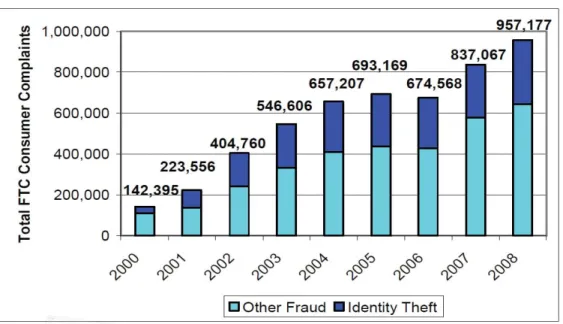
The FTC has been recording consumer complaints since 2000. Figure 2 below represents
the number of identity theft complaints received by the FTC between 2000 and 2008 in
connection to the number of all other fraud complaints received. “According to CRS analysis,
since 2000, the number of identity theft complaints has averaged about 37% of the total number
of consumer complaints received by the FTC. (Finklea, 2010) Not only has the number of
identity theft complaints continued to be the primary consumer fraud complaint to the FTC, but
the sheer number of identity theft complaints has generally increased.
Figure 2: Source: FTC Identity Theft Consumer Complaint data for each calendar year from 2000 – 2008, in correlation to all other fraud complaints.
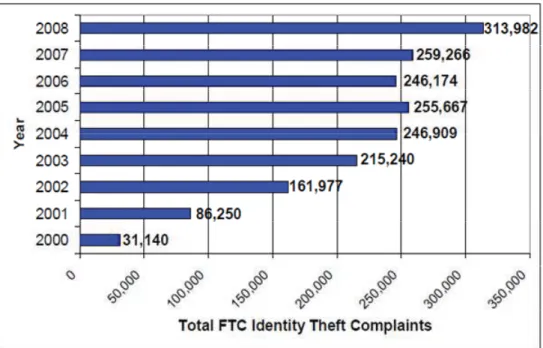
The number of identity theft complaints received by the FTC has generally increased since
the FTC began recording identity theft complaints in 2000. Figure 3 below represents the
general increase of identity theft complaints reported to the FTC from 2000 to 2008. Since the
commission of the FTC began recording identity theft complaints in 2000, the number of identity
theft complaints has generally increased.
Figure 3: Source: FTC reports an increasing trend in the number of identity theft complaints from 2000 – 2008. http://www.fas.org/sgp/crs/misc/R40599.pdf, January 10, 2010.
Figure 4 provides a brief description of each type of identity theft, which was gathered by the
Federal Trade Commission based on complaint data.
Figure 4: Source: Types of identity theft statistics in 2009. 2009. http://www.spendonlife.com/guide/2009-identity-theft-statistics, 2009.
• Credit Card fraud (26%): Credit card fraud continues to be one of the most common of identity theft reported by victims. This can occur when a perpetrator acquires the victim’s credit card number and uses it to make a purchase.
• Utilities fraud (18%): Utilities are opened using the name of someone who may not be living at the residence. Parents may be so desperate for electricity, water, and gas that they would use their own children’s clean credit report to be
approved for utilities.
• Bank fraud (17%): Many forms of bank fraud, including the following: ATM pass code theft, check theft, and changing the amount on a check.
• Employment fraud (12%): This will occur when the perpetrator does not have a valid social security number and steal a victim’s to obtain a job.
• Loan fraud (5%): Loan fraud occurs when the perpetrator applies for a loan in the victim’s name.
• Government fraud (9%): This type of fraud will include the following: driver license, tax, and Social Security fraud.
• Other (13%)
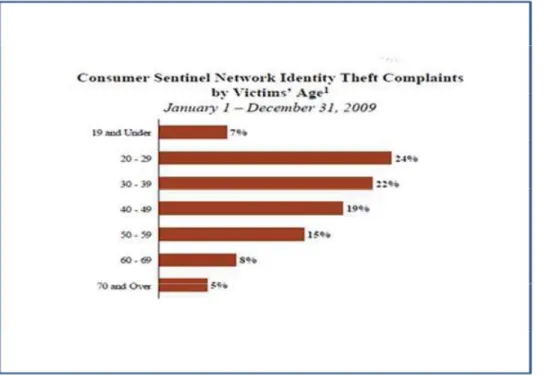
The FTC not only shows that identity theft is rising, but that it is targeting one of most
financially vulnerable age groups: 20-29 age groups. Over the past three years, the target
In 2006, the 20-29 age group made up 25-percent of the complaints, while the 30-39 age
group made up 23-percent. In 2007, the two groups were at 24-percent and 23-percent,
respectively, and, in 2008, at 24-percent and 23-percent.” (Hwang, 2009)
The belief is that identity thieves are targeting victims with expendable income and have less
experience in dealing with identity theft scams. Figure 5 displays, in 2009 again these numbers
continue to stay roughly the same. According to the FTC, 65 percent of the complainants were
between the ages of 20 and 49. Nearly half (46 percent) of the victims were between the ages of
20 and 39. The largest numbers of complaints were collected from Florida, Arizona, Texas,
California, and Nevada. North Dakota reported only 192 complaints in 2009, ranking 49th out of
50 states.
Figure 5: Source: Consumer Sentinel Network Identity Theft Complaints by age in 2009. http://www.ftc.gov/sentinel/reports/sentinel-annual-reports/sentinel-cy2009.pdf, February 2010.
The perception may that identity theft only occurs when the identity thief is across the world
claim that identity theft occurred when someone they knew used their personal information
inappropriately. Many victims claim that the perpetrator is someone they know who feels some
animosity or anger towards them. “Of identity theft cases where the perpetrator was identified
13 percent were cases of “friendly theft,” perpetrated by friends, family members, or in-home
employees.” (2010) Relationships that were identified included family members, neighbors,
roommates, co-worker, or individual’s working in the victim’s home.
2.7 Victims Experiences and Rights
Victims of identity theft often experience financial losses in addition to non-monetary harm.
The leading types of non-monetary harm cited by victims were invaded privacy, time to resolve
problems, denied credit or other financial services, and lack of closure. Some victims also claim
that they have been subjected to criminal investigations, arrests, or convictions of identity theft
related crimes. “It has been estimated that in every 30 to 60 hours a victim handles various
matters, which are related to cases of stolen identity which includes creating an account or using
existing accounts.” (DeJarnette, 2009) Victims also believe that (1) that they receive little help
from authorities who announced the identifying information to them; (2) that they receive the
proper support from the credit reporting agencies, banks, or the credit guarantors; (3) that law
enforcement agencies did not properly investigate many identity theft crimes due to the lengthy
number of complaints.
Many news reports signify that people everywhere are increasingly being fooled by identity
theft. Identity theft victims continue to be the focus of this crime in television interviews and
news articles, while the justice system generally focuses on the perpetrators. Some of the stories
include:
I. “What the Wilkinsons believe may have been months after his wife fell victim phishing attack, the couple began noticing that their online banking transactions were not going
through. Automatic bill payments were being turned down for insufficient funds and checks were being ordered and mailed to locations the Wilkinsons did not recognize. At one point, the fraudsters tried to wire a $40,000 line of credit from the Wilkinsons’
account. “It puts you in a terrible place, and you don’t know what do,” Wilkinsons says.” (Kitten, 2010)
II. “Parents, pay especially close attention to this unfortunate identity theft story. These days, ID theft victims are getting younger and younger. The Consumerist reports that a thief stole the identity of 9-year-old Kyle Shoemaker to open up two credit card accounts and an $18,000 line of credit. Apparently, ID thieves don’t discriminate against age.” (2007)
III. “One 23-year-old Delaware waitress was paid $10-$15 for every card she skimmed. A similar scam in Los Angeles was discovered after six customers complained of $16,000 in unauthorized charges. All, it turned out, had dined at the same restaurant.”
(Handsschuch, 2009)
While most financial organizations do not hold victims accountable for fraudulent debts,
victims may incur a substantial amount of expenses while trying to restore their financial health
and good name. It has been reported by the FTC, that victims may incur costs on a routine basis
on the following items: notary fees, document copies, certified mail, and long-distance
telephone calls. In some cases, victims may have had their tax refunds withheld pending
resolution of the identity theft crime. “Respondents in 2009 spent an average of $527 dollars in
out-of-pocket expenses for damage done to an existing account.” The average out of pocket
expenses have declined from $741 which was reported in 2008. (2010) The FTC also reported
that out of pocket costs of identity theft victims varied widely.
However, 10 percent of all ID theft victims reported costs of $1,200 or more, and 10% of
victims of new accounts and other frauds reported out of pocket costs of $3,000. One
quarter of all new accounts victims reported expenses of at least $1,000. (Frayer, 2009)
The Identity Theft and Assumption Deterrence Act in October of 1998 became the first piece
of federal legislation to deal directly with identity theft. The act was necessary because prior to
its enactment, laws only addressed the fraudulent creation, transfer or use of identification
incarceration and a maximum fine of $250,000. This act makes it a crime when a perpetrator
performs the following:
knowingly transfers or uses, without lawful authority, a means of identification of another
person with the intent to commit, or to aid or abet, any unlawful activity that constitutes a
violation of federal law, or that constitutes a felony under any applicable state or local
law. (2008)
This Act established the Federal Trade Commission (FTC) as the government body charged
with establishing procedures to log and acknowledge the receipt of complaints by victims. The
FTC will then provide educational materials to these victims and to refer the complaints to the
appropriate law enforcement agencies and three major national credit reporting bureaus.
The Electronic Fund Transfer Act (EFTA) of 1978 is devoted to protecting consumers
engaging in electronic fund transfers (EFTs). EFT services may include the following: transfers
through automated teller machines, debit cards, automated clearinghouse systems, point of sale
terminals, and telephone bill payment plans. This Act also limits the debt for unauthorized
electronic fund transfers. The amount of loss that the victim incurs is responsible on how
quickly the stolen or lost ATM or debit card is reported. If the card is reported stolen or lost
within two business days, the victim will be liable for a maximum of $50 for the total losses
incurred. If the card is reported is reported to the financial institution between a 3 and 60 day
timeframe, the victim will be liable for up to $500. If the victim waits until after 60 days, the
victim will be liable for all of the money taken out of their account and before the card was
reported missing. MasterCard and VISA took the initiative to limit the victim’s liability for
unauthorized purchased of a debit card to $50 per card, no matter how much time has elapsed
identified, in addition to calling the financial institution, follow that up in writing with a certified
letter, return receipt requested. After being notified of an error on a statement, the financial
institution has 10 business days to investigate. After the investigation has been completed within
three business days all error must be corrected after determining that an error has occurred.
Fortunately, the victims of identity theft do have some assurances related to financial losses.
The Truth in Lending Act (TILA) is a federal law which was instituted by Congress in 1968,
regulates the extension of consumer credit by lender in the United States. “This federal law aims
at protecting the public against unfair and erroneous credit card practices and credit billing.”
This Act has the following several provisions: Limits the amount the cardholder can be charged
for unauthorized purchases, Blocks credit card companies from issuing cards to individuals who
have not applied for them. In most cases, TILA limits liability for unauthorized use of credit
card charges up to 50 dollars to credit card holders.
“A federal law called the Fair Credit Billing Act gives people who use “open end” credit
accounts the right to dispute fraudulent and unfair credit charges.” (2010) Effective in 1975, the
Fair Credit Billing Act (FCBA) requires that a credit card company immediately credits the
identity thefts victim’s payments and adjusts mistakes on their bill. To take advantage of the
law’s consumer protections, write to creditor at the address given for “billing inquiries”, and
include your name, address, account number, and a description of the billing error. The victim
should mail their letter so that it reaches the creditor within 60 days after the first bill containing
the error was mailed out. Even if there is a case that the identity thief changed the address on the
account and the bill was not received, the dispute letter still must reach the creditor within 60
days, or the victim may be responsible for the charges. When the victim sends a dispute letter,
responsibility to acknowledge the complaint in writing within a 30 day time frame, unless the
Chapter 3 – Methodology
Most of the secondary research tools that will be utilized will be the following: The
library and its resources, World Wide Web, news, computer periodicals, and surveys. A number
of case studies or victim testimonials on the subject of identity theft can be located within
congressional hearings. A structured survey was used as a research instrument. This sample
study will be based on a non-probability planned sample of colleagues from my place of
employment. Existing surveys may be referenced with regards to their methodologies,
population estimates, and sample sizes. The survey will be conducted and any modifications that
are necessary will be made to the questions.
Creating a model for a given domain from scratch can be very difficult and time consuming.
One of the major ontologies that will be utilized is the quantitative research method. Information
from standards and classification schemes that already exist will be utilized as well as case
studies, news articles, books, and websites. The proposed methodology used for building
computer fraud ontology should be treated through a risk management process. The focus of risk
management is to identify, measure and consider these risks in order to reduce the likelihood of
identity theft happening. Establishing the fraud relations for a home user involves defining the
type of fraud the home user wishes to fight and identifying which processes that fraud occurs
upon. The computer fraud ontology will be a generic framework for defining both the domain
and case specific fraud ontologies. This framework will be able to adapt and extend to different
domains and types of fraud.
The Interpretivist Epistemology will be employed. In the field of computer security there are
multiple ways to get the job done. Having virus protection installed on a computer can provide a
stronger sense of security. Having a layered approach is the best defense on protecting users
from computer identity theft. Hackers may be able to easily get past one layer of defense, but by
employing multiple layers, this will make life more difficult for hackers as they try to invade
your information.
The thesis will be made more manageable in the following ways: focus will be placed on
educating users on some of the ways identity theft occurs, implement common security practices
to circumvent a security breach, and discuss the existing laws in place to protect users. By
setting up these parameters, this should provide a framework for my thesis research. “
By way of comparison, identity theft-related losses due to credit card account takeovers
at the two largest credit-issuing organizations totaled $46.1 million in 2000, and total
check fraud-related losses associated with new-account fraud, check forgery,
unauthorized access to checking accounts, illegal credit card purchase, and fraudulent
cash advances on credit cards, collectively, were estimated to total $2.4 billion over the
12 months ending April 2004, or $1,200 per victim. (2004)
People should find this research interesting because if computer identity theft continues to
grow, the growth of online banking and commerce will gradually decline. Experts recommend
using a layered approach to computer security because no single security method is sufficient to
prevent identity theft. By educating consumers to practice some common security practices,
consumer confidence may rise on how it may come to trust online transactions which may help
all participants in Internet commerce.
The bulk of my research will come from secondary research. With that being said, repetitive
patterns should start to materialize with what is being read. Once these patterns start to become
Chapter 4 –Results 4.1 Research Questions
This survey was designed to answer certain research questions to determine the extent of the prevention of identity theft. Questions 1 – 2 were focused on a respondents experience with identity theft.
1. Have you ever been a victim of identity theft?
o Yes
o No
2. Do you know someone that has been a victim of identity theft?
o Yes
o No
Questions 3-5 focused on capturing the demographic information from the respondents. The purpose of this was to determine if there was a segment of the population that were affected more so than the other(s) by identity theft.
3. What is your sex?
o Male
o Female
4. Please specify your race.
o American Indian or Alaska Native
o Asian
o Black or African American
o Hispanic or Latino
o Native Hawaiian or Other Pacific Islander
o White
5. What is your age range?
o 18-29
o 30-39
o 40-49
o 50-60
Question 6 wanted to ask the respondent’s opinion on whether they felt identity theft will increase or decrease in the near future.
6. Identity Theft is likely to increase rather than decline in the near future.
o Strongly Disagree
o Somewhat Disagree
o Somewhat Agree
o Strongly Agree
Question 7 focused on capturing the respondent’s computer usage. Due to the continued uptick in Internet usage, this will further expose respondents to identity theft.
7. Do you use a computer at your workplace, at school, at home, or anywhere else on at least an occasional basis?
o Yes
o No
Question 8 was asked to determine the frequency of respondent(s) reading any disclaimers before downloading or installing any programs. If respondent(s) read through the disclaimer, malware may be minimized from being downloaded onto a computer.
8. On a different topic…how often, if ever, do you read user agreements, privacy
statements, or other disclaimers before downloading or installing programs or files from the internet?
o Always
o Most of the time
o Only sometimes
o Hardly ever
Question 9 was designed to capture how respondents may be using the Internet. Some of these possible ways may be how respondent’s contract malware onto their computers.
9. Please tell me if you ever use the internet to do any of the following things. Do you ever…?
Please select all that may apply.
Send or read e-mail
Buy a product online, such as book, music, toys, or clothing Play online games
Share files from your own computer, such as music files
Download music files onto your computer so you can play them at any time you want
Download computer programs from the internet Visit an adult website
Questions 10 – 13 focused on the respondent’s experiences to spyware on their computers. Respondents may be aware of the danger posed by malicious files found during normal web surfing activities, but they may still be unaware of spyware and the dangers they pose until they get infected. These questions were asked to determine the potential of the respondents having been affected by spyware possibly without their knowledge.
10. In the past year, have you experienced any of the following problems on your main home computer, or not?
Your computer has slowed down or is not running as fast as it used to.
o Yes
o No
11. Your computer started freezing up or crashing, requiring you to shutdown or reset.
o Yes
o No
12. Your internet home page changed without you resetting it.
o Yes
o No
13. A new program appeared on your computer that you didn’t install or new icons suddenly appeared on your desktop.
o Yes
Question 14 wanted to capture the respondent’s opinion of their ability to keep malware off of their computers. The question was asked to track the respondent’s belief in their ability to combat the problem.
14. Overall, how confident are you that you can keep things like computer viruses, spyware, and adware off of your home computer when you want to?
o Very Confident
o Somewhat Confident
o Not Too Confident
o Not At All Confident
o Do Now Own A Home Computer
o Do Not Know
Question 15 wanted to track if the respondents have experienced phishing scams. Respondent’s that unknowingly give out their username and passwords may have their accounts raided by identity thieves.
15. Have you ever been prompted by an email from your financial institution to enter your password information to gain access to your account?
o Yes
o No
Question 16 wanted to track to see if respondents had virus protection software installed on their computer. This question was posed to see if the necessary steps are taken in hopes of mitigating a respondent’s risk.
16. Do you happen to have virus protection on your main home computer?
o Yes
o No
Question 17 wanted to capture the frequency of how often a respondent will update their virus definition file. Antivirus applications are only as good as the most recent virus definition file update. The most recent updates will likely protect respondents from being attacked by the latest virus.
17. How often is the virus protection on your main home computer usually updated?
o Daily
o Weekly
o Monthly
Question 18 wanted to capture if respondents have firewalls installed on their computers. Respondent’s that use good Internet firewalls; continue to protect themselves from the spread of hacker dangers, often without being aware of it.
18. Do you happen to have a firewall installed on your home computer?
o Yes
o No
Question 19 wanted to capture the respondent’s confidence in protecting themselves from identity theft. The Internet has drastically transformed the way personal details, income, and expenses are handled.
19. Do you know what to do to protect yourself against identity theft?
o Yes
o No
Question 20 is asked to see if the respondents practice any of the security tips that are listed below. By applying an onion layered approach to security, respondent’s can make their computers more difficult to penetrate when it comes to identity theft.
20. Do you practice the following security tips on your home PC or laptop?
Please check all that apply.
Install and maintain Operating System patches.
Install and regularly update AntiVirus and AntiSpyware applications. Install and configure a firewall on personal computer.
Configure security encryption on wireless technologies Use strong passwords.
4.2 Initial Survey
The awareness of identity theft survey was originally designed and administered as a study for
a research methods class. This pilot study was initially disseminated to 110 engineers within my
company of Aurora, CO 2010. Since the researcher was already employed with the engineering
firm in Aurora, the respondents were chosen as a convenience sample, because they were readily
available to take the surveys. An online survey was created and distributed by email, which the
user could gain access by clicking on a link. The main focus of the Identity Theft survey was to
obtain quantitative data regarding identity theft awareness.
Emails were distributed to 110 engineers among various age groups at Merrick & Company
in Aurora, CO. The age ranges from 18-29, 30-39, 40-49, 50-60, and 61+. To avoid duplication,
engineers were encouraged to complete one survey, and a setting in the online survey was
checked off allowing one response per computer. Respondents could not go back and change
existing responses after the survey is submitted. Each survey that was submitted also tracked the
respondents IP address of the computer that they were on. Although this did not occur, any
responses that had a duplicate IP addresses would be tossed from the data collection.
Part of the survey was designed for quantitative purposes and asked for personal experience
either as a victim of identity theft or did they know anybody who may have become a victim.
This survey also requested demographic information, such as the following: age, race, and sex.
All 110 respondents reported to this question. The next part of the survey asked for Yes\No
responses or chose multiple answers in a multiple choice setting. The results of this survey
produced outstanding results.
This study targeted the engineering population at Merrick & Company, but ultimately identity
research showed that 11 million people were victims of identity theft in 2009, this represents that
3.6 percent of the US population have been victimized.
Table 1
Engineers at Merrick & Company
18-29 30-39 40-49 50-60 61+ Total
engineer engineer engineer engineer engineer
American Indian or Alaska Native 0 0 1 1 0 2
Asian 0 1 1 0 0 2
Black or African American 8 8 3 9 2 30
Hispanic or Latino 2 2 3 0 0 7
Native Hawaiian or Other 0 0 0 0 0 0
Pacific Islander
White 10 18 13 23 5 69
Totals 20 29 21 33 7 110
Surveys were distributed to 110 employees of Merrick & Company. Prior to distributing the
surveys, approval was requested from project management of each department. Merrick has a lot
of diversity among all departments throughout the company. The number of surveys to
distribute was calculated based on the populations chosen. 55 males and 55 females were polled
totaling 110 employees. This represents that 22 percent of the organization was polled, as the
total employee count for full time employees at the main headquarters of Merrick & Company in
Aurora, CO totaled 500. All of the surveys that were forwarded to Merrick employees were
returned (100% return rate). The data was collected from the surveys which were compiled into
4.3 Prevention of Identity Theft Survey Results
The first section of the survey of identity theft prevention asked five personal questions about
the respondents. In section 4.1, question 1 provided two responses from which to choose. 28 out
of 110 respondents admitted to being victimized by identity theft. Most of these victims were
white males that were in the 40-49 age range.
Table 2
Section 4.1, question 2, provides two possible responses between male and female. 62 out of
110 respondents knew someone that has been victimized of identity theft.
Table 3
Question 2: Do you know someone that has been a victim of identity theft?
57 million Americans receive scam emails on an annual basis. “19% click on the link inside.
3% disclose bank and financial information by accident. 1.7% is then scammed.” (2010)
Section 4.1, questions 3 -5 captures demographic information. Section 4.1, question 3,
respondents had two responses to select from between Male and Female. 55 males and 55
females were polled.
Table 4
Section 4.1, question 4 had the following 6 choices to choose from: American Indian or
Alaska Native, Asian, Black or African American, Hispanic or Latino, Native Hawaiian or Other
Pacific Islander, or White. The majority of the respondents were white representing 62.7% of
this survey.
Table 5
Section 4.1, question 5 had the following 5 choices to choose from: 18-29, 30-39, 40-49, 50
60, and 61+. The majority of the respondents were in the 50-60 age range representing 30% of
the engineering population.
Table 6
Section 4.1, question 6 had 63 of 108 respondents strongly agreed that identity theft would
increase in the near future. 2 respondents skipped this question.
Table 7
Question 6: Identity Theft is likely to increase rather than decline in the near future.
Nationally recognized experts in identity theft have come up with 10 predictions for what the
nation can expect in 2010 and beyond.
I. More Scams: Whenever there is a difficult time within the United States, perpetrators
will find a way to take advantage of the existing problem. Today there are more
variations of sophisticated new scams.
II. Job Scams: With the unemployment rate holding at an all time rate of 9.6%,
perpetrators are taking advantage of this by tricking desperate people seeking out
employment. Fake work at home scams or job listings will lead to the victim providing
their Social Security number.
III. New Low Tech “Desperate” Identity Theft: More perpetrators are beginning to