QUT Digital Repository:
http://eprints.qut.edu.au/
Mehta, Amisha M. and Xavier, Robina J. (2008) Building self-evaluation skills through criterion-referenced assessment in public relations. PRism OnLine PR Journal 5(1-2).
1
Building self-evaluation skills through
criterion-referenced assessment in public relations.
Amisha Mehta & Robina Xavier
Queensland University of Technology
AbstractAlthough technical skills in public relations are essential to practice, skills in self-evaluation, critical thinking, and problem solving are required when new practitioners move to management roles (Van Leuven, 1999). Public relations courses integrate spe-cialist subject knowledge with graduate skill sets and capabilities in non-technical areas (Butcher & Stefani, 1995). Given that auton-omy in learning is a skill valued by employers (Clifford, 1999) and advocated by accrediting professional bodies (Anderson, 1999), this study explores how public relations students build skills in and perceive the practice of self-evaluation.
Currently, the public relations education literature presents a limited treatment of self-evaluation. Therefore, this study is guided mostly by the education literature and uses criterion-referenced assessment to determine how more than 150 students understand as-sessment requirements, assess their strengths and weaknesses, and interpret the differences between their own and their tutor’s judge-ment of performance. The results indicate strong support for student understanding of assessment requirements and self-evaluation techniques but lower than expected support for understanding the differences between their own and tutor judgements. These find-ings are significant to educators, practitio-ners and professional bodies as they have im-plications for lifelong learning for public re-lations professionals.
Introduction
Skills and attributes that increase the employ-ability of public relations students are an im-portant part of university courses (Anderson, 1999; Holt & Sheenan, 2004). Universities are also mandated to provide personal
learn-ing opportunities that extend beyond discipline-based knowledge. The two primary goals of the higher education experience are for students to develop their “capabilities to the highest poten-tial levels” and to become lifelong learners (Stefani, 1998, p. 349). From an Australian per-spective, the Australian Council of Educational Research believes that universities value skills in communication, problem solving, interper-sonal skills, critical thinking, ethics, commit-ment to lifelong learning, and familiarity with technology (Trapper, 2000).
Supporting the call for educators to prepare students for lifetime careers, Turk (1989) en-courages the incorporation of management skills into public relations courses. This sugges-tion was extended by Badaracco (2002) who argued that pre-professional curricula should use industry standards to evaluate class content and student performance. Practitioners’ views are an integral part of education and at least in Australia, most public relations courses offered by universities are accredited by professional bodies such as the Public Relations Institute of Australia.
However, the public relations literature pre-sents little treatment of non-technical skills such as self-evaluation, critical thinking and problem solving beyond this framework. Greg-ory, Yeomans and Powell (2003) explored the use of peer assessment in group assignments within a public relations module at Leeds Met-ropolitan University in the United Kingdom. The task required students to assess each other on a range of criteria that measured individual contribution (Gregory et al., 2003). They found the process encouraged student ownership and increased student responsibility for learning outcomes (Gregory et al., 2003).
We extend the work of Gregory et al. (2003) to look at self-evaluation in public relations
education. The education literature frames self-evaluation as a reflective practice where students actively monitor their progress and devise strategies to achieve personal learning outcomes (Klenowski, 1995). This study de-scribes the process of self-evaluation as part of criterion-referenced assessment before pre-senting the student perspective on self-evaluation.
Literature review
As one of the key non-technical skills devel-oped at university, self-evaluation is defined as judgement and dialogue between the stu-dent and teacher (Klenowski, 1995). Self-evaluation is not a traditional assessment measure. In most higher education settings, performance is judged not by students them-selves but by tutors or lecturers. A number of authors believe that traditional models of as-sessment are flawed because they do not al-low for engagement or participation of the learner, or consider assessor bias (Carless, 2006; Reynolds & Trehan, 2000).
Dialogue between students and teachers is encouraged through assessment and feedback, both of which are critical to learning and the student experience (Taras, 2002). Appropriate feedback requires student and lecturer knowl-edge of particular standards, comparison of these standards to the student’s work, and the taking of action to close the gap between these two (Taras, 2002; Rust, O’Donovan & Price, 2005). Without appropriate feedback, student learning outcomes are limited.
With its focus on judgement and dialogue, evaluation incorporates a range of self-monitoring activities including diaries, learn-ing logs, group work, self evaluation or as-sessment, and questioning techniques (Klenowski, 1995; Sullivan & Hall, 1997). This study is primarily concerned with the practice of self-evaluation. Self-evaluation is defined as the judgement of one’s own per-formance by identifying one’s strengths and weaknesses with a view to improving learn-ing outcomes (Klenowski, 1995). Self-evaluation also encourages dialogue between the student and teacher.
Self-evaluation involves “a high level of self-awareness and the ability to monitor one’s own learning and performance”
(Cassidy, 2006, p. 170). Yet despite being aware of the benefits of reflective learning, stu-dents are reluctant to self assess (Evans, McKenna & Oliver, 2005; Hanrahan & Isaacs, 2001; Orsmond, Merry & Reiling, 1997; Sulli-van & Hall, 1997). This reluctance stems from the pressures of over or under scoring in com-parison to tutor evaluations (Orsmond et al., 1997; Sullivan & Hall, 1997) and the difficul-ties associated with becoming objective about their own work (Hanrahan & Isaacs, 2001).
Despite this reluctance, research has also showed that self-evaluation enhances the stu-dent’s understanding of their personal learning habits (Hanrahan & Isaacs, 2001), the effec-tiveness of these strategies (Orsmond et al., 1997), the extent of their learning as well as an awareness of the learning strategies required in the future (Mok, Lung, Cheng, Cheung & Ng, 2006). Through self-evaluation, Klenowski (1995) identified that students gain further ideas and insight into their teacher’s tacit knowledge as well as build their own under-standing of quality performance. Further, self-evaluation reinforced student understanding of marking standards (Hanrahan & Isaacs, 2001).
However, before self-evaluation can occur learners “must first develop the capacity for self-assessment or self-evaluation” (Stefani, 1998, p. 345). Teachers play an important role in equipping students with the skills and infor-mation required for self-evaluation. In a study of junior high school students’ use of rubrics and self-evaluation, Andrade and Boulay (2003) found that meaningful improvements in student work required the integration of a range of learning strategies.
Using criterion-referenced assessment to build self-evaluation skills
According to Klenowski (1995), self-evaluation requires three steps: 1) the identification of cri-teria upon which to conduct a self-evaluation, 2) the opportunity for interactive dialogue, 3) the determination of the grade. Following from Klenowski’s (1995) recommendations about the processes of self-evaluation, this study adopted criterion-referenced assessment (CRA) as a means of establishing criteria for assess-ment, encouraging interaction, and determining a grade. Unlike normative approaches where one student’s performance is relative to peers’
3
performance (Carlson et al., 2000), CRA is a participative process that holds student and lecturer negotiation and understanding of as-sessment requirements as central to successful learning outcomes (Abbiss & Hay, 1992; Carlson et al., 2000; Neil et al., 1999). A so-cial constructivist approach to assessment overcomes judgment problems found in norm-based systems (Rust et al., 2005).
An introductory public relations subject was chosen for study. After designing as-sessment tasks in line with subject goals and identifying skills to be demonstrated within assessment tasks (Carlson et al., 2000), four criteria were identified as relevant to the sub-ject: problem identification; research and de-cision making; application and evaluation; and communication and interpersonal skills. These criteria were mapped to the two major assignments for the unit: a proposal for an issue brief on a contemporary business issue and a fully developed issue brief including significant media analysis. Each criterion was weighted based on its importance to the task. Students were graded on a 1 to 7 scale with 7 representing a high distinction and 1 repre-senting a fail. Descriptive performance stan-dards for each of the criteria at each possible grade were written and presented as an as-sessment rubric. Following Norton (2004), this study conceptualised CRA as learning criteria that encouraged “meaningful learning and active engagement” between students and teachers (p. 689).
Several learning and teaching activities were designed to encourage dialogue between students and teachers and embed both CRA and self-evaluation into the public relations subject. This embedding strategy facilitated the transfer of both explicit and tacit knowl-edge through shared understanding of expec-tations (Nonaka, 1991). An assessment pack-age was prepared to explain the new assess-ment paradigm to students, describe the prin-ciples of CRA, outline the requirements of each assessment item, and present the rubrics. The assessment processes and rubrics were discussed with students first by the lecturer and then by each of the tutors.
In order to build familiarity with these cri-teria, a tutorial exercise was designed to build
student skills in grading through the use of an exemplar or sample paper. Students then dis-cussed their grading structure in the tutorial session and the tutors showed the students the assessor’s grades and explained any differences that appeared. Exemplars offer students practi-cal experiences in critique which build student skills in evaluation that can be transferred to the practice of self-evaluation (Stefani, 1998; Klenowski, 1995). Student involvement in marking sample exercises has improved results in students’ subsequent work (Rust, O’Donovan & Price, 2003). Sadler (1987) sug-gests the combination of verbal descriptors and exemplars helps assessors and students over-come the inherent imprecision of verbal de-scriptors and also helps the students acquire strong evaluation skills.
Methodology
Following the introduction of CRA into an in-troductory undergraduate public relations unit, self-evaluation activities were designed to en-courage student skills in non-technical areas. Students were asked to self assess their assign-ments prior to submission. These self-evaluations were submitted with assignments and tracked by the assessors to identify where students had over- or underestimated their per-formance. Assessors graded each assignment using the assessment rubric and this was re-turned to the students. A follow-up tutorial ses-sion discussed students’ performance on the first piece of assessment and students had the opportunity to meet with their tutors to get a more detailed explanation of the grading proc-ess.
A questionnaire was designed to capture student perspectives on the use of CRA in the unit and its impact on their learning strategies. The questionnaire allowed students to identify how they had understood assessment require-ments, used criteria to assess the strengths and weaknesses of their assignment, and interpreted the differences between their own and their tu-tor’s judgement of performance. Likert scales allowed the students to demonstrate their strength of agreement or disagreement with particular statements. The questionnaire also captured key demographic information and any prior experience with CRA.
The questionnaire was administered in a lecture session towards the end of the semes-ter. All students enrolled in the unit were eli-gible to complete the questionnaire. The unit included full and part time public relations students as well as students from other disci-plines who were taking the unit as an elective. In line with the university’s profile, the stu-dents were both domestic and international and represented both school leavers and more mature age students returning to university after a period of absence from formal educa-tion. All students studied on campus. Com-pletion of the questionnaire was anonymous and optional, in line with the University’s eth-ics approval for research on current students.
The questionnaires were completed and the data analysed using SPSS. Frequency counts and descriptive statistics were calcu-lated for relevant variables with chi-square analyses and t-tests conducted where appro-priate.
Results
Nearly two-thirds of the students enrolled in the introductory public relations unit com-pleted the survey. Of the 264 students en-rolled in the unit, 158 completed and returned the questionnaire. The majority of the re-sponding sample were female (n=128) which
is consistent with a strong female skew across enrolments in public relations internationally (Grunig, Toth & Hon, 2000). Of the sample, 47 percent of students were in their first semester of university study and 24 percent were in their final year with 67 percent identifying some prior experience with CRA.
Level of student understanding of assess-ment requireassess-ments
A major part of effective self-evaluation is student understanding of assessment re-quirements (Klenowski, 1995; Stefani, 1998). Almost 70 percent of students indicated that they agreed or strongly agreed that they under-stood what was required for the assignment by reviewing criteria and performance standards. Approximately 65 percent of students indicated that they agreed or strongly agreed that using the matrix in tutorials helped them understand how to match the performance standards speci-fied (see Table 1). Almost one-third of the stu-dents provided a neutral response to this same question. Anecdotal feedback from students during and after enrolment in the subject indi-cated support for the self-assessment activity as a way to understand what skills are being as-sessed and as an opportunity to review and pre-sent their best work.
Table 1: Student understanding of assessment requirements Strongly
Disagree
Disagree Neutral Agree Strongly
Agree
Total
Freq % Freq % Freq % Freq % Freq % Freq %
Understanding of assignment requirements was enhanced by reviewing criteria 2 1.3 16 10.1 31 19.6 84 53.2 25 15.8 158 100 Use of matrix in tutorials helped me understand how to match performance standards 3 1.9 6 3.8 45 28.7 90 57.3 13 8.3 157 100
5
Table 2: Student reflections on performance Strongly
Disagree
Disagree Neutral Agree Strongly
Agree
Total
Freq % Freq % Freq % Freq % Freq % Freq %
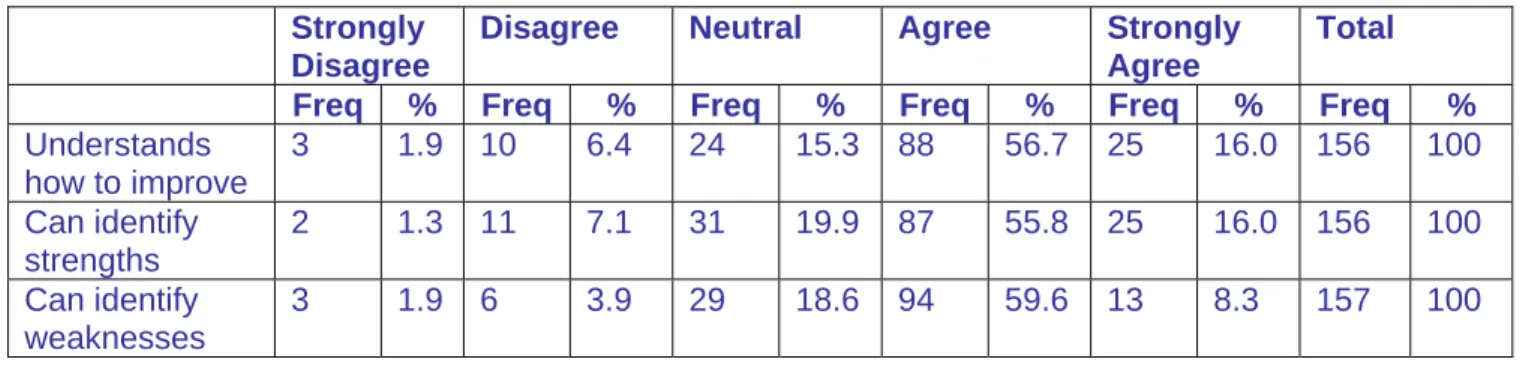
Understands how to improve 3 1.9 10 6.4 24 15.3 88 56.7 25 16.0 156 100 Can identify strengths 2 1.3 11 7.1 31 19.9 87 55.8 25 16.0 156 100 Can identify weaknesses 3 1.9 6 3.9 29 18.6 94 59.6 13 8.3 157 100
Table 3: Student reflections on own versus tutor assessment of performance Strongly
Disagree
Disagree Neutral Agree Strongly
Agree
Total
Freq % Freq % Freq % Freq % Freq % Freq %
Self-evaluation activity helped me understand where my in-terpretation was different to the assessor 0 0 12 8.2 55 37.7 37 45.9 12 8.2 146 100.0 Level of self-evaluation
Critical reflection is an integral self-learning mechanism for students. Through CRA, stu-dents were able to engage with their own learning practices by identifying their strengths and weaknesses. Approximately 69 percent of students agreed or strongly agreed that they understood how to improve their performance by seeing how the assessor had graded their assessment on each of the criteria using the specific performance levels (see
Table 2). More than 70 percent of students said they could now identify their strengths and 67.9 percent of students their weaknesses in performance.
Evaluation of self-evaluation against tutor assessment
Although the majority of students agreed that self-evaluation activities were beneficial, only 54 percent of students agreed or strongly agreed that the self-evaluation process helped them understand where their personal per-formance interpretation differed from their tutor’s assessment (see Table 3). An addi-tional analysis showed significant correlation
between student perception that self-evaluation activity helped them understand the difference between personal and tutor performance judgement and understanding of assessment requirements (r = .303, N = 146, p < .0001 (two-tailed)).
Further analysis of the data showed a sig-nificant correlation between student perception that self-evaluation activity helped them under-stand the difference between personal and tutor performance judgement and the identification of weaknesses (r = .17, N = 145, p = .041 (two-tailed)) and understanding of how to improve (r = .26, N = 146, p = .001 (two-tailed)).
Discussion
In order to be effective self-evaluators, the lit-erature identifies the importance of guidance from teachers (Klenowski, 1995). The strong embedding strategy used in this study built a shared understanding of learning criteria, the assessment requirements, and experience in evaluation through exemplars. As this study is part of a longitudinal research project, the au-thors will continue to collect data about student self-evaluation and compare findings.
Within the framework of CRA, the major-ity of undergraduate public relations students who responded to the survey built skills in self-evaluation. These skills were achieved through the capacity of students to identify their strengths and weaknesses and areas for improvement in their performance. Approxi-mately 10 percent of the responding sample suggested they did not fully understand as-sessment or use asas-sessment to identify strengths, weaknesses and areas for im-provement and approximately 20 percent in-dicated a neutral position.
In a recent study, Cassidy (2006) identified that students with particular learning styles showed a greater affinity for self-evaluation. Of the deep, surface, strategic and apathetic learning approaches categorised in an earlier study (see Cassidy, 2004), Cassidy (2006) found the strongest correlation between a deep learning style and skill in self-evaluation. Future research should consider the relationship between learning styles and self-evaluation skills and pre-test students to help identify their preferred learning ap-proach. This understanding will help educa-tors identify subsequent support services needed to enhance student learning outcomes.
More than half the sample indicated that they understood how their interpretation of performance was different to their tutor’s judgement. Although the authors hoped for a higher level of agreement, these findings could be explained by a number of factors including the possibility of students inflating perceptions of their own efficacy, the nature of the qualitative feedback provided by the tutor, and the timing of the questionnaire. Be-cause the questionnaire was administered several weeks after the tutors returned the marked assessment, students’ perceptions of their performance may have changed.
Future research could investigate the valid-ity of this study’s findings in relation to stu-dent-versus-tutor judgements. One way to understand the similarities and differences between student self-evaluation and tutor evaluation of performance is to compare their marking of the exemplar. To complement stu-dents’ perspective, research from the tutors’ perspectives will be collected in future to
un-derstand the perceived contribution of self-evaluation to student learning outcomes.
Perceived differences between students’ and tutors’ judgements of student performance may have a strong impact on students’ future learn-ing. According to Orsmond et al., (1997), an assumption that the tutor mark is always correct is false. One way to overcome this impact is to incorporate student or peer performance judgements into the student’s final grade. Un-dergraduate units could follow the work of Ste-fani (1998) who integrated student self-evaluation scores into final grades.
The findings of this study contribute to the existing literature on public relations education and assessment. They demonstrate the impor-tance of learning criteria to student understand-ing of assessment requirements. This findunderstand-ing builds on the work of Gregory et al. (2003) and provides evidence to support the importance of criteria to educators whose programs do not include assessment plans or procedures for as-sessing learning outcomes (see Rybacki & Lat-timore, 1999; Stacks et al., 1999).
This study has provided insight into the self-evaluation activities of an introductory public relations unit. As students progress into the fi-nal years of their public relations education, additional opportunities for self-evaluation must be created to enhance their evaluation abilities and critical thinking skills. More work can also be done to transition students into work. Translating the practice of self-evaluation from university assessment to the real world requires dialogue amongst the stu-dents/graduates, employers and educators. Stu-dents who recognise that their work environ-ment may not provide a clear set of criteria to guide their self-evaluation processes are likely to find the transition to work easier. Therefore, we encourage public relations educators to pro-vide students with the opportunity to develop criteria or standards for their own work within university settings.
Self-evaluation is one of the skills and at-tributes that complements discipline-based knowledge. Public relations educators should extend beyond traditional learning and teaching activities to encourage and continue to build student capacity for lifelong learning in our profession.
7 References
Abbiss, J., & Hay, I. (1992). Criterion-referenced assessment and the teaching of geography in New Zealand universities. New Zealand Journal of Geography, 94, 2–5. Anderson, C. L. (1999). Learning partnerships:
Involving practitioners in public relations education. Corporate Communications, 4(1), 30–36.
Andrade, H. G. (2005). Teaching with rubrics: The good, the bad and the ugly. College Teaching, 53(2), 27–30.
Badaracco, C. H. (2002). How we teach: An introduction to this special issue on innova-tive pedagogy. Public Relations Review,
28(2), 135–136.
Butcher, A. C., & Stefani, L. A. J. (1995). Analysis of peer-, self- and staff-assessment in group project work. Assessment in Educa-tion: Principles, Policy & Practice, 2(2), 165–185.
Carless, D. (2006). Differing perceptions in the feedback process. Studies in Higher Educa-tion, 31(2), 219–233.
Carlson, T., Macdonald, D., Gorley, T., Hanra-han, S., & Burgess-Limerick, R. (2000). Im-plementing criterion-referenced assessment within a multi-disciplinary university depart-ment. Higher Education Research and Devel-opment, 19(1), 103–116.
Cassidy, S. (2004). Learning styles: An over-view of theories, models and measures. Edu-cational Psychology, 24(4), 419–444.
Cassidy, S. (2006). Learning style and student self-assessment skill. Education and Train-ing, 48, 170–177.
Clifford, V. A. (1999). The development of autonomous learners in a university setting.
Higher Education Research and Develop-ment, 18, 115–128.
Evans, A. W., McKenna, C., & Oliver, M. (2005). Trainees’ perspectives on the assess-ment and self-assessassess-ment of surgical skills.
Assessment and Evaluation in Higher Educa-tion, 30, 163–174.
Gregory, A., Yeomans, E., & Powell, J. (2003). Peer assessment and enhancing student learn-ing. In R. Kaye & D. Hawkridge (Eds.),
Learning and teaching for business: Case studies in successful innovations. London: Kogan Page.
Grunig, L. A., Toth, E. L., & Hon, L. C. (2000). Feminist values in public relations. Journal of Public Relations Research, 12(1), 49–68.
Hanrahan, S. J., & Isaacs, G. (2001). Assessing self- and peer-assessment: The students’ views.
Higher Education Research and Development,
20, 53–70.
Holt, D., & Sheehan, M. (2004). Designing con-temporary learning environments for excellence in public relations education. Asia Pacific Pub-lic Relations Journal, 5(1), 21–33.
Klenowski, V. (1995). Student self-evaluation processes in student-centred teaching and learn-ing contexts of Australia and England. Assess-ment in Education: Principles, Policy & Prac-tice, 2(2), 145–154.
Mok, M. M. C., Lung, C. L., Cheng, D. P. W. C., Cheung, R. H. P., & Ng, M. L. (2006). Self-assessment in higher education: Experience in using a metacognitive approach in five case studies. Assessment and Evaluation in Higher Education, 31, 415–433.
Neil, D. T., Wadley, D. A., & Phinn, S. R. (1999). A genetic framework for criterion-reference assessment of undergraduate essays. Journal of Geography in Higher Education, 23(3), 303– 326.
Nonaka, I. (1991). The knowledge-creating com-pany. Harvard Business Review, 69(6), 96–104. Norton, L. (2004). Using assessment criteria as
learning criteria: A case study in psychology.
Assessment and Evaluation in Higher Educa-tion, 29(6), 687–702.
Orsmond, P., Merry, S., & Reiling, K. (1997). A study in self-assessment: Tutor and students’ perceptions of performance criteria. Assessment and Evaluation in Higher Education, 22(4), 357–370.
Reynolds, M., & Trehan, K. (2000). Assessment: A critical perspective. Studies in Higher Educa-tion, 25(3), 264–278.
Rust, C., O’Donovan, B., & Price, M. (2005). A social constructivist assessment process model: How the research literature shows us this could be best practice. Assessment and Evaluation in Higher Education, 30(3), 231–240.
Rybacki, D., & Lattimore, D. (1999). Assessment of undergraduate and graduate programs. Pub-lic Relations Review, 25(1), 65–75.
Sadler, D. R. (1987). Specifying and promulgat-ing achievement standards. Oxford Review of Education, 13(2), 191–209.
Stacks, D. W., Botan, C. H., & Turk, J. V. (1999). Perceptions of public relations educa-tion. Public Relations Review, 25(1), 9–28. Stefani, L. A. J. (1998). Assessment in
partner-ship with learners. Assessment and Evalua-tion in Higher EducaEvalua-tion, 23, 339–350.
Sullivan, K., & Hall, C. (1997). Introducing students to self-assessment. Assessment and Evaluation in Higher Education, 22(3), 289– 306.
Taras, M. (2002). Using assessment for learning and learning from assessment. Assessment and Evaluation in Higher Education, 27, 501–510.
Trapper, J. (2000). Preparing university students for the communicative attributes and skills required by employers. Australian Journal of Communication, 27(2), 111–130.
Turk, J. V. (1989). Management skills need to be taught in public relations. Public Relations Review, 15(1), 38–52.
Van Leuven, J. K. (1999). Four new competen-cies for majors. Public Relations Review,
25(1), 77–85.
Nominated contact author’s address for correspondence:
Amisha Mehta, School of Advertising, Market-ing and Public Relations
Queensland University of Technology PO Box 2434
Brisbane, Queensland 4001, Australia Tel: +61 7 3138 1798
Fax: +61 7 3138 1811 Email: [email protected]
Copyright statement:
The authors retain copyright in this material, but have granted PRism a copyright license to permanently display the article online for free public viewing, and have granted the National Library of Australia a copyright licence to in-clude PRism in the PANDORA Archive for permanent public access and online viewing. This copyright option does not grant readers the right to print, email, or otherwise reproduce the article, other than for whatever limited research or educational purposes are permitted in their country. Please contact the author named above if you require other uses.