A Comparison of Novel and State-of-the-Art
Polynomial Bayesian Network Learning Algorithms
Laura E. Brown
Ioannis Tsamardinos
Vanderbilt University, Department of Biomedical Informatics 2209 Garland Avenue, Nashville, TN 37232-8340
laura.e.brown, ioannis.tsamardinos, [email protected]
Constantin F. Aliferis
Abstract
Learning the most probable a posteriori Bayesian network from data has been shown to be an NP-Hard problem and typ-ical state-of-the-art algorithms are exponential in the worst case. However, an important open problem in the field is to identify the least restrictive set of assumptions and corre-sponding algorithms under which learning the optimal net-work becomes polynomial. In this paper, we present a technique for learning the skeleton of a Bayesian network, called Polynomial Max-Min Skeleton (PMMS), and compare it with Three Phase Dependency Analysis, another state-of-the-art polynomial algorithm. This analysis considers both the theoretical and empirical differences between the two al-gorithms, and demonstrates PMMS’s advantages in both re-spects. When extended with a greedy hill-climbing Bayesian-scoring search to orient the edges, the novel algorithm proved more time efficient, scalable, and accurate in quality of recon-struction than most state-of-the-art Bayesian network learn-ing algorithms. The results show promise of the existence of polynomial algorithms that are provably correct under mini-mal distributional assumptions.
Introduction
The problem of learning the most probable a posteriori Bayesian network (BN) from data under certain broad con-ditions is worst-case NP-hard (Chickering, Meek, & Heck-erman 2003). Given the recent emergence, particularly in bi-ology and medicine, of very high dimensional datasets with tens of thousands of variables, an important open research question is whether it is possible to design polynomial learn-ing algorithms – with well-understood theoretical properties – that are not only time-efficient, but also exhibit reasonable average performance in terms of network reconstruction.
A first step towards answering this questions was the Three Phase Dependency Analysis (TPDA) algorithm (Cheng et al. 2002). The algorithm runs in polynomial time and correctly identifies the data-generating network, provided the data distribution is monotone DAG-faithful. In-tuitively, the monotone DAG-faithful assumption requires that the conditional mutual information of two variables be a monotonic function of the “active paths” between the variables in the network structure: the more active paths Copyright c 2005, American Association for Artificial Intelli-gence (www.aaai.org). All rights reserved.
open by a conditioning set, the greater the mutual infor-mation between the variables should be. Compared to other constraint-based learning algorithms, such as the PC (Spirtes, Glymour, & Scheines 2000), TPDA uses not only the binary (yes/no) results of tests of conditional indepen-dence between two variables, but also the strength of asso-ciation as indicated by the conditional mutual information. This additional piece of information, in conjunction with the monotone faithfulness assumption, is what enables the algo-rithm to become polynomial.
One way to formally define monotone DAG-faithfulness was provided by Chickering & Meek (2003). Given their definition, the authors show that this assumption highly re-stricts the structure of the BNs that adhere to the condition. We note, however, that it may still be possible to identify other formulations of the assumption that are not as restric-tive.
In this paper we present a new polynomial algorithm, known as Polynomial Max-Min Skeleton (PMMS), for learning the BN skeleton, i.e., the graph of the BN without regard to the direction of the edges. In certain cases, PMMS can correctly reconstruct skeletons of networks that are not monotone DAG-faithful and in which TPDA does not return the proper structure. In addition, PMMS employs a differ-ent search strategy for iddiffer-entifyingd-separating subsets that exhibits better sample utilization. In an extensive empirical evaluation we compared PMMS with other constraint-based network learning algorithms on the task of reconstructing the network skeleton. PMMS proves to be a good trade-off between time and quality of reconstruction compared to all algorithms, and in general outperforms TPDA particularly for the smaller sample sizes.
To compare PMMS against search-and-score Bayesian network learning algorithms (i.e., including the edge ori-entations), we extended the algorithm with a greedy hill-climbing Bayesian-scoring search augmented with a TABU list (as in Friedman, Nachman, & Pe’er 1999) to orient the edges. The resulting algorithm is more time-efficient than its non-polynomial counterpart without sacrificing quality of reconstruction. In addition, this algorithm outperformed most other state-of-the-art Bayesian network learning algo-rithms. The evaluation points to the existence of polynomial algorithms that are provably correct under minimal distribu-tional assumptions.
Background
We will denote the conditional independence ofX andY givenZin some distributionP withInd(X;Y|Z), depen-dence asDep(X;Y|Z), and the conditional mutual informa-tion used as a measure of associainforma-tion asInf(X;Y|Z)(the reference distributionPcan be inferred by the context).
A Bayesian network (BN) is a tupleN =hG, Pi, where
G = (V,E)is a directed acyclic graph (DAG) with nodes representing the random variablesV andPa joint probabil-ity distribution onV. In addition,GandP must satisfy the Markov condition: every variable,X ∈ V, is independent of any subset of its non-descendant variables conditioned on the set of its parents (Pearl 1988).
A graphical criterion called d-separation is useful for characterizing conditional independencies (Pearl 1988). First, we define the terms “collider” and “blocked path” to aid in the definition ofd-separation. A collider is defined as a nodeW on pathpifpcontains two incoming edges into W, e.g., W is a collider in the chain X −→ W ←− Y. A path p from node X to nodeY is blocked by a set of nodesZ, if there is a node W on pfor which one of the following two conditions hold: (1)W is not a collider and W ∈ Z, or (2)W is a collider and none of W or its de-scendants are in Z. A path that is not blocked is termed
open or active. Two nodes X andY are d-separated by
Zin graphG, denoted asDsepG(X;Y|Z), if and only if ev-ery path fromX toY is blocked byZ(Pearl 1988). Two nodes are d-connected if they are not d-separated. For a BNN = hG, Pi,DsepG(X;Y|Z)⇒Ind(X;Y|Z)(Pearl 1988).
A BN N =hG, Pi satisfies the faithfulness condition (called faithful network) if the Markov Condition applied on
G entails all and only the conditional independencies inP (Spirtes, Glymour, & Scheines 2000). We will call a distri-butionP for which there exists a faithful networkhG, Pi, a faithful distribution andGa perfect map ofP (Pearl 1988). In a faithful BNhG, PiDsepG(X;Y|Z) ⇔ Ind(X;Y|Z) (Pearl 1988).
It can be proven that in a faithful BN, an edge between X andY exists if and only if there is no d-separating set Z such that Ind(X;Y|Z) (Spirtes, Glymour, & Scheines 2000). Algorithms following the constraint-based approach in BN learning (Spirtes, Glymour, & Scheines 2000; Cheng
et al. 2002) estimate from data the conditional
independen-cies and return only the edges which satisfy the above condi-tion. These algorithms differ in the strategies for searching for suchd-separating sets.
The Polynomial Max-Min Skeleton
We will denote withPCGT the parents and children ofT in the BNhG, Pi, i.e., all nodes with an edge to and fromT. This set is unique for all G, such that hG, Piis a faithful Bayesian network to the same distributionP (Pearl 1988) and so we will drop the superscriptGwhen the distribution Pcan be inferred by the context.We define the minimum association ofX andT relative to a feature subset Z, denoted as MINASSOC(X;T|Z), as
MINASSOC(X;T|Z) = min S⊆ZAssoc(X;T|S) Algorithm 1 PMMPC Algorithm 1: procedure PMMPC (T,D) %Phase I: Forward 2: CPC=∅ 3: repeat
4: F = arg maxX∈VGREEDYMINASSOC(X;T; CPC;Assoc(X;T| ∅);∅)
5: assoc= maxX∈VGREEDYMINASSOC(X;T; CPC;Assoc(X;T| ∅);∅)
6: ifassoc6= 0then
7: CPC=CPC∪F
8: until CPC has not changed
%Phase II: Backward 9: for allX ∈CPC do 10: if GREEDYMINASSOC(X; T;CPC; Assoc(X;T| ∅);∅) = 0then 11: CPC=CPC\ {X} 12: return CPC 13: end procedure
14: function GREEDYMINASSOC(X,T,Z,minval,minarg) 15: min= minS∈ZAssoc(X;T|minarg∪ {S})
16: arg= arg minS∈ZAssoc(X;T|minarg∪ {S})
17: if ((min < minval) AND (Z\minarg6=∅)) then 18: minval=GREEDYMINASSOC(X;T;
Z\minarg;min;minarg∪ {arg}) 19: returnminval
20: end function
i.e., as the minimum association achieved betweenXandT over all subsets of Z. Assoc(X;T|S), the association be-tween two variables given a conditioning set, can imple-mented with a number of statistical or information theo-retic measures of association, e.g., by the conditional mu-tual information Inf(X;T|S). In our implementation we prefer a statistically oriented test and we use the negative p-value returned by theχ2test of independenceInd(X;T|S) (the smaller thep-value, the higher we consider the associa-tion betweenX andT) as in Spirtes, Glymour, & Scheines (2000). A requirement forAssoc(X;T|S)is to return zero whenInd(X;T|S).
The Polynomial Max-Min Skeleton algorithm (PMMS) is run on a dataset and returns the skeleton network. PMMS works by calling the Polynomial Max-Min Parents and Chil-dren algorithm (PMMPC) for each variable. PMMPC iden-tifies an approximation ofPCT given a target node,T, and the data. Once the parents and children set has been dis-covered for each node, PMMS pieces together the identified edges into the network skeleton.
PMMPC(T,D), the main subroutine of the PMMS algo-rithm, discovers thePCT using a two-phase scheme (shown in Algorithm 1)1.
In phase I, the forward phase, variables sequentially enter
a candidate parents and children set ofT, denoted as CPC, by use of the MAX-MINHEURISTIC:
1
PMMPC is a polynomial variant of the Max-Min Parents and Children (MMPC) algorithm (Tsamardinos, Aliferis, & Statnikov 2003). The MMPC algorithm can be created from Algorithm 1 by replacing the calls to GREEDYMINASSOCat lines 4, 5, and 10 with the function MINASSOC.
X A B Y X P(X) 0 1 0.5 0.5 XP(B|X) 0.8 B 0 0 1 0 1 1 0 1 0.2 0.2 0.8 BP(Y|A,B) 0.3 A 0 0 1 0 1 1 0 1 0.95 0.1 0.75 0.7 0 0 1 0 1 1 0 1 0.05 0.9 0.25 Y 0 0 0 0 1 1 1 1 XP(A|X) 0.8 A 0 0 1 0 1 1 0 1 0.2 0.2 0.8 + + +
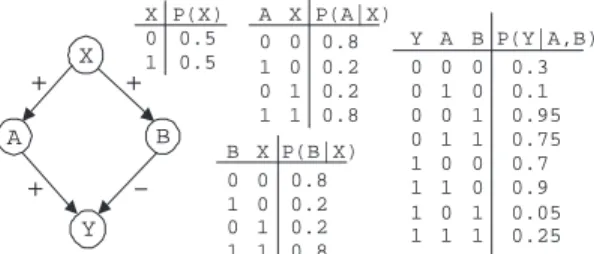
-Figure 1: A network DAG and probabilities tables.
Select the variable that maximizes the minimum
asso-ciation withT relative to CPC (hence the name of the algorithm).
The heuristic is admissible in the sense that all variables with an edge to or fromTand possibly more will eventually enter CPC. The intuitive justification for the heuristic is to select the variable that remains highly associated withT despite our best efforts to make the variable independent ofT. Phase I stops when all remaining variables are independent of the targetTgiven some subset of CPC, i.e., when the maximum minimum association reaches zero.
Conditioning on all subsets of CPC to identify the MINASSOC(X;T|CPC) requires an exponential number of calls to Assoc. In this polynomial version of the al-gorithm, PMMPC, we greedily search for the subsetS ⊆
CPC that achieves the minimum association betweenX andT conditioned over the subsets of CPC. The function GREEDYMINASSOC(X, T,CPC, minval, minarg)starts withminval as the current estimate of the minimum and minargas the current estimate of the minimizerS⊆CPC. Initially,minarg = ∅ andminval = Assoc(X;T| ∅). It then augments minarg by the memberS of CPC that re-duces the associationAssoc(X;T|minarg∪ {S})the most. It continues in this fashion recursively until we condition on the full CPC or the minimum association achieved between X andT cannot be further reduced by augmentingminarg by a single variable.
For example, examine the network structure in Figure 1, the set Z={A, B} is a minimal d-separating set of X andY. Assuming, Assoc(X;Y| ∅) ≥Assoc(X;Y| {A})
≥Assoc(X;Y| {A, B})thenZ, ad-separating set, can be discovered in a greedy fashion.
In phase II, the backward phase, PMMPC attempts to
re-move some of the false positives that may have entered in the first phase. The false positives are removed by test-ingInd(X;T|S)for some subset of the candidate parents and children set, S ⊆ CPC. If the independence holds, X is removed from CPC. The existence of a S ⊆ CPC for whichInd(X;T|S)is approximated by testing whether GREEDYMINASSOCreturns zero.
For example, in the network structure of Figure 1 it is possible that X enters CPC before both A and B when the target is Y. Phase II, however, will remove X once bothA and B are in CPC and the test GREEDYMINAS
-SOC(X;Y,{A, B},Assoc(X;Y| ∅),∅) returns zero (since Assoc(X;Y| {A, B}) = 0).2
A Theoretical Analysis of PMMS
PMMS is a polynomial variant of the skeleton
identifica-tion phase of the Max-Min Hill-Climbing (MMHC) algo-rithm (Brown, Tsamardinos, & Aliferis 2004; Tsamardinos, Brown, & Aliferis 2005). The difference between the algo-rithms is that MMHC implements the non-polynomial ver-sion of the parents and children algorithm, MMPC, that per-forms an exponential search for a d-separating set, while the polynomial version, PMMS, employs the greedy polyno-mial PMMPC. MMHC provably correctly identifies the BN skeleton, provided the distribution of the dataDis faithful and the association and independence tests are reliable given the available data. Thus, any false positives introduced by
PMMS are due to the use of the polynomial approximation
of the heuristic. Notice that PMMS does not introduce any false negatives (i.e., will not miss any skeleton edges) when the assumptions hold: since the network to reconstruct is faithful, everyX∈PCT has a non-zero association withT conditioned on any variable subset, and thus, will enter and never be removed from in CPC (see Lemma 1 in Tsamardi-nos, Brown, & Aliferis 2005).
Following the complexity analysis of the non-polynomial algorithm (Tsamardinos, Brown, & Aliferis 2005) and notic-ing that the exponential search has been substituted with a polynomial greedy search, one can show that PMMS will perform at mostO(k·P C · |V|2)calls to functionAssoc, wherekis the maximum size of any conditioning set,P C the average size of the parents and children set, and|V|the number of variables. In the worst case, this may grow to O(|V|4). Notice that both the average and worst case com-plexity of the algorithm match the corresponding complexi-ties ofO(|V|2)andO(|V|4)of the Three Phase Dependency Analysis algorithm.
For each pair of variables X and Y, constraint-based algorithms search for a d-separating set Z, such that Ind(X;T|Z). PMMS raises the following question: when will a greedy search identify such ad-separating set Z and when will it fail?
Cheng et al. (2002) use the analogy of active paths be-tween two variables and pipes of flow of information to aid in addressing this question. The monotone DAG-faithful condition assumes that the more active paths, the larger the information (association) flow between two variables. Following this intuitive analogy, let us assume that a d-separating set betweenXandY isZ={A, B}as in Figure 1. We intuitively expect that as we condition on subsets of Z of increasing size and are closing active paths betweenX andY the association will be dropping. If this is correct, then a greedy search will build up Z starting from the empty set.
2
In our implementation we may remove additional false pos-itives by checking whether the symmetry X ∈ PCY ⇔ Y ∈
PCXholds (for more details see Tsamardinos, Brown, & Aliferis 2005).
There are, however, situations where this assumption does not hold. We extend the analogy to consider not only the magnitude of the associations carried by the different paths, but also whether they are positive or negative in direction. The association carried over multiple paths is the sum of the individual associations of the paths.
We then intuitively expect that if two paths, e.g.,X →
A → Y andX → B → Y carry associations from X toY that cancel each other out, then by conditioning onA and by closing the active pathX → A → Y the associ-ation between X andY may rise, i.e.,Assoc(X;Y|∅) < Assoc(X;Y|{A}). This situation is depicted in Figure 1 when we consider the network structure and the probabili-ties given. The plus and minus signs on the edges denote a positive and a negative association respectively, e.g.,Ais more likely to get the same value as X (positive associa-tion) whileY is more likely to get a different value thanB (negative association).
PMMS will fail to identify Z = {A, B} as a d-separating set for X and Y on the network of Figure 1 with the probabilities given, and thus return the false pos-itive edge X—Y in the output skeleton. This is because Inf(X;Y|∅) = 0.014 < Inf(X;Y|{A}) = 0.015 and also Inf(X;Y|∅) = 0.014 < Inf(X;Y|{B}) = 0.032. When running PMMPC(Y,D)bothAandBwill enter CPC (since they cannot bed-separated fromY); however, when trying to identify the minimum association ofX andY the greedy search will stop conditioning on additional variables of CPC, because the information increases when condition-ing on eitherAorBalone. The backward phase of PMMPC
will not removeXfrom the CPC because the greedy search is also used here. Therefore, PMMPC(Y,D) will return
{A, B, X}.
A slight adjustment to the probabilities of the net-work in Figure 1 (specifically,P(Y=0|A=0, B=1)=0.9 and P(Y=1|A=0, B=1)=0.1), results in the greedy heuristic giv-ing correct results (i.e., it is able to find a minimal d-separating set). With the new probabilities, when block-ing the active path X → A → Y information decreases: Inf(X;Y|∅) = 0.0152≥ Inf(X;Y|{A}) = 0.011. This allows the greedy search to continue and discover{A, B}as ad-separating set. This is despite the fact that closing the other active pathX→B→Y makes information increase: Inf(X;Y|∅) = 0.01526≥Inf(X;Y|{B}) = 0.030. Thus, even for active paths with cancellation of association, it is unlikely that for all paths the association will increase when blocked, and thereby force the greedy search to stop.
Comparison of PMMS with TPDA
PMMS and TPDA are similar at a fundamental level. Both
have a forward phase where variables enter a candidate par-ent and children set for each nodeT. This set is the CPC in the PMMS algorithm and the set of neighbors ofT in the current draft of the skeleton in TPDA. They also both have a backward phase where variables are removed from this set. During these phases, both algorithms attempt to discover a set Z such thatAssoc(X;T|Z) = 0for everyXconsidered. A major difference between the algorithms, however, is that PMMS builds up Z starting from the empty set. In
con-A C B D A P(A) 0 1 0.5 0.5 A P(C|A) 0.8 C 0 0 1 0 1 1 0 1 0.2 0.2 0.8 C P(D|B,C) 0.9 B 0 0 1 0 1 1 0 1 0.5 0.5 0.1 0.1 0 0 1 0 1 1 0 1 0.5 0.5 0.9 D 0 0 0 0 1 1 1 1 A P(B|A) 0.7 B 0 0 1 0 1 1 0 1 0.3 0.3 0.7
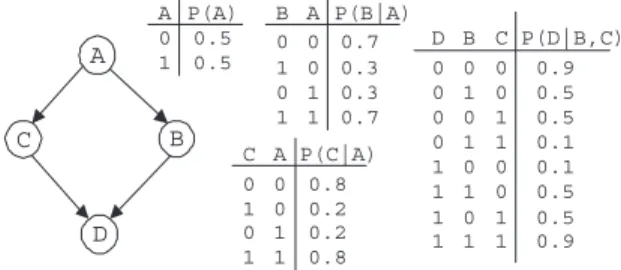
Figure 2: An example Bayesian network from Cheng et al. (2002), slightly modified to make the conditional probability table values for variableDproperly sum to one.
trast TPDA starts by conditioning on the full set of the can-didate parents and children (some nodes may be removed from the conditioning set by considering the current skele-ton graph) and removing nodes from this set to reach Z.
When the available sample is not enough to condition on the full set of the parents and children set ofT, we expect
TPDA’s strategy to fail to accurately estimate the conditional
mutual information betweenT and any other node. On the other hand PMMS starts with the smallest conditioning set possible – the empty set – and proceeds with conditioning on larger sets only when the sample allows so. Thus, we expect
PMMS to better reconstruct the skeleton when the available
sample is low relative to the parent and children set sizes. On the other hand, TPDA’s strategy may pay off for rela-tively large sample sizes. For example, suppose thatXand T can bed-separated by S⊆Z, where Z is the current esti-mate ofPCT. If the available sample is enough to condition on Z it may be possible thatInd(X;T|Z), which TPDA will discover with a single call to mutual information. In con-trast, PMMS has to perform at least |S| calls toAssoc to identify S.
This different search strategy also gives rise to differ-ent correctness properties. For example, PMMS will cor-rectly reconstruct the non-monotone DAG-faithful network in Cheng et al. (2002), where TPDA fails (see Figure 2). Similarly, TPDA will correctly reconstruct the (non-monotone DAG-faithful) network in Figure 1 that is prob-lematic for PMMS. The above intuitions are exactly corrob-orated by the empirical results presented in the next section.
Experimental Evaluation
For the subsequent experiments, the greedy hill-climbing search with a TABU list (GTS, following Friedman, Nach-man, & Pe’er 1999), PC3, Three Phase Dependency Anal-ysis (TPDA), Max-Min Hill-Climbing (MMHC), and Poly-nomial Max-Min Skeleton (PMMS) have been implemented in Matlab 6.5. Optimal Reinsertion (OR, Moore & Wong 2003), Sparse Candidate (SC, Friedman, Nachman, & Pe’er 1999), and Greedy Equivalent Search (GES, Chickering
3
PC is implemented as described in (Spirtes, Glymour, & Scheines 2000) and the Tetrad 3 documentation.
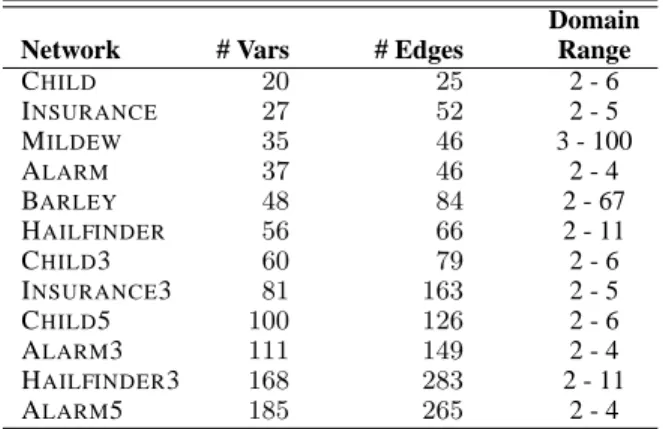
Table 1: Bayesian networks used in the evaluation sorted by number of variables.
Domain Network # Vars # Edges Range
CHILD 20 25 2 - 6 INSURANCE 27 52 2 - 5 MILDEW 35 46 3 - 100 ALARM 37 46 2 - 4 BARLEY 48 84 2 - 67 HAILFINDER 56 66 2 - 11 CHILD3 60 79 2 - 6 INSURANCE3 81 163 2 - 5 CHILD5 100 126 2 - 6 ALARM3 111 149 2 - 4 HAILFINDER3 168 283 2 - 11 ALARM5 185 265 2 - 4
2002) use publicly available implementations by the origi-nal authors for the first two cases and the Tetrad 4 software for the last one. The statistical threshold used in PC,
MM-HC, and PMMS was the standard 5%; a threshold of 1% was
used in TPDA as suggested by the authors. OR is an anytime algorithm and it was set to run both one and two times the amount of the time MMHC required on the same dataset. In addition, the algorithm was run with values chosen from the set{5, 10, 20}for the parameter to constrain the number of parents to consider. The best performing variant of OR per dataset is reported in the tables below. SC was run withk= 5 or 10, wherekis the size of candidate parents sets. Again, the best performing variant of the SC algorithm is reported. The parameter space for both algorithms is suggested by the algorithms’ authors. Bayesian scoring with the equivalent sample size of 10 was used in SC, GTS, and MMHC.
The networks used in the evaluation are mainly ob-tained from real decision support systems covering a wide range of real life applications (many of the networks used are available at the Bayesian Network Repository http://www.cs.huji.ac.il/labs/compbio/Repository/). To ex-periment with larger networks than what is available in the public domain, a method developed by Statnikov, Tsamardi-nos, & Aliferis (2003) was used to generate large BNs by tiling several copies of smaller BNs. The tiling is performed in a way that maintains the structural and probabilistic prop-erties of the original network in the tiled network (the num-ber next to the name denoting the numnum-ber of tiles). Overall, 12 networks were used in this evaluation with information on the networks given in Table 1.
From each network, 10 datasets were randomly sampled in sizes of 500, 1000, and 5000. The performance metrics of an algorithm were the averages over those 10 datasets for each sample size and network. All algorithms were run on Pentium Xeons, 2.4GHz, 2GB RAM running Linux. The evaluation here extends the results of Tsamardinos, Brown, & Aliferis (2005).
Table 2: Comparing Algorithms for Learning the Skeleton Network. The median of the number of statistical tests run, errors of commission, and errors of omission. PMMS re-quires fewer statistical tests than the non-polynomial algo-rithms PC and MMHC while maintaining comparable qual-ity against MMHC and better than PC for small sample sizes. Number of Statistics Alg. 500 SS 1000 SS 5000 SS PMMS 3.7K 4.9K 7.5K MMHC 3.9K 5.9K 10.0K PC 81.2K 78.5K 50.6K TPDA 12.1K 8.8K 5.3K Total Errors =
Errors of Commission + Errors of Omission
Alg. 500 SS 1000 SS 5000 SS PMMS 69.7 = 60.0 = 57.5 = 48.5 + 21.2 44.3 + 15.7 45.4 + 12.1 MMHC 64.7 = 47.1 = 34.9 = 43.5 + 21.2 31.3 + 15.8 22.5 + 12.4 PC 131.0 = 75.4 = 50.2 = 108.2 + 22.8 59.8 + 15.6 39.8 + 10.4 TPDA 176.7 = 103.8 = 35.2 = 129.6 + 47.1 70.2 + 33.6 9.3 + 25.9
Results of Evaluation
Skeleton Identification. First, the PMMS algorithm is compared with the other constraint-based methods for learn-ing the skeleton network, namely the skeleton identifica-tion phase of MMHC (i.e., the non-polynomial version of
PMMS), PC, and TPDA (results in Table 2). The metrics
re-ported are found by calculating the median over all networks for a given algorithm and sample size (the median was used over the mean, because the distribution of values was usually skewed; PMMS performance is even better when measured by the mean). The first section of Table 2 reports the number of statistical tests performed by the algorithm. To compare the quality of the learned skeleton, the number of errors of commission (extra edges) and errors of omission (missing edges) are presented in the next section of Table 2.
PMMS in general outperforms the other polynomial
algo-rithm TPDA. The only exception is at sample size 5000, cor-roborating our intuitions presented in the previous section. As expected PMMS requires fewer statistical tests than the non-polynomial algorithms PC and MMHC while maintain-ing comparable quality against MMHC and better than PC for small sample sizes. Since PMMS performs only a subset of the association calls completed by MMHC, as expected, the results show a larger number of errors of commission and a smaller number of errors of omission.
Bayesian Network Reconstruction. We extended PMMS to orient the edges of the identified skeleton and further refine the network with a greedy hill-climbing search and score procedure using the BDeu score (Heckerman, Geiger, & Chickering 1995) and augmented with a TABU list (as in
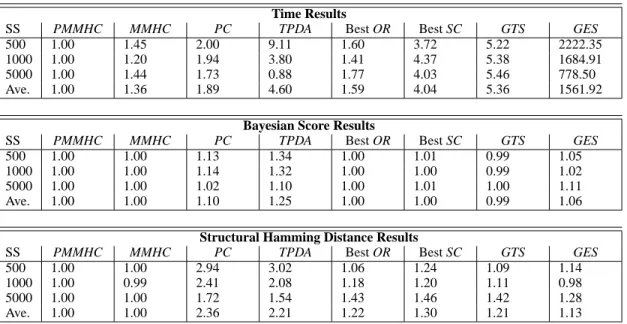
Table 3: Median Normalized Results. Each metric is normalized by dividing the metric for a particular sample size and network by the corresponding metric value for PMMHC. A median normalized metric value smaller than one corresponds to an algorithm with a faster time, better score, or fewer structural errors than PMMHC. PMMHC is the fastest algorithm on average.
PMMHC proves more time efficient and accurate than most other state-of-the-art Bayesian network learning algorithms.
Time Results
SS PMMHC MMHC PC TPDA Best OR Best SC GTS GES
500 1.00 1.45 2.00 9.11 1.60 3.72 5.22 2222.35
1000 1.00 1.20 1.94 3.80 1.41 4.37 5.38 1684.91
5000 1.00 1.44 1.73 0.88 1.77 4.03 5.46 778.50
Ave. 1.00 1.36 1.89 4.60 1.59 4.04 5.36 1561.92
Bayesian Score Results
SS PMMHC MMHC PC TPDA Best OR Best SC GTS GES
500 1.00 1.00 1.13 1.34 1.00 1.01 0.99 1.05
1000 1.00 1.00 1.14 1.32 1.00 1.00 0.99 1.02
5000 1.00 1.00 1.02 1.10 1.00 1.01 1.00 1.11
Ave. 1.00 1.00 1.10 1.25 1.00 1.00 0.99 1.06
Structural Hamming Distance Results
SS PMMHC MMHC PC TPDA Best OR Best SC GTS GES
500 1.00 1.00 2.94 3.02 1.06 1.24 1.09 1.14
1000 1.00 0.99 2.41 2.08 1.18 1.20 1.11 0.98
5000 1.00 1.00 1.72 1.54 1.43 1.46 1.42 1.28
Ave. 1.00 1.00 2.36 2.21 1.22 1.30 1.21 1.13
Friedman, Nachman, & Pe’er 1999). The greedy search was constrained to add edges only identified by PMMS. We call the resulting algorithm PMMHC and it is the polynomial equivalent of MMHC. We then compared PMMHC with other state-of-the-art BN learning algorithms.
We choose to use a search-and-score approach for learn-ing the orientation of the network, the PC and TPDA al-gorithms both use a polynomial orientation procedure that identifies and directs the edges for v-structures and any com-pelled edges.
Three metrics were used to compare performance of the algorithms for learning the complete BNs. The first metric is execution time. This metric is used as a measure of com-putational efficiency, though it should be noted it is highly dependent on the specific implementation. The second met-ric used as a measure of reconstruction quality is the BDeu score of the final DAG returned by the algorithm on a sepa-rate testing set of data. The BDeu score is attractive because it assigns the same score to networks that are statistically indistinguishable from each other (i.e. , Markov equivalent). The third metric reported that also measures quality is Structural Hamming Distance (SHD) (Tsamardinos, Brown, & Aliferis 2005). The Structural Hamming Distance di-rectly compares the structure of the corresponding equiva-lence classes of the learned and original networks. The dis-tance between the two is the number of the following opera-tors required to make the DAG patterns match: add or delete an undirected edge, and add, remove, or reverse the orienta-tion of a directed edge (see Tsamardinos, Brown, & Aliferis 2005 for more details and use of this metric). Thus, an al-gorithm will be penalized by an increase of the score by one
for learning a DAG pattern with an extra un-oriented edge and by one for not orienting an edge that should have been oriented. The reason for using a metric on DAG patterns is so we do not penalize an algorithm for not differentiating between statistically indistinguishable orientations.
The median normalized results are in Table 3. The nor-malized metrics reported are found by dividing the metric for a given algorithm, network, and sample size by the corre-sponding metric for PMMHC. The median of these normal-ized values was then used to compare algorithms. A nor-malized metric of greater than one implies an algorithm is worse than PMMHC on the same learning task for that met-ric (i.e., slower, with more structural errors, or with smaller Bayesian scoring). The normalization essentially gives the same weight in the average to each network irrespective of its size, both in terms of sample and variables, as well as the difficulty of learning. Without it, the larger networks would dominate the median calculations.
PMMHC is the fastest algorithm on average, with MM-HC being about 35% slower. TPDA is actually faster than PMMHC at higher sample but is significantly slower at
smaller sample sizes. We note that OR should be excluded from this comparison since it was set to run 1 or 2 times the time of MMHC and that GES’s Tetrad implementation does not contain all optimizations suggested by its authors.
All the algorithms illustrate similar Bayesian score re-sults with GTS posting the lowest and TPDA the highest scores. In terms of SHD, MMHC outperforms PMMHC finding slightly fewer errors for sample sizes 1000. Since
MMHC started with a better skeleton (see Table 2) this result
most of the false positives introduced by PMMHC and bring the SHD difference closer to zero. GES also learns a net-work with fewer structural errors for sample size 1000. In comparing PMMHC and MMHC, the polynomial algorithm gains significant computational efficiency for only a slight drop in quality.
It is important to observe that TPDA begins edge ori-entation with a better skeleton than PMMHC for sam-ple size 5000. However, the resulting Bayesian networks have significantly more structural errors after the orientation phase than the output networks of PMMHC. This indicates that while constraint-based algorithms are time-efficient and high-quality for skeleton identification, the constraint-based techniques for orienting the edges as the ones used by the
PC and TPDA are highly inaccurate when compared with
Bayesian scoring techniques used by all other algorithms in our experiments.
Discussion and Conclusion
The problem of learning the most probable a posteriori un-der certain conditions BN from data is NP-hard. In this paper, we developed and explored an approximate polyno-mial learning algorithm called Polynopolyno-mial Max-Min Skele-ton (PMMS), which has been shown empirically to improve time-efficiency with a minimum degradation of reconstruc-tion quality. Extensive empirical results also show PMMS (extended to also orient the edges) outperforming most state-of-the-art BN learning algorithms.
The results presented here indicate that polynomial strate-gies for learning BNs with high quality are feasible; an im-portant open question is the theoretical properties of such algorithms and the minimal, least restrictive set of assump-tions required for their optimality. In addition, our results provide evidence for the efficiency with which constraint-based algorithms can identify the skeleton of a network and the advantages of search-and-score procedures for orienting the edges in the skeleton over constraint-based ones.
Acknowledgements
The first author is supported by the National Library of Medicine grant T15 LM07450-01. The second and third au-thor are supported by the National Library of Medicine grant LM-7948-01.
References
Brown, L.; Tsamardinos, I.; and Aliferis, C. 2004. A novel algorithm for scalable and accurate bayesian network learning. In 11th World Congress on Medical Informatics
(MEDINFO). San Francisco, California: MEDINFO.
Cheng, J.; Greiner, R.; Kelly, J.; Bell, D.; and Liu, W. 2002. Learning bayesian networks from data: An information-theory based approach. Artificial Intelligence 137(1-2):43– 90.
Chickering, D., and Meek, C. 2003. Monotone dag faith-fulness: A bad assumption. Technical Report MSR-TR-2003-16, Microsoft Research.
Chickering, D.; Meek, C.; and Heckerman, D. 2003. Large-sample learning of bayesian networks is np-hard. In
Proceedings of the 19th Annual Conference on Uncertainty in Artificial Intelligence (UAI-03), 124–133. UAI.
Chickering, D. 2002. Optimal structure identification with greedy search. Journal of Machine Learning Research
3(1):507–554.
Friedman, N.; Nachman, I.; and Pe’er, D. 1999. Learn-ing bayesian network structure from massive datasets: The ”sparse candidate” algorithm. In Proceedings of the
Fif-teenth Conference on Uncertainty in Artificial Intelligence (UAI-99), 206–215. UAI.
Heckerman, D.; Geiger, D.; and Chickering, D. 1995. Learning bayesian networks: The combination of knowl-edge and statistical data. Machine Learning 20(3):197– 243.
Moore, A., and Wong, W. 2003. Optimal reinsertion: A new search operator for accelerated and more accurate bayesian network structure learning. In Proceedings of the
Twentieth International Conference on Machine Learning (ICML). ICML.
Pearl, J. 1988. Probabilistic Reasoning in Intelligent
Sys-tems. San Mateo, CA: Morgan Kaufmannn Publishers.
Spirtes, P.; Glymour, C.; and Scheines, R. 2000.
Causa-tion, PredicCausa-tion, and Search. Cambridge, MA: MIT Press,
2nd edition.
Statnikov, A.; Tsamardinos, I.; and Aliferis, C. 2003. An algorithm for generation of large bayesian networks. Tech-nical Report TR-03-01, Vanderbilt University.
Tsamardinos, I.; Aliferis, C.; and Statnikov, A. 2003. Time and sample efficeint discovery of markov blankets and direct causal relations. In Proceedings of Ninth ACM
SIGKDD International Conference on Knowledge Discov-ery and Data Mining, 673–678. Washington, DC: ACM
SIGKDD.
Tsamardinos, I.; Brown, L.; and Aliferis, C. 2005. The max-min hill-climbing bayesian network structure learn-ing algorithm. Technical Report DSL-TR-05-01, Vander-bilt University.