On Load Balancing:
A
Mix-Aware
A
lgorithm
for
Heterogeneous Systems
Sebastiano Spicuglia
University of Lugano Lugano, SwitzerlandMathias Björkqvist
IBM Research Zurich LabSwitzerland
Lydia Y. Chen
IBM Research Zurich LabSwitzerland
Giuseppe Serazzi
Politecnico di Milano Milano, ItalyWalter Binder
University of Lugano Lugano, Switzerland[email protected]
Evgenia Smirni
College of William and MaryVirginia, US
ABSTRACT
Today’s web services are commonly hosted on clusters of servers that are often located within computing clouds, whose computa-tional and storage resources can be highly heterogeneous. The workload served typically exhibits disparate computation patterns (e.g., CPU-intensive or IO-intensive), that fluctuate both in terms of volume and mix. The system heterogeneity together with workload diversity further exacerbates the challenge of effective distribution of load within a computing cloud. This paper presents a novel, mix-aware load-balancing algorithm, which aims to distribute requests sent by multiple applications in heterogeneous servers such that the application response times are minimized and system resources (e.g., CPU and IO) are equally utilized. To this end, the presented algorithm tries to not only balance the total number of requests seen by each server, but also to shape the requests received by each server into a certain “mix", that is analytically shown to be opti-mal for response time minimization. Our experimental results— based both on simulation and on a prototype implementation— show that the mix-aware algorithm achieves robust performance in most workload mixes as well as a consistent performance improve-ment in comparison with one of the most robust load-balancing schemes of the Apache server.
Categories and Subject Descriptors
H.3.4 [Systems and Software]: Performance evaluation—Algo-rithms; Experimentation; Measurement
Keywords
Load balancing algorithm; Heterogeneous system; Cloud comput-ing; Simulation; Prototype
Permission to make digital or hard copies of all or part of this work for personal or classroom use is granted without fee provided that copies are not made or distributed for profit or commercial advantage and that copies bear this notice and the full citation on the first page. To copy otherwise, to republish, to post on servers or to redistribute to lists, requires prior specific permission and/or a fee.
ICPE’13,March 21–24, 2013, Prague, Czech Republic. Copyright 2013 ACM 978-1-4503-1636-1/13/03 ...$15.00.
1.
INTRODUCTION
To ensure scalability, today’s web services are replicated and hosted on distributed systems that experience regular resource up-grades and are thus comprised of heterogeneous components. Web service applications are characterized not only by disparate re-source requirements (e.g., a CPU-intensive browsing mix versus an I/O-intensive transaction mix), but also by time-varying request workloads [4, 17]. Consequently, the overall system workloads fluctuate in terms of mixes of dissimilar applications and their vol-ume of requests [16]. The heterogeneity of servers, together with the workload heterogeneity, further exacerbate the challenges of load balancing. Load balancing within a compute cloud is critical for performance and effectiveness of the compute cloud paradigm, see for example the elastic load balancer in Amazon EC2 [1].
There is a large body of load balancing studies [3, 6, 8, 17] that focus on mainly homogeneous systems and consider a single bottle-neck resource where queues build up. Dispatching requests to the servers with the least number of outstanding requests, the so-called Join the Shortest Queue (JSQ) policy, has been shown to be theo-retically robust [10] and is also used in practice [12] for distribut-ing the entire load across distributed servers. In a heterogeneous system experiencing a time-varying workload mix, such a policy can potentially lead to the situation where servers receive similar amounts of requests but servers with powerful CPU (resp. IO) pro-cess a lot of IO- (resp. CPU-) intensive requests. Such unantic-ipated behavior can be detrimental for the overall system perfor-mance as well as for the individual application response times. It is therefore imperative for the load-balancing scheduler to evolve such that it becomes aware of both of the heterogeneity of the work-load (e.g., is it IO- or CPU-intensive) but also on the heterogeneity of the architecture of the back-end servers.
In this paper, we aim to provide a robust load balancing solution in a heterogeneous compute cloud. We first focus on the following questions: Is there an optimal application mix for each server which can lead to a low response time such that all resource types equally utilized? Moreover, is there a load-dispatching policy to control the received application mix for each server such that an optimal value is reached? Last, as JSQ has been shown to be very effective in balancing the overall loads on homogeneous servers, can one leverage JSQ when designing a mix-aware load dispatching policy to further balance resource loads on heterogeneous servers?
To this end, we develop a novel mix-aware load-balancing al-gorithm, which aims to balance the server loads as well as bal-ance bottleneck across the various server resources such that the
global response time averaged over all applications is minimized. We explore the JSQ policy and the analytical results in [15], which illustrate via a closed queueing network model that there is an op-timal application mix for each server. Our algorithm distributes requests based on two criteria: the number of outstanding requests per server and the desire to balance the load across each resource of each server, by eliminating the existence of a single bottleneck, e.g., CPU or IO. Abalancemetric, that measures the variability of queue lengths for outstanding requests across servers, is used to decide whether it is more beneficial to balance the number of outstanding requests per server using JSQ or to slightly violate the JSQ conditions by aiming to eliminate single resource bottlenecks in each server by directing requests such that each server serves an “optimal" load. The threshold value of thebalancemetric that triggers the above activity is based on a bound analysis of the po-tential queue lengths at the various servers. We use an event-driven simulator to evaluate the scalability of the proposed algorithm and a prototype implementation to support the applicability of the pro-posed algorithm on a real system.
The contributions of this paper are both analytical and practical. Our proposed load-balancing algorithm is designed for distributing time-varying requests from multiple applications, hosted on a set of heterogeneous systems with multiple resources. Being aware of the queue length of the servers and of the application mix, our algorithm is able to achieve consistent performance improvements when compared to the standard load-balancing policy available on Apache web server, i.e., thebybusynesspolicy.
This paper is organized as follows: The system architecture is explained in Section 2. The proposed mix-aware load-balancing algorithm is explained in Section 3. Section 4 presents experimen-tal results. Related studies are summarized in Section 5. Section 6 concludes this paper.
2.
SYSTEM MODEL
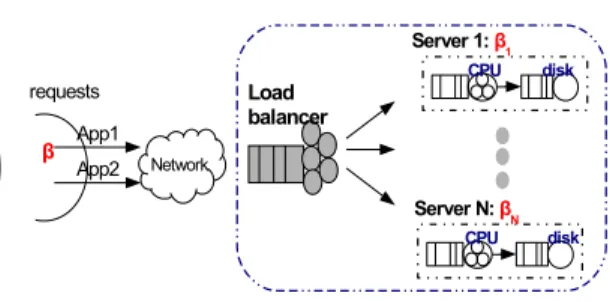
Figure 1: System model
We consider a service hosting system consisting ofK heteroge-neous servers and one load balancer, as well astwotypes of appli-cations, that we classify asCPU-intensiveandIO-intensive. These two classes of applications are referred with the index j={1,2}. We model each server as a two-station queueing model shown in Fig. 1, see also [2, 7] for the effectiveness of such queuing network models in capturing the performance of non-trivial application co-location. The first station marked “CPU" represents the aggregate computational capacity of the available cores in the server, and the second station marked “IO" corresponds to the disk of the server. These two stations are referred with the indexi={CPU,IO}. The available computational and IO capacity is different across servers. As a result, the execution times of the same application on each server may vary. The threads at the load balancer are concurrently
dispatched to the servers, based on a load balancing scheme. Per-formance statistics (e.g., response times and the characteristics of the workload mix) are collected at the load balancer. We consider that the network delay of dispatching requests from the load bal-ancer to servers to be negligible.
Clients generate requests, which are sent to the load balancer. We assume that the interarrival times of requests follow an expo-nential distribution with parameterλ. The percentage of the two application classes in the arriving flow of requests is{β1,β2}with β1+β2=1. Both types of requests can be executed on any server;
the execution of a request needs certain CPU time and IO time. Once requests complete execution in both stations, they leave the system.
The cumulative time an application spends on the CPU station includes any memory and cache accessing times. Yet, as shown in [2, 7], although the memory and caches are not explicitly mod-eled, if the CPU execution times without any queueing are correctly measured, then the performance effects of memory and cache are captured via the queueing delays at the CPU station. The cumula-tive time spent on the CPU or on the IO resources by an application in the absence of any queueing is referred to asresource demand. CPU and IO demands are assumed to be exponentially distributed with meanRi j, with the subscriptireferring to the resource and
the subscript jreferring to the application. Note that the resource demands do not reflect any waiting nor queueing times due to re-source contention with other applications.
Resource demands vary on different servers, because of the server heterogeneity. Consequently, to capture the variability of CPU and IO demands on different servers, we introduce the scal-ing factors γi,k, corresponding to each resourcei on serverk=
{1. . .K}. In a homogeneous system, the scaling factors equal to one for all servers, implying that the average resource demands of an application are the same across all servers. Based on this con-vention, the average resource demands of application jon serverk areRi j·γi,k. Because services are replicated, i.e., each server may
be able to executeanyapplication, we assume that it serves a per-centage of requestsβj of application j. The application mix
re-ceived by each server depends on the load-balancing policy, and this mix may be very different from the one that is observed by the load balancer (or alternatively, the one generated by the clients).
3.
LOAD BALANCING SCHEME
In this section, we first introduce some theoretical background regarding optimization of application mixes for single server sys-tems and load-balancing schemes for multiple servers. Motivated by the advantages of balancing server loads and resource loads on a single server, we propose a new, mix-aware, load-balancing algo-rithm.
3.1
Background
3.1.1
Optimal Application Mix in a Single Server
Rosti et. al [15] showed that there is an optimal application mix, which can minimize response time while maximizing throughput. The authors of [15] focus on a single server closed system with multiple resources and provide a closed form formula on the appli-cation mix, which is derived from the equal utilization point for all system resources.
Intuitively, a system operates at the best performance when the global utilization of the resources is maximized. According to their methodology, in a system with two stations and two classes of ap-plications, the optimal mix of application class jon serverk, is:
β1∗,k = log
RIO,2γIO,k
RCPU,2γCPU,k
logRCPU,1γCPU,kRIO,2γIO,k
RCPU,2γCPU,kRIO,1γIO,k
, (1)
β2∗,k = 1−β1∗,k.
This optimal mix refers to a single serverk. Here the problem we are addressing is significantly more complex because to mini-mize response times in a system consisting of multiple heteroge-neous servers, one needs to reach not only the optimal mix of Eq. 1 for each server, but also minimal queue lengths of outstanding re-quests across all servers. Clearly, joining the server with the short-est queue of outstanding requshort-ests is not a sufficient condition to optimize performance.
3.1.2
Load Balancing on Multiple Servers
There is a large body of literature on how to balance loads on multiple servers, especially for web systems. The Apache web server provides three default policies, namelybybusyness, byre-quest, andbytraffic. Thebyrequestpolicy is very similar to the round-robin policy. Thebybusynesspolicy is almost iden-tical to JSQ, except when handling the situation where multiple servers have the same number of outstanding requests. Indeed, JSQ is a simple yet powerful policy for balancing homogeneous server loads, its optimality has been shown theoretically [10]. The
bytrafficpolicy tries to balance number of bytes transmitted by each server.
3.2
Mix-Aware Algorithm
We now develop a mix-aware policy, leveraging the advantages of the optimal application mix on a single server and the JSQ policy on multiple servers. We first illustrate some bound analysis of the servers which provides us guidance to tune the algorithm parame-ters and we then present the mix-aware load balancing algorithm.
3.2.1
Overview
The proposed mix-aware algorithm tries to balance the queue length of outstanding requests on servers using JSQ and the re-source loads on each server by achieving the optimal application mix that equalizes the utilization IO and CPU resources. When servers have very different queue lengths, it is imperative to balance the outstanding requests across servers. When queues of servers are balanced, then the algorithm slightly “unbalances" the queues by aiming to reach the optimal mix as shown by Eq. (1) on each server and achieve equiutilization across its resources. Straddling between the above two competing targets, the mix-aware algorithm aims to achieve overall better performance.
We definite a metric calledbalancethat quantifies the degree of (un)balancing across theKservers. We start by defining this metric and discuss its usefulness.
3.2.2
Balance and Threshold
The queue length of outstanding requests is an indicator of the server load. The higher the variability of queue length, the higher the performance improvement that can be achieved with JSQ. To identify the best opportunity for applying JSQ, we propose a met-ric, calledbalance, defined as follows:
balance=1− Q
min
∑Kk=1Qk
×K. (2)
Qkdenotes the queue length of serverkandQminis the minimum
queue length across all servers, i.e.,Qmin=min{Qk,∀k}. The
rea-soning behind this is that when comparingQmin to the average
queue length, one can obtain not only a rough estimate of the vari-ability but also of the potential performance improvement using JSQ. When all servers have the same queue lengths,Qminis equal to the average value and thus thebalancevalue is 0. In contrast, whenQminis significantly lower than the average queue length, bal-anceis approaching one and thus using JSQ can improve the over-all system performance. A higherbalancevalue indicates greater variability across queues as well as the advantage of applying JSQ. The mix-aware algorithm dispatches requests primarily using JSQ but when thebalancevalue is low, as a second step it attempts to unbalance the queues at the servers by aiming to equally utilized the CPU and IO resources at the servers. This unbalancing action is bringing higher performance gains on a per-server basis, which is also positively reflected in the overall system performance.
Sincebalanceis a metric between zero and one, it is not clear what is its value that should trigger using JSQ or instead the unbal-ancing the queue lengths while aiming equiutilization of individual server resources. To calculate this threshold ¯B, we use the upper bound of the queue length variability across servers. LetVar[Q]
present the variance of queue lengths.
COROLLARY 1. The upper bound of Var[Q]is a function of balance: Var[Q]≤(K−(1−balance)(K−1)) 2−1 K2 K
∑
k=1 Qk !2 . (3)PROOF. Based on the definition of variance, one can write Var[Q] =∑ K k=1Q2k K − ∑Kk=1Qk K !2 . (4)
Following simple algebraic manipulations, one can write the upper bound of the queue length of serverkas
Qk≤ K
∑
h=1
Qh−(K−1)Qmin,k∈ {1. . .K} (5)
As Qmin is bounded by the average queue length, thenQmin∈ {0. . .∑Kk=1Qk
K }. We further relax the discrete property ofQminand
expressQminas a continuous variable usingα∈[0,1], Qmin=α×∑
K k=1Qk
K ,α∈[0,1]. (6) Substituting Eq. 6 in Eq. 5, we obtain Eq. 7
Qk≤ K−α(K−1) K K
∑
k=1 Qk. (7)Substituting Eq. 7 in Eq. 4 we obtain Eq. 8 Var[Q]≤(K−α(K−1)) 2−1 K2 K
∑
k=1 Qk !2 . (8)Combining Eq. 6 and Eq. 2, we straightforwardly obtain
balance=1−α,α∈[0,1]. (9) Substituting Eq. 9 in Eq. 8, we thus can express the upper bound ofVar[Q]as a function ofbalance
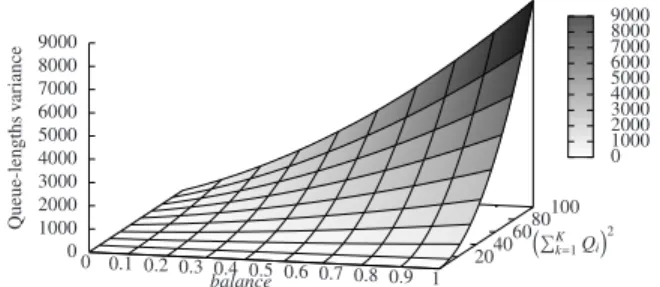
To quantitatively gauge the relationship between the queue length variability andbalance, we plot the upper bound ofVar[Q]
in Figure 2, assuming a scenario of three servers, i.e., K=3. Clearly, the upper bound of the queue length variability increases asbalanceincreases. We can observe that whenbalancevalues are
small, e.g., less than 0.1, such upper bounds are constantly low, in-dependently of the values of(∑Kk=1Qk)2, as shown by the flat area
on the left corner of Figure 2. On the other hand, whenbalanceis greater than 0.2, the upper bound varies a lot due to the multipli-cation of(∑Kk=1Qk)2in Eq. 3. We conjecture that a smallbalance
value ensures the similarity of queue lengths across servers. Our extensive evaluation of the numerical results of Eq. 3 leads us to set thebalance threshold, ¯B, very low, i.e., between 0.05 to 0.1, so as to capture the cases where the queue lengths of all servers are very similar. 0 0.1 0.2 0.3 0.4 0.5 0.6 0.7 0.8 0.9 1 2040 6080 100 0 1000 2000 3000 4000 5000 6000 7000 8000 9000 Q u eu e-le n g th s v ar ia n ce balance PK k=1Qi 2 0 1000 2000 3000 4000 5000 6000 7000 8000 9000
Figure 2: The upper bound of queue length variability of a three server case
3.2.3
Unbalance by Equiutilizing
When dispatching a particular request, the aim is to search for a server, whose optimal application mix (i.e., server equiutiliza-tion, as expressed by Eq. 1) can be reached as quickly as possible. When a request from applicationjarrives, we check the difference between the current application mix,βj,k, including this request,
and the optimal mix on serverk,β∗
j,k, for all servers:
Sj,k=βj,k−β∗j,k.
We chose the server with the minimumSj,kvalue. When this value
is negative, it implies that there is not a sufficient number of re-quests from application jon server k. The resource utilizations (loads) on serverkcan be better balanced by processing an extra request from application j. When all servers have positiveS val-ues, it implies that all servers have more applicationjrequests than their optimal values, at the time instant the new request arrives. In such a case, choosing a server with the minimumSvalue can min-imize the deviation from the optimal one.
3.2.4
Combining JSQ and Unbalance by
Equiuti-lization
Combining together JSQ and Unbalance by Equiutilizing, we obtain the Mix-Aware Load Balancing Policy. As a first step, the algorithm calculates thebalancemetric and compares it to the ¯B threshold. If the value is larger than ¯B, then the incoming request from application class jis scheduled using JSQ. Otherwise, the Sj,kvalues are computed for allkservers and the server than can
best improve its optimal value in Eq. 1 is selected. The required inputs of the algorithm are the class of the current request, the cur-rent queue lengths on all servers, and the curcur-rent application mixes on all servers. The load balancer computes these inputs by keep-ing counters of outstandkeep-ing requests for both application classes on each server. When a request arrives or leaves the cluster, the load balancer retrieves its application type from the request header and increments or decrements the corresponding counter. The load bal-ancer is assumed to know the optimal application mix listed in Eq. 1 for all servers. The output of the algorithm is the server to which
the arriving request should be dispatched. We assume that the re-source demands and scaling factors required in Eq. 1 can be ob-tained via statistical profiling methods, although the development of such profilers is out of the scope of this paper. We summarize all this in Alg. 1.
Algorithm 1Mix-Aware load-balancing algorithm.
//j is the class o f the arriving request
functionMIX-AWARE(j)
Q← {Qi, . . . ,Qk}
Sj← {(βj,1−β∗j,1), . . . ,(βj,K−β∗j,K)}
server←k such that Qk=min(Q),k∈ {1. . .K} //JSQ
balance←1− Qres ∑K
k=1Qk×K
ifbalance<B¯then //Unbalance by Equiutilizing server←k such that(βj,k−β∗j,k) =min{Sj,k},∀k
end if
returnserver //send request to the selected server
end function
4.
EVALUATION
In this section, we evaluate the proposed mix-aware algorithm for service systems, using event driven simulation and a proto-type. The performance metrics evaluated are the response times, and difference between CPU and disk utilization of servers. We benchmark the mix-aware load balancing algorithm against purely JSQ andbybusyness, under different system sizes and workload mixes.
4.1
Simulation Results
To evaluate the scalability of the mix-aware algorithm on differ-ent system sizes, we built an evdiffer-ent driven simulator of the model shown in Figure 1 and also a discrete event simulator for JSQ. We simulate the systems with 10, 20 and 30 replicated servers. The workload is generated using the following traffic intensities: inter-arrival rates are exponentially distributed withλ=9,18 and 27 per second, for the scenarios with 10, 20 and 30 replicas, respectively. We assumed a two-class workload, with 55% of the requests are from class one, and the remaining requestst are from class two. The CPU and disk demands for both applications are also exponentially distributed with averages beingRCPU,1=0.75s,RCPU,2=0.64s,
RIO,1=0.48s, andRIO,2=1.25s. To enforce server heterogeneity,
the scaling factorsγi,k, are uniformly distributed in[0.8,1.2].
Our mix-aware algorithm computes the optimalβ∗j,kfor applica-tion class jin serverk, see Eq. 1. With the above inputs, this value is in[0.37,0.89]. Note that we assume that the resource demands are known and are obtained via a profiling methodology, see [?,?]. The threshold value ofbalance, ¯B, is set to 0.1.
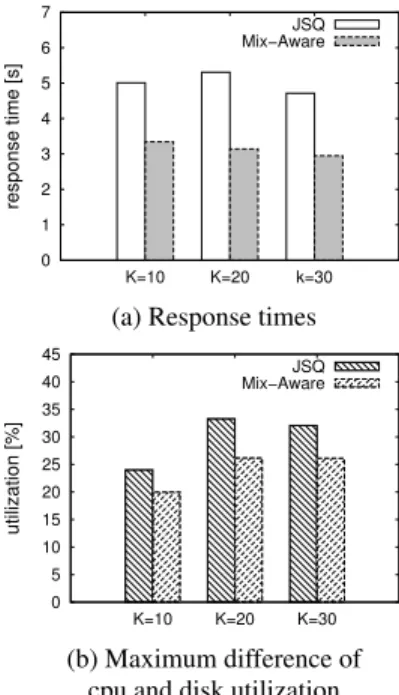
We summarize the simulation results in Figure 3. Compared to JSQ, the mix-aware algorithm can achieve a significantly lower (roughly 35%) average response time. As expected, the average re-sponse times of mix-aware decreases with an increasing number of servers, whereas JSQ seems to not scale well with the cluster size, as shown by the increase in the response times from the scenario of 10 servers to 20 servers. Focusing on equiutilizing the loads on the server resources is expected to be more effective when there is a larger number of servers, because of a higher chance to attain the optimal mix on individual servers. To validate this reasoning, we compute the difference of average CPU and disk utilization per server and plot the maximum values among all servers, see Fig-ure 3(b). The plotted values show the worst case of unbalance re-source utilizations, which results in rere-source bottlenecks, overall
higher queue lengths, and thus higher response times. Clearly, the mix-aware algorithm can achieve more “balanced "resource utiliza-tions than JSQ. 0 1 2 3 4 5 6 7 K=10 K=20 k=30 response time [s] JSQ Mix−Aware
(a) Response times
0 5 10 15 20 25 30 35 40 45 K=10 K=20 K=30 utilization [%] JSQ Mix−Aware (b) Maximum difference of cpu and disk utilization
Figure 3: Simulation results: comparison of JSQ and mix-aware algorithm on systems with different numbers of servers.
4.2
Prototype
We built a prototype system, consisting of three servers and one load balancer, in the IBM Research Cloud. Each component is based on a virtual instance, equipped with 4GB of RAM, 4 x86_64 CPUs, 55GB of disk, and Fedora 14 the operating system distribu-tion. Requests are generated from the client servers, located at the IBM Zurich Research Laboratory, using the httperf load generation tool [13], and forwarded to the load-balancer, which is based on the Apache web server version 2.4.2. Naturally, we present here experiments withbybusyness, the standard Apache load balanc-ing policy that resembles JSQ and our mix-aware policy.
We consider a two-class workload. Class one consists of thefop
benchmark in the Dacapo suite [11], a CPU intensive benchmark producing PDF documents from XSL-FO files. Class two consists ofluindex, a disk intensive benchmark that indexes a set of doc-uments. The average inter-arrival rate of arriving requests (fopor
luindex) isλ=2 applications per second. We consider two work-load scenarios: (1) the two-class mix isstationaryand kept at 0.5, and the total number of requests (i.e., applications sent for execu-tion) is 2000; (2) the workload mix isnon-stationary, i.e., changes across time as shown in Figure 4(a).
The challenge of applying the proposed mix-aware algorithm on a real system lies in deciding the optimal application mix for each server. Within a server, the optimal mix is 0.4, i.e., 40% offopand 60% ofluindex, see [2] for the methodology to compute ths mix. As in the simulation experiments, the threshold value ofbalance,
¯
B, is set to 0.1.
4.2.1
Stationary Workload
In Table 1, we summarize the average, 90th, 95th, 99thpercentile
and maximum response times for both bybusyness and mix-aware algorithms. To accommodate high performance variability in the
computing cloud [5], we present the results of two separate experi-mental runs. One can see that the statistics of the higher percentiles for a given policy have higher differences from one experimental run to the other. Moreover, one can observe that the average re-sponse times of mix-aware are lower thanbybusynessby roughly 10%, for all presented statistics. The performance improvement of mix-aware is particularly visible for the higher percentiles of re-sponse times. For example, in run one, the maximum rere-sponse time of mix-aware is lower thanbybusynessby roughly 24%, whereas the performance gain of the 90th−percentile of the mix-aware
algo-rithm is only 10%. This experiment illustrates that the mix-aware algorithm is able to achieve lower response times, especially for the higher percentiles, meaning that the worse performance is bet-ter mitigated.
4.2.2
Non-stationary Workload
In this subsection, we evaluate our proposed algorithm on a non-stationary workload mix, as shown in Figure 4(a). Here we fo-cus on presenting the higher percentile of response times computed from 2 minute windows, see Figure 4 (b), (c), and (d). One can observe that mix-aware is able to achieve lower response times, especially for the 99thpercentile. Another observation worth
men-tioning is that the performance gain of the mix-aware algorithm compared tobybusyness, is lower in our cloud prototype than in simulation. This can be attributed to applying inaccurate values of optimal application mix on virtual servers, which are known to be highly variable [5], i.e., resource demands may change across time. In our future work, we will address the profiling methodology that is able to compute the optimal mix on the fly. Nonetheless, given the inherent inaccuracy of optimal values applied in the mix-aware algorithm in the cloud environment, we are still able to mitigate the worse performance, compared to thebybusynessalgorithm.
5.
RELATED WORK
There is a large body of related studies of load balancing for var-ious conventional service systems [6, 8, 14, 17] and modern cloud systems [9]. As a detailed survey of the extensive related work is not possible here, we only outline some particularly relevant work. Cardellini et. al [6] qualitatively classified existing load balancing schemes for web server systems into four approaches, namely server-based, client-based, DNS-based, and dispatcher-based. They quantitatively compared the maximum utilization of clusters, via simulation. Cherkasova and Ponnekanti [8] developed FLEX, a locality-aware load balancing solution, especially for effi-cient memory usage. Zhang et. al [14,17] proposed ADAPTLOAD for rapidly fluctuating workloads that are characterized in terms of arrival rates and document popularity. Via simulation, they showed that ADAPTLOAD can achieve a low slowdown and resource uti-lization on a cluster of homogeneous web servers. Björkqvist et. al [3] used a lottery balancing algorithm for distributed stateful ser-vice systems. Dejun et. al [9] focused on balancing requests among a set of heterogeneous machine instances in the cloud, based on the profile of response times and request rates for each server.
Singh et. al [16] leveraged the idea of application mixes and proposed a mix-aware resource allocation for data centers. They used a k-means clustering algorithm to automatically determine the workload mix and allocate servers. However, they did not explore the workload mix in their load balancing scheme.
Most of the aforementioned studies focus on balancing loads on homogeneous servers with a single resource type, i.e., CPU. In con-trast, our mix-aware algorithm considers multiple resources on a set of heterogeneous servers, and aims at balancing the overall server loads as well as their resource load.
0 20 40 60 80 100 0 5 10 15 20 25 30 dacapo−fop requests [%] time [min] Workload mix 16 18 20 22 24 0 5 10 15 20 25 30 response time [s] time [min] Bybusyness Mix−Aware 16 18 20 22 24 0 5 10 15 20 25 30 response time [s] time [min] Bybusyness Mix−Aware 16 18 20 22 24 0 5 10 15 20 25 30 response time [s] time [min] Bybusyness Mix−Aware
(a) workload mix,βge (b) 90thpercentile (c) 95thpercentile (d) 99thpercentile
Figure 4: Non-stationary workload mix: comparison ofbybusynessand mix-aware algorithm on90th,95thand99thresponse times
over the time.
Statistics mean[s] 90th[s] 95th[s] 99th[s] Max[s]
Algorithm bybusy. m-w bybusy. m-w bybusy. m-w bybusy. m-w bybusy. m-w run 1 16.40 15.01 19.70 17.30 20.60 17.90 21.80 18.60 24.10 19.54 run 2 16.46 15.08 19.10 17.30 19.90 17.90 21.10 18.80 22.93 19.96
Table 1: Response times statistics of stationary workload mix: comparison ofbybusynessand mix-aware load balancing.
6.
CONCLUSION
In this paper, we propose a mix-aware load-balancing algorithm for web services that are hosted on heterogeneous servers and cater for requests from a dynamically varying application mix. Our al-gorithm aims at minimizing the response times by dispatching re-quests in a way that optimizes the application mix for each server. We evaluate the how well the variability of outstanding requests across servers and based on this metric we balance the outstanding requests using JSQ or unbalance the server queues by aiming to equally utilize CPU and disk resources on the servers. Our results obtained with simulation and with a cloud prototype show that our proposed algorithm can scale with an increasing system size, and improve on the worst response times compared to thebybusyness
policy, one of the most robust default load-balancing algorithms in the Apache web server. Regarding ongoing research, we are ex-ploring efficient on-line profiling methodologies to obtain the opti-mal application mix, as well as extending our algorithm to a larger number of applications.
7.
ACKNOWLEDGMENTS
The research presented in this paper has been supported by the Swiss National Science Foundation (project 200021_141002) and by the European Commission (Seventh Framework Programme grant 287746). The research presented in this paper was conducted while the first author was with IBM Research Zurich Lab. Evge-nia Smirni is partially supported by NSF grants CCF-0937925 and CCF-1218758.
8.
REFERENCES
[1] Amazon EC2. http://www.amazon.com/.
[2] D. Ansaloni, L. Y. Chen, E. Smirni, and W. Binder. Model-driven Consolidation of Java Workloads on Multicores. InProceedings of IEEE/IFIP DSN, pages 1–12, 2012.
[3] M. Björkqvist, L. Y. Chen, and W. Binder. Load-balancing dynamic service binding in composition execution engines. InProceedings of APSCC, pages 67–74, 2010.
[4] M. Björkqvist, L. Y. Chen, and W. Binder. Dynamic replication in service-oriented systems. InIEEE/ACM International Symposium on Cluster, Cloud and Grid Computing (CCgrid), pages 531–538, 2012.
[5] M. Björkqvist, L. Y. Chen, and W. Binder. Opportunistic service provisioning in the cloud. InProceedings of IEEE Cloud, pages 237–244, 2012.
[6] V. Cardellini, M. Colajanni, and P. S. Yu. Dynamic load balancing on web-server systems.IEEE Internet Computing, 3(3):28–39, 1999.
[7] L. Y. Chen, D. Ansaloni, E. Smirni, A. Yokokawa, and W. Binder. Achieving Application-Centric Performance Targets via Consolidation on Multicores: Myth or Reality? InProceedings of HPDC, pages 37–48, 2012.
[8] L. Cherkasova and S. Ponnekanti. Optimizing a ’content-aware’ load balancing strategy for shared web hosting service. InProceedings of MASCOTS, pages 492–, 2000.
[9] J. Dejun, G. Pierre, and C.-H. Chi. Resource provisioning of web applications in heterogeneous clouds. InProceedings of the 2nd USENIX conference on Web application
development, pages 5–5, 2011.
[10] V. Gupta, K. Sigman, M. Harchol-Balter, and W. Whitt. Insensitivity for ps server farms with jsq routing.
SIGMETRICS Performance Evaluation Review, 35(2):24–26, 2007.
[11] http://dacapobench.org/.Dacapo suite. [12] http://httpd.apache.org/.Apache.
[13] http://www.hpl.hp.com/research/linux/httperf/.httperf. [14] A. Riska, W. Sun, E. Smirni, and G. Ciardo. Adaptload:
Effective balancing in custered web servers under transient load conditions. InProceedings of ICDCS, pages 104–111, 2002.
[15] E. Rosti, F. Schiavoni, and G. Serazzi. Queueing Network Models with Two Classes of Customers. InProceedings MASCOTS, pages 229–234, 1997.
[16] R. Singh, U. Sharma, E. Cecchet, and P. Shenoy. Autonomic mix-aware provisioning for non-stationary data center workloads. InProceedings of ICAC, pages 21–30, 2010. [17] Q. Zhang, A. Riska, W. Sun, E. Smirni, and G. Ciardo.
Workload-aware load balancing for clustered web servers. IEEE Trans. Parallel Distrib. Syst., 16(3):219–233, 2005.