Tjalling C. Koopmans Research Institute
Discussion Paper Series nr: 09-26
Do loans harm?
The Effect of IMF Programs on Inequality
Niels Gilbert
Brigitte Unger
Tjalling C. Koopmans Research Institute Utrecht School of Economics
Utrecht University Janskerkhof 12 3512 BL Utrecht The Netherlands telephone +31 30 253 9800 fax +31 30 253 7373 website www.koopmansinstitute.uu.nl
The Tjalling C. Koopmans Institute is the research institute and research school of Utrecht School of Economics.
It was founded in 2003, and named after Professor Tjalling C. Koopmans, Dutch-born Nobel Prize laureate in economics of 1975.
In the discussion papers series the Koopmans Institute publishes results of ongoing research for early dissemination of research results, and to enhance discussion with colleagues. Please send any comments and suggestions on the Koopmans institute, or this series to [email protected]
çåíïÉêé=îççêÄä~ÇW=tofh=ríêÉÅÜí
How to reach the authors
Please direct all correspondence to the first author. Niels Gilbert Faculty of Economics Cambridge University Sidgwick Avenue Cambridge CB3 9DD E-mail: [email protected] Brigitte Unger Utrecht University
Utrecht School of Economics Janskerkhof 12
3512 BL Utrecht The Netherlands. E-mail: [email protected]
This paper can be downloaded at: http://
Utrecht School of Economics
Tjalling C. Koopmans Research Institute Discussion Paper Series 09-26
Do loans harm?
The Effect of IMF Programs on Inequality
Niels Gilberta Brigitte Ungerb a Faculty of Economics Cambridge University b
Utrecht School of Economics Utrecht University
October 2009
Abstract
IMF programs consist of granting loans, and of conditionality that countries have to follow in order to qualify for them. The paper uses a pooled time-series cross section analysis, covering 98 countries over the period 1970-2000 in order to find out which effect IMF programs have on the personal and wage income distribution of the grant receiving country. Similar to findings on growth (Dreher 2006), IMF programs have also a negative impact on income. This is due mainly to conditionality, whereas the amount of loans granted does not seem to harm.
Keywords: developing countries, inequality, pooled regression, IMF programs, loans and conditionality
JEL classification: 011, E 63, F 33, F 34
Acknowledgements
We thank Axel Dreher, for having been so generous and prompt in providing us his dataset. Jaap Bikker, Wolter Hassink and Adriaan Kalwij from the Utrecht University School of Economics gave us very helpful comments with the econometric part. We also thank the honors student research group of Utrecht University School of Economics for fruitful discussions and Jorrit Hendriksma for critically reading the manuscript.
1. Introduction
“The IMF works to foster global growth and economic stability. It provides policy advice and
financing to members in economic difficulties and also works with developing nations to help
them achieve macroeconomic stability and reduce poverty.” (IMF, 2009)
In fighting the current financial crisis the International Monetary Fund (henceforth:
IMF) has been provided with a central role. In April 2009, the G20 leaders decided to triple its
budget to 750 billion dollars. The IMF will thus play an important role in granting loans to the
countries most hurt by the financial crisis, and hence in the world economy. At the same time
however, concerns about the effects of IMF programs have not diminished.
Many studies have already been performed into the effect of IMF programs on
economic growth, the outcomes of which are not giving rise to great optimism (see section
2.1). For an organization of which a former managing director has often expressed that its
'main goal is growth’ (Camdessus, 1990, cited in Przeworski & Vreeland, 2000), this comes
as a shock. An important contribution in this respect has been made by Dreher (2006), who
attempted to discover how this paradox occurred by separating the different economic policy
instruments of an IMF program, which are loans granted and conditionality set for granting a
loan. In addition he analyzes the effect of IMF policy advice and of moral hazard. He then
studied their isolated effects on growth.
At least as controversial is the effect of IMF programs on the income distribution in the
program-country. NGOs like Oxfam (see Oxfam, 2007), Caritas (2003), Global Exchange
(2005) and the few existing empirical studies (see Pastor 1987, Garuda 2000 and Vreeland
2002) have been strongly criticizing the IMF for the supposedly adverse effects of its policies
on poverty and inequality, an accusation clearly contradicting the official aims of the Fund
2 distribution as it is nowadays. Originally, the main mission of the IMF has been to provide
financial assistance to member countries in balance of payment need. The oil shock of the
1970s and the debt crisis of the 1980s caused more and more low- and lower middle income
countries to become IMF borrowers (IMF, 2009). In addition, more and more of the Fund’s
support extended over longer periods. This all affected the way the IMF (and the world
society) looked at the effects of its policies on poverty and the income distribution in those
countries (Polak, 1991).The IMF had to re-identify its goals in a new international setting of
liberalization, where it suffered itself from ‘the failure of market-driven globalization to
deliver sustained growth and diminished inequality’ (Evans and Finnemore 2001).
Starting in 1990, the Managing Director of the IMF stated that “our primary objective
is… high-quality growth,” not merely “growth for the privileged few, leaving the poor with
nothing but empty promises” (Camdessus, 1990, cited in Vreeland, 2002). Today, developing
countries have a number of programs available1 and reducing poverty is among the IMF's
official aims (IMF 2009). Among the few empirical studies available on the effect of the IMF
on inequality - scarce mainly due to a lack of reliable data - the most advanced study is
Vreeland (2002), who was the first to use regression analysis to control for non-random
selection into an IMF program. He found a negative effect of IMF programs on the income
share of labor in the manufacturing sector, a result in line with earlier less-advanced studies
which found a negative effect of IMF programs on both inequality and poverty (see section
2.2). Again, this result clearly contradicts the IMF’s aim. Taking into account the negative
1
Developing countries can borrow at concessional rates under the Poverty Reduction and Growth Facility (PRGF) and the Exogenous Shocks Facility (ESF). Non-concessional loans are mainly provided through the Extended Fund Facility (EFF), aimed at longer-term problems and the Stand-By Arrangements (SBA), which have a (shorter) length of between12 and 24 months (see, amongst others, the website of the IMF for detailed information on the specific programs).
3 effect of IMF programs on economic growth, this is a very disturbing result. More so, in view
of the IMF’s most recent task, to fight the current financial crisis, which is largely caused by
income and wealth inequalities (Leijonhuvfud 2009), and might lead to even more inequality
(Atkinsons 2008). Is it really so that for IMF programs there exists no equity-efficiency
trade-off, as simply both suffer?
Building on Dreher’s (2006) instrumental variable approach to overcome the selection
problem (see section 2), this paper will be the first to analyze the effects of IMF programs on
both personal income inequality and on industrial pay inequality.2 It thereby extends on
Vreeland (2002) and Garuda (2000), which restricted their analysis either to industrial pay
inequality or did not do a regression analysis. In the literature so far, the different channels
through which the IMF programs directly or indirectly affect the income distribution have
been identified. These channels are reductions in the budget deficit, currency devaluation,
changes in growth rates, changes in inflation rates and trade liberalization. However, the
studies did not distinguish between the different economic policy instruments included in an
IMF program. This paper is the first to split the total effect of IMF programs into the effect of
the pure money being spent, i.e. the size of IMF loans, and the effect of conditionality and
policy advice which is related to the granting of the loans. Understanding the exact
relationship between Fund programs and possibly growing inequality can help alleviating
these effects. We use a pooled time-series cross section analysis, covering 98 countries3 over
the period 1970-2000.
In the following section, a short overview of the literature on the effect of IMF
programs, will be provided. Hereafter, the theoretical linkages between IMF programs and the
income distribution will be discussed and the empirical analysis performed.
2
Inequality measures used are the Gini-index, a measure of household income inequality, and a Theil coefficient measuring industrial pay-inequality. As the former includes income from all sources, including social security programs, while the latter only looks at the reward for labor, more specific conclusions about the impact of IMF programs can be drawn.
3
4
2. IMF Programs: A Short Overview of the Empirical Literature
The empirical literature on the effect of IMF programs on growth is huge and has recently
made great advances with respect to the selection problem and isolating the effects of the
different elements of IMF programs. Those improvements have generally not yet reached the
much smaller IMF & inequality literature. Without pretending to be comprehensive, this
section will provide a short overview of both the growth- and the inequality literature, and
then point out how recent improvements in the research methods of the former can be applied
to the latter.
2.1 IMF & Growth
Studies into the effect of IMF programs on economic growth can generally be split up into
three categories (see, amongst others, Gould 2005 and Dreher 2006).
The first approach is that of 'with-without' comparisons, comparing the growth rates of
a group of program countries with a control group consisting of countries without such
programs. These comparisons do not control for the basic differences between IMF
borrowers and others countries, thus ignoring the fact that IMF borrowers might be
systematically worse off (Gould, 2005).
Other studies use a so-called 'before-after' comparison, comparing growth rates before
the IMF program has been approved with its value after the program, attributing any
difference to the program. This approach ignores all the other possible causes of changing
growth rates. Moreover, by ignoring the fact that IMF programs are usually the result of a
crisis (and hence are far from exogenous), this method is likely to judge the effect of IMF
programs too negatively (Dreher, 2006).
The method used most by recent studies is that of regression analysis. Here the
5 with-without and before-after studies generally did not find a clear effect on growth (for an
overview of the literature, see Dreher 2006 or Gould 2005), more recent regression analyses
generally do. For example, Przeworski and Vreeland (2000) found that IMF programs have a
negative effect on growth in the short run, and do not help in the long run. Also Barro and Lee
(2005) and Dreher (2006) find a direct negative effect of IMF program participation on
growth.
Even though the negative effect of IMF programs on economic growth becomes more
and more established, none of these studies clearly separates all the different channels through
which the IMF can influence growth. This is where Dreher (2006) makes his contribution. He
distinguishes four ways in which the IMF can influence growth. First, an IMF program
supplies a certain amount of loans (money). This money can have multiple effects: while it is
meant to restructure the economy, it might in practice also reduce the government's incentives
to reform by increasing governments' leeway. Second, following the moral hazard hypothesis,
the "availability of IMF money may deteriorate economic policy even before it has been
disbursed". By interpreting IMF lending as a subsidized income insurance against adverse
shocks, the incentives to take precaution against this are reduced. Dreher and Vaubel (2004)
found that countries with higher IMF loans available indeed follow more expansionary
policies. Third, the IMF attaches conditionality to its loans. Fourth, the IMF often supplies
policy advice. Dreher found a negative effect of IMF loans (money), a small mitigating effect
from compliance to conditionality, and, once loans and compliance were controlled for, an
additional negative effect of IMF programs which he suspected to be caused by either moral
hazard or bad policy advice.
2.2 IMF & Inequality
The literature on IMF and inequality is huge (see e.g Abdalla. Ismail-Sabri (1980), Handa and
6 scarce. The first to examine this relationship was Pastor (1987), who performed a
'before-after' analysis analyzing the effect of IMF programs on the wage share of the Net Domestic
Product. He concluded that IMF programs redistribute income away from workers. Although
he also included a control-group with non-program countries, his approach did not adequately
deal with the selection problem (Vreeland, 2002).
Garuda (2000) was the first to explicitly address the selection problem in his study into
the effect of IMF programs on Gini-coefficients and incomes of the poor. However, data
problems restricted him from using regression-based modeling. Instead, he controls for
selection by splitting the countries up into groups with different propensity-scores4. He finds
that “participation in Fund programs may have important distributional effects, and both the
direction and magnitude of these effects may depend critically on a country’s pre-program
economic situation”, more specifically a country’s balance of payments situation.
Vreeland (2002) was the first, and so far the only one, to address the selection problem
using regression-based modeling. He studied the effect of IMF programs on the income share
of labor, and found that this effect was negative. His conclusion was that IMF programs have
negative distributional consequences. The novelty of his study was his large dataset (2,095
observations of 110 countries over the period 1961–1993), which allowed him to address the
selection problem in a more adequate fashion. This dataset had the downside however that it
only dealt with one sector of the economy, the manufacturing sector. Vreeland also only
looked at the effect of IMF program participation, thereby not investigating the effects of the
separate elements of IMF programs (such as disbursed money and conditionality).
4
Propensity scores are scores “measuring the probability that a country would request Fund assistance in a given year based on its economic circumstances”, see Garuda (2000)
7
3. Data & Methodology
This study makes use of a pooled time-series cross section analysis, covering 98 countries5
over the period 1970-2000. It builds on a dataset created by Dreher (2006) augmented by
variables mainly derived from the World Bank’s World Development Indicators. Five year
averages are used of all variables6, allowing inclusion of several variables that are not
available on a yearly basis. Moreover, the inequality indices used as independent variables are
relatively stable over time, so that little information is lost by using averages. As not all of the
data is available for all countries or periods, the dataset is unbalanced
For income inequality, as dependent variable, the Gini-index and the Theil-coefficient
for industrial pay-inequality are used. The selection of those is strongly driven by the
availability of data, which is a major problem for empirical (cross-national) studies into
inequality. As the Gini-coefficient includes all household income while the Theil-coefficient
only looks at the reward for labor, using them both seems promising in order to learn about
specific impacts of IMF programs.
3.1 The Theil-Coefficient as dependent variable
The Theil-coefficient of inequality (often also referred to as Theil's T-statistic) generates an
element for each individual or group in the analysis which "weighs the data point’s size (in
terms of population share) and weirdness (in terms of proportional distance from the mean)"
(UTIP, 2009). Hence, when using individual data each individual's element is determined by
his proportional distance from the mean. The Theil-coefficient is then computed as follows:
(1)
5
Country selection is driven by data availability. See the appendix for all included countries.
6
Periods used in the analysis are 1971-1975, 1976-1980, 1981-1985, 1986-1990, 1991-1995 and 1996-2000
∑
= = n p y p y p y y n T 1 ln * * 1 µ µ
8 where n is the number of individuals in the population, µy is the population’s average income and yp is the income of the person indexed by p. When all persons have the same income, the coefficient equals zero (as emphasized by the last term of equation (1)). Incomes below the
mean lower the coefficient, incomes above the mean increase it. More income inequality leads
to a higher Theil-coefficient; the upper bound is given by ln(n). The fact that the upper bound
depends on population size represents a major problem when using the Theil-coefficient in
cross-national comparisons.
If however members of a society can be split up in mutually exclusive and completely
exhaustive groups then the Theil-coefficient exists of two elements: the between-groups
inequality and the within-in group inequality. The between-groups element is defined as
following (see Hale, 2003):
(2)
Where i now indexes the groups, pi the size of group i, and P the total population. The upper bound is now given by the natural logarithm of the total population divided by the size
of the smallest group. This is reached when the smallest group holds all the resources. The
between-groups element of inequality represents a lower bound for total inequality. Moreover,
if a consistent group structure is used in measurements taken in different countries, the
between-groups measure of inequality is a reasonable robust proxy for the relative degree of
inequality in the those different countries (Galbraith, 2007), so that it can also be used in
international comparisons. The great advantage of this measure is that the data requirements
are lower than for most other inequality indices, as no individual data is needed. For a more
∑
= = m i i i i g y y P p T 1 ln * * ' µ µ
9 comprehensive overview of the interesting properties of Theil's inequality measure, including treatment of the within-groups element of the Theil-coefficient see Hale (2003).
The data used in this study comes from the University of Texas Inequality Project - United Nations Industrial Development Organization (UTIP-UNIDO) dataset. Standardized categories are used to facilitate international comparison. After having taken averages, the dataset contains 388 Theil-coefficients.
3.2 The Gini-Index as dependent variable
The Gini index is perhaps the world's best known inequality measure. It is defined as half of the average of the absolute differences between all pairs of incomes, the total then being normalized on mean income (Barr, 2004). The Gini-coefficient has a minimum of zero (perfect equality) and a maximum of one, the Gini-index used in this study is equal to the Gini-coefficient times 100.
The meaning of the Gini is not always clear: when Lorenz curves cross, its gives ambiguous results. Moreover, it is based on a social welfare function in which the highest income has a weight of 1, the second highest has a weight of 2, etc. This is a completely arbitrary welfare function. Also, redistribution from the very rich to the rich might be associated with the same change in the Gini-index as redistribution from the middle class to the poor. Nevertheless, Garuda (2000) found a very strong relation between the Gini index and the income of the poorest quintile. For this reason he concluded that "such trends must be verified empirically and do not necessarily hold as a mathematical proposition."
Data for the Gini coefficient derives from Deininger and Squire (1996) and the World Development Indicators (2002). After having taken five year averages, the dataset contains 263 Gini-coefficients.
10
3.3 The Control Variables
The right-hand side variables include the IMF variables (to be discussed below) and control variables that are known determinants of inequality. Data restrictions pose a few limitations to the selection of variables. As this study includes a large share of developing countries, the control variables derive from a study done by Li et al (1998) aimed at explaining inequality in especially developing countries.
In their empirical analysis they find a measure for political liberty and the extent of initial secondary school enrollment to be important determinants of income inequality. In our paper, an index of the freedom of press (Freedom House, Press Freedom Survey) is included to proxy political freedom, and instead of the initial level of education, the five year lag of gross secondary school enrollment is used.
According to Li et al (1998), imperfections in the financial system (which limit access to the financial system especially for the poor) are found to have a significant determinant of inequality and seem to be even more important than political freedom. The measure of financial development (M2/GDP) used in this paper is the same as in Li et al (1998).
All variables used by Li indicate that the rich can retain their wealth, which asks for a measure of the initial distribution of income. For this they include the Gini coefficient of the initial distribution of land as a proxy for the initial distribution of assets and the initial level of real GDP. A measure for the initial division of assets is missing as this was not available for the majority of countries included in our analysis; however the inclusion of country dummies covers for differences between countries such as initial wealth distribution. Time dummies cover for possible time trends.
In appendix C regression results of the above mentioned control variables on Gini- and Theil- coefficients are shown. Country differences account for a vast part of the variation, the variables proposed by Li et al (1998) are not all significant. Surprising is the effect of
11 'financial development' (M2/GDP), which reduces industrial-pay inequality but increases inequality as measured by the Gini coefficient. One explanation could be that monetarization of the economy in developing countries takes place only in the industrial sector, while the rest of the economy, mainly the rural part, stays outside this development (see Unger & Siegel 2006 for Suriname).
3.4 The IMF Variables as independent variables and Instrument variables
The IMF provides loans and attaches conditions to those loans plus gives policy advice. Through these diverse policy instruments, different effects might be created along the channels that affect income distribution, which range from budget cuts to trade liberalization. Only the effect of IMF loans can be directly measured, using the amount of IMF credit supplied in percentage of GDP. Measuring the effect of conditionality and policy advice is more problematic. However, by adding a dummy for an IMF program being in effect7 a first
distinction can be made: the effect of policy advice and conditions is covered by the dummy, while the effect of money supplied is covered by the IMF loans-variable.
To be able to distinguish between policy advice and conditionality, Dreher (2006) proposes various variables measuring compliance with conditionality. If a variable measuring compliance is included, the dummy for existing IMF programs can cover the effect of policy advice. All measures of compliance however suffer from one major problem: a lack of available data, which combined with the limited availability of data on income inequality has such an adverse effect on the number of observations that a reliable analysis is no longer possible. Data problems therefore do not allow us to further separate policy advice from conditionality.
7
The dummy equals one if an IMF program has been in effect for at least five months in a given year, so that only years are included in which an IMF program ran for a significant period.
12 A second problem is the endogeneity of IMF programs. Many authors have acknowledged that countries are not randomly selected into IMF programs (see section two). IMF loans are usually given to countries in economic problems. Just as it 'would be perverse to blame motorway accidents on ambulances, even though they appear every time there is one' (Evans, 1998 in Barr, 2004), it would be similarly unfair to blame the IMF for all the (economic) problems in the countries they assist.
Hence, as the circumstances between program- and non-program countries differ systematically (Przeworski and Vreeland 2000) there is a selection problem. Causation needs to be sorted out: effects of IMF programs must be distinguished from the effects of the initial income distribution on the probability and size of the programs. Ideally, one would need an experiment in which the IMF randomly assigns loans to countries, regardless of their initial conditions. Barro & Lee (2005), and later also Dreher (2006), try to approximate such an experiment by using instrumental variables for IMF loans. Those variables should on the one hand be good predictors of IMF loans and on the other hand be exogenous with respect to, in the case of this paper, inequality (see Barro & Lee, 2005).
As the instrumental variable approach is new in the IMF & inequality strand of literature, inspiration for instruments typically follows from other strands of empirical literature on the IMF. One instrument “typically employed” (Dreher, 2006) is voting in the General Assembly of the United Nations. Dreher’s dummy is used and equals 1 if the borrowing country votes in line with the average of the G7 countries (weighted with their quota in the IMF), and 0 otherwise. As the G7 countries are in control of the IMF, it is to be expected that closer allies receive more programs and larger loans.
Other instruments typically used in the empirical IMF literature include the degree of democracy, as it has often been claimed that the IMF supports undemocratic regimes and, for similar reasons, a measure for freedom of the press. In addition, the share of foreign
13 term debt in total foreign debt, total debt service in percent of GDP, the size of a country's quota at the IMF, LIBOR on three months credit to US banks, GDP per capita and the square of GDP per capita, a dummy for special interest governments, a dummy for proportional representation, international reserves (in months of imports), foreign direct investment relative to GDP, a measure for the rule of law, the rate of monetary expansion, the duration of the political regime and the number of years left in the chief executive’s current term are used (for a description of the data see appendix one. All instruments mentioned are suggested in Dreher (2006) or Barro and Lee (2005)). In addition to these instruments we include dummies for banking- and currency crises, as IMF programs are typically concluded after a crisis.
Instruments should satisfy two requirements: they must be correlated with the endogenous explanatory variable and they must be uncorrelated with the error term (Woolridge, 2006), i.e. be exogenous with respect to inequality. Regressions will be run to find instruments that have significant explanatory power. The Sargan test for over-identifying restrictions will be conducted to ensure that the instruments are uncorrelated with the structural error.
Regressions explaining the IMF variables first included all the instruments mentioned, except for democracy and freedom of the press which are on theoretical grounds found to be far from exogenous8, and a dummy for each country. The estimation method is Generalized
Least Squares, as this produces heteroskedasticity-robust results and allows estimation in the presence of AR(1) autocorrelation within panels. An AR(1) term was included to correct for serial correlation where necessary9. As the goal was purely to find instruments with sufficient
explanatory power, the variable with the lowest t-value was eliminated after every regression,
8
Freedom of the press is included as control variable explaining inequality, see section 4.1 for the theoretical background of this.
9
An AR(1) term is included when Woolridge’s (2002, 282-283) test for serial correlation rejects the hypothesis that there is no serial correlation at the 10% level.
14 eventually only keeping variables that are significant at the 10%-level (all country dummies are kept regardless of their significance). The results are presented in table one.
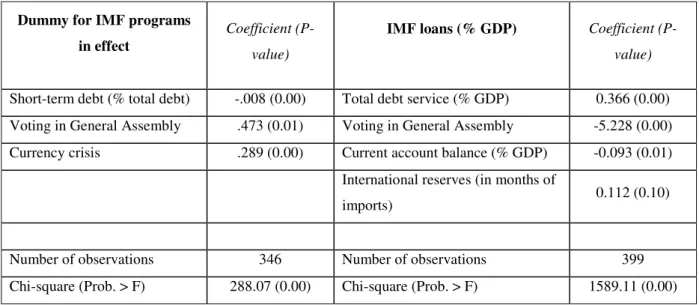
Table 1. Instruments for IMF programs and IMF loans (GLS, 98 countries, 1970-2000)
Dummy for IMF programs in effect
Coefficient (P-value)
IMF loans (% GDP) Coefficient (P-value)
Short-term debt (% total debt) -.008 (0.00) Total debt service (% GDP) 0.366 (0.00)
Voting in General Assembly .473 (0.01) Voting in General Assembly -5.228 (0.00)
Currency crisis .289 (0.00) Current account balance (% GDP) -0.093 (0.01)
International reserves (in months of
imports) 0.112 (0.10)
Number of observations 346 Number of observations 399
Chi-square (Prob. > F) 288.07 (0.00) Chi-square (Prob. > F) 1589.11 (0.00)
Dummies are included for each country
As can be read in table 1, three significant predictors for IMF programs10 remain. Voting in
line with the G7 in the UN General Assembly and the occurrence of a currency crisis both increase the likelihood of program participation. Those results are as expected; a currency crisis increases demand, while voting in line with the G7 is likely to increase the availability of IMF programs (as described above). A higher short term debt is likely to reduce IMF supply (Dreher and Vaubel 2004), so all signs are pointing in the right direction.
In the regression explaining IMF credit, total debt service has the expected positive sign as a higher debt service increases demand for IMF loans. A better current account balance decreases the size of IMF loans, possibly through lower demand. Bigger international reserves increase IMF supply, as this reduces the risk that a country can not pay back its loans.
10
IMF programs include all types of IMF programs, whereas Dreher (2006) only included Stand-By and EFF arrangements. His reasons for this included the (lack of) availability of compliance-data, which is of no concern in this study. Additionally, our data on IMF loans as percentage of GDP includes all types of IMF loans.
15 The most surprising result is the coefficient on voting in line with the G7, which is significantly negative. Thus, where the hypothesis was that closer allies of the G7 receive both more programs and larger loans, it appears that they receive more programs but smaller loans relative to GDP. This is a result that deserves some attention, as in both regressions the G7-variable has a large explanatory power. A possible explanation is that countries voting in line with the G7 are economically more developed than those that don't11; in that case they are
considered more trustworthy by the IMF (so that they have easier access to IMF programs), but they need less money (so that they get smaller loans). A second, easier, explanation might be the (on average) higher GDP of the in line-voting countries. When splitting up our sample in two groups, one that scores below the mean with respect to voting in line in the General Assembly and one that scores above, the average GDP of the second group is roughly 2.5 times as big as that of the first group. If the size of loans does not increase proportionally with GDP 12 this can also explain the negative coefficient.
3.5 Econometric Methods
The methods employed largely follow Dreher (2006). First, the equations explaining the Theil- and Gini coefficients will be estimated using Seemingly Unrelated Regressions (SUR). This takes the information from the equations explaining IMF-program participation and the size of IMF loans (table 1) into account. This method is consistent and more efficient than OLS (Dreher, 2006).
To account for the likely endogeneity problem the SUR analysis is replicated using the instrumental variables for IMF variables derived in section 4.2. The estimation is performed using three-stage least squares (3SLS). The use of 3SLS allows for different error variances in
11
An indication, though certainly not a proof, is that the correlation between voting in line and both GDP and GDP per capita is positive.
12
While GDP size has not been found significant in the regressions explaining the IMF variables, there is a negative correlation between GDP size and loans as a percentage of GDP.
16 each period and the correlation of these errors over time (Barro & Lee, 2005). It is consistent and in general more efficient as compared to two-stage least squares (Dreher, 2006).
Potential simultaneity arises in the case of one variable, financial development (M2/GDP), as this runs the risk of being affected by IMF programs and/or loans. For this reason M2/GDP is instrumented using its own lagged value.
4. Results: Effects of IMF Programs & Loans
In this section the effects of IMF involvement on respectively the Theil- and Gini-coefficient will be shown. For both the Theil- and Gini regressions three specifications of the model will be used: One including only a dummy for IMF program participation, one including only IMF credit as percentage of GDP and one including both variables simultaneously.
4.1 Results for the Theil-Coefficient
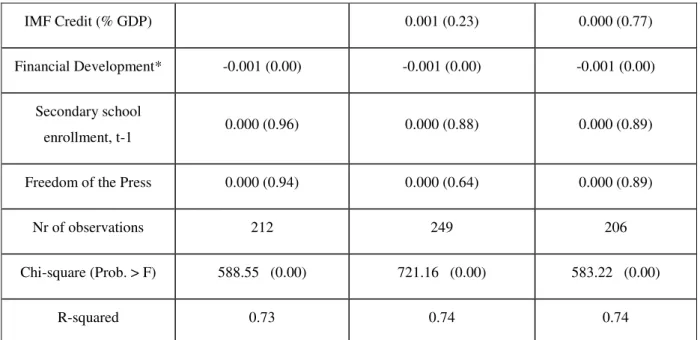
Table 2 shows the SUR-results for the Theil-coefficient. The coefficients might seem small, but it must be taken into account that the mean value of the Theil-coefficient is only 0.07 (standard deviation 0.05). Financial development significantly reduces inequality in all specifications; the other control variables are not significant. Due to the high explanatory power of especially the country dummies (in line with the results derived by Li et al), the R-squared is still reasonably large.
Table 2. Regressions for Theil-coefficients, SUR (p-values in parentheses),
(1) (2) (3)
17 IMF Credit (% GDP) 0.001 (0.23) 0.000 (0.77) Financial Development* -0.001 (0.00) -0.001 (0.00) -0.001 (0.00) Secondary school enrollment, t-1 0.000 (0.96) 0.000 (0.88) 0.000 (0.89)
Freedom of the Press 0.000 (0.94) 0.000 (0.64) 0.000 (0.89)
Nr of observations 212 249 206
Chi-square (Prob. > F) 588.55 (0.00) 721.16 (0.00) 583.22 (0.00)
R-squared 0.73 0.74 0.74
Regressions take the information from table 1 into account. Dummies are included for each country and time period. * instrumented using its own lagged value.
As to the IMF variables, participating in an IMF program significantly increases inequality in both the first and third specification. The loans supplied by the IMF do not affect inequality in any of the specifications.
In table 3, the IMF variables are instrumented using the variables from table 1. All instruments are jointly significant in explaining the IMF variables and pass the Sargan test, conducted to ensure that the instruments are uncorrelated with the error term. The results for the control variables do not change, with financial development still being the only significant one. IMF programs still significantly increase industrial pay-inequality at the 5% level. Moreover, the coefficient has become three times as big. IMF loans themselves still do not have any effect.
Table 3 . Regressions for Theil-coefficients, IMF variables instrumented, 3SLS (p-values in
parentheses)
18 IMF Program 0.058 (0.02) 0.056 (0.05) IMF Credit (% GDP) 0.003 (0.28) 0.001 (0.62) Financial Development* -0.001 (0.04) -0.001 (0.00) -0.002 (0.00) Secondary school enrollment, t-1 0.000 (0.86) 0.000 (0.84) 0.000 (0.87)
Freedom of the Press 0.000 (0.99) 0.000 (0.67) 0.000 (0.82)
Nr of observations 212 249 206
Chi-square (Prob. >F) 529.25 (0.00) 2572.94 (0.00) 533.49 (0.00)
Joint significance of
instruments (Prob. > F) 0.00 0.00
Sargan test (Prob. >F) 0.19 0.21
R-squared 0.69 0.73 0.69
Dummies are included for each country and time period (results not reported). IMF variables are instrumented using the regressions in table 1: IMF Program is instrumented with short-term debt as percentage of total debt, voting in the General Assembly and a dummy for currency crises. IMF Credit
is instrumented with total debt as percentage of GDP, voting in the General Assembly, the current account balance in percentage of GDP and the international reserves in months of imports. * instrumented using its own lagged value.
4.2 Results for the Gini-Index
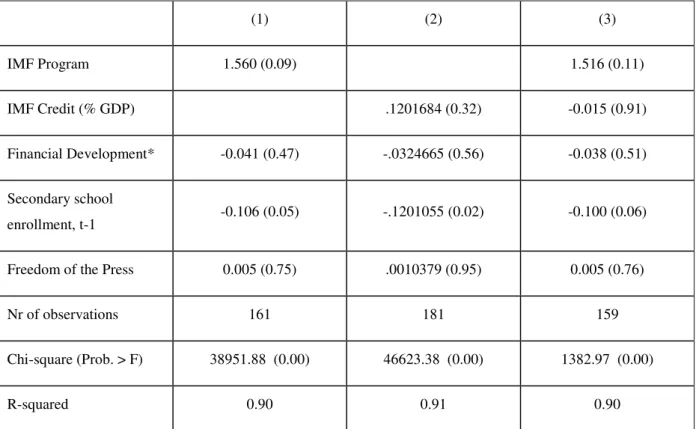
The results from the SUR regression for the Gini-index are displayed in table 4. Contrary to the results for the Theil-coefficient, secondary school enrollment is a significant predictor of inequality in all specifications, while financial development is not significant even at the 10% level.
19 The coefficient on IMF programs is positive and significant at the 10% level in the first specification, and positive and just not significant in the last. IMF loans again never are significant.
Table 4. Regressions for Gini-coefficients, SUR (p-values in parentheses)
(1) (2) (3) IMF Program 1.560 (0.09) 1.516 (0.11) IMF Credit (% GDP) .1201684 (0.32) -0.015 (0.91) Financial Development* -0.041 (0.47) -.0324665 (0.56) -0.038 (0.51) Secondary school enrollment, t-1 -0.106 (0.05) -.1201055 (0.02) -0.100 (0.06)
Freedom of the Press 0.005 (0.75) .0010379 (0.95) 0.005 (0.76)
Nr of observations 161 181 159
Chi-square (Prob. > F) 38951.88 (0.00) 46623.38 (0.00) 1382.97 (0.00)
R-squared 0.90 0.91 0.90
Regressions take the information from table 1 into account. Dummies are included for each country and time period. * instrumented using its own lagged value.
When using instruments for the IMF variables the signs of the control variables do not change, though secondary school enrollment looses significance in the last specification.
The results for the IMF variables are however much stronger here. IMF program participation has a large and significant negative effect on the income distribution. When included on their own IMF loans have a positive effect, though only significant at a (hypothetical) 20% level.
20 When programs and loans are included simultaneously, both are significant at the 5% level. Moreover, both the positive and the negative coefficient become stronger, indicating a negative role for IMF programs but a mitigating role for the money disbursed. The fact that the size of loans does not have a mitigating effect on the Theil-coefficient of industrial pay-inequality while it does have this effect on the Gini deserves some more attention. The crucial difference between this Theil-coefficient and the Gini-index is that the former only includes working people, while the latter includes everyone, including those on welfare. From the results presented in table 5 it thus appears that governments use IMF money for policies which mitigate the effect of IMF programs. This result is in line with Dreher and Vaubel, 2004, who found that countries with higher IMF loans follow a more expansionary economic policy.
The third specification also provides an interesting illustration of the 'net effect' of resorting to the IMF. As an example we can (using mean values) compare a country with an 'average' use of IMF programs and loans with a country not resorting to the IMF at all. The mean program duration is 1.5 year, the median loan is equal to 2.5 % of GDP. This IMF program increases the Gini by 2.60 points. The size of the loan lowers the Gini by 2.1 points, leaving a negative net effect on inequality of 0.5 point.
Table 5. Regressions for Gini-coefficients, IMF variables instrumented, 3SLS (p-values in
21 (1) (2) (3) IMF Program 5.418 (0.07) 9.072 (0.01) IMF Credit (% GDP) -.348 (0.16) -0.826 (0.01) Financial Development* -0.039 (0.50) -.015 (0.78) -0.006 (0.92) Secondary school enrollment, t-1 -0.096 (0.08) -.122 (0.01) -0.082 (0.14)
Freedom of the Press 0.007 (0.69) -.001(0.97) 0.006 (0.70)
Nr of observations 161 181 159
Chi-square (Prob. >F) 1236.29 (0.00) 1550.68 (0.00) 24821.03 (0.00)
Joint significance of
instruments (Prob. > F) 0.00 0.00
Sargan test (Prob. >F) 0.25 0.26
R-squared 0.88 0.89 0.83
Dummies are included for each country and time period (results not reported). IMF variables are instrumented using the regressions in table 1: IMF Program is instrumented with short-term debt as percentage of total debt, voting in the General Assembly and a dummy for currency crises. IMF Credit
is instrumented with total debt as percentage of GDP, voting in the General Assembly, the current account balance in percentage of GDP and the international reserves in months of imports. * instrumented using its own lagged value.
22
Summary and Conclusion
This paper raised the question whether it is the case that, besides restraining growth, IMF programs also harm the distribution of income. Sadly, the answer to this question is affirmative. Hence, IMF involvement not only reduces the size of the pie, but also causes it to be split in a more unequal way. It is regretful that not even the trade-off between efficiency and equity, usually postulated in economics, seems to exist. This result is confirmed, and becomes even stronger, when using instrumental variables to account for non-random selection.
The negative result for IMF programs is in line with the literature.13 Being the only
paper besides Vreeland (2002) to use regression based modeling to account for the selection problem, this study included two novelties: Firstly, it distinguished between IMF programs as a whole and the size of IMF loans, in order to filter out the effect of different policy instruments involved in an IMF program. Secondly, it used both a measure of personal income inequality and a measure for industrial pay-inequality.
From this some interesting conclusions can be derived. Firstly, in all specifications of the model, using instrumental variables or not, IMF programs significantly increase inequality. Earlier papers finding similar results found forced reductions in government deficits, currency devaluations, changes in growth & inflation rates (see Garuda, 2000) and trade liberalisation (see Vreeland, 2002) as possible explanations for this adverse effect.
Secondly, generally speaking, it is the presence of an IMF program, not the size of the loan that matters. To be more precise, the size of the loan never has a negative influence.
When using instrumental variables, it appears that bigger IMF loans actually have a
13
A recent conference paper by Valerie Frey and Ethan Siller seems to arrive at a different conclusion with regard to the effect of IMF conditionality on inequality. However, at this moment only the abstract is publicly available, which makes it impossible to compare results and methodology in more detail.
23 mitigating effect on the Gini-index. On industrial pay-inequality IMF loans do not have any significant influence.
Of course, not finding any econometric influence does not necessarily mean that there is none. However, at the very least, it appears that IMF loans do more to mitigate general income inequality than they do to reduce industrial pay-inequality. Combining this with the finding that larger IMF loans lead to a more expansionary economic policy (Dreher and Vaubel, 2004) provides an indication of possible use of IMF money to improve for example welfare programs.
This is however not enough to offset the negative impact of IMF programs. As programs consist of loans, policy advice and policy conditions, it is a reasonably devastating result that after controlling for the loans, programs have such a negative impact on the distribution of income. One of the problems certainly is that economic models are based on assumptions about functioning markets, which do not exist in many developing countries. The IMF itself realizes that institutions play an important role for understanding developing countries (see Evans and Finnemore 2001). And the IMF’s task is not easy. If it only gives the money without conditionality, loans risk to disappear in the pockets of corrupt politicians or civil servants. If it sets conditions stemming from developed country models, these will be inappropriate. However, if the IMF is serious about its ambitions in the areas of poverty and inequality, its policy of conditionality still is in need of a very careful review. And the findings of our study suggest that as long as no better solutions can be found, more freedom should be left to developing countries when organizing their economies.
24
Appendix A - Data Description
Five year averages are used of all variables
IMF program (based on Dreher, 2006). Dummy that equals one if an IMF program has been
in effect for at least five months in a specific year
Use of IMF credit, percentage of GDP (World Bank, World Development Indicators 2003).
Use of IMF credit denotes repurchase obligations to the IMF for all uses of IMF resources (excluding those resulting from drawings on the reserve tranche). These obligations comprise purchases outstanding under the credit tranches, including enlarged access resources, and all special facilities (the buffer stock, compensatory financing, extended fund, and oil facilities), trust fund loans, and operations under the structural adjustment and enhanced structural adjustment facilities.
Short-term debt, percentage of total external debt (World Bank, World Development
Indicators 2003). Short-term debt includes all debt having an original maturity of one year or less and interest in arrears on long-term debt.
Total debt service (% GDP) (World Bank, World Development Indicators 2003). Total debt
service is the sum of principal repayments and interest actually paid in foreign currency, goods, or services on long-term debt, interest paid on short-term debt, and repayments (repurchases and charges) to the IMF.
25 The Gini index measures the extent to which the distribution of income among individuals or households within an economy deviates from a perfectly equal distribution. A Gini index of zero represents perfect equality, while an index of 100 implies perfect inequality. See section 4.2
Theil-index (University of Texas Inequality Project, University of Texas at Austin). Measure
for industrial pay-inequality between different sectors. See section 4.1
Voting in General Assembly (Dreher & Sturm, 2005) Dummy equaling 1 if the borrowing
country votes in line with the average of the G7 countries (weighted with their quota in the IMF), and 0 otherwise.
Financial Development (World Bank, World Development Indicators 2003). Proxied by
M2/GDP. Money and quasi money comprise the sum of currency outside banks, demand deposits other than those of the central government, and the time, savings, and foreign currency deposits of resident sectors other than the central government.
Secondary school enrolment, gross % (World Bank, World Development Indicators 2003).
The ratio of total enrollment, regardless of age, to the population of the age group that officially corresponds to secondary education. Secondary education completes the provision of basic education that began at the primary level.
Freedom of the Press, index (Freedom House, 2009) Countries scoring 0 to 30 are regarded as
26 description: http://freedomhouse.org/). Period 1979-92: Not free (100), Partly free/ not free (60), Partly free (45), Free/ Partly Free (30), Free (0).
International reserves (in months of imports) (World Bank, World Development Indicators
2003). Gross international reserves comprise holdings of monetary gold, special drawing rights, the reserve position of members in the International Monetary Fund (IMF), and holdings of foreign exchange under the control of monetary authorities. Reserves are expressed in terms of the number of months of imports of goods and services which could be paid for.
Current account balance, percentage of GDP (World Bank, World Development Indicators
2003). Current account balance is the sum of net exports of goods, services, net income, and net current transfers.
Currency crisis (Glick, Reuven; Michael Hutchinson: Banking Crises: How Common are
Twins? and Caprio, Gerard; Daniela Klingebiel: Episodes of Systemic and Borderline Financial Crises). Dummy equaling 1 if there has been a currency crisis in the year specified and 0 otherwise.
27
Appendix B - Summary Statistics
Variable Nr. of observations Mean Standard deviation
IMF Program 588 .29 0.35
Use of IMF credit (%
GDP) 482 2.55 4.56
Gini-index 263 41.61 19.67
Theil-index 388 0.07 0.40
Short-term debt (% of
total debt) 484 13.8 12.05
Total debt service (%
GDP) 473 5.32 4.08 Voting in General Assembly 550 0.35 0.11 Currency crisis 381 0.12 0.20 Financial Development 523 34.44 23.02 Secondary school enrollment 552 47.00 28.63
Freedom of the Press,
index 450 54.09 31.15
International reserves (in
months of imports) 465 3.427 2.885
Current account balance 459 -3.89 7.94
Appendix C – Regressions explaining Gini- and Theil-coefficients
Table 6. Regressions for Gini- & Theil-coefficients, GLS
Dependent variable: Gini Dependent variable: Theil
Financial Development 0.0489 (0.03) Financial Development -0.0006 (0.01)
Secondary school
enrollment, t-1 -0.1535 (0.00)
Secondary school
enrollment, t-1 -0.0008 (0.00)
Freedom of the Press -0.0021 (0.88) Freedom of the Press 0.0001 (0.45)
Nr of observations 185 Nr of observations 282
Chi-square (Prob. >F) 2353.05 (0.00) Chi-square (Prob. >F) 1077.14 (0.00)
28
Appendix D - Countries included in the analysis
Albania Algeria Argentina Bahamas Bahrain Bangladesh Barbados Belize Benin Bolivia Botswana Brazil Bulgaria Burundi Cameroon Central Africa Chad Chile China Colombia Congo, Dem Congo, Rep Costa Rica Cote d'Ivo Croatia Cyprus Czech Repu Dominican Ecuador Egypt, Ara El Salvado Estonia Fiji Gabon Ghana Guatemala Guinea-Bis Guyana Haiti Honduras Hungary India Indonesia Iran, Isla Israel Jamaica Jordan Kenya Korea, Rep Kuwait Latvia Lithuania Madagascar Malawi Malaysia
Mali Malta Mauritius Mexico Morocco
Myanmar Namibia Nepal Nicaragua Niger Nigeria Oman Pakistan Panama Papua New Paraguay Peru Philippine Romania Russian Fe Rwanda Saudi Arab Senegal Sierra Leo Singapore Slovak Rep Slovenia South Africa Sri Lanka Syria Tanzania Thailand Togo Trinidad Tunisia Turkey Uganda Ukraine United Ara Uruguay Venezuela, Zambia Zimbabwe
29
Bibliography
Abdalla. Ismail-Sabri (1980),The inadequacy and loss of legltimacv of the International Monetarv Fund, Dkelopment Dialogue. Vol. 2. (1980), pi. 25-53.
Atkinson, A. (2008). ‘Policy can counter inequality’. Interview with Professor Anthony Atkinson, Intervention. European Journal of Economics and Economic Policies,Volume5,
issue 1, pp. 9-11
Barro R.J. and J. Lee (2005). IMF programs: Who is chosen and what are the effects?,
Journal of Monetary Economics 52, pp. 1245–1269
Barr, N. (2004). Economics of the Welfare State, Oxford: Oxford University Press
Brakman, S., H. Garretsen. C. van Marrewijk & A. van Witteloostuijn (2006). Nations and
Firms in the Global Economy, Cambridge UK: Cambridge University Press
Caritas (2003), Ozspirit:World Bank, IMF, WTO, what the….Caritas and Church Resources
http://www.catholicaustralia.com.au/page.php?pg=mission-poverty6
Development Gap (1998), IMF Programs Increase Poverty, Unemployment and Inequality in Latin America, Reflecting Worldwide Impact, The Development Group for Alternative Policies, retrieved on 05-06-2009 from
30 Dreher, A., & Vaubel, R. (2004). Do IMF and IBRD cause moral hazard and political
business cycles? Evidence from panel data. OpenEconomies Review, 15(1), pp. 5–22.
Dreher, A. (2006). IMF and Economic Growth: The Effects of Programs, Loans, and Compliance with Conditionality, World Development Vol. 34, No. 5, pp. 769–788
Dreher, A. and S. Walter (2009) Does the IMF Help or Hurt? The Effect of IMF Programs on the Likelihood and Outcome of Currency Crises, World Developmen still to be placedt.
Evans, Peter and Martha Finnemore (2001), Organizational Reform and the Expansion of the South’s Voice at the Fund, G-24 discussion paper series, no 15, United Nations, New York
http://www.sog-rc27.org/Paper/DC/Finnemore.rtf
Frey, V. A. and E. Siller. "The Distributional Consequences of Participation in IMF Programs" Paper presented at the annual meeting of the Midwest Political Science
Association 67th Annual National Conference, The Palmer House Hilton, Chicago, 22-05-2009
Galbright, J.K. (2007). Global Inequality and Global Macro Economics, in D. Held & A. Kaya, Global Inequality, Cambridge UK: Polity Press
Garuda, G. (2000). The Distributional Effects of IMF Programs: A Cross-Country Analysis,
31 Global Exchange (2005), Top Ten Reasons to Oppose the IMF, in Global Exchange, 2005.
Internet: Global Exchange website
Gould, E. (2003). Money Talks: Supplementary Financiers and International Monetary Fund Conditionality, International Organization 57 (3), pp. 551-586
Hale, T. (2003). The Theoretical Basics of Popular Inequality Measures, University of Texas
Inequality Project, retrieved from http://utip.gov.utexas.edu on 10-06-2009
S. Handa and D. King (1997), Structural adjustment policies, income distribution and poverty: a review of the Jamaican experience. World Development25 (1997), pp. 915–930
International Monetary Fund (2009). Lending by the IMF, retrieved from
http://www.imf.org/external/about/lending.htm on 03-05-2009
Krugman, P. R. (1979). "Increasing Returns, Monopolistic Competition, and International Trade", Journal of International Economics, November 1979, Vol. 9, No. 4, pp. 469-479.
(ABS)
(P) Krugman, P. and A. Venables (1995) "Globalization and the Inequality of Nations",
Quarterly Journal of Economics, Vol. 110, 1995, pp. 857-880.
Li, H., L. Squire & H. Zou (1998). Explaining International and Intertemporal Variations in Income Inequality, The Economic Journal, Vol. 108, No. 446, pp. 26-43
32 Oxfam (2007). Oxfam calls on new IMF chief to set the tone on urgent reform. Retrieved
from http://www.oxfam.org/en/node/216 on 04-06-2009
Pastor, M. (1987). The effects of IMF programs in the third world: debate and evidence from Latin America, World Development 15 (February), pp. 249–262
Polak, J. J. (1991). The changing nature of IMF conditionality. Princeton Essays in
International Finance No. 84, Princeton NJ: Princeton University
Polak, Jacques. 1997. “The IMF Monetary Model: A Hardy Perennial.” Finance and
Development, December, pp.16-19.
Przeworski, A. & J.R.Vreeland (2000). The effect of IMF programs on economic growth,
Journal of Development Economics 62, pp. 385–421
Unger, B. and F. van Waarden (1995) (eds). Convergence or Diversity, Edward Elgar,
Avebury
Unger, B. and M. Siegel (2006), Workers Remittances: The Netherlands Suriname Corridor, World Bank 2006
Vreeland, J.R. (2002). The effect of IMF programs on labor, World Development 30, pp.
121-39
Vreeland, J.R. (2004). The International and Domestic Politics of IMF Programs, Paper
33
conference on The Fund’s Role in Emerging Markets: Reassessing the Adequacy of its
Resources and Lending Facilities. Amsterdam, November 18-19, 2004, De Nederlandsche
Bank, Westeinde 1.
Weil, D.N. ( 2005). Economic Growth, Boston: Pearson Education/Addison-Wesley
Wooldridge, J. M. (2002). Econometric Analysis of Cross Section and Panel Data,
Cambridge, MA: MIT Press.
Wooldridge, J.M. (2006). Introductory Econometrics - A Modern Approach, Mason: